


Below is the uncorrected machine-read text of this chapter, intended to provide our own search engines and external engines with highly rich, chapter-representative searchable text of each book. Because it is UNCORRECTED material, please consider the following text as a useful but insufficient proxy for the authoritative book pages.
For-Profit Enterprise in Health Care Committee on Implications of For-Profit Enterprise in Health Care INSTITUTE OF MEDICINE Bradford H. Gray, Ph.D., editor NATIONAL ACADEMY PRESS Washington, D.C. 1986
National Academy Press · 2101 Constitution Avenue, NW · Washington, DC 20418 NOTICE: The project that is the subject of this report was approved by the Governing Board of the National Research Council, whose members are drawn from the councils of the National Academy of Sciences, the National Academy of Engineering, and the Institute of Medicine. The members of the committee responsible for the report were chosen for their special competences and with regard for appropriate balance. This report has been reviewed by a group other than the authors according to the procedures approved by a Report Review Committee consisting of members of the National Academy of Sciences, the National Academy of Engineering, and the Institute of Medicine. The Institute of Medicine was chartered in 1970 by the National Academy of Sciences to enlist distinguished members of the appropriate professions in the examination of policy matters pertaining to the health of the public. In this, the Institute acts under both the Academy's 1863 congressional charter responsibility to be an adviser to the federal government and its own initiative in identifying issues of medical care, research, and education. Library of Congress Cataloging in Publication Data For-prof~t enterprise in health care. Bibliography: p. Includes index. 1. Medical economics. 2. Health facilities. Proprietary. 3. Medical corporations. I. Institute of Medicine (U.S.~. Committee on Implications of For- Profit Enterprise in Health Care. [DNLM: 1. Health Facilities-United States. WX 27 AA1 F6] RA410.5.F67 1986 362.1'1'0681 86-854 ISBN 0-309-03643-7 Copynght ~ 1986 by the National Academy of Sciences No part of this book may be reproduced by any mechanical, photographic, or electronic process, or in the form of a phonographic recording, nor may it be stored in a retrieval system, transmitted or otherwise copied for public or private use, without written permission from the publisher, except for the purposes of official use by the United States government. First Punting, May 1986 Second Prindug, July 1987 Printed in the United States of America
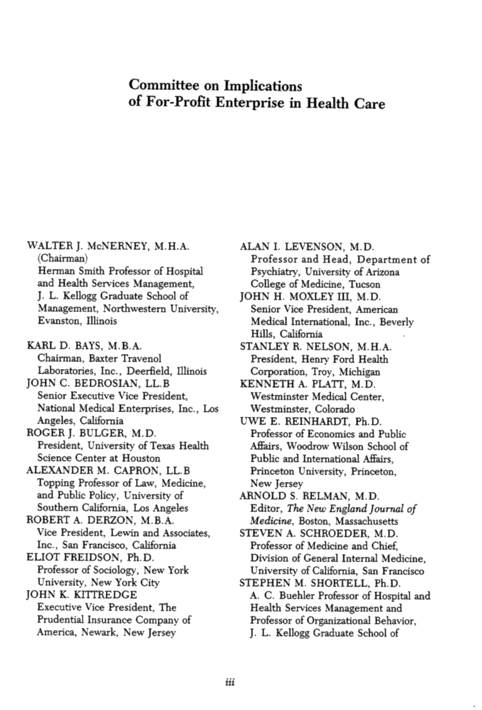
Committee on Implications of For-Profit Enterprise in Health Care WALTER I. McNERNEY, M. H.A. (Chairman) Herman Smith Professor of Hospital and Health Services Management, J. L. Kellogg Graduate School of Management, Northwestern University, Evanston, Illinois KARL D. BAYS, M. B. A. Chairman, Baxter TravenoT Laboratories, Inc., Deerfield, Illinois JOlIN C. BEDROSIAN, LL.B Senior Executive Vice President, National Medical Enterprises, Inc., Los Angeles, California ROGER J. BULGER, M.D. President, University of Texas Health Science Center at Houston ALEXANDER M. CAPRON, LL.B Topping Professor of Law, Medicine, and Public Policy, University of Southern California, Los Angeles ROBERT A. DERZON, M. B.A. Vice President, Lewan and Associates, Inc., San Francisco, California ELIOT FREIDSON, Ph. D. Professor of Sociology, New York University, New York City JOHN K. KI11REDGE Executive Vice President, The Prudential Insurance Company of America, Newark, New Jersey . . . ALAN I. LEVENSON, M.D. Professor and Head, Department of Psychiatry, University of Arizona College of Medicine, Tucson JOHN H. MOXLEY III, M.D. Senior Vice President, American Medical International, Inc., Beverly Hills, California STANLEY R. NELSON, M. H.A. President, Henry Ford Health Corporation, Troy, Michigan KENNETH A. PLAIT, M.D. Westminster Medical Center, Westminster, Colorado UWE E REINHARDT, Ph. D. Professor of Economics and Public Affairs, Woodrow Wilson School of Public and International Affairs, Princeton University, Princeton, New Jersey ARNOLD S. RELMAN, M.D. Editor, The New England Journal of Medicine, Boston, Massachusetts STEVEN A. SCHROEDER, M.D. Professor of Medicine and Chief, Division of General Internal Medicine, University of California, San Francisco STEPHEN M. SHORTELL, Ph. D. A. C. Buehier Professor of Hospital and Health Services Management and Professor of Organizational Behavior, J. L. Kellogg Graduate School of
Management, Northwestern University, Evanston, Illinois KATHARINE BAUER SOMMERS Scholar-in-Residence, Institute of Medicine, Washington, D.C. ROSEMARY STEVENS, Ph.D. Professor of History and Sociology of Science, University of Pennsylvania, Philadelphia JAMES S. TODD, M.D. Senior Deputy Executive Vice President, American Medical Association, Chicago, Illinois JAMES WALLACE, C.P.A. Partner, Arthur Andersen and Company, Washington, D.C. DONALD C. WEGMILLER, M.H.A. President and Chief Executive Officer, The Health Central System, Minneapolis, Minnesota DANIEL WIKLER, Ph. D. Professor of Bioethics, University of Wisconsin School of Medicine, Madison Study Stab Bradford H. Gray (Study Director) Committee on Implications of For-Profit Enterprise in Health Care Karl D. Yordy, Director Division of Health Care Services Jessica Townsend, Staff Officer Division of Health Care Services Sunny G. Yoder, Staff Officer Division of Health Care Services Wallace K. Waterfall, Editor Institute of Medicine V
Contend Preface W alter J. M cN er7uey Acknowledgments .. .. Introduction to the Volume B rac~ford H. G ray ...... Part ~ COMMIT 1hE REPORT 1. Profits and Health Care: An Introduction to the Issues .................................................... APPENDIX: Economic Theories of For-Profit and Not-for-Profit Orgaruzations S u n nil G. Yocler .............................................................. 2. Changes in He Ownership, Control, and Configuration of Health Care Services .................................... 3. Financial Capital and Health Care Growth Trends APPENDIX: The Nature of Equity Financing U w e R einhuzrdk ........................................................... 4. Investor Ownership arid He Costs of Medical Care 5. Access to Care and Investor-Owned Providers APPENDIX: Data on Hospital Services and Facilities 6. Quality of Care IX , xiii · . XV11 19 26 47 ........ 67 ......... 74 97 ..... 121 , . ~ ~ - . - 7. Implications for Education and Research v 127 .......... 142
vi S. Physicians and Entrepreneurism in Health Care 9. The Changing Nature of Physician Influence in Medical Institutions ........................................... 10. Summary arid Conclusions ..................... SuculementarY Statement on For-Profit Enterorise in Health Care CONTENTS , 151 ..................... 171 ......... IS2 ~ ^, ., ~ Alexander M. Capron, Eliot Freidson, Arrows. Relman, Steven A. Schroeder, Katharine Bauer Sommers, Rosemary Stevens, an3DanielWikler 205 Part II PAPERS ON FOR-PROFIT ENTERPRISE IN HEALTH CARE I. An Exchange on For-Profit Heath Care Arnold S. Relman and Uwe Reinhardt 2. Ethical Issues in For-Profit Health Care Dan W. Brock and Allen Buchanan . . 3. Trends in the Growth of He Major Investor-Owned Hospital Companies Elizabeth W. Hog and Bradfor3H. Gray 4. The Effects of Ownership and Muldhospital System Membership on Hospital Functional Strategies and Economic Performance 209 J. Michael Watt, Steven C. Renn,James S. Hahn, Robert A. Demon, and CarlJ. Schramm................................................ 5. Response to Financial Incentives Among Investor-Owned and Not-for-Profit Hospitals: An Analysis Based on Califomia Data, 1978-1982 Robert V. Patt&son .............................................. 6. Hospital Acquisitions and Their Effects: Florida, 1979-1982 Kathryn]. Brown and Richard E. KJostennan 7. Hospital Ownership and Comparative Hospital Costs Crayg G. Coelen ............................................. ................. 260 , · - - ~ - ~ - . ~ ..... ... 290 ................................ 303 .................... 322
CONTENTS S. Medicare Patient Outcomes and Hospital Organizational Mission Gary Gaumer ................................................. 9. Compliance of Multihospit~ Systems with Standards of the Joint Commission on Accreditation of Hospitals Daniel R. Longo, Gary A. Chase, Lynn A. Ahigren, James S. Roberts, and Carol S. Wersn~an ............................................................... 10. Hospital Ownership end the Practice of Medicine: Evidence Mom He Physician's Perspective Robert A. Musacchio, Stephen Zuckerman, Lynn E. Jensen, and Larry Freshnock ................................................................. Il. Physician Participation in the Administration and Governance of System and Freestanding Hospitals: A Comparison by Type of Ownership Jeffrey A. Alexander, MichaelA. Morrisey, and Stephen M. Shortell 12. Medical Self Size, Hospital Privileges, and Compensation Arrangements: A Companson of System Hospitals MichaelA. Morrisey, Jeff:reyA. Alexander, and Stephen M. Shortell 13. Hospitals and Heir Communities: A Report on Free Case Studies Jessica To~vmer~1 ................................................................ 14. Investor-Owned Muldhospital Systems: A Synthesis of Research Findings Dan Er7ruznn andJon Gabel .................................................... 15. The Changing Structure ofthe Nursing Home Industry and the Impact of Ownership on Quality, Cost, and Access Catherine Hawes and Charles D. Phillips ........ Index ........... vii 354 375 385 402 422 458 474 492 543
Preface For-Profit Enterprise in Health Care was stimulated by concerns among members of the Institute of Medicine (IOM) and others that health services already heavily dependent on monetary transactions through prepayment and insurance will be- come excessively commercialized, with growing ownership by stockholders. The issues closely associated with these concerns are examined in depth in this report, against a background of such broad public policy challenges as how to balance social justice and efficiency and to what degree regulation or competition can be relied on to strike the proper balance. In my view, this report makes clear that type of ownership is an important variable affecting the entire health care system delivery and financing institutions alike. And ~ believe that it wiD become even more important as competition among health institutions increases and services are paid for increasingly on a prospective or incentive basis. Indeed, it is an issue that will require close attention by regulators and informed buyers in both the public and private sectors. In this context, special attention must be given systemwide to such key outcomes as cost, access, quality, and equity, as wed as to the viability of research and educational programs. With regard to the broad public policy challenges, opinions differ as to the degree to which the market can be trusted to allocate limited resources; but in my view, there can be little doubt that the market alone cannot be trusted and that it must be buttressed by enlightened public policy beyond what is seen today and by a clearer commitment to excellence among professionals. In a sense, little is new for those who have watched the health field evolve for the past forty years. The same underlying public issues enlivened the debates when, for instance, Medicare (1965), Medicaid (1965), and the National Health Planning and Resources Development Act of 1974 were enacted. But today, these issues are seen across a broader spectrum as market forces have been unleashed in such commercial areas as banking and transportation as well as in education and wel- fare- by a federal government that sees greater use of the private sector and the sale of government assets as an effective, philosophically right way to reduce budget deficits. This may be viewed, alternately, as pruning the excesses of the Great Society or as dismantling the New Deal legacy. At the grass roots level, we may ax
x PREFACE be seeing a new conception of what is properly public or private in mature markets and what is taxable. In recent months, a series of incidents have arisen that suggest we are undergoing a major reappraisal of our health institutions. For example, the House Ways and Means Committee has acted to strip the nation's 85 Blue Cross and Blue Shield plans of their tax-exempt status, a matter still being debated in Congress; proposals to reduce or eliminate tax-exempt debt financing for hospitals are being seriously considered; five major not-for-profit teaching hospitals in New York City recently signed a preliminary agreement with Maxicare Health Plans, Inc., to plan the city's first for-profit health maintenance organization; and the Utah Supreme Court cre- ated a test that not-for-profit hospitals in the calm mart neck tm o.oim I; from county property taxes. The context within which this report is issued is clearly undergoing remarkable change, and many of the underlying changes in values are having a substantive impact on services well beyond the health field. The question of ownership of health institutions per se is timely and of major consequence because it has refocused our attention on effectiveness after a period of preoccupation with cost containment; on our commitment to the underserved; and on the fi~ndamental significance of education and research. The study was a challenge. The facts bearing on the issues are limited, and, in a health care system in which rapid change is pervasive, differences in institutions of different ownership are blurring. Thus, the study committee had to exercise considerable judgment in framing the issues and the conclusions. It was helped significantly by a valuable group of commissioned research papers, three case stud- ies, anti a public meeting at which testimony was received Tom many knowledgeable individuals speaking either on their own behalf or on behalf of their organizations. Furthermore, the study committee, by design, offered diverse shIls, experiences, and points of view. Members varied widely in terms of their orientation to the changes that have been taking place in the health care system, their willingness to accept nonquantitative evidence as valid, and their beliefs about the likely course of events (for example, whether investor-owned institutions will achieve dominant market position or peak short of this). These differences enriched and enlivened the committee process, but nevertheless, a high degree of general agreement was reached. It should be noted that a statement, termed "supplementary" by com- mittee members who signed it, appears at the end of the report, adding emphasis or different interpretations to some of the points made therein. In our examination of the characteristics and influences of investor versus not- for-profit ownership, it is tempting to focus on the potential results of further investor-owned initiatives. In my view, we should be equally concerned with the responses of the not-for-profit institutions to these initiatives, as well as to a ma- turing, inherently more competitive market in general. It is tempting to overlook the crucial role of government in all of this. Without enlightened public policy, the private sector cannot function effectively. Problems such as we face with the un- derserved, for example, cannot be resolved on a community-wide basis absent _ ~ ~-v ~w^~ LlV11 at.
PREFACE Xt adequate protection for the poor and selective regulation bearing on the quality of the services they receive. If this report were to avert our attention from this fiun- damental fact, it would have failed. The committee's concerns with public policy deserve careful note. Similarly, because most available data have been derived from institutions, prin- cipally hospitals, it is possible to overlook important committee observations and recommendations on the practicing physician, who in many ways sets the tone for all sectors and who, in a competitive environment, faces an increasing number of potential conflicts between his or her fiduciary responsibilities to the patient and more entrepreneurial opportunities. Concerns expressed in this regard certainly need to be addressed. Finally, the report should be viewed as a benchmark and not the final answer to the issues addressed. Its essence lies in an illumination of the issues, not in their resolution. As the health field matures and grows more slowly and as territory becomes more precious, increased competition wiD put many of the quality and service issues to test against a background of new institutions and relationships where our experience is limited. Given the speed of change in the environment and our unprecedented state of flux extraordinary in institutional terms we must accent accountability and Ally support vigilant monitoring of important outcomes involving costs, quality, access, and equity. Any report of this complexity demands a highly shIled staiT, and, characteristic of the Institute of Medicine's ability to attract first-rate scholarship, the staE work was indeed exceptional. ~ particularly want to thank Bradford H. Gray, who headed a fine team and who personally deserves credit for most of the organization and composition of a report that is by far the most comprehensive and insightful on the subject to date. Also, ~ should like to thank the members of the committee, all of whom expressed themselves openly and honestly throughout the study, and gave clear leadership to the staff. Because of the strength of the committee, the report should serve as an excellent resource of lasting value on an issue that, almost like no other, touches raw nerves in a field that is undergoing a major and troubling transition. WALTER J. MCNERNEY, Chairman Committee on Implications of For-Profit Enterprise in Health Care
Acknowl~nen~ The contributions of many individuals and organizations to the committee's work deserve acknowledgment. Major support for the study was provided by the Andrew W. Mellon and John A. Hartford Foundations of New York City; The Medical Trust, one of several charitable trusts established over the past thirty years by members of the Pew Family of Philadelphia; and the National Research Council (NRC) Fund. The NRC Fund is a pool of private, discretionary, nonfederal fiends that is used to support a program of Academy-initiated studies of national issues in which science and tech- nology figure significantly. The NRC fund consists of contributions from: a consor- tium of private foundations including the Carnegie Corporation of New York, the Charles E. CuIpeper Foundation, the William and Flora Hewlett Foundation, the John D. and Catherine T. MacArthur Foundation, the Andrew W. Mellon Foun- dation, the Rockefeller Foundation, and the Alfred P. Sloan Foundation; the Acad- emy Industry Program, which seeks annual contributions from companies that are concerned with the health of U.S. science and technology and with public policy issues with technological content; and the National Academy of Sciences and the National Academy of Engineering endowments. Supplemental financial assistance for the study was received from various health care corporations, nonprofit hospital organizations, and investment and accounting firms. These sponsors were American Medical International, Inc.; Arthur Andersen & Co.; Associated Health Systems (which has since merged with United Healthcare Systems, Inc., to become American Healthcare Systems); Charter Medical Cor- poration; Community Psychiatric Centers; Emst & Whinney; Hospital Corporation of America; Humana, Inc.; Kidder, Peabody & Co.; Multihospital Mutual Insur- ance, Ltd.; United Healthcare Systems, Inc.; and Voluntary Hospitals of America, Inc. Less-direct support was provided by several organizations. The James Irvine Foundation of San Francisco provided financial support to the Health Services Research Foundation for a study done at the committee's request by Robert Pattison, whose paper appears herein. The University of Texas Health Science Center at Houston provided support for the paper on ethics and for-profit health care by Dan xiii
xlv ACKNOWLEDGMENTS Brock and Allen Buchanan. The American Medical Association added several ques- tions of interest to the study committee to one of its periodic surveys of physicians. These and other data were analyzed in the paper prepared for the committee by Robert Musacchio, Stephen Zuckerman, Lynn E. Jensen, and Larry Freshnock. Costs associates] with the data analyses and papers prepared for the committee by staff members of the loins Commission on Accreditation of Hospitals and the Amer- ican Hospital Association's Hospital Research and Educational Trust were borne in total or in part by those organizations. Merlin K. DuVal, M. D., now president of the American Healthcare Institute, and Thomas Frist, Ir., M.D., Chief Executive Officer of the Hospital Corporation of America, were instrumental in obtaining financial support for the committee's work from the not-for-profit and for-profit health care sectors. The committee is particularly gratefid to all of the authors who prepared the papers appearing in this volume. It also wishes to thank the many researchers who shared unpublished work with the committee, including Frank Sloan, Diane Row- land, Karen Davis, Deborah Freund, Mark Hiller, Burton Weisbrod, Mark SchIes- inger, Jeffrey Alexander, Michael Morrisey, Stephen Shortell, Geri Dallek, Ruth Hanit, Richard EgdahI, Howard Veit, and Michael Watt and colleagues at Lewin and Associates. Frost and Sullivan, Inc., of New York, provided several of its major industry analyses, and Douglas Sherlock of Salomon Brothers, Seth Shaw of Shear- son Lehman/American Express, and Gerald Bisbee of Kidder, Peabody provided their periodic published evaluations of the investor-owned health care sector. The AHA s Center for Hospital Data, directed by Peter Kralovec re.cnond~A ~,irklv and expertly to numerous requests for data. The committee also expresses appreciation to four individuals who shared their expertise with it at a special meeting at Airlie House, Virginia, in 1984: Paul Ellwood of Interstudy, Henry Hansmann of Yale Law School, Clark Havighurst of Duke University, and Burton Weisbrod of the University of Wisconsin. Many other in- dividuals provided valuable data and/or consultation to the staff, including lack Hadiey and Judith Feder of the Georgetown University Center for Health Policy; Helen Darling of the Government Research Corporation; Alan Sager of Boston University School of Public Health; Michael Watt of Lewin and Associates; Samuel Mitchell of the Federation of American Hospitals; Steven Renn, The Johns Hopkins University; Ross MulIner, Steven Wood, and Deborah Freko Reczynski of the American Hospital Association; Philip Held of The Urban Institute; Brian Kinkead of Moody's Municipal Department; Donald Cohodes of Blue Cross; B. I. Anderson of the American Medical Association; Jeffrey L. Fielder of the AFL-CIO Food and Beverage Trades Department; Penelope Roeder of American Medical International; Peaches Blank of the Hospital Alliance of Tennessee; Lacy Maddox of the North Carolina Center for Public Policy Research; Brian Sperry and Karen Greider, then of the Texas Task Force on Indigent Health Care; Kristie ZamraziT of the Texas Hospital Association; George Annas of Boston University Law School; Howard Newman of Memel, Jacobs, Pierno anct Gersh; Robert Halper of O'Connor and Hannan; Myron Straf of the National Research Council's Committee on National , = _ _ ~ ~._.~,
ACKNOWLEDGMENTS XV Statistics; Phyllis Virgil and James Smith of the Hospital Corporation of America; Michael Stoto of Harvard School of Public Health; and Richard Knapp of the Amer- ican Association of Medical Colleges. Judith Miller Jones's inclusion of the com- mittee's staff in programs organized by the National Health Policy Forum was consistently valuable. The committee staff end committee members who served as site visitors-Jessica Townsend, Bradford Gray, Rosemary Stevens, Carleton Evans, Steven Schroeder, Katharine Sommers, Alan Levenson, and Daniel Wikler express particular ap- preciation to everyone who shared their time and knowledge in the committee's three case studies of communities and hospitals. The committee is most grateful to all of the individuals and organizations who made presentations at the committee's public meeting on March 15, 1984, and to Margaret A. McManus, who prepared an excellent summary of the meeting. The committee received testimony from the following: Quentin D. Young, President, Health and Medicine Policy Research Group, Chi cago, Illinois ~ am e s E . B ryan, m e dical j ournali s t Toby Edelman, Board Member, National Citizens' Coalition for Nursing Home Reform Paul R. WilIging, Executive Vice President, National Council of Health Centers Ran Coble, Executive Director, North Carolina Center for Public Policy Research, Inc. Edward E. Berger, Director of Planning and Project Development, National Med ical Care, Inc. Ruth Watson Lubic, General Director, Maternity Center Association Cecil G. Sheps, American Public Health Association Joseph C. Hutts, Jr., President, Hospital Corporation of America, West Robert M. Heyssel, Chairman, Association of American Medical Colleges Duira Ward, Board Member, National Home Caring Council Adele S. Hebb, President, Community Home Health Services of Philadelphia James F. Doherty, Executive Director, Group Health Association of America James Roberts, Executive Director, National Association of Freestanding Emer gency Centers I. Alexander McMahon, President, American Hospital Association Judith G. Waxm an, Managing Attorney, East Coast Office, National Health Law Program, Inc. William S. Hoffman, Acting Director, Social Security Department, United Auto Workers International Union Frank S. Swain, Chief Counsel for Advocacy, U. S. Small Business Administration Robert E. McGarrah, Jr., Director for Public Policy, American Federation of State, County, and Municipal Employees Stuart Wesbury, Jr., President, American College of Hospital Administrators Linda B. Miller, Executive Director, Volunteer Trustees of Not-for-Profit Hospitals Michael D. Bromberg, Executive Director, Federation of American Hospitals
xv! ACKNOWLEDGMENTS lames F. Davis, Vice Speaker, House of Delegates, American Medical Association Donald Arnwine, President, Voluntary Hospitals of America (written testimony) Leslye E. OrIoff, National Women's Health Network (written testimony) Finally, the contributions of the report's authors should be acknowledged. The study director, Bradford H. Gray, was the primary author of the report. Jessica Townsend drafted the chapters on changes in the ownership and control of health services (Chapter 2), the costs of care (Chapter 4), and access to care (Chapter 5), in addition to planning the site visits and writing the paper on the case studies that is included in this volume. Sunny Yoder revised the first draft of the education and research chapter (Chapter 7) and prepared the appendix to Chapter I. Committee member Uwe Reinhardt did much of the writing for Chapter 3, on financial capital. Elizabeth Hoy, a research assistant, prepared several tables based on American Hospital Association data and collaborated on the paper on the growth of the six major hospital management companies that is published herein.
In~ucdon to He Volume The growth of for-prof~t enterprise in health care has become a passionately debated phenomenon. Investor-owned companies, which have come about in just the past 20 years, have made a business of providing health services and achieved great size and diversity. The proliferation of these companies is but one manifes- tation of a broad trend toward more openly entrepreneurial activities in health care. A wave of such activities involving physicians is also taking place, and the changing relationship between physicians and institutions may have important implications for the doctor-patient relationship. Both fearfill and hopefid expectations have been expressed for these developments, but their policy implications have not heretofore been systematically examined. Ordinarily, in our predominantly capitalist society, it would be deemed odd to inquire into the implications of making a business of providing services or of making money from such a business. However, the services discussed here help people to keep or regain their health and can affect, at minimum, whether they are able to pursue their life goals, and, at maximum, whether they live or die. Many people see health care as the sort of public good that should be the right of aD citizens, but this view has never prevailed in public policy. Traditionally, health services have been provided primarily by not-for-profit in- stitutions and by professions whose codes of ethics disdained commercial practices and a commercial image. Until recently, health care was seldom thought of in terms of business or investment; medical institutions typically were rf,~arde,`1 a.s oharitahl~ o ~ _ _ _ or community service organizations. A change in that outlook has taken place for several reasons. Scientific and tech- nological advances that have made cure and rehabilitation a more likely outcome have also made health care a more plausible "product" that organizations can sell. The development of a flexible, open-ended system of health insurance, although incomplete, allowed most Americans to choose services from a wide array of pro- viders and organizations. Revenues from services provided have become the pri- mary source of income for health care institutions. And costs of health care have risen to almost Il percent of the gross national product. Although proprietary organizations have long existed in health care, their history xvii
~ . ~ chit! INTRODUCTION TO THIS VOLUME is largely irrelevant in today's discussions of for-profit enterprise in health care for two reasons. First, many of the profit-making organizations, such as pharmaceutical and hospital supply companies, have not been directly involved in patient care, at least until recently. Second, health care organizations such as the original proprie- tary hospitals (which constituted 40 percent of hospitals in the 1920s) were typically small, independent, and locally owned, usually by physicians as extensions of their medical practices. Often such hospitals were a community's only place for treatment of patients who could not be cared for at home. However, there was not a "for- profit sector" as a factor for consideration in health policy matters on the national scene. The archetypal hospital was voluntary or governmental. Today's for-profit health care companies are a new type of organization in health care. They were established explicitly as business ventures, in response to govern- ment programs (and private insurance plans) that made money available for pro- viding health care services. Many of these companies are publicly held and thus responsible to stockholders. Company ownership of multiple institutions often means that ownership is no Icnger local. Some of the health care organizations-both investor owned and the not-for-profit systems that have grown in tandem have exhibited growth trends that have led some observers to speculate that most health care in the United States could be controlled by as few as 20-30 organizations by the end of the century. ORIGINS OF THIS INQUIRY In June 1981, the Institute of Medicine (IOM) invited a diverse group of people for a one-day workshop to identify and discuss issues raised by a topic of growing controversy: "Trends in For-profit Health Care." Although a very broad range of perspectives was represented, most of the discussion focused on four issues: (~) ethical problems raised by physician involvement in for-profit enterprises that provide health services, (2) the effects of such involvement on professional autonomy and power, (3) the behavior or performance (for example, cost, efficiency, quality, and types of patients served) of institutions with different types of ownership, and (4) Me eEects of for-profit trends on medical education and research. There was broad agreement that the growth of for-profit enterprise was a very important develop- ment, that the issues raised were poorly defined, and that the available data were inadequate for a sound assessment of the issues. The Institute was encouraged by workshop participants to examine the topic further, and in subsequent discussions the outline for a study was developed. It was decided that the Institute would appoint a committee to examine professional issues raised by for-profit health care, including questions of physician conflict of interest, professional autonomy, and trust in the physician-patient relationship. This relatively narrow scope was suggested in part because few studies were available that compared the behavior of the new investor-owned institutions with their not-for-profit counterparts. It was felt that several years of work by health services researchers at institutions around the country would be required to develop
INTRODUCTION TO THIS VOLUME Ax the body of empirical research that would be needed by an lOM study committee concerned with issues of comparative organizational behavior. Meanwhile the In- stitute should examine the professional issues. During the following year a proposal was prepared, hinds were sought and ob- tained, a series of background papers were commissioned and published as The Neil: Health Care for Profit (Washington, D.C.: National Academy Press, 1983), and a study committee was appointed. At the committee's first meeting in July 1983 the questions and issues to be acIdressed in the study were broadened well beyond a focus on professional issues. The committee had a strong sense that the behavior of investor-owned health care organizations demanded examination. As a result, much of this report is concerned with the comparative behavior of health care organizations under different types of ownership and control. Furthermore, it was becoming apparent that a research literature was developing rapidly and that much more research could be conducted that would utilize existing data. Eventually, a substantial group of research papers was stimulated by the committee's activities and is published as Part I! of this volume. FOCUS OF THIS STUDY This study attempts to understand the provision of health care by investor-owned organizations and to illuminate the issues that are involved. It focuses primarily on the development of the newer forms of investor-owned health care providers, with attention to other types of organizations (including physicians' office practices; public and not-for-profit health care organizations; and traditional, independent proprie- tary hospitals and nursing homes) for purposes of comparison and contrast. It does not examine other commercial enterprises in the health field, such as insurers, suppliers, and pharmaceutical and equipment manufacturers, except as these en- terprises have diversified into the provision of services. The intent is to understand what, if anything, is new and significant about the provision of health care by investor-owned health care organizations. Because expansion of investor-owned chains of health care facilities involves two elements investor ownership and multi-institutional arrangements efforts have been made whenever data permit to compare independent and chain institutions, both for-profit and not-for-profit. The distinction between independent and chain institutions is examined in part because of the possible implications for institutional governance if the institution is owned by a larger organization whose home office is elsewhere. In addition, the hospitals of investor-owned companies are different from independent proprietary hospitals on several other important grounds. For one, their growth mirrors the decline in the number of proprietary hospitals. They also differ in terms of accountability of management to stockholders, who typically have no contact with the hospital, and in terms of the sources of capital to which they have access. Whether such differences translate into behavioral differences is an empirical question that is examined in this report whenever relevant data are available.
xx INTRODUCTION TO THIS VOLUME Although this report attempts to illuminate the implications of the growth of for- profit provision of health services in general, its emphasis is on hospitals. This is partly because most available data comparing for-profit arid not-for-profit providers pertain to hospitals. Time and space limitations were factors as well. However, the report's emphasis also derives from the fact that different types of health services providers nursing homes, home health agencies, dialysis centers, ambulatory sur- gery centers, psychiatric hospitals, urgent care centers, and so forth each have their own particular characteristics and issues. Data from such types of providers are cited where available and relevant, but no systematic attempt has been made to address issues that are specific to any type of provider other than hospitals. THE COMPLICATIONS OF CHANGE Any serious consideration of the implications of for-profit trends in health care must contend with the ubiquity and rapidity of change throughout today's health care environment. Public policy in the last decade has shifted from the goals em- bodied in the passage of the Medicare and Medicaid programs to enhance access , ~ , ~ ~.. . .. . .. . ~. ~. ~ to care en cl trom the incentives emoouleo in cost-nasecl ano cnarge-nasea relm- bursement for services provided. Such incentives in the 1960s and 1970s rewarded the provision of additional services, stimulated the development of new technologies and the growth of health care expenditures, and helped to ensure institutional survival and the growth of the health care economy as a whole. In contrast, public policy during the 19SOs has emphasized competition, organizational innovation, and control of the costs and use of medical services. Medicare's so-called prospective payment system* fundamentally changed hos- pitals' incentives by paying prospectively set rates per case, rather than reimbursing for expenses incurred in the care of a patient. Other payers are seeking to reduce their costs through a wide variety of mechanisms for example, by more cost- sharing by beneficiaries, by establishing second opinion and pre-admission screen- ing programs, by creating over incentives for beneficiaries to use low-cost provid- ers, by negotiating discounts from providers, and by entering into health maintenance organizations (HMO) or preferred provider arrangements that include controls on utilization of services. Some sectors of health care now have the appearance of a maturing market: excess beds and physicians in some areas, leveling or falling demand for hospital beds, the growth of one provider coming more and more at the expense of another, increased attention to market share, segmentation of the market, and shake-outs of unsuccessful competitors. Remarkable changes have begun to take place in the use of hospitals as admission rates and lengths of stay have declined rapidly in recent years. Patient visits per physician show a similar pattern of decline as the number *The term "prospective payment" is conventionally used to refer to the payment system that Medicare instituted in 1983 to pay hospitals according to prospectively set rates per case. Although the committee recognizes that what transpires prospectively is the setting of rates, not the making of payments, it bows to convention and uses the term "prospective payment" to refer to the new system.
INTRODUCTION TO THIS VOLUME text of physicians in practice has increased rapidly. The Federal Trade Commission has become active in health care by discouraging regulations and practices it deems anticompetitive, even if done in the name of preserving professionalism or con- trolling costs. The changing environment is putting pressure on all parties, and the rapidity of their responses constantly outpaces our ability to document them adequately. For example, because of inevitable lags in the availability of data, the committee had access to very little systematic information about how health care organizations of different types of ownership are responding to the new f,~onami~ in~?ntiv~c in ~ ~_¢ ~ ~¢ ~^~ ~ ~_ ~ ~ ~^A ~ ~A ~A ~ wO 111 . ~ .. . . ~ . , nealtn care. in a period of rapid change, available numbers always describe a reality that has changed. The committee's response to this problem has been not only to report on various pieces of factual information, but also to interpret those facts in light of our current theoretical understanding of the nature of for-profit, not-for- profit, and public organizations and in light of our understanding of the changing environmental constraints that health care institutions face. SOURCES OF INFORMAllON This report of an TOM study committee, whose members were selected for both diversity and expertise, synthesizes information from several sources: I. Committee discussions and deliberations over nine meetings between July 1983 and June 1985; 2. A public meeting on March 15, 1984, * at which testimony was received from 23 witnesses (named in the section on acknowledgments); 3. Case studies based on site visits in three small cities with populations between 50,000 and 150,000 in which hospitals owned by for-profit and not-for-profit multi- institutional systems could be studied in the same environment; 4. Original research studies, literature reviews, and scholarly papers conducted or prepared for the IOM study committee by independent researchers. These papers are published after the committee's report, in Part I! of this volume. Much additional information was obtained from the published literature and, as the acknowledgments section notes, from unpublished studies, data from trade sources and regulatory agencies, and discussions between the staffand those people who are involved in the developments examined in this report. THE PRODUCTS OF THIS INQUIRY The results of the study committee's activities take two forms: the committee report itself and a group of 15 papers-most of which convey original research- that were prepared at the committee's request or as part of its work. Although *Some copies of a summary of this hearing are available from the Office of Information, Institute of.\Iedicine, 2101 Constitution Avenue, NW, Washington, DC 20418.
· ~ xxt' INTRODUCTION TO THIS VOLUME designated members of the committee reviewed the caners they reflect the views of the authors, not of the committee. These papers are published in the second part of this volume. They include literature reviews on ownership differences among hospitals and nursing homes' an analysis of the ethics of for-profit health care, and new empirical studies on the growth of the hospital management companies and the impact of their acquisitions, on ownership differences in hospital governance and control and in the cost and quality of hospital care, on physicians' experiences with different types of hospitals, and on the operation of different types of hospitals in the same market. This group of papers constitutes a very substantial addition to the empirical literature on for- profit versus not-for-profit health care and was used by the committee in its delib- erations. The committee report itself makes up the first half of this volume and is organized as follows: Chapter ~ introduces the topic and sets forth the value conflicts that underlie most of the concerns about the growth of for-profit enterprise in health care. It also contains an appendix by Sunny G. Yoder that summarizes economic theories re- garding the behavior of for-prof~t and not-for-profit organizations. Chapter 2 documents the various trends that are part of the organizational trans- formation taking place in health care: the growth of investor ownership, of multi- institutional arrangements, of new types of health care organizations that provide ambulatory services, of vertically integrated organizations, and of for-profit/not-for- profit hybrids. Chapter 3 examines the issue of access to capital, a factor that underlies many changes taking place in health care. It also contains an appendix by Professor Uwe Reinhardt on the cost of equity capital. Chapters 4 through 7 examine the comparative performance of for-profit and not- for-prof~t health care organizations in four key areas: cost, quality, providing access to care, and involvement in education and research. Chapters 8 and 9 examine how changes taking place in health care affect the fiduciary aspects of the role of the physician, either by their becoming involved in entrepreneurial activities or by changing their involvement in institutional decisions that may affect patient care. Chapter 10 summarizes the conclusions from the earlier chapters and offers the committee's analysis of the issues raised by empirical and theoretical inquiries. CONCLUSION In many ways, as committee member Rosemary Stevens noted, the topic of this inquiry is a lens that brings into often troubling focus many fundamental problems and issues in the health care system: How to provide access to medical care for those who are unable to pay ~ How to regard the occurrence and likely further development of a multi-tiered or multicIass health care system
INTRODUCTION TO THIS VOLUME · · ~ xxt~t · How to control health care costs under cost-based and charge-based methods of payment, a problem whose "solution" via administered prices and price com- petition raises its own set of questions about health care quality and institutional survival · How to create incentives that serve patients' interests but that do not rewarc] either inefficiency or greed · How to obtain the potential benefits of multi-institutional arrangements while keeping local identity ant] sensitivity in our health care institutions · How to sustain or encourage responsiveness to noneconomic values (altruism, service, caring, science-based rather than clemand-based services) when capital for all types of health care institutions (both for-profit and not-for-profit) comes from lenders and investors of equity ~ How to support professional education in the health care field (particularly graduate medical education) · How to avoid increasing conflict of interest in the physician's role · How to ensure an appropriate dynamic balance between market forces and community interests in health care These problems were not created by the emergence or growth of a significant investor-owned sector in health services in the 1970s and 19SOs, and their solution wiD require attention to much more than the for-profit sector. Yet the existence of a vigorous and growing investor-owned sector in health care raises many questions of public policy, the implications of which are not yet fully understood This report, bringing together the available data on comparisons between for-profit and not-for- profit institutions in recent years and examining changes in the role ofthe physician, is a beginning-a baseline for ongoing debates and filture explorations. BRADFORD H. GRAY, Study Director Committee on Implications of For-Profit Enterprise in Health Care