



Below is the uncorrected machine-read text of this chapter, intended to provide our own search engines and external engines with highly rich, chapter-representative searchable text of each book. Because it is UNCORRECTED material, please consider the following text as a useful but insufficient proxy for the authoritative book pages.
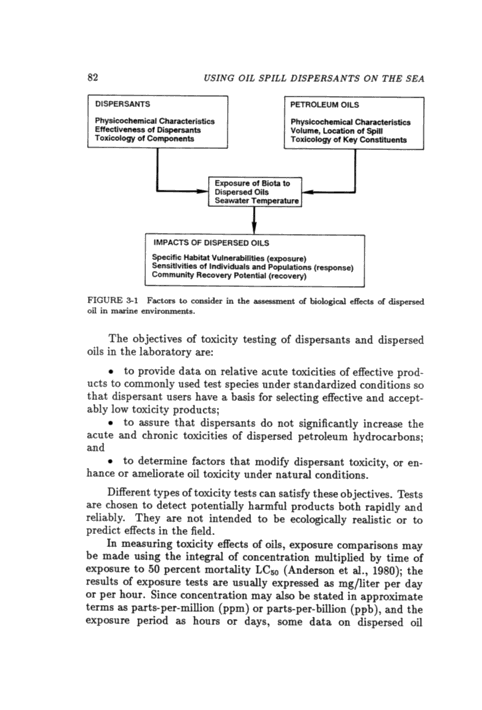
3 Toxicological Testing of Dispersants and Dispersed Oil This chapter describes what is known about biological espe- ciaBy toxicological effects of dispersants and dispersed oils from laboratory studies; reviews the evidence on oil-induced damage to organisms and how it is modified by dispersant use; and notes the applications and limitations of this knowledge (Figure 3-1~. Experi- ence with of} spill dispersants over the years has resulted in less toxic formulations. However, some questions pertaining to the effects of dispersants with and without oil remain, and they are addressed throughout this chapter. OVERVIEW OF TOXICOLOGICAL TESTING Toxicity, the potential of a material to cause adverse effects in a living organism, is a relative measure (see GIossary). Estimates of toxicity depend on many experimental physicochemical and biolog- ical factors. In addition, there are many different testing methods and variations in the products tested. A related problem has been the uncertain applicability of toxicity data from one species in one body of water to another species or area. For example, are species' sensitivities to dispersed oils in New England waters applicable to Texan waters? This question, which is of concern to regulators and industry, is addressed in this chapter. 81
82 USING OIL SPILL DISPERSANTS ON THE SEA DISPERSANTS PETROLEUM OILS Physicochemical Characteristics Physicochemical Characteristics Effectiveness of Dispersants Volume, Location of Spill Toxicology of Components Toxicology of Key Constituents Exposure of Biota to Dispersed Oils l Seawater Temperature |1 IMPACTS OF DISPERSED OILS Specific Habitat Vulnerabilities (exposure) Sensitivities of Individuals and Populations (response) Community Recovery Potential (recovery) FIGURE ~1 Factors to consider in the assessment of biological effects of dispersed oil in marine environments. The objectives of toxicity testing of dispersants and dispersed oils in the laboratory are: ~ to provide data on relative acute toxicities of effective prod- ucts to commonly used test species under standardized conditions so that dispersant users have a basis for selecting effective and accept- ably Tow toxicity products; · ~ . ~ ~ co assure anal c~lspersants do not significantly increase the acute and chronic toxicities of dispersed petroleum hydrocarbons; and . to determine factors that modify dispersant toxicity, or en- hance or ameliorate of] toxicity under natural conditions. Different types of toxicity tests can satisfy these objectives. Tests are chosen to detect potentially harmful products both rapidly and reliably. They are not intended to be ecologically realistic or to predict effects in the field. In measuring toxicity effects of oils, exposure comparisons may be made using the integral of concentration multiplied by time of exposure to 50 percent mortality LC50 (Anderson et al., 1980~; the results of exposure tests are usually expressed as mg/liter per day or per hour. Since concentration may also be stated in approximate terms as parts-per-million (ppm) or parts-per-billion (ppb), and the exposure period as hours or days, some data on dispersed of]
TOXICOL O GICA L TESTINrG OF OIL DISPERSA NTS 83 presented in this chapter will be stated as ppm-hour (ppm-hr) or ppm 1-day or 2-days. This allows a comparison to be made between different exposures used by different investigators who use the same analytical techniques. The exposure-time expression also allows an exposure to be expressed as concentrations change rapidly in the field. This concept probably holds during time periods from 1 hr to 4 days for oil and dispersed of} exposures. The use of ppm-hr assumes that organisms wiB respond in the same manner to a tox~cant if exposed, for example, to 20 ppm for 1 hr or to 1 ppm for 20 hr. The concept is approximately valid for some of the data shown in this chapter. There are obvious limits to this concept. If the time is short and the concentration high, the organism may be killed immediately. If the time is long and the concentration correspondingly lower, many organisms can tolerate, adapt to, or metabolize hydrocarbons and ~~spersants and survive and recover without apparent adverse effects. This concept has long been used in radiation exposures. It was proposed and used by Anderson et al. (1980, 19843, and McAuliffe (1986, 1987a) used the concept to compare laboratory bioassays that actuary measured the dissolved hydrocarbons in the water-soluble fraction and chemically dispersed of! exposures with those measured in the field. O Toxicological Testing Methods Considerable attention has been paid, especially by regulatory agencies, to the choice of suitable exposure regimes (static, continuous flow); test species; acute versus chronic testing; influence of modifying factors; and standardized testing protocols. International workshops on these issues have been held by the United Nations Food and Agriculture Organisation (FAD) and the United Nations Environmental Programme (UNEP). Work from the United Kingdom has included Shelton (1969), Perkins (1972), and Beynon and Cowell (1974~. Work from the United States has in- cluded Tarzwell (1969, 1970), ZiDioux et al. (1973), and Becker et al. (1973~. Canadian work has included Mackay et al. (1981), Wells (1984), and workshops leading to the Canadian Dispersant
84 USINrG OIL SPILL DISPERSANTS ON THE SEA Guidelines, 2d edition, Environment Canada (1984~. FAD has been represented by White (1976) and UNEP by Thompson (1980 and private communication). It is difficult to compare disperant formulations or sensitivities of different species, unless such work is conducted comprehensively in qualified laboratories (Doe and Wells, 1978; Wells, 1984; Wilson, private communications. Furthermore, information obtained using rigorously controlled and standardized testing protocols is desirable for reliable interpretation of toxicological information. Major com- ponents and trace contaminants should be known and exposures verified by analyzing the water in which the organisms are exposed. Fish, arthropods (usually decapod crustaceans), mollusks (pele- cypods), annelids (polychaetes), and algae have been the favored test species. Some researchers have also studied sensitive life stages; behavioral, biochemical, and developmental responses; and multi- species interactions, either acute or chronic. Testing of current for- mulations can be acute (i.e., short term), single-species, lethal, or sublethal; it is usually done in static rather than flowing systems, and at ambient temperatures. Some testing includes standard sam- ples or reference tox~cants. Dispersant toxicity thresholds are most often reported as nom- inal concentrations total amount of dispersant or oil divided by the total volume of water in the experimental chamber- rather than measured concentrations of materials to which organisms are actu- ally exposed. This can lead to major errors in some cases. For some water-immiscible formulations at high concentrations, dispersant in the bioassay chambers can separate into a floating and dispersed upper-surface layer, several millimeters thick, and a dissolved sub- surface fraction during the tests. For example, BPllOOX in static tests separates like this immediately. Expressing the LC50 or EC50 on the basis of nominal concentration then gives a higher (and in- correct) value than if the water-soluble fraction were analyzed and used as the basis. Thus the toxicity of a water-soluble material may be underestimated. The same problem arises because of the immis- cibility of water and dispersed oil (as discussed later in this chapter). For some dispersant formulations, this is an important but generally unrecognized source of error for toxicity estimates. Dispersant Screening Procedures for Toxicity: Considerations The qualities of a good laboratory screening test are that it is easy to perform and control, and it is reliable, reproducible, and
TOXICOL O GICA L TESTING OF OIL DISPERSA NTS 85 adequately sensitive. Because its purpose is to determine the relative toxicity of one dispersant versus other previously tested dispersants, practicality and known sensitivity are weighed against ecological realism. Screening tests are usually conducted with a single species, but do not yet attempt to simulate interactions of two or more species, that is, community responses (Cairns, 1983; Mount, 1985~. Screening tests can include various test species and life stages; response parameters other than mortality; various test materials; different exposure modes; varying length of exposure; and various pass-fai] criteria. Laboratory tests are poor simulations of natural conditions because they are conducted under standard controlled conditions. Gener- aBy, this means exposing animals in the laboratory to more or less constant concentrations for 2 to 4 days, while in the ocean initial concentrations of dispersants and dispersed of} would be diluted pro- gressively and generally rapidly. Because the effectiveness and toxicity of a dispersant may be positively correlated, screening tests should consider both criteria in sequence (Bratbak et al., 1982; Doe and Wells, 1978; Mackay and Wells, 1983; Nes and Noriand, 1983; Norton et al., 1978; Swedmark et al., 1973~. Both criteria have already been considered together when evaluating dispersants for government agencies (Anderson et al., 1985; Aranjo et al., 1987; Environment Canada, 1984~. Screen- ing tests should accurately evaluate and accommodate the possibly greater acute toxicity of more effective dispersants. For improved accuracy and utility of hazard assessments, future screening toxicity tests should consider the above factors, the physical chemistry of the dispersant solutions, and the responses of the test organisms during short exposures. Dispersant Screening Procedures in Canada, the United States, and Other Countries Until 1982, most countries used a combination of dispersant and dispersed oil tests, of! and dispersed of} tests, or tests with ah treatments (WeBs, 1982a). The primary concern was to evaluate the toxicity of oils upon dispersal. Such an approach was particularly
86 USING OIL SPILL DISPERSANTS ON THE SEA supported by the United Kingdom's sea and beach test.* However, the inclusion of oils in dispersant tests is experimentally complex because it introduces a new set of variables associated with the oil and is subject to errors in interpretation because of immiscibility (Welis, 1982a; Wells et al., 1984a,b). Yet most countries, out of concern about dispersed of} effects and joint toxicity of of} and dispersant constituents, have included both of! and dispersant in their tests. Some countries screen dispersants only (e.g., Australia, Canada, several Asian countries). At least 10 countries employ a toxicity screening test for dispersants or dispersed oil: Australia, Canada (linked to effectiveness test), France, Hong Kong (modified U.K. sea test), Japan, Norway (modified U.K. sea test), Singapore (modi- fied 1970s Canadian test; Environment Canada, 1973), South Africa (modified U.K. sea test), United Kingdom, and the United States. Brazil (Aranjo et al., 1987), Nigeria, the Philippines, and Sweden are also developing testing approaches (SchaTin, 1987~. Screening meth- ods and status are listed in Tables 3-1, 3-2, and 3-3; of particular note are procedures for Australia, Canada, South Africa, the United Kingdom, and the United States (Table 3-1; reviewed in detail by Moldan and Chapman, 1983; Thompson, 1985; and WeDs, 1982a). A number of other countries are thought to be doing tests. The most frequent combination of test materials are dispersant, oil, and dispersed oil, that is, dispersant and oil mixture (Table 3-3~. Most tests use seawater, and lethality is the usual toxicity re- spouse. Many different test species are used, with little uniformity among countries. Both indigenous and standard species have been selected, such as local shrimp and Artemia, and in most countries lo- cal species are used as the standard (rainbow trout, Salmo gairdneri, in Cana(la; brown shrimp, Crangon crangon, in the United Kingdom; and mummichog, Fundulus heteroclitus, in the United States). Most countries have pass-fai} criteria, but they vary. When dispersed of! is tested in the laboratory, of! composition is variable and differs from place to place, the water-soluble fraction is normally not separated, and hydrocarbon exposures are normally not measured. Hence, the same dispersant submitted to different countries for approval may be subjected to quite different toxicity screening methods and pass-fai! · ~ criteria. *The United Kingdom screens for effectiveness first, and dispersants that pass go onto the toxicity-testing phase. The work is conducted in two laboratories and is a phased approach rather than a linked approach.
TOXICOLOGICAL TESTING OF OIL DISPERSANTS TABLE 3-1 Worldwide Survey of Dispersant Toxicity Screening Geographic Location Author/Year Report/Result United States Canada European Nations Europe Finland France Norway Sweden Battelle Memorial Institute, 1970 Blacklaw et al., 1971 California State Water Resources Control Board, 1971 Becker et al., 1973 McCarthy et al., 1973 U.S. Department of the Nary, 1973 Exxon Chemical Company, 1980 Cashion, 1982 Smith and Panic, 1983 Lindstedt-Siva et al., 1984 Peoria and Smith, 1984 U.S. Environmental Protection Agency tEPA), 1984 API, 1985 Pavia and Onstad, 1985 Abbott, 1972 Environment Canada, 1973 Doe and Harris, 1976 Environment Canada, 1976 Harris and Doe, 1977 Wells, 1982a Abbott, 1984 Environment Canada, 1984 Harris et al., 1986 Trudel and Rose, 1987 Wilson et al., 1973, 1974 Kerminen et al., 1971 Division Qualite des Eaux, 1979 Auger and Croquette, 1980 CTGREF, Division Qualite des Eaux, 1981 Norwegian Ministry of Environment, 1980 Westerngaard, 1983 Lehtinen et al., 1985 Early test procedures developed for American Petroleum Institute (API) U.S. Toxicity Test Procedure Early test procedures developed for California Regional U.S. survey for bioassay species for tests U.S. EPA standard toxicity tests U.S. Military Dispersant Specifications U.S. policies on dispersant use Draft ASTM Method No.6, dispersed oil Dispersant use guidelines, California Use guidelines, ecological considerations, coast Use guidelines, California U.S. revised standard dispersant toxicity test API Dispersant Use Guidelines Use guidelines, California Ontario guidelines, Ministry of the Environment Canadian Dispersant Acceptability Guidelines Selection of suitable species for toxicity tests Standard Listing of Acceptable Dispereants, Department of Energy (D OK) Toxicity methods for screening dispereants, DOE Summary/re~riew, toxicity testing worldwide for regulatory control Discussion paper, Canadian Dispersant Acceptability Guidelines Dispersant Acceptability Guidelines, 2d ed. Regulatory considerations, acute toxicity test spp. Dispersant use decision-making methods Review, toxicity tests Policy on toxicity, fish, early reports Toxicity protocol Acceptability list, use guidelines Toxicity testing protocol Regulations on dispersant composition and use Dispersant policy Study for criteria for guidelines 87
88 USING OIL SPILL DISPERSANTS ON THE SEA TABLE 3-1 (Continued) Geographic Location Author/Year Report/Result United Kingdom Other Countries Australia Moore, 1968 Jeffery and Nichols, 1974 Blackman et al., 1978 Lloyd, 1980 Norton and Franklin, 1980 Norton, private . ~ . communication Wilson, 1981 Franklin and Lloyd, 1982 Lloyd, priorate . i. communication Wilson, 1984 Henry, 1971 Thompson, 1985 Thompson and McEnnally, 1985 Linden, 1981 Bahrain Hong Kong Thompson and Wu, 1981 Ministry of Transpor- tation, 1974 White, private communication Port of Singapore Authority, 1976 South Africa McGibbon, priorate communication Moldan and Chapman, 1983 Japan Singapore International Agencies FAO White, 1976 IPECA IMO Early paper, U.K. dispersal experience in ports List of approved dispersants and rationale Procedure for U.K. screening, sea and beach tests U.K. role of toxicity tests, registration and notification Methods, dispersant toxicity, sea and beach tests U.K. methods, dispereant toxicology Toxicity tests, rationale for choice Toxicity, 2S oil-dispersant mixtures, sea and beach tests U.K., MAFF toxicity approach U.K. policies on dispersant use, risk analysis Policy, dispereant use, early report Program, effect and toxicity of dispersants Resource atlas for spill countermeasures Fisheries, use recommendations Toxicity testing/ecreening methods Testing standards, toxicity Testing method Toxicity testing methods Dispereant testing program Review, toxicity methods International Petroleum Industry En~riron- mental Conservation Association, 1986 IMO/UNEP International Maritime Organization, 1982 Hayward, 1984 IMO Organization, 1986 Course, methods for oils and dispereants Statement of environmental concerns, fate and effects Guidelines, environmental considerations Bonn Agreement, toxicity test methods Hong Kong, acceptance list KEY: ASTM--American Society for Testing and Materials; FAO--Food and Agriculture Organisation of the United Nations; MAFF--Ministry of Agriculture, Fisheries, and Food; and UNEP--United Nations Environment Programme.
89 a, CD a, - al L' ._ - . - ._ o Le o : ·_ x o ._ Cat o CQ en 1 CO m En o · ~3, O ~ Lo ~ ._ "_ ~ ~ A_ ~ - ~ TV Cr. ~ V . , _ ~ _ o ~ 3 ~ ._ _ ~ _ O. m A ~ ._ _ ~ ._ A,. 5 ~ ~ ~ _ ~ ~ a, ·O ~ -~ male rB bO a, ~ ·8= ~q ~ o v - e~ ~ _ o ~ U. |, X U2 ~ ~ Q L4 ~ ~ =_ . - o ._ . ~ o _ ~ o5 o _ &4 + ~ rL·O · a' _ 0 ~ a' O _ U] ~e ·_ _ _ O ·E C~ )0 ~1 ~ C. · C,Q 0" ~ . - O oo _ :^ · _ e~ ~ 11 3 ·E L' GO ~ ·2' · _ CO C~ 11 :~ 1 Q. ._ . - ,~ 3 a' ~ o ~ ~ t_ ._ ~ C~ ~ t- `,9, L ~ B ~ o 3 ~ ~o -- =- ~ m ~ ^ O tn c es . ~ =, .> L4 ~o -_,._ o ._ · ~ ~ £> V o o o _ ~ ~ ~ o ~ ~ ~ 3 ~ ~ C ~ X c~ · a~ ~~S ~ ° ~ ~ ~ ~ 8 ~ E ~ ~ ~ ~ ~ ~ ~ ~ ~ ~ ~ ~ = = o c ___ ___ ____________ e~ co ~ u~ CD ~ e~ co ~ ~o ~ ~ e~ oo ~ u~ co ~ ___ ___ ____________ C ~ D. C ,-, c .1 ° ~ ~ j=- Ej - `2., Q' ." ._ oo ._ _ m ~ a~~ a · _ ..o ,, 2 ~ ~ .- ~
go w w o w · - ~' ~ ~ .~" ~ ~ ~ o ~ ~ ~ 3 ~ ~ ~ E ~ £ Y., P. ._ L. a; . · . W o X ~ ~ Wo W-E V o o of ,~ _ 4, _ - _ _, W ~ no ~ o ~ =1~ so .. ~ ~ , - ~ ~ . ~ :~ ~ c, ~ ~ ~ ~ W ~ ~ v 8 a, ~ ·_ W · L. ~ W o ~ A: ~ ___ ~ en of ___ w W _ en A, ~ p. c o c- o ~ ~ al X _ w A ~ g A o ._ ·- ~ ~ ~ ~ C ~ _ W ~ ~ ~ _ ~ _ `,,a ~ ~- ~ ~ ~ -° ~ a o ~ ~ Ik, ~ a ~ p, c ~; e~ O_ ._ ~ · W t., ·" W ~ ~ W a w ~ C) ~ ~ ._ ~ __ _ ___ _ _ _____ _ _____ _ ~ ~ e~ o' ~ u, ~ ~ e~ o, ~ u, CD ~ e~ a) ~ u, co __ _ ___ _ _ _____ _ _____ - ._ o v e~ CO m ¢ E~ ~ b4 W ·C) U U. v - =0O ~ ~ O .~ U] ~ CO W .E . _ _ _ C o- W 3c Cl ~V , ~ ·~ "o _ L. o ~ ·~ W ct C. ct v
91 Go Go o ~ S ~ b ~ - - - - ~ - - - - ~ ~ ~ en ~ en ~ en _ En , _ _ _ , _ ~ L O U] Ad a _ O pi, O `= ~ . O V O c5 ~ ~ =: C) a' ~ ~ m al U] ~ ~0 _ ~ ~ ~ ^ ~ ~ _ L' O .s ~ ~ _ ~ _ it_, _ - , so ·- al ~ ~o ~ ~ al ~ ~ ',, . _ s- O 2: 7 ~~ ~ ; _____. ~ _ __ ~ ~ _ ~ up _ 3S . - ~ S 3 ~ ~ =~ IS ~ . , E ~ 3 ~c ~ _____ en on ~ us ~ _____
92 al v al o al ._ o ~ ~ ~ Lit ~ v ~~ . _ .~ a, ~ ~ _ . _ l_ al I 5 ~ o - o o _ ._ . _ ·" ~ 3 ~ a, to os ~ ~ ~ It . m - ._ o v - m ¢ ~ be 00 .o U] V 41, Q4 U] u ._ GO my _ rS _ · ·- ~ ~ z ~ z ~ _ ~ _ _o _ 4) ~S ~ _ m~ CS ~ b! Q. .E ~ - ~ _ O ~ O v # ~.o =._ O O 00 _ 3~ __ e~ a~ __ _ ~ . ~ os X =O J ._ CO ~ _ ~ ~ ·_ O 4I _ ~ ~ . ° >, (~S ~ a~ ~ ~ ~ ~ ~ O t m `~,,.S ~ C: ~ -D ~ ~ L~ 00 tZ~ _ ·~ ~_ _ ._ O ~ ~ ~ X ~ ~ ~ ~ ~ ~ ~ O :D OV S" o oo O .4.~ · ·" · _ r8 bO ~ ·_ ~ O C) ._ L. 4- o 1_ _ CO ~¢ - 3 0 3 `, ~ I O 4~ ~ ._ . O v ._ ._.0 > ~ ~ 3 ~ t$ ~ ~ ~ ~ o._ 3 ~ 3 d 3 ct 0 ~ =- 1 ~ ~ 2 ~ ~ C o ~ a~ _ ~ ~ ·O ~ b. ° 1 S_. 3 O _ ~ ~v o
93 CO Go o o CO · I- ~ {35 (5, ~5 CS ~ o · ~ ~ c to, ~ ~3 · =-o ~ ~ ~ O.E ~ ~ ~ ~ o ~ o · ~ ~ o o ~ ~ ~ ~ 8 1 ~ at. ~ ~ ~ lo, ~ Do. ~ ~ ._ ~ . - CO ._ L. i- Go ·" m - ._ ray m CL$.~_ol ~ ~ 00 rC ° ° Us ~ ~ ~ es D ~ A. - o so o o I_ o ~ ~ to .- ~ ~ o V ~ .= o °° °° a ° _ _ ~ _ ~ ~ ~ C~ _ ~ ~ '6~.c=~$.c~ . _ ~5 o a, O C~ c.e ~ .~ ~ u, N O O ·~ O + ta ~ 3~ ~ ~ 3=a ._ o Vl :~ ._ ._ x o ________ ___ ~i e~ oo ~ u: CD ~ e~ co ~ u, c9 _________ ___ ·~1 ° O oo ~: p, _ o5 _ o o U. d - ·~ ~S ~ U] ~C .O ~ ct ~ O ~ ~ 00 ~
94 - . o v - e~ m CO 4- 00 o C: 00 ·_ O ~ L. {. . TV ~ _ . _ .~ Cal ,~ ._ ~ m ~ ~ 5 O O O ~ U] {D ·~ O (D ~ - ._ i, us ~ L' O O TIC O ~ a) _ ~ · · _ ~ ~ ~ cat ·,, 11 At: ~ O 00 a TV 5 - I, E :, 0~ ~ a,=~ O~55 ~ __ ____. ~ _ ~ ~ ~ en of ~ us ~ ~ A-,_ _ ____- ~ cot al ·O v, to v I~ so V so Do oo - s" o b. . U] ~ ·~ o ~ ~Q m m ~ ~ L. ~ ~, m ~ O ~ ._ h O C) os _ ~ CJ · O O m ~ m .~ ;: ~ ~ O ~,Q m V ~ ~ O ~ .6 O .` _ m ~ ~ ~c~ ~ ~ . o ~ ~ m ~m P. I,_ O ~ ~ ~ I m h ~ O _ ~ ~ e_ ~ oi =-~ # 0 3 # `: ,~. m ~ p, aS ~ ~ ~.O m 0 ·h 43 ~ ~ ~ ~ b`~= m ~ ~, 0O ~ ~ ~~ .~ m _~ ~s~ 3 ·_ ~ ~, t~! ~ _1 g .c ~ - ~ E ~ rc ~ m V V~ Z ~ ~ 9~ {1X; o - e~ oo -
95 . ~, . oo . ~ ~4 . ~ V ~ >, m V o ._ a, X oo O ~ oo oo ._ ~o oo 'dV V ._ X o V ._ o C~ b4 o U] CO CO ~L 3 o . ~S1 a~ - . C~ oo ·e v U] L40 >= L. ~ m m ~n m a~ m ~ a' O ~ O :~ :^ :^ ~ ~ :^ :~ :^ :~ ·_ ._ ._ ._ ~ ._ ._ ._ .~ ~ ~ ~ `6 3 r~ c. ~ ~ ~ ~ ~S: =: o ~: =: ~ 5: (D (D t3° ~ /V (U z; x x x x X X x X X X X X X X x X X X X X X X X X o m U] 1 X X x x x Vl X X X z X X X X X X X X X X X X X X X X X c ~ X X X a' _ X d O O - O o a ~ B ~4 ~ ~ ,c < m X - m V =) V EO O .OX C) h L. - o - - ._ o - o + - _ _ :> ·_ ~ o U] =~_, ~ h W ~ h ~ ~S Q, w W ._ _ _ ;^ _~ ~ _ h O 1 . ~, m .a} h ~1~1 oZ - e~ 0o a, - w - 3 o . o . . v o V)
96 USING OIL SPILL DISPERSANTS ON THE SEA The lack of a standardized approach displays a lack of consensus about screening test objectives. For example: · The United Kingdom attempts realism in both its sea and beach tests, one with of} exposure in the water column and one sim- ulating exposure to a beach application of dispersant, respectively. However, the sea test ignores the experimental complexity of prepar- ing and controlling the of] preparation, and the beach test assumes that dispersants will be used directly on rocky shorelines. The U.S. test covers all treatments but simply lists the tox~- city data without interpreting it for use by the on-scene coordinator (OSC). Canada's test is linked closely to the effectiveness test through a formal decision framework, but it only screens the dispersant using a single-species freshwater fish test. The state of Sao Paula in Brazil is adopting an approach sim- ilar to Canada's, ultimately screening the dispersant with a valuable indigenous shrimp. To date, only Canada and Brazil link effectiveness and toxicity screening tests in a formal decision-making framework, although the United States is considering such a linkage based on Anderson et al. (19851. Yet, as pointed out by Thompson (1985), it is important ~ , for ah countries to recognize Contemporary problems arising from the development of effective third-generation dispersants and more accurate methods for determining the toxicity of oils" in the design of their toxicity screening tests. There are significant advantages to screening only the dispersant formulation, but an international consensus on the key treatments to test has not yet been reached. A consensus on methods would allow reliable comparisons of data from one country to another. TOXICITY OF DISPERSANTS This section summarizes the aquatic toxicology of dispersant components and commercially available dispersants. Data are re- ported for early formulations, as wed as second- and third-generation dispersants that generally are less acutely toxic than earlier products. Toxicity is a relative measure that is influenced by many fac- tors, particularly concentration, duration of exposure, and type of organism. Most of these experiments use concentrations and expo- sure durations that substantially exceed expected field exposures. Nevertheless, the following factors are important to understand:
TOXI COL O GI CA L TES TING OF OIL DISPER SA NTS i: 97 · the risks of misapplication of dispersants; · the environmental fate and effects of dispersant materials added to ocean waters to treat of} spills; · the range of responses in different species and to different formulations and to different environments; and · which components contribute most to toxicity in order to mprove formulations. Acute Toxicity of Components Knowledge about the toxicity of the primary components of dis- persants would assist in evaluating dispersant toxicology and the toxicities of dispersed oils. Ad surfactants are toxic at high concen- trations. Many surfactants have unique toxicological properties, are usually but not always nonspecific or physical toxicants, can cause narcosis, and can disrupt membranes physically and functionally. A number of factors control the toxicity of surfactants to aquatic or- ganisms, among them, ethoxylate chain length, the presence of esters versus ethers, and hydrophilic-lipophilic balance (HLB). Rates of up- take and penetration into an organism's tissues are highly dependent on species (Abel, 1984; Wells, 1974~. Acute toxicity data of some surfactants used in current formu- lations (circa early 19SOs) are presented in Table 3-4 (WelIs et al., 1985~. New and more effective formulations may have different sol- vents and different combinations or types of surfactants. Toxicity in Table 3-4 is expressed as a 1- or 2-day EC50 for two crustaceans, Artemia sp. and Dc~phnia magna. Results of these laboratory tests show that the anionic surfactants are generally more toxic than the nonionic surfactants or esters, toxicities being influenced by alkyl chain length, degree of dispersion, and HLB. Studies on surfactants cover a wide range of organisms because of concern for effects on membranes, reproductive stages, bacte- ria, behavior (especially chemoreception), and other subtle sublethal changes in exposed organisms (Abel, 1974; Moore et al., 1986~. Solvents were the most toxic components of some early disper- sants, due to high concentrations of aromatic hydrocarbons in the petroleum fractions employed (Nelson-Smith, 1972; Smith, 1968~. Several types of solvents are now used in most formulations (see Chapter 2 and Appendix A), and they are far less toxic (Caneveri, 1986~. Nagell et al. (1974) and Weds et al. (1985) have shown tox- icities to decrease in the order: aromatic hydrocarbon > saturated
98 USING OIL SPILL DISPERSANTS ON THE SEA TABLE 3-4 Acute Toxicity of Surfactants From Dispersant Formulations to Two Planktonic Crustaceans, Artemia sp. and Daphnia manna, at 20°C Description Behavior in Watem'b , Chemical General Salt Fresh Family Description Water Water Anionic surfactant Surfactant salt Oxyalkylated (6.5 m)C12-C13 alcohol Sulfate salt of Oxyalkylated (3 m) Cl`~-C15 alcohol (6096 in water a et anal) S S Sulfosuccinate, Alkyl (C ~ sulfosuccinate salt, D S anionic surfactant 70% solution Amine surfactant Alkyl (C 3) sulfosuccinate salt, D D 70% solution Anionic surfactant Oxide ester of DDBSA in amine D D salts Aromatic surfactant Oxyalkylated (9 m) alkyl phenol D D Anionic surfactant, Sodium xylene sulfonate, 40% S 13 salt in water Nonionic surfactant Sorbitan monooleate D D Surfactant ester Oxyalkylated (20 m) sorbitan S S monooleate Surfact ant ester Oxyalkylated (20 m) sorbit an D D trioleate aThese data are expressed as ppm, which is approximate since variability in calculating and measuring field concentrations and toxicity thresholds used in analyses are much greater than the difference in the relationship between ppm and mg/liter. Data in Table i-4 were originally expressed in mg/liter. Behavior in water code: Se-soluble, D--dispersible.
TOXICOLOGICAL TESTING OF OIL DISPERSANTS 99 1-Day EC50s (ppm)-' - '- Artemia 8p. DaDhnia 8p. 2-Day EC~j08(Ppm) Artemia sp. Danhnia sp. 14.0 (11.1-17.7,1.5) 23.0 (14.4-36.7,2.1) [13.8*] [8.6-22.01 14.8 (10.1-21.6,2.4) [10~4] [7.1-15.1] > 1,000 [> Too] 23.5 (19.5-28.3,1.5) [14.1][11.7-17.0] 32.0 (21.2-48.2,1.6) [22.41 [14.8-33.7] 180 (93-350,3.2) 1126][65-245] 8.2 (5.6-11.9,1.8) 13.5 (8.3-21.9,2.2) [8.1][5.0-13.21 18.5 (13.2-25.9,2.2) [12.9][9.2-18.1] n.c. [< 3 6.0 (4.0-9.0,2.1) 6.0 (3.8-9.4,2.2) [3.6][2.3-5.6l 21.0 (15.2-28.9,2.8) [14.7][10.6-20.3] < 56 60.0 (49.6-72.5,1.5) 3.8 (2.0-7.2,6.1) 32.0 (23.4-43.7,2.0) ~ 1 46.5 (36.1-60.0,1.8) 20.0 (16.5-24.2,1.39) 68.0 (45.5-101.7,4.~) 6.3(4.2-9.5,2.0) > 3,000 430 (239-773,2.27) > 1,000 100-820 [> 1,200] [172][96-309] [> 400] [40-1281 > 1,000 300 (181-498,3.3) > 1,000 90 (39-209,3.3) > 1,000 220 (100-482,3.9) -- ~ 100 > 1,000 205 (86-487,4.6) -- 75 (36-157,4~7) Cdn.c.: Not calculated. Values in parentheses are: (95 percent confidence limits, slope function). -Values in brackets have been adjusted to represent 100 percent of parent surfactant. SOURCE: Wells et al., 1985.
100 USING OIL SPILL DISPERSANTS ON THE SEA hydrocarbons > glycol ethers > alcohols. Third-generation concen- trate dispersants tend to use less toxic solvents, such as glyco} ethers. Acute Toxicity of Formulations More than 100 studies have been conducted on acute lethal toxicity of dispersants alone, more than half of them on currently used second-generation dispersants (Doe and Weds, 1978; Doe et al., 1978; Dye and Frydenborg, 1980; Nelson-Smith, 1972, 1980, l9S5; Pastorak et al., 1985; Sprague et al., 1982; Wells, 1984~. Such an extensive data base of varying quality invites periodic critical analysis by dispersant, organism type and stage, and method of exposure before definitive statements can be made about the acute toxicity of any one formulation. This has been done for Corexit 9527 (Wells, 1984~. Table 3-5 lists toxicity data, expressed as l.C50s for a wide va- riety of species and dispersants. A wide range of values is reported, including the following: ~ In Weds (1984) 4-day LCsos were 150 to greater than 10,000 ppm. · Eleven dispersants tested with rainbow trout showed 4-day Is of 260 to greater than 10,000 ppm (Doe and Wells, 1978~. Early EPA data showed 2-day LC50s for Artemia sp. of 1.2 to 100,000 ppm for 15 products (Dye and Frydenborg, 1980~. · In a study with freshwater phytoplankton and several dis- persants, estimated 2-day LC50s were 1 to 575 ppm (Heldal et al., 1978). Studies by Kobayashi (1981) with sea urchin embryonic stages gave threshold concentrations of 0.32 to 320 ppm. i, A range of 0.1 to 20,000 ppm for a wide range of species and stages were compiled in Pastorak et al. (1985). From Table 3-5 it can be seen that the "second-generation" conventional dispersants, such as BPllOOX and Corex~t 7664, are generally much less toxic than earlier formulations (BP1002, early Finasol formulations). One useful way to present dispersant toxicity data is by testing several products on one species (Table 3-6). Table 3-6 illustrates that the majority of products had l.C50s and EC50s greater than 100 ppm to a planktonic crustacean, that is, a marine copepod. Some formulations with high toxicities to certain species still exist. Most research studies have examined only Corexit, BP, and
101 a v o o ._ _4 - a, 00 ._ ~4 o ._ lo; o ._ a - ._ U. - ._ o o V) o :^ ._ ._ o - ~S ~ O ¢ ~ U. {I 03 ·s O X al O ~ · US I,,, O ~ ~ C) ~ ME V O ~ lo_ ~5 ~0 ._ U] - CO ._ C) U. al 09 ._ be o ·0 ·0 ·0 ·0 ~ CS) ~ ~ I" ~ I" ~ o, `~, `~' O. ~ ~. p`4 o$ ~ 0, o, C ~ Q ,5 ~ ~ ·= ,~ _ _ oo ~ ~ ~ °° ~ ~ a~ ~V ·_ ·_ ~ C53 ~ ~ a) ~ ~ ~ ~ ~ _ a~ ~ <¢ > 4~ q~ ~ C~ C~ ~ ~ S oO m 3~ `4~vo~E~ u3~;:z;~ ~ 33 ~ oo 0 0 0 _I O ~ O O O ~ O O O O O O e~ u: 0 c~ 0 0 ~ ~ oo ~ co ~ oo 0 0 0 0 0 0 co ~ e~ ~ ° ° ~ ~ A ~ ~ A A oc °-o ~ '~ o ~ e~ 00 CO CO CD CD CD CD ~ ~ ~ C~ ~ ~ ~ C~ C~ CO CD ~D CD CO'tD C~ C~ CD o0 mrs~=a~c~a e~ ~ ~ ~ ~ ,,` e~ ~ ~ e~ c~ e~ ~ =, 14 I.. ~ s-' ~ ~ V ~ ~ x X X X X ~X ~X ~X X ° ° O, ~ Q.o ~ x. x ~ ~ L ~ ~ ~ ~ ~ ~ ~ ~ ~ ~ ~ _I _~ ~ ~ ~ . ~ ~ o o o o o o o o o o o o o ~ ~ ~ - ~ o o vvvv vvvvv vvvommm~ ~ vv E Q. ~ co m os s| E| s| o ¢1~1¢1o X m .~ b~ X O O0 ¢ ._ 3 X ai ~ o ¢Im 00 .- .- .~ ~ d O _ _ 0 .s ·s ~ 0 0 O O O ~ s.. ~ £ ·~ {e . . . . . . ~P4~= a~ oo a~ a~ oo ~ 0 3 0 3 ~ 0 s£ ~ ~ ce ~ ~ ~ ~ ~ ~ ~ ~ ~ ~ o. 0 - a~ oo _ _ .E .E o0 00 a ~ c~ O O 0 00 CQ c) .s .E .s ~ ~ ~ ~ ~ ~ ~ ~ ~ ~ ~ ~ ~ ~ O O O O O O O O O O O O O O == P~ ~ ~ ~ ~ ~ ~ ~ ~ ~ ~ ~ ~ ~ O O ~ co 0 ~ . ._ ._ ._ ._ ._ ._ ._ ._ ._ ._ ._ ._ ._ ._ ~ ~ =~ ~ ~ ~ ~ ~ ~ ~ ~ ~ ~ ~ ~ f: ~ E v mmm~ <:~<C<< <:~:~:¢< <: vv
102 al C) ._ ~ ~ ~ of ~ V ~ En ~ to a' o ~ al ._ - ~s ._ o v - U, CO m be V] - 0 ._ v U] ~0 GO ._ be a m~ Itch ~ _I :0 :0 :0 L1 be ~ be be ~ V ~4 ~ ~ ~ ~ 5 `i ~ ~ ~ ~ O. _. ~ _' _ ~ _ ~ ~ ~ ~ ~ ~ ~ ~ ~ ~ 0 ~ ~ {35 {~ ~ ~ ~ ~ be ~ ~ ~ be ~ ~~> O O O 0 0> 0 - V 00 - o Go _ CO - V _=o o o o A ~ o V a, o _I ~ _ ° ~ ~ o-O~3~$~° ~ ~ o o ~ ~ ~ o _ =° - ° ~ ~ ~ ~ o ~ ° ~ ~ ~ ~ ~ A - ~ - A ~ - - A~ ~ ~ - = {D CD CD {D CS) C9 00 ~ CD CO {9 tD CO CO CD CO {D ~ ~ ~ cn ~ ~ ~ cs, ~ ~ a) ~ c~ ~ ~ ~ ~ - - ,~ a' ~p , ~ ~ ~ ~ ~ = X X ~ ~ ~ O: . ~ · 3 ~ vommov ~ o:z vo v v vv L' bO ~w o . . ·b~ 00 NJ~0 .c .c 3 ~ . os ~1~1~1~ . oo ~ ~= oo · · · · · oo oo m cn oo a' _ :^ ~ ~ ~ ~ s" O b ~1 O O O O O O bC bt bt b bt b P P P ~ P C ~1~1 ~1 ~1 ~1P-1 P.~ P. P. P P. ._ ._ ._ ._ ._ ._ S" L4 L4 ~W ~ ~ ~W oo m m ~w w~ m 0 oo ~w a2 oo ~w oS r~ $4 ~ Le L'
103 N _ D ~ O O ~ ~ - ~ ~- ~ C~ ~~S (~~ ~n ~ ~ ~ ~ V ~ ~ ~ - _ a~ t_ t_ ~'~S C'6 ~ a~ ~ ~ ~ ~ r C~ ~ ~ ~~S ~ 0 y y ~ ~ = ~ c E ~ ~ =~ ~ ~ ~ = ~ ~ ~o ~ ~ ~ E E ~ ~ 04 ~ z; u, u, 3 ~ ~ ~ ~ p~ ~ ~ o o o o oo o o oo o o ~ ° ° A A ° oo ° ° ° ° ° ° ° ° o o x o ~ o o A ~ e~ A A ~ ~ e~ e~ ~ A ~ ~ A ~ ~ A ~ ~ ~ Al oo oo oo oo c9 co {D 00 00 00 00 o0 ~P ~p ~ ~ ~ ~ ~ ~ ~ ~P ~ ~ ~ e~ ~ CD CD CD CS~ CO CO ~ °) ~ ca c~ ~ a, ~ a' E, X ~ ~ ~ ~ ~ ~ X X X E, E~ X ~ ~ ~ o o x 3 X ~ ~ ~ X ~8 ~ ~,. `',~8 8 8~8~- ~X~o o88 8~;~8 8 ~ ~ ~ ~ x ~ ~ ~ ~ ~ x ~ ~ ~ ~ ~ ~ ~ ~ ~ X ~ J ~ o ~~ ~ =- ' O ~ 4 .£ ,.C ~ O ~ ~ O .~ .~ ~ ~ ~ O O~ 0 ~ ~m_ vm m m~`Qmv u2 v~mm moov~ 5 ~| ~ ~1 . ~1 ~/ ~ ~} El ~ E '~i E~ S| = E | ~1 l V VIVl ~ ~! ~ V Vl~ ~1~1 ~ ~ ~ ~ V VlVIVIVt ~ === ~ _ ~ ~ ·" .~m Q .~ ~ e, ~Z; `\S .,4.6 3 3 3 ~ o ~ ~ ~ ~ ~ =^ ~ ~ ~ O =~=o=~=o= cncQm ~ ~ cQ<n~c:~: 0 ~ 0 ~ ~ vvvvv
104 Do C) o ._ ° ~ ~ ~ ~ ~ on J O X V ~ V ~ ~ _ L' O ~ 3 5-~ J - ._ o V - 1 CO m U. U3 US ~ ~ C53 to C53 CS) _ (S: ~ ~ ~ ~ _ :s :E ~ ~ ·.~ ~ ~ ~ ~ ~ >0 ~ ~ ~ ~ ~~~ t,~ ~ - - ~ b. _^ · ~ 3 ~ ~ ~ ~ ~ ~ ~ :t ~~ ~ ~~ ~ ~ ~ ~ ~ ~ _ · _ _ _ ~ E ~ S =: ~ E S ~ ~ ~ ~ E ~ ' ~ = A ~U)U3~CQU]O ~ ~ ~ ~ - V - _oo 0 O OV _ e~ O O O O O O CO O O O O O CD 0 0 o 0 0 ° ° O ° O O ~ N C~ N {D ~' O O CD O N ° ~ O ° A /\ Al/\ t\ - c,~N AN ~ ~ O /\C~ /\ - ~ CO ~ ~ CD tD CO CD {D ~ CO a~ ~ ~ oo oO oO °O o0 C53 ~ ~ ~ C53 ~ ~ ~ C53 c~ a CO ~ CD CD CD {D ~ X X X X ~ ~ ~ ~ X 0 oo 0 ~ ~ ~ ~o 0 0 o ~ ~ ~ 0 ~ ~ ~ ~ ~ ( .- ~ ~ ~ P. o o o o ~ mmmmoooom a5 u, - a~ v u, m oo ._ b~ L o t~ e~ {D e~ {D u~ co u~ co [,. X x 2 X ~ ~ O v v vv~m v i~ . Vl 1 . 1 - ~: 1 1 - I. . - . - . - m :, 5 5 . . . · . ~1~1~1~1~1 oo . i- ._ _ ." L. C _ ~ `: L CL ~ ~< I~ 81 ~ CS ·E 0 ~V r~ J L L, .- ~a L. o I. - ol ~ O, ~ ~ ~ ~m m -~. Ii U, ~ ~ ~ ~ ~ ~ O O O ~ ~ ~ ~ ~ ~ m ~ ~n oo oo oo _ _ _ ~ ~: 0 3 3 3 3 3 3 v ~ v ~ ce es ~ ~ v ~ ~.a v~= v vooo ~ mm~
105 U: 14 U) U: cry 4~O ~ ~ a- °° al Q ~ a~ ~ ~ o o o o ~~~ a Ed cat ~ 0 ~ ~ ~ ~ - · - - (5) ~ - - be be c5) be be ~ - - _ _ ~ ~ o o o _, - ~ It ~ ~ ~ It (~ C~ t- it- e.4 ~ ~ ~ ~ v (V~ ~ v ~ ~ ~ ~ <53 ~ ~ 5 =: = o4 ~ B ~ ~ 3 3 3 a ~ ~ ~ ~ ¢q ~ ~ ~ -, ~ z-~ ~ ~ ~ o O° ~ O 8 g 0 0 g g g g O O g g ,, g g ° ° O ~ ~ 0 ~ ~ O co O ~ O O ~ O O O O O O O - CD a) cs~ oo o~ ~ 0 0 o~ ut u~ 0 0 0 _ A ~ ~ ~ ~ e~ a, ~ ~ ~ ~ ~ ~ ~ ~ ~ ~ ~ A ~ ~ A ~ ~ ~ oo oo ~ 00 00 CO tD co ~ ~ CD {D ~ 00 e~ CD {D CO CD CD CO ~ ~ CO CO ~ = ~ ~ m c~ ct m a~~ m a~ ~ cs~ m m a~ cn = m v ~ x ~ x ~ ~ x ~ ~ ~ ~ v ~ ~ ~ ~ ~ ~ ~ ~ x x ~ ~ ~ ~ ·~ 8 · - $ ·- g ·- 8 - ·- v`. _v v ~ `,. ~ =~- - 8 8 v ·- x ~ x ~ (,, . x. ~ x 4,, ~ ·0 - c' O ~ ~ ~ O, ~ tO x x .,c ,= o ~ O ~ O ~ O p. O O O ~ _ v O O ~ ~ ~ ~ O O ~ ~ O O cn~v m v mooomoov~ vv 3 s. vommov '0 ~ al _ O ~ w _ ~ r' O ~1u: jol~ ~lu3IV oo os ~C aS X ~ .o ·" ·~ b. ~ ~ `~S )<1 |~. u,1 u31u31 ~ Q1 ~ -o I·E ~ 0 hl _ o . ~1> ~ 0 o 5 ~ C~ I0 0 , 0, 0 ~o ~ ~ | ~ !~ t a, ~ ~ ~ ~ ~ , 1 a, ~S ~S ~1~1~1~1~1~1 b. o o o o ·~-, ~ ~ Ll ~ O ~ ,~ ~ ~ ~ ~ ~ ~ ~ 3 3 3 ~ ~ ~ ~ ·s ~ ~ D D ~ ~ R ~ o o O O O ~:: ~ ~ ~ i ~ _ rY ~ _ O ._ ~ ~ ~ ~ ~ ~ 0 0 ._ ._ ._ ~ ~ ~ ~ · - . - .~ . - ._ ._ ._ ~ m ~ ~vv>~ ~ ~ Gq=~=
106 ._ v - 1 of m UP US ~ _I OF C) O ~ <I1 ~ ~ as ~ v ~ V ~ al O ~ a. ._ be aS - ._ U] ID 00 ._ AS to o :0 :0 4= al en be be _' 00 00 :t C. ~ ~ .. ~ C. :2 :r 00 O O lo; lo; 0^ O O ~_, ~ ~ ~ :~ . , I, _ COW· ~ ~ ~ ~ ~ ~ ~ ~ V 00 m lo lo en CO {D ID ~ ~ a' CD e ~ l lv o o ~ ~ · L. p4 0 0 · - · - o ~ ~ ~ ~ o o v3 mm v v ~] ~01 I] ~ O O ~ co o5 ~ O-p, ~° v O O O aa vv ~ ~ ~ - 00 - 9 3 . . v o u,
TOXICOL O GICA L TESTING OF OIL DISPERSA NTS TABLE 3-6 Acute Toxicity Threshold Concentrations for Several Dispersants and Marine Calanoid Copepods (Primarily P seudoc al anus minut us) at 10°C Concentration RangeC (ppm) 1-Da='b 4-Daya'b C50 EC50 1-10 2 DSS DSS, C-9527 1O210 3 C-9527 10 -10 BPllOOWD BPllOOWD, 3 C-7664 10 -104 C-8867, BPllOOX, C-8667, C-9550, 4 C-7664 BPllOOX 10 C-9550 1-10 2 DSS DSS, C-9527 1O210 3 C-9527 BPllOOWD 1O3-1O4 BP1OOOWD C-8667, C-7664 10 -10 C-8667, BPllOOX, C-9550, 4 C-7664 BPllOOX ~ 10 C-9550 bC is Ex~con's Corexit; BP is British Petroleum. cDodecyl sodium sulfate (DSS) is the reference to~cicant. -dMedian lethal concentration (LC). Median effective (lethality plus incapacitation) concentration (EC). SOURCE: Wells, 1985. 107 Finaso] products. A few studies have related dispersant toxicity to its detailed chemical composition (Ladner and Hagstrom, 1975; NageD et al., 1974; Wells et al., 1985~. I:ethal toxicities of dispersant formu- lations vary greatly with product, testing conditions, species, and life history stage (e.g., Thorhaug and Marcus tI987a,b] on seagrasses). It is particularly useful to know the differences in toxicities by species for dispersant products. A single product can have a wide range of acute toxicity. This is clearly shown with Corexit 9527 (Ta- ble 3-7), which has been used in much recent biological and tox~colog- ical research on dispersants and dispersed oils (Nelson-Sm~th, 1985; PeakaD et al., 1987; Sergy, 1987; Wells, 1984; WeDs et al., 1984a). Table 3-7 shows that for some algae, protozoa, fish, copepo(ls, and mollusks the dispersant is not very toxic LC50 concentrations are
108 Vl a~ ~c a~ ._ c~ a' L' ~Q o e~ u, x o v o :^ v ._ x o v ._ ¢ 1 co m ¢ - ~ V - b. O a' O ·~ ct o v o o o - o O O ~C ~S1 - O O ~ L. :^ 0 . ~ C) U] CO (D ~ _ , _ ~ ~ ~ Y N ~ ~ =- m _ . ~ 3 ~ C' ~ _ :> ° t~0 43, 3 ~ ~ ., ~, ~ _ o ~ ~ :t ~ 3 ~ 3 ~ 0 e~ u, U. _ 1 1 1 1 0 e~ 0 e~ o~ _ ~ ~ e~ o, q o ° Oo A ° ° ° C5~~ e~ O _ o ~P o o U~ U~ ~ ~ ~ ~ ~ o o o o o o o o o ~ ~ ~ 0 ~ ~ ~ ~ U, U, V V V ~ V V b. V V V V V ~ ~ `'s V ~ aC ~ ~ ~ ~ _ ~ ~s 1 1 ~ 1 1 1 1 C- 1 1 1 1 . ~ {D ~ ~ ~ ~ e~ ~ e~ m 0s 4= ~ 3 ~,v O . O =. = - 2 ~ c~ v ~ & & ~ O ~ 3 ~ ~ ~ u' u' co `i O ~ ~ 00 P. ·0 c~ v v 00 ~ s.. ._ _ ~ v .s ~| i | '| ~ 4, , ~ C~ R. {~6 o. ~41 0 m cn cn v
109 so so <9 CD :8 ~ ~ ~ , ~ , ~ Hi = . _ ~ _ is ~ en ~5 .o ~ :o :o o o o ,~ 3 ~ ° 3 ~ ° , C ,, U. A. 8 O. ~ o a, 0 o o o _. To V - oo o ~ . ~ _~ _1 _~ _ To i.' o o o o o o ~ - , - , o o o ,o ~ oo V e~ o o .° o o o ° V~ V~ o~ ~ ~ ~ ~o _ V V V ~ o ~ =, =. ° =, =, ~V~ 0 = ~ _ _ _ C) ~C ~ o c; oo ~ oo ~ 00 q~ 011 ~ CQ P~ V m i'"ul=U~ ~ ~i ~ E ~i z VV V - m ~ 0 m `~, .5 ~ ._ =~ V · ~ ~ ~_ ~_ u~ v~ - c. s" o m ~ 0 v . o ._ o c, ._ ._ ._ ._ 11 v ~ · o ._ o · 05 ._ q, m bO 11 o u, v r~ _~ . ._ e~ 0 ~ ~ m~ ~ _ ~ ~ .s ~ ~ _ ~ m ~ ~t, ~ ~ ~ ~V cr~ ~, ~ ~v _ ~ c, .~ 3 m_ V° °c =: ~1 ilf1 o1 U,
110 USING OIL SPILL DISPERSANTS ON THE SEA above 100 ppm for exposures of 6 hr to 4 days. However, many more reported toxicity thresholds are below 100 ppm, and some life stages are extremely sensitive. A lO-m~n ECso for sea urchin sperm is 0.03 to 0.05 ppm, and is the only laboratory-derived threshold concentra- tion so far that is likely to be still encountered-in the field hours after dispersant use. Patterns of sensitivity do not readily emerge. The threshold con- centrations for eggs, embryos, and larvae are widely spread, showing EC50 values from 0.0003 to 1,000 ppm. Crustaceans exhibit wide ranges of toxic thresholds. Freshwater species appear to be less sen- sitive than marine species. For Corex~t 7664 (Table 3-8), Ladner and Hagstrom's (1975) LC50s show that there may be increasing sensitivities from crus- taceans to mollusks to fish, although there are exceptions. Seventy- five percent of toxicity thresholds for this dispersant are above i,000 ppm. A similar evaluation for BP1IOOX shows the greater sensitivity of some crustaceans, and approximately 80 percent of all reported threshold concentrations for BPl1OOX are over 1,000 ppm. Table 3-9 compares the three dispersants in terms of the number of tests in each concentration range. Although there is considerable overlap, Corexit 9527 is generally more toxic than the other two. Such evaluations (Tables 3-7 to 3-9) could be usefully compiled for all extant disper- sant formulations and local species of interest as an aid to on-scene coordinators at spill sites (Trudel, private communication). Factors Influencing Acute Toxicity A number of physicochemical and biological factors influence the toxicity of a dispersant formulation (Wells, 1984~. These fac- tors are important to understand because estimates of toxicity are relative not absolute numbers, and they change depending on en- vironmental conditions and biological populations being exposed. Physicochemical Factors Surfactant molecular structure and ionic state were considered by Portmann and Connor (1968), Bellan et al. (1969), George (1971), Wildish (1972), Abe} (1974), Nagell et al. (1974), Macek and Krzem~nski (1975), Tokuda (1977a,b), Tokuda and Arasaki (1977), Wilson (1977), Ernst and Arditti (1980), and Wells et al. (1985~. Solvent type and aromatic content were considered by Shelton (1969), Nagell et al. (1974), I,adner and Hagstrom (1975), Wilson
111 so · - al a as L4 R o oo w ·_ o :^ ._ C) ._. X o C) ._ oo 1 CO m E o ._ ~s c' ~ 1 v o Ll ~c 0 ~ V " = o e~ o "o a, 0 ~o A o U) V - CO a ._ a, U: N U~ io 1O ~ ~ ~ 2 .° w t" E ._ E~, wa '_ , = = a e a a E ~ ~ ~ · ~ -~ ~ ~ E ~0 ~ ~ w~=Z~< ~ ~ ~ CD ~ 0 0 u: 0 x 0 ~ 0 ~ 0 0 O o O ~ $ 0 0 ~ 0 0 ~ °- v _ O ° u, - - OO o ~e ~tI ~ A ~ a, ~ A ~ ~ e~ e~ A A ~e O Oo O=OC) ~ t_ O O O _o 0 e~ ° ~ O-u, ~ o ~ - _ ~_ - ~ ~ co oo oo ~ oO oo a' oo co ~ oo oo so oO oO CO ~ W^W~ >~ ~ W^~> ~ ~ W~ e~ ~ ~ ~ e~ ~ ~ ~ ~ ~ ~ ~ ~ ~ e~ ~ ~ __ · o. L~ E~ _o ~ _ C.,e =0 ~ ·_ ._ ~' W p; t: ~ C CO W W ~ O ~ W 00 Ct 0O __ · 00 00 eA~ eA~ · _ W _ ~ ~ :- P< ~ ~ A' Ao ~ ~ ~ 3 =" W ~ ~ ~ O ~ _ . .,, o mm>: 0 v _ ·0 - W b. . _ o~ 9 W 41 ~ oo 3 _ ~ a~ m _ rb _ _ ._ AW W S~ u~ al b\# a _ .0 "` ~ =~ .~ ~ al .. ~S ~c ~ o~ E ~D) ~
112 al L. - o as L4 V As o a. - ._ o V - oo or ¢ En o en o go JO JO A - ~ o of V us ._ U. U. ~ . . ~ , = < -7 _ ~ ~ ~ · ~ U) rat 0 ~ o ~ ~ ~ so ~ so _ o . · ~ Coo ~ o loo o o o, ~ ~ ~ ~ ~ ~ ~ ._ o ~ o V ° ~tl Co ~ ~ o~ ~ t_ g ~ g g ~ o° N ~ ~ e~ ." - ~ ~ - - - .;E ~ /\ ~ ~ ~ e~ o v ~ go ~ oo ~ oo oo co ~ ~ ~ oo oo ~ ~ >~ >> ~ >:^ ~ ~ >} ~ ~ ~5 ~ ~ ~ ~ ~ ~ ~:5 ~ ~ ~ ~ ~ ~ ~p ~ ~ ~ ~ ~p m o o V E _ ~ a, a' ~1 ~ o v ~ ~ _ _ p~, ~ ." ~ X a~ ~ ~ _ 0 s" ° ,`' mm ~ m ~ O 0 ~ ~ 0 _ ~n a~ ~ = ,1§ El,, ~ r. ~ ~ O. U] V U] IC ~ o bO ~ _ m O ~ m ~ 0 | ~ ~- 31 - ,= 0 =~_. _ _ `, ~oo ~ ~ == ~ o o · ~ V V: - CS m al _ 3 E ~ ~ o~ ~ _ ~ _ ·~ °
113 . us us us us cn ~ a, 4 ~ of 0~ co cat ° ~ al :E ~ ~ ~ ~ ~ ~ ~ ~ 0 - . ~ _ ~ ~ ~ .. ~ ~ ~ ~ _ _ _ ~ ~ ~ . a ~ ~ =_ a-,) ~ ~ ~ ~ ~ ~ ~ ~ ~ ~ A .` ~ ~ ~ ~ ~ ~.c _ ~ ~ ~ ~ ~ ~ 3 ~ ~ ~ ~ ~ ~ ~ ~ ~ ~ ~ ~ ~ ~ ~ ~ ~ __ ~ ~ ~ ~ _ ~ ~ ~ ~ ~ ~ at._ ~ 5 ~ ~ ~ p4 Z ~ 5 5 ~ ~ ~ ~ 5 ~ ~ ~ Z ~ ~ ~ ~ ~ to o o so oo oo N. so O oo Co ~ to 8 $ u, ~ o ~ AAA OON - ~ - ~ o o o m g o° ,°0808 8 8 8 ~ ~ ~ ~ ~ ~ O ~ ~ _ e~ A Ac~ - Ao' ~ ~ e~ o ° % 8 ~ O 00 0 O O O O O O O O A A ~ ~ ~ al 0 0 al a. a. al al ~ ~ al oo al al a oS ~ ~ ~ C~ oS ~ CS ~ ~ ~t ~5 ~ ~ ~ ~ ~ ~ ~ ~ ~ ~ ~5 e~ e~ ~ e~ ~ ~ ~Pe~ ~ ~ ~ ~P ~P os _ - 1 ~ bC E ~ ~Q _ ~~! - b° ~ .'s Oo - E CIC, ~ ~ ~ 0 -b ? .= 0 O ~ ~5 aS Q c' E bO ~ ~ 0 ~ & s· 3 84·l~== I=~] ~ D~4 =~ =3~Al_ :t cn OV~V ~<0 ~ V ~ o~= ~ ~m v _ Io ~ o ·~ ~ ~lv ~ o
114 USING OIL SPILL DISPERSANTS ON THE SEA TABLE 3-9 Reported Acute Toxicity Thresholds of Some Common Dispereants Threshold Concentrations (ppm) Dispersant Na > 104 103-104 102_103 1o_1o2 1-10 < 1 Correct 9527 24 0 1 6 10 5 3 Corexit 7664 32 7 17 8 0 0 0 BPllOOX 26 4 17 5 0 0 0 aN = number of reported data sets, up to 1986. (1976), Tokuda and Arasaki (1977), and Wilson (1977~. For example, a study by Mommaerts-Billiet (1973) found that Finaso} with a relatively toxic aromatic carrier lengthened the lag growth phase of the nanoplankter PZaytymonas tetrathele to a greater extent than did the less toxic water-soluble Finasol. Diminished growth rates were also noted at high concentrations. Parameters affecting the condition of the dispersant in water have been considered: . concentration of a dispersant and duration of test (McManus and Connell, 1972; Wilson, 1976, 1977~; · temperature, salinity, oxygen, and so on (Abel, 1974; Wells et al., 1982; Wilson, 1977~; and · chemical stability of the dispersant and age of test solution (Wilson, 1977~. Biological Factors Biological characteristics of the exposed organisms were divided into three groups: species (phylogeny), life history, and physiology. Sensitivities to anionic and nonionic surfactants varied widely: 4-day LCsos ranged from 0.1 to 800 ppm (Abel, 1974; Czyzewska, 1976~. Sensitivity to surfactants followed the general order: crustaceans < bivalve mollusks < teleost fishes (Butler et al., 1982; Eisler, 1975; NageD et al., 1974; Ladner and Hagstrom, 1975; McManus and Connell, 1972; and Swedmark et al., 197l,1973~. Sensitivity to water-based dispersants fed in the same order as sensitivity to surfactants crustaceans < bivalves < fishes; but sensitivity to petroleum-based dispersant fell in the reverse order fishes < bivalves < crustaceans (Ladner and Hagstrom, 1975; NageB
TOXICOLOGICAL TESTING OF OIL DISPERSANTS 115 et al., 1974; Swedmark et al., 1971, 1973~. Other comparisons of fishes, bivalves, and crustaceans were made by Macek and Krzeminski (1975), Lonning and Falk-Petersen (1978), and Wells et al. (1982~. Phylogeny Phylogeny is an important factor. Dispersant ranking tests differ with phyla (Abel, 1974; Beynon and Cowell, 1974; Boney, 1968; Heldal et al., 1978; LaRoche et al., 1970; Wilson, 1974~. Foliose lichens are more sensitive than crustose (Cullinane et al., 1975~. Life History Stage The influence of life history stage varies for different species. Teleost fishes, despite their great commercial importance, have re- ceived only limited study. For example, fish eggs are often very susceptible to dispersant at time of fertilization. Developing em- bryos are less sensitive than fish larvae (Linden, 1974; Wilson, 1976~. Sensitivity of both embryos and larvae vary with dispersant formula- tion (Linden, 1974; Lonning and Falk-Petersen, 1978~. For some fish larvae, the difference in susceptibility between species is less than the difference between different ages of a single species (Wilson, 1977~. Young life stages of other organisms, such as echinoid sperm and larvae, and some species, such as copepods, appear to be particularly sensitive. Larval resistance of crustaceans increases with age, based on studies with surfactants only (Czyzewska, 1976~. For polychaetes, the most sensitive stages are gravid animals (Fores, 1975~. Other studies considering life history include Portmann (1969), BeHan et al. (1972), and Abel (1974~. Physiological Factors Physiological factors include seasonal variation in susceptibiity to dispersants (Baker and Crapp, 1974; Braaten et al., 1972; Crapp, 1971a,b,c; Fingerman, 1980; Perkins et al., 1973~. Previous exposure and acclimation makes a difference (Abel, 1974~. The transition from yolk sac to feeding is especially susceptible (Lonning and Falk- Petersen, 1978; Wilson, 1977~. Health and feeding state are also important (McManus and Connell, 1972; Wilson, 1977~. Starvation of fish larvae has been found to increase their susceptibility (Wilson, 1977~.
116 USING OIL SPILL DISPERSANTS ON THE SEA Of ah the many possible factors, five have the primary influence on toxicity thresholds, by ~ to 3 orders of magnitude when changed: type of surfactant, type of solvent, water temperature, phylum, and stage of development (WelIs, 1984~. Few studies varying these fac- tors have been conducted in a single laboratory where each variable can be controlled. Wilson's (1977) study with fish larvae was one; it considered the influences of aromatic content of the solvents, temper- ature, salinity, and species. Work with copepods and brine shrimp (Wells et al., 1982; WeDs, unpublished data) has also shown the in- fluences of temperature and species, toxicity thresholds increasing in magnitude with declining temperatures. The influence of these factors becomes apparent when evaluating sets of data for any one dispersant (see Tables 3-S and 3-9~. Most products produce wide threshold ranges, even the reportedly "low toxicity" products such as Corex~t 7664. Relatively few products approved for use in several countries fall into the range of high acute toxicity (4-day LC50 less than 10 ppm). Products that do give such high toxicities to local organisms should be used with caution, especially in nearshore environments (Tables 3-5 and 3-6~. Additional work on standardizing methods (WelIs, 1981; Wells et al., 1984b) and on studying sublethal effects and their causes should clarify the major influencing factors, the degree of their influence, and the implications of such variable responses to the field effects of dispersed oils. Temperature Influence on Toxicity of Dispersants A wide range of studies (Or~zie and Garofalo, 1981; Wells, 1984; Wilson 1977) show that dispersants become less toxic with lowering temperatures. This is most accurately shown by comparing threshold concentrations at the different temperatures. This relationship holds for Corexit 9257 which is, or has been, used as a reference dispersant in many studies. Wells reported 1-<lay I`C50s, median lethal concentrations, show- ing an order of magnitude lower toxicity at 15°C (51 to 96 ppm concentration) than at 25°C (greater than 560 ppm concentration) with Artemaa sp. and Corexit 9257. For scallops, Or~zie and Garo- falo (1981) found that as temperature increased, the concentration of Forest 9527 required to kill 50 percent of the scallops decreased: 200 ppm at 20°C, 1,800 ppm at 10°C, and 2,500 ppm at 2°(~. They also noted that dispersant concentrations that were not lethal to scallops
TOXICOLOGICAL TESTING OF OIL DISPERSANTS 117 during winter temperatures caused greater than 50 percent mortality at summer temperatures. The reasons for the higher toxicity at higher temperatures may be a combination of increased uptake rates of chemicals, greater exposure due to increased activity of the organisms in the water, and combined factors such as higher temperatures and lower-oxygen levels. The exact mechanisms for the higher toxicity have not been elucidated. In general, the same phenomena occurs with dispersed petroleum oilsgenerally higher toxicities at higher temperatures in laboratory exposures (Bobra and MacKay, 1984~. The implications of these studies are that water temperature has a profound influence on the toxicity of dispersants. There are significantly higher sensitivities of organisms in warmer waters and in summer as compared to winter conditions. Individual dispersants should be screened at the range of expected environmental temperatures and threshold concentrations reported that could be used by on-site commanders in decisions regarding dispersant deployment. Sites and Physiology of Toxic Action Contact, uptake, internal storage, toxic action, detoxification, and deputation are all processes by which a marine organism re- sponds to and may be affected by dispersants. Thus, understanding these processes within exposed organisms is crucial to understanding why species sensitivities vary, which sublethal effects are significant, and whether dispersant-oi} combinations might be more harmful than either one by itself. It is also important to know whether toxicity is temporary or permanent. Few studies have used weD-characterized dispersants or known constituents, hence much understanding is tentative or based on detergent-surfactant literature. Early dispersant formulations-and anionic and nonionic surfactants act "often physically and irre- versibly, on the respiratory organs and other tissues of aquatic organ- isms, and reversibly, depending upon exposure time, on their nervous systems" (WelIs, 1984~. A large number of studies describe the work of early investigators on the sites and physiology of toxic action of dispersants, much of the work being conducted at high concentrations in order to investigate the various responses (WeDs, 1984~. Some constituents of dispersants appear to cause disruptive effects to membranes and narcosis of the
118 USING OIL SPILL DISPERSANTS ON THE SEA whole organism. No single action is implicated, but rather a total response of the surface membranes and tissues, particularly gills, to the exposure of surface-active agent. Behavioral responses include cessation of feeding, slowed swimming, disorientation, impaired lo- comotion, and paralysis often leading to death (if the exposures are high and long enough). For example, fish gills were damaged under 200 ppm exposures to Oilsperse 43 over ~ to 4 days (McKeown and March, 1978~. Blood enzyme (cathepsin D and acid phosphatase) activities were increased in shrimp exposed to a high concentration (10 to 100 ppm) of a nonionic detergent, Solo, for 72 hr. presum- ably reflecting a change in the membrane permeability of lysosomal enzymes (Drewa et al., 1977~. Asphyxiation due to the swelling of gill lameliae and changes in membrane permeability is the princi- pal manifestation of toxicity in fish (Granmo and Koliberg, 1976~. Reduced surface tension may also play a role with HeLa cells (a spe- cialized cell line used in bioassays) and nonionic surfactants (Ernst and Arditti, 1980~. Certainly, "asphyxiation by surfactants packing at gill surfaces appears to be one main physical toxic mechanism of surfactants" (Pastorale et al., 1985), but evidence of the exact mech- anisms and the NOEL (no-observable-effect level) concentrations are not yet conclusive. Surfactant molecules have both lipophilic and hydrophilic chem- ical groups, and surfactants of different HLB characteristics are usu- aDy blended in the solvents to ensure the separation of the of} droplets when dispersed. Crustacean surfaces and gills, which are largely hy- drophobic, tend to be contacted by low HLB surfactants and hydro- carbons. Fish gills are coated with mucus and are less hydrophobic. Such differences may help explain the different sensitivities of crus- taceans and fish to water immiscible and water-miscible dispersants (Nagell et al., 1974~. Considering the differences between the exter- na] structure and composition of fish and crustaceans, the influence of the molting cycle on water uptake and loss in crustaceans, and the way by which ions and water are regulated or otherwise controlled in many species, variations in sensitivity are not surprising. Sublethal Effects Many studies, performed mostly in the 1970s, have examined sublethal effects. Sublethal responses such as reproduction, behav- ior, growth, metabolism, and respiration usually occur at levels wed below lethal thresholds, and hence are the most sensitive biological
TOXICOL O GICA L TESTING OF OIL DISPERSA NTS Lethal Thresholds Sublethal Thresholds Expected Initial Concentrations in Water Column 119 1 1''''..;...-. .-,-,L, - ~ ~ ,. .. ... ~~..~. ~..~..~., ~...~.~i~ ~~ ~~ ~! L --my ~~ -~-i 1 1 1 1 10 1 10° 101 1o2 103 104 Concentration, ppm FIGURE ~2 Comparison of lethal and sublethal threshold concentrations and ex- pected concentrations in the water column for dispersants, as of 1982. Source: Adapted from Wells (1984~. responses. Normally, although not always, the laboratory exposure durations are 1 to 4 days longer than organisms that would be ex- posed in most dispersant use situations in open waters. Further, laboratory exposure concentrations of reported sublethal effects nor- maby are 1 or 2 orders of magnitude above highest anticipated con- centrations in field use (see Figure 3-2~. Organisms from bacteria to algae and invertebrates to fish exhibited varied biological responses to dispersants in 50 to lOO sublethal laboratory studies (Wells, un- published compilation; Nelson-Smith, 1985~. As with acute toxicity, the range of threshold concentrations is extremely wide, from less than 1 ppm to 106 (undiluted dispersant) based on exposures from 10 min to 3 weeks (Table 3-10~. Some studies have described effects of dispersant applied di- rectly to external surfaces or injected into organisms. This work is particularly relevant to interpreting dispersant effects on inter- tidal organisms, if dispersants are applied directly onto shorelines. Limpets dropped off rock surfaces in response to dispersants (Black- man et al., 1977~. However, Fingerman (1980) observed that the regeneration of killifish caudal fins were unaffected when BP1OOOX was injected in amounts of I:8O by weight for each fish. The principal studies of sublethal effects of solvents have included hydrocarbons (such as naphthalene) and mixtures (such as kerosene) that contain them (Neff, 1979; Nelson-Smith, 1972; NRC, 1985~; many responses have been measured. In contrast, few sublethal studies have been conducted using other components known to be in dispersant formulations.
120 o a: o PI x al of ._ be o ._ lo; o ._ :> o ._ v o v o L. ._ al m O a. TV ._ -a _ _ ~ ._ in ~ ~ _ ._ 0 O O · O 1 a, ~ m O O 00 o ._ b. - o ._ m m O o ·_ O ~ _ ._ ~S1 - - b4 C _ =: ~ C0 r~ _ _ _ :0 ~ ~ ~ ~ ~ ~ ~ _ ~ ~ ~ ~ ~ m ~, ~ X o~ m ',3 3 B ~, 3 ~ CO oo C~ _1 - o · - - o. ~ ~ 7' ~ ~ ~= '$, ~0 ~ ~ ~ =- -U ~ = z~ ~ _ ·~ o~ O ~ ~ ~ O O CO ~ ~ CD O e~ a~ e~ e~ ~ ~ ~ e~ c~ cs 'o ~ ~ a, e~ o~ 0 0 0 . e~ ~ o o o o o oo o o o o ~ ~ ~ ~ - , , ~ e~ ~ o,,,, oooooooo _~ _~ ~ _I _~ ~ _1 E~ ~ ~ ~P {D {D CO CD CO oo oo o .~ . - .~ ~ ~ mO X X X U) ~ CO ~o Q a, ~ ~ C~ ~ Pe ~ ~ .= = X § ~ X X ·X ~ ·X ·X ~ ~ ° ~ ° ·X ° ° o · o o ~ ._, ~ ~ ~ o P~ ~ v~vv=~:momomm
121 easel Go a~ - ~ _' _ .OQ o ~ ~ :o =- ~: ~ ~ b. ARC ~' m ~ · ~ ~ ~ ~ ~ ~ ,c - .° C: 0 m AS (V ~ ~ O =~!~.~51~-' o~ ao ~ ~ a ~ a: 00 ~ ·bO O _ ~ O O PA - _ ~ C. a .5 ~ ~ _ SAC ;^ s"~ 33 ~ 3 3 O ~ 0 1 1 . 1 _ en ~ ~ ~ a, at al ~ co al ~ co ooo too o o al al ~ co ooo too o o o ~ _' ~ _I ~ ~ _I _I CD aO ~ U) :^ ~ 8~ _I U) tO ,., td ~ X ~x ~ ~ ~ ° ~ X a vmv OOo ~ v ~ cn - 00 a, - - 00 0 ~ .h _ ~ P4 rB · . o U]
122 USING OIL SPILL DISPERSANTS ON THE SEA One example is Payne (1982) who showed that fish (Salmo gaird- neri), crabs (Cancer irroratus), and mollusks (Ch.lamys islandicus) "had the capacity for enzymatic hydrolysis of the complex fatty acid ester mixtures found as surfactants in second-generation disper- sants." Laboratory and fieldwork comparing of} with dispersed of} has tended to replace sublethal toxicity studies of dispersants alone, be- cause it is believed that organisms under natural conditions would be exposed only briefly to very low concentrations of dispersant. However, this position requires examination for various marine habi- tats and organisms, using recognized hazard assessment approaches (Cairns et al., 1978~. Hazard Assessment of D~spersant Alone Effects due to the dispersant solvent and surfact ants in the water column may be surmised only from laboratory studies, as field studies have not examined this question. A commonly accepted approach for laboratory and field comparisons and predictions does not yet exist. Exposure in the water column depends on the concentration-time profile of components as they dilute and degrade through various processes, such as advection, volatilization, solubilization, diffusion, bacterial degradation, uptake by organisms, and detoxification. Normally, a portion of the dispersant applied to an of! slick misses the of] and enters the water column directly, particularly if dispersant droplets are large and slick thickness and distribution varies (Chapters 2 and 5~. Dispersant may also partition from the of] droplets into the water. This effect has been demonstrated by laboratory toxicity experiments with Conceit 9527 and mineral oil (Wells et al., 1982), and may be a common phenomenon (Fingas, private communication). The above dispersant concentrations that were measured are: . range of less than 0.2 to 1.0 ppm (McAuliRe et al., 1975~; · 1 to 10 ppm for a short period after application (Canevari and I`indblom, 1976~; and 1984~. up to 13 ppm at various depths and times (Bocard et al., Concentrations in the water for uniform mixing to various depths and rates of application have been calculated: · 1 to 12 ppm for shadow inshore areas (Griffiths et al., 1981~;
TOXICOLOGICAL TESTING OF OIL DISPERSANTS 123 · 1 ppm for 1,000 see in top 3 m (Mackay and Wells, 1983~; and · 0.5 to 2.0 ppm in the top 2 m, after an application of 10 to 4() liters/ha (Mackay, private communication). McAuliffe et al. (1981) calculated total dispersant exposure un- der the best dispersed of} slick to be 3.2 ppm-hr in southern California field tests (see Chapter 4~. This calculation is based on an integra- tion of the dispersed of} concentrations measured over 12 hr. In addition, it was assumed that the dispersant, which was sprayed at a concentration of 5 percent that of oil, was distributed in the water, as were the dispersed of! droplets. The above numbers are depen- clent on application rates, depths, sampling, and chemical analysis methods. The evidence is limited, but at presently recommended application rates with elective dispersants, concentrations as high as 10 ppm may be expected initially. In the open ocean, smaD-scale field tests (see Chapter 4) have indicated that the concentration of dispersant in water falls to less than ~ ppm within hours. Hence, even initial concentrations in the water column are below most, but not all, estimated lethal and sublethal concentrations (Figure 3-2) derived from "constant" exposure experiments. These experiments were conducted for a much longer period (24 to 96 fur). Therefore, the effects on the field were expected to be much less. Some effects of dispersants on organisms in the sea may occur, considering the variety of organisms and biological processes in the upper-water column, their frequent concentration at oceanic bound- aries (surface microlayers and convergence zones caused by surface currents, winds, and Langmuir circulation) and nutrient locations, and the demonstrated sensitivity of some single organisms (partic- ularly reproductive and larval stages). However, such effects would probably be minor and short-lived due to dilution of materials and recruitment of organisms from unaffected areas. In conclusion, major effects (other than on insulation capability of fur and feathers) should not occur in the near-surface waters due to dispersant alone, provided properly screened dispersants are used at recommended application rates. TOXICITY OF DISPERSED OIL This section addresses exposure assessment, comparative toxi- city, and joint toxicity. Laboratory work is reviewed later in this chapter; field studies, which assess both toxicological and ecological
124 USING OIL SPILL DISPERSANTS ON THE SEA effects of dispersed oil, are described in Chapter 4. Case histories of spiRs in which dispersants were used are reviewed in Appendix B. The following discussions of marine ecotox~cology of chemically dispersed oils are based on considerable literature on dispersants, oils, and dispersed oils (e.g., Allen, 1984; Doe et al., 1978; Nelson-Smith, 1972, 1980, 1985; NRC, 1985; Sprague et al., 1982~. Exposure Assessment Exposure assessment involves estimating the concentrations of tox~cants to which the organisms wid be exposed and the time of exposure. This assessment is the first step in the process required to estimate potential damage to marine organisms. Once the exposure to toxic materials is known, it can be combined with laboratory mea- sures of toxicity to obtain a hazard assessment. Exposure assessment must take into account the several factors affecting of} concentration. Untreated of} produces a certain level of exposure to surface or near- surface organisms; treatment with chemical dispersants modifies this exposure, moving the of} from the surface slick into the water col- umn as droplets with a significant lifetime. Chemically dispersed of! thus reaches a greater volume in which organisms can be affected, but at the same time it is being diluted so that those effects will be mitigated. Measured concentrations of of} in water reported at test oil spills (Chapter 4) have frequently been regarded as repre- sentative (McAuliffe et al., 1980, 1981; Nichols and Parker, 1985~. When dispersants are used in confined areas with poor circulation, concentrations of dispersed of} in the water column will be higher than those found under open-water, experimental spills. In Chapter 4 recent field experiments designed to stimulate the latter situation will be discussed. Factors Affecting Comparative Toxicity Some of the physicochemical and biological factors influencing toxicity of dispersed oils and the magnitude of their effects are wed known (Mackay and Wells, 1981; NRC, 1985; Sprague et al., 1982~. Key biological factors to consider with chemically dispersed of] in- clude phylum, life stage, physiological condition, and habitat. An ideal theoretical structure for understanding the influence of these factors would allow for · extrapolation from one species or region to another;
TOXICOL O GICA L TESTING OF OIL DISPERSA NTS 125 · evaluation of joint toxicity of dispersant and of} in dispersions prepared under different circumstances; and · evaluation of the linkages between dispersant effectiveness and toxicity of dispersant and dispersed oil. The current limitations to fundamental understanding of such broad relationships, due to the limited data base, somewhat restrict the application of the laboratory-derived and field toxicity data bases and their use in predicting possible sensitivities of species exposed to dispersed oils under various field conditions. Joint Toxicity Joint toxicity, also referred to as joint action or mixture toxicity, occurs where two or more chemicals are exerting their effects simul- taneously. Although the terminology is not standardized and is often used ambiguously, one mode! of joint toxicity describes the effects of mixtures of chemicals as additive, more than additive (synergistic), or less than additive (antagonistic) (Calamari and Alabaster, 1980; Marking, 1985; Rand and Petrocelli, 1985; Sprague, 1970~. The combined effect of dispersant and of} could be a simple combination of effects each causes separately; but synergistic toxicity, which is greater than the sum of the two separate exposures, is a possibility that must be seriously considered. As discussed earlier, joint toxicity cannot be assessed by a straightforward comparison of of} toxicity with dispersed oil toxi- city. In most experiments using of} alone, the of} remains primarily at the surface of the experimental tank, and only a small fraction the water-soluble fraction (WSF), which is sometimes called "water- accommodated," a term including fine droplets as well as truly dis- solved components dissolves or is dispersed in the water. When dispersant is added, the limited volume of the experimental system experiences a much higher concentration of dissolved plus dispersed oil components. Even if the WSF is compared with the dispersed oil, this situation exists. Thus, based on such exposures, many early experiments concluded that dispersed of} was much more toxic than oil alone. In contrast, laboratory experiments comparing toxicity of the WSF of of} with the WSF of dispersed oil, generally have found the toxicity of the two indistinguishable. This experience in accounting for the WSF suggests that mean- ingful evolution of joint toxicity must involve adequate chemical
126 USING OIL SPILL DISPERSANTS ON THE SEA analysis of the of} in the water phase to allow comparisons of hydro- carbon toxicity on the same hydrocarbon scale, whether dispersants are present or not. This observation also reinforces the need for thorough, comprehensive experimental design in any experiments examining the toxicity of hydrocarbon versus hydrocarbon plus dis- persant (Wells et al., 1984b). Questions also arise concerning the most appropriate experi- mental procedures for studying dispersed oils, such as constant ex- posures versus declining concentrations. Simple, measurable toxicity parameters in individual organisms are needed to predict effects on population success (i.e., survival of individuals, reproduction and development, and recruitment). Dispersant composition influences toxicity directly and also indi- rectly because a more effective dispersant mobilizes more oil into the water column (Mackay and Mascarenhas, 1979; Mackay and Wells, 1983; Nes and NorIand, 1983; Wells, 1984; Weds et al., 1984a). This relationship must be considered in an accurate assessment of joint toxicity. LABORATORY STUDIES WITH DISPERSED OIL Since the Torrey Canyon spill in 1967, many studies of the effects of dispersed oils on marine organisms under laboratory conditions have measured toxicities and relative toxicities of various oils, of! with dispersants, and dispersants themselves. This section reviews studies employing dispersed of} or oil-dispersant mixtures on a wide range of organisms from phytoplankton to fish. To evaluate hazards to marine organisms caused by dispersant use, the most important toxicity information needed is the compari- son of chemically dispersed oil (particularly the effects of dispersant at concentrations normally used) with undispersed or physically dis- persed oil, under conditions approximating those in the field. As discussed previously, the most appropriate laboratory measurement is the toxicity of the water-soluble fraction of of! or dispersed oil. Unfortunately, about two-thirds of the literature published prior to 1987 does not give values for of! concentration in the water phase, but instead uses the total of! per unit volume, or nominal con- centration. Approximately one-third of the many tests measured the dissolved hydrocarbons that cause immediate biological toxicity. As noted earlier, in systems where of} or dispersant forms a sepa- rate (floating layer) phase, basing toxicity on nominal concentrations
TOXICOLOGICAL TESTING OF OIL DISPERSANTS 127 leads to unrealistically high LC50 or EC50 values (i.e. underestimates of toxicity). A major portion of the toxic fraction remains in the floating layer and does not reach the test organism, resulting in erroneous estimates of exposure concentrations and toxicities. If physically dispersed of} (where most of the of} resides in the surface layer) is compared with chemically dispersed of} (where much of the oil is accommodated in the water) using nominal concentra- tions, the chemically dispersed of} appears to have a higher toxicity. For example, based on studies using nominal concentrations, it has been hypothesized that under natural field conditions, toxicity of oil-dispersant mixtures to organisms would be greater than that of untreated of! (Nelson-Sm~th, 1972; Swedmark et al., 1973~. As wiD be shown in the following sections, tests in which water-soluble frac- tions and water-accommodated fractions are measured and used as a basis for toxicity generally show no difference between physically dispersed and chemically dispersed oil. As stated above, approximately one-third of the studies, varying with organism grouping, reviewed for this report measured the water- soluble fraction. Many studies used much higher concentrations of of} and dispersant than would likely be found under field conditions, except in highly enclosed bodies of water where the volume of of! may be large relative to the receiving waters. Some studies compared the toxicity of dispersed of} to dispersant alone, but not to of} alone. It is, therefore, difficult to estimate threshold concentrations accurately from these studies, and hence address the joint toxicity of dispersed oil. Swedmark et al. (1973) and Doe and Weds (1978) proposed that the primary difference between untreated of} and dispersed oil under laboratory conditions was "that effective dispersants simply make more oil or its many components available to aquatic organ- isms," rather than causing greater-than-additive effects. Norton et al. (1978) likewise correlated the "coarsening [formation of larger particles] of the dispersion to a reduction in toxicity," that is, less of! was then available to the organisms. Bobra et al. (1979) recognized the importance of separating the contributions of dissolved hydrocarbons, dispersed of} particles, and dispersants in the laboratory to identify which effect dominates tox~- city based on the fate of materials under different aquatic conditions. This information was then incorporated into a hazard assessment of dispersed oil. Bobra et al. (1979, 1984) and Mackay and Weds (1983) have attempted to mode} these contributions of dispersant,
128 USING OIL SPILL DISPERSANTS ON THE SEA dissolved oil, and particulate of} to acute toxicity at different oil- water ratios and volumes and at different weathering states, using crustacea as model organisms and standardized physicochemical and toxicity data for the remaining input. For example, when a fresh Norman Wells crude of} is dispersed with Corexit 9527, 85 percent of the toxicity (to DapEnia magna) was attributed to the dissolved hydrocarbon fraction, 14 percent to the suspended particles, and less than 1 percent to the dispersant. A similar system, but with the oil weathered by 42 percent, gave 87 percent of the toxicity in particles, 10 percent in the dissolved fraction, and 2 percent in the dispersant (Bobra and Mackay, 1984; Bobra et al., 1984~. This kind of model is useful for assessing the sources of toxicity in of} dispersions to different organisms over the crucial time periods after a major spill. It has been hypothesized that acute toxicity of chemically dis- persed oils fans between that of the whole of] and its water-soluble fraction (Figure 3-3; Weds, 1985; Mackay and WeDs, unpublished data). The exact location of the toxicity curve for each of! dispersion is determined uniquely by each laboratory or field spill situation, as wed as the chemical components. Mackay and Wells (1980, 1981, 1983) and Weds et al. (1984a,b) described the many factors known to influence the toxicity of dis- persed oils (compare with discussion entitled "Factors Influencing Acute Toxicity," earlier in this chapter). These include time. the stability of the hydrocarbon mixture; the ratio of dissolved to particulate oil; and changes in concentration and composition of of} over exposure Whether toxicity may be synergistically enhanced that is, or- ganisms will experience greater effects from hydrocarbons and disper- sant surfactants together than would be predicted from experiments with either alone is a more difficult hypothesis to test because it involves eliminating the large effects of individual components. Only a few investigators have seriously attempted to investigate this prob- lem. One attempt was a detailed study of fish responses to dispersant, oil, and dispersed of] that included hydrocarbon measurements in the water (Weds and Harris, 1980~. They concluded that the interaction of dispersant and of! was additive, and that "with an effective but low-tox~city dispersant, the acute toxicity of the chemically dispersed of! reflected primarily the toxicity of the oil-derived hydrocarbons." This study and others discussed below (e.g., PeakaB et al., 1987)
TOXICOLOGICAL TESTING OF OIL DISPERSANTS 100 10 \ l WATER- SOLUBLE FRACTION OF \ FRESH \ CHEMICAL \ · DISPERSION ~ \ OF FRESH CRUDE \ . PHYSICAL DISPERSION \ OF FRESH CRUDE Exact location _ dependent on ~ effectiveness, \ toxicity, and other factors . . . - 1 1 , , , 0.1 1.0 10 100 INITIAL CONCENTRATION OF EXTRACTABLE ORGANICS, ppm FIGURE ~3 Hypothetical relationship of the toxicity curares for water-soluble frac- tions (WSF), chemical dispersions, Ed physical dispersions of fresh crude oils. Concen- trations are of extractable organ measured by gas chromatography or fluorescence. Numbers on axes represent approximate Clues for manne planktorac crustaceans. Curves would be three-dimensional in practice. This figure formed part of the overall hypothesis tested in the study on the relationship between the effectiveness of disper- sants and the toxicity of dispersants Ed disposed oils (see Mackay and Wells, 1983~. Source: Wells, 1985. show that the apparently greater toxicity of chemically dispersed of} is generally a reflection of exposure, not a reflection of a greater inherent toxicity. The following discussion is devoted to a detailed survey of the current literature covering phytoplankton, marine plants, zooplank- ton, crustaceans, and other marine organisms. This literature has not been recently reviewed (the last reviews were by Nelson-Smith, 1973; Sprague et al., 1982; and Pastorak et al., 1985~. Moreim- portant, a substantial portion of the studies have misinterpreted the toxicity of the dispersed of} because they used nominal concentrations
130 USING OIL SPILL DISPERSANTS ON THE SEA rather than measured ones. Even though their numerical values for threshold concentrations are incorrect, their observations on type, duration, and recovery of responses are useful in understanding the toxicity of dispersed of] and have been noted, where relevant, in the following discussion. Phytoplankton Laboratory studies of the toxicity of dispersed of! to phytoplank- ton are summarized in Table 3-11. Four of the seven studies (Chan and Chin, 1985; Hsaio et al., 1978; Lacaze and ViDedon de Naide, 1976; ViDedon de Naide, 1979) report that dispersed of} is more toxic than undispersed oil. However, these studies were incorrectly based on the use of nominal of} concentrations and are not considered further. One investigator (Trudel, 1978) analyzed of} concentrations in water by infrared spectroscopy, and measured response by carbon fixation. His dose-response relationship was the same in oil and i:1 oil-dispersant mixtures, and no change occurred in toxicity of the dispersed of} with the dispersant present. Another study (Fabregas et al., 1984) measured the water soluble fraction of weathered crude from the wreck of the tanker Urquiola, and concluded that the toxicity of the dispersed of} was the same as that of the dispersant (Seaklin 101-NT). There were other observations as well. An increase in light intensity increased the toxicity of dispersed Kuwait crude of! to phy- toplankton. In the presence of Corexit 8666, toxicity increased by a factor of 5 in darkness and increased by a factor of 9 in light (Lacaze and ViBedon de Naide, 1976~. The weathered of} mixture, when il- Juminated and mixed with dispersant (1:~), was the most toxic. In another study, growth of the marine diatom Skeletonema costatum, under the influence of dispersed oil, was the same as for of! alone, but greater than that for dispersant alone (Tokuda, 1979~. Both studies demonstrated similar toxicities of of] and chemically dispersed of} to phytoplankton. Macroscopic Algae and Vascular Plants As with phytoplankton, three of the five papers reviewed on macroscopic plants (Table 3-11) employ nominal concentrations and conclude, without convincing evidence, that dispersant-oi] mixtures are more toxic than of] alone (Ganning and Billing, 1974; Hsiao et al., 1978; Thelin, 1981~.
TOXICOL OGICA L TESTING OF OIL DISPERSA NTS 131 The other two studies (the last two entries in Table 3-11) em- ployed gas chromatographic analysis of the water-soluble fraction; they consider seagrasses, which are discussed in Chapter 4. Zooplankton This section covers ad groupings that have been studied except crustacea, which are discussed later. Protozoa Little work has been conducted with protozoa and dispersed oils. Goldacre (1968) was the first to describe the narcotic effects of hydrocarbons and some nonionic dispersants on the cell membrane of amoebae, but no oil-dispersant mixtures were evaluated. Rogerson and Berger (1981) determined the toxicity of oil- dispersant mixtures to ciliates, Tetrakymena pyriformis and Colpid- ium campylum, on the basis of growth rate. Corexit 9527 concentra- tions above ~ ppm (nominal) were acutely toxic. The protozoa grew better in dispersed oil tests than in of} alone. This was attributed to the more rapid volatilization of the more toxic, aromatic fraction of the of} from the dispersed of] mixtures. After of} had weathered, the dispersant was apparently the primary toxicant. Polychaetes Polychaetes are known to be tolerant of of} and are often the first species to colonize the benthic community after aIt of} spill (NRC, 1985~. The acute toxicity (l-day LC50s) of Corexit 7664 to Spionid larvae was 889 ppm for the dispersant and 222 ppm for an Traq crude oil-dispersant mixture (Latiff, 1969~. Likewise, 48-hr LC50s for Corexit 7664 with the polychaete Ophryotrocha were extremely high: 35,000 ppm for males, 30,000 ppm for females, and 12,000 ppm for larvae (\kesson, 1975~. With of} (not described) in a ratio 1:2, the toxicities became 580, 420, and 420 ppm, respectively. Even though the data from these experiments were analyzed using nominal concentrations, McKesson concluded correctly that the oil-dispersant mixture was more toxic than the dispersant alone. Mollusca The only reported study on molluskan plankton deals with the gametes, embryos, and larvae of two oysters (`Crassostrea anguiata
132 USING OIL SPILL DISPERSANTS ON THE SEA TABLE 3-11 Laboratory Studies of Toxicity of Dispersed Oils to Plants Method of Analysis Oil Dispersant Organisms Nominal Measured Type Type Response PHYTOPLANKTON x Kuwait crude Corexit Lethality (?) 8666 Arctic species x Four crudes Corexit Primary production 8666 (?) Four species x Kuwait crude Nine Photosynthesis Chlorella (?) (?) saline Natural popula- tion, Conception Bay, Newfoundland Tetraselmis suec~ca BP light Diesel IR Lago Media crude WSF Weathered Urquiola crude dispereants BP1100 X BLllOOWD, Shell oil herder Corexit 9527 Growth, chlorophyll a, photosynthesis, respiration Carbon fixation Seaklin Growth, 101-NT chlorophyll a MARINE DIATOM Skeletonema Oil Several Growth . costatum products MARINE PLANTS Fucus resiculosus (bladder wrack) Laminaria x saccharine; Ph~rllonhora truncate Fucus serratus Thalassia testudinum (seagrass) Thalassia, Halodule, Syrin~odium x x GO NOTE: Uncertain information is noted by (?). Venezuelan and three other crudes Ekofiak, Corexit Statfiord 9527 crudes Prudhoe Bay crude Murban and Corexit Louisiana 9527 crudes Corexit 9527 -abO + D ~ Ooil and dispersant toxicity is greater than for oil alone. ~ O + D < Ail and dispersant toxicity is less than for oil alone. -CWater-soluble fraction. Corexit Discolored oxygen 766d, uptake BPllOOX Corexit 8666 In situ primary production Effects on zygotes and seedlings Lethality leaf coloration Mortality blade condition
TOXICOLOGICAL TESTING OF OIL DISPERSANTS Toxicity Comparison O+D>Oa O+D<Ob Comments References x x x O+D>O, O+D<O, high low concen- concen- tration tration O+D=0 O+D=0 x x x x Illumination, enhanced photooxidation O+D=D (growth) O+D>D Threshold concentra- tion>100 ppm Lacaze and Villedon de Naide, 1976 Hesio et al., 1978 Villedon de Naide, 1979 Chan and Chiu, 1985 Trudel, 1978 Fabregas et al., 1984 Tokuda, 1979 Ganning and Billing, 1974 Heiso et al., 1978 D+Ekofisk> Thelin, 1981 D+Statfjord WSFC compared with Baca and Getter, 1984 dispereed oil D+O=D WSF of dispereed oil had Thorhaug et al., 1986; concentration 10 times Thorhaug and Marcus, oil alone 1985 133
134 USING OIL SPILL DISPERSANTS ON THE SEA and C. gigas) and the mussel Mytilus galloprovincialis (Renzoni, 1973~. Only very high nominal concentrations of hydrocarbons in water, with and without dispersants, were toxic, producing responses with the eggs and embryos. Oil-dispersant mixtures (1 to 1,000 ppm) were toxic to fertilization. The toxicity of oil and oil-dispersant mixtures at high concentrations were similar, although the analytical method using nominal concentrations is incorrect. Echinoderms A number of studies have been conducted exposing sea urchin eggs, embryos, and larvae to oil-dispersant mixtures (Falk-Petersen, 1979; Falk-Petersen and Lonning, 1984; Lonning ~~d Hagstrom, 1975, 1976), but their conclusions have been brought into question because toxicities were based on nominal concentrations and the water-soluble fraction of the of} was not analyzed. Experiments were conducted with Kuwait and Ekofisk crudes, a range of dispersants, especially Cored 9527, and a number of sensitive sublethal embry- ological responses. Ichthyoplankton The high commercial value of fish, combined with the vuinerabil- ity of early life stages to oil, makes the toxicology with ichthyoplank- ton particularly important. Unfortunately, only one paper compares the toxicity of the water-soluble fraction of physically dispersed oil and chemically dispersed oil. That study found chemically dispersed of] less toxic than of} alone (Borseth et al., 1986~. In other studies, nominal concentrations were used and, as expected, chemically dis- persed of} was reported to be more toxic. Six of these papers are compared in Table 3-12. {ran crude of} (1,000 ppm nominal concentration) and Corex~t 7664 (100 ppm) produced narcosis or lethality in 1-day-old herring larvae (Kuhubold, 1972~. After 2 days in static laboratory conditions, the physically dispersed of! had lost its toxicity, but the chemically dispersed of} had retained or increased its toxicity. Another early study considered the effects of Russian crude oil and dispersants on the eggs and larvae of northern pike, Eso~ lu- cius (Hakkila and Niemi, 1973~. The study's main finding was a description of the comparative sensitivities of the life stages to of] dispersions. More than 60 ppm of} plus dispersant caused some egg
TOXICOLOGICAL TESTING OF OIL DISPERSANTS 135 mortality and 300 ppm caused complete mortality; this is high com- pared to other results. Larval tests gave 2-day LC50s of 66 ppm (stage IT) and 4.4 ppm (stage IlI). The toxicity of the oil-dispersant mixture was greater than the oil, but the same as the dispersant alone; and was attributed to the dispersant since it was a nonionic surfactant in an aromatic solvent. Linden (1975, 1976) studied the effects of Venezuelan crude plus dispersant (BPllOOX, Finasol SC, and Finasol OSR-2) on the on- togenetic development (i.e., embryonic movement and heart rates, morphology, and length of larvae) of the Baltic herring, Clupea harengus. Both acute and sublethal effects of the oil increased 2 to 3 orders of magnitude if the oils were dispersed by the least toxic dispersant (BP1lOOX), and 3 to 4 orders of magnitude with a highly toxic dispersant formulation, such as Finasol SC. Two studies of oil-dispersant mixtures were conducted by Mori et al. (1983, 1984~. They found that the tolerance of common sea bass eggs is greater than those of parrotfish and flounder (Mori et al., 1983), and that oil-dispersant mixtures were more toxic than oil alone for the young of sea bream and Japanese flounder and the larvae of stone flounder (Mori et al., 1984~. The results of these experiments are questionable because the water-soluble fraction of the oil was not measured, and toxicities were based on nominal concentrations. Borseth et al. (1986) conducted a comparison of in viva and in situ exposure of plaice (~leuronectes platessa) eggs to the water- soluble fraction of Stati3ord A + B crude oil topped at 150°C and mixtures with Finasol OSR-5. To cause significant mortalities (98 percent) required the fud strength WSF of the oil-dispersant mixture. In contrast, 10 percent mortality occurred with the maximum WSF concentration for the topped crude. At 1:1 dilutions of both WSFs, mortalities were equivalent. In spite of these experimental studies, a dependable generalized hazard assessment with ichthyoplankton, and therefore to fisheries potential, cannot be made without considerably more research. Crustaceans More work with dispersed oil has been conducted on crustaceans than any other type of organism, due to their ecological and com- mercial importance and the relative ease with which many species can be studied. The sensitivity of many crustaceans, particularly in young and molting stages, to dissolved and physically dispersed
136 USING OIL SPILL DISPERSANTS ON THE SEA TABLE 3-12 Laboratory Studies of Toxicity of Dispersed Oils on Ichthyoplaniton Method of Analysis Oil Dispereant - Organisme Nominal Measured Type Type Herring (Clupea x haren~us, larvae) Northern pike x (Esox lucius, eggs and larvae) Baltic herring x (Clupea haren~us, embryos and larvae) Spot (Leiostomus x xanthurus eggs) Sea bass, parrotfish, Japanese flounder, stone flounder, sea bream (eggs) Cod (Gadus morhua, x eggs and larvae) Flounder tPlatichthvs fleus, larvae) Plaice tPleuronectes patessa, eggs) Gra~ri- metried Iran Corexit 7664 crude Russian Several crude Venezuela BPllOOX, Finasol crude SC, Finasol OSR-2 Ixtoc I Corexit 9527 crude t?) NEOS AB 3000 Ekofisk 9 including crude Corexit 9527 Statfjord Finasol OSR-5 A+B, crude oil topped at 150 C NOTE: Uncertain information is noted by I?). b0+D>0 = toxicity of oil plus dispersant is greater than oil alone. C0+D<0 = toxicity of oil plus dispersant is less than oil alone. -WSF = water-soluble fraction. dPresumed, based on abstract.
TOXICOL O GICA L TESTING OF OIL DISPERSA NTS Toxicity Comparison Biological Response O+D>Oa o+D<Ob Comments References Lethality, x narcosis Lethality x Lethality, embryonic function, larval length Lethality x Lethality x Lethality x Lethality x High concentration Kuhnhold, 1972 only 1-day larvae O+D=D Hakkila and Niemi, 1973 Dispersant toxicity contri- buting factor Linden, 1975, 1976 O+D>D Slade, 1982 Mori et al., 1983, 1984 O+D>D Falk-Petersen and Lonning, 1984 Undiluted WSFC of O and O+D compared; 0+D= O 1:1 dilutions of WSFs of O and O+D compared (100% WSF) Borseth et al., 1986 137
138 USING OIL SPILL DISPERSANTS ON THE SEA hydrocarbons as well as to dispersant formulations has been wed documented (NRC, 1985; Sprague et al., l982~. A number of studies are compared in Table 3-13, and additional details are given in the text. Copepoda Lipid metabolism, swimming behavior, respiration, and survival of the copepods Acartia sp. and Cyclops sp. were used as indicators of toxicity in the early work of GyIlenberg and Lun~quist (1976~. A number of potential sublethal ejects were identified with the disper- sal of oil by Finaso! OSR-2 and Finaso} SC, but comparisons were not reliable because only nominal concentrations were used. Venezia and Fossato (1977) studied the acute and chronic effects of suspensions of Kuwait crude oil and Corex~t 7664 on Harpacticoid copepods, Tisbe ~oulbaselosa. They prepared aqueous phases of dis- persant and of! (1:5), which they analyzed by gas chromatography and fluorometry. Noting that the hydrocarbon concentration in the aqueous phase depends mainly on the amount of dispersant present, and less on the quantity of of! added, they rejected the hypothesis of a synergistic effect of hydrocarbons with this dispersant, assigning the effects to the higher of} concentrations in the oil-dispersant suspen- sion. Even though the acute toxicity of the separated aqueous (~:5) phase of the dispersant and of} mixture was 37 ppm (9-day LCso) and 9 ppm (20-day I`C50), exposure of the developing eggs and nauplii of the copepods to 39 to 45 ppm (or lower) of this mixture showed no significant effects on numbers of eggs or nauplii, or percent hatching. Spooner and Corkett (1974) studied the effects of Kuwait 250°C residue of} combined with BPllOOX on the feeding rate of Calanus heigolandicus females. Toxicities were similar between of! and dis- persed oil. Exposure to 10 ppm total of] (analyzed spectroscopically) plus 2 ppm dispersant for 20 hr reduced the number of fecal pellets produced, whereas 2 ppm of] and 0.4 ppm dispersant had no ef- fect. Feeding rates recovered in Al treatments. Spooner and Corkett (1979) found clear effects of of] on four species of copepods at 10 ppm. Wells et al. (1982) studied the mortality of Calanoid copepods (predominantly Pseudocalanus minutes with some Acartia hudson- ica) in a white, low-toxicity, paraffinic mineral of! (MarcoT 70) with Corexit 9527. Temporary Toss of the toxic components of the disper- sant into the of} was shown by mixing the oil and dispersant together
TOXICOLOGICAL TESTING OF OIL DISPERSANTS 139 at different speeds and testing their aqueous dispersions. When mix- ing stopped, the dispersant components, which had been dissolved in the oil or associated with the interface, eventually partitioned back into the water. The experiment demonstrated that dispersant could stay in the of} phase and not the water phase with mixing as done in the laboratory. Therefore, an incorrect conclusion may have been made about dispersant concentrations in oil-water-dispersant mixture dilutions in many bioassays, unless the experiments were conducted during continuous mixing of all materials. Foy (1982) demonstrated that 96-hr I.C50s for Calanus hyper- boreus, when based on hydrocarbon concentrations measured by flu- orescence spectroscopy, were lower in Pru~hoe Bay crude oil-water mixtures than in oil-Corexit 9527 mixtures, that is, 73 (51 to 103) ppm versus 196 (161 to 238) ppm, respectively. There was no evi- dence that oil dispersal with the dispersant led to a dispersion more toxic to copepods. The copepods were quite resistant to the Pru~hoe Bay crude but suffered fouling with of] that may reduce survival in similar exposures under natural conditions. Falk-Petersen et al. (1983) studied the effects of of} and disper- sants on plankton. And in 1984, Falk-Petersen and Lonning (1984) summarized their many studies of the effects of oils and dispersants on embryos and larvae of sea urchins and fish, and copepods. The main finding of this body of work is that the fertilization and em- brionic development of organisms may be affected by exposures at quite low concentrations, but this requires confirmation with chemi- cal analysis. Their studies also demonstrated the changes in toxicity thresholds with organism and life stages. Decapoda Franklin and Lloyd (1986) used the standard U.K. Ministry of Agriculture, Fisheries, and Food (MAFF) Crangon crangon (brown shrimp) dispersant "sea test" to examine the relationship between of} droplet size and the acute toxicity of oil-dispersant mixtures with the use of a Coulter Counter. Toxicity increased with decreasing droplet size. The authors speculated that with a distribution of very small droplets, soluble toxic components were more rapidly transferred into aqueous solution. Anderson et al. (1980, 1981, 1984, 1987) and Anderson (1986) have reported on the toxicity of dispersed and undispersed crude
140 USING OIL SPILL DISPERSANTS ON THE SEA Table S-13 Laboratory Studies of Toxicity of Dispereed Oile to Crustacea Method of Analysis Oil Dispereant Organisms Nominal Measured Type Type Response COPEPODA Tisbe bulbisetosa Calanus hel~rolandicus C. hYnerboreus Pseudocalanus x minutus Acartia 8p. Acartia 8p., X CYC10PS 8p. Field-caught sp., x Metridia 8p., Calanus finmarchicus DECAPODA GC, fluor. Kuwait crude Corexit 7664 Spect. Kuwait 250 degree residue Fluor. Prudhoe Bay crude Marcol 70 refined mineral oil Venezuelan crude Ekofisk crude BPllOOX Corexit 9527 Corexit 9527 Lethality, reproduction de~relopment Feeding Lethality Lethality Finasol SC, Sur~rival, lipid Finasol OSR-2 metabolism, · `. resp~ra`~on, swimming beha~rior Lethality Corexit 9527, Finasol OSR-5, Finasol OSR-7 Cran~on cran~on x Iraq Corexit 7664 Lethality, (shrimp) crude beha~rior C. cran£on x 25 oile BPllOOX, Lethality Corexit 9527, and othere C. cran~on Noramium Reference DASO toxicant Pandalus danae IR, Prudhoe Corexit 9527 Lethality (shrimp) GC Bay crude Homarus GC South Corexit 9527 Lethality, americanus Louisiana respiration, lar~rae crude other sublethal Para~rapeus x Gra~ri- Ku~vait quadridentatus metric light BP/AB Lethality Palaemon x BAL 150 BPllOOWD, Enzyme serratus crude BPllOOX respiration (shrimp) Finasole, othere Carcinus x Forties BPllOOWD Cardiac action, maenas crude oxygen uptake (shore crab) perfusion indic
TOXICOL OGICA L TESTING OF OIL DISPERSA NTS Toxicity Comparison O+D>Oa O+D<Ob Comments References - x Only aqueous phase of oil and dispereed oil tested O+D=0 O+D=0 x x x Toxicity due to dispereant Oil+OSR-2<0SR-2, Oil+SC>SC O+D>O, Finasole>Corexit O+D>D Dispereant type modifies availability of oil fractions O+D=0 O+D=0 O+D>O nominal; O+D<0 analysed O+D=0 WSF preparation shaken, not stirred; synergistic effect unlikely Venesia and Fossato, 1977 Spooner and Corkett, 1974, 1979 Foy, 1982 Welle et al., 1982 Gyllenberg and Lundquist, 1976 Falk-Petereen et al., 1983 Latiff, 1969 Franklin and Lloyd, 1982, 1986 Bardot and Castaing, 1987 Anderson et al., 1980, 1981, 1984, 1987; Anderson, 1986 Capusso and Lancaster. 1982 Aheanullah et al., 1982 Papineau, 1983; Papineau and LeGal, 1983; Papineau and Chese, 1984 Depledge, 1984 141
142 TABLE 3-13 (Continued) USING OIL SPILL DISPERSANTS ON THE SEA Method of Analysis Oil D`spereant Organisms Nominal Measured Type Type Response OTHER CRUSTACEA Artemia sp. x Tunisian Finasol Lethality, (shrimp crude OSR-2 respiration larvae) rate Artemia sp. x Fluor., Lago Media Corexit 9527 Lethality (larvae) GC crude Onisimus Fluor. Pembina, Corexit 8666 Metabolism, affinis (arctic Norman Wells, respiration amphipod) Atkinson Pt. Anonvx nu~rax, Fluor. Prudhoe Corexit 9527 Lethality Boeckosimus Bay edwardsi, Gammarus setosus (arctic amphipods) Gnorimosphaeroma Fluor. Prudhoe Corexit 9527 Lethality, ore~onensis Bay physiology (estuarine isopod) behavior Mvsidopsis IR, Prudhoe Several Lethality bahia GC Bay KEY: Fluor. = fluorescence; GC = gas chromatography; IR = Infrared; Spect. = spectroscopy. ;O+D>O = toxicity of oil plus dispereant is greater than oil alone. O+D<0 = toxicity of oil plus dispereant is less than oil alone. WSF = water-soluble fraction. Oil to the decapod shrimp Pandalus dance. Toxicity indexes (ppm- hr) were measured for physically dispersed and chemically dispersed oil, under constant and diluting exposures. All four were similar. Toxicity indexes for Prudhoe Bay and light Arabian crude were also · ~ S1ml. tar. Anderson et al. (1987) pointed out that toxicity indexes corre- lated with the presence of mono- and all-aromatics in the chemically dispersed of} and in the water-soluble fraction of physically dispersed oil. Toxicity was summarized as the lower limits at which effects would be observed: 48 ppm-hr for total hydrocarbons, 3 ppm-hr for aromatics. If aromatic compounds were removed, neither the WSF nor the dispersed of] were toxic. Papineau (1983), Papineau and LeGal (1983), and Papineau and
TOXICOLOGICAL TESTING OF OIL DISPERSANTS Toxicity Comparison O+D>Oa O+D<Ob Comments References x x Lethal O+D>O; sublethal: O+D>0 O+D<D pre-e~cposure Vemopoulos et al., 1986; induces higher Vemopoulos and Moraitou- tolerance Apostolopoulou, 1982, 1983 O+D=0 Dispereant was contribut- Mackay and Welle ing toxic factor 1980, 1981; Wells et al., 1982 Percy, 1977; Wells and Percy, 1985 x Oil type major factor influencing reversed respiratory rates Aromatics in WSF of oil preparation were more concentrated than dispersed oil Pattern of sublethal respiration: O+D=O; recovery also occurred, D+O>D Foy, 1982 Duffel et al., 1980, 1982 Anderson et al., 1985 143 Cheze (1984) studied sublethal effects of dispersants, oil, and oil dis- persions on the gins of the shrimp Palaemon serrates. Inhibition of the giD sodium-potassium-magnesium-ATPase enzyme system and a change in its kinetic properties were caused by exposure to low of} concentrations, and these changes were suggested as a way of estimat- ing "safe" concentrations. Effects on gill structure included cellular damage, membrane deterioration, and interference with blood circu- lation. No conclusions can be drawn about the comparative effects of of} and of} dispersants since only nominal concentrations were reported. Depledge (1984) measured the changes in cardiac activity, oxy- gen uptake, and perfusion indices in the shore crab Carcinus maenas after exposures to sublethal concentrations of Forties crude water- soluble fraction. A 20 percent dilution of this WSF, BPllOOWD
144 USING OIL SPILL DISPERSANTS ON THE SEA (10 percent solution), and mixtures (I) were tested. All treatments caused increases in cardiac activity and oxygen consumption and dis- ruption of feeding behavior, but effects were reversible. Conclusions on comparative effects of of} and dispersed of} can only be considered as tentative because of the use of nominal concentrations. Ahsanuliah et al. (1982) described the acute lethal responses of the crab Paragrapsus quadridentatus to Kuwait light crude, an Aus- traiian dispersant (BP/AB), and an oil-dispersant mixture. Based on of} concentrations measured by hexane extraction, 4-day LCsos were 63 to 70 and 69 to 106 ppm for the of} and oil-dispersant mixture, indicating no significant difference in acute toxicity. Capuzzo and Lancaster (1982) studied the physiological effects of physically dispersed and chemically dispersed Southern Louisiana crude of] and ingestion of an oil-contaminated food source on larvae of lobsters, Homarus americanus. No enhanced toxicity was observed due to the presence of dispersant, but the sublethal effects occurred at concentrations expected in the water column during the first hours or days of a major spill. Larvae were exposed to dispersions in a continuous-flow system at 20°C for 4 days. Physically dispersed of} had droplet sizes of 20 to 50 am (0.25 ppm) and chemically dispersed of} (Corexit 9527) had sizes of 10 to 20 am (0.025 ppm). Concen- trations were unusually low for this type of study and designed to resemble the exposure expected in the water column during the first days after a major spin. Survival of larvae was the same in aD treat- ments (i.e., oil, of] plus dispersant, and controls). Exposure reduced metabolism, as shown by lowered respiration rates and reduced ra- tios of oxygen consumed to ammonia and nitrogen excreted. This was interpreted to be a result of increased dependence on protein catabolism, inhibited lipid utilization, and delayed molting. Larvae did not accumulate of! droplets in their digestive tracts, but those exposed to of} and dispersed of} had reduced metabolism during the exposure. Lobsters exposed to oil-contaminated food also showed reduced respiration. Other Crustaceans Percy (1977) reported on the effects of sublethal exposures to dispersed oils on the respiratory metabolism of an arctic marine amphipod, Onisimus (Boekisimus) Alibis. The relative magnitude of the change in respiration rate was less in oil-dispersant mixtures
TOXICOLOGICAL TESTING OF OIL DISPERSANTS 145 than in oil alone, but in both cases, reversal of respiratory depres- sion was influenced by of} type. Low concentrations (13 to 21 ppm initial measured concentration) significantly depressed respiration rates, whereas increased hydrocarbon concentrations (268 to 800 ppm initial measured concentration) reversed depression, and respi- ration rates reached and even exceeded the controls (Wells and Percy, 1985~. Duval et al. (1980, 1982) studied the lethal and sublethal physi- ological and behavioral effects of physically and chem~caLy (Corex~t 9527) dispersed of} on the estuarine isopod Gnorimosphaeroma ore- goner~sis under computerized flow-through exposure to the water- soluble fraction. The extent of responses was greater in oil-dispersant mixtures, even at lower total oil concentrations. The organisms re- covered in clean water. Corex~t itself had a low toxicity (no mortality in 4 days at 1,000 ppm). The 48-hr LC50 for of} dispersant was 32 (13-78 c.~.*) ppm, compared to 70 (2~203 cat.) ppm for physically dispersed oil, suggesting slightly more toxicity in the chemically dis- persed oil. The toxicity curves are linear but nonparallel, suggesting that the mode of toxic action might be different in the two dispersion types. The sublethal studies (Duval et al., 1982) showed that oil alone gave patterns of sublethal responses as G. oregonensis similar to of} plus dispersant: respiration rates, carbon assimilation rates and efficiencies, naphthalene uptake, behavior (coordinated motor ability), molting, and reproduction (frequency of mating). Mackay and Mascarenhas (1979), Bobra et al. (1979), and Mackay and WeDs (1983) discussed the need to develop a mathe- matical analytical framework for expressing individual and combined toxicities of dispersant constituents and dispersed oil. A formula was developed to examine data for Daphnia sp., Artemia sp., and cope- pods (Abernathy et al., 1986; Bobra et al., 1984~. This work wiD result in a computerized joint toxicity mode} for the mixture that takes into account dispersant, dispersant components, water-soluble fraction of the oil, specific hydrocarbons, and of} droplets or particles (Bobra et al., 1987; Wells, 1985; Mackay, private communication). Mackay and Wells (1980, 1981) reported the effects of of} disper- sions, water-soluble fractions, Corexit 9527, and chemically dispersed of] on Artemia nauplii in static exposures at 20°C. In the chemical dispersion, most of the of} was in particle (droplet) form, the stabil- ity of the dispersion was greater, and the water-soluble of! fraction *Range of 95 percent confidence limits.
146 USING OIL SPILL DISPERSANTS ON THE SEA was more concentrated (shown by gas chromatography). At the toxic threshold for the dispersion, the dispersant itself was at its lethal threshold (2-day I'C50s were 24 to 45 ppm; Wells and Mackay, unpublished data). Oil physically dispersed, settled, and diluted pro- duced few effects in Artemia at 100 percent dispersion: 2-day LC50s were greater than 41 to 65 ppm, based on concentrations of water- accommodated of} (by fluorescence and gas chromatography) at time zero hour. Chemically dispersed oil, prepared in a similar manner (18 to 24 percent dispersion), was similarly toxic: 2-day LC50s were 82 to 120 ppm of} (plus 37 to 55 ppm dispersant, since the dispersant-oi} ratio was 1:2.5~. In another experiment with dispersed fresh and weathered Lago Media crude and Artemia (Mackay and Wells, 1980, 1981), 50 percent mortalities were reached within 3 days in dispersions of 2.9 to 7.6 ppm (measured by fluorescence) or 1.0 to 2.1 ppm (gas chromatography). There were few differences between fresh and weathered dispersions. Acute toxicities decreased as the dispersant-oi} ratio decreased from 1:10 to 1:50, confirming that the dispersant could contribute to acute toxicity. Mollusks Pelecypod and gastropod mollusks, with many species in the littoral and shallow sublittoral zones, are particularly susceptible to oiling. At least nine laboratory studies (Table 3-14) show the ranges of species, oils, and dispersants and responses evaluated in studies to determine if dispersants change oil or oil component toxicity. With bivalves, studies with measured concentrations showed equivalent toxicities or lowered toxicities between the dispersed oil and the oil (or its WSF) alone. Studies with nominal concentrations showed greater toxicities for the mixtures, but such conclusions are suspect because exposures were unknown for ah compared treatments. Physiological, behavioral, and recovery experiments predominated with the bivalve research and illustrate differential sensitivities and often the capacity to recover from exposures. For gastropods (Table 3-14), all studies used nominal concentra- tions, thus invalidating conclusions about the comparative effects of dispersed oils to oil alone, but showed that respiratory and behavioral responses were quite sensitive to oil or dispersant exposures. In summary, laboratory research on mollusks shovers that high concentrations of dispersed oils can be toxic, but that little defensible
TOXICOLOGICAL TESTING OF OIL DISPERSANTS 147 evidence (with measured concentrations) exists to suggest higher toxicities of oils and their components in the presence of dispersants. Comparison of Laboratory Studies and Field Studies With Measured Hydrocarbons This section reviews and compares laboratory bioassays that measured dissolved hydrocarbons ACE to Clot in the water-soluble fraction from untreated and chemically dispersed crude oils with those measured in the field, and it also compares the Cal to CIO hydrocarbon fraction bioassays or behavioral studies of untreated crude of} with dispersed of} bioassays using the same organisms. Oil toxicity to organisms is thought to result principally from hydrocarbons that dissolve into water from crude oils or refined products (NRC, 1985~. A large number of laboratory bioassays have been conducted with the WSF obtained by equilibrating of} and water, but many have not measured these dissolved hydrocarbons. Table 3-15 summarizes exposures to untreated of} and chemically treated of! of several fish and a crustacean, expressed as ppm-hr, and lists the salient laboratory studies that measured dissolved or added hydrocarbon components to determine their effect on fish. This table shows the 96-hr LCso values and the exposures (in ppm-hr) required to cause 50 percent mortality among several Alaskan species. Most of the species survived in the maximum possible concentration of dissolved hydrocarbons from Cook Inlet crude oil; a condition that never occurs in marine spills. The largest number of studies with various species that measured aromatic or tote] dissolved hydrocarbons in exposure waters was reviewed by McAuliffe (1986, 1987a). The most extensive studies were conducted by Rice et al. (1979, 1981), using subarctic species in southern Alaska. Rice et al. (1981) also determined the 96-hr LCso for the larvae of five marine species to tote] aromatic hydrocarbons in the bal- last water treatment effluent at Port Valdez, Alaska. The relative proportions of the dissolved aromatic hydrocarbons in the effluent discharge were very similar to those measured for water equilibrated with Cook Inlet and Pru~hoe Bay crude oils. As for the studies reported in Table 3-15, saturate hydrocarbons present in the ballast water effluent were not measured. McAuTiffe et al. (1981) compared exposures with those found in the best chemically dispersed oil plumes of the 1979 California
148 USING OIL SPILL DISPERSANTS ON THE SEA TABLE 3-14 Laboratory Studies of Toxicity of Dispersed Oile to Mollusks Method of Analysis Oil Dispereant Organisms Nominal Measured Type Type Response BIVALVES Brachidontes x Arabian Corexit 7664 Mortality, variablis, crude respiratory Donax trunculus rates Mya truncate x Venezuelan Corexit 9527 Metabolism Serripes Lago Medio O:D=10:1 scope-for- groenlandicus crude growth (enzymes), hydrocarbon uptake Serripes x Venezuelan Corexit 9527 Behavioral effects roenlandicus Lago Medio tO:D=10:1) (wide range of crude responses) Arctic clams (Mva truncate, x Venezuelan Corexit 9527 Scope-for- Astarte (UV, Lago Medio growth borealis) floor.) crude (physiology) Bay scallop x Kuwait Corexit 9527 Predator-prey (Arzooecten crude relationships, irradians) e.g., predator discrimination Mussel x (MYtilus £alloprovincialis) GASTROPODS Hydrocarbons Three (Atlantic- Lethality (toluene, Pacific, n-hexane) Cor.:xit 9527, Corexit 7664) Patella x Wide range of Corexit 9527, Lethality Vulgate crudes and others refined oils Patella x North Sea BPllOOX, Histopathology Sonata crude BP1100WD of gill (WSF) epithelium Littorina x Bunker C Corexit 8666 Behavior littorea (crawling); respiration (oxygen uptake) KEY: Fluor. = fluorescence; HO = hydrocarbon; MAFF = Ministry of Agriculture, Fisheries, and Food; SFG = scope-for-growth; UV = ultraviolet; WSF = water-soluble fraction. -O+D>0 = toxicity of oil plus dispereant is greater than oil alone. b0+D<O = toxicity of oil plus dispersant is less than oil alone.
TOXICOLOGICAL TESTING OF OIL DISPERSANTS Toxicity Comparison O+D>Oa O+D<0 Comments References O+D>O Respiration rates declined A`rolizi and in all treatments Nuwayhid, 1974 O+D=0 Sensitivity varied with species O+D=0 Flow-through exposure, followed Englehardt et al., 1985 by recovery period; concen- trations: 0.5-500 ppm-18 he; enzyme function altered, SFG decreased, HO accumulated, then lost O+D=0 Dose-response relationship Englehardt et al., 1985 clear; many responses reversible x Comparison was WSF ire. O+D Hutcheson and mixture (10:1); reduced SFG at Harris, 1982 0.4-2.1 mg/liter; Myra did not recover oared 14 days x Disper~ant and mixture had Ordzie and similar lethal toxicity curves j G arofalo, 1981 dispereant and mixture affected scallop discrimination similarly; susceptibility lower in winter x Very-high-exposure Ozelsel, 1983 concentrations (100 mg/liter to 10%) x Test was MAFF beach toxicity Franklin and Lloyd, test 1982 Comparison of O ire. O+D was not Nuwayhid et al., 1980 made; both WSFe and dispersants cawed damage to surface micro- `,illi, cilia, and epithelial cell structure x Dispereant was considered Hargrave and responsible for decreased Newcombe, 1973 behavior and respiration rates 149
150 o En i ._ L' CS U] ._ ._ V ~ ._ ~ ~ . _ .~ ~ _ ~ On gal Ma am ~= A: ~ O ~ :^ t O ~ a. m O ° A; O O ~ O O ·S~ Lit O V ~ IS 1 · CO ~ m ~ ¢ ~ ~ 0 - 4- IS ~ _ ~ 0 I" ~ ~ o rQ ~ ~ 0 ~ 00 O ~ ~4 V ~ 0 00 a' to (~3 4,, ~ ~ ~ ~ _ _ _ ~ ~ ~ ~ ~ ~ ~~S ~35 ~~! ~~5 3 38; ~ ;: ~ E `: = E ~ 0 1:, 83 ., ° ~ o __ ,= ,~: e~ ~ ~ ~ , 0 ~~ ~ 0 a, 0 c~ O ~i 0 ~ ~ ~ _ tD _I ~F _I __ __ ~C ~ L' =.C ~ _~ e~ ~_ ~r ~ t_ t ° O ~ ~ ~ ~ e~ e~ ~ a, o o o A ~ ~ A ~ ~ ~ ~1 ~ ~ ~ ~ al ~ .~ ~ ~ ~ ~ ~ 1 ~ A ~ ~ A A A ~ A e E v E I ~ ~ `'s ~ ~ V ~ ~ ~ - . o . ~s V ~ Q oo ~ ·s b. ~ L
151 o o : E ,, ~ c = _ _ _ _ _ _ _ ~ ~ ~ ~ ~ ~ ~ o _ ~ ~ . _ ~ ~ ~ ~ AS ~ US HIS HIS ° ~ ~ arch= ~ ° ~ o ° ~ ~ X .~.~.C).O .~.O .O .t,, .o .o ~ o X . o._ ,~ ~ .-Q ~ to so ~ ~ o o · ~ ~ L~ o _ ~ 0 ~ ~ ~ ~ ~ £_ x ~ ~, O.~ ~ 0 ~ .~ _ `'s ~ Pe ~ ~ ~ ~ ~ £ -,_ A ° -' .~: ~ = .,, 0, ~ O. ~ co ~ _ ~ ~ O v 0 C ' ~ ~ a o] = ~ `~ ~ ~, E ~ · ~ ~ ~ ~ - ~ ~ D t ~ ~, 0 0 ._ 0 a~: - ~ ._ ~ 0 ~ ~: - ~ ~ ~ ~ ~ ~ ~ O V °q ~ ~ v ~ ~ ~ ~ ~ v ~ ~ ~ ~ 0 ~1 ~ ~ ~ ~1 ~
152 USING OIL SPILL DISPERSANTS ON THE SEA tests, and with exposures measured under untreated Pru~hoe Bay crude oil slicks. The total of C1 to C,0 dissolved hydrocarbons under untreated slicks were reported to be 1 ppm or less (McAuliffe et al., 1981~. In later publications McAuliffe (1986, 1987a) quoted an average integrated exposure of 0.002 ppm-hr, as listed in Table 3-15. In other field observations, including those at oil spills, concen- trations were as much as 100 times higher (Howarth, 1987; NRC, 1985~. On the other hand, the relatively unpolluted area of Georges Bank was sampled at 20 stations four times during 1977 (Farrington and Boehm, 1987~. The concentration of dissolved hydrocarbons in the water column ranged as follows: February 14 to 60,ug/liter (ppb); · May 1 to 25 ~g/liter (ppb); August less than 1 to 5 ~g/liter (ppb); and November less than 0.2 to 2 ~g/liter (ppb). The February values were high because of the Argo Merchant oil spin in December 1976 and January 1977. Over a 24-hr period, these data give exposures of 0.005 to I.4 ppm-hr. If only the latter part of the year is considered, the range is 0.005 to 0.12. Under the best dispersed oil plumes of the 1979 California tests (McAuliffe et al., 1981), the dissolved hydrocarbon concentration was taken to be 150 ppb for the first 30 min (although samples as high as 54 ppm were reported from 1 m depth 15 mitt after spraying, more typical samples were ~ ppm) and because the concentration decreased as a result of evaporation and dilution, the integrated exposure over 24 hr is listed in Table 3-15 as 0.06 ppm-hr. Nevissi et al. (1987) and McAuliffe (1987a) determined the exposures to dissolved hydrocarbons required to cause 50 percent mortality of chum salmon fry with untreated and chemically dispersed Pru~hoe Bay crude oil. The total Cat to Cal o hydrocarbon content of the water was measured ~ times during the 24-hr exposures. University of Washington researchers (Brannon et al., 1986; Nakatani et al., 1983, 1985) measured the effects of untreated and chemically dispersed Prudhoe Bay crude oil on the homing of adult chinook salmon (Oncorhynchus tshawylscha) in fresh water, adult coho salmon (O. kisutch) in seawater, and the amounts of these oils to cause mortality of adult coho salmon. Waters were monitored from 4 to 6 times during the I- and 4-fur exposures, and the results expressed as ppm-hr dissolved hydrocarbons.
j TOXICOLOGICAL TESTING OF OIL DISPERSANTS 153 At Battede Pacific Northwest Laboratories, Pearson (1985) stud- ied the effect of Pru~hoe Bay crude of} and chemically dispersed oil on Pacific herring egg fertilization, hatching, and larval abnormalities using a flow-through system. Anderson et al. (1987) of Battelle mea- sured acute toxicity of the WSF and chemically dispersed Pru~hoe Bay crude of} to coonstripe shrimp (Pandalus dance), Pacific herring (Clupea harengus pallasi), and sand lance (Ammodytes hexapterus). Constant concentrations of of} were selected using a flow-through system and determining the time (from 12 to 96 hr) to 50 percent mortality. Dissolved hydrocarbons were monitored. These bioassays showed little difference in toxicity between total Cal to Cal hydro- carbons from Pru~hoe Bay crude of! and dispersed oil. The one exception is the 4 ppm-hr exposure from the WSF of untreated of} that caused half kid of coonstripe shrimp larvae, which is not clearly accounted for. Otherwise, the toxicities, based on the Cat to C~0 hydrocarbon fraction, were about the same from untreated and chemically dispersed oil. Dissolved hydrocarbons were monitored in both Battelle studies referenced in Table 3-15. The WSF of physically and chemically dispersed of} to Artemia nauplli with Lago Media crude of} and Conceit 9527 was compared by Mackay and Wells (1980, 1981~. The toxicities were similar. Physical dispersion was a little more toxic than chemical dispersion. Greater toxicity to the dissolved hydrocarbon fraction from untreated oil than from chemically dispersed oil was also observed by Foy (1982) . The opposite was observed by Duval et al. (1980, 1982) for the isopod G. Oregonensis using a crude of} (Table 3-15~. Other studies that measured the dissolved hydrocarbons or added pure hydrocarbon components individually include Morrow et al. (1975), who studied young coho salmon and individual hydro- carbons, and Strnhsaker et al. (1974), who tested benzene and the eggs and larvae of Pacific herring and northern anchovy in 24-hr ex- posures. These additional studies generally showed less toxicity than found by Rice and coworkers. Table 3-15 supports the following observations: . The field exposures in the water column for both untreated and chemically dispersed oils generally are much lower than expo- sures required to cause mortality or behavioral effects on a large number of species and life stages. · The dissolved hydrocarbons from the WSF of untreated oil and chemically dispersed oil produced similar organism mortalities.
154 USING OIL SPILL DISPERSANTS ON THE SEA Dispersed of] was about twice as toxic to chum salmon fry compared with dissolved hydrocarbons from untreated oil. Coonstripe shrimp, sand lance, and Pacific herring larvae were about the same sensitivity. Artemia nauplli and an isopod were also affected to about the same degree by dissolved hydrocarbons from dispersed oil. Summary The laboratory studies summarized above, comparing lethal and sublethal toxicities of dispersed of} to various organisms, demonstrate the wide range of responses that may occur when dispersants have been used to treat oil, and the many factors influencing the responses. In general, the results fall into three categories: 1. those employing nominal concentrations (total of} per unit volume), which find that dispersed of] is more toxic; many (nearly 30 percent) of the tests (usually the earlier ones) fall into this category. Test results stemming from use of this technique are in error, and much data are of little use. 2. those analyzing for the water-soluble fraction, which find no difference in toxicity between physically and chemically dispersed oil; and 3. those comparing dispersant to dispersed of] toxicity that find dispersed of] to be more toxic when a relatively nontoxic dispersant is used, and find dispersant alone to be more toxic when a toxic formulation is used. When the WSF of the of} has been analyzed, there is seldom evidence for synergism (i.e., greater than additive toxicity) between of] and dispersant components, validating the general conclusion that of] is as acutely toxic as dispersed oil. These laboratory studies also demonstrate some of the difficulties of accurately controlling the exposure of organisms to complex or- ga~ic mixtures in small tank systems. Such experimental approaches have been used because they are suitable for specific test organisms, and because they offer some control over experimental variables. It is recognized that such approaches do not simulate field conditions. To date, laboratory studies have been most valuable in exploring the types of responses and the duration of effects under "high exposure" conditions, and offering guidance to the design and conduct of field studies on dispersed oils.
TOXICOLOGICAL TESTING OF OIL DISPERSANTS MICROBIAL DEGRADATION 155 A potentially important factor for planning dispersant use is whether it will significantly enhance or retard degradationparticu- larly microbial degradation of spiced oil. The ultimate fate of spired petroleum depends primarily on the ability of microorganisms to use spilled hydrocarbons as sources of carbon and energy (NRC, 1985). AH marine waters appear to contain mixed natural microbial populations with the genetic ability to grow on petroleum hydrocar- bons. However, ocean waters that have continuous of} inputs, as from seeps or discharges from populated areas, are likely to have greater numbers and types of oil-degrading microorganisms. Biodegradation begins after evaporative losses have ceased and continues for a week to a year. Evidence suggests that chemical or mechanical disper- sion in the water shortens the time period during which microbial degradation assists of} removal. Biodegradation appears to be limited primarily to paraffinic and aromatic fractions, although studies by Rontani et al. (1986) have shown some degradation of asphaltenes. To date there is no evidence of biodegradation of polar fractions, or nitrogen-, sulfur-, and oxygen- containing compounds (WestIake, 1982~. Dispersants applied effectively increase the rate and possibly the extent of biodegradation by · creating more of} surface area; · reducing the tendency of of} to form tar bans or mousse (Gunke} and Gassman, 1980; Daling and Bran~vik, 1988~; and · enabling dispersed oil droplets to remain in the water column instead of beaching or sedimenting (Gilfi~n et al., 1985~. They may also diminish biodegradation rates by · adding new bacterial substrate (the dispersant) that microbes might preferentially attack over the oil; or · increasing concentrations of dispersed of] and dispersant in the water column, which may have temporary toxic or inhibitory effects on the natural microbial populations. Creation of new surface area is the most important factor relat- ing to biodegradation. Because chemical dispersion of oil increases surface-to-volume ratios of the oil, and because degradation occurs at the oil-water interface, the use of dispersants should enhance the environmental conditions required for suitable microbial growth.
156 USING OIL SPILL DISPERSANTS ON THE SEA Ideally, key questions relating to possible differences in the rate and extent of degradation of chemically dispersed and nondispersed of} should be addressed by direct field comparisons. However, these comparisons are extremely difficult to accomplish (Green et al., 1982~. As a result, knowledge of dispersed of! degradation is lim- ited mainly to laboratory studies, pond and mesocosm studies, and information on physical and chemical changes that are known to occur mainly when dispersants act on spilled oil. Laboratory Studies Laboratory studies are useful for observing such important phe- nomena as mechanisms of degradation; changes over time of type and numbers of oleocIasts petroleum-degrading bacteria (AtIas, 19SS; Lee et al., 1985~; relative degradability of various petroleum compo- nents; biodegradability of various commercial dispersants; effects of nutrient supplements; and enhancement or retardation of degrada- tion rates with dispersant use. Laboratory studies, including innocu- lations of field collections, have shown that degradation rates can be enhanced or inhibited when dispersed of} is added to culture vessels. For example: . TraxIer and Bhattacharya (1978) found that chemical dis- persants significantly enhanced bacterial degradation of petroleum hydrocarbons. · Traxier et al. (1983) found that dispersed of} was more ef- fectively metabolized by hydrocarbon-utilizing microorganisms than either untreated of} or dispersant alone. · Mulkins-Phillips and Stewart (1974) found only slightly en- hanced degradation upon dispersion. · Bunch and HarIand (1976) found no difference between un- treated of} and dispersed oil. Gatellier et al. (1973) found either enhancement or inhibition depending on the dispersant used. Zeeck et al. (1984), using 900 ppm (an extremely high con- centration) of dispersants, inhibited bacterial growth or decreased glucose uptake rates. These widely varying and even apparently conflicting results are not conflicting, however, given differences in laboratory techniques, exposure concentrations and durations, nutrient availability in the culture, temperature, and dispersants and oils tested. Generally, the
TOXICOL O GICA L TESTING OF OIL DISPERSA NTS 157 experiments showing inhibition used dispersant concentrations that exceeded the range found in field tests. The biodegradable nature of some commonly used dispersants has been reported from several laboratory studies (Cretney et al., 1981; Gunkel, 1974; Traxler and Bhattacharya, 1978~. Because some dispersants are preferentially utilized over the of} as the carbon source, some experiments have shown initial of! degradation rates in the laboratory to be inhibited by the addition of dispersants (Bunch et al., 1983; Foght and WestIake, 1982; Foght et al., 1983; Mulkins- PhiDips and Stewart, 1974~. Griffiths et al. (1981) reported decreased uptake of labeled glucose that appeared to be dependent on disper- sant concentration. These dispersant-oi} concentrations were higher than would usually be observed in situ, although Griffiths et al. (19S1) reported one experiment that showed a 10 percent decrease observed at 1 ppm. Generally, inhibition has not been important in pond or mesocosm studies. The extent to which laboratory studies of biodegradation rate and extent can be extrapolated to the marine environment is severely limited. Major problems include the confining conditions of test vessels and the need to add nutrient supplements. Hydrocarbon degradation rates from laboratory experiments have been several orders of magnitude higher than in situ rates. Conversely, toxic or inhibitory effects are likely to be magnified in the laboratory because the dispersant and dispersed of} mixtures in the test vessels are not able to dilute as they would in nature. Mesoscale Studies Pond and mesoscale experiments are seen by many researchers as a way to increase substantially the realism of oil-dispersant ex- periments. They suffer some of the same shortcomings as laboratory studies (e.g., a limited water volume), but to a lesser extent. Key results of several experiments are summarized below. They con- sistently show enhanced oil degradation rates of dispersed of] over undispersed of] (see Chapter 4~. In CEPEX bag experiments reported by Cretney et al. (1981) and Green et al. (1982), biodegradation was greatly increased in the dispersed oil bag. Microbial oxidation of the n-alkane component of the of! was completed within 15 days, a rate at least an order of
158 USING OIL SPILL DISPERSANTS ON THE SEA magnitude higher than for undispersed of} (Green et al., 1982~. Fur- thermore, only 0.1 percent of the dispersed of! reached the sediment during these 15 days, and it was in an advanced state of bacterial decomposition. At the surface slick in the CEPEX experiments, microbial degradation had not begun by the end of the 15 days. In Seafluxes enclosure studies of dispersant and dispersed oil- stimulated bacterial production, Lee et al. (1985) observed increased glucose uptake rates in enclosures with dispersant and dispersed oil. Biodegradation was more important than abiotic processes in the removal of low volatility n-alkanes of dispersed of! in the Seafluxes enclosure. In freshwater pond experiments, alkane degradation rates of test oils were substantially increased in dispersed of] ponds versus undispersed oil ponds (Dutka and Kwan, 1984; Dutka et al., 1980; Green et al., 1982; Scott et al., 1984~. Heterotrophic bacterial counts increased tenfold in oil-dispersant ponds versus oil-only ponds. Also, substantially less of} was found in the sediments of the pond treated with dispersants than in the oil-only ponds after ~ year (Scott et al., 1984). In seawater pond experiments, Marty et al. (1979) compared dispersed and nondispersed of] in 20-m2 (24 x 103 liters) basins filled with lagoon seawater. Four months after the first treatment, dispersed slicks were no longer visible, while the untreated reference slick did not appear significantly different. Nutrients were not added to the lagoon seawater. Dispersant concentrations were 13 to 130 ppm, significantly higher than manufacturers found in field tests, even immediately after dispersion. In dispersant-only tests, oil-degrading bacteria increased by 4 to 100 times those in the seawater only (Marty et al., 1979~. Although bacterial populations doubled in the oil-only basin after 14 hr of contact, in the dispersant-treated ponds a doubling was not evident until the fifth day of treatment. Despite the delay, microbial popu- lations and extent of degradation were significantly enhanced in the dispersant tanks after 4 months. Microbial Field Studies Bunch (1987) studied the effects of chemically dispersed crude of} on bacterial numbers and microheterotrophic activity in the water column and sediments of selected bays at the BIOS experiment site, Cape Hatt, Northwest Territories, from 1980 to 1983. In the release
TOXICOLOGICAL TESTING OF OIL DISPERSANTS 159 of dispersed of} in 1981, there was a transient decrease in Vmax (max- imum velocity) of glutamic acid uptake in water samples. Bacterial numbers were unaffected. In vitro experunents with water samples demonstrated that a combination of petroleum and dispersant, or disperse alone, reduced the Vmax of glutamic acid uptake to a greater extent than petroleum alone. In addition, total organic carbon and bacterial numbers tem- porarily increased in the sediments impacted by dispersed oils, re- covering to normal (control) values by the second year. Effects on the water column were considered inconsequential or marginally delete- rious, while effects on the sediment were indirect, long-term, and likely of marginal significance to microheterotrophic activity. Summary Some laboratory studies and all mesocosm studies have shown increased oil biodegradation rates when dispersants are used. Tem- porary inhibition of biodegradation with dispersed of} also has been observed in the laboratory, but appears to occur only at dispersed of} concentrations higher than would occur in the field. Data from pond and mesocosm studies strongly indicate that effective use of dispersants would enhance the biodegradation rate of spilled oil. With limited field data (Bunch et al., 1983, 1985) available, and because biodegradation may be slow or incomplete under some field conditions, this conclusion requires additional verification by field studies. The primary objectives of dispersant use are to enhance dilution effects, to get of} off the water surface, and to prevent stranding of oil. Hence, any rate enhancement of biodegradation probably should be viewed simply as a secondary benefit to the primary objectives. Finally, on the question of whether dispersants enhance the ex- tent of biodegradation, available information suggests that refractory compounds would remain undegraded regardless of the addition of dispersants (Lee and Levy, 1986~. One aspect of this question that has not been quantified is the extent to which dispersants prevent tar bad formation. Prevention of tar bass and large mousse accumula- tions possibly could be an important advantage of chemically dispers- ing oil, because tar balls, especially large ones, trap biodegradable hydrocarbons, and mousse accumulations do not break up before stranding and eventually become buried in intertidal and shallow subtidal sediments (Jordan and Payne, 1980; NRC, 1985~.
160 USING OIL SPILL DISPERSANTS ON THE SEA SEABIRDS AND MARINE MAMMALS Despite concerns of coastal resource managers and of] spill re- sponse teams about the effects of of} spills on seabirds and marine mammals, far more research has been conducted on the effects of oil and dispersed of] on intertidal and subtidal invertebrates, plants, and fish. Because of high susceptibility to damage and high visibility when oiled, however, much recent public policy consideration has been given to seabirds and marine mammals. Unfortunately, many of the critical questions regarding damage to marine mammals and seabirds by of} and possible mitigation by dispersants have not yet been addressed. There are two primary effects of of] on seabirds and marine mammals (Leighton et al., 1985; NRC, 1985~: 1. toxic effects resulting from direct ingestion of of! from the water, or indirectly from grooming or preening; and 2. effects on the water-repellency of feathers or fur needed for thermal insulation. Research on toxic effects of ingestion is reviewed below. Seabeds The few studies of direct toxicity of of} and dispersants to seabirds (Table 3-16; Peakall et al., 1987) show that dispersant and crude of! reduce hatching success and lower resistance to infection to about the same extent, and sometimes less than, of} ~one. Studies have been primarily on avian reproduction and physiology. The effects of of} alone on embryos and early development are well known, and the effects of oil-dispersant mixtures have been studied at various stages of the reproductive cycle. Generally, crude oil and Corex~t 9527 mixtures and crude oil alone are similarly toxic to bird eggs, based on nominal concentrations. Work with other species, such as mallard ducks and herring gulls (Table 3-16), also shows a wide range of sensitivities, particularly with duck eggs. For example, Albers (1979) tested Prudhoe Bay crude oil, Corexit 9527, and mixtures (5: l and 30:1) on the hatch- ability of mallard eggs (Anas platyrhynchos) over 6 to 23 days. All produced diminished hatchability at the 20-pl dose level per egg (ex- ternal surface). The oil, dispersant, and 5:1 mixture had similar effects, but the 30:1 mixture was significantly less toxic. At reduced dosage, only the Cored mixture caused significant effects.
161 ~- C~ _ ~ ~ ~ _ _ ~ e s~ t~ ~ ~ ~ ~ ~ s" s" oo ~ oo . oo ~ oo ~ ~ Q ~ ~ ~ ~ ~ ~ ~ ~ ~ ~ ¢ ¢ m ~ ¢- ~ o ._ o ~: ._ o · _ 4 - ._ o v a, - e4 U. a, ._ x L. o v - - ._ o v m o P. o m C) q' 43 o m ._ U] tD CO m b. ._ h o ._ C~ ._ ~ "Q ._ o V cn o o o" ._ Pc U. 4, .> C) o ~V ° ~ ~ ~ :% U) ~ V ~i _ ~ ~ X ° 5 X ~ ~ ~ a ° C O w V X 0 0 ~ .~ .> ~ ~ ~ ~Q ~ 0 E ~ o E ° - ' ~ E ~ ' ~ ~ ~ ~ ~ ° s v 3 v o g o · s-. ~ . - S O bO o o ~ o ._ . 4~ O b. C).-- o Y _ ° ~ ° .,~ m a. 4, ~ ~ ~ ~ ~ ~ . ,.d, X 0 ~ 0 ~ 0 ~ 0 ~ 0 ~ _ X~ X C X C X C X C X C X C o~ o~ o~ o~ o.Q o~ o~ v~ v £ v ~ v Ev ~ v ~ v ~ .. ~ .. o .. o .. o o .. o .. o _ ~6 _ ~ _ ~ _ ~ _ ~ _ ~ _ ~ o o o o o o o 43 ~ o ~ ° _ ~ _ _ s ~ -, o ' o E _ c ° D >~._ =3 E ~-~ .> = ~ C ~o ~ ~ o E ali ~ =~ O ~ ~ si~ =,.= ~ ~ ~ cn
162 USING OIL SPILL DISPERSANTS ON THE SEA The results of coating experiments are important to note, par- ticularly for breeding birds, which may transfer dispersant and oil back to their nests. For example, a field study with Leach's storm petrels (Butier et al., 1988) showed no effects of internal dosing with Pru~hoe Bay crude of} or mixtures with Corex~t 9527 (10:1), but the highest dose of externally applied dispersant-oi] mixture (1.5 m] per bird) significantly increased the percentage of brooding birds de- serting the nesting burrow. No significant effects were seen with of] alone. Hatching success was decreased to the same extent with both oil and dispersant-oil treatment. A mathematical model for the exposure of diving and surface- feeding seabirds to surface oil and dispersed subsurface oil (Peakall et a]., 1987) led to the conclusion that the exposure resulted from the surface slick, and that "a highly effective dispersant significantly reduces of} exposure for both types." The literature review by Peakall et al. (1987) on dispersed of! effects on seabirds concluded that the hazard of chem~caDy dispersed of] to seabirds depended primarily on differing exposures under nat- uraDy and chemically dispersing conditions. Their evaluation of the toxicology, based on sublethal responses at the biochemical and phys- iolog~cal level, showed similar responses to of} components, with and without dispersants. Other studies have examined the toxicity of dispersed oils to seabirds; these include Butler et al. (1979, 1982, 1987), Albers (1980), Lambert and PeakaD (1981), Miller et al. (1981, 1982), PeakaD and Miller (1981), Butler and Peakall (1982), Trudel (1984), and Ekker and Jenssen (1986~. Collectively these studies, including those by PeakaD et al., show the range of responses of birds to of} and dispersed oils, the similarity in responses to of] and dispersed oils, and the obvious need to reduce surface oiling for bird protection. There are also occasional concerns regarding the direct effects of the dispersants themselves on seabirds, both on adults and on eggs and young at the nest. These effects, although perhaps fewer than those produced by of] itself, include direct accidental spraying of birds with dispersants (from aircraft) and the potential increased risk of oiling to seabirds from slicks that have spread after dispersant application. The seabird-dispersant issue, following from the above summary, seems to be one of exposure to the dispersant and the dispersed oil, rather than one of enhanced toxicity of the oil as perceived until recently.
TOXICOL O GICA L TESTING OF OIL DISPERSA NTS Marine Mammals 163 Effects of of} spins on marine mammals include physical fouling, thermal and compensatory imbalance due to oil coatings, uptake, storage and depuration of hydrocarbons, changes in enzymatic activ- ity in the skin, interferences with swimming, occasional mortalities, eye irritation and lesions, and oiling of young (Engelhardt, l9SS). Reviews by Geraci and St. Aubin (1980), Smiley (1982), Engel-- hardt (1983, 1985), and NRC (1985) describe the effects of oiling on the fur of sensitive marine mammals (sea otters), based on lab- oratory and mesocosm toxicology experiments and observations of oiled animals in the field. More than a twofold increase in thermal conductance (over baseline), and therefore a 50 percent reduction in insulating capacity, has been reported for polar bears (Hurst and Oritsland, 1982), sea otter pups and fur seals (Kooyman et al., 1977), live adult sea otters (Costa and Kooyman, 1982), and sea otter pelts (Hubbs Marine Research Institute, 1986; Kooyman et al., 1977~. Dispersants have been used experimentally like "shampoos" to remove crude of! from marine mammal fur, but such attempts re- moved natural skin oils along with the crude oil, thus destroying the fur's water-repellency (Williams, 1978~. Surface-active agents, such as those used in dispersants, can increase the Nettability of fur or feathers, which in turn allows cold water to penetrate and increase the thermal conductance of the pelt. This is particularly dangerous to animals that are buoyed or insulated by their fur or feathers. In the case of the sea otter, unless grooming can quickly repair the damage, cold water leaks through the fur and against the skin, causing fatal chilling. If the animal grooms excessively, however, it can scratch away large amounts of underfur, further complicating the restoration of body insulation (McEwan et al., 1974~. Direct toxicity is also a potential problem. Polar bears died from toxic effects of oil ingested during grooming (Engelhardt, 1981) as did river otters examined after an oil spill at Sullom Voe, Shetland Islands (Richardson, 1979~. To date, only Hubbs Marine Research Institute (1986) has ad- dressed chemically dispersed oil effects. The critical work by the American Society for Testing and Materials (ASTM, 1987) reviews the literature on oil damage and other human disturbances to marine mammals, but cites none regarding the effects of dispersed oil. Attempts to remove oil or dispersed oil from sea otter pelts showed that any residue of oil or dispersant left on the fur, even if the fur was dry, permitted water to penetrate into the fur upon
164 USING OIL SPILL DISPERSANTS ON THE SEA immersion (Hubbs Marine Research Institute, 1986~. This confirmed the earlier studies of the damaging effects of increased wettability of sea otter fur after contact with crude oils, detergents, and dispersants (Costa and Kooyman, 1982~. Research on thermal responses was conducted by rubbing fresh oil or 5-day weathered Santa Barbara crude oil on adult California sea otter pelts (Hubbs Marine Research Institute, 1986~. Fresh oil alone, or with Correct, easily penetrated the fur, which quickly saturated upon immersion in water. Thermal conductance was more than twice as high as in untreated control pelts. There was no difference in conductance between fresh crude alone or with of} combined with the dispersant. Based on such sparse information, oil dispersant chemicals may not reduce the physical threat of spilled of! to some fur-insulated sea mammals. Smiley (1982) stated that Nonetheless, dispersion of large oil slicks is probably a useful countermeasure tool, assuming that both the floating oil and the applied chemical are effectively diffused into the water column. The risks of direct fouling and of inhalation toxicity when swimming at the sea surface would be reduced, especially in cold icy situations where natural weathering And evaporation of oil slicks is slow. In addition, the ASTM (1987) concluded that Use of chemical dispersants and mechanical methods is recommended to prevent these habitats from being contaminated or to reduce contamination. . . . Because sea otters and polar bears are very sensitive to oil contamination, dispersant use is recommended even if application must occur near or in a habitat used by these animals. However, available data do not seem to support this recommen- dation, and Smiley's conclusion assumes complete dispersion and disappearance of surface of} after dispersant application, which may not occur. In view of the enormous public interest in, and concern for, the fate of seabirds and marine mammals, it is surprising that so little research with dispersants has been done with these animals, and that the conclusions on the use of dispersants for protecting these animals can only be tentative. Clearly, there is a great need for more laboratory and field studies, particularly in order to determine whether the use of dispersants wiD lessen the adherence and impact of of] on the fur of marine mammals and the feathers of birds. Thus far the data only appear to indicate that there is no difference between the effects of oft with dispersants or alone.
