
1
What Is Materials Science and Engineering?
Materials have been central to the growth, prosperity, security, and quality of life of humans since the beginning of history. Only in the last 25 years, and especially in the last decade, has the intellectual foundation of the field that we call materials science and engineering begun to take shape and to achieve recognition. This has occurred just as the field itself is expanding greatly and contributing significantly to society. Without new materials and their efficient production, our world of modern devices, machines, computers, automobiles, aircraft, communication equipment, and structural products could not exist. Materials scientists and engineers will continue to be at the forefront of these and other areas of science and engineering in the service of society as they achieve new levels of understanding and control of the basic building blocks of materials: atoms, molecules, crystals, and noncrystalline arrays.
MODERN MATERIALS
The fruits of the efforts of materials scientists and materials engineers over years and decades can be illustrated by literally hundreds of examples, and those few given below are but an inescapably arbitrary selection.
-
The strength-to-density ratio of structural materials has increased dramatically throughout the industrial age (Figure 1.1). Modern advanced materials are approximately 50 times better than the cast iron of two centuries ago in this important engineering measure. To suspend a 25-ton weight vertically from the end of a cast iron rod would require a rod with a cross
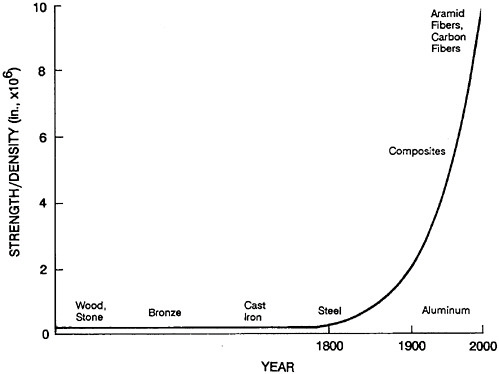
FIGURE 1.1 Progress in materials strength-to-density ratio as a function of time, showing a 50-fold increase in the strength of today’s advanced materials compared to that of primitive materials.
-
section of 1 in.×1 in. weighing about 4 lb/ft. To suspend the same weight from a modern high-strength polymer fiber would require a fiber with a cross section of 0.3 in.×0.3 in. weighing about 1 oz/ft. We experience the results of these advances every day, for example, in household appliances that are lighter and more efficient, in eyeglasses that are more comfortable, and in automobiles and airplanes that use less fuel and go faster.
-
The efficiency with which heat energy is converted to mechanical or electrical energy in engines and power plants is another engineering measure important to society. This efficiency depends directly on the temperature at which the device can operate well; thus materials that are strong at high temperatures are desired. Superalloys can now operate at temperatures of over 2000°F, and advanced ceramics may push engine operating temperatures to 2500°F (Figure 1.2). The maximum theoretical efficiency of such engines is about 80 percent, whereas the efficiency of conventional engines is limited to about 60 percent. The ultimate result is more efficient production of energy
-
in the forms needed by society, with a concomitant reduction in cost, fuel requirements, and pollution.
-
Before about the mid-1930s, the only permanent magnetic materials available were special steels. Modest improvements in the magnetic strength of these materials were made, but significant increases came only with the development of aluminum-nickel-cobalt alloys in the 1940s and 1950s. In the 1960s, the rare earth/cobalt alloys produced the next major jump, and the 1980s saw the development of the neodymium-iron-boron compounds. Today, permanent magnets have magnetic strengths more than 100 times greater than those available at the turn of the century (Figure 1.3). These and other magnetic materials are making possible smaller, more powerful motors and better and smaller sound systems, and they are carrying out many other hidden tasks in modern machines and devices.
-
Superconductivity was first discovered in 1911. After some 60 years of effort, researchers developed materials suitable for practical use at temperatures up to 23° above absolute zero (23 K, i.e., 250° below 0°C). Then, beginning in 1986, working with entirely new classes of materials, researchers developed a material with a superconducting transition temperature of 39
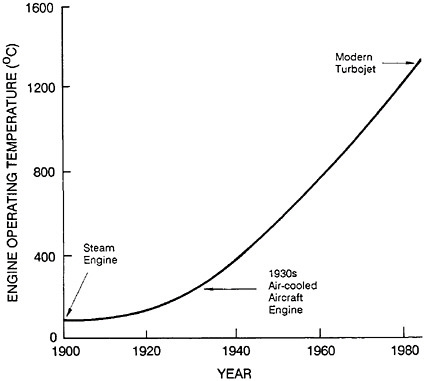
FIGURE 1.2 The steep climb in operating temperatures of engines during this century made possible by modern materials.
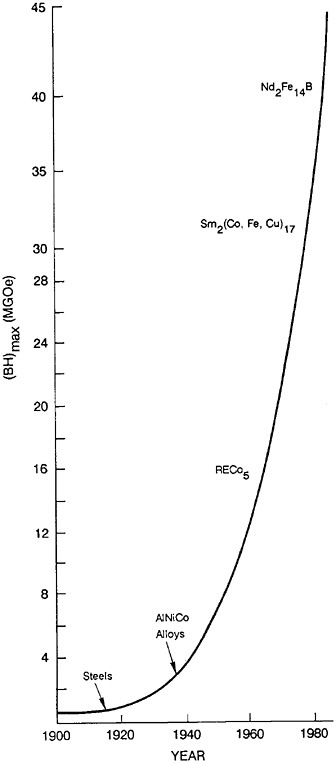
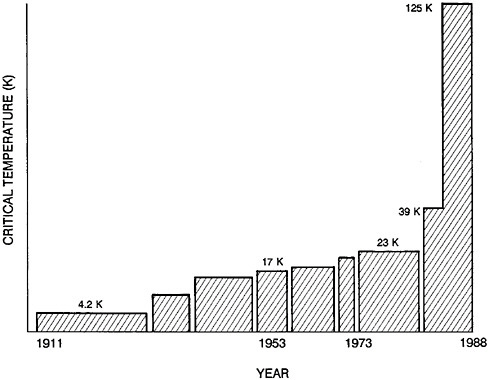
FIGURE 1.4 Progress of critical temperature of the best superconducting material as a function of time.
-
K.Rapid progress in developing materials with even higher transition temperatures culminated in the present (1988) record of 125 K (Figure 1.4). This discovery not only is of great scientific interest, but it also promises to have a significant practical impact in a wide range of fields. The technical difficulties that prevent the general use of these materials today are precisely those connected with synthesis and processing that contribute the principal challenge to materials science and engineering as a whole.
-
Scientists and technicians improved the transparency of silica glass slowly over the centuries from 3000 B.C. to 1966, when work on optical fibers was begun in earnest. Today, these fibers are some 100 orders of magnitude more transparent than they were in 1966 (Figure 1.5). A single glass fiber 0.01 mm in diameter can transmit thousands of telephone conversations—many more by far than can be sent over a conventional cable.
-
Even for abrasives and cutting tool materials, it is possible to find significant, often exponential increases in the performance of materials. Figure 1.6 shows, for example, that cutting tool speeds have increased by a factor of 100 since the turn of the century, owing to the development of new
-
materials. The result is far more efficient manufacturing processes that lower the costs of goods we buy.
-
In integrated electronic circuits, the number of components per chip has increased at exponential rates since about 1960 (Figure 1.7), making possible the ubiquitous and economical use of the electronic chip we know today. This increase has been achieved partly through steady reductions in line widths through continuing improvements in photolithography (Figure 1.8). Integrated circuits, in turn, have led to computers and electronics that have revolutionized our lives. This achievement is a triumph for both materials scientists and materials engineers, who have mastered the complex interacting relationships between phenomena, materials, and processing.
-
Innovations in materials processing have had enormous impacts on the factory floor. In the steel industry, for example, the average worker can now produce 6 times as much steel per hour as he could in the 1920s (Figure 1.9), and the finished steel is of higher quality.
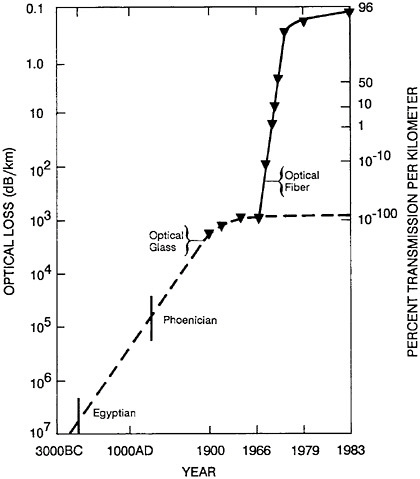
FIGURE 1.5 Historical improvement in glass transparency.
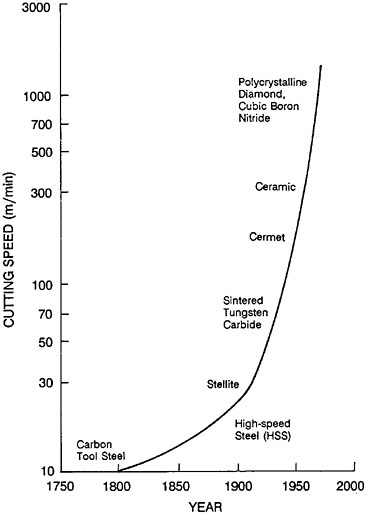
FIGURE 1.6 Trend in speeds of cutting tool materials. (Adapted from M.Tesaki and H.Taniguchi, 1984, High-Speed Cutting Tools: Sintered and Coated, Kogyo Zairyo (Industrial Materials) 32:64–71.)
Materials science and engineering influences our lives each time we buy or use a new device, machine, or structure. Some examples of developments now emerging from our laboratories include the following:
-
integrated circuits that will contain as many as a billion components per chip and thus will further the revolution in information technologies that has reshaped modern societies;
-
devices that can manipulate and store data optically and thus will contribute to a greatly increased use of optical technology in telecommunications and information storage;
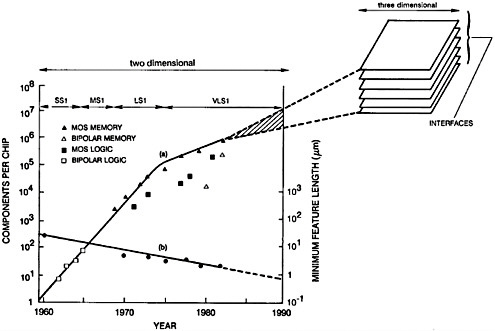
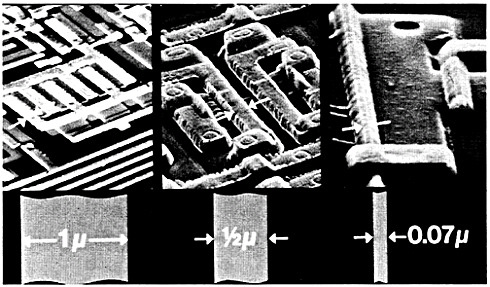
FIGURE 1.8 Micrographs of integrated circuits showing progress in reduction of feature sizes. (Courtesy Praveen Chaudhari, IBM Corporation.)
-
materials that can sense, in new ways, their environments of temperature, pressure, and chemistry for control of processes and machines;
-
active polymeric materials whose properties, such as color or rigidity, depend on applied electrical or photonic fields, with applications ranging from electronic devices to building materials; and
-
biomaterials that can serve as templates for the regrowth of human body parts, such as living tissue or organs.
MATERIALS SCIENCE AND ENGINEERING AS A FIELD
What is the nature of materials science and engineering, a field that so profoundly affects the quality of our lives in so many different ways? The intellectual core and definition of the field stem from a realization concerning the application of all materials: whenever a material is being created, developed, or produced, the properties or phenomena the material exhibits are of central concern. Experience shows that the properties and phenomena associated with a material are intimately related to its composition and structure at all levels, including which atoms are present and how the atoms are arranged in the material, and that this structure is the result of synthesis and processing. The final material must perform a given task and must do so in an economical and societally acceptable manner.
It is these elements—properties, structure and composition, synthesis and processing, and performance and the strong interrelationship among them—that define the field of materials science and engineering. These elements and their relationships are shown schematically in Figure 1.10 in the form of a tetrahedron. In developing new materials, it is difficult to anticipate where seeking knowledge ends and applying it begins. Hence science and engineering are inextricably interwoven in the field of materials science and engineering.
The field of materials science and engineering has evolved along many parallel and intertwined paths associated with academic disciplines, R&D laboratories, and the factory floor. It draws on areas as diverse as quantum mechanics on the one hand and societal needs, including manufacturing, on the other. A proper perspective from which to consider the field requires understanding of the roles of science and engineering and their synergies.
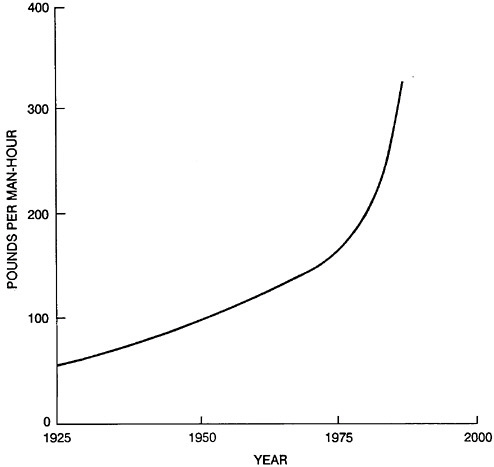
FIGURE 1.9 Production of steel in the United States in pounds per man-hour (1 kg= 2.2 lb).
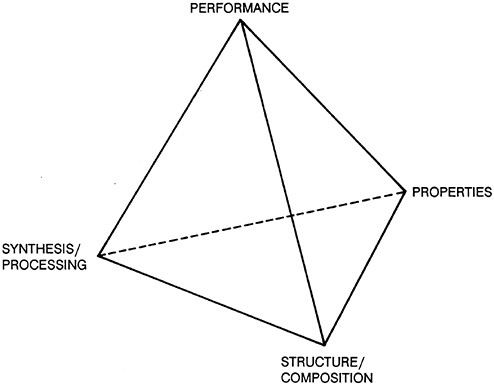
FIGURE 1.10 The four elements of materials science and engineering.
At the science end of its spectrum, materials science and engineering is rooted in the classical disciplines of physics and chemistry. Condensed-matter physicists, solid-state chemists, and synthetic chemists form the bridge between fundamental science and a subset of that science on which modern materials science and engineering rests. These sciences aim to increase knowledge, and especially understanding, of structure, phenomena, behavior, or synthesis. Very often, the stimulation for this group to follow a particular direction of research may come from a technical problem. But the most important advances typically have been made when the research has been placed in a broad context and has been allowed to follow directions whose promise may not have been apparent at the outset.
Earlier in this century, the discovery and understanding of dislocations in crystals revolutionized our understanding of the strength of materials and led to the development of vastly improved structural materials. Understanding of the electronic structures of semiconductors, especially how they are influenced by impurities and in the vicinity of a surface, led to the development of the transistor and, subsequently, to the integrated circuit, which led to the microelectronic revolution.
The deep understanding of the quantum mechanical energy levels of atoms
and molecules and of the coupling of electronic motion to light and other forms of radiation made possible the invention of the laser. This discovery, in turn, led to a variety of solid-state lasers, which are used in communication and in information storage.
In three consecutive years—1985, 1986, and 1987—three great advances in fundamental materials science were recognized by the awarding of Nobel Prizes:
-
. In 1980, in the course of fundamental studies of electrons moving in semiconductor surfaces, an entirely new and unexpected effect, the quantum Hall effect (associated with almost total absences of electrical resistance), was discovered (Figure 1.11). It should be noted that this research was certainly stimulated in part by the enormous technical interest in electrons near semiconductor surfaces. The experiments were entirely dependent on recent progress in materials science and engineering, which had made possible the preparation of surfaces with extremely well-controlled properties. The full implications of the Hall effect for our understanding of the dynamics of surface electrons are still being developed.
-
. In the early 1980s a radically new type of microscope, the scanning tunneling microscope, was developed. It depended on a subtle quantum mechanical effect, the tunneling of electrons below the tops of barriers (an event that could not happen under the laws of Newtonian mechanics). This technique led to incredibly accurate information about the positions of individual atoms on surfaces (Figure 1.12). Displacements of the order of 1 percent of the normal interatomic distance can be detected with the scanning tunneling microscope. Instruments of this kind can now be produced very cheaply (for about $25,000) and are responsible for exciting advances in such fields as surface physics, electrochemistry, and biology.
-
. Superconductivity was discovered in 1911 in mercury, which lost all electrical resistance below 4.3 K above absolute zero. By the early 1970s, a painstaking materials science effort lasting more than 60 years had led to metallic compounds that remained superconducting at up to 23 K, an average increase of about 0.3 K/yr. No further progress occurred until 1986, when researchers studying entirely different classes of compounds discovered superconductivity at up to 39 K. Since then, based on accumulated knowledge of materials, compounds have been developed that remain superconducting at up to 125 K. Although major materials problems remain to be overcome (e.g., poor ductility and low critical currents), we may well be on the threshold of a technological revolution started by superconduction.
Breakthroughs such as these cannot be predicted or planned, but the environment conducive to their continued occurrence can be. It requires sustained support for and commitment to the basic science that undergirds materials science and engineering.
Collectively, practitioners of materials science and engineering generate
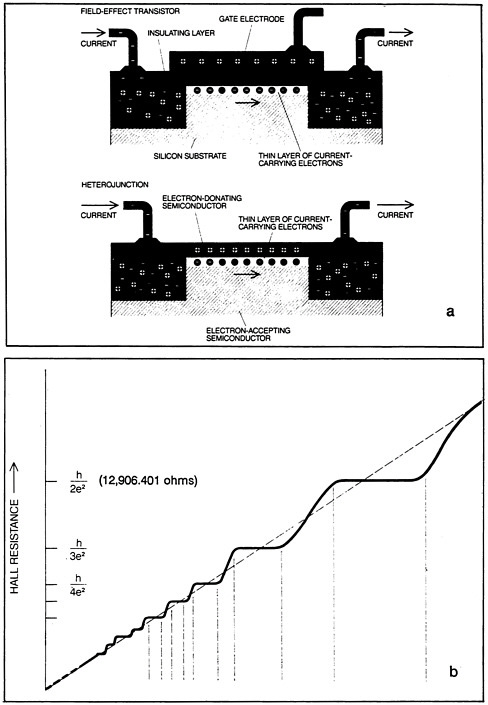
FIGURE 1.11 Quantum Hall effect, (a) Semiconductor devices in which the quantum Hall effect is observed hold current-carrying electrons within a thin layer of semiconducting crystal, (b) Quantum Hall effect appears as plateaus in the Hall resistance of a sample. (Reprinted, by permission, from Bertrand I.Halperin, 1986, The Quantized Hall Effect, Sci. Am. 254:52–60. Copyright © 1986 by Scientific American, Inc. All rights reserved.)
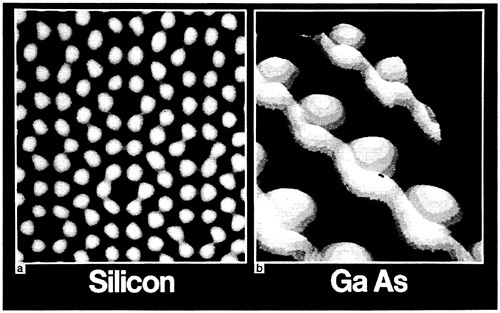
FIGURE 1.12 (a) Scanning tunneling microscope image of silicon surface, (b) Scanning tunneling microscope image of gallium arsenide (GaAs) surface. (Reprinted, by permission, from Praveen Chaudhari. Copyright © 1988 by IBM Corporation.)
and build on the field’s scientific base. They understand and exploit the fundamentals of both basic science and engineering, and they translate scientific breakthroughs into forms beneficial to society. Semiconductor devices and integrated circuits would never have been developed if both science and engineering had not been understood; the development of a room-temperature laser required an understanding of semiconducting phenomena and structure (e.g., defects in solids) and of their relationship to processing. Similarly, building and processing of modern composite materials require an understanding of surface science and molecular bonding as well as a strong engineering foundation. Future development of superconducting materials is also essentially dependent on materials science and engineering because such advances require expertise in understanding materials phenomena and their relationship to structure and defects in the structure, to processing (which influences the structure), and to other properties such as brittleness and susceptibility to environmental degradation.
The general approach to solving materials problems for applications came from metallurgists. It was first used at the turn of the century and continued to develop as the relationship between structure, properties, and performance of metals was clearly established. Over time, the important role of processing
in controlling structure was realized. The critical role of processing is a central theme of this report. Today, relationships between structure, properties, performance, and processing are understood to apply not only to metals, but also to all classes of materials. Thus modern materials engineering involves exploitation of relationships among the four basic elements of the field—structure and composition, properties, synthesis and processing, and performance (i.e., the elements shown schematically in Figure 1.10), basic science, and industrial and broader societal needs.
Some important materials discoveries have been made by scientists, some by engineers, and still others by craftsmen. Many have been made by teams comprising all three types of individuals. Today, craftsmanship alone, in the absence of modern science and engineering, rarely suffices to bring about a new development in materials. Craftsmanship alone is also increasingly inadequate with respect to processing or production of materials.
A crucial challenge for the future is to find ways of carrying out education, research, and engineering—including production—that encourage the maximum interaction among scientists and engineers, among mathematicians, physicists, chemists, and biologists, and among the four basic elements of materials science and engineering. Supporting such interactions is a difficult task requiring much wisdom, and, realistically, a willingness to make tradeoffs. But progress in accomplishing this task is both possible and essential.
WHO ARE MATERIALS SCIENTISTS AND ENGINEERS?
Materials scientists and engineers study the structure and composition of materials on scales ranging from the electronic and atomic through the microscopic to the macroscopic. They develop new materials, improve traditional materials, and produce materials reliably and economically through synthesis and processing. They seek to understand phenomena and to measure materials properties of all kinds, and they predict and evaluate the performance of real materials as structural or functional elements in engineering systems. This diversity of interests is mirrored in the fields of materials science and engineering practitioners, who come from a broad range of academic departments and disciplines.
There is a growing realization among scientists and engineers that, to develop materials for society, all four elements of materials science and engineering are needed. Even though an individual may identify with a physics, metallurgy, or other department in a university emphasizing a particular aspect of the field, it is implicitly and increasingly recognized that important contributions will come from various disciplines working together.
The interdisciplinary nature of materials science and engineering and its growth as a field have also been recognized in the professional world outside academia. For example, the American Society for Metals, once the largest
metallurgical society in the United States, has expanded to become a broad materials society with a new name, ASM International, with a membership numbering about 53,000. The Materials Research Society, established early in 1973, has been one of the fastest growing professional societies in the United States; its current membership includes approximately 8000 individuals. Many industrial and governmental research laboratories have been reorganized into groupings that cut across traditional disciplines and materials areas and have titles such as “materials synthesis,” “materials chemistry,” and “materials performance.” As the science and engineering base of this new field of materials science and engineering develops, so must the process by which its practitioners are educated and the infrastructure and resources with which they approach their task.
SCOPE OF THIS REPORT
This report discusses the vital role that materials science and engineering plays in the development of technology. Chapter 2 summarizes the committee’s findings about the impact of materials science and engineering on private and public sector activities that are crucial to U.S. economic and strategic well-being. Opportunities for research are discussed from two perspectives: Chapter 3 describes needs for new materials and for novel methods of processing in terms of the functional roles of materials; Chapter 4 describes research opportunities in the context of the four basic elements of materials science and engineering, thus emphasizing the intellectual coherence of the field while also stressing the essential connection between basic research and progress in developing materials. Educational challenges posed by the national need to encourage such progress and to ensure an adequate supply of well-trained materials researchers are considered in Chapter 5, which briefly assesses resources available for educating materials scientists and engineers at various levels of the U.S. educational system and also emphasizes the significance of the field’s multidisciplinary aspect. Chapter 6 presents the committee’s findings about funding and facilities currently available—as well as those needed in the future—to support the research efforts of materials scientists and engineers who work at the perennially shifting boundary between gathering knowledge and applying it. Finally, to examine from a broader perspective its assessment that materials science and engineering is vital to the future development of U.S. technology, the committee also examined how a number of nations view materials science and engineering and its role in their development. The international perspective is presented in Chapter 7. The committee is convinced that its findings and recommendations, if implemented, will strengthen the field of materials science and engineering and, in so doing, will contribute immeasurably and in unanticipated ways to meeting U.S. needs for economic and strategic security as well as the future needs of mankind.


