
SUCCESS IS NOT SERENDIPITOUS: MAKING CONSTRUCTION INNOVATION WORK IN THE REAL WORLD
Ken P. Chong
National Science Foundation
The central theme of this symposium is federal policies to foster innovation. We have heard a lot about design-build. I'd like to give some observations. I recently drove on the autobahns of Europe. I noticed they don't have too many potholes there, and there is no speed limit either. I understand that their pavements are twice as thick as ours. They not only design-build, they also have to maintain it for a certain number of years. That may be one way to go.
The global picture of what is at stake when we talk about this improvement in innovation in constructed facilities is as follows. The total cost of construction in the world is about $1.5 trillion; that is 10 to the 12th power or roughly 10 percent of the gross national product of the world.
The U.S. share of that is about $500 billion, according to a recent National Science Foundation-Civil Engineering Research Foundation survey (NSF/CERF). About one-tenth of that, about $50 billion, is in the federal construction area. This level of funding could act as a catalyst to promote innovation. And that's precisely what we have in mind. The U.S. construction industry, again according to the NSF/CERF survey, accounts for about 0.5 percent of the sales in research and development (R&D) in this country. Industry in the U.S. spends on average about 3.4 percent of its funds on R&D. The construction industry really spends about only one-seventh of the U.S. industrial average on R&D. According to an Office of Technology Assessment report for Congress, this is 30 times less than Japan and about 8 times less than the major European counterparts.
Infrastructure in this country is worth about $20 trillion. According to Dr. Dave Sharmer, one of the administrators of the Department of Transportation, constructed infrastructure of transportation is about $2.4 trillion. So of this $20 trillion worth of infrastructure, about $2.4 trillion of that is in transportation. A lot of these constructed facilities are 50 years old or more. Like the interstate
system, they were built in the Eisenhower era and are deteriorating. Deterioration is caused by corrosion, stress fractures and fatigue, overuse, and other factors. If you look at corrosion alone, the estimate is $250 billion a year in corrosion losses in the United States. Any new technology that we can develop to monitor, predict, sense or mitigate the corrosion early, will be quite beneficial. Suppose for example, we could mitigate the effects of corrosion and make the structure last 10 percent longer? That could equal a cost savings of $25 billion. This is about seven times the budget for NSF, which is $3.5 billion.
With that kind of perspective, you can see that innovation pays. We are looking at life-cycle performance, efficiency, improved quality. The life cycle is a useful concept. We still need to overcome some of the challenges. For example, how do we characterize and quantify the life-cycle costs so that the policy makers can make intelligent decisions? As an example, let's say we spent 10 percent more initially on the material or on the construction of a structure to double the life of this structure and save energy. Those are tremendous payoffs. But how can we quantify those payoffs? That is one of the challenges.
Figure 1 illustrates one of the initiatives which I have helped to develop at the National Science Foundation. It is called Civil Infrastructure Systems and is a $55 million initiative.
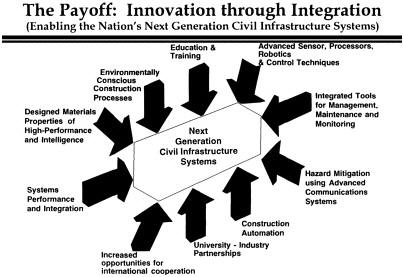
FIGURE 1 Civil Infrastructure Systems
We are looking into the next generation of infrastructure, which we think should possess some of the following characteristics. The structure doesn't tell you whether it is about to collapse or not. It doesn't have the intelligence. It doesn't have the sensors. It doesn't have the control. The next generation of structures might have some or all of these things. They may be more environmentally friendly and provide the feedback and the control to the user to make it more comfortable to stay in. These are some of those attributes that we think are the payoffs.
ABOUT THE SPEAKER
Marcel H. Cheyrezy is Director of the Research and Development Department of the Bouygues Group and associate professor of civil engineering at the École Normale Supèrieure de Cachan. Mr. Cheyrezy received his engineering degree from the École Nationale des Ponts et Chaussèes in Paris. Mr. Cheyrezy is Chairman of GMC—the Rilem Technical Committee.


