
developed regions of the world, cost appears to be the primary obstacle to its use in poorer nations. Cost may serve as an even larger disincentive in the case of vaccines against Streptococcus pneumoniae, which will probably contain mixtures of 7 to 10 individual serotype preparations. Workshop attendees discussed at length a number of approaches to reducing the cost of these vaccines, including simplifying the production process. As was also pointed out, however, where popular demand for a vaccine is strong enough, governments may purchase and distribute to the public (at a nominal price or for free) even an expensive vaccine.
ARI AND MENINGOCOCCAL MENINGITIS IN THE DEVELOPING WORLD1
ARI is the leading cause of death in children under age 5. ARI-related microorganisms are implicated in some 30 percent of the roughly 14 million annual deaths in that age group (Figure 1). Nearly three-quarters of children who succumb to a respiratory illness die of pneumonia. Viruses, particularly the respiratory syncytial, parainfluenza, and influenza viruses, are isolated more frequently than are bacteria from children with pneumonia. However, bacteria appear to play a more important role in severe or fatal pneumonia, especially in the developing world.
In these regions, approximately half of children hospitalized with untreated severe pneumonia harbor bacteria in their lungs. Taken together, S. pneumoniae and H. influenzae may comprise up to 80 percent of the organisms isolated from the lungs of these patients. The frequency with which these two organisms can be isolated from the upper respiratory tract of normal children under 1 year of age approaches 100 percent in some parts of the developing world.
The global burden of Neisseria meningitides-caused meningitis is relatively small compared to that of the respiratory pathogens. One recent estimate, prepared by scientists at the Centers for Disease Control and Prevention (CDC), places the total number of annual cases worldwide in children under age 5 at 170,000 and the total number of yearly deaths in this age group at 16,000. This is probably an underestimate, however, since much of the available information about meningitis incidence comes from passive rather than active reporting. In many parts of the world where meningitis epidemics are a recurring health threat, there are limited laboratory capabilities to confirm these diagnoses. Despite the relatively small absolute number of N. meningitides-caused deaths, the epidemic potential of this pathogen is significant and is a key factor driving the development of meningococcal vaccines.
|
1 |
This section is based primarily on material presented by Floyd Denny. |
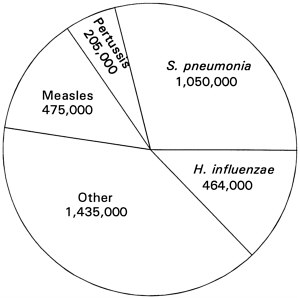
FIGURE 1 Etiology of deaths due to acute respiratory infection (ARI). According to the World Health Organization, there were 3.63 million deaths due to ARI in 1994. NOTE: The leading pathogen in the “Other” group is respiratory syncytial virus. SOURCE: Adapted from CDC, 1994.
The incidence of ARI is consistent across the continuum of developing and developed countries. However, in terms of disease severity and mortality, those in the developing world fare far worse than their developed-world counterparts. Among the variety of epidemiologic risk factors for ARI, three stand out as especially important: being very young, being malnourished, and living in poverty. These and other risk factors are described in a recent series of studies overseen by the National Research Council’s Board on Science and Technology for International Development.2
|
2 |
Reviews of Infectious Diseases, Vol. 12, Suppl. 8, November–December 1990, pp. S861–S1083. |
Although pneumonia is the principal clinical sign in children with acute lower respiratory infections (ALRI), researchers have an incomplete understanding of pneumonia etiology. This is largely because of the lack of effective bacterial pneumonia diagnostics, which makes it difficult to confirm the role of a particular bacterial causative agent, since so many healthy children carry Hib and S. pneumoniae. Based on a model developed by the CDC, S. pneumoniae is thought to account for the majority of deaths in children under age 5 (Figure 2). The pathogenesis of acute respiratory disease also is poorly understood, in part because of the paucity of developing-world autopsy data. Also requiring more study is the relative importance of viruses and bacteria in causing illness.
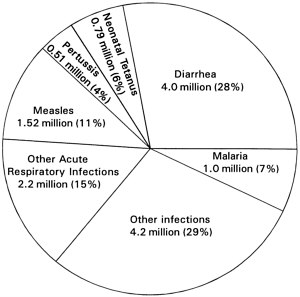
FIGURE 2 Annual deaths of children under age 5 by main causes. For the purpose of this chart, one cause has been allocated for each child’s death, in practice, children often die of multiple causes, and malnutrition is a contributory cause in approximately one-third of all child deaths. Measles deaths are sometimes ascribed to acute respiratory infection, as a severe case of measles renders a child highly susceptible to other infections. Pneumonia is often the ultimate reason for a death for which measles is primarily responsible. SOURCE: Adapted from UNICEF, 1990.


