
1 INTRODUCTION
Although the same physical principles govern the operation of free electron lasers (FELs) in all wavelength regions, the costs and benefits of FELs depend strongly on wavelength. Therefore, this report is organized largely according to spectral region. Chapter 2 describes the history of free electron lasers, the principles of their operation, and their properties, and it lists existing and some of the proposed FELs.
Chapter 3, Chapter 4, Chapter 5 through Chapter 6 each deal with a specific spectral region: Chapter 3 covers the far infrared from 1000 to 10 µm; Chapter 4, the region from 10 µm to 200 nm, including the near infrared, the visible, and the ultraviolet; Chapter 5, the region from 200 to 10 nm, a region referred to as the vacuum ultraviolet and extended ultraviolet; and Chapter 6, the x-ray from 100 to 1 Å. Each chapter describes the present capabilities of photon sources, including FELs and other advanced coherent light sources if they exist, as well as more conventional sources; in addition, each outlines some proposed FELs that have been envisioned but do not currently exist. Also presented in each chapter is a discussion of scientific opportunities that will require sophisticated sources of photons, along with comments on which source or combination of sources is likely to be most appropriate. In discussing scientific opportunities, the committee has not tried to be exhaustive in listing all possible experiments that might use FELs or other advanced coherent light sources. Instead, it has selected, from among the many potential opportunities of which it was informed, those that seemed to represent the most interesting problems and the most exciting possibilities. Finally, each chapter ends with a list of the committee's findings and recommendations.
There were some general concerns that apply to the future development of free electron lasers in all wavelength regions that the committee believed were important but that did not fit into the chapters on individual wavelength regions. These are discussed in Chapter 7.
As a basis of comparison among various photon sources, Figure 1, Figure 2, Figure 3, Figure 4, Figure 5 to Figure 6 give the peak power, pulse energy, and average power of various photon sources as a function of wavelength. Because photon sources have many important properties other than the three described in these figures, the figures cannot be used by themselves to identify the source of choice for any given experiment. They may, however, be qualitatively useful to readers of this report.
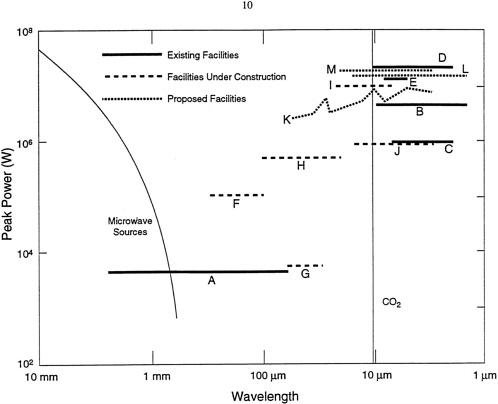
FIGURE 1 The peak power as a function of wavelength is shown for the following existing and proposed infrared radiation sources. Appendix B provides further details on each facility. SOURCE: Courtesy of Erik Johnson, Brookhaven National Laboratory.
|
EXISTING FEL FACILITIES |
WAVELENGTH RANGE |
|
|
A |
University of California at Santa Barbara (UCSB) |
2.5 mm - 60 µm |
|
B |
Mark III FEL at Duke University (Mark III) |
9.5 - 1.5 µm |
|
C |
Stanford Picosecond FEL Center (SPFELC) |
7 - 2 µm |
|
D |
Vanderbilt University FEL Center (Vanderbilt) |
10 - 2 µm |
|
E |
Advanced FEL at Los Alamos National Laboratory (AFEL) |
8 - 5 µm |
|
FEL FACILITIES UNDER CONSTRUCTION |
||
|
F |
Stanford University FEL |
300 - 100 µm |
|
G |
University of California at Santa Barbara (UCSB) |
60 - 30 µm |
|
H |
Stanford Picosecond FEL Center (SPFELC) |
100 - 20 µm |
|
I |
Compact Infrared FEL Project (CIRFEL) |
20 - 7 µm |
|
J |
Stanford Picosecond FEL Center (SPFELC) |
15 - 3 µm |
|
PROPOSED FEL FACILITIES |
||
|
K |
Chemical Dynamics Research Laboratory FEL at LBL (CDRL) |
50 - 3 µm |
|
L |
Mark III FEL at Duke University (Mark III) |
15 - 1.5 µm |
|
M |
Continuous Electron Beam Accelerator Facility (CEBAF) |
20 - 3 µm |
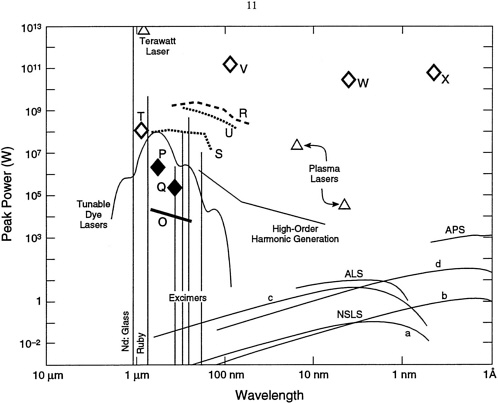
FIGURE 2 The peak power as a function of wavelength is shown for the following radiation sources in the short-wavelength region. Existing FEL facilities, solid lines or solid diamonds; FEL facilities under construction, dashed lines; proposed FEL facilities, dotted lines or open diamonds. Synchrotron facilities include Argonne Nat'l Lab., APS-UA undulator; Lawrence Berkeley Lab., ALS-U5 undulator; Brookhaven Nat'l Lab., NSLS (a, UV bending magnet; b, X-ray bending magnet; c, UV undulator U13/UA; d, X-ray wiggler X21/X25). Appendix B and Appendix C provide further details on each facility. SOURCE: Courtesy of Erik Johnson, Brookhaven National Laboratory.
|
EXISTING FEL FACILITIES |
WAVELENGTH RANGE |
|
|
O |
OK4 Optical Klystron at VEPP-3 in Novosibirsk |
690 - 240 nm |
|
P |
High Average Power FEL, Boeing Space and Defense |
630 - 510 nm |
|
Q |
Average Power Laser Prototype Experiment, Los Alamos Nat'l Lab. |
380 - 369 nm |
|
FEL FACILITIES UNDER CONSTRUCTION |
||
|
R |
OK4 Optical Klystron at Duke University |
400 - 50 nm |
|
PROPOSED FEL FACILITIES |
||
|
S |
Continuous Electron Beam Accelerator Facility (CEBAF) |
1 µm - 170 nm |
|
T |
Advanced FEL, Los Alamos National Laboratory (AFEL) |
900 - 800 nm |
|
U |
Deep Ultraviolet FEL, Brookhaven National Laboratory (DUV) |
300 - 75 nm |
|
V |
Chirped Pulse Amplifier FEL, Brookhaven National Lab. (CPA) |
88 nm |
|
W |
Linear Coherent Light Source-1, Stanford Linear Accelerator Center |
4 nm |
|
X |
Linear Coherent Light Source-2, Stanford Linear Accelerator Center |
0.45 nm |
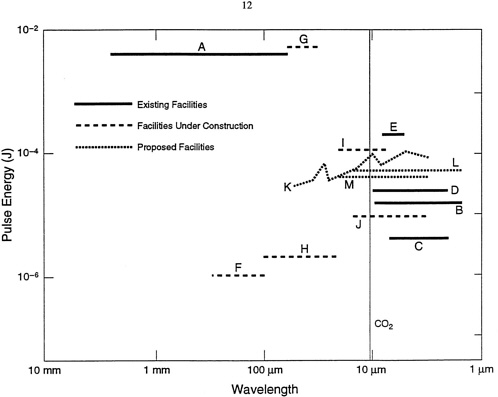
FIGURE 3 The pulse energy as a function of wavelength is shown for the following existing and proposed infrared radiation sources. Appendix B provides further details on each facility. SOURCE: Courtesy of Erik Johnson, Brookhaven National Laboratory.
|
EXISTING FEL FACILITIES |
WAVELENGTH RANGE |
|
|
A |
University of California at Santa Barbara (UCSB) |
2.5 mm - 60 µm |
|
B |
Mark III FEL at Duke University (Mark III) |
9.5 - 1.5 µm |
|
C |
Stanford Picosecond FEL Center (SPFELC) |
7 - 2 µm |
|
D |
Vanderbilt University FEL Center (Vanderbilt) |
10 - 2 µm |
|
E |
Advanced FEL at Los Alamos National Laboratory (AFEL) |
8 - 5 µm |
|
FEL FACILITIES UNDER CONSTRUCTION |
||
|
F |
Stanford University FEL |
300 - 100 µm |
|
G |
University of California at Santa Barbara (UCSB) |
60 - 30 µm |
|
H |
Stanford Picosecond FEL Center (SPFELC) |
100 - 20 µm |
|
I |
Compact Infrared FEL Project (CIRFEL) |
20 - 7 µm |
|
J |
Stanford Picosecond FEL Center (SPFELC) |
15 - 3 µm |
|
PROPOSED FEL FACILITIES |
||
|
K |
Chemical Dynamics Research Laboratory FEL at LBL (CDRL) |
50 - 3 µm |
|
L |
Mark III FEL at Duke University (Mark III) |
15 - 1.5 µm |
|
M |
Continuous Electron Beam Accelerator Facility (CEBAF) |
20 - 3 µm |
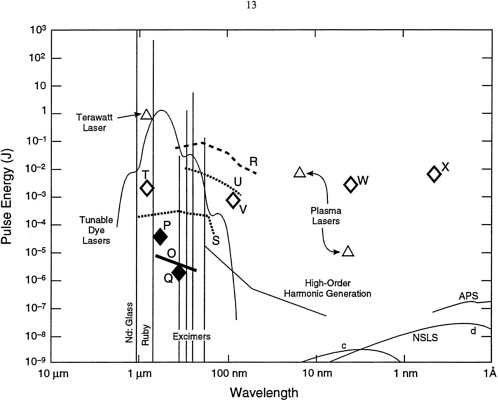
FIGURE 4 The pulse energy as a function of wavelength is shown for the following radiation sources in the short-wavelength region. Existing FEL facilities, solid lines or solid diamonds; FEL facilities under construction, dashed lines; proposed FEL facilities, dotted lines or open diamonds. Synchrotron facilities include Argonne Nat'l Lab., APS-UA undulator; Lawrence Berkeley Lab., ALS-U5 undulator; Brookhaven Nat'l Lab., NSLS (a, UV bending magnet; b, X-ray bending magnet; c, UV undulator U13/UA; d, X-ray wiggler X21/X25). Appendix B and Appendix C provide further details on each facility. SOURCE: Courtesy of Erik Johnson, Brookhaven National Laboratory.
|
EXISTING FEL FACILITIES |
WAVELENGTH RANGE |
|
|
O |
OK4 Optical Klystron at VEPP-3 in Novosibirsk |
690 - 240 nm |
|
P |
High Average Power FEL, Boeing Space and Defense |
630 - 510 nm |
|
Q |
Average Power Laser Prototype Experiment, Los Alamos Nat'l Lab. |
380 - 369 nm |
|
FEL FACILITIES UNDER CONSTRUCTION |
||
|
R |
OK4 Optical Klystron at Duke University |
400 - 50 nm |
|
PROPOSED FEL FACILITIES |
||
|
S |
Continuous Electron Beam Accelerator Facility (CEBAF) |
1 µm - 170 nm |
|
T |
Advanced FEL, Los Alamos National Laboratory (AFEL) |
900 - 800 nm |
|
U |
Deep Ultraviolet FEL, Brookhaven National Laboratory (DUV) |
300 - 75 nm |
|
V |
Chirped Pulse Amplifier FEL, Brookhaven National Lab. (CPA) |
88 nm |
|
W |
Linear Coherent Light Source-1, Stanford Linear Accelerator Center |
4 nm |
|
X |
Linear Coherent Light Source-2, Stanford Linear Accelerator Center |
0.45 nm |
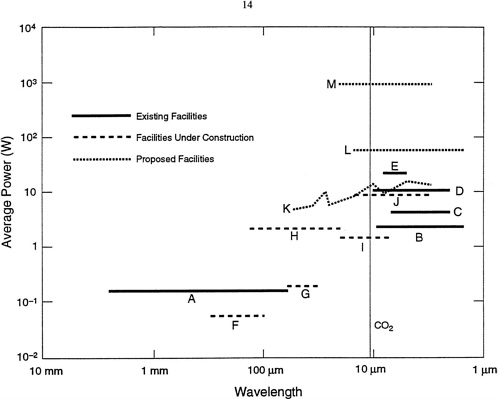
FIGURE 5 The average power as a function of wavelength is shown for the following existing and proposed infrared radiation sources. Appendix B provides further details on each facility. SOURCE: Courtesy of Erik Johnson, Brookhaven National Laboratory.
|
EXISTING FEL FACILITIES |
WAVELENGTH RANGE |
|
|
A |
University of California at Santa Barbara (UCSB) |
2.5 mm - 60 µm |
|
B |
Mark III FEL at Duke University (Mark III) |
9.5 - 1.5 µm |
|
C |
Stanford Picosecond FEL Center (SPFELC) |
7 - 2 µm |
|
D |
Vanderbilt University FEL Center (Vanderbilt) |
10 - 2 µm |
|
E |
Advanced FEL at Los Alamos National Laboratory (AFEL) |
8 - 5 µm |
|
FEL FACILITIES UNDER CONSTRUCTION |
||
|
F |
Stanford University FEL |
300 - 100 µm |
|
G |
University of California at Santa Barbara (UCSB) |
60 - 30 µm |
|
H |
Stanford Picosecond FEL Center (SPFELC) |
100 - 20 µm |
|
I |
Compact Infrared FEL Project (CIRFEL) |
20 - 7 µm |
|
J |
Stanford Picosecond FEL Center (SPFELC) |
15 - 3 µm |
|
PROPOSED FEL FACILITIES |
||
|
K |
Chemical Dynamics Research Laboratory FEL at LBL (CDRL) |
50 - 3 µm |
|
L |
Mark III FEL at Duke University (Mark III) |
15 - 1.5 µm |
|
M |
Continuous Electron Beam Accelerator Facility (CEBAF) |
20 - 3 µm |
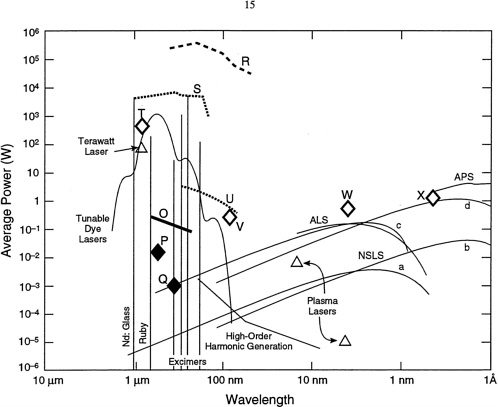
FIGURE 6 The average power as a function of wavelength is shown for the following radiation sources in the short-wavelength region. Existing FEL facilities, solid lines or solid diamonds; FEL facilities under construction, dashed lines; proposed FEL facilities, dotted lines or open diamonds. Synchrotron facilities include Argonne Nat'l Lab., APS-UA undulator; Lawrence Berkeley Lab., ALS-U5 undulator; Brookhaven Nat'l Lab., NSLS (a, UV bending magnet; b, X-ray bending magnet; c, UV undulator U13/UA; d, X-ray wiggler X21/X25). Appendix B and Appendix C provide further details on each facility. SOURCE: Courtesy of Erik Johnson, Brookhaven National Laboratory.
|
EXISTING FEL FACILITIES |
WAVELENGTH RANGE |
|
|
O |
OK4 Optical Klystron at VEPP-3 in Novosibirsk |
690 - 240 nm |
|
P |
High Average Power FEL, Boeing Space and Defense |
630 - 510 nm |
|
Q |
Average Power Laser Prototype Experiment, Los Alamos Nat'l Lab. |
380 - 369 nm |
|
FEL FACILITIES UNDER CONSTRUCTION |
||
|
R |
OK4 Optical Klystron at Duke University |
400 - 50 nm |
|
PROPOSED FEL FACILITIES |
||
|
S |
Continuous Electron Beam Accelerator Facility (CEBAF) |
1 µm - 170 nm |
|
T |
Advanced FEL, Los Alamos National Laboratory (AFEL) |
900 - 800 nm |
|
U |
Deep Ultraviolet FEL, Brookhaven National Laboratory (DUV) |
300 - 75 nm |
|
V |
Chirped Pulse Amplifier FEL, Brookhaven National Lab. (CPA) |
88 nm |
|
W |
Linear Coherent Light Source-1, Stanford Linear Accelerator Center |
4 nm |
|
X |
Linear Coherent Light Source-2, Stanford Linear Accelerator Center |
0.45 nm |


