
OUTDOOR SPORTING GOODS
Bruce Guile
The size of the U.S. outdoor sporting goods industry—that includes backpacks, climbing ropes, kayaks, tents, and ski parkas, to name a few items—varies considerably depending on how it is defined relative to the much larger general sporting goods industry. Perhaps the easiest way to start is with how the industry defines itself. First, the recently formed Outdoor Recreation Coalition of America (ORCA)—a trade association “for the human-powered outdoor recreation industry”—lists the following sports as outdoor recreation (Outdoor Recreation Coalition of America, 1993):
whitewater rafting
scuba diving
outdoor photography
backpacking
fitness walking
mountain biking
ice climbing
canoeing
in-line skating
fly fishing
caving
cross-country skiing
hiking
nature study
birdwatching
camping
rock climbing
kayaking
windsurfing
mountaineering
sightseeing
snowshoeing
Bruce Guile is director of the Program Office of the National Academy of Engineering.
This paper was prepared for an NAE workshop on small companies in outdoor sporting equipment on February 14–15, 1994, during the Outdoor Retailer Expo in Reno, Nevada.
As a general rule, sports in this industry see their future as intimately related to the use of public wilderness land, public forests, and public natural parks. Table 1 and Figure 1 are adapted from a 1993 report by ORCA on the state of the industry. Table 1 shows the variety of recreational uses of public lands. Figure 1 shows the demographics of participants in outdoor sports activities. Table 1 is particularly interesting in that it illustrates the heavy recreational use of public lands that underlies the industry’s perception that maintenance and accessibility of these areas is a key public policy issue.
There are exceptions to this definition, however. For example, rock climbing clearly is, in the industry’s vernacular, an outdoor sport, even though much of the recent growth in climbing has been fueled by indoor climbing gyms. In-line skating (a sport that requires a great deal of concrete or asphalt) is often included among outdoor sports while biking, except off-road mountain biking, is excluded. Also, the exclusion of hunting equipment companies is an economic mystery if not a political one.
The 1993 ORCA report, drawing on U.S. Department of Interior data, estimated annual consumer expenditures for outdoor recreation at $15.1 billion. Of this, equipment was estimated at $6.85 billion; trip-related food, lodging, and transportation totaled $7.16 billion; and miscellaneous (including specialty magazines, membership dues, and land-use fees) accounted for $1.1 billion (Outdoor Recreation Coalition of America, 1993). These estimates diverge considerably from estimates by the Sporting Goods Manufacturers Association (SGMA) of industry sales, by broad product category, for 1993 (see Table 2). In Table 2, the value of U.S. manufacturers’ shipments is considerably lower than the ORCA estimate of nearly $7 billion for equipment: SGMA estimates total revenues for camping, in-line skates, scuba and skin diving, skiing, fishing, skiing and outerwear, and hiking/outdoor footwear to be $4.5 billion. Using these estimates, then, the U.S. outdoor sporting goods industry may be valued at between $4 billion and $7 billion (Sporting Goods Manufacturers Association, 1993).
A second definition of outdoor sporting goods that is perhaps more useful and consistent comes not from the products, but from segmentation in the consumer market and the segmentation in retail stores and trade shows that, presumably, mirrors consumer segmentation. The outdoor sporting goods industry’s largest U.S. trade show is the Outdoor Retailer Expo, which is sponsored by Outdoor Retailer magazine and attracts manufacturers who make products that are sold in outdoor specialty stores. Outdoor Retailer is a trade magazine aimed at the approximately 9,000 U.S. retail stores that define themselves as outdoor specialty retailers. The show they put on twice a year seems increasingly to define, through its exhibitors (mostly manufacturers producing products for the sports listed above) and attendees (mostly retailers), the rapid expansion of the outdoor sporting goods industry. From its inception in 1989, the show targeting summer sports has grown from 585 booths and 282 exhibitors to 1,727 booths and 683 exhibitors in August 1994; the show for winter sports has grown from 271 booths and 128 exhibitors in 1990 to 1,727 booths and 650 exhibitors in 1995. Retail buyer attendance
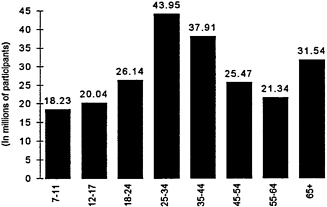
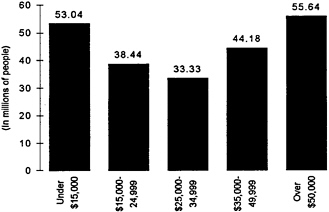
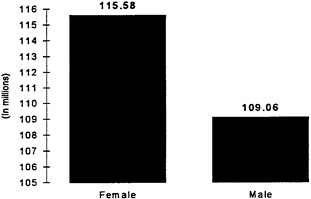
TABLE 1 How Public Lands Are Used for Recreation
|
Percentage of U.S. population using public lands for selected recreational activities |
|
|
Walking for pleasure |
41% |
|
Nature study |
36% |
|
Camping (developed) |
35% |
|
Day hiking |
24% |
|
Camping (primitive) |
14% |
|
Canoeing and kayaking |
14% |
|
Backpacking |
10% |
|
Cross-country skiing |
7% |
|
Source: Outdoor Recreation Coalition of America (ORCA), 1993 |
|
at each show exceeds 6,000 people. Total attendance for each show exceeds 14,000 (J.Alvarez. Publisher, Outdoor Retailer Magazine. Personal communication. 1995).
SMALL COMPANIES DOMINATE
Smaller, privately-held companies dominate the sporting goods industry. A prominent industry newsletter, Inside Sporting Goods (1994), has identified 62 public companies across a wide variety of sporting goods industry segments. Table 3 shows the distribution of size of market capitalizations and compares the distribution to that of the NASDAQ, the primary exchange for small and medium-size public companies in the United States.1
Of the six companies in the industry with market capitalizations over $1 billion, one is an apparel manufacturer (Russell Athletic), and three are primarily footwear companies (Nike, Reebok, and Fila). CML is a diversified retailer (Britches clothing, Smith and Hawkin lawn furniture, and the Nature Company) that is part of the industry primarily because of its ownership of the exercise equipment company NordicTrack. The sixth large company, Brunswick, manufactures equipment for bowling, billiards, fishing, and boats, marine engines, and accessories.
Another indicator of the small size of companies is provided by another industry newsletter, Sporting Goods Intelligence (1994), which collects data on sales from the largest companies in four
TABLE 2 SGMA Recreation Marketing Report—1993 U.S. Wholesale Value of Annual Manufacturers’ Shipments ($ millions)
|
|
1993 |
1992 |
||
|
A. SPORTS EQUIPMENT |
|
|||
|
Archery |
290 |
|
260 |
|
|
Baseball/Softball (ALL) |
328 |
|
315 |
|
|
Gloves and mitts |
|
87 |
|
90 |
|
Baseballs |
57 |
57 |
||
|
Softballs |
62 |
57 |
||
|
Bats |
80 |
72 |
||
|
Batting Gloves |
29 |
27 |
||
|
Protective |
13 |
12 |
||
|
|
328 |
315 |
||
|
Basketball (balls, backboards, accessories) |
136 |
|
129 |
|
|
Billiards |
195 |
174 |
||
|
Bowling |
208 |
200 |
||
|
Camping (ALL) |
1,225 |
1,160 |
||
|
Tents |
|
265 |
|
255 |
|
Coolers/chests |
265 |
250 |
||
|
Sleeping bags (excl. slumber) |
135 |
130 |
||
|
Jugs/containers |
85 |
85 |
||
|
Backpacks |
70 |
65 |
||
|
Electric lights |
85 |
75 |
||
|
Other |
320 |
300 |
||
|
|
1,225 |
1,160 |
||
|
Exercise (ALL) |
1,755 |
|
1,625 |
|
|
Exercise cycles |
|
200 |
|
200 |
|
Rowing machines |
10 |
10 |
||
|
Home gyms |
180 |
180 |
||
|
Treadmills |
460 |
400 |
||
|
Exercise benches |
80 |
70 |
||
|
Step climbing machines |
190 |
175 |
||
|
Cross-country ski machines |
350 |
330 |
||
|
Other retail |
150 |
140 |
||
|
Exercise—Institutional |
135 |
120 |
||
|
|
1,755 |
1,625 |
||
|
Firearms and hunting |
1,487 |
|
1,400 |
|
|
Footballs and sets |
120 |
114 |
||
|
Golf (ALL) |
1,335 |
1,270 |
||
|
Balls |
|
485 |
|
455 |
|
Clubs |
585 |
575 |
||
|
Other |
265 |
240 |
||
|
|
1,335 |
1,270 |
||
|
Ice skates and hockey |
140 |
|
120 |
|
|
Optical goods |
380 |
360 |
||
|
Racquetball |
56 |
58 |
||
|
In-line roller skates |
310 |
290 |
||
|
Skateboards |
65 |
70 |
||
|
Scuba and skin diving |
261 |
|
246 |
|
|
Snow skiing (alpine) |
299 |
259 |
||
|
Snow skiing (cross-country) |
25 |
23 |
||
|
Soccer (balls, accessories only) |
35 |
28 |
||
|
Table tennis |
22 |
24 |
||
|
Tennis (ALL) |
300 |
330 |
||
|
Balls |
|
91 |
|
100 |
|
Racquets |
156 |
170 |
||
|
Other |
53 |
60 |
||
|
|
300 |
330 |
||
|
Volleyball (balls, sets) |
85 |
|
82 |
|
|
Water sports—Skis |
77 |
76 |
||
|
Water sports—Other |
400 |
360 |
||
|
Fishing |
1,200 |
1,100 |
||
|
Miscellaneous e.g., lawn games, darts, indoor games, boxing, cricket, field hockey, gymnastics, handball, lacrosse, martial arts, paddleball, polo, rugby, sleds, toboggans, track and field, squash. |
195 |
185 |
||
|
Team institutional (not listed above) |
1,400 |
1,330 |
||
|
TOTAL SPORTS EQUIPMENT |
12,329 |
11,588 |
||
|
B. SPORTS APPAREL AND FOOTWEAR |
|
|||
|
Sports apparel (ALL) |
14,405 |
|
14,080 |
|
|
Socks |
|
891 |
|
959 |
|
Swimwear |
1,115 |
1,130 |
||
|
Sports shirts |
4,020 |
3,805 |
||
|
Shorts |
1,555 |
1,735 |
||
|
Ski (excl. outerwear) |
232 |
210 |
||
|
Sweat pants |
1,000 |
1,045 |
||
|
Sweat shirts |
1,895 |
1,780 |
||
|
Sweat suits |
945 |
865 |
||
|
Parkas/vests/jackets (non-ski) |
625 |
630 |
||
|
Team |
445 |
425 |
||
|
Miscellaneous (e.g., aerobics, bowling, cycling, caps, hunting/fishing) |
1,682 |
1,496 |
||
|
14,405 |
14,080 |
|||
|
Footwear (ALL) |
7,545 |
|
7,450 |
|
|
Aerobics |
|
380 |
|
400 |
|
Basketball |
1,600 |
1,700 |
||
|
Cross-training/fitness |
1,150 |
1,075 |
||
|
Golf |
280 |
275 |
||
|
Cleated |
275 |
270 |
||
|
Running/jogging |
650 |
625 |
||
|
Tennis |
525 |
650 |
||
|
Other court |
40 |
40 |
||
|
Walking |
|
800 |
|
725 |
|
Hiking/outdoor |
325 |
200 |
||
|
Children’s |
1,200 |
1,175 |
||
|
Other (e.g., canvas, cycling, bowling) |
320 |
315 |
||
|
|
7,545 |
7,450 |
||
|
TOTAL SPORTS APPAREL AND FOOTWEAR |
21,950 |
|
21,530 |
|
|
C. RECREATIONAL TRANSPORT |
|
|||
|
Bicycles and accessories |
1,720 |
|
1,620 |
|
|
Motorcycles (includes ATVs) |
1,819 |
1,460 |
||
|
Pleasure boats and motors |
4,100 |
3,760 |
||
|
Recreational vehicles (excl. motorhomes) |
5,622 |
5,287 |
||
|
Snowmobiles |
285 |
275 |
||
|
Water scooters |
498 |
357 |
||
|
TOTAL RECREATIONAL TRANSPORT |
14,044 |
12,759 |
||
|
TOTAL SPORTS AND RECREATION |
48,323 |
45,877 |
||
|
Source: Outdoor Recreation Coalition of America (ORCA), 1993 |
||||
categories: apparel, footwear, equipment, and retail. Table 4 shows average first quarter 1994 sales for the four categories, both with and without the six large companies named above.
TRENDS SHAPING OUTDOOR SPORTING GOODS
Four trends are important and evident in outdoor sporting goods. First, the dominant role of retail in defining the boundaries of outdoor sporting goods is reflected in the recognized importance, to manufacturers, of the character of retail sales operations. For many products, the customers’ primary information about a product is provided by the retailer’s sales staff. Manufacturers of innovative or instruction-intensive products especially depend on the sophistication of retailers to differentiate their products from those of competitors. Manufacturers are often deeply involved in nurturing dealer relationships through activities aimed at building commitment to their products in retail sales staffs, many of whom are heavy users of the products.
Outdoor Retailer magazine surveys retailers annually, and the 1993 State of the Market Report published in December 1993 reveals a good deal about the retail industry’s operation and the role it plays in instruction about, and promotion of, different outdoor sports (Outdoor Retailer, 1993). The
TABLE 3 Capitalization of 62 Public Sporting Goods Companies
|
Size (capitalization) |
Number of companies |
Percent of Total |
Comparable percentage for NASDAQ Composite Issues |
|
Greater than $1 billion |
6 |
9.7 |
2.6 |
|
$500m to $1b |
4 |
6.5 |
3.3 |
|
$250m to $500m |
7 |
11.3 |
6.2 |
|
$100m to $250m |
16 |
25.8 |
15.9 |
|
$50m to $100m |
6 |
9.7 |
18.4 |
|
$25m to $50m |
11 |
17.7 |
18.7 |
|
Less than $25m |
12 |
19.4 |
38.1 |
|
Source: Inside Sporting Goods, 1994 |
|||
TABLE 4 First Quarter 1994 Sales for 51 Larger Sporting Goods Companies
|
Category (number of companies) |
Average sales 1st quarter 1994 |
Average 1st quarter sales w/o $1 billion+cap. companies |
|
Apparel (9) |
$54 million |
$32 million |
|
Footwear (12) |
$184 million |
$34 million |
|
Equipment (23) |
$44 million |
$37 million |
|
Retail (7) |
$51 million |
$51 million |
|
Source: Sporting Goods Intelligence, 1994 |
||
majority of respondents to the 1993 survey are stand-alone operations (rather than based in shopping malls) with 35 percent operating stores with floor space of between 1,500 and 3,000 square feet, 18 percent in stores with 3,001 to 5,000 square feet, and 23 percent in stores with greater than 5,000 square feet. Most of the respondents (53 percent) offer sport clinics, often with vendor or sales representative support. Many offer product demonstrations (47 percent) or slide shows and lectures (28 percent).
But in many product categories, increasing retail concentration, and especially the emergence of large catalog operations (such as L.L.Bean) and a few multisite retailers (Seattle, Washington-based REI and Eastern Mountain Sports [EMS], for example), is widely perceived as a threat to smaller retailers and to manufacturers because of the increasing ability of large store chains to dominate local markets and to private-label or manufacture products. Reflecting this perception, a recent delphi survey predicted that the number of retailers will drop from a high of 21,000 in 1995 to around 16,000
in 2010 (KSA/SGMA, 1993). Conventional wisdom, of course, can be wrong, but the retail side of sporting goods does seem ripe for consolidation.
A second important trend in outdoor sporting goods, as well as general sporting goods, is the expansion of alternative sales channels. Catalog (and perhaps eventually television) sales and direct sales by manufacturers may erode the sales base of sporting goods stores. Indeed, one of the most uncertain and interesting developments in the industry revolves around the relationships among required skill levels in a sport, the role of instruction, and different sales channels.
On the one hand, some sporting goods equipment sales are intimately related to instruction. For example, martial arts equipment—uniforms, sparing pads, etc.—is sold almost exclusively through instruction-related clubs or teams. Golf equipment and rock-climbing gear sales are reinforced by instruction in combination with facilities (the pro shop at the golf course or the local outdoor specialty retailer that offers indoor or outdoor climbing instruction and provides adventure travel promotional material). On the other hand, some equipment—such as exercise equipment—is intended for home use and requires little or no instruction even for first-time users. In the middle are purchases such as tennis balls or golf balls (often made in proximity to the location of play but not necessarily), footwear purchases (stock, no-instruction items but overwhelmingly sold where a purchaser can try them on), and purchases of equipment by sophisticated users who can evaluate the product through a catalog description. The interaction of these product characteristics with economy-wide trends in retail is yet to be worked out.
Third, continued international competitiveness in outdoor sporting goods seems very likely. U.S. sporting goods, U.S. sporting goods product labels, and large U.S. sporting goods retailers enjoy a good reputation abroad. In addition, foreign sporting goods markets are growing rapidly. For example, the U.S. Department of Commerce identified sporting goods as one of the 10 most rapidly growing markets in Japan, the most promising segments being golf, outdoor, and fitness equipment. Exports of sporting goods increased from $735 million in 1988 to $1.54 billion in 1993, an annual growth rate of 16 percent (Sporting Goods Manufacturers Association, 1994).
Fourth, the industry continues to harbor the potential for very rapid growth in some market segments. For example, in 1992, five rapid-growth companies backed by venture capital went public: Authentic Fitness (swimwear, swim accessories, fitness apparel), Bell Sports (protective helmets for bicycles, motorcycles, auto racing), Callaway Golf (oversized golf clubs), ERO (water sports and camping gear), and SportsTown (discount sporting goods retail).
Rapid sales growth in outdoor sporting goods is driven by technological innovation, by fashion products that cross over from specialized sports to larger, general markets, or by powerful demographic trends. For example, in-line skates, climbing gear, and snowboards are products with rapidly growing sales and in each case there are one or two innovations—in most cases industrial design and the application of new materials—that have contributed to the creation of a new or substantially altered market. Another, overlapping category of innovation makes a sport more accessible to the
occasional or less-skilled participant. Large-face tennis racquets; large-head golf clubs; light-weight and well-cushioned running shoes; and indoor rock-climbing walls all fit this category of innovation. In the apparel and footwear categories, substantial growth has been driven by crossover products—in recent years hiking boots, ski parkas, outdoor apparel, and exercise clothing have crossed over from sports users to general casual wear, driving rapid growth in product sales. Finally, some sporting goods sales are driven by incremental innovation in combination with overwhelmingly powerful demographics. Affluent, aging, health-conscious consumers are primarily responsible for the rapid growth in home exercise equipment—cross-country ski machines, treadmills, stationary bicycles, and rowing machines—and the demand for these goods has stimulated steady, incremental innovation in the products to make them more easily usable by novices and to bring prices down.
As a final note, the definition of the outdoor sporting goods industry is in a considerable state of flux. Growth of the Outdoor Retailer Expo beyond its traditional boundaries reflects the increasingly mainstream nature of outdoor sporting goods. Additionally, growth rates in some segments of the industry clearly reflect the fact that outdoor products are attracting a group of buyers who might otherwise be buying soccer balls and football helmets. Although this is good for the industry, it raises the question as to whether the outdoor products industry is sustainably distinguishable from the general sporting goods industry.
CHARACTERISTICS OF R&D AND PRODUCT INNOVATION IN THE INDUSTRY2
As the examples in the earlier section illustrate, successful commercial innovation in sporting goods often mixes in seamless ways technical change, functional advance, and fashion. This is not surprising as the outdoor sporting goods industry, in general, is one in which user-inventors and trendsetters traditionally play a large role. In outdoor sporting goods, a climber, hiker, or paddler envisions a product he or she would like to have, creates a prototype in the basement, and manages to grow a company on the strength of a product that other enthusiasts, with similar experience, appreciate. The result is that many companies in the industry have a strong predisposition to plan on product innovation as part of their company strategy. They are forced into process innovation by product and volume requirements.
As companies grow, however, it becomes more and more difficult to sustain adequate innovation through such serendipity. Companies in the industry remain technically innovative—largely without organized research, materials testing, product development, and product testing—by relying heavily on a small cadre of designer/innovators. A few “product designers” in these companies make
virtually all decisions about aesthetics, structural characteristics, manufacturability, raw material specs and purchasing, pricing, testing, and presentation and shipping.
The concentration of R&D and manufacturing process development in a few product designers also affects the organization of market research. To stay close to the market, companies count on the personal outdoor experience of a few designers, and on the smarts or creativity of the same group to bring new technology (usually first developed outside the industry) to bear on either products or manufacturing processes. Successful designers in the industry demonstrate considerable retail experience (it helps to know what the customer wants) and product-use experience (most designers are moderate to heavy users of the products they design). In other words, small company and market size is an incentive to keep product development costs low and the various design functions centralized. At the same time, the technical characteristics of the products are such that it is possible for one or several individuals to execute most or all of the design functions.
The personal nature of most of the products and the fact that many designers are outdoor enthusiasts allow product development decision making to be centralized in people close to their markets. Additionally, executives in the industry refer to the necessity of maintaining both advanced design/technology and a “feel” for the products and the industry. In the case of Black Diamond, a manufacturer of high-quality climbing and skiing equipment, virtually all of the firm’s senior staff are themselves climbers. In sum, the size of companies and the technical nature of most products dictate the characteristics of research, development, design, and innovation in the outdoor sporting goods industry. The design functions that are separated in larger companies (or in companies building very complex systems) are condensed in a few individuals in these smaller companies.
The potential weakness in this approach, in particular the risk created by the lack of market research, is obvious. The danger is that designers may be out of touch with the markets they are trying to reach or, even more likely, may have a concept of the market that is incomplete. Peter Metcalf, president of Black Diamond—a company built around a culture of “extreme” outdoor climbing and skiing—has observed that the company may not be adequately aware of potential customers: He described watching unathletic mothers and fathers belaying their 10-year-old children on Black Diamond’s indoor climbing wall in Salt Lake City, Utah, and realizing that neither the parents nor the children were target markets for Black Diamond. Jim Wagner, an independent designer in the industry, recently visited about 75 specialty outdoor retailers and observed that the men in the store were browsing (“like they were in a hardware store”) while the primary purchasers were women, buying either for themselves or for accompanying children.
Mitigating this weakness is the fact that prototype development and market testing are often fairly inexpensive and quick. It is not unusual for a prototype of a sewn product such as a bag, an accessory, or apparel to be developed and shown at a trade show—as a way of testing the market— before manufacturing challenges or capacity are seriously considered. It is a somewhat different story for larger-scale hard goods such as kayaks or skis. In any event, the retail industry is currently fairly
forgiving of long delivery times. According to the Outdoor Retailer 1993 survey, 39 percent of retailers order their fall/winter lines 3-to-6 months in advance of delivery, and 39 percent order their fall/winter lines 6-to-9 months in advance of delivery (Outdoor Retailer, 1993). Spring/summer order-to-delivery times are somewhat shorter, with 30 percent of retailers ordering less than 3 months in advance, 39 percent ordering 3-to-6 months in advance, and 29 percent ordering 6-to-9 months in advance.
PROCESS INNOVATION AND MANUFACTURING MANAGEMENT
As is typical with smaller firms, decision making in the manufacturing process is treated as an integral part of new product design. It is not obvious, however, that the industry’s cadre of product designers—whose comparative advantage comes from their experience with the product and familiarity with the market—has a comparative advantage in manufacturing. What is clear is that small outdoor sporting goods manufacturers have the same problems as most small companies in obtaining assistance in the manufacturing process and specialized production equipment.
In general, participants in the National Academy of Engineering workshop agreed that their typical position as relatively low-volume users of component parts or raw materials hurt them in getting attention from suppliers. The same problem occurs with regard to the willingness of capital-goods suppliers to work with smaller companies in the industry on process equipment innovation. This is especially problematic when the sporting goods company regards a material, component, or production process as a key to its competitive advantage. While it is clear that smaller companies are at a disadvantage, some outdoor sporting goods manufacturers do manage to establish relationships that allow cooperative equipment investment and development with suppliers.
While workshop participants agreed about the problem, there were several stories of successful negotiation with both large and smaller suppliers: Sweetwater’s effective relationship with a component supplier on both quality and technological innovation; Magellan’s recognition of the need to “sell suppliers” on the product to get them to deliver, and Black Diamond’s success at negotiating away a threat from its major aluminum supplier to stop providing aluminum for climbing equipment because of product liability concerns.
Most companies in the industry are low-volume users of often specialized parts and equipment. Product innovation in the industry (new materials, new designs) seems to be characterized by the need for specialized components and manufacturing approaches. For cost and delivery protection, most manufacturers would like to have multiple suppliers, but many suppliers regard servicing such customers as high-risk, low-return activities. These conditions push innovative manufacturers in this industry to invest more aggressively in specialized process equipment and in supplier relations than might be more typical of standardized, higher-volume industries.
Manufacturing in the outdoor sporting goods industry raises a number of questions:
-
Is the nature of the product development process (little advance market research, short time between prototype and demand), in combination with the likely increasing demands of ever more powerful retailers, going to push the industry to deepen its knowledge of, and capability in, manufacturing processes?
-
Does the increasing prevalence of dedicated offshore manufacturing and private-label offshore contract manufacturing pose special challenges or bring changes to the industry?
-
Can smaller companies in the industry continue to justify the costs of a large, diverse product line? Is SKU management/product-line manufacturing efficiency likely to become an issue as it has in other industries?
In sum, the outdoor sporting goods industry is characterized by opportunistic approaches to manufacturing process development and improvement, which is not unusual in industries dominated by smaller companies. Further development of the industry may force changes on existing producers by favoring companies that take a more systematic and integrated approach to manufacturing.
THE CHANGING NATURE OF TECHNOLOGICAL START-UPS IN THE INDUSTRY: A TALE OF TWO COMPANIES
In the outdoor sporting goods industry, product launches have generally been shoestring (inexpensive) endeavors with the simultaneous goals of learning what the market wants and of keeping financial risk low. The founding and growth of the Leatherman Tool Company (which makes a folding pocket tool that includes, most notably, a pair of pliers) is an excellent (though unusually successful) model of the way the industry thinks about product innovation.
During a trip to Europe 18 years ago, Tim Leatherman was frustrated with his boy scout knife’s lack of a pair of pliers. On returning to the United States, he decided to develop an alternative, a project that expanded to 3 years. Finding the first customer took an additional 5 years, during which time he tried unsuccessfully to sell rights to the product. During the last 10 years, the business has boomed, from 200 units sold in the first year to 1 million units sold annually today. The primary challenges during the last 10 years have been (1) identifying and developing markets for the product (between cutlery and tools, Leatherman seems to have discovered a latent demand for pocket tools in three categories: outdoor recreationist, professionals, and do-it-yourselfers) and (2) process innovation to allow the company to keep up with rapidly growing demand. Leatherman expressed his awareness of a growing set of competitors for his product and spoke briefly about his company’s approach to developing new products.
In stark contrast to the founding of Leatherman Tool Company, one of the newest entrants into the portable water-filtration business is a company called Sweetwater, started by an individual with considerable previous experience in the computer peripherals industry, Sandy Platter. Sweetwater seems to be a textbook high-tech, venture-backed start-up, in part a consequence of Platter’s previous experience, and for this reason stands out as unusual in the outdoor sporting goods industry. There was initial venture capital of $2.5 million, substantial attention to developing a unique product and protecting it with patents, substantial simultaneous product and process development, considerable effort in working on technological issues with suppliers (technology trading) so they could provide quality components, an initial public offering to raise an additional $5.1 million, and an aggressive product launch. Now that production is mostly up and running, the company has taken steps to separate product development people from the production process; the danger is that product development funds and talent will get funneled off to support problem solving in the manufacturing process. This attitude is, again, migrated from the computer peripheral business—an industry in which companies without new products die quickly.
An additional interesting element of Sweetwater’s product is that, while squarely targeted at the outdoor recreation industry, it is a health product with applications (and regulatory issues) in a wide variety of settings such as emergency health care and the military.
Workshop participants focused on several issues that seem to differentiate Sweetwater—or Sweetwater’s growth path—from other companies in the industry. Three aspects in particular stood out. First, the degree to which Sweetwater was managed as an aggressive new entrant into an already crowded market made it clear that technically advanced, well-financed companies could be “upping the ante” in the industry. Second, the degree of financial commitment to a product (the assumption/assertion that a market was available) without any sales history by the company stands out as unusual in the industry. Third, several participants commented on the increased migration of outside investors into the industry and the impact that has. (Sweetwater’s planning, actions, and growth rate are driven by the need to satisfy outside investors rather than customers.) It may or may not be possible to generalize Sweetwater’s start-up experience to other parts of the industry, but if Sweetwater proves to be successful in meeting investor’s expectations, other established markets may be targets for similarly funded, high-risk, aggressive start-ups.
INVENTORS AND INVESTORS IN INDUSTRY
The economic logic of most innovative industries argues that for the risks they take, entrepreneurs must be compensated with high returns. Software entrepreneurs dream of going public or selling the company to Microsoft, and semiconductor entrepreneurs hope to build another Intel. Public stock markets and larger private companies are accustomed to success stories in these industries
and considerable effort by the financial community goes into spotting opportunities, developing deals, and determining value.
Quite apart from where the boundary line should be drawn between the outdoor sporting goods industry (with a market of between $4 billion and $7 billion) and general sporting goods, the industry is clearly large enough and probably dynamic enough to attract venture capital. Furthermore, simple and inexorable demographic trends are likely to drive industry growth at a rate faster than the overall economy. Finally, as discussed earlier, U.S. sporting goods have a good image, and are favored in many if not most foreign markets, and the prospects for trade growth seem very good. These factors mitigate in favor of financial institutions—from banks to venture investors—taking an active interest in the industry. By and large, however, start-ups in this industry continue to be financed primarily by bootstrapping, and the growth rates of companies that bring out a major product advance or that catch a fad appear to be limited by capital. Why is this industry—like many mature but dynamic industries populated by smaller companies—largely ignored by the financial community? Some of the reasons appear common to many industries dominated by small companies; others are specific to the sporting goods industry.
First, from the financial community’s perspective, most successes in this industry result from technological developments financed and initiated by other industries. In microelectronics, for example, technological advance regularly and somewhat predictably brings new products to market. In contrast, the sporting goods industry lives primarily off of technological innovations that migrate into sporting goods from other industries. While technological migration of this sort is almost a certainty, it is much less predictable and reliable than the steady cascade of advances brought on by an industry developing around a new technological direction. Innovation by users has its strength, but it also has its weaknesses.
Second, referring to the average life of the public companies cited earlier in this paper, it is clear that few companies maintain product or business leadership through a product cycle; in general, companies in this industry have not reinvented themselves to bring out new products using the next generation of technology. The most visible examples of companies that have done this successfully in general sporting goods are Nike and Reebok, which grew to dominance from start-up companies in spite of the fact that they entered a market crowed with existing shoe manufacturers.
Third, “category killer” retail chains have so far failed, and few manufacturing companies grow large enough with one or two product lines to be of interest to the public market. This is an issue of economies of scale since, from the financial community’s perspective, it takes almost as much effort to manage a loan or investment of $5 million as it does to manage an investment of $50 million. Without consolidation in either retail or manufacturing, the average size of enterprises is likely to continue to keep interest low.
Finally, the culture of the outdoor sporting goods industry is somewhat different. The outdoor sporting goods industry is often described as a “passion” or “lifestyle” industry in which money matters
relatively less and accomplishment or satisfaction in making a product that people love matters relatively more. As a result of this industry characteristic, employees and owners may be willing to accept lower than average compensation simply to be part of the industry. Indeed, as long as companies remain relatively small, access to financial capital may not be regarded as a primary barrier to rates of company growth that people in the industry find satisfactory. In the market segments being served by the newer, successful companies, the growth rates are sustained with equity investments out of the community and from retained earnings, and debt financing is available from banks. But because investors are paid after employees and owners, the return available to outside investors may be insufficiently attractive.
In sum, most companies in the outdoor sporting goods industry may be too small to both make profits (of sufficient size to interest outside investors) and be able to renew the company in the context of some rapid changes in the industry. The investor community may become interested (1) if there is consolidation in the industry, (2) if there is better penetration of foreign markets, and (3) if a few good success stories (resulting in high returns to investors) emerge.
CONCLUSIONS
Smaller companies and start-ups play a critical role in both innovation and production in the outdoor sporting goods industry. They are responsible for the wide range of product diversity available to consumers in relatively small market niches and for important technical and design innovations that create new markets. The personal character and small scale of the products keeps barriers to entry for product designer/inventors low, but two types of scale economies may work against the growth of small manufacturers. First, the low volumes of production may make it difficult to attract the attention of manufacturing process specialists (equipment manufacturers and materials suppliers). Second, and probably most important, economies of scale in distribution and sales may be a significant barrier to growth to manufacturers. If there is significant retail consolidation in the next decade, small manufacturers may increasingly be squeezed by retailers with the volume necessary for profitable integration backwards into production.
REFERENCES
Inside Sporting Goods. 1994. Inside Sporting Goods stock index. January 10: pp.4–5.
KSA/SGMA Delphi Study, 1993.
Outdoor Recreation Coalition of America (ORCA). 1993. Human Power Outdoor Recreation: 1993 State of the Industry Report.
Outdoor Retailer. December 1993. 1993 State of the Market Report. Pp.14–28.
Sporting Goods Intelligence. 1994. Sporting Goods Intelligence industry scorecard. June 10: pp.2–3.
Sporting Goods Manufacturers Association (SGMA). 1993. SGMA Recreation Market Report.
Sporting Goods Manufacturers Association (SGMA). 1994a. SGMA Recreation Market Report.
Sporting Goods Manufacturers Association (SGMA). 1994b. “America’s Sporting Goods Exports: The Beat Goes On,” Sporting Goods Manufacturers Association Press Release, April 8.


