




Below is the uncorrected machine-read text of this chapter, intended to provide our own search engines and external engines with highly rich, chapter-representative searchable text of each book. Because it is UNCORRECTED material, please consider the following text as a useful but insufficient proxy for the authoritative book pages.
The Fourth Edition Dictionary of Occupational Titles: Structure and Content The Dictionary of Occupational Titles (DOT) is a reference manual, intended mainly to assist Employment Service interviewers in placing workers in jobs. It also provides other users with a broad range of information on the content and characteristics of occupations. In this chapter the fourth edition DOT and closely related publications are described as an introduction to the discussion in chapters 3 and 4 about the use of the DOT inside and outside the Employment Service. OCCUPATIONAL TITLES The DOT is a dictionary, or compendium, of occupational titles in common usage in U.S. labor markets. The term "occupation," as used in the DOT, refers to the "collective description of individual jobs performed, with minor variations, in many establishments" (U.S. Department of Labor (1977b:xv); hereafter referred to as Fourth Edition DOT). Several types of occupational titles are distinguished. "Base titles" identify what the U.S. Department of Labor's occupational analysts consider to be distinct occupations; they are supposed to represent the job titles most frequently used by employers. Each base title is defined. "Master titles" (e.g., Pamela S. Cain had primary responsibility for the preparation of this chapter. 18
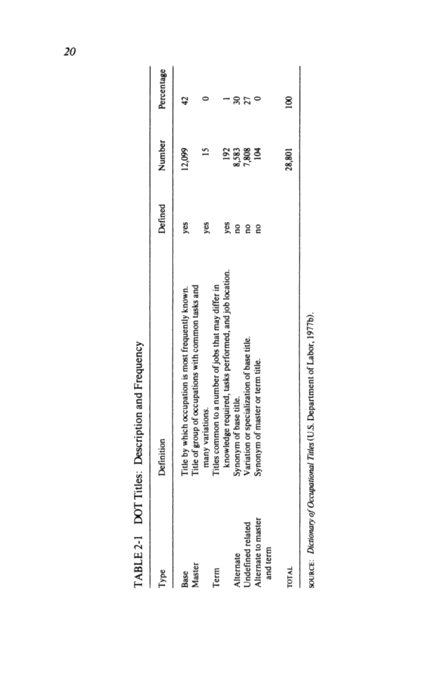
The Fourth Edition DOT: Structure and Content 19 apprentice, salesperson) refer to occupations found in a variety of work settings for which work content may vary but duties tend to be similar. Each master title is defined. "Term titles" (e.g., assembler, social worker) refer to titles common to a number of jobs that may differ with respect to the knowledge required, the tasks performed, or the job location. Each term title is defined. For two other types of titles, definitions are not provided: "alternate titles," which are synonyms of base titles, and "undefined related titles," which are specialized offshoots of particular base titles. The fourth edition DOT contains 28,801 titles, of which 12,099 (42 percent) are base titles. The definition and the frequency of each type of title are presented in Table 2-1. THE DOT CODE In the fourth edition DOT, titles are presented in order of their DOT codes. The classification scheme embodied in the code scheme and the organiza- tion of the volume were designed to facilitate the retrieval of information needed in the counseling and placement activities of the Employment Service. The nine-digit code has three parts, as shown in Figure 2-1. The first digit places occupations in one of nine broad categories: four are widely used groupings (professional, technical, and managerial; clerical and sales; service; agricultural, fishery, and forestry); four employ industrial trade terminology (processing; machine trades; benchwork; structural work); and one is a residual category, "miscellaneous." The first and second digits in combination are refinements of the broader categories and are termed occupational divisions. The 82 divisions are intended to group occupations on the basis of general types of skills or knowledge required; technological objective; type of activity or service; the machines, tools, equipment, or techniques used; or the materials or products produced. Divisions are further subdivided into 559 occupational groups, each defined by a three-digit code, which are intended to provide additional detail on technological objective and on materials, products, subject matter, or services. Thus the first three digits of the code are intended to reflect with increasing specificity the kind of work performed. The fourth, fifth, and sixth digits of the code are intended to reflect the levels of complexity at which a worker in a particular occupation functions in relation to data, people, and things, respectively. The digits correspond to a structure of 24 worker functions, each of which is denoted by an action verb or verbs, such as "compiling" or "handling" (shown in Figure 2-2~. The structure of the worker functions is in the form of three listings that are arranged, in scalelike fashion, from relatively simple tasks (high numbers) to complex tasks (low numbers), such that "each successive
20 oo Ct C, A A Cal o ._ A_ ._ Cal o ~ _ . . . - 1 ¢ C ~° _ o ~ o o - cr, ~ ~ ~ ~ O ~_ ~ To o o o _ ~ Go _ ~Go ~ - a' ~ O 0 0 :^ :^ I:: o ._ . ~ Ct - t, o Cal ~ at: ~=.o _ :~= o ~ ~ o s ~ ~ of U. ~·_ .= c C, ~° E ·° :<s ~ ~° A O _ C ~ ~ G ·O ~ ' - ~ ~ ~0 0 0 3 01) 3 ~ o ~ ~ ao _ .4 - .~ :~. a, e~ ~ 2 - o oo oo Ct - a, _ - U' O Ct ~ ~ ~, - C ~o 0- - o Ct o Ct a~ V) - .0 C~ . . . o c7'
The Fourth Edition DOT: Structure and Content CATEGORY BENCHWORK OCCUPAT I ONS ~ l DIVISION ~ LAY I NG OUT, MARK I NG, CUTT I NG, AND PUNCH I NG I OCCUPATIONS, N.E.C. I GROUP ' OCCUPAT I ONS I N FABR I CAT I ON AND REPA I R OF TEXT I LE, LEATHER AND RELATED PRODUCTS 1ST 3 DIGITS OCCUPATIONAL GROUP ARRANGEMENT 7 8 1 . 2ND 3 DIGITS WORKER FUNCTIONS (DATA, PEOPLE AND THINGS) 6 8 4 DATA 6 Comparing PEOPLE 8 Taking Instructions - Helping THINGS 4 Manipulating 21 LAST 3 DIGITS SERIAL # (ARRANGED BY # IN AlPHABETICAL ORDER) O 3 O UNIQUE NUMERICAl CODE Of A SPECIFY BASE TITLE. FIGURE 2-1 Parts of the DOT code. Source: The DOT: Unit III, Trainer's Package for DOT Users (U.S. Department of Labor, 1977e:22). relationship includes those that are simpler and excludes the more complex" (Fourth Edition DOT: 13691. A disclaimer is made for the PEOPLE function: insofar as each of these functions "represents a wide th`~ir ~rr~naem~nt is somewhat arbitrary and range of complexity . . - ~ can be considered a hierarchy only in the most general sense" (Fourth Edition DoT:1369~. Occupations are rated for level of functioning; an occupation's relationship to data, people, and things is expressed in terms of the lowest-numbered (or most complex) function for each hierarchy. Properties of the worker function scales are explored further in chapter 7. The last three digits-or suffix-of the code have no substantive referent. These digits did not appear in earlier editions of the DOT but were issued shortly after the publication of the third edition in a companion volume (U.S. Department of Labor, 1967~. They were developed to assist in Employment Service record-keeping when it was discovered that the initial six digits of the code were insufficient to distinguish among specific occupations in many instances. The vital role of these nonsubstantive codes in making distinctions among base titles is evidenced by the fact that there are only 3,963 six-digit combinations among the 12,099 occupations defined in the fourth edition DOT. Suffix codes were assigned to base titles by alphabetizing all titles with the same first six digits. The first title in each set was assigned the suffix code of 010, and the remaining titles were
22 WORK, JOBS, AND OCCUPATIONS Explanation of Data, People and Things Much of the information in this publication is based on the premise that every job requires a worker to function in some degree to Data, People and Things. These relationships are identified and explained below. They appear in the form of three listings arranged in each instance from the relatively simple to the complex in such a manner that each successive relationship includes those that are simpler and excludes the more complex.' The identifications attached to these relationships are referred to as worker functions, and provide standard terminology for use in summarizing exactly what a worker does on the job. A job's relationship to Data, People and Things can be expressed in terms of the lowest numbered function in each sequence. These functions taken togeth- er indicate the total level of complexity at which the worker performs. The fourth, fifth and sixth digits of the occupational code numbers reflect relation- ships to Data, People and Things, respectively.2 These digits express a job's relationship to Data, People and Things by identifying the highest appropriate function in each listing as reflected by the following table: DATA (4th digit) PEOPLE (5th digit) THINGS (6th digit) 0 Synthesizing 0 Mentoring 0 Setting-Up I Coordinating I Negotiating 1 Precision Working 2 Analyzing 2 Instructing 2 Operating-Controlling 3 Compiling 3 Supervising 3 Driving-Operating 4 Computing 4 Diverting 4 Manipulating 5 Copying 5 Persuading 5 Tending 6 Comparing 6 Speaking-Signaling 6 Feeding - Offbearing 7 Serving 7 Handling 8 Taking Instructions Helping Definitions of Worker Functions DATA: Information, knowledge, and conceptions, related to data, people, or things, obtained by observation, investigation, interpretation, visualization, and mental creation. Data are intangible and include numbers, words, symbols, ideas, concepts, and oral verbalization. 0 Synthesizing: Integrating analyses of data to discover facts and/or develop knowledge concepts or interpretations. 1 wruinalin~; LJelermining time, place, and sequence of operations or action to be taken on the basis of analysis of data; executing determination and/or reporting on events. 2 Analyzing: Examining and evaluating data. Presenting alternative actions in relation to the evaluation is frequently involved. As each of the relationships to People represents a wide range of complexity, resulting in consi- derable overlap among occupations, their arrangement is somewhat arbitrary and can be considered a hierarchy only in the most general sense. 20nly those relationships which are occupationally significant in terms of the requirements of the job are reflected in the code numbers. The incidental relationships which every worker has to Data, People, and Things, but which do not seriously affect successful performance of the essential duties of the job, are not reflected. FIGURE 2-2 Definitions of the worker function scales represented in the fourth, fifth, and sixth digits of the DOT code. Source: Dictionary of Occupational Titles (U.S. Department of Labor, 1977b:1369-1371).
The Fourth Edition DOT: Structure and Content 3. Compiling: Gathering, collating, or classifying information about data, peo- ple, or things. Reporting and/or carrying out a prescribed action in relation to the information is frequently involved. 4 Computing: Performing arithmetic operations and reporting on and/or carry- ing out a prescribed action in relation to them. Does not include counting. 5 Copying: Transcribing, entering, or posting data. 6 Comparing: Judging the readily observable functional, structural, or compo- sitional characteristics (whether similar to or divergent from obvious stand- ards) of data, people, or things. PEOPLE: Human beings; also animals dealt with on an individual basis as if they were human. 0 Mentoring: Dealing with individuals in terms of their total personality in or- der to advise, counsel, and/or guide them with regard to problems that may be resolved by legal, scientific, clinical, spiritual, and/or other professional . . prmclp es. 1 Negotiating: Exchanging ideas, information, and opinions with others to formulate policies and programs andlor arrive jointly at decisions, conclu- sions, or solutions. 2 Instructing: Teaching subject matter to others, or training others (including animals) through explanation, demonstration, and supervised practice; or making recommendations on the basis of technical disciplines. 3. Supervising: Determining or interpreting work procedures for a group of workers, assigning specific duties to them, maintaining harmonious relations among them, and promoting efficiency. A variety of responsibilities is in- volved in this function. A Diverting: Amusing others. (Usually accomplished through the medium of stage, screen, television, or radio.) ~ Persuading: Influencing others in favor of a product, service, or point of view. 6 Speaking-Signaling: Talking with and/or signaling people to convey or ex- change information. Includes giving assignments and/or directions to helpers or assistants. 7 Serving: Attending to the needs or requests of people or animals or the ex- pressed or implicit wishes of people. Immediate response is involved. 8 Taking Instructions-Helping: Helping applies to "non-learning" helpers. No variety of responsibility is involved in this function. THINGS: Inanimate objects as distinguished from human beings, substances or materials; machines, tools, equipment and products. A thing is tangible and has shape, form, and other physical characteristics. 0 Setting up: Adjusting machines or equipment by replacing or altering tools, Jigs, fixtures, and attachments to prepare them to perform their functions, FIGURE 2-2 Continued 23
24 WORK, JOBS, AND OCCUPATIONS change their performance, or restore their proper functioning if they break down. Workers who set up one or a number of machines for other workers or who set up and personally operate a variety of machines are included here. 1 Precision Working: Using body members and/or tools or work aids to work, move, guide, or place objects or materials in situations where ultimate re- sponsibility for the attainment of standards occurs and selection of appropri- ate too:;,, bjects, or materials, and the adjustment of the tool to the task require exercise of considerable judgment. Operating-Controlling: Starting, stopping, controlling, and adjusting the prog- ress of machines or equipment. Operating machines involves setting up and adjusting the machine or material(s) as the work progresses. Controlling in- volves observing gages, dials, etc., and turning valves and other devices to regulate factors such as temperature, pressure, flow of liquids, speed of pumps, and reactions of materials. 3 Driving-Operating: Starting, stopping, and controlling the actions of mach- ines or equipment for which a course must be steered, or which must be guided, in order to fabricate, process, and/or move things or people. ln- volves such activities as observing gages and dials; estimating distances and determining speed and direction of other objects; turning cranks and wheels; pushing or pulling gear lifts or levers. Includes such machines as cranes, conveyor systems, tractors, furnace charging machines, paving machines and hoisting machines. Excludes manually powered machines, such as hand- trucks and dollies, and power assisted machines, such as electric wheelbar- rows and handtrucks. 4 Manipulating: Using body members, tools, or special devices to work, move, guide, or place objects or materials. Involves some latitude for judgment with regard to precision attained and selecting appropriate tool, object, or material, although this is readily manifest. 5 Tending: Starting, stopping, and observing the functioning of machines and equipment. Involves adjusting materials or controls of the machine, such as changing guides, adjusting timers and temperature gages. turning valves to allow flow of materials, and flipping switches in response to lights. Little judgment is involved in making these adjustments. 6 Feeding-Offbearing: Inserting, throwing, dumping, or placing materials in or removing them from machines or equipment which are automatic or tended or operated by other workers. 7 Handling: Using body members, handtools, and/or special devices to work, move or carry objects or materials. Involves little or no latitude for judg- ment with regard to attainment of standards or in selecting appropriate tool, object, or material. FIGURE 2-2 Continued
The Fourth Edition DOT: Structure and Content 25 assigned codes at intervals of four in order to allow for later insertions. An occupation with a unique six-digit code was assigned the suffix code of 010. INDUSTRY DESIGNATION For each base title an industry designation is presented. The industry designation is included to aid users in distinguishing among different occupations with identical titles. For example, the title Pellet-Press Operator is used for three different DOT occupations, depending on whether the accompanying industry designation is "ammunition," "chemi- cal," or "ore dressing, smelting, refining." The industry designations used in the DOT were specially developed for it and originated with the first edition (1939~. They thus reflect the industrial terminology and classifications in use at that time, although modifications have been made in later editions. For example, the designations "military services" and "social services" were included for the first time in the fourth edition. Strictly speaking, the term "industry" is a misnomer. Although for some titles the designated setting is industrial, for many others the industry designation is actually a broad occupational grouping. For example, "clerical" is used as the industry designation for more than 600 occupational titles; "professional and kindred" is used for another 1,000. Also included among the designations is an "any industry" category. This category contains hundreds of occupations that occur in a number of industries (sometimes in virtually all industries). The category is essential- ly a catchall, containing, for example, such diverse occupations as Accordian Repairer, Elevator Operator, Miller, Cornice Upholsterer, and Artists' Model. A title's industry designation is indicative but not restrictive, i.e., an occupation may be found in industries other than the one specified. Each designation is defined in an appendix, which also indexes occupational titles by their industry designation. DEFINITIONS The DOT titles are defined according to a highly structured format. Each definition begins with a lead statement that is intended to summarize the occupation in terms of (1) worker actions, including instructions followed or judgments made, expressed by specific action verbs in the present tense, (2) work fields, which are the purpose of worker actions (i.e., what gets done on the job), (3) machines, tools, equipment, and/or work aids (MTEWA) used by workers in performing their jobs, and (4) materials,
26 WORK, JOBS, AND OCCUPATIONS WORKER ACT I ON I nd i Gates what the worker does, and i s expressed by Act i on Verbs i n the present tense. Some examp 1 es: LOADS . . . D I SASSEMBLES. . . CONTROLS . . . I NTERV I EWS. . . 2. MACH I NES, TOOLS, EQU I PMENT, AND/OR WORK A I DS lndicates the devices used by workers to assist them in performing their job. Some examp 1 es: Loads I NJ ECT I ON MOLD I NG MACH I NE (mach i ne) . . . D i sassemb 1 es gee r sh i f t mechan i sm us i ng A I R WRENCH ( too 1 Control s GAS FURNACE (equi pment) . . . Interviews cl ients using PROCEDURES MANUAL (work aid) . .. 3. PURPOSE OF THE WORKER ACT I ONS I nd i cates what gets done. Some examples: Loads injection molding machine TO MOLD... Disassembles gear shift mechanism using air wrench TO REPAIR Controls gas furnace TO MELT I nterv i ews c 1 i ents us i ng procedures manua 1 TO ASSESS . . . 4. MATERIALS, PRODUCTS, SUBJECT MATTER, AND/OR SERVI CES Some examples: Loads injection molding machine to mold GRANULATED RESIN PELLETS (materials) into PLASTIC BOTTLES (products)... Disassembles GEAR SHIFT MECHANISM (material) using air wrench to repa i r TRANSM I SS I ONS (mater i a 1 ) . . . Controls gas furnace to melt STEEL (materials)... Interviews CLIENTS (subject matter) using procedures manual to assess BACKGROUND AND ATTRI BUTES (sub ject matter) FOR VOCATIONAL GUIDANCE AND COUNSELING (subject matter), AND REFERRAL TO EMPLOYMENT TRAINING OPENINGS (service)... FIGURE 2-3 Examples of the four categor~es of information as the basis of the DOT definition. Source: The DOT: Un~t III, Trainer's Package for DOT Users ~J.S. Department of Labor, 1977e:iii-20). products, subject matter, and/or services (MPSMS) that a worker produces on the job. The distinctions among these four are illustrated in Figure 2-3. The lead statement is followed by one or more task element statements, which describe the specific tasks a worker performs to accomplish the overall purpose of the job. Figure 2-4 presents a DOT definition, diagramed to show its component parts. In the first example the task element
The Fourth Edition DOT: Structure and Content 27 statements "turns handwheel . . . ," "turns screws . . . ," and "sharp- ens doctor . . . " indicate how the occupation Cloth Printer is actually performed. Many definitions also contain job variables, so-called may items, which designate tasks that have been found to be included in a job in some establishments but not in all. In Figure 2-4, for example, the occupation Cloth Printer may "notify Colorist when color shade varies from specifications." Some definitions contain additional elements. Technical terms or special uses of terms not ordinarily found in a standard dictionary are italicized to indicate that they are defined in the DOT'S glossary. Bracketed titles in a definition indicate that workers in the base title may also, on occasion, perform some of the duties of the bracketed occupation. Unbracketed titles (e.g., Colorist in the example) denote occupations with which the occupation being defined frequently works. Examples of these three features are found in Figure 2-4. Slightly different occupations with the same title in the same industry are designated by a roman numeral following the title. For example, the title Surgeon I indicates that there are other occupations with this title in the medical services industry. Finally, some definitions contain a statement of significant variables. Distinct from a may item, which refers to specific job tasks, this statement lists other related jobs that are covered by a particular definition. It is included to reduce the number of nearly identical definitions in the DOT. ADDITIONAL FEATURES Although titles are presented in order of their codes in the fourth edition, the DOT contains alphabetical and industry designation indexes designed to assist users in locating job or occupational titles about which they have limited information. To assist users further in locating titles and interpreting the information available about them, the DOT provides 25 pages of introductory instructions that explain the DOT code, definitions, indexes, and other features of the Dictionary of Occupational Titles. A 16- page glossary of technical terms is also provided. RELATED PUBLICATIONS A number of publications closely related to the fourth edition were planned at the time of its publication. Many of these publications use, in one form or another, information about worker traits, the attributes considered to be required of workers performing a particular occupation. This information was collected during the course of job analysis for the
28 a, i_ Cot en _ ~ \ - ' Cot ~ =. ^ \ \ \ \ O ~ C Cot _ ~r_, C) Or Cat o ·~_ Cot Cot ~ ~ O O V - _ _ ~- Ce ~ V) Cat C'D i_ ~ a, a,, - Cat _ ED - O e' O L _; ~ O (I) i.. 0.is.~ Sit I- ..,,., . ,,,,,..... .~:~,l=,.1 .- .~..%~.~ ~.-e,..,~. --1's-~-,~,. ..,: . =,-:--., . ., ~ =~ ... . _~. .. . join . 9-'~,Is -. is:-.., . ., Is.~*" ~ . ;1 t At it v, o - A) - - .. in- ~::~: ~S:: : ~.:~::S: ~: ~e<::}~:< _ ~ - . ~ As ~ ~ an ~ s ~ s: :~ ~ it - 4- . a~ ~ a' Go: - ,; ,~ 8 ~ ~ ~ I, I _ ~ 3 E 3 ~ `" si~Z . 6,, ~ :~ ~ A >~.s*s~.s.~(3 ~ ~ ~ ~ ~ E- are, ~ s. ..,3~ -........ l~u . . / =1 ~ / ~ ~ ~=- l - ~_ .. ~ .2: .s<.~ ;3~ 2.s'.2~S~:: 1~:= ~:::~s *~:::*" ~ - ~ [~ =~ ~e ~ ~:O :~o ~O :: ~ :~= :~ (; ~7~ ~ a' ~ .,~ T ~E ~ ~:::~:u z ~ ~ t~, e~ 4, E =~ x ~ 2: ~ . . ~ , - 1 C~ . - o ~s t ~ . U. ~ s: ·~ ·;: .~ . . o o :- o P~
The Fourth Edition DOT: Structure and Content 29 DOT. Although worker trait information does not appear in the fourth edition DOT, each base title was assigned scores for the types of traits listed below; additional information is provided in chapter 6. 1. Training time, the "amount of general educational development (GED) and specific vocational preparation (svP) required of a worker to acquire the knowledge and abilities necessary for average performance in a particular job-worker situation" (U.S. Department of Labor, 1972:8~. GED includes aspects of fonnal and informal education that contribute to the worker's reasoning development, the ability to follow instructions, and the use of language and mathematical skills. svP includes training acquired in a "school, work, military, institutional, or avocational environment" (U.S. Department of Labor, 1972:8) but excludes schooling without specific vocational content. 2. Aptitudes, the capacities or abilities required of a worker to facilitate the learning of job tasks, e.g., intelligence and motor coordination. 3. Temperaments, the personal traits useful to a worker in adjusting to the requirements of his or her job, e.g., adaptability in dealing with people or in performing repetitive tasks. 4. Interests, tastes, and preferences for certain kinds of activities that are entailed in job performance, e.g., a preference for activities involving business contact with people. 5. Physical demands, the physical requirements made of a worker in carrying out job tasks, e.g., strength or stooping. 6. Environmental conditions, the physical surroundings and circum- stances in which a job is performed, to which a worker must adapt, e.g., extreme cold or heat. Specific vocational preparation (SVP3 scores were published in an interim edition of the DOT in February 1978. This edition will be superseded by a formal supplement to the DOT (to be published in 1980) that will include svP and GED estimates as well as ratings on physical demands and environmental conditions. The recently issued Guide for Occupational Exploration (U.S. Depart- ment of Labor, 1979a) makes extensive use of information akin to that contained in the worker traits, although it does not use the identical items or the actual ratings themselves. The Guide was designed to assist applicants in vocational exploration and choice. In the format and presentation of vocational information, particular attention was paid to the needs of entry-level workers. The Guide is organized around a new classification scheme that is said to provide an entry-level classification of occupations.
30 WORK, JOBS, AND OCCUPATIONS The classification is based on an interest inventory developed by the U.S. Employment Service's testing division (Droege and Hawk, 1977~. For each of 12 interest areas (which are not the same as the worker trait interests described above) a description is provided of the qualities and characteris- tics workers should possess to perform jobs in a particular area. A listing of representative DOT occupations is also provided for each area. Much of the descriptive material about jobs in the interest areas is presented in a simple question-and-answer format. For counseling and placement pur- poses the Guide can be used alone or in conjunction with an interest inventory that can be self-administered by applicants. In the latter instance, results from the interest inventory can be used for job-worker matching by comparing applicants' test results to the appropriate occupational interest groups. By means of this capability, developers of the Guide hope to facilitate the placement of workers with little previous or recent work experience. SUMMARY The fourth edition DOT, in conjunction with related publications, provides (1) a dictionary of occupational titles, (2) a classification of occupations, and (3) information about a large number of occupational characteristics in terms of the demands they make on workers. Not surprisingly, given this wealth of information, the DOT iS widely used both inside and outside the Employment Service. The next two chapters of this report discuss this use.
