








Below is the uncorrected machine-read text of this chapter, intended to provide our own search engines and external engines with highly rich, chapter-representative searchable text of each book. Because it is UNCORRECTED material, please consider the following text as a useful but insufficient proxy for the authoritative book pages.
Dimensions of Active Criminal Careers Participation in criminal activity is ob- viously restricted to a subset of the popu- lation. For the subset who do become offenders, our focus turns to the fre- quency, seriousness, and duration oftheir criminal careers. This chapter provides some empirical estimates ofthose dimen- sions of active criminal careers and also examines some factors that may be asso- ciated with active offending, such as age of initiation, drug use, and employment history. INDIVIDUAL FREQUENCY RATES Individual offending frequencies are a funciamental feature of the criminal ca- reer. The offense rate for individual of- fenders, A, reflects the frequency, or in- tensity, of offending by individuals who are actively engaging in crime (i.e., active offenders). Despite the importance of A, research that statistically characterizes the intensity of offending for large num- bers of offenders is relatively recent. Short of having offenders maintain daily Togs of their criminal activity, two main approaches are available to measure fre 55 quency rates for active offenclers: retro- spective self-reports of prior criminal ac- tivity and officially recorded arrest histories. Each approach has its own lim- itations ant! sources of error. The main problems with self-reports stem from se- lection biases in the subsample of of- fenders who are willing to provide self- reports and errors in responses arising from erroneous recall or intentional mis- representation. The main problem in us- ing official arrest records aside from er- rors in the records themselves is that arrests typically occur for only a small number of the crimes that are committed. The limitations of each approach require that various assumptions, albeit clifferent ones, be made in order to draw inferences about individual crime rates from the available data. Because ofthe basic differ- ence in the sources of error, however, the two approaches can serve as impor- tant tests and cross-validations for each other. Two sources provide explicit estimates of inclividual offense rates for active of- fenders: self-report estimates developed at the Rand Corporation and official
56 record estimates developed at Carnegie- Mellon University. Both estimates of A are limited to samples of adult males who have committed serious offenses. The Rand Corporation estimates are baser! on surveys of male inmates serving sentences in state prisons (Peterson and Braiker, 1980; Chaiken ant! Chaiken, 1982a), and the most recent survey also includes inmates serving sentences in To- cal jails. The samples are thus restricted to offenders whose current offense or prior criminal record are serious enough to have warranted incarceration. The fre- quency estimates are based on inmate self-reports of counts of crimes they com- mitted in an observation period preced- ing the current incarceration. The Carnegie-Mellon studies using of- ficial arrest records are based on samples of adult arrestees selected because they had at least one arrest for an index offense (other than larceny) during the years sam- pled. Arrest frequency estimates are de- veloped from the history of arrests re- corded prior to the arrest leading to their selection. This design excludes offenders who engage exclusively in minor of- fenses. While females are not explicitly exclucled, the arrestee samples are com- posed predominantly of adult mates. In addition to total rates, crime-specific frequencies can be estimated for specific offense types. In computing the mean frequency for a given crime type during any observation period, only "active" of- fenders those who commit at least one offense or experience one arrest for that crime type- are included in the calcula- tions. Therefore, mean frequencies differ from "incidence rates," which relate the total number of crimes to the size of the entire sample, including those with no crimes of that type. The Rand and Camegie-Mellon stud- ies are different from the much larger body of research on participation in of- fending, which is based on self-reports or CRIMINAL CAREERS AND CAREER CRIMINALS official records of offending or of deviance for juveniles sampled from a general pop- ulation. Results from that body of re- search are therefore dominated by com- mon minor offenses such as vandalism and simple assault. This difference in design reflects the different focus of the studies, in one case on the scope of cle- viance found in a broad population, and in the other case on the intensity of seri- ous offending by more continuously ac- tive adult offenders. By focusing on subsets of offenders who are active in serious offense types, these studies can yield frequency estimates for serious of- fenses. In aclclition to focusing on active of- fenders, the studies also restrict the cal- culation of A to periods when offenders are at risk of committing offenses in the community. The time that an offender is incapacitated through incarceration or Tong-term hospitalization (e.g., more than a 1-month stay) is excluded from the time at risk. The resulting estimates of A reflect the frequency of offending that occurs while an offender is criminally active in the community. It is the rate of offending that wouIcl be expected if the offender were not incarcerated. While not reporting explicit estimates of frequency rates for active offenders, a number of other studies do report esti- mates of population incidence rates mea- surecl by offenses per capita (Wolfgang, Figlio, and Sellin, 1972; Elliott et al., 1983; Farrington, 1983b, 19841. These in- cidence rates reflect the frequency of of- fenses (or arrests) in a total population at risk of offending, while A is calculated for active offenders only. Such reported inci- dence rates reflect the combined effects of participation in crime in a population and individual frequency rates for active offenders. An incidence rate measured by crimes per capita in a total sample can be partitioned between participation rates and frequency rates:
DIMENSIONS OF ACTIVE CRIMINAL CAREERS Incidence _ rate (C) = Total number of crimes committed by sample Total number of persons in sample Number of persons who commit crimes in sample Total number of persons in sample Total number of crimes committed by sample x Number of persons who commit crimes in sample Current participation rate (d) x Mean individual frequency rate (A) This partition indicates that the com- monly reporter! incidence rates, when combined with estimates of participation rates, can be user! to develop estimates of indiviclual frequency rates. The general strategy is to divide incidence rates by participation rates for the same measure- ment period to yield frequency rates for the active subset in the population. With this approach, frequency rates can be es- timated for a broader range of offender samples, including juveniles. However, these estimates of frequency are inflated by the requirement of at least one event (offense or arrest) during the measure- ment period] reflected in current partici- pation rates, but adjustments for this up- ward bias are possible (see Cohen, Appendix B).i Also, values of A estimated iEstimates obtained directly from data in the Rand and Carnegie-Mellon studies (Blumstein and Cohen, 1979; Peterson and Braiker, 1980; Chaiken and Chaiken, 1982a; Cohen, 1983) are also vulner- able to this upward bias: to be considered active in an offense type, offenders must have at least one event for that offense type. In the Carnegie-Mellon studies, this arrest may occur any time in a career; in the Rand studies the criterion event must occur within the observation period prior to the current incarceration. As indicated in Cohen (Appendix B), however, this upward bias is small when the length of time during which the required event may occur is long-as in the Carnegie-Mellon studies, or when frequency rates are high as in the Rand studies. 57 from incidence rates typically do not dis- tinguish between time incarcerated and time at risk of offending in the commu- nity, and so they understate frequency rates while offenders are free in the com- munity. For the samples of juveniles that are the basis for most available incidence rate estimates, however, these underesti- mates are likely to be small because in- carceration is infrequent, and when it occurs, the length of time served is usu- ally shorter than found among adults. Arrest Frequencies (it) by Crime Type The Camegie-Mellon estimates of mean individual arrest frequencies for active adult offenders (,u) have been ob- tained directly from longitudinal official- record data (Blumstein ant] Cohen, 1979; Cohen, 19811. The analysis inclucled only offenders whose first arrest as an adult occurred! before age 21 and who had a subsequent arrest in the sampling period 7-10 years later. Arrest frequencies were estimated for the period between the two required arrests. This requirement of an arrest prior to and another arrest follow- ing the estimation period was intended to limit the analysis to arrestees who-with reasonable certainty were active in criminal careers during the estimation pe- riod. Since inclusion of the required ar- rests would lead to artifactually inflating the estimate offs, the required arrests were excluded from the analysis. Fur- thermore, when calculating arrest fre- quencies for any particular offense type, say, robbery, only offenders in the sample with at least one arrest for robbery are included.2 Since the required one arrest for an offense type may occur during the estimation period, the result- ing crime-specific frequency estimates may be in- flated somewhat. To have restricted the required arrest for each offense type to the bounding periods before and after the estimation period would have
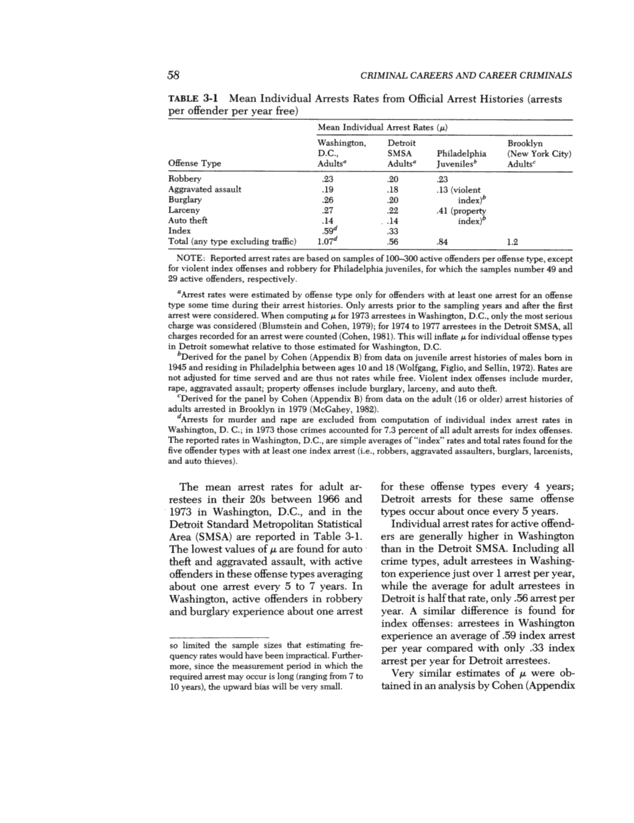
58 CRIMINAL CAREERS AND CAREER CRIMINALS TABLE 3-1 Mean Individual Arrests Rates from Official Arrest Histories (arrests per offender per year free) Mean Individual Arrest Rates (,u) Washington, Detroit Brooklyn D.C., SMSA Philadelphia (New York City) Offense Type Adultsa Adultsa Juvenilesb AdultsC Robbery .23 .20 .23 Aggravated assault .19 .18 .13 (violent Burglary .26 .20 indexer Larceny .27 .22 .41 (property Auto theft .14 .14 indexes Index .598 .33 Total (any type excluding traffic) 1.078 .s6 .84 1.2 NOTE: Reported arrest rates are based on samples of 100~00 active offenders per offense type, except for violent index offenses and robbery for Philadelphia juveniles, for which the samples number 49 and 29 active offenders, respectively. aArrest rates were estimated by offense type only for offenders with at least one arrest for an offense type some time during their arrest histories. Only arrests prior to the sampling years and after the first arrest were considered. When computing ,u for 1973 arrestees in Washington, D.C., only the most serious charge was considered (Blumstein and Cohen, 1979~; for 1974 to 1977 arrestees in the Detroit SMSA, all charges recorded for an arrest were counted (Cohen, 1981~. This will inflate ,u for individual offense types in Detroit somewhat relative to those estimated for Washington, D.C. bDerived for the panel by Cohen (Appendix B) from data on juvenile arrest histories of males born in 1945 and residing in Philadelphia between ages 10 and 18 (Wolfgang, Figlio, and Sellin, 1972~. Rates are not adjusted for time served and are thus not rates while free. Violent index offenses include murder, rape, aggravated assault; property offenses include burglary, larceny, and auto theft. CDerived for the panel by Cohen (Appendix B) from data on the adult (16 or older) arrest histories of adults arrested in Brooklyn in 1979 (McGahey, 1982~. Arrests for murder and rape are excluded from computation of individual index arrest rates in Washington, D. C.; in 1973 those crimes accounted for 7.3 percent of all adult arrests for index offenses. The reported rates in Washington, D.C., are simple averages of "index" rates and total rates found for the five offender types with at least one index arrest (i.e., robbers, aggravated assaulters, burglars, larcenists, and auto thieves). The mean arrest rates for adult ar- restees in their 20s between 1966 and 1973 in Washington, D.C., ant! in the Detroit Standard Metropolitan Statistical Area (SMSA) are reported in Table 3-1. The lowest values of ,u are found for auto theft and aggravated assault, with active offenders in these offense types averaging about one arrest every 5 to 7 years. In Washington, active offenders in robbery and burglary experience about one arrest so limited the sample sizes that estimating fre- quency rates would have been impractical. Further- more, since the measurement period in which the required arrest may occur is long (ranging from 7 to 10 years), the upward bias will be very small. for these offense types every 4 years; Detroit arrests for these same offense types occur about once every 5 years. Individual arrest rates for active offend- ers are generally higher in Washington than in the Detroit SMSA. Including all crime types, adult arrestees in Washing- ton experience just over 1 arrest per year, while the average for adult arrestees in Detroit is half that rate, only .56 arrest per year. A similar difference is found for index offenses: arrestees in Washington experience an average of.59 index arrest per year compared with only .33 index arrest per year for Detroit arrestees. Very similar estimates of ,u were ob- tained in an analysis by Cohen (Appendix
DIMENSIONS OF ACTIVE CRIMINAL CAREERS B) of the arrest histories of active juvenile offenders in a 1945 birth cohort of boys in Philadelphia (Wolfgang, Figlio, and Sellin, 19721. On the basis of reported incidence and participation rates, active mate juvenile offenders are arrested at average annual frequencies of .23 for rob- bery, .13 for the other violent index of- fenses (murder, rape, and aggravated as- sault), and .41 for property index offenses (burglary, larceny, and auto theft). Active offenders among Philadelphia juveniles experience an average of .84 arrest per year. In another estimate from incidence and participation rates (Cohen, Appendix B), active offenders in a sample of adult arrestees in Brooklyn, New York (McGahey, 1982), are arrested for all of- fense types at a mean annual rate of 1.2 per year free. The accuracy of the estimates of A, · 1 1 especially in comparisons across Jurisclic- tions, depends in large part on the com- pleteness of the arrest history data. As indicated in Cohen (Appendix B), nonre- cording rates vary substantially across jurisdictions: in the Detroit SMSA, less than half of all arrests reported in local police statistics are recorded in the arrest history data, while in Washington, D.C., recording in arrest histories is almost complete.3 The failure to record large numbers of arrests leads to two countervailing biases: an undercount of total arrests, which bi- ases estimates of,u downward, and an undercount of low-rate active offenders, which biases estimates of ,u upward (see Cohen, Appendix B). The accuracy of arrest frequency estimates thus depends on the relative strengths ofthe two biases. Incompleteness of the arrest history data 3A major factor in Me low recording rates for Me Detroit SMSA is a policy in the city of Detroit to only forward arrest reports win known dispositions. However, this nonrecording of many arrests in De- ~oit does not affect the estimates of q, which are based on aggregate statistics. 59 could be a factor contributing to the Tower values of,u estimated for arrestees in the Detroit SMSA than for Washington, D.C., arrestees, especially for less serious of- fense types, which are more likely to be subject to greater discretion in terms of being recorded in the central repository. Offending Frequencies (A) by Crime Type This section discusses estimates of A that have been obtained in either of two ways: by adjusting estimates of,u to infer A, using aggregate arrest probabilities, or by surveying samples of offenders to ob- tain self-reports of their offending fre- quencies. Inferring A from ,u Individual arrest rate estimates like those in Table 3-1 can be used in combi- nation with assumptions about the arrest process to generate estimates of individ- ual frequency rates for crimes committed. Assuming that the individual crime rate (<A) is independent of the probability of arrest for a crime (qj, the individual arrest rate (it) is just the product of the individ- ual crime rate and the risk of arrest per crime, ,u = Aq. Therefore, some estimate of the probability of arrest for a crime is needed to estimate A. Assuming that all offenders face the same arrest risk, the probability of arrest per crime can be estimated using aggre- gate data: the needed probability is basi- cally the ratio of the number of reported arrests for an offense type (A) divided by the number of reported crimes (C). The number of reported crimes, however, must be adjusted by the fraction of crimes reported to the police (r) to account for unreported crimes. Also, because many crimes are committed in groups, the num- ber of arrests must be divided by the average number of offenders per criminal
60 CRIMINAL CAREERS AND CAREER CRIMINALS TABLE 3-2 Estimates of Arrest Risk per Crime (q) by Offense Estimates of q from Estimates of q from Self-Reports Aggregate Data California, Washington, Detroit Michigan, and Offense Type D.C.a SMSAa Californiab Texas CombinedC Robbery .069 .043 .21 (armed .21 (business) robbery) .16 (personal) Aggravated assault .111 .062 .10 .24 Burglary .049 .038 .07 .06 Larceny .026 .030 .02 (theft) Auto theft .047 .015 - .11 aProbability of arrest per crime is estimated from aggregate data on reported arrests (A), reported crimes (C), the rate of victims reporting crimes to the police (r), and the average number of offenders per crime incident (O) (Blumstein and Cohen, 1979; Cohen, 1981~. A, C, and r are based on data available from local police statistics and from victimization survey data for Washington, D.C., and the State of Michigan; O is estimated from national victimization data available in Reiss (1980a). bThe probability of arrest per crime is estimated from the ratio of self-reported arrests to self-reported crimes in a survey of inmates of California prisons in 1976. The estimates from inmates are weighted to reflect the estimated average probability of arrest per crime faced by street offenders (Peterson and Braiker, 1980:Table 2, 236-2371. CThe probability of arrest per crime is estimated from the ratio of self-reported arrests to self-reported crimes in a survey of state prison inmates in California, Michigan, and Texas in 1978. The estimates reflect the arrest risk per crime faced by an incoming cohort of state prison inmates for respondents in the three states combined (Petersilia, 1983:Table 4.4~. event, O. The final estimate of the prob- ability of arrest per crime of type i (as proposed by Blumstein and Cohen, 1979) · ~ IS given Dy qi = Al/O Cllr Table 3-2 presents estimates of the ar- rest risk per crime (q) derived from aggre- gate data in Washington, D.C., and the Detroit SMSA. The probability of arrest per crime is highest for aggravated assault in both jurisdictions, at about 1 arrest for every 10 to 20 offenses committed, or more than 5 percent; the risk of arrest for other offense types is generally less than 5 percent. The arrest probability is also generally higher in Washington than in Detroit. This higher arrest risk per crime in Washington contributes to the higher individual arrest rates found in that city (Table 3-l). Alternative estimates of q from self- reported arrests and self-reportec! crimes by inmates are also presented in Table 3-2. With the exception of larceny (theft), the arrest risk estimated from the inmate self-reports is somewhat higher than that from aggregate data. In part, this differ- ence reflects the nature of the offenses surveyed: armed] robbery and serious as- saults were more likely to involve identi- fications by victims that would increase the risk of arrest for these crimes. Also, the arrest risk may have been inflated by the exclusion of individuals who reported no arrests (see Peterson and Braiker, 1980:237~. Table 3-3 presents inclividual offending frequencies estimated from arrest fre- quencies for adults. For most offense types, the inclividual frequency rates es- timatecl in Washington and Detroit are comparable in magnitude, with mean in- diviclual rates of 3.5 to 4.5 robberies, 2 to 3 aggravated assaults, and 5 to 6 burglar- ies. The largest difference in A between
DIMENSIONS OF ACTIVE CRIMINAL CAREERS the two jurisdictions is found for auto theft, with a mean rate of only 3 auto thefts committed per year free by offend- ers in Washington compared with more than 9 by offenders in Detroit. Total fre- quency rates are Tower in Detroit than in Washington: active adult offenders are estimated to commit from 9 to 13 index offenses per year free in the two jurisdic- tions. The accuracy of these estimates of A derived from ofI?icial arrest histories de- pends fundamentally on the adequacy of estimates ofthe arrest risk per crime, q. In adclition to concern about the accuracy of the average value of q that is used, the TABLE 3-3 Mean Individual Offending Frequencies Estimated from Arrest Histories for Adult Arrestees (crimes committed per active offender per year free) Mean Individual Offending Frequencies, A Offense Type Robbery Aggravated assault Burglary Larceny Auto theft All index Washington, D.C., Adultsa Detroit SMSA Adultsb 3.4 1.7 5.7 10.9 3.0 13.2 4.7 2.9 5.3 7.3 9.3 8.7 NOTES: Sample sizes for specific offense types range from 100 to 300 active offenders. In computing A for all index offenses, the arrest probabilities for individual offense types are weighted by the distribution of offense types found in the aggregate. Murder and rape are excluded from the computation of rates in Wash- ington, D.C.; in 1973 those offenses accounted for 7.3 percent of all adult arrests for index offenses. The Washington, D.C., index rate reported here is a simple average of index rates computed for each of the five offender types with at least one index arrest (i.e., robbers, aggravated assaulters, bur- glars, larcenists, and auto thieves). aEstimates from Blumstein and Cohen (1979~. bDerived from data of Cohen (1981, 1983~. 61 estimates of- A may also be clistorted by failure to aclequately address variation in q among offenders. Even after controlling for offense type, this heterogeneity in q is especially problematic if A ant] q for an offense are systematically related to one another. If A and q are negatively relatecl, with high-rate offenders less likely to be arrested for each crime, use of a single, homogeneous value of q for all offenders will result in an underestimate of A. Cor- responclingly, if A and q are positively related, A will be overestimated. Such relationships might arise directly because the same offenders are skflIfuT both at committing crimes and avoiding detec- tion (a negative relationship) or because of police practices that target apprehen- sion efforts at high-rate offenders (a posi- tive relationship). Alternatively, A and q might be relatecl indirectly because they both vary systematically with other of- fender attributes. If A and q are relatecI, the failure to adequately control for vari- ations in q will confound individual dif- ferences in A with differential police practices reflected in q. While knowledge about the variation in q and its relation- ship to A is crucial to developing improved estimates of A from arrest histo- ries, available results suggest that esti- mates ofthe average value of A clerived by assuming A and q to be independent are not likely to be seriously in error. The Rand Inmate Surveys Two surveys of sentenced prisoners (in 1976 ant! in 1978) provide estimates of inclividual crime rates for active adult male offenders (Peterson ant! Braiker, 1980; Chaiken and Chaiken, 1982a). The estimated rates are based on self-reports of the number of offenses committed dur- ing an observation period] prior to the start of the current incarceration. The most striking feature of these estimated fre- quency rates is the highly skewed distri
62 button of rates across individuals. Figure 3-1 presents Me distribution for robbery only, but it is illustrative of the clis~ibu- tion of frequency rates found for other offenses. The distribution is character- ized by a large number of offenders com- mitting offenses at Tow rates and a small number committing offenses at very high rates. In this example, among incoming prisoners who commit robbery (i.e., in 60 50 4J cot to ~40 9 ~2 o CC E o 30 CD 4, Cat E - O 20 4J cat c' cot 10 o CRIMINAL CAREERS AND CAREER CRIMINALS mates who report at least one robbery during the 1 to 2 years prior to incarcera- tion), We mean frequency rate per of- fencier is 43.4 robberies committed per year of sweet time. Half of these offend- ers, however, committed fewer than 4 robberies each per year free, while about 5 percent committed more than 180 rob- beries per year free. A distinguishing fea- ture of these skewed distributions is that r Median= 3.75 ~Mean = 43.4 25 50 75 100 125 150 175 1 80+ Individual Robbery Frequency per Year of Street Time, ~ FIGURE 3-1 Distribution of robbery frequency among incoming inmates. Source: Derived from data in Visher (Volume II) reanalysis of Rand inmate survey data.
DIMENSIONS OF ACTIVE CRIMINAL CAREERS TABLE 3-4 Mean Individual Frequency Rates (A) from Surveys of California Prison Inmates (offenses committed per person per year free) First 63 Inmate Survey, Second Inmate Survey, 1978 1976a Incoming Chaiken/ Resident Prisoners Visher Rolph Adjusted Prisoners (Min-Max~b ReanalysisC Reanalysis Ratese Robbery 5.2 49-74 42.4 38.9 21.8 Assault 7.1-7.6 N.A. 7.5 N.A. Shot/cut 2.0 Threatened 3.2 Aggravated 2.8 Burglary 14.2 116-204 98.8 114.6 44.6 Motor vehicle theft 3.9 38-102 N.A. 28.7 N.A. Forgery 4.9 6~94 N.A. 52.5 N.A. Fraud 11.4 156~202 N.A. 48.1 N.A. Drug deals 115.0 927-1681 N.A. 849.9 N.A. NOTE: Sample sizes for specific offense types are generally in the range of 100~50 active offenders, except for fraud and motor vehicle theft in the second inmate survey of incoming prisoners, with 69 and 87 active offenders, respectively. In general, the offense type categories in the second survey were more inclusive than those in the first survey (except assault). For example, the first survey includes only Brined robberies; the second survey includes all robberies. aThe first inmate sample was drawn randomly from the resident population at five California prisons (Peterson and Braiker, 1980:Table 10a). bThe second inmate sample was drawn to reflect cohorts of incoming prison and jail inmates in three states: California, Michigan, and Texas. Minimums and maximums for the mean frequency rates were estimated. These rates for California prison inmates are reported as a range in the table; from Chaiken and Chaiken (1982a:Tables A3-A141. CThe original data from the second inmate survey were reanalyzed for the panel as described in Visher (Volume II). The rates reported from this reanalysis include both prison and jail inmates in California; the rates for prisoners alone will be slightly higher. The rates are adjusted downward to reflect the offender's frequency averaged over spurts in activity and quiescent periods; from Chaiken and Rolph (1985:Appendix). eUsing the Visher estimates, high estimates of A are truncated at the 90th percentile value before calculating the final adjusted means. most offenders committed crimes at rates well below the mean. The original frequency rates from the two surveys of inmates published by the Rand Corporation differ substantially in magnitude, with much higher values of A estimated from the second inmate survey. Table 34 compares various estimates of mean frequency rates for selected offense types. Except for assault the only of- fense that is not defined more broadly in the second] survey-even the minimum mean rates estimated in the second sur- vey are at least seven times higher than the mean rates for incoming prisoners estimated in the first survey. Many factors contribute to the substantial differences between the rates reported from the two surveys. For various methoclological rea- sons~iscussed in detail in Cohen (Ap- pendix B) and summarized here-there is reason to believe that the originally pub- lished estimates from the second survey are inflated, while the rates from the first survey are underestimatecI. The principal differences between the surveys relate to the length of the obser- vation periods and the response formats
64 used to elicit counts of the number of crimes committed during that observa- tion period. In the first survey, the obser- vation period was the 3 years preceding the current incarceration. In the second survey, the observation period ranged from 1 to 2 years depending on when in the calendar year the arrest leading to the current incarceration occurred: the later in the calendar year, the longer the avafl- able observation period preceding that arrest. The longer observation period in the first survey could contribute to under- estimates of A if memory recall problems led to greater underreporting of offenses in the more distant and longer observa- tion period and if the time that offenders were active in an offense type was over- estimated by a failure to account for pos- sible initiation and termination of careers sometime during the longer observation period. Imprecision in the frequency re- sponse categories in the first survey, es- pecially for high frequencies, could also contribute to underestimates. Other factors could lead to possible overestimates of A in the second survey. By directly requesting a respondent's own estimate of usual frequency rates, the question eliciting counts of crimes committed on the second survey is in- tended to provide greater precision for high rates of offending. The increased complexity of the rate response items- which required separate responses on (1) the most appropriate time interval for gauging their offending frequencies (e.g., monthly, weekly, or dafly); (2) the num- ber of crimes committed during that time period; (3) the number of months in which crimes were committed at this usual rate; and (4) total months free dur- ing the observation period greatly in- creased respondent problems in answer- ing these items. The resulting 35 to 40 percent ambiguous responses were likely to have been a factor in the computation CRIMINAL CAREERS AND CAREER CRIMINALS of minimum and maximum rates for each respondent in the original analysis of the second inmate survey. In a reanalysis of the survey data, Visher (Volume II) adopts an alternative to the extreme val- ues represented by the minimum and maximum estimates: in cases with ambig- uous responses, she relies on information available in the responses of unambigu- ous respondents to develop a single esti- mate for each respondent. As indicated in Table 3-4, Visher's estimates are close to Rand's minimum estimates for the second survey. However, even Rand's minimum esti- mates and the alternative Visher esti- mates from the second survey are much higher than the estimates from the first survey. Certain structural features of re- sponse items, especially reliance on crime counts in small time intervals (e.g., monthly, weekly, or dally counts), could lead to overestimates of A. When offend- ing is irregular over the entire observa- tion period with periods of high levels of activity interspersed with periods of Tow levels of activity, applying frequencies found in short high-activity periods to the entire observation period will overstate the frequency rate. In a reanalysis of the data from the second inmate survey, Chaiken and Rolph (1985) found evi- dence of such spurts in offending, with periods of high activity clustered just prior to the current incarceration. Re- spondents with short street times are thus especially vulnerable to overestimates since their observation periods are more likely to be limited to periods of spurts in activity. To account for these spurts in activity, the estimated rates were ad- justed downward to reflect an estimate of an offender's frequency averaged over active and quiescent periods. As indi- cated in Table 34, this adjustment re- duces the original minimum frequency by as much as 25 percent for some offense
DIMENSIONS OF ACTIVE CRIMINAL CAREERS types; only burglary and assault are unaf- fected by the adjustment for short-term spurts in activity. Even with the adjustment for spurts, a few individuals are estimated to commit crimes at very high rates averaging one or more crimes every day. The mean frequency is very sensitive to these few very high-rate offenders, and thus vulner- able to serious overestimates arising from errors in the estimates] rates for those offenders. To reduce the impact of the high-rate offenders, the mean A can be reestimated by identifying a maximum limiting value of A and assigning that value to all offenders whose estimated rates exceed it. Cohen (Appendix B: Ta- ble 16) uses the Visher estimates to illus- trate the changes in mean value of A when different upper limits are used: using the 90th percentile as a limit for robbery, for example, the maximum value of A is 71.3 robberies for the three states combined. The 10 percent of active robbers with individual rates above that limit each commit an estimated average of 346.3 robberies per year. When the 90th per- centile value of 71.3 is assigned to the high-rate robbers, the mean A decreases from 43.4 to 14.3 per year. When the 90th percentile is used for burglary, the mean A is similarly reduced by more than half, from 79.0 to 36.7 per year. A similar pro- ceclure was used to estimate the acIjusted rates for California prison inmates that appear in Table 3-4. The maximum limit adjustments to the estimates from the second survey reduce the mean frequency rates to values that are much closer to those estimates! from the first survey. For incoming inmates, the mean rates for the various offense types (other than drugs and burglary) most likely fall in the range of 5 to 15 offenses committed per active offender per year free. The lower rates in this range are characteristic of violent crimes, 65 and the higher rates are characteristic of property crimes. The rates for burglary are even higher: between 15 and 40 bur- glaries per active offender per year free. National Youth Survey Individual offense frequencies are also estimated from self-reported offenses in the annual National Youth Survey. Inci- dence rates (offenses per capita) are com- bined with current participation rates (of- fenders per capita) reporter! by Elliott et al. (1983) to yield] estimated offending frequencies for active offenders (see dis- cussion by Cohen in Appendix B). An- nual incidence rates for male youths are between .5 and 1.0 for serious offense types, while annual participation rates are between 5 and 20 percent over the 5 years of the annual survey. When esti- mates are restricted to male youths who are active, mean annual frequencies by offense type are 4.4 felony assaults, 8.4 robberies, and 7.1 felony thefts commit- ted per year per active offender. Youthful male offenders who are active in index offenses are estimated to commit an aver- age total of 7.6 index offenses per year.4 Estimates of A As shown in Table 3-5, there is reason- able convergence among various esti- mates of A that are derived by applying different estimation techniques to data from different jurisdictions and with dif- ferent offender attributes. The frequen- cies derives! from the arrest histories of 4These rates are adjusted to remove the upward bias introduced by the requirement that all active offenders commit at least one crime of an offense type during the 1-year observation periods. The rates do not account for any time served by active offenders. However, if the amount oftime served by youthful offenders is small, the underestimates of A will also be small.
66 CRIMINAL CAREERS AND CAREER CRIMINALS TABLE 3-5 Alternative Estimates of A by Offense Type (crimes committed per active offender per year free) Self-Reports of Incoming Arrest Histories of Inmates to Prison and Jaila Adult Arresteesb Self-Reports Offense Type California Michigan Texas Washington Detroit YouthsC . Robbery 21.8 15.8 4.8 3.4 4.7 8.4 Burglary 44.6 50.3 14.9 5.7 5.3 Larceny N.A. N.A. N.A. 10.9 7.3 7.14 Auto theft N.A. N.A. N.A. 3.0 9.3 Aggravated assault N.A. N.A. N.A. 1.7 2.9 4.4e NOTE: Sample sizes for specific offense types number from 100 to 325 active offenders. The one exception is for robbery among U.S. youths, with an annual average of 59 active offenders. aMean rates based on estimates by Visher (Volume II) using the original data from the second Rand inmate survey (Chaiken and Chaiken, 1982a); means have been adjusted downward by assigning the 90th percentile value of A to all active offenders with estimated rates above that value. bMean rates inferred from individual arrest frequencies estimated from arrest history data for active offenders; see text. This offending frequency is obtained by dividing the mean individual arrest frequency by an estimate of the arrest risk per crime for each offense type (Blumstein and Cohen, 1979; Cohen, 1983~. COffending frequencies derived from incidence rates (crimes per capita) and participation rates (active offenders per capita) reported for a national sample of youths (ages 11 to 21) in the United States by Elliott et al. (1983) (see Cohen, Appendix B). Felony theft, includes burglary, larceny (over $50), auto theft, and receiving stolen goods. eFelony assault, includes aggravated assault, sexual assault, and gang fights. adult arrestees ant! those derives] from self-reports of youths in a general popula- tion sample are most similar. Active of- fenders in various offense types are esti- mated to commit an average of 2 to 4 serious assaults each year and an average of 5 to 10 of the various property offenses. The rates from the self-report data are slightly higher than those from arrest his- tories. This difference may reflect under- estimates in the rates from arrest data, due to incomplete arrest histories, or it may reflect age differences in offending frequencies with slightly higher rates for younger offenders. The frequencies estimates! from self- reports by inmate samples are generally higher than those for offenders who are free in the community. For California and Michigan inmates who were active in robbery or burglary before being incar- cerated, annual frequencies were esti- mated at 15 to 20 for robbery and 45 to 50 for burglary. These higher mean rates for inmates would! be expected if higher-rate offenders are more vulnerable to incar- ceration. Even if the arrest risk per crime does not vary systematically with A, of- fenders who commit more crimes in a year would be expected to experience more arrests: if the arrest risk per crime averages 10 percent for all offenders, for example, an offender who commits 10 crimes each year will be arrester! on av- erage once every year, while an offender who commits only one crime each year will be arrested on average only once every 10 years. Each arrest exposes the offender to the risk of incarceration, and so increases the representation of more frequently arrested high-rate offenders among inmates. The overrepresentation of high-rate offenders among inmates will be even larger if there is any selectivity in offender processing that increases the risk of incarceration after arrest for high-rate offenclers. On the other hand, if high-rate offenders have a particularly Tow arrest
DIMENSIONS OF ACTIVE CRIMINAL CAREERS risk for each offense, their representation will be diminished. The differences in average values of A among inmates in different states (see Table 3-5) could reflect either cross-state differences in general offender popula- tions, with higher frequencies in CaTifor- nia and Michigan than in Texas, or differ- ences in offender processing, with greater selectivity in directing incarceration at high-rate offenders in California ant! Michigan while imposing incarceration more broadly in Texas. Further research estimating A for different population groups (e.g., offenders in and out of prison in the same jurisdiction) and using dif- ferent estimation techniques on the same samples (e.g., using arrest data and self- report data for the same sample of of- fenders) is required to resolve the sources of any important differences in estimates of A. Until recently, estimates of A were available only for offenders generally, with little attention to distinguishing among offenders by demographic and other attributes. With varying degrees of richness, information is available on char- acteristics of the offenders used to gener- ate estimates of A. These data provide an opportunity to explore some of the varia- tions in the magnitude of A across dif- ferent offender attributes. Accumulating knowledge on the patterns of variation in frequency rates is essential for under- standing the factors contributing to indi- vidual criminal activity, anct ~t may Be useful in developing more effective crime control policies. Variations in A by Sex, Age, and Race 67 demographic subgroups defined in these terms. Sex Large differences are found in partici- pation rates for mates and females, with 5:1 ratios of maTe/female participation for UCR inclex crimes. Because the numbers of female offenders are generally small, especially for serious offense types, sepa- rate frequency rates are rarely reported for females. However, some preliminary indications of sex differences in offending frequencies are available in two estimates of A obtained from reported incidence and participation rates (see Cohen, Ap- pendix B). Both estimates are based on self-reports of crimes committed in the preceding year, in one case by active heroin users (Inciardi, 1979) ant! in the other by a nationally representative sam- ple of U.S. youths surveyed at ages 11-21 (Elliott et al., 19831. As indicated in Table 3-6, offending frequencies for females who are active in a crime type are reasonably close to those for active males; the maTe/female ratios are generally less than 2:1. The one major exception is burglary by active heroin users, for which males report committing almost five times as many burglaries as females. Another sex difference that might be expected is for prostitution, an alternative economic opportunity for fe- maTes. The large differences between mates and females found in aggregate population arrest rates appear to arise predominantly from differences in partic- ipation. If active in a crime type, females commit that crime at rates similar to those of active mates. Sex, age, and race data are routinely collected on arrestees, primarily for agency identification purposes. There fore, even though the relationship ofSeveral studies provide preliminary ev these variables to A is theoretically am-idence on the nature of changes over age biguous, A is frequently contrasted acrossin individual frequency rates for active Age
68 CRIMINAL CAREERS AND CAREER CRIMINALS TABLE 3-6 Individual Offending Frequencies (A) by Sex Self-Reports by Active Heroin Users Self-Reports of U.S. Youths Offense Type Male Female Male Female Robbery 29.7 28;7 8.4 3.3a Assault 3.3 2.7a 4.4b 2.6b Burglary 24.8 4.9 Vehicle theft 7.4 2.2a Theft from vehicle 12.5 8.3 7.1c 4.4c Shoplifting 68.2 63.1 Other theft 12.0 7.6 Forgery/counterfeiting 17.8 25.4 Con games 17.6 12.6 Drug sales 186.7 118.8 NOTE: Frequency rates were derived by Cohen (Appendix B) from incidence and participation rates reported for 356 active heroin users in Inciardi (1979) and for a national probability sample of 1,725 U.S. youths surveyed at ages 11 to 21 (Elliott et al., 1983~. Sample sizes for specific offenses range from 20 to 95 active offenders for females and from 49 to 219 active offenders for males. aBased on fewer than 20 active offenders in the offense type and thus subject to considerable sampling variation in the estimates. bFelony assault, includes aggravated assault, sexual assault, and gang fights. CFelony theft, includes burglary, larceny (over $50), auto theft, and receiving stolen goods. Offenders. Whether based on estimates of inclividual arrest frequencies (,u) from of- ficial arrest histories or inclividual offend- ing frequencies (A) from self-reports, the data provide little evidence of strong sys- tematic changes with age in offense- specific frequency rates for active offend- ers. The strong opposite trends observed during the juvenile and adult periods in aggregate population arrest rates in- creasing for teenagers and decreasing for adults are not observed in individual frequency rates estimated by offense type and age for cohorts of juveniles or adults. Within cohorts of arrestees first ar- rested as adults in the same year and at approximately the same age, ~tumste~n and Cohen (1979:576) find no evidence of clownward trends in crime-specific arrest frequencies for young adults. Indeed, for burglary and narcotics offenses, arrest fre- quencies appear to increase with age, at least through the late 20s. Furler sup- port for general stability over age of A is found in the first self-report survey of California prison inmates. After control- ling for individual offenses, Peterson and Braiker (1980:54) found that among their inmate sample, the mean values of A for older offenders active in an offense type were the same as those of younger active offenders. Similarly, in the second inmate survey, Chaiken and Chaiken (1982a: 8~124, see especially p. 105) report that while age is often a factor in identifying the type of offender in this sample of inmates (as indicated by the mix of of fense types in which he participates), it is rarely a factor in distinguishing crime- specific offending frequencies for an of- fender. There is also a general absence of strong increases with age for crime- specific frequencies among juveniles and youths, especially for violent index of- tenses (Table 3-71. With the notable ex- ception of robbery in Philadelphia and in the U.S. sample (and much less so, bur- glary in London), frequency rates for sep- arate offense types are much flatter over age than are aggregate arrest rates or par- ticipation rates for the same offense types.
DIMENSIONS OF ACTIVE CRIMINAL CAREERS TABLE 3-7 Individual Frequency Rates by Age A. Annual Arrest Frequencies for Philadelphia Juvenilesa 69 Age Offense Type 13 14 15 16 17 Robbery UCR property UCR persons (excluding robbery) Total (any type) .1 .5 .6 .1 .5 .1 .7 .4* .4 .1 .9 .4 .4 .2 .9 .2 .8 B. Annual Conviction Frequencies for London Youthsb Age Offense Type 10-13 14-16 17-20 21-24 Burglary Taking vehicles Stealing from vehicles Shoplifting Assault Damage Total (any type) .4 .3 .3 .4 .3 .3 .5 .6 .4 .4 .5 .3 .3 .8 .5 .4 .3 .4 .3 .3 .8 .3 .4 .3 .5 .3 .3 .7 C. Annual Offending Frequencies for U.S. YouthsC Age Offense Type 13 14 15 16 17 18 19 20 Robbery 6.3 5.4 15.3 6.7 6.5 5.6 5.2 3.7 Felony theft 3.6 6.5 6.2 4.5 8.7 6.3 8.8 7.2 Felony assault 4.0 3.4 5.5 3.3 3.4 3.7 6.6 5.5 Any index 6.0 5.6 10.0 5.2 7.1 5.3 7.9 7.1 aFreauencies were derived bY Cohen (Ancendix B) from arrest incidence and participation rates at , , ^, . . . each age for a cohort of boys born in 1945 and residing in Philadelphia from ages 10 to 18 (Wolfgang, Figlio, and Sellin, 19721. The rate marked with an asterisk is based on a sample of less than 20 active offenders. Otherwise, samples include 24 to 32 active offenders for robbery, 197 to 356 active offenders for UCR property offenses, and 25 to 80 active offenders for UCR person offenses. bFrequencies are convictions for indictable offenses experienced by a sample of male youths residing as children in a center-city neighborhood of London. Since conviction risk aDcer arrest is very high in England and Wales, conviction frequencies are close to arrest frequencies in this sample. The rates were derived from the ratio of incidence rates to participation rates in Farrington (1983b:Table Cob. No adjustment for the required one conviction in each age category is made. However, since the age categories are at least 3 years long, the reported rates are not likely to be seriously overstated (see Cohen, Appendix B). These rates are based on samples of less than 30 active offenders per age category; also, half of the crime-specific rates are based on sample sizes of less than 10 active offenders. Offending frequencies were derived by Cohen (Appendix B) from incidence and participation rates of self-reported crimes for a national sample of youths (Elliott et al., 1983~. These rates are based on samples offewer than 30 active offenders annually per age category; for robbery, the sample sizes often fall below 10 active offenders. This absence of strong opposite age ef- fects for juveniles and adults in crime- specific frequencies, however, is still a .. . . . ~. age-specific rates and because the avaiT able analyses do not yet extend past ages in the 20s for adults. preliminary result because ot the gener- Some evidence of a more systematic ally small samples of active offenders age effectis found, however, when sepa (sometimes less than 35) used to generate rate offense types are aggregated to form
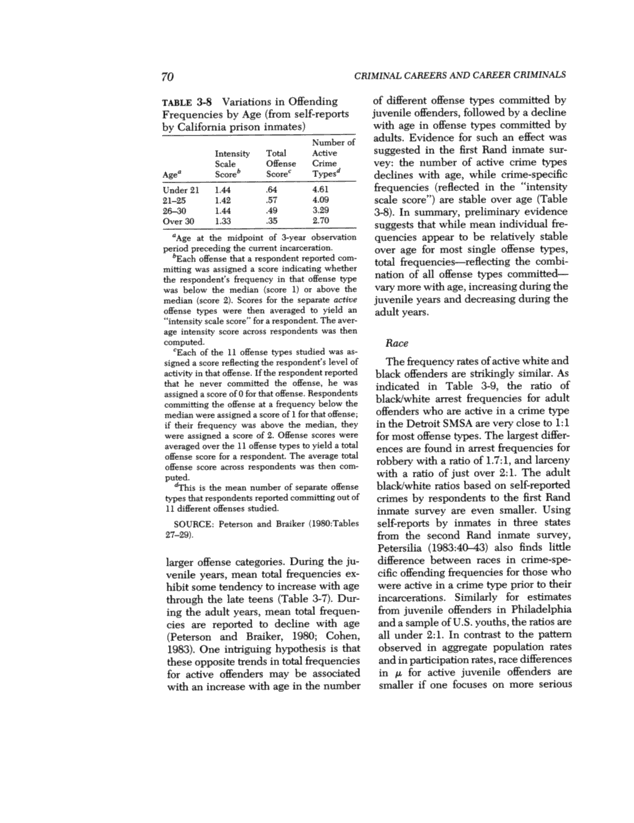
70 TABLE 3-8 Variations in Offending Frequencies by Age (from self-reports by California prison inmates) Intensity Scale Scoreb Total Offense ScoreC Number of Active Crime Types 4.61 4.09 3.29 2.70 Under 21 21-25 26~0 Over 30 1.44 1.42 1.44 1.33 .64 .57 .49 .35 aAge at the midpoint of 3-year observation period preceding the current incarceration. beach offense that a respondent reported com- mitting was assigned a score indicating whether the respondent's frequency in that offense type was below the median (score 1) or above the median (score 21. Scores for the separate active offense types were then averaged to yield an "intensity scale score" for a respondent. The aver- age intensity score across respondents was then computed. CEach of the 11 offense types studied was as- signed a score reflecting the respondent's level of activity in that offense. If the respondent reported that he never committed the offense, he was assigned a score of 0 for that offense. Respondents committing the offense at a frequency below the median were assigned a score of 1 for that offense; if their frequency was above the median, they were assigned a score of 2. Ollense scores were averaged over the 11 offense types to yield a total offense score for a respondent. The average total offense score across respondents was then com- puted. This is the mean number of separate offense types Mat respondents reported committing out of 11 different offenses studied. SOURCE: Peterson and Braiker (1980:Tables 27-29). larger offense categories. During the ju- venile years, mean total frequencies ex- hibit some tendency to increase with age through the late teens (Table 3-71. Dur- ing the adult years, mean total frequen- cies are reported to decline with age (Peterson and Braiker, 1980; Cohen, 19831. One intriguing hypothesis is that these opposite trends in total frequencies for active offenders may be associated with an increase with age in the number CRIMINAL CAREERS AND CAREER CRIMINALS of different offense types committed by juvenile offenders, followed by a decline with age in offense types committed by adults. Evidence for such an effect was suggested in the first Rand inmate sur- vey: the number of active crime types declines with age, while crime-specific frequencies (reflected in the "intensity scale score") are stable over age (Table 3-81. In summary, preliminary evidence suggests that while mean individual fre- quencies appear to be relatively stable over age for most single offense types, total frequencies reflecting the combi- nation of all offense types committed vary more with age, increasing during the juvenile years and decreasing during the adult years. Race The frequency rates of active white and black offenders are strikingly similar. As indicated in Table 3-9, the ratio of black/white arrest frequencies for adult offenders who are active in a crime type in the Detroit SMSA are very close to 1:1 for most offense types. The largest differ- ences are found in arrest frequencies for robbery with a ratio of 1.7:1, and larceny with a ratio of just over 2:1. The adult blacklwhite ratios based on self-reported crimes by respondents to the first Rand inmate survey are even smaller. Using self-reports by inmates in three states from the second Rand inmate survey, Petersilia (1983:4~43) also finds little difference between races in crime-spe- cific offending frequencies for those who were active in a crime type prior to their incarcerations. Similarly for estimates from juvenile offenders in Philadelphia and a sample of U.S. youths, the ratios are all under 2:1. In contrast to the pattern observed in aggregate population rates and in participation rates, race differences in ,u for active juvenile offenders are smaller if one focuses on more serious
DIMENSIONS OF ACTIVE CRIMINAL CAREERS TABLE 3-9 Individual Frequency Rates by Race 71 Total (any type) Juvenile Offenders in Philadelphia Robbery Violent index Property indexe Non-index Total (any type excluding traffic) Crimes Committed per Year per Active Offender, of Estimates for Adult Street Offenders in California Armed robbery Assault Burglary Auto theft Forgery Drug sales Self-Reported Offenders Among U.S. Youths Robbery Felony theft Felony assault Any index .13 .18 .18 .13 .13 .2s .ss .27* .11 .34 .46 .ss 2.3 2.7 2.4 s.o 5.4 08 9.6 5.8 3.4 6.4 .23 .18 .22 .29 .15 .39 .56 .23 .14 .46 .79 .08 1.7 2.1 2.7 2.8 4.8 21 4.6* 7.4* 3.9 6.3 Offense Type Arrests per Year per Active Offender, lob Adult Offenders in Detroit SMSA Robbery Aggravated assault Burglary Larceny Auto theft All indexC Whites Blacks Ratio of BlackMrhite Ratesa .74 .97 1.19 2.13 .15 .54 .01 .84 .32 .34 .72 .84 .74 .78 .22 .56 .89 .12 .48 .28 .15 .98 NOTE: Rates denoted by an asterisk are based on fewer than 20 active offenders in the offense type. Sample sizes for other offense types number at least 35 active offenders and, in most cases, more than 7s active offenders. "The ratios were computed before the frequencies were rounded to the two significant decimal places reported in this table. bIndividual arrest frequencies were estimated for separate offense types only for offenders with at least one arrest for an offense type. For adult offenders in the Detroit SMSA, arrests any time in their arrest history prior to the sampling years were considered (Cohen, 1981~. Arrest frequencies for juvenile offenders in Philadelphia are based on a reanalysis of the data from Wolfgang, Figlio, and Sellin (19721. The raw frequency rates computed by dividing incidence rates by participation rates, and which require at least one arrest in a year, were adjusted to reduce the impact of this criterion event (see Cohen, Appendix B). CIndex offenses include murder, rape, robbery, aggravated assault, burglary, larceny, and auto theft. Violent index offenses include murder, rape, and aggravated assault. eProperty index offenses include burglary, larceny, and auto theft. Offending frequencies for adults are based on self-reported counts of crimes committed by respon- dents to the first Rand survey of inmates in California prisons. By use of a model reflecting the likelihood of being in prison for a crime, the inmate responses were reweighted to reflect frequency estimates for a sample of street offenders (Peterson and Braiker, 1980:Table 35~. The offending frequencies for youths (ages 11 to 21) were derived for the panel by Cohen (Appendix B) from annual incidence and participation rates for 1976 to 1980 reported for a national sample of U.S. youths by Elliott et al. (1983~.
72 offense types. This same trend is also found for A on the basis of self-reports by juveniles.5 The most striking finding in the com- parisons in Table 3-9 is the general simi- larity in frequency rates for active white and black offenders. The race differences in arrest frequencies, which are basecI on official-record data, do not come close to the ratios of 10:1, or even 5:1, in aggregate population arrest rates and offlcial-record participation rates for robbery and violent index offenses. And the black/white ratios for A based on self-reported crimes by active offenders are even lower than ra- tios based on arrest data. The black/white ratio for frequency rates based on self-reports is always lower than that for participation rates based on self-reports. Indeed, the blacklwhite ra- tios for A often fall below 1:1. For robbery, for example, self-reported participation rates among black respondents are about twice those of white respondents, but self-reported frequency rates for black of- fenders are only one-half to three-quar- ters those for white offenders. Thus, the sometimes substantial race differences in criminal activity found in aggregate pop- ulation rates appear to result primarily from differences between blacks anti whites in participation: there are more active offenders in the black population, but, when considering only active offend- ers, frequency rates are very similar for whites and blacks. 5This finding contrasts win the finding reported by Elliott and Ageton (1980) of significant di~er- ences in 1976 between whites and blacks in inci- dence rates, but not in parUcipabon rates, for total crimes and predatory crimes against property. The differences in incidence rates for 1976 are not re- flected in similar differences in frequency rates when the 5 years of data from 1976 to 1980 are combined. CRIMINAL CAREERS AND CAREER CRIMINALS Other Factors Associated with Variations in Frequency Rates Other factors have been studied in re- lation to frequency rates. Though their theoretical significance is not always clear, these variables often offer insights for policy, especially as they provide a basis for identifying high-rate offenders. Age at Onset of Criminal Activity Aside from any changes in frequency rates as offenders get older, age at crimi- nal career initiation is another variable that may distinguish among offenders. Numerous studies have reported higher recidivism rates among offenders who have records of early criminal activity as juveniles. Estimates of recidivism rates during a follow-up period reflect the com- binecl contribution of the fraction of of- fenclers who persist in criminal activity and their frequency rates. The lower re- ciclivism rates for offenders who started criminal activity at older ages thus may result either from a greater tendency for those relatively late starters to terminate their criminal activity early or from lower frequency rates for active offenders who begin their criminal activity at older ages. Figure 3-2 presents annual total fre- quency rates for all offenses estimated for offenders who begin criminal careers at different ages (as indicated by age at the first detected criminal event). These esti- mates of frequency rates were derived from incidence and participation rates and then adjusted to reduce the upward bias introduced by the requirement that offenders have at least one event (see Cohen, Appendix B). The estimates of arrest frequencies for Philadelphia male juveniles are based on annual incidence and participation rates at every age for offenders who start at the same age. (The estimates were provided by Wolfgang, Figlio, and Sellin, personal communica
DIMENSIONS OF ACTIVE CRIMINAL CAREERS 1.1 1.0 0.9 in a) a) o 0.8 0.7 ·t, 0.6 a) a, LO 0.5 cn ~ 0.4 . _ ._ - 0.3 - <` 0.2 0.1 t \ \ \ 1-~ A \ \/ ~ Arrest Frequencies for Philadelphia Male Juveniles - Conviction Frequencies for London Male Youths 10-12 13 14 15 16 17 18-19 20-24 Age at First Event (years) FIGURE 3-2 Annual individual frequency rates by age at first criminal event. Source: Frequency rates were derived by Cohen (Appendix B) from incidence and participation rates obtained from longitudinal data for Philadelphia males born in 1945 and residing in Philadelphia from ages 10 to 18 (Wolfgang, Figlio, and Sellin, 1972) and for a sample of London male youths aged 8 and 9 in 1961 and 1962 and residing in a center-city neighborhood of London (Farrington, 1983a). tion.) Thus, only active offenders enter the estimates. The estimates of average conviction frequencies for London mate youths are based on the total convictions per youth over the period between ages 10 and 24 for each starting age, as re- ported in Farrington (1983a:Table 3~. The 19 offenders first convicted at age 14, for example, are reported to average a total of 2.82 convictions each from age 14 to 24. As a first approximation, the annual fre- quency rate can be estimated by dividing 73 total convictions by the number of years observed (11) for 14-year-old starters and adjusting for the one required conviction. The resulting estimate shown in Figure 3-2, however, does not account for career termination before age 24 for some of- fenders. If the estimate were properly limiter! to include only active years for each offender (i.e., years in which they have at least one conviction), the estimates of an- nual conviction frequencies would be higher than reported in Figure 3-2.
74 Offenders who start careers at younger ages generally have higher annual fre- quency rates than older starters. The de- cline in conviction frequencies at older starting ages that is observed for London male youths would be even sharper if younger starters are also clisproportion- ately more likely to terminate their ca- reers before age 24. The same general pattern of a decline in frequency rates for older starting ages, illustrated in Figure 3-2, is also observed for separate offense types. Drug Use Offending frequencies vary with drug use for active offenders (Wish and Johnson, Volume II). Higher frequency rates are found both among active of- fenders currently using drugs and among those with histories of drug use, espe- cially early drug use as juveniles, across a variety of offense types, and using both official-arrest and self-report data. Annual incidence and participation CRIMINAL CAREERS AND CAREER CRIMINALS rates from official arrest records reporter! in Sechrest (1979) were user! to estimate ,u and A for active offenders in samples of participants in drug treatment programs (see Cohen, Appendix B). When esti- mates of the probability of arrest for a crime are applied to mean individual ar- rest frequencies, active offenders among participants in drug treatment programs are estimates! to commit an annual aver- age of 3 assaults, 6 to 8 robberies, and more Man 20 property offenses. These rates are twice those fount! for adult ar- restees generally (Table 3-3, above). The offending frequencies derived from official records of arrests are compa- rable in magnitude to We mean annual offending frequencies estimated from the self-reportec] offenses of"irregular" drug users in another sample of sheet drug users (see Table 3-101. In general, A in- creases as drug use increases. There are also increases in the number of offenders active in various property offenses (Table 3-10), suggesting increases in participa- tion rates with increases in drug use. TABLE 3-10 Inclividual Offending Frequencies (A) by Drug Use for Street Drug Users (offenses committed per year per active offender) Drug Usersa Offense Type Robbery Burglary Shoplifting (resale) Other larceny Forgery Con games Irregular 8.9 (12) 12.8 (19) 67.8 (31) 14.8 (22) 6.8 (6) 138.1 16) Regular 16.7 (18) 35.9 (33) 74.7 (48) 40.4 (41) 11.4 (7) 125.2 21) Daily 26.5 (27) 60.5 i35) 105.7 (42) 32.4 (37) 18.4 (8) 85.9 (21) All 20.4 (57) 41.2 (87) 84.5 (121) 32.1 (100) 13.4 (21) 113.8 (58) NOTES: Derived by Cohen (Appendix B) from data on incidence and participation rates reported by Johnson et al. (1983:Tables VI.1 and VIII.2~. The number of active offenders in each offense type is noted in parentheses. aIrregular drug users reported using heroin less than an average of 3 days per week; regular drug users reported using heroin an average of 3 to 5 days per week; daily drug users reported using heroin an nvF~r~f? of ~ or 7 rl:~vs ner week (Johnson et al. 1983:42). ~=,
DIMENSIONS OF ACTIVE CRIMINAL CAREERS Drug use also distinguishes frequency rates estimated from self-reports by in- mates (Chaiken and Chaiken, 1982a). Higher mean values of A while free are estimated for drug users than for nondrug users, especially for armed robbery and burglary, while forgery is committed at higher rates by noncirug users. Offenders who commit robbery, burglary, ant! as- saults at especially high rates ("violent predators") are characterized by exten- sive use of drugs as juveniles and use of multiple drug types as adults. The differences between the rates re- ported for daily drug users in Table 3-10 and those for offenders generally in Table 3-3 (above) are consistent with the large differentials in A between drug users dur- ing periods of heavy drug use and other offenders that are found in some self- report studies. During these periods, crime spurts with frequencies as much as 6 times as high as those for nonusing offenders have been reported (McGIoth- lin, Anglin, and Wilson, 1978; Ball, Shaf- fer, and Nurco, 1983; Gropper, 19851. Employment Only a few studies that examine the relationship between employment and A for active offenders are available. Studies that rely on official-record data rarely in- clucle the necessary information on indi- vidual work experiences. When available, employment data are usually obtained from self-reports by stucly participants. Time spent unemployed is a significant factor distinguishing the frequency rates of active offenders. Among inmates sur- veyed by the Rand Corporation, offenders who were employed less than half the time cluring the observation period prior to their incarceration reported commit- ting property crimes at higher rates than other offenders (Chaiken and Chaiken, 1982a; Greenwood, 19821. Irregular em- ployment is also a factor distinguishing those who committed robbery, burglary, 75 and assaults ("violent preciators") at espe- cially high rates. These findings for A are consistent with other results on the effect of time spent unemployed! in increasing individual lev- els of criminal activity, but typically mea- surecl by aggregate incidence rates (e.g., crimes per capita) that confound A and participation (Glaser and Rice, 1959; Glaser, 1964; Cook, 1975; Sickles, Schmidt, and Witte, 1979; Thornberry and Farnworth, 1982; McGahey, 1982; see also the interpretation ofthe potential intervening role of increased time unem- ployec3 in Rossi, Berk, and Lenihan (1980), and a critique of this approach in Zeisel, 1982a). Research has generally found that indiviclual levels of crime, as measured by incidence rates, are not re- lated to wage rates (e.g., Witte, 1980; McGahey, 19821. Previous Criminal Involvement High levels of criminal activity in the past are a good indicator of continuer! future offending at high frequencies. This relationship has been observed for vari- ous offense types, for both juveniles and adults, using frequency rates based on official-record and self-report data and us- ing various indices of previous offending, inclu(ling self-reporte(1 offenses, arrests, convictions, and incarcerations (Blum- stein and Cohen, 1979; Peterson and Brai- ker, 1980; Chaiken and Chaiken, 1982a; Greenwood, 1982) and also using inci- dence rates that combine frequency and participation (see e.g., Farrington, 19841. In most of these studies, past criminal activity has been measured crudely, us- ing a simple count of events found in a prior criminal record (often referred to as an offender's record length) or a binary variable indicating the presence or ab- sence of a prior record. A recent study reanalyzing data for persistent offenders among male juveniles in Philadelphia, however, finds that when past offending
76 rates are used explicitly, the relationship between record! length and subsequent frequency disappears: offenders with Tong prior records also tend to have high rates in the past, and, with age and the number of prior arrests held constant, arrest frequency in the past is predictive of subsequent arrest frequency for juve- niles who remain active (Barrett and Lofaso, 19851. Summary In contrast to the patterns observed in aggregate data on population arrest rates and participation rates, individual fre- quency rates for active offenders do not vary substantially with the demographic attributes of sex, age, or race. Differences in frequency rates are observed with age of onset of careers, drug use, unemploy- ment, and prior criminal involvement. Active offenders who begin criminal ac- tivity at young ages, use drugs heavily, are unemployecl for Tong periods of time, and have extensive prior records of crim- inal activity generally commit crimes at higher rates than other offenders. These results suggest a general stability in the frequency of offending by active offend- ers. It thus appears to be reasonable to characterize indivicluals as high-rate or low-rate offenders, since these frequency rates generally are sustained during ca- reers. These characteristics form the basis for several prediction-based classification rules, which are evaluated in Chapter 6. CRIMINAL CAREERS AND CAREER CRIMINALS interest. The patterns of change in offense types during individual criminal careers are also of concern, especially the extent of specialization in the same offense type by offenders and of escalation from less serious to more serious types of offenses. One can consider changes in the serious- ness of offense types without regard to patterns in frequency rates. -Types of Studies SERIOUSNESS In addition to individual frequency rates, which gauge the intensity of of- fending by active offenders, the mix of different offense types that are committed is a key dimension of indiviclual criminal careers. Distinguishing offenders most likely to engage in serious predatory of- fenses is of particularly important policy A number of studies have analyzed individual trends in the seriousness of offenses over a career. These studies share a common reliance on official- record data. Some use the broad category of police contacts, which may include police stops for questioning that do not leac! to arrest or any formal charges but are recorcled in police files. Analysis of police contacts is especially characteristic of research on juvenile offending. Other studies rely on arrests or convictions. This research relies predominantly on official-record data because it represents the only recorded source of information on the sequence of offense types. The usual self-report interval of a year or more is too long to obtain reliable information on the sequence of offenses for individu- als. Self-report data can be used, how- ever, to explore patterns of offense mix by active offenders, as has been done by Chaiken and Chaiken (1982a), who used self-reports by inmates. Also, if repeated self-report surveys ofthe same sample are available, changes in offense mix during different reporting periods can be exam- irled. Such analyses of self-reportec] of- fenses are part of the National Youth Sur- vey (e.g., Dunforc] and Elliott, 19841. It is important to stress that analyses relying on official data reflect patterns of official contacts with the criminal justice system, but they are not likely to be rep- - resentative of switching among offenses actually committed. The distortion in of
DIMENSIONS OF ACTIVE CRIMINAL CAREERS ficial records arises from variation in the likelihood that different offense types will result in an official contact. Rare offenses generally have a high risk of arrest (like murder or aggravated assault), while com- mon offenses like larceny or drug law violations have low risks of arrest and so are underrepresented in official record sequences. In addition, overcharging by police or erroneous arrests conic! further distort official records. Because of these differences in the probability that dif- ferent offense types will appear on official records, the results of analyses basecI on official contacts do not generalize to of- fense-type sequences between crimes ac- tually committed. Transitions from rarely reported events to frequently reporter] events will appear to be more common than they actually are because occur- rences of the rarely reported events will often be missing from the record. Since dynamic processes like "special- ization" or"escalation" make sense only in the context of Tongituclinal data of incli- vidual event histories, all studies of crime type sequences necessarily involve longi- tudinal data on individual offenders. Be- cause of the focus on transitions between events, these studies are dominated by more persistent offenders who accumu- late larger numbers of events. Two general approaches are used in analyzing the offense types found in indi- vidual offense histories. One approach attempts to characterize complete histo- ries, summarizing offending patterns in terms of the mix of offense types found or using profiles of complete offense se- quences. The usefulness ofthese summa- ries of complete histories clepends on the extent to which large numbers of individ- ual histories can be adequately repre- sented by a relatively small number of distinctive patterns. If identifiable pat- tems cannot be found, analysis based on large numbers of complete histories can be quite cumbersome. 77 Offense Type of k + 1st Arrest 4 - ~ i o ~ : v) O i - . . I . .. i \ - Wi\ Diagonal Elements (specialization) FIGURE 3-3 Simplified transition matrix for of- fense-type switches between successive arrests. The other approach relies on transition matrices that focus more narrowly on pairs of successive events within histo- ries. The term "switching" commonly re- fers to the sequence of crime types in a pair of successive arrests but also refers to repeating the same crime type. As shown in Figure 3-3, transition matrices charac- terize pairs of successive arrests in terms of the probability of a next arrest for type j after an arrest for type i. The diagonal elements in the transition matrix depicted in Figure 3-3 reflect transition probabiTi- ties between arrests for the same offense type. This approach has Me advantage of being able to accommodate in a conve- nient analytic form both the mix of dif- ferent offense types and the sequence in which those offense types occur for large numbers of offenders. Changes in Offense Mix Data on the changing mix of offense types at different stages of criminal ca- reers are available from several sources. As illustrated in the first two studies in Table 3-11, comparing adult and juvenile offending patterns, property offenses are
Offense Type Under 13 13-18 19-22Over22 Property 91.4 80.9 44.840.7 (71.1)(71.3) Person 5.7 6.1 9.110.7 (14.4)(18.7) Sex 2.9 5.3 9.16.0 (14.4)(10.5) Drunkenness 0.0 7.7 37.042.9 (-)(-) (Number of convictions) (35) (131) (143)(84) 78 CRIMINAL CAREERS AND CAREER CRIMINALS TABLE 3-11 Changes in Mix of Offense Types (in percent) - A. 1,000 adjudicated delinquentsa Age at Arrest Offense Type11-15 16-2021-2526-30 Property62.9 48.724.618.2 (34.6)(31.9) Disorderly conduct21.7 22.230.322.5 (42~7)(39.5) Violence2.5 4.47.36.8 (10.3)(11.9) Drunkenness0.0 9.329.043.0 (-)(-) Family and children0.0 0.51.63.3 - (2.3)(5~8) Sex0.3 1.62.42.6 (3~4)(4~6) Narcotics0.0 0.10.30.6 (0.4)(1.1) Others12.6 13.24.53.0 (6~3)(5~3) (Number of arrests)(1,333) (2,719)(2,547)(2,195) B. Cambridge-Somerville Youth Studyb Age at Conviction C. Juveniles with police contacts in Philadelphia birth cohorts Sequence Number of Juvenile Police Contact Offense Type1 2-34-67-9 Non-index65.5 63.361.657.8 Injury7.6 8.19.I11.2 Theft13.9 16.518.117.5 Damage7.3 3.93.13.2 Combination5.8 8.28.110.2 (Number of juvenile police contacts)(3,475) (3,074)(1,960)(875) D. Adults arrested in Washington, D.C.& Sequence Number of Adult Arrest Offense Type 1 23 4 Violent 21.3 24.0 20.9 19.4 Property 36.2 32.8 35.1 32.9 Robbery 13.3 13.1 10.6 11.6 Drugs 4.3 6.2 6.7 6.1 Others 24.9 23.9 26.6 29.8 (Number of adult arrests) (2,968) (2,968) (2,431) (1,952) NOTE: The renormalized distribution for adults after excluding arrests for drunkenness is reported in parentheses. aAdapted from Cline, 1980; Table 13.2 in Brim, O., and J. Kagan, eds., 1980, Constancy and Change in Human Development, Harvard University Press. Used by permission. Based on data from Glueck and Glueck, 1940. bN = 506; adapted from Cline, 1980; Table 13.3 in Brim, O., and J. Kagan, eds., 1980, Constancy and Change in Human Development, Harvard University Press. Used by permission. Based on data from McCord and McCord, 1959. ON = 3,475; adapted from Wolfgang, Figlio, and Sellin, 1972:Matrix 11.1, Tables 11.2 to 11.6. IN = 5,338; adapted from Moitra, 1981:Table 2.1.
DIMENSIONS OF ACTIVE CRIMINAL CAREERS more common for juveniles ant! violent offenses are more common at older ages (Glucck and Glueck, 1940; McCord and McCord, 19591. The last two studies in Table 3-11 provide data on changes in offense mix on successive arrests for juve- niles (Wolfgang, Figlio, and Sellin, 1972) and adults (Moitra, 1981~. In contrast to the differences in offense mix of juveniles compared with aclults, offense mix is rather stable over successive arrests within either age group. Overall, violent offenses are more common among aclults than among juveniles. The first two studies in Table 3-11 are distinguished by the heavy representa- tion of drunkenness at adult ages, which comprises 43 percent of the arrests and convictions in the oldest age categories; a similar pattern is not observed in the final stucly for adults reported in the table. The studies cover different historical periods, with the Gluecks and McCords studying offending in the first half of this century, and the Moitra data including predomi- nantly arrests in the 1960s and early 1970s. Much of the difference in the role of drunkenness for aclults may lie in changes in arrest and police reporting practices over this period, not in changes in offending behavior. When drunken- ness is removed in the first two studies, the distributions for adults are more com- parable across the various studies, espe- cially for violent offenses, which repre- sent 10 to 20 percent of all arrests or convictions for adults. These data on offense mix at different times during careers provide useful in- sights into the relative frequency of dif- ferent offense types, especially highlight- ing which types are rare ant! which are commonplace. However, they do not nec- essarfly reflect the dynamics of change during criminal careers. Because the dis- tributions are not linked to the same of- fenders in each time period, comparisons across time periods may reflect changes 79 in the mix of offenders rather than changes in offense types cluring careers. Increases in violent offenses at oIcler ages, for example, might result from of- fenclers' changing to violent offenses as their careers progress or from earlier ter- mination of careers by offenders who do not engage in violent offenses. In the latter case, violent offenders wouIcI con- tribute a larger share to offenses at older ages with little or no change in the of- fense mix for those who remain active in careers. Data on offense mix alone that are not linked to the sequence of offense types for individual offenders cannot dis- tinguish between these processes. General O~ense-Switching Patients Transition matrices are often used to characterize the sequence of crime types over successive events for the same indi- viduals. A number of studies examine directly or provide data that permit com- parisons of offense-switching patterns across various demographic subgroups of inclividual offenders (see Cohen, Appen- dix B. for details). Race Significant differences in offense switching by race are found in all but one of the samples of offenders examined. These race differences are found for a variety of offense types and for both juve- niles and adults. Nonwhite offenders are more likely than whites to switch to seri- ous offense types, especially those involv- ing violence and robbery, and less likely to switch to less serious offenses or to (resist from offending (Wolfgang, Figlio, and Sellin, 1972; Bursik, 1980; Moitra, 1981; Blumstein, Cohen, and Das, 19851. Among male juveniles with police con- tacts in Philaclelphia, for example, the likelihood of a next police contact for an offense involving injury is .09 for
80 nonwhites and .04 for whites; the likeli- hood of no further contact is .23 for nonwhites and .37 for whites (derived from data in Wolfgang, Figlio, and Sellin, 1972:Tables 11.27 and 11.28~. Among aclults arrested in the Detroit SMSA, the likelihood of a next arrest for a robbery is .08 for whites and .13 for blacks (clerivecI from data in Blumstein, Cohen, and Das, 1985). The greater likelihood of switches to violence and robbery found among nonwhite offenders parallels the race dif- ferences observed in participation rates for these offense types. The only study that tincis no evidence of differences in offense switching for black groups in- cludes other ethnic groups in addition to blacks and is distinguished by its much lower representation of blacks and by its larger representation of females in the offender sample (Rojek and Erikson, 1982~. These factors contribute to a greater representation of less serious of- fense types in the sample, which may obscure differences that are more promi- nent in serious offense types. . ~. . ~ Sex CRIMINAL CAREERS AND CAREER CRIMINALS age of onset. While the basic data are generally available in sample data, appro- priate analyses of these data have not yet been performed. Variations with age of onset could be evaluated by directly com- paring transition matrices estimated for clifferent starting age groups. To detect age effects, offenders could be character- ized by age of the offender at a transition. Separate transition matrices could then be estimated and comparer! for each age at transition. Offense Clusters Offense-switching patterns also pro vicle a basis for identifying clusters of related offense types. Clusters represent natural partitions of offense types: offend ers display a stronger tendency to switch among offense types within a cluster and a correspondingly weaker tendency to switch to offense types outsicle a cluster. A cluster is defined by the fact that switching within it is higher than would be expected if the next crime type were independent of the previous crime type; switching between clusters is Tower than wouicl be expected under inclependence of crime types. Only one sample includes a sufficient In three jurisdictions, two distinct clus numberoffemaTestopermitexamination ters-one for violent offenses and the of differences in offense switching by sex other for property offenses- were found for adult offenders in analyses done for the panel (see Cohen Ancendix B). This (Rojek and Erikson, 1982~. In this sample of juvenile offenclers, offense switching is significantly different for mate and female offenders, with female offenders much more likely than mates to desist or to shift to runaway offenses. Switches to these two categories comprise 73 percent of offense transitions for females compared with only 36 percent for mates. Age Adequate evidence is not available to assess changes in offense-switching pat- terns either with age of offender or with tendency for offense types to cluster var- ies somewhat by race, with a stronger partition between violent and property offenses evident among black than white offenclers. In Detroit and the rest of Mich- igan, but not in Washington, D.C., there is some relationship between these clus- ters and other offense types: switching is elevated between the cluster of violent offenses and robbery and diminished be- tween the cluster of property offenses and clrugs. Offense switching does not appear to
DIMENSIONS OF ACTIVE CRIMINAL CAREERS be inclepenclent of prior offense type. In- stead, knowledge of prior offense type provides information that is useful in predicting the next offense type. The analysis of offense switching by adults provides behavioral support for the fre- quently used partition between violent ancl property offenses. Adults exhibit clef- inite tendencies to switch among offenses within clusters of violent or property of- fenses and a tendency not to switch be- tween these two clusters. The clear tendency toward distinct clusters of violent (person) offenses and of property offenses provides empirical sup- port for the use of these aggregate catego- ries in other studies of offense switching. Not only are these offense types concep- tually similar, they are also behaviorally related, with offenders more likely to switch among offenses within a cluster on successive arrests. While a strong partition between vio- lent and property offenses was found among adults, this partition is not as sharp among juveniles (see Cohen, Appendix B). Only incarcerates! juveniles in New Jersey (Smith and Smith, 1984), nonwhite juvenile offenders in Philaclelphia (from data in Wolfgang, Figlio, and Sellin, 1972), and white juvenile offenders in Cook County (from data in Bursik, 1980) display a tendency not to switch between injury and theft offense categories. Fur- thermore, there is some evidence of a tendency to switch between violent ant! property offenses among juveniles. fuve- nile offenders of both races in Philadel- phia exhibit higher-than-expectec! switch- ing between theft ant] "combination" offenses (which inclucle components of both harm to persons ancI property loss). Switching between persons and property categories is also elevated in the Pima County sample of juveniles (from data in Rojek and Erikson, 19821. The Pima County study provides the only cIata that separately identify juvenile 81 status offenses (runaway and "other sta- tus"~. The observer! switching patterns in this sample inclicate a sharp partition be- tween status offenses and other crimes. There is a tendency not to switch from status offenses to other crimes. Also, while there is a tendency not to switch to Resistance (i.e., no further arrests in juve- nile record) from other crimes, there is a tendency for Resistance to follow a juve- nile status offense. Specialization Specialization is the tendency to repeat the same offense type on successive ar- rests. This tendency has been reported in several studies of arrest cIata (Wolfgang, Figlio, and Sellin, 1972; Bursik, 1980; Moika, 1981; Rojek and Erikson, 1982; Smith and Smith, 1984; Blumstein, Cohen, and Das, 19851. Specialization es- timates based on arrest records could be inflated by police arresting and recording practices. For example, an arrest may be recordecl reclundantly by several police clepartrnents, or police may arrest sus- pects because of a recent history of simi- lar offenses. Table 3-12 illustrates this greater ten- clency of repeating the same offense type on successive arrests for juveniles with police contacts in Philaclelphia ant! adults arrested in the Detroit SMSA. When white juvenile offenders in Philadelphia are arrested again, the overall probability is .17 of a next arrest for theft; among those rearrested! after an arrest for theft, however, the probability that the next arrest also will be for theft is almost twice as high, .30. Similarly, among all blacks who are arrested again in the Detroit SMSA, the probability is .13 that the next arrest will be for robbery; for those ar- restecl again after an arrest for robbery, the probability is .31 that the next arrest also wit] be for robbery. In general, ar- rests for any specific offense type are
82 CRIMINAL CAREERS AND CAREER CRIMINALS TABLE 3-12 Specialization in Offender Samples: The Likelihood of Repeating the Same Offense Type on Next Arrest, by Race Probability of Each Offense Type on Next Arrest Conditional on Offense Type of Prior Arrest White Offenders Black Offenders Offense Type of Next Arrest Among Recidivists Overall Same Overall Same Juveniles in Philadelphiaa Non-index .66 .70 .58 .62 Injury .07 .13 .11 .14 Theft .17 .30 .18 .25 Damage .03 .14 .03 .05 Combination (e.g., robbery) .07 .20 .10 .18 Adults in Detroit SMSAb Murder .01 .15 .01 .14 Rape .01 .15 .01 .17 Robbery .08 .35 .13 .31 Aggravated assault .07 .22 .08 .23 Drugs .17 .50 .09 .34 Burglary .27 .45 .20 .38 Larceny .19 .31 .27 .45 Auto theft .07 .24 .07 .28 Weapons .05 .12 .07 .19 Fraud .08 .40 .06 .32 NOTE: Among those arrested again, the overall rate is the likelihood of a next arrest of each offense type, regardless of the previous offense type; the repeat rate is the likelihood of a next arrest for the same type as the previous arrest type. aDerived from data in Wolfgang, Figlio, and Sellin (1972:Matrices 11.11 to 11.26~. bDerived from data in Blumstein, Cohen, and Das (1985~. more likely to follow a previous arrest for the same type than they are to follow any other offense type. As defined here, specialization does not imply that repeating the same offense type is very likely on the next arrest. Age Important differences in specialization are observed between adults and juve- niles. While specialization is evident in some offense types for juvenile offenders, Indeed, in the examples in Table 3-12, ' the likelihood of repeating the same type rarely exceeds one-third. However, re peating an offense type, say, aggravated assault, is more likely than the overall chance that a next arrest will be for aggra spec~a~zat~on is stronger in magnitude and found in all offense types for adult offenders (see Table 3-12, for example). This finding suggests a more exploratory approach to crime by juvenile offenders and a stronger commitment to particular offense types by adult offenders. The difference between juvenile and adult offenders may reflect a develop- mental process in which more special vatec! assault. For white adults who are rearrested in Detroit, only 22 percent of aggravated assault arrests are followed by another aggravated assault arrest, but this number is more than three times the 7 ized offending patterns emerge gradually percent chance of an aggravated assault as offending continues over time. But it arrest found generally among recidivists. might also reflect a selection process in
DlMENSlONS OF ACTIVE CRIMINAL CAREERS which juvenile samples include a mixture of casual offenders who desist from of- fending very quickly and a core of com- mittecI offenders who are more special- ized in their offending. As the casual exploratory offenders leave offending in the juvenile years, adult samples wouIc] consist more heavily of the committed, specialized offenders. Sorting out these rival hypotheses re- quires samples with data on both the juvenile and aclult periods for the same individuals. Whether specialization changes or is stable over time could then be examined for the subset of offenders who begin as juveniles and persist into aclulthoocI. Unfortunately, none of the available samples permit such an analy- sis. However, a sample in Cook County, Illinois, of very serious juvenile offend- ers all had been acIjudicated clelinquent in juvenile court, and they all hac! at least five arrests as juveniles (Bursik, 1980 - exhibits widespread offense speciaTiza- tion like that found among aclults. Signif- icant specialization is found in all of- fenses and for both races, except personal injury by white offenclers. The pervasive- ness of specialization in this sample of persistent juvenile offenders suggests that the juvenile/adult differences in spe- cialization found in the other juvenile samples may be clue to sample selection, particularly the presence of large num- bers of early Resisters in other juvenile samples. Offense Type While specialization is pervasive among aclults, it is not uniformly strong for all offense types. The most specialized offense types in all adult samples are drugs and fraucI. Auto theft is also highly specializes! among black offenders in the Detroit SMSA and among the predomi- nantly black offender population in Washington, D.C. (Cohen, Appendix B). 83 Higher specialization in these offense types is consistent with the frequent role of these offenses as part of larger, orga- nized illegal economic enterprises. The least specialized offenses among aclult offenders are the violent ancl often impul- sive offenses of murder, weapons, and rape (Cohen, Appendix B). Specialization is more sporadic among juvenile offenders. A sample of Pima County juveniles exhibits the least spe- ciaTization; only property and runaway offenses show a significantly greater ten- clency to be repeated on successive ar- rests than wouIc! be fount! if switching were inclepenclent of prior offense types. (For analysis of data from Rojek and Erikson, 1982, see Cohen, Appenclix B.) Sex The only study of specialization to con- trast sexes is a sample of juvenile of- fenders in Pima County (Rojek and Erikson, 19821. While specialization is in fact less frequent for female offenders, occurring only for runaway offenses, spe- ciaTization is generally limited in this sample of juveniles. Even among mate offenders, only property and runaway of- fenses show evidence of specialization. Race In a sample of Philadelphia juveniles, white offenders are more specialized than nonwhite offenders (Wolfgang, Figlio, and Sellin, 19721. No differences in spe- ciaTization are observed between white and black adults. Interestingly, despite the greater tendency of nonwhites to switch to violent offense types discussed previously for Philadelphia juveniles, they do not exhibit specialization in ei- ther injury or damage offenses. While arrests for violent offenses are more likely for nonwhites than for whites, they are no more likely to follow previous arrests for
84 violent offenses than to follow arrests for any other offense types. Escalation Escalation is the tendency for offenders to move to more serious offense types as offending continues. A belief in escala- tion is probably the most wiclely held view of the pattern of criminal careers. Data on offense transitions provide an opportunity to investigate escalation em- pirically. The evidence shows that escalation is observed for juveniles: seriousness of of- fense types increases on successive events, especially for nonwhite offenders. Average seriousness scores increased on successive police contacts for Phfladel- phia juveniles (Wolfgang, Figlio, ant] Sellin, 1972), and analysis of successive transitions finds increases in switches to more serious offense types ant! decreases in switches to less serious offense types on later transitions (Cohen, Appendix B). Likewise, reanalysis (Cohen, Appen- dix B) of data for juveniles in Pima County (Rojek and Erikson, 1982) finds increases in switches from juvenile status offenses to more serious crimes on later transitions. In contrast, the evidence for aclults from several studies shows that average seriousness measured by several seriousness scales clecTines on succes- sive arrests (Moitra, 1981; Blumstein, Cohen, and Das, 1985~. (See Cohen, Ap- pendix B. for a discussion of seriousness measures.) The apparent opposite seriousness trends for adults and juveniles, however, are confounded by a potentially impor- tant selection effect in the analyses. Be- cause offenders have different numbers of arrests, the same offenders are not ob- served over the full sequence of arrests. For early arrests, average seriousness re- flects the contributions of a mixture of offenders, some with only a few arrests CRIMINAL CAREERS AND CAREER CRIMINALS and some with long records of arrests. As the arrest number increases, however, average seriousness is increasingly re- strictec3 to offenders with large numbers of arrests. Thus, the trencis in seriousness observed over successive arrests could reflect differences among offenclers, rather than changes in seriousness over the course of indivicluals' criminal ca reers. - To control for this potential selection effect, offenders can be partitioned by their number of arrests, and the analysis of trends restricted! to a common se- quence of arrests found for a subset of offenders. Thus, for example, only offend- ers who have at least six arrests would be ~ . . used In comparing average seriousness from the first to the sixth arrest. When record length is controlled in this way in adult samples, average seriousness ap- pears to be generally stable over succes- sive arrests within subgroups of offenders who have the same minimum number of arrests. When compared across various offender subgroups, however, average se- riousness is lower for the subgroups of adults with larger numbers of arrests. In Washington, D.C., for example, including only adults who have at least six arrests, average seriousness over the first six ar- rests is stable. For offenders who have at least eight arrests, average seriousness is again stable over the first eight arrests, but with a lower average seriousness score. Just as the apparent decline in serious- ness for adult offenders results from dif- ferences in the mix of offenders available on successive arrests, differences among offenders may also be a factor in the . . increases in seriousness on successive police contacts for juveniles. As the num- ber of police contacts increases, average seriousness measures depend increas- ingly on offenders with large numbers of contacts. If more serious offenses are more common in the records of the more
DIMENSIONS OF ACTIVE CRIMINAL CAREERS active juvenile offenders, the changing mix of offenders alone conic! produce the observed increases in average serious- ness on successive contacts. Appropriate controls for record length are needed to assess the role of selection effects in the observed escalation for juveniles. TERMINATION AND LENGTH OF CRIMINAL CAREERS The findings that participation in crim- inal activity is more widespread among teenage males than among adult mates, that A is relatively stable over age for offenders who do remain active, but that there is a decline with age in aggregate arrest measures suggest that many crimi- nal careers must be very short, ending after only brief ventures into crime as teenagers. At the same time, however, many offenders do continue careers be- yon(1 the teenage years. Consequently, certain critical questions about the dura- tion of criminal careers emerge, particu- larly about the length of typical careers and how to prospectively distinguish short careers from long careers. Also, for already active offenders, there are ques- tions about the process of terminating their careers, especially about the ex- pectec! time remaining in an offender's criminal career as of a particular time the residual career length. Variations in career length with crime type and with attributes of offenders may be important factors in distinguishing persisters- those with Tong careers from other of- fenders. The answers to these questions have implications for attempts to modify crim- inal careers. A finding that career length is related to identifiable attributes of of- fenders, for example, may serve as a basis for distinguishing among offenders who have different career lengths. At one level, such variations in the base levels for duration across offenders shouts! be 85 taken into account in evaluating treat- ment programs so that existing differ- ences among offenders are not mistakenly interpreted as effects of treatment. At an- other level, the variations may be used! in selecting offenders for intervention programs. A strong relationship between legitimate employment and termination of criminal careers, for example, may sug- gest greater attention to employment fa- cilitation as a useful policy intervention. Alternatively, the factors associated with longer residual careers might influence the selection of offenders for incarcera- tion for reasons of incapacitation, since the effectiveness of incapacitation is di- minishec! if an offencler's career termi- nates while he is incarcerated. Types of Studies Depending on the attributes of Me data usecl, analyses have addressed career ter- mination at very different levels.6 Partly because ofthe partition between juvenile and adult justice systems, much research on criminal careers has focused exclu- sively either on juveniles or on aclults. These studies have of necessity taken the passage from juvenile to adult status as a partition for analysis, signaling the end of juvenile careers or the start of adult ca- reers. Other researchers, recognizing the potential continuity in offending between juvenile and adult periods, have followed juvenile samples into the early adult pe- riods and report data on the juvenile/adult 6Besides the analyses discussed here, earlier studies have reported termination rates for groups of subjects followed for long periods following juve- nile court contact (e.g., Glucck and Glucck, 1940), release on parole (e.g., Glueck and Glueck, 1943), or other types of release (e.g., Christiansen et al., 1965; Soothill and Gibbens, 1978~. Because of the wide range of ages in the samples and the methods used, those studies do not provide estimates of career length (measured in years), of the probability of persistence of juveniles into adult criminality, or of the probability of a "next" arrest.
86 link in participation between these two periods. Other studies have examined the se- quence of events in individual careers in more detail, providing estimates of termi- nation probabilities after each arrest. In these analyses, career length is character- ized by the number of arrests in a history. Important questions in these studies are how termination probabilities change with the accumulation of further arrests, what the expected number of future ar- rests is at any point in a career, and whether there are any bases for prospec- tively identifying the "persisters," who go on to have Tong records with large numbers of arrests or crimes. The third approach to career length focuses on the actual duration of criminal careers, estimating the time that elapses between the first and last crimes commit- ted. In analyzing incapacitative sentenc- ing policies, variation in residual career lengths at the time of sentencing is espe- cially important because incarceration that extends beyond the end of a career has no incapacitative effect. Persistence by Delinquents into Adult Careers Consistent evidence is available from various research settings that 30 to 60 percent of juvenile delinquents known to the police or juvenile courts persist as adult offenders with at least one arrest or conviction as an adult for an index or felony offense (McCord, 1978, 1982; Shan- non, 1978, 1982a; Polk et al., 1981; Far- rington, 1983a; Wolfgang, Thornberry, and Figlio, 1985; see also a review by Langan and Farrington, 19831. As shown in Table 3-13, follow-up studies of delin- quent and nondelinquent juveniles indi- cate that a much smaller fraction of nondelinquents are arrested as adults. The fraction classified as persisters into adult careers increases when the expo CRlMINAL CAREERS AND CAREER CRIMINALS sure period is lengthened by observing adults to older ages, when broader do- mains of crime are used, and when the measures are based on arrests instead of convictions. For three birth cohorts in Racine, Wisconsin, for example, Shannon (1982a) reports that 31,44, and 54 percent of mates with police contacts for nontraf- fic offenses before age 20 were arrested again as adults by ages 21, 26, and 32, respectively. If the cohorts are in fact similar in terms of their tendency to per- sist into adult careers, the differences in persistence must reflect the effects of ear- lier cutoff ages for the more recent co- horts. Reflecting the relationship be- tween persistence and domain of crime, a study by Shaw in 1947 (cited in Langan and Farrington, 1983) reports that, of 1,336 males appearing in Chicago juve- nile court for the first time in 1930, 66 percent were arrested as adults by age 31 for a felony or misdemeanor but only 46 percent were arrested for a felony. When comparable measures and proce- dures are available, demographic varia- tions in juvenile-to-adult persistence mir- ror variations in overall participation rates. Among the mate delinquents in the 1945 Philaclelphia cohort followed from age 18 to 30, about twice as many non- whites (54 percent) as whites (28 percent) were arrested for nontragic offenses as adults. For young female offenders in the three Racine cohorts, Shannon (1982a) reports persistence rates after age 20 in nontragic offenses of 20, 29, and 34 per- cent compared with rates of 31,44, and 54 percent, respectively, for male offenders. One implication of these findings is that differences in sample composition with respect to these demographic attributes would substantially affect juvenile-to- adult persistence rates in different sam- ples. A juvenile record is a strong indicator of later adult offending, and the strength of this relationship increases as the juvenile
DIMENSIONS OF ACTIVE CRIMINAL CAREERS TABLE 3-13 Persistence of Delinquents into Aclult Careers 87 Study Offenses Criminal Sample Examined Event Non delinquents mange tor warn Laud with Adult Adult Careers Careers Events (percent) (percent) Age Delinquents ~r .. , · ~it. Shannon 356 males born All nontrafficArrests (police 21 to 32 54 36 (1982a: in 1942 and (including contacts as Table 2) "residingcon- suspicion juveniles) tinuously"a in and inves Racine, Wis., ligation) to 1974 As above for (Same as (Same as 21 to 26 44 15 740 males above) above) born in 1949 As above for (Same as (Same as 21 31 3 1,114 males above) above) born in 1955 Farrington Cohort of 411 Indictable Conviction 18 to 25 71 16 (1983a) London boys offenses aged 25 in 1980 McCord and 506 boys from All nontragic Conviction 18 to 52 18 McCord Cambridge (adult end median (1959:92) and Somer- juvenile) age ville, Mass.; 28.5 median age 10.5 in 1939 McCord (Same as All nontragic Conviction 25 to 36 11 (1978:285) above) as juve- median niles; age 47 "serious . ,, crimes against persons or property, as adults Polk et al. 1,227 boys from All nontragic Arrests (1981) Marion County, Ore.; high school soph omores in 1964 Wolfgang, 975 Philadel- All nontraffic Arrests (police 18 to 30 Thornberry, phia boys contacts as and Figlio born in 1945 juveniles) (1985:348) 18 to 30 49 22 51 18 aNever absent from Racine for a period exceeding 2 years. record becomes longer. As shown in three cohort follow-up studies in Table 3-14, the fraction of members with adult criminal records is lowest 16 to 18 per- cent in the data of Farrington (1983a) and Wolfgang, Thornberry, ant! Figlio (1985 - for members with no juvenile records. This fraction rises sharply with the presence of just one police contact in a juvenile record and continues to rise
88 CRIMINAL CAREERS AND CAREER CRIMINALS TABLE 3-14 Persistence into Adult Careers, by Length of Juvenile Record Study Sample Criminal Event Juveniles Becoming Cutoff Adult Offenders (%) Age for Number of Juvenile Adult Arrests Offending 0 1 2 3 4 5+ 16 64 71 92 Farrington (1983a) Wolfgang, Thornberry, and Figlio (1985:348) Shannon (1982a) Cohort of 411 London boys aged 25 in 1980 10% follow-up sample of cohort of boys born in 1945 and residents of Phila- delphia from ages 10 to 18 Males and females born in 1942 and residing continu- ously in Racine, Wis., to 1974 Same as above for males and females born in 1949 Same as above for males and females born in 1955 Convictions for in- dictable offense 25 Arrests for nontragic 22 offenses (police contacts as juve- niles) Arrests for any of- fense including traffic (police con- tacts as juveniles) (Same as above) 26 (Same as above) 21 18 38 45 55 68 78 32 47 71 89 90 89 93 41 58 75 79 89 98 26 44 59 70 78 85 with each additional police contact in the juvenile record. Thus, while the precise fraction persisting into aclult criminal ca- reers varies by jurisdiction, by domain of crime, and by the criterion used for char- acterizing the adult record (e.g., arrests or convictions), there is strong evidence that the existence of a juvenile delinquency career foreshadows adult criminal ca- reers. Even though juvenile delinquents are far more likely than nondelinquents to become adult offenders, 40 to 50 percent of adult offenders do not have records of juvenile police contacts: because nonde- linquent juveniles greatly outnumber de- linquent juveniles, even though a smaller fraction of the nonclelinquents become adult offenders, their great numbers lead to a substantial contribution of adult of- fenders. Thus, for a sample of the 1945 Philadelphia cohort followed to age 30, in which B1s was 35 percent, nondelin quents macle up 65 percent of the entire sample and 41 percent of adult arrestees in the sample, even though only 18 per- cent of nondelinquents were arrested as adults, compared with 51 percent of the delinquents (see Table 3-13~. Similarly, nondelinquents accounted for 47 percent of adult arrestees in the 1942 Racine co- hort (followed to age 32) and 49 percent of adult offenders in the Cambridge study. These findings from prospective studies, based on official records, are consistent with studies of retrospective self-reports; of 755 incarcerated robbers and burglars providing usable responses in the second Rand inmate survey, 67 percent reported not having been convicted of any offense before age 16 (Greenwood, 1982:Table 4.4~. This result, previously noted by Shannon (1982a) has significant policy implications for targeting crime control efforts on juvenile offenders: despite the much higher likelihood of continued of
DIMENSIONS OF ACTIVE CRIMINAL CAREERS fending as adults by juvenile delin- quents, substantial proportions of adult offenders will not be prospectively iden- tifiable as juvenile delinquents. Measuring Career Length by Number of Arrests Attention was initially drawn by Wolfgang, Figlio, and Sellin (1972) to analysis of career length as measured by number of arrests. They noted that "chronic" juvenile offenders those who were arrested five or more times by age Manmade up only 6 percent of the Phil- adelphia 1945 cohort, or 18 percent of all arrestees in the cohort, but accounted for 52 percent of all arrests of cohort mem- bers. Thus, any social intervention that could reduce participation by the chronic offenders could have a significant crime control impact. In retrospective analyses comparing chronic offenders with those whose juvenile careers terminated with fewer arrests, Wolfgang, Figlio, and Sellin (1972) reported that chronics were more likely than others to be nonwhite; within each race category were more likely to be of low socioeconomic status; and within each race-status category were distinguished from other arrestees bY more family moves, lower mean lids, fewer school grades completed, and more school discipline problems. The authors reported that chronic offenders were ar- rested for more serious offense types than other offenders and began their delin- quency careers earlier, as measured by the age of first arrest. Their longer period of exposure to risk before turning 18 artifactually creates greater opportunity . · ~ for early starters to become curon~cs, out later analyses controlling for exposure time (Barrett and Lofaso, 1985; Cohen, Appendix B) suggest that the result is also attributable to a genuinely higher level of activity by early starters, as measured by annual arrest frequency, ,u. 89 The basic finding that a small number of extraordinarily active offenders ac- count for a disproportionately large share of total arrests attracted the interest of scholars and practitioners and stimulated efforts to understand offenders' tem~ina- tion pattems. This problem has often been pursued by examining persistence probabilities of at least one more event after each event in a criminal history.7 As indicated in Table 3-15, between one- half and two-~irds of first offenders are rearrested (Philadelphia and Racine) or reconvicted (London). After each subse- quent event, the persistence probability increases, reaching a plateau range of .7 to .9 by the fours event. This same gen- eral pattern has been found in various settings, win only minor variations due to differences in Me criminal event (arrest or conviction) and the domain of offenses (indictable offenses in London and all non~affic offenses in Philadelphia and Racine).8 Blumstein and Troika (1980) noted that Me Philadelphia data are consistent with a constant persistence probability of .72 Actually, the research has often computed termi- nation probabilities following each arrest, usually in the context of analyses of crime-type switching be- tween arrests. Following any arrest, however, per- sistence probability is simply the complement ofthe termination probability. 8Police contacts in the Racine cohorts include substantial numbers of contacts for investigation and suspicion involving nothing more than police stops for questioning. This broader domain of of- fense types accounts for the higher participation and persistence rates in those cohorts. Persistence prob- abilities have also been computed for two Colum- bus, Ohio, samples: juveniles arrested at least once for a violent offense before age 18 (Hamparian et al., 1978), and adults arrested at least once for robbery, murder, assault, or rape (Miller, Dinitz, and Conrad, 1982~. Because the arrest causing inclusion in the sample may not have been the first arrest, persis- tence probabilities for those samples are not compa- rable to the probabilities for the other samples described in Table 3-15, and are therefore not re- ported there.
go CRIMINAL CAREERS AND CAREER CRIMINALS TABLE 3-15 Conditional Persistence Probabilities for Males from Contact (k- 1) to Contact k Contact Number Philadelphia Philadelphia Racine, Wis., Cohorts (k) Cohort Ia Cohort IIb LondonC 1942 1949 1955 1 .35 .33 .70 .68 .59 2 .54 .63 .69 .72 .68 3 .65 .67 .74 .78 .77 .76 4 .72 .73 .69 .78 .81 .80 5 .72 .73 .76 .83 .81 .89 6 .74 .72 .69 .91 .83 .89 7 .79 .81 .91 .86 .84 .90 8 .77 .73 .90 .88 .88 .87 9 .80 .78 .92 .88 .87 10 .83 .86 .82 .92 .92 11 .79 .87 .94 .90 12 .80 .85 .93 .92 13 .73 .82 .90 .94 14 .88 - .89 .90 .96 15 .70 - .79 .94 .98 aData from Wolfgang, Figlio, and Sellin (1972:163). bData from A. Barnett, 1985, personal communication. CData from Farrington (1983a). Data from Shannon (1981:169~. Contacts for investigation and suspicion but not for traffic offenses are included in computation of the persistence probabilities reported here. after the third arrest. All offenders with more than three arrests can be expected to have an average of 2.57 subsequent arrests [.72/~1 - .721] no matter how many prior arrests they have. Thus, the number of previous arrests alone would not be sufficient to prospectively distinguish chronic offenders from other offenders who have at least three arrests. There is a need for research on correlates of persis- tence probabilities. The tendency for persistence probabil- ities to increase to a common limit as the number of arrests or convictions increases can be interpreted as reflecting a devel- opmental process, in which persisters gradually become more strongly commit- ted to illegal behavior (or less well suited for legal employment) as their criminal careers progress. An altemative account (Blumstein, Farrington, and Moitra, 1985) poses a model of offender heterogeneity in which some offenders are "clesisters," with relatively low persistence probabil ities and others are "persisters," with rel- atively high persistence probabilities. As more careers of Resisters end after each arrest, the remaining sample of offenders is increasingly composed of persisters with their higher persistence probabiTi- ties. This moclel of population heteroge- neity represents a reasonable alternative to moclels of a homogeneous population in which career parameters change as individual offenders' careers progress.9 Another problem in interpreting the findings on desistance is the cutoff of observations at a specific age. Arrest-free 9In Blumstein, Farrington, and Moitra (1985), persisters were distinguished from desisters by the following characteristics observed at ages ~10: "troublesomeness" as assessed by peers and teach- ers; "conduct disorder" and "acting out" as rated by teachers and social workers; a "deprived back- ground" (in terms of income, social class, housing, family size, and neglect); criminal parents; low nonverbal IQ; and poor parental child-rearing prac- tices.
DIMENSIONS OF ACTIVE CRIMINAL CAREERS intervals at the end of the observation period do not necessarily indicate termi- nation of criminal careers. Offenders who are arrested at rate ,u per year will have average time intervals of length 1/,u years between successive arrests. Thus, crime- free intervals as Tong as 1/,u years will not be uncommon for active offenders.~° Er- roneously attributing the absence of fur- ther events near the end of the observa- tion period to career Resistance rather than to the random time between events in a still active career will leac! to over- statements of Resistance, called "false de . ,, slstance. For example, in the case of the analysis by Wolfgang, Figlio, ant! Sellin (1972), some portion of arrestees who are not considered chronic offenders by age 18 would accumulate additional arrests if they were followed after age 18. There- fore, truncation of observations at age 18 undoubtedly biases downward the esti- mated proportion of cohort members with five or more arrests. Barnett and Lofaso (1985) attempter! to measure this bias by estimating individual arrest rates for the 312 youths with five arrests by age 17. They estimated that even if there were no Resistance in this group, 43 of these youths would be expected to have no further arrests between their fifth and the cutoff age of 18. That number is quite close to the 51 youths actually observed to have no more arrests. This similarity suggests that the true Resistance rate is very small and that the Resistance rate of 28 percent reported for the chronics prob- ably exceeds the actual rate substantially. Similar false Resistance among youths with less than five arrests by age 18 prob- ably led to an understatement of the num- ber of chronic offenders in the cohort. Thor example, under an assumption that arrests occur according to a Poisson process with annual rate A, the chance of an arrest-free interval of at least 1/,u years is given by e-~, or 37 percent. 91 The problem of false Resistance high- lights the ambiguity inherent in the char- acterization of chronic offenders in terms of numbers of arrests without reference to exposure time. For example, a cohort member first arrested at age 15 would have to be arrested at twice the annual rate of one first arrester! at age 12 in order to accumulate five arrests by age 18. "Chronics" can be early starters, high- rate offenders, or offenders with espe- cially Tong careers. Measuring Career Length in Years Analysis of career length measured in years is relatively rare. Estimates of total career length in three major studies range between 5 ant! 15 years (Shinnar ant! Shinnar, 1975; Greenberg, 1975; Greene, 1977~. Shinnar and Shinnar (1975) esti- mate<3 total careers to be 10 to 15 years based on aggregate data on the time be- tween first ant] current adult arrests of 5 years for all offenders and 10 years for recidivists reporter! for a sample of of- fenders from the FBI computerized crim- inal history file. This estimate is depen- clent on the statistical assumptions made to infer total career length from the partial career length observed for active offencI- ers. Also, because the data include only first arrests as adults, the 5- to 10-year arrest careers observed for aclults were arbitrarily inflated to 10 to 15 years to include both juvenile careers and the ac- tive period before the first aclult arrest (Shinnar and Shinnar, 1975:597~. There is also some concern about the representa- tiveness of the arrestee sample, which preclominantly includes persons arrested for a fecleral offense. Greenberg (1975:561~62) used a sim- ple approximation to estimate the average length of careers for index offenses. If ,u is the average number of index arrests per year for an offender and N is the total number of adclitional lifetime index ar
92 rests experienced after the first arrest, then T = Nix is the average career length for index offenses. Using estimates off = .5~i ant] N = 2.5,~2 Greenberg calculated the average index career length to be 5 years. Following a method outliner] in Shin- nar and Shinnar (1975), Greene (1977: Chapter 3) applied a life-table approach (derived from survival moclels) to the age distribution of arrestees in a single year to estimate the total length of aclult criminal careers. Using data on aclult inclex ar- restees in Washington, D.C., in 1973 and assuming that they were all criminally active at age 18, he estimated the mean adult career length for index offenses to be 12 years. This career length estimate, however, was acknowledged to be quite sensitive to late starters who begin their careers after age 18; failure to exclude these late starters leads to overestimates of career length. This career length esti- mate includes only adult careers, so time as a juvenile offender wouIc3 be added to estimate overall career length. More recently, Blumstein and Cohen (1982) user! life-table methods to provide estimates of residual career length- the expected time remaining in careers con iiThis crude estimate of,u, based on the total number of intervals between index arrests divided by the time between the first and most recent index arrests derived from the FBI report on criminal careers in 1965 (Federal Bureau of Investigation, 1966), is almost identical to the more recent esti- mates off for index offenses, reported earlier in this chapter, based on analysis of arrest histories for active offenders. i2In a simulation of criminal careers using crime- specific recidivism probabilities (which were held constant to some age and then declined to zero at some later age) and an empirically derived crime- type switch matrix for recidivists, Blumstein and Larson (1969:222-226) estimated the total number of subsequent index arrests after the first to be between 2.2 and 2.9 for different initial index of- fense types, which was Greenberg's source for his estimate of N. CRIMINAL CAREERS AND CAREER CRIMINALS ditional on the time already elapsed in careers. The analysis used data on the histories of incliviclual arrestees to adjust the more conventionally reported age dis- tribution of arrests and to estimate the relationship between residual career length and age. The pattern displayed in Figure 3-4 led Blumstein and Cohen (1982) to characterize the career in terms ofthree segments: a"break-in" period (I), a "stable" period (II), and a "wear-out" period] (III). For aclult careers beginning at age 18, the total aclult career is esti- matecl to average 5.6 years for inclex of- fenses. This is very close to the approxi- mation for aclult inclex careers provided by Greenberg (19751. As time in the ca- reer elapses, the pattern in residual ca- reer length is consistent with the hetero- geneous population mode! of persistence in arrests. Over the first 10 to 12 years of the break-in period of index careers, mean residual career length increases from 5 to 10 years, a pattern consistent with increasing dropout of Resisters from the offender population. After the 12th elapsed year (or around age 30 for 18- year-old starters), residual career length remains fairly stable at about 10 addi- tional years for each of the next 10 years, perhaps representing the mean residual career length for persisters. Finally, per- haps reflecting "burnout" by persisters in the wear-out period, the resiclual career begins to clecTine at about age 41 (or after 23 years in active aclult careers). Furler research is needled to discover the extent to which this decline is due to greater mortality found among active offenders than among the general population, dif- ferential incarceration at biller ages, phys- ical "bumout," or other reasons. The three-periocl pattern for resi(lual career lengths has important implications for incapacitation policies appliecl to older, more established offenders. The sharp decline in aggregate arrest rates by age 30 has conventionally been inter
DIMENSIONS OF ACTIVE CRIMINAL CAREERS 14 ;' 1 2 10 8 a, 6 4 ._ cr ~2 car a, o 1 _\ 11 Time Already 2 7 12 17 22 . . . . . . 20 25 30 35 40 45 50 55 60 111 inaCareer,a-18 27 32 37 42 Age, a FIGURE 34 Variation in mean residual career length (TR) with time already in a career (18- to 20-year-old starters only). Source: Blumstein and Cohen (1982:Fig- ure 12~. preted to mean that incarceration wouIcl be wasted on 30-year-old offenders be- cause they are about to terminate their careers. The findings for residual career lengths, however, suggest that such inter- pretations may be wrong. The few per- sistent offenders who begin their aclult careers at 18 and remain criminally active into their 30s appear to represent prime candidates for incarceration. There are also variations in residual career length by crime type. Estimates of crime-specific residual career lengths re- fer to the average period during which offenders engage in a particular crime type. For example, the residual career length for robbery refers to the remaining period cluring which a robber continues to commit robberies. The same offender could similarly have a residual burglary career or an index offense career. When the techniques laid out by Blumstein and Cohen (1982) are used, distinct career 93 length patterns are evident for property and violent offenses. For the property crimes of burglary, auto theft, and rob- bery analyzecl separately and as a group-patterns of residual career length are similar to that shown in Figure 34 for all index offenses. In terms of career length, then, robbery is perhaps best viewer! as a property crime from the per- spective of the offender, even though it is a violent crime from the perspective of the victim. In contrast, for the serious violent offenses of murder, rape, and ag- gravated assault, resiclual career lengths are on average longer, ant! offenders who are arrested for these crime types are less likely than property offenders to drop out during the early years of their careers. Thus, older offenders often have Tong careers marked by arrests for violent of- fenses, especially aggravated assault. These crime-specific career length pat- tems suggest that persisters are found
94 widely among violent offenders. Among property offenders, persisters are less widely found, but those who do remain active as aclult property offenders in their 30s are likely to continue committing property crimes for another 10 years. CONCLUSION Some of the most important conclu- sions from the review of research on crim- inal careers relate to factors that are well known to be associated with aggregate crime rates (C) or aggregate arrest rates (A - factors such as age, race, ant! sex. Most prior literature has not distin- guished whether such factors are associ- ated with participation in offending or with frequency, and the literature has implicitly suggested that the association is equally strong with both. As the last chapter showed, these demographic vari- ables are associated with participation; however, results from research on active offenders indicate that those variables are only weakly related to inclividual fre- quency. Thus, the demographic groups most often found to be associated with offending-young, black, and male dif- fer predominantly in the fraction of their base population who become involved in offending. To the extent that criminal jus- tice officials use their knowledge of the demographic correlates of aggregate rates to make judgments about the future crim- inaTity of individual offenders, those judg- ments are likely to be incorrect. Even though appreciably different fractions of the various demographic subgroups be- come involved in crime, those who do participate seem to be much more similar across the demographic categories. The distribution of inclividual offencI- ing frequencies (A) is highly skewed over the population of active offenders. The median offender engages in only a few crimes per year, but the most active 10 percent of offenders commit crimes at CRIMINAL CAREERS AND CAREER CRIMINALS rates that may exceed 100 per year. At virtually all stages of criminal careers, the factors that distinguish the hi~hest-rate offenders are still only incompletely known, but certainly include the follow- ~ng: ,, , · high frequency of prior offending; · early onset of delinquency as a juve- nile; · drug use, measured either currently or over time; and · unstable employment in the recent Offenders engage in a great diversity of crime types, with a somewhat greater tendency for offenders to repeat the same crime or to repeat within the group of property crimes or the group of violent crimes. For samples of juvenile offenders, later arrests tent! to be for more serious offenses than earlier arrests, but it is clif- ficult to determine how much of that tendency is a consequence of more seri- ous offenders committing a larger number of offenses or of the same indivicluals esca- lating the seriousness of their offenses as their careers progress. Adult offenders who are arrested more than once do not, on average, escalate to more serious crimes as their criminal careers progress. Research on the length of criminal ca- reers indicates, first, that careers are rea- sonably short, averaging about 5 years for offenders who are active in index offenses as young adults. In the first 10 to 12 years of adult careers, resiclual careers (i.e., the time still remaining in careers) increase from 5 years for 18-year-olds who commit FBI index offenses to an expected 10 years for index offenders still active in their 30s. This increase probably occurs because of early career termination in the early years by many offenders, leaving the offender group more clensely popu- latec! with offenders who have longer av- erage career lengths. Offenders with the longest resiclual career length (TR) are
DIMENSIONS OF ACTIVE CRIMINAL CAREERS those who were active in careers at age 18 ant! who are stflT active in their 30s. TR does not begin to decline rapidly until active offenders reach their 40s. These insights into the structure of re- sidual career length contradict a widely held view that derives from aggregate statistics. These show low aggregate ar- rest rates (A) by individuals in their 30s 95 ant! have been assumed to reflect high termination rates in those years. Individ- ual-leve} analysis ofthe variation in resid- ual career length with age suggests that offenders who started young and who re- main active into their 30s are few but have the lowest termination rates and so are probably the most confirmed offend- ers.
