
1
Background
INTRODUCTION
A rapid succession of military actions in the few years since the collapse of the Soviet Union in 1990 have defined the shape of the future world in which the U.S. armed forces, including the Navy and Marine Corps, will have to operate. In the absence of a hostile global competitor having both the strategic and tactical force reach and military power of the Soviet Union at the peak of its strength, regional concerns have come to the fore. The Gulf War, military operations in northern Iraq (Provide Comfort), Somalia (Restore Hope), Haiti (Support Democracy), in and near the former Yugoslavia, and in many other areas, together with rising tensions with China, North Korea, and Russia over nuclear proliferation and export of long-range missiles and other auxiliaries of weapons of mass destruction, illustrate the range of actual and threatened military activities that will be involved. The regional focus of these activities does not make them less difficult for the U.S. armed forces, or less threatening to the nation's vital interests in the long run, than the situation that existed during the Cold War.
In many ways, the new orientation of national security concerns presents greater difficulties for the armed forces than have existed for the previous 45 years. Reduced defense budgets and force structure that followed the end of the Cold War mean that smaller U.S. forces will have to be prepared to operate in many more areas of the world—perhaps in widely separated areas at the same time. Opponents and their tactics will not be known in advance. Potential adversaries will include countries and “non-countries”—transnational and subnational groups such as broadly organized criminal or terrorist organizations—making for difficult planning against a diffuse “threat.”
Almost always, the United States will find itself operating militarily in international coalitions. The latter may shift and be reconstituted in response to local situational dynamics. The ad hoc Gulf War coalition and continuation of the U.N. Command in Korea are examples. Extension of NATO, our most enduring coalition, to areas outside the borders of its constituent countries is being contemplated by the Alliance with cautious recognition that its core security may now require such extension. The United Nations, as an organization that provides internationally recognized sanction for collective security-related action by groups of nations, will almost always be involved.
Events in Somalia and Bosnia, among others, have reinforced the prevalent U.S. position that U.S. forces will not be under U.N. command unless that command is delegated to U.S. force commanders, as in Korea and the Gulf. Nevertheless, the United Nations, by virtue of the collective political umbrella that it throws over security-related military activity by any coalition, will usually have to be accounted for in planning and executing such activity.
At the same time, modern civilian communications technology—instant replay of ongoing world events on evening television news —brings the ugly details of war and of related highly disturbing events to full public view. The American public views these events with ambiguity and perplexity, and these attitudes affect military planning and operations in a complex way. While the public presses for military involvement to mitigate the suffering being shown, it also does not want to inflict suffering, and it takes a cautious view of the price worth paying to uphold our interests overseas. In the absence of a direct threat to the U.S. homeland or to our most vital national interests abroad (such as materialized when Iraq invaded Kuwait and threatened Saudi Arabia), few issues are seen to justify U.S. involvement in long, costly conflicts with potentially high U.S. casualties and extensive local civilian damage.
In response, the military Services are all evolving visions of their organizations and concepts of operation for future warfare. All recognize that they will be involved in such operations under joint command and with the need to operate jointly. However, the visions remain to be fully formulated and are not all consistent with each other. They differ especially in the areas of the very same questions of joint organization and operations, and also in consideration of operations in and around the highly urbanized and populated areas that will constitute the main zones of military conflict.
There are, nevertheless, many common elements in the Services' visions of their futures. The most critical of them are as follows:
-
The conviction, well founded, that the U.S. advantage in any conflict lies in advanced technology, especially technology related to the “war” for information. This includes technologies associated with command, control, communications, computing, and intelligence (C4I). The technology advance is reflected in the ability to find the military opposition; to know what the opponents are doing and to predict their activities based on real-time observation and on intelligence data; to precisely locate and identify hostile, friendly, and neutral forces in both space and time; to rapidly synthesize an accurate picture of the battlefield or zone of conflict for force maneuver and for weapon delivery; and to perform maneuvers and weapon delivery with precision. It also involves the ability to deny such information and weapon delivery to the opposition. Beyond that, there is concern about
-
and attention to “information warfare” more broadly, in terms of being able to influence and deny the opposition 's situational knowledge outside the military sphere.
-
The current U.S. military paradigm is that, with smaller forces to be allocated over broader areas of the world, the Services must use their information warfare advantage, their capability for rapid strategic deployment, and high tactical tempo to focus their forces against key objectives rapidly while keeping the opposition confused about those objectives and about the Services' maneuver plans and operations until the opponents are defeated. The strategy of the Gulf War illustrated some concepts and techniques that had long developed in preparation for warfare against Soviet forces in the NATO context. It is intended that these concepts and techniques will be much more highly developed and refined in the future.
-
The Services seek rapid success in military action. Weapon systems must do their work rapidly and destroy only their intended targets. Collateral damage and friendly casualties in protracted campaigns are to be avoided to the greatest possible extent. This is in keeping with the public's view of U.S. military involvement in warfare, casualties, and local civilian damage attending military engagements involving any but the most vital U.S. national interests.
-
Given the uncertainties over where crises requiring military action will erupt, and the certainty that all potential opponents learned from observation of the Gulf War that time should not be allowed for a deliberate U.S. force buildup in a crisis area, readiness for rapid and effective response to hostile military action is paramount.
These elements of agreement among the Services about future conditions and needs of warfare in regional conflict provide a basis for assessing Navy and Marine Corps missions and concepts of operation in such conflicts. First, some further aspects of this study and its background are explained, followed by a review of the missions and emerging concepts of operation. Some key issues of implementation are described and then treated in some detail. The questions asked in the terms of reference for the study are answered in the discussions of the several topics involved. The significance of the results for future Navy and Marine Corps planning and operations in regional conflict along the littoral is then evaluated.
The time period covered by this study is roughly from 2005 to 2020. The decisions that will determine the shape and equipment of the armed forces by 2005 have already been made, and relevant plans and acquisitions are under way. The 2020 generation of equipment and forces is not yet under serious consideration. The period chosen is therefore the one for which the results of the study can be most helpful to Navy and Marine Corps choice of further directions for development.
Every study of strategic and operational matters must be based on an assumed background environment. It is usually anticipated that the assumptions will hold for the duration of the period being studied, but it is prudent to ask what the consequences of changes in the environment might be.
In this case, the key assumptions are as follows:
-
Many regions of the world will remain politically unstable and confused.
-
The United States will continue to project its influence in the world.
-
There will be regional powers with strong economies and powerful military capability. A military “peer competitor” on a global scale, in the pattern of the former Soviet Union, is unlikely in the near term but may well emerge during the study period. Weapons of mass destruction will continue to proliferate.
-
Pressures to further reduce the U.S. defense budget will remain severe. This means that the major platform array of the armed forces, which will absorb a large fraction of R&D and acquisition resources, will be the one that is in train today. These acquisitions include such systems as the F/A-18E/F; the F-22; possible aircraft that may emerge from the Joint Advanced Strike Technology (JAST) program; the V-22; the C-17; the advanced amphibious assault vehicle (AAAV); the LPD-17; the Seawolf and new attack submarine; the Comanche; and many other platform systems, both new and upgraded. The numbers of any of these systems to be acquired are likely to be curtailed by pressures to keep expenditures down.
Changes in the international environment could obviously affect these assumptions and their implications for the armed forces. For example, a Russian decision to stop short of implementing Strategic Arms Reduction Talks (START) II would have profound effects on our defense budget size and
orientation. Beyond such potential developments, it would be unrealistic at this stage to forecast that the world political situation will become more orderly; it is still sorting itself out after the relaxation of the restraints imposed by the rigors of the Cold War. Many of the ancient political, religious, and ethnic animosities, drives for political control, and economic hardships that underlie the instabilities are matters that will change over generations rather than years. It would be difficult for the United States to withdraw from involvement in this unstable world, given our worldwide strategic and economic interests, although we will doubtless be careful about deciding which of the many ongoing conflicts affect those interests enough to warrant U.S. involvement.
The appearance of a world-scale “peer competitor,” collapse of existing arms control agreements, or growth of adverse relationships with currently friendly nations could change current defense budget emphases or loosen budget constraints. If that happens, and the U.S. government decides to build up its forces, that would typically mean doing so with the capabilities available at the time. Thus it is important in any case for the Navy and the Marine Corps to continue developing their new concepts and capabilities to the maximum extent currently possible, despite the environment of severe budgetary restraint that may prevail into the indefinite future.
The implications of the budget assumption for the Navy and Marine Corps over the period considered by the study warrant deeper consideration. By the turn of the century, years of technological progress will have brought these Services to the brink of a new level of military capability that is much greater than the current level. Strategic closing time of a large force will have been reduced from weeks or months to a few days or a week or two. Airborne assault speeds of amphibious forces will have been increased from about 100 miles per hour using helicopters to 250 miles per hour using the V-22, with large increases in range of operation. Seaborne assault speeds will have been increased relatively more, from about 7 knots using current landing craft to 25 knots using the new AAAV; this increase in speed and range will carry with it the opportunity for the amphibious fleet to stand off at much longer distances from shore defenses. The Services will be able to count on relatively unconstrained observation and communication using both airborne and space systems. And they will have the use of weapons that mostly hit their targets with one or two shots, rather than weapons that mostly miss.
Once the Navy and Marine Corps have achieved these new, high levels of capability, they face a period of consolidation over the time period being considered in the study. The next technological steps toward improving combat power are known. They include advanced ship hull designs for more rapid movement across the oceans with ship-sized cargoes; efficient vertical short take-off landing (VSTOL) for all combat aircraft; stealth in all systems; long-range, small ballistic missiles for tactical use; automatic target recognition for
guided weapons; and many other advances. The problem is that all these next steps require overcoming significant technological hurdles that will greatly increase the costs of the individual systems. And, as currently anticipated, the finances simply will not be available to make these advances.
A period of consolidation should not be thought of as simple, however. As the remainder of this report shows, the Services will face many problems of changing doctrine, acquiring new equipment, and budget reallocations, simply to absorb the most important advances currently at hand. And it must be kept in mind that decisions about further advances will have to be selective—often the increased individual cost of a new system may save substantial force-wide costs and help reduce the duration of a conflict. In addition, the Services will have to be on the alert for unforeseen technological advances (e.g., inexpensive automatic target recognition) that will clearly warrant exploitation. Such opportunities will place additional pressures on available resources and will impose a need for unexpected trade-offs within the expected tight budgets.
The committee considered a range of possible scenarios in which the Navy and Marine Corps might be involved in different parts of the world. These ranged from major regional conflicts (MRCs), in which aggression that threatens U.S. vital interests must be halted; through smaller regional conflicts that might involve fighting between and sometimes within less developed countries, where our interest is in containing violence that might pose secondary threats to our national well-being and that of our allies; to military operations short of war that nevertheless require applications of military force and might involve combat. The operations short of war include protecting evacuations, separating fighting factions, creating or maintaining order out of chaos in a military or civilian setting, operations against sub- or transnational groups such as international terrorists or drug lords whose activities endanger U.S. citizens and interests, and tasks of related character.
All operations of the Navy and the Marine Corps over the past few years, from the Gulf War to activities in the Adriatic, Somalia, Rwanda, and Haiti, illustrate the range of military activities involved in the above kinds of scenarios. Military operations short of war are and will clearly continue to be the most frequent. However, anticipation of possible MRCs that would involve the United States requires the greatest preparation of the forces for extensive combat and absorbs the most resources in research and development, system acquisition, training and exercises, and simply maintaining a forward posture and a high condition of readiness.
How serious might the military opposition be in any of the scenarios considered?
Even in situations of lesser conflict or operations short of war, with primitive opposition, opponents may field some formidable capabilities. Such capabilities will be available to any opponent, however crude or advanced. They include access to information from space-based observation (which sophisticated adversaries may obtain by launching their own systems, or that others may purchase from any of the space data systems offered for sale in world markets). Any regular or irregular force may be adept in the use of concealment, cover, and deception, and many have demonstrated exceptional ability to exploit the international news media for their purposes. All opponents will be able to field capable low-altitude air defenses, including shoulder-fired, IR-guided surface-to-air missiles (SAMs) of Stinger vintage that are very difficult to countermeasure, and advanced, vehicle-mounted antiaircraft machine guns of large caliber having lead computing sights and associated night-viewing devices. All will also have skill with small arms, explosives, and fusing, and all will be able to use diverse land and sea mines.
Many potential adversaries will also have broad arrays of modern weapons and military capabilities that are currently for sale in world markets today and that are being developed by several nations with recently acquired advanced technological capability. These are likely to include the following:
-
Modern tanks, combat aircraft, and artillery;
-
Radar-based air defenses, including short-range systems like Crotale, medium-altitude systems like the Russian SA-6 and SA-8, and advanced, long-range, high-altitude systems like the SA-10 and SA-12 that may have some counter-stealth and counter-tactical ballistic missile capability;
-
Tactical ballistic missiles with ranges from 200 to 2,000 miles and advanced guidance systems capable of achieving an accuracy of 50 meters, and possibly equipped with maneuvering, radiation-seeking guided warheads;
-
Antiship cruise missiles that (1) fly at subsonic speed but have stealth characteristics that significantly reduce engagement time or (2) are supersonic sea-skimmers that present similar difficulties;
-
Many means of surveillance and targeting, including space systems, aircraft, and unmanned air vehicles (UAVs) that may provide some
-
information-gathering capability even in the face of U.S. and allied air superiority; and
-
An additional array of sea combat capabilities, including advanced quiet submarines armed with modern torpedoes; surface combatants up to destroyer, cruiser, or even, in the future, aircraft carrier level; and small, fast speedboats that are difficult to sink and that can damage U.S. surface combatants with missile launches or in suicide missions.
Many countries in what used to be known as the “Third World” are also known to be working on weapons of mass destruction that can be associated with some of the delivery systems listed above. Over the period being considered by the study we may expect continuing gradual proliferation of nuclear weapons in small numbers, and more rapid proliferation of chemical and biological weapons.
This listing of military capabilities that the Navy and Marine Corps may meet in any of the scenarios considered emphasizes that the Services must not rest complacent with their present military capabilities. Given the time it takes to field new military systems and to develop new tactics and operational techniques using them, especially in the assumed tight budget environment, continuing progress will be necessary to meet potentially demanding opposition that we can see being fielded today.
The missions for which the Navy and Marine Corps are preparing their forces are driven by the diffuse character of post-Cold War threats to U.S. national interests in a constantly changing world and by the retrenchment of the extensive forward basing that characterized U.S. force deployments during the Cold War era. The Navy continues to be responsible for protection of the sea lines of communication (SLOC) and for contributions to protection of the
|
1 |
The material in this section describing the Navy and Marine Corps views of their missions and operational concepts has been synthesized from extensive Navy and Marine Corps publications and briefings that were given to the committee. The interpretation of the input material and elaboration of its significance and potential problems of implementation are the exclusive responsibility of the committee. |
overseas airlift and sealift terminals. The Navy and Marine Corps are ideally designed to maintain, with only a few anchoring bases, a forward presence that can be adjusted to the exigencies of regional political and military developments. Maintaining a continuing forward presence in peacetime is their first mission. It enables friendly engagement with local forces and populations, through port visits, combined military training and exercises, and mutual education that can be used to encourage policies and activities that further the interests of the United States as well as those of the local powers.
Forward forces, in the form of carrier battle groups (CVBGs) and amphibious ready groups (ARGs), with potential augmentation by maritime prepositioned forces (MPFs), create a visible presence in areas where crises involving a need for military force may arise, without the need to infringe the sovereignty of any country in a region. The forces' presence can act as a deterrent, and they can be reinforced for enhanced deterrence with minimal provocation and without creating local political difficulties for current or potential allies at sensitive times.
Transition forces would be in place, visible, and ready to intervene if necessary should deterrence fail and a crisis arise. The Navy and Marine Corps mission in such cases is to be the initial intervention force. Rapid and timely military action by these ready forces may prevent a military situation from getting out of hand by stopping an attack before it develops fully. Through maneuver, firepower, and isolation of the battlefield, these forces can keep an aggressor from building up enough local military strength to succeed in a planned attack, and they can confine aggression in such a way that if reinforcements are needed there will be time for them to arrive and enter the action in the most effective manner.
Should reinforcement be necessary, the Navy and Marine Corps forces that meet the crisis become the transition force to secure a lodgment for the entry of Army and Air Force combat units where the latter have had no prior opportunity to deploy into a base structure before the onset of the crisis, either because no bases existed or because they were not able or invited to deploy beforehand.
The Navy and Marine Corps would then continue with the other U.S. Services and local national forces in joint and combined operations until the military action is successfully completed. All the while, the Navy, and the Marine Corps as needed, would protect the sea lines of communication and help protect the air lines of communication into the theater.
The classical mode of operation for amphibious landing against opposition has included a landing onshore from the sea at a point where opposition could be evaded or reduced, followed by a buildup of forces, of facilities such as airfields, and of enough logistic supply (e.g., 60 days) for a sustained campaign. When the buildup has been readied, offensive maneuver against opposing forces could be undertaken. In this pattern, the transition over the sea-land boundary dominated the initial part of the operation. This pattern of amphibious operation has been conditioned by the performance of the available transport technology, including amphibious assault craft with their 7-knot speeds and 100- to 120-knot helicopters, in the transition from sea to shore.
The coming availability of a new generation of movement capability, in the form of the 25-knot AAAV and the V-22 aircraft that can land and take off vertically but fly like an airplane at airplane speeds, will enable the Navy and Marine Corps to extend the concept of Operational Maneuver from the Sea (OMFTS) to large enough dimensions to circumvent the earlier constraints of the sea-land boundary. In the new formulation that is being considered, Marine forces will land by air and by surface, taking tactical advantage of much greater available space along the shoreline and inland to go where immediate opposition to the landing is non-existent or weakest. They will be able to place forces in multiple locations over a broad front, positioned to focus on and maneuver rapidly to the objective of the landing: port(s); airfield(s); C3 facilities; and the people who operate them. They will, by their maneuver, seek to neutralize or subdue opposition rapidly and to make the objective secure and functioning in the service of the lodgment. The anticipated rapidity of maneuver will put a premium on pre-landing intelligence gathering, preparation of the landing zones by special operations forces and of the local population by psychological operations, and preliminary fires to clear landing areas deep in the opposition 's territory as well as on the beach, if and as necessary.2
It is helpful, to visualize the scope of the OMFTS concept as it is currently evolving, to picture a scenario in which a port city with its airfield must be taken (see illustration in Figure 1). The city is defended by an army dispersed in depth around its periphery as well as inside its boundaries. Its outer defenses and logistic support include a crucial strong point at another settled area that commands a vital cross-road, about 50 to 75 miles away.
Under the old scheme of amphibious maneuver, a landing might be made on a shore area near the city; an assault force with several weeks ' logistic supply
|
2 |
It is worth noting that activities such as those described here will appear, in some form and emphasis, in any of the scenarios examined, from forcible entry in an MRC to any of the missions associated with the many different kinds of operations other than war. |
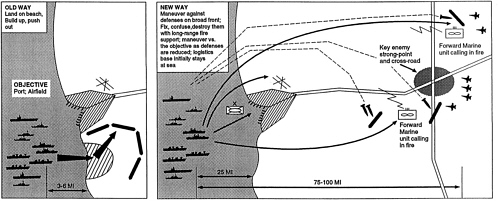
would be built up on that beach; and then an assault on the city would be undertaken. The opposition forces would in the meantime have had an opportunity to converge on the landing and build defenses against it, and would have to be overcome upon the initiation of the assault.
Under the new approach, the initial assault force would, for example, first move against the crucial strong point inland. The mission of these forward maneuver elements would be reconnaissance by fire; attracting, locating, engaging, fixing, damaging, and destroying the opposing defensive units; and thus preparing the way for the main force to land directly where it could take the city with minimal resistance. The forward units, operating far inland from “the beach, ” would thus be key elements in the creation and control of the lodgment, essentially developing the safe space for much larger scale friendly operations.
To implement the OMFTS concept in its emerging form, the Navy and Marine Corps have the following sequence in view:
-
Lighten the force. In their ultimate form the initial assault forces ashore would have organic mobility in the form of light vehicles and helicopters, sensors, communications, and much close-in combat power such as mortars and antitank and antiaircraft weapons, but no tanks or artillery for indirect fire. (The Marine Corps is not currently considering total elimination of artillery from the initial assault force in the new version of OMFTS; in fact, it is working on a lightweight 155-mm howitzer for that role. The extrapolation of the concept to complete elimination of artillery from this part of the force, in favor of other forms of long-range firepower that the Navy and Marine Corps also plan to use—described immediately below and discussed in detail later in this report—is a limiting case that the committee used to explore the full implications of the concept. The study was pursued in terms of that limiting case, with implications of any version of the concept that has less radical change—implications largely associated with the ability to support the concept logistically— indicated in the discussion of the results that emerged.)
-
Provide major fire support from the fleet. Such fire support, in the form of attack aviation, surface-to-surface missiles, and extended-range ships' guns, will be provided on call, with targeting by the forward assault elements, over the entire depth of the area under attack, to engage threats to the lodgment and the fleet. In providing the fire support, the fleet will stand off from shore farther than has been
-
customary before the availability of the new transport means, the AAAV and the V-22, with their higher assault speeds. Whereas previously the amphibious assault fleet might be 3 to 6 miles offshore, in the new concept it will stand off about 25 miles, out of visual range of shore-based defenses, and outside the area where ground clutter from the shore would interfere with radars contributing to the ships ' defenses against antiship missiles. The higher assault speeds will more than compensate for the time spent covering the longer distances to the landing and combat areas.
-
No major logistic base ashore. The support base will stay at sea, in logistic support ships or on a mobile offshore base (both described in a subsequent section). Logistic support will be furnished from the seaborne base as needed until the objective area is firmly held. (This should not be taken to imply “just-in-time” logistic supply, in the pattern of new manufacturing technology. Rather, it means that logistic support will be called for and furnished as the forward combat elements need it, starting from a base that stays at sea rather than being moved ashore in anticipation of need during combat.)
It is visualized that with these changes in force design and operations, the maneuver forces ashore will be able to rapidly take and hold key terrain and facilities essential to winning the campaign early or to pursuing it successfully into subsequent phases. The assault forces would be expected to drive opponents out of the objective area with a minimum of friendly and collateral civilian casualties; to remove mines and other passive defenses from ports and airfields, preparing those facilities for friendly entry in force; and to preempt communication facilities such as radio and television stations and the telephone and radio communications networks, preparatory to establishing and maintaining civic order while any subsequent military campaigning is pursued in forward areas.
A few observations on the emerging form of the OMFTS concept are in order.
The concept as described above (either the limiting case described or a somewhat less radical change) is, as yet, an evolutionary goal, not a firm force development plan. The concept will emerge in a series of major steps, associated with major equipment advances in the force —for example, acquisition in quantity at different but overlapping times of the AAAV, the V-22, advanced weapons and targeting, revised C3 and logistic systems enabled
by advancing technical capabilities, and other changes. Each change in equipment will require adjustments in tactical concepts and perhaps in doctrine. The changes will have to be implemented and tried in exercises and in operations, and force commanders will have to develop confidence thereby that each step taken will work successfully before the next step can be taken. This will be especially true when forces have to rely on far-distant sources of firepower for their protection and logistic support.
Once the new OMFTS concept is fully implemented, it will be based on an interconnected set of systems and operations that are finely tuned to each other. Experience in war suggests that there is a high risk that such a concept can prove fragile in wartime operations.
The committee accepted the Navy's and Marine Corps' new concept of OMFTS, to which the Services are already committed, as a good one, following logically from feasible technological developments and well conceived to meet changing military needs. The current approach to amphibious operations in warfare along the littoral in an MRC poses a number of serious problems: the time it takes to build up a landing to meet a surprise attack effectively; the opportunity that time affords an opponent to marshal resistance to the operation; and the vulnerability of the fixed supply base on land during the buildup and subsequent operations. The new approach can remedy these problems.
There are, however, a number of weaknesses in the Navy and Marine Corps ability to implement the expanded OMFTS concept with current systems:
-
Uncertainty of responsiveness and effectiveness in providing long-range fire support from the fleet to forces far over the horizon. This uncertainty is based on the following conditions:
-
Communications connectivity with mobile forces beyond the horizon, the linchpin of battlefield awareness, is weak;
-
Command and control and targeting are too slow, and combat identification (CID) is too uncertain, to assure the forward forces of reliable, sustained, and accurate fire support when they call for it; and
-
Old patterns, generally unsuited to the new operational concept 's fire support needs, still dominate weapon system design and munitions acquisition.
-
-
Today's logistic system cannot support the new concept.
-
The mine countermeasures arsenal is inadequate to ensure success with the necessary rapid timing in landing operations.
-
Today's planning scenarios neglect the need to deal with large populations in potential objective areas, which will often be highly urbanized.
-
There is insufficient attention to field medicine suited to the littoral environment.
-
There is insufficient attention to several aspects of force protection in operations along the littoral—in particular, vulnerability of the logistic ships to antiship cruise missiles and quiet submarines, and vulnerability of the entire force to potential use of weapons of mass destruction;
-
Many opportunities to benefit from joint system elements are not yet recognized. Coalition issues, especially command and control in complex arrangements involving the United States, other coalition partners, and the United Nations, also have to be addressed.
-
The new OMFTS concept and associated systems will require resources beyond current plans.
In the chapters that follow, each of these problem areas is addressed in turn. The committee has attempted to show what must be done to make the evolving OMFTS concept work most effectively. The problems and issues in each area are outlined, and remedial actions are recommended.
2
Improving Capability to Provide Long-Range Fire Support
COMMUNICATIONS CONNECTIVITY
Current Situation
Extensive work is under way, based on the Navy's Copernicus architecture and related systems work by the other Services, to build command, control, and communications systems at what might be called the “wholesale” level. These systems are designed to provide modern, responsive, flexible, and robust communications to convey C2, situational, and target data from National, theater, and forward forces' sensors to all major command centers ashore and afloat, as well as among those centers. This includes provision for communication and data transfer among all ships, from carriers to frigates, that can provide fire support to forces ashore by any means.
However, much more attention is needed to ensure “retail-level” connectivity between major headquarters afloat or ashore and fighting units down to platoon or squad level. Especially, current and planned systems will not meet the needs of Marine forces in the highly mobile transition phase from ship to shore and beyond the horizon. The only available communications for forward troops during that critical period are vulnerable, low-capacity, line-of-sight communications, not suited for calling in the essential fire support and logistic support that can ensure the success of the forward elements in OMFTS. Even when the forces are fully established ashore, their communications equipment will be large, inflexible, and based on old technology. The Marine Corps' current and planned communications system resembles the Army's as it was configured for operations in Western Europe during the Cold War.
Future Communications Systems: the 2020 Vision
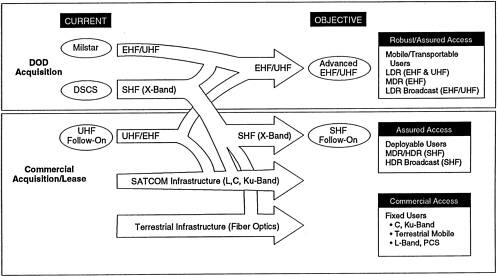
Communications technology in the civilian world is moving toward widely distributed, flexible, high-capacity systems that will provide many alternate modes from mobile cellular communications among individuals to major, secure multi-channel communications among fixed and mobile terminals distributed worldwide, using satellite and fiber-optic links as appropriate. DOD
communications that will be in place by 2006 will continue to be concentrated in the ultrahigh-, superhigh-, and extremely high frequency bands and will also have assured access to an array of commercially provided communications. The commercial world will also provide a broad satellite communications (SATCOM) infrastructure including L, C, and Ku-and communications, and a terrestrial infrastructure based on fiber-optic links. The architectural trends are illustrated in Figure 2. The Navy and Marine Corps can take advantage of these developments to design the “retail-level” systems needed to implement the future OMFTS.
Communications links and terminals at the “retail” level should be highly mobile, robust, and jointly interoperable with other Service systems. They should have high capacity for transfer of all necessary status, targeting, and logistic information. They should be able both to transmit filtered, processed, and tailored situational awareness data at a high rate to forward forces having small terminals and to receive such information from the forward forces. Ships would transmit the data via broadcast satellites, while forward forces with very light equipment would use surrogate satellites in the form of communication relays, preferably carried by UAVs dedicated to the purpose. (Communication relays can be launched or emplaced ad hoc, in airplanes or on hilltops. The value of dedicating UAVs to the purpose is that the relay-carrying UAVs would be a known and reliable part of the system, launched for the purpose during the landing operation, without the uncertainties attending ad hoc deployment during the exigencies of battle. They would be most economical of manned aircraft and personnel at critical times during the operation, and they would avoid the risk that the enemy might dominate the necessary high ground at the time of need.) The communications system should allow forward and rearward transmittal of information in direct communication modes if needed, and in broadcast modes that would allow potential users to download the information they need selectively without becoming saturated by a flood of data.
Desired system features include the following:
-
Assured and seamless (without breaks or pauses at switching points) connectivity, permitting both voice and high-rate data transmissions among major headquarters and forward troops down to platoon and squad level, and even to individual soldiers deployed on combat-related missions;
-
Interoperability with other Service communications and with the local communications infrastructure, both civilian and military;
-
The ability to adapt and use commercial communications equipment and services (in uses that are highlighted below); and
-
The capacity to transmit and receive direct broadcast situational awareness and other tactically useful information as described above.
The communications system with these characteristics would transmit and receive targeting, surveillance, and damage assessment information; convey intelligence products and environmental data; and serve as a tool for managing personnel and medical and logistics data and requests. Local political and infrastructure data would be provided as needed, both to and from forward troops in action. And the capacity would exist for the selective wideband transfer of databases and imagery, to forward forces according to their needs. The system would thus enable flexible and reliable use suited to the needs of small, fast-moving forward forces that might be heavily engaged with the enemy. It would permit much more than a hand-held radio able only to communicate to the horizon, and it would not put much more of a burden on the soldier than that piece of equipment.1
Recommended Actions
The Navy and Marine Corps can take some immediate steps to move toward implementing the “2020 vision” sketched above. These steps include the following:
-
The Navy and Marine Corps should consider the establishment and maintenance of robust communications connectivity as a joint endeavor with the other Services, National and civilian agencies, and coalition partners where appropriate.
-
The Services should establish programs to acquire
|
1 |
It may be observed by those with experience that a communications system such as the one described would permit, and therefore might encourage, intervention by higher headquarters and even National authorities in local tactical operations. But the capability to do that has been available since the 1950s, and was demonstrated in such diverse operations as the Cuban missile crisis and the Falklands war. There have also been notable instances where the capability, although available, was not used. In short, it will always be available, and the chain of command will have to depend on internal discipline to ensure use appropriate to the situation. |
-
Army extrahigh-frequency (EHF) tactical terminals for assured mission-critical connectivity (SCAMP and SMART-T, respectively a man-portable and a high-mobility multipurpose wheeled vehicle [HMMWV]-mounted satellite terminal, both providing low-data-rate—2.4 kb/sec—and the mounted terminal providing medium-data-rate—1.544 Mb/sec—communications);
-
Surrogate satellite communications for battlefield cellular and tactical communications relay (with relay capability deployable by any means, but, for reasons given above, preferably using dedicated long-endurance UAVs);
-
The ability to connect with and use emerging commercial (Low Earth Orbit [LEO] and Geosynchronous Earth Orbit [GEO]) satellite communications; and
-
The ability to use the emerging Global Broadcast Service for intelligence-related and situational data.
-
The Marine Corps is already working with the Army in connection with the Army's Battlefield Digitization Effort. Special attention should be given in this work to the areas of telecommunication and information distribution, such as battlefield cellular, and results should be adapted to Marine Corps needs and operations. The Navy and Air Force should also be involved in this effort, to ensure interoperability among all the Services in joint operations.
-
The Navy and Marine Corps should be involved in related Advanced Concept Technology Demonstration (ACTD) programs, such as the ongoing Battlefield Awareness and Data Dissemination (BADD) ACTD being conducted by ARPA. This program will demonstrate dissemination, according to user demands, of exploited and fused National and theater reconnaissance/surveillance data in near real time to echelons below Joint Task Force (JTF) via the Global Broadcasting Service.
C2, TARGETING, AND COMBAT IDENTIFICATION
C2 and Targeting for Long-Range Fire Support
Deficiencies in Current Systems and Plans
Situational and Battlefield Awareness. As indicated above, all the Services plan to overcome increasingly sophisticated future opposition by using the information advantage conferred by superior U.S. information-related technology. This advantage includes denial of information about U.S. forces and their activities while gaining timely and accurate knowledge about the opponents' forces and activities, so that U.S. forces can act against them within the time lines imposed by our high tactical tempo operations. This means maintaining situational awareness that is as complete as the available technology will allow and that is updated in nearly real time—in a few minutes at the tactical level for high-tempo operations, and in times on the order of an hour or less for much operational-level information.
There has always been some level of situational awareness in the modern sense in warfare, to the extent that available technology or operational capability would allow. This could simply mean information returned by scouts and spies, or, later, information gained by observation aircraft and various forms of human and technical intelligence gathering. In the years since World War II the capability has been augmented by space observation, advanced sensors across the spectrum, and sophisticated computer-aided analysis. The time lines in building situational awareness have been suited to the technical capabilities and the resulting tempo of the warfare of the time, with the operational and tactical advantage going to the side that could build the greatest information advantage in the least possible time within those constraints.
Situational knowledge can never be perfect. Since each side in a conflict takes steps to mask its observables and to deceive opponents about its intentions, forces, and activities, the resulting information available to each side is usually incomplete and sometimes wrong. The uncertainties are wrapped up in the commonly expressed term “fog of war.” The key point is for U.S. forces to gain a commanding advantage in situational awareness, as they had at the Battle of Midway or in the Gulf War—the information must be mostly right, denied to the enemy, and actionable at the right time.
The capability to establish such an advantage in future conflicts is latent in all the Service C3I programs, and all the Services individually have programs that seek to build it in some parts of their mission spectrum. However, as a recent Navy strategic war game showed, it can only be achieved completely enough to ensure slimmed-down U.S. forces' success in future warfare by pooling and integrating all relevant Service and National resources in the joint arena. There has been much discussion of this need by all the Services and the
Joint Chiefs of Staff (JCS), but the Service programs remain narrowly focused and resources to build a joint situational awareness capability usable by all, including the Navy and Marine Corps, are meager.
The sections that follow lead to some recommended steps to improve key aspects of situational awareness that will be needed by Navy and Marine Corps forces in joint operations along the littoral. Essential integration beyond those steps will require application of the will and the resources across the entire DOD.
Targeting. Targeting—accurate location of targets for weapon delivery—grows out of surveillance and reconnaissance, which provide data in the form of imagery and electronic signals that allow detection, location, classification, and identification of targets. Much of the information required for targeting enemy forces and installations beyond the horizon, which will be necessary for long-range fire support from the fleet, derives from sensors that are not organic to the Navy or Marine Corps. These include National sensors, which furnish tactical data to fielded forces through the Tactical Exploitation of National Capabilities (TENCAP) program, and a number of theater-level sensors operated (or to be operated) by other Services and national agencies. Among the latter are the Joint Surveillance and Target Attack Radar System (JSTARS), which is carried on modified Boeing 707 aircraft and can both provide radar data on moving target tracks over a broad area and focus on narrow areas to obtain high-resolution synthetic aperture radar (SAR) images; the Advanced Synthetic Aperture Radar System (ASARS) carried on U-2 aircraft, which provides high-resolution SAR imagery; and soon-to-be-available imagery in several spectral bands that will be obtained from high-altitude endurance unmanned air vehicles (HAE UAVs) provided by the Defense Airborne Reconnaissance Office (DARO), replacing more limited imagery obtained from manned reconnaissance aircraft. The forward forces will also operate small reconnaissance UAVs locally, obtaining imagery that not only can help the forces operating those UAVs but also can be sent to higher headquarters to enter the detailed theater-wide situational description. Additional data can be obtained directly from forward observers (FOs) and forward air controllers (FACs), whose task will be to call in the long-range fire support from the fleet.
At present, the planned Navy and Marine Corps capacity to handle all-source imagery for targeting and situational awareness for C 2 purposes is marginal. JSTARS data are planned to be transmitted to the Navy via the Joint Tactical Information Distribution System (JTIDS), but this will be processed information that will lose much of the richness of the area-wide moving target indicator (MTI) picture obtained directly from the JSTARS radar. The Army has a JSTARS terminal small enough to be mounted on a HMMWV, which could be adapted for shipboard use. JTIDS will be able to transmit fewer tracks
than will be available from the ground station. Navy connection to obtain SAR imagery on ships from ASARS is planned. However, the connection will be through an antenna that will require time sharing with other uses, so that ASARS data transmissions could be delayed at critical times. There are as yet no plans for the Navy and Marine Corps to obtain DARO HAE imagery. TENCAP information will be obtained on shipboard, but plans for use of such information by forward troops are not as far advanced or as thoroughly developed as the Army's plans. Transmittal of available information to forward combat elements, and transmittal of information and imagery from those elements to targeting centers afloat, will depend on the capacity and robustness of the communications connectivity, which will be weak unless the steps recommended above are taken.
If the Navy and Marine Corps are to be able to use the data and processed information from the sources described, the sensors must be in the theater. There will be enough flexibility among the different sources, some of them (the DARO Tier 2+ UAV) having very long endurance, that there is a very high probability that any action along the littoral will take place within operating range of one or more of these sources. A parallel organic capability within the fleet would be the ideal, to cover the times when available land bases may be too distant from the action. In view of the likely availability of the needed operating bases on shore, building such a capability in the current and foreseen budget environment at the expense of meeting other, more essential needs, cannot be justified.
Timeliness and Responsiveness. Under current plans, the situational and targeting data available will be incomplete and will take significant time to assemble—perhaps hours. The information will be needed in minutes by forward combat elements to attack maneuvering enemy forces, and they will have to know about all such forces and where they are, essentially in real time. Thus, if forward forces depend on the information as it can currently be furnished, they cannot be assured of complete and timely enough data to make the long-range fire support that will be an intrinsic part of their combat capability as effective as it will have to be.
It may be concluded that unless the ability is created to obtain, synthesize, and disseminate all-source imagery and other target information with appropriate timeliness, the forward combat elements will not be able to bring to bear the combat power needed to fulfill their missions.
In addition, the C2 system to exploit the information will, in its current form, be insufficiently responsive to make the fire support available when needed. The Marine Corps has organization and procedures designed to make close air support responsive to the ground forces' needs. However, Navy and
Marine air operations must be under Joint Forces Air Component Commander (JFACC) direction in the theater. The traditional JFACC airspace control cycle for planning air missions, including strike and close air support, is lengthy—up to 72 hours. To meet the need for responsive air support of ground forces, air operations officers have, in the past, compensated for this delay by planning other missions that could be diverted to the purpose. This worked reasonably well in a “steady-state” theater like Vietnam, when there was time to learn and therefore predict for most days how much air support would have to be made available this way. It was not as much a problem in the Gulf War, where the air and ground war were fought in clearly separable phases, special arrangements were made for hunting mobile Scud targets, and the ground war was over so quickly that a routine need for closely coordinated air support of the ground forces scarcely had time to develop. In a new combat theater where the air support that will constitute a significant part of the long-range fire support must be quantitatively predictable and on time, there will not be time for such ad hoc adaptations.
C2Integration. In the limiting case being considered where the forward combat elements will not carry their artillery with them, the remainder of the long-range fire support (other than that provided by aviation) will have to be provided by some mix of long-range guided artillery shells and surface launched cruise or ballistic missiles. In current operational concepts the forward ground commander commands the artillery batteries in his force, and he has a forward observer who can call in artillery fire from some miles to the rear, in response to that ground commander 's needs. Since the artillery is already miles to the rear, it should not matter in theory if the artillery's distance to the rear is increased to the distance between the forward unit and the fleet, as long as the fire is equally responsive to the ground commander. Since the flight times would be only minutes longer, the use of long-range guided shells and ballistic missiles from the fleet 25 miles offshore would permit the required responsiveness, provided the fire is launched in response to the same ground commander's order without intervening layers of command. This calls for some rearrangement of current command relationships.
Even with such a rearrangement, there remains the problem of coordinating fire when both the air support and the surface-launched fire support must operate through the same airspace but are sent from over the horizon through two different command chains—the JFACC for the air support, and the surface fire direction center, which may or may not (depending on where it is) report to the ground commander for the surface-launched systems. At present there are no plans to integrate command and control of the attack aviation and the surface-launched elements of the long-range fire support systems.
Since targeting and weapon delivery will involve joint operations, and since the dependence on and the characteristics of the long-range fire support being considered are essentially new, appropriate joint doctrine and tactics will have to be developed. JCS Publication 3 establishes the joint doctrine in the general sense.2 However, the details of the very complex joint interactions involved in this case must be worked out procedurally and exercised jointly if the system is to function as required in wartime.
Matching Targeting and Weapon Accuracy. As is discussed below, much of the long-range fire support will have to be provided by guided weapons. To achieve the full potential of accurate weapon guidance, targets must be located in the same geographic grid, and with the same time reference, that the weapon system uses for guidance. The common grid and universal time are in view through the use of GPS, but they have not yet been fully established in the joint arena or between the targeting system and weapon guidance systems within the Navy and Marine Corps. Theoretically, if they existed and if differential GPS could be used for both targeting and weapon guidance, an accuracy of <1 meter should be achievable for weapons on target with only GPS target location and guidance.
In the practical case, a target location accuracy of 10 to 100 meters, obtained from remote surveillance and reconnaissance systems, would be more likely. An FO/FAC who sees the target, who can locate himself in differential GPS and has a laser range finder, a good alidade, and an accurate way of establishing true north, would achieve good enough accuracy to permit weapon delivery on GPS coordinates without having the target in view of the shooter and without a sensor on the weapon. In the practical case of dynamic field operations, it is more likely that the FO/FAC's target location accuracy will be on the order of 15 to 25 meters. To achieve better accuracy than this for weapons on target will mean that, however the target is located, the weapon will have to have a seeker that can recognize a target element from within a delivery “basket” compatible with the target location accuracy. Alternately, it will have to guide on a laser spot furnished by the FO/FAC or the delivery aircraft, or be able to return an image to the launcher and be command guided through a data link of some sort.
If the target can move in the time between weapon launch and landing, then the seeker field of view within the weapon delivery “basket” must be made large enough for the seeker to detect the target in its new location, or else updated target location information must be passed to the weapon. Means to do the latter without unduly expensive data links are discussed below. However,
|
2 |
Doctrine for Joint Operations, Joint Chiefs of Staff, September 9, 1993. |
suitable matching of weapon and target location accuracy, seeker field of view, and short flight time will remain the preferred solution. Locating and striking rapidly moving targets will remain a difficult problem, in any case.
Finally, it may be noted that even if target location from a long distance (e.g., by JSTARS) is in error by as much as 100 to 200 meters, location of points within the area seen by the surveillance sensor may be only 1 to a few meters in error relative to each other. Thus, if there is a point within the surveillance sensor's field of view whose GPS coordinates are known (e.g., through a radar map-matching sequence), then the overall target location uncertainty problem can be circumvented for accurate weapon delivery.
Availability of the common grid and universal time would reduce the difficulty in solving these problems and would therefore reduce the costs entailed in weapon system design and weapon delivery.
Recommended Actions
A number of steps should be taken to remedy the problems outlined above.
-
The Navy and Marine Corps should take the lead in the joint arena toward building a single, joint situational and battlefield awareness capability, based on all-source inputs and all-Service use of the products, that will confer a commanding information advantage on U.S. forces at all command levels down to forward units in the field in any future regional conflicts and operations short of war. Individual Service tactical and operational concepts for the future, including those of the Navy and Marine Corps, will not succeed without this capability.
-
The Navy and Marine Corps should exploit existing non-organic sensors fully by
-
Distributing Tactical Reporting and Processing/Tactical Information Broadcast System (TRAP/TIBS) receivers more widely;
-
Preparing to receive JSTARS MTI data early in a landing; and
-
Supporting Marine Corps use of the Army Common Ground Station to exploit U-2 and JSTARS SAR imaging data.
-
-
The Navy and Marine Corps TENCAP program for littoral warfare should be aligned with the Army approach, including strengthened joint participation with the Army and Air Force TENCAP program
-
offices. In addition, Navy and Marine Corps funding priority for TENCAP should be increased, and the Navy and Marine Corps TENCAP offices should have acquisition authority to be able to exploit such participation.
-
The Navy and Marine Corps are aware of the DARO UAV ACTD program and communications studies. They should acquire the ground elements of the UAV systems as the utility of these elements is demonstrated, and they should develop doctrine to use UAV-sensed data to plan maneuvers and to target fires over the horizon.
-
The Navy and Marine Corps, in the joint arena, should
-
Monitor the trend toward use both of the GPS-based World Grid System (WGS)-84 grid as a common grid by all the Services and National agencies, and of universal time, for mapping, navigation, target location, and weapon delivery, and take all feasible steps to accelerate that trend; and
-
Help establish priorities for the Defense Mapping Agency to prepare accurate WGS-84 maps and data banks for likely regional conflict areas of operation.
-
-
The Navy and Marine Corps will benefit greatly from advance sensor technology efforts currently under way, and should encourage them to the extent feasible. Efforts of special interest include unattended ground sensors, foliage- and ground-penetrating radars, and sensors that can penetrate buildings.
-
Command arrangements must be made such that the long-range fire support to be made available to the forward combat elements is immediately responsive to the forward ground commander, regardless of the source of fire. These arrangements must include a single coordinating mechanism to manage the integration of air- and surface-launched long-range fires into the objective area.
-
For all C3 systems, the Navy and Marine Corps should ensure interoperability with Army, Air Force, and National networks, and with allied systems. This includes ensuring that organizational connections are made compatible so that the full benefits of the hardware, software, and procedural changes in the C3I area can be captured.
Combat Identification
Ongoing Actions and Persisting Problem Areas
The fast tactical tempo of the modern U.S. military style, including that planned for the future OMFTS concept, increases the already high risk of fratricide. This risk calls for extraordinary avoidance measures. The Marine Corps operating procedures for close air support that were referred to earlier have been designed to mitigate this risk, but they do not extend to the joint and combined environment. Also, these procedures are generally linked to air attack from low altitude. As is indicated below, close air support in the future will often have to be delivered from medium instead of low altitude, making target recognition by the pilot in these closely coordinated operations much more difficult.
To start solving the general problem, the Joint Requirements Oversight Council chaired by the Vice Chair of the JCS has published a Joint Mission Need Statement,3 necessary for the Services to establish system requirements, and it has established a Joint Combat Identification Program Office (JCIDO). Also, a General Officers Steering Committee (GOSC) has been formed to coordinate all Service CID efforts. The JCIDO, together with the GOSC, has assigned responsibility for CID efforts to the Services as follows:
-
U.S. Navy: Air-air cooperative CID and air situation assessment,
-
U.S. Army: Battlefield ground-ground CID, and
-
U.S. Air Force: Non-cooperative air-air CID techniques.
In addition to the JCS-level activity, an Office of the Secretary of Defense (OSD) task force has also been formed. This was stimulated by several concerns, including disturbing results from the Joint Air Defense Operations/Joint Engagement Zone (JADO/JEZ) series of exercises, where attempts to coordinate air and SAM intercepts in the same airspace led to unacceptably high levels of (simulated) fratricide; the shooting down of friendly helicopters over northern Iraq by U.S. Air Force fighters; and long-continuing technical and funding issues associated with the modifications of the Mark-12 Identification Friend or Foe (IFF) system desired by NATO for interoperable air-air CID. The OSD task force has established an overall CID system
|
3 |
Report of the Commission on Roles and Missions of the Armed Forces, Office of the Secretary of Defense, May 24, 1995. |
structure and architecture and has focused on situational awareness as the key to reliable CID.
It is generally agreed that, ultimately, situational awareness by all shooters on or over a battlefield (the scope for each established by the area each shooter's firepower can cover) will provide the best means of avoiding fratricide. If shooters know where every friendly or neutral unit is, then presumably they will not shoot at those units. Of course, this still would not provide protection against foolish actions or actions beyond the control of the “players.” Units may not be where they are supposed to be, or they may be where they are not supposed to be, and other exigencies of combat may disturb maneuver plans and battlefield observations. Also, “handoff” problems, where jurisdiction is shifted from one control point to another, pose a higher risk of error; they have been involved in such disparate incidents as the accidental helicopter shoot-down in Iraq and commercial aircraft accidents in terminal areas. For these reasons, and because rates of fire may outrun situation update rates in some fast-moving situations like air-air combat or armored combat with air support, some query-response systems will still be needed. The combination of needs and circumstances makes for a highly complex system problem that is difficult to solve completely.
Despite the extensive activity sketched above, or because it has not yet had time to achieve the ends desired, the current CID situation remains fragmented. Although the need to integrate all the programs is recognized, there is as yet no funded program aimed at such integration. The risk is therefore high that related subsystems emerging from separate Service efforts will be “stovepiped” and difficult to interoperate without extensive “patching” when all are fielded. The issues of air-ground combat have yet to be addressed; small-unit identification (at the platoon, squad, and section levels) is lagging behind; and funding for CID systems is uneven, with most funds still going into air-air systems, including the expensive Mark-12 updates, and the others essentially languishing. Without satisfactory CID, the forward Marine maneuver elements in OMFTS and allied combat forces intermixed with enemy forces that are being subjected to heavy fire from long range, would be very much at risk.
Recommended Additional Actions
The following additional actions, which the Navy and Marine Corps should undertake, stimulate, and support in the joint arena, as appropriate, are necessary to achieve a satisfactory CID outcome:
-
A formal program to integrate all the separate Service CID projects into a coordinated system effort must be initiated, to ensure compatibility
-
and interoperability among the subsystems and techniques that the Services, the Joint Staff, and the OSD are exploring.
-
Responsibility for air-ground CID should be assigned. As part of this effort, the Marine Corps Position Location and Reporting System (PLRS) and the Army Enhanced PLRS should be added to the evolving architecture for small-unit identification and location through situational awareness.
-
The design of the Navy Situational Awareness Beacon with Reply (SABER) currently in development must be reviewed and revised as appropriate to enhance its sturdiness in the face of information saturation and electronic countermeasures, and to ensure that the update interval of the broadcast situational information is compatible with the expected fast operational tempo (situation changes measured in minutes).
-
Some funding should be shifted from the air-air functional area to the others, to achieve a more balanced effort across the board. This will probably have to include reaching some closure in the complex discussions of interoperable air-air IFF that have been ongoing in NATO for decades, even if that means that the United States will set a deadline for resolution of the issues and will proceed unilaterally thereafter.
-
The Services should perform continual joint simulation, practice, and training exercises, so that all units can learn how to spot friendly units at all times, can learn how to identify neutrals rapidly, and can learn how to detect and respond to interference or exploitation of cooperative links. An important part of this practice will be the attention given to interfaces and handoff problems, where a large proportion of errors occur.
WEAPON SYSTEMS FOR LONG-RANGE FIRE SUPPORT
Increased Need for Guided Weapons
Combat objectives in future Navy and Marine Corps operations along the littoral will require that the combat operations succeed quickly, with minimal friendly losses. Incidental civilian casualties and damage must also be minimized. Repeat attacks against the same targets, often necessitated because
weapons delivered are not accurate enough to hit and destroy the targets the first time, are inconsistent with these objectives because they increase the exposure of aircraft and ground soldiers to enemy defenses. Inaccurate weapons with large miss distances also create extensive collateral destruction and casualties.
One way to achieve high-accuracy air-to-ground weapon delivery with free-fall weapons is to attack from low altitude (under 5,000 ft), preferably using shallow dive-bombing and very low altitude weapon release close to the target if the defenses permit. However, although this kind of weapon delivery has been favored in the past and used largely as the basis for U.S. tactical air weapon delivery, it will be increasingly denied because, as indicated above, highly effective close-in antiaircraft weapons are proliferating. These weapons, including vehicle-mounted antiaircraft guns with lead computing sights and night thermal sights, and infrared-guided antiaircraft missiles of Stinger vintage, which are very difficult to countermeasure, will be widespread. They emit no signals that can be detected prior to firing, thus denying important suppression or avoidance tactics. A campaign for suppression of enemy air defenses (SEAD) of this kind a priori, though feasible in special circumstances, would require using heavy fire from long range to “sanitize” areas that must be traversed by the aircraft; it would be expensive and could create extensive collateral damage and casualties.
The main tactic used to avoid these weapons has been to keep the aircraft at higher altitudes—5,000 to 20,000 ft—where the shoulder-fired antiaircraft weapons cannot be effective. Use of the weapons in Afghanistan is credited with increasing Soviet aircraft losses dramatically and, by forcing their aircraft to higher altitude, greatly reducing the effectiveness of their air operations. Russian air forces suffered significant losses to such weapons in Chechnya, according to recent reports.
Radar-directed high-altitude air defenses must also be reckoned with. They can be countered by electronic countermeasures (ECM) and SEAD, but their threat value remains high. In particular, the most modern weapons of this kind, the SA-10 and SA-12, will be able to engage aircraft having lowered radar cross sections. Some aircraft, like the F/A-18 E/F, will have to carry all attack weapons externally, eliminating the benefits of lower radar observability for the clean aircraft. These aircraft will have to deliver their weapons from long horizontal standoff distances unless the effective radar-directed SAMs are fully suppressed or countermeasured. Stealthier aircraft (such as the F-117), some designs that may emerge from the JAST program, or the F-22 in its secondary air-ground role will carry their direct attack weapons internally, limiting the number of weapons to two. Or, if they carry weapons externally, they will also prefer to deliver those weapons from long horizontal standoff. The smaller number of weapons will preclude “level-of-effort” bombing using free-fall
weapons with relatively high circular errors probable (CEPs)—every weapon delivered will have to count.
Finally, long ranges, on the order of 60 to 200 miles, will become increasingly important for surface-based fire support under the newly emerging concepts of operation.
All of the above trends mean that a much larger fraction of the strike and fire support weapons delivered will have to be guided, using laser, GPS/inertial, automatic target recognition, or other guidance systems.4 Accurate delivery (e.g., 3 to 13 meters) of free-fall weapons from 15,000 to 20,000 ft is infeasible, as is accurate delivery of weapons following simple ballistic trajectories from long horizontal standoff (e.g., 15 to 40 miles or more), whatever the launch altitude, from the surface up. High accuracy from either medium-high altitude in the target vicinity or from long horizontal standoff will thus require guided weapons. Further, artillery-derived concepts of surface-to-surface fire—in which the relatively inaccurate fire on the battlefield is considered useful mainly for suppression of enemy activity, with actual target kills made by a small percentage of randomly falling shots—are incompatible with the high costs of long-range surface-launched weapons (gun projectiles or missiles) and the smaller numbers available when such weapons fill a significant part of a ship's magazine.
All analyses of the subject performed over the past 2 decades show that extensive use of guided weapons in air attacks reduces the number of sorties needed to destroy a set of targets by up to an order of magnitude.5 Thus, although some level-of-effort bombing is needed for air support of troops in combat during rapidly changing situations of maneuver, most target destruction objectives in an air campaign and in the kind of fire support needed to make OMFTS succeed can be achieved in a much shorter time using guided weapons. Such use significantly reduces weapon delivery costs by large factors; the total costs of repeat sorties needed to reduce a target with inaccurate weapons, including fuel,6 aircraft losses (both operational and those due to enemy action),
|
4 |
Such weapons have customarily been called precision guided munitions (PGMs). However, as the weapons proliferate, there is coming to be some differentiation in the terminology. For example, “precision” weapons might refer to weapons able to achieve accuracy within 3 meters, while those able to achieve accuracy to within 13 meters might simply be called “accurate.” In order to avoid confusion at a time when terminology may be evolving, weapons are referred to in this discussion simply as “guided”; the accuracy of different weapons is specified where appropriate. |
|
5 |
A typical analysis of this kind, performed for this study, was provided to the committee during the course of the study. |
|
6 |
In the Gulf War some 40 tons of aviation fuel, used for all associated flying in the theater, were used for every ton of weapons dropped during the air campaign. |
and other costs of operating over a much longer time, exceed the higher initial cost of guided weapons. Also, compared with unguided weapons, guided weapons minimize incidental damage—not perfectly, because some of them will miss their targets for various reasons, but far better than unguided weapons.
It should be noted incidentally in this context that matching target location accuracy with weapon accuracy through use of a common grid and universal time reference becomes a critical system need in terms of economic and military campaign imperatives for target destruction. It is not simply a “nice-to-have” improvement.
Services' Planned and Potential Acquisition of Guided Weapons
At present the Services, including the Navy, are acquiring a variety of guided weapons for attacking ground targets. These are listed in Table 1; Table 2 shows approximate unit costs and numbers of the different weapons that might be acquired. The numbers are based on plans discussed by various offices and field agencies during briefings to the committee, and on incidental data gleaned during the course of the study, and so they represent a “snapshot” of plans being considered for the period from 2005 to 2020. They should not be taken as firmly planned acquisitions. They are presented to provide some indication of the DOD guided weapon inventory that may exist in the time period of this study. Under current plans, these weapons, if acquired and considered as “munitions,” would represent less than 10 percent of the entire DOD munitions inventory projected for the period. The implications of the trends sketched above are that this percentage will have to increase significantly for the Navy and Marine Corps to support OMFTS—perhaps double, or more. (The cost implications are discussed below in the section “Reducing the Cost of Guided Weapons. ”)
Additional weapon and system improvements are needed to support the long-range fire support part of the OMFTS concept as articulated above. Providing long-range fire support from the fleet requires ranges of 60 to 200 miles to cover the potential battle space that the V-22 will make available, including consideration of fleet standoff from shore. Fleet attack aviation will be able to cover such ranges, but it will not, alone, be able to provide the responsive, 24-hour fire support that the forward combat elements will need to have on call.
The Navy is working on long-range guided shells to provide long-range fire support by naval gunfire. But the demands for timeliness and weight of fire entailed in the concept point to a ship-launched, appropriately guided tactical ballistic missile having the required range. Early candidates for such a weapon include a version of the Army's Tactical Missile System (ATACMS), which has
already been fired in a test from a Navy ship and could be adapted to a shipboard vertical launch system (VLS), or a ground attack version of the Navy's SM-II, Block IV-ER, which could also be launched from the VLS. Either weapon's warhead could be loaded with bomblet munitions effective against both personnel and logistic or lightly armored combat vehicles, or with brilliant antitank (BAT) submunitions. The adapted ATACMS system (called here NTACMS for Navy TACMS) would provide about twice the payload of the SM-II, but somewhat more effort might be required to integrate it into Navy ships and operations.
Table 1 Guided Attack Weapons Currently Available or in Development 7
|
AIR TO SURFACE |
SURFACE TO SURFACE |
|
|
Table 2 Estimated DOD Plans for Guided Attack Weapon Inventory
|
WEAPON |
ESTIMATED # PLANNED |
ESTIMATED UNIT COST $(103) |
ESTIMATED TOTAL COST $(106) |
|
TOMAHAWK |
1,200 |
750 |
900 |
|
TOMAHAWK/BAT |
500 |
1,350 |
675 |
|
SLAM/ER |
1,000 |
650 |
650 |
|
TACMS/CEM |
1,500 |
600 |
900 |
|
TACMS/BAT |
500 |
1,200 |
600 |
|
JSOW/CEM |
16,000 |
150 |
2,400 |
|
JSOW/BLU-108 |
6,000 |
275 |
1,650 |
|
JSOW/UNITARY |
5,000 |
350 |
1,750 |
|
PAVEWAY III |
16,000 |
45 |
720 |
|
JDAM |
74,000 |
40 |
2,960 |
|
TOTALS |
121,700 |
13,205 |
|
|
WEIGHTED AVG UNIT COST $(103) |
108.5 |
If budget pressures dictated that only one long-range surface-launched weapon improvement could be supported, then the missile would be preferable to the long-range guided shell. The shells could reach the lower end of the requisite range, 60 to 70 miles, and they would have small warheads relative to the missiles. The missiles, especially NTACMS, would provide much more range-payload flexibility. The rate and weight of fire on the target would be much greater with the missile than with the gun, constituting a qualitative change in the nature of the fire support. For example, one comparative study showed that it would take about 15 to 25 extended-range shells loaded with the dual-purpose submunitions described above to destroy infantry or mechanized target forces, compared with a single NTACMS missile comparably loaded (the NTACMS submunition would be larger and more effective than the one in the guided projectile).8 Typically, when infantry comes under artillery fire, the first shell to land exacts a few casualties and causes the remainder of the troops to seek shelter in foxholes. Casualties are inflicted more slowly then, but the infantry is “suppressed”—it cannot do anything else while it is under fire. But when the fire stops, it can continue with the combat mission it had in hand. With an NTACMS, on the other hand, the first missile to land would cover an area larger than a football field with submunition fragments, subjecting the entire infantry unit to devastating fire before it could take cover. The unit would be out of action from that moment on; it would not be able to return easily to its previous mission after the attack.
As further points of comparison, it should be noted that the long-range shells for naval gunfire each require more magazine space, thereby limiting the extent of the classical suppressive barrage that they could deliver. Their design is such that they will increase gun barrel wear, limiting naval guns to perhaps 300 shots before a new barrel liner is needed (compared with 10 times that many for conventional shells alone). Finally, because of the difference in terminal effects, the total cost of destroying targets like the infantry or mechanized forces mentioned above will be roughly the same (within 10 to 20 percent) for the two weapon systems, long-range shells or tactical missiles.
Navy warships in the aggregate will have many vertical launch tubes —to be numbered in the thousands. However, when ship weapon loads for offense and defense must be planned and strike missiles must be divided, for example, between the NTACMS for battlefield fire support and the Tomahawk for long-range strike, and when the number of ships available offshore for any landing is
|
8 |
Assessment of Alternative Ship-to-Shore Fire Support Systems (U), Institute for Defense Analyses, Alexandria, Virginia, June 1993. |
taken into account, it may appear that operationally there are not enough missiles readily available to meet the fire support needs of a major campaign. As a further complication, the VLS bay cannot be reloaded at sea.
For these reasons, the Navy could consider outfitting dedicated fire support ships, perhaps based on available supertanker hulls to save costs, to provide sufficient at-sea rounds and a capability for at-sea reload from the ships' holds by cranes aboard. Only a few such ships, one or two per ocean, might be needed to provide formidable support to OMFTS along the littoral. Their vulnerability to missile, submarine, or air attack would be mitigated by covering warships, in the same way as is done for logistic transports and the fleet's underway replenishment groups.
It is noted in this context that another kind of fire support ship is under consideration—a nuclear-powered guided missile submarine (SSGN) that would be derived from decommissioned nuclear-powered ballistic missile submarines (SSBNs) (with appropriate a daptation to meet the needs of extant arms control agreements). The submarines ' missile tubes would be loaded with about 300 Tomahawks or other tactical missiles of equivalent size.9 If known to be stationed offshore in a crisis area, these ships would add to deterrence in a valuable way. Among other uses, their stealth would make them an effective source of surprise delivery of preparatory fire against stationary targets that could interfere with the opening of an amphibious campaign; and they could be outfitted to launch special operations forces for mine clearance and other clandestine missions.
Additional needs to enable long-range fire support include enough targeting pods for guided weapon delivery by all Navy and Marine Corps attack aircraft; a guided submunition dispenser; and a replacement weapon to carry out the missions intended for the canceled Tri-Service Standoff Attack Missile (TSSAM). For the first, the pods cost approximately $2 million each. Acquiring them would be part of the resource problem discussed in the Chapter 6 section entitled “Resources.” For the dispenser, the Navy and Marine Corps could join the U.S. Air Force Wind-Corrected Munition Dispenser program, or simply acquire the dispenser after it is fully developed. TSSAM replacements are under discussion, and a replacement acquisition may be initiated in the near future.
|
9 |
Navy-21 Update, Implications of Advancing Technology for Naval Operations in the Twenty-First Century, National Research Council, Naval Studies Board (National Academy Press, Washington, D.C., 1993). |
Reducing the Cost of Guided Weapons
The high unit cost of guided attack weapons has kept inventories low and has thereby inhibited wide application of the guided weapons. Even though overall system cost per target kill has consistently been shown to be lower when guided attack weapons are used than when free-fall bombs are used, the DOD budgeting structure requires that the weapons be purchased separately, out of budget allocations for munitions or missiles. Taken alone, out of the system context, the unit cost of the weapons is much higher than the cost of unguided munitions. But feasible changes in guided weapon design, acquisition, and utilization, outlined below, can reduce average unit costs of such weapons by 50 percent or more, thereby making larger inventories and broader use more feasible.
Weapon Design
Elaborate seekers and data links associated with weapon guidance are the most costly design components of guided weapons. A key means of reducing weapon cost is, therefore, to simplify these elements of weapon design.
Elaborate seekers are needed only for special targets such as bridges or certain kinds of buildings, and for other situations where extremely high accuracy (e.g., 3 meters or less miss distance) is needed and there is no line of sight from the weapon delivery system to the target. Apart from such specialized situations, GPS/inertial systems can be used for autonomous guidance to known target coordinates. When a point target is in view of an observer or of a launching aircraft and weather permits, laser guidance homing on a laser spot can be used. For distant targets, fine fiber-optic lines can provide the analog of television guidance with a radio link, with higher bandwidth and no vulnerability to enemy jamming, although the target can be masked. (Fiber-optic guidance systems have been tested successfully to distances of tens of miles. They are especially useful for surface-and helicopter-launched weapons.) Many fire support targets are in view of an observer who can adjust aim for the weapon; for this purpose, JSTARS or UAVs can be considered “observers,” in addition to forward observers attached to ground forces.
Expensive data links are needed when detailed two-way information transfer, including complete images, is required between target and targeter for guidance. Often, however, this requirement is based on a weapon delivery concept requiring continuously updated target location information and either automatic or manual correction of the weapon flight path to the target by observation of a visual image of the target beyond the horizon and return of weapon flight path data for flight path correction. The desire for such guidance is stimulated by concern that expensive standoff weapons may be wasted or that
re-attacks may be undertaken needlessly because it is not known whether the first weapon struck the target. However, updated target information can be sent to the targeter by observers like those mentioned above. The targeter can then send that information, or continual target location signals allowing weapon flight path error correction to static target locations, to the weapon over simple, low-data-rate, one-way data links that are much less expensive. If a weapon-to-targeter link is needed for bomb damage indication (BDI) (i.e., to indicate that the weapon will indeed strike the target within a small error from the aim point), a single image frame before impact, requiring a much less expensive link to the targeter, will usually suffice. Post-strike bomb damage assessment (BDA) using UAV reconnaissance can mitigate many wasted re-attacks by indicating the targets that have survived initial attacks, provided the shortcomings in BDA that were brought to light in the Gulf War continue to be remedied.
The least expensive guidance systems will be based on GPS/inertial guidance, in which the target location is known in GPS coordinates (as discussed above in the section “Matching Targeting and Weapon Accuracy”) and the weapon uses its own GPS position to update an inertial measurement unit (IMU) continually to compensate for the drift of the IMU. For reasons of cost and simplicity, GPS/inertial guidance is so attractive that its widespread use in U.S. weapon guidance systems will be unavoidable.
There are problems in the use of the system, however. The GPS satellite signal at the weapon is very low compared with the signal that even a low-power jammer can send. The P(Y) precision code available for use by the U.S. military is relatively difficult to jam once the weapon has locked onto it, but achieving that lock-on in the presence of a jamming signal will be difficult. Although jamming after lock-on to the P(Y) code will still be feasible, the required jammer power will increase, thereby making the jammers more difficult to proliferate and making them viable targets for attack with radiation-homing missiles, such as the high-speed antiradiation missile (HARM).
A further concern is that, with GPS widely available commercially, opponents could use it to guide weapons against U.S. forces. The commercially available navigation accuracy based on the C/A code is lower than that achievable with the P(Y) code, but that lack can be compensated for in many cases by use of differential GPS, comparing the signal at the weapon with that at a known location.
These problems are potentially serious enough that a Defense Science Board (DSB) study group was convened recently to examine them. That
classified study10 recommended ways to mitigate the worst potential effects of jamming and exploitation.
Based on results of the DSB study, and on further analyses carried out in the course of this study, a reasonable course of action would include the following steps, among others:
-
Use adaptive nulling antennas that can exclude the jamming signals, where the expense of such antennas is justified. In most cases, except for very long range weapons like Tomahawk and its successors, that expense would not be justified for weapons, but it would be justified for aircraft that launch weapons repeatedly.
-
Provide for transfer of position location and weapon lock-on to the P(Y) code before the weapon is launched from the aircraft. (This is not a complete solution, because when the weapon is released it is under the aircraft and its antenna is shadowed by the aircraft; the weapon then loses lock with the GPS satellites. The complete solution requires a fast correlator to allow reacquisition of GPS while the initialization fix is still accurate, or a fiber-optic link that will remain connected until the weapon is out of the shadow of the aircraft.) The circuitry must be built into the launching aircraft for this purpose, and this is being done in the F/A-18 E/F. Retrofit has been estimated at $2 million per aircraft for those not built with the capability ab initio. However, the need is strong enough that the expense must be considered justified if a large aircraft force is to be available to launch a large inventory of weapons. A mitigating factor is that the retrofit costs can be spread over time, to match the weapon acquisition schedules.
-
Pursue ongoing R&D to perfect fiber-optic-based and other IMUs whose designs are projected to drift no more than 0.1 degree per hour. Such inertial units can carry the weapons to their targets with only a small loss of accuracy in the short flight time during which most weapons will be exposed to effective GPS jamming signals as they approach the targets.
-
Take any other steps to force jammer power and size up, to make the jammers viable targets for antijammer weapons.
|
10 |
Report of the Defense Science Board Task Force on the Global Positioning System (U), November 1995. |
-
Prepare to deny GPS guidance to hostile users. Under international agreements by which the United States furnishes GPS for commercial use, general denial is prohibited. However, the C/A signal can be denied locally in a combat area, by modifying the broadcast schedule and by use of the same techniques that are of concern to us. Work to perfect these techniques must include attention to denial of differential GPS using the C/A code, to ensure that highly accurate GPS guidance is not available to an enemy.
The possibility of shifting the GPS system to commercial control is under discussion within the U.S. government. The implications of such a potential shift are uncertain. The availability of the precision code for military use would not be affected. There might be some inhibition of work to counter the system vulnerabilities in military applications. However, it may also be determined that universal use also carries its own protections. Once the entire world 's navigation depends on the system, there should be a reluctance to disrupt the system because all users, including the disruptor, would be affected.
These problems raise the question of whether the Navy and Marine Corps, and the other Services, should accept dependence on a system with a known vulnerability that must be accounted for, at some cost, so early in the design stages of so many weapons. The answer is that there will be heavy dependence on GPS for all manner of military operations with which weapon delivery will have to be coordinated; that such coordination will be greatly facilitated by using GPS for targeting and weapon guidance; that the need for guided weapons will be so strong that large inventories will be required; and that the cost savings from using this guidance are essential to providing those large weapon inventories. The counter-countermeasures will add some cost, but not enough to outweigh the overall cost advantages of using GPS broadly in weapon guidance. When appropriate low-cost IMUs are developed, the cost penalty of the counter-countermeasures will be very small for most weapons.
Weapon Utilization
Another approach to cost savings in acquiring a large, guided-weapon inventory lies in appropriate selection of the weapon mix in the inventory, based on utilization plans. Most weapons can be “competent, ” rather than “brilliant,” because the accuracy needed varies according to the target. Only a few high-value targets would need highly accurate weapons with elaborate seekers. The weapon mix in the total weapon inventory can be designed accordingly.
Three-meter CEPs (or smaller) are needed for unitary warheads to be used against hard targets. A 10- to 100-meter “basket” is adequate for delivery of submunition warheads that disperse into a pattern, or for weapons having
sensors or seekers to acquire their targets (this “basket” can be up to a mile wide for warheads containing BAT submunitions launched against distant tank columns).
Operational concepts can be adapted to efficient weapon utilization. For example, to stop a distant armored column moving to the attack, missiles or bombs loaded with combined-effects submunitions can be used to destroy the column's softer vehicles and exposed personnel. Distant, unsupported tanks are a lesser threat and can be attacked subsequently, quite possibly with greater effect.
Finally, it might be noted that, after air defenses have been effectively evaded, suppressed, or destroyed, the new JDAM and, in good weather, laser-guided bombs are likely to remain indefinitely the weapons of choice on the basis of cost-effectiveness (see Table 2).
Acquisition Management
Acquisition management includes both the design of the weapon inventory, from a point of view other than that provided above, and the administrative and management means by which the inventory is acquired.
Weapon performance requirements must be kept to the bare essentials, disavowing features considered simply “nice to have.” Weapon designs should avoid costly features such as seekers or data links specialized for extreme situations. By and large, the Services can adapt standardized approaches to diverse mission needs. Even if such adaptation introduces some inefficiencies, the net result will be much lower overall costs for the weapons and the target destruction for which they are being acquired.
There would thus be fewer types of weapons, each in larger quantities, in all the Service inventories. The cost leverage in production of weapons in larger quantities can lead to reduction by factors of two in unit costs of individual weapons, in addition to the 30 to 50 percent savings estimated to be achievable through technical and management changes.
Standardized components across weapon types can also reduce costs, through application of economies of scale to acquisition of the components. This may not be possible for all components, if existing production facilities are already so specialized that changing weapon designs would add rather than save cost. But it should be applicable to new components appearing from current R&D, such as advanced, low-cost IMUs.
Finally, the DOD is working hard on acquisition reform. This will involve, among other things, adopting commercial practices for managing production and ensuring quality, in a departure from detailed military specification (MILSPEC) requirements; reduction of decision times about what to acquire at
critical milestones; reduced government inspection requirements; and other reforms. These trends should be pursued in all guided-weapon acquisition.
Recommended Actions
In the absence of data from experience, it is difficult to estimate the total cost savings that may accrue in acquiring a guided weapon inventory by following all of the approaches outlined above. A single study11 performed by a group of experts on behalf of the Under Secretary of Defense for Acquisition concluded, before the decision was made to cancel that weapon program for other reasons, that savings of 30 percent could be made in the TSSAM program by adopting “best commercial practice” acquisition roles, and an additional 20 percent by technical changes in the design. These results led to the above estimate of 30 to 50 percent savings in guided weapon unit cost. This estimate did not yet account for savings that might accrue from acquiring more units of fewer weapon types.
Despite these uncertainties, it is clear that all the recommended steps in this section, if implemented, would make a significantly larger inventory of guided weapons feasible within the resources planned for such weapons. The evolving operational concepts will demand the larger inventory. Therefore, it is recommended that
-
The planned guided weapon family as a whole (Table 1) be reviewed and revised according to the principles outlined above, where the application of those principles would provide a net benefit (significant revisions in guided-weapon acquisition plans across all the Services may be justified for the gains achievable); and
-
New guided weapon developments and acquisitions in the future follow the principles outlined.
|
11 |
Tri-Service Standoff Attack Missile (TSSAM) Affordability Team Final Report, January 1995. |
3
Re-engineering the Logistic System
The emerging concept of Operational Maneuver from the Sea (OMFTS) precludes pauses to build a resupply base ashore between the time of a landing and the beginning of the main operations against opposing forces. Today's logistic support system for amphibious operations is still, in many respects, tailored to the older concept of operations calling for pauses to resupply. To be able to move on the main objective from the sea while delivering support as needed directly from a supply base on ships to maneuvering forces ashore, the logistic support system will have to be re-engineered. Unless this is done, inability to provide logistic support will prevent full implementation of the new OMFTS concept. Critical implementation issues include lift availability to support troops inland; adapting the assault and follow-on echelonment to the new maneuver concept and patterns; and devising methods to find and gain access to needed supplies without taking time to search and sort bulk cargo.
LIFT TO SUPPORT THE INITIAL ASSAULT ECHELON
As suggested by the hypothetical scenario depicted in Figure 1, the initial assault echelon in the new formulation of OMFTS will be widely dispersed. In an opposed landing situation, the echelon will have landed in hostile territory where land lines of communication using truck transport will not exist until landing forces consolidate their positions and connections. In this circumstance, resupply of the forward combat elements of the initial assault echelon will have to be by air, using mainly the vertical lift aircraft (CH-53E and V-22) organic to a Marine expeditionary force (MEF).
Some augmentation of this lift for resupply by airdrop will be feasible in circumstances where the absence of medium-high-altitude air defenses and the range to rear basing allow use of fixed-wing cargo aircraft such as the C-130 or C-17 for airdrops. The Advanced Precision Aerial Delivery System (APADS), which is based on steerable parafoils carrying resupply pallets and is being developed by the Army with Marine Corps participation, will allow delivery of loads of up to about 20 tons within 100 meters of a target landing point from a 20-kilometer offset. The following observations assume that the vertical lift aircraft organic to an MEF will provide the normal landing and resupply lift during the initial assault operations, with long-range airdrop as an emergency backup.
A major challenge in this resupply is the transportation of bulk liquids: fuel and water. In the absence of pipelines and ground transport, these commodities would be delivered in 500-gallon pods slung under the delivery aircraft (a V-22 could carry two such pods; a CH-53E could carry three). In the simple scenario hypothesized, 40 pods per day might be needed to support a battalion (minus) landing team having 700 Marines and a Forward Arming and Refueling Position (FARP) for their supporting helicopters. The bulk liquids would make up more than 65 percent of the daily sustainment tonnage needed for a battalion with a six-gun artillery battery. For a unit with no artillery, the liquids would make up nearly 90 percent of its daily tonnage requirement.
The artillery constitutes the greatest part of the heavy lift load. More than 20 CH-53E sorties would be needed to transport six guns with their trucks and trailers to the landing zone for this hypothetical landing team, and the artillery ammunition load would constitute about 80 percent of its daily resupply tonnage. (The committee estimates that the total daily resupply tonnage [excluding bulk liquids] for this battalion [minus] would be about 37 short tons, compared with 7 tons for the team without artillery.)
Calculations of the number of lift sorties required show that, accounting for aircraft availability and other essential uses for the airlift in an MEF during these complex landing operations, the available vertical lift force could support two battalion (minus) landing teams with artillery, at the distances being considered, or possibly three if the lift is stretched to its probable limit. Without the artillery, the same lift could support four landing teams comfortably, and possibly five. Thus, a substantially larger and more capable force could be landed forward in the first assault echelon if the force were to rely wholly on long-range fire support from the fleet to deliver heavy firepower on the enemy.
Building the commanders' confidence that the long-range fire support will be ready and available when needed and called for, with the same reliability and responsiveness as their organic artillery, will require all the force and system changes described previously, as well as much experience in exercises and even some operations. The acceptance of reliability by commanders is essential if the logistic constraints inherent in the new OMFTS concept are to be extended to more useful boundaries. For this reason the limiting case of “no artillery forward with the first assault echelon” proves to be the most interesting one to consider for planning purposes.
The initial landings against opposition will place the first assault echelons in hostile territory. The entering and supporting airlift will need continuous protection from enemy fire. Of special concern will be the shoulder-fired, IR-guided SAMs discussed earlier (pp. 33, 57-58). If not appropriately countered they can devastate the new OMFTS concept. However, several approaches can be taken to counter them, involving tactics, defense suppression, and countermeasures.
The initial landings will be designed to settle in unoccupied and unguarded landing zones, thereby achieving tactical surprise. For those landings, and for resupply, the vertical lift aircraft can fly at low altitude, taking advantage of terrain and vegetation for masking where possible, and avoiding overflights of areas where enemy forces are known to be. Night operations would predominate. Such tactics are better suited to internal load carriage; carriage of external loads (e.g., vehicles and fluid tanks) forces the aircraft higher and exposes them more, but flying as low as possible could still be helpful, depending on the time of day, terrain, and vegetation. Alternatively, these aircraft could fly at high altitude en route if descent to the landing zones were known to be safe.
For initial landings and important resupply missions, if there is concern that transit and landing areas are occupied by enemy forces, SEAD can be undertaken. Combat aircraft can be used to suppress known enemy forces. Transit and landing areas can be cleared by long-range fire support as necessary, with overflights and landings avoiding populated areas. The bomblet-loaded NTACMS weapon discussed earlier could be an especially effective weapon for this purpose, since it can arrive with no warning and it would have a large area of effectiveness.
Finally, work should proceed to reduce the IR signatures of the aircraft involved. The committee recognizes that this is not easy for these large aircraft. However, even a certain degree of shielding of the IR emissions would narrow the field from which the enemy defenses could fire, and would therefore work well together with the low-altitude and night operations tactics. Also, the Marine Corps should adopt the Army's Advanced Tactical IR Countermeasures System/Common Missile Warning System for its CH-53E and V-22 aircraft as soon as that system is successfully developed.
These steps will alleviate the danger from enemy defenses, but they cannot eliminate it altogether. There will inevitably be losses, which will have to be accepted as part of the maneuver battle. But the known dangers must be kept in view during operational planning, and all known means to avoid or reduce danger and to minimize losses must be taken.
FOLLOW-ON SUPPORT TO THE INITIAL ASSAULT ECHELON
All the above steps will not ensure indefinite support for the forward combat elements against strong opposition that can maneuver against them. Rapid follow-up will be needed, to establish a link between the forward maneuver elements of the initial assault echelon and the follow-on assault and support echelons that will constitute the main landing force, as illustrated in
Figure 3, based on the scenario of Figure 1. The link will have to be secure and move over and through terrain controlled by friendly forces. It may be an air link at first, and subsequent temporary air segments may be required where gaps are created (e.g., by bridges destroyed), but ultimately truck transport on the ground will be essential.
The effective combat endurance of the forward combat elements will be measured in days, not weeks. It will depend on the enemy's combat capability and the U.S. forces' ability to maneuver to attack the enemy, the effectiveness of the long-range fire support, and the security of the resupply links and continued availability of the aircraft. The committee's study of potential combat situations involving OMFTS showed the continued need for follow-on assault and support echelons on the beach. While these echelons will be lighter than those envisioned in current operational concepts and plans, it will nonetheless be essential that they rapidly build land links to the initial assault forces. The need for rapid closing with the initial assault forces by the follow-on echelons will probably require redesign of the echelonment for the entire amphibious operation.
A modest combat service support area ashore will be needed. This will not be a major supply depot with enough materiel to sustain a lengthy campaign. Rather, it will contain a few days' supply, to serve both as a reservoir from which maneuver forces can draw when resupply from the sea base is interrupted, and as a “settling chamber ” to smooth any disparities between the flow of supplies from the fleet and the demand for supplies by the operating forces.
In the absence of a suitable port under friendly control, unloading equipment and supplies will have to take place over the beach using logistics-over-the-shore (LOTS) capability. Most cargo is in containers, but vehicles—trucks and armored fighting vehicles—are also involved. Ship-to-shore transport alternatives include lighters, if they have suitable places to load and unload, various landing craft, and temporary causeways, usually floating. Loading of the lighters and landing craft depends on cranes aboard ship, aided by auxiliary crane ships, or, in the case of the landing craft air cushion (LCAC), which can go onshore to unload, loading in the well-decks of amphibious assault ships. There are still some logistic support ships in the force that can unload directly onto the beach, but these are scheduled to be retired during the time period being considered in this study.
A key limitation of all the LOTS systems is inability to load and unload in sea states beyond the lower boundary of sea-state 3 (approximately 3½-ft waves), because of the relative motions between ships and lighters and between lighters and the beach during cargo transfer operations. In some geographic areas sea-state 3 or worse conditions are encountered as much as half the time, and at best more benign conditions exist up to about only 70 percent of the time.
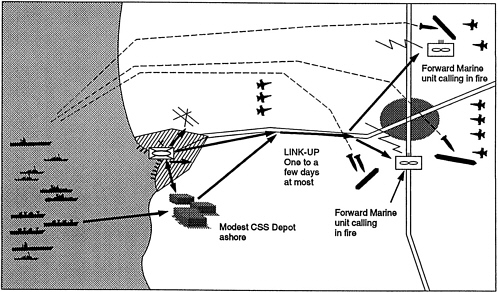
Ability to conduct LOTS operations in sea-state 3 conditions would increase the available operating times to 70 to 90 percent of the total time available.
Programs are under consideration to overcome this sea-state 3 barrier, at least to the extent of permitting loading and unloading in sea-state 3 conditions. They include the possibility of computer-stabilized cranes; a proposed advanced modular causeway that would function as a stabilized lighterage system that could be assembled in different configurations and that could be beached for roll-off discharge of vehicles; and a proprietary proposal by an industrial firm for a landing ship quay/causeway (LSQ/C), which would station a modified very large crude carrier off a beach, resting temporarily on the bottom, to establish a stable pierhead offshore from which an elevated causeway would be deployed across the beach. The causeway sections, designed to function through sea-state 5, would have adjustable legs resting on the bottom so that the causeway would not rise and fall with the waves but would be limited only by the severity of the wind and the action of overwashing or breaking waves.
Additional means (perhaps aided by stabilized cranes and floating platforms on which the LCACs can rest adjacent to a ship) are also needed to load cargo onto LCACs and other lighters from the major logistic ships. LCACs are designed to be loaded in the well-decks of amphibious assault ships, and these ships are designed to carry Marine Corps forces and their equipment to a landing location and unload them rapidly before carrying out other combat support functions. The amphibious ships, like the maritime prepositioned ships (MPSs), and the LCACs, are not well configured for supporting large-scale sustainment operations because they lack the capability to routinely receive, handle, and selectively transport and discharge large quantities of generalized materiel. However, LCACs are, in essence, large-capacity lighters able to carry up to 85 tons, depending on distance to be traveled (a proposed heavy-lift version of the LCAC would carry up to 150 tons). After discharging their initial assault cargo on the beach they can contribute very usefully to sustainment. They are made of aluminum and therefore subject to damage from bumping or hard landing of containers in the bottom, and so means are needed to load them safely alongside logistic support ships at sea when there are waves of significant height.
The logistic support ships themselves must be redesigned to suit them to modern cargo transport and handling concepts. In the future, most support cargo will likely be carried in standard 8 ft × 8 ft × 20 ft containers. Ships designed to function as logistic bases at sea must be able to stack these containers for easy access below-decks and provide for automated access to and movement of any container. (Means to identify which containers are of interest at any particular time are discussed in the next section.) The ships must have large internal “hangar” space for breaking and rearranging loads as needs change, and shop space for repairs and construction as needed. There must be
an upper deck from which V-22 and CH-53E aircraft can operate and there should be, if possible, the means discussed above to load LCACs.
While building many new ships with these characteristics may appear as a formidable budget obstacle in these times, the MPSs can be reconfigured to have many of the necessary characteristics when they are reconditioned, as will be necessary after some years. Some storage capacity may have to be sacrificed, however, to accommodate materiel handling. Existing logistic support ships, and leased commercial ships that can be expected to have many of the necessary characteristics, could also be so reconfigured.
The advances described above will all be needed to ensure that major supply depot operations at sea remain viable during OMFTS. (A vastly different alternative, the MOB under consideration by the JCS, is discussed below.)
INCREASING DISTRIBUTION EFFICIENCY
The logistic system today is not able to meet the needs of forward fighting forces without great excesses of supply in the system and without much wasted motion in locating needed supplies. For example, during Operation Desert Shield/Desert Storm, of more than 40,000 containers sent to the theater, over 20,000 had to be opened and the materiel they contained spread over a large area simply because there was no visibility into the containers' contents. The responsiveness of the logistic system was degraded by thousands of duplicate orders placed because of operational units' inability to know the status of their requisitions. Moreover, although an enormous amount of materiel was shipped to the theater, much of it was not readily available to our forces because of the poor visibility and control over assets in-theater.
DOD has launched an initiative to remedy the situation brought to light by the Gulf War. Called Total Asset Visibility (TAV), the initiative seeks to identify and track all materiel, whether issued to units, stored in warehouses, undergoing repair or manufacture, or in transit from one location to another. This enormous undertaking is now in its early stages. However, a TAV Executive Steering Committee has been established including the logistics chiefs of all the Services and the Office of the Secretary of Defense (OSD), the commander of the Defense Logistics Agency, and the Vice Commander of the U.S. Transportation Command (USTRANSCOM). A Joint Program Office is to be established to provide day-to-day coordination and management of the effort.
The Marine Corps has initiated experimentation with industry technologies that will be especially helpful in tracking and handling materiel in-theater. Packaging will have to be revised so that the standard 8 ft × 8 ft × 20 ft containers contain materiel packaged for a sequence of anticipated unit needs
rather than for bulk shipment. These containers will be liftable by the available vertical heavy lift in an MEF, the CH-53E. A variety of automated information technologies (already being applied in the commercial world) are being explored, from linear bar codes for individual item identification to reprogrammable radio-frequency tags that can, on being queried, announce a container's contents to a distance of 300 ft, with the possibility of relaying such information to remote locations via satellite. These technologies, in combination with automated databases, will, when implemented, enable tracking and access to needed supplies without wasted time or motion. Not the least of the benefits, in addition to system responsiveness, will be a great reduction in the quantity of supplies needed in the logistic system to effectively support an operation.
Overall, the idea is to package the materiel once, and then move the package via any and all modes necessary to the ultimate user. The system should be a comprehensive, end-to-end set of processes that encompass packaging, handling, and transport by all modes. To the extent possible, packages based on the standard containers should be configured and assembled in the continental United States (CONUS) and then transported unopened to the user (so-called “unitized” loads). Any required breakout or assembly in-theater would be done aboard the logistic ship (or MOB, discussed below) and the revised, re-assembled package then sent on to the unit. However, break-bulk shipping and pallet distribution of dry cargo must be minimized or eliminated as they are too inefficient to meet the high-volume, time-sensitive throughput requirements.
Many problems remain to be solved to apply these technologies effectively, to establish the needed level of supply visibility so that the logistic system will be responsive enough to reduce the need for large supply depots ashore to support intense combat by maneuvering forces inland. Not the least of the problems remaining is the need for reconciliation of requirements and increased equipment standardization across the Services, so that incompatibilities will be minimized as TAV is implemented. The committee strongly endorses these initiatives, especially those being undertaken by the Marine Corps to ensure rapid location, identification, and offloading of supplies in-theater. In the committee's judgment, the new concept of OMFTS cannot work unless the initiatives are successfully concluded.
The committee also suggests that, as part of implementing these initiatives, the Marine Corps invest further in its logistic analysis capability. Although some logisticians are starting to think about the ramifications of OMFTS, the current dearth of applicable quantitative analysis is troubling. A small cell of analysts devoted to evaluating alternatives and cost-benefit trade-offs could yield large dividends in setting the course for future Marine air-gound task force (MAGTF) logistics.
An important part of OMFTS logistics is communications. Lack of adequate tactical communications has been a chronic problem for logisticians. Most logistics communication is made up of messages, usually long, about resupply needs, and is considered of routine priority in comparison with intelligence- or combat-related communications. However, for the responsive logistic support of forward elements in OMFTS to work in the new mode, these communications will have to be accommodated in faster, higher-capacity links. Communications associated with daily logistic support to forward combat elements, possibly isolated on the ground and changing location frequently, will have to be accorded the same precedence as tactical communications that call for firepower to support them.
OMFTS logistic communication can benefit from access to the great diversity of civilian systems that will exist at the time of implementation; the potential utility of the civilian systems constitutes one reason that linkage to those systems in the overall unit-to-headquarters communications architecture is recommended on pp. 45-46. Although commercial channels are not as secure as the military links, some encoding of logistic messages over them will be possible, at least to the extent that by the time messages are decoded they will no longer be current and useful to an opponent in high-tempo operations. The commercial systems will be well suited to logistic traffic and should represent a useful alternative for this application if tactical military links become overloaded or the logistic requirements are preempted by other emergency calls such as calls for fire support.
MOBILE OFFSHORE BASE
The Joint Staff has been exploring various industry proposals to create a mobile offshore base (MOB) using floating oil platform technology. In one of the proposals, the base would be made up of six semi-submersible modules, each 500 ft long by 300 ft wide, to produce a 3,000-ft-long structure. The modules would be assembled and interconnected in quiet waters. The platform would constitute an operations and logistics base, having all the characteristics described above for modern logistic support ships, as well as the capacity to store internally as much supply as a major base ashore. It would be extremely stable in high seas, with the runway surface well above all but the largest waves expected. In addition to CH-53E and V-22 aircraft the platform would be able to accommodate C-130 aircraft (and possibly C-17s at a 4,000-ft-long configuration proposed by another vendor); and with the addition of a ski-jump on one end, conventional take-off launch (CTOL) combat aircraft could use it (as demonstrated by the former Soviet Union 's carrier Kuznetsov). The assembled platform would be self-propelled and, with the aid of tugs to help
control it and perhaps provide some additional propulsion, it could displace from one offshore location to another across the ocean at speeds on the order of 4 to 8 knots. The cost of the bare base, configured but not loaded for use, is estimated at somewhere between $1 billion and $2 billion, when allowance is made for the preliminary nature of the quotes.
Such a base could provide many opportunities to support forces in littoral warfare. The ability to move it from place to place means that a single base, loaded to support an MEF, could be stationed in an ocean and moved to any area where a crisis creates the need. It could be emplaced at sea outside the territorial waters of any nation, avoiding sovereignty issues at sensitive times. Aircraft from all Services could operate from it, making the airdrop option for logistic support of forward combat elements more attractive. Such a base could minimize the need for onshore supply depots, although with the risk of operational disruption by weather or enemy action the need would probably not be wholly eliminated.
As with any experimental concept, the MOB proposal poses problems that must be taken into account. Although the basic platform technology is well known, important aspects of the technology in this application have not been tested. The creation of a long, free-floating platform for deep-sea use, its assembly at sea in sections, and its use for takeoffs and landings of large transport aircraft would all be new endeavors. While any problems attending the construction and use of such a platform could certainly be solved in time, they could increase costs more than would be tolerated.
Moving the platform over long distances would, because of its sheer bulk, be a major and costly engineering task. Displacement over long distances at the low speeds achievable would reduce responsiveness to sudden crises; for example, it could take 20 days or more, not counting setup time at each end and possible delays caused by weather en route, to move the platform 4,000 miles. This means that the need for ships to support initial action would not be completely obviated.
A major base like this would, in an MRC against a capable enemy, be a prime target for antiship cruise missiles and tactical ballistic missiles, or even air attack. While the platform would be essentially unsinkable, a determined attack could lead to enough damage to cause a “mission kill” for a long period of time. Therefore, either effective defenses would have to be built onto the platform, raising its cost significantly, or large portions of the fleet would have to be devoted to protecting it in a more or less static location.
Finally, even though the platform could technically be stationed outside the territorial waters of a sensitive nation, international political problems could still attend its proximity to an unwilling host, as experiences along the North African, Indian Ocean, and Pacific littorals have illustrated from time to time.
Table 3 Comparison of Two Kinds of Offshore Logistic Bases
|
SHIPS AS “WAREHOUSE OFFSHORE” |
MOBILE OFFSHORE BASE |
|
|
PRO |
|
|
|
CON |
|
|
Although some of these problems can be severe, none of them is significant enough to discourage interest in the MOB concept based on initial examination. A comparative summary of the advantages and disadvantages of the proposed MOB and the more conventional support concept based on logistic ships is presented in Table 3. This comparison suggests that, although the MOB concept is attractive for many reasons, the necessary information to decide whether to pursue it further is not yet in hand. The initiation of studies and simulations leading to a detailed Cost and Operational Effectiveness Analysis (COEA) is indicated.
SUMMARY OF NECESSARY ACTIONS
It is indicated above that with appropriate re-engineering of the logistic system to support warfare along the littoral, as many as four or five landing teams having the strength of light battalions without organic artillery could be logistically supported from the sea by the organic vertical lift in an MEF, up to 75 to 100 miles inland, in an initial assault under the newly emerging concept of Operational Maneuver from the Sea. These initial assault forces would bring heavy firepower to bear on enemy forces from long range, fixing the opposition and destroying much of it. They would set up and facilitate the maneuvers of the main landing force against the objective(s) of the operation. Depending on enemy reaction and strength, a landing on the beach, establishing secure support links with the forward combat elements and consolidating the entire operation into a unified maneuver force, could be accommodated within a few days of the initial assault, at most. Instead of a large resupply depot being built on the
beach, the base would be kept at sea, with only a few days' supply kept on land to smooth the flow of support.
In summary, the Navy and Marine Corps should take the following steps toward re-engineering the logistic system to make logistic support of the new OMFTS concept viable:
-
Examine, and revise according to need, the echelonment of initial and follow-on assault and support forces to suit the advanced concept of operation.
-
Revise materiel packaging and movement protocols and procedures so that unitized loads in standard 8 ft × 8 ft × 20 ft containers arranged according to anticipated need, rather than as bulk cargo, can move from loading points (possibly in CONUS) directly to users with a minimum of need for break-bulk sorting and repackaging. As part of this effort, participate in and capitalize on DOD's TAV program; pursue ongoing experimentation with Automated Identification Technology for tracking cargo; and coordinate with the other Services to prevent conflicting interfaces that would interfere with interoperability.
-
Build the appropriate logistic C3 system to support the concept (as described on page 77), and re-classify the communications precedence, capacity, and timeliness as “tactical ” in nature, rather than “administrative,” as logistic communications are usually treated.
-
Obtain appropriate intelligence and devise flight and defense suppression tactics and countermeasures, including signature reduction and other possible means, to enable the vertical lift aircraft of an MEF (the CH-53E and the V-22) to penetrate reliably and with a high degree of safety to the dispersed positions of the forward combat elements, to provide them with logistic support until secure land lines of communication are established.
-
Acquire the capability to move LOTS in sea-state 3 and, as part of this, provide for use of LCACs as logistic carriers between merchant ships and shore after their missions in the amphibious assault have been completed.
-
Configure logistic ships to suit their roles as logistic depots at sea.
-
Undertake the studies and simulations necessary to complete COEAs of (1) the MOB concept in comparison with ship-based means for
-
providing logistic support from the sea to forces maneuvering ashore and inland, and (2) the LSQ/C for providing offload capability in sea states greater than 3.
-
Make available to U.S. Marine Corps Headquarters a logistics analysis capability to help plan and evaluate the changes to the logistic system needed to support the new approaches to OMFTS.
4
Countermine Warfare
All potential opponents to Navy and Marine Corps amphibious operations, whatever their level of sophistication, will be able to use mines and obstacles in the approaches to beaches, on the beaches, and in inland transit and landing zones. If not appropriately countered, the mines can be “show-stoppers” for operations from the sea just as much as the shoulder-fired, IR-guided SAMs discussed earlier could be—more so in fact, because they can attack all Navy and Marine Corps means of movement: ships, landing craft, and landing aircraft. Moreover, overcoming the problem with current techniques can take days or weeks, a time scale not compatible with planned high-tempo operations.
Building a countermine capability for OMFTS is a matter of devoting enough command attention and resources to obtaining the needed capabilities. Many countermine capabilities, some of which are reviewed below, are available, in development, or conceived. Determining the countermine force sizes needed is beyond the scope of this study, but it must be emphasized that the Navy has rarely devoted extensive resources to this area. Often, the United States has been able to depend on our allies to supply the assets, but since future crises and conflicts will involve shifting coalitions we cannot be certain who our allies will be or what capabilities they will bring to the fray. The Navy and Marine Corps must build enough kinds of capability, and in sufficient quantity, and they must devote enough attention to the problems at all command levels, to ensure that mines do not stop amphibious operations at critical times, either in the seaborne or inland phases of a campaign.
It is impossible to describe briefly the huge variety of mines and obstacles that can be brought to bear, but some of the richness of the mine warfare field can be suggested. Mines of various size, up to thousands of pounds, in deep water (over 40 ft) can be floating, moored, or resting on the bottom. They can be released to seek their targets, fused to explode if disturbed by a swimmer, or exploded by contact or by the influence of various physical phenomena such as ship acoustic or magnetic signatures or the pressure wave created by a ship's passage. Mines in shallower water and in the surf zone can also be buried, and can be exploded by command as well as by passage of the target. Mine fuses can have counters that allow several targets to pass before they are exploded by the “n”th target. Analogous mines on land, buried or on the surface, can be designed to attack personnel, landing craft, or armored vehicles. To guard aircraft landing zones, Claymore-type wide area mines can be elevated on
tripods to attack vertical lift aircraft on landing and troops on disembarking from them.
Mine density affects the ability to find and clear or neutralize mines in a short time, and therefore influences both the kind and amount of countermine resources needed. Mine densities in deep water might be measured in terms of only a few mines per square mile. In shallow water and surf zones, there might be a dozen mines in the 50-yard pathway that must be cleared for an assault force to move ashore. Scattered antipersonnel and antitank mines on land may be as dense as dozens per acre; buried antitank mines on roads or elevated antiaircraft mines in landing zones will be less dense on average because their effective areas are larger and because they tend to be placed at strategic locations. However, they may be clustered at strategic locations.
Obstacles to landing on the beach could be reinforced concrete blocks of various shapes and sizes; crossed, welded, and embedded railroad rails; embedded telephone poles; or concertina wire and razor tape. If the obstacles do not actually damage the vehicles and injure the personnel who attempt to cross them, they can stop would-be penetrators for long enough to make them targets for defending fire.
Eliminating mines and obstacles from the path of an invasion requires operations by mine sweeping and clearing ships and helicopters, by special operations forces, and by the landing forces themselves in the surf and landing zones. Such capabilities exist in the mine countermeasures and minehunter class (MCM-1 and MHC-1) ships, the minehunter (MH)-53E helicopter, and various towed sonars and SEALs (sea, air, land teams), all of which can find and clear or neutralize mines in depths of up to 20 ft. SEALs have clandestine capabilities to locate, classify, tag, and place explosive charges on mines at shallower depths, in 12-ft depths or less, and to prepare explosive charges to destroy beach obstacles. The amphibious assault ship Inchon (LPH-12) is being refitted as a mine countermeasures command, control, and support ship (MCS) for use by the Mine Countermeasures Group Commander in an amphibious force.
All such operations take time, and stealth must be preserved in the vicinity of landing beaches and zones. The longer the mine clearance operations take, the greater the chance that the landing force's stealthy cover and thus the element of surprise will be “blown” and that new mines and obstacles will be emplaced by a resourceful enemy. The very shallow water and surf zones, from about 12-ft depth in through the craft landing zone on the beach, are especially difficult to deal with in this respect.
The time taken to overcome mines and barriers can deny surprise to the landing force. The Marines have focused attention in their requirements process on the idea of “in-stride” mine clearance in the shallow water and surf zones, so that the landing forces in these zones can simply move at the time and speed
they choose, as though the mines had never been there. This is unrealistic, since the mines cannot be attacked until the landing zone is “announced ” by the initiation of the landing. A more realistic objective in overcoming mines and barriers in these zones is to convert them from a potentially insuperable obstacle to the status of a “speed bump. ”
The following steps represent the least that should be taken. All of them incorporate existing capabilities, capabilities in development, or those that are within the state of the art. What is required is the application of resources, the attention of management and command, and the diffusion of mine warfare awareness and operational responsibility throughout the Navy structure, to ensure that the resources are applied in an appropriately focused manner and that the capabilities are integrated into the OMFTS concept:
-
Pre-hostilities observation and denial of emplacement. This requires enhanced surveillance and intelligence analysis of potential crisis areas, including pre-hostilities intelligence on mine production, storage, and movement to possible deployment areas, so that the extent of local mining capabilities and areas where mines may be emplaced can be anticipated. In international waters, emplacement of minefields can be denied, or mines once emplaced can be cleared with justification at any time. If operations appear imminent, these denial and clearing operations can be extended to projected sea-base sanctuary areas (e.g., for logistic “warehouses at sea”), even if those operations may penetrate waters claimed as territorial. Movement to emplace a minefield at sea is considered a clear indicator of hostile intent, and a successful countercampaign at this stage can save considerable effort later on and perhaps forestall further hostilities.
-
Pre-assault minefield surveys and neutralization. Once an intended landing area has been chosen but before it has been revealed, covert minefield surveys in shallow water, mine location in GPS coordinates, and set-up for neutralization or destruction on command can be undertaken by appropriately equipped SEALS. Although underwater vehicles and sensors exist, much of this capability remains to be fully developed.
-
Rapidly deployable explosives in very shallow waters. Work is under way on deployable line charges (Shallow Water Assault Breaching System [SABRE]) and explosive nets (distributed explosive technology [DET]), to explode mines in the surf zone in the vanguard of a landing force. Under one concept, a lead AAAV would deploy these charges, but other means, from other vehicles, could be devised.
-
These developments are viewed as the key to rapid movement to a beach through a mined surf zone.
-
Obstacle clearance. Means are needed for rapid clearance of defenders' obstacles other than mines from the path to the beach. Such techniques, which could be used under circumstances where mines have not yet been cleared from the intended channel, might include the use of robotic bulldozers able to run in the surf and up onto the beach, direct fire from tanks on LCACs to clear heavy concrete obstacles, and small, remotely operated vehicles that can carry explosive charges to obstacles and either detonate them on contact or be detonated on command.
-
Precision emplacement of large explosive charges (PELEC). Another approach has been proposed and its feasibility demonstrated analytically,1 but it has yet to be taken up seriously. PELEC involves dropping a string of GPS-guided penetrating 10,000-lb bombs along the intended path of the 50-yard-wide channel needed for the invasion landing craft. Calculations show that if dropped at intervals of 20 yards and exploded within .01 seconds of each other in a line charge analog, the bombs would create a channel effectively cleared of all mines and obstacles that is 50 yards wide and 10 to 15 feet deep. A secondary benefit would be reduction of surf along the resulting channel. The bombs would be dropped by the bomber force in a joint operation with the Navy and Marine Corps. PELEC is the only approach that can comprehensively handle the problem of rapidly clearing a transit channel through mixes of various kinds of mines and obstacles in the surf zone and the craft landing zone. It should be developed and tested, and, if the tests are successful, deployed.
-
Clearing mines from inland landing zones. Although Marine vertical lift aircraft have the flexibility to land in any area found to be unoccupied and undefended, there is always the possibility that a smart enemy, knowing his own terrain and force disposition, will anticipate likely landing zones and mine them to set an ambush. An obvious means to protect against this possibility is the use of preparatory fires from long range to clear the landing zone and the area around it.
1
Mine Countermeasures Technology, Volume II: Task Group Reports (U) (classified), National Research Council, Naval Studies Board (National Academy Press, Washington, D.C., 1994).
-
Distributed-effect warheads, such as those discussed earlier for tactical attack missiles, could perform the task without creating craters that would interfere with troop mobility after landing. The potential presence of civilians in the vicinity may preclude use of such fires, however. Special operations forces can scout potential landing zones as one precaution. Three Army ATDs are seeking means for detection and rapid clearance of land mines, and may yield results applicable to the Marines' problem in this situation. This entire area needs attention as the potential for airborne landings deep in enemy territory is expanded.
RECOMMENDED ACTIONS
The Navy and Marine Corps have long been aware of the mine and obstacle problems in amphibious warfare. Work is under way to resolve them, but it is not as far along as it might be. For example, PELEC is not yet being seriously supported as a means to reduce the mine and obstacle problem to speed bump status. There are 12 ATDs involving Navy, Marine, Army, and joint systems, making up an ACTD in the countermine warfare area. Although they will contribute strongly to solution of the problems outlined, and the Navy and Marine Corps must remain cognizant of and ready to use the results of those not within their purview, the 12 ATDs will not solve the problems fully.
The Navy and Marine Corps must assign staff and operational responsibility and build the expertise for mine and countermine warfare at all levels. They must fully define the overall system problem from the approach of an invasion fleet toward the littoral to landings on the beach and far inland, evaluate all the alternatives to resolve the component sub-problems, and devote the necessary command attention, R&D attention, and resources to the total problem if it is not to become a main stumbling block to successful implementation of OMFTS.
While the sea mine problem may remain a substantial responsibility of the Navy Department, with other Service inputs such as the PELEC approach described above, the problem of land mines is of great concern to both the Army and the Marine Corps. The Marine Corps should continue to work with the Army to seek solutions to the problems of finding and evading or neutralizing land mines in movements ashore and in air landings and subsequent maneuvers deep inland.
5
Improving Capabilities in Related Areas
MILITARY OPERATIONS IN POPULATED AREAS
It has been pointed out that some 70 percent of the world's population lives within 200 miles of the sea. This has served to define the area of interest for Navy and Marine Corps involvement in warfare along the littoral. Yet many planning scenarios, especially those for MRCs, consider only the interactions of the military forces that will be involved. Given the nature of regional international interactions that can lead to military operations, however, such operations in populated areas will be common, even in MRCs. Certainly the Marine Corps will have to deal with populations on land; the Navy will also have to be (indeed, has been) concerned with them in actions such as boarding ships, handling refugees at sea, and countering terrorists.
Military operations in populated areas may involve operations in or on the fringes of cities or other areas having various degrees of urbanization. Because of that variability, the nature of the areas in which the operations may take place has been difficult to characterize. The term “military operations in built-up areas” (MOBA) has long been used. A draft Marine Corps manual deals with the subject as “military operations in urban terrain” (MOUT). Also involved are “operations other than war” (OOTW). The term “military operations in populated areas, ” without a defining acronym, has been adopted here to encompass all of the implied variations in meaning.
To operate in populated areas the Marines will have to emphasize intelligence and psychological operations. These operations will call for specialized knowledge about the area; knowledge of the local language; ability to intercept and exploit local communications (including other than electronic communications—drums were used at critical times in Mogadishu) to enhance combat intelligence gathering and response to developing situations; ability to establish and use local human intelligence (HUMINT) networks, and to connect with and exploit those that may already be in place; and the ability to preempt, use, or deny opponents' use of local communication and information networks, such as radio, television, and print media. Clearly, such capabilities put a premium on operations in coalitions, some of whose members will have the requisite expertise.
While the Marines need the ability to deal with populations in their operations, the Army has extensive capabilities in this area, from psychological operations to establishing civil governments and keeping civic order. The Marines will therefore need the capability to bring appropriate Army units along and integrate them into Marine operations.
Tactically, the Marines must be able to operate with indigenous forces. They may not have had the chance to practice with those forces before the onset of the crisis precipitating military action, so that advance preparation, along the lines sketched above, will be essential. One step that can help all these preparations would be the establishment and continual updating of area databases for cities and countries where it is anticipated that military action may take place—recognizing that the areas assigned highest priority may not be the ones demanding attention first. The problem is akin to that of preparing up-to-date maps, and demands the same kind of joint attention.
Combat in areas with buildings and streets produces extensive casualties in attacking forces, as well as casualties and destruction among civilians trapped as bystanders. To engage in such combat while minimizing both casualties in their own forces and collateral casualties and destruction, the Marines will need many technical capabilities, some of which are in some phase of R&D but not yet fully available for use in the forces. These capabilities include, among others, periscopes and robots for scouting around corners and along streets; radar and IR sensors that can “see” through walls and clothing; lightweight, short-range radio communications that do not depend on line-of-sight transmission in areas that have tall buildings, and that do not occupy a soldier 's hands while in action; and non-destructive (or minimally destructive) weaponry to isolate and overcome armed resistance.
An important part of operations in populated areas is the ability to organize, maintain order among, and feed and provide shelter and medical care to neutral or friendly populations disturbed or displaced by the military operations. It may also be necessary to subdue or control hostile populations in relatively benign ways. This calls for non-lethal or less-than-lethal means to make them immobile and/or passive. These means might include foams, slimes, and sticky substances making movement difficult; nausea generators to deflect people from hostile purposes; and others of similar character. “Instant barriers ” to movement, such as foams that expand and then harden in place on exposure to air, would enable partitioning of built-up areas and interdiction or canalization of vehicular movement. Specially tailored and focused information techniques can also deflect or control mob action, and can counter incitement to such action.
The ability to rapidly establish holding, feeding, and screening areas for prisoners and civilian detainees, using indigenous materials and facilities where available, and applying some of the “instant barrier” techniques noted above
where necessary, is also important. While facilities such as warehouses, stadiums, or simply empty fields may be available, doctrine, area knowledge, and practice are needed. Food and medical care may be critical items and must be included in preliminary expedition planning.
Many of the techniques and technologies used for controlling population dynamics raise ethical and policy issues that may be viewed differently by the U.S. military and civilian sectors (as was the case, for example, with the use of CS [o-chlorobenzylidenemalononitrile] riot control agent to drive Viet Cong from tunnels during the Vietnam war). While it is difficult to argue such things in the abstract, the committee believes that there would be some utility in starting discussion of these issues now so that they can be anticipated and paths to their resolution considered before the issues arise at critical times to hobble operations and cause dissension. Restriction of applicable R&D would be premature at this stage, however.
Finally, all the capabilities described above will have to be adapted to operations against sub- and transnational groups, such as drag lords, terrorists, bandits, and so on, with whom the Navy and Marine Corps may be assigned to interact militarily. Special attention is needed to adapt the following capabilities for such operations:
-
Local intelligence, psychological operations, and communications capability designed for populated areas;
-
Tailored information warfare and signal intelligence (SIGINT) exploitation;
-
Fast-response, precise attack of small, fleeting, low-signature targets;
-
Neutralizing mines, IR SAMs, and antiaircraft artillery (AAA) in landing zones; and
-
Non-destructive operations against opponents in populated areas in the presence of civilian populations.
Recommended Actions
-
The Navy and Marine Corps must expect to operate in populated and built-up areas along the littoral in all military actions from those short of war to MRCs. Capabilities should therefore be built to
-
Develop local area and language expertise and the ability to establish and exploit local intelligence networks, and to preempt and exploit local communications media, with the aid of local forces and governments;
-
-
Fight in built-up areas with techniques and technical means that minimize friendly casualties and collateral civilian casualties and destruction, in coordination with local forces where appropriate and necessary;
-
Assist local civilian populations in maintaining order and subsisting in war-induced food emergencies, and subdue and control hostile local populations by non-lethal means; and
-
Adapt these techniques, and others as appropriate, to operations with sub- and transnational groups like drug lords, bandits, and terrorists.
-
The Marines should be prepared to integrate and involve Army units in Marine Corps activities associated with military operations in populated areas, especially in intelligence, psychological operations, civil affairs, and maintenance of local order, where the Army may have capabilities not immediately available to the Marines.
-
Ethical and policy issues attending some aspects of operations in populated areas should be raised and discussed in advance to the extent feasible in the abstract, so that they can be resolved practically and with forethought during crises without hobbling ongoing operations.
ADVANCED MEDICAL LOGISTICS
Along the African littoral and the southern and eastern Asian littoral, a high incidence of disease will likely create more casualties than will the direct results of combat. Up to 75 percent of casualties in previous conflicts in these areas have been the result of disease rather than of military action. In areas such as sub-Saharan Africa, malaria infection rates among deployed troops may approach 100 percent. Human immunodeficiency vires (HIV) is profoundly altering the medical risk to U.S. troops, worldwide. A U.S. force could easily find itself ineffective for its mission, without severe combat having taken place. Also, medical care for indigenous civilian populations can be an important aspect of military operations in populated areas. Finally, preventive measures and treatment for the effects of exposure to chemical and biological weapons are far from completely in hand.
Most Navy medical assets are oriented toward hospital-based medicine rather than toward support of operational forces. This carries over into operation of hospital ships, where many Marine casualties will be sent. There are some casualty care facilities on amphibious ships, but these are relatively meager. For many reasons, field medicine is not a strong discipline in the Navy: as a career option it is less attractive for medical officers; many hospital corpsmen serve in operational billets without having attended field medical school; and few Navy physicians or nurses have field training or full familiarization with their operational billets.
In keeping with the Navy's and the Marine Corps' emerging forward presence missions and orientation toward warfare along the littoral, many of these aspects of medical care for forward forces will have to be revised. Medical considerations and personnel will have to be fully integrated into plans for future Navy and Marine Corps operations. Policies and facilities for casualty care, evacuation, and CONUS hospitalization must be reviewed and revised accordingly. Medical capabilities of amphibious ships should be enhanced, and the ships of the logistic support base (or the MOB if that support base proves preferable) should be given some casualty-handling capability. Another application would be the use of returning strategic airlift aircraft for early casualty evacuation, with CONUS hospitals adapted to their treatment as appropriate. All these considerations must be part of the review and reformulation of medical care policy for the evolving concepts of operation in the littoral environment.
Recommended Action
The Navy and Marine Corps should review the policies for medical care and medical treatment of forward forces to account for the actual conditions of military operations along the littoral, and consider the need for revising them. This includes recognition of the role of disease in producing casualties even when troops are not engaged in combat, and of the importance of field medicine as distinct from hospital-based medicine in medical support and practices.
PROTECTING THE FORCE
As is indicated in the section on opposing capabilities (p. 32), potential opponents in regional conflict will be able to bring to bear a variety of modern weapons against U.S. Navy and Marine Corps forces. A CVBG, an ARG, and MPSs concentrating for military action, especially in an MRC, become prime targets for enemy attack. Many defense systems to meet such attack are already aboard U.S. warships, and many new ones are under development. Among the
latter are air defenses, including cooperative engagement capability (CEC) that will integrate and multiply the effectiveness of separate defenses on many ships in a CVBG; air superiority systems, including advanced aircraft and air-to-air weapons; and antitactical missile systems. Torpedo defense systems were under development as the Cold War came to a close and can be adapted to the new mission needs.
Comment on these system—all of which are of vital importance to U.S. regional conflict capability and all of which have problems of implementation—is beyond the scope of this study. However, the committee highlighted four defense areas that it believes need additional attention and emphasis.
The first is protection of MPSs and cargo ships against antiship cruise missiles. As noted earlier, a proliferating variety of such missiles, from stealthy subsonic cruise missiles to supersonic sea skimmers, can be launched from land, air, or sea against those ships. The fleet's CEC is designed to cover any ships protected by fleet formations. However, with logistic ships serving in a new role as logistic warehouses at sea, they will be offshore in a relatively small general area, in association with the amphibious assault ships, perhaps for protracted periods. It will not be desirable to restrict the combat fleet's mobility by keeping it in a protective position for the amphibious ships and the logistic fleet for long periods. Either the fleet's long-range fire support will have to eliminate the sources of enemy fire early (difficult if some of that fire can come from submarines or hidden launchers on land), or capable anticruise missile defenses will have to be added to the amphibious and logistic fleets, or both means of defense may be needed. The defenses can take many forms, which this study has not explored for relative cost-effectiveness or operational preference. Here, the committee primarily emphasizes the need.
A second area of concern is protection against the large and growing number of modern, quiet submarines that hostile regional powers will be able to bring into a conflict. From some 40 such submarines in holdings outside Europe and Japan a few years ago, the number may grow to 80 or more by the turn of the century, in addition to Russia 's strong emphasis and continued upgrading of her submarine fleet and submarine warfare capability. The needs of such protection differ significantly from those of deep-water ASW since during a regional conflict many of the submarines will operate in relatively shallow coastal waters, where signals and signatures are uncertain or can be masked and where there are unlikely to be established bottom-mounted long-range sonar networks. Again, the amphibious and the logistic support ships may well have to be configured to contribute to the defense of the amphibious fleet against this threat. Without going into detail on the nature of such systems, the committee emphasizes the need for increased attention to ASW in littoral environments.
Ballistic missiles with guidance accuracy as good as 50 meters and with radiation-seeking or distributed-effect (bomblet) warheads will constitute an important part of the threat against friendly forces. In addition to the extensive work under way in all the Services to counter such missiles in flight and before launch, there is a need for launch warning and some degree of early target area prediction to forces that can take appropriate passive defense actions—for example, having exposed personnel in rear bases take shelter, emission control of ship radars, and ship evasive action. SOPs for such actions must also be worked out in advance.
Finally, the force operating along the littoral must be able to contribute to deterrence of the use of weapons of mass destruction and to countering their effects. This includes the following actions:
-
Having a stated policy of severe retaliation, with a known retaliatory capability to which the Navy and Marine Corps forces in the local area are known to be able to contribute;
-
Having a demonstrated ability to find and destroy weapon storage sites;
-
Developing doctrine and carrying out training for continued operations in case weapons of mass destruction are used;
-
Deploying early warning systems against chemical weapons;
-
Developing and deploying early warning systems against biological weapons;
-
Having chemical protective gear available and troops trained to don it and to operate while wearing it; and
-
Developing and having available vaccinations and treatments for biological weapon effects.
Recommended Actions
There are many R&D, operational, and system acquisition activities under way that will enhance protection of Navy and Marine forces engaged in conflicts along the littoral. A thorough evaluation of these measures is beyond the scope of this study, but the committee wishes to emphasize the need for action in the following areas, which it believes are not receiving enough attention in planning for future missions:
-
Protection of logistic and amphibious assault ships against the variety of antiship cruise missiles that can be launched against them from land, sea, or air;
-
Protection of logistic and amphibious ships against the proliferating numbers of modern, quiet submarines that will be held by potential opponents;
-
Provision for launch warning and SOPs for passive defense actions to take when hostile ballistic missiles are launched against the amphibious force; and
-
Capabilities for Navy and Marine Corps littoral warfare forces to contribute to effective retaliation in case weapons of mass destruction are used, and to mitigate their effects if they are used against our forces.
6
Synthesis
ISSUES IN JOINT AND COMBINED OPERATIONS
Current doctrines and policies call for all expeditionary operations to involve fully coordinated use of all Service, National, and allied assets and forces under command of the regional commander in chief (CINC). Although many organizational and system changes to implement these doctrines and policies are under way, many have yet to be made. It is essential to complete the many initiatives in this area, and to undertake others not currently under way, if the Navy and Marine Corps (and indeed the other Service and allied forces operating with them) are to implement the new OMFTS concept for conduct of regional conflict successfully and with the resources available.
All of the preceding review of the evolving Navy and Marine Corps concept of operations for regional conflict has assumed fully joint and sometimes combined operations. All the recommendations have emphasized them. In summary, the following are among the many areas and activities where inter-Service collaboration has been assumed or recommended:
-
Treatment of the Navy and Marine Corps, considered as separate Services in many forums, as essentially a single force for operations along the littoral;
-
Preparation by special operations forces of the ground for Marine landings and operations ashore, in many ways including scouting, neutralization of defenses, calling in preparatory fires, and other measures;
-
Use of National, Air Force, and Army as well as Navy and Marine sensors and sensor platforms in integrated surveillance and reconnaissance systems under CINC command;
-
Creation of situational awareness at different command levels, command and control for long-range fire support, targeting, and CID—all cooperative, multi-Service functions;
-
Use of Army, National, and commercial systems, in addition to Navy and Marine Corps assets, to contribute to communications connectivity and to common facilities and systems for logistic support of amphibious maneuvers from the sea;
-
Expansion of the Navy and Marine Corps guided-weapon inventory, coordinated with that of the other Services; and
-
Cooperative operations in populated areas with Army and coalition partners.
Indeed, it could be argued that one of the frequent objectives of an entire Navy and Marine Corps operation is likely to be the establishment of a lodgment for continuing heavy combat by the Army and the Air Force—the ultimate in cross-Service collaboration under a CINC. Enough is understood about such operations that it is possible to indicate, based on the above, the key steps that will have to be taken to enable joint operations.
Combined operations present a different set of problems, since it is not always possible to know ahead of time who the coalition partners will be. However, many such coalitions, such as NATO, have already spent decades and extensive resources to ensure that disparate national forces can operate together. It is possible, from those experiences, to indicate steps that can be taken to prepare better for smooth and effective functioning of ad hoc as well as existing coalitions with which U.S. forces may be involved in regional conflicts.
Key Areas of Emphasis to Refine Joint Operations
Provision must be made in all the following areas to ensure seamless interoperability of all forces—including Navy and Marine Corps forces —that may be involved in all manner of regional conflict situations:
-
Joint interoperability for tactical C4I and weapon systems;
-
Common WGS-84 grid and universal time, with all maps in the grid, for all forces—for situational awareness, targeting, unit and force location (of all participants in a conflict, and neutrals), and non-cooperative CID;
-
A multi-Service (and allied) coordinated approach to CID;
-
The ability to receive, process, and use all-source surveillance and targeting data, in a timely fashion;
-
Robust communications connectivity using multi-Service, National, and commercial communications assets, for long-range fire support and logistic support to forward combat elements; and
-
Joint C2 of theater logistics operations—this must include moving logistics C2 from the administrative chain in-theater, where it has relatively low priority, to the operational chain, where it can be given the same level of attention for support of forward units from the sea as is given to fire support for the forward units. Parallel changes in the logistic communications system will be needed to ensure that logistic traffic does not swamp the operational communications links.
In addition, it must be observed that developing and deploying systems represent only part of the task in ensuring smooth functioning of a joint force in crisis and combat conditions. It is also necessary that all potential elements of the force—all Service expeditionary units and forces—train and exercise together, frequently. Cooperative gaming and simulation will also contribute to training in an economical way and should be part of the joint training cycle.
Another step that would help in integrating Service forces for joint action is an officer exchange program. As has been demonstrated wherever such programs have been instituted, in the national or international arenas, the resulting understanding of each other's operations and the friendships made will contribute uniquely to inter-Service communication, understanding, and cooperation in planning as well as in stressful situations.
Key Areas of Emphasis to Refine Combined Operations
More than 40 years of collaboration among the United States and its NATO partners in force planning, standardization of doctrines, equipment, facilities, and protocols; combined training and exercises; and establishment of a recognized Alliance command and control regime have shown how combined operations can be made to function smoothly and responsively. While some of the processes are cumbersome, they have worked well when invoked under stress—during alerts in Europe, in the Persian Gulf area, and in the Adriatic off and over Bosnia. Similar arrangements, different in detail to suit local circumstances, obtain in Korea and with Japan.
With the impossibility of predicting exactly who other potential future coalition partners may be, it may appear difficult to extend such arrangements beyond the existing ones. However, the United States does understand its strategic interests, and it should not be difficult to assess where future international crises requiring coalition action may arise. While it may not always be possible to make arrangements having the solidity of those made in,
say, NATO, it should be possible to make some arrangements and to have some interactions with potential future coalition partners that will smooth the way for combined Navy and Marine Corps operations with them when the need arises. Any useful steps taken ahead of time will obviate the confusion and delays, with attendant penalties in coalition effectiveness, of starting from scratch in a time of crisis.
The following steps, suited to local conditions and participants, should be undertaken:
-
Work out SOPs, C³ doctrines, and equipment interoperability agreements with potential coalition partners (as has been done in NATO);
-
Exchange key personnel with potential coalition partners, for enough time to establish rapport and understanding of each other's doctrines, tactics, technical capabilities, and modes of operation; and
-
Train with and undertake periodic gaming, simulation, and live field exercises with allies and potential coalition partners.
RESOURCES
Force Changes Required
Many force changes must be involved in the Navy and Marine Corps evolution to the future concept of OMFTS. To recapitulate from the prior discussion, these changes are as follows:
-
Drastically lightening the assault force, by reducing its landing weight and its logistic support requirements;
-
Delivering major fire support from the fleet, thereby separating the weight of heavy firepower from the most forward echelon of the assault force;
-
Establishing the logistic depot in the waters offshore;
-
Re-engineering the logistic delivery system;
-
Changing the C4I system to ensure robust, responsive situational awareness, targeting, communications connectivity, and enhanced CID;
-
Making broader use of guided weapons, including the fielding of a Navy tactical, ballistic-type missile system;
-
Devoting much more attention to countermine warfare, at sea, going ashore, and on land;
-
Devoting more attention to military operations in populated areas;
-
Reorienting of the medical logistic system to support expeditionary forces; and
-
Embedding all of the above in a joint and combined operational environment, with more joint system elements, planning, and activities.
Taken all together, these changes amount to a significant effort that will require expenditure of possibly substantial resources in what is expected to remain an extremely tight budget environment. In the interest of completeness and credibility it is worth exploring at least the general feasibility of marshaling the resources for such changes in that environment.
Estimated Resources Required
The changes needed to support the OMFTS concept must come in two broad areas: capitalization and operations. The costs of operational changes are virtually impossible to isolate, since with a given force size they take place within the Services' overall operating and training budgets. Issues of budget feasibility have traditionally focused on budgeting for force size and for capitalization, and here it is possible to make some estimates.
The main non-weapon capitalization changes highlighted by the results of this study are as follows:
-
Communications connectivity, other C2, targeting, CID, intelligence, and situational awareness enhancements;
-
Provision for long-range fire support systems on fleet combatants, and possible specialized fire support ships;
-
Aircraft targeting pods, and avionic system modifications to enable GPS P(Y) code transfer to guided weapons before launch and retention of the initialization fix while the weapon is in the aircraft shadow after launch;
-
Logistic ship modifications, enhanced protection, LOTS enhancement, and logistic supply system transformation;
-
Enhanced mine clearance capability; and
-
Enhancements for military operations in populated areas.
It is estimated that these changes might cost $13 billion to $14 billion altogether. A breakdown of the estimates is given in Table 4. The potential costs shown there are very coarse estimates, but they are informed by knowledge of past costs in related areas, by some estimates for specific system changes that were given to the committee by the Services in the course of the study, and by costs included in some proposals for proprietary systems in the logistics area. Although rough, the estimates are believed to be reasonably within the “ball park.”
In addition to the above changes, a substantial expenditure must be anticipated for guided weapons in the new operational paradigm. To estimate what the cost of the additional weapons might be, it was assumed that the Navy and Marine Corps alone would acquire, for their own use, a roughly 50 percent increase in numbers of guided weapons, above the projected DOD-wide inventory outlined in Table 2. The distribution of weapon numbers by type in this acquisition would be roughly as shown in Table 2, with the exception that the original purchase of Block IV Tomahawk would not be increased, and that 2,000 NTACMS (assumed for this purpose), similar to the numbers of ATACMS in the DOD-wide plans, would be acquired. This would lead to Navy and Marine Corps acquisition of ~60,000 guided weapons in an assumed mix having an average unit cost of $108,500, as shown in Table 2, for a total cost of ~$6.5 billion.
Table 4 Potential Cost, OMFTS Improvements
|
IMPROVEMENTS |
COST ($B) |
|
3.5 |
|
2.5 |
|
1.2 |
|
5.0 |
|
0.5 |
|
1.0 |
|
TOTAL |
~14.0 |
In total, then, the estimated cost of capitalization involved in the projected force changes would be in the neighborhood of $20 billion. This money would not have to be spent all at once. Modifying the logistic ships and system, building new communication links, and acquiring new weapons under an annual weapon inventory acquisition budget would all take time, and the acquisitions could be adjusted to some extent to meet the exigencies of annual budgeting. While in actuality there would be peaks and valleys through the years, to the first approximation it may be assumed that the $20 billion would be spent uniformly over the 20-year period from 2000 to 2020. 1
The rough costs projected above do not yet include offsetting savings from:
-
Steps taken to reduce guided-weapon costs;
-
Less excess supply in a modernized logistic system;
-
More reliance on joint systems and task sharing; and
-
Fewer tanks and artillery in the initial assault forces.
Not enough is known to quantify these potential savings with any accuracy. However, it is not unreasonable to project them at roughly $5 billion. Fifty percent reductions in the costs of guided weapons alone were deemed possible in the committee's analyses, above, leading to a possible $3 billion or more in savings. It appears conservative to project that the other items could lead to $2 billion in additional savings. For example, the latter might be only a small fraction of the excess holdings and potential reduction of those holdings in the logistic system alone. Possible additional savings from infrastructure reduction are not accounted for in the above enumeration.
|
1 |
The expenditure period is projected to start in 2000 because of the DOD budget cycle. It will take some time to plan exactly how the changes are to be made, and the changes will then have to be entered into the Program Objectives Memorandum (POM) that plans the budget for the year after the POM appears. Work on POM 1998 is soon to begin. |
Potential Sources of Resources and Relative Magnitude
These rough estimates suggest that funds averaging on the order of $¾ billion to $1 billion per year over a 20-year period must be found to pay for the force changes deemed necessary to ensure the success of the new approach to OMFTS. Where can such sums be found in the Navy and Marine Corps budget?
It is clear that in a stringent budget period such as the one anticipated over the period covered by this study, funds will have to be traded among existing accounts to make desired changes in force capability. Such exchanges could be considered if they are not unreasonably large. As examples of their potential size, budget shifts in manpower-related costs or in procurement costs were considered by the committee. A shift of about $¾ billion to $1 billion per year, on average, from manpower-related costs to capitalization would represent a 3 to 4 percent reduction in the manpower-related costs, in the O&M and Personnel accounts of the combined Navy and Marine Corps budget, reallocated to capital improvements in the forces and their weapons. Alternatively, it would represent a shift of 6 to 8 percent of funds within all the procurement accounts except weapons procurement (i.e., ship construction, aircraft procurement, and “other” Navy and Marine Corps procurement) to different uses.
Conclusion
The results of the coarse resource exchange estimates outlined above should not be taken as recommendations to reduce force size or to modify any specific current procurement plans to capture the resources needed for the recommended force changes. Indeed, great caution would have to be exercised in making the exchanges. For example, only after making the modernization investments would it be prudent to make compensating personnel and O&M reductions. It is simply concluded from these estimates that, barring ugly surprises on the international scene that would require severe changes in all defense planning, the resource exchanges required to achieve a sturdy OMFTS capability, while they would be difficult, appear to be within the realm of economic feasibility, given expected resource limitations.
SIGNIFICANCE OF THE OPERATIONAL AND FORCES CHANGES
The new Navy and Marine Corps approach to OMFTS has been occasioned by the convergence of a need for enhanced capability to engage in future warfare along the littoral of the world's oceans, with new equipment and
capabilities that are becoming available to help meet that need. The committee has shown some critical areas where the advanced concepts could fail in implementation (e.g., in fire support, logistics support, mine warfare, and other areas that need improvement), and the committee has reviewed how practical problems in these areas could be resolved and the resulting force changes made more robust. Assuming that these solutions to problems, or equivalent alternative solutions, are implemented, what would be the significance of the resulting operational and force changes?
Force Design and Support for Warfare Along the Littoral
The Navy and Marine Corps will have to equip and train themselves differently for littoral warfare at the theater level, to meet new conditions of warfare and to exploit opportunities that will be offered by the technical capabilities being acquired, as was done for warfare in the NATO arena during the Cold War. Achieving this new capability will involve integrating sensors, exploitation of the sensor data, communications, weapons, mobility, and support in a total systems approach. It includes changing the sizes and operational characteristics of the assault, the assault follow-on, and the follow-on support echelons, and the logistic system as a whole.
These force and equipment changes will require systematic revision of doctrines, concepts of operation, tactics, and training. The revisions must cover how the initial maneuver forces ashore are to be used; those forces' reliance on major fire support from the fleet at sea to deep inland locations beyond the horizon; and logistic support of the maneuver forces across the sea-land boundary. Also, the revisions must account for the presence of large, possibly hostile populations in objective areas.
Overall, the advanced concepts will need gaming, simulation, and “red-teaming” to help refine the newly oriented forces and make them sturdy and resilient to unexpected events in carrying out their newly evolving missions.
Great Expansion of the Lodgment Area
Typically, amphibious landing forces can count on establishing a secure initial lodgment of 30 to 50 square miles on the beach, determined largely by the range of artillery brought ashore.
Under the new concepts, with the new equipment and systems, the area of the secure initial lodgment will be expanded to 2,500 to 3,000 square miles, defined by the reach of the V-22. An area as large as 5,000 to 10,000 square miles would be dominated by the fleet-based surface and air fire support of the landing force, up to 75 to 100 miles inland. The time to establish a lodgment of this size will have been reduced from possibly weeks to a few days at most.
Shorter Campaigns, Fewer Casualties, Less Damage
The new concept of OMFTS will have to depend heavily on much more extensive use of guided weapons, especially in MRCs, than has been envisioned in past Navy and Marine Corps planning. Even when their unit costs are reduced by the means outlined in this report, and others, guided weapons will remain more costly than conventional unguided weapons.
What perspective can be put on the added costs to illustrate compensating gains? Those gains must come in the areas of shorter campaigns with consequent cost savings, fewer casualties, and less collateral damage.
Duration of “Heavy Firepower” Campaign, and Consequences
The duration of wars is notoriously difficult to predict; even in recent history, many wars expected to be short instead extended into tragically long and difficult conflicts. Wars can be extended by many circumstances of chance; strategic miscalculations about geography, relative resources, determination, and interpretation of events by the different sides; and other factors. Their length may depend on the resolve and decisiveness in action of the opposing combatants. What starts as a definitive battle between armies in the field could end in the defeat of one of the armies, only to be extended by difficult combat in cities or a succeeding guerrilla war.
Nevertheless, some useful metrics can be brought to bear in gauging the probable duration of modern conflicts. Modern wars involving major forces on each side, as is likely to be the case in an MRC, usually begin with a straggle for air superiority and a campaign designed to destroy opposing aviation, C³, targets related to long-term support of the war, and tactical forces before they enter the fray. This part of the war—a “heavy firepower campaign,” if one will—will rely heavily on aviation, but in the future it will increasingly use surface-to-surface weapons such as long-range cruise missiles. Such a campaign can cause many incidental civilian casualties and much unintended damage, even before ground forces clash seriously.
Focusing first on this phase of a war, recent experience (e.g., the Gulf War) shows that a week of major regional warfare costs several billion dollars, when the costs of petroleum, oil, and lubricants, 2 weapons, other consumables, and major equipment losses are included. In Desert Storm, for which about 7 percent of the munitions used were guided, the munitions cost came to about 3 percent of the total cost of the war. Even if 50 percent of the munitions used
|
2 |
In the Gulf War, some 40 tons of aviation fuel were expended for all purposes, for every ton of bombs dropped. This expenditure represents a significant fraction of campaign cost, even if the weapon tonnage involves many guided weapons. |
had been guided, the munitions cost would have been only about 10 percent of the cost of the war. The total cost of the guided munitions would amount to approximately the overall cost of a week or two of major regional war.
Large-scale use of guided weapons can greatly reduce the length of the “heavy firepower” phase of an MRC. Many analyses through the years have shown, and the Gulf War corroborated, that the typical 10,000 to 30,000 targets (other than attacking ground forces) to be attacked in that phase of the campaign—such as air defenses, C4I sites, airfields, major weapon and munitions storage and fixed launch sites, other fixed or relatively immobile installations, and other ground forces in bivouac or defensive sites—can be neutralized or destroyed by up to an order-of-magnitude fewer weapons and aircraft sorties. Such a reduction includes both air- and surface-launched weapons. The reduction in weapon use translates into a corresponding reduction in the duration of this phase of a campaign, preparatory to the ground combat phases of the war. In addition, the fact that many more weapons hit their intended targets without re-attacks, in addition to the earlier end to bombardment of targets that may be embedded in populated areas, would greatly reduce collateral damage and casualties to the civilian population.
Duration of Ground Combat and Consequences
Experience in Vietnam and Korea shows that ground force casualties in such major engagements tend to be proportional to the length of the campaign; they occurred at a rate of between 100 and 1,000 per week in those wars. While the circumstances of any war cannot be predicted with any precision, it is reasonable to expect that resistance by organized ground armies will be much lower, and a campaign's duration consequently shorter, when enemy ground combat elements, their C3, and their support are severely weakened prior to ground combat force engagement. To the extent that such attrition is accomplished, friendly casualties will be reduced, as will the collateral destruction and civilian casualties attending the clash of ground armies in populated areas.
Conclusion: Return on Investment
The return on investment for the advanced Navy and Marine Corps concepts of operation with expanded use of guided weapons can be expected to be very high. The success of the long-range firepower contribution to OMFTS, and therefore the ultimate success of the concept, depend on extensive use of guided weapons. Break-even costs could be reached in 1 or 2 weeks of major regional war, not counting casualties saved. U.S. air forces, including those of the Navy and Marine Corps, have been significantly reduced since the end of
the Cold War. More extensive use of guided weapons will allow the smaller force to be more effective in the future than the force was when it was larger. Finally, such usage could enable CVBG+ARG+MPS combinations to contain situations beyond their current capability.
PRIORITIES
The committee believes that all of the force changes and equipment investments described in this report will be needed to ensure that the new Navy and Marine Corps concepts of operation for conflicts along the littoral are viable and robust. The severe budget pressures under which these changes must be made are recognized, and possible approaches to accommodating them are discussed above. However, the total package must have high enough priority relative to other Navy and Marine Corps investments to ensure successful implementation of the new concepts.
Within this overall emphasis, some of the force changes and investments constitute “long poles in the tent” that will determine the success or failure of the concepts. The order in which these program essentials are listed below should not be taken as a rigid sequence of priorities, but it is not altogether accidental.
The essential program elements are as follows:
-
Improved situational awareness, communications connectivity, C2, targeting, and combat identification (CID) enabling sustained, reliable, and effective fire support from the fleet offshore to forward combat elements deep inland;
-
Provision for increased use of guided weapons, including reduction of their cost, and application to long-range fire support from the sea;
-
Re-engineering of the logistic system; and
-
Countermine warfare.
Several additional areas are in the “must do” category. They are as follows:
-
Developing a much-enhanced capability to operate in populated areas, including combat in urbanized terrain, and operations other than war (OOTW);
-
Force protection, with special attention, beyond currently ongoing efforts, to
-
Protecting the logistic ships against antiship cruise missiles;
-
Protecting the amphibious force against modern, quiet submarines;
-
Using launch warning and passive protection SOPs against hostile tactical ballistic missiles; and
-
Taking measures to protect against and to sustain operations in case weapons of mass destruction are used.
-
-
Field medicine for forward forces and for OOTW.
-
Preparation for coalition warfare.
Finally, and of paramount importance, beyond these specific priorities and affecting all of them profoundly, attention to “jointness” must pervade everything.


