2
Issues: Background and Findings
A large number of issues were brought to the attention of the committee. Of these, six issues appeared to be of first order, which could be documented adequately in the time allowed for this review.
ISSUE 1
SEA GRANT'S POSITION WITHIN NOAA
The National Oceanic and Atmospheric Administration (NOAA) funds a large portion of U.S. applied aquatic research carried out in universities. Much of this support is provided through Sea Grant, which is the largest single extramural funding program within NOAA. The Sea Grant budget accounts for approximately 2.2% ($43.2 million) of the FY1995 President's request for NOAA. Sea Grant has focused on strategic research, research that is targeted to solve coastal environmental problems and to stimulate coastal economies. This strategic research is coupled with education and advisory services to form integrated approaches to coastal issues. Sea Grant capabilities are implemented through the state-based Sea Grant programs that facilitate information flow into local communities and from communities and states to NOAA. State Sea Grant staff have developed broad networks of contacts with state and local agency personnel, legislators and their staff, and industry representatives. Most state programs focus on addressing state, and to a lesser extent regional, issues.
Sea Grant interacts within NOAA through contributing NSGO staff to OAR and NOAA-wide activities, through a series of memoranda of agreement, and by handling pass-through funding. The Coastal Ocean Program uses Sea Grant to
handle planning, review, and funding for its Estuarine Habitat Program and as a pass-through mechanism for most of its extramural funding. 1 Other parts of NOAA also use Sea Grant as a pass-through mechanism. In fact, pass-through funding (from NOAA and elsewhere) accounted for approximately 13% of funds handled by state programs in FY1993.
Although NSGO staff often participate in cross-NOAA activities, Sea Grant has funded few joint activities with units in other Line Offices because funds for joint NSGO-Line Office activities must be derived from within its capped administrative costs. There is little use of the capabilities of state Sea Grant programs in a wider NOAA context. Sea Grant could use its proven state-level capabilities more broadly within NOAA, but it was evident to the committee, state program directors, and the Sea Grant Review Panel (SGRP) that the program has not achieved its potential in this area. For example, many state program directors noted that NOAA has not adequately integrated Sea Grant with other parts of NOAA to use strengths and capabilities of Sea Grant. As an example of how Sea Grant could help NOAA, the Sea Grant Marine Advisory Service (MAS) “was the lead organization in stabilizing the conflict between NOAA's National Marine Fisheries Service and the shrimp industry regarding the use of turtle excluder devices (TEDs). All [state Sea Grant] programs along the Southeast and Gulf coasts have contributed to development of certification procedures and new TED models, which in turn contributed to decreased anxiety on both sides.”2 More generally, many different programs in NOAA have developed their own schemes for accomplishing strategic research, outreach, and education. None of the research, outreach, and education activities carried out elsewhere in NOAA has such a well-developed network of state programs or devotes as many of its resources to outreach and education focused on strategic research issues, as does Sea Grant.
It is not clear why Sea Grant's capabilities have not been used throughout NOAA, although it may be because Sea Grant accounts for only a minor part of the NOAA budget and operates primarily in the states. It is relatively invisible within NOAA at the national level. Sea Grant is administered as a part of NOAA located in the Office of Oceanic and Atmospheric Research (OAR) (Figure 3). As a result of Sea Grant's low-level placement, subsumed within a program in a Line Office, the capabilities of state Sea Grant programs have little impact on other NOAA activities.
Sea Grant was not included in the President's budget for eight years, in part, because it was viewed as a Congressional program of aid to states of unrecognized usefulness to NOAA and to the Department of Commerce (DOC). During
|
1 |
National Research Council. 1994. A Review of the Accomplishments and Plans of the NOAA Coastal Ocean Program (1994). National Academy Press, Washington, D.C. |
|
2 |
National Sea Grant College Program. 1993. Sea Grant Review 1990 through 1992. National Oceanic and Atmospheric Administration, Department of Commerce, Washington, D.C. |
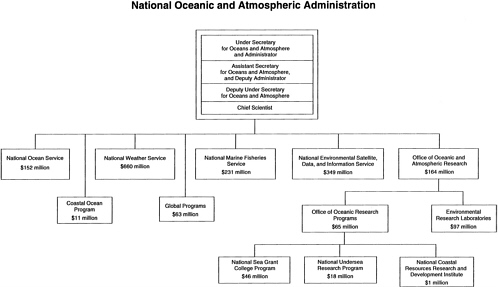
this time, Sea Grant was unable to take part in many budget initiatives and the underlying planning exercises within NOAA. Sea Grant's present position in the NOAA hierarchy makes it difficult for it to function across NOAA and it has insufficient authority and financial leverage to overcome bureaucratic barriers within NOAA.
NOAA and DOC have missed opportunities that Sea Grant could provide; for example, DOC did not propose budget increases to increase Sea Grant's role in the marine biotechnology initiative of the Federal Coordinating Council for Science, Engineering, and Technology.3 Although Sea Grant could have been a working model for strategic research planned and carried out by state-university partnerships, DOC has chosen to reinvent such mechanisms through the National Institute for Standards and Technology (NIST). This may be a reflection of Sea Grant's relative invisibility within NOAA and DOC.
It would benefit NOAA to apply Sea Grant's capabilities throughout NOAA. Although Sea Grant is a component of OAR, many of Sea Grant's responsibilities and capabilities suit it for a role outside OAR and the Line Office structure. Sea Grant, if properly positioned within NOAA, could provide NOAA with early recognition of opportunities that cut across Line Office missions. Sea Grant must receive the attention from upper NOAA management appropriate for an organization that can provide cross-NOAA capabilities and opportunities for cooperation between states and the federal government and between universities and industry.
It is unlikely that Sea Grant capabilities can be applied throughout NOAA unless the constraints discussed above are removed. To function effectively, Sea Grant must interact with, but be administratively and fiscally insulated from, the Line Offices. The decentralized Sea Grant structure provides NOAA the opportunity to operate at a state level and to tailor its programs to the needs of each individual state. In many states, Sea Grant personnel have formed strong ties with local coastal management personnel and with local and regional NOAA personnel. NOAA could better use Sea Grant to disseminate and gather information in the coastal states. To have its full impact, Sea Grant must be repositioned in the NOAA structure. NOAA has encouraged cooperative Line Office activities on important topics by initiating programs that operate outside the Line Offices, for example, the Climate and Global Change Program and the Coastal Ocean Program. These programs use a variety of mechanisms to promote interactions among the Line Offices to achieve program goals, including “councils ” of the assistant administrators and control of funding dedicated to joint activities. Interactions are also promoted by these two programs through funding of activi
|
3 |
National Association of State Universities and Land-Grant Colleges. 1993. The National Sea Grant College Program. A white paper prepared by the Board on Oceans and Atmosphere, Commission on Food, Environment, and Renewable Resources. Washington, D.C., p. 7. |
ties that combine the strengths of NOAA and academic investigators. These programs could be models for a repositioned Sea Grant program.
Finding: Sea Grant is not properly positioned within NOAA to fulfill the objective of the National Sea Grant College Program Act4 or to contribute in efficient and effective ways to NOAA's missions. Sea Grant's location within a Line Office focused on research inhibits Sea Grant's non-research activities and makes it difficult for the program to function across Line Office boundaries.
ISSUE 2
SHARED VISION AND STRATEGIC PLANNING
An organization uses strategic planning to gain consensus about its identity, to articulate its vision for the future, and to determine the best strategies and priorities for reaching the vision, taking into account existing economic and social conditions. Strategic plans are useful for building consensus among disparate participants and for providing a framework to determine if existing and proposed activities contribute to the organization's most important goals or if the activities are tangential. Strategic plans can help organizations that are involved in a broad range of activities, such as Sea Grant, to focus on those activities that are most important and for which they have strong capabilities, and to ensure that they are not involved in activities that would be carried out better elsewhere.
Sea Grant has been advised and even required to develop a strategic plan. For example, Section 206 of Public Law 100-220 (passed in 1987) states that:
Within 1 year after the effective date of the Marine Science, Technology, and Policy Development Act of 1987, and every 3 years after that date, the Under Secretary shall develop and publish in the Federal Register, a Sea Grant Strategic Research plan for the next 3 years.
The section then details what the plan shall do, to whom it should be submitted, criteria for areas to be included in the plan, and who should participate in its development. Section 206 was subsequently repealed but, according to NSGO, resulted in two documents that describe OAR's plans for its research programs.5
SGRP has a Long Range Planning Committee whose interest is to help NSGO with strategic planning. This panel has written a position paper (#2) on
|
4 |
See Appendix 1 for excerpt from the National Sea Grant College Program Act. |
|
5 |
Office of Oceanic and Atmospheric Research. 1988. Ocean System Studies. NOAA/OAR Research Strategy I. The Ocean System —Prediction and Resources. National Oceanic and Atmospheric Administration, Washington, D.C. 80 pp.; and Office of Oceanic and Atmospheric Research 1988. Ocean System Studies. NOAA/OAR Research Strategy II. The Ocean System —Use and Protection. National Oceanic and Atmospheric Administration, Washington, D.C. 79 pp. |
strategic management and made the following recommendation at its June 1992 meeting:
It is moved that the Sea Grant Director undertake strategic planning as a method of setting general priorities and directions and long range planning guidelines for Sea Grant that will provide a framework for decision making and guiding the future direction of Sea Grant; that such planning include as an inherent feature the flexibility to capitalize on the creativity of the academic community and to meet the unpredictable threats and opportunities that will surely arise; and that the Review Panel take an active role in advising the Director and his staff in this work.
Recommendations from SGRP, that Sea Grant should develop a strategic plan, have elicited a response from at least two entities in the Sea Grant system. At its February 24-26 meeting, the committee was told by NSGO and the Council of Sea Grant Directors (CSGD) that each is working on a strategic plan for Sea Grant and that the results would be reconciled when the respective plans are completed. It was evident that these activities were proceeding essentially independently and without a shared vision at the most basic level of program philosophy and administrative responsibility.
The draft NOAA strategic plan6 integrates Line Office activities by themes. Because of this structure, neither Sea Grant nor other NOAA units are prominent in the plan. The FY 1995 NOAA budget (based on its strategic plan) specifies Sea Grant budget requests among NOAA themes. Sea Grant activities are listed as part of only five of the ten themes: (1) Advance Short-term Forecasts and Warnings, (2) Build Sustainable U.S. Fisheries, (3) Coastal Ecosystems Health, (4) Education and Human Resources, and (5) Environmental Technology. The committee believes that this underestimates the potential contributions of Sea Grant to NOAA. NOAA should reexamine its strategic plan to ensure that the capabilities of Sea Grant to contribute to NOAA's identified missions are utilized fully.
A Sea Grant strategic plan must take into account strategic planning that is being conducted at the state level as well as at the NOAA level. Sea Grant programs in several states carry on their own strategic planning activities; for example, directors from the New Hampshire/Maine, North Carolina, New York, and Rhode Island programs, among others, mentioned strategic planning as a component of their state program development. The Sea Grant strategic planning process must result in a vision shared by all Sea Grant partners, including NSGO, CSGD, the individual state programs, SGRP, and the Sea Grant Association (SGA; a non-profit association supported with private funds from Sea Grant colleges).
|
6 |
National Oceanic and Atmospheric Administration. 1993. Strategic Plan, 1995-2005. Department of Commerce, Washington, D.C. |
The network of state programs developed a document entitled Economic Competitiveness and the Coastal Environment, which describes what Sea Grant does to benefit coastal business and suggests some future activities. This document will form the basis of a new funding initiative sometime in the next few years. Such existing initiatives should be included in the strategic plan, and new initiatives should result from the strategic planning process.
Finding: To date, Sea Grant has not developed a strategic plan to articulate a shared vision of its future and specify how it integrates its programs to achieve a set of appropriate goals. The lack of a shared vision, common to all Sea Grant partners, for what Sea Grant is and should become, may have hindered its operations and decreased its visibility and utility within NOAA.
ISSUE 3
OVERLAPPING ROLES AND RESPONSIBILITIES
The Sea Grant program has a dual nature, being a national program but one that is primarily conducted in the states by individual state programs, with the average contribution from the states ranging from 40 to 47% over the past 11 years. An important but difficult task is to balance the needs and prerogatives of the individual state programs with the regional and national needs and prerogatives of the Sea Grant system. At present, the magnitude of the tension among the Sea Grant partners, in particular between NSGO and the state directors, is counterproductive to the goals and objectives of Sea Grant. The committee chose to limit its consideration to the three entities that have roles and responsibilities set by statute or by agency regulations: NSGO, SGRP, and state programs. Hence, it did not consider the roles, value, or responsibilities of CSGD or SGA.
National Sea Grant Office
NSGO has guided the activities of the program in five ways, through: (1) the annual guidance document; (2) the manual of procedures (the “green book”); (3) its program monitor and subject area specialist reviews of individual proposals in institutional submissions; (4) the biennial allocation of funds among the state programs; and (5) the state program recertification process. State program directors did not find much of the guidance provided by these mechanisms to be helpful. For example, the green book “provides weak programmatic guidance, it is unevenly produced, largely uninformative, and does little to redress the problem of image, uniformity, and accountability of the program.” The annual program guidance “seems diffuse and has been accused of pandering to the latest NOAA fad.” “National guidance is wholly inadequate and lacks vision.”
NSGO carries out its activities with a staff of 27 full-time employees (FTEs), and a budget of $43.2 million ($1.6 million/FTE). The administrative portion of the NSGO is capped under existing legislation (33 U.S.C. 1231). For purposes of comparison, basic research funded by the Office of Naval Research (ONR) is administered with an annual budget of $417 million with a staff of 192 ($2.2 million/FTE), and the National Science Foundation (NSF) Ocean Sciences Division administers a research budget of $96 million (in FY1993) with a staff of 22 ($4.4 million/FTE). It is difficult to make a direct comparison among these three agencies because of two offsetting factors. NSGO has responsibilities in addition to proposal processing and, conversely, state administrative costs are not included in this figure. The cap on NSGO administrative costs was introduced in 1991 because they rose faster than overall program funding during the period from FY1984 to FY1989.7 As administrative costs rose, NSGO eventually reduced or eliminated funding for rotators8, regional and international programs, and SGRP activities.
The range of roles and responsibilities currently undertaken by NSGO may not best reflect the resources and constraints of the office. NSGO has been relatively successful in including NOAA priorities in its guidance to state programs, but less successful in representing individual and collective state program needs and interests to NOAA. The committee recommends a revised proposal review process (Recommendation 4) that will eliminate the redundant scientific review of proposals at NSGO. Implementation of this recommendation will require Sea Grant to reassign its subject area specialists.
State Programs
The vast majority of the activity of the Sea Grant program takes place at the state level, through the individual state programs. State programs are managed by directors who spend 25 to 100% of their official time managing their programs. Most directors have earned Ph.D.'s, and the average tenure of service is eight years. State programs compete with each other for federal funds within four separate subgroups, staggered over a two-year period (see Appendix 6). The individual programs have effective constituencies within their states, as evidenced by the strong congressional support for Sea Grant in general and by the significant dollar match provided by many states through direct appropriations.
Although they are the driving force in the Sea Grant program, the individual
|
7 |
Presentation to committee by Chris Mann, staff of the House Merchant Marine and Fisheries Committee. |
|
8 |
Rotators are temporary staff members assigned to an agency to bring outside perspectives to the agency. The Office of Naval Research and the National Science Foundation commonly host scientists from academic institutions as rotators for two-year terms. |
state programs vary in size, organization, character, and quality. The Sea Grant system must be structured to deal with these variations. The committee had neither the time nor the information to examine these variations, but recognized that the quality, management, and the balance of state versus federal priorities must be evaluated for each state program.
Many research priorities lend themselves well to regional funding and coordination. At present, regional coordination of the various Sea Grant state programs consists primarily of bilateral activities between two adjacent states. NSGO provided funding in the early 1980s to help initiate regional programs, but either has not been able to continue such funding given other fiscal demands on the program or has assigned a lower priority to this enterprise. The various regional programs still operate, although the committee did not receive much information about their activities. There have been a number of successes from the regional structure in the areas of outreach and education, including coordinating responses on the issues of bycatch (South Atlantic and Gulf of Mexico), oyster population enhancement (Chesapeake Bay), zebra mussels (Great Lakes, New England, Mid-Atlantic), and amnesiac shellfish poisoning (Pacific Coast). Some of these activities have even been funded through a single regional coordinated proposal. Regional research activities have been less common. There are undoubtedly many missed opportunities for coordinating research efforts in the regions. The current statutes governing Sea Grant include guidelines for designation of Sea Grant Regional Consortia (33 U.S.C. 1126), but none have been designated.
Sea Grant Review Panel
SGRP was first established by legislation in 1976. It has the following statutory mandates:
The Panel shall advise the Secretary [of Commerce], the Under Secretary [for Oceans and Atmosphere], and the Director [of NSGO] concerning —
-
Applications or proposals for, and performance under, grants and contracts awarded under section 205 of this Act [33 U.S.C. 1124];
-
the Sea Grant fellowship program;
-
the design and operation of Sea Grant colleges and Sea Grant regional consortia, and the operation of Sea Grant programs;
-
the formulation and application of the planning guidelines and priorities under section 204 of this Act [33 U.S.C. 1123 (a) and (c)(1)]; and
-
such other matters as the Secretary refers to the panel for review and advice.
SGRP's mandate thus includes both review and advisory functions. It has 15 members from academia and industry. Its meetings have decreased in num
ber recently due to funding limitations within NSGO; its expenses in FY1993 were approximately $126,000. Despite a limitation on its meetings, SGRP has been very active and has recently produced a series of position papers on a wide range of issues involving Sea Grant (Appendix 4), including strategic planning and Sea Grant-industry interactions.
SGRP appears to be well suited to providing general programmatic review and advice to the Sea Grant program, but less well suited to providing scientific review and advice. It appears to have become more of an initiator of plans and advisor to NSGO (e.g., see SGRP position papers No. 2 and 3), rather than reviewing the overall program and plans developed by NSGO.
Finding: Management advice by NSGO is inadequate, NSGO and the state programs duplicate proposal review (Issue 4) and strategic planning (Issue 2), and SGRP has initiated activities that should have been undertaken by NSGO.
ISSUE 4
PROPOSAL REVIEW AND PROGRAM EVALUATION
At present, an arduous biennial process for research proposal review is conducted sequentially by the state programs and then by NSGO. NSGO subject area specialists and program monitors often conduct an entirely new scientific review of proposals, partially duplicating functions at the state level. NSGO also conducts whole program evaluations (and site visits) linked to project reviews. There are several serious problems with this approach. First, the length of the time between proposal solicitation, review, selection, and funding extends up to one and a half years. Second, proposal review and program evaluation are separate issues, and the system developed to handle them together is ineffective. The coupling of proposal review with program evaluation complicates the system, and the combined review process is not well suited for either purpose. It has resulted in significant redundancy of scientific review. This system has not permitted evaluations of balance within state programs or rewarded programs based on past performance. For example, state program directors noted that “the National Office must align its review process with that of the states...It will save money and a lot of time, and eliminate the current double review.” Also, “the Sea Grant development, review, and funding process takes far too long and should be streamlined and speeded up. We have some good researchers who won't bother with the process for the relatively small projects funded under Sea Grant when they have other more attractive funding alternatives available.” Finally, the role and excessive authority of the subject area specialists is a problem. These individuals, no matter how devoted or talented, cannot provide the breadth of expertise available by peer mail and panel reviews. Indeed, their reviews are viewed as redundant, duplicating efforts at the state level. The subject area
specialist position should be eliminated by using reviewers external to NSGO with responsibility for such review being concentrated at the state program level.
State program directors use a variety of means to solicit proposals. NSGO apparently does not monitor this process. Presently, most state programs conduct mail and/or panel reviews of the individual proposals before they are included in their omnibus proposals that are submitted to NSGO. All omnibus proposals are subjected to additional reviews by subject area specialists and program monitors at NSGO, and review by NSGO. NSGO scientific review of proposals may have been necessary in the past because state review processes have varied in their quality and state program performance in the area of proposal review was not necessarily evaluated. The purpose of the NSGO review of individual proposals is to help set the award size of each state program. After funding recommendations are made by NSGO, each state program has the opportunity to revise its omnibus proposal and resubmit it to NSGO. Most state program directors believe that this process takes much longer than necessary, and CSGD is developing a position paper 9 on new processes designed to reduce the time required for proposal review. The committee finds that overall time from submission of preproposals to state programs until the final funding decision by NSGO is excessive.
On a subsidiary issue, a report issued by the National Association of State Universities and Land-Grant Colleges (NASULGC)10 presented information about the distribution of grant processing times of Sea Grant compared with other agencies that fund marine studies, specifically ONR and NSF (Figure 4). This is the time elapsed after all reviews have been completed. Recent information provided by NSGO indicates that the grant processing time decreased from FY1992 to FY1993 (Figure 4); however, it remains excessively long compared with the processing times of grants by ONR and NSF.
Table 1 shows a typical proposal cycle for a state program. The portion of time spent at NOAA is approximately 6 months of the 17-month period displayed, with the majority of the proposal process time occurring before the state programs submit their omnibus proposals.11 Approximately 70% of preproposals and proposals are eliminated prior to submission of each omnibus proposal to NSGO (Figure 5).
The size of most programs has not changed substantially over the past 11 years. The coefficient of variation12 for federal funding to state programs over
|
9 |
Some New Approaches to Decision-Making in the National Sea Grant College Program. |
|
10 |
National Association of State Universities and Land-Grant Colleges. 1993. The National Sea Grant College Program, A white paper prepared by the Board on Oceans and Atmosphere, Commission on Food, Environment, and Renewable Resources, Washington, D.C. |
|
11 |
The omnibus proposal is the proposal for the entire state program, submitted once every two years. It includes all research proposals and all costs for outreach, education, and administration. |
|
12 |
Coefficient of variation equals the standard deviation of a series of measurements divided by their mean. |
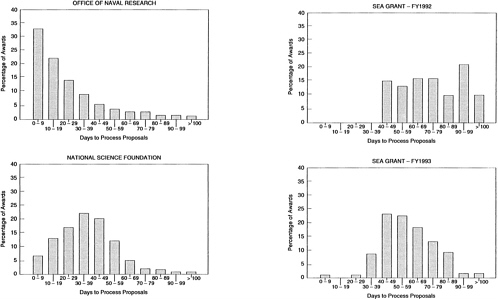
FIGURE 4 Comparison of the administrative time required to process research grants to university investigators after completion of external and internal scientific reviews, for the Office of Naval Research (FY1991), the National Science Foundation (FY 1992), and the National Sea Grant College Program (FY1992 and FY1993).
TABLE 1 Example of Proposal Preparation and Processing Time (from the Oregon Sea Grant College Program)
|
State Phase |
|
|
March 1 (year 1) ↑ 11 months ↓ February 1 (year 2) |
|
NSGO Phase |
↑ |
|
3 months ↓ May 1 (year 2) |
|
State and NSGO Phase |
↑ 3 months |
|
Proposal revisions and resubmission to NSGO; NSGO/NOAA processing Funds available to investigators |
↓ August 1 (year 2) |
the period from FY1983 to FY1993 ranged from 3.7 to 35.3%, with amajority of programs having values below 9%. During this period, seven programs were designated as official Sea Grant Colleges; all but one of these programs had received similar funding levels before official designation.
There is a perception among some individuals both within and outside the Sea Grant system that the solicitation and review process is not “open,” i.e., that certain universities do not solicit outside their campus or that individual proposals are funded on the basis of considerations other than quality and relevance of proposed work. Factors that contribute to this perception are that the solicitation and review process does not appear to be monitored, decisions do not appear to be documented, and rejections are not explained adequately. The committee was convinced, however, that strenuous efforts continue to be made by NSGO and state programs to disseminate information, about Sea Grant goals and its proposal mechanisms, very widely. This seems to be particularly true at the national level. Other extramural funding programs are much more careful about documentation of this type, and invite outside reviewers to evaluate the validity of their review process and decisions. An “oversight committee” similar to that used by NSF could readily be established to address such details.
The committee investigated the issue of perceived lack of turnover of principal investigators in two ways. First, directors were asked how they attempt to
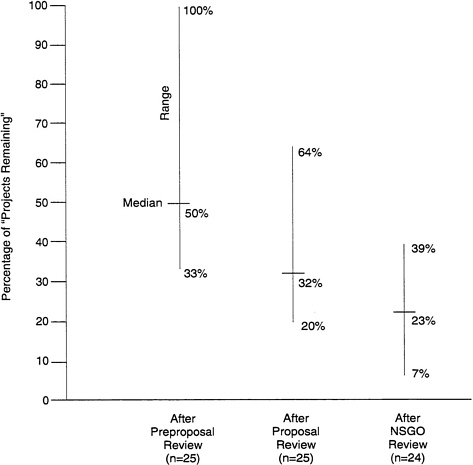
FIGURE 5 Effect of the state and federal review processes for Sea Grant preproposals and proposals
achieve openness of the proposal solicitation process and how they monitor it. Although the committee did not investigate the proposal solicitation procedures of state programs, virtually all programs stated that they attempt to maintain openness by wide distribution of proposal solicitations. For example, the largest state Sea Grant program, in California, sends out a request for proposals to 1,400 “individuals, departments, institutes, and grants offices of higher education institutions throughout the state” and, in the FY1993-94 cycle, funded research at 10 different institutions. Quantitative monitoring was reported by several states, and often took the form of an examination of the distribution of projects among educational institutions within the state and sometimes measurement of the turnover of investigators. Some programs make presentations about Sea Grant, and how to obtain Sea Grant funding, at universities around their states. Other pro-
TABLE 2 Change in the Composition of the Principal Investigator Pool over Time
|
Program |
Time Span |
% New PIsa |
Increase in Investigators |
%Net Turnover |
# of PIsb |
|
Sea Grant |
1989-1993 |
56 |
3% over 4 yr |
53 |
557 |
|
ONR |
1989-1993 |
64 |
17% over 4 yr |
47 |
612 |
|
NSF |
1988-1993 |
76 |
36% over 5 yr |
40 |
370 |
|
DOE |
1986-1991 |
33 |
0% over 5 yr |
33 |
36 |
|
aThe percentage of new principal investigators (PIs) equals the number of investigators funded at the end of the time span that were not funded four or five years earlier, divided by the total number of investigators at the end of the time span. Calculations for DOE, NSF, and ONR were determined on the basis of the pool of all principal investigators funded by each agency. Calculations for Sea Grant were carried out on a program-by-program basis and the median of all program values is reported, although it is not substantially different from the mean (58%). bNumber of principal investigators at the end of the time span. |
|||||
grams assert that they use less stringent review criteria for new investigators or for grants to universities not normally represented within their Sea Grant program.
Second, the committee gathered data from NSGO, the Department of Energy (DOE), ONR, and NSF regarding the inflow of new principal investigators over time (Table 2). These data indicate that, taking into account the percentage of new principal investigators and growth in the total number of investigators in each program, Sea Grant's net turnover is higher than that for ONR, NSF, and DOE. There was a great deal of variation in the percentage of new investigators among state Sea Grant programs, however, with the lowest value being 27% over fours years and the highest value being 78%.
The openness of competition among programs was more difficult to measure. There was a significant positive correlation (r = 0.824, p < 0.01)) between the length of time that a program has held Sea Grant College status and its level of federal funding (Figure 6). The federal allocation to state programs was not correlated to either the state population or the tenure of the director. Many of these programs received essentially the same level of federal funding, and presumably supported the same level of activities before they were awarded Sea Grant College status, so it is not clear why such a correlation exists. Because the committee did not evaluate the quality of state programs, it could not determine if the funding and quality of state programs are related. The committee recommended in Chapter 3, however, that state program performance in the three areas of research, education, and outreach be evaluated using well-publicized measurement methods, and funds be redistributed accordingly, on a four-year cycle.
Priorities of NSGO and the state programs are often different; consequently investigators who tailor their proposals to national priorities may have their ideas
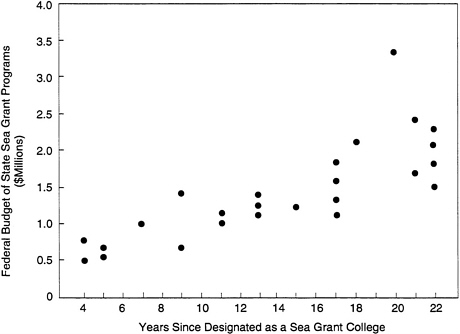
FIGURE 6 Effect of time since designated a Sea Grant College on the state program FY1993 budgets.
eliminated at the state level, and investigators who tailor their proposals to state priorities may have their proposals eliminated at the national level. Although many of the national priorities are stated vaguely enough to include many state priorities, the lack of specific advice does little to focus research dollars on either the real NSGO priorities or the state priorities. Matching funds available to state programs take some of the fiscal pressure off these programs, but this approach raises the issue of the balance of funding versus the balance of priorities. In view of the significant source of funding from nonfederal sources, state programs desire more flexibility to direct their programs toward the issues of importance to donors of the matching funds (i.e., to devote a greater portion of their funding to issues not in the national guidance document).
Finding: The Sea Grant process for reviewing research proposals and for processing grants is slow compared with other federal agencies and is not standardized at the state level. There is redundancy in proposal review between the state and national levels. The process is further complicated by being coupled to the overall program evaluation process.
ISSUE 5
INTERACTIONS WITH INDUSTRY
A central feature of the National Sea Grant College Program Act is that Sea Grant has an important role to play in fostering economic development, promoting technology transfer, and encouraging wise use of resources. Financial support from industry may fill the gap created by federal budget shortfalls but is forthcoming only if the investing company can anticipate a return on its investment, which depends, to a large degree, on the talent of the supported investigators and the availability and quality of any needed facilities. Clearly, enlisting industry financial support is within the state program purview.
State programs interact with industry on a regular basis through their MAS agents and through other means, such as problem-targeted industry advisory committees. MAS accounted for 32.4% of Sea Grant 's FY1993 budget.13 MAS agents are similar to agricultural extension agents in being responsible for promoting the development of local industries and for providing advice to companies as they grow. In fact, the MAS portions of many Sea Grant programs are housed in the local Cooperative Extension Service units. MAS agents disseminate and apply information from a variety of sources: from their own and other Sea Grant programs, from elsewhere in NOAA, and from outside sources. They also function to relay information about research and education needs from industry to other participants in their Sea Grant programs.
Present interactions between Sea Grant and industry are primarily through state programs and primarily take the form of information transfer. In general, few of the state programs apply much industry money to match their federal funds. The percentage of match contributed by industry to state programs ranged from 0 to 40%, with a mean of 4%, though the median value was 0%.14 in part, this percentage is so low because many of the businesses with which Sea Grant interacts are small and have little money to invest in research. Many state program directors also noted that they did not use industry contributions to match federal funds because of arduous NOAA grant reporting requirements and because the industry match (often in-kind contributions) is often harder to document and more likely to be disallowed. Also, all matching contributions can be audited, even above the one-third match requirement. State program directors indicated that only rarely have they funded research by commercial entities, although many programs cited a few cases of industry scientists who serve as principal investigators or co-principal investigators.
Interactions of NSGO with industry are less well developed than those at the
|
13 |
By comparison, in FY1993 research accounted for 43% of funding, education and training accounted for 8.8%, and program management and development accounted for 15.9%. |
|
14 |
These values were calculated from the 25 programs that responded with quantitative answers. |
state level, and this seems to mirror the general situation within NOAA. Priority setting by NSGO could, in fact, hinder state interactions with industry when industry and national priorities differ. NSGO is planning to establish an Industry Fellows program, modeled after its successful Knauss Marine Policy Fellows program. Although the committee was not provided with much information about this program because it is still early in the development process, the placement of recent graduates in a “real” work place for one year could serve both the company and the student if the student selection process is thorough and balanced. Apparently, this is the only direct contribution of NSGO to improving interactions with industry.
In another industry-related initiative, Sea Grant contributed $223,600 to the Small Business Innovation Research (SBIR) program in FY1994. SBIR proposals are handled for Sea Grant and other NOAA programs by the NOAA Office of Research and Technology Applications. All NOAA Line Offices and Programs that fund extramural research transfer a percentage of their extramural research budget (a minimum of 1.5% in FY1993-FY1994, 2.0% in FY1995-FY1996, and 2.5% thereafter) to this office. Programs that contribute finances also submit topic areas for inclusion in the overall DOC proposal solicitation and contribute representatives to the final selection panel that weighs peer reviews and makes award decisions. Sea Grant's SBIR contribution comes from within NSGO's administrative funding cap; its contribution will rise to approximately $512,000 in FY1995 due to the increase in percentage and a NOAA-wide change in the way the SBIR contribution is calculated, if Sea Grant receives the amount of funding requested in the FY1995 President's budget.
The 29 state programs and NSGO currently interact with marine industry through management advisory bodies, MAS, and a limited number of applied research projects. These interactions are tightly focused, limited primarily to small companies, and are not a significant source of Sea Grant program funding. Industry committees are sometimes used to evaluate the relevance of proposed research projects. State programs may use these mechanisms to determine how to target their research and outreach activities. The actual priority given to industry needs seem to vary from state to state, but the priority is difficult to judge from responses from state program directors. The mutually beneficial opportunities of university-industry cooperation envisioned by the Sea Grant program founders have not been realized.
SGRP produced a position paper (#3) on Sea Grant-industry relations that makes a number of relevant recommendations. It recommends that a policy be developed for Sea Grant-industry relations to comply with the National Sea Grant College Program Act. The policy would include guidelines for industry involvement at state and national levels and would include the development of a Sea Grant corporate relations program. SGRP also recommended that a review be undertaken, documenting existing benefits and constraints to industry involvement in Sea Grant.
SGRP, with its strong industry orientation, could play an important role in developing Sea Grant-industry partnerships. Indeed, SGRP views this as one of its primary mandates.15 It has formed a Business Initiative Committee “to play an active role in developing the SBIR and NIST relationships and continue to help develop Sea Grant in the development of coastal business.”16 The committee commends this activity but is concerned that NSGO is not playing a greater role in promoting Sea Grant-industry partnerships.
Finding: The mutually beneficial opportunities of university-industry cooperation envisioned by Sea Grant program founders have not been realized.
ISSUE 6
FUNDING
A principal finding of the NASULGC white paper on NSGCP was that Sea Grant has not received a level of support from DOC reflecting the high national priority otherwise assigned to research and development activities by both the administration and Congress. In fact, DOC, “through inefficient and inconsistent administrative procedures,” has impeded the development and operation of NSGCP and prevented the program from “making its full potential contribution to the nation. ”17
The argument has been made that NSGCP is actually a congressional program of aid to states, and this perception has been used by the previous administrations (and by the Grace Commission18) to recommend limiting or even eliminating federal funding for the program. In 1981, the administration recommended scaling back NSGCP and other NOAA extramural programs. In review, DOC recommended complete elimination, rather than scaling back, but Congress protected the program, albeit at a reduced level of funding. Congressional intervention kept NSGCP in the budget for the next eight years during which period there was an overall erosion of the program's fiscal resources and scientific capabilities.
NSGO attempts to minimize fluctuations of state program funding, and most states have experienced level funding for the past 11 years. Program percentage match has fluctuated between 40 and 47% during this period. About half of the state programs use a project-by-project match versus applying match on a pro
|
15 |
SGRP Position Paper #3. |
|
16 |
November 1993 SGRP minutes. |
|
17 |
NASULGC, op. cit., p. 7. |
|
18 |
Grace Commission. 1993. President's Private Sector Survey on Cost Control, Volume 9, pp. 143-144. |
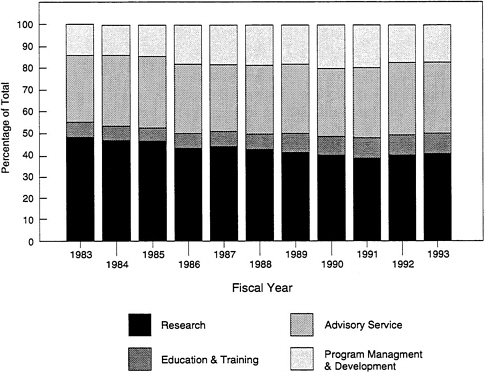
FIGURE 7 Percentage of state Sea Grant program funds allocated to research, education and training, advisory services, and program management and development, FY 1983 to FY 1993.
gram-wide basis. Even for those programs that seek match for each project, most allowed some flexibility in this requirement.
The group of state Sea Grant programs has spent an average, over the past 11 years, of 44.3% on research, 7.1% on education, 31.5 % on advisory services, and 17.0% for program management and development (Figure 7). These values have not varied much over time. Actual state Sea Grant support of educational activities is greater than 7.1% of the budget because much of the support labeled as “research” actually funds the education of graduate students involved in the research. Yet, the finding that state program administration costs are a factor of two greater than dedicated education support is an issue of considerable concern to the committee.
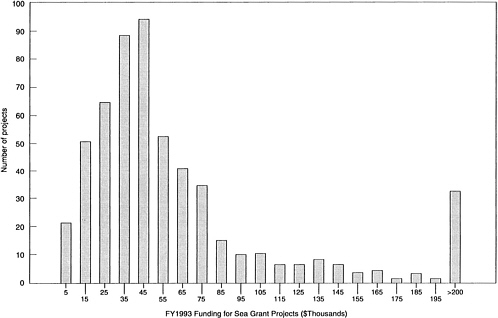
The number of projects funded, both research (Figure 8) and all projects (Figure 9), and the dollar amounts allocated to each project have remained relatively constant over the last 11 years. The real value of these grants, however,
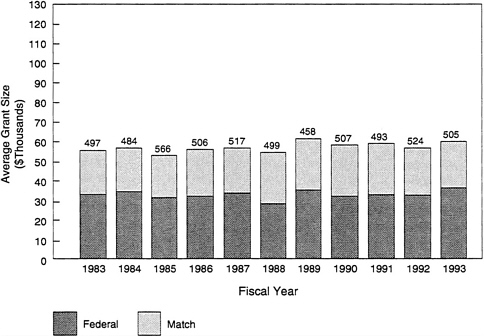
FIGURE 8 Mean Sea Grant research award size from FY 1983 to FY 1993. The number of awards is shown above the bar for each year.
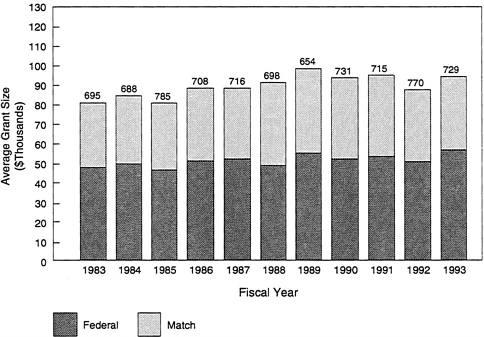
FIGURE 9 Mean size of all Sea Grant awards from FY 1983 to FY 1993, including research, education, advisory services, and administration. The number of awards is shown above the bar for each year.
has eroded by 45%19 or more over this time period due to inflation, greatly reducing the attractiveness and potential payoff of each funded project.
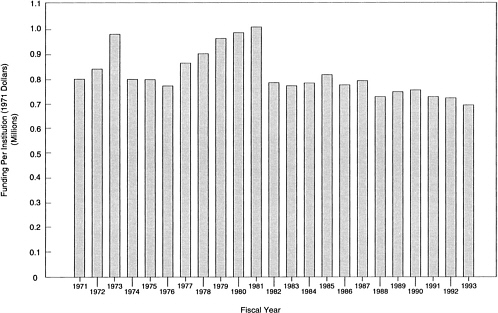
The history of funding for NSGCP shows a significant decrease in funding per institution (in 1971 dollars) since the program's incorporation into NOAA within DOC, from $780,000 in FY1971 to an FY1993 average of about $683,000 per institution (Figure 10). The average grant (in 1971 dollars) for individual research projects (federal plus match) dropped from $34,400 in FY1983 to $29,300 in FY1993. The mean award for all proposals was $93,800 in current dollars (federal plus match); the average research award was even smaller, averaging $59,700 in current dollars in FY1993 (Figure 11), much smaller than adequate for some types of research that Sea Grant funds. By comparison, the mean grant size for the NSF Ocean Sciences Division was $210,000 in FY1993.20 The committee recognizes that effective mechanisms need to be implemented to ensure that each award is adequate for the proposed task.
Almost without exception, the state Sea Grant program directors reported that the greatest cause of Sea Grant's eroded capabilities has been the combined effects of the program's level funding coupled with inflation. It must be recognized that funding levels need to be adequate to support a high caliber of research carried out by high-quality scientists and students who constitute a healthy and productive research program.
Finding: Level funding, growth in the number of participating state programs, inflation, and increased NSGO administrative costs have severely eroded the real purchasing power of NSGCP since its inception and are preventing the program from providing its full potential contribution to the nation.
|
19 |
The Consumer Price Index (CPI) rose by 45% during this period. Adjustment using the CPI provides a conservative estimate of the erosion of grants for university-based activities, given the probable increase in university overhead rates, tuition, and costs of research at a rate greater than the overall inflation rate. |
|
20 |
According to the NSGO director, 50.6% of Sea Grant funding to states is used for salaries and benefits compared to 37.9% of National Science Foundation awards. The NSGO director noted that Sea Grant may have a higher percentage of funding devoted to salaries because it funds salaries related to research proposals plus salaries related to state program administration. |