
3
Scientific and Operational Niches
What is the most appropriate astronomical use for a technology demonstration such as the ATD/NTOT? Clearly a variety of technical capabilities must be demonstrated, and they are discussed in Chapter 4. The task group also foresees a high probability that the telescope will have the capability to carry out important astronomical research. Indeed, several projects that seem to be particularly worthy are discussed in Chapter 5.
But to choose which demonstrations and research programs to emphasize, it is critical to understand those areas in which the ATD/NTOT might have significant advantages over those other facilities likely to be in operation at the end of this decade. To this end, the task group considers two aspects of the telescope: its performance at near-infrared and optical wavelengths, and its potential operational modes.
NEAR-INFRARED AND OPTICAL PERFORMANCE
Earth’s atmosphere hampers infrared observations from terrestrial observatories in several ways:
-
Broad regions of the spectrum are blocked by strong absorption from H2O in the atmosphere;
-
These absorption bands emit thermal radiation characterized by the mean temperature of the troposphere;
-
Strong emission by OH makes the sky very bright at wavelengths from about 0.7 to 2 microns; and
-
Turbulence, primarily in the tropopause, degrades a telescope’s theoretical spatial resolution by introducing rapidly varying phase errors on scales smaller than the size of the aperture of the telescope.
Moreover, a telescope’s own support structure and mirrors, which ideally are in thermal equilibrium with their surroundings, emit thermal radiation characterized by the emissivity of the mirrors and the ambient temperature (~280 K).
The top panel in Figure 3.1 shows a theoretical model of the atmosphere’s absorption-line spectrum, at wavelengths between 2 and 10 microns, above the 13,800-foot summit of Mauna Kea—one of the world’s best sites for infrared astronomy. As the figure shows, the spectral range from approximately 2.4 to 3.4 microns is blocked. As the task group argues here and in Chapter 5, this inaccessible region is especially important for cosmological observations.
The bottom panel in Figure 3.1 shows the background radiation that will be seen by the infrared-optimized, 8-meter Gemini telescope at Mauna Kea. The two most important components of this background are the thermal emission from the mirrors (assumed to have a low emissivity of 0.03) and the thermal emission and airglow from
the atmosphere. The radiation background seen by Gemini is orders of magnitude brighter than the limiting background due to thermal emission and scattered light from zodiacal dust (the lowermost curve in the bottom panel of Figure 3.1).
Infrared observations from space are limited only by a telescope’s collecting area, thermal emission, and the natural background set by zodiacal dust. Figure 3.2 shows the zodiacal background at an ecliptic latitude of 45 degrees, calculated using a standard set of assumptions.1 At wavelengths shorter than the minimum at approximately 3.8 microns, the background rises as scattering by the zodiacal dust becomes more efficient. At wavelengths longer than the minimum, the background rises due to thermal emission from optically thin zodiacal dust.
A primary goal of space infrared astronomy is to reduce the thermal emission from the telescope below the background. This reduction is readily achievable at wavelengths between 2 and 3 microns using passive cooling techniques. The natural background in this spectral region is more than five times darker than the darkest part of the optical spectrum near 0.5 micron.
Figure 3.2 shows the thermal background from the ATD/NTOT for two different operating temperatures: the baseline value of 200 K, and a scientifically more desirable temperature of 160 K (see Box 3.1, “Enhancing Infrared Performance”). The figure includes the background for the 8-meter, infrared-optimized Gemini telescope for comparison. If the ATD/NTOT operates at a temperature of 200 K, it will be background limited and therefore able to make the deepest infrared images, in the wavelength range from 2.0 to 2.4 microns, while still having substantially lower background at longer wavelengths than any other telescope.
The ATD/NTOT will be background limited in the 2.0- to 2.4-micron band only if its baseline InSb detector
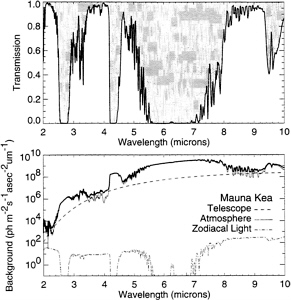
FIGURE 3.1 Upper panel: A theoretical model of the absorption-line spectrum of Earth’s atmosphere, in the spectral region 2 to 10 microns, above Mauna Kea. Lower panel: Sources of the background radiation in the 2- to 10-micron region that will be seen by the infrared-optimized, 8-meter Gemini telescope on Mauna Kea.
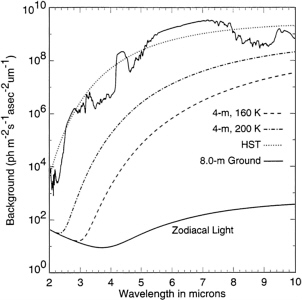
FIGURE 3.2 The zodiacal background at an ecliptic latitude of 45 degrees is compared with the thermal emission from the ATD/NTOT (assuming the effective emissivity from the 10 mirrors in the optical path to the InSb detector is 0.20) when operating at 200 K (baseline) and also at a more desirable value of 160 K (enhanced). Note that the ATD/NTOT is background limited at wavelengths up to 2.4 and 3.0 microns for the baseline and enhanced temperatures, respectively. Thermal emission from the Hubble Space Telescope and the ground-based, 8-meter, infrared-optimized Gemini telescope is included for comparison.
has sufficiently low dark current and read noise. The task group calculated the noise requirements by assuming that the bandpass of a filter at 2.2 microns is 0.4 microns and that half the 2.2-micron photons incident on the aperture are detected by the InSb array. The zodiacal background rate is then ~0.2 electrons per second per 50-milliarc-sec pixel. To be background limited, the dark current in the array must be lower than ~0.2 electrons per second per pixel. Assuming a 1000-second integration, the background shot noise will be ~14 electrons per pixel. Consequently, the rms read noise per pixel must be lower than this value to realize background-limited exposures.
|
Box 3.1 Enhancing Infrared Performance There is considerable advantage in lowering the temperature of the telescope from the baseline value of 200 K to 160 K. As Figure 3.2 indicates, the telescope is then background limited to a wavelength of 3 microns where the zodiacal background is twice as dark as at 2.4 microns. Cooling the telescope would, as indicated in Figure 3.3, result in a limiting magnitude approximately 2 magnitudes fainter over the interval from 3 to 8 microns than can be achieved in the baseline. If the telescope flies with low-noise detectors that operate at these wavelengths, every effort should be made to reach the goal of 160 K. |
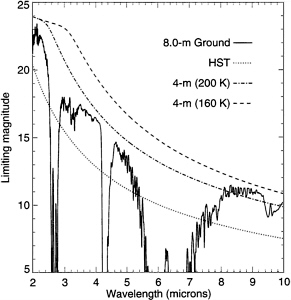
FIGURE 3.3 The limiting magnitudes of both the baseline (at 200 K) and an enhanced (at 160 K) ATD/NTOT are compared with those of the Hubble Space Telescope and the 8-meter, infrared-optimized Gemini telescope. Note the ATD/NTOT ’s advantage over the much larger Gemini telescope in the region between 2 and 3 microns. Also note that the performance of Gemini in this atmospheric window reflects the goal of 3% emissivity for that telescope.
Figure 3.3 shows the limiting magnitude for the ATD/NTOT and the Gemini telescope at wavelengths between 2 and 10 microns. The calculation assumes that the former is diffraction limited at all wavelengths and that the latter instrument uses adaptive optics to achieve a near-diffraction-limited image with a Strehl ratio of 0.5.
At a temperature of 200 K, the 4-meter ATD/NTOT has a fainter limiting magnitude at all wavelengths between 2 and 8 microns than does the 8-meter Gemini telescope. In the limited spectral windows transparent from the summit of Mauna Kea, the ATD/NTOT will see objects at least 1 magnitude fainter than the Gemini telescope. The smaller aperture wins because of the lower operating temperature.
The biggest advantage of the 4-meter telescope is its deep limiting magnitude at all wavelengths between 2 and 3 microns, where the Gemini telescope is severely limited by the strong telluric absorption centered at 2.7 microns. Because the 5- to 8-micron interval is strongly blocked from the ground, exploiting the ATD/NTOT’s performance in this region would be especially valuable, provided a suitable infrared detector was added to its instrument suite.
As described in Chapter 2, the baseline optical system yields images with a full width at half maximum (FWHM) that is considerably smaller than the FWHM of images obtained with the HST or with any other currently existing or planned facility. However, the optical quality of the primary mirror is low, a characteristic that leads to the rather poor value for the Strehl ratio and for the diameter encircling 50% of the total energy.
Many problems requiring high spatial resolution can be carried out with the baseline system. However, the limits on the image quality are dominated by the surface accuracy of the primary mirror, making it difficult to evaluate other contributors to the error budget for image quality. Furthermore, the small fraction of the energy in
|
Box 3.2 Enhancing Optical Performance With an enhanced primary mirror, the ATD/NTOT has an rms wavefront error of ~λ/10 at 0.5 micron. This corresponds to a Strehl ratio of ~0.6 and gives a point-spread function (PSF) with a full width at half maximum (FWHM) of ~30 milliarc sec (mas). Objects at cosmological distances are better observed at longer wavelengths because of redshift and K-corrections, and the zodiacal background is decreasing toward its minimum at ~3 microns (see Figure 3.3). Furthermore, the distant primitive bodies of the solar system, such as those in the Kuiper Disk, are best surveyed in the far red, where they are brighter than in the visible. The task group assumes, therefore, that the CCD in the optical framing camera (see Box 2.4, “Focal Plan Enhancements,” in Chapter 2) will be optimized for a wavelength of ~0.8 microns. At this wavelength the Strehl ratio will be ~0.8 (i.e., the telescope is nearly diffraction limited) and the PSF’s FWHM will be ~40 mas. Using these numbers and assuming that each of the silver-coated mirrors has 98% reflectivity, the task group estimates that 52% of the photons incident on the aperture are detected by the optical CCD. Table 3.1 compares the limiting magnitude attainable by the ATD/NTOT equipped with an enhanced primary mirror and an optical framing camera, and by the Hubble Space Telescope equipped with either the existing second-generation Wide Field/Planetary Camera-2 (WFPC2) or the proposed Advanced Camera (AC). The ATD/NTOT will go nearly 3 magnitudes deeper in the I-band than can the HST with the WFPC2, and will go more than a magnitude deeper than can the HST with the AC. In the assumed bandpass, the ATD/NTOT will have approximately 70% better resolution than the HST with the AC and some 3.7 times better resolution than the HST with the WFPC2 (for the more commonly used wide-field CCDs). These significant improvements would enable an attack on cosmological and cosmogonical problems that are beyond the reach of the HST. |
the central peak will lead to problems when trying to track using very faint guide stars. However, if some of the enhancements discussed in Chapter 2 are implemented, then the outlook is very much improved. Box 3.2, “Enhancing Optical Performance,” discusses this possibility in more detail.
SCIENCE OPERATIONS FOR THE ATD/NTOT
Provided that the ATD/NTOT’s demonstration of defense technologies is successfully completed, the task group has assumed that there will be a period devoted purely to astronomical tests and observations. Such science operations might last 5 years, a period commensurate with estimates from Lockheed of the probable lifetime of the ATD/NTOT based on a design lifetime of 1 year. The task group has addressed the question of how to carry out the science operations assuming this lifetime. Successful operations for a drastically shorter period might require a very different approach, but a factor-of-two change would not alter the considerations presented here.
The Science Team
How the ATD/NTOT will be operated during the astronomical phase of its mission is an important issue. During the early planning for what is now called the Hubble Space Telescope, a committee of the National Academy of Sciences met at Woods Hole to consider how the telescope would be operated.2 NASA’s vision of the HST as a Great Observatory, serving a large national and international community, had to be accommodated in the operations plan. The Woods Hole committee recommended the creation of a university-affiliated institute at which astronomers would carry out the HST’s science operations. The contract for this Space Telescope Science Institute was awarded to the Association of Universities for Research in Astronomy, and the institute was built on the Homewood Campus of Johns Hopkins University.
The task group believes that the Woods Hole principle of using astronomers for science operations is a good one and should be followed for the operation of the ATD/NTOT. However, because of the need to minimize the costs of science operations, it will not be possible to operate the 4-meter telescope as an observatory that executes a large number of programs from a community of guest observers.
Rather, the task group envisions the appointment of a principal investigator and science team that will have responsibility for executing a science program and determining the suitability and limitations of ATD/NTOT
TABLE 3.1 Limiting Magnitudes for the ATD/NTOT and the HST
|
Telescope |
Strehl Ratio |
FWHM Net (arc sec) |
DQE (%) |
Limiting I Magnitude |
|
ATD/NTOT |
0.8 |
0.040 |
50 |
29.4 |
|
HST/AC |
0.9 |
0.070 |
50 |
28.3 |
|
HST/WFPC2 |
— |
0.150 |
10 |
26.6 |
technology for the next generation of large space telescopes. The science team will be responsible for the science operations defined below. In the task group’s view, the science phase of the ATD/NTOT mission will have more in common with a small- or medium-class explorer mission than with the HST. At the outset of the program, somebody must oversee definition of science policies and goals and selection of the science team.
NOTE: Comparison between the full width at half maximum (FWHM), detective quantum efficiency (DQE), and estimated limiting magnitudes of the ATD/NTOT equipped with both an enhanced primary mirror and an optical framing camera and the Hubble Space Telescope (HST) equipped with either the second-generation Wide Field/Planetary Camera (WFPC2) or the proposed Advanced Camera (AC). The calculated values assume a 2400-second exposure through an HST F814W filter; the sky background is 22.7 V magnitudes per square arc sec; and the limiting magnitude is the I magnitude of a star, of effective temperature 4700 K, which has a signal-to-noise ratio of 10 through an aperture that encircles half the light.
The scientists on the mission team will have two responsibilities: (1) adequate definition of the optical assembly so that it is capable of carrying out the astronomical technology demonstrations (see Chapter 4) and does not compromise the astronomical observations, and (2) definition of a science program to be performed after the technology demonstration. This latter task includes consideration of appropriate filters and advice on detectors and optical coatings.
The import of these decisions for the success of the science mission necessitates the inclusion of at least an advisory group of scientists early in the planning of the mission, before design constraints are frozen. It is understood that NASA and the space science community are not the primary customers of this mission but are included as partners to the extent that changes do not add unduly to the cost or change the capabilities of the ATD/NTOT’s demonstrations of technology for DOD.
The composition of the science team should not be static. Rather, it should change as the mission evolves from one phase to the next. At the outset, particularly in the planning phases, the team should consist of astronomers with expertise in the design of large telescopes. The task group emphasizes that the astronomical community has developed considerable experience in the design and building of large astronomical instruments. Astronomers who have been involved with such projects should be included on the team. Additionally, it is essential to select a team of astronomers early in the mission on the basis of proposed scientific activities, so that scientific goals can be kept in mind during the design phase.
The astronomers responsible for design oversight and devising initial science programs would also be responsible for formulating and conducting the technology demonstrations outlined in Chapter 4, as well as for defining what calibrations are necessary for the instruments and the needed calibration interval. The initial team would start the science projects, including overseeing the sequencing of the observations and the verification of science quality.
If the demonstrations of the astronomical technology are successful and if the ATD/NTOT survives beyond its 1-year design lifetime, as is expected, the task group recommends that NASA select additional members of the science team at approximately yearly intervals to ensure that the mission is always pursuing current, important astronomical questions. It is probable that these new members would replace some of the existing team. It is recommended that sufficient overlap of team members be employed so that efficiency of the sequencing is maintained.
The task group also suggests that the Clementine model be followed with respect to data rights. In other
words, there should be a short proprietary period while the science team prepares data for archiving and for dissemination to the science community in a timely manner.
Science and Spacecraft Operations
The task group sees a natural division between what it refers to as science operations (defined below) and operation of the ATD/NTOT spacecraft, telescope, and instruments. During the initial DOD phase of the mission, the latter operations will be done by a command center under contract to the DOD. The task group assumes that this command center will continue to operate the telescope and science instruments during the subsequent science phase.
Based on its experience with comparable military spacecraft, Lockheed estimates that the ATD/NTOT command center will require a staff of 46 people during the astronomy phase. For comparison, the Clementine operations staff had 51 full-time equivalents (FTEs) (excluding 11 FTEs devoted to mission science planning and scheduling) and 15 part-time FTEs.3 The HST command center at NASA’s Goddard Space Flight Center is staffed by several hundred FTEs. But since the HST is a long-duration mission, many of the FTEs allocated to it are responsible for planning instrumental and software upgrades and preparing for future servicing missions, activities that have no counterparts in a short-duration mission such as the ATD/NTOT.
The first task of the science team is to plan a detailed science program. The program must then be turned into a detailed schedule that can be used by the operations center to produce command loads for the spacecraft and telescope. As the program is executed, considerable bookkeeping must be done to verify that all or part of the observations have been made. Calibration targets must be selected and observed, and the calibration data must be inserted into a data pipeline in an appropriate format. The observations of science targets must be calibrated by going through a data-reduction pipeline and must be distributed to members of the science team and archived for public access. The sum of these tasks—the science operation—are the responsibility of the science team.
Cost of Science Operations
Although it proposes that a principal-investigator-led science team be responsible for science operations, the task group has estimated the cost of science operations based on experience at the Space Telescope Science Institute (STScI), as projected for the ATD/NTOT mission. The factors it has identified as strong cost drivers are ordered below by approximate impact on operations; factors with the largest impact are listed first.
-
The number of observers served. There is a huge difference in the cost to support a guest observer program versus one with a few knowledgeable co-investigators. A large number of guest observers increases initial costs and greatly increases recurring costs.
-
The number of distinct science programs carried out. There is a substantial overhead cost for planning each program, generally requiring interaction between the operations staff and the observers. Many small programs require more work than a few large ones.
-
The number of scientific instruments and their complexity. There is a large potential cost to document, schedule, command, and analyze data from complex instruments with many different features and operating modes. This factor affects both initial costs and ongoing operations costs.
-
The number of different detectors and calibration flows. These drive the costs of calibration and calibration software.
-
Requirements to observe targets of opportunity. Control centers are most efficient if they can plan well in advance and operate primarily on a one-shift basis. Requiring responses to targets of opportunity drives the techniques for commanding the spacecraft and thereby adds to the cost.
-
Requirements to observe moving targets. Observing moving targets requires extra software for scheduling and computing the positions of objects. For planning observations of moving targets, the interface between the project and the astronomer should be set up so that most of this additional effort could be borne by the astronomer,
-
who would be highly motivated to carry it out in the most efficient manner. If not approached in this or a similar manner, a requirement to observe moving targets could become a prime area for unplanned cost growth.
-
The fraction of data collected per orbit that can be stored on-board. If there is sufficient capacity to store data on-board, the scheduling process can ignore data volume, leaving schedules for data downlinks to the control center. If there is insufficient on-board storage capacity, the scheduling process must consider data rates and data volume while scheduling, driving up both the initial and recurring costs.
-
Scheduling constraints. The following constraints have approximately equal impact: the type of orbit; Sun, Earth, and Moon viewing constraints; requirements for time critical observations; and constraints on spacecraft roll angles. The complexity of the constraints drives the initial costs for the scheduling system: the more complex and constrained the actual observing programs, the longer the staff needed to do the scheduling.
-
The complexity of planning for guide-star acquisitions. Selecting guide stars is generally automated, and so it drives the initial costs of the ground system but is a minor driver of recurring costs.
Although the task group thinks that many of the cost drivers such as observing targets of opportunity and observing moving targets are scientifically desirable, it makes the following assumptions in order to estimate a lower limit to the cost of science operations:
-
The telescope will be in a 12-hour Molniya orbit;
-
The telescope will acquire guide stars autonomously;
-
Sun, Earth, and Moon constraints will be comparable to those of the HST;
-
There will be minimal support for time-critical observations, observing targets of opportunity, or observing moving targets;
-
The telescope will have sufficient on-board memory to store the data from two orbits; and
-
There will not be a guest observer community.
Any of the above assumptions can be relaxed, but doing so will increase the cost of science operations. For example, if the telescope is in low Earth orbit and operated with HST capability and a large guest observer community, the cost of science operations will be a significant fraction of the cost of HST science operations.
For the purposes of evaluating the likely costs of supporting such a mission, the task group has used estimates from the STScI. While other approaches to supporting the mission could conceivably be used, drawing on the substantial investment in support activities at the STScI would allow substantial savings in cases where to do otherwise would be to “reinvent the wheel.” In addition, some services could be provided quite effectively at marginal cost (as is normally done, for example, with archives where the substantial investment by NASA in hardware and software is utilized for a number of programs).
The task group estimates that the task of planning the science program will require the equivalent of one full-time astronomer. It assumes that the schedule of science observations will be created with the software developed at the STScI to schedule the HST, namely, the artificial intelligence system called “Spike.” Spike is being used to schedule NASA’s Extreme Ultraviolet Explorer and Japan’s Advanced Satellite for Cosmology and Astrophysics and is being considered for NASA’s X-Ray Timing Explorer and Far Ultraviolet Spectroscopic Explorer. Thus it is a system with demonstrated utility for smaller science missions.
Using Spike, two or three people could schedule the ATD/NTOT’s scientific observations. The precise number will be determined by the requirements of the spacecraft and telescope control center. Based on information supplied by the STScI, the task group estimates that Spike could likely be converted to the scheduling specifics of the 4-meter telescope for about $100,000. The exact amount will depend on the mission parameters of the spacecraft.
The analysis here is based on the assumption that the science team will contract with the STScI for the use of its existing data pipeline. The present HST pipeline handles images from four 800 × 800 CCDs. By 1997 the pipeline will calibrate images from the Space Telescope Imaging Spectrograph’s (STIS) 1024 × 1024 CCDs, and infrared images from the 256 × 256 HgCdTe arrays of the Near Infrared Camera and Multi-Object Spectrograph (NICMOS).
The pipeline could be modified to accommodate optical and infrared images from the ATD/NTOT for a cost
TABLE 3.2 Estimated Annual Costs in Full-Time Equivalents (FTEs) for BMDO 4-meter ATD/NTOT Science Operations
|
Science Team |
|||
|
Task |
Optical |
Infrared |
Total FTEs |
|
Planning the observing program |
0.5 |
0.5 |
1.0 |
|
Scheduling the scientific observations |
1.5 |
1.5 |
3.0 |
|
Monitoring data quality and calibrations |
2.0 |
2.0 |
4.0 |
|
Using Space Telescope Science Institute pipeline for data reduction |
0.5 |
0.5 |
1.0 |
|
Total Science Operations |
9.0 |
of approximately $200,000. Approximately two people for each of the two instruments (infrared and optical) would be needed at the STScI to monitor science data quality, plan calibration observations, reduce the calibration observations, produce the calibration files, and deliver the reduced data to the science teams. These four astronomers could either be members of the science team or STScI staff working under contract to the science team. The cost of contracting to use the STScI modified pipeline are estimated to be one FTE per year.
The cost of modifying the STScI data archive to accept ATD/NTOT images would be approximately $100,000. There would be a relatively small operational charge for optical disks, scaled by the volume of data collected by the telescope. The four calibration scientists would be responsible for delivering the data to the archive and ensuring that the data were archived correctly. The estimated costs in FTEs for science operations are summarized in Table 3.2.
The annual estimated effort for science operations is 9 FTEs. This estimate can be compared to the 11 FTEs in the Clementine mission devoted to mission science planning and scheduling. For comparison, the STScI schedules some 300 guest observer (and Investigation Definition Team) proposals a year on the HST’s four multimode science instruments. Approximately 50 FTEs are required to process and schedule the proposals, and another 10 FTEs are needed to maintain the processing and scheduling software. Approximately 12 people are required to process the data through the data-reduction pipeline and put the data into the data archive. These numbers do not include the approximately 20 FTEs required to support the instruments and instrument calibrations, nor the science data aides who support visiting astronomers at the STScI.
In summary, the task group estimates that 9 FTEs will be needed for ATD/NTOT science operations. The one-time cost for software conversion is approximately $400,000. It has not estimated the cost of writing or modifying software for data analysis, or the cost of supporting the science team for analysis of the science data.
In the task group’s opinion, these estimates of the costs of science operations are a lower limit to the operations cost. Experience shows that unanticipated problems will increase costs. Additional scientific requirements will also increase costs.
SUMMARY
The preceding sections suggest some clear directions for astronomical use of the ATD/NTOT beyond the demonstrations of technological capability. Large surveys are an appropriate use of the ATD/NTOT because they can be carried out at minimal operational cost. Furthermore, surveys make repeated use of a single mode and require only a small team of scientists. Such observations are not an optimal use of major facilities such as the HST, whose high versatility and complex instrumentation can support a wide community of users with diverse needs. In the context of surveys with the ATD/NTOT, which will necessarily sample the sky sparsely, guest observers could, perhaps, be accommodated to the extent that they want observations of the same general type as are being made for the surveys but that are pointed at other parts of the sky to view particular targets. Adding to
the survey a target list that requires no extra calibrations, provided the observations are not time critical, adds minimal extra cost to the operations.
Emphasis should be given to programs for which access to space significantly reduces the sky background for observations and to programs for which either high spatial resolution or large collecting area is important. The ATD/NTOT thus has a major advantage over other facilities for the following kinds of programs:
-
Programs in the near infrared (2 to 4 microns), where the difference in the sky background is reduced by several orders of magnitude (largely through reduction of H2O and other tropospheric species);
-
Programs in the far red (>0.7 micron), where the sky is reduced by up to one order of magnitude (OH emission); and
-
Programs that depend on the contrast between a point source and its neighborhood (either the sky background or its own astronomical environment) or that require subarc-second spatial resolution to reach interesting spatial scales or that are photon-starved, that is, receive little attention with the HST.
REFERENCES
1. Thompson, R.I., “NICMOS: A Second Generation Infrared Instrument for the Hubble Space Telescope”, Advances in Space Research 13(12):509-519, 1993.
2. Space Science Board, National Research Council, Institutional Arrangements for the Space Telescope, National Academy of Sciences, Washington, D.C., 1976. Also see, Space Science Board, Institutional Arrangements for the Space Telescope: A Mid-Term Review , National Academy Press, Washington, D.C., 1985.
3. Space Studies Board, National Research Council, Lessons Learned from the Clementine Mission, National Academy Press, Washington, D.C., in preparation.


