
1
Why Europa?
Europa — one of the four large satellites of Jupiter discovered by Galileo Galilei in 1610 (Figures 1.1 and 1.2) — is among the most intriguing objects in the solar system (Box 1.1). In large part, this interest stems from the possibility that Europa may have substantial amounts of liquid water, possibly as a global-scale ocean buried beneath a surface layer of ice,1,2 with liquid water being one of the primary requirements for the origin or continued existence of life as we can imagine it. The interest in Europa extends beyond the scientific community, and the idea that a europan ocean might harbor life has become a part of popular culture. This is exemplified by Arthur C. Clarke's science-fiction novel, 2010: Odyssey II,3 in which life-harboring Europa is declared off-limits to humans with a mysterious, preemptive warning — "All these world are yours except Europa, attempt no landings there."
Scientific and public interest has intensified as the Galileo spacecraft has revealed remarkable indications of geologically recent or ongoing activity in Europa's atmosphere, on its surface, and within its interior. There is abundant evidence on its icy surface for relatively recent geologic activity, including resurfacing with fresh ice and tectonic movement of the ice. Above the surface is an atmosphere produced mainly by the bombardment of the icy surface by energetic particles interacting with the jovian magnetospheric environment. The average density of Europa suggests that the interior, although not sampled or observed directly, is composed predominantly of a rocky material similar to that of Io or the Moon and has a dense core at its center. The outermost 100 to 200 km, however, consists of a layer composed predominantly of water. Evidence for fairly recent geologic activity at the surface suggests that the combined heating produced by the decay of radiogenic isotopes, tidal flexing associated with its orbit around Jupiter, and resonant interactions with neighboring satellites is substantial.4
What makes Europa of special interest, however, is the potential that it may hold for the presence of liquid water within this surface layer and the associated possibility of life. Internal heating may be sufficient to raise temperatures to the melting point of water ice at only a modest depth of a few to tens of kilometers. Consequently, Europa may contain a global ocean of liquid water more than 100 km thick and covered by only a thin layer of water ice. The presence of liquid water is suggested by Galileo images showing blocks of ice, some of which are several kilometers across, that appear to have "rafted" away from a larger mass, possibly on a liquid-water or slushy-ice layer that subsequently froze. Moreover, Europa's relatively crater-free surface suggests that the rafting occurred in the recent geologic past (i.e., within the last few millions to tens of millions of years).
The possible presence of liquid water, combined with the presumed availability of geochemical energy within its interior, creates the potential for life to have originated on Europa and perhaps even to exist today within a

FIGURE 1.1 The heliocentric system of Copernicus, depicted in this mid-17th-century copper-plate engraving, included the recently discovered moons of Jupiter. Galileo's "Medicean stars" encircling Jupiter are today called the Galilean satellites, Io, Europa, Ganymede, and Callisto. (From Atlas Coelestis seu Harmonia Macrocosmica of Andreas Cellarius, 1660-1661 edition, Amsterdam; 25" × 28 5/8". Courtesy of the Mendillo Collection.)
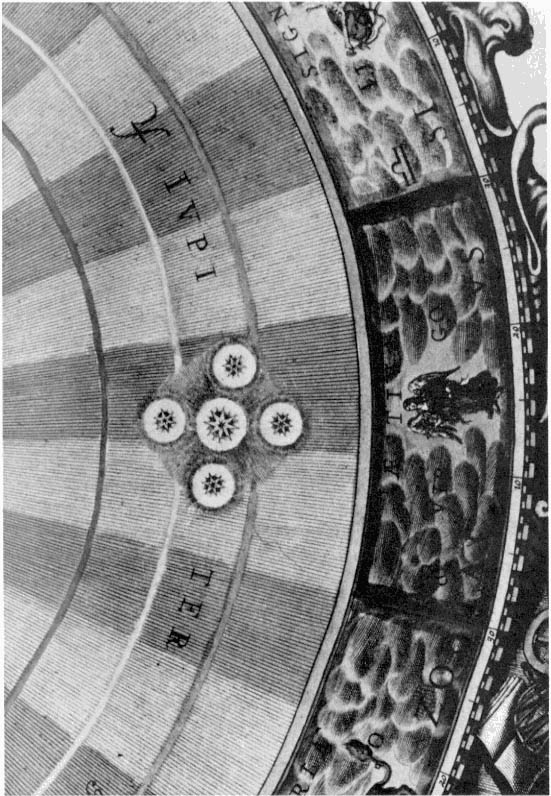
FIGURE 1.2 facing page Detail from the Planisphaerium Copernicanum copper plate in a mid-17th-century celestial atlas summarizing the state of astronomy. In this elegant depiction of the heliocentric theory, Galileo's discovery (1610) shows Jupiter orbiting the Sun to be itself "a center of motion" The four Galilean moons are shown as star-like objects, equidistant from Jupiter. It would be 300 years before these "Medicean stars" would be shown to be the individual worlds of Io, Europa, Ganymede, and Callisto. (From Atlas Coelestis seu Harmonia Macrocosmica of Andreas Cellarius, 1660-1661 edition, Amsterdam. Courtesy of the Mendillo Collection.)
|
Box 1.1 Europa was discovered by Galileo in 1610, along with the three other large satellites of Jupiter — lo, Ganymede, and Callisto. The four are now collectively called the Galilean satellites. Europa travels around Jupiter at an orbital distance of about 9.5 times the radius of Jupiter (9.5 RJ, or 670,900 km), which puts it deep within the strong jovian magnetic field and its associated radiation belts. With a radius of 1565 kilometers, Europa is 90% the radius of Earth's Moon. Its surface gravity is only some 13% that of Earth, and it has an escape velocity of about 2 km/s. Europa's surface is highly reflective, and characteristic absorptions at certain wavelengths in the reflected sunlight, measured using ground-based telescopes beginning in the 1950s, indicate the presence of water ice. However, the mean density of Europa, about 3000 kg m-3, is substantially higher than that of ice (about 1000 kg m-3) and is lower than that of rock (about 3400 kg m-3, including the compression that occurs deep inside Europa's interior), implying that Europa consists of a mixture of water and rocky material.* The Voyager spacecraft showed the surface to be relatively free of impact craters, suggesting that Europa's surface is younger than the surfaces of Ganymede and Callisto. In addition, Voyager data revealed that ice tectonics shapes Europa's surface geology and raised the possibility that liquid water might exist beneath its icy surface. In 1994, observations made by the Hubble Space Telescope revealed the presence of a tenuous oxygen-bearing atmosphere, probably formed as a result of the impact of energetic particles trapped by Jupiter's magnetic field onto the icy surface. Since 1995 when the Galileo spacecraft began its mission in the jovian system, significant new discoveries about the properties of Europa's interior, surface, and atmosphere have been made. Galileo's images revealed the existence of ice blocks on the surface that appear to have drifted like icebergs from their original positions. Moreover, Galileo's magnetic and gravitational measurements provided additional indications, but not conclusive proof, of the likely presence of liquid water beneath a relatively thin layer of surface ice.** While the results from telescopic observations, theoretical studies, and data from Voyager indicated that Europa was a fascinating body for additional study, it was the results from Galileo that raised the serious possibility that Europa is a potential abode of life. |
subsurface ocean.5 Although multiple forms of metabolism are possible, it is likely that europan life forms, should they exist, would probably utilize chemical energy rather than photosynthesis to support metabolism. Thus, they might resemble terrestrial organisms found in environments that are considered hostile by human standards, such as hot springs and deep-sea thermal vents; these terrestrial organisms are often called "extremophiles." Certainly, a search for evidence of a liquid ocean and for the extent to which either prebiotic chemical activity or biological activity has progressed on Europa is warranted based on the currently available data, and the information obtained from such a search may help us to understand the chemical, prebiological, and biological evolution of our solar system.
In addition to the search for liquid water and the potential for the existence of either present or past life, the occurrence of relatively recent geologic processes on Europa makes it an appropriate and high-priority target for detailed exploration. Evidence for resurfacing and ice tectonics, dynamic interactions between the surface,
atmosphere, and magnetosphere, and the possible presence of liquid water (even without life) make Europa a fascinating object and a suitable place to examine chemical and physical processes that may have preceded the emergence of living organisms.6 These characteristics cause Europa to stand out as being important to understanding the jovian system and, in fact, the solar system as a whole, and to require further exploration after the completion of the Galileo mission. Indeed, NASA's current strategy for solar system exploration calls for the launch of the Europa Orbiter mission in the early part of the next decade (see Box 1.2). And such a mission received a new start as part of the ''origins" initiative in the agency's FY 1998 budget. Since NASA has not yet selected an instrument complement for this spacecraft, it is not possible at this time for COMPLEX to comment on the degree to which NASA's proposed mission will address the scientific goals outlined in the remainder of this report.
|
Box 1.2 As part of its Outer Planets/Solar-Probe project, NASA has begun development of the Europa Orbiter mission. The spacecraft, tentatively scheduled for launch in 2003, is correctly under development. The Europa Orbiter Science Definition Team has already released its recommendations regarding the mission's scientific objectives and suggested instruments that can achieve these objectives.* According to the Science Definition Team, the primary science objectives of the Europa Orbiter should be the following:
The Science Definition Team's secondary science objectives are the following:
The Science Definition Team suggested a set of observations that would likely satisfy the primary scientific objectives of the Europa Orbiter mission. These measurements included the following:
|
The Science Definition Team suggested that the radar and Doppler tracking experiments should be facility instruments (i.e., provided by the mission) and that the others be selected through open competition. NASA issued a single Announcement of Opportunity in September 1999, soliciting scientific investigations for the Europa Orbiter, Pluto/Kuiper Express, and Solar Probe missions. According to current plans, the Europa Orbiter would have a total mass of some 900 kg, including 20 kg of scientific payload and more than 500 kg of fuel for its orbital maneuvering engine. The spacecraft would be powered by a new-generation, radioisotope power source. The Europa Orbiter is tentatively scheduled for launch aboard the space shuttle in November 2003 and will follow a direct trajectory to Jupiter. Following entry into orbit about Jupiter in February 2007, the mission will follow three distinct operational phases. The Science Definition Team dubbed these the satellite tour, the end game, and the Europa orbit. These phases encompass the following activities:
|
REFERENCES
1. S.W. Squyres, R.T. Reynolds, P.M., Cassen, and S.J. Peale, "Liquid Water and Active Resurfacing on Europa," Nature 301: 225, 1983.
2. R.T. Pappalardo et al., "Does Europa Have a Subsurface Ocean? Evaluation of the Geological Evidence," Journal of Geological Research — Planets, 1999, in press.
3. A.C. Clarke, 2010: Odyssey II, Balantine Books, New York, 1982.
4. For a review of current understanding of Europa and the other galilean satellites, see, for example, A.P. Showman and R. Malhotra, "The Galilean Satellites," Science 286: 77, 1999.
5. Space Studies Board, National Research Council, An Integrated Strategy for the Planetary Sciences: 1995-2010, National Academy Press, Washington, D.C., 1994, page 60.
6. Space Studies Board, National Research Council, An Integrated Strategy for the Planetary Sciences: 1995-2010, National Academy Press, Washington, D.C., 1994, page 61.


