
Suggested Citation:"The Northeast Ohio Experience." National Research Council. 1999. Harnessing Science and Technology for America's Economic Future: National and Regional Priorities. Washington, DC: The National Academies Press. doi: 10.17226/9456.
×
The Northeast Ohio Experience
Dorothy Baunach
Cleveland Tomorrow
Today's Presentation
- Give an overview of Northeast Ohio.
- Describe our technology infrastructure and model.
- Share lessons learned.
Northeast Ohio Overview
- Eight-county region with two major urban areas, Cleveland and Akron
- Almost 3 million people (fourteenth largest consumer area in the United States)
- Twenty-three percent of jobs are in manufacturing
- About half as high-tech as San Francisco or Boston
- High-school educated region
- High-poverty region, 11.8 percent
|
|
|
Northeast Ohio's Technology Infrastructure
- Years of experience (making it up as we go along)
- But the key has been a comprehensive partnership with industry; academic and research organizations; state, federal and local governments; and foundations.
- All partners are organized and managed to harness technology for economic benefit.
Suggested Citation:"The Northeast Ohio Experience." National Research Council. 1999. Harnessing Science and Technology for America's Economic Future: National and Regional Priorities. Washington, DC: The National Academies Press. doi: 10.17226/9456.
×
Targeted R&D/Industry Clusters
- Automotive—large employment base, losing inventive edge.
- Aerospace—anchored by NASA Lewis Research Center.
- Biomedical—eighteenth largest city for receipt of National Institutes of Health (NIH) funding.
- Polymers/advanced materials—ranks in top five U.S. regions for industry and research and development (R&D).
- Information/telecommunications—impacts all other segments.
|
|
|
Our Strategy
- Increase the competitiveness of businesses in key sectors of the economy.
- Form, incubate, and retain new businesses.
- Support research collaborations and tech transfer.
- Develop the workforce—general, highly skilled, entrepreneurial.
- Figure B-1.
Our Vehicle Enhanced: A Complementary Set of Financial Tools
- Primus Venture Partners ($350 million venture capital fund)
- Cleveland Development Partnership ($60 million real estate development fund)
- Ohio Innovation Fund ($11 million in seed capital)
- Figure B-2.
Economic Impact
This has been difficult to track and measure. Anecdotes abound and a few accomplishments are worthy of note:
- Manufacturing employment has stabilized and CAMP's (Cleveland Advanced Manufacturing Program) GLMTC (Great Lakes Manufacturing Technology Center) has reached annual fees of $5 million from industrial projects.
- Industrial research consortia and networks have formed around several key technologies.
- Incubator tenants have returned state investment in payroll taxes.
- Biomedical research base has tripled and company formation is improving.
- Companies started during the past 15 years are making real contributions to the economy (STERIS Corp. is an example).
Suggested Citation:"The Northeast Ohio Experience." National Research Council. 1999. Harnessing Science and Technology for America's Economic Future: National and Regional Priorities. Washington, DC: The National Academies Press. doi: 10.17226/9456.
×
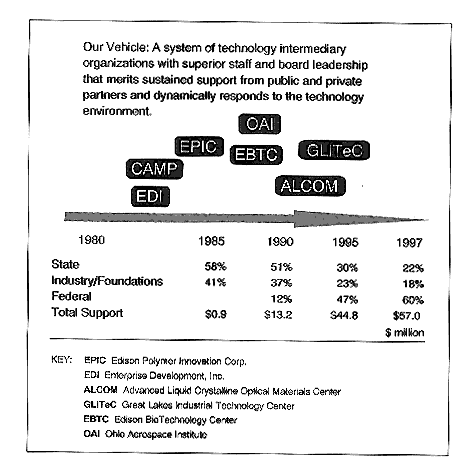
Figure B-1
Northeast Ohio technology intermediaries and funding trends
Technology Leadership Council Lessons Learned
- Leadership matters.
- Public/private partnerships work.
- It's really hard to maintain long-term commitments.
- Partners and programs need to innovate as region learns/changes over time.
- Federal funds are critical to regional science and technology strategies.
- Toughest support to find is for early stage, technology-based business formation.
Suggested Citation:"The Northeast Ohio Experience." National Research Council. 1999. Harnessing Science and Technology for America's Economic Future: National and Regional Priorities. Washington, DC: The National Academies Press. doi: 10.17226/9456.
×
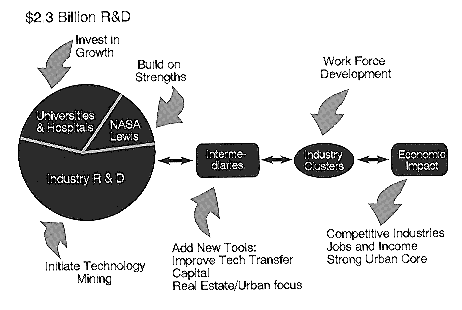
Figure B-2
Technology Leadership Council Model
Examples of Federal Government Role in Technology-Based Economic Development, Northeast Ohio
- Research grants—National Science Foundation (NSF), NIH, National Aeronautics and Space Administration (NASA), Department of Defense (DoD), etc.
- Small Business Innovation Research grants
- National Institute of Standards and Technology—Manufacturing Technology Center funding; Advanced Technology Program
- NSF Science and Technology Center
- EDA (Economic Development Administration) grant for urban Bio-Enterprise incubator
- NASA—RTTC (Regional Technology Transfer Center), incubator, education grants
- DoD ECRC (Electronic Commerce Resource Centers) funding
Suggested Citation:"The Northeast Ohio Experience." National Research Council. 1999. Harnessing Science and Technology for America's Economic Future: National and Regional Priorities. Washington, DC: The National Academies Press. doi: 10.17226/9456.
×
Technology Leadership Council, an Executive Network
- Enhance the model by identifying and implementing select initiatives.
- Facilitate activities among intermediaries to remove barriers, build linkages, and garner support.
- Communicate and advocate the importance of technology to regional economic growth.
- Target technology investments to build on regional strengths and focus on economic development returns.
Suggested Citation:"The Northeast Ohio Experience." National Research Council. 1999. Harnessing Science and Technology for America's Economic Future: National and Regional Priorities. Washington, DC: The National Academies Press. doi: 10.17226/9456.
×
| This page in the original is blank. |


