
3
Process for Performing Risk Assessment
In addition to asking the committee to make recommendations on appropriate uses of risk assessment in the Department of Energy remediation process, Assistant Secretary Grumbly asked us to consider institutional and procedural mechanisms that DOE might adopt for implementing the recommendations.
The presentations and discussions at the workshop continually noted the importance of including considerations other than quantitative ones in risk assessment and risk management. Moreover, it was noted that the overall decision-making process associated with DOE's remediation efforts—which takes into account risk management considerations-but goes beyond them, should include the consideration of other factors such as the economic effect of different remediation options on the local community. The need for effective public participation and communication with all the stakeholders in each of these processes was emphasized.
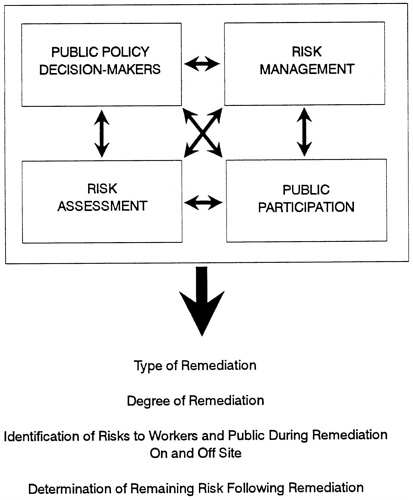
These comments of the workshop were often directed specifically to risk assessment, risk management, overall decision-making, and public participation. The committee notes that the four processes of risk assessment, risk management, overall decision-making, and public participation occur simultaneously and com-
monly interact with one another (see Figure 3-1). Each requires information from the others, and each needs to provide information to the others. Indeed, it can sometimes be difficult to distinguish the boundaries between them.
Therefore, even though the committee focused its deliberations on risk assessment, we include the other processes in our recommendations because they are essential to the implementation of an effective environmental remediation program based on risk assessment. We have not attempted to address each of the other processes comprehensively, and we certainly would not claim that our recommendations fully address the improvements that could be made in the process as a whole. However, we have gone in some depth throughout this section into how public participation should fit into the decision-making and risk assessment process to achieve the objectives described below.
OBJECTIVES
To be most effective and useful, the procedures and institutions adopted for risk assessment should satisfy several objectives.
First, they must be credible to the stakeholders and the general public. Credibility is best established if the process is open, invites participation from all stakeholders, does not incorporate real or perceived conflicts of interest, and is scientifically rigorous with independent peer review.
Second, they must operate expeditiously without threatening scientific validity. A process that appears to produce little but delay will soon lose relevance, credibility, and support. The main purpose of DOE's environmental-remediation program is to reduce risks, not to conduct studies.
Third, they should consider the full range of risks of concern to the stakeholders in the light of social, religious, historical, political, land-use, and cultural values and needs. Such wide-ranging consideration can help the process of risk assessment become an
integral part of the consensus-building effort that is essential to successful remediation.
Fourth, they should be efficient and cost-effective and produce results that contribute to identification of remedies and priorities that are themselves efficient and cost-effective. The meanings of these two terms are not always the same for all stakeholders, and it would help if agreed on the definition of these terms before remediation.
One of the goals should be reduction of human and environmental risks to acceptable levels as determined by the stakeholders involved and members of the public at large, who are paying for the remediation. Obviously, all relevant regulatory standards and guidelines must be observed. Thus, it should not be forgotten that stakeholders include not only the public, but federal and state regulators.
The first and probably most important step in effective risk assessment and risk management is to establish public participation that involves all the stakeholders.
Figure 3-2 depicts a general sequence of events in the decision-making process for remediation. Risk assessments are used for varied management purposes, including the urgent reduction of risk, the decision on the type and degree of remediation to pursue, the prediction of risks to be encountered by workers and the public during the remediation process, and prediction of the risk that will remain when remediation is completed. The committee believes that each risk assessment should be tailored to the facility in question. Therefore, it is important to note that the general model for risk assessment within the remediation decision-making process shown in Figure 3-2 is not the only one that can be envisioned, but is an illustration of a process that the committee believes is workable. DOE should be prepared to modify the processes depicted in Figures 3-1 and 3-2 on the basis of the needs of specific facilities and the concerns of the stakeholders for those facilities.
Figure 3-2
Suggested Procedures for Performing Risk Assessments at DOE Remediation Sites
|
Step |
Action |
Activities |
|
1 |
Stakeholder Identification |
Identify stakeholders in the risk assessment process (e.g., local residents; federal, state, and local citizen groups; federal, state, and local environmental groups; native american governments and associations; workers, unions, industry, and other economic interests; federal, state, and local environmental, safety, and nuclear regulatory agencies; local, county, and state government; universities and research groups; technical advisors and reviewers) |
|
2 |
Scoping |
Identification of: Potential human and nonhuman targets Potential adverse consequences (e.g., cancer, non-cancer, ecological) General risk assessment methods Perspectives and values of stakeholders (e.g., historical, aesthetic, religious, and cultural) High-risk groups |
|
Community specific scenarios (e.g., dietary practices) Non-traditional routes of exposure (due to local customs, culture, and population) Monitoring needs relevant to specific exposure concerns Information needs and data quality objectives Coordinate: Regulatory requirements and timetables Consider: Possible future land uses Possible exposure during that use Conduct: Preliminary data-gathering, e..g, --historical records on occurrence and patterns of disease and population activities --anecdotal data from public on health and environmental impacts of concern due to exposure --particular ecological impacts of concern) |
||
|
3 |
Scoping Review |
Review of scoping by external national advisory panel of scientific experts |
|
4 |
Work Plans |
Establish items to be addressed in risk assessment Identify contaminants, pathways of exposure, and end points of concern to stakeholders Specify methods to be used in assessing exposures and risks |
|
Identify research needs relative to data gaps and methodological needs Identify kinds of monitoring needed to improve risk assessment Outline timetable for assessment and remediation activities Determine mechanisms and timing of public participation Indicate how results of risk assessment and remediation activities will be provided to public Determine mechanisms to provide technical and scientific assistance to public Develop list of options for site remediation and future land use Indicate how stakeholder perspective and views are to be addressed |
||
|
5 |
Review of Work Plans |
Review of scoping by external national advisory panels |
|
6 |
Preliminary Risk Assessment |
Conduct site-oriented preliminary risk assessment Identify data gaps |
|
7 |
Risk Assessment Review |
Review of risk assessment by external national advisory panels |
|
8 |
Step I Risk Assessment |
Conduct assessment (as needed) for long-term risks Conduct further site characterization (as needed) |
|
Conduct off-site exposure monitoring and assessment |
||
|
9 |
Risk Assessment Review |
Review of risk assessment by external national advisory panels |
|
10 |
Site Remediation and Future Land Use Option Selection |
Determine (with public participation) options for site remediation and future land use based on results of Step I risk assessment |
|
11 |
Remediation |
Conduct remediation activities Monitor exposure to environment, population, and workers |
|
12 |
Remediation Monitoring Review |
Review of monitoring plan and results by external national advisory panels |
|
13 |
Step II Risk Assessment |
Determine effect of remediation activities on worker and public as data are available |
|
14 |
Risk Assessment Review |
Review of remediation risk assessments by external national advisory panels |
|
15 |
Population Monitoring |
Continue long-term population exposure measurements and surveillance following remediation (where justified) Review of monitoring plans and results by national advisory panel of scientific experts |
|
16 |
Step III Risk Assessment |
Update risk assessments on periodic basis until site no longer poses potential hazard to population or environment Review of risk assessment implementation and results by national advisory panels |
STAKEHOLDER IDENTIFICATION
The identification of stakeholders is obviously a vital first step in ensuring their inclusion in the risk assessment process. The committee has used a very broad and inclusive definition of the term stakeholder and believes that DOE should, also. When conducting facility-specific risk assessments, DOE should work with stakeholders to form appropriate advisory bodies. Considerations of size might mean that these advisory bodies are less than inclusive. There is no clear formula for success in identifying all stakeholders or forming specific advisory groups. A continuing effort at outreach and openness by DOE to the views of all interested stakeholders is the only general rule that is easily identified.
SCOPING
Scoping identifies the potential human and nonhuman targets of pollution and possible adverse consequences of exposure to be considered in a risk assessment, and it identifies the general methods to be used in the assessment. The potential consequences include cancer and noncancer health effects in humans, ecological effects. In addition, the perspectives and values of stakeholders (e.g., damage to objects of historical, aesthetic, religious, cultural,
and economic value) should be evaluated and undergo careful consideration.
Scoping precedes all the risk assessment activities, including the preliminary or screening assessment described above, and is pivotal in engaging all the stakeholders in risk assessment and risk management. At this stage, the perspectives and values of the stakeholders are explicated, and high-risk groups and community-specific exposure scenarios are identified. For example, particular dietary practices might be found to increase or decrease the risks associated with exposure to specific agents through the food chain and therefore might require adjustment in risk assessment scenarios, or loss of a component of the ecological system might be shown to have a large potential effect on the way of life and economic well-being of a community and thus require special consideration during risk assessment.
During scoping, the regulatory agencies have an opportunity to coordinate their regulatory requirements and timetables in view of community needs and risk assessment requirements.
Two other types of issues should be addressed in scoping. The first is the health and environmental effects that the community residents believe are occurring and that might be related to contamination at a facility. The perceived credibility of risk assessment requires the acquisition of anecdotal information from the public on the sources and impacts of exposure. Identification of nontraditional routes of exposure that reflect local customs, culture, and populations can provide important information for risk assessment. That kind of information can be valuable in identifying end points to be considered in risk assessment and can sometimes identify a need for monitoring to determine the extent of specific exposures. The second is the possible future uses of a facility and the land that it includes. The determination of future uses and the restrictions that should be placed on them is a fundamental component of risk management. Consideration of possible uses leads to questions about the exposures that might result from such uses, and the answers to these questions can be important in
making risk assessments realistic. Note that the relationship between future land use and risk assessment is iterative. Decisions about future land use can be informed by risk assessments for alternative land uses under consideration.
Considering a wide range of health end points and other consequences in the scoping process does not guarantee quantitative estimates of their likelihood. In many cases, lack of suitable methods (e.g., for predicting many ecological effects) or inability even to quantify effects prevents that. The main purposes of scoping then are to define the agenda for future consideration of remedial alternatives and their cost effectiveness and to begin communication among all the stakeholders on the key community and safety issues.
Numerous approaches can ensure an open and inclusive scoping process, and we do not advocate a single approach for all facilities and sites. Establishing a Site-Specific Advisory Board (SSAB) that represents the full range of stakeholders, including regulators, is an effective way to start. An SSAB not only can help in the initial scoping activity, but can help to ensure that the entire facility-remediation process —including risk assessment, public participation, risk management, and decision-making—proceeds effectively with the concurrence and understanding of the stakeholders. The efforts of SSABs and other kinds of groups can be complemented by public workshops, public comment periods, public hearings, and specifically designed opinion polls to elicit public concerns. Workshops are often found to be effective in encouraging dialogue among the parties, but each community should be free to choose its own approach.
Note that conducting an SSAB activity is not easy. Often there are difficulties in identifying members, exclusion of potential members by others, and the appearance late in the process of new potential members. In addition, there is the overall problem of changing levels of interest of stakeholders as the process unfolds over a number of years. Thus, inclusion of stakeholders results in a process that is unlikely to be as straightforward and efficient as
some might desire; however, this inclusion is essential for the overall credibility of the process.
WORK PLANS
The product of scoping is a work plan or series of work plans prepared in conjunction with the public via the SSAB as described above plus its auxiliary activities. The risk assessment work plan establishes which items should be addressed in the risk assessment. It should identify the contaminants, pathways of exposure, and end points that are of concern to the stakeholders. It should specify the methods to be used in assessing exposures and risks and identify short-term and long-term research that should be undertaken to fill gaps in data and methods. The work plan should identify the kinds of monitoring that would improve the quality of the risk assessment, including plans for continued involvement of the public in the risk assessment process. It should also outline a realistic timetable for assessment activities and a preliminary timetable for remediation activities, contingent, of course, on the findings of the site assessment and consideration of remediation options.
STEPS OF RISK ASSESSMENT
Depending on the specifics of a work plan for a site, the information obtained in the scoping phase might be used in a site-oriented preliminary risk assessment (see Figure 3-2). The results of this preliminary assessment determine the need to do a further assessment for other long-term risks and to identify the data gaps that must be filled by further site characterization and off-site exposure monitoring and assessment. These activities, when completed, provide the stakeholders with the information necessary
to complete a risk assessment that can be used in discussing options for site remediation. All these steps make up Step I of the process.
The results of Step I can then be incorporated into the evaluation of land-use and remediation options. Once a remediation option has been selected, a new round of exposure and other hazard monitoring (not just of environmental quality) and population and worker surveillance should be conducted. These results should be used in Step II of risk assessment to predict the effect of remediation activities on worker and public exposures.
The final stage of the process is the long-term commitment to population-exposure measurements and surveillance after remediation. The resulting data should be used to conduct Step III of risk assessment, whose purpose is to ensure the efficacy of the remediation and the usability of the remediated site for the chosen purpose. Step III could be updated periodically until it is determined that the site, in its intended use, will no longer pose a potential hazard to the population or the environment.
PUBLIC PARTICIPATION
Stakeholder involvement must be planned and scheduled with at least the same degree of care that is taken in planning and scheduling the technical aspects of risk assessment and risk management. Each work plan should identify the major technical and policy decision points in the program and should include a schedule and general plans for involving stakeholders in each of those decisions. The work plan should also describe how stakeholder input will be used and how DOE will provide people with information about how their input has been used, as well as information about final decisions.
-
Assistance. The effectiveness of public participation can often
-
be substantially improved if the most-affected communities are given grants to provide for technical assistance in understanding and responding to scientific studies.
-
Characteristics. In general, the stakeholder involvement in risk assessment and risk management should be planned, scheduled, and supported in ways that enable it to affect the important decisions. It should begin early in the conceptual phases of a program and continue through each phase. It should be interactive and iterative, and stakeholders should perform consultative roles in which they help to develop basic concepts and approaches, rather than exclusively the more traditional “review and comment” role.
-
Purpose. Broad stakeholder participation can improve the quality of assessments by increasing the comprehensiveness of data; ensuring that all site-relevant pathways, end points, and land uses are taken into account and are based on an accurate understanding of habits, values, and preferences of affected people; and contributing to the discussion of appropriate and acceptable uses for risk assessment in the process of risk management. Stakeholder participation in assessing risks at DOE facilities must be an integral component of any process that is expected to result in credible, broadly accepted assessments.
-
Participants. Many groups of people—stakeholders—will be affected by or interested in the outcome and use of risk assessments. They include EPA; Native American tribal governments and associations; state and local regulators; state and local governments; federal, state, and local interest groups; national and local environmental groups; workers, unions, and industry; universities and research groups; and local residents.
-
Information. Stakeholders must be provided with accessible, understandable, clear information. Information must be tailored to the needs of individual stakeholder groups and distributed far enough in advance of decision points or interaction points for them to study and understand it. All stakeholders should have access to the same information.
-
Methods. Stakeholder participation should begin with scoping and continue throughout the assessment process. It should be
-
included in key decisions and integrated into the work plan. The methods for involving stakeholders should be chosen in consultation with them. Their preferences might differ by site, and Site-Specific Advisory Boards can be helpful in providing advice about stakeholder involvement.
INSTITUTIONAL ARRANGEMENTS
Assistant Secretary Grumbly questioned whether the institutions used by DOE were able to conduct risk assessments in such a manner as to achieve the objectives set forth at the beginning of this section, and he expressed particular concern about their credibility. Indeed, much of his presentation focused on alternative institutional models.
Unfortunately, this request was not part of the committee's original charge and was given the committee by him only during his speech at the workshop. Thus, the committee was able to consider the attributes that the risk assessment “institution” should have and alternative approaches to establishing such an institution only in this report. Another committee with focused expertise might be able to provide more specific guidance if requested. The quotation marks around the word institution indicate that the committee is using this term in a much broader sense than to refer to a particular agency, organization, or company. It uses the term to refer to the entire system for undertaking and explaining risk assessments. As indicated below, many different organizations could collaborate in making up this institution.
To satisfy its objectives, the institution needs at least six attributes:
-
It needs to be perceived as being neutral and credible. The most effective way for the institution to gain this attribute would probably be for it to use oversight boards that include stakeholders as their members.
-
It needs the ability to conduct scientifically valid and responsi-
-
ble risk assessments. Such assessments must include clear statements of what is not known and what is uncertain, as well as statements of what is known.
-
Its assessments must be subjected to independent external review by technical experts.
-
It needs the ability to plan, organize, manage, and facilitate public participation in communities. This attribute is particularly difficult because a community might have important concerns both about risks and about the outsiders who appear to have a large role in determining the fate of the facility in question.
-
It needs to have management capability. This includes both financial management, because of the large sums that are likely to be involved in risk assessment, and scientific management, because of the importance of ensuring the scientific quality of the risk assessment and keeping it on focus and on schedule.
-
It needs the ability to communicate complicated scientific information on potential risks and uncertainties effectively. The value of the best risk assessment is reduced if the information that it provides is not communicated accurately, clearly, and in a manner that makes it readily understood by decision-makers and by the people affected.
To ensure the institution's credibility, serious consideration should be given to establishing a national stakeholder oversight board that includes representatives of the various stakeholder groups that are represented in the SSABs described earlier. This oversight board should include not only local stakeholders but members of the public who are not near to DOE facilities but who are paying for remediation. Indeed, because this institution needs to be closely linked with the 17 major facilities in the DOE weapons complex throughout the country, it might better incorporate two national oversight boards—first, one that includes representatives of all the various stakeholders associated with the many sites and, second, an “executive” board agreed to by the first one that would be able to meet more frequently. Figure 3-3 illustrates this structure.
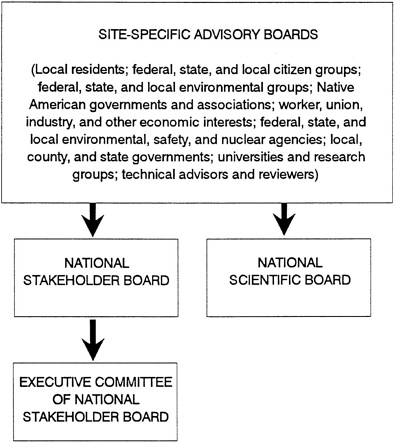
As also shown in Figure 3-3, the committee recommends that the institution include a national advisory panel of scientific experts who will help to maintain consistently high standards in risk assessment. This blue-ribbon panel of scientists could be called on for assistance ranging from broad advice about the structure and functioning of the institution itself, through advice on methodological consistency, to reviews of site-specific risk assessments. The panel could review the risk assessment work plans developed in scoping, including methods proposed, gaps in plans, and exposure and monitoring protocols and programs. Such reviews would not only provide quality assurance for individual plans, but help to ensure national consistency in the technical and scientific elements of the plans, particularly in the use of up-to-date risk assessment science and default options. The panel would also review drafts of risk assessments that are circulated for comment to reviewers in other federal and state agencies and bodies, scientific bodies and organizations, and public groups. Such comment plays a pivotal role in ensuring that risk assessments are reliable, credible, and clear before they are used to select remediation. Finally, the panel would review the application of risk assessments to the selection of remedies in risk management. Risk assessment should not be the only determinant of the approach to remediation; but to the extent that DOE uses risk assessments, they should be subjected to independent scientific review.
Various institutional arrangements could provide the necessary attributes of the risk assessment institution and satisfy its objectives. Indeed, the committee considered such different arrangements as existing organizations (both nonprofit and for-profit), academic institutions, coalitions of existing organizations and academic institutions, and new or existing government agencies or commissions. Each could probably offer at least some of the desired attributes.
Although the committee is not in a position to recommend a specific institutional model, it believes that the criteria that should be applied in the selection process are clear: credibility, speed, and capability.
We have emphasized the need for credibility throughout our report. Will small community groups trust the institution as little as they trust government agencies and DOE facility managers? As Assistant Secretary Grumbly indicated, trust in the institution might require that none of its components be under the control of DOE or beholden to DOE for large amounts of other, even unrelated, work. Nevertheless, the information and expertise of DOE and its contractors must be incorporated into whatever institution is chosen.
The need for speed is clear. How quickly can the institution be established and operating? DOE cannot afford to delay remediation because it is establishing a new risk assessment institution. The need for speed probably favors existing organizations over ones to be newly established. However, it is not clear that any existing organization has all the required attributes.
The institution needs to have the scientific capability to manage and undertake scientific assessments; the management capability to coordinate a large, scattered, and diverse set of activities; and the communication capability to ensure that stakeholders are effectively involved in the assessments. This is a daunting task.


