
The Committee on Toxicology
50 YEARS OF SCIENTIFIC SERVICE TO THE NATION
Toxicology plays a major role in the assessment of health and environmental hazards associated with the many substances that are used or encountered by military personnel and the general public. More than 75,000 chemical substances are currently manufactured or used in commerce in the United States, and almost 1,000 more are introduced into commerce each year. Many laws have been enacted that require government agencies —primarily the US Environmental Protection Agency (EPA), Occupational Safety and Health Administration (OSHA), Consumer Product Safety Commission (CPSC), and Food and Drug Administration (FDA)—to protect the general population and workers from toxic exposures to chemical substances in the environment and the workplace. The Department of Defense (DOD), which employs millions of military personnel and civilians, has the responsibility to protect not only active military personnel, but also their families and other civilians who live or work on or near military installations.
Toxicological issues encountered by the US military can be traced back at least to World War I, when Germany launched chemical-warfare attacks on Allied troops. Gas poisoning in World War I resulted in 100,000 deaths and over 1 million casualties. Toxicological issues in the military also rapidly expanded to occupational environments. During World War I, nearly 230 fatalities per billion pounds of manufactured explosives were attributed to exposures to TNT and nitrous gases in US munitions plants.
Military personnel are at times exposed to new chemicals used in vehicles, equipment, and clothing. Concerns often arise about the acute and chronic toxicity associated with the use of those chemicals and the materials that contain
them. In response to those concerns, the military has established toxicology laboratories for the Army, Navy, and Air Force to generate data on the toxicity of chemical-warfare agents, other munitions, pesticides, jet fuels, submarine pollutants, and many other substances used or encountered by the military. In addition to generating data in laboratories, the armed forces have often asked the National Research Council (NRC) to conduct independent toxicity and health risk assessments of chemicals used by the military.
In response to many requests from the DOD for toxicological studies, the NRC in 1947 convened the Committee on Toxicology (COT)—with expertise in toxicology, epidemiology, occupational medicine, industrial hygiene, and chemistry—to provide scientific information and expert advice on difficult questions involving toxicology and risk assessment. One of the oldest scientific bodies of the NRC, COT was created to be a US counterpart of the Commission de Toxicologie of the International Union of Pure and Applied Chemistry and to represent the US professions of toxicology and industrial hygiene in international forums. However, the need for COT's services in many important military and domestic situations has long been recognized, especially by the armed forces, and federal agencies have requested COT's assistance many times in tackling complex scientific issues. Such civilian agencies as the National Aeronautics and Space Administration (NASA), EPA, the Coast Guard, CPSC, OSHA, and the Department of Energy have sought advice from COT on matters related to toxicology and risk assessment.
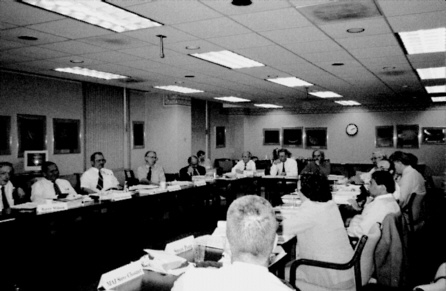
COT subcommittee meeting.
This pamphlet highlights some of the work of COT over its first 5 decades of service (1947-1997) and describes some of COT's recent and current activities.
BACKGROUND
The National Academy of Sciences (NAS) was chartered by the US Congress and President Abraham Lincoln in 1863 as a private institution dedicated to furthering science and technology and providing independent, authoritative scientific and technical advice to the federal government. NAS and its associated organizations—the National Academy of Engineering (NAE), the Institute of Medicine (IOM), and the NRC—constitute what has been called the “Supreme Court of Science” and the most important independent expert advisory mechanism for science and technology relevant to public policy in the United States and perhaps in the world.
The NRC is the principal operating agency of NAS and NAE and conducts most of the studies done in their names on scientific and technical matters of national importance. The studies are carried out primarily by committees, panels, and working groups consisting of distinguished experts chosen by the NRC in science, engineering, medicine, and other disciplines from universities and other institutions. About 200 study reports are prepared and distributed by the NRC each year. The reports are provided to the government and available to the public through the National Academy Press (800-624-6242) or the COT Toxicology Information Center (202-334-2387). Recent reports are also available through the web site of the National Academy Press (http://www.nap.edu/readingroom).
MISSION
COT's mission is to conduct independent, authoritative studies on issues in toxicology for the Army, Navy, Air Force, NASA, EPA, and other governmental agencies. COT's specific responsibilities to its sponsoring agencies are the following:
-
To serve as an independent body to assess or adjudicate controversial problems in toxicology.
-
To respond to scientific questions from sponsoring agencies.
-
To assess contaminant limits for emergency and continuous exposures.
-
To assess standards and procedures for the safe handling, use, and disposal of hazardous materials.
-
To assess precautionary and protective measures for exposures of personnel to hazardous substances.
-
To assess protocols for monitoring of hazardous substances and surveillance of exposed personnel.
-
To assess techniques and substances for hazardous substance treatment and decontamination.
-
To recommend research on toxicological and other scientific issues.
-
To evaluate programs or studies conducted by sponsoring agencies and to assist in interpreting the results of the studies.
COT reports, like all other NRC reports, provide independent evaluations of scientific information, identification of data gaps, and technical recommendations. All COT reports are advisory. They do not represent government standards, and they do not contain judgments regarding the acceptability of health risks.
STUDY PROCEDURES AND REPORT REVIEW
COT's primary output is in the form of independent, peer-reviewed, consensus reports to government agencies in response to requests for scientific information or evaluations. When an agency requests a study, COT develops a project plan and seeks approval from its parent organizations within the Academy complex: the Board on Environmental Studies and Toxicology, the Commission on Life Sciences, and the NRC Governing Board. Once approval is obtained and financial support by sponsors is arranged, COT and the NRC identify renowned scientists with appropriate expertise to undertake the project. The scientists review the literature and other pertinent materials and prepare a consensus report. Before the report is released, it is edited and submitted to rigorous external peer review according to procedures of the NRC Report Review Committee. Because COT reports carry the weight and the authority of the NRC, report review is an integral part of producing a COT report. Critical and careful review helps to ensure that the highest scientific and expository standards are met.
SPONSORING AGENCIES
In its early days, COT's studies and reports were confined to the needs of its original sponsors—the US armed services and the former Atomic Energy Commission. Most of COT's work was performed for the Army, Navy, and Air Force, all of which needed information on potential health hazards to military and civilian personnel from exposures to substances ranging from fuels and explosives to sunscreens and pesticides.
Since then, COT has accepted requests for assistance from other government agencies (see shaded box). The reports for civilian agencies address many of the same kinds of topics as those produced for the armed services.
|
COT Sponsors
Primary Sponsors: Army Navy Air Force Other Sponsors: Atomic Energy Commission (later part of the Department of Energy) Coast Guard Consumer Product Safety Commission Department of Energy Environmental Protection Agency General Services Administration National Aeronautics and Space Administration Occupational Safety and Health Administration |
MEMBERSHIP
COT is composed of about 20 members who are experts in relevant sciences and are appointed for 3-year terms by the NRC. COT's list of distinguished past and present members (see shaded boxes) include national and international leaders in such fields as toxicology, epidemiology, occupational health, pharmacology, pathology, biochemistry, chemistry, industrial hygiene, biostatistics, and risk assessment. Members are chosen from universities and other institutions for
|
Chairs of COT H.H. Schrenk |
1947-1950 |
|
Lawrence T. Fairhall |
1951-1952 |
|
Harold C. Hodge |
1952-1958 |
|
Norton Nelson |
1958-1961 |
|
Arnold J. Lehman |
1961-1968 |
|
William L. Sutton |
1968-1969 |
|
Herbert E. Stokinger |
1969-1972 |
|
Bertram D. Dinman |
1972-1977 |
|
Joseph F. Borzelleca |
1977-1981 |
|
Roger O. McClellan |
1982-1987 |
|
John Doull |
1987-1992 |
|
Rogene F. Henderson |
1992 |
|
Current and Past Members of COT Alarie, Yves |
1974-1978 |
Greenwald, Peter |
1981-1983 |
Reinhardt, Charles F. |
1972-1980 |
|
Amdur, Mary O. |
1975-1977 |
Grice, Harold C. |
1975-1978 |
Richardson, A.P. |
1951-1952 |
|
Angle, Carol |
1985-1988 |
Griesemer, Richard |
1983-1986 |
Rodricks, Joseph V. |
1977-1982 |
|
Axelrod, David |
1977-1980 |
Guzelian, Philip |
1986-1989 |
Rowe, Verald K. |
1964-1972 |
|
Bates, Richard R. |
1982-1984 |
Halperin, William |
1983-1989 |
Schrenk, H.H. |
1947-1952 |
|
Bell, Hays |
1988-1994 |
1995- |
Shaffer, C. Boyd |
1969-1975 |
|
|
Bingham, Eula |
1986-1992 |
Hamblin, D.O. |
1947-1952 |
Shank, Ronald C. |
1977-1983 |
|
Borzelleca, Joseph F. |
1975-1981 |
Heath, Clark |
1983-1986 |
Shy, Carl M. |
1979-1981 |
|
Buck, Germaine M. |
1995- |
Henderson, Rogene |
1985- |
Silverman, Leslie |
1952-1957 |
|
Burns, John J., Jr. |
1975-1976 |
Higgins, Ian T. |
1977-1982 |
Sipes, I. Glenn |
1987-1990 |
|
Hine, Charles H. |
1952-1957 |
Smuckler, Edward A. |
1980-1983 |
||
|
Carlson, Gary P. |
1996- |
Hites, Ronald |
1991-1993 |
Smyth, Henry F., Jr. |
1964-1970 |
|
Carter, Dean |
1991-1994 |
Hodge, Harold C. |
1950-1958 |
Snyder, Robert |
1980-1984 |
|
Cory-Slechta, |
1991-1997 |
||||
|
Deborah |
1993-1996 |
Irish, D.D. |
1947-1951 |
Spanggord, Ronald J. |
1982-1985 |
|
Cox, Colonel |
Spencer, Peter S. |
1979-1984 |
|||
|
Wesley C. |
1950-1953 |
Jones, Warren H. |
1977-1979 |
Standaert, Frank G. |
1971-1977 |
|
Sterner, James H. |
1947-1952 |
||||
|
Dagirmanjian, Rose |
1984-1987 |
Karol, Meryl |
1984-1987 |
1971-1973 |
|
|
Dean, Jack H. |
1996- |
Kerkvliet, Nancy |
1987-1990 |
Stewart, Richard D. |
1971-1974 |
|
Dinman, Bertram D. |
1967-1977 |
Kilgore, Wendell W. |
1979-1982 |
Stokinger, Richard D. |
1952-1975 |
|
Doull, John |
1987-1993 |
Kimmel, Carole |
1988-1994 |
Sutton, William L. |
1964-1969 |
|
Driscoll, Kevin E. |
1995- |
Klaassen, Curtis |
1988-1991 |
||
|
DuBois, Arthur B. |
1967-1976 |
Kodell, Ralph |
1987-1993 |
Tardiff, Robert G. |
1975-1977 |
|
Koelle, George B. |
1995-1997 |
Taylor, Kathleen |
1985-1991 |
||
|
Eckardt, R.E. |
1969-1971 |
Koller, Loren |
1990-1996 |
Taylor, Robert |
1986-1989 |
|
Ecobichon, Donald |
1981-1984 |
Krewski, Daniel |
1987-1990 |
Tephly, Thomas |
1984-1989 |
|
Eisenbud, Merril |
1952-1962 |
1995- |
Tepper, Lloyd B. |
1982-1985 |
|
|
Terhaar, Clarence J. |
1982-1985 |
||||
|
Fairhall, Lawrence T. |
1947-1952 |
Larson, Paul S. |
1951-1952 |
||
|
Fassett, David W. |
1957-1962 |
Lehman, Arnold J. |
1950-1970 |
Van Winkle, W., Jr. |
1951-1952 |
|
Faustman, Elaine |
1994-1997 |
||||
|
Feigley, Charles |
1989- |
Maibach, Howard I. |
1979-1984 |
Wagner, Bernard |
1986-1993 |
|
Fishbein, Lawrence |
1979-1981 |
Mandel, H. George |
1977-1982 |
1995- |
|
|
Ford, Richard |
1953-1957 |
Maynard, Elliott A. |
1958-1961 |
Waitt, General Alden H. |
1947-1948 |
|
Fowler, Bruce |
1988-1991 |
McClellan, Roger O. |
1979-1987 |
Walker, Bailus |
1990-1996 |
|
Frederick, William G. |
1962-1964 |
McConnell, |
Watanabe, Philip G. |
1977-1982 |
|
|
Friess, Seymour L. |
1967-1976 |
Ernest E. |
1988-1994 |
Watson, Annetta |
1994-1997 |
|
McKone, Thomas E. |
1995- |
Whittenberger, James L. |
1958-1961 |
||
|
Gardner, Donald |
1988-1997 |
Medinsky, Michele |
1992- |
Witschi, Hanspeter |
1991-1997 |
|
Gaulden, Mary |
1987-1993 |
Menzer, Robert E. |
1982-1985 |
Wogan, Gerald |
1992-1995 |
|
Gaylor, David W. |
1981-1987 |
Wood, Colonel John |
1950-1951 |
||
|
1993- |
Nay, Carl A. |
1958-1961 |
|||
|
Generoso, Walderico |
1989-1995 |
Nelson, Norton |
1952-1961 |
Yant, William P. |
1947-1951 |
|
Gerarde, Horace W. |
1958-1961 |
Norton, Stata E. |
1977-1979 |
Yost, Garold |
1991-1997 |
|
1962-1966 |
|||||
|
Graham, Judith A. |
1996- |
O'Donoghue, John |
1994- |
Zapp, John A., Jr. |
1952-1964 |
|
Greaves, Ian |
1989- |
||||
|
Green, Sidney |
1993- |
Peck, Harold M. |
1969-1976 |
||
their professional qualifications, judgment, and integrity. They bring to the committee's deliberations the expertise that enables authoritative and thorough examination of the problems presented. The members of COT have included current and past presidents of the Society of Toxicology, the Teratology Society, and the Society for Risk Analysis. COT's current roster includes members of NAS, advisers to the International Agency for Research on Cancer, and members of the science advisory boards of the National Institutes of Health and EPA.
Most of the work of COT is carried out by its various subcommittees, panels, and working groups, assisted by staff professionals. Like the members of all other NRC study committees and boards, all members of COT and its subsidiary groups serve without monetary compensation. In a typical year, the members of COT and its subcommittees and panels donate more than 10,000 hours in service to the nation. Additional experts and consultants are called on to augment these groups when special expertise is needed.
|
National Research Council Staff Paul Gilman Executive Director Commission on Life Sciences |
Kathy Iverson Manager Toxicology Information Center |
|
James J. Reisa Director Board on Environmental Studies and Toxicology |
Ruth E. Crossgrove Publications Manager Norman Grossblatt Editor |
|
Carol A. Maczka Program Director Toxicology and Risk Assessment |
Catherine M. Kubik Senior Program Assistant |
|
Kulbir S. Bakshi Program Director Committee on Toxicology |
Linda V. Leonard Senior Program Assistant |
|
Margaret McVey Program Officer |
Lucy Fusco Project Assistant |
|
Susan N.J. Pang Research Associate |
|
|
Abigail Stack Research Associate |
|


