
National Academy of Sciences | 150 Year Anniversary

Questions? Call 800-624-6242

| Items in cart [0]

The National Academies Press

Rights & Permissions

topleft topright

Doctoral Scientists and Engineers in the United States 1995 Profile (1998)
National Research Council (NRC)

Citation Manager

. "Retention and Mobility." Doctoral Scientists and Engineers in the United States 1995 Profile. Washington, DC: The National Academies Press, 1998.

Please select a format:

BibTeX EndNote RefMan


Page
13
bottomleft bottomright

The following HTML text is provided to enhance online readability. Many aspects of typography translate only awkwardly to HTML. Please use the page image as the authoritative form to ensure accuracy.


Doctoral Scientists and Engineers in the United States

award. Postsecondary teachers of science and engineering were from 23 to 36 percent of the total.

  • The proportions working as scientists or engineers, on the other hand, decreased as years since doctorate increased. Of those with 5 years or less since doctorate 52 percent were scientists and 13 percent were engineers; of those more than 25 years since doctorate 33 percent were scientists and 7 percent were engineers.

Retention and Mobility

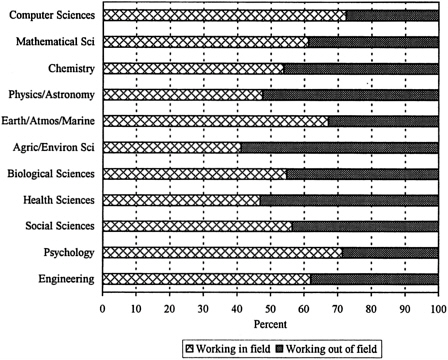
In this report, the percentage of employed individuals with degrees in a particular field that were also working as practitioners or postsecondary teachers in that specialty is called the “retention rate” of the field.

  • In 1995 the retention rates ranged from highs in computer sciences and psychology, 72 and 71 percent, respectively, to a low of 41 percent for agricultural/environmental sciences doctorates (see Table 11 ).

FIGURE 5. Retention in field of science and engineering Ph.D.s, by field of doctorate, 1995.
Page
13

Below are the first 10 and last 10 pages of uncorrected machine-read text (when available) of this chapter, followed by the top 30 algorithmically extracted key phrases from the chapter as a whole.
Intended to provide our own search engines and external engines with highly rich, chapter-representative searchable text on the opening pages of each chapter. Because it is UNCORRECTED material, please consider the following text as a useful but insufficient proxy for the authoritative book pages.

Do not use for reproduction, copying, pasting, or reading; exclusively for search engines.

OCR for page 13
Doctoral Scientists and Engineers in the United States award. Postsecondary teachers of science and engineering were from 23 to 36 percent of the total. The proportions working as scientists or engineers, on the other hand, decreased as years since doctorate increased. Of those with 5 years or less since doctorate 52 percent were scientists and 13 percent were engineers; of those more than 25 years since doctorate 33 percent were scientists and 7 percent were engineers. Retention and Mobility In this report, the percentage of employed individuals with degrees in a particular field that were also working as practitioners or postsecondary teachers in that specialty is called the “retention rate” of the field. In 1995 the retention rates ranged from highs in computer sciences and psychology, 72 and 71 percent, respectively, to a low of 41 percent for agricultural/environmental sciences doctorates (see Table 11 ). FIGURE 5. Retention in field of science and engineering Ph.D.s, by field of doctorate, 1995.