




Below is the uncorrected machine-read text of this chapter, intended to provide our own search engines and external engines with highly rich, chapter-representative searchable text of each book. Because it is UNCORRECTED material, please consider the following text as a useful but insufficient proxy for the authoritative book pages.
Appendix A OVERVIEW OF THE AVLIS PROCESS HISTORY Dunog World War II, the United States invested significant financial and personnel resources in the Manhattan Project in order to develop large-scale isotope separation capabilities to produce clinched uranium for the manufacture of nuclear weapons. The present technological legames of this Herculean effort are the gaseous diffusion plants at Oak Ridge, Tennessee; Paducah, Kentucky., and Portsmouth, Ohio, which have produced most of the enriched uranium used in civilian nuclear power plants in the free world. Through the mid-1970s, these plants were periodically upgraded and had a virUlal monopoly on enrichment services in the international marketplace. In this time penod, a significant growth rate in nuclear power plant deployment was berg projected. Since the gaseous division process is very energy intensive (~80% of operation costs), the United States supported the development of advanced eng~neenng and scientific approaches for uranium enrichment to provide additional enrichment capacity by using more energy-e~cient technology. In l9T7, President Carter initiated a program to build the next increment in enrichment capacity in the United States by using gas centrifuge technology. Advances made in this technology since its early evaluation in the 1940s promised nearly an order of magnitude reduction in power consumption and a substantial improvement in total processing costs. Both gaseous diffusion and gas centrifuge development were being pursued aggressively by several western European countries to provide them with nationally independent enrichment capabilities. In those assessments, there was also a general understanding that more efficient and lower-cost enrichment processes were possible and that it was important to develop and deploy them. The Soviet Union has been installing gas centrifuge technology since the 1960s and is now using fourth- generation machines. Private U.S. interests have decided to add enrichment capacity based on the Urenco gas centrifuges. Centrifuges are being installed in Japan, and Asahi Chemical Industnes has a pilaf plant that uses a chemical process that it claims is competitive with the gas centrifuge. The French have a different chemical process that is claimed to be better than their present diffusion plant. Among a number of possible chemical, aerodynamic, electromagnetic, and photophysical uranium enrichment processes, three processes involving four organizations were explained in depth ~ the United States in the late 1970s and early 1980s to demonstrate the best process. All three were funded by the U.S. government, and two, the atomic vapor laser isotope separation (AVLIS) and molecular laser isotope separation (MLIS) processes, were pursued independently by EXXON in the private sector. EXXON withdrew from active participation in 1981. After intensive review In the early 1980s, two of the processes, an MLIS process, developed at Los Alamos, New Medico, and an electromagnetic plasma separation process (PSP), developed at TRW Corporation, were eliminated from further competition. In 1985, the AVLIS program managed by the Lawrence Livermore National Laboratory (LLNL) was chosen as the only advanced uranium ennch~nent technology program in the United States after a competition with an advanced-design gas centrifuge under development by an industrial team composed of Boeing Aircraft Company, Garrett AirResearch Corporation, the Oak Ridge Gaseous Division Plant, and Goodyear Corporation. Figure A-1 summarizes these events as well as the projected activities of the next 7 years. From the beginning of the LLNL AVLIS program, the primary goal was to understand and develop a process that could enrich uranium at a price substantially below the existing market price. An early commitment to high-be~-quality and high-puIse-repetition-frequen~ (Prf) dye lasers was a fundamental difference between LLNL and Jersey Nudear AVCO Isotopes, Inc. In 1980, the Department of Energy (DOE) judged the LLNL design to be more cost-competitive in the long-term market. 27
28 of c-a, A o - ~ ~5 2 _ ° ' Ott ~ C ~ ~1 t- ·- ~I To Q 1 =_ 1 _ O Cal O ~ ~ E0 o ~ ~ o O ~ E ; CO' 00 1 o =8 . o CtS Q m ~1 ~1/ r con .. ~5 ._ _ ~ _ In In O O In ~ 1 Cal · C5) C5) Cal an = Cal AL ~0 a,, ._ Q Cal CO CO - C~ w' e_ ~ \\cn ~ \ W~ o - ~_ 3 , 1: o Q o o C J ~ ~ ~ I 1 1 C~ . 1 l Z U) ~ cn ~ I CL o CR ._ C) o C~ o ._ ._ _. o C~ U. ·- ,,,) C~ - C)
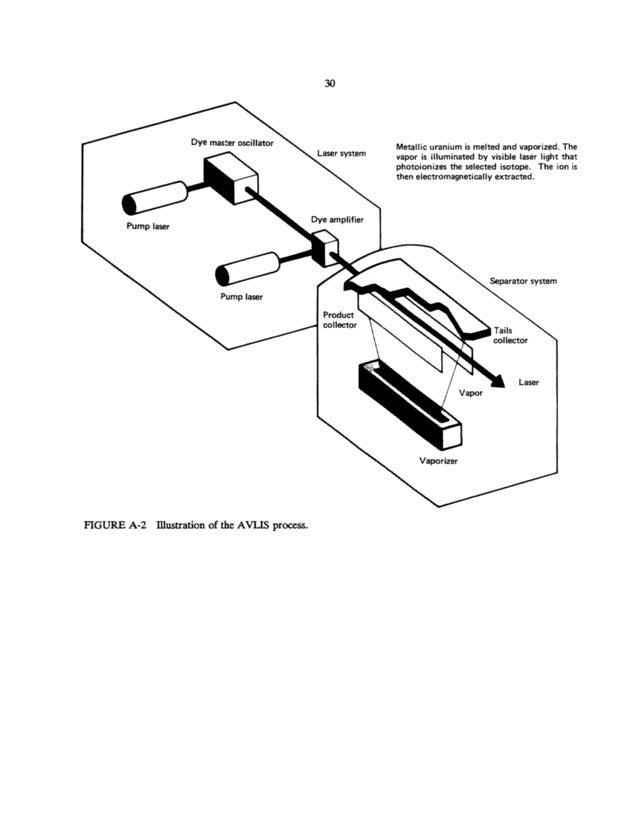
29 As the technical feasibility of us~gAVLIS to separate uranium became clear in the late 1970s, scientists at LLNL applied the technology to the mission of purifying DOE-owned plutonium up to weapon-grade specifications by removing unwanted plutonium isotopes. After a peer-review competition in 1983 against an MLIS process sponsored by Los Alamos National Laboratory, AVLIS was chosen as the nation's technology for plutonium isotopic enrichment. A large and successful plutonium AVLIS scientific and engineering development program has been in effect at LLNL since the early 1980s. Milestones in this effort were (1) extended plutonium isotope separation runs in plant-scale hardware in 1984 and (2) extended isotope separations of surrogate metals in engineered, plant-ready hardware in 1989. In early 1990, the Secretary of Energy announced a decision to indefinitely postpone construction of the plutonium AVLIS (special isotope separation) production plant at the Idaho National Engineering Laboratory. This action was based entirely on the Ranged nations needs for plutonium, not on any shortcomings of the AVLIS "ethnology. In fact, the desire to find alternative uses for this sophisticated "ethnology prompted this study. The following sections describe AVLIS technology in terms of uranium enrichment. The reader should recognize that the same technology, and much of the same hardware, has already been applied to the separation of plutonium isotopes and isotopes of several heavy metals and can be applied to the separation of isotopes of other elements. As a result of the plutonium AVLIS program, process-ready hardware is available at LLNL for the separation of selected metallic elements on a gram to kilogram scale. PROCESS DESCRIPTION The AVLIS process developed at LLNL consists of two major subsystems: a laser system and a separator system (Figure A-2~. In the separator, unenriched metallic uranic is vaporized by an electron beam that creates an atomic 235U/238U vapor stream that rapidly moves away from the uramum melt. At the "me time, dye lasers produce beams of red-orange light precisely tuned to the colors that will selectively photoioni7~. 235U isotopes. Powerful copper lasers emit beams of green-yellow light that energize the dye lasers. Ibis configuration produces powerful beams of tuned red-orange light to illuminate the uranium atomic vapor inside the separator. 235U isotopes absorb the tuned red-orange light, but 238U isotopes do not. The excited 235U isotopes eject electrons (become photoioni~ed) and retain a net positive charge. The 235U ions can then be moved preferentially by an electromagnetic field to condense on the product colDector. The 238U isotopes, which remain uncharged, pass through the collector section to condense on the tails collector. The separated uranium condensates are collected in metallic form. Presently, the technology is being developed to convert the AVLIS product to a uraniums oxide form suitable for fabricating nuclear reactor fuel elements. The primary goal of the AVLIS program is to develop a process that can enrich natural (and/or tails) material at less than half the cost of any other competing technology. After numerous reviews by peer groups and h~gh-level government advisory panels, AVLIS has been judged to have the potential for processing natural uranium at a cost of between $25 and S50 per separative work unit (SWU).* Each of the major subsystems is described below in enough detail to identify performance and operational characteristics that have potential in other applications. *The standard measure of both the capacity of urban enrichment plants and the amount of enrichment required for a particular task is the SWU. For example, about 4 SWU is required to produce 1 kg of 3% enriched uranium starting Tom natural uranium (0.7%), assuming a waste or tails uranium concentration of 0.25%. Similarly, about 200 SWU is required to produce 90% enriched uranium from natural uranium. Thus, an enrichment plant with a capacity of 1 minion SWU/yr could produce either ~250,000 kg of 3% enriched material or ~5,000 kg of 90% enriched material. The cost of enrichment is commonly Even ~ dollars per SWU [see reference Ad.
30 - \ Dye master oscillator \ Metallic uranium is melted and vaporized. The \Laser system vapor is illuminated by visible laser light that _ ~\ photoionizes the selected isotope. The ion is _ \ then electromagnetically extracted. _ ~ Pump laser ~ Pump laser 7\~ \ \ | roduct :~ collector I\ - Laser ~ Vapor \ ~ \Vaporizer ~ Dye amplifier FIGURE A-2 Illustration of the AVLIS process. Separator system - - - -
31 AVLIS is not a single-market technology limited to the separation Of 235U from 238U. The periodic table shown In Figure A-3 shows that most elements can, in principle, be separated in this way. Separation of uranium isotopes, which potentially bears great economic benefits, Is an obvious application for AVLIS. However, as the teleology improves, as costs decrease, and as demands for the new isotope products increase, new markets may well appear. For example, markets might develop for the separation of gadolinium (for use In power reactors) apt for the isolation of radioactive xenon (to use for radioiodine production). Markets already exist for small-scale medical diagnostic, and research uses of a number of stable and radioisotopes. The SWU costs projected for a uranium AVLIS plant, $~5-$50/SWU, translate directly into a cost of $30 $60/mole Of product with a typical away concentration of 32%. A rough estimate of the cost per mole of product in other isotope separation missions can be obtained by scaling these costs by the ratio of the fraction of the product that is processed as photoions in the mission to that fraction for the uranium mission (i.e., 0.0323. For missions that are on a smaller scale than that for uranium, costs can exceed these estimates, depending on how the laser and separator systems are union. It is important to realize that each element requires a unique set of frequencies and that many will present unique materials handling problems related to vaporization, separation, and collection. Each element will require a substantial independent development effort. Elements requmng vacuum ultraviolet radiation may not be tractable. TECHNICS Numerous technologies are required to construct and operate an AVLIS process. Table A-1 is a top- level summary of the scientific and eng~ncenug disciplines that have been developed In the major programmatic areas. Note Mat the copper lasers and uranium separators share many common problems and technology requirements. Both operate at low pressure and high temperatures with corrosive liquid metals (uranium being much more corrosive than copper), but copper lasers operate at a temperature several hundred degrees higher. To engineer the AVLIS copper lasers and uranium separators, the AVLIS staff has expertise in selecting, motiving, and testing refractory metals, ceramics, and h~gh-effic~engy thermal and electrical insulators and in constructing electrically and mechanically complex precision mechanisms. To rewires the AVLIS system together, very sophisticated optical design capabilities have been developed that allow transport of high-average-power light with meal absorption, Fresnel, scattering, diffractive, or aberration losses. Many optics elements simultaneously have absorptions of <10-5, transmittance or reflectance losses of <0.0003, scattering of < 10-5, rms wavefront errors on the order of 0.01 optical wavelength and the ability to operate continuously at optical power densities of more then 104 W/cm2. Deformable optical elements whose surfaces An be adjusted have been develop to preserve the inherent optical quality of laser beans with enough power to thermally a- . . ~ ~ ,' ~ ~ · ,- . ~ . ~ ~ · _ _ 1 _ __ ~ 1 _ _- _ t _ ~ _ mat-__ ~ ._ ___- I_ distort even very low loss optics. Sophisticated measurement techniques have then designed and ut~zeo to guide the development and evaluation of optical and electro-optical subsystems and to provide precise control capability. Highly integrated, efficient, user-friendly microprocessor and computer networks and associated data bases have been deveiope<] and deployed to mate and record the thousands of operations that take place in the AVLIS process. Since AVLIS must operate as a cost-competitive continuous industrial process, detailed understanding of cost and reliability eng~neenag, user-friendly product development, integrated refurbishment, and preventive maintenance has had to become part of the AVLIS culture. The capabilities of some of the AVLIS subsystems are outlined below to aid in identifying new applications of this technology to industrial, scientific, medical, or military moons. Lasers and Optics After more than 15 years of sustained development of very complex high-average-power laser, optical, and materials processing systems for the AVLIS program, LLNL now has a mature and comprehensive capability to design, engineer, construct, integrate, activate, operate, m~nta~n, and On prove indus~ial-grade laser and optical delivery systems for cost-competitive commercial processes. Because of the inherent complexity of the AVLIS process and the absolute requirement that the lasers not represent a performance or cost problem, the kinds of laser systems developed have characteristics that surpass the performance and reliability of most presently available commercial systems. Because the funded applications of AVLIS at LLNL have been for nuclear materials, dissemination of information and technology transfer have been controlled by DOE classification polimes derived from the Atomic Energy Act. With a few key exceptions associated primarily with the details of a specific materials process, this
A u, D __ Cal ~ _ it;_ U) - ~ a O ·= ._ ~ O is_ Ct I ~5 .~ ~ . 8 N . ·_ N Cal ~ an Cal - 2 ye . ~,~4~;:, N J m ID - 3 o ; Q O o Z E on ~ 8 E o s' I an ILI ~ ~ ~ D o C, E .5 - E {D ~ 0) ~ ' ~0 E , . N ~o, I l E g z o I O Z _ OC ~ ~ Cal ~ (~' l ~ m~ o,C) 1~ 5 ~= LO . ~ ._ - C~
33 ~n o ~8 , C~ _~ oe ~ a, 8 8 8 · 0 8 8 2 · = - · = . · E- .0.!.~8803.08.8 8 o ~ ~ ~ ~ ~ ~ &< ~ ~ Eo ~ ~ 7~zm8 ~a -~o E~ D _ O C] C' o' _ ~0e a, ~ Q ~ ~ o ~ 8 0 0 ' ~ 8 8, { ~8' e 8 , 8 8 3 ' i E ' 8 E o ~ ~ 8 8 . 8 ~ le ' E S - 8 E 2 _ _ 1 1 1 1 1 1 1 ~ 1 1 1 1 1 1 ~ 1 1 1 m . - C~ o, ~3 · i ~ · ~ 5 ' f · -y Y ~ f D ~, ~o ~| I I I I S I I _ I I I I I C I I , s S CL ~ o o D ~a cn es o c) u' s: - · c.> u' · - o · - ~ e~ ~c m g a, Q os ~ ~ O J ~ ~L O C~
34 laser and electro-optical system capability is not limited to the processing of materials that have an impact on national security and may be of broad use In the industrial sector. If the laser systems developed for AVLIS are examined by subsystem, there are many laser and/or optical systems, components, and engineering capabilities that can address many processing problems much less sophisticated than AVLIS. Many Department of Defense applications require sources of reliable high-intensity ~llun,~nahon that range from nonspectrally sensitive target iBum~nators to narrow-band frequengy-stable optical laser radars Pith multispectral scan capabilities. Cost-compet~tive high-average-power lasers with kilowatt-per- aperture capabilities have numerous applications In cutting, welding, marking, and heat treating. These applications include common construction materials such as iron and aluminum and range to complex material matrices used In the semiconductor and computer industries. The Prf (~1-30+ p~Hz]) and the moderate- pulse-energy (03 05 J/pulse) capability of the copper laser or copper-laser-pumped tunable dye lasers milt be appropriate for generating practical x-ray plasma sources for submicron-level lithography needed for the next major advance in computer memory and processing technology. The primary issue with any AVLIS mission is the value of the material to be processed relative to the capital and operating cost of a high-technology laser system. Since the primary goal of the uranium AVLIS program has always been to develop a minimum-cost process, the associated laser systems developed within the LLNL program are engineered to be cost-competitive in a commercial environment. On the basis of costs projected for a uranium-scale AVLIS plant, fixed-frequenc~r copper laser photons (green and yellow) can be procluced for $150-$250/mole, and t~able dye laser photons (yellow and red) can be produced for $10- $18/mole. Accounting for inflation and increased equipment costs over the past decade, the costs for producing these photons in replicated hardware similar to that operating at LLNL today are twice as great as the values gnen above, depending on system size and date of deployment. Other applications of the laser capability developed in the AVLIS program become practical only after the technology leaves the laboratory and the prototypical hardware reaches its true economic potential in the commercial world. These applications include: ~ . ~ ,~ _ ~ ~_ , Control of chemical and biological processes. Environmental monitoring. Direct line-of-sight communication Nondestructive testing. Commercial laser radar. A wide variety of scientific and commercial applications of spectral analysis and control. To provide an appreciation of the broad rate of transferable capabilities developed In the AVLIS program, the laser system, components, and engineering capabilities are described below In terms of products and/or capab~t~es. System Description: Ind~strial-Grade High-Average-Power Risible Laser Systems, Components, and Technology The laser facility shown in figure AT Is constructed by using a modular integration of copper and tunable dye lasers. The performance characteristics of the copper laser system and the copper-laser-pumped dye laser system are given below. Characteristics of this system include: Parallel architecture for high availability (>99%) and continuous operation. Discrete optical component or fiber-optic cable power transport and delivery. · Manual or computer-controlled power, wavelength, beam position, thermal, and environmental control . Integrated diagnostic and data management system. For the replication of all or portions of this system, one or more of these options could be used.
35 W^~< \ \ · Copper laser system · Optical systems · Instrumentation and control systems · Laser support systems · Dye laser system · Refurbishment facilities FIGURE AN Industrial-grade high-average-power visible laser system.
36 Subsystem Descap~on: Modular Copper Laser Chains win Beam Multiplexing Optics A copper laser chain (Figure A-S shows six copper laser chains in a comdor) is capable of providing high average power for optical pumping' headug, x-ray generation, and other missions. Typical operating characteristics are s~nnmarizect in Table A-2. TABLE A-2 Operating Charactenstics of AVLIS Copper Lasers Optical power System Single amplifier cham Wavelength Frequency bandwidth Operational mode Prf Pulse duration (FWHM) Beam quality Laser head ~F) Efficiency, electrical to light Power stability Photon cost Capital cost Up to ~10,000 W 600 to ~1500 W 511 and 578 (nary) ~8 (GHz) at 511 am; ~12 GHz at 578 am Continuous, 24 in/day 2 to ~30 kHz; typically =5 kHz 20 to 60 (us); 50 ns typical 2 to 15 x diffraction limited ~ 1,000 hours ~1% Y%/day +L5%/week ~ $28/kW~h ~ S630/W Subsystem Description: Tunable Dye Laser Systems Copper-laser-pumped dye laser osciDator/=nplifier chains are visible, wavelength tunable, narrow- spe~ral-bandwidth, high-average-power lasers for spectrally sensitive optical excitation, coherent illumination, and materials processing missions. The typical operating characteristics of a tunable dye laser system such as the one shown in Figure AT are summarized In Table A-3. TABLE A-3 Operating Characteristics of AVLIS Dye Lasers Optical power System Single amplified chain Wavelength Frequency bandwidth Frequency stability Operational mode PI Pulse duration Beam quality Maintenance cycle Efficiency, pump to dye Power stability Photon cost (mclucting Co laser pomp) Capital cost (including Cu laser pump) >2,000 W Up to ~1,500 W Tumble 500 to 1000 am ~50 MHz ~120 MHz Continuous, 24 in/day 2 to ~30 kHz 20 to 60 ns ~DifEraction limited Mission dependent, ~ 100s of hours 20 60% Typically she as excitation source ~$ 200/kWh ~$5,300/W
FIGURE A-S Copper laser corridor showing six copper laser chains.
38 FIGURE AN Tunable dye laser system.
39 Other Subsystems To construct the systems discussed above, many subsystems have been developed and engineered for routine operation. For example: . Tunable TiAI2O3 oscillator/amplifier systems. Multiwatt tunable continuous-wave dye oscillators. High-performance-frequenc y measurement and control systems for tunable lasers. Optical transport system desk and fabrication capability for efficient high-optical-quality distribution of h~gh average-power lasers. High-average-power fiber-optics transport and distribution systems for broadband laser light. Integrated high-performance diagnostic and control systems for laser-based materials processing systems. Optical, spatial and temporal multiplexing systems. Low-cost adaptive optics phase-correction systems. Highly stable three-dimensional optical system architecture design and construction. High-performance laser electronics, such as: Higb-reliability (>20,000 hours M=F), high-voltage (~10 kV) switching power supplies. High-voltage (>100 kV), higb-average-power (~100 kW), short-pulse (~100 ns) modulators. Smart local microprocessor controllers. Comprehensive ancillary control and diagnostic systems. Although each of these capabilities was developed for constructing the integrated AVLIS system, they are easily applied to other applications with minor interface engineering. The key characteristics that differentiate these subsystems and components from others in the laser optical field are that they have all been engineered for continuous operation and cost-effective manufacturability and have been proven in large-system applications. Separator Systems The second major subsystem required for the AVLIS process is the separator system, in which the material to be isotonically enriched or purified is vaponzed, photoionized~ and collected separately from the . . , non~on'~ed or tans vapor tiow stream. DOth the collected product and tans streams condense as liquids and flow via separate paths to product and tails accumulators. To operate for reasonable processing times, a separator system must also have provisions to continuously feed material as it is vaporized. The most visible characteristic of the separator system is the external vacuum vessel, shown in Figure A-7. Typically manufactured from stainless steel, the vessel provides a high-vacuum envelope for the vaporization and collection process. Satellite subvessels at each end house the optical system to insert and control the AVLIS process laser beams' which interact with the vapor flow stream. Since a loss of vacuum or a water leak can generate a vigorous reaction with liquid metals, the vessel must also be designed to withstand moderate overpressure and release safely above a defined pressure limit. Because the near-term applications involve radioactive and/or tone metals, all operations must be engineered to prevent any material release that could be harmful or hazardous to the workers and surrounding community. Highly engineered airflow and control systems integrated with a redundant high-efficiengy particulate filter system are a significant part of the separator system. Vaponzation is accomplished by focusing an electron beam from high-average-power electron beam guns onto the working material. These gums are similar to those used in steel or other metal reEning processes. Long life (hundreds of hours) and nominally constant vaporization at high efficiency are requirements for an AVLIS process. Generally, the electron beam gun is located out of the direct vapor path and the electron beam is deflected by as much as 270°. To some degree, the beam is focused by magnetic and electrostatic lenses. An initial charge of material for the vaporizer is prepared in a metal crucible that is replenished by external feeders to maintain long-duration, high-volume evaporation rates from a nominal constant-volume crucible with a well- defined surface level. To begin the vaporization process, the electron bean gun ~n~tiaBy melts the solid material in the crucible. Once a stable pool of liquid metal is formed, the electron beam vaporizes metal Tom the surface
40 FIGURE A-7 Uranium AVLIS separator vacuum vessel.
41 of the liquid melt by intense local heating. Thermal control in the crucible is typically provided by careful thermal design referenced to eternal water and/or gas cooling. When the vapor Is generated as described above, a dense beam of atoms elands rapidly away from the surface of the melt until it passes through the laser irradiation zone. When the multiple laser frequencies (colors) are ad precisely tuned to the absorption lines for the vaporized isotopes of interest and the power denser ~ each color is above a nominal limit, most of these isotopes become electrically charged wherever all the multiple laser beams overlap spatially and in the correct temporal format. Collector plates located near the laser bean path have a negative voltage and attract the ionized isotopes as the atoms flow through the region. These ion extractors (or, in the case of uranium, product plates) work very efficiently if the geometry, applied voltage, and number of ions and atoms fall within certain ranges. Typically, the practical limits on ion extraction are imposed by practical limits on voltage and the amount of heat the extractor plates can dissipate without having a negative impact on the process. Product purity is dominated by the spatial characteristics of the flow stream, the collector geometry, and the charge exchange between selected ions and nonselected neutrals. Several degrading effects (such as charge exchange) scale with the vapor density and set the practical upper limit to throughput per unit area. Other factors such as ion sputtering must also be accounted for ~ the extractor design to ensure overall acceptable performance. Most of the discussion above Is very general since the geometry, materials, many critical dimensions, and operating points for the electron gun, vaporizer evaporation rate, extractor voltage, and any other parameters needed to desk an AVLIS process separator are classified. Those having appropriate clearances to obtain more specific information may find novel applications for the vaporizer and/or material systems developed for AVLIS. Specific information on vaporizers and separator systems and descriptions of their capabilities will be available Only to individuals having DOE ~Q~ security clearances and need-to-know approval from DOE. URANIUM PROCESSING To operate the AVLIS process, the working material must be in an atomic state and is typically generated by vapormng a metal. Uranium and many other metals are generally found in nature as mineral compounds, ounces, sulfides, etc. The miners and refiners provide uranium oxide, which must be converted to metal by an efficient, environmentally sound process. Once processed by AVLIS, the enriched product must be converted to an oxide that meets the strict purity and form requirements for nuclear reactor fuel rod elements. Historically, nearly all uranium enrichment has been performed in gaseous diffusion and centrifuge plants by using a molecular gas, U[6. Figure A-8 illustrates two technical paths to process naturally occurring uranium oxide (yellow caked through its venous chemical and enrichment stages and subsequent chemical processing to an oxide fuel pellet. Clearly, there can be alternative processing options. What has been done in the uranium AVLIS program, primarily at Martin Marietta Energy Systems, Oak Ridge, Tennessee, Is to evaluate several practical approaches from many possible options to generate metal from the natural oxide from the wewpo~nt of minimum process cost, residual waste, and environmental impact. Similar examinations have taken place on the conversion of ennched metal to an oxide with purity and material properties compatible with the exacting demands of the fuel rod industry. Similar activities have taken place for processing plutonium in which significant capabilities have been developed in pyrochemistry, electr~refining, and waste reduction by using electrochemical processing. Much of this expertise in chemical engineering and analysis can be applied to other processes In the nuclear fuel complex and to cost and/or environmental problems now being identified In the chemical industry. Although it would be fortuitous to find an exact match between a developed AVLIS chemical process and an existing ~ndus~ial requirement, much of the engineering capability that has been developed could be of significant benefit to industnes now searching for environmentally superior processing approaches. REFERENCE A1. Benedict, M., T. Pigford, and H. Levy. 1981. Nuclear Chemical Engineering, 2nd ea., Chapter 2. McGraw-HiD, New York.
42 O ~ :~l AL Lie T He ~ 1 8 Nan ~ In Ct Q [L. ~ _~ - E ~ ~ - o' o ~ - in o - - - Ct In Ct ~2 - C~ I_ __ em T ~3_ - ~ 1, ~ . - al E ·) U) IS . , - C) :~ so o Coo Ct CD Ct 3 To - ·= In U. C) o ·8 o ~4 sol ·~ Coo CO LL
