




Below is the uncorrected machine-read text of this chapter, intended to provide our own search engines and external engines with highly rich, chapter-representative searchable text of each book. Because it is UNCORRECTED material, please consider the following text as a useful but insufficient proxy for the authoritative book pages.
C:ETAPTER VI TIDAI) FRICTION NV. D. LAMBERT U. S. Coast and Geodetic Survey Friction represents conversion of mass motion into molecular motion, that is, into heat. Obviously, wherever there is a tidal current there is friction between adjacent particles of water, also between the moving water and the bottom. The earth tides involve a strain or relative move- ment of particles in the solid earth, and in this relative movement. there is friction also. It is I'amiliar to students of hydraulics that the coefficient of' viscosity of water determined in the laboratory (0.018 c.~.s. units at 0° C.) ap- plies only to velocities so small that regular flow is maintained. When the velocity exceeds some critical velocity, turbulence sets in and the mass energy ultimately convertecl into heat is many times greater than would be inferred from the laboratory coefficient of viscosity a.ncl from the effective velocity of the current. The usual procedure for treating motion with velocities such as are ordinarily met with in the case of tides is to replace the laboratory coe-~i.cient of viscosity by a virtual coefficient, or coefficient of turbulence. This its, however, only a makeshift, as the coefficient of' turbulence depends on the velocities attained To what extent friction a.fI:'ects the amplitudes and phases of the tide is not easy to say. At one time it was common to attribute many familiar tidal phenomena mainly to I'riction; for instance: the interval between the transit of the moon and the occurrence of high water; the interval between syzygy and the occurrence of spring tides or between quadrature and Heap tides, and the interval between the time of the moon's maximun~ declination and the occurrence of tropic tides; the fact that in a river the duration of fall exceeds that of rise, a difference that in general in- creases with the distance from the mouth of the river and which when extremely exaggerated becomes the tidal bore (eager, a.gger or eyt,re). The present tendency is to attribute these phenomena mainly to causes other than friction. The part played by friction is most naturally treated in connection with the phenomena in question. The main subject of' this chapter is a particular effect of' friction, the interest of which is primarily astronomical and cosmogonic. The 81 \
82 FI CURE OF THE EAR TH energy dissipated in friction obviously comes from somewhere; it comes in fact from the rotational energy, both axial and orbital, of the earth- moon system. Before considering the consequences of this loss of rotational energy, let us consider in a general way how it comes about and how it may be estimated. A very natural but entirely incorrect mental picture of the phenomenon is that of an ocean enveloping the rotating earth, the ocean tendin, to remain stationary in space and so acting directly as a brake '1 ~1 ~· ~1 1 1 V V upon tne earths axial rotation. This mental picture is commonly associ- ated with the idea of tides as equilibrium phenomena and the inadequacy, already pointed out, of this simple conception of the tides should put us on our guard against any such over-simplified idea. Frictional dissipation of energy must be reckoned as such regardless of the direction of the tidal current. At some given point, say point ~L, the current might be along a meridian and thus its friction would con- tribute no component to a torque about the earth's axis; or the current Night be from west to east, that is, in the direction of the earth's rotation, so that its friction along the bottom, or between the water particles them- selves, would seemingly contribute a torque that would accelerate the earth's rotation rather than retard it. Nevertheless the energy dissipated in both these cases must be counted in along with the rest. Again, a current near the pole seems to exert but little torque, because the lever arm, or distance from the point of application of the force to the axis of rotation is so short; nevertheless the friction even in such a case must be counted at its full value. The key to this seemingly paradoxical state of affairs lies in the fact that no small region call it A, for convenience- may be considered by itself; the whole ocean must be included and the currents at regions like A that have no component of torque about the earth's axis, or that have an accelerating rather than a retarding com- ponent, are not isolated but affect the tides and currents elsewhere, at other regions, as B. C, D, etc. If we arbitrarily separate the region A from the whole complex phenomena of tidal movement and consider what happens at A as to some extent the cause of what happens at B. C, D, etc., we may say that if the phenomena at A did not exist the phenomena at B. C, D, would be different. Suppose the friction appears to accelerate the rotation at A. The current, though dissipatin, energy in the process, may well cause the retarding action at B. C or D to be reinforced. In short, the whole phenomenon is so complex that we can not just say where and how the real braking action of a current occurs. We merely put our faith in the principle of the conservation of energy and in other general principles of mechanics, and try to find out, if we can, just how much energy is dissipated in friction, anal we accept it
TIDAL FRICTION 1 ~1 c~ 83 as a fact that this energy cones out of the energy stored up in the axial and orbital rotation of the earth-moon system. Various attempts to estimate the amount of friction have been made from time to time but all have involved so much assumption that little confidence could be placed in the results obtained. Taylor,9 availing, himself of our recently acquired knowledge of fluid friction, evaluated the energy dissipated in the Irish Sea. Jeffreys'0 using such data as were available, extended Taylor's method to the entire world. His result was dissipation during spring, tides ~ at the rate of 2.2 x i0~9 ergs per seconcl. ~ The available data are rather meager, so that there is a considerable element of estimate in this result, as is illustrated by the fact that Heiskanen,5 using, essentially the same data, found 3.6 xlOi9 ergs per second (4.83 billion horsepower). Perhaps the most striking result of these investigations is that frictional dissipation occurs almost entirely in the shallow seas, the part contributed by the oceans, although they vastly exceed the shallow seas in area, being almost negligible. Jeff'reys finds for the different bodies of water the following values for the rate of' dissipation of energy. Irish Sea 0.6 X 10~S ergs per sec. English Channel . . 1.1 North Sea 0.7 South China Sea Small Yellow Sea 1.1 Sea of Okhotsk. . . 0.4 Bering Sea ....15.0~<10lS ergs per sec. Malacca Str. . . 1.1 Hudson Strait.. 0.2 Hudson Bay . . Small Fox Strait .... 1.4 Bay of Fundy. . 0.4 The contribution of the <,reat ocean basins is negligible when the uncertainty of the data is considered. The figures {'or the waters driven ad] up to 22.0 xlOiS, or 2.2 Slot eras per seconcl, as previously merl- tioned. Since the friction increases rapidly with the range of tide, the factor to reduce the rate of dissipation of energy at spring tides to an average figure is much less than unity. Jeff'reys obtains a value 0.51 so that the average rate of dissipation of energy due to the lunar tide alone is 1.1 x 10~9 ergs per second, or 1.5 billion horsepower. Merely from the principle of the conservation of energy and other fundamental principles of mechanics we can calculate the rate at which the axial rotation of the earth and the orbital revolution of the moon are being slowed down. ' The tide tables usually give the information for spring tides rather than for mean tides. Hence first estimates are most cons eniently made for spring tides. ~ (2.95 billion horsepower.) The Cord billion is here used in the sense of one thousand million or 109.
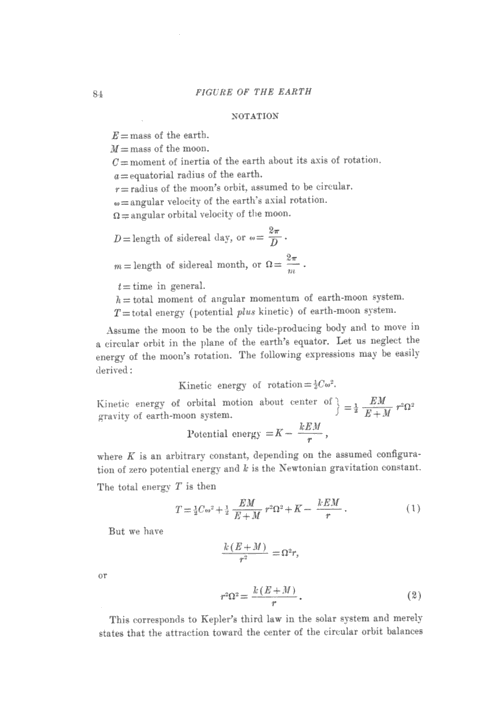
81 FI CURE OF THE EAR TH NOTATION E=mass of the earth. 11!=mass of the moon. C=moment of inertia of the earth about its axis of rotation. a=equatorial radius of the earth. r= radius of the moon's orbit, assumed to be circular. o.=angular velocity of the earth's axial rotation. Q-. angular orbital velocity of tile moon. D=length of sidereal clay, or o.= ~g . ret = length of sidereal month, or Q =-. r'', t=time in general. h=total moment of angular momentum o:t earth-moon system. T=total energy (potential plus }kinetic) o1: earth-moon system. Assume the moots to be the only ticle-producing body and to move in a circular orbit in the plane of the earth's equator. Let us neglect the energy of the moor's rotation. The following expressions may be easily derivecl: Kinetic energy of rotation = '°'C(, 2. Kinetic energy of orbital motion about center of :< ~ E.ll All ,ravity of earth-moon system. Potential Oll en lo,> = ~; _ 7cE lI - where K is an a,rbitrary constant,, depencling on the assumecl confi~ura tion of %ero potential ener,~y and k is the Newtonian gravitat,ion constant. The total energy T is then But we have or T= '-C(,, +' ~E~,~ r~Q3+K_ O'ER 7~ ( E + .11! ) _ it _ , ret q~,Q,= 7~(E+lI) r (1) (2) This corresponds to Kepler's third law in the solar system and merely states that the attraction toward the center of the circular orbit balances
TIDAL FRICTION 85 the centri]:'u~t,al force away from the center. By using (2 ), equation ~1 ) becomes T = -~-Co. 2 - -4; + 7t . ~ 3 The total Monet of rotation is found to be + L' - ~ ~ ~ The quantity 7~, is constant regardless of frictional resistance; this I'act is due to the principle that action and reaction are equal and opposite. Differentiate (3) and (4) with respect to the time. TVe know that it =0 and that 2~ has a value estimated from oceanic tidal friction; :t'or purposes of' numerical illustration we shall adopt Jeff'rey's value of' 1.l x ~ Oi9 eras per second. Alter some rather easy manipulation we find: dT d(,)_ dt dt C((,)-Q) dQ_3C do E+ d-l- dt JU~1Jr~ (is) Instead of' thin};in~ in terms ol' it and 2~ ~ the rates of change in the angular velocities, it seems a little more natural to evaluate the total accumulated chant,es in the lengths of the day and month over some ion<, period of' time, say a century. If' we treat the change as uniform over this period and let At represent one century expressed in seconcls, I'ro~n the first part of' equation (I) eve At i'or the change, ~D, ire the length of the sidereal day -D -~ t fit Its) ( 0)-Q ) (6) By calculation with this formula and JeE'reys' value of IT, we find that the sidereal day increases 0.00072 second in a century. The cor- respondin~, calculation for the month from the second part of equation (I) gives an increase off:' 0.012 second. An increasing period means an increasing, distance; the corresponding increase in r, the radius of' the lunar orbit, is 14~- meters per century. If it were possible to construct a clocl: that would run at an invariable rate and to regulate it exactly according to the earth's velocity: of' rotations
86 ,. FIGURE OF THE EARTH at the beginning of a century, then at the end of the century it would be 13.2 seconds last according to the stars. But in practice we keep time by the stars. If we waited for this 13.2 seconds to elapse, so that the earth might assume what we would consider its proper position with respect to the stellar universe, the moon would have advanced in its orbit by rY."2, which would represent an apparent acceleration of the moon's Otis. But tidal friction has been at work on the moon too, and during the century has retarded its motion by 4."4. The net apparent accelera- tion of tidal friction on the assumptions made is thus 2."8 per century. This is a quantity that increases as the square of the time.* Some approximations made in the calculation tend to reduce somewhat the computed acceleration. The actual acceleration may be determined by ~ study of the records of ancient solar eclipses, which, though not very precise, are valuable because of their relative remoteness in time, and of the occultations of stars by the moon, of which we have accurate records from the seventeenth century on; for more modern times we have also good observations of the meridian transits of the moon. These records show an acceleration of some 11" or Id" per century. Part of this is provided for in the ordinary lunar theory, quite apart from any con- siderations of tidal friction. The remainder is plausibly attributed to tidal friction and mainly, as has been said, to tidal friction in the shallow seas, for Jeffreys' estimate of a frictional dissipation of 1.! x i0~9 ergs per second provides for about 80 per cent of the needed acceleration. The figures here given do not correspond to the full 80 per cent. This is mainly due to omitting the tidal friction caused by the sun. The tidal friction caused by the sun, like that caused by the moon, tends to lengthen the day; but unlike the friction caused by the moon has little effect on the length of the month. In view of the uncertainty of the whole estimate, tidal friction might well provide for the whole of the otherwise unexplained portion of the secular acceleration. To show the uncertainty of the process of estimating we have only to note that Heiskanen 5 using essentially the same data as Jeffreys, found a dissi~a tion of 1.9 x 10~9 ergs per second, or about 70 per cent more than Jeffreys ~ did. * This is what the astronomers call the acceleration. It is half of what a physicist would be inclined to take as the measure of the acceleration. Thus the distance s travelled by a falling body is -hit, where t is the time and g the acceleration of gravity in the physicist's sense. According to analogy of the practice of astrono- mers in connection with the lunar theory, the acceleration would be fig. In read- ing Jeffreys' book,7 note that he uses acceleration in the physicist's sense. ~ Both Jeffreys and Heiskanen made the preliminary calculation for the diss.i- pation at spring tide. This is because most tide tables give data for spring tide. Jeffreys used a factor 0.51 to reduce from conditions at spring tide to a mean figure. The value 1.9 X 10¹⁹ ergs is obtained by applying this factor to Heiska.nen's
I/~[ F~Io~ 87 Ibus, as we bare seen; tidal friction in Me sb~lIQw seas is by itself capable of accounting for abut portion of the secular ~ccele~tion Off the moon not provided for hy We ordinary lunar theory. Ibus Iriction~1 resistance in the Bogy tides of the earth ~pp~en~ seems to be crowded out AS OD impact element in the case; ~ at Mast there ~ no urgent uccessit~; even on the showing gluey manes for assuming that it now plays an important part. Obese is indeed ~ reason of hotbed sort: presently to be giveD; for believing tat friction in the bogy tides is resistively small It is Jesir~ble, bovever, to consider at Last the theory of friction of this sort, for it is easier to form some Sort of ~ meIlt~1 picture of bow friction acts; wbere~s the preceding resUlts, tbougb SOUGH Cough seem to have beck derived ty ~ kin] of m~tbem~tic~1 jUgglery that gives US gut little UPON which our intuitions of space add of mecb~Di- Cal action can My bold. Moreover; the theory of friction in the body tides of Me ebb ma be used as ~ basis on which to develop ~notber method of estimating friction in the ocean tides ~ metbo] tat bus the double advantage of enabling ~n estimate to he made from data of ~ Ji~ereDt nature from those Just mentioned, and of lending itself better to the formation of ~ mental idea of the process. Suppose we leave the ocean out of consiJerndon for the moment ~] consider only Me body tides. If the substance of Ibid the ebb is compose] were frictionless there would he tidal swells abut reached their maximum at two points; Norma, the point fibers the moon I ~ in the zenith RD] the ~ntipoisl point where ~ is in the nadir. If, bow- ever, the e~rtb-sUtst~nce is not Irictionless, friction will tend to make it act to some extent hke ED inveigle body; 8~] the tidal hUlge tat it bus acquired wig he Carrie] fly the rbtad~ of the ebb to ~ position past the meridian of the moon. Ibe two maximum tiff bulges OCCUT in time after the moon bus passed the meridian of ~ given place (eitbeT at Upper or lower truant) RD] are four] in sp~cc along au axis in advance of the moons position in its ortiL See Figure 1. It is easy to see abut in this position the moon exerts ~ force on the tiff Bulges of the ebb tedding to retard its rotations Dud conversely the tiff bulges tend to increase the linear orbital velocity of the moon.: Ibis Act result for spring Odes. If me use Heisk~nen's reduction factor, ~bicb is lamer HID Jerseys) Me discrepant between the two ~im~te~ed ~ =~aud~ly the same data becomes even greater. * ~in) calculation dealt mosOy gab f~ct10n in We body tides of the egg and must now be read in the [gh1 of more modern developments t For (mplichy we ~E speak of the moon as if ~ were the only dde-producing body. t It may seem p~do~ic~I that an increase ig the Wider velocity of the moon tends to lengthen the month, but such is the case. This apparent paradox ~iH be . . . . . exp^ulDea in due course.
88 FIGURE OF THE EARTH appears whether we consider the total acceleration acting on the bulges ~ and B in Figure 1, or whether we consider merely the tide-producing acceleration, which is the resultant of the total acceleration due to the tide-producing I'orce of' the moon and the centri:f'ugal acceleration of the center of the earth due to the orbital motion. (See Figure 2.) If we / consider total force only ~ I ~ I l l it\ - 1 l / 1 1 ~ M t M 1 l l l l l :~?IG. 1. J 1 l FIG. 2. / ( Figure 1 ), and l'or simplicity replace the bulges A and B by hearty particles at these points, then it is easy to see that the component of' the :f'orce on A tending to retard the rotations of' the earth is greater than the correspoT~clin~ component at B. both because A is nearer the moon than B is, so that the force along, A)/I is greater than aloe,, BN1, and also 1~eca.use the line AM is more nearly
TIDAL FRICTION 89 perpendicular to AB than the line BM, and hence gives a greater compo- nent perpendicular to AB, which is the component tending to retard rotation. We must get the same result if we consider tidal forces only, as in Figure 2, for the tidal acceleration is merely the total acceleration com- bined with the centr;:tugal acceleration of the center of the earth; this latter component is the same for A and B and since these are on opposite sides of the center its effect on the rotation is null. For many purposes, moreover, it is more convenient to use the tidal force. By evaluating the expressions for the tidal force in the prime vertical we see that the forces on A and B (Figure 2) are numerically equal and that both teal to retard the rotation of the earth. The elevation due to the tidal bulge (y), positive or negative, for latitude ~ and longitude * A is given by the expression y=H cost ~ cos 2A. If now the angle A()M ~ between the meridian of the snoop and the meridian of magnum bulge be denoted by c, the couple, 1V, tending to retard the rotation is given by N ~ 1M (tat H sin 2 Here p is the density of the matter composing the bulge; ~ the other symbols have either just been explained or have the same meaning as in. equations (~) to (6), pares 84 and So. To get the rate at which e~.- ergy is being expended we must multiply N by ~-Q. the arl¢,ular velocity of the moon relative to a point on the earth. We thus get AT = ~ ~76~f 't [Ip sin he (~-Q). (7) Let us attempt to follow out the consequences of assuming that the tidal retardation of the earth's rotation and the consequent apparent acceleration of the moon are entirely due to friction in the body tides of the earth. For GG we shall <lssume as be-fore 1.! x 10~0 ergs per second, which, as has. been seen, is nearly- sufficient to account for the * The moon, as before, is assumed for simplicity to be in the equator; the longi- tude is reckoned from the meridian of maximum bulge. ~ In Figures 1 and 2, the letter " O ' should be supplied at the centers of the ellipses representing the earth, and also a line from B to A. ~ This assumes that the bulge is entirely in an outer layer of density p, and that the bulk of the earth beneath this layer suffers no tidal distortions. This is of course a. simplifying assumption but is adequate l;o give an idea of the order of magnitude of the quantities. involved\
90 FIGURE OF THE EARTH observed acceleration of the moon. The quantities E, p, and ~ depend on the physical properties of the earth, that is, on how the density, elasticity and viscosity vary from center to surface. If the viscosity is zero, ~ is zero, the tidal bulges A and B are in line with the moon, and no energy is dissipated. For simplicity we shall assume the physical proper- ties of the exotic constant throughout its mass. The mathematical developments for even the simplest cases are too lofts, and complicated to be given here; they will be -found in the world oil Darwin. The combination of elasticity Title viscosity is assumed to be according, to the Maxwell-Butcher law o-? elastico-viscosity. The coe~- cient of viscosity (v) tales the forms V IT (8) where ,u is the modulus of rigidity and ~ is the so-called time of relaxa- tio~-~; this ~ is the time in which the stresses sink to i/e part of their initial value.* Of this law Darwin remarries: ~ " The term elastico-viscous is used to denote that the stresses requisite to maintain the body in a given strained configuration decrease the longer the body is thus constrained, and this is undoubtedly the case with many solids. In the particular case which is here treated, it is assumed that the stresses diminish in geometrical progression, as the time increases ire arithmetical progression. If, for example, a cubical block of the substance be strained to a given amount by a shearing stress T. and maintained in that: nn~it:inn then after a time t. the shearin,, stress is Texp ( - - ). The time T measures the rate at which the stress falls off, and is called (I believe by Professor Maxwell) ' the modulus of the time o:t the :elaxation of rigidity '; it is the time in which the stress leas been reduced to c-i or .3679 of its initial value. ~] I do not suppose, however, that any solid conforms exactly to this law; but I conceive that it is often use:tu.1 in physical problems to discuss mathematically an ideal case, which presents ~ sufficiently marked likeness to the reality, where we are unable to determine exactly what that reality may be." Darwin also used the term "semi-elastic" as synonymous with "elastico-viscous." According to this law all substances to which a constant stress is applied :Ior a tinge and then removed would receive a constant " set," the magni- tude o:l: which would increase with the intensity of stress and lerlt,tI~ of: time for which it was applied, that is, such substances exhibit plasticity e is the base of the natural logarithm = 2.71828 .... 1/e = 0.368. The base of the natural logarithms is here called c.
TI~[ F~zcTIo~ 91 Under the action of Any atreaa, bomber appall Ibere is also the bypotbesis of Brmo-viacoaity; which may Be combine] him that of el~stico-viacoait>. [or ~ fuller discussion of the aUBject, reference May he acme to the work of Jeerers/ Trowel even frmo-Viacosi~ RD] el~stico-viscosity co~hinc] Jo not represent the full complexity of the n~tUr~1 pbenomen~ Jeerers; hovever, bus given reasons Ior believing Abut BTmo-viscosity is not im- port~nt in the case of We secular acceleration of Me moon, ~] so me mall confine the calculations to Me tr~0ition~1 case of el~stico-viscosity. Let us assume ~ modulus of rigidity aqua to 16.0 xlOll c.g.s. units, which is twice abut of steel and Ibid represents Ronald the mean e~ec- tive rigidity ic~uced from observations of ebb tides; and calculate ty Delvings formulas go ~ modulus of the time of religion of rigidity ~ (or mom trieby Me <; time of relaxation ~) corresponding to ~ dissipation of energy at the rate of 1.1 x TOlg ergs per second. Ibe details cannot be given here But ~ is Ionn] tat the maximum equ~101i~1 tiff protutcr- ~ncD is about 12 cm., the Anne between the axis of equ~tori~1 bulges ~] the meridian Plane of Me moon is 0° J53 and the time ~ r~ion for file Crib is about 1.8 x 10⁵ seconds; or ~ little over go Alas. As far as the earth tides alone ale collcerneJ, Mere is at present r~ reason Baby we sold not be gibing to accept this result Ibe tangle between the axis of tiff protuter~Dces ~d the meridian plane of the moon implies ~ lag in the obese of the observed ebb tides Rebind the corresponding please of the tidy forces. But this lag in pose Stolid in the present i~st~nce'5 be only 25~, ~] this is too small ~ quantity to LO detected vitb cert~iD~. Abe secondary erects of the owed Udrs Disturb the abase t~ amounts In larger than Aim Ibe most conclusive argument against attributing And great portion of the ret~rJ~tior of the Cribs rotation to tiff friction in the bogy of the earth comes Idiom the variation oI latitude. Wb~tever may be the C]USC of the 14-montb Cb~ndleri~n or prolonged nutrition of the Doles, it is IoulId fly otser~tion to Persist with little ii~blution of amplitude our periods of sever~1 dears. If; bowed the tiff dissipation of energy hos entirely in the body of go clothe which implies, as bus been scon, ~ Hmc of rcl~tion of the c~lth-suDst~re cqn~1 to gout two dam than ~ The brad 1~ ~ not the same as twice the angle bet~ecu the axis of hdu1 ~ ~ ~ ~ ~ ~ _ ~ protuberances and the moons merlulun plane. -lnls IS fine 1~ in Vellum of Lag oc6~Z earn [de, Me favor 2 ending hiccup the tide ~ s~idiu=~, but abet unsaved is the tidal defo~ion of the level surfaces near the ebb. On ~c- count of the method Of observation, this deformation is referred to the arty and ~ bigoted by the tide) in the soLd earth. Far restively large values of the time of relaxation, such as are bare considered, the observed lag in please is less than the rectum lag in pose of the earth tides; for subduer values, such as are used by Darwin the observed lag in phase may be greater than the rectum lag.
92 FI GURE OF THE EAR Y'H Lo the forces concerned in the Chandlerian Mutation, which is, ire fact, ~ sort of tide of long period, the earth would behave as if it were practi- cally fluid. The Chandleria.n Mutation could not exist; on the a.ssump- tions previously made, calculation shows that its amplitude would be reduced in the ratio 1: e in about eleven days. Thus the arguments in favor of the thesis that tidal dissipation of energy takes place chiefly in the hydrosphere and above all in shallow seas are: 1 ) that the best available estimates of the dissipation of energy ire the shallower seas give just about enough dissipation of energy to account for the apparent secular acceleration of the moon; 2) that the results of the assumptions of any considerable dissipation in the body of the earth would be in contradiction with the observed behavior of the Char~d- lerian nutation in the variation of latitude. The conception of the tidal distortion of the earth, elongation, the earth with the elongation in the general direction of the moon, but some- what in advance of it in space (reckoned in the direction of orbital revolutions ), is too useful in forming a. mental picture of how ticla1 friction acts to be summarily put asicle, in spite of the fact that friction ill the body tides of the earth appears to be relatively unimportant. The conception may be adapted to the case of the ocean tides and enables us to base an estimate of tidal friction on observational data different from those used in deducing the estimate so far used. The semidiurnal tides in the solid earth conform approximately to the equilibrium theory, that is, the two high tides lie in the line of the meridian plane of the moon. Except for friction the high waters would be exactly in this plane. But in the case of the ocean tides neither the equilib- ~iu~ theory nor any letdown modification of it is even a first ouch a~proxi~natioT~ to the truth. If we consider the tidally perturbed surface ,. . . v of the ocean at any instant, instead of its being, an ellipsoid it is an exceedingly irregular surface, A, B. C, D (Figure 3). But within this irregular surface, and in the mathematical sense a part of it, lies hidden, so to spear<, a re~,ula.r ellipsoid, E, F. G. H. This ellipsoid may be sepa- rated from the irregular tidal surface of the sea by the process of spherical harmonic analysis; furthermore, it appears that only this ellipsoid is needed for the calculation of the couple tending to retard the rotation of the earth and to increase the linear velocity of the moon; the remaining components which the spherical harmonic analysis requires to represent mat.hematicallyr the irregular surface of the sea are without effect on this couple.* * This is because the ellipsoid corresponds to a s,pherica,1 harmonic of the second degree. In the calculation of the moment the tidal height of the sea is multiplied by another second-degree harmonic and integrated over the surface of the globe.
TIDAL FRI C TI O1V 93 If we lo the form of' the tidal surface of the sea at any instant eve can deduce the ellipsoid that gives rise to this couple alla thus calcu- late'the rate at which work is beings, done. A picture of the tidal surface -H \W An\ - - - By FIC. 3. F - - TIC ma:: be deduced frolic a map of' the cotiLlal lines of the globe. Noxious sets of cotidal lines have been drawn which differ considerably in cletai.1 According to one of the fundamental properties of spherical harmonics only the second-degree component of the tidal height that is, the ellipsoid, contributes to the moment. All other spherical-harmonic components, when thus multiplied and integrated, give a zero contribution.
94 FIGURE OF THE EARTH and at various points exhibit more fundamental differences; still it may be said that, taking the world as a whole, there is a general re- sembla.nce among the more modern sets of cotidal lines. If we accepted any one of these we could calculate the rate of dissipation of energy at any instant during the lunar day by a process of mechanical quadrature. NVe are not, however, so much interested in the rate of dissipation at one or another instant as in. the average rate over a lunar day and this may be calculated once for all by mechanical quadrature. What is needed Is the amplitude of the tide and the lunitidal interval. If we denote the amplitude by A, and the lunitidal interval expressed in lunar time by c, we have for the average rate at which energy is dissipated cat = 3-7cplll 3 (0-Q) iiA cost ~ sin be dS. Here dS denotes an element of area and the two integral signs mean that the integration covers the entire globe. On land, A is zero.* The necessary quadrates have been made by Heiskanen 5 using Ster- ~eck's cotidal lines as a basis. Heiskanen found 2.0bx10~9 ergs per second as the rate at which energy is being dissipated at sprint, tides.: Obviously this :~<,ure is somewhat less for the mean tide than for the spring tide; the necessary reduction factor may be estimated at 3-. Still another reduction must be applied to allow for the yielding of the earth. Formula (8) is based on a calculation of the gravitational potential due to a load of tidal water on an unyielding earth beneath. But the actual earth yields and a given load produces less gravitational effect than if it stood upon an unyielding earth. The reduction factor depends on the constitution of the earth, in red ard both to density and elastic properties and on the extent ot the ioacl. nor a load represented by second-de~,ree spherical harmonic, and for an earth of uniform density and rigidity, the reduction factor is 0.8. For the actual earth it is even mnil~r r)~.rh~.r)s as small as 0.6.~ Takirlt, both reduction factors together ~ ~ 1~ ·- '' * The formula may be derived from quite a different method, that of consider- ing the work done against the tidal forces by the vertical rise and fall of the water. This is the method followed by Taylor and Heiskanen.5 ~ Heiskanen made the quadratures, as stated, but treated the result not as ~ different method of estimating the same quantity as had been derived from a study of the currents; but as a correction to the latter quantity. The subject is further discussed by Lambert.8 ~ See in this connection paper by L. Rosenhea.d on the Annual Variation of Latitude, in the Geophysical Supplement to' the Monthly Notice of the Royal Astronomical Society, Sol. 11, no. 2, May 1929. This same question of a. reductions factor for the yielding of the earth comes into the problem of the variation of latitude as in the problem of the tides; moreover, the spherical harmonics are of the second degree in both problems.
95 ~e sce tb~t roUghly ~e ~e~n r~te of dissIp~tio~ of energy ~s csti~tc] from tbe cotid~1 m~p of tbe glote is ~bo~t 1.0 x 101# in good ~greement ~ith the Ogure ott~ine] 1rom tid~1 cUlrents in sh~llov se~s. In viev of tbe uncert~int~ unic~l~ing thc d~t~ of toth mctbo~s thc closcncss of tbe ~g~ccmcnt mUst tc ~ttribUtc] to cb~nce. Hovever; tbe ~greement m~kcs US ~ [ttlc more con0dent of tbe ~>p~D~i~te gener~1 correctness of OUT cotid~1 m~ps. Ibe dissip~tion c~lcul~te] Irom ore~n curreuts c~n be only of one ~l~ebr~ic sT~n thc co~rcct one. bo~c~er erronro~ thr ~ ~ ~ ~ ~ ~ ~ O _, _ ~ ~ ~ v v ~ v ~ v ~ ~ v . . v . ~ ^ ~ ~ ~ ~ v ~ ~ ~ ~ ~~gnitude ~ight be; ~bere~s; ~dtb ~n erroneous ~oti]~1 m~p it voul] he entirely possitle to act ~ 1csult vitb ~ i~possiblc ~1gctf~ic sign. Tn thc mccb~Dic~1 qu~dr~ture c~lle] Ior ty fDrmul~ (8) so~e oI 81C elcmc~ts ~re posi6>e HD] s~me neg~tive. If tbe tides ever>~bere con- forme] to tbe cquilibriu~ tbeory; sll ele~ents voul] be zero Ber~use voul] tc zcro ~] tb~ zero result ~oul] inJic~tc thc ~tsencc of friction. zero result coul] ~lso tc rc~cb~] By ex~rt countert~l~ncing of poeitive d Ile~tive elemcnts. ~ sct of coti]~1 lincs tb~t ~oUl] ~ccomplisb tbis counterb~l~ncing might look just ~s complic~te], ~D] be ~s Ji~erent fro~ ~ set conformi~ to tbe equiLtriUm tbeory as ~re Sterneck~s cotid~1 [nes or ~ny oI thc othcr ~odcrn ones. BUt tbe ex~ct cou~terb~l~ncing of positivo ~n] neg~ti~e clcmcnts ~o~l] indic~tc ~c ~tsc~cc of friction. Tbis vould inJic~te tb~t thc m~I~ pecuIi~rities of the tiJes (if ve t~kc the eqniL#](u~ tbeory ~s ~ ~orm j: n~mel>: the irregUl~r v~ri~tions in Lbe r~: the 1~Tge v~Tues oF the lul~tid~l interv~ls; ~e <: ~s ~ of ~e v~rious tida1 ine-~l~ies ~n] tbe di~erc~ce Bet~een tbe aCtU~ r~ho of ~c v~rious tid~1 co~poncnts ~nd tbe thcorctic~1 r~tio of tbe cor- respondiDg Iorccs, ~11 thcsc could Be Juc; ~nd perh~ps i~ thc ~in ~re ]uc, to c~uscs other ~u tid~1 friction, n~mcl>; to thc ir~cgul~rities of tb~ oce~n t~sins hoth i~ Iorm oI peri~eter ~n] T~ Jeptb; ~n] to the rot~tion oI tbe e~rtb. Tbus f~r in tbe csl~l~ion of the hd~1 dissip~ti~ of enc~y ~c h~vc becn roDcerne] ~ith the r~tcs ~t ~bicb thc lc~gtb oI thc sidore~1 d~> ~d siicre~1 ~ontb ~re cb~nging. B~ either oT thc two ~il~Blc mctbods tbo r~te ~t ~hicb energy js Deing iissip~te] or vork Jone ty tbe tides is ~tout I.0 x IO10 ergs ~cr scconi, or; s~y Bet~een o~e ~0 two hibion ~ horsepover. The r~tes ~t ~hicb tbe i~y ~nd monib ~re cb~nging in consequence of tbTs iissip~Iion of cnc~g~ voUld b~ve ~ ncgligiLlc c~ert witbin histolic or C~Cn ~cccnt gcologic~1 timc. But it is intC~CStiDg to considcr ~b~t ~ight h~vc b~ppcnc] ~s ~ ~csult of [d~1 1riction iD thc remoter geologic~1 p~st. Oere thc~c is room o~l~ for ~ vcry tri~f t~c~t A trillion here mcuns onc thousu.nd ~~iIlion, or 10'}. 7
96 FIGURE OF THE EARTH ment of the subject. For a fuller discussion reference must be made to the writings of Darwin ~ ~ ~ 3' 4 and Jeff'reys.7 Friction obviously depends very largely on the outline and depth of the ocean basins. In the past this has been quite different from what it is now, especially as regards the shallow coastal seas, where, as we have seen, tidal friction is comparatively large. Geologists have reconstructed for us the map as it looked in past geological time, but our mathematical powers are entirely inadequate to the problem of determining a prior, from such a map what the tides and tidal friction were during some past geological era. Geologists tell us that at one time areas of shallow sea were much more extensive there now. This condition would make I'or increased tidal friction. But shallow seas by themselves are not sufficient to produce a great amount of friction. Conditions must be such that there must be a considerable tidal current in these seas, and free com- munication with an open ocean where large tides are found would gen- erally be required. How the rate of frictional dissipation of tidal energy during the era of extensive shallow seas compared with the corresponding rate today we are, therefore, unable to say. But some tidal friction must have been present always; accordingly as in imagination we go further and further back into the past we find the day and the month getting shorter and the moon getting nearer the earth. The decreasing distance of the moon implies that tidal friction would tend to be greater, other things being equal, in the past than it is now., for the f'riction-producing effect varies inversely as the sixth power of' the distance. The more rapid rotation of' the earth would diminish the period of tidal forces, that is, the time of a tidal oscillation. If the tidal load of water to be shifted from one place to another and back to its original position within the tidal period remains the same, the shortened period means a more rapid transfer and therefore greater friction. The general tendency would thus be for the effects of tidal friction to develop at a more rapid rate in the remote past than now. If the moon in the past was much closer to the earth than it is now, might it not have been at one time almost in contact with it, thus raising enormous tides? ~ If' we look still farther bacl<, might not the * In. reading Darwin it must be remembered that he wrote with the idea that most of the tidal friction would be found in the body of the earth rather than in the ocean waters; this is the opposite of the view now generally accepted. But friction, wherever it may be found, is still friction, and affects the length of the day and month. Darwin's calculation of the heat developed by tidal friction in the interior of the earth must, however, be accepted with appropriate reservations. ~ When the moon is very near the earth the customary approximation by whirls the tidal forces and the tidal protuberances (of the earth tides) on opposite sides of the earth are equal becomes inadequate. Tidal forces depending on the fourth
TIDAL FRICTION 97 moon and the earth have formed a single body'? These ideas are the germ of Darwin's theory of the origin of the moon. He supposes that the rotation of the earth was originally so rapid that the solar sem;- diurnal tides had a period approximating to the natural period of vibra- tion of the earth for a disturbance of the tidal type, that is, a period o-t' about two hours. The near coincidence in period of the free vibration of the earth with the forced tidal vibration raised such enormous solar tides that the earth was disruptecl. A fragment separated from the parent earth and formed the moon. Since the separation there have been lunar tides also; and tidal i'riction leas done the rest, lengthening the day and month and malting the moon recede from the earth. This is merely a very brie:t' and inadequate statement of:' a plausible but not ur~iversall~r accepted speculation. For I'urther discussion of' this theory End for the tracing out of:' the supposed future evolution of the earth-moon system under the influence of' tidal 'friction, reference must again be made to the authors already mentioned. Another interesting speculation regarding the effects of tidal friction arises in connection with the variation of latitude. If the earth in the past rotated more rapidly it would have been more flattened, its natural free period for the motion of the pole, now fourteen months, would have been shorter arid might have coir~;ded at a~ epoch. sufficiently remote with the year, the period o:t' forced oscillation due to seasonal effects. With the free and -i'oreed periods coinciding, resonance Plight be expected; that is, large excursions of the pole :L'rom its mean position arid in con- sequerlce large stresses in the earth, perhaps large enough to cause rupture, also a large latit.ude-va.riation tide. The change in the velocity of rotation needed to reduce the free period to one year on the supposition that the constitution of' the earth remains unaltered is about six per cent, corresponding to a decrease of 1.4 hours in the length of day. If' we talkie an average decrease at the rate of 0.001 sec. per century, about half a billion years would be needed to decrease the clay by this 1..l hours. According to currently accepted estimates of the age of the earth an era half a billion years ago is rather ancient geological history, but it would belong to geology rather than to cosmogony. In order to account for climatic and other phenomena of past geologi- cal time, geologists have sometimes postulated large displacements of' power of the moon's distance and involving third-degree spherical harmonics can no longer be neglected? as in the customary approximation, and these tides made the protuberance under the lagoon higher than that on the opposite side of the earth.
98 FIGURE OF THE EAR TH the pole. But such shiftings of the pole as the geologists clesire, in general require more extensive displacements of matter on or within the earth than neologists are willing to accept. The phenomena of tidal friction suggest, however, that the pole might on one occasion have undergone a fairly large displacement and that without any great displacement of mass. In the preceding discussion the inclination of the lunar orbit to the equator has been neglected. The fact that the moon does not move in the plane of the equator, but in an orbit the average inclination of which to the equator is nearly equal to the obliquity of the ecliptic, introduces other effects of' tidal friction. The most important of these is a tendency for the obliquity of the ecliptic to increase. The existence of this tendency seems to be contradicted by the fact that obliquity of the ecliptic is now decreasing at the rate of' some 47'" per century. This clecrease, how- ever, is due to the complicated gravitational interactions among the members of the solar system and does not represent a permanent state of affairs; for the ~resent. however. the tendency of the obliq u-itv to decrease much tidal friction. ~., more than counterbalances the contrary small effect of NVe now return to the postponed question as to why the moment due to I'riction which obviously retards the axial rotation of the earth should also slow clown the Notion of' the moon and tend to push the moon farther away from the earth. At -first ,la~-~ce it should appear that the moment would make the snooty move -['aster and would have no effect on the distance. Suppose the orbit of' the moon to be originally circular and a tangential impulse to act at A for an instant in the direction of motion, thus increas- ing the velocity; what is the effect on the shape of the orbit'? Evidently, because of the inertia of the moon, the new orbit is no longer circular but elliptic with the apogee lying in a line parallel to the direction ol' the impulse and in the sane direction. The major axis is thus increased by the impulse and according to K:epler~s third law this increase is accompanied by an increase in the time of revolution or a decrease in the mean angular velocity. The effect of' tidal friction may be compared to a succession of very minute impulses acting, in succession all around the orbit. The effect of these impulses-is not to elongate the originally circular orbit into an ellipse with its major axis in a fixed direction (as a single impulse would have done) but on account of inertia gradually to open out the orbit into a very slowly increasing spiral. At any given point in the spiral there is a difference in direction between the direction of' a tangent to the spiral at the center of' the moon and a tangent at the sense point to a circle the center of' wl~icl~ is at tl~e center of' the earth.
TIDAL FRICTION 99 The central force due to the earth leas Rio component whatever in the direction of the tangent to the circle and hence no effect either of accelera- tion or retardation. But. in the direction of Else ta,n`~ent to the spiral the central force evidently acts to retard the orbital motion. The angle between circle and spiral is small so that this retarding effect of the central force is very minute; but the central force is so much larger than the pull of the tidal protuberance, which acts to accelerate the orl~ital ~notion, that the central force prevails and the net effect is ~ retardation o-L' the orbital notion. REFERENCES 1. Darwin, Sir G. H. On the bodily tides of viscous and semi-elastic spheriods and on the ocean tides upon 3~ yielding nucleus. Phil. Trans. Roy. Soc., 170: 1 (1879); Ol, Scientific Papers' Cambridge (Eng.), 2: 1 (1908). 2. . On the procession of a viscous spheroid, and on the remote history of the earth. Phil. Trans. Roy. Soc.' sol. 170, pt. 2: 447; or, Scientific Paper, 2:36. 3. . Problems connected with the tides of a viscous spheroid. Phil. Trans. Roy. Soc., vol. 170, pt. 2: 539; or, Scientific Papers, 2: 140. 4. . The tides and kindred phenomena of the solar system. 3rd ea., London, 1911. 5. Heiskanen, W. Uber den Einfluss der Gezeiten auf die sakulare Acceleration des Mondes. Annales Academiae Scientiarum Fennicae, 18A: 1 (1921). 6. Jeffreys, Harold. Tidal friction in shallow seas. Phil. Trans. Roy. Soc., 221A: 239 (1920). 7. . The earth, its origin, history and physical constitution. 2nd ea., Cam- bridge (Eng.), 19291. (Particularly Chap. 14.) 8. Lambert, W. U. The importance from a geophysical point of view of a knowI- edge of tides in the open sea. Union Geodesique et Geophysique Inter- nationale. Section d'Oceanographie. Bulletin No. 11: 52 (1928). 9. Taylor, G. I. Tidal friction in the Irish Sea. Phil. Trans. Rov. Soc. 220A: 1 (1919).
