
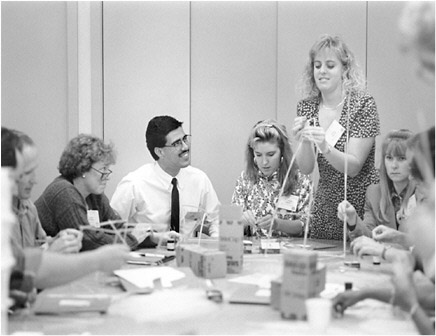
5
Preparing Teachers for Inquiry-Based Teaching
For students to understand inquiry and use it to learn science, their teachers need to be well-versed in inquiry and inquiry-based methods. Yet most teachers have not had opportunities to learn science through inquiry or to conduct scientific inquiries themselves. Nor do many teachers have the understanding and skills they need to use inquiry thoughtfully and appropriately in their classrooms.
What do teachers need to know and be able to do to use inquiry effectively? What kinds of professional development can help prospective and practicing teachers both develop and use inquiry-based strategies?
The National Science Education Standards — and particularly the standards for the professional development of science teachers — are a useful organizer for these questions. In the context of inquiry, these professional development standards can be organized into four categories:
-
Standard A: Learning Science through Inquiry
-
Standard B: Learning to Teach Science through Inquiry
-
Standard C: Becoming Lifelong “Inquirers”
-
Standard D: Building Professional Development Programs for Inquiry-Based Learning and Teaching
The latter part of this chapter is organized around these four themes. The chapter begins, however, with a broad overview of the role professional development can play in redirecting teaching and learning toward inquiry.
THROUGH A TEACHER’S EYES: A VIEW OF PROFESSIONAL DEVELOPMENT FOR INQUIRY-BASED TEACHING
In the following vignette, Steve, a high school physics teacher, reflects on the three-year professional development program that led to his Master of Arts in Teaching Integrated Sciences. His story raises important issues about teachers’ motivations, values, understandings, and experiences as they learn about inquiry and about how to teach science using inquiry.
|
state’s science content standards, which had been developed to be consistent with the National Science Education Standards. Furthermore, the assessments I gave students at the end of the unit demonstrated to me that they had learned more about energy than when I had taught it in earlier classes. One of my previous ideas about inquiry was that it consisted mainly of doing laboratory activities. I discovered that, although labs can aid in the process of sense-making, they often don’t because they are either “cookbook” (they don’t allow the students to make choices or judgments) or “confirmatory” (they follow lectures or students’ reading). What I have realized is that the essence of inquiry does not lie in any elaborate, equipment-intensive laboratory exercise. It lies, rather, in the interactions between the student and the materials, as well as in the teacher-student and student-student interactions that occur dozens of times each and every class period. One way that we learned about student-teacher interactions in my program was through a series of videotapes of teachers. We also were encouraged to try our hand at such behaviors as listening, clarifying statements, and open-ended questioning. I found myself responding to students with statements like, “Tell me more about Y,” “What is the evidence for that conclusion?” and “How did you decide on that explanation over the one you were convinced of yesterday?” I tried more small-group activities that were structured to encourage the team members to talk, debate, and come up with predictions based on initial observations and with explanations based on evidence. I informally assessed my students’ knowledge almost daily. Frequently, I began lessons with activities to set the context for helping students discuss conceptual ideas and make my presentations more meaningful. Another major step I took in my growth as a teacher was to begin allowing student questions to influence the curriculum. Instead of always framing the questions myself, I encouraged the students to pose questions that arose in their minds. This idea was a revelation! Listening to the students’ questions has uncovered countless points of confusion that otherwise would have gone completely unrecognized. As part of my masters program, I decided to monitor how much I was listening. I recorded the amount of time I was talking and the amount of time my students were talking. At first, the proportion of teacher/student talk time was approximately 80/20. By midway through the first semester, this proportion had been exactly reversed. This small piece of research was a turning point in my appreciating the value of teaching through inquiry. Our professional development program allowed ample time during each of our classes for us to talk with each other about our recent “experiments” in our classrooms. Although the group was quite diverse in backgrounds and grades taught, those conversations were important to my growth and encouraged me to keep trying inquiry approaches. As I reflect on the three years I spent in the program, I know I gained immensely from the other teachers and from the education faculty and scientists with whom we worked closely. |
Steve’s account reflects some concerns that are common among teachers early in their exploration of inquiry. Initially he perceived that his teaching was already successful and that an important part of his role as science teacher was to help students become familiar with the myriad facts and concepts of science. Yet he also suspected that his students were not really learning (and retaining) what he wanted them to know. And he knew he was neglecting the need to help his students learn inquiry skills and understand how scientists used those skills to produce knowledge.
Steve came to see that moving toward inquiry-based teaching meant adopting a different role as a teacher. He created more opportunities for his students to explore ideas alone, with materials, and with each other. He listened more so he could learn what they understood and misunderstood, what they were thinking, and what they were learning. And he learned to structure his lessons around “big ideas” rather than around the facts and formulas that he had previously seen as central to the discipline of physics.
Steve’s reflections demonstrate many of the changes that can reorient teaching toward inquiry. He is using inquiry in all three of the ways specified by the Standards by teaching inquiry abilities, an understanding of inquiry, and science subject matter through inquiry. He is paying more attention to student questions and creating opportunities for them to collect evidence and use it as the basis for explanations, and he is doing this before he presents material to them rather than after.
Steve’s reflections also point out some important features of professional development for inquiry-based teaching. One is the need for teachers to do inquiry to learn its meaning, its value, and how to use it to help students learn. Another is the importance of a community of teacher-learners that mirrors scientific communities. According to the Standards, such communities both challenge and support the development of knowledge by scientists, students, and, in this case, teachers.
Steve’s reflections also demonstrate that it can take a significant amount of time to make transformational changes in teaching. Steve’s program included six-week-long summer institutes and monthly academic-year seminars. By his own account, Steve was able to make headway on his journey to inquiry-based teaching but by no means reach a final destination. Finally, the professional development in which Steve engaged gave him a wide range of opportunities with inquiry, from field work to inquiries fed by the literature to inquiries into his own classroom behaviors, such as his research on teacher-student talk time.
Steve’s experiences provide a basis
from which to explore the four main topics discussed in the professional development standards, beginning with how teachers learn the science they need to know to do inquiry-based teaching.
LEARNING SCIENCE THROUGH INQUIRY
Teachers have very different levels of knowledge and skills in science. Prospective teachers in colleges and universities may have only high school science courses behind them. Experienced teachers who are certified in other fields may find themselves teaching science. Veteran science teachers or scientists who aspire to
teach may have a strong but traditional science background or may be teaching a science different from their background. All may find themselves challenged by the need to learn more or a different kind of science.
To teach their students science through inquiry, teachers need to understand the important content ideas in science — as outlined, for example, in the Standards. They need to know how the facts, principles, laws, and formulas that they have learned in their own science courses are subsumed by and linked to those important ideas. They also need to know the evidence for the content they teach — how we know what we know. In addition, they need to learn the “process” of science: what scientific inquiry is and how to do it.
But how can teachers learn the major ideas in the scientific disciplines? There are many possibilities, from formal preservice or in-service classes, to independent programs of study, to serious reflection on their interactions with students in their inquiry-based classrooms. The next three vignettes in this chapter describe a range of science courses and professional development experiences that give teachers an opportunity to learn the major ideas of science disciplines through inquiry. The first vignette tells the story of a university-based physicist who teaches teachers within the structure of a university course. The second describes the experiences of a teacher taking part in that same course. And the third tells of a kindergarten teacher who is immersed in science at a program in a science museum.
Besides changing the traditional lecture approach in a science course,
some college professors have developed special science courses for K-12 teachers. The Physics Education Group in the Department of Physics at the University of Washington offers special courses for both preservice and inservice teachers. The curriculum is based on Physics by Inquiry (McDermott et al., 1996), a set of laboratory-based modules that have been developed on the basis of research on the learning and teaching of physics. (References to relevant research can be found in McDermott and Redish, 1999.) The courses help teachers develop a functional understanding of important physical concepts. This level of understanding
|
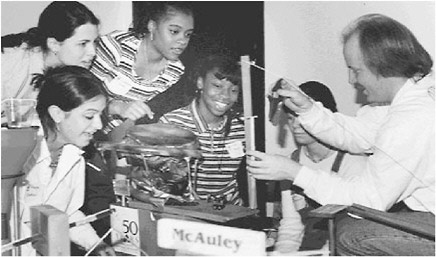
A University-Based Physicist Discusses Concept Formation in the Laboratory: Lillian’s Story The curriculum used in physics courses for teachers should be in accord with the instructional objectives. If the capacity to teach “hands-on” science is a goal, then teachers need to work through a substantial amount of content in a way that reflects this spirit. However, there is another compelling reason why the choice of curriculum is critical. Teachers often try to implement instructional materials in their classrooms that are very similar to those that they have used in their college courses. Whether intended or not, teaching methods are learned by example. The common tendency to teach physics from the top down, and to teach by telling in lectures, runs counter to the way precollege students (and many university students) learn best. Therefore, courses for precollege teachers should be laboratory-based. In the curriculum that we have developed and use in our courses for preservice and inservice teachers, all instruction takes place in the laboratory. The students work in small groups with equipment similar to that used in precollege programs. The approach differs from the customary practice of introducing a new topic by stating definitions and assertions. Instead, students are presented with a situation in which the need for a new concept becomes apparent. Starting with their observations, they begin the process of constructing a conceptual model that can account for the phenomenon of interest. Carefully structured questions guide them in formulating operational definitions of important concepts. They begin to think critically about what they observe and learn to ask appropriate questions of their own. As they encounter new situations, the students test their model and find some instances in which their initial model is inadequate and that additional concepts are needed. The students continue testing, extending, and refining the model to the point that they can predict and explain a range of phenomena. This is the heart of the scientific method, a process that must be experienced to be understood. To illustrate the type of instruction summarized above, here is a specific example based on a topic included in many precollege programs. It describes how we guide |
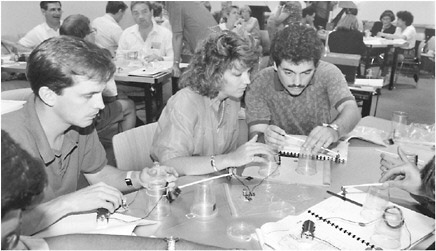
connotes the ability to do the reasoning necessary to apply the concepts to new situations. Lillian’s story tells how the program is structured.
In Lillian’s story, we see the instructors’ decision to guide the learning process so that the college students are forced to confront difficult conceptual ideas and to go through the reasoning necessary to reach their own understanding. Generalizations and elucidation of general principles come after experience and in iterative fashion. They are not presented first as a base for students’ investigative work. The guided activities are purposely selected by the instructors based on years of prior experience with college students (including teachers) and extensive knowledge of students’ typical thinking about key ideas in physics. Carefully chosen questions are designed to elicit debates and hard thinking about these ideas based on guided investigations, related readings, and small group and individual work. Specific laboratory investigations have been selected by the staff — activities they know will cause the students to confront their existing beliefs about physics. This guided inquiry is essential at the introductory level so that the students can later use their developing knowledge and conceptual understanding to dig more deeply into the key ideas of physical science. The University of Washington program is based on the belief that both lecturing on basic principles and providing unstructured lab time are less effective strategies for bringing about student growth in conceptual understanding and reasoning skills.
Below, in Lezlie’s Story, we see the impact of this type of instruction on an elementary school teacher. Lezlie was at the beginning of her career when she first participated in the NSF Summer Institute for Inservice Teachers at the University of Washington. Today, more than 25 years later, she reflects on how her experience in the program has affected her professional development as a teacher.
|
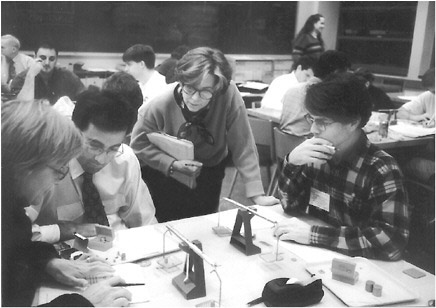
An Elementary School Teacher Reflects on her Learning and Teaching Through Inquiry: Lezlie’s Story In late spring of my first year of teaching, I was informed that a drop in enrollment would result in the elimination of the 2nd grade position that I held. The good news, however, was that I was welcome to take a newly-created position as the science specialist for grades K-4. Not wanting to relocate and not stopping to consider that my major in French might not have appropriately prepared me for this new position, I |
|
quickly agreed to take it for the following year. The district science supervisor suggested that we start with a couple of Elementary Science Study units, Clay Boats and Primary Balancing. The unit guides and equipment were ordered. I was all set to begin my new teaching role. Never having had a science lesson in elementary school, I was not predisposed, as I had been with the other subjects, to teach it as I had been taught. In fact, without any real textbook to guide the students, I was left with the materials and a few general instructions in the teacher’s guide. And so it was that my students and I became “explorers of materials.” We had a great time. The students were engaged. They talked a lot about what they were doing and we all asked a lot of questions. But I wanted to do more than just explore and ask questions. I wanted to learn some basic principles and have a clear vision of where we were going. I wanted to lead my students to discover and understand something. But what was it that we should understand? I hadn’t a clue. This is when I first came to recognize that if I were to become a truly effective teacher, I would need scientific skills and understandings that I had not been required to develop during my undergraduate years. Not long after this recognition of my deficiencies, I happened to glance through the school district’s newsletter, and came across a notice for a Summer Institute in Physics and Physical Science for Elementary Teachers. I applied and was accepted. The professional development provided by that first summer’s intense coursework was the first meaningful education I had experienced since high school. Nothing I had been exposed to in college had really addressed what I needed to know to guide my students to develop the conceptual understanding and thinking and reasoning skills needed to make sense of the world around them. I walked away from that summer feeling that my brain had been to boot camp. No course of study, no one teacher had ever demanded so much of me. I had never before been asked to explain my reasoning. A simple answer was no longer sufficient. I had been expected to think about how I came to that answer and what that answer meant. It had been excruciating at times, extricating the complicated and detailed thought processes that brought me to a conclusion, but I found it became easier to do as the summer progressed. I also began to realize that just as important as what I came to understand, was how I came to understand it. Through the process of inquiry, I had come to an understanding of content that I had always felt was beyond me. I wanted to be able to ask the questions that would lead my students to the same kind of understanding. The key to the questions was first understanding the content. The content had been the focus of the summer institute and as a result I had developed a conceptual understanding of several basic science concepts including balance, mass, and volume. Along with these concepts I had discovered an appreciation for the need to control variables in an experiment. I was now better equipped to take a more critical look at the science units I had used the previous year. I recognized that Clay Boats had probably not been the best choice for a teacher with only a budding understanding of sinking and floating, but Primary Balance seemed to be an appropriate choice since I had explored very similar materials and had some ideas of how I could lead students to discover, through experiments in which they would come to understand the need to control variables, which factors seem to influence balance and which do not. |
|
students clear. I am well acquainted with this terrain, because I have traversed it on more than one occasion myself, and have conversed with others who have, perhaps, taken a different path to the same destination. It is in this way that I can offer guidance to my students, so that they may not wander too far from a fruitful path. I want them to encounter some difficulties and to resolve conflicts and inconsistencies, and to grow intellectually from these experiences. But I do not want them to wander aimlessly or to plunge headlong over a cliff. I want them to arrive at the destination relatively unscathed. For this reason it is crucial, that like a vigilant parent, I continue to offer support in their intellectual insecurity. I question and listen carefully. I scan the territory to find where the explanations and responses to my questions place them, and then plan my next strategy to keep them moving ahead. I recall from my own experience as a learner that sometimes this next strategy is a question such as, “What would you need to do to find out?” Sometimes it is a suggestion of some experiment to try. And sometimes it is a comment such as, “Why don’t you think about that for a bit.” It has only been through many years of trying these strategies out that I have learned to gauge which tactic is appropriate at what time and with which student. There are, of course, other considerations in the teaching of inquiry-based science to elementary students. Engagement has never been a problem for the students with whom I have worked. Science is naturally engaging. Developmental appropriateness is another matter. I have come to a much clearer recognition of what will “fly” and what will not as a result of the research-based curriculum I worked through in the summer institutes. These materials were carefully designed to build conceptual understanding in logical, sequential steps. You do not, for instance, begin to think about why things sink or float without first developing an understanding of what we mean by mass, and what we mean by volume, in terms of concrete operational definitions. Only then can one begin to think about how these two variables may influence sinking and floating. In summary, the most important step for me in becoming a more effective teacher of science was gaining a sound understanding of the subject matter content. It was equally important that this content was learned in an environment of inquiry-based instruction. It was then necessary to reflect on my experience as a learner so that I could put into practice what had been modeled for me. Finally, I must add that it is essential to take a critical look at what we are doing and to evaluate what is working and what is not. If what we are doing does not result in a better understanding of the content by our students, it could be that the problem lies with us and not with them. |
This description illustrates a change in college science coursework toward a more inquiry-based format and its impact on a teacher’s knowledge and skills. University coursework, which traditionally has been didactic with hands-on activity relegated to labs that confirm the lectures or reading, has been a source of concern to many involved in K-12 teaching and learning. Numerous reports emphasize the necessity of changing the way science courses are taught to teachers (AAAS, 1990; Project Kaleidoscope, 1991; NRC, 1996). Some provide examples of inquiry-based teaching at the university level and strategies for doing so (NRC, 1997). Still others strongly recommend that every undergraduate preparing to teach have as part of their coursework the experience of engaging in original research under the supervision of a research scientist (NRC, 1990). The above description also illustrates a change in college science coursework toward an instructional sequence that is inquiry-based. It demonstrates the important features of beginning with exploration of a phenomenon, delaying the teaching of terms and principles until they are needed, emphasizing the formation of concepts, and applying newly learned concepts to other situations. The result is mastery of subject matter
|
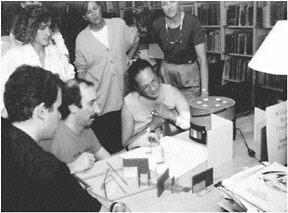
A Kindergarten Teacher Learns Inquiry at a Science Museum: Joanna’s Story How do I design a classroom environment that facilitates children’s efforts to conduct investigations? How do I behave to promote, support, and observe inquiry? I had been teaching kindergarten for many years before coming to a two-week workshop on light and color at a prominent science museum. I was ready to learn a new way to teach science. I was convinced that traditional approaches were not giving my students a sense of the skills they would need to succeed in later science courses and in a technologically advanced world. But instead of learning about teaching, we began as learners of science. First the instructors set the stage for a long-term inquiry. We played with different ways to mix colored pigments and colored light. I had always believed in hands-on activities for my students, but I had never had the opportunity to engage in a long term investigation of my own — I had only taken high school laboratory classes where you filled in the blanks on worksheets. What a surprise doing an inquiry turned out to be! I thought I knew about hands-on science, but I discovered that there is big difference between inquiry and hands-on. From the starting points provided to us by the staff, we came up with a series of questions that would guide our investigations. The staff told us that, like scientists, we might take some twists and turns, but that the time spent on our investigation would |
with deep understanding through inquiry. This form of teaching also enhances students’ understanding of the process of scientific inquiry itself.
Joanna’s experiences illustrate the explicit teaching of inquiry to teachers as learners. As she and other participants explored light and color, they came to understand inquiry as a long-term and often unpredictable process. They learned how to learn with and from others pursuing similar scientific questions, the importance of models and materials, and how to communicate their findings to others. The workshop gave them an opportunity to “immerse” themselves in the essential features of classroom inquiry and to learn many important scientific concepts related to light.
As illustrated by the three vignettes in this section, learning science through inquiry gives teachers opportunities to learn firsthand several essential aspects of inquiry-based teaching:
-
How both science subject matter and inquiry outcomes can be built into learning experiences.
-
How a deeper understanding of scientific concepts can promote discussion and the formulation of productive questions.
-
How the essential features of classroom inquiry can be woven into a learning experience.
-
What it feels like to learn this way, complete with frustrations and struggles.
-
What roles and behaviors instructors can use that promote and support learning.
LEARNING TO TEACH SCIENCE THROUGH INQUIRY
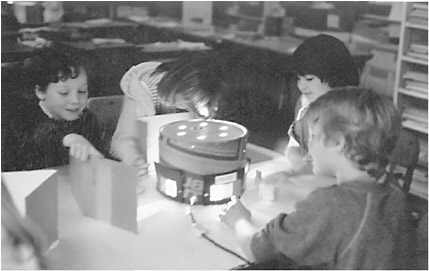
As important as it is for teachers to understand inquiry, develop their skills of inquiry, and learn science concepts through inquiry, teachers also need to learn how to teach this way. This can be done through professional development that extends their own inquiries to the implications for their teaching. Or it can be done through professional development designed especially to help teachers teach through inquiry. The following vignette illustrates the former through the continuation of Joanna’s story: how this kindergarten teacher carried her learnings back into her classroom.
|
I have noticed that many kindergartners do not have the language skills to express their questions, but that they often ask questions with their bodies by moving objects around. I help this ability along. I model the beginning of questions by saying: “I’m going to think out loud now — I’m wondering how I can find out if this prism will work if I move it to this side of the window — that’s asking a question.” As students are working with the mirrors and light, I model how to ask their questions. For example, I’ll say: “I see by the way you are moving that mirror that you are wondering, ‘Can I bend the light?’” I copy down students’ questions and post them for all to see. I allow time for free exploration with materials in a safe environment, so that mirrors and prisms are as much regular parts of the classroom as are paints and sand. Now that I have learned how to set up the classroom environment, I am trying harder to listen to their questions, watch their actions, and gently guide small groups into planning and conducting longer investigations. Looking back, I can see how my own experience with inquiry has shaped how I work with my students. I want them to experience the curiosity, success, and perseverance that I felt. I know that they can accomplish much with the right kind of teaching and that their feelings of competence grow with each step along the way. I feel that I am helping students to learn for themselves to become independent thinkers, a skill that will serve them well in their future schooling. And they will never look at light, shadow, and color the same way again. |
Joanna’s story demonstrates her continuing development of “pedagogical content knowledge,” a term coined by Lee Shulman (1986) to represent a third component of teaching expertise that is unique to teachers. Pedagogical content knowledge is the integration or synthesis of teacher’ pedagogical knowledge (what they know about teaching) and their subject matter knowledge (what they know about what they teach) (Cochran, 1992). As Shulman (1986) notes, pedagogical content knowledge
… embodies the aspects of content most germane to its teachability. Within the category of pedagogical content knowledge I include, for the most regularly taught topics in one’s subject area, the most useful forms of representation of those ideas, the most powerful analogies, illustrations, examples, explanations, and demonstrations — in a word, the ways of representing and formulating the subject that make it comprehensible to others… [It] also includes an understanding of what makes the learning of specific concepts easy or difficult: the conceptions and preconceptions that students of different ages and backgrounds bring with them to the learning (p. 9).
As an example, experienced biology teachers planning a unit on photosynthesis draw on their peda-
gogical content knowledge when they know the specific ideas students are likely to bring to the classroom (such as the idea that plants get their food from the soil), the ideas most likely to be difficult (such as how ATP-ADP transformations occur), and how to best deal with these difficult concepts using examples, analogies, models, and demonstrations (Hashweh, 1987). In Joanna’s case, her experiences with inquiry learning and teaching are building her pedagogical content knowledge. Her understanding and abilities of inquiry were sharpened in the museum program where she learned to ask good questions and design investigations to gather evidence she could use to explain
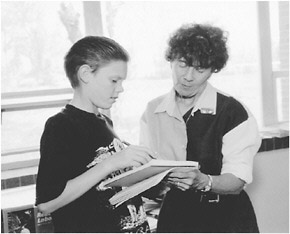
the observations that piqued her interest. As she engages her own students in inquiry, she has become conscious of how they learn to ask questions about scientific phenomena and how she can help them do so. She observes how they combine their developing language skills with use of their bodies. She is learning what materials stimulate her children and help them develop explanations of light and color. She has arranged the learning environment to reflect all of the essential features of classroom inquiry.
Joanna’s professional development program emphasized her experiences with inquiry and focused less on how she could bring these into her classroom. Other kinds of professional development programs focus more directly on inquiry-based teaching. They help teachers think in new ways about what they want their students to learn, how they can help them learn it, and how they will know whether and what students have learned. They focus more directly on strengthening teachers’ pedagogical content knowledge in science.
Preservice or graduate courses and in-service workshops are still the most prevalent formats for teachers to develop and improve their inquiry teaching. But many other strategies also are being used throughout the country to help both prospective and practicing teachers learn more about teaching science through inquiry. Loucks-Horsley et al. (1998) have identified 15 different strategies for professional development, including case discussions, examining student
work, action research, study groups, technology-based learning, curriculum implementation, coaching and mentoring, and immersion in scientific inquiry (the approach taken in Joanna’s workshop). Their research suggests that strategies in which teachers study their own or others’ practice are especially powerful in building their knowledge of how students learn most effectively. Some examples of this kind of professional development are the study of videos of classroom teaching; discussion of written cases of teaching dilemmas; and study of curriculum materials and related student work (assignments, lab reports, assessments, etc.).
Written teaching cases and videotapes of teaching are especially useful in allowing teachers to examine many aspects of inquiry-based teaching and learning. Student thinking can be analyzed as students respond to problems or questions posed by the teacher or to those that they themselves have posed. Teachers can study the responses given by the teacher in the video or case study and the effect of those responses on the students. They also can consider the teaching decisions that were or could be made to help the students learn.
Looking at student work, such as the write-up of an inquiry or the results of a performance assessment, can be a valuable process for teachers. A number of questions can be asked and discussed about the student’s inquiry abilities. Has the student asked a question that can be addressed? Does the design of the investigation demonstrate that the student understands how to control variables? How elaborate is this student’s explanation? Is it based on evidence? Has the student applied his or her new knowledge appropriately to this new situation?
Working with curriculum materials can take many forms. Teachers can work through lessons to learn inquiry and science subject matter as well as to analyze what students will learn, where they might have trouble, and how teachers might help at those points. Teachers can try out a “replacement unit,” substituting an inquiry-oriented unit for one in their current curriculum. Or teachers can analyze how students are learning a particular set of outcomes from a unit that the teachers are all teaching at the same time.
The following vignette illustrates several of the ways teachers can learn and practice their teaching of inquiry using a new set of curriculum materials.
|
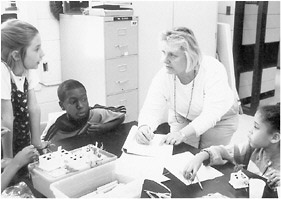
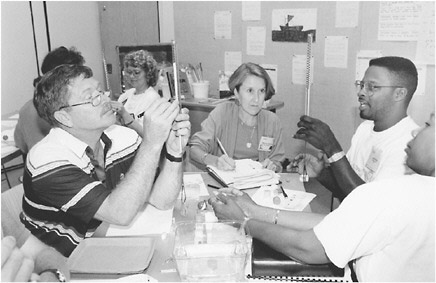
A Fifth-Grade Teacher Learns to Teach Through Inquiry as She Works with New Curriculum Materials: Sandy’s Story I used to lack confidence about teaching science, largely because my own science background was limited. I tended to put my efforts into teaching literacy and numeracy. So when our school decided to adopt a new “hands-on inquiry” science program, I was anxious. All teachers, plus the principal and librarian, were expected to participate in four professional development sessions: two days at the beginning and midway through term one, and a half day at the beginnings of terms two and three. Between sessions, we would teach one assigned unit (there were three per grade level) with the support of colleagues in the building. Jenny, the district professional developer, had organized my school and three other schools to do the course together. She began the first session with an overview of the course and the curriculum materials. For each grade level there was a teacher’s book (and a student book) that focused a series of units, each on a major concept and a major skill. We participated in a number of activities that helped us see what was in the materials and experience some of the active investigations on which they were based. In the afternoon, all of the fifth-grade teachers met together. We reviewed the first lesson for the unit on animal behavior that we would be teaching that term, viewed and discussed a video of a few minutes of teacher-student interactions during the lesson, and looked at some student papers in which they responded to the question about the topic of the unit, which focused on the behavior of mealworms: “What do you know and what questions do you have about mealworms?” We had a wonderful discussion about what the unit was designed to teach students and how the combination of materials, student activities, and teacher-student interactions could best help them achieve the goals. Then we were each asked to choose a lesson that interested us from early in the unit and come prepared after teaching it to lead an in-depth discussion among the teachers at our next session three weeks later. We were to bring some “artifact” to focus discussion — for example, some student work, a video or audiotape of a teaching episode, or some student assessments. For example, I chose the lesson on how mealworms behave toward light — whether they move toward it, away from it, or are neutral to it. I brought in an audiotape of a small group discussion in which the students were puzzling over the mealworms’ behavior when they were placed different distances from a bright lamp. The students’ data indicated that the mealworms closest to the lamp moved away from it, but those within about a meter moved towards it. One student noted that it may be the heat that was influencing the mealworms’ behavior, not the light: another student said that they had too many things in the experiment that were varying and asked how they could determine the influence of light only, if lights were always hot. Another student looked around the room and located a relatively cool light and so they together devised a way to distinguish between the influences of light and heat on the mealworm behavior. It was a remarkable example |
|
new unit that we would teach that term. The unit was about density and focused on sinking and floating objects. As we shared our thinking about each of the lessons and developed our plans, we realized how much more careful we were being to identify the outcomes we wanted for our students. In some cases, we needed to problem-solve with Jenny about how to be certain that our students had learned these outcomes. The materials addressed both inquiry outcomes as well as science subject matter, so we paid attention to both. For the final session of the year, Jenny brought in a videotape of part of her lesson on sinking and floating. The students were investigating which objects sank and which floated, and they were developing their explanations of why. They seemed to have concluded that when air is inside an object (e.g., a boat or holes in a log) it would float and when there’s no air (e.g., a penny, a chunk of clay), it wouldn’t. Jenny was stuck. She didn’t know what to do next. She wondered how she could help her students get to the “right” explanation when their explanations were all over the map. We had a long and thoughtful discussion of this problem. We needed to consult our teacher’s guide to understand density better. We also needed to determine what the students’ observations and explanations told us about what they knew and where they needed to go. We asked, Are these students old enough to explain something they can’t really see? Are they really basing their explanations on the evidence they have? Have they considered enough of the explanations being posed by others? Have they listened and tried to understand how those explanations differ from their own? Can they explain in turn why they weren’t swayed to other explanations? At what point should I as the teacher come in and tell them which is the scientifically correct explanation, and what might be the consequences of doing so? It was a terrific discussion and emphasized for us how important it is to consider our students’ thinking, our role as teachers in building on their ideas and helping them to learn, and how important it is to increase their inquiry abilities so they can investigate more carefully and discover important science ideas from the National Science Education Standards. |
Sandy’s story illustrates how the use of a new curriculum can provide a vehicle for students to learn, at the same time as it helps teachers learn. Study and use of strong, inquiry-based curriculum materials can sharpen a teacher’s understanding of inquiry and the science students are learning through inquiry. It can create situations that stretch the teacher’s knowledge, stimulate focused discussions with colleagues, and motivate the teacher to seek more knowledge about science content and teaching approaches.
Sandy’s story is likely to continue as she and her colleagues repeat the same units with new students the next year. As they increase their comfort with the materials, they will be able to focus on student thinking and learning and adjust their questioning, probing, and elaborating to deepen students’ understanding. Ongoing collaboration
with other teachers, and with others with more expertise in science and student learning, helps teachers such as Sandy continue to learn science concepts, inquiry abilities, and how scientific knowledge advances.
Professional development that focuses on improving teaching through inquiry achieves several simultaneous objectives:
-
It provides teachers with learning experiences different from the more traditional college course or inservice workshop to include one-on-one experiences such as coaching, collaborative work such as study groups, and “job-embedded” learning such as action research.
-
It focuses on important aspects of teachers’ practice, including the organization and presentation of curriculum, student work, and teaching dilemmas.
-
It helps teachers think carefully about how their students come to understand important science concepts through inquiry, what help their students need in developing the specific abilities of inquiry, and what learning experiences can make the work of scientists “real” to their students.
BECOMING LIFE-LONG “INQUIRERS”
This chapter uses the term “professional development” to refer to opportunities that teachers have to learn at all stages of their careers. It thus encompasses learning experiences for prospective, beginning, and experienced teachers through preservice, induction, and in-service programs, respectively. This chapter also emphasizes the importance of thinking about professional development as a continuum. Teachers at any level may know an enormous amount about some things but not others, and the stage of their careers should not dictate what they will learn and in what depth they will learn it.
The Standards emphasize the importance of lifelong learning by making it one of four professional development standards. Professional development must satisfy the ongoing need of all prospective and practicing teachers to continue to grow, to increase their knowledge and skills, and to improve their value to their students. A commitment to inquiry — as something that all humans must do to improve their lives and those of others — is an important theme for professional development, in addition to its other goals.
The most effective professional development not only stimulates the need to continue to learn. It also provides knowledge about where to look for information, it provides opportunities to improve teaching and learning, and it introduces teachers to tools for continuous improvement. These tools include strategies to analyze
classroom experiences; to observe and provide useful feedback to others; to record and document observations and important information from other sources; and to search databases for useful guidance and material.
The vignettes in this chapter show several of these tools in action. Several of these stories were drawn from
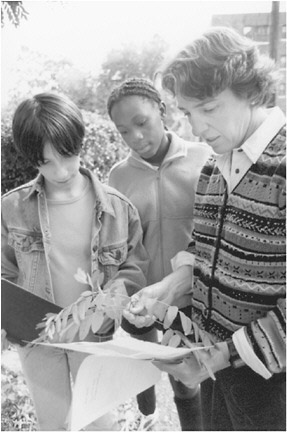
the journals of teachers. Some journal writing was required by the teacher’s professional development experience. Other teachers simply keep journals as a tool for self-reflection and as a way to take time to understand their activities and experiments.
Several of the vignettes also illustrate ongoing learning through inquiry. Steve describes a component of his program in which he was asked to define a research question about his teaching, design and use a data collection and analysis scheme to address the question, and then report the results to his colleagues. Such action research projects are important sources of information for teachers. They organize what might otherwise be random impressions, unsystematic observations, and unconscious behaviors into a frame that can inform teachers’ practice. They give teachers a tool that they can use to pursue questions about teaching throughout their careers.
In Joanna’s case, a teacher who had not previously experienced inquiry had her eyes opened to its possibilities as a source of ongoing learning. Through professional development, she acquired the confidence to continue to inquire into science concepts. Joanna’s motivation to think deeply about how her students were learning and what abilities they needed to keep learning produced continual refinements in her teaching and the learning environment she established for her students.
The following vignette demonstrates many of these aspects of becoming a life-long inquirer.
|
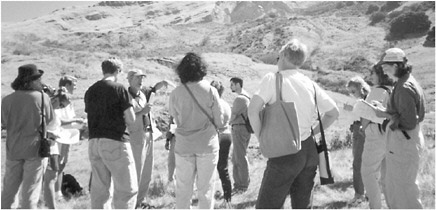
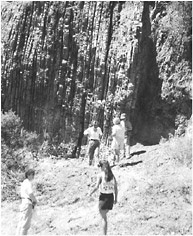
We spent the next day in the laboratory testing water and soil samples and working with our descriptions, maps, and calculations to address the primary question (as well as many other questions that arose over the course of the day in the field). With input from the geologists and a laboratory chemist, we formulated answers to the question about the impact of dumping. We made predictions about where runoff from the site would go, how fast it would move, and how we could test our predictions. In this way, I feel that we developed a keen understanding of the scientific ideas behind our observations, analyses, and conclusions. |
Gabe was introduced to a nearby resource, a federal energy research laboratory, where scientists cared about education and made it possible for teachers (and, in other programs, students) to participate in the actual research being conducted. The professional development gave him an opportunity to actually “do” science, which neither his preservice program nor previous inservice programs had given him. In this situation, he was introduced to his local environment in a way that he had not known it before. It also taught him a variety of ways to inquire about this environment. In sum, it equipped him to think about how the inquiry process and inquiry abilities could interweave with science subject matter and how he could use the local environment as a primary locale for his students’ learning.
PROFESSIONAL DEVELOPMENT PROGRAMS FOR INQUIRY-BASED TEACHING
Professional development often suffers from being piecemeal and fragmented. Preservice programs are often simply a collection of courses. Great rifts exist between science courses and education courses and between courses within both science and education. New teachers are often placed in the least desirable teaching positions, with full teaching loads, many preparations, difficult-to-teach students, and little or no support to ease the challenging transition from student to full-time professional. Similarly, professional development for in-service teachers is generally fragmented, consisting primarily of short workshops that are neither connected to each other nor to the teachers’ classroom work (National Commission for Teaching & America’s Future, 1996).
Professional development that is supposed to improve inquiry-based teaching can have all these ills, and in addition, it often does not explicitly help teachers learn inquiry abilities and understandings. Programs are needed that explicitly attend to inquiry — both as a learning outcome for teachers and as a way for teachers to learn science subject matter. Furthermore, these programs need to help teachers learn how to teach through inquiry.
The vignettes in this chapter
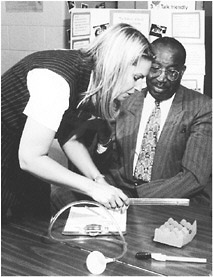
describe very different professional development programs, from Lillian’s university courses for prospective teachers, to immersion in inquiry in a science museum, to a three-year masters program. Yet all share some attributes of effective professional development programs.
First, they offer coherent opportunities for teachers to learn over time. Three-year masters programs and long-term curriculum implementation help teachers to gain new knowledge and apply it to their teaching with support by colleagues, their schools, and districts. Second, many of these professional development programs were the product of a collaboration of many people and organizations. Partnerships between educators, universities, and research institutions involved scientists in creating opportunities for teachers to conduct scientific research — an activity so critical to their teaching that it merits inclusion in both preservice and inservice programs. Finally, all of the programs illustrated here had a clear commitment to the vision of the National Science Education Standards, which call for giving teachers the knowledge and abilities they need to address the science literacy needs of all their students. All of the programs viewed inquiry as a set of abilities and understandings that teachers themselves needed to have, and their students needed to learn — as well as being a vehicle through which subject matter could be learned, and learned well. This lies at the heart of the Standards’ view of inquiry. All of the programs helped teachers learn science subject matter, develop inquiry abilities, and do so through their own opportunities to inquire.
Professional development for inquiry-based teaching and learning is critical to the future of science education as envisioned in the Standards, which note:
The current reform effort requires a substantive change in how science is taught; an equally substantive change is needed in professional development practices (National Research Council, 1996, p. 56).
Long-term, comprehensive, inquiry-based professional development is an absolute requirement for the success of standards-based reform.


