
6
Army Work and Approaches to Occupational Analysis
This chapter focuses on the U.S. Army as a case study in the changing nature of work. It focuses on the application of the concepts, issues, and principles presented in previous chapters. The Army is a unique organization in many ways, set apart from the civilian sector with respect to its function, structure, and place in society. Yet it is also important to recognize that the Army is part of the social fabric of the nation, experiencing in various ways the same trends that affect civilian employers. For example, demographic changes in the general population will ultimately be reflected in the military, along with the forces of change that influence the content and structure of work.
In our analysis, we draw on the framework for conceptualizing the changing nature of work and occupational analysis (Figure 1.1), which has been used as a unifying theme throughout the book. However, before examining the Army in the context of this framework, it is important to recognize the similarities and differences between the Army and employers in the civilian sector.
Key Features of Army Mission and Employment
Understanding the nature of work in the Army means first understanding the nature of the Army. The U.S. Army mission,
as officially stated, is to preserve the peace and security and provide for the defense of the United States; to support national policies; to implement national objectives; and to overcome any nations responsible for aggressive acts that imperil the peace and security of the United States (http://www.army.mil/mission-vision.htm). In much simpler terms, the Army exists primarily to be the nation's warriors and protectors. Both officers and enlisted personnel must be prepared to use force as required and must be willing to stand in the way of prospective violent acts committed by others. The armed services are the only organizations that forthrightly presume that their employees will sacrifice their lives as part of their jobs. Some social scientists suggest that the central skill of military officers is "the management of violence" (Huntington, 1959).
The recent end of the cold war and other geopolitical events have placed Army personnel in new situations and redefined its role with respect to "preserving peace and security." Along with its central and more traditional role of warfighter, the Army and the other services have been asked increasingly to act as peacekeeper and peacemaker, and as an instrument of international humanitarian aid. These added roles are often strange to many military members who may not have received adequate training to deal with the varied aspects of operations other than war. New missions can be sources of profound change since they may call for major modifications in the way people are selected, trained, assigned, evaluated, managed, and used.
Army personnel are currently governed by a highly structured set of rules and regulations. Some of these rules are presented below as a means for drawing distinctions between the Army and the civilian sectors. Although most of the features are fixed at the present time, it may be useful to revisit the rules in light of new missions and personnel mixes, the long-range impact of all-volunteer recruiting, and changing performance requirements.
Structure
All of the aspects of bureaucratic structure in the Army and other services can be translated into a loss of independent control
on the part of the individual members. The details of service are strictly and widely regulated to ensure smooth operation and equity in a very large organization. First, the Army has a fixed-rank structure, determined by federal law, with the number of incumbents fixed at each rank. Individuals who enter the Army generally do so at the very lowest level. Since there is no lateral entry into the organization, as there is in most civilian enterprises, the Army must "grow its own" employees and leaders. Individuals who remain in service form a pipeline to higher grades or levels of authority and experience in occupations.
Second, Army enlisted personnel serve fixed terms of service, although the Army has experienced a first-term attrition rate (that is, recruits who fail to complete their first obligated term of service) of approximately 30 percent since the end of conscription in 1973. Unlike procedures in the civilian sector, employee dissatisfaction cannot usually be translated into an immediate resignation or separation from duty because of contractual requirements. Also, Army personnel are not allowed to organize for the purpose of collective bargaining or for claims regarding working conditions, pay, or benefits.
Third, the pay structure of the Army is fixed. It is entirely determined by rank and time in service, although there is the option of supplementary or special pay and bonuses (such as for reenlistment or service extension of persons in hard-to-fill specialties). A key element of the pay system is that bonuses or merit pay cannot be used in individual cases for rewards or incentives. Merit is recognized through awards (nonmonetary) and medals, whereas superior performance over the longer-term may be rewarded with special honors, early selection (within limits) for promotion to the next higher rank, or selection for a higher position of leadership within the rank pyramid. Military compensation also includes many facets not found in civilian employment, such as pay allowances, benefits, and supplementary pay for support of dependents. In addition, the retirement system requires a minimum of 20 years of service before qualification (unless a special release program authorizes early retirement, as was the case during the force reduction of the 1990s).
Fourth, the conduct of the Army's members is subject to the Uniform Code of Military Justice, along with the U.S. criminal
and civil codes. As an earlier report of this committee (National Research Council, 1997a:257) observes:
In most organizations, a violation of company policy may result in being fired; in the military, violation of company policy may result in formal charges, trial, and imprisonment. . . . And to enforce its standards of conduct, the military maintains its own judicial and penal systems. The mechanisms of control of military members stands in sharp contrast to the treatment of civilians employed by the organization.
In addition, the Army maintains strict control over aspects of its members' personal life, including mandatory drug screening, engagement in fraternization, and sexual conduct, among other areas.
Functions and Culture
The Army is designed as a community of workers that can be nearly self-sufficient if necessary. A core of soldiers is dedicated to combat activities that are complementary and interdependent. The culture of these fighting units is centered around discipline and a teamwork approach to tasks. They are augmented by large numbers of support personnel who provide everything from administrative services to equipment repair to transportation to meals and housing to medical and dental services to training and all other aspects of organizational need.
All active-duty soldiers are considered to be on a permanent 24-hour call for service, they may be called to duty at any time, including while on leave, and they may be deployed to a duty station far from their home on very short notice. This is a condition of their employment contract and they do not have the right to refuse such duty or to resign. In fact, during Operation Desert Shield and Operation Desert Storm, a "stop loss" action was initiated in order to postpone the discharge of active-duty personnel, regardless of scheduled transitions, expired terms of service, or retirement.
The greatest distinction between the Army and the civilian workforce is one of culture. The structure of military units is hierarchical and their operation is guided by rules of order and discipline. Discipline, in the military context, is more than a
requirement to obey the orders of a superior, it also involves following a set of general rules of behavior, even in the face of distractions that include lethal threats. The emphasis on discipline serves two purposes: it facilitates the accomplishment of difficult missions and it supports the creation and maintenance of esprit and morale.
The families of service members are considered to be a part of the Army community. The Army expects certain forms of compliance from family members but also offers a wide scope of support to them. Such support includes religious or pastoral services, social work assistance, family housing, schools for dependents, day care for small children, commissary facilities, and medical care.
The work culture of the civilian economy as contrasted to the Army is less formal and the trend is toward less hierarchical, flatter work structures. Civilian workers have more flexibility in work hours and more choices in terms of the jobs they perform and the organizations for which they work. Even with the military downsizing, however, civilian workers have less job security than their military counterparts.
Although the Army and the other services have continued distinctive organizational practices based on rank and discipline, there are those who believe that changes are coming (Moskos and Wood, 1988; Moskos, 1992; Segal, 1993). These researchers suggest that, because the all-volunteer nature of the force requires competition with the civilian sector for employees, military jobs will become more like civilian jobs in order to appeal to potential recruits. For example, over the years there has been some movement toward making military pay more equal to pay for similar civilian jobs. Also, the Army has become more lenient regarding the justification for attrition during an enlistee's first term.
Control
The Army, as an organization, is controlled in many important respects by the American people and their elected representatives. Indeed, the Army has been called the "service of the people," because of its size, history, tradition, generally high profile, and previous dependence on "citizen-soldiers" through con-
scription. One of the most effective controls over the organization is the Army's annual budget, which is approved by Congress each year and affects the authorized number and distribution of personnel. The adoption or elimination of weapon systems can likewise affect the occupational distribution of soldiers, as do congressional decisions regarding the Army's missions, structure, or function. The budget process allows for a level of subcategory specification that targets specific programs or operations; staffing of these operations must frequently be accomplished by diverting personnel from other programs, rather than by adding new personnel to the organization.
Downsizing Procedures
The Army's post-cold war downsizing is in some respects closer to the personnel cuts in other public or private organizations than it is to armies of previous eras, which demobilized largely conscripted forces after the conclusion of a major war (McCormick, 1998). This relates to the fact that service in the Army has been entirely voluntary since the end of America's involvement in the Vietnam war. The end of conscription and the later conclusion of the cold war have also been identified as seminal events in transforming the very nature of the U.S. armed forces. Since 1987, the Army's active-duty force has been reduced by more than one-third and the budget has decreased by 40 percent.
The reduction of the force called for at the end of the cold war was guided by four principles: protecting quality, shaping the force, maintaining personnel readiness, and demonstrating care and compassion (McCormick, 1998). The need for "force shaping" was driven by the understanding (mentioned above) that the Army would basically be stuck with the results of the reduction-in-force for a long time. Thus, the downsizing was aimed at maintaining the "experience content" of the force, gauged in terms of years in service (Timenes, 1996); a great effort was made to ensure that the loss of personnel would be proportional within all categories of soldiers by their years of service, across certain broad skill areas. Programs and policies for force reduction also attempted to ensure that the vast majority of people leaving the
Army would do so voluntarily. This was achieved primarily through two monetary separation incentives, the special separation bonus (a lump-sum payment) and the variable separation incentive (an annuity). As McCormick (1998) found, the long-term effects of the force reduction are still undetermined, although the Army appears to have been relatively successful in achieving its goals. These procedures illustrate the drive within the Army to make political decisions into rationalized practices.
External Contexts of Work
This section presents a brief discussion of trends in demographics, missions, and technology and their roles in influencing the structure and content of Army occupations. These forces need to be taken into account by occupational analysts in the Army in the same way that similar forces in the civilian sector are considered in the development and use of occupational analysis systems for civilian work.
Demographic Change
Personnel in the Army and the other military services share certain demographic characteristics that are quite unusual when compared with their counterparts in the civilian workforce. This is due largely to laws and policies that restrict military service to persons who meet specific qualifying standards—including requirements related to age, health, moral background (e.g., arrest records and previous use of drugs or alcohol), physical attributes, marital status and dependents, cognitive ability, gender, citizenship status, education, and sexual orientation, among other personal or background characteristics. However, as the data below show, the Army workforce, like its civilian counterpart, is becoming more diverse.
General Trends
Since the end of the draft in the mid-1970s, the Army has experienced several noteworthy shifts in its demographic content. First, the proportion of black soldiers in its enlisted ranks has risen
TABLE 6.1
Selected Characteristics of Active-Duty Army Personnel, by Enlisted/Officer Status, September 1996
|
|
Percent of Personnel |
|
|
Characteristic |
Enlisted |
Officer |
|
Female |
14.3 |
14.3 |
|
Black |
29.9 |
11.2 |
|
Hispanic |
6.2 |
3.3 |
|
Ages 20–24 |
33.8 |
10.6 |
|
Ages 25–29 |
23.3 |
23.4 |
|
Ages 40 and above |
5.8 |
24.4 |
|
High school graduate (with diploma) or above |
95.8 |
100.0 |
|
College degree or above |
10.5a |
99.1 |
|
Married |
56.0 |
71.4 |
|
Pay grade E4–E5 |
45.0 |
— |
|
Pay grade 03–04 |
— |
54.6 |
|
a Includes persons with college credit but no degree, as well as those with a degree. SOURCE: Defense Manpower Data Center, Monterey, California. |
||
from 14 percent in 1971 to close to 37 percent of new recruits and nearly one-third of all enlisted personnel by 1979. As of 1996 (Table 6.1), the proportion of enlistees who are black had declined by 30 percent, but the relatively high representation of this racial/ethnic minority group remains as one of the most distinguishing demographic characteristics of the all-volunteer Army (Binkin and Eitelberg, 1982).
Second, in 1973, women comprised about 2 percent of enlisted personnel and 4 percent of officers in the Army. By the late 1980s, this proportion had risen to 11 percent in both the active-duty enlisted and officer ranks; and by 1996, it stood at 14 percent of the Army's enlisted force and 14 percent of the officer corps (U.S. Department of Defense, 1997). Third, in 1973, white men of European descent accounted for about 75 percent of Army active-duty enlisted personnel and 9 in 10 officers; by the mid-1990s, these proportions had declined to 44 percent of the enlisted force and 66 percent of officers (Defense Manpower Data Center, 1998; U.S. Department of Defense, 1997).
Another noteworthy trend has been the increasing age of the Army's active-duty personnel over the past two decades. This has continued throughout the history of the all-volunteer force, as experience levels (number of months or years in service) have risen across the board. The Army's smaller career force has also extended its efforts to recruit enlisted personnel who are somewhat older than the traditional 18- or 19-year-old youth fresh out of high school. In 1989, over 62 percent of all new Army recruits were 19 years old or younger, including 33 percent at age 18 and more than 6 percent at age 17. In 1996, just about half (53 percent) of the Army's recruits were 19 years old or younger, with 27 percent at age 18 and fewer than 4 percent at age 17. (By law, recruits must be between 17 and 36 years old, and those who are 17 must have parental permission.)
Compared with the other military services, the Army has recently tended to take relatively larger proportions of older recruits (over age 21) and lower proportions of younger recruits (17 to 18 years old) (U.S. Department of Defense, 1997). Overall, in 1990, approximately 72 percent of the Army's active-duty enlisted population (men only) were under the age of 30; 6 years later, this proportion had fallen to 66 percent. Some people have referred to this trend as the "maturing" of the Army. Two related consequences, one considered positive and the other negative, have been attributed to this so-termed maturing: higher levels of experience tend to translate into improved performance, allowing (in theory) for a trade-off between quality and quantity; at the same time, older soldiers tend to place a greater demand on the personnel support framework (since they have more dependents) and they cost more (with higher salaries, a greater expense for moving families, and so on).
The demographic trends in the U.S. population described in Chapter 2 and their effects on the general workforce are expected to have both direct and indirect effect on the characteristics of Army personnel. For example, as the proportion of minorities increases in the general population, manpower planners expect to see a corresponding, but smaller, increase of minorities in the Army's ranks; as the mean age of American workers rises, so, too, will the mean age of Army personnel; and, as more women enter the American labor force, most observers anticipate an increasing
presence of women in the Army. It should be noted, however, that the Army's workforce is younger and includes a smaller proportion of women than the civilian workforce.
Sociodemographic Trends
Certain sociodemographic trends in the general population are also expected to affect the Army in ways that are similar to the anticipated impact on civilian employers. Of all the changes that the American family has undergone in recent decades, the Army's personnel planners are perhaps most concerned about the growth of two-income couples, who are expected to represent three-quarters of all married couples by the year 2000. This particular trend has been accompanied by a more equitable sharing of parental responsibilities between men and women—which, along with certain demographic changes, has forced all employers to take greater interest in developing responsive workplace policies and a more family-friendly working environment. More civilian employers are thus implementing flexible work schedules and job-sharing plans, offering expanding opportunities for people to work at home, placing greater emphasis on participatory management, and introducing new compensation packages tailored to the needs of individual workers and their families.
It is clearly more difficult for the Army to create a responsive workplace environment than it is for many civilian employers, given its mission and its corresponding demands on people for their time, availability for deployment, geographic mobility, periodic separations and possible isolation from family, foreign residence, and related obligations of service life. Indeed, both the Army and the family have been called "greedy" institutions, in the sense that each places a great (and often conflicting) demand on the individual for his or her commitment, loyalty, time, and energy (Moskos and Wood, 1988). Yet if the Army is to survive as an all-volunteer organization in a changing demographic landscape, it may have to adapt in a way that can keep step with the movement toward family-friendly work settings.
Recruit quality is another concern of U.S. military manpower planners: that is, whether tomorrow's recruits will have the necessary abilities to perform certain complex tasks in a high-tech
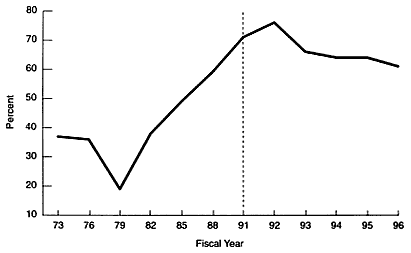
Figure 6.1
Percentage of high-quality recruits attracted by the Army during fiscal years 1973–1996.
force. According to Kageff and Laurence (1994:93), military recruits will have to be more versatile: "They will be required to operate and maintain several technically sophisticated systems and, during a course of service, may have to be retrained and transferred laterally." The Army's efforts at attracting high-quality recruits have been quite successful throughout most of the 1980s and early 1990s (Figure 6.1). Applying the Army's own definition of high quality—that is, possession of a high school diploma and a score at or above the 50th percentile (population mean) on the Armed Forces Qualification Test—the trend appears quite positive, although more recently observers have noted test score declines in the military pool of potential recruits (Kageff and Laurence, 1994:92).
One other general demographic trend should be mentioned here. Over the years, considerable concern has centered on the socioeconomic status (SES) of Army personnel relative to that of the U.S. population. When the draft ended, some observers claimed that economic conscription would replace the draft and fill the ranks with disadvantaged young people and that the Army would become an employer of last resort. During the early years
of the all-volunteer force, evidence seemed to support the prediction that military recruits would be drawn disproportionately from the nation's lower socioeconomic classes. Since the mid-1980s, however, studies suggest that military recruits tend to come from families in both the middle and lower half of the SES distribution. At the same time, although recruits can be found at all SES levels, persons at the top and the bottom of the scale are underrepresented. These studies, it should be noted, have examined enlisted recruits only and have not taken into account officers, who enter the military as college graduates (U.S. Department of Defense, 1997).
Occupational Distribution of Women and Racial/Ethnic Groups
Table 6.2 shows the distribution of men and women in the Army's active-duty enlisted force by occupational area. Almost one-third of all male soldiers serve in the Army's general combat
TABLE 6.2
Percentage Distribution of Army Enlisted Personnel, Active Duty, by Occupational Area and Gender, September 1996
|
Occupational Area and Codea |
Male |
Female |
Total |
|
(0) Infantry, gun crews, and seamanship specialities |
32.9 |
5.8 |
29.0 |
|
(1) Electronic equipment repairers |
6.9 |
4.8 |
6.6 |
|
(2) Communications and intelligence specialists |
9.9 |
8.1 |
9.6 |
|
(3) Medical and dental specialists |
6.1 |
15.9 |
7.5 |
|
(4) Other allied specialists |
2.9 |
2.7 |
2.9 |
|
(5) Functional support and administration |
13.3 |
36.2 |
16.6 |
|
(6) Electrical/mechanical equipment repairers |
14.6 |
8.3 |
13.7 |
|
(7) Craftsmen |
2.0 |
1.6 |
1.9 |
|
(8) Service and supply handlers |
10.9 |
16.3 |
11.6 |
|
(9) Nonoccupational |
0.6 |
0.4 |
0.6 |
|
Totalb |
100.0 |
100.0 |
100.0 |
|
a Based on the Department of Defense (DoD) occupational conversion index. DoD numerical designator appears in parentheses. b Percentages may not add up to 100 due to rounding. SOURCE: Defense Manpower Data Center, Monterey, California. |
|||
TABLE 6.3
Women as a Percent of Army Active-Duty Enlisted Personnel Assigned to Occupational Areas, September 1996
|
Occupational Area and Codea |
Percent Who Are Women |
|
(0) Infantry, gun crews, and seamanship specialities |
2.9 |
|
(1) Electronic equipment repairers |
10.4 |
|
(2) Communications and intelligence specialists |
12.1 |
|
(3) Medical and dental specialists |
30.3 |
|
(4) Other allied specialists |
13.3 |
|
(5) Functional support and administration |
31.2 |
|
(6) Electrical/mechanical equipment repairers |
8.7 |
|
(7) Craftsmen |
11.6 |
|
(8) Service and supply handlers |
20.1 |
|
(9) Nonoccupational |
9.4 |
|
All Areas |
14.3 |
|
a Based on the Department of Defense (DoD) occupational conversion index. DoD numerical designator appears in parentheses. SOURCE: Defense Manpower Data Center, Monterey, California. |
|
areas (designated as infantry in the table), and somewhat more than a third of women serve in functional support and administration. In fact, the combination of three areas—functional support and administration, medical/dental specialists, and service and supply handlers—accounts for over two-thirds of Army enlisted women (compared with less than one-third of their male counterparts). Also, as Table 6.3 shows, almost one-third of all personnel in the functional support and administration and the medical/dental service areas are women. This was more than twice the level of representation (14 percent) by women in the enlisted force as a whole in 1996.
A similar pattern of participation by men and women can be found when looking at the active-duty officer corps. Nearly half (45 percent) of all male officers serve in tactical operations (the core warfare areas), and an almost equal proportion (48 percent) of female officers serve in health care. In fact, almost one-third of all health care officers are women. Based on the overall percentage of women in the officer corps (14 percent), however, women
are underrepresented only in tactical operations and as general officers—and by a very wide margin.
The reasons for such disparities between the participation of men and women in Army occupational areas can be attributed to legal and policy restrictions on women in combat, tradition, and personal choice. On the matter of personal choice, previous research suggests that women who join the military tend to prefer jobs that are traditionally associated with women (Binkin and Eitelberg, 1986). One factor to keep in mind here is that women, although underrepresented in many areas (based on overall levels of participation) are not unrepresented. As Table 6.4 indicates,
TABLE 6.4
Number and Percentage of Military Occupations with 10 or More Personnel That Have No Women, by Service and Officer/Enlisted Status, 1996
|
Service |
Officer |
Enlisted |
Total |
|
Army |
|
|
|
|
All occupations |
188 |
250 |
438 |
|
No women |
19 |
35 |
54 |
|
Percent |
10.2 |
14.0 |
12.4 |
|
Navy |
|
|
|
|
All occupations |
526 |
999 |
1,525 |
|
No women |
104 |
263 |
367 |
|
Percent |
19.8 |
26.4 |
24.1 |
|
Marine Corps |
|
|
|
|
All occupations |
123 |
316 |
439 |
|
No women |
49 |
64 |
113 |
|
Percent |
39.9 |
20.3 |
25.8 |
|
Air Force |
|
|
|
|
All occupations |
257 |
243 |
500 |
|
No women |
29 |
17 |
46 |
|
Percent |
11.3 |
7.0 |
9.2 |
|
Total |
|
|
|
|
All occupations |
1,094 |
1,808 |
2,902 |
|
No women |
201 |
379 |
580 |
|
Percent |
18.4 |
21.0 |
20.0 |
|
SOURCE: Defense Advisory Committee on Women in the Services, Utilization of Women Indicator Report (Monterey, CA: Defense Manpower Data Center/Naval Postgraduate School, 30 September 1996), p. 53. |
|||
women are missing from only about 12 percent of all Army occupations with 10 or more personnel, a percentage considerably lower than is found in the U.S. Marine Corps, the U.S. Navy, or the U.S. Department of Defense as a whole—even though women are prohibited from serving in ground combat operations, in which 30 percent of Army enlisted personnel can be found. (It is worth noting that only 35 percent of all military enlisted occupations were open to women when the nation initiated the all-volunteer force.)
Table 6.5 shows racial/ethnic distributions across enlisted occupational areas. As seen here, whites, Hispanics, and "others" tend to be concentrated in the infantry; blacks tend to be most highly concentrated in functional support and administration. The level of these concentrations can be better observed in Table 6.6, which shows the proportion of all enlistees in each occupa-
TABLE 6.5
Percentage Distribution of Army Enlisted Personnel, Active Duty, by Occupational Area and Racial/Ethnic Group, September 1996
|
Occupational Area and Codea |
White |
Black |
Hispanic |
Other |
Total |
|
(0) Infantry, gun crews, and seamanship specialities |
32.3 |
22.6 |
31.1 |
27.3 |
29.0 |
|
(1) Electronic equipment repairers |
6.8 |
6.3 |
6.0 |
6.3 |
6. |
|
(2) Communications and intelligence specialists |
11.5 |
6.7 |
8.0 |
8.1 |
9.6 |
|
(3) Medical and dental specialists |
6.9 |
8.1 |
8.4 |
9.9 |
7.5 |
|
(4) Other allied specialists |
3.0 |
2.7 |
2.8 |
3.0 |
2.9 |
|
(5) Functional support and administration |
11.0 |
26.3 |
18.6 |
19.0 |
16.6 |
|
(6) Electrical/mechanical equipment repairers |
14.8 |
11.4 |
13.1 |
14.4 |
13.7 |
|
(7) Craftsmen |
1.9 |
2.0 |
1.7 |
1.9 |
1.9 |
|
(8) Service and supply handlers |
11.1 |
13.7 |
9.4 |
9.6 |
11.6 |
|
(9) Nonoccupational |
0.8 |
0.2 |
1.0 |
0.4 |
0.6 |
|
Totalb |
100.0 |
100.0 |
100.0 |
100.0 |
100.0 |
|
a Based on the Department of Defense (DoD) occupational conversion index. DoD numerical designator appears in parentheses. b Percentages may not add up to 100 due to rounding. SOURCE: Defense Manpower Data Center, Monterey, California. |
|||||
TABLE 6.6
Racial/Ethnic Composition (in Percent) of Army Occupational Areas, Active-Duty Enlisted Personnel, September 1996
|
Occupational Area and Codea |
White |
Black |
Hispanic |
Other |
Totalb |
|
(0) Infantry, gun crews, and seamanship specialities |
63.9 |
23.3 |
6.7 |
6.1 |
100.0 |
|
(1) Electronic equipment repairers |
59.5 |
28.6 |
5.7 |
6.2 |
100.0 |
|
(2) Communications and intelligence specialists |
68.7 |
20.7 |
5.2 |
5.5 |
100.0 |
|
(3) Medical and dental specialists |
52.3 |
32.2 |
6.9 |
8.5 |
100.0 |
|
(4) Other allied specialists |
59.3 |
27.9 |
6.1 |
6.8 |
100.0 |
|
(5) Functional support and administration |
38.2 |
47.4 |
6.9 |
7.4 |
100.0 |
|
(6) Electrical/mechanical equipment repairers |
62.3 |
24.9 |
5.9 |
6.8 |
100.0 |
|
(7) Craftsmen |
57.3 |
31.0 |
5.3 |
6.4 |
100.0 |
|
(8) Service and supply handlers |
54.5 |
35.2 |
5.0 |
5.3 |
100.0 |
|
(9) Nonoccupational |
74.5 |
10.6 |
10.3 |
4.6 |
100.0 |
|
All areasb |
57.5 |
29.9 |
6.2 |
6.4 |
— |
|
a Based on the Department of Defense (DoD) occupational conversion index. DoD numerical designator appears in parentheses. b Percentages may not add up to 100 due to rounding. SOURCE: Defense Manpower Data Center, Monterey, California. |
|||||
tional area according to racial/ethnic group. As the table shows, blacks account for over 47 percent of all active-duty enlisted personnel in functional support; this compares with 38 percent of whites, who comprise 58 percent of enlisted personnel as a whole. Aside from this disparity—as well as in the area of communications and intelligence specialists for whites and blacks—levels of racial/ethnic representation in Army occupations are reasonably close to the proportions found in the entire enlisted force.
As with women, patterns of participation for racial/ethnic groups in the enlisted force are similar to those seen in the officer corps (see Table 6.7). For example, whites tend to be more highly concentrated than other racial/ethnic groups in tactical operations, corresponding to their overrepresentation in the enlisted infantry. The largest proportions of each racial/ethnic minority
TABLE 6.7
Percentage Distribution of Army Commissioned Officers, Active Duty, by Occupational Area and Racial/Ethnic Group, September 1996
|
Occupational Area and Codea |
White |
Black |
Hispanic |
Other |
Totalb |
|
(1) General officers |
0.5 |
0.4 |
0.04 |
0.1 |
0.5 |
|
(2) Tactical operations |
41.3 |
30.4 |
36.3 |
33.4 |
39.5 |
|
(3) Intelligence |
6.8 |
5.5 |
8.2 |
6.0 |
6.7 |
|
(4) Engineering and maintenance |
9.2 |
13.5 |
10.3 |
10.2 |
9.7 |
|
(5) Scientists and professionals |
4.3 |
2.7 |
3.4 |
3.1 |
4.0 |
|
(6) Health care |
21.6 |
20.7 |
22.1 |
31.6 |
22.0 |
|
(7) Administration |
5.4 |
9.5 |
7.5 |
5.5 |
5.9 |
|
(8) Supply, procurement, and allied |
9.2 |
16.3 |
11.3 |
8.9 |
10.1 |
|
(9) Nonoccupational |
1.9 |
1.0 |
1.0 |
1.2 |
1.7 |
|
All Areasb |
100.0 |
100.0 |
100.0 |
100.0 |
100.0 |
|
a Based on the Department of Defense (DoD) occupational conversion index. DoD numerical designator appears in parentheses. b Percentages may not add up to 100 due to rounding. SOURCE: Defense Manpower Data Center, Monterey, California. |
|||||
group can similarly be found in tactical operations, but these groups also tend to be somewhat concentrated in engineering and maintenance positions as well as in supply, procurement, and allied specialties. In fact, black officers are overrepresented in supply, administration, and engineering and maintenance occupations. Whites are most overrepresented as general officers, scientists and professionals, and, to a lesser extent, tactical operations officers.
Migration Between Primary and Duty Occupations
Most studies of military enlisted personnel by occupational category use the service member's primary occupation, or formal area of occupational training, to identify his or her military occupational specialty. Military personnel also have what is known as a "duty occupation," which is the occupation to which they are assigned. Generally, there is a clear connection between a
member's duty occupation and his or her primary occupation, or it is assumed that they are the same. We undertook an analysis to determine if the primary occupations of active-duty enlisted personnel matched their duty occupations during the years 1987 and 1997. The results of this analysis appear in Tables 6.8 and 6.9.
Table 6.8 shows the results by broad (one-digit) occupational codes. Almost 16 percent of Army personnel who received infantry-related training as their primary occupational specialty were assigned to some other type of occupation as of 1997. At the same time, 12 percent of personnel trained in functional support and administration were performing some other job; the mismatch of primary and duty occupations for the entire enlisted force that year was 9 percent.
Further investigation focused on primary-duty mismatches
TABLE 6.8
Number and Percent of Army Enlisted Personnel Serving in a Duty Occupation That Does Not Match Their Primary Occupation, by One-Digit Occupational Category, 1987 and 1997
|
|
1987b |
1997b |
||
|
Selected Two-Digit Categorya |
Number |
Percent |
Number |
Percent |
|
Infantry (0) |
10,414 |
6.8 |
17,219 |
15.9 |
|
Electronic equipment repairer (1) |
1,997 |
6.6 |
1,409 |
5.3 |
|
Communications and intelligence (2) |
5,042 |
6.4 |
2,017 |
5.2 |
|
Health care (3) |
1,141 |
2.7 |
1,453 |
4.5 |
|
Other technical and allied specialists (4) |
681 |
4.3 |
612 |
5.0 |
|
Functional support and administration (5) |
9,030 |
8.5 |
8,205 |
12.0 |
|
Electrical/mechanical equipment repairer (6) |
4,437 |
4.6 |
2,649 |
4.8 |
|
Craftsworkers (7) |
774 |
5.6 |
422 |
5.4 |
|
Service and supply handlers (8) |
2,592 |
3.8 |
1,345 |
2.8 |
|
Nonoccupational (9) |
— |
— |
— |
— |
|
All Areas |
36,108 |
6.0 |
35,331 |
8.9 |
|
a Based on the Department of Defense (DoD) occupational conversion index. DoD numerical designator appears in parentheses. b As of the end of September of each year. SOURCE: Derived from special tabulations provided by the Defense Manpower Data Center. |
||||
TABLE 6.9
Number and Percent of Army Enlisted Personnel Serving in a Duty Occupation That Does Not Match Their Primary Occupation, by Selected Two-Digit Occupational Category, 1987 and 1997
|
|
1987b |
1997b |
||
|
Selected One-Digit Categorya |
Number |
Percent |
Number |
Percent |
|
Infantry (01) |
5,514 |
7.6 |
15,204 |
24.8 |
|
ADP computer (15) |
92 |
8.4 |
72 |
16.6 |
|
Teletype/cryptology equipment (16) |
149 |
6.5 |
59 |
12.2 |
|
Radio and radio code (20) |
1,698 |
5.9 |
204 |
14.2 |
|
Mapping, surveying, drafting, illustration (41) |
258 |
7.9 |
228 |
13.8 |
|
Personnel (50) |
2,512 |
10.5 |
1,394 |
8.9 |
|
Administration (51) |
2,553 |
11.0 |
1,041 |
8.8 |
|
Clerical/personnel (52) |
206 |
13.8 |
4,073 |
79.9 |
|
Artillery/gunnery, rockets, missiles (04) |
2,456 |
5.9 |
1,220 |
5.1 |
|
Radio/radar (10) |
1,422 |
7.1 |
1,145 |
5.0 |
|
Other functional support (55) |
3,063 |
6.7 |
1,262 |
4.5 |
|
Automotive repair (61) |
2,408 |
5.1 |
1,397 |
4.9 |
|
All areas |
36,108 |
6.0 |
35,331 |
8.9 |
|
a Based on the Department of Defense (DoD) occupational conversion index. DoD numerical designator appears in parentheses. b As of the end of September of each year. SOURCE: Derived from special tabulations provided by the Defense Manpower Data Center. |
||||
by more refined (two-digit) occupational categories. As Table 6.9 shows, close to one-quarter of personnel (over 15,000 soldiers) with infantry training were serving in a noninfantry occupational category during 1997; this type of mismatch was also found for nearly 80 percent of personnel trained in clerical skills.
It is not clear why these mismatches occur. A study of detailed occupational categories suggested that the primary-duty mismatches were prevalent in occupational categories that are associated with specific weapon systems—perhaps indicating that some migration may have occurred when a weapon system was scaled back or eliminated. Another possible explanation could be that the Army of the late 1990s is providing more flexibility to personnel who may wish to migrate from one occupation to an-
other for the purpose of retention or career advancement. Whatever the case, the study results raise a significant question regarding the accuracy of data on the actual occupations of Army personnel. In this respect, one may likewise question the accuracy or usefulness of current methods to describe the nature of Army occupations. If increasing mismatches are due to lateral movement across occupational specialties, and not to irregularities in the data or to reporting errors, then this would suggest a need for a more refined method of defining occupations. A similar situation exists in the civilian sector, in which workers are more actively moving within and across occupations.
Mission Change
In Chapter 2 we discussed the impacts of changing markets and global competition on work in the civilian sector. To some, these civilian-sector activities may be considered as responses to threats of corporate well-being. The Army responds to changing global threats; dramatic changes in these threats are producing new Army missions and corresponding visions.
Prior to the end of the cold war the Army was generally guided by a singular threat, which led to clear personnel policies, doctrine, and weapon system assignment. With the end of the cold war, however, there have been fundamental changes in the nature of threats and a shift in missions to include more humanitarian and peacekeeping activities. The core premise of present-day strategic planners is that unpredictability has increased. These planners accept that U.S. military forces must now operate in an environment characterized by a more rapid pace of change than at any time in its history (Paige, 1996a).
In this new post-cold war environment, threats are likely to be more diverse, so that it becomes a challenge to clearly define the threats and develop a strategy for addressing them (White, 1996; Kaminski, 1996). One parameter of threat analysis is the assumption that the total threat picture requires the capability to take on two simultaneous large threats (on the order of Iraq and North Korea) separated by large geographic distance, while deterring any other smaller aggressors from taking advantage of those conflicts (Paige, 1996a; White, 1996).
The proposition that there is a shift from a few large threats to many small threats is confirmed by historical data. For example, during the period 1950–1989, there were 10 major military deployments. Since 1990 there have been 27 major deployments, representing a 16-fold increase, and almost all of them have involved joint operations of U.S. services (U.S. Army, 1997). General John Shalikashvili notes that between Operation Desert Storm and the end of 1996, the military had engaged in over 40 contingency operations.
In addition to expected changes in the types of hostile threats, it is anticipated that military units will engage in numerous and diverse operations other than war, most of which are expected to be highly unpredictable (Shalikashvili, 1996a, 1996b, 1997; Holmes, 1997; National Research Council, 1997a; Osborne, 1997; Association of the United States Army, 1997; Senate Armed Services Committee, 1997). These operations other than war may include:
|
1. |
Traditional peacekeeping, which involves stationing neutral, lightly armed troops, with permission of the host state(s), as an interposition force following a cease-fire. |
|
2. |
Passive observation, which consists of the deployment of neutral, unarmed personnel, with permission of the host state(s), to collect information and monitor activities (e.g., cease fire, human rights, or disarmament). |
|
3. |
Election supervision, which consists of monitoring polling places and voting procedures. |
Other distinctive missions in this category might include humanitarian assistance and disaster relief, pacification of civil disturbances, arms control verification, drug interdiction, and antiterrorist operations.
The conduct of such missions will require military formations of widely variant size and composition. Command and control practices will be particularly challenged and the training of individuals and units will need to be adapted to the nonmilitary dimensions of such missions.
Top military officials at the Defense Department envisage a lean, more mobile, more flexible force with significantly greater
ability to rapidly project power or provide assistance anywhere in the world on a moment's notice (Reimer, 1997a, 1997b; Paige, 1996a). Four formal vision statements explain, in general terms, how the armed forces (especially the Army) expect to implement the new military strategies: The Joint Vision 2010, Concept For Future Joint Operations , and Army Vision 2010 documents describe expected requirements for joint operations and Army operations through the year 2010, which is the long-term planning milestone for the military. The Army After Next project description identifies Army requirements projected for the very long-term, from 2010 through 2025.
Technological Change
Some of the changes in work in the military parallel changes in the civilian sector that result from advances in technology. In both sectors, technology has reduced the number of blue-collar jobs and increased the number of technical and professional jobs. In addition, many jobs in the Army are increasing in scope to include the new technologies. And in some cases, because of shared technology, there is sharing of skills across jobs. This has implications for how work is classified and the training programs that are needed.
Changes in technology interact with other factors, such as: (1) resources (e.g., changing budgets can drive technology and vice versa); (2) political change (e.g., the collapse of the Soviet Union, both affected by technology and producing implications for technological needs); and (3) change in doctrine (e.g., moving from cold war static strategic defense doctrine to one of active defense, which can be facilitated by technology as well as drive it). Moderated by these factors, technology can have implications that reverberate throughout the Army's organizational structure and the content of its work. Although change is a constant in organizations that, like the Army, must adapt to environmental conditions at many levels, technology may accelerate the rate of change, affecting an Army-wide "system of systems" that includes such things as manpower, equipment, training, provisioning, maintenance, evaluation, and doctrine. Box 6.1 provides an example of advances in tank technology.
|
BOX 6.1 Advance in Tank Technology The M1 tank (the current model is the M1A2), which replaced the 1970s vintage M60 model, embodied dramatic technology advancements in armor firepower, ammunition, propulsion, and crew safety. In addition, the large-scale application of the microchip upgraded the tank's systems for fire control, target localization and acquisition, communications, and command and control. This new technology provided tank crews with greater battlefield situation awareness (Where am I? Where are my friendly forces? Where is the enemy?) and this encouraged further changes in both doctrine and the organizational system for the tank's employment Armor units could now have greater flexibility on the battlefield, and the scope of execution of order changed. The capability was also introduced to fight with fewer tanks per fighting unit (the platoon and the tank company). As a consequence, technical training tactics, techniques, and procedures had to be change for tank crew members, crews, and small units, as well as for all maintenance, transport, and supply personnel connected with the tank. These new task and training requirements led to the need for changes in job classifications and changes in the scoping of individual skills, attributes, and mental ability required to handle the increased complexity associated with the new technology. |
Advanced technology will be essential to meet the requirements of speed, flexibility, mobility, force protection, smaller staff, information sharing, and awareness of the battle area (Shalikashvili, 1996b). New systems for battlefield use center on digitization but also include other technologies. For example, lightweight armor for both soldiers and vehicles will be more effective in damage protection in the near future. Similarly, the firepower of hand-held weapons will increase. Given the range of battlefield innovations, it will be possible for the individual soldier to be more autonomous while still relying on close teamwork with unit members. For example, fire teams comprised of three soldiers will continue to be the basic infantry combat unit and will constitute a strongly interdependent team. However, the standard doctrine is likely to specify greater spacing so that
each team will function more independently of the platoon or company command structure.
Technologies such as the global positioning system will be able to support the fire team leader's new responsibilities for decisions regarding the choice of route for advancing or withdrawing. The actual decision to advance or withdraw will in most instances be made by higher command, but the fire team leader will possess most of the determining information via digitized communications from tactical intelligence sources.
In the future it is expected that new technologies will allow global sharing of information for command, control, and communication functions. Such information is projected to involve high-fidelity images, accurate friend or foe location and identification, smart decision aids, and intelligent filters to reduce, organize, and digest the high volumes of data flowing through the system. It is also anticipated that the future will see new and upgraded applications of information technology for combat support services, such as equipment and system maintenance, logistics, and training. Simplified maintenance and improved reliability of information systems will be achieved by their being self-organizing and self-healing (automated diagnostics and self-reconfiguration). Database management systems that link logistics information (e.g., spares inventory) to maintenance information (e.g., maintenance history and status of equipment) will permit both preventive maintenance and just-in-time delivery of spare parts. Some commanders expect that progressive advancements in technology will produce a metasystem for personnel management. This ideal device would enable commanders to choose soldiers for units, task forces, special team assignments, and duty assignments based on a soldier's proven performance and training on mission-relevant skills and tasks.
Training is another area in which technology is expected to make a substantial contribution. Some examples include the use of high-fidelity simulations for mission rehearsal and the acquisition of new mission-related skills. Embedded, self-paced training that can be tailored to the trainee's level of expertise is also under development.
The Army has developed a program called MANPRINT (Manpower and Personnel Integration) to integrate concerns re-
garding personnel considerations into the technology development cycle (analysis of requirements, specification, design, testing, and fielding) of newly acquired technological systems. The six areas covered by MANPRINT are: human factors engineering, manpower, personnel, training, health hazards, and system safety. The MANPRINT program applies the following principles for technological procurement (Booher, 1990):
Organizational Change
As for many organizations in the civilian sector, downsizing has significantly affected the Army's work—in the past decade, the active Army has been reduced by 275,000 (36 percent reduction), the Army National Guard by 84,000 (18 percent reduction), the Army Reserve by 89,000 (28 percent reduction), and the civilian workforce by 135,000 (33 percent reduction). Figure 6.2 shows the progression in the Army's planned downsizing from 1989 to 1997.
The active Army provides a forward presence and an initial rapid response to emergencies; the Reserves and the National Guard provide a pool of trained individuals for active duty in time of war or other emergencies that can act as reinforcements for contingency operations. In today's environment, the two reserve components are being exercised and deployed to a greater
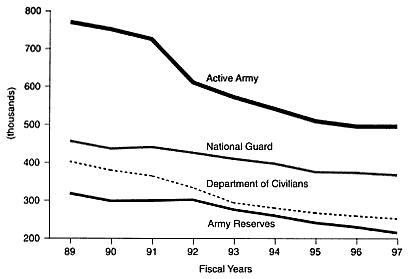
Figure 6.2
The Army personnel drawdown, fiscal 1989–1997.
degree than in the cold war period. The result is increased strain on all components and a requirement for greater flexibility in mission adaptation for both individual soldiers and units.
The total Army is composed of both tactical and nontactical units. The tactical units include combat, combat support, and combat service support; the nontactical units perform such functions as recruiting, training, personnel management, and materiel command. The total Army composition in 1997 for tactical units was: National Guard (45 percent), active Army (38 percent), and Army Reserve (17 percent) (U.S. Army War College, 1997). A further breakdown in shown in Figure 6.3; it shows that the National Guard provides 55 percent of the combat troops, 33 percent of the combat support units, and 26 percent of the combat service support units. Currently there are 8 combat divisions and 15 separate brigades in the National Guard. The Army Reserve, in contrast, represents only 3 percent of combat troops, while providing 31 percent of combat support and 46 percent of combat service support units. The Reserve also provides 100 percent of the railway units and enemy prisoner-of-war brigades, 86 percent of the
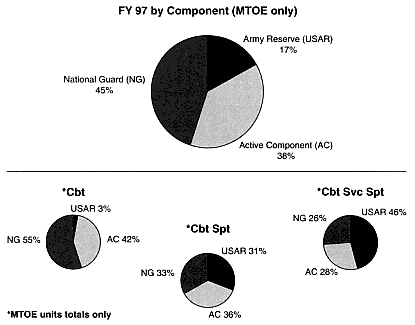
Figure 6.3
Total Army composition by component (MTOE only), fiscal 1997.
psychological operations units, and 70 percent of the medical and chemical capability.
To enter the National Guard and the Army Reserves, there are several paths (Figure 6.4). Some of those entering as reserves are individuals who have left the active force sometime during their careers; others, after being recruited, go directly into the reserve forces with no prior military service. According to a recent study (Grissmer et al., 1994), the percentage of individuals in the Army Reserves and the National Guard with no prior service experience was approximately 60 percent for the enlisted force; for commissioned officers, these percentages were 45 for the Army Reserve and 60 percent for the National Guard. Current procedures require that individuals entering the reserves directly must undergo active Army basic training. Generally, this training is accomplished in two eight-week segments called split-entry training. As service in the Army Reserves continues, more specialized
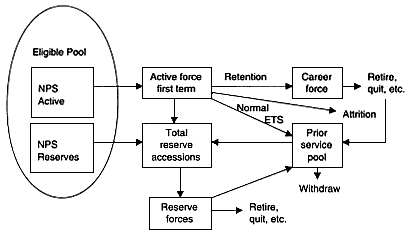
Figure 6.4
Total force supply and demand. (ETS = expiration of term of service)
training is provided. Both the National Guard and the Army Reserves receive 39 days of training a year, far less than the training of those on active duty. There is some concern that, as the active force continues to downsize, there will be an even greater proportion of reservists with no prior service, further reducing combat readiness.
The Army's Approach to Occupational Analysis
The work structure in the Army provides the basis for selecting, training, organizing, and managing personnel to meet mission requirements. The result of changing mission requirements has been the development of a smaller, more flexible force with a wider range of fighting skills—as well as new skills in negotiation and interpersonal interaction. Some of the implications of these changes parallel changes in the civilian sector. For example, the increased diversity of Army missions coupled with downsizing has led to the creation of teams of individuals with different skills from different work cultures. Instead of an infantry unit working alone in a combat role, a tradition in the Army, there is
now a need to combine combat troops with Army Reserve negotiators and civilian technicians to perform humanitarian and peacekeeping missions. As a result, there is an increasing requirement for communication and coordination, both of which may involve some increase in the emotional labor component of the work. Also, because of the large number of potential threats around the world, there is a need to rapidly deploy teams of people who have not had the opportunity to develop cohesive relationships.
With fewer personnel, individual soldiers may need a broader range of skills than in the past, or they may have to work with a more diverse group of individuals from various parts of the military. The work structure must be flexible enough to adapt to these changes and must facilitate a rapid response to a wide variety of situations. According to Sellman (1995:10):
We can no longer afford the luxury of occupational specialization. Personnel again will be trained in broad skills and knowledge that are necessary to perform a wide variety of job activities, rather than just those skills and knowledge needed to perform a small set of tasks. Obviously, such a change in training philosophy will have major implications for occupational analysis.
The central question is: Do the current structures and the analysis tools used to design jobs and training programs support the present and future needs of the Army?
Occupational Classification in the Army
The personnel of the active Army, the Army National Guard, and the Army Reserves are all classified and managed according to a common set of occupational categories. All soldiers in the Army are assigned to and trained in one of the combat, combat support, or combat service support branches, depending on the functions they will perform either in combat or in support of combat.
The occupational structure that is used to classify soldiers is hierarchical. The enlisted force is divided into 31 career management fields that relate to the Army's branches (Box 6.2). Each career management field, such as infantry, special forces, and
transportation, includes a series of military occupational specialties (MOSs).
There are approximately 350 MOSs. Every MOS has a promotion structure and a description of the tasks, skill qualifications, training and time in rank requirements associated with every enlisted rank. Enlisted personnel are assigned to an MOS when they enter the Army. Assignment is based on both mental and physical performance standards and on position availability. Mental abilities are measured by the Armed Forces Vocational Aptitude Test Battery (ASVAB). Different MOSs have different standards for assignment. Currently, over 95 percent of recruits are high school graduates and have ASVAB scores in the upper 50 percent. There is no lateral entry for enlisted soldiers. Essentially, the Army recruits potential and provides the training necessary for the individual to perform his or her job assignments. That is, recruits come with aptitudes and the basic capacity to learn the needed skills; the Army does not look for individuals who already possess such skills.
As a trainee enters the infantry, he is assigned to one of four career paths—infantryman, indirect fire infantryman, heavy artillery / armor infantryman, or fighting vehicle infantryman. The levels represent steps in a career progression (from private/specialist to sergeant, to staff sergeant, and so on). At each level there are specific requirements for training, skill level, and time in service.
Approximately 80 percent of enlisted soldiers stay within the same MOS throughout their Army career. In some fields, however, there are specified points at which a soldier may cross from one MOS to another. Also, personnel may transfer out of a combat arms MOS later in their careers. The system is based on the premise that enlisted soldiers who choose an Army career and move up through the ranks need the training and experience provided at the lower levels of the specialty in order to have sufficient knowledge to take on each higher level of tasks. Although there may be MOSs with overlap in tasks or skills, there is no easy way to efficiently make these links using the current system.
New MOSs may be added and existing ones can be modified on a yearly cycle. A given MOS can be combined with other MOSs or eliminated entirely as a function of new mission requirements
|
BOX 6.2 Career Management Field
|
||||||||
|
||||||||
or technological advances. These changes generally are the result of requests from the field. When changes occur, a consequence is that some soldiers must be reassigned, retrained, or assisted in finding a job outside the Army. According to a cross-walk using the U.S. Department of Labor's Dictionary of Occupational Titles, more than 75 percent of military jobs have one or more counter-parts in the civilian economy.
The career management fields vary in size—the three largest are infantry (49,837), mechanical maintenance (39,474), and supplies and services (38,526); the three smallest are psychological operations (458), public affairs (688), and topographic engineering (832).
All officers are commissioned in one of the basic branches of the Army. Functional areas are assigned based on the Army's needs and the qualifications of the officer. Most officers are developed within a branch; branch transfers are considered in the third to the eighth year from branches with overstrength to those
with understrength. Each position is characterized by the occupational skills required to perform its principal duties; secondary skills and areas of expertise are also listed as part of the overall position description.
Requirements for personnel and equipment are driven by the Army's current and future mission requirements (U.S. Army War College, 1997). Once these requirements are defined, the force (including National Guard and Reserve units) can be configured and sized to best meet the requirements. Manpower managers, working within force structure requirements, determine the number of personnel spaces to be allocated to each grade and skill at both the officer and the enlisted levels. Information on the exact composition of the total force at any given time is provided by a computerized system that accounts for individuals who are operationally available plus those who are in training, hospitalized, traveling, or otherwise unavailable. Personnel managers can maintain readiness by efficiently filling the allocated spaces with qualified individuals listed in the computer system. The Army's occupational structure is at the core of all of these activities.
At the enlisted level, for each MOS, there is a specification of the number of spaces for each rank and skill by geographic location; these specifications change as force structure requirements change. There are also historical data on the amount of turnover at each level and thus the expected vacancies needed to be filled at any one time. These data are used by personnel managers to make decisions about recruiting, training, promotion, and assignment to units. Units are prioritized in accordance with readiness status; those with the highest status are kept at full strength.
Recruiting targets are based on the number of first-term spaces that need to be filled in each MOS, the expected attrition rate during the first enlistment term, and the number of soldiers needed to reenlist to fill the required number of second-term positions. Even with the high quality of recruits, the attrition rate during the first term remains around 35 percent (U.S. General Accounting Office, 1998). These enlistees are separated from active duty before the end of their first term for medical or physical reasons or because they claim special conditions that may legally allow early discharge. In order to fill gaps that are generated by
attrition, financial incentives are used to attract recruits to serve in understrength MOSs.
Soldiers entering a second term are generally at the level of corporal (E-4) or sergeant (E-5). Once a soldier reenlists for a second term, he or she is tracked by the U.S. Total Army Personnel Command, providing information on rank, time in rank, training, special skills, location, and time at location. These files are used in conjunction with information on spaces to be filled at each level, in each MOS, and at each geographic location to make decisions about promotion, training, and distribution of enlisted personnel. As soldiers continue their careers and meet criteria for promotion, they are placed on the appropriate promotion lists. Because there may be more individuals eligible for promotion than there are available slots, those on the list are ranked (according to a point system) for purposes of selection. The promotion process at the lower levels (E-1 to E-3) is decentralized, at the midrange (E-4 to E-7) it is partially centralized, and at the top it is centralized (E-8 to E-9). Critical aspects of this progression through the ranks are both skill training and leadership training. The U.S. Army Total Personnel Command maintains several data systems that provide the information needed to manage personnel throughout the Army.
As noted above, most officers stay for their entire careers in the branch they select when entering the Army. Changes are generally made when the structure changes and branches are downsized or when an officer in an overstrength branch applies for duty in an understrength branch. Officers progress through a promotion structure that generally requires time in rank as well as specific training and operational experiences. Above the level of first lieutenant, the promotion process is centralized. Adjustments in the size of the enlisted and officer force and the ratio of officers to enlisted personnel are made as budget and mission requirements change. There is a continuing need to reassess personnel distributions in order to provide the appropriate levels and types of skills in a sufficient number of troops to ensure readiness to meet projected missions.
Challenges Facing Occupational Analysts
The increasing emphasis on joint operations, particularly when hybrid units are formed (i.e., when personnel from different services combine into low-level units, as opposed to more traditional joint operations strategies that assign specialized tasks to homogenous units within the different services), will require a fundamental change in the Army's culture, and perhaps a generation to fully implement (Depuy, 1995). Joint operations may also eventually involve increased competition between the services, especially if duplicate capabilities are integrated. For example, the United States currently has four air forces, two infantries, three medical corps, and many other units that are duplicated across the services. A major implication is that the different services may be required to develop a common work structure that supports the development and assignment of hybrid teams. For example, a new career opportunity has been created for officers who wish to take a Joint Specialist path (Depuy, 1995).
Rapid expansion (response and on-demand increases in both the size and range of force capabilities) and tailoring (matching force capabilities to mission needs) will be required to respond to sudden, nonstandard events. Thus, the work structure itself becomes an increasingly important tool—a part of the information technology that must be used to speedily identify, locate, and assign large numbers of personnel for specific missions. If these missions are joint, this increases the desirability of a work structure that describes jobs, people, and missions in a common language. Since changes are expected to be ongoing and rapid, the work structure must be continually and rapidly updated; this implies value for automated on-line services with Internet-like availability across the services. Since this work structure and personnel information becomes part of the battle, it must be protected.
New missions—particularly those that extensively or primarily involve interaction with civilians—will require that the work structure identify new tasks; team mixes; and knowledge, skills and abilities. New tasks for operations other than war involve the development of social skills for dealing with civilians and their leaders in such roles as peacekeeping and community ser-
vice. These tasks also may require special knowledge, skills, and abilities, such as fluency in the native language; cross-cultural sensitivity and knowledge; emotional work skills; and ability to engage enemies who do not follow traditional rules of war (Peters, 1994; Russell et al., 1995; Force XXI Operations, 1994; Schoomaker, 1998). Work structures must include descriptors for these tasks and knowledge, skills, and abilities (National Research Council, 1997a).
Extremely high tempo and a strategy that allows attack from multiple positions simultaneously will require commanders who possess suitable decision-making, teamwork, and problem-solving skills, and work structures must include descriptors for these skills. Commanders will be supported by different organizational structures that delegate responsibilities and authorities to lower ranks, and by technologies that permit such delegation by rapid collection, transmission, and analysis of information. Commanders must be able to plan, decide, and execute commands extremely rapidly and with great flexibility—rapidly grasping changes in situations and exercising judgment while reasoning under uncertainty (Force XXI Operations, 1994).
Stress response and soldier adaptability may be very important descriptors for all officers and enlisted personnel (Joint Chiefs of Staff, 1997; U.S. Army Training and Doctrine Command, 1996; Reimer, 1997c). The document for the AAN project, which identifies Army battlefield requirements for the years 2010 through 2025, also suggests that the following knowledge, skills, and abilities will be important for all future missions: mental agility under severe circumstances, the ability to translate the commander's intent into effective tactics with minimal supervision, the ability to handle complex tasks, and interpersonal skills such as trust, confidence, and loyalty despite less face-to-face contact.
Finally, a major, debated question with significant potential implications for the Army work structure is: Should the number and type of special operations forces be increased to address the expanded set of unusual missions, or should special forces type tasks be considered part of most soldiers' work (Holmes, 1996; Russell et al., 1994; Schoomaker, 1998)? On one hand, nonstandard operations have traditionally been addressed by special forces who are supported by a training and work assignment structure
geared toward rapid response and tailored personnel and equipment mixes. On the other hand, nonstandard operations—particularly operations other than war that require less "warrior" and more "warrior-diplomat" skills—may become the norm for the future Army. The Force XXI Operations document (1994) identifies Army battlefield requirements through the year 2010 and suggests that the smaller force will have fewer individual specialties for both officers and enlisted soldiers, and individual soldiers will be trained for a wider variety of missions. That would argue for a thorough reconsideration of the existing work structure in light of the requirements for these nonstandard missions.
As discussed in previous chapters, changes in technology and organizational context have contributed to two challenges that face occupational analysts in the civilian sector: the need to define and respond to the higher skill requirements of jobs, and to the blurring of distinctions between jobs. These two challenges are also salient for the Army.
Higher Skill Requirements (Upskilling)
The mix of Army jobs in the post-World War II period shows a shift from blue-collar to white-collar jobs, reflecting the move away from work requiring general military skills toward that requiring special skills (Binkin, 1994). The most conspicuous change has been the increase in electronics-related occupations. It should be noted, too, that the growth in the proportion of technical jobs has been accompanied by an increase in the technical complexity of specific jobs. These trends are closely parallel to those in the civilian sector. As the armed services draw down their forces, the requirements for bright, technologically literate personnel are not likely to diminish proportionately. It is more likely that the requisite personnel qualifications in the leaner military of the future will grow commensurate with the sophistication of the systems that are fielded.
Paige described the skills associated with using and maintaining sophisticated equipment as follows (1996b:5):
Let me give you a vivid example of our world of changing technology. Today 82 percent of what (a particular person) maintains is computer controlled. He averages 100 hours of training a year. His
average age is 36. Twenty-seven percent of his peers attend college. He deciphers 500,000 pages of technical manuals. The best and brightest who are skilled in computer diagnostics can command $75,000 per year. Does this technician maintain the new Comanche helicopter with its four onboard supercomputers? No. The technician I have described maintains your new automobile. If this is what today's mechanic(s) need to do their job, think what tomorrow's warfighter will need.
A related question is whether "smart" systems of the future will permit use and maintenance by smaller staffs of people. Binkin (1994) suggests that the number of personnel needed by the armed services depends on many factors, such as what tasks specific units are expected to do, how they are organized (combat-to-support ratio), what skills are required, and guiding personnel policies (how people are assigned and used). The influence of technology comes into play when calculating the number of people needed and the qualifications that specialists and technicians need to operate and maintain the military equipment. As new systems and advanced technologies are introduced, the effects on the military workforce will largely depend on the degree of equipment complexity, which is directly related to its reliability, maintainability, and availability. Binkin concludes, for example, that the military has consistently been underestimating the number of maintenance personnel that will be needed for new equipment.
The Army's current job classification system distinguishes between electronic equipment repairers and electrical/mechanical equipment repairers; there are currently twice as many of the latter than the former. However this level of distinction is far too coarse. Some truly advanced systems, for example, are likely to require maintenance MOSs that are system-specific. These new MOSs will need to be supported by analyses of tasks, knowledge, skills, and abilities—especially cognitive tasks (National Research Council, 1997b). Different jobs using similar equipment can involve different tasks and skills. By the same token, apparently dissimilar tasks can involve similar fundamental jobs and skills. Only comprehensive task analyses can decompose the nuances of such jobs.
In any case, most military leaders caution against assumptions that future "smart" technologies will replace human sol-
diers' and commanders' abilities to plan and to make decisions. Although there are clear cases in which complete automation of human tasks is a goal (e.g., mine clearance operations, surveillance under extremely dangerous conditions), improved technologies are intended to augment and assist, not replace, human control of the battle area. Technology will not negate the requirement for basic human warrior skills (Joint Chiefs of Staff, 1997; Holmes, 1997). Military experts endorse the notion that future technology will require not only continued employment of human warfighters, but also higher levels of skill (Sanders, 1997:3).
In addition, the Army's future work structure will have to contend with the fact that workers who deal with information technology must keep up with a staggering rate of growth in the relevant knowledge base. One study found that the half-life for material covered in college engineering classes is between 5 and 10 years, and engineering reference library documents have an even shorter useful half-life of only 1 to 2 years. As a result, workers in information technology careers must constantly enhance their knowledge just to keep up, and today's graduates must be prepared to change careers many times in response to technology changes. The same considerations will apply to military workers (Kaminski, 1996).
Blurring of Distinctions Between Jobs
Distinctions between jobs may be increasingly blurred due to changes in technology-based skills and new mission requirements. In at least two cases, previously distinct jobs may be at least partially melded in the future. One pair of job types that is losing its distinction is operational users (e.g., tank crews, helicopter crews) and maintainers. The modular design and self-test capabilities of advanced technologies will increasingly permit "pull and replace the box" maintenance, which requires no special tools and can be performed in the field by operational users. In addition, equipment and systems are becoming more software-intensive, and in the future it is possible that operational personnel may be trained to monitor, diagnose, and reconfigure their systems through software control—a significant increase in maintenance responsibilities.
Distinctions are also being lost between commanders and subordinates. Since new information distribution and processing technologies will permit (and strategies will require) commanders to perform their monitoring, planning, decision-making, and controlling functions through interaction with common computer-based systems, they will have to be proficient in the technical skills required to interact with and understand the capabilities and limitations of those systems. That is, command tasks will require more technical skills and knowledge. The same strategy and technologies will permit and require subordinate soldiers to operate at a distance from the commander and to assume more responsibility and authority for tactical actions based on immediate situational feedback and awareness. Osborne observes (1997:14): "The evolution of smart computer terminals has unleashed the potential of the individual to control information flows. The armed forces have already made great use of this process by empowering individual soldiers to make decisions on the battlefield. The new [organizational] structures often require supervisory and nonsupervisory personnel, trained to function in diverse capacities, to cross the lines of conventional job descriptions. That is, a subordinate's tasks will often require some command skills and knowledge." However, as noted earlier in this chapter, rules regarding recruitment, compensation, and status difference remain throughout the enlisted and officer ranks.
New Organizational Structures and Processes
In the civilian sector, the conventional management hierarchical pyramid is being flattened to provide faster information flow horizontally and from the top down and from the bottom up (Osborne, 1997). Reducing the number of organizational levels promotes teamwork, speeds product development, and allows flexible, rapid response to market changes. Although the military's new strategic emphasis on speed and flexibility of response has implications for a wider distribution of information and work responsibilities, there is little serious consideration being given to flatter, nonhierarchical organizational structures. The Force XXI Operations document (1994) suggests that, in the future, physically dispersed Army organizations are likely to be electronically
linked and structured to provide the most timely information directly to soldiers so that they can exercise their full potential for initiative and action within the overall intent of the commanders.
In any case, the military assumes that, in the future, warfare will require adjustments to organizational structures that take advantage of, and may even be organized around, the processes and systems for information processing and distribution (Joint Chiefs of Staff, 1997; Force XXI Operations, 1994). Such changes may include changes in the nature of command authority (e.g., authority corresponding to possession of knowledge—and therefore changeable—rather than purely on the basis of rank), are likely to diffuse authority, and will change the dynamics of leader-to-led in ways that are yet to be fully explored and exploited (Force XXI Operations, 1994).
Such explorations are likely to benefit from investigation of new work structures being developed in association with the concept of computer-supported cooperative work, in which teams work together using common information-processing and distribution systems, while individual tasks are allocated dynamically based on overall team actions, performance, and requirements (National Research Council, 1998). Army work structures in the future are likely to benefit from inclusion of detailed descriptors for team tasks and knowledge, skills, and abilities.
Developing an Effective Occupational Information System
In 1965, the Army recognized the need to make use of occupational analysis methodology for creating, revising, and merging occupational specialties. The first effort in this direction was the development of the Military Occupational Data Bank, which later evolved into the Army Occupational Analysis Survey. In 1972, the Army abandoned these systems for the Comprehensive Occupational Data Analysis Program (CODAP), developed by the Air Force.
CODAP is based on the assumption that occupational analysis begins by defining all jobs of interest down to the task performance level. In this approach, the list of specific job tasks is the primary anchor for job data; this list can be augmented or modified by other factors, such as equipment used. Once the task list
is completed and appropriate rating scales are added, this preliminary job inventory is reviewed for accuracy and completeness by experienced job incumbents, supervisors, trainers, or other subject-matter experts. The next step is to administer the inventory to a large number of job incumbents to collect quantitative data on the time spent and the importance of tasks (in some cases, other data are also collected). These data are then analyzed, interpreted, and used for a number of manpower management purposes, including especially the development of training programs and the definition of career paths with specific details about the increases in responsibility at each level of advancement. This approach, although labor-intensive and time-consuming, provides a common framework for commanders, personnel managers, and trainers.
In an effort to streamline the occupational analysis process, the responsibility for the system was transferred to the Army Research Institute in 1994. The three biggest concerns of the users of the system at that time were (1) the need to shorten the time needed to obtain occupational data once a requirement was identified, (2) the need for a central on-line database to facilitate analysis, and (3) the need for timely analysis and easy interpretation and use of results.
In 1996, the Army Research Institute's occupational analysis group stated its goal (U.S. Army Research Institute for the Behavioral and Social Sciences, 1996:00):
The mission of the Occupational Analysis Program is to provide the Army's manpower, personnel, and training communities the individual task information critical to job design, analysis, and training development. It is through the integration of the requirements of these three communities at the military occupational specialty or job level, that the OA Program supports the field commander, the ultimate customer for occupational analysis in the Army.
Its definition of occupational analysis encompasses all aspects of work organization, performance, and training. Job analysis, which is central to creating an effective fighting force, is a critical subset of occupational analysis. In its Army application, it focuses on defining MOSs through detailed description of both the
tasks and the knowledge and skills required for effective performance.
Recent efforts to modernize the job analysis process and make it more efficient led to the development of a new computer-based survey system called Operational Data, Analysis, and Structure (ODARS). By combining psychological and computer methodologies, this system offers (1) automated surveys, (2) continuous data collection, (3) a centralized and accessible occupational analysis data base, and (4) flexible, easy analysis and report generation. ODARS has been used with some success in characterizing changing task requirements in selected MOSs and for developing responsive and targeted training programs (U.S. Army Research Institute for the Behavioral and Social Sciences, 1996).
The greatest use of occupational analysis is in the training function; task and knowledge lists are regularly reviewed to ensure that training is up to date. Training courses now are on a 6-to 8-year revision schedule. Experienced job incumbents and supervisors provide task ratings and updating. The goal is to obtain ratings by 100 percent of soldiers in small MOSs, and by every trainee attending a training school in one year for larger MOSs. There is limited capacity to validate task lists; it is assumed that raters are qualified subject-matter experts. Training developers analyze task lists and decide when, where, and how to train. On average, approximately 250 development hours are devoted to every instructional hour per program.
Consolidation of MOSs is an important current issue. A redesign is instigated by a "proponent office" at one of the 26 training schools, in response to one or more sources of pressure to change. These pressures occur due to changes in command, doctrine, technology, quality of human resources, performance problems, downsizing, and so on. Consolidation of MOSs is done on the basis of common knowledge, not common tasks, because MOSs are designed to have nonoverlapping tasks. There are no set procedures on how to design or redesign an MOS, and proponents have no formal training in MOS design. The recent drawdown in military personnel can have dramatic effects on this process due to attrition of professional expertise.
The occupational analysis staff has identified three programs
for future development. The first will focus on creating approaches to MOS analysis and job design that will provide a database of common tasks, skills, and knowledge across MOSs. It is suggested that such a database could be extremely valuable for designing new jobs or combining existing jobs. The second development concerns evaluating the applicability and usefulness of various civilian job classification systems, such as O*NET™, both for relevant methodology and for matching military and civilian jobs. The third development involves exploring the use of the Internet for data collection and information dissemination.
In a report prepared for the Army Research Institute, Russell, Mumford, and Peterson (1995) proposed the application of O*NET™ to occupational analysis in the Army. They begin their discussion with a statement of the role of occupational analysis in the Army of 2010 with regard to changing missions, tailoring units to missions, developing new technology and weapons systems, changing battle command, emerging information technology, and ongoing rapid change. Table 6.10 (taken from this report) provides an overview of the implications of these changes for manpower, personnel, and training as well as for occupational analysis.
The report further proposes an ideal Army occupational analysis system that would "be used by manpower, personnel and training professionals and perhaps Army commanders in the Army 2010. Its linked data bases would allow easy access to descriptions of training courses that teach a particular skill, to lists of soldiers who have skills and abilities relevant to a particular type of mission, to Army jobs that have similar requirements, and so on. It would have a menu-driven, user-oriented interface that allows users to access data at the level of aggregation and specificity that is best suited to the application" (Russell et al., 1995:11).
The three linked databases—readiness, occupations, and training—would be related to each other through a common language provided by O*NET™ variables. Together, these databases would provide all the information needed for such tasks as assembling a special operation in the field or for developing training requirements for a combined MOS.
The specific characteristics of an ideal Army Personnel Network (AP*NET) and their relationship to existing O*NET™ char-
TABLE 6.10
Implications of Anticipated Changes in the Army for Manpower Personnel and Training and Occupational Analysis Systems
|
Anticipated Change |
Implications for Manpower Personnel and Training Systems |
Implications for Occupational Analysis |
|
Changing missions |
Must address interpersonal, cross-cultural, and other non-technical knowledges, skills, and abilities in selection and training. |
Include descriptors for interpersonal and other non-technical knowledges, skills, and abilities. |
|
Tailoring units to missions |
Must provide information for rapid team formation. |
Describe jobs, people, and missions in a common language. |
|
Developing new technology and weapons systems |
Must enhance transfer of training across jobs and specific pieces of equipment. Must select soldiers who are adaptable. |
Include descriptors of broad technological skills. |
|
Changing battle command |
Must ensure that soldiers have needed decision making, teamwork, and problem-solving skills. |
Include descriptors for decision making, teamwork, and problem-solving skills. |
|
Emerging information technology |
Must realize that manpower personnel and training information can become a part of the battle. |
Include descriptors useful to commanders in the database. Develop policies and controls for use. |
|
Ongoing rapid change |
Must be continually updated and accessible. |
Take advantage of automation and on-line services. Develop future-oriented job analysis approach. |
|
SOURCE: Russell et al., (1995). |
||
TABLE 6.11
Mapping of Desirable AP*NET Characteristics Against O*NET™ Characteristics
|
Desirable AP*NET Characteristic |
O*NET™ Characteristic |
|
Uses a common language. |
Uses a common language developed through extensive literature reviews and analyses. |
|
Includes descriptors for a wide range of person attributes (e.g., interpersonal, problem solving). |
Includes a comprehensive set of personal characteristic descriptors. |
|
Includes descriptors for general work activities, skills, and knowledges that are relevant across jobs. |
Includes cross-job descriptors that would need to be supplemented with Army-specific cross-job descriptors. |
|
Includes occupation-specific descriptors (e.g.,specific tasks, equipment, and technology). |
Includes a process for gathering occupation-specific descriptors. Does not include task, equipment, or technology descriptors. |
|
Includes descriptors at varying levels of specificity arranged hierarchically. |
Includes hierarchically organized descriptors. |
|
Includes a taxonomy of missions and linkages among missions, work activities, skills, and knowledge. |
Does not include Army-specific variables. |
|
Includes variables or aggregates of variables likely to be useful to commanders. |
Does not include Army-specific variables. |
|
Is linked to civilian occupational analysis databases. |
Is linked to the Bureau of Labor Statistics databases. |
|
Is automated and on-line. |
Is planned to be automated and on-line. |
|
Is coupled with a top-down future-oriented analysis procedure. |
Does not include a built-in future-oriented job analysis approach. |
|
SOURCE: Russell et al., (1995). |
|
acteristics is shown in Table 6.11 (taken from the report). It can be seen from this table that some of the areas proposed for the AP*NET have corresponding characteristics in O*NET™, whereas others would require specific development for Army use. For example, O*NET™ uses a common language, includes a comprehensive set of personnel characteristic descriptors and cross-job descriptors, uses hierarchically organized descriptors, provides a process for gathering occupation specific descriptors, includes civilian jobs, and is planned for on-line automation. The Army would have to develop:
- Army-specific cross-job descriptors;
- Equipment and technology descriptors to be linked to tasks;
- A taxonomy of missions and linkages among missions, work activities, skills, and knowledge; this taxonomy will need to be included in the common language so that missions can be linked to tasks, skills, and knowledge;
- Variables of use to commanders; and
- Coupling with top-down, future-oriented job analysis procedures.
Russell et al., (1995) suggest that the Army build a prototype of AP*NET and then run a pilot test to identify development problems and to assess usefulness. In addition, their report makes the following long-term recommendations. First, develop procedures for assigning individuals to teams that optimize on multiple personnel considerations associated with readiness. Second, initiate studies to identify and measure individual and teamwork requirements for new missions. Third, develop performance measures to be used in career development, training, and job classification. Finally, develop simulation exercises to allow officers to run what-if scenarios based on various mixes of force capabilities. The key is to develop an occupational analysis system that efficiently links workforce capabilities with mission planning and provides the structure for recruiting, training, and assignment and promotion of personnel.


