
1
Introduction
Work and its role in society has become the subject of considerable public commentary and debate in recent years. Some people believe that the world of work is changing so thoroughly and quickly that we should consider ourselves pioneers of a new historical era. Some say that the idea of a job has become antiquated (Bridges, 1994; Arthur and Rousseau, 1996), that job security has become illusory (Osterman, forthcoming), and that, as manufacturing gives way to service work, the workforce will be populated by more unskilled workers (Ritzer, 1998; Levin et al., 1990). Some commentators have even argued that work is disappearing altogether, at least for a significant percentage of the population (Rifkin, 1995; Aronowitz and Cutler, 1998). There are those who assert, more optimistically, that America is becoming a nation of highly skilled technicians, professionals, free agents, and telecommuters (Handy, 1989; Barley, 1996a; Pink, 1998). Still other voices argue that all such claims are overstated, either naively utopian or unnecessarily alarmist. These analysts see changes in the nature of work as more gradual and evolutionary, and that society is experiencing incremental and in many ways expected adaptations to shifts in demography, technology, markets, organizational structures, and employment practices (Farber, 1995).
Our purpose in this book is to clarify the terms of this debate by providing guidance on how to understand changes in work and effectively assess their implications for the changing structure of occupations in the United States. To this end, we examine existing evidence on how the nature of work and the composition of the workforce are changing in both the civilian and the military sectors and review existing systems of occupational analysis and classification. We then delineate the implications of our findings about the changing nature of work for developing tools and approaches to occupational analysis and classification. Our intent is to sort through what is changing and what is not in order to provide an interpretive framework that will aid both organizational decision makers and members of the workforce as they contemplate decisions about career selection and progression. We suggest that by better understanding the full array of forces affecting work and further developing the occupational analysis tools to take account of these changes, decision makers may be better equipped to shape work, occupations, and organizations for generations to come. Indeed, a better understanding of how the forces driving change interact with labor market policies and institutions and with organizational and individual decisions can give decision makers greater control over the future of work and its consequences for individuals, organizations, and society.
Framework for Analyzing the Changing Nature of Work
To better describe and track the nature of work, and possibly to gain greater control over how people work, it is first necessary to understand and consider the full range of forces that shape work and how these forces are changing. Figure 1.1 lays out the framework we use to analyze these forces and their effects on work.
When people speak of "the nature of work," they usually refer to one or more of four tightly related aspects of a society's primary mode of production. The first is what people do for a living, the occupations or primary lines of work that characterize a society at a particular point in time. Second is the content of work or how people do what they do: the techniques, technologies,
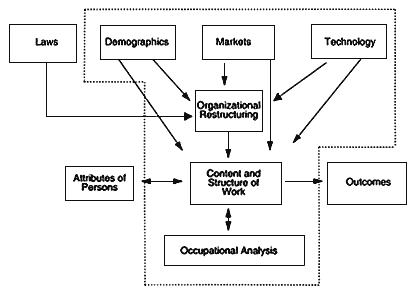
Figure 1.1
Framework for conceptualizing the changing nature of work and occupational analysis.
and skills they employ. Third are the organizational, social, and institutional contexts in which work takes place. Finally, the nature of work encompasses the way work affects and relates to other aspects of daily life—the standards of living it produces for workers and their families, its relationship to community life, its effects on one's self-esteem and social status, etc.
Figure 1.1 seeks to understand these different aspects of work by first examining the key external factors affecting work and how it is changing. For example, one of the most widely recognized forces shaping work is technology. Indeed, one of the reasons there is so much debate today over how work is changing is that some are persuaded that the world is in the midst of another era of transformation in the technological infrastructure similar to those that triggered the first industrial revolution in the late 1700s and the early 1800s and the second industrial revolution at the end of the 19th century. For example, by the beginning of the 20th century, interchangeable parts, electric power, the electric motor, dedicated machine tools, the internal combustion engine, the telephone, and a number of new office technologies (including the
typewriter and the vertical filing system) had occasioned a chain of events that directly and indirectly transformed the nature of work in all four senses described above (Coombs, 1984; Hounshell, 1984; Yates, 1993). New occupations such as automobile mechanics and electricians were born, and existing occupations such as clerical work became increasingly mechanized and differentiated into such subspecialties as typist and filing clerk. The context of work was also irrevocably transformed by the advent of large corporations and urbanization that, in turn, created the milieu for unionization.
Several investigators argue that current changes in the nature of work driven by the multiple uses of digital technologies (digitization) are symptomatic of a third industrial revolution (Bell, 1973; Dertouzos and Moses, 1979; Nora and Minc, 1981; Perrole, 1986; Negroponte, 1995; Block, 1990; Stewart, 1997). They observe that the technology of microelectronics, robotics, and computer-integrated manufacturing, the advent of artificial intelligence, experimentation in electronic data exchange, and the explosion of digital telecommunications evidenced by the unprecedented growth of the Internet and the World Wide Web have brought the world to the verge of a transformation similar to the second industrial revolution.
Three other external forces are frequently identified as contributors to the changing nature of work. These are the demography of the workforce, the globalization of markets, and the laws and regulations governing work and employment relations. The changing demography of the workforce includes the growing presence of women, especially young mothers, in the labor Market; increasing racial and ethnic diversity, including a declining majority of white workers; an increasing number of dual-career families; increasing levels of educational attainment; and the aging of the workforce. These demographic trends are well documented; not only do they increase the heterogeneity of the working population, but they also create pressures for expanding existing lines of work and for creating new ones to address the needs of a labor force that were previously handled outside the paid economy, through the family and the community.
Globalizing product markets creates greater and more uncertain competitive pressures, larger labor markets, and the tendency to-
ward specialization in an international division of labor. In order to regain competitiveness, American and European firms have embarked on a quest for increased flexibility. Key components of this flexibility include lean production and quality management, downsizing, the outsourcing of business services, the use of contract labor, and the growing acceptability of strategic alliances, even among competitors.
A full treatment of the effects of the laws and regulations governing work and employment lies well beyond the scope of this analysis. Although we recognize that legal structures and their enforcement play important roles in the workplace, we diagram these forces outside of the dotted line in Figure 1.1 to signify that we will not deal with them specifically in our analysis. Indeed, we do so because it is our judgment that changes in law should be informed by analysis of changes in how work is being performed. Thus, this report may be a useful input to some future analysis of the implications of changes at work for public policies regulating work and employment.
Having said this, we make two points about how legislation and workplace regulations intersect with our analysis. First, the basic framework for labor and employment law in place today originated from the New Deal legislation of the 1930s. Thus, much of it still reflects the images of industrial work and organizational structures that dominated at that time. That is, the dominant image of work embedded in most of these laws and regulations carried over from that era—the unemployment compensation system, the National Labor Relations Act, the Fair Labor Standards Act, etc.—is that of either a blue-collar production worker or white-collar managerial employee working for a large firm in a long-term employment relationship with a spouse at home attending to personal and family affairs. Thus, it may be problematic that the workforce, family structures and household work hours, and the organization of work have changed considerably since the 1930s while the basic structure of labor and employment law has remained essentially the same.
Second, although the structure of labor and employment laws has not changed, they have expanded considerably in number, scope, range of issues regulated, and complexity. In addition to those cited above, the workplace is now regulated by laws and
regulations governing equal employment opportunity, safety and health, pension security, family and medical leave, and many other aspects of the employment relationship. One study estimated that the number of regulatory programs administered by the U.S. Department of Labor expanded from 43 in 1960 to 134 by 1974 and has continued to grow since then (Dunlop, 1976). Moreover, the growth in legislation and regulations has outpaced the ability of agencies and courts to resolve complaints of violations filed under these statutes, with long backlogs of cases reported at agencies such as the Equal Employment Opportunity Commission, the Wage and Hour Division, and the unit responsible for administering the Family and Medical Leave Act, among others (Commission on the Future of Worker Management Relations, 1994). Thus, there are good reasons to believe that the current structures and content of workplace regulations are having two effects at work: (1) they may be trying to force the organization of work into outmoded categories and structures and (2) the overall complexity and difficulty of enforcing these regulations may be producing frustrations on the part of both workers and employers. There is considerable evidence that both of these are true (Commission on the Future of Worker Management Relations, 1994, 1995).
Thus, although beyond the scope of our analysis, these issues may warrant a study of their own at some point in the near future. Our work may serve as a starting point for the analysis of the role of law by providing data on how work has changed since the basic legal framework governing employment relations in the United States was enacted.
These external forces do not uniquely determine the nature of work. Rather, as illustrated in Figure 1.1, we see them as operating through and interacting with the strategies, structures, and processes of the organizations that employ workers. Organizational restructuring can also exert an independent effect on work. Indeed, a major theoretical and empirical focus of social scientists who study work and employment relations today is to understand the nature of the interactions between these environmental and organizational forces. This reflects a growing recognition that how people work is influenced in significant ways by the senior executives, managers, and military officers who make choices
about how to pursue their organization's strategies and missions. In fact, the successes and failures of these strategies and missions are influenced by the work structures that their decisions create. From this perspective, current experiments with organizational forms, ranging from teamwork to virtual organizations and contingent employment, are as momentous as the rise of corporate and administrative bureaucracies in the late 19th century (Chandler, 1977; Jacoby, 1991; Guest, 1997; Ulrich, 1997).
This interdependence is not well understood, and even when it is recognized in theory, it has not been effectively translated into decision-making processes that join issues of strategy and work design. For example, organizations may address personnel and job design issues after making decisions about competitive strategies or basic missions, choice of technology, and the deployment of other resources. The goal of this report is to provide decision makers with a framework for thinking about how their strategies and decisions affect and reflect work structures and why organizational processes need to be designed to take these interrelationships into account.
One of the main tools used by organizational decision makers to structure work into jobs is occupational analysis. Yet, as our review of these systems suggests, their main use to date has been to describe how work has been structured in the past. That is, by their very nature these systems are backward-looking, since they describe jobs at the point in time when data on them were collected. To be useful these systems must therefore be updated frequently enough to keep up with the pace of change in how work is being structured. Moreover, given advances in the technologies available for displaying and communicating how alternative tasks might be combined, we envision the possibility for these systems to become more forward-looking and serve as analytic aids to decision makers. This vision, however, is mostly speculative at this point in time and, as we note in the final chapter, stands as one clear implication and need for future research and experimentation. Thus, occupational analysis systems, if properly updated and fully utilized can support better tracking and assessments of changes in work, perhaps helping to improve decision making in organizations and the counseling of individuals.
Together, these external and organizational forces and the
tools of occupational analysis shape how people work—what we label in Figure 1.1 the content of work. The content and structure of jobs, in turn, dictate the kinds of knowledge, skills, and abilities that employees are likely to require and also affect important outcomes, such as the quantity, quality, and efficiency of work; the performance of organizations; and the psychological, social, and economic rewards people achieve through work.
Nature of the Evidence
Although it is possible to draw conclusions about why the nature of work and occupations are changing, it is difficult to say with certainty what the changes imply. First, data on the way in which work is changing are ambiguous. For instance, one can point simultaneously to studies that suggest that the new world of work will require greater cognitive and interpersonal skills and to other studies that suggest that fewer such skills will be needed than in the past. Frequently, these conflicting images arise because researchers have used different methods or have studied different types of work (Spenner, 1990, 1995), but in some cases researchers have reached conflicting conclusions after studying similar occupations using similar methods (Kuhn, 1989). Similarly, researchers who have studied changing organizational practices differ over whether the use of teams and advanced technologies universally increases (Mankin et al., 1996; Cotton, 1993; Cohen and Bailey, 1997) or decreases (Babson, 1995; Barker, 1993; Graham, 1995) workers' skills and autonomy, or whether the outcomes are contingent on organizational context (Adler, 1993; Appelbaum and Batt, 1994; Berggren, 1992; Klein, 1989).
Second, studies that examine what workers actually do and how they do it are surprisingly rare. Most studies that pass as investigations of the changing nature of work actually examine changing organizational or employment practices; although these certainly affect work, they are not the same as work content or practices. For example, studies of the replacement of full-time employees by temporary employees tell us nothing about what full-time and temporary employees do at work. Although situated studies of work have a venerable history in sociology, the number of sociologists who currently study work activities in de-
tail is quite small, and the number who concern themselves with how work practices are changing is even smaller. Most contemporary sociologists of work have focused on field studies of professional and blue-collar occupations and, as a result, there have been relatively few studies of the most rapidly growing occupational sectors—managers, salespeople, engineers, technicians, and service workers.
Among anthropologists there has been a long-standing taboo against studying work in industrial societies, especially the work of people who are not somehow underprivileged. Hence, anthropological studies of work are even rarer than sociological studies. Finally, despite the fact that industrial psychologists and ergonomists routinely study the details of work, their research often concerns specific skills and abilities at the individual level of analysis and focuses on purposive measurement for such applications as the design of workplaces, employee selection systems, training programs, and appraisal and compensation systems, rather than on attempts to characterize shifts in the nature of work more broadly. As a result, data on work in postindustrial settings are largely, though not exclusively, anecdotal.
The most significant roadblock to assessing whether and to what extent the nature of work is changing arises, however, from the fact that existing systems of occupational analysis and classification are outdated. Occupational analysis refers to the procedures that analysts (usually industrial psychologists) use to characterize the attributes of a specific job and the knowledge, skills, and abilities that are required to perform the job. Occupational classification systems are taxonomies for naming and grouping occupations into ever larger subsets (see Box 1.1 for definitions).
All systems of occupational classification and analysis reflect the historical and cultural milieu in which they were devised. Conk (1978), for example, has shown that, from 1870 to 1940, the Bureau of the Census specifically designed its system of occupational categories to chart the rise of industrialism and its associated problems, especially the effects of immigration on urban demography and the social structure. To the degree that occupational classifications reflect the social and cultural conditions of an era, the conceptions of work they encode will inevitably be-
|
BOX 1.1 Definition of Terms Used in the Report Work: human activity that is goal directed, purposive, or instrumental and creates value to society. The processes by which humans transform resources into outputs. Work structures: patterns of work activity that are multiply determined by social, economic, political, technological, and cultural processes. Work and works structures are manifested in: Position: a single individual performing a particular set of work activities in a particular location. Job: a collection of individual positions having common work activities in a specific employment relationship. Occupation: a collection of individual jobs having similar work activities. Occupational structure = occupational category system: an organization of occupations into categories for some purpose, including labels and connections or relationships between labels. Occupational analysis: the tools and methods used describe and label work, positions jobs, and occupations. Occupational classification—has two general meanings: (a) the act of classifying positions, jobs, or occupations into an existing occupational category system and (b) the set of occupational categories in an occupational category system. |
come outdated. The Dictionary of Occupational Titles of the U.S. Department of Labor (Spenner, 1979, 1983; Steinberg, 1990, 1992) makes far more elaborate and accurate distinctions among blue-collar than among white-collar occupations (National Research Council, 1980), although only 25 percent of today's workforce is employed in blue-collar jobs, a percentage that is falling (Silvestri, 1997).
Furthermore, because occupational analysis systems are backward-looking and tend to emphasize skills and attributes that are valued by the culture at the time they are developed, they not only fail to assess attributes of work that may eventually prove to
be more important, but they also make attributions that in retrospect seem unwarranted, if not biased. That is, they reflect reality of the past that may not accurately represent the current or future nature of work. For example, Steinberg (1992) has shown that current systems for classifying occupations, such as the Dictionary of Occupational Titles and the Hay System, not only use managerial work as a baseline for assessing the complexity of other jobs, but they also tend to rate occupations traditionally filled by men (e.g., zookeeper) as more highly skilled than occupations traditionally filled by women (e.g., child care provider).
Unfortunately, outdated systems of occupational analysis and classification hamper more than the ability to assess the changing nature of work; they also create serious practical problems. As noted earlier, they are used by educators, employment counselors, military planners, policy makers, and parents.
Multidisciplinary Approach
Given the uncertain and multiple directions in which the nature of work may be changing and the fact that research on the topic is both scarce and diverse, determining whether and how work is changing and then recommending an approach for mapping an occupational structure carries risks. Particularly important is the failure to consider a sufficient range of perspectives and types of evidence. As a result, we have attempted to incorporate the contributions of a variety of disciplines.
Research on work and the workplace is found in many disciplines, including economics, labor relations, sociology, organization studies, anthropology, industrial and organizational psychology, and ergonomics. The methodological and substantive differences among these disciplines are useful for developing a broad understanding of how and why the nature of work may be changing. As changes occur, they must be examined and understood at three levels of analysis: (1) work and the individual practitioner, (2) organizations and other institutions in which the work is embedded, and (3) the economy and society as a whole. The different disciplines typically have more to say about one level of analysis than the others. In general, anthropology, industrial and organizational psychology, and ergonomics focus on the
content of work, whereas economics, industrial relations, and organizational studies concentrate on its context. Sociologists tend to conduct studies in both areas.
Anthropologists (and ethnographically oriented sociologists) are primarily concerned with describing the practices associated with specific types of work and the meaning that those practices have for the individuals who perform them. Most anthropologists argue that work and its meaning are culturally and socially constituted and, for this reason, are likely to vary across contexts. Ergonomists share with anthropologists an overriding concern for the specifics of work practice, but ignore meaning and study instead the physical and cognitive interactions that occur between humans and machines. For anthropologists, work is a social and interpretive activity; for ergonomists, it is a biophysical or an information-processing activity. Industrial and organizational psychologists also study individuals and the jobs they perform. However, unlike either anthropologists or ergonomists, they are relatively unconcerned with the unique aspects of machines or tasks and instead seek to identify and measure individual abilities and task requirements using constructs that generalize across situations. More than those in any other discipline, industrial and organizational psychologists have developed extensive and rigorous methodologies for analyzing jobs for purposes of specifying the skill, knowledge, and ability requirements associated with selection, performance management, and training program development.
The most relevant features of work for an economist are the wages that employers pay, the hours that workers spend, the skills workers bring to the workplace, and the incentives created by employers. Broadly speaking, issues pertaining to work, such as changes in skill requirements, the conditions of work, and the organization of the workplace, can be treated in terms of their implications for wages, skill levels, and the structure of incentives. For instance, if the changing nature of work demands a more skilled workforce, then those who have more skill should garner more pay and returns to skill should increase over time, as workers respond by acquiring more skills. By imposing a market framework on work and work structures, economics provides both a starting point for the analysis of work and an important
criterion for evaluating outcomes: Does a work structure increase or decrease the efficiencies and social benefits that flow from the allocation of scarce resources?
Sociologists and industrial relations researchers (as well as institutional economists) concern themselves primarily with the institutions in which work is embedded. These range from the structure of internal labor markets and human resource systems to the laws that govern the employment contract. Thus, like organizational theorists, sociologists and industrial relations researchers are more likely to study the context in which work occurs than its specific content. Sociologists have historically had more to say about occupations than any other discipline and have done the most research on how work and occupations contribute to social stratification. When sociologists speak of the occupational structure, they tend to refer to the division of labor in society; when industrial psychologists and industrial relations researchers speak of occupational structures, they frequently refer to internal labor markets or to the patterns that link jobs across organizations and thus create occupational, regional, or industry wage structures and labor markets.
The various disciplines differ in their approach to work in several other substantive ways as well. Industrial relations and sociology pay more attention to the historical context of work than any other discipline—with the exception, of course, of history itself. Thus, these disciplines have more to say about employment relations institutions and policies because they bring issues of interests, power, and social values directly into their models and analyses of work. Anthropologists and some sociologists tend to view skill and knowledge as properties of communities. Industrial and organizational psychologists, ergonomists, and economists treat skill and knowledge as properties of individuals. Because of its ties to engineering, ergonomics deals most directly with technology's influence on work, but its purview tends to be highly situation-specific. After ergonomics, sociology and anthropology have probably shown the most interest in technology as a material cause. Economists view work as rationally motivated, whereas sociologists and anthropologists are more likely to view work as a normative or cultural activity.
Given the committee's view that a multidisciplinary approach
is crucial and that the phenomena of interest are multifaceted, analyses have been guided by the following principles. First, we value and have drawn broadly on different methods and types of data, such as ethnographies, organization-specific case studies, surveys, census data, and other sources of information as a basis for suggesting emerging developments and potential trends. Furthermore, for purposes of illustration, we have relied on examples from field research and well-known events at specific organizations. When data are conflicting or ambiguous, the interpretation is based on our collective judgment. Our hope is that these judgments will encourage further research and debate.
Second, we have refrained from concluding that, because specific developments are occurring today, they will necessarily endure or spread across the economy. We have exercised caution about concluding that a given change represents a fundamental transformation in work structures, and we urge readers to do the same. In our view, fundamental transformation requires widespread breaks from past patterns on multiple, interrelated fronts. At the moment, it is difficult to make the connections necessary to argue how various developments are interrelated or whether they will have long-term consequences.
Third, we do not seek to predict the future. Rather, we have attempted to provide a framework that will help individuals and organizational leaders to make more informed choices about issues concerning labor markets, work, and careers. We consider such a stance to be required because one of our primary findings, emphasized throughout this report, is that there is no singular deterministic trend in how work is changing. Instead, there are systematic variations that can be influenced by choices.
Finally, we found it necessary to restrict the scope of our inquiry by limiting our analysis to paid work. We are acutely aware the large numbers of Americans, especially American women, work in the home or contribute to the larger good of society by working in volunteer positions. By ruling home and volunteer work outside the scope of our inquiry, we have no intention of implying that such activities are not crucial to the economy. They surely are. Rather our decision reflects the fact that there is almost no research on how new technologies and other social changes are altering the nature of home and volunteer work.
Nevertheless, based on what is known about the history of work in the home in the early part of the 20th century, we suspect contemporary changes are afoot here as well (Cowen, 1983; Boris, 1994).
Charge to the Committee
The Army Research Institute asked the National Research Council to form a committee to examine issues related to the changing nature of work and the adequacy of occupational analysis systems to classify them. The committee was asked to perform the following tasks:
- Review and analyze the research on the environmental forces, organizational factors, and the content of work that contribute to an understanding of the nature and structure of work.
- Identify key issues in the changing context and content of work that affect the design of occupations.
- Evaluate the changes in the tools for analyzing the nature of the work environment and developing occupational classification systems that are responsive to the current and future needs of the workplace.
- Assess the application of methods and tools developed in the civilian sector to occupational classification and analysis in the Army.
These issues are taken up in the following chapters by working through the structure laid out in Figure 1.1. Because the committee's objective is to address the question of whether and why the nature of work may be changing and what this implies for occupational analysis, we are less concerned either with the personal attributes that changes in work may require or with the way in which the content and structure of work influence organizational or personal outcomes. The dotted line in Figure 1.1 encloses the relations on which this book focuses. In addition, the committee adopted a common set of definitions to lend consistency to the analysis.
Guide to the Report
The next chapter presents a general overview of the major external factors that can influence both the organization and content of work. Chapter 3 turns to the organizational context of work and reviews what is known about recent trends in the restructuring of organizations and what these changes in organizational context imply for work and work relationships. Chapter 4 synthesizes recent research on changes in the actual content and structure of blue-collar, service, managerial, professional, and technical work. These chapters constitute our analysis of what is known and unknown about the ways in which work seems to be changing.
Chapter 5 introduces the topic of occupational analysis and explores what the findings of the preceding chapters imply for current and future systems of occupational analysis and classification. Chapter 6 recapitulates our analysis of the civilian sector for the special case of the Army. Chapter 7 details the committee's central conclusions and implications for policy and research.
The detailed discussion in the chapters is guided by four themes, three of which concern increasing heterogeneity. First, the workforce is becoming more diverse with respect to gender, race, education, and other demographic characteristics. The most visible of these demographic changes over the past 20 years has been the increasing participation and expanding role of women in both the civilian and the military workforces. The increasing presence of women in the workforce means that there are more families in which both spouses work and more single parents in the workforce. As a result, the needs of workers and their families are changing in ways that make work and family decisions highly interdependent. We currently do not have very good data on what the increasing presence of women means for the nature of work in most occupations.
Second, the boundaries between lines of work are becoming more fluid. Traditional distinctions associated with vertical (hierarchical) divisions of labor, such as manager-worker and exempt-nonexempt, no longer seem useful as they once were for distinguishing between lines of work. Horizontal divisions of labor (the allocation of distinct duties to specific positions or jobs)
are being blurred as organizations emphasize teamwork and hold a larger range of employees responsible for communicating and interacting directly with customers, clients, or coworkers inside or outside the organization. Perhaps as a result of these changes, we observe increased within-occupation variability in compensation, employment security, skill requirements, and other outcomes. Nevertheless, this variation suggests that both military and civilian employers are using a wider variety of people and skill mixes to accomplish their missions and goals. Work today often involves teaming people with different skills, backgrounds, and pay structures who have seldom or never worked together before.
Third, the range of choices about how to structure work appears to be increasing. Although market, technological, and demographic forces impinge in systematic ways on how work structures evolve, they are not deterministic. Organizational decision makers, job design specialists, and the tools they use also shape work structures and occupations. We need to better understand how organizational contexts and employment relations influence the technical processes of job design and occupational analysis.
Fourth, the interdependent nature of work structure decisions highlights the need to take a systemic approach to understanding how the context of work is changing and the effects of these changes on outcomes. Technology, work structure, and human resources policies and practices (selection, training, compensation) are all interdependent. A growing body of evidence suggests that bundles of human resources and work practices have bigger effects on performance than individual practices. We therefore need to provide a conceptual map of the broader system of decisions that need to be considered in thinking about work and occupational analysis.


