
2
The External Contexts of Work
This chapter provides a brief discussion of markets, technology, and labor force demographics and their roles in shaping the organization and content of work. Work structures vary in the pace by which they are exposed to, are affected by, or react to these forces. Occupational analysts and other decision makers who influence how work is structured need to systematically take into account the full range of factors affecting work structures and the consequences of their actions for the full range of stakeholders involved. How decision makers respond to changing markets, technologies, and demographics, the human resource policies and systems employed in organizations, and the work structures and outcomes they produce for organizations, individuals, and society are all interdependent.
Changing Markets1
Change in Product Markets
Since the demand for labor is derived from the demand for the products and services it produces, any effort to understand how work is changing must start with how product markets have
been changing. Increased product market competition associated with globalization and deregulation has brought about two types of change: (1) downward pressure on prices and therefore on labor and other production costs and (2) increased pressure to compete in terms of speed, innovation, variety, and customization.
Increasing Price Competition
The heightened price competition facing U.S. industry is the result of both increased international trade and the deregulation of domestic industries. Between 1980 and 1995, imports as a percentage of U.S. gross domestic product rose sharply from 8 to 14 percent (Economic Report of the President, 1995). U.S. manufacturers faced lower-priced, high-volume goods from low-wage countries as well as relatively lower-priced, high-quality goods from high-wage countries such as Japan. Price competition in manufacturing fueled the demand for cheaper services as inputs and, as a result, many service providers no longer enjoy protected or local markets. Changes in technology and deregulation (in such industries as financial services, transportation, utilities, and telecommunications), accelerated domestic competition among service providers, and the mobility of information technologies coupled with international deregulation in services led to higher international competition in services (Office of Technology Assessment, 1987; McKinsey Global Institute, 1992). Deregulation in service industries has led to an influx of new entrants that have lower cost structures because they: (1) have no sunk costs in outdated technologies; (2) pay lower wages than those negotiated and enforced through collective bargaining in the oligopolistic structures of the regulated industries; and (3) utilize work systems and employment contracts that are more flexible and that in some cases rely more on nonstandard employment arrangements that shift risks associated with market uncertainty from the firm to the workforce (e.g., Belzer, 1994; Keefe and Batt, 1997; Lipsky and Donn, 1987). Deregulation has also increased wage inequality by shifting employment to the nonunion sector, in which wage inequality is greater (DiNardo et al., 1996; Fortin and Lemieux, 1997).
U.S. firms responded to price competition by downsizing, flattening hierarchies, and restructuring organizations and processes. In one survey, for example, three-fourths of the corporate respondents cited increased competitive pressures as the key factor motivating restructuring of their operations (Wyatt Company, 1993). Increases in investments of foreign companies in the United States also grew significantly during this time period (growing from $83 billion in 1980 to $406 billion by 1990) and put additional pressure on production and work systems to compete with ones designed (and sometimes managed) by international competitors.
These changes in markets interacted with—and in industries such as trucking and telecommunications accelerated (e.g., Belzer, 1994; Batt and Keefe, 1999)—the decline in unionization. In industries especially hit by price competition (such as auto supply, steel, tires, apparel, electrical machinery, and trucking), union strategies to "take wages out of competition" by maintaining common wage standards (Kochan et al., 1986) were substantially curtailed. Jobs that in the past paid high premiums could be supplied more cheaply in other countries or in domestic enterprises that pay competitive market rates. As a result, unionized employment fell as these jobs moved to lower-cost environments and organizations. This is particularly true of semiskilled blue-collar work in both manufacturing and services. Thus, the combination of increases in international and domestic competition is one major cause of the restructuring experienced in American industry in recent years. It is also a contributing factor to the increase in inequality in the wage structure that is discussed later in this chapter. Those with the most scarce skills and capabilities realized increasing returns to these attributes, and those with fewer and more easily replaced skills were affected most by pressures to hold down wages and labor costs.
Product Innovation, Variety, Customization, and Speed-to-Market
Along with increased price competition, markets have changed in ways that require increased capacity and speed in developing and introducing new and more varied products. Prod-
uct cycle times, for example, have declined significantly in recent years (Fine, 1998), and batch production has risen. U.S. firms have responded by experimenting with a wide variety of new forms of work organization (e.g., Appelbaum and Batt, 1994; Cappelli et al., 1997). For example, to reduce product development time and enhance innovation, firms have introduced various types of cross-functional teams. To improve manufacturing quality and flexibility and reduce time-to-market, they have reduced job classifications, increased job rotation and multitasking, and used shop floor teams and employee participation in problem solving and statistical process control. They have also gained flexibility by focusing on core competencies and efficient supply chain management. Although there is little direct evidence of the effects of decreased product cycle time on job content, the implications are that employees must adapt by continuously learning new skills and new product knowledge in order to produce and service new products. In sum, increased change and variability in product content is associated with new forms of work organization as well as new and more rapidly changing skill requirements of jobs. These changes have profound implications for our occupational classification systems and undermine the extent to which they map the reality of work.
Changing Financial Markets
Researchers have paid less attention to how financial markets influence work structures than to the effects of product markets. Yet capital markets have always been recognized as having a major influence on the organizational forms that evolve in industries and societies (Chandler, 1977; Roe, 1994; Aoki, 1988). For example, the rise of large, integrated corporations in the late 1800s was made possible by the pooling of large sums of capital and gave rise to the dominant role that finance plays in American firms (Fligstein, 1990; Lazonick, 1992). Similarly, in the 1960s, the growth of large-scale conglomerates in the United States reflected the growing view that firms could diversify their risks by operating in different product markets subject to varied exposures to market fluctuations. In the current period, two changes in financial markets appear to be affecting the content of work: (1) the
increased focus on shareholder interests and (2) the increased volatility in international capital flows.
Shareholder Interests
Developments over the past two decades have begun to focus attention on the role of financial markets and institutions in organizational restructuring and disciplining management to focus more narrowly and intensively on the interests of shareholders and other capital market agents. In the 1980s, the rise in the market for corporate control (Lazonick, 1992; Porter, 1992), the rise of shareholder activism (Useem, 1996), and the growth of agency theory within economics were all contributing factors (Appelbaum and Berg, 1996). For example, the 1980s wave of hostile takeovers, mergers and acquisitions, and leveraged buyouts created pressures on American companies to refocus their resources on their "core competencies" and to sell or close business units deemed nonessential to the company's main product line or service activity. Deregulation of financial markets, the growth of mutual funds, and the increased leverage of institutional investors put pressure on top management and led to new activism among members of corporate boards of directors—leading to the replacement of chief executive officers in a number of large and highly visible companies such as IBM, Eastman Kodak, and General Motors. Corporate boards have also tied an increasingly larger proportion of executive pay to shareholder value. The net result of these pressures was to induce top executives to become more responsive to shareholder and investor concerns (Useem, 1996).
In some cases, firms took preemptive measures and downsized in anticipation of future problems and in anticipation of a favorable stock market reaction, rather than treat downsizing as a strategy of last resort taken only in the face of an immediate crisis (Osterman, forthcoming). The evidence suggests that downsizing alone did not produce favorable reactions from the stock market, but downsizing combined with other restructuring moves did have at least a temporary positive effect on stock price (Worrell et al., 1991; Cascio et al., 1997). Although the direct links between these pressures and work content have not been well researched,
it is apparent that these changes in financial markets provided additional incentives for major organizational downsizing and restructuring, which, in turn, profoundly affect the organization of work and content of jobs—by collapsing multiple jobs into single jobs to reduce the number of workers, by dividing jobs in new ways to facilitate outsourcing, or by reorganizing work in new ways to improve productivity and competitiveness.
Global Capital Flows
In addition to financial market changes that link shareholder interests more closely to managerial decision making, the last two decades have witnessed a dramatic rise in the volume and volatility of global capital flows (Burtless, 1995). The relationship between these changes and managerial decision making with respect to production strategies and work organization also has not been well researched, but is important to recognize. The logical implications are that any given productive enterprise faces a more uncertain future, lacking certainty about what level of organizational performance is sufficient to attract and sustain the commitment of capital to investment in the enterprise. We can only speculate about how this heightened uncertainty influences managerial decision making with respect to the organization of work, adoption of new technology, demand for skills, and deployment of labor. In the case of the information services industry, market and technological uncertainty appears to lead companies to hedge their bets by merging and consolidating, on one hand, and investing in competing technologies, on the other (Keefe and Batt, 1997). But the responses to uncertainty are likely to vary significantly across industries and contexts. At a minimum, however, rising environmental uncertainty is likely to be associated with greater variety in experimentation with organizational forms and greater instability in the content of work, suggesting greater challenges for the occupational classification system to accurately mirror the reality of work.
We explore the combined effects of these financial and product market changes on the organization and content of work in more detail in Chapters 3 and 4. For now it is sufficient to note that they serve as one set of critical drivers of changes in employ-
ment relationships and changes in the way work has been carried out in recent years.
Changing Technology
Historically, advances in technology have had profound effects on the workplace and how work is conducted. In essence, technology and work are integrally related (Baba, 1995): work is the processes by which humans transform resources into outputs (Applebaum, 1992), technologies are the means by which the transforming is done (Perrow, 1967). Technology, therefore, shapes not only what people can do, but how they do it. Typically, technological change has three effects on work and occupational structures. It creates new occupations and reduces or eliminates some existing occupations; it increases the skills required on some jobs and decreases the skills of others; and it changes the skills required in ways that are not captured by "up or down-skilling" effects. Because changes in technology occur with some regularity in most work settings, the reformatting of work by new technology is commonplace. Nevertheless, most technological change entails an incremental modification to an existing technological base. The effect of incremental changes can be dramatic, however, as many organizations that rely on computers discover when they switch to a new operating system (DOS, UNIX, Windows) or programming language (COBOL, C++). Incremental technological changes may alter the parameters of specific jobs, seal the fate of particular individuals, and even create or destroy entire occupational communities. But incremental technological changes are unlikely to trigger broad shifts in an occupational structure because they build on, and hence leave unchallenged, existing technological regimes. Broadscale occupational shifts usually require a change in the technical infrastructure.
Digitization: Change in Infrastructure
The technologies of the second industrial revolution (interchangeable parts, electrical power, the electric motor, dedicated machine tools, the internal combustion engine, the telephone, the
typewriter, and vertical filing systems) slowly made obsolete those occupations that were predicated on the previous technological regime, a system of production based largely on hand tools and animate or natural power sources augmented by steam engines and railroads. The question now being debated by historians of technology is whether the advances in digital technologies are ushering in a new era—a third industrial revolution.
With the proliferation of microelectronics, the spread of robotics and computer-integrated manufacturing, the advent of artificial intelligence, experimentation in electronic data exchange, the explosion of digital telecommunications technology, and the unprecedented growth of the Internet and the World Wide Web has come the premonition that the world again stands on the verge of a profound transformation (Bell, 1973; Dertouzos and Moses, 1979; Nora and Minc, 1981; Perrole, 1986; Negroponte, 1995). At the core of this change is digitization, which refers to the conversion of physical phenomena and meaningful symbols like words and numbers into binary (or digital) electronic signals and the use of those signals to control machines and create or manipulate information. The engineering community is currently in the process of fusing the servo-mechanisms characteristic of the second industrial revolution with microelectronics to create a technological base that melds the mechanical and the digital. The Japanese refer to this hybrid technology as "mechatronics." Digitization is a fundamental change in a technological paradigm that is conceptually on a par with electrification (Nye, 1990; Hughes, 1983).
Digitization and Skills
Over the last two decades, debate and research on the implications of digital technologies for the nature of work has centered on three hypotheses: deskilling, upgrading, and polarization. The deskilling hypothesis predicts that widespread use of digital technologies will result in less skilled, more routine work. Contemporary deskilling theory stems from Harry Braverman's (1974) influential book, Labor and Monopoly Capitalism. According to Braverman, by encoding production plans in computer programs, digital technologies enable management to transfer conceptual
tasks to programmers and engineers and relegate operators to doing little more than data input or monitoring a machine's actions.
In sharp contrast, the upgrading hypothesis predicts that digital technologies will, on balance, create new jobs and transform existing work in ways that demand greater levels of skill. The upgrading thesis rests on two lines of reasoning. The first, rooted in the studies of work in continuous processing industries (Blauner, 1964; Gallie, 1978), argues that highly digitized work environments may eliminate the need for older skills, but simultaneously demand new skills that many jobs did not previously require: for example, responsibilities for monitoring, visualizing, and intervening in an entire production process, for responding quickly and decisively in the case of emergencies, and for interacting with a broad array of people in other functional roles (Adler, 1992; Hirschhorn, 1984; Zuboff, 1989; Kern and Schumman, 1992). The second line of argument is based on the contention that working through a symbolic interface is, more often than not, a substantively complex activity that requires people to have technical skills, to conceptualize transformation processes abstractly, and to analyze, interpret, and act on abstractions instead of, or in addition to, sensory data (Zuboff, 1989; Barley, 1990).
The polarization or mixed change hypothesis claims that the shift to digital technology pushes in both directions. Some occupations may be deskilled, others may be upgraded, and still others may experience both forces simultaneously depending on a variety of contextual factors (Barley, 1988; Spenner, 1995; Jones, 1982). Versions of this hypothesis that speak of polarization (Gallie, 1994) generally envision a bifurcation of the occupational structure along lines of skill: an increase in both high-skilled and low-skilled work and a gradual elimination of work that falls in between. Advocates of the mixed change hypothesis tend to see little net change in overall levels of skill, because forces for deskilling and upgrading cancel each other when aggregated.
The most convincing data, to date, comes from the Social Change and Economic Life Initiative (SCELI) sponsored by Great Britain's Economic and Social Research Council (Penn et al., 1994). In 1986, SCELI researchers surveyed over 6,000 individuals ran-
domly selected from the electoral registries of six cities in Great Britain. The cities were selected to include those that had experienced both higher and lower than average levels of unemployment. Respondents were asked a wide range of questions concerning their employment experience, including whether they felt the skills they used on the job had increased, decreased, or stayed the same over the preceding five years. Overall, 52 percent of respondents felt that their skills had increased, whereas only 9 percent reported that their skills had decreased. And 60 percent reported that levels of responsibility in their job had grown, whereas only 7 percent reported a decrease (Gallie, 1994). The pattern of results was robust across occupational categories and industries and was similar for people who did and did not change jobs, but evidence of upgrading was least pronounced among low-skilled manual workers in service industries.
Furthermore, the SCELI data clearly show that upgrading was associated with the use of "automated or computerized equipment" (Gallie, 1994:63). The data show that 39 percent of the respondents reported using digital technologies. Of these, 67 percent reported an increase in skill and 74 percent reported an increase in responsibility. Among those who did not use digital technologies, the percentage reporting an increase in skill and responsibility were 39 and 49 percent, respectively. These results were also robust across occupational categories.
The SCELI data on the impact of digital technologies are consistent with attempts to estimate financial returns from computer use. Analyzing data from 1984 and 1989 Current Population Survey, Krueger (1993) found that using a computer in one's job led to a 10–15 percent premium in wages after controlling for obvious covariates, such as years of education, job tenure, industry, and occupation. DiNardo and Pischke (1997) found returns to computer use of similar magnitude using German data. However, they also found that use of other office technologies, including pencils and paper, also increased wages after controlling for computer use. DiNardo and Pischke therefore argue that economic returns to computer use potentially reflect an unmeasured phenomenon, since it is hard to believe that the ability to use pencil and paper is in short supply. Gallie reaches much the same conclusion regarding the use of computers in the SCELI data: "It is
unlikely that these trends reflect a deterministic impact of new technology . . . the general association between change and higher skill levels is likely to reflect factors such as the prevailing nature of managerial views about effective ways of enhancing employee motivation and the bargaining power of employee work groups" (1994:65) However, neither study provides evidence of a plausible alternative explanation.
After reviewing the research on changing levels of skill conducted up to the early 1990s, Spenner (1995) concluded that aggregate studies of skill, especially those that focused on changes in the occupational composition of the workforce, were more optimistic about upgrading than was the literature composed of case studies of technical change in specific occupations and organizations. These conflicting findings and methodological inconsistencies led Spenner (p. 81) to conclude that "much of what we . . . know suggests an uncertain, complicated and contradictory relationship between technological change and skill requirements of work. Technology has substantial effects on the composition and content of work . . . but these effects vary for different dimensions of skill, for different jobs, occupations, industries, and firms and for different technologies."
By focusing debate on upskilling and downskilling, this literature largely misses other important changes in the mix of skills required to take full advantage of emerging digital technologies. Moreover, this debate also fails to do justice to the interactive effects technology and work organization have on skill requirements. We have more to say about this in Chapter 4 on the content of work, especially when we review the evidence of the different approaches to technological change and their effects on performance in the automobile industry (Shimada and MacDuffie, 1987; MacDuffie, 1996).
Changes in Workforce Demographics
A third factor that influences changes in the nature of work is the changing composition of the workforce (see Figure 1.1). That is, it is unlikely that changes in the nature of work can be examined in isolation from changes in who works, as the composition of the workforce is likely to influence how work is organized and
performed. At the turn of the 20th century, the population of the United States numbered about 76 million people, with just under 40 percent of the population in the civilian labor force. By the year 2000, the total population is expected to be in the neighborhood of 275 million people, with a civilian labor force in the range of 150 to 145 million (about 50 percent of the population). This section presents evidence on some of the salient demographic changes in the U.S. population and the U.S. workforce and presents some indirect evidence on how these changes may influence occupational analysis and classification.
There is no claim that demographic changes, in and of themselves, directly lead occupational classifications to become outmoded. More likely, there are several ways in which demographic changes indirectly shape the occupational structure and occupational classification systems and analysis, and hence merit attention. Demographic change shapes who is available to work in the workforce. Significant changes in the types of workers in the workforce, and more importantly in the types of workers performing various jobs, may point to instances in which traditional occupational classifications are likely to break down. For example, classification systems developed in an era when manufacturing and blue-collar jobs traditionally filled by men predominated may represent this sector of the economy in fine detail and afford much less detail to other occupational arenas, such as clerical work (National Research Council, 1980).
Furthermore, demographic changes may directly shape the changing content and contexts of work, and hence indirectly shape occupational analysis and classification systems. For example, there is also a growing body of evidence (Williams and O'Reilly, 1998; Chatman et al., 1998) that demonstrates that demographic diversity (age, race, gender, etc.) affects the social interactions and processes of groups or teams by altering patterns of communications, cohesion, conflict, and decision making, which in turn affect performance. These performance effects can be either positive or negative, depending on how effectively the intervening social processes are managed. Thus, increased diversity may have an effect on work contexts, content, and outcomes through these group or team processes and their management. In
this way, increased diversity poses some new challenges to managers.
Another way in which demographic change can indirectly shape the occupational structure and occupational classification systems and analysis is through demands for products and services. For example, the baby boom generation, both as children and as young parents, contributed to the conditions leading to an expansion and differentiation in child care services. Similarly, the aging of the population is among the forces pressing for the expansion and differentiation of health care specializations, health care delivery systems, and related technologies, including expanded institutional options and home health care. One could also include consumer products available to the elderly, ranging from foodstuffs to prescription drugs to entertainment.
In this section, we present major demographic trends in the U.S. population and the workforce (based on data from the Current Population Surveys and the U.S. Bureau of the Census) and data showing the extent to which demographic changes have occurred both across occupations and within occupations (based on original research). It is the changes within occupations that are likely to provide the greatest challenge for existing occupational classification, because the increased heterogeneity of workers within an occupation may be associated with differentiation of tasks within the occupation. For example, the entry of women into police work may result in new tasks and may generate work or skill requirements that reduce the importance of physical strength.
Trends in the Population and the Workforce
Age, Fertility, and Family Structure
Over the course of the 20th century, both the U.S. population and the civilian labor force have aged. In 1900, the median age for the white population in the United States was 22.9 years (Gill et al., 1992:76). Estimates for the nonwhite population at the turn of the century are considerably less reliable and generally show a lower median age compared with the white population. By 1997, the median age of the population had risen to 37.3 years for
whites, 29.8 years for blacks, and 26.5 years for Hispanics (U.S. Bureau of the Census, 1996b).
One major trend underlying the aging of the population has been the decline in the total fertility rate. A white woman in 1900 could expect an average of 3.56 children by the end of her childbearing years. Nonwhite fertility rates at the turn of the century were higher but, again, the estimates are subject to greater error. In contrast, by the mid-1990s, a white woman could expect to bear just under two children, whereas black and Hispanic total fertility rates were somewhat higher (Bachu, 1995). By the late 20th century, families were smaller, and there were many more families and households with a single parent. More families and households now are likely to have both spouses working, or the only adult in the family or household working.
Women and Mothers in the Workforce
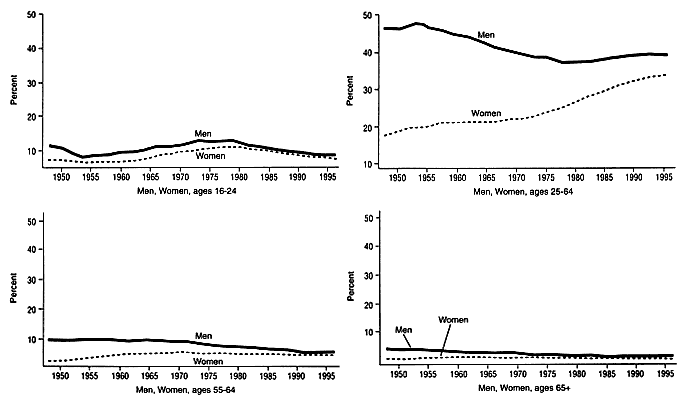
Between 1890 and the mid-1900s, the participation rate of women in the labor force increased from 1 in 5 to 3 in 5 (Monthly Labor Review , 1997:61; Sweet, 1973). Currently, during the prime working years from ages 25 to 54, about three-quarters of women are working. Figure 2.1 describes the sex composition of the workforce by age in the period 1948–1996. Continuing the longer-term trends, the panel for 25- to 54-year-olds shows the convergence of the representation of men and women in these age ranges in the workforce. Although less pronounced, this same convergence appears for the other three age groups shown in the figure (16 to 24, 55 to 64, and over 65). Thus, at young, old, and prime working ages, women's share of the workforce has increased.
Racial and Ethnic Changes
At the turn of the century, African Americans were less than 15 percent of the population, and Hispanics and Asians were less than 5 percent (Passel and Edmonston, 1992; U.S. Bureau of the Census, 1992). Furthermore, the major source of immigrants was from Europe—over two-thirds of whom were male. As we approach the end of the century, the origins of immigrants have diversified, with much larger shares from Asia in particular, and
with nearly equal shares of men and women (Gill et al., 1992:320–323). Nonwhites now compose about one-quarter of the U.S. population. Middle Series Projections by the U.S. Census Bureau show the minority share of the U.S. population approaching 35 percent by 2020 and 50 percent by 2050 under a given set of assumptions about trends in fertility, longevity, and immigration (Passel and Edmonston, 1992; U.S. Bureau of the Census, 1992).
Educational Attainment
The 20th century has seen a substantial increase in the years of formal schooling and educational credentials of both the U.S. population and the labor force. The increases have occurred across all gender and racial groupings, although the average levels of educational attainment differ among whites, blacks, and Hispanics. These differences are even more extreme at higher levels of education. The rising educational attainment of the workforce is apparent in recent data. Between 1970 and 1995, the fraction of the workforce with less than a high school diploma declined sharply. By the mid-1990s, 93 percent of whites, 87 percent of African Americans, and 57 percent of Hispanics had received a high school diploma or equivalency certificate (National Center for Educational Statistics, 1997:92). Also, the fractions of the workforce with some college, particularly with four or more years, rose strongly, especially for women, for whom the fraction was near zero at the beginning of the sample period. These trends in educational attainment, however, do not necessarily point to greater diversity of the workforce. For example, the fraction with a high school education—the modal level of educational attainment—appears relatively stable over this period (at approximately 20 percent).
Trends in Worklife
Duration of Work
One way to summarize some of the most important trends is with comparisons of life and worklife expectancy for U.S. men and women for selected years since the turn of the century. Table 2.1
TABLE 2.1
Life and Work Expectancy at Birth for Selected Years by Sex (in years)
|
Expectancy |
1900a |
1940b |
1950b |
|
Men |
|
|
|
|
Life expectancy |
48.2 |
61.2 |
65.5 |
|
Work expectancy |
32.1 |
38.1 |
41.5 |
|
Nonwork expectancy |
16.1 |
23.1 |
24.0 |
|
Women |
|
|
|
|
Life expectancy |
50.7 |
65.7 |
71.0 |
|
Work expectancy |
6.3 |
12.1 |
15.1 |
|
Nonwork expectancy |
44.4 |
53.6 |
55.9 |
|
Women's worklife as a percentage of men's worklife |
19.6 |
31.6 |
36.3 |
|
a Data for 1900 are for white persons in death registration states. b Figures adjusted to remove 14- and 15-year-olds from the labor force to be consistent with 1970 (1900 is not comparable). c Figures for 1970 and 1980 are based on the increment-decrement methodology. All other figures reflect ordinary life table methodology. See text for explanation. |
|||
provides the data.2 The life expectancies of both men and women increased substantially over the course of the century from about 50 years at the turn of the century to well over 70 years at the end of the century. These increases amount to 20 additional years of life for men and about 30 additional years for women born in 1980.
For men born at the turn of the century, nearly all of their nonwork lives occurred prior to entry into the labor force, with approximately 32 years of worklife and 16 years of nonwork. By 1980, the last year for which methodologically sound estimates exist, men had added about seven years to their worklife expectancy, a small decline from the peak in 1950, after which retire-
|
Expectancy |
1960b |
1970c |
1980c |
1990 |
1995 |
|
Men |
|
|
|
|
|
|
Life expectancy |
66.8 |
67.1 |
70.0 |
|
|
|
Work expectancy |
41.1 |
37.8 |
38.8 |
na |
na |
|
Nonwork expectancy |
25.7 |
29.3 |
31.2 |
na |
na |
|
Women |
|
|
|
|
|
|
Life expectancy |
73.1 |
74.8 |
77.6 |
|
|
|
Work expectancy |
20.1 |
22.3 |
29.4 |
na |
na |
|
Nonwork expectancy |
53.0 |
52.5 |
48.2 |
na |
na |
|
Women's worklife as a percentage of men's worklife |
48.6 |
59.0 |
75.8 |
na |
na |
|
SOURCES: Fullerton, H.N., and Byrne, J.J. 1970. Length of working life for men and women. Monthly Labor Review, 1976 (99):31–35 (Table 1) Smith, S.J. 1985. Revised worklife tables reflect 1979–1980 experience. Monthly Labor Review (108):23–30 (Table 3). Parts of this table were first published in Spenner (1988). |
|||||
ment became a widespread transition and men's labor force participation rates edged downward for ages above 55 (Foner and Schwab, 1983; Hayward and Grady, 1990). Thus, much of the increase in life expectancy for men translated into nonwork or part-time work activity after the ages of 55 or 60. Women's patterns of labor market work and nonwork activity show much more substantial change and convergence toward men's patterns. A typical female born in 1900 could expect just over six years of work in her lifetime in the labor force. Over the course of the century, her work expectancy increased dramatically to about 30 years in the labor force by 1980.
As worklife has been increasing, the length of the work week has declined substantially over much of the 20th century, although highly precise time-series data are not available. The best available estimates suggest that the length of the work week declined from about 62 hours per week in 1880 to about 42 hours a
week in 1950 (Leontif, 1982). The trend since 1950 is far less certain for several reasons. First, the industrial goods-producing sector, for which the best comparative data exist over the long term, no longer dominates the economy, compared with the rise of service-producing industries in the post-World War II era. Second, some would argue that the changing contexts of work, for example telecommuting, multiple job holding, and work at home, have increased the intensity and duration of work in people's lives, an argument that is considered further in Chapters 3 and 4 (Hochschild, 1997). Hence, the typical length of work week estimates may no longer accurately capture the time that work takes in our lives.
Third, and related to the above point, major debate exists on methodological issues surrounding measurement of trends in hours of work. Conventional survey methodology, as used in the Current Population Survey, shows considerable stability in the average hours worked per week over the past 20 years, with men averaging about 41 hours and women about 35 hours per week in the mid-1990s (Rones et al., 1997). In contrast, some ethnographic studies (Hochschild, 1997) and much of conventional wisdom suggest that people are working longer hours in more places, have less free time, and feel more pressed for time now compared with the past. More comprehensive methodology and data, that is, national time diary studies, show a fair amount of stability in the estimated length of the work week between 1965 and 1985, and perhaps even a slight decline in the length of the work week of men but not of women (Robinson and Bostrom, 1994). The estimates by Robinson and Bostrom (1994) showed a sample of U.S. men in 1985 working an average of 46.4 hours per week, and women working an average of 40.6 hours per week. Schor (1992) criticizes these estimates, suggesting they overestimate women's labor force participation at the start of the period and ignore possible changes in weeks worked per year. Her national data and comparisons show a 9 percent increase in hours worked per year (from 1,786 to 1,949) between 1969 and 1987, for fully employed U.S. workers. In a recent study, Jacobs and Gerson (1998) found that men in professional and managerial careers were more likely to work 50 hours or more per week (34.5 percent) than men in other occupations or women in any occupation. Of women work-
ers in the sample, 17 percent of those in professional and managerial jobs reported working 50 or more hours per week, and approximately 26 percent of those in nonprofessional/managerial occupations reported working less than 30 hours per week. These results were based on self-reports of hours worked in the previous week. Furthermore, Jacobs (1998) suggests that self-reports of work week length correlate highly with independent measures of working time, such as time between departure and return (with commuting time subtracted).
Another relevant dataset is the WorkTrends™ survey, conducted annually since 1984 by Gantz Wiley Research of Minneapolis. This multitopic survey was administered to samples of U.S. households, stratified according to key U.S. census demographics, including age, income, and geography. Surveys were completed by principal wage earners, with the stipulation that respondents were employed full-time at establishments of 100 employees or more. Analyses of the WorkTrends™ database for the years 1985, 1990, and 1996 were prepared for the committee for use in this report. In 1985, there were 5,000 surveys distributed and 2,667 completed and returned (53 percent); in 1990 and 1996, 10,000 surveys were distributed with returns of 4,573 (46 percent) and 6,978 (70 percent), respectively.
Meaning of Work
Two major concepts are generally used to assess the meaning of work for the individual: (1) job involvement or work commitment is the extent to which work is a central life interest and (2) work values are the extent to which people place importance on various aspects of work. The ability to draw conclusions about trends in these two aspects of the meaning of work is hampered considerably by the paucity of useful data on worker attitudes. One dataset that does contain some information on trends in the meaning of work for Americans is the General Social Survey. This survey is a nearly annual, multitopic survey administered to a sample of roughly 1,500 adult, English-speaking American men and women (for an introduction to the General Social Survey, see Davis and Smith, 1992).
Work Centrality One way to assess the extent to which work is a central life interest for workers has been to ask them if they would continue to work if they could live comfortably without working. This question was first asked in a study conducted by Morse and Weiss at the University of Michigan (1955). They found that 80 percent of a national sample of male workers said they would continue to work even if they did not have to do so for financial reasons. They interpreted this finding as demonstrating both that work was a central activity to most American men, and that work meant more to them than simply an economic activity. This basic result has since been replicated a number of times in the United States (for a summary, see O'Brien, 1992).
A form of this question was also asked in the General Social Survey: "If you were to get enough money to live as comfortably as you would like for the rest of your life, would you continue to work or would you stop working?" As Table 2.2 shows, 69 percent of Americans in 1973 said they would continue to work. In
TABLE 2.2
Trends in Work Centrality in the United States, 1973-1996 General Social Survey
|
Year |
% of Americans Saying They Would Continue to Work |
|
1973 |
69.1 |
|
1974 |
64.8 |
|
1976 |
69.0 |
|
1977 |
70.0 |
|
1980 |
76.9 |
|
1982 |
72.3 |
|
1984 |
76.0 |
|
1985 |
69.5 |
|
1987 |
75.4 |
|
1988 |
71.0 |
|
1989 |
72.2 |
|
1990 |
72.7 |
|
1991 |
66.9 |
|
1993 |
69.0 |
|
1994 |
65.8 |
|
1996 |
68.0 |
1996, 68 percent said they would continue to work, which represented virtually no change. In the intervening years, a low of 65 percent (1974) and a high of 77 percent (1980) responded similarly. These results are consistent with the percentages obtained in other surveys of the United States in this time period, which are reported in O'Brien (1992). These data reinforce the Morse and Weiss finding that Americans are highly committed to work as a central activity in their lives.
These findings are supported by the Gantz Wiley Research WorkTrends™ survey. Mean responses by year and occupational grouping are shown in Table 2.3 (the scale is from 1 to 5—1 is the most positive response). Responses to the item, "I like the kind of work I do," although showing minor fluctuations across time and occupational groupings, revealed no consistent trend. Respondents generally reported that they like the work they do (on average, 86 percent agreed or strongly agreed with the item). Professionals and managers tended to be most positive in their responses (approximately 91 percent of professionals and 89 percent of managers agreed or strongly agreed) and laborers were least positive (approximately 69 percent agreed or strongly agreed). Similarly, respondents reported substantial amounts of job satisfaction (on average, 68 percent said they were satisfied or very satisfied with their job), with little change from 1985 to 1996. Again, professionals and managers tended to be most satisfied (approximately 73 percent of each group answered satisfied or very satisfied) and laborers least satisfied (approximately 59 percent answered satisfied or very satisfied).
Work Values Trends in work values were assessed in the General Social Survey by asking respondents the following questions: "Would you please look at this card and tell me which one thing on this list you would most prefer in a job?" The card contained the names of five job characteristics and respondents were asked to rank them from 1 (most important) to 4 (fourth most important) (the job characteristic that was not chosen as one of the four most important was coded as 5).
The five job characteristics that were ranked were: high income (income); no danger of being fired (job security); short working hours, with lots of free time (hours); chances for advancement
TABLE 2.3
Trends in Attitudes Toward Work, 1985-1996 Gantz Wiley Research WorkTrends™ Survey
|
|
Years |
Total Sample |
Clerical |
Sales |
Service |
|
I like the kind of work I do.a |
1985 |
1.80 |
1.91 |
1.76 |
1.92 |
|
1990 |
1.73 |
1.79 |
1.75 |
1.82 |
|
|
1996 |
1.83 |
1.90 |
1.92 |
1.95 |
|
|
Considering everything, how satisfied are you with your job?b |
1985 |
2.33 |
2.39 |
2.26 |
2.49 |
|
1990 |
2.29 |
2.27 |
2.34 |
2.44 |
|
|
1996 |
2.26 |
2.23 |
2.25 |
2.40 |
|
|
My work gives me a feeling of personal accomplishment.a |
1985 |
2.04 |
2.18 |
2.01 |
2.21 |
|
1990 |
1.93 |
2.03 |
1.99 |
2.03 |
|
|
1996 |
1.99 |
2.12 |
2.08 |
2.10 |
|
|
My job makes good use of my skills and abilities.a |
1985 |
2.34 |
2.43 |
2.33 |
2.51 |
|
1990 |
2.20 |
2.29 |
2.26 |
2.41 |
|
|
1996 |
2.11 |
2.21 |
2.30 |
2.33 |
|
|
How do you rate the amount of pay you get on your job?c |
1985 |
2.48 |
2.57 |
2.43 |
2.80 |
|
1990 |
2.53 |
2.63 |
2.57 |
2.77 |
|
|
1996 |
2.65 |
2.79 |
2.81 |
2.91 |
|
|
How do you rate your total benefits program?c |
1985 |
2.05 |
2.02 |
2.04 |
2.00 |
|
1990 |
2.19 |
2.04 |
2.26 |
2.32 |
|
|
1996 |
2.27 |
2.15 |
2.41 |
2.42 |
|
|
How do you rate your company in providing job security for people like yourself?c |
1985 |
2.13 |
2.14 |
2.24 |
2.09 |
|
1990 |
2.28 |
2.27 |
2.45 |
2.20 |
|
|
1996 |
2.70 |
2.69 |
2.71 |
2.71 |
|
|
I am seriously considering leaving my company within the next 12 months.a |
1985 |
2.45 |
2.59 |
2.50 |
2.48 |
|
1990 |
3.60 |
3.51 |
3.45 |
3.56 |
|
|
1996 |
3.65 |
3.64 |
3.52 |
3.60 |
|
|
In my company, employees are encouraged to participate in making decisions which affect their work.a |
1990 |
2.82 |
2.86 |
2.72 |
3.12 |
|
1996 |
2.68 |
2.71 |
2.73 |
2.96 |
|
|
Years |
Crafts |
Operatives |
Laborers |
Technical |
Professionals |
Managers and Executives |
R2 |
|
I like the kind of work I do.a |
1985 |
1.86 |
2.16 |
2.31 |
1.84 |
1.60 |
1.76 |
.043 |
|
1990 |
1.71 |
1.83 |
2.29 |
1.70 |
1.57 |
1.67 |
.043 |
|
|
1996 |
1.89 |
1.99 |
2.26 |
1.78 |
1.65 |
1.73 |
.032 |
|
|
Considering everything, how satisfied are you with your job?b |
1985 |
2.39 |
2.58 |
2.54 |
2.43 |
2.22 |
2.24 |
.012 |
|
1990 |
2.25 |
2.30 |
2.54 |
2.33 |
2.20 |
2.20 |
.010 |
|
|
1996 |
2.39 |
2.42 |
2.42 |
2.30 |
2.21 |
2.14 |
.008 |
|
|
My work gives me a feeling of personal accomplishment.a |
1985 |
2.11 |
2.33 |
2.66 |
2.09 |
1.78 |
1.91 |
.054 |
|
1990 |
1.91 |
2.22 |
2.51 |
1.87 |
1.72 |
1.86 |
.046 |
|
|
1996 |
2.02 |
2.22 |
2.48 |
1.96 |
1.74 |
1.91 |
.040 |
|
|
My job makes good use of my skills and abilities.a |
1985 |
2.22 |
2.68 |
3.05 |
2.60 |
2.09 |
2.20 |
.046 |
|
1990 |
2.16 |
2.23 |
2.86 |
2.13 |
1.99 |
2.06 |
.041 |
|
|
1996 |
2.12 |
2.30 |
2.64 |
2.12 |
1.87 |
2.00 |
.039 |
|
|
How do you rate the amount of pay you get on your job?c |
1985 |
2.32 |
2.41 |
2.44 |
2.35 |
2.56 |
2.12 |
.027 |
|
1990 |
2.46 |
2.39 |
2.57 |
2.50 |
2.55 |
2.23 |
.018 |
|
|
1996 |
2.54 |
2.53 |
2.64 |
2.58 |
2.63 |
2.46 |
.015 |
|
|
How do you rate your total benefits program?c |
1985 |
2.22 |
2.25 |
2.26 |
2.00 |
2.06 |
1.89 |
.009 |
|
1990 |
2.33 |
2.29 |
2.38 |
2.26 |
2.15 |
2.10 |
.010 |
|
|
1996 |
2.41 |
2.39 |
2.42 |
2.18 |
2.20 |
2.16 |
.011 |
|
|
How do you rate your company in providing job security for people like yourself?c |
1985 |
2.43 |
2.67 |
2.50 |
2.14 |
2.00 |
1.92 |
.026 |
|
1990 |
2.52 |
2.32 |
2.74 |
2.35 |
2.12 |
2.19 |
.024 |
|
|
1996 |
3.04 |
2.85 |
2.79 |
2.87 |
2.66 |
2.59 |
.009 |
|
|
I am seriously considering leaving my company within the next 12 months.a |
1985 |
2.12 |
2.46 |
2.48 |
2.68 |
2.40 |
2.34 |
.008 |
|
1990 |
3.76 |
3.81 |
3.61 |
3.63 |
3.61 |
3.62 |
.004 |
|
|
1996 |
3.79 |
3.70 |
3.68 |
3.57 |
3.69 |
3.62 |
.002 |
|
|
In my company, employees are encouraged to participate in making decisions which affect their work.a |
1990 |
3.01 |
3.02 |
3.03 |
2.87 |
2.70 |
2.56 |
.022 |
|
1996 |
2.88 |
2.92 |
2.87 |
2.72 |
2.55 |
2.48 |
.022 |
|
|
Years |
Total Sample |
Clerical |
Sales |
Service |
|
I am given a real opportunity to improve my skills in my company.a |
1985 |
2.80 |
2.92 |
2.58 |
3.05 |
|
1990 |
2.70 |
2.75 |
2.68 |
2.86 |
|
|
1996 |
2.68 |
2.70 |
2.62 |
2.85 |
|
|
I am satisfied with the opportunities for training and development that my company provides me.a |
1990 |
2.88 |
2.97 |
2.91 |
2.93 |
|
1996 |
2.82 |
2.82 |
2.79 |
2.94 |
|
|
Considering everything, how would you rate your overall satisfaction in your company at the present time?b |
1985 |
2.51 |
2.50 |
2.37 |
2.63 |
|
1990 |
2.49 |
2.48 |
2.47 |
2.58 |
|
|
1996 |
2.51 |
2.46 |
2.44 |
2.66 |
|
|
Senior management gives employees a clear picture of the direction the company is headed.a |
1990 |
2.97 |
2.91 |
2.79 |
3.08 |
|
1996 |
2.79 |
2.68 |
2.54 |
2.90 |
|
|
When my company's senior management says something, you can believe it is true.a |
1990 |
3.12 |
3.05 |
3.03 |
3.29 |
|
1996 |
2.97 |
2.87 |
2.78 |
3.09 |
|
|
Sample sizes (N) |
1985 |
2667 |
482 |
204 |
204 |
|
1990 |
4573 |
759 |
352 |
366 |
|
|
1996 |
6978 |
879 |
370 |
555 |
|
|
Notes: Analyses of the WorkTrends™ data presented in this table were prepared for the committee by Gantz Wiley Research of Minneapolis. Tabled values are item means, for total samples and occupational subsamples. Five-point response scales are used for all items, as follows: a 1 = Strongly Agree, 2 = Agree, 3 = Neither Agree nor Disagree, 4 = Disagree, 5 = Strongly Disagree. b 1 = Very Satisfied, 2 = Satisfied, 3 Neither Satisfied nor Dissatisfied, 4 = Dissatisfied, 5 = Very Dissatisfied. |
|||||
|
|
Years |
Crafts |
Operatives |
Laborers |
Technical |
Professionals |
Managers and Executives |
R2 |
|
I am given a real opportunity to improve my skills in my company.a |
1985 |
2.90 |
3.29 |
3.12 |
2.86 |
2.66 |
2.57 |
.028 |
|
1990 |
2.85 |
2.84 |
3.10 |
2.71 |
2.52 |
2.55 |
.024 |
|
|
1996 |
2.89 |
2.99 |
2.91 |
2.75 |
2.59 |
2.54 |
.016 |
|
|
I am satisfied with the opportunities for training and development that my company provides me.a |
1990 |
3.04 |
2.77 |
3.09 |
2.92 |
2.77 |
2.76 |
.010 |
|
1996 |
3.03 |
2.93 |
2.93 |
2.94 |
2.78 |
2.70 |
.008 |
|
|
Considering everything, how would you rate your overall satisfaction in your company at the present time?b |
1985 |
2.68 |
2.80 |
2.56 |
2.59 |
2.49 |
2.33 |
.010 |
|
1990 |
2.58 |
2.43 |
2.74 |
2.56 |
2.40 |
2.41 |
.008 |
|
|
1996 |
2.66 |
2.74 |
2.64 |
2.57 |
2.48 |
2.39 |
.008 |
|
|
Senior management gives employees a clear picture of the direction the company is headed.a |
1990 |
3.19 |
2.98 |
3.14 |
3.11 |
2.95 |
2.88 |
.010 |
|
1996 |
2.98 |
2.88 |
2.83 |
2.92 |
2.80 |
2.77 |
.008 |
|
|
When my company's senior management says something, you can believe it is true.a |
1990 |
3.43 |
3.22 |
3.31 |
3.19 |
3.08 |
2.91 |
.015 |
|
1996 |
3.27 |
3.16 |
3.03 |
3.20 |
2.97 |
2.83 |
.015 |
|
|
Sample sizes (N) |
1985 |
127 |
64 |
149 |
195 |
784 |
284 |
|
|
1990 |
294 |
129 |
287 |
336 |
1235 |
533 |
|
|
|
1996 |
416 |
247 |
426 |
426 |
1411 |
1318 |
|
|
|
c 1 = Very Good, 2 = Good, 3 = Fair, 4 = Poor, 5 = Very Poor. R2 values are for multiple regression analyses in which survey items were regressed on occupational groups (effects coded). Respondents specifying occupation as "other" and respondents missing occupational codes are not included in the occupational categories in this table. |
||||||||
(promotions); and work is important and gives a feeling of accomplishment (intrinsic).
Table 2.4 presents the average ranking (calculated across all respondents) for each job characteristic in each year these questions were asked. As the table indicates, Americans in 1973 rated "intrinsic" aspects of work (i.e., having a job that gives them a feeling of accomplishment) as the job characteristic that they would prefer most in a job, followed in order by: promotions, income, job security, and hours. What is perhaps surprising is that this basic ordering, despite some minor fluctuations, has remained remarkably stable during the subsequent two decades: the rank order of these characteristics has remained virtually the same, with intrinsic aspects of work being the job characteristics most preferred by Americans in general and hours the least preferred. The relatively and consistently low emphasis that Americans place on job security (i.e., "danger of being fired") is somewhat surprising, given the fluctuations in unemployment
TABLE 2.4
Trends in Work Values in the United States, 1973–1994 General Social Survey
|
|
Average Ranking Across Categories of Values |
||||
|
Year |
Income |
Security |
Hours |
Promotions |
Intrinsic |
|
1973 |
2.72 |
3.60 |
3.99 |
2.61 |
2.08 |
|
1974 |
2.81 |
3.69 |
3.91 |
2.56 |
2.03 |
|
1976 |
2.67 |
3.53 |
4.10 |
2.62 |
2.08 |
|
1977 |
2.65 |
3.50 |
4.12 |
2.57 |
2.16 |
|
1980 |
2.59 |
3.73 |
4.14 |
2.55 |
1.99 |
|
1982 |
2.41 |
3.25 |
4.13 |
2.78 |
2.43 |
|
1984 |
2.64 |
3.54 |
4.27 |
2.54 |
2.00 |
|
1985 |
2.64 |
3.61 |
4.26 |
2.43 |
2.06 |
|
1987 |
2.49 |
3.61 |
4.17 |
2.58 |
2.16 |
|
1988 |
2.60 |
3.60 |
4.18 |
2.56 |
2.06 |
|
1989 |
2.57 |
3.68 |
4.26 |
2.56 |
1.93 |
|
1990 |
2.61 |
3.62 |
4.22 |
2.59 |
1.97 |
|
1991 |
2.56 |
3.61 |
4.19 |
2.65 |
1.98 |
|
1993 |
2.62 |
3.49 |
4.24 |
2.63 |
2.02 |
|
1994 |
2.55 |
3.43 |
4.26 |
2.67 |
2.09 |
rates (and thus of the probability of finding alternative employment) during this period.
Another source of data on values comes from the WorkTrend™ survey (see Table 2.3), in which respondents generally reported that work provides a feeling of accomplishment (on average, 78 percent agreed or strongly agreed with this item), with only minor fluctuations between 1985 and 1996. Similarly, respondents answered positively to the intrinsic item, "My job makes good use of my skills and abilities" (on average, 71 percent agreed or strongly agreed with the item). For this item, however, there was a noticeable positive trend from 1985 to 1996 for most occupational groupings, particularly operatives, laborers, and technicians. In contrast, substantial negative trends between 1985 and 1996 were evident for the extrinsic work aspects of pay, benefits, and job security for all occupational groupings. On average, 54 percent of respondents rated their pay as good or very good in 1985 and 49 percent by 1996. Likewise, 72 percent rated their benefits as good or very good in 1985, dropping to 64 percent by 1996. Furthermore, respondents were substantially more positive about their jobs in 1985 (70 percent answered good or very good) than in 1996 (47 percent answered good or very good).
Although not directly comparable to the General Social Survey results due to differences in questions and response formats, there is nevertheless consistency in the findings from these two nationally representative surveys. Americans tend to evaluate intrinsic aspects of work more positively than extrinsic aspects. Furthermore, trends evident in the WorkTrends™ data on skills, pay, benefits, and job security help shed light on the General Social Survey results.
Work Shifts and the Timing of Work
Work shifts and work time, perhaps more than any other dimension of work, are likely to be driven by demographic change. For example, the increased entry into the labor force of women with small children might be expected to increase the relative incidence of part-time work and of evening and night shifts, as parents juggle jobs and schedules. Popular accounts suggest that
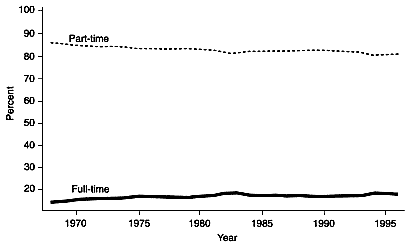
Figure 2.2
Percentage distribution of civilian employment by employment status.
there is a public perception of large growth in nonstandard work times and work shifts.
In fact, these changes are probably more modest than is commonly believed. Regarding the lengths of shifts people work, the percentage of the workforce that works part time did increase between 1968 and 1996, but much of the increase occurred in the 1970s (Figure 2.2).
Evidence on changes from 1973 to 1991 in the distribution of work time throughout the day reveals two main findings (Hamermesh, 1996). First, the proportion of hours worked at night (between 12 am and 4 am) has decreased steadily over this period. At the same time, the proportion of hours worked at the "fringes" of the work day (6–7 a.m. and 4–6 p.m.) increased over this period. These trends are similar for men and women, although more pronounced for men.
Another aspect of timing is the extent to which work is concentrated at particular hours of the day. To study this question, Hamermesh calculated the proportion of total work time worked during the eight most frequently worked hours. The data indicate small changes from 1973 to 1985 and declines for both men
and women from 1985 to 1991. For men and women combined, for example, the proportion of work at these hours declined from .750 in 1985 to .730 in 1991, a difference that is statistically significant.
Demographic Change Across Occupations
The aggregate occupation distributions of the workforce for selected years since the turn of the century, as well as occupation projections for 2005, are presented in Tables 2.5 and 2.6. Data for 1900 through 1980 come from decennial censuses; data for 1985–1995 come from the Current Population Survey and the Bureau of Labor Statistics. The major shifts over this century are well known and documented (see Table 2.5). In occupational locations, the
TABLE 2.5
Occupational Distribution of the Work Force, 1900–1995 (select years)
|
|
Year (percent) |
||||
|
Occupational Group |
1900a |
1930a |
1960b |
1970c |
1980c |
|
Professional and technical |
4.3 |
6.8 |
11.4 |
14.6 |
16.0 |
|
Managers and officials |
5.8 |
7.4 |
8.5 |
8.3 |
11.0 |
|
Clerical |
3.0 |
8.9 |
14.9 |
17.8 |
19.0 |
|
Sales |
4.5 |
6.3 |
7.4 |
7.2 |
7.0 |
|
Craft and supervisors |
10.5 |
12.8 |
14.3 |
13.8 |
13.0 |
|
Operatives |
12.8 |
15.8 |
19.9 |
17.8 |
13.0 |
|
Laborers |
12.5 |
11.0 |
5.5 |
4.7 |
4.0 |
|
Farmers and farm managers |
19.9 |
12.4 |
3.9 |
1.8 |
2.0 |
|
Farm laborers and supervisors |
17.7 |
8.8 |
2.4 |
1.3 |
1.0 |
|
Private household workers |
5.4 |
4.1 |
2.8 |
1.5 |
1.0 |
|
Other service workers |
3.6 |
5.7 |
8.9 |
11.2 |
12.0 |
|
a Base population is "gainful workers." b Refers to employed persons 14 years and older. c Refers to employed persons 16 years and older. SOURCES: U.S. Bureau of the Census. 1975. Historical Statistics of the United States, Colonial Times to 1970, Bicentennial Edition. Part 2. Washington, DC: U.S. Government Printing Office. Tausky, C. 1984. Work and Society. Itacca, IL: Peacock Publishers. Parts of this table were first published in Spenner (1988). |
|||||
TABLE 2.6
Occupational Distribution of the Work Force, 1985–2005 (projected) (select years)
|
|
Year (percent) |
|||
|
Occupational Group |
1985a |
1990 |
1995 |
2005b |
|
Executive, administrative, and managerial |
11.4 |
12.5 |
13.8 |
10.4 |
|
Professional specialty |
12.7 |
13.7 |
14.5 |
15.5 |
|
Technical and related support |
3.0 |
3.2 |
3.1 |
3.7 |
|
Sales |
11.8 |
12.3 |
12.1 |
11.4 |
|
Administrative support including clerical |
16.2 |
15.6 |
14.7 |
16.7 |
|
Service |
13.5 |
13.5 |
13.6 |
17.2 |
|
Precision production, craft, and repair |
12.4 |
11.5 |
10.8 |
10.3 |
|
Operators, fabricators, and laborers |
15.7 |
15.1 |
14.5 |
12.4 |
|
Farming, forestry, and fishing |
3.2 |
2.6 |
2.9 |
2.5 |
|
a All figures refer to employed persons 16 years and older. b Projections refer to the "moderate" series estimates provided by the Bureau of Labor Statistics (i.e., under assumptions of moderate economic and industry employment projections). SOURCES: Table A-22, Employed Civilians by Occupation, Sex and Age. 1991. Employment and Earnings Statistical Abstract of the United States 1987 and 1995. (U.S. Department of Labor, Bureau of Labor Statistics) 38(1):37. Silvestri, G.T. 1995. Occupational employment to 2005. Monthly Labor Review 118:60–87. Parts of this table were first published in Spenner (1988). |
||||
most dramatic change was the decline of farm-related occupations, from nearly 40 percent of the workforce in 1900 to less than 3 percent by 1995. The other major occupational shifts were major increases in the percentages of the workforce in professional, managerial, clerical, and service occupations from about 1 in 6 workers in 1900 to about 6 in 10 workers by 1980. Other major categories experienced more modest increases (sales and craft) or net decreases (laborers and private household workers). Operatives increased their percentage over the first half of the century but have gradually declined as a share of the workforce since 1960.
Table 2.6 provides the occupational distribution of the workforce for more recent years, including the Bureau of Labor Statis-
tics' projections for 2005 (Silvestri, 1995). All of the figures in Table 2.6 are based on the updated occupational classification system used by the Census Bureau. The projections shown here use the Census Bureau's "moderate" series estimates that assume moderate (versus higher or lower) assumptions about economic growth and industry employment projections. Managerial occupations, after peaking in the 1990s, are expected to decline in their relative share of the workforce, and the projection for professional specialty occupations shows steady growth in relative share over the period, which is expected to continue into the next century. Again, the demographic changes mentioned earlier may be among the underlying forces driving this change. Technical, sales, and administrative support occupations, although expected to grow in their absolute numbers, have and will retain about equal proportions of the workforce over the period from 1985 to 2005. Service occupations, although fairly constant in relative share in the 1980s and 1990s, are expected to employ about 1 in 6 workers by 2005, a trend that is likely in part to reflect underlying demographic forces. Finally, occupations at the lower end of the socioeconomic spectrum—production, craft, repair, operators, fabricators, laborers, and farm, forestry, and fishing occupations—will all shrink in their relative shares of the workforce. The latter downward shifts are more likely to reflect technological and productivity changes rather than demographic shifts.
The long-term industry shifts are equally dramatic and generally reflect the well-known shift from jobs in goods-producing to service-producing categories. Service-producing industries contained 3 in 10 jobs at the turn of the century but had grown to nearly 7 in 10 jobs by 1980, and nearly three-quarters of all jobs in 1995.
A final set of general demographic trends that are important for understanding the evolution of occupational classification systems involves the gender composition of occupational employment. Long-term comparisons of trends in the sex segregation of occupations are difficult because of changes in occupational classifications systems and problems in comparability of categories over time (England, 1981; Beller, 1984; Reskin, 1993; Wootton, 1997). Occupational sex segregation is usually defined and measured as the percentage of women (or men) who would have to
change occupations in order to be distributed to occupational categories in the same percentages as men (or women). The actual levels of sex segregation depend on the level of disaggregation in the categories, with more-detailed categories producing higher values of segregation. Furthermore, studies of detailed job categories show it is quite possible to have nearly complete sex segregation at the level of jobs even though aggregate occupational categories show modest or small levels of segregation of men and women.
Although there were some variations, the levels of occupational sex segregation appear to have been fairly stable, perhaps with small declines, over the first 60 to 70 years of this century. For example, the index of segregation computed on detailed occupational categories for the entire workforce declined from a value of 69.0 in 1910 to 67.6 in 1970 (that is, 67.6 percent of women in 1970 would have had to change their detailed occupation in order for women to have an occupational distribution that matched that of men) (Reskin, 1993). According to Jacobs (1998), by 1990 this index had been reduced to 56.4 percent, and in 1997 it reached 53.9 percent. He further notes that declines since the early 1970s have been the greatest for professionals and managers. The dissimilarity index for college graduates declined 20 points, compared with 11.8 points for those with less than a high school diploma.
Demographic Change Within Occupations
To address the question of demographic change within occupations, the committee used data from the Current Population Survey for the 1983 and 1991 periods to analyze the changing demographic and skill composition of the workforce. For example, a particular workforce change over this period—such as the increase in the proportion of the workforce that is black—can be decomposed into across-occupation and within-occupation components.
This decomposition works because the total change in the proportion of blacks can be written as the sum of two components, each of which in turn is a sum. The first component is the sum over all occupations of the change in the proportion of the
workforce in each occupation, multiplied by the (1983 or 1991) proportion of blacks in that occupation; this is the across-occupation component, since it is the change in the proportion of blacks that would have occurred had the proportion of blacks within each occupation remained constant, with only the occupational structure changing. The second component is the sum over all occupations of the change in the proportion of blacks in the occupation, multiplied by the proportion of the workforce in that occupation (in 1991 or 1983);3 this is the within-occupation component, since it is the change in the proportion of blacks that would have occurred had the occupational structure remained unchanged. We carry out this analysis at the level of three-digit occupations. 4
Table 2.7 reports the results of this analysis for demographic changes by age, sex, race/ethnicity, and educational attainment. Although not strictly demographic categories, we also present these decompositions by occupational and employer tenure and reported incidence of formal training, which provide further insight into within-occupation changes in the workforce or workers' skills. The first column summarizes the demographic and other shifts over this period. The demographic shifts, of course, correspond to the figures, showing increased representation of women of prime working age, workers with higher levels of educational attainment, and minorities. The last 6 rows indicate a decreased share with low (1 year or less) occupational tenure, and an increased share with high (10 years or more) occupational tenure. With regard to employer tenure, the data reflect increased shares at both the high and the low ends. Finally, a greater proportion of workers reported formal training either to improve skills on the job or to obtain the job.
The last four columns report on the decomposition, using alternative base years. Looking first at the age and sex changes, we
TABLE 2.7
Changes in Demographic Characteristics of the Workforce, Across and Within Three-Digit Occupations, 1983–2001
|
|
Total Shift |
Proportion in 1983 |
Proportion in 1991 |
|
Proportion employed |
|||
|
Women, 16–24 |
-0.021 |
0.094 |
0.073 |
|
Women, 25–54 |
0.043 |
0.285 |
0.328 |
|
Women, 55–64 |
-0.004 |
0.046 |
0.042 |
|
Women, 65+ |
0.001 |
0.012 |
0.013 |
|
Men, 16–24 |
-0.025 |
0.104 |
0.080 |
|
Men, 25–54 |
0.019 |
0.375 |
0.393 |
|
Men, 55–64 |
-0.012 |
0.066 |
0.055 |
|
Men, 65+ |
-0.001 |
0.018 |
0.016 |
|
Black |
0.009 |
0.093 |
0.102 |
|
White |
-0.017 |
0.881 |
0.864 |
|
Hispanic |
0.023 |
0.052 |
0.075 |
|
< 4 years of high school |
-0.040 |
0.184 |
0.143 |
|
4 years of high school |
-0.014 |
0.367 |
0.353 |
|
1–3 years of college |
0.025 |
0.233 |
0.258 |
|
4+ years of college |
0.030 |
0.216 |
0.246 |
|
1 or fewer years in occupation |
-0.023 |
0.191 |
0.168 |
|
1 or fewer years with present employer |
0.033 |
0.230 |
0.263 |
|
10 or more years in occupation |
0.058 |
0.337 |
0.395 |
|
10 or more years with present employer |
0.029 |
.270 |
0.299 |
|
Received formal training to obtain jobc |
0.024 |
0.093 |
0.118 |
|
Received formal training to improve skillsc |
0.049 |
0.110 |
0.159 |
|
SOURCE: Demographic variables are from the NBER extracts from outgoing rotation group files of the CPS; training and tenure variables are from CPS training supplements. Black and white refer to race. Hispanic refers to ethnic origin. a Using as weights 1983 proportion of occupation and 1991 proportion of demographic group within occupation. |
|||
|
|
Percent Demographic Shift Across Occupationsa |
Percent Demographic Shift Within Occupationsa |
Percent Demographic Shift Across Occupationsb |
Percent Demographic Shift Within Occupationsb |
|
Proportion employed |
||||
|
Women, 16–24 |
9.96 |
90.04 |
4.18 |
95.86 |
|
Women, 25–54 |
6.78 |
93.22 |
10.28 |
89.72 |
|
Women, 55–64 |
27.58 |
72.42 |
18.47 |
81.53 |
|
Women, 65+ |
-30.93 |
130.93 |
-52.58 |
152.58 |
|
Men, 16–24 |
11.54 |
88.46 |
8.03 |
92.01 |
|
Men, 25–54 |
21.46 |
78.49 |
5.46 |
94.54 |
|
Men, 55–64 |
1.65 |
98.35 |
7.01 |
92.99 |
|
Men, 65+ |
27.78 |
73.02 |
38.89 |
61.11 |
|
Black |
-7.95 |
107.95 |
-9.45 |
109.45 |
|
White |
-2.27 |
102.27 |
-0.93 |
100.93 |
|
Hispanic |
-6.49 |
106.53 |
-10.55 |
110.59 |
|
< 4 years of high school |
26.61 |
73.39 |
22.63 |
77.34 |
|
4 years of high school |
64.44 |
35.56 |
69.51 |
30.42 |
|
1-3 years of college |
13.26 |
86.74 |
8.92 |
91.08 |
|
4+ years of college |
56.18 |
43.82 |
56.90 |
43.14 |
|
1 or fewer years in occupation |
10.09 |
89.91 |
13.90 |
86.10 |
|
1 or fewer years with present employer |
-10.56 |
110.56 |
-14.69 |
114.69 |
|
10 or more years in occupation |
-2.11 |
102.13 |
-2.35 |
102.35 |
|
10 or more years with present employer |
-1.94 |
101.97 |
-1.36 |
101.36 |
|
Received formal training to obtain jobc |
20.20 |
79.80 |
21.39 |
78.61 |
|
Received formal training to improve skillsc |
15.84 |
84.16 |
18.02 |
82.00 |
|
b Using as weights 1991 proportion of occupation and 1983 proportion of demographic group within occupation. c Formal training refers to company training programs, including apprenticeships. It does not include informal on-the-job training, in-school training in high schools, postsecondary schools, colleges or universities, or training in the armed services. |
||||
see that, with the possible exception of men age 65 and older, the changes were almost exclusively within occupations.5 As an example, the proportion of the workforce that is female and between ages 25 and 54 rose by .043 over this period; using the first decomposition, 93 percent of this change was within occupations.
This finding is even stronger for changes by race and ethnicity. The across-occupation shifts would have reduced slightly the proportions of blacks and Hispanics, as indicated by the negative values for the across-occupation component of the decomposition. This implies that the occupations in which blacks and Hispanics tended to be represented have shrunk, so the increase in the proportion of the workforce in these categories was all within occupations.
The changes by educational attainment are more balanced. The decline in the proportion with less than four years of high school is largely a within-occupation phenomenon, as is the increase in the proportion with some college. However, the smaller change (decline) in the proportion with 12 years of schooling occurred partly across and partly within occupations, whereas about half of the increase in the proportion with at least four years of college was across occupations.6
The decomposition for employer tenure, in particular, indicates growing diversity of the workforce within occupations, as the entire increase in the proportion both with low tenure and with high tenure occurred within occupations. Finally, the decomposition for training also indicates possible changes within occupations, as approximately 80 percent of the increase in both types of training arose within occupations, pointing predominantly to changing skill requirements of existing occupations, rather than growth of higher-skilled occupations.
To summarize, this evidence on demographic and workforce
changes across and within occupations indicates that most of these changes in recent years have occurred within occupations. This does not necessarily imply that occupational classifications were increasingly challenged. But it does imply that there was increasing diversity of the workforce and requirements of workers within narrow occupational groupings. If this diversity is also associated with diversity in the content of work and the skills of workers, which seems particularly likely given the findings for tenure and training, then it is more likely that occupational classifications may have to be reevaluated.
Changes in Wage and Earnings Inequalities Within Occupations
The other salient change in recent decades is the sharp increase in the dispersion of wages or wage inequality. Most economic research on this topic focuses on either within-group or between-group inequality, with groups typically defined by education, age, and experience. Thus, for example, between-group inequality may refer to the wage (or earnings) differential between workers with a high school diploma and workers with a college degree, whereas within-group inequality may refer to the dispersion of wages for those with a college degree. Recent research has clearly established that, for education, age, and experience groups, both between-group and within-group wage inequality has increased substantially over the past two decades (see, for example, Blackburn et al., 1990; Bound and Johnson, 1992; and Katz and Murphy, 1992). For example, wage differentials between college and high school graduates have widened, as has the dispersion of wages for high school students.
The rise in both components of inequality, especially the between-group component, has been linked to increased relative demand for workers with higher educational attainment, stemming in part, perhaps, from the diffusion of computers in the workplace, but due no doubt to other factors as well, such as intensified competition in global and domestic product markets, the decline of unions, and declines in the ratio of the minimum wage to average wages in the economy. To some extent, then, rising
inequality has been attributed to changing demands for skills performed on the job.
This suggests that indirect evidence can be obtained on whether skills or tasks performed in jobs are changing by looking at changes in wage or earnings inequality within occupations. Research suggests that within detailed occupations, there is relatively little variation in educational attainments. Thus, an increase in inequality within detailed occupations is unlikely to be related to changes in wage or earnings differentials associated with education. Rather, such an increase in inequality is probably due, at least in part, to changing demands for particular skills performed by workers within an occupation.
Such changes are likely to indicate one of three things. First, workers may be entering the occupation who perform new skills or tasks not previously integral to the occupation. Second, the nature of the skills or tasks required of workers in the occupation may be changing, with those who can ably perform the newly required skills and tasks earning labor market rewards, and vice versa. Third, there could simply be growing dispersion in the types of workers (differentiated by skills and tasks) in many occupations.
In all three cases, however, the evidence of rising inequality within occupations would suggest that the specific or "typical" work performed within the occupation has changed. In contrast, if the increase in inequality is largely an across-occupation phenomenon, it may be related to the same factors that have changed wage and earnings differentials by schooling, experience, etc., but it would not provide indirect evidence of changing and more variable work within occupations.
Table 2.8 reports evidence on changes in wage and earnings inequality overall, within occupations, and between occupations. These changes are also calculated over the 1983 to 1991 period, which are both relatively high unemployment years, using the Current Population Survey. The first thing the table reveals is that earnings inequality has not risen, but wage inequality has risen (i.e., an increase in the log variance of .024 indicates a 2.4 percent increase in the variance). For the purposes of this investigation, wages are of more interest than earnings, as they reflect the price of a unit of labor and do not reflect changes in hours or
TABLE 2.8
Changes in Wages and Earnings Inequality Across and Within Three-Digit Occupations, 1983–1991
|
|
1983 |
1991 |
|
Theil index of wage inequality |
0.1464 |
0.1530 |
|
Within-occupation inequality |
0.0939 |
0.0967 |
|
Between-occupation inequality |
0.0525 |
0.0563 |
|
Theil index of earnings inequality |
0.1947 |
0.2000 |
|
Within-occupation inequality |
0.1122 |
0.1162 |
|
Between-occupation inequality |
0.0825 |
0.0838 |
|
Variance of log wages |
0.3025 |
0.3267 |
|
Average within-occupation variance |
0.1870 |
0.2061 |
|
Between-occupation variance |
0.1155 |
0.1206 |
|
Variance of log earnings |
0.6183 |
0.6132 |
|
Average within-occupation variance |
0.3638 |
0.3747 |
|
Between-occupation variance |
0.2545 |
0.2386 |
|
SOURCE: NBER extracts from outgoing rotation group files of the CPS. Earnings and wages are in real 1983 dollars and real 1991 dollars per hour. Real weekly earnings are truncated at 999 dollars per week in both 1983 and 1991. |
||
weeks of work.7 The decompositions for wage inequality indicate that about 42 percent (using the Theil decomposition) to 79 percent (using the variance decomposition) of the rise in wage inequality occurred within detailed occupations during the period. As explained above, the increase in within-occupation wage inequality may point to changes in the types of work performed by workers in the standard occupations, possibly accompanied by growing dispersion within occupations in the skills and tasks required of workers.
Summary of Demographic Findings
There are difficulties inherent in assessing how well current occupational classification systems accommodate a changing
workplace. As a result, our analysis is somewhat speculative and perhaps contributes as much by posing research questions as by answering them. What we can establish is that the long-term increasing diversity of the U.S. workforce has been mirrored in occupations in recent years. In terms of both demographic characteristics and pay, workers in the occupations that we currently use to classify the workforce are increasingly diverse, making it more likely that such occupations include men and women, whites and blacks, more-tenured and less-tenured workers, and high-wage and low-wage workers. This increased diversity within occupations constitutes indirect evidence that the correspondence of current occupational classifications with the jobs that workers do is breaking down, since it is plausible that the increasing diversity of workforce characteristics and wages is reflected in increasing diversity of work.
Nonetheless, the evidence is limited in two important ways. First, it is indirect. It is possible, for example, that a more diverse workforce now does the same jobs that more homogeneous workers performed in the past, in which case this increasing diversity need not pose any challenge to occupational classification. However, at least from the perspective of economics, we would regard this latter possibility as far more plausible if there were not growing variance of wages within occupations; if wages ultimately reflect productivity, growing variance of wages is an indicator of growing variance of productivity, which in turn seems likely to be linked to increased diversity of work.
Second, we can document increasing variability in the type of work done within occupations as we now describe them. We do not attempt to assess the implications (presumably, the costs) of any failure of occupational classification systems to adapt to this increasing variability. On one hand, we could speculate that private businesses in a competitive environment find other ways to organize work to best utilize their workforce. On the other hand, occupational classification is also important in institutions that do not compete in the market—such as public organizations involved in training and career planning and the military.
Conclusions and Implications
The characteristics of the workforce and other features of the external environment reviewed here are changing in ways that will continue to affect the context, content, and outcomes of work. Some of these changes are readily tractable, such as changing demographic patterns. Others, such as changes in markets and technologies, are less easily measured or observed. However, in doing their work, those who design work structures and occupational analysis systems need a solid understanding of what is known and what existing research suggests, but cannot at this point document conclusively, about the effects of these changes. The evidence presented suggests the following conclusions:
|
1. |
Increased competition in product and financial markets will continue to exert pressures to hold down compensation costs, increase uncertainty over job stability, and call for emphasis on quality, innovation, and flexibility in work processes and outcomes. |
|
2. |
Changing technologies will continue to alter skills and eliminate and create jobs at a rapid rate. Although skill requirements for some jobs may be reduced, the net effects of changing technologies are more likely to raise skill requirements and change them in ways that give greater emphasis to cognitive, communications, and interactive skills—points that are documented in more detail in Chapter 4. |
|
3. |
Demographic changes will increase the diversity of individuals and groups across and particularly within occupations and organizations. Much more research is needed to understand the full implications of increased diversity, although the evidence available to date suggests that it will alter many of the social processes (communications, conflict, cohesion, etc.) that affect work outcomes. Changing workforce demographics will also alter occupational structures by increasing demand for goods and services that in the past were more often provided by family members who were not part of the paid workforce. Thus, managing diversity and addressing the consequences of more household hours being devoted to paid work will be increasingly |
|
4. |
One well-documented labor market outcome of recent decades has been an overall increase in the inequality of wages and incomes. For our specific purposes here, the variation in wages observed within occupations is especially important, since it is another indicator of how an outcome of seemingly similar work varies more today than in the past. Whether this trend continues, remains constant, or reverses in the future is a critical question worthy of study and active consideration both for its implications for work design and occupational analysis and for the broader aspects of work and employment policy. |


