
6
Meeting the Challenge of Global Engineering
SUMMARY POINTS
-
A “global engineer” is defined as one who has the personal qualities, international knowledge, and technical skills required to work effectively in a range of international settings and work environments.
-
The United States and Japan are among the leading countries in global engineering activities and capability. However, the two countries have different strengths and environments for global engineering training and education.
-
The global engineering skill set includes (1) language and cultural skills, (2) teamwork and group dynamics skills, (3) knowledge of the business and engineering cultures of counterpart countries, and (4) knowledge of international variations in engineering education and practice.
-
This U.S.-Japan joint study naturally focuses on the experiences and capabilities of Japan and the United States. Still, the Joint Task Force believes that much of this experience has wider applicability, and that an expanded examination of global engineering issues to include other developed and developing countries would be useful.
-
The U.S. group believes that the United States has been making progress in developing awareness of the importance of international capabilities in engineering, but believes that new efforts by government, universities and industry are needed.
WHY ENGINEERS WITH GLOBAL CAPABILITIES?
With the explosive growth in recent years of foreign direct investment and international corporate alliances involving technology transfer and engineering cooperation, the development of products and manufacturing processes increasingly requires cooperation among technical personnel based in two or more countries. Speed to market, efficiency in product development and even the technical success and failure of a given project often depend on the performance of engineers working in international settings with teams spanning diverse cultures. Japanese and U.S.-based companies are very often at the forefront of these global engineering activities.1 Even in academic research, collaboration between researchers in different countries is becoming more frequent and more important to the advancement of engineering science.
Recognizing the growing necessity for American and Japanese engineers to work effectively in international collaborative activities, the Joint Task Force on Engineering Education decided to focus a major part of its effort on identifying the required capabilities of “global engineers,” the skills and approaches that engineers from the United States and Japan bring to international
collaboration, and future tasks for companies, educational institutions and engineers to meet emerging challenges of the global engineering environment.2
A U.S.-Japan Definition and Vision of the “Global Engineer”
At a basic level, a “global engineer” can be defined as one who possesses the cultural and personal skills to work effectively anywhere in the world, displays outstanding technical competence, and contributes to advancing the objectives of his or her individual organization and its partners. Below, we will discuss in greater detail the skills and capabilities required of global engineers, and the contributions that global engineers can be expected to make in the future.
U.S. AND JAPANESE CONTEXT FOR DEVELOPING AND UTILIZING ENGINEERS WITH INTERNATIONAL SKILLS
The preceding chapters provide most of the context for understanding the skills, styles of work and engineering cultures that prevail in the United States and Japan today, and how they affect the skills and capabilities that U.S. and Japanese engineers bring to international collaborative activities. Some of the material for the following discussion is drawn from surveys and interviews conducted by the Japanese and U.S. working groups (see Box 6-1).
The Place of Engineers in Society
U.S. and Japanese engineers both play prominent roles in their respective societies, but there are interesting differences. It is widely perceived that managers with engineering backgrounds are more likely to rise to the top management level in Japanese companies, particularly in manufacturing, than is the case in U.S. companies. Figure 6-1 shows that a high percentage of Japan's corporate top management are engineers. Rigorous U.S.-Japan comparative surveys are difficult to come by.
The situation in public service appears to be somewhat different. It appears that U.S. engineers and scientists are more likely to hold key policymaking positions as cabinet level officials and heads of major scientific and regulatory agencies than are Japanese scientists and engineers. This is partly due to the fact that under Japan's parliamentary system elected legislators are generally chosen to head the major agencies, in contrast to the U.S. system in which the president appoints cabinet members from a variety of backgrounds. In addition, the U.S. system allows for presidential appointments to a much lower level of the bureaucracy than is the case in Japan, where only the minister and a parliamentary vice minister for each agency are appointed by the prime minister. Career officials, many of whom graduated from the law or economics faculties of their universities, possess correspondingly greater influence in Japan.
Therefore, while it appears that Japanese engineers enjoy a higher level of status and responsibility in the corporate sector than their U.S. counterparts, greater job mobility and other factors may allow U.S. engineers the flexibility to wield leadership in a wider range of institutions, including universities, private foundations and other nonprofit organizations, as well as public service in federal, state and local agencies.
|
Box 6-1 Informal U.S. and Japanese Surveys on Global Engineering Discussion in this chapter incorporates insights from informal surveys conducted separately by the U.S. and Japanese Working Groups on issues related to global engineering. U.S. Survey The U.S. group asked two types of experts for their perspectives on global engineering. One type consisted of two senior managers with engineering backgrounds, one the senior vice president for technology at a supplier of high performance computing systems and the other the chief executive officer of an engineering consulting firm specializing in risk-based assessment of engineered systems. This group gave “corporate level” assessments of the motivations and context for international cooperation in engineering and technology development. These managers gave their perspectives on the following issues:
In addition to these two senior managers, the U.S. group also heard from two engineering managers with hands-on experience in U.S.-Japan and other international engineering and product development projects. One of these “project level” engineers had worked with a small software developer, and the other for a large office equipment manufacturer. They gave their perspectives on the following issues:
|
|
Japanese Survey The Japanese Working Group sent questionnaires to managers at nine large manufacturing companies, mainly in the electronics and heavy equipment sectors. Of the nine respondents, most were directors of their respective firm's technical training institute, although a few managed other activities. The Japanese survey included the following questions:
|
Incentives for Organizations.
One of the engineers interviewed by the U.S. working group was a senior executive at Alpha Corp., a medium-sized U.S. company in the field of high performance computing (not the real name of the company). This company's experience reflects a number of the traditional motivations for international engineering collaboration on the part of U.S. companies. Alpha has utilized collaboration in order to develop market opportunities in a variety of countries, and most of the international projects involve some form of technology transfer from the United States to the other country or vice versa. Although at times international collaboration can be difficult to manage, Alpha reports that the benefits of greater exposure in international markets are well worth it.
Alpha makes extensive use of foreign nationals in its overseas operations and alliances. Most collaboration is company-to-company. In one case, Alpha worked with a large Japanese steel company as it sought to diversify into computing and information systems. Alpha received funding for the development of several specific products. The Japanese partner became more familiar with the American management style in computing, and gained licensing revenues and
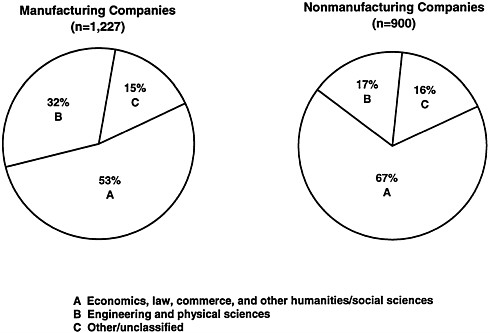
Figure 6-1 Academic backgrounds of Japanese corporate presidents, 1993. SOURCE: Toyo Keizai Shimpo Company.
limited distribution rights within the Japanese market. Most of Alpha's successful collaborative projects with non-U.S. companies have been with Japanese partners. Market exposure and access, rather than technology acquisition, has typically been the most important motivation for Alpha.
In other cases, Alpha has had success in working jointly with universities in Taiwan and Spain. This has worked well in terms of accessing technology. Since universities are often able to tap government funding, this approach can also help to leverage resources. In Alpha's experience, a non-U.S. university will generally not demand technology transfer as a condition for collaboration, as non-U.S. companies often do. Indeed, collaboration with Taiwan has been expanding in recent years. One factor contributing to the ease of collaboration is that the vast majority of Taiwanese engineers with graduate degrees received advanced training in the United States. Thus, Taiwanese engineers often have a better understanding of American culture than do engineers from other countries.
Incentives for Individuals
The U.S. respondents point out that there are few immediate incentives for individual engineers to develop international skills and experience. Often, these skills and experience are gained as a by-product of being selected to work on a given international project because of
specific technical skills. Japanese companies are seen by U.S. respondents as generally providing more structured career tracks and support for employees to gain international skills. However, Japanese respondents did not think that the approaches of Japanese companies are adequate at this point.
Both Japanese and U.S. respondents pointed out several strengths of the U.S. system. For example, several Japanese responses pointed out that although Japanese companies do send talented engineers for training in leading U.S. universities, the U.S. system provides greater flexibility for individuals to pursue their own interests and gain necessary skills by returning to graduate school or seeking other outside training.
Another difference between the U.S. and Japanese systems springs from differences in approaches to managing international operations. According to several U.S. respondents, U.S. companies are more likely to rely on non-U.S. engineers and other professionals in managing overseas facilities and engaging in collaborative product development than Japanese companies are to rely on non-Japanese. Many of these foreign engineers with experience in U.S. multinational companies have moved to the United States to take on key responsibilities with headquarters. As their numbers grow, and it becomes more obvious that the best U.S. companies do not limit the opportunities of capable foreigners, these U.S. companies are better able to attract highly skilled foreign engineers.
Accreditation and Certification Standards
Two kinds of standards can affect global engineering. The first consists of the standards used to accredit or certify engineering education programs and professional engineers. Chapter 4 contains some discussion of differences between the United States and Japan in accrediting undergraduate and graduate engineering education programs. The Accreditation Board for Engineering and Technology (ABET), the U.S. accreditation body, is a participant in the Washington Accord, where a number of countries grant mutual recognition to their engineering accreditation processes.
The Japanese working group believes that the development of international standards for certifying professional engineers is an important task. 3 In practice, certification is most important in civil engineering and related areas involving large projects. Some members of the U.S. working group believe that the engineering community as a whole needs to pay more attention to certification as a means of enhancing the status of engineering as a profession. The present study was not able to address certification issues in great detail, but the task force members agree that international harmonization in accreditation and certification will be increasingly important.
The second area in which standards affect global engineering is that related to information technology and other systems standards. The U.S. and Japanese surveys indicate that familiarity with these standards usually needs to be acquired on the job.
U.S. AND JAPANESE PERSPECTIVES ON GLOBAL ENGINEERING TASKS AND NECESSARY SKILLS
The Challenge of Organizing and Managing Multinational Product Teams
One of the experts interviewed by the U.S. Working Group worked as a “front line” engineer who managed and participated in a variety of international engineering projects for Advanced Office, Inc. (AOI), a major supplier of office equipment (not the real name of the company). Multinational teams utilizing staff from the United States, Japan and Europe have developed a number of products collaboratively.
These global engineering project teams have provided AOI with world wide engineering development capability, allowing it to capitalize on the strengths of each site and to implement development and manufacturing world wide. This global engineering capability gives AOI the flexibility to locate development or manufacturing activities at the most desirable site.
AOI has encountered a variety of obstacles to smooth global engineering interactions. There are often differing agendas among the regions involved in a project. Ultimate customer requirements are sometimes different for each market area. Different views of contracts or specifications exist. There are differences between the short-term and long-term focus or vision. Personnel issues, such as differences in merit systems, promotions, rewards and recognition, vacation entitlement and practices, bonus systems, expense accounting and local customs governing relationships with vendors and customers, are frequent obstacles. Ordinary “red-tape” or paper work problems and relationships with government agencies can be a source of frustration.
Communications problems arise between team members due to differences in language, culture, value systems, process and protocol. Differences in style and perspective among team members can also cause friction in areas such as the value placed on the ability to act quickly as opposed to a desire for advanced preparation. Outside the United States there is a greater focus on the importance of establishing interpersonal relationships as part of the business relationships among team members. Foreign team members often place a much greater emphasis than Americans upon their view of total consistency in a person's behavior. They expect to see an integration of the business, social and personal behaviors of an individual. This emphasis may have important implications for the training of U.S. engineers. Finally, hardships arise due to long-term business travel and expatriate family adjustments.
Human relations issues have caused barriers to international collaboration for AOI as well. As in purely domestic projects there have been personality clashes. Specifically, there are sometimes clashes due to different reporting relationships arising from hierarchy differences among companies. There are often differences in expectations for professional roles, especially with respect to the technical contributions of managers. Responsiveness to requests can vary among sub-teams. Distrust can emerge among team members due to mistrust at higher levels in the partner organization.
AOI provides cross-cultural training for engineers who will be joining international project teams, using both inside and outside consultants. This is supplemented by on-the-job training and ad hoc sessions. Expatriates can elect to receive language instruction. First-time visitors to a foreign country are usually briefed in sessions that explain the basics of expected behavior and available resources. They can also elect to receive consultations from “veterans.”
International work sessions require an investment in planning and organization in order to achieve maximum output. This includes: a clear, advanced definition of session objectives and definition and discussion of issues plus expected outcomes. Work sessions are preceded by an exchange of presentation materials one to two weeks prior to the session to provide an opportunity for questions to be submitted in advance. Meetings of each site team are held before the session in order to align opinions and positions so misunderstandings are avoided and time is not wasted at the session. Proper meeting management and facilitation are required to keep to the agenda topics, and to document agreements and action items. Issues are discussed and efforts are made to validate agreement on wording in real-time while the topic is fresh in participants' minds. A wrap-up session is held to brief upper management of both sites on accomplishments, agreements, issues and next steps. Entire work session materials are compiled before the session breaks up so that everyone leaves with the identical package and common understanding.
In forming international teams, AOI requires at least one individual with fluency in the appropriate language(s), at least one team member with mediation skills, and at least one with negotiation skills. Team members are expected to be flexible and to have a positive attitude toward interactions with others. Global engineers should be open-minded and be willing to accept different ideas, ways of thinking and ways of doing things. An enthusiasm toward the country being dealt with is also required of global engineers.
While AOI expatriates upon their return to their “home” division are guaranteed a job assignment equivalent to the position held prior to going abroad, there are currently no specific incentives provided for individuals to develop overseas experiences and skills and little actual value is placed on overseas experience by the domestic division. All incentives for developing such skills are currently based upon the individual's own initiative and interest in a particular country, travel, or international involvement.
The primary avenue for obtaining global engineering skills is on-the-job training through continuous improvement and nurturing by peers and management (mentoring). Language skills can be gained through schooling and immersion in the foreign environment. A systems-oriented college curriculum that balances the “generalist” perspective and the “specialist” perspective, is appropriate for the global engineer. Such a curriculum should broaden the global engineer's focus while at the same time allow him or her to integrate the “deep” perspectives of a variety of specialists across several disciplines. Finally, global engineers should seek out jobs that entail international interactions for self-training.
The significant problems encountered by global engineering project teams at AOI have included major slips in schedule (some of which have led to program cancellations), successive production line stoppages and start-ups, and major distrust between managers at different sites.
Significant successes have included the ability to launch a variant product produced by another site months ahead of schedule, the ability to take full advantage of learning and complementary strengths across the AOI group companies in development and manufacturing, and the ability to balance resources and capacity to produce a better product line for AOI's world wide customer base. Furthermore, AOI subsidiaries and partners have learned processes and technologies from each other, have shared competitive benchmarking information, have developed technologies and products for use on a world wide basis, and have agreed upon missions at each site to reduce redundancy of efforts and to maximize productivity.
Teamwork
The ability to work effectively in groups or teams is an increasingly critical skill for engineers, as products become more sophisticated and complex, and companies devise new organizational systems to improve product development and manufacturing performance. The informal surveys conducted by the U.S. and Japanese working groups indicate that there are some interesting differences in perspective on the context for teaching these teamwork skills.
Most of the U.S. respondents and members of the U.S. working group familiar with Japanese and U.S. education practices and organizations believe that the Japanese system (both in formal education and corporate management) develops teamwork skills much more systematically and effectively than does the U.S. system. As noted in Chapter 2, primary and secondary school students in Japan do much of the cleaning up and other work tasks at school in teams. On the job, it is the impression of U.S. group members that Japanese engineers (and other employees) are evaluated and rewarded more on the basis of group performance than is the case in U.S. organizations, where more emphasis is placed on documenting and evaluating individual contributions.
Although one Japanese expert polled by the Japanese Working Group did not believe that there is a great disparity in teamwork skills between U.S. and Japanese engineers, most respondents confirmed the impression that Japanese organizations place a higher emphasis on training engineers and others to work in teams. The implications are not clear-cut, however. One of the Japanese respondents remarked that in some situations U.S. teams whose members perform well individually may perform as well as Japanese teams. There was also a concern that Japanese engineers may not perform as well outside of the group context.
Language and Cultural Skills
Respondents to the U.S. and Japanese working group surveys responded that language and cultural knowledge are very important in enabling engineers to work effectively in international settings. Several Japanese respondents stated that knowledge of two languages in addition to Japanese is necessary. There appears to be asymmetry between U.S. and Japanese needs in this area. International business is conducted largely in English, so language skills are more important for non-U.S. engineers working with Americans. However, respondents agreed that even limited capability in foreign languages is useful for U.S. engineers working with international partners. In addition, a growing number of engineers in Asian countries such as China and Korea are learning Japanese.
In the area of cultural skills, Japanese respondents tended to emphasize the importance of understanding foreign cultures and what was unique or different about Japan. The American respondents tended to emphasize the importance of basic adaptability and openness to foreign cultures. Several of the U.S. survey respondents believed that the most important personality factors, such as openness to different viewpoints, tolerance for different ways of doing things, and patience, perhaps cannot be taught.
Box 6-2 contains more discussion of language and cultural issues arising in a specific U.S.-Japan partnership.
|
Box 6-2 Superior Software-Momiji Electric1 One of the respondents to the U.S. survey worked for Superior Software, a small U.S. company that developed several products in collaboration with Momiji Electric, a large Japanese manufacturer of office equipment. The experiences of these companies illustrate several differences between U.S. and Japanese engineering styles, and the skills necessary to overcome resulting obstacles to collaboration. Superior engineers participating in the collaboration were given opportunities to pursue Japanese language training, and presumably Momiji provided English language training as well. However, the U.S. engineers did not receive any other specialized training. Balancing Language, Cultural, and Technical Skills in Selecting Engineers for “Interface” Roles The Superior-Momiji experience illustrates that one obvious, but still very important, issue is language and culture. In U.S.-Japan technology and engineering alliances, key people on both sides in the relationship are often chosen because their language skills and cultural adaptability allow them to operate effectively. This selection is mostly independent of whether the people have the best technical skills or have the correct degree of influence in their organizations. For example, one of the engineers assigned to the project at the outset by Momiji could barely speak English and had difficulties in dealing with Americans. He was taken off the project, but later reemerged and was able to contribute several years later when the relationship between the two companies had become more established. However, selecting engineers to manage the relationship with the best language and cultural skills usually meant that Superior's engineers were not interacting with the “right” Momiji person for the problem at hand, and vice versa. Engineers playing interface roles may not have a great deal of clout in the organization, particularly on the U.S. side. Their insights or the information they glean from counterparts may fall on deaf ears back home. One practical lesson a Superior engineer learned in effective communication in English with Japanese counterparts is that written materials should be favored over or used in conjunction with verbal presentations wherever possible. Most Japanese engineers have greater facility in reading and writing English than in speaking. Mutual Benefits From Collaboration In the Superior-Momiji relationship, both sides benefited, but some of the benefits were not what was expected at the outset. The Japanese company learned a great deal about modularity in software development, top down design, utilizing modern software development tools, software project management tools, and how to develop multiple products simultaneously from the same software base. The U.S. firm learned the importance of the factory in the development process, that a good application of less advanced technology in a good team is generally superior to a spotty application of cutting edge technology, the special factors involved in developing a product that will go out in thousands of units rather than tens or hundreds, and structuring a question-answer setup for testing a major application. |
|
Differences in Business and Engineering Management Culture: “Effort” vs. “Results” The Superior-Momiji collaboration also illustrates differences in business and engineering culture between the two countries. Besides those differences that have been extensively discussed, such as greater Japanese emphasis on group effort and performance vs. American emphasis on individual effort and performance, Superior engineers also learned that different values placed by U.S. and Japanese organizations on “effort” vs. “results” has an impact on the management of projects which can result in frictions between U.S. and Japanese partners. For many Japanese organizations, a “good effort” builds character and is very important to morale. For many American organizations, however, an effort without a result is essentially a waste of time and energy, while a result without an effort is welcomed as a bonanza. In a case where management decides to end an unsuccessful project, an American organization will end all effort and work on a project the instant the decision is made. After all, further work would only be wasted effort, in the American view. In Japan, the approach is often different. If employees are to be denied the benefits of successful completion, they should not be denied the benefit of a good effort. Therefore, management may keep secret the impending demise of the project until the next major milestone, doing nothing to alleviate the hard work and late nights that people put in to meet that deadline. When the milestone is reached, management congratulates everyone on their good effort and explains that the company has no further need for the project. Everyone has saved face, everyone has benefited, and life goes on. These different attitudes may cause problems in U.S.-Japan collaborative endeavors. In the second year of the Superior-Momiji collaboration, the U.S. partner scrambled to complete a drastically under-bid schedule for a December 31 release. Engineers worked weekends, evenings and holidays. When the product was delivered, there was no response for several weeks. Then, a manager from Japan visited to announce that the project had been cancelled. Suspicious that the software had never been tested and that the decision to cancel had been made well before Christmas, the U.S. team members were frustrated and demoralized. Later, when one of the Superior engineers was in Japan acting as a liaison for another project, a Momiji colleague came by quietly to let him know that this project had also been cancelled. As the Momiji engineer tried to explain why he did not want his U.S. counterpart to tell anyone, the cultural difference was recognized, and a solution was worked out. At Momiji, the management and the U.S. liaison were the only ones to know, and the American agreed to work to maintain the illusion as the Japanese engineers assigned to the project continued to work on it. At Superior, however, everyone (including the Japanese liaisons positioned there) would know, all work would stop immediately, and planning would start on the next project. Better mutual understanding of these sorts of differences among Japanese, American and other engineering cultures on the part of participating engineers could promote smoother interactions. Note: The intent of this description is to illustrate several issues that can become barriers in cooperative activities, rather than to portray a typical interaction between U.S. and Japanese engineers. |
Knowledge of Business and Engineering Culture.
The example described in Box 6-2 illustrates how lack of knowledge of differences in business and engineering culture can act as a barrier to cooperation. These differences can make it difficult or impossible to reconcile the perspectives of partners on market and product goals. Misunderstandings and distrust at higher levels of the organization can often impact working level relations between companies. As companies from different countries gain experience in working together, both the larger strategic issues and the differences in business and engineering culture can be overcome. The U.S. respondents point out that the real benefits of collaboration are savings of time and resources, which are realized as a partnership matures.
“Engineering” Aspects of Global Engineering
One question raised by a member of the NRC's Committee on Japan in discussing the concept of global engineering was “what does global engineering have to do with engineering?”4 In other words, are differences in engineering education and practice all related to language and culture (including management practices), or are there real differences related to technology? One of the U.S. interviews explored an aspect of engineering practice that is fundamentally technological, but where implementation can raise cultural issues. This is the field of quantitative risk assessment.
The U.S. engineer that was interviewed is a member of the top management team at QMH Inc., a U.S. engineering consulting company whose business focuses on risk-based and performance assessment technologies for large engineered projects such as power plants, chemical plants, defense projects and space systems.5
QMH has worked for Japanese clients in the nuclear power and space industries. Most of the consulting contracts have been for technology transfer rather than large pieces of applications work. The technology transfer has taken the form of workshops, conferences and seminars given in Japan or of very selected work assignments in the United States often involving Japanese engineers.
Many QMH personnel have experience in engineering education in the United States. When teaching Japanese engineers, they have found that certain style adjustments need to be made. In general, teaching U.S. engineers tends to be highly interactive and at times even confrontational. Students are expected to respond to direct questions from the instructor. Interaction between the instructor and students consists of a dialogue with both instructor and student playing active parts. While the situation expected by Japanese engineering students is changing, they generally are less comfortable responding to direct questions and prefer that the instructor lecture rather than engage students in a dialogue.
This difference becomes very apparent in the teaching of the more abstract topics such as probability, including quantitative risk assessment, an area that QMH has pioneered in applications. Instruction in those topics is greatly enhanced if it is highly interactive, with the instructor repeatedly challenging the student to demonstrate his or her understanding of the concepts involved. This format is unusual in Japan. Instructors must continually push Japanese students to participate more, and some students, usually those with prior educational experience in the United States, have had some measure of success. Still, this difference leaves U.S. instructors uncertain whether the Japanese students have gained sufficient grasp of the necessary
concepts to enable the students to apply them effectively. This uncertainty requires follow up in the field to assess the skills of the Japanese students.
Recent curriculum changes in U.S. engineering education have put more emphasis on such subjects as probability and statistics in order to quantify the engineer's confidence in deterministic results. In particular, engineers now must often perform probabilistic analysis to quantify the uncertainties in their engineering calculations. This movement towards accountability for uncertainty conflicts with a Japanese technical culture that is often uncomfortable with admitting uncertainty in results. And yet, modern engineering needs such expressions of confidence more and more in areas of risk assessment, reliability, and other quality metrics.
INSTITUTIONS AND RESOURCES FOR PREPARING THE GLOBAL ENGINEER IN THE UNITED STATES AND JAPAN
When in Their Careers is it Advantageous for Engineers to Develop International Skills?
As a general principle, the Joint Task Force believes that just as engineering education should be a lifelong learning process, so should global engineering training. There are tasks and insights from international exchange that could benefit K-12, undergraduate students, graduate students and adult engineers pursuing careers. Indeed, the earlier the start, the better. This is particularly true of language learning.
In practice, however, the U.S. and Japanese systems provide different opportunities and incentives for gaining international experience. Much of the international training and experience provided by Japanese companies to employees fairly early in their careers may be functionally equivalent to what U.S. graduate students experience through international internships and other mechanisms.
One of the Japanese respondents states that engineers should be provided with an international experience 4–5 years after entering a company, and that these capabilities should be provided as part of more systematic career planning. Participation in international technical meetings is also a useful mechanism.
University-Based and Other Formal Educational Programs
The Japanese respondents indicate that currently there are not many opportunities for Japanese undergraduate or graduate engineering students to gain international knowledge and skills. Several respondents stated that there should be more opportunities for Japanese engineering students to gain experience abroad and develop language skills, particularly during the university years or perhaps between university graduation and beginning a career. A related concern was that engineering education in universities should allow students to become familiar with current communications and information technologies.
Several examples of U.S. and Japanese programs are listed in Box 6-3. If we think of the basic global engineering skill and knowledge areas as language and culture, business and engineering culture, team work and group dynamics, and technical environment (including
standards), there has been a slow development in the United States of specific programs and curricula to address those areas.
The MIT Japan Program has a long track record of training scientists and engineers in Japanese language and culture, and providing opportunities for research in Japanese university and industrial laboratories. One of the strengths of the program is its flexibility. It does require two years of language study before undertaking the internships, but students are able to structure their engineering and humanities studies in a way that meets their needs.
An interesting, recently launched program at the University of Illinois allows engineering undergraduates to take an international minor in a specific geographical region.
Several U.S. respondents mentioned that the inflow of engineering talent from overseas constitutes another advantage for the United States in the area of global engineering, in that immigrant engineers often possess capabilities to function effectively in more than one culture and language.
Other mechanisms allow collaborations between engineering students in different countries. One example is Robocon, an international engineering competition that teams students from various participating countries to design and build remote controlled machines.6 The students benefit from the experience of working through the challenges of communicating ideas, negotiating work strategies, and problem-solving as an integrated team. The competition also provides exposure to peers with different skill sets, educational backgrounds, and approaches to engineering.
|
Box 6-3 Examples of U.S. and Japanese Academic and Government Programs to Provide Global Engineering Capabilities U.S. Programs MIT Japan Program NSF Programs (Tsukuba Summer Institute, Short/Medium/Long-Term Stays) U.S.-Japan Manufacturing Technology Fellowship Program University of Illinois International Minor in Engineering Japanese Programs JAIMS (Japan-America Institute of Management Science) Joint Programs JAMS (Japan-American Math and Science Institute—summer meeting alternating between the United States and Japan) JSPS-NSF Cooperative Science Program SOURCE: Compiled from various sources by OJA staff. |
The Need for New Approaches and Expanded Efforts
The U.S. working group believes that U.S. engineering schools, funding agencies (such as the National Science Foundation and private foundations), and industry should devote more attention and resources to increasing U.S. global engineering capabilities. U.S. institutions have collectively amassed considerable experience in this area. This report naturally focuses on U.S.-Japan issues and insights, and much of the U.S. effort in international training for engineers and scientists in recent years has been focused on Japan. Yet, obviously, there is a need to prepare engineers to work with a wide range of countries and partners around the world. The experiences of the MIT Japan program and other efforts could be very useful in developing broader approaches.
Possible tasks
The Japanese group recommends expanded efforts in the following areas:
-
Promotion of training for global engineering through internships at Japanese facilities in the foreign host countries.
-
Development of communication skills through interaction with foreign counterparts.
-
Encouragement for senior personnel to accompany students and trainees during international exchange programs.
-
Promotion of collaboration between Japanese engineering universities and their foreign counterparts.
-
Requirements for foreign language training.
-
Encouragement of training through collaborative projects with students from other countries.
-
Utilization of expertise and experience of engineers who have been trained in foreign countries.
-
Development of training programs for engineers from developing countries.
-
Development of training programs for young Japanese students and engineers to work in developing countries.
The U.S. working group has identified a number of possible tasks that could be the focus of expanded global engineering training and education efforts:
-
Training for graduate engineering students that incorporates language learning and 6-to 12-month internships in the country of interest.
-
Expanded study-abroad and language study opportunities for undergraduate engineering students.
-
Development of case-based and other teaching materials aimed at building knowledge of the business and engineering cultures of various countries.
-
Development of continuing education programs (seminars and short courses) aimed at a corporate audience, perhaps in collaboration with business or management schools.
-
Tapping foreign engineering students and non-native faculty as a resource for learning about global engineering approaches.
-
Development of “sister” relations with foreign engineering schools, including linked course work and exchange opportunities.
-
Development of training programs for engineers from developing countries and for U.S. engineers planning to work in developing countries.
Options.
The U.S. working group developed several possible options and approaches for future consideration by various stakeholders. The U.S. working group hopes that this report spurs a broader discussion of these issues and what might be done.
-
Option One: Expand grant programs targeted at individual students and researchers for education and training related to global engineering. One option would be for NSF and private foundations to expand funding available for individual students, researchers and schools pursuing one or more of the tasks outlined above.
-
Option Two: Establish a new program of global engineering centers. The U.S. working group members also discussed establishing a new program of funding for global engineering centers. This approach might build on the experiences of the MIT Japan Program, with centers at different schools specializing in training and education aimed at particular countries, regions, or industries. Several working group members and experts consulted during the study are skeptical about the value of new centers, particularly large ones, and would prefer to focus resources on individual efforts. Other members believe that establishing smaller centers focused on particular countries or industries might allow for the accumulation of a critical mass of expertise.
-
Option Three: Expanded discussion and exchange among stakeholders. In order to further explore these and other options, perhaps various U.S. stakeholders could hold a conference to share their insights and discuss U.S. needs. The relevant stakeholders would include a range of engineering schools, industry, government funding agencies, private foundations, and engineering societies. The National Academy of Engineering might play a useful role in furthering this discussion.
NOTES AND REFERENCES
1 The Joint Task Force realizes that companies based in smaller markets, particularly in Europe, are often more internationally focused than U.S. or Japanese companies, and may therefore have more international business and engineering experience.
2 Leaders in engineering education and practice have been aware of these growing international imperatives for some time. See National Academy of Engineering, Strengthening U.S. Engineering Through International Cooperation: Some Recommendations for Action (Washington, D.C.: National Academy Press, 1988).
3 Hideo Ohashi, “Guroubauru Jidai no Kogaku Kyoiku” (Engineering Education for a Global Era), Gijutsu to Keizai (Technology and Economics), April 1998.
4 Several U.S. respondents emphasized that in order to be an effective global engineer one must first be an excellent engineer.
5 Not the actual company name.
6 Communication with Evelyn Wang, Massachusetts Institute of Technology student who participated in Robocon.


