
In sum, human dimensions research aims at understanding how human activity drives greenhouse gas emissions, regional air quality, land cover change, and alterations in terrestrial and marine ecosystems; predicting the course of the activities that drive those transformations; estimating how changes in climate, land cover, ecosystems, and atmospheric chemistry affect food, water, natural resources, human health, and the economy; analyzing the ways that societies manage environmental resources; and analyzing the feasibility and possible costs and implications of technical, economic, behavioral, and policy responses to those environmental changes. This research builds basic understanding of human-environment interactions and provides information and responsive tools to decision makers.
Although research on the social and policy aspects of environmental change has a long history, human dimensions research only became formally linked to global change research in the late 1980s. The potential for making this link was set forth in seminal writings addressed to national and international research policy makers.5 Human dimensions research became part of the U.S. Global Change Research Program (USGCRP) in 1989 with a small National Science Foundation (NSF) program and has since become a significant component of the USGCRP. This activity, together with more general support from government, foundations, and universities for social science research on global change, has resulted in some significant accomplishments and insights in understanding the human dimensions of global climate change.
Case Studies: Contributions of Human Dimensions Research in Addressing Global Change
Human Dimensions Research and the IPCC
Contributions to the recent Intergovernmental Panel on Climate Change (IPCC) reports are a good illustration of the significance and policy relevance of human dimensions research. The year 1988 is often identified as a turning point in public and political perceptions of climate change in the United States. While the news media linked drought to global warming, scientists, environmental groups, and decision makers gathered in Toronto to declare the need for a 20 percent cut in greenhouse gas emissions.6 Meanwhile, social and applied scientists were working to develop methods for assessing the economic and social consequences of climate change and examining the implications of the policies that might be used to mitigate it. The results of this research were reported to the IPCC and became an important part of international debate and decision making in response to the threat of climate change.
For example, demographers, geographers, and others have estimated populations at risk from sea level rise and demonstrated the tremendous vulnerability of many large cities to climatic variations.7 The synthesized results of many country case studies indicated many billions of U.S. dollars in potential losses and protection costs associated with a 1-meter rise in sea level (see Table 7.3).
TABLE 7.3 Impacts of a 1-Meter Sea Level Rise in Selected Countries
To estimate the potential effects of global warming on the world's food system, agronomists and economists linked the output of climate models to crop yield and economic models.8 Figure 7.1 shows several important results of these studies, including the sensitivity of impact assessments to the results of different climate models, the considerable potential for adaptation to alter the impact of climate change, and the relative vulnerability of developing countries.
Also important to the IPCC and other assessments are efforts to calculate the costs and benefits of various mitigation strategies, such as carbon taxes and carbon sequestration through reforestation, including estimates of nonmarket values. For example, the estimated costs of a carbon tax to achieve a 20 percent reduction in CO2 emissions ranged from $50 to $330 per ton of carbon in the IPCC study,9 depending on the economic assumptions and model used. Forest plantations and forest management have the potential to sequester up to 75 billion tons of carbon a year.10 Studies of the economic feasibility of this strategy have been used as a basis for discussions in the negotiations for the Framework Convention on Climate Change and have informed debate on strategies such as joint implementation of carbon reductions through aid for forest and energy efficiency projects.
Also considered by the IPCC was the issue of deforestation in Amazonia, where human dimensions research has informed policy decisions in Amazonian nations, especially Brazil, and in international organizations such as the World Bank. In the late 1980s international attention focused on Amazonia, where rapid deforestation was linked to climate change, loss of biodiversity, and threats to indigenous peoples.11 Human dimensions research revealed the causes of forest destruction; for example, the building of highways opened the forest to migrants, many of whom did not know how to farm cleared land or manage forests sustainably.12 Biases in agricultural subsidies, tax incentives, and high inflation promoted extensive land clearing for ranching.13 Detailed social and spatial analyses of relationships among deforestation, secondary growth, and demo-
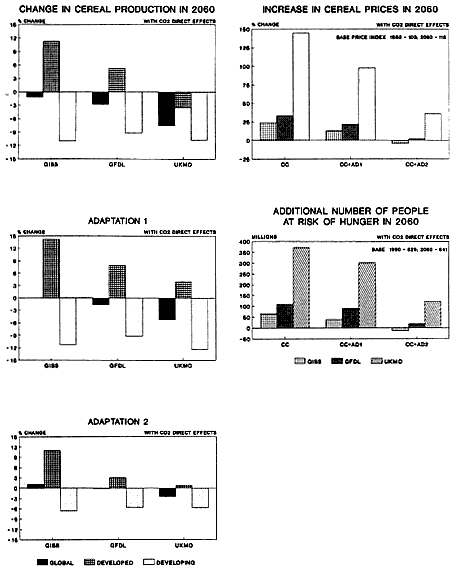
Figure 7.1
Change in global, developed country, and developing country cereal production, cereal prices, and people at risk of hunger in 2060 under different climate change scenarios (% change from a base estimate for 2060). NOTES: GISS, Goddard Institute of Space Science; GFDL, Geophysical Fluid Dynamics Laboratory; UKMO, U.K. Meteorological Office; CC, climate change scenario including direct CO2 effects; Adaptation 1 (AD1), adaptation level involving minor changes to existing agricultural systems; Adaptation 2 (AD2), adaptation level involving major changes. Reference scenario assumes no climate change.
SOURCE: Rosenzweig and Parry (1994). Courtesy of Macmillan Magazines Ltd.
graphic characteristics showed heterogeneous patterns that challenged simple explanations of land use change and showed the need for local strategies for ecosystem protection.14
Partly as a result of these research insights, countries such as Brazil have altered taxation and subsidy structures that favored ranching and have adopted policies for more sustainable development of forest lands. Multilateral development agencies now undertake environmental assessments for transportation and other development projects. Popular accounts are now more sensitive to the varied causes and responses to Amazonian deforestation.
Consequences of Climate Change and Variability at the Regional Level
Researchers have compiled data on overall losses from climatic disasters and have shown that economic damages are increasing dramatically, especially in the United States. For example, hurricane and flood losses have reached more than $1 billion annually in recent years and have stressed both federal disaster relief and private insurance systems.15 Although these increased disaster losses may be due to climate change, much of the increase is a result of increasing vulnerability resulting from more people living in hazard-prone locations, increasing property prices, and inadequate land use and building regulations. In the developing world, millions of people have been displaced by cyclones, flooding, and droughts, as population growth, migration, and poverty expose more people to climatic extremes.16 The human consequences of climate change and variability depend critically on the vulnerability of human populations and on their ability to adapt, as well as on climatic events.
Studies have also identified a serious threat of changes in the patterns of diseases and pests associated with climate change and variability.17 The 1993 Midwest floods were associated with multiple epidemics in the United States. Heavy rains in Milwaukee overwhelmed the sanitation system, creating a plume of farm waste and contaminated runoff in Lake Michigan that later entered the water supply, resulting in a large outbreak of Cryptosporidium (400,000 cases, with more than 100 deaths). In Queens, New York, an exceptionally hot, humid summer boosted local mosquito populations, leading to local transmission of malaria. In the southwestern United States, intense rains provided a sudden burst of food supplies for rodents, following a six-year drought that significantly reduced rodent predators (owls, coyotes, and snakes). The 10-fold rise in rodents led to transmission of a ''new'' disease—hantavirus pulmonary syndrome—with a case fatality rate of 50 percent.
In Southern Africa, prolonged drought, punctuated by heavy rains in 1994, precipitated an upsurge of rodents, crippling agricultural yields in Zimbabwe and leading to plague in Mozambique and Malawi. In India in 1994 flooding following a summer of 51°C temperatures across the plains led to an outbreak of rodent-borne plague, as houses with stored grains heated up, generating clouds of fleas. In addition to severe human losses in the affected regions, measured economic


