
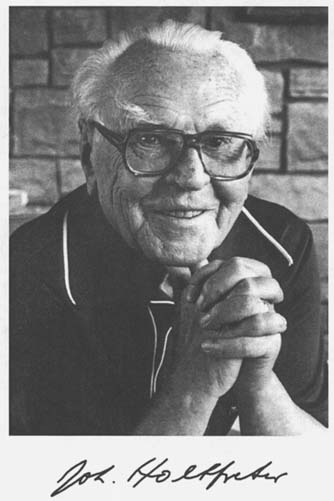
Johannes Holtfreter
January 9, 1901–November 13, 1992
BY JOHN GERHART
JOHANNES HOLTFRETER WAS the world's foremost experimental embryologist in the decades between 1930 and 1960. His research was done entirely with amphibian embryos, the favored material of the time. He initiated and contributed substantially to many lines of experimentation that are still ongoing in the analysis of the embryonic organizer and of embryonic induction. For embryologists, his research shifted their view from the developing embryo as a supracellular organismal entity to the embryo as a complex population of interacting cells in which the numerous cells surrounding the organizer have a high competence for development, held in a latent state. The signals from the organizer mostly evoke or release this development, rather than provide detailed instructions for it. Our present-day concepts of secreted inductive signals, cell competence, and cellular morphogenetic activities sprang from Holtfreter's findings and insights.
Holtfreter's particular contributions include:
- The invention of Holtfreter's medium (a balanced salt solution in which operated embryos and clumps of embryonic cells survive and differentiate) and the introduction of sterile technique (1931).
- His discovery that dead and disintegrated organizer tissue could still induce locally organized parts of secondary axes (1932–38) and his findings that most tissues of embryos and adults of representative members of many animal phyla contain substances that induce neural development, findings that set off an international search for the true inducer.
- His improvement of the sandwich assay for inducers, by which the experimentalist can define the responding tissue and control its contact with inducing tissue or extracted test material (1933).
- The use of these conditions to test the autonomous differentiation capacity of small clusters of cells from various parts of the urodele or anuran gastrula embryo and the contribution of data to specification maps, competence maps, and distribution maps of head inducers and trunktail inducers in the early gastrula (1938).
- Discovery of conditions to produce urodele exogastrulae in which neural tissue does not form. These embryos provided evidence that the organizer may exclusively transmit neuralizing signals to the ectoderm by a vertical path in urodeles (1933).
- The use of interspecies (xenoplastic) grafting experiments (urodele-anuran) to demonstrate the species-specific competence of tissues to respond to the organizer's signals, yet the cross-species commonality of the organizers inductive signals (1935–36).
- Analysis of minimal conditions of pH extremes, Ca++ depletion, and hypotonicity (sublethal cytolysis) to obtain neural development in ectodermal fragments (1944–51).
- Analysis of the role of the notochord and somites in shaping the floor plate and walls of the neural tube (1933).
- Discovery of cell sorting and analysis of tissue affinities and tissue segregation in embryos (1939, 1955).
- Analysis of the three kinds of region-specific morphogenetic activities of cells in the amphibian gastrula and the integration of this information into a unified view of gastrulation (1942–43).
Holtfreter published approximately sixty papers in his career, and all but three were under his sole authorship. Many are still widely cited. Several of his techniques and modes of analysis have become standard practice in embryology, a subject now included in developmental biology. After becoming a U.S. citizen, he was elected to the National Academy of Sciences in 1955. Celebrations of his seventieth birthday and university retirement were accompanied by symposia and memorial volumes.
A recent issue of Developmental Dynamics, organized by Viktor Hamburger and Hazel Sive, was dedicated to his memory,1 and I had the honor of contributing to that issue. A detailed account of Holtfreter's scientific contributions and aspects of his life has been prepared by his long-time colleague Viktor Hamburger in The Heritage of Experimental Embryology2. Holtfreter presented his own account in A Conceptual History of Modern Embryology (1991, pp. 109–28).3
Education and Early Life
Holtfreter was born in Richtenberg, a small rural town in Pomerania in northeastern Germany on January 9, 1901, the second of three children and the single son. His father owned a prosperous whisky factory and rye fields. By Holtfreter's own account, he grew up in a stable supportive family and spent his early years collecting and drawing animals and butterflies. At the start of World War I, his family moved to Stralsund 20 miles away on the Baltic Sea, where he graduated from the Realgymnasium despite deteriorating conditions at the end of the war. As a student, he felt unsuited for mathematics, physics, and chemistry,
yet he felt confirmed in his inclination as an incipient field biologist. He pursued natural science at the Universities of Rostock and Leipzig from 1917 to 1919 and then transferred to the University of Freiburg, attracted by the hiking and skiing in the area and by the possibility of working with a renowned naturalist on the faculty (Professor Doflein). However, the professor died shortly before Holtfreter arrived. His replacement was Hans Spemann, whose work as the preeminent embryologist of the time was unknown to Holtfreter. Nevertheless, Holtfreter began studying embryology and in 1924 received a doctoral degree in natural sciences based on thesis research completed in Spemann's laboratory. The thesis subject was the development of the liver and pancreas of the frog embryo, and Holtfreter commented that this subject was not of great interest to Spemann or himself.
During this time, he shared a laboratory bench with Hilde Mangold (nee Pröscholdt), who was in the process of discovering the amphibian gastrula organizer, a discovery later acknowledged in the award of the 1935 Nobel Prize to Spemann. In these experiments she extended a systematic study of Spemann's, which involved operating on gastrula stage amphibian embryos to remove small clumps of cells from various locations of one embryo and graft them into new locations in other embryos of the same age. Most clumps blended harmoniously into their new surroundings and joined the paths of development of cells there, giving a near-normal looking embryo. Hilde Mangold was to graft cell clumps from the dorsal lip of the blastopore, and the results with these cells were indeed different. When she transplanted these cells to the opposite side of a host, the host developed as a partial twin with a second embryonic body axis located at the site of the graft. The secondary axis contained a well-formed central nervous system
and blocks of body muscles. A few tissues of the secondary axis derived from cells of the graft, but the nervous system and muscles were composed of cells of the host. The graft had certainly not blended harmoniously into its new surroundings; it had kept its own path of development and altered the paths of development of the surrounding cells. Later analysis confirmed that, in the presence of this particular graft, the nearby host tissues indeed developed along paths they would not otherwise have followed. The dorsal lip of the blastopore was called ''the organizer" by Spemann, in recognition of its role in organizing the development of a body axis and central nervous system from cells surrounding it. Its influence on the surrounding tissues was called an induction. Thus, the nervous system was induced by the organizer. Spemann and Mangold published their landmark paper on the organizer in 1924 to great acclaim.
Although Holtfreter was to become the world's leading researcher on the organizer and on induction, he himself played no part in this discovery and felt that Spemann did not have a good opinion of his laboratory ability. He is said to have worked by night rather than by day and to have disappeared for long periods for hikes and outings with the Wandervögel. Neither behavior endeared him to the dedicated professor. After Holtfreter received his degree, Spemann suggested that he study marine biology at the famous Stazione Zoologica in Naples, and Holtfreter undertook this at his father's expense. In Naples, however, he avoided the laboratory, traveled throughout Italy (mostly on foot), and painted, finally settling in the small village of St. Angelo on the coast of Ischia. There, it is said, he oil-painted a large panel of the saint for the local church. On returning home to Stralsund after almost two years, he had no prospects for a research appointment. He tried portrait painting but to little effect. He traveled to Lapland
and wrote an account of his travels. He went to Helgoland and assisted at a marine biology institute, caring for the oyster beds. In the absence of a job prospect in Helgoland, he went to the University of Greifswald for a diploma to qualify him as a high school teacher. Balking at the prospect of high school teaching, he went to Holland in hope of getting a position in a botanical-zoological garden in Java but to no avail. By 1928 all prospects seemed exhausted. Then he received an invitation from Otto Mangold, chairman of a department at the Kaiser-Wilhelm Institute in Berlin-Dahlem, to accept a research position, and he took this with no hesitation. He began this position in 1928, four years after his degree, with but one scientific publication to his name, the 1925 presentation of his thesis research. Mangold, who had been a student and associate of Spemann (and widower of Hilde Mangold, who had died in a kitchen accident), knew Holtfreter's thesis work and training.
Breakthrough Years
Mangold left Holtfreter to his own research pursuits. Holtfreter chose to extend the organizer studies of Spemann's laboratory by addressing questions of how instructive the organizer is to surrounding cells versus how self-instructive are these cells regarding their choices of developmental paths. He entered a very productive and creative phase of his career, working until 2 a.m. or 3 a.m. almost daily (the laboratory had small attic rooms with bunks, where he lived), with several lines of experimentation conducted in parallel. He usually worked alone. He devised a balanced salt solution in which operated embryos and pieces of embryonic tissue could survive for periods of several weeks and differentiate, and he introduced sterile conditions to reduce bacterial infections. These
techniques are now commonly used but were new at the time. (In the Spemann-Mangold experiments, only five of several hundred operated embryos survived infection and the hypotonicity of pond water.) With these conditions, Holtfreter undertook several revealing studies. The first (1931–38) was to see if the organizer retained its activities after being "devitalized" by heat, alcohol, drying, or freezing, or if its activities depended on its intact living structure as Spemann implied. Holtfreter soon showed that dead and partially extracted organizer material was strongly inductive, especially in eliciting neural development, including braining structures. He then tested a variety of embryonic and adult tissues from animals of diverse phyla and found that many tissues from many organisms and developmental stages release materials capable of neural induction. Surprisingly, agents with inductive activity were not unique to the organizer. Holtfreter soon saw the similarity of inducers to hormones, and this comparison has been upheld by modern studies, although the similarity may be more to growth factor proteins and their antagonists than to endocrine-type hormones. These discoveries set off an international search for inductive substances released either by the organizer or by heterologous sources such as chick embryo extract or HeLa cells. Joseph Needham and Conrad Waddington, who headed an English effort to isolate the inducer, visited the Berlin-Dahlem laboratory to learn techniques. Holtfreter's student H.-P. Chuang, was able to show that partial purification separates at least two kinds of inducers, one with neural inducing activity and one with mesodermizing activity. The evidence for two kinds of inducers was later incorporated by others into models of neural induction (by Nieuwkoop and by Saxen and Toivonen), which persist to this day.
Holtfreter also found conditions to produce exogastrulae
in large numbers and used these to examine the path by which the organizer transmits neuralizing signals to the responding ectoderm (1933). He found that urodele embryos developing in a hypertonic salt solution retain a solid interior of cells because they fail to inflate the blastocoel. When gastrulation begins, the involuting surface cells have no internal space into which to move. Instead, they turn outward; the embryo exogastrulates. In particular, the organizer mesoderm pushes itself away from the ectoderm rather than rolling under it. Since the organizer of this exogastrula does not underlie the ectoderm, it cannot transmit inducing signals to it by a vertical path, that is, across planes of apposed tissue. However, even in the exogastrula, the organizer mesoderm and the prospective neural ectoderm remain connected across a planar boundary (which would become the limit of involution in the normal embryo). Thus, if a planar path suffices for the organizer to transmit inducing signals to the ectoderm (as Spemann considered possible), the exogastrula should still form a neural plate. As Holtfreter showed, the ectodermal cap of the exogastrula develops no neural tissue that can be detected by morphological criteria. Instead, it develops as a wrinkled atypical epidermis connected by a thin stalk to the mesoderm and endoderm. The result seemed to show clearly the indispensability of the vertical path and to eliminate the sufficiency of the planar path of induction. Although Holtfreter seemed to have settled this issue for the urodele embryo, it has arisen again in recent studies of Xenopus embryos, where some neural development does occur in exogastrulae and in planar explants. Some kinds of embryos may use both paths, whereas others may use only one path or the other.
Approximately twelve papers were published in the five years at Berlin-Dahlem. Holtfreter's artistic interests found
expression in his numerous detailed drawings of embryos and differentiated explants for these publications.
University of Munich
The significance of Holtfreter's research became quickly recognized, and in 1934 he accepted an associate professorship at the University of Munich, in the Department of Zoology headed by Professor Karl von Frisch (the discoverer of the language of bees). His five years in Munich were also very productive, interrupted in 1935 by a one-year Rockefeller fellowship to work in the United States in the laboratory of Ross Harrison at Yale University. However, he did not undertake much laboratory work during the year. He had also received an unrestricted travel grant from a private donor (Dr. Gwinner), allowing him to tour the world first class by way of the western United States, Hawaii, Japan, China, and the Pacific islands. He spent several months in Bali, enjoying the music, arts, and dance, and engaging in painting and black-white scratchboard etching (a technique of scratching through a layer of India ink on chalkboard). Some colleagues feel he replenished his ideas and immense capacity for concentration during these periods away from the laboratory.
At the University of Munich, Holtfreter began a systematic study of the capacity of small pieces of the gastrula embryo to develop and differentiate in isolation in his balanced salts solution, that is, in the absence of signals from the organizer. This is currently called a specification test, and was then called a differentiation capacity test, or a test of the cells' state of determination. He found that cell clumps from some regions (such as the ectoderm) reliably differentiate only to epidermis, although they would form neural tissue and epidermis in the embryo. Hence, organizer signals of the neuralizing kind seemed stringently
required for the development of ectoderm cells to nervous tissue, whereas the cells seemed self-instructed for epidermis development, a finding he probed more deeply a decade later. By contrast, small clumps of cells from the marginal zone mesoderm, which were expected to form somites in the embryo, would in isolation form not only somites but also notochord, neural tube, and epidermis, that is, much more than expected in the embryo in the presence of organizer signals. In fact, some of these explants developed as small bilateral embryoids. Thus, some regions seemed highly self-informed for paths of development and, if not wholly independent of the organizer's signals, were then perhaps inhibited in the embryo from developing their full range of capabilities. This work was done in both urodele and anuran embryos, with a very large number of cases. The two classic 1938 papers, in German, on the differentiation capacity of parts of the gastrula, have been recently translated into English by Viktor Hamburger.4 The results led Holtfreter to suggest that, except in the case of the neural induction of ectoderm, the organizer does not provide detailed instructions for the differentiation of neighboring cells. The cells have extensive inherent capabilities of their own, and the organizer just evokes or releases these. As further evidence supporting this point, he made "sandwiches" of explanted ectoderm wrapped around an explanted organizer, using as tissue sources the embryos of different amphibian orders (urodeles, anurans). He found that the ectoderm gave a species-specific response to inducers, whereas the organizer's inducers seemed common to, and similarly distributed in, animals of both orders. This reinforced the conclusion that the type of differentiative response is defined extensively by the reacting tissue, and not only by the inductive source (1936–38). Around this time, he suggested that the term "organizer" may be misnomer.
Holtfreter also published several papers on the properties of inducers (1934–38), a subject of intense international attention, and this kept him in regular contact with Needham and Waddington in England. Holtfreter gave an invited presentation of his induction studies to a very large audience at the Congress of Physics, Chemistry, and Biology at the 1938 International Exhibition in Paris. Among his last experiments in Munich, he disaggregated cells of a neurula-stage embryo, mixed them together randomly and observed their extensive capacity to sort out, to selectively adhere, and to reconstitute well-organized tissues similar to those of the intact embryo (1939), a project he returned to after World War II.
When he returned to Germany in 1936 after his sojourn in Bali, he was concerned for his future, saying (1991), "I was full of hatred and disgust for the regime, but felt helpless. I knew that I was spied upon and sooner or later the Gestapo would get hold of me. I saw the war coming. In 1939, shortly before the war started, I managed 'by the skin of my teeth' to escape from Germany. Thanks largely to Joseph Needham, I found refuge in Cambridge." He was a guest lecturer at the Zoological Institute for a year. In 1940, when the German invasion of England seemed imminent, he was interned with thousands of German refugees and shipped to Canada, where he spent almost two years behind barbed wire.
McGill University
In 1942 Holtfreter was released from internment. He found a research position at Montreal's McGill University, supported by a Rockefeller fellowship. At McGill, he began a study of the cell biological basis of gastrulation, one of the first systematic analyses of morphogenesis. He built on the 1929 work of W. Vogt to locate and characterize the various
kinds of cell activities by which the lower half of the embryo (the mesoderm and endoderm) is internalized in this crucial period when egg organization is transformed into embryonic organization. He explanted single cells or clumps of cells from different regions and microscopically observed their movements and changes of shape in his culture medium. He also examined the surface coat of the cleaved egg, a coat seeming to hold the cells together. (More recently, it has been shown that this is not actually a coat, but an intercellular array of tight junctions and adhenens junctions located close to the embryo surface.) Holtfreter studied epiboly in ectoderm fragments, bottle cell elongation and bottle cell ingression in marginal zone explants, and convergent extension in organizer mesoderm explants. He favored the interpretation that bottle cells invaded the yolk mass and tugged other surface cells into the interior after them. At the same time, the layer of ectodermal cells expands to cover cells of the lower half due to the insertion of deep cells into a surface sheet of cells, thereby increasing its area. Although he observed the convergent extension of organizer cells, he gave this morphogenetic activity a lesser role in gastrulation than the tugging force of bottle cells; recent studies give it the primary role. He then integrated his findings in two major articles, "A study of the mechanics of gastrulation," Parts I and II (1943, 1944), which still serve as models for the ongoing analysis of morphogenesis.5
University of Rochester
In 1946 Holtfreter accepted the offer of an associate professorship at the University of Rochester in the Department of Biology chaired by Professor Curt Stern (who had known him at Berlin-Dahlem). He was advanced to full professor in 1948, and he remained at Rochester until his retirement
in 1969. Although he had several students at Rochester, he and they tended to publish their research independently. Holtfreter pursued several significant lines of analysis during the Rochester years. One line concerned autoneuralization and the question of whether the organizer's signals are really indispensable for neural induction. He began by confirming and extending the 1941 discovery by L. Barth that the ectoderm of some amphibian species (axolotl, R. pipiens) will develop neural structures if merely exposed to a saline solution. Holtfreter, of course, felt from his previous studies that his salts solution was inert and free of inducers. He found, however, that the gastrula ectoderm of certain amphibians (ones not previously examined by him) did respond to his medium by forming neural tissue, and that the ectoderm of yet other amphibians (ones he knew formed only epidermis in his medium) would also do this if briefly exposed to a slightly acidified or alkalinized solution before culturing in his medium. By optimizing the conditions, he could get the ectoderm to differentiate even brain vesicles with multiple sense organs (1947). This was a clear example of neural development without signals from the organizer and proof of the inherent capacity of ectoderm to develop into neural tissue if released to do so.
Holtfreter suggested that, although the ectoderm cells are inherently capable of neural development, this capability is self-suppressed in them (and hence epidermis develops unless inducers are added). He postulated that the sub-lethal conditions of the medium dissociate or inactivate the suppressive agent, allowing other agents to become active and initiate neural development of the tissue. This is autoneuralization. He also noted that since the differentiated tissue was locally well organized, spatially arrayed signals from an intact organizer must not be needed for fine grain pattern. The ectoderm had an inherent capacity
to self-organize, at least on the local level of a brain vesicle and attending sense organ (though not on the larger scale of an entire nervous system). This work served to shift research attention from the inducer to the responding tissue as the source of specificity and organization. With these proposals Holtfreter may have reached his point of greatest departure from the 1924 views of the organizer held in Spemann's laboratory, namely, that its activity required the living intact state and that it provided detailed instructions to naive surrounding cells. Unfortunately for some researchers of 1947, Holtfreter's analysis of autoneuralization just emphasized the futility of studying induction and the organizer and confirmed for them the wisdom of switching to the upcoming field of molecular genetics. However, recent research has returned to these questions and has strongly supported Holtfreter's interpretation of the innate and suppressed capacity of the ectoderm for neural development, except that the current views hold that the suppression is enforced by intercellular, not intracellular, means.
Also during this Rochester period, his student, P. L. Townes, renewed and extended Holtfreter's provocative 1939 study of tissue affinity, using disaggregated cells from different germ layers of a neurula-stage embryo, which were then mixed and reaggregated randomly in different combinations. Ectodermal and endodermal cells segregated strongly from one another in these mixtures while adhering to like cells, eventually forming separate spheres. Mesodermal cells, by contrast, adhered to both ectoderm and endoderm and held them together in a three-layered arrangement, occupying the middle layer as mesoderm would in the intact embryo. Neural tube cells sorted to an intermediate position between epidermis and mesoderm and reconstituted a remarkably normal looking hollow neural
tube. Townes and Holtfreter suggested that the directional migration of cells as well as the elective affinities of cells ruled the organization of these recombinates and of the normal embryo's germ layers. The Townes and Holtfreter paper of 1955, which offered cell biological explanations for embryological phenomena, is one of the best known of Holtfreter's papers.
In 1955 Holtfreter and Hamburger co-published a large chapter on amphibian development, summarizing the field at the time and including many original observations and points of emphasis. This remains essential reading for students of amphibian embryology. In that article and elsewhere, Holtfreter remarks on his dislike for concepts of supra-cellular organizing agencies, such as gradients, and on his preference for explanations involving local cell-cell interactions. In the 1944–56 period he had moved increasingly into the area of cell biology, then in its infancy, and published several papers on the cell membrane, the nucleus, and various organelles. After 1956 Holtfreter turned his attention increasingly to individual cell behaviors, including the aggregation of Dictyostelium amoebae and the differentiation of muscle cells in culture, little of which has been published.
Overall it has been said that Holtfreter's contribution to embryology was to move the studies of the organizer in an analytical and reductionist direction,2 along which the supracellular and extra-embryonic interpretations of development were replaced with ones based on hormone-like secreted agents, cell-specific and stage-specific competence, release of latent capacities by inducers, cell sorting, cell shape change, cell migration, and cell interactions in populations. Although this cell-centered view is now taken for granted in cell biology and developmental biology, it was a rare and penetrating view in Holtfreter's time. From our
vantage point of fifty years, it seems as if Holtfreter brought to light an individualistic and anti-authoritarian view of the embryo in which competent responsive cells interact in a self-organizing community, in place of conceptions of the embryo as a collection of naive passive members dependent for their future on detailed directions from a central organizer. The term ''organizer" was laden with connotations from the realm of human activity.
Among his students and research associates, in addition to H.-P. Chuang and P. L. Townes, have been A. Haggis, N. Cohen, L. Stevens, C. Loeffler, and W. B. Muchmore. Holtfreter was known as a demanding mentor who held high standards for experimentation and brooked no nonsense in the discussion of research results. Hiroko Ban was his last student. They were married in 1959. Her 1965 thesis on the autonomous differentiation of subregions of the organizer contains a wealth of information. It was never published in journal form, but it is available as a microfilmed thesis and in outline in Viktor Hamburger's book.2
Johannes Holtfreter retired from the University of Rochester in 1968 and continued as Tracy H. Harris emeritus professor of zoology until approximately 1981. In his last years he was in good health except for the decline and eventual loss of his eyesight, which precluded any writing or painting. He died in Rochester at the age of ninety-one. Hiroko Ban-Holtfreter continues to live in Rochester.
MOST OF THIS MATERIAL is taken from published accounts by Viktor Hamburger and by Holtfreter himself. The author did not have the opportunity to know Johannes Holtfreter personally, but he has greatly admired Holtfreter's research contributions for many years. It is the fate of nonagenarians that few of their contemporaries survive who could have written a more personal account.
Notes
-
1.
Dev. Dynamics, vol. 205, no. 3, 1996.
-
2.
V. Hamburger. The Heritage of Experimental Embryology. New York: Oxford Press, 1988.
-
3.
A Conceptual History of Modern Embryology, ed. S. F. Gilbert, pp. 109–28. Baltimore: Johns Hopkins Press, 1991.
-
4.
Dev. Dynamics, vol. 205, no. 3, 1996, pp. 217–44.
-
5.
See discussion of Holtfreter's work on gastrulation by R. Keller, Dev. Dynamics vol. 205, no. 3, 1996, pp. 257–64.
Selected Bibliography
1925 Defect- und Transplantationsversuche an der Anlage von Leber und Pancreas jüngster Amphibienkeime. Roux' Arch. EntwMech. Org. 105:330–84.
1931 Über die Aufzucht isolierter Teile des Amphibienkeimes. II. Züchtung von Keimen and Keimteilen in Salzlösung. Roux' Arch. EntwMech. Org. 124:404–66.
1932 With H. Bautzmann, H. Spemann, and O. Mangold. Versuche der Analyse der Induktionsmittel in der Embryonalentwicklung. Naturwissenschaften 20:971–74.
1933 Eigenschaften and Verbreitung induzierender Stoffe. Naturwissenschaften 21:766–70.
Der Einfluss von Wirtsalter und verschiedenen Organbezirken auf die Differenzierung von angelagertem Gastrulaektoderm. Roux' Arch. EntwMech. Org. 127:619–775.
Nachweis der Induktionsfähigkeit abgetöteter Keimteile. Isolationsund Transplantationsversuche. Roux' Arch. EntwMech. Org. 128:584–633.
Die totale Exogastrulation, eine Selbstablösung des Ektoderms vom Endomesoderm. Entwicklung und functionelles Verhalter nervenloser Organe. Roux' Arch. EntwMech. Org. 129:669–793.
1934 Der Einfluss thermischer, mechanischer, und chemischer Eingriffe auf die Induzierfähigkeit von Triton-Keimteilen. Roux' Arch. EntwMech. Org. 132:225–306.
Über die Verbreitung induzierender Substanzen und ihre Leistungen im Triton-Keim. Roux' Arch. EntwMech. Org. 132:307–83.
1935 Morphologische Beeinflussung von Urodelenektoderm bei xenoplasticher Transplantation. Roux' Arch. EntwMech. Org. 133:367–426.
1936 Regionale Induktionen in xenoplastisch zusammengesetzen Explantaten. Roux' Arch. EntwMech. Org. 134:466–550.
1938 Veränderung der Reaktionsweise im alternden isolierten Gastrulaektoderm. Roux' Arch. EntwMech. Org. 138:163–96.
Differenzungspotenzen isolierter Teile der Urodelengastrula. Roux' Arch. EntwMech. Org. 138:522–656.
Differenzungspotenzen isolierter Teile der Anurengastrula. Roux' Arch. EntwMech. Org. 138:657–738.
1939 Gewebeaffinität, ein Mittel der embryonalen Formbildung. Arch. Zellforsch. 23:169–209.
1943 A study of the mechanics of gastrulation. Part I. J. Exp. Zool. 94:261–318.
1944 A study of the mechanics of gastrulation. Part II. J. Exp. Zool. 95:171–212.
Neural differentiation of ectoderm through exposure to saline solution. J. Exp. Zool. 95:307–40.
1945 Neuralization and epidermization of gastrula ectoderm. J. Exp. Zool. 98:169–209.
1947 Neural induction in explants which have passed through a sublethal cytolysis. J. Exp. Zool. 106:197–222.
1948 Concepts on the mechanism of embryonic induction and its relation to parthenogenesis and malignancy. Symp. Soc. Exp. Biol. 2:17–48.
1951 Some aspects of embryonic induction. Growth 3(suppl.):117–52.
1955 With V. Hamburger. Amphibians. In Analysis of Development, eds. B. H. Willier, P. A. Weiss, and V. Hamburger, pp. 230–96. W. B. Saunders.
With P. L. Townes. Directed movements and selective adhesion of embryonic amphibian cells. J. Exp. Zool. 123:53–120.
1991 Reminiscences on the life and work of Johannes Holtfreter. In A Conceptual History of Modern Embryology, ed. S. F. Gilbert, pp. 109–27. Baltimore: Johns Hopkins University Press.


