
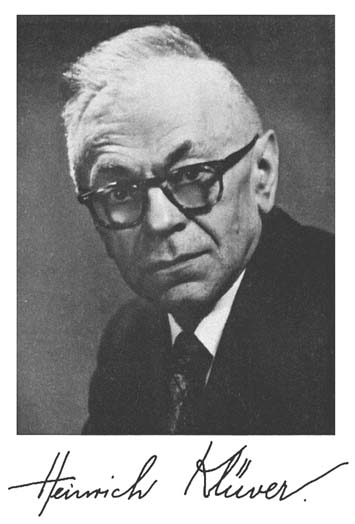
Heinrich Klüver
May 25, 1897–February 8, 1979
BY FREDERICK K. D. NAHM AND KARL H. PRIBRAM
HEINRICH KLÜVER WAS AN influential figure in the field of animal behavior and is said to have brought the Gestalt psychology movement to the continental United States. Joining rigorous experimental methods with a phenomenological spirit of investigation, he became one of the foremost experimental psychologists of his time and helped to shape the field today known as neuroscience.
He is known mostly for his work with the neurosurgeon Paul Bucy and the description of the Klüver-Bucy syndrome, which was described in non-human primates following large bilateral lesions of the temporal lobe. Later in his career he turned to neuroanatomy and developed staining techniques that are still in use.
He was by many accounts a man devoted to the practice of science. He successfully refused the pull of administrative duties and continued to carry out experiments until his mandatory retirement from the University of Chicago in 1963. Klüver's work had an important influence on the growth of the neurobiological sciences in the United States. His experimental practices were both conceptually rich and methodologically sound. He subjected his ideas to strict experimental validation and had no patience for arm-chair psychology. His studies furthered our understanding of
the brain mechanisms involved in vision and emotion. Klüver's papers are still frequently cited and continue to engender debate and stimulate research into the functions of the human and non-human primate's occipital and temporal lobes.
Personal History
Heinrich Klüver, son of Wilhelm and Dorothes (Wübbers) Klüver, was born on May 25, 1897, in Schleswig-Holstein, Germany. He arrived in the United States in 1923, married Cessa Feyerabend on February 4, 1927, and was naturalized as a U. S. citizen in 1934. On February 8, 1979, at the age of eighty-one, he died in Oak Lawn, Illinois, and is survived by his second wife Harriet Schwenk Klüver. After reluctantly serving as a private in the German army at the age of seventeen, he entered the University of Berlin and then the University of Hamburg where, in 1920 as a graduate student, he spent the next three years working with one of the fathers of Gestalt psychology, Max Wertheimer.
After leaving Germany, he boarded a freighter and, via the Panama Canal, traveled to the United States. His first year was spent in Palo Alto, California, as a student in the department of psychology at Stanford University. In 1924 he was granted his Ph.D. in psychology for his work on eidetic phenomena—unusually strong visual imagery in young children. Next, Klüver headed for the University of Minnesota where he spent two years (1924–26). It was there that he met psychologist Karl Spencer Lashley, who became both a friend and a lifelong colleague.
After leaving Minnesota, Klüver spent two years at Columbia University as a fellow of the Social Science Research Council and then moved to Chicago to join Lashley at the Institute for Juvenile Research. Thereafter, he moved to the University of Chicago, holding appointments in the
Division of Psychiatry and the Division of Biological Sciences. Although he was formally retired at the age of sixty-three, he continued to visit his Culver Hall laboratory up to the year before his death.
Upon arrival at the University of Chicago as an associate professor of experimental psychology, he joined the ''Neurology Club," a collection of outstanding neuroscientists that included among others Karl Lashley, Percival Bailey, A. Earl Walker, Ralph Gerard, Stephen Polyak, Charles Judson Herrick, and Roy Grinker. As remarked by Paul Bucy, another member and later to be Heinrich Klüver's most notable collaborator, "Even in this constellation of brilliant stars, Heinrich Klüver shone". 1
Throughout his years at the University of Chicago, he never taught undergraduate or graduate students, and after his twenty-four hours of chairmanship in the Department of Psychology took no part in any further administrative duties. Furthermore, Klüver, toward the latter part of his career, was by choice left alone in his Culver Hall laboratory, without a secretary. He refused to see visitors unless their interests were exceptionally close to his own. When visitors were admitted they had to stay at least a half day behind the locked door to his laboratory. One of us (K.H.P.) enjoyed such a visit for a full day—lunch was not even considered. Towards the end of his retirement, as recognition of his work came, he ventured out more often, attending meetings and presenting himself as a cordial colleague.
At the time of his retirement, a plumbing leak destroyed most of Klüver's papers; the remainder are now under the care of the Department of Special Collections at the Joseph Rejenstein Library, University of Chicago.
Professional History
Visual Psychology And Psychoparmachology
As a student of Max Wertheimer, Klüver began his scientific career studying the nature of visual perception in children. He continued these phenomenologically motivated psychological investigations during his period as a graduate student at Stanford University, studying 'eideteker,' young children with unusually strong visual imagery. These children experienced persistent visual imagery, and the goal of these early studies was to understand how such visual phenomena related to normal mechanisms of perception. In addition, he knew the value of studying the varieties of perceptual phenomena in both the normal and pathological state. His systematic review of the clinical neurology literature on brain-damaged patients, mostly German soldiers after World War I (1927), is one example of his lifelong interest in visual processes in the context of pathophysiological states.
Years before psychoactive compounds became popular, Klüver's interest in mescal "buttons" or peyote (the dried tops of the cactus Lophophorus Williamsii) can be traced back to his earlier publications on eidetic visual phenomena, for mescal visions were thought to resemble visual eidetic imagery (1928, 2). This phase of Klüver's career is rather colorful from an historical perspective, for he provided an intimate analysis of these mescaline-induced visual changes. With the aid of an assistant in a laboratory setting at the University of Minnesota around 1924, he ingested mescal buttons and compulsively documented the nature of his own experiences during intoxicated states. Though he found the value of mescal in the study of eidetic vision to be minimal, he did notice that during his
mescal state the boundaries between subjective and objective world tended to disappear and concluded that the use of mescal may shed light on the loosening of subject-object relations in schizophrenics. He also experienced recurring visual forms such as those used by Miro in his painting and suggested that their existence might be of some interest to anthropologists studying visions and symbolic art of various tribes (1928). Klüver always recognized the importance of his data for other fields, and he confidently pointed out that psychoactive compounds were an important tool in the study of visual abilities such as color and space phenomena, dreams, illusions, and hallucinations.
Animal Behavior and Occipital Lobe Lesions
After his self-experimentations with mescal, he began to study the behavioral effects of mescal on the non-human primate. For Klüver the use of non-human primates and the study of visually guided behavior provided a means by which to objectify and test his views. The aim of his studies on monkeys that had been administered mescaline was to determine how this psychoactive compound affected monkeys' ability to judge the similarity or differences between objects. During this period, Klüver developed new techniques that extended his experimental methods and helped him to document the sensory capabilities of monkeys in both normal and drug-induced state.
One of these innovations was the "pulling-in" technique that consisted of a horizontal platform on which lay two strings, at the ends of which were attached various weighted, colored, and textured forms. Using this set-up, monkeys could be trained, for example, to choose the darker of two colored disks for a reward. The "method of equivalent and non-equivalent stimuli" was then used to determine the
range of stimuli which were from the monkey's perspective similar to the positively rewarded training stimuli. Eventually, this apparatus was further developed and provided Klüver the means by which to test monkeys on a wide battery of stimuli in various conditions (1935, 1-3). With an introduction by Karl Lashley, Klüver's 1933 book entitled Behavior Mechanisms in Monkeys contains the data collected using these behavioral methods. After fully acquainting himself with the behavioral characteristics of nonhuman primate behavior, he then embarked on his lesion studies, which would add a new dimension to his experimental arsenal.
Klüver's first attempt to apply the ablation method was conducted with the aid of Karl Lashley. These experiments studied the influence of occipital lobe lesions on visually mediated behavior (1936; 1937, 1). The studies showed that, in the absence of occipital cortex, monkeys could still respond to changes in light flux. Later, in one of our laboratories (K.H.P.) a more accurate resection of visual cortex was undertaken by Lawrence Weiskrantz as a graduate student. His lifelong experiments led to the discovery of blind-sight in humans: the ability to respond to the location and form of objects in the absence of subjectively seeing them.
Temporal Lobe Lesions and the Klüver-Bucy Syndrome
With Paul Bucy, Klüver would extend the scope of his ablation studies to include lesions of the temporal lobes. The temporal lobe experiments of Klüver and Bucy were initially motivated by Klüver's previous findings that injection of mescaline in monkeys produced chewing and licking movements, as well as convulsions. Klüver made the observation that these oral behaviors were reminiscent of the "uncinate" fits first described by Hughlings Jackson in
certain patients with temporal lobe epilepsy. If surgical removal of the uncal region could abolish the oral behaviors produced by mescaline administration in monkeys, a strong case could be made regarding the underlying neuroanatomical site at which mescaline exerted its effect.
In collaboration with Paul Bucy, the first unsuccessful attempts to identify the locus of action of mescal in monkeys began with dissections of the trigeminal and facial nerves. These were then followed by lesions of the temporal lobes. Paul Bucy's contribution was invaluable at this point as Klüver had no surgical experience with temporal lobe resections. Despite Klüver's desire to perform more restricted lesions of the uncal region, Bucy felt he couldn't perform such an operation and decided to take out the whole temporal lobe.
On the afternoon of December 7, 1936, Dr. Bucy removed a large portion of the left temporal lobe in the aggressive adult female Rhesus monkey named "Aurora." This monkey had been an experimental subject of Prof. George W. Bartelmes, but due to its viciousness was offered to Klüver who was recognized for his monkey handling skills. As recounted by Bucy, on the morning after the left temporal lobe was removed, Klüver called him on the phone and exclaimed, "What did you do to my monkey?" 1 Hastening to the laboratory, Bucy saw that this preoperatively aggressive monkey had by all accounts become "tame." It was unbelievable. 2 This formerly vicious, unmanageable beast was indeed tame. After a second surgery that removed the right temporal lobe, the full extent of Aurora's behavioral disturbances became manifest.
Klüver's pursuit of the locus of action of mescaline would end here, as the monkeys continued to exhibit mescaline-induced lip-smacking behavior even after temporal lobe lesions. The unexpected behavioral findings redirected
Klüver's main research program to the study of the temporal lobe and diseases of the temporal lobe in non-human and human primates. Though temporal lobe lesions had failed to abolish the oral behaviors (as Klüver had initially hypothesized), it was not without reward, for as Paul Bucy wrote, "…it may come as a surprise that the discovery of the syndrome of bilateral destruction of the temporal lobes came by chance and without prior planning—but not by accident. This discovery was the result of the action of a well-prepared, active, alert mind, which perceived the unexpected and recognized its importance."1
The syndrome that Klüver and Bucy described was initially referred to as the "temporal lobe syndrome";3 according to Klüver, "…the most striking behavior changes ever produced by a brain operation in animals" (1951). This syndrome has since come to bear their name and is comprised of six categories of symptoms:
- "Psychic blindness"—the inability to recognize objects by sight in the absence of any impairment in visual acuity;
- "Hypermetamorphosis" (of Wernicke)—a condition characterized by repetitive and persistent responses to small visual objects;
- Oral tendencies such as the oral examination of objects consisting of licking, biting, and chewing;
- Taming; and
- An increase in the manipulation of genitalia and in heterosexual and homosexual behaviors.
Klüver and Bucy never attempted to localize their behavioral findings to any particular neuroanatomical structure. This was left to one of us (K.H.P.) to accomplish. Lashley doubted that Bucy's temporal lobe lesions accounted for the changes in aggressive and sexual behavior. He surmised (erroneously) that the lesions had invaded the hypothalamus. Klüver was reluctant to sacrifice his now tame monkeys.4
By contrast, Klüver's motive was not to determine the functional significance of the structures damaged. Rather, his aim was to understand what the constellation of symptoms he referred to as the "temporal lobe syndrome" revealed about the psychological structure and the phenomenal determinants of visual and emotive experience. It is this "behavior with phenomenal determinant" to which Klüver devoted his life, and as he wrote early in his career:
…the question we wish to answer is: What is it that determines the directions and turns of behavior? More specifically, what are the factors which impart certain directions to the animal's behavior in situations in which reactions to sensory stimuli are performed? What are, briefly speaking, the determinants of sensory responses? We are not interested in the fact that there is such a thing as "behavior"; we are interested in the factors responsible for certain kinds of behavior (1933, p. 332).
What Klüver and Bucy reasoned from their observations of temporal lobectomized monkeys was that damage to both cortical and subcortical structures of the temporal lobe had disrupted the processes by which the meaning of a sensory precept is "appreciated." Supported by solid behavioral testing of monkeys with circumscribed neurosurgical ablations, Klüver, along with Bucy, proposed that between the stimulus and the response lay an essential psychological process; namely the ability to understand what is perceived. The experiments of Klüver and Bucy were a catalyst for the psychosurgical movement of the mid-twentieth century, for at the end of one of Klüver's presentations in the late 1930s, Egas Moniz stood up and publicly queried Klüver whether such methods could be used to treat intractably violent individuals. Klüver later remarked that he was mortified by this interaction. Moniz performed the first frontal lobe ablation only a few years later and subsequently received a Nobel Prize for his accomplishments.
Porphyrins and the Klüver-Barrera Stain
Though Heinrich Klüver is best known for his temporal lobe experiments with Paul Bucy, his work during the following two decades with Elizabeth Barrera was an important contribution to the field of neuroanatomy. During this period he embarked on the last major phase of his scientific career and began his neuroanatomical studies investigating the brain tissue of many animals. With these experiments, Klüver mastered an entirely new set of laboratory techniques. Using fluorescence spectral analysis, he made the important discovery that the white matter in brains of warm-blooded animals contained a high concentration of porphyrin.
Using spectrochemical methods and data on solubility, Klüver and Barrera later found that the 625mm band of porphyrins was composed of both protoporphyrin and coproporphyrin. Characteristic of Klüver's active mind, he astutely reasoned that certain neurological and psychiatric disorders might be associated with a disturbance in the metabolism of porphyrins—a condition he termed "cerebral porphyria" (1944).
The concentrations of these porphyrins was too minute to allow the differentiation of structures at a cellular level, as Klüver had originally hoped. Klüver and Barerra then conducted in vitro studies to investigate whether the differential uptake of particular cells or fibers to exogenous applied phthalocyanine derivatives (porphyrin-like compounds) could help to visualize the microarchitecture of brain slices. Although they were unable to show any effect at a microscopic level, they did observe incidentally that at a more macroscopic level, the white matter compared with gray matter had a greater affinity for erogenous porphyrins. Like his studies with Bucy, the unexpected had arisen,
and as he had done before, he grasped its significance and went on to develop a new histological method for staining brain slices.
After experimenting with a number of synthetic organic pigments, they discovered that the Luxol fast blue MBS stain provided a remarkable means by which to stain the myelin sheaths of nerve cells. This Luxol fast blue MBS stain could also be used in conjunction with the Nissl stain cresyl violet. This combination allowed both the myelin and the cell to be visualized on the same brain section, and continues to be a widely used histological method in neuroanatomy and neuropathology.
An "incident" that occurred at the beginning of this research typifies Klüver's character. Trying out a great number of tissue stains without success, he dropped the discards into a slop jar for later disposal. One morning, glancing down as he deposited another failure, Klüver was astounded to find some slides at the top of the slop jar with contrasting blue and violet stained tissue. He spent the next two years combining chemicals used during the previous years (as catalogued in his records) to discover the successful combination.
Conclusion
Heinrich Klüver did not train any graduate students, and is thus without a living legacy of pupils. Nonetheless, he had an undeniable impact on the growth of biological psychology as editor to ten journals spanning the fields of psychology, neurology, and biological psychiatry. He was a member of twenty-eight scientific societies, consultant to numerous advisory committees, and lectured widely throughout the world. Klüver left little in the form of autobiographical material—his sparing comments inextricably associated with documents pertaining to his scientific work.
Upon his nomination, however, to the National Academy of Sciences in 1957, Klüver wrote the following:
I have always felt greatly in debt to the country to whose shores I came about a third of a century ago and at this moment feel particularly pleased and honored that the outstanding scientists representing the foremost scientific academy of this country have asked me to join them. WE THANK ROBIN ANNE O'SULLIVAN of the Joseph Regenstein Library, University of Chicago, for providing archival materials.
Honors and Distinctions
Professional Appointments
|
1924–26 |
Instructor in psychology, University of Minnesota |
|
1926–28 |
Fellow, Social Science Research Council, Columbia University |
|
1928–33 |
Research psychologist, Behavior Research Fund, Chicago |
|
1933–35 |
Research associate, Department of Pathology, University of Chicago |
|
1935–36 |
Associate professor of experimental psychology, University of Chicago, Division of Psychiatry |
|
1936–38 |
Assistant professor of experimental psychology, University of Chicago, Division of Psychiatry |
|
1933–38 |
Associate member, Otho S.A. Sprague Memorial Institute, University of Chicago |
|
1938–57 |
Professor of experimental psychology, University of Chicago, Division of Biological Sciences |
|
1957–62 |
Sewell L. Avery distinguished service professor of biological psychology, University of Chicago, Division of Biological Sciences |
|
1963 |
Sewell L. Avery distinguished service professor emeritus, University of Chicago, Division of Biological Sciences |
Academies, Honors, and Awards
|
1954 |
American Academy of Arts and Sciences |
|
1957 |
National Academy of Sciences |
|
1960 |
Karl Spencer Lashley Award in Neurobiology, American Philosophical Society |
|
1963 |
Samuel W. Hamilton Award, American Psychopathological Association |
|
1964 |
Gold Key Award, Medical Alumni Association, University of Chicago |
|
1965 |
Honorary M.D., University of Basel |
|
1965 |
Gold Medal Award, American Psychological Foundation |
|
1966 |
Honorary member, American Neurological Association, International Brain Research Organization, American College of Neuropsychopharmacology, Society of Biological Psychiatry |
|
1969 |
Distinguished Achievement Award, Modern Medicine |
|
1969 |
Gold Medal Award, Eastern Psychiatric Research Association |
|
1969 |
Honorary Ph.D., University of Hamburg |
|
1971 |
Honorary M.D., University of Kiel |
|
1975 |
Honorary member, Society of Biological Psychiatry |
Notes
-
1.
P. C. Bucy. Heinrich Klüver. In Neurosurgical Giants: Feet of Clay and Iron, ed. P. Bucy, pp. 349–53. New York: Elsevier Science Publishers, 1985.
-
2.
It still is. Unilateral temporal lobectomices have little if any grossly observable effects. The observation most likely followed the second surgery.
|
|
types of quantitative behavioral tests that needed to be done. As a result, some years later K.H.P. and his students showed a double-dissociation between "psychic blindness" produced by the cortical resection of the temporal lobes due to a flattening of generalization gradients and disabilities on the Klüver equivalence task, which is disturbed by resections of the amygdala. |
Selected Bibliography
1924 The determination of types with an experimental study of the eidetic type. Dissertation, Leland Stanford Junior University.
1926 Mescal visions and eidetic vision. Am. J. Psychol. 37:502–15.
1927 Visual disturbances after cerebral lesions. Psychol. Bull. 24:316–58.
1928 Studies on the eidetic type and on eidetic imagery. Psychol. Bull. 25:69–104.
Mescal: The 'Divine' Plant and Its Psychological Effects. London: Kegan Paul, Trench, Trubner, and Company.
1931 The equivalence of stimuli in the behavior of monkeys. J. Genet. Psychol. 39, 3–27.
1933 Behavior Mechanisms in Monkeys. Chicago: University of Chicago Press.
1935 A tachistoscopic device for work with sub-human primates. J. Psychol. 1:1–4.
Use of vacuum tube amplification in establishing differential motor reactions J. Psychol. 1:45–47.
An auto-multi-stimulation reaction board for use with sub-human primates. J. Psychol. 1:123–27.
1936 Analysis of the effects of the removal of the occipital lobes in monkeys. J. Psychol. 2:49–61.
1937 Certain effects of lesions of the occipital lobes in macaques. J. Psychol. 4:383–401.
With P. C. Bucy. "Psychic blindness" and other symptoms following bilateral temporal lobectomy in rhesus monkeys. Am. J. Physiol. 119:352–53.
1938 With P. C. Bucy. An analysis of certain effects of bilateral temporal lobectomy in the rhesus monkey, with special reference to "psychic blindness." J. Psychol. 5:33–54.
1939 With P. C. Bucy. A preliminary analysis of the functions of the temporal lobes in monkeys. Trans. Am. Neurol Assoc., 65th Meeting, pp. 170–75.
With P. C. Bucy. Preliminary analysis of functions of the temporal lobes in monkeys . Arch. Neurol. Psychol. 42:979–1000.
1940 With P. C. Bucy. Anatomic changes secondary to temporal lobectomy. Arch. Neurol. Psychiatr. 44:1142–46.
1944 On naturally occurring porphyrins in the central nervous system. Science 99:482–84.
1951 Functional differences between the occipital and temporal lobes with special reference to the interrelations of behavior and extracerebral mechanisms. In Cerebral Mechanisms in Behavior, ed. L. A. Jeffress, pp. 147–99. New York: Wiley.
1953 With E. A. Barrera. A method for the combined staining of cells and fibers in the nervous system. J. Neuropathol. Exp. Neurol. 12:400–403.
1955 With P. C. Bucy. An anatomical investigation of the temporal lobe in the monkey (Macaca mulatta). J. Comp. Neurol. 103:151–251.
1958 "The temporal lobe syndrome" produced by bilateral ablations. In Neurological Basis of Behavior, eds. G. E. W. Wolstenholme and C.M. O'Connor, pp. 175–82. Boston: Little, Brown and Company.
1965 Neurobiology of normal and abnormal perception. In Psychopathology of Perception , eds. P. H. Hoch and J. Zubin, pp. 1–40. New York: Grune & Stratton.
1966 Mescal and Mechanisms of Hallucinations. Chicago: University of Chicago.


