
4
Pilot Programs
The committee developed 18 pilot programs to improve the effectiveness and integration of reserve components (see Box 4-1). This chapter begins with definitions of the terms pilot program, test, and experiment . Next, the committee explains how it (1) developed the 18 pilot programs and (2) selected the four that warrant priority attention, the four that address cultural issues, and the two that address obvious deficiencies the Department of Defense should focus on immediately. The remaining eight programs are described in Appendix B. The chapter closes with some general observations about future methodologies for developing pilot programs and collecting and managing data.
DEFINITIONS
A pilot program usually consists of one or more tests or experiments that address subissues related to the major issue (see example in Box 4-2).
A test is designed to determine whether a measured outcome meets or exceeds some standard, either a desired outcome or a baseline measurement. Tests are highly structured and usually measure the specific outcome of a single level of an independent variable. The measurement methodology is specified in advance.
An experiment, which also examines a subissue under a pilot program, has a formal structure (an "experimental design") in which some variables are changed from time to time during the experiment to determine the relationship between those variables and measurable outcomes. By providing new information, experiments improve the basis for decision making. Experiments are broader than tests and may encompass tests. They are also usually more difficult and costly to conduct than tests.
The committee did not fully develop the designs of the experiments and tests suggested for the pilot programs. Designing the recommended experiments and tests will require specifying measures and developing methodologies for analyzing the data, which were beyond the scope of this study.
METHODOLOGY
Development of Candidate Pilot Programs
The committee developed many concepts for candidate pilot programs intended to shed light on ways to improve the readiness and/or effectiveness of reserve components or improve their integration with active components. After refining the most promising concepts, the committee had developed 18 pilot programs. The development and application of selection criteria are described below.
Criteria
Six criteria were used for prioritizing and selecting pilot programs:
-
scope of impact (breadth)
-
magnitude of impact (depth)
-
ability to change
-
credibility
-
technical feasibility
-
administrative feasibility
These criteria were divided into two groups of three, the first group relating to the potential impact of a pilot
|
Box 4-1 Overview of Pilot Programs Areas for Immediate Action
High-Priority Pilot Programs
Highlighted Pilot Programs
Other Pilot Programs for Consideration
|
program and the second relating to the chances of successfully conducting the pilot program.
The first group of criteria includes (1) scope of impact (breadth), (2) magnitude of impact (depth), and (3) Department of Defense's ability to change. These criteria involve the anticipated effect on defense capability of a policy change based on the results of a pilot program. The impact is measured both by the scope (number of units [or people] affected) and the magnitude (the amount of change in a typical unit [or in Department of Defense readiness and budgets]) of the change, as well as the Department of Defense's ability to make these changes. A successful pilot program would be useless if resultant changes could not be implemented.
The second group of criteria relates to the expectation of performing a pilot program successfully. The criteria are (4) the credibility of the results, (5) the technical feasibility of conducting the pilot program, and (6) the administrative feasibility of conducting the pilot program.
Scope of Impact (Breadth)
How many units or people would be affected? Would they be in one or all services, in the active components only, in the reserve components only, or in both? How many skills or occupational specialties would be affected? A few? Many? All? Are they critical skills?
|
BOX 4-2 Sample Pilot Program, Test, and Experiment Assume that the leadership of a military service is concerned about the condition of its personnel system because its personnel record keeping is slow, cumbersome, and prone to errors. The leadership might establish a pilot program to determine whether automation could improve the situation. Early experiments could generate data for measuring the effectiveness of several aspects of the automated system. As part of the pilot program, a test could be conducted using a given computer program, exercised in a specific way, to see whether it produced less than x-percent errors. The program could also include an experiment to (1) use multiple software programs and compare the results, (2) investigate ways to use the system most effectively, or (3) develop and evaluate measures of effectiveness, such as data accuracy, time to record data, and failure rates. |
Magnitude of Impact (Depth)
What would the effect of the changes be? For example, would there be a substantial improvement in readiness (e.g., improved training, improved capability to mobilize the reserve components), a significant reduction in resources or costs (e.g., fewer personnel required to perform a function, improved active/reserve component integration), less turnover, greater retention, or better administration?
Ability to Change
Would credible results lead to changes? For example, would laws or executive branch policies have to be changed? Would there be political resistance or inertia to overcome (e.g., by the Office of the Secretary of Defense, the active components, the reserve component establishments, Congress, state governors, the public)? Would the changes require large investments in dollars, equipment, people, or time?
Credibility
Would this program produce believable results? For example, would the results be difficult to measure or not measurable at all (e.g., not demonstrable statistically)? Would the results be representative (e.g., is the situation realistic militarily)?
Technical Feasibility
Would the pilot program be technically difficult to conduct? Would the experiment required for meaningful results take too long? Would the costs or other resources required be within reasonable bounds?
Administrative Feasibility
Is the pilot program likely to be conducted? Would conducting the pilot program have an adverse impact on personnel or readiness? Would there be legal or policy impediments? Would political difficulties arise (e.g., from the active components, the reserve component establishments, Congress, state governors, the public)?
Process
The members of the committee evaluated each candidate pilot program by each criterion. The committee then reviewed the prioritized list for reasonableness, discussed the viewpoints of individual members, and revised some of the programs. This process enabled the committee to balance the views of various members and select pilot programs informed by the wisdom and judgment of the committee as a whole. Several pilot programs were eliminated because they were considered to be infeasible, impractical, or intended to resolve issues of limited importance. The shortcomings identified in some early pilot programs led committee members to seek input from defense and industry experts and to improve experimental designs. Thus, the committee was able to evaluate the programs on a systematic and rational basis.
Figure 4-1 shows that there was considerable consensus among the committee members about four of
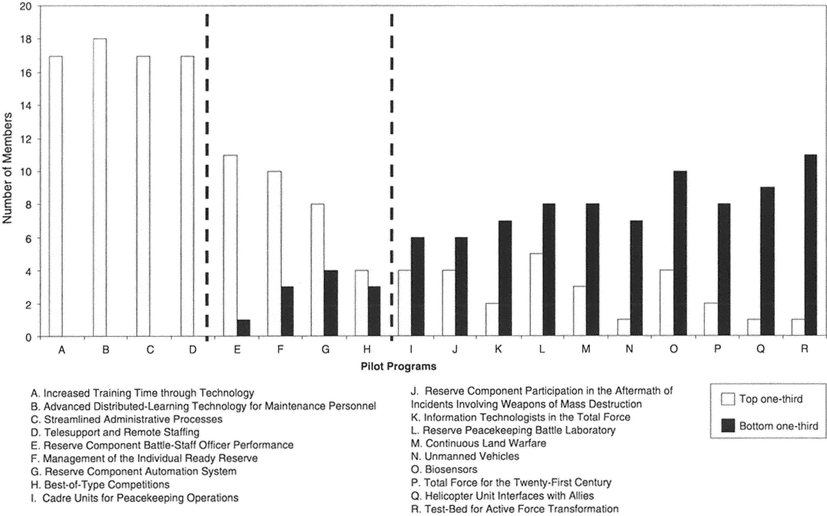
Figure 4-1 Rankings of pilot programs.
Note: The specific rankings in this figure were developed for the evaluation process during this study. They do not reflect the adjustments in pilot program M (Continuous Land Warfare) that occurred as a result of the peer review process and the committee's final deliberations. If the committee were to reevaluate that pilot program, its relative position might be different. However, the committee believes that the general rankings would not be changed.
the pilot programs; almost every member ranked these four (A through D) in the top one-third. The next four pilot programs (E through H) were ranked in the top one-third more often than in the bottom one-third. The rest of the pilot programs (I through R) were most often ranked in the bottom one-third.
AREAS FOR IMMEDIATE ACTION
One focus of this report is to improve reserve component capability for rapid deployment by recommending modern information and communications technologies that would minimize administrative impediments. The committee developed two pilot programs to address administrative issues but decided, after careful consideration, that these programs would only delay the necessary changes to administrative procedures. The committee believes the Department of Defense could take immediate action in these two areas (management of the Individual Ready Reserve and Reserve Component Automation System), using currently available technology to improve the integration of reserve component and active component personnel systems and information processing systems. If necessary, the Department of Defense should ask the Congress to change laws and provide support. In these areas, the need for pilot programs, although they might provide supplementary information, would only delay the straightforward implementation of improvements. The two pilot programs developed for these areas are summarized below; they are described more fully in the appendix to this chapter.
Management of the Individual Ready Reserve
By design, neither active nor reserve units are fully manned in peacetime. Trained replacements are drawn from the Individual Ready Reserve (and other sources) to fill out the unit as it deploys. This pilot program would evaluate the active and reserve data systems with respect to both supply and demand, determine whether the systems were compatible, and determine how long it would take for trained people to show up for deployment. After careful consideration, however, the committee concluded that the Department of Defense could and should adopt modern personnel and data management tools to improve management of the Individual Ready Reserve without waiting for the results of this pilot program.
Reserve Component Automation System
Currently, Army Reserve and National Guard units use the Reserve Component Automation System, a computer system that is only used in peacetime. When reserve units are mobilized, they must use a different system, which is based on software incompatible with the first system. The delays caused by the changeover could delay mobilization and, possibly, wartime operations as well. Experiments in the pilot program would determine the costs and benefits of expanding the Reserve Component Automation System to a "go-to-war" status. The committee concluded, however, that the Department of Defense should take immediate action and request congressional approval for making changes without taking the time to implement a pilot program.
HIGH-PRIORITY PILOT PROGRAMS
Using the process and criteria outlined above, the committee reached strong consensus on four pilot programs that warrant priority attention by the Department of Defense because of their potentially significant impact and relatively good chances of success. These programs, which are applicable in various degrees to all of the military services, are described below. (See Chapter 5 for more detailed discussions.)
The four programs involve (1) distance-learning technology, (2) advanced distributed-learning technology (3) the use of technology to streamline administrative processes, and (4) bandwidth and computing power for increasing remote staffing. The committee recognizes that the Department of Defense already makes limited use of these technologies, and these proposals are not intended as criticisms. These pilot programs specifically focus on reserve component effectiveness and active-reserve integration. This discussion also focuses on pilot programs to explore nontraditional uses of technology to determine if full-scale implementation is warranted.
Increased Training Time through Technology
This pilot program applies distance-learning technology (with which all services are experimenting) to increase the time effectively available for training. Reserve units have limited time to conduct both individual and unit training. An important barrier to the
effectiveness of reserve units as a whole is that individuals must often use unit training time for their individual training. This pilot program would explore the use of distance-learning technology to encourage voluntary individual training, either at home or at another convenient place. (Examinations would be given under controlled conditions.) The pilot program would explore the costs and effectiveness of a wide range of incentives for reservists to complete courses successfully, including meeting requirements for promotion, early advancement, retirement points, paid training time, the reward of a computer, and cash bonuses.
Advanced Distributed-Learning Technology for Maintenance Personnel
Modern military equipment with more reliable components is becoming increasingly complex. But this equipment tends to fail in unanticipated ways, making repairs difficult. This pilot program would be conducted in cooperation with private companies that have already tackled this problem to determine if their diagnostic and repair technologies-transferred over long distances from an expert to a user-could be used for military equipment. The program would also examine whether advanced distributed-learning technology for the maintenance of one kind of machine could be readily transferred to another-an issue of great importance to reserve components whose units must maintain a variety of equipment often different from the equipment used by their active counterparts.
Streamlined Administrative Processes
Current administrative practices, which are both time consuming and labor intensive, cut into training time and slow down mobilization. Although widely available commercial practices and technologies could be used to streamline administrative processes, their adoption has been slow despite strenuous efforts to make improvements. This pilot program would evaluate some "quick fixes" and demonstration projects that use advanced database technologies. One goal of the program would be to demonstrate to Congress and the Department of Defense that time and money could be saved and reallocated to other essential tasks, thereby creating pressure for implementation of near-term improvements.
Telesupport and Remote Staffing
With vastly increased bandwidth and computing power, combat units can be linked to technical support units and personnel based in the United States. This capability could reduce the size and vulnerability of units deployed overseas and, at the same time, provide the deployed units with access to the best advice from a wide range of sources. It could also help reserve components retain technical support personnel who might otherwise be discouraged by frequent overseas deployments. The experiments in this pilot program would be used to determine which "remote staffing" possibilities work best.
HIGHLIGHTED PILOT PROGRAMS
A part of the reserve component/active component integration problem reflects cultural differences, and it is difficult to assess the ability of technology to change culture. Nevertheless, the committee decided to highlight four pilot programs that could shed light on reserve component capabilities and address some of the issues stemming from cultural differences. Each program involves the Army Reserve or Army National Guard performing an important, visible task in partnership with active component forces. The committee believes the simple act of working together would promote trust and improve integration.
Reserve Component Battle-Staff Officer Performance
The Army National Guard has about half of the Army's combat forces in its brigades and divisions. Skeptics are doubtful that these units could be trained quickly enough after mobilization to get into the fight. The principal impediment involves training time for high-level commanders and their staffs to work together to hone leadership and battle-staff skills. This pilot program is designed to explore the use of modern simulations as part of distance training of the leadership of the Army National Guard.
Best-of-Type Competitions
The fact that "the reserves often win the annual fighter competition" is often cited as evidence of the capabilities of the Air National Guard and Air Force Reserve. The committee did not find a consensus (or
objective data), however, about the capabilities of the Army Reserve. This pilot program would involve experiments featuring competitions using attack helicopters-an important weapon system for all Army components that is also well represented in reserve component units. These competitions could provide objective measures of comparison of capabilities (as they do for the Air Force). Competitions might increase incentives for training, reveal new tactics, and engender mutual pride and respect.
Reserve Peacekeeping Battle Laboratory
Although the Department of Defense has been studying small-scale contingencies, little attention has been devoted to the role of the reserve components, which are significant participants in these operations. This pilot program would explore the merits of setting up a peacekeeping battle laboratory focused on improving the effectiveness and integration of the reserve components in peacekeeping operations.
Continuous Land Warfare
The technological superiority of U.S. forces has enabled them to "own the night" (i.e., to operate around the clock and in adverse weather). However, in the early stages of a military operation, there may not be sufficient personnel to maintain this momentum. A potential solution could be to augment combat support and combat service support units, whose equipment is already in-theater, with personnel who have shipped into theater ahead of their equipment. Experiments would be conducted to address uncertainties, such as (1) the best level of augmentation (e.g., individual, team, or unit); (2) the best timing for augmentation; and (3) the merits of using distributed training, exercises, and battle simulations to integrate reserve component augmentees with their active counterparts.
OTHER PILOT PROGRAMS
The committee believes that the remaining eight pilot programs also merit consideration. They are described below in order of their ranking by the committee members using the criteria described earlier. Over time, issues and technologies will change, and the Department of Defense might decide to perform some of these pilot programs. The Department of Defense's (and the committee members') judgments could change as new issues and uncertainties arise. The committee believes that the Department of Defense should consider using the criteria outlined above in its deliberations-and not rely on the rankings in this report. Some programs are Army-specific, but several are applicable to more than one military service.
Cadre Units for Peacekeeping Operations
Some Army reserve component units (e.g., psychological operations, civil affairs, and military police) are in such high demand for peacekeeping and stability operations that they have been deployed repeatedly in recent years, raising the possibility of growing dropout rates in the years ahead. This pilot program would evaluate the adequacy of deploying cadre units at one-quarter strength and filling them at the time of mobilization with active and reserve component volunteers who had received some training through distance-learning techniques.
Reserve Component Participation in the Aftermath of Incidents Involving Weapons of Mass Destruction
One mission of the reserve components is to help manage the consequences of attacks with weapons of mass destruction in the United States. This pilot program would focus on the establishment of reserve component units in major cities comprised of technical specialists who can diagnose a situation immediately after an incident and call in appropriate experts. Locating and using these units in major cities might attract experts who, not wanting to leave their home areas, might otherwise not volunteer to serve in the reserve components.
Information Technologists in the Total Force
In the future, the Department of Defense's doctrine and tactics will rely increasingly on information dominance. However, the private sector will continue to take the lead in the application of new information technologies, and few information specialists are likely to choose active component duty given the attractiveness of civilian jobs. This pilot program would explore innovative ways of using information technologists in the reserve components to make service more attractive. A subsequent experiment could then evaluate incentives for attracting such individuals to the reserve components.
Unmanned Vehicles
Advanced unmanned aerial vehicles have great potential not only for war but also for operations other than war (e.g., reconnaissance and communications). Today they can be operated remotely within a theater of operations (e.g., Bosnia). In the future, technology will enable control of unmanned vehicles from halfway around the globe. Reserve component personnel could participate in the operation of advanced unmanned aerial vehicles. This pilot program would involve a series of graduated experiments to determine if unmanned vehicles could be operated by reserve component personnel.
Biosensors
Injury and stress naturally degrade an individual's performance. Personal biosensors, similar to the ones used for manned space flight, could be attached to military personnel in stressful situations (e.g., during training) to detect conditions that could affect performance and relay the information back to a command post where it could be interpreted remotely by reserve component specialists. Several experiments in this pilot program would focus on using this information effectively.
Total Force for the Twenty-First Century
It will be difficult for large, Army National Guard units to meet rapid deployment requirements. Large units generally require more post-mobilization training, and heavy equipment requires sealift and airlift. This pilot program would explore the capability, mobilization time, and integration potential of small, elite Army National Guard combat units, such as helicopter companies and special reconnaissance units, equipped with the latest hardware.
Helicopter Unit Interfaces with Allies
The Army National Guard has had very few early entry combat assignments and thus has had limited opportunities to prove that it can successfully discharge these assignments. This pilot program would experiment with using Guard-operated, high-technology helicopters to provide battlefield information to allied forces.
Test-Bed for Active Force Transformation
Future military operations, as described in Joint Vision 2010, will be strikingly different from current military operations. The development of, and transformation to, future doctrine will take years. As the military (particularly the Army) changes, it will have to decide when to deploy and fight using the former (abandoned) doctrine and/or when to change to the new (not yet mastered) doctrine. This pilot program would explore ways for evaluating new doctrine by reserve components.
ADDITIONAL CONSIDERATIONS
The Statement of Task concluded with a request for the study to ''identify methodologies for Department of Defense to gather data on the broadest set of opportunities for efficient total force integration after 2010." In consideration of this subtask, the committee developed a process for the continued development and expanded use of pilot programs, as well as targeted data collection and data management.
Benefits of Pilot Programs
The committee urges the Department of Defense to consider a wide range of pilot programs (the ones described in this report and others). In addition to offering relatively low-cost ways of exploring opportunities for using new technologies, pilot programs could demonstrate the feasibility of innovative concepts. A visible, successful pilot program could also be useful for getting program funding approved by authorities in the Department of Defense and Congress.
Tangible benefits to the integration of reserve and active components can result just from conducting pilot programs. Increased interaction between reserve and active components at a variety of levels could increase their confidence in each other's capabilities. Pilot programs represent low-risk opportunities for reserve and active components to become familiar with each other's capabilities and operations in a nonthreatening environment.
Development of Additional Pilot Programs
The committee believes that the Department of Defense should explore potential pilot programs on an
ongoing basis. Pilot programs should be developed and evaluated jointly by elements of reserve and active components. A process like the one used by the Department of Defense to evaluate funding for Advanced Concept Technology Demonstrations could be adapted for this purpose.
Baseline Data Collection
Despite the great value of pilot programs, they will not solve all of the problems associated with maintaining and improving reserve component capabilities. For example, in the administrative areas discussed earlier, the Department of Defense simply needs to implement good business practices. In other areas, the Department of Defense first has to gather data on existing practices to determine whether or not changes in policies or the implementation of pilot programs would be beneficial and cost effective. For example, based on this study, the committee concluded that the Department of Defense should gather data on the stability of personnel in small reserve component units over time to prove or disprove anecdotal reports of high turnover. The committee's experience in this area is described below.
Recognizing the importance of stability to unit effectiveness, some committee members tried to develop pilot programs to improve the stability of important units, such as tank crews. According to anecdotal reports, some small reserve component units have not been stable because individuals tend to leave to take advantage of opportunities for promotion elsewhere. The committee also heard anecdotal reports that reserve components are highly stable. In addition, the committee learned that Israel has adopted measures to award promotions to reserve personnel without their having to leave their units, thus improving stability. (Stability is an issue that also affects active components.)
The committee decided that it would make the most sense for the Department of Defense to gather data on the stability (turbulence and turnover) of personnel in small units, both active and reserve, before suggesting pilot programs in this area. The data should be collected in consistent form using standard definitions, and it should cover, for example, tank crews, battle staffs at the battalion or other levels, and maintenance teams for sophisticated equipment. Once these data have been gathered and analyzed, the Department of Defense might design and conduct one or more pilot programs. For example, experiments could focus on the correlation between combat effectiveness and various levels of stability in small units. The results of the pilot programs could be used to assess the merits of alternative means of stabilizing personnel to maintain quality performance in times of crisis or war.
Data Management
The Department of Defense already collects extensive data from distributed simulations and field exercises. To facilitate future assessments, the committee encourages the Department of Defense to create and maintain performance databases that incorporate these data. If integrated databases and measures of performance are developed soon, they could encompass forthcoming simulations (such as Warfighters' Simulation 2000 and Joint Simulation System) and could influence the specifications for the next generation of test ranges during the transition from analog to digital instrumentation. In addition, integrated databases could be "data mined" (i.e., opened to undirected searches for relationships hidden in high-dimensional data).
Finally, the lack of uniformity among reserve components is an ideal situation for creating a performance database of best practices. For example, the committee was frequently told of solutions to problems that had been found by one or another of the 54 state and territory guard organizations. In an organization as large as the Department of Defense, there are many, informal "pilot programs" occurring all the time. A well constructed performance database of best practices would enable the benefits of these informal pilot programs to be used by many groups.
Appendix to Chapter 4
MANAGEMENT OF THE INDIVIDUAL READY RESERVE
Objective. Determine how technology can improve the management of the Individual Ready Reserve.
Problem
The Individual Ready Reserve is the primary source of fillers and replacements for active and reserve component units of all the military services in the event of a deployment of forces for a major-theater war or complex contingency operation. The Individual Ready Reserve can also provide units with individuals with special skills. Although the Army has the most urgent need for improvements in the management of the Individual Ready Reserve, the Marine Corps, Navy, and possibly the Air Force could also benefit.
Most military units are staffed in peacetime with fewer personnel than they are authorized. These units are filled to their full authorized strength before they are deployed overseas for a military operation. New personnel-officers, noncommissioned officers, and enlisted personnel-assigned to a unit in preparation for deployment are called "fillers." Personnel assigned later to replace combat losses are called "replacements." The goal of the personnel system is to provide a filler for each vacancy that matches the grade and skill specified in the authorization document.
The Individual Ready Reserve is not as effective as it could be because of the difficulties and time required to match supply with demand. Although each military service maintains databases with the names, grades, and skills of the members of its Individual Ready Reserve, there is no system that can rapidly correlate this information with shortages of personnel in deploying units. Because supply and demand are changing continuously, regular annual or semi-annual estimates of the numbers and types of personnel needed to fill units are almost immediately out of date. A system that would earmark members of the Individual Ready Reserve who could meet specific requirements on a near-real-time basis would benefit all of the services.
The demand for deployment fillers could be calculated by comparing the assigned strength of a unit with the authorized deployable strength of the unit. Demand for casualty replacements, however, is hard to estimate because the numbers and kinds of combat casualties are hard to predict. Replacements have to be available only after combat has started, while fillers must be available immediately after mobilization. The current system does not even begin operating until units have been alerted. Therefore, fillers usually arrive long after units have begun their post-mobilization training.
Description
This pilot program would determine whether emerging relational-database technology and wide-band communications links could provide near-real-time matching of the Individual Ready Reserve supply with the demand for fillers. The overall measures of merit for the pilot program would be the time it takes to fill a deploying reserve component unit after it has been alerted for mobilization and the unit's skill-qualification rating after it has been filled. The pilot program would involve the Army and Marine Corps, but the results could also be used by the Navy and Air Force.
This pilot program would focus only on the Individual Ready Reserve, but fillers and replacements
from active component individuals (nonunit manpower), recent graduates of initial entry training, and retired military personnel might be included later. If this pilot program is successful, the new technology might be expanded to cover all sources of pretrained individuals for both active and reserve component units.
Experiments
The experiments would demonstrate how long it would take to determine the demand and then supply the required fillers. Each experiment would consist of a simulated mobilization of a combat organization-an enhanced separate brigade for the Army National Guard, an infantry regiment for the Marine Corps Reserve, and fighter wings for the Naval Reserve and Air Force reserve components. Each simulated mobilization would begin with an alert date and end when the demand for fillers had been met. The first experiment would establish a baseline, and the next two experiments would examine how well near-real-time systems could complete the process.
The ground rules for each experiment would be (1) no personnel could be exchanged between units; (2) only the Individual Ready Reserve would be used to supply fillers; and (3) unqualified unit members would be replaced by qualified Individual Ready Reserve personnel.
Experiment 1
Objective. Determine how long it takes for the exercise combat organization to receive its fillers.
This experiment would use the existing system for reporting vacancies to the mobilization station, ordering fillers from the Individual Ready Reserve, and bringing the unit to deployable strength. The members of the Individual Ready Reserve would be deemed to have reported as ordered.
Question 1. What method is used currently to determine filler requirements for mobilizing reserve component units?
-
Identify the person or office that determines filler requirements.
-
Identify the method used to determine filler requirements.
-
Determine at what point in the mobilization process the filler requirements are established.
-
Identify changes or modifications to initial requirements during mobilization.
-
Identify the persons or agencies to whom filler requirements are sent.
Question 2. How is the filler requirement met?
-
Identify the individuals or agencies that receive filler requirements.
-
Identify the person or agency responsible for providing fillers.
-
Identify the agency that supplies the fillers.
Question 3. How long does it take for fillers to join their units?
-
Determine how long after the alert date the filler requirement was transmitted.
-
Determine when and how filler requirements were transmitted to the supplying agency.
-
Determine when the supplying agency matched the requirement with the available supply.
-
Determine when the supplying agency issued orders to fillers.
-
Determine the latest time for all fillers to report to the requesting organization.
-
Determine the total elapsed time to provide fillers.
Question 4. How well did the fillers meet the needs of the units?
-
How many fillers met the stated filler requirement?
-
Could mismatches be used in the units in some other capacity?
-
What were the skill-qualification data of units before and after fillers arrived?
Experiment 2
Objective. Determine the feasibility of matching the demand and supply of fillers on a weekly basis.
This experiment would evaluate a system using advanced relational-database software to connect the
requesting organization directly with the supplying organization. It would provide a weekly strength report to the supplying organization that identified by grade and skill code the authorized positions in the organization that either have no incumbent or a nonqualified incumbent. The new system would identify demand weekly and identify Individual Ready Reserve personnel who could meet that demand. If the unit is alerted for mobilization, the supply agency would automatically compute Individual Ready Reserve fillers for that week, identify them, and order them to report to the mobilization station on the date the organization is mobilized.
Question 1. Can the demand and supply of fillers be matched weekly?
-
How much extra time is required to compute and transmit filler requirements?
-
How much would computing requirements weekly add to the workload?
-
How much time would it take to match supply with demand?
-
How much does matching supply with demand weekly add to the workload?
Question 2. What is the effect of weekly matching on filling mobilizing units?
-
How long does it take to fill units using the weekly system?
-
How closely do fillers match the demand at mobilization time?
-
How much does the weekly filler system cost?
Experiment 3
Objective. Demonstrate the effectiveness of quarterly pre-assignments of Individual Ready Reserve fillers compared to weekly matches and the current system.
This experiment would test a system that pre-assigns Individual Ready Reserve fillers on a quarterly basis. Unlike Experiment 2, which focuses on matching supply and demand, this experiment would also pre-assign specific individual personnel to specific units each quarter. Units would report shortages by grade and skill via quarterly reports. Upon receipt of a request for fillers, the supply agency would identify appropriate personnel and earmark them for that unit. If the units were alerted, the supply agency would automatically issue orders for the pre-assigned fillers to report to the mobilization station on the day the unit is mobilized.
Question 1. Could the supply and demand of fillers be matched quarterly?
-
How long does it take to compute and transmit filler requirements?
-
How much work is required to compute demand quarterly?
-
How long does it take to identify specific personnel to meet requirements?
-
How much work does it take to match specific personnel with requirements quarterly?
Question 2. What is the effect of quarterly matching on filling units?
-
How long does it take to fill units using the quarterly pre-assignment system?
-
How closely does the quarterly pre-assignment system match the actual requirements?
-
How does pre-assignment compare to the current bulk identification system?
-
How much does a quarterly ordering and preassignment system cost?
Implications
The results of the three experiments in this pilot program should provide enough data for the services to determine whether to retain the current system for filling mobilizing units, install a weekly matching system, adopt a quarterly preassignment system, or try another system.
RESERVE COMPONENT AUTOMATION SYSTEM
Objective. Demonstrate how technology could improve the Reserve Component Automation System.
Problem
When reserve component units are mobilized, they need computers to support military operations and tie into active component systems. Currently, many reserve component units must use commercial
computers and adapt software to support their operations and then try to tie into active component systems. This is a distinct disadvantage for small units participating in small-scale contingencies; it would be a major problem if large numbers of reserve component units were mobilized to support a major-theater war. Modern technology could be used to improve the integration of reserve component systems into active force systems for wartime operations. One approach would be to use some or all of the elements of the Reserve Component Automation System to support wartime operations.
Description
The Reserve Component Automation System has been in development for a long time and is now being fielded to the Army National Guard and the Army Reserve. However, the system was developed as administrative support in peacetime. By law, the system cannot be used to support wartime operations. Therefore, units can use the Reserve Component Automation System to support peacetime administration and the planning and preparation for mobilization but must leave Reserve Component Automation System computers behind when they are deployed for military operations. To support military operations, many units are issued or purchase commercial computers that use standard software. Thus, many reserve component units must maintain two incompatible computer-support systems, neither of which may be compatible with the systems used by the active forces.
With congressional approval, the Reserve Component Automation System might also serve as all or part of a "go-to-war" system for the Army National Guard and Army Reserve. A pilot program could demonstrate the feasibility of integration and determine if the tangible benefits would exceed the cost of the modifications. The Reserve Component Automation System Program Executive Office should manage this pilot program in coordination with the U.S. Army Forces Command, the U.S. Army Reserve Command, and the National Guard Bureau. Factors that should be considered for all of the experiments described below are cost, benefits, coverage of operating systems, the speed of operations, and the quality of performance.
Experiments
The experiments would consist of modifying the existing Reserve Component Automation System to perform post-mobilization tasks. The first experiment would provide a baseline for comparison with other configurations. Each configuration would extend the capabilities for degrees of wartime use. The modifications must be made in a way that preserves current functionality of the system.
The overall pilot program would consist of five experiments that would be conducted simultaneously by similar elements of the Army National Guard and Army Reserve. Enhanced separate brigades of the Army National Guard (perhaps the brigades in two integrated divisions) could provide five to six battalion headquarters and about 20 companies for each experiment. The Army Reserve, using combat service support brigades, each with a traditional set of battalion headquarters and operating companies, would provide five to six battalion headquarters and about 20 companies for each experiment.
Each experiment would include two exercises: (1) a mobilization exercise that would simulate bringing units to active duty, moving them to a mobilization station, performing soldier-readiness processing, and commencing post-mobilization training; and (2) a combat simulation in which the units would engage in simulated combat or support operations in a major-theater war. A JANUS1 simulation would be used for the Army guard brigades. Combat-support simulation would be used for the Army reserve headquarters and units.
Each experiment would take 60 days. The experiment period would also require one annual training period for each participating company, battalion, and brigade headquarters. Teams of observers would record the results of each experiment, and participating personnel would prepare after-action reports. The results of each experiment would be collated and compared. Appropriate members of Congress and congressional staff would be invited to observe and or take part in these experiments. The Reserve Component Automation System Program Office, in coordination with the Army Staff, the National Guard Bureau, and the Chief, Army Reserve, would determine whether and how much the Reserve Component Automation System should be modified to provide wartime support.
Experiment 1
Objective. Determine what kind and how much wartime computer support Army reserve component units can expect in the event of a major-theater war.
This experiment would provide a baseline for comparison. The Reserve Component Automation System computers and software would not be used for mobilization or wartime operations, and reserve component units would use a different system upon mobilization. The results would be compared with the results of the other experiments in this program.
Question. What computer systems does the Army use in wartime for combat, combat support, and combat service support operations?
-
What are the capabilities and distribution of Army wartime computers used to support field operations?
-
What are the standards for Army wartime computer systems for combat and combat-service support?
-
What plans and programs are in place to provide reserve component units with wartime computer systems during and after mobilization?
-
Can these systems be linked to the combat and combat-service support systems used by the Army in a theater of operations?
-
What is the cost of providing a complete set of Army wartime computer systems to Army reserve component units being mobilized for a major-theater war?
Experiment 2
Objective. Determine if Reserve Component Automation System software could be adapted to provide wartime support.
This experiment would use Reserve Component Automation System software to provide administrative support for reserve component units during and after mobilization to determine if the current software suite could be modified for installation on the Army wartime computers issued or purchased by units. If current software could be used, units would not have to transfer administrative data during mobilization.
Question 1. Can the Reserve Component Automation System software be modified to operate on Army wartime computers?
-
Can the Army's wartime computer system operate Reserve Component Automation System software without modification?
-
What modifications are required for Reserve Component Automation System software to run on the Army wartime computer system?
-
What problems would be encountered in adapting Reserve Component Automation System software to meet the Army standards?
Question 2. Does it make sense to use the Reserve Component Automation System software on Army wartime computers?
-
How useful would the current Reserve Component Automation System software suite be in a theater of operations?
-
How useful would modified Reserve Component Automation System software be for each battlefield operating system?
-
What would be the cost of modifying the Reserve Component Automation System software to run on Army wartime computers?
Experiment 3
Objective. Determine if the Reserve Component Automation System software suite could be modified to provide wartime computer support.
This experiment would use Reserve Component Automation System software in Army wartime computers, as well as develop new software or modify existing commercial software to satisfy anticipated wartime requirements and add it to the Reserve Component Automation System software suite. This would provide reserve component units with a "go-to-war" system they could use during peacetime training and take with them when deployed to a theater.
Question. What modifications to the Reserve Component Automation System software suite would be necessary to provide full battlefield operating systems support for reserve component units using Army wartime computers?
-
What modifications would be necessary for the Reserve Component Automation System software suite to be used in the theater of operations on Army wartime computers?
-
To what extent would these modifications support combat operations?
-
How much would these modifications cost?
Experiment 4
Objective. Determine if Reserve Component Automation System computers with modified software suites (Experiment 3) would provide wartime support.
In addition to developing operational software for Reserve Component Automation System computers, this experiment would use the Reserve Component Automation System computers themselves as "go-to-war" systems. Upon mobilization, units would take with them their Reserve Component Automation System computers outfitted with applications to support the unit's administration and operations while on active duty.
Question 1. Can Reserve Component Automation System computers be equipped with software to provide both administrative and operational support to units in a theater of operations?
-
What are the legislative or policy barriers to using Reserve Component Automation System computers in a theater of operations?
-
How durable would Reserve Component Automation System computers be in a theater of operations?
-
What modifications would be necessary for effective operations?
Question 2. Should Reserve Component Automation System computers that could provide both administrative and operational support accompany units to the theater of operations?
-
How well can Reserve Component Automation System computers with current software suites be linked to Army battlefield systems to provide operational support in a theater of operations?
-
How much would it cost (or save) to use Reserve Component Automation System computers and modified software suites to provide wartime support?
Experiment 5
Objective. Determine if the Reserve Component Automation System could be linked to Army wartime computer systems in peacetime.
This experiment would determine if the Reserve Component Automation System computers and the integrated peacetime and wartime software suite could be linked to the operational systems of active forces so that mobilized reserve component units would be integrated into the total Army systems without having to get active force computers and having to learn to operate active force systems.
Question. Should the Reserve Component Automation System be linked in peacetime to Army wartime computer systems so no transition would be necessary during mobilization?
-
Would linking Reserve Component Automation System computers with modified software suites to existing systems of the active force in peacetime be feasible?
-
What would the benefits be in terms of administration, training, and operations?
-
How much would it cost (or save)?
In addressing the specific data elements for all of these experiments, the following factors should be considered.
-
Adjusted incremental cost of modifying the Reserve Component Automation System to contribute to wartime operations. This cost would also reflect savings that would accrue from not having to procure a separate computer system for wartime operational support.
-
Utility of the Reserve Component Automation System in a wartime support role. All estimates of benefits should be based on comparisons with the baseline data from the first experiment.
-
The extent to which the wartime Reserve Component Automation System allows reserve component commanders, staffs, and units to integrate all of the battlefield operating systems relevant to the
-
unit's role in the army-in-the-field.
-
Extent to which the wartime Reserve Component Automation System speeds up the decision process of reserve component commanders and staffs.
-
Extent to which a wartime Reserve Component Automation System improves the ability of reserve component commanders and staffs to perform their wartime missions.
Implications
The results of this pilot program would provide a basis for assessing the potential of the Reserve Component Automation System to provide wartime support. Analyses of the costs and benefits of each modification would indicate whether or not it makes sense to expand the Reserve Component Automation System.


