
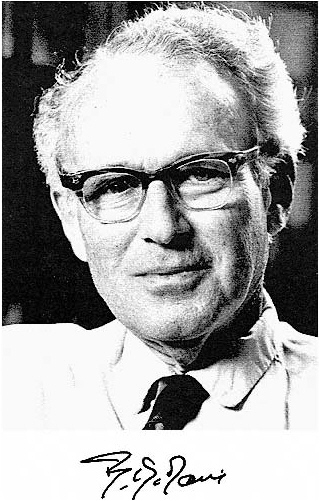
BERNARD DAVID DAVIS
January 7, 1916–January 14, 1994
BY WERNER K. MAAS
BERNARD DAVIS'S MAJOR scientific contributions were in microbial physiology and metabolism. During the late 1940s he discovered an ingenious method for isolating mutants of Escherichia coli that were deficient in individual steps of biosynthetic pathways. His approach was based on the previous work of Beadle and Tatum with the mold Neurospora, but his efficient method permitted him to isolate in one year an arsenal of mutants that in its number and variety surpassed the Neurospora mutants isolated over a previous seven-year period. Furthermore, E. coli was in several ways more suitable for metabolic studies than Neurospora.
Davis used his mutants mainly for working out the steps of biosynthetic pathways. A major advance was his elucidation in the early 1950s of the complete biosynthetic pathway of aromatic amino acids from a common precursor, shikimic acid. Further studies with mutants led also to the clarification of other biosynthetic and catabolic pathways, and to basic findings in the areas of antibiotic action, drug resistance, active transport of metabolites and protein synthesis.
Bernard Davis became a leading figure in biology through his ability to carry out incisive experiments that answered
basic questions. His wide knowledge and penetrating analytical powers made him a superb expositional writer, teacher, and author of a first-rate, inspiring textbook.
Bernard D. Davis was born on January 7, 1916, in Franklin, Massachusetts, where his parents, immigrants from Lithuania, had settled. ''Bernie'' (I hope that the reader will forgive this familiarity, but I have known him by this name over a forty-five-year period of close association) was raised, together with three siblings, in the close-knit environment of a Jewish family. There was great emphasis on learning and intellectual achievement. All four children graduated as valedictorians from the local high school. Despite the limited financial resources generated from his dry goods store the elder Davis managed to provide his children with an education at Harvard (for the two sons) and Radcliffe (for the two daughters).
From early childhood Bernie had a penchant for rational explanations. This turned him off at an early age from the rituals of the Jewish religion, and he became an agnostic. In high school he excelled in science and mathematics. His valedictorian address dealt with "creative chemistry." A complication arose because the year of his graduation coincided with the bicentenary of George Washington's birth. His teachers insisted that the valedictorian address should deal with the first president. Bernie overcame this obstacle by starting his speech with, "Little did George Washington dream that chemistry. . . ." This diplomatic approach satisfied his teachers.
At Harvard, after an abortive attempt to broaden his education by taking courses in history and literature, Bernie settled down to a hard-science curriculum with a concentration in biochemistry. His undergraduate honors thesis dealt with the oxygen dissociation curve of hemoglobin. Twenty years later he was able to point out the generality of
this S-shaped curve at a Cold Spring Harbor symposium, since the same kind of curve was found in the allosteric regulation of enzymes, as proposed by Jacques Monod.
After graduation he vacillated between graduate work in chemistry and medical school. For practical reasons he decided for the latter and enrolled at Harvard Medical School. During the medical curriculum he also worked in the laboratory of E. J. Cohn, a pioneer in protein chemistry. Thus, as well as his medical qualifications, he acquired during this period a solid background in biochemistry. He graduated in 1940 with the very rare degree of M.D. summa cum laude.
Following medical school Bernie went to Johns Hopkins Hospital where he had been offered a research fellowship combined with a part-time internship. He set up a Tiselius apparatus for the analysis of plasma proteins. During this time he carried out a significant study on the consequences of the binding of sulfa drugs to plasma proteins. His medical duties did not generate a great deal of interest and enthusiasm and he decided to discontinue the practice of medicine.
In 1942 he began a research career as a commissioned officer in the U.S. Public Health Service. After a brief period in aviation medicine at the National Institutes of Health in Bethesda, Maryland, he was assigned to work on serological tests for syphilis. He felt he needed more experience in immunochemistry and spent the next two years in the laboratories of Elvin Kabat at Columbia University and Jules Freund at the Public Health Research Institute in New York City. In 1945 the U.S. Public Health Service offered Bernie his own laboratory to work on basic science problems related to tuberculosis. He prepared himself for this by spending two years in the laboratory of René Dubos at the Rockefeller Institute. During this time he contracted a
mild case of tuberculosis and had to undergo surgery, followed by a protracted recovery period. It was during this period of reading and reflection that he formulated the plans for his future research. A deciding factor was a review by George Beadle on the use of biochemical mutants of the mold Neurospora as tools for genetic and biochemical studies. As he stated in his autobiographical memoir in 1992, "It seemed to me that such work on universally distributed biosynthetic pathways should be deeply satisfying because it was near the trunk of the evolutionary tree, while attempts to grow bigger and better tubercle bacilli were only twigs." Thus, after five "Wanderjahre," Bernie had found his niche.
The period at the tuberculosis research laboratory between 1947 and 1954 represented the flowering of Bernie's research career. He set up his new laboratory in the Department of Preventive Medicine at Cornell Medical College in an obscure corner, yet in a scientifically central position, near the Rockefeller Institute in New York City. The direction of his research was set by his early discovery of the penicillin method for the isolation of biochemically deficient mutants. The important contributions that resulted from his work with mutants of E. coli paved his way to becoming a widely recognized figure in microbial physiology. As a consequence of his achievements he was appointed, first, chairman of the Pharmacology Department at New York University School of Medicine in 1954 and, three years later, chairman of the Department of Bacteriology and Immunology at Harvard Medical School, a position he held until 1968.
While at New York University Bernie married Elizabeth Menzel, who, as he stated, "brought a great deal of balance to my life," and who remained a supportive and gracious companion until his death. They had three children: Franklin Arthur born in 1956, Jonathan Harry born in 1958, and
Katherine Judith born in 1960. They acquired a summer home in Woods Hole, where Bernie taught in the prestigious physiology course from 1955 to 1960. Subsequently they spent most of their summers in Woods Hole, and Bernie became a prominent member of the local scientific community. During this period, among many other tokens of recognition, he was elected to the National Academy of Sciences in 1967.
One of Bernie's main tasks in the 1960s was the writing, with Barry Wood, Renato Dulbecco, Herman Eisen, and Harold Ginsberg, of a new kind of microbiology textbook (1967) for medical students. It emphasized the use of bacteria as a model for the new genetic and molecular biology. Through four editions in twenty-three years this popular textbook bore the marks of Bernie's lively and clear expository style.
In 1968 Bernie resigned from the chairmanship of the department and set up a separate Bacterial Physiology Unit to carry out his research with a small group of investigators. At the same time he developed an interest in the relationship between science and society, which became increasingly dominant during subsequent years. In many articles and several books he addressed problems created, directly or indirectly, by the impact of science on human relations. He played an important role as an outspoken critic of problems that arose inside and outside the scientific community, but at times his candor created difficulties for him. For example, in commenting in an article in 1976 on the dangers of affirmative action in lowering the standards of medical education, he attracted the wrath of the dean of the Harvard Medical School and other members of the faculty, and was denounced as a racist.
Bernie retired from his laboratory in 1984, but continued an active life as a lecturer and writer. He was a visiting
professor at Tel Aviv University in 1985, University of California, Berkeley in 1986, and National Taiwan University in 1987; he was a Fogarty scholar at the National Institutes of Health in 1988. At the time of his death Bernie was writing a book about the "Baltimore affair," in which he defended David Baltimore against the unfair treatment he had received in his defense of his collaborator Imanishi-Kari against accusations of alleged scientific fraud by a congressional committee (later shown to be groundless).
Bernie's insistence on exposing the truth outlived him. An obituary in the New York Times described his role as a critic of affirmative action, but hardly mentioned his many other positive contributions. A number of his colleagues and friends (myself included) wrote a letter of protest to the Times describing Bernie's achievements, and as a result the Times published a second obituary in which it rectified its previous omission.
THE TUBERCULOSIS RESEARCH LABORATORY AND NEW YORK UNIVERSITY SCHOOL OF MEDICINE (1948–1957)
I was associated with Bernie during this period, first as a member of his group at Cornell and later as a faculty member of his department at New York University. I was, therefore, intimately acquainted with his scientific activities in directing the laboratory, including my own research.
The work on elucidating biosynthetic pathways was based mainly on the use of mutants as "living dissecting needles" for individual reaction steps. The principle is that a mutant blocked in a given step accumulates the substrate of the blocked reaction and can use the product of the blocked reaction as a growth factor. Thus, the substrate of a blocked reaction step becomes a growth factor for a mutant blocked at an earlier step. In this fashion the order of reaction steps in a pathway can be determined. To carry out this kind of
analysis it is necessary to identify chemically the intermediates of a pathway. Consequently, our laboratory included, in addition to Bernie and myself, associates with training in organic chemistry.
The major project in the laboratory was the elucidation of the pathway leading to the synthesis of the aromatic amino acids tyrosine, phenylalanine, and tryptophan from the common precursor, shikimic acid. This compound had originally been isolated from the fruit of the oriental shikimi tree. Shikimic acid, besides being the precursor of aromatic amino acids, was found to give rise to the then unknown growth factor, parahydroxybenzoic acid. The cellular origin of shikimic acid from intermediary metabolites did not yield to the mutant methodology but was determined in collaboration with David Sprinson of Columbia University by using radioactive isotopes labeled in specific atoms. It was shown that three of the atoms of shikimic acid came from phosphoenol pyruvate and the other four from erythose-4-phosphate.
Besides the aromatic pathway, the pathways of proline, lysine, methionine, histidine, and pantothenate biosynthesis were investigated with the use of mutants. Other people who at one time or another were members of the Bernie Davis laboratory engaged in these studies included Ulrich Weiss, Ivan Salomon, Edwin Kalan, Charles Gilvarg, and Henry Vogel.
The work on biosynthetic pathways constituted the bread-and-butter research of the laboratory. The studies with mutants also led in directions that were not as well defined as biosynthetic pathways, but they were of perhaps greater general interest in foreshadowing developments in molecular genetics. Such studies included the work of Charles Gilvarg and Howard Green, which demonstrated the existence of specific transport systems for metabolites (later named "per-
meases" by Monod); my own studies, with a temperature-sensitive pantothenate-requiring mutant, published in 1952, demonstrated that a mutation could alter the structure of an enzyme. The following year the double-helix structure made it clear how a gene could determine the structure of a protein molecule; and Bernie's work on sulfonamide-resistant mutants indicated that such mutations can involve an alteration of the enzyme that is the target of the drug. This notion, now generally accepted, was entirely novel at the time.
HARVARD MEDICAL SCHOOL (1958–1984)
Bernie's work at Harvard veered from the systematic use of mutants to explore biochemical pathways and concentrated on specific problems that he considered important. One of these problems was the mode of action of streptomycin that had aroused his interest in connection with his work on tuberculosis.
Streptomycin was known to kill bacteria by irreversible inhibition of protein synthesis. Visibly, cells remain intact, but on examining these cells it was found that many processes went awry. The question was: what is the primary action of streptomycin that leads to the killing of the cell?
Bernie and his associates found that there were two major areas of damage: ribosomes involved in protein synthesis and the integrity of the cytoplasmic membrane responsible for the uptake of metabolites. Bernie spent many years trying to disentangle the chain of events that led to killing. In the course of these studies, he and Luigi Gorini, a member of his department, discovered that streptomycin causes misreading of the genetic message, resulting in the production of faulty proteins. Bernie finally solved the problem in 1987 after he realized that killing depends not on one key step but on a series of interlocking multiple steps.
Two other major problems occupied Bernie during this period: the reactions of the ribosome cycle and the mechanism of protein transport across cell membranes. For these studies he used conventional biochemical rather than genetic methods. In the former project he worked out details of the cycle and in the course of this discovered that the initiation factor IF3 acted as a dissociation factor for maintaining 30S and 50S subunits. For the latter process he and David Rhoads showed that the incorporation of protein into membrane vesicles requires the setting up of a membrane potential.
In summary, Bernard Davis's scientific contributions can be arranged under three headings:
-
Protracted effort on one topic that resulted in a solid and complete piece of research, such as the elucidation of aromatic biosynthesis and the determination of the mode of action of streptomycin;
-
More limited projects that led to significant findings that opened up a new area of research for future investigators. His work leading to the recognition of specific membrane transport systems falls into this category.
-
The publication of papers that presented original interpretations of experiments carried out by others. For example he offered a reasonable explanation for the occurrence of adaptive mutations observed by John Cairns and his associates (1989). His papers in this category were on a wide range of topics and were indicative of Bernie's intellectual mastery of biology.
I can do no better than let Bernie himself speak about his contributions and his role as a scientist:
I clearly have "internalized the canons of science," emphasizing rationality
and reality more than most. I think my strongest suit in science has been critical, logical analysis, leading to a single but decisive experiment. And although a systematic program, pursuing the shikimate pathway, has probably contributed most to my scientific reputation, I have tended not to pursue programs at length but to skim the cream from a variety of problems.
This is a portrait of a "romantic" scientist. His contributions, like the sometimes more spectacular contributions of the contrasting class of "classical" scientists, will find a permanent place in the edifice of science.
SELECTED BIBLIOGRAPHY
1942 Binding of sulfonamides by plasma proteins. Science 95:78–81.
1947 With R. J. Dubos. The binding of fatty acids by serum albumin, a protective growth factor in bacteriological media. J. Exp. Med. 86:215–28.
1948 Isolation of biochemically deficient mutants of bacteria by penicillin. J. Am. Chem. Soc. 70:4267.
1950 Studies on nutritionally deficient bacterial mutants isolated by means of penicillin. Experientia 6:41–48.
p-Hydroxybenzoic acid: A new bacterial vitamin. Nature 166:1120–21.
1951 Aromatic biosynthesis. I. The role of shikimic acid. J. Biol. Chem. 191:315–25.
1952 With W. K. Maas. Production of an altered pantothenate-synthesizing enzyme by a temperature-sensitive mutant of Escherichia coli. Proc. Natl. Acad. Sci. U. S. A. 38:785–91.
With W. K. Maas. Analysis of the biochemical mechanism of drug resistance in certain bacterial mutants. Proc. Natl. Acad. Sci. U. S. A. 38:785.
1954 Biochemical explorations with bacterial mutants. Harvey Lect. 50:230–44.
1956 With C. Gilvarg. The role of the tricarboxylic acid cycle in acetate oxidation in Escherichia coli. J. Biol. Chem. 222:307–19.
1958 On the importance of being ionized. Arch. Biochem. Biophys. 78:497–509.
1960 With N. Anand. Damage by streptomycin to the cell membrane of Escherichia coli. Nature 185:22–23.
With N. Anand and A. K. Armitage. Uptake of streptomycin by Escherichia coli. Nature 185:23–24.
1961 The teleonomic significance of biosynthetic control mechanisms. Cold Spring Harbor Symp. 26:1–10.
1967 With R. Dulbecco, H. N. Eisen, H. Ginsberg, and W. B. Wood, Jr. Microbiology . New York: Harper and Row.
1969 With A. R. Subramanian and R. J. Beller. The ribosome dissociation factor and the ribosome-polysome cycle. Cold Spring Harbor Symp. 34:223–30.
1980 With P.-C. Tai. The mechanism of protein secretion across membranes. Nature 283:433–38.
1986 Storm Over Biology: Essays on Science, Sentiment, and Public Policy . Buffalo: Prometheus Books.
With S. M. Luger and P.-C. Tai. Role of ribosome degradation in the death of starved Escherichia coli cells. J. Bacteriol. 166:439–45.
1987 Mechanism of bactericidal action of aminoglycosides. Microbiol. Rev. 51:341–50.
1989 Transcriptional bias: A non-Lamarckian mechanism for substrate-induced mutations. Proc. Natl. Acad. Sci. U. S. A. 36:5005–5009.
1992 Science and politics: Tensions between the head and the heart. Annu. Rev. Microbiol. 46:1–33.


