
Achievements in Marine Geology and Geophysics
Marcia K. McNutt
Monterey Bay Aquarium Research Institute
ABSTRACT
If any prominent researcher were to list the crowning achievements in science over the past 50 years, two discoveries in marine geology and geophysics would surely make everyone's top ten: the development of the theory of plate tectonics and the unraveling of Earth's paleoclimate history through the use of the deep-sea sediment record. The former has become the archetypal example of a scientific revolution, whereas the latter now provides the essential observational evidence for the magnitude, rates, and fundamental causes of climate change. These major discoveries cannot be completely understood apart from the people, the institutions, the organizations, and the funding agencies that led to their advancement. In particular, the establishment of the National Science Foundation at the dawn of the modern era of ocean exploration and on the eve of the discovery of plate tectonics fueled the rapid rise of marine geology and geophysics to become one of the most fundamentally exciting and societally relevant disciplines in all of science. This essay is a personal attempt to describe the context within which this rapid advancement took place and to relate how the institutions and funding structures adapted as the century aged.
INTRODUCTION
It is a formidable task to review all of the achievements sponsored by the National Science Foundation (NSF) in the area of marine geology and geophysics (MG&G). To begin with, this one program within the Division of Ocean Sciences at NSF sponsors research programs nearly as broad in scope as NSF's entire Division of Earth Sciences: marine petrology, tectonics, geomorphology, paleontology, geochemistry, sedimentology, stratigraphy, and geophysics. Personally, an even more immediate problem was the fact that the first NSF grant in MG&G was awarded the month I was born. It was not until some 20 years later that I even became aware that the National Science Foundation existed. Therefore, in order to focus this presentation, I made the conscious effort to concentrate on what I consider to be the two greatest achievements in this field over the past 50 years: the development of the theory of plate tectonics and the deciphering of Earth's paleoclimate record from deep-sea sediments. The fact that any one field could lay claim to two such fundamental paradigms in a single half-century is indeed remarkable, and it is only in the enormity of their impacts that one can justify overlooking the myriad of other important, although more isolated, discoveries in MG&G.
Despite the very different natures of these two major discoveries, there are several parallels in their respective developments. Neither theory could have been advanced had it not been possible to establish a global chronology that allowed observations from different oceans to be inter-compared. The plate tectonic "clock" is the history of reversals of Earth's magnetic field, as calibrated by radiometric dates of igneous rocks and biostratigraphy in sediments. In the case of Earth's climate record, the relevant clock arises from the variations in Earth's orbital parameters, such as eccentricity, obliquity, and precession. For both theories it was relatively simple to reconstruct what happened (e.g., how fast the plates moved in what direction or when Earth experienced relatively warm or cold periods), but it has been a far thornier task to understand why. Exchange of ideas within an international community of scientists was essential for both the plate tectonic theory and paleoclimate proxies, and advances in both seagoing and laboratory analytical instrumentation led to important breakthroughs. In looking over the histories of both revolutions, one discerns the influ
ence of NSF in enabling the collection of the fundamental data sets, promoting international collaborations, providing access to technology, and stressing the importance of relating the observations to basic physical, chemical, and mathematical models in order to gain real understanding.
MG&G IN THE PRE-NSF ERA
The Challenger Expedition
Marine geology and geophysics as a field dates back at least to the HMS Challenger expedition in 1872-1876. The Challenger was a sailing ship of 2,300 tons with auxiliary steam power. With funding from the British Royal Society, that expedition systematically collected observations of the oceans stopping every 200 miles. At each station, depth to the seafloor and temperature at various depths were measured by lowering a sounding rope over the side. Water samples were collected, and the bottom was dredged for rocks and deep-sea marine life. The Challenger expedition set the pattern for all expeditions for the next 50 years. The results from the expedition were staggering and filled 50 volumes. Surprisingly, oceans were not the deepest in the middle—the first hint of the vast mid-ocean ridge system that was so central to the seafloor spreading concepts to be proposed later. Although 715 new genera and 4,417 new species were identified, unexpectedly, none turned out to be the living fossil equivalents to the trilobites and other ancient marine creatures found in terrestrial strata. The types of sediments on the seafloor were unusually lacking in diversity compared with terrestrial equivalents and were categorized by Sir John Murray as being one of only two types: chemical precipitates or accumulations of organic remains. Despite the great improvements in sampling technology that have been achieved since the days of the Challenger, some things never change. The dredge is still a mainstay for bringing up samples of submarine rocks, and it can still be expected to return to the surface right at the dinner hour.
Between the Two Wars
The modern era of ocean sciences began in the years preceding the Second World War. It was in these years that Scripps Institution of Oceanography (SIO) grew from a coastal marine station to an oceanographic research laboratory. Founded as a coastal marine station in 1903 by William Ritter, chairman of zoology at the University of California, Berkeley, Scripps grew in national and international stature under its second director, T. Wayland Vaughn, but lacked a ship to truly explore the Pacific Ocean. In 1936, Harold Sverdrup took over and obtained $50,000 from a long-time benefactor of the institution, Robert P. Scripps. The funds were used to purchase the E.W. Scripps , a 100-foot sailing vessel. Scripps as an institution was now a viable deep-sea research institute. Of course the realities of the endurance of a 100-foot vessel still meant that the institution was hardly global in scope. The great marine geologist Francis Shepard was the first to use the ship to take bottom cores and measure currents near the bottom of the ocean.
Woods Hole Oceanographic Institution (WHOI) was established in 1930, by direct intervention of the National Academy of Sciences (NAS, 1929). The U.S. Navy and other government officials saw the need to establish an East Coast equivalent to Scripps to concentrate on the Atlantic Ocean. Although a number of sites along the East Coast could have suited the purpose, the fact that the Marine Biological Laboratory (MBL) was already established in Woods Hole, Massachusetts, was a deciding factor (along with access by rail and an "equitable" climate year around). At one point, MBL was approached to ascertain whether the institute was interested in expanding its scope to be an interdisciplinary oceanographic center. MBL declined the offer, but helped to establish Woods Hole Oceanographic Institution and, to this day, retains close ties with its research neighbor.
The World War II Effort
In 1940, the threat of submarine warfare provided the national imperative to understand the marine environment. At the time, there were two differing views as to how to detect submarines. As recalled by Roger Revelle,
[Ernest] Lawrence and his friends, reasoning with some justification that oceanographers were bumbling amateurs, quickly decided that underwater sounds were a poor way to catch submarines and that optical methods should be used instead. They constructed an extremely powerful underwater searchlight and sewed together a huge black canvas cylinder which could be towed underwater to imitate a submarine. Unfortunately, it turned out that when the searchlight was directed on this object, it could be detected out to a range of about 100 feet. Shortly thereafter, the physicists disappeared. (Shor, 1978, p. 25)
and the "bumbling amateurs" took over. It was only after the war that oceanographers learned that the contribution of these physicists to the war effort was not entirely useless. They had been shuffled off to New Mexico, to design and build an atom bomb.
The current format of oceanography, which involves an interdisciplinary grouping of marine physicists, biologists, engineers, chemists, and geologists, was largely an invention of the Navy to meet its specific needs. Although at first glance it might seem odd that investigations undertaken for the purpose of antisubmarine warfare might lead to plate tectonics or paleoclimate reconstructions, mary observations relevant to Navy interests turned out to be key ingredients for these future revolutions. For example, detecting the presence of submarines acoustically required knowledge of the shape of the bottom of the ocean and the sediment type, magnetic detection required knowing the ambient back
ground field, and so forth. This strategic alliance between scientists and the military counted in the victory, and after the war the nation's leaders recognized the need to maintain a cadre of scientists and engineers trained in oceanography. The initiative for ONR came from the wartime Office of the Coordinator of Research and Development under Admiral J. A. Furer. Columbus Iselin of WHOI and Lieutenant Mary Sears encouraged Roger Revelle, then Director of Scripps, to become involved with the new ONR's Geophysical Branch. The National Science Foundation was founded soon after, in 1950. From the very beginning, marine geology and geophysics was supported by these two agencies.
THE EARLY DAYS OF NSF
The First MG&G Research Supported
In the very first round of awards from the NSF presented in February 1952, MG&G was represented. The Earth Science Program awarded Bob Ginsburg at the University of Miami $4,700 for one year for a project entitled, "Geological Role of Certain Blue-Green Algae." Forty-six years later, Bob Ginsberg is still submitting proposals to NSF.
In 1953, a second research project in MG&G supported Kulp at Lamont for carbon-14 measurements of ocean sediments. In the following year, three more awards were made in MG&G, all again going to Lamont or to the Geology Department at Columbia. In 1955, there were two more new awards, again both going to Lamont, same pattern in 1956: two more new awards to Lamont. Not until 1957 was the Lamont monopoly broken. In that year, there were three more new awards to Lamont, but also one to K.O. Emery, who was at the time at the University of Southern California, for research on the deposition of sediments off southern California. One of the Lamont awards was to Maurice Ewing for "Reduction of Magnetic Data." Typical awards during these first five years included up to about $30,000 in funds and durations of one to three years.
In the postwar era, oceanographers were given extensive freedom to direct the course of their investigations to serve basic science. The Navy recognized that it would not be possible to precisely predict which question it would need the answer to next, and therefore it was essential to have broadly trained problem solvers. Unlike the situation in later years when one might reliably guess the source of support for a particular research project by its topic, in the 1950s and 1960s ONR and NSF were funding similar sorts of research. This strong overlap in research interests between ONR and NSF at first caused me some discomfort. I was concerned as to how I would distinguish, many years later, which of the great discoveries in MG&G should be attributed to the Navy and which to NSF. I soon realized that this was a non-issue. ONR and NSF did not seem to mind if their researchers were not careful about distinguishing who was supporting what, and they were delighted to take credit for jointly funded achievements. In thumbing through Lamont's annual collections of published papers, a common acknowledgement is of the form: "This research was funded by the Office of Naval Research and the National Science Foundation."
For those of us raised by the NSF of the latter quarter of the century, it is easy to envy the funding rate in the early years of NSF. In January 1961, J.D. Fautschy at Scripps issued to all division directors a list of all proposals to NSF that had been submitted in the prior two years. Every one was funded. The average time between submission of the proposal and the awarding of funds was five months. However, Fautschy did not circulate the list for the purpose of marveling at the largess and efficiency of the Foundation. Rather, he was complaining that despite NSF's encouragement of proposals for three to five years duration if "consistent with the nature and complexity of the proposed research," several of the proposals for longer durations had been cut back such that no grant was for more than three years. It is clear that even at that time, we were at the mercy of our peers, regardless of policies NSF might be trying to promote. More than 30 years later, requests for more than three years of funding on a single grant request are still having difficulty in peer review.
Even in its earliest years, funding from the Foundation was not limited to individual research grants. In June 1955, Raymond J. Seeger, then acting Assistant Director of the National Science Foundation, wrote a letter to Walter Munk at Scripps requesting suggestions for facilities that NSF might sponsor that would be relevant to the Earth sciences. The general policy, as articulated by the Divisional Committee for the Mathematical, Physical, and Engineering Sciences was:
The NSF should recommend as a national policy the desirability of government support through NSF of large-scale basic scientific facilities when the need is clear, the merit endorsed by panels of experts, and funds are not readily available from other sources. (Letter from R.J. Seeger to W.H. Munk, June 1, 1955)
Astronomical observatories, radioastronomy facilities, computers, accelerators, and reactors were all given as examples of what NSF was looking for, and the committee made it clear that funds for these large-scale projects should not compete under the normal grants program. In his reply to Seeger's letter, written a mere seven days later (coast-to-coast mail service was clearly faster then than now), Munk suggested computer facilities and support for research vessels, the latter being the oceanographer's equivalent of an astronomical observatory. It is hard to imagine what marine geology and geophysics would be like today had NSF not eventually acted on both of Munk' s suggestions.
The Beginning of the MG&G Program
After the MG&G program was established at NSF in the late 1960s, its first program managers (e.g., Bob Wall) came
from ONR and set up styles of doing business that were very reminiscent of ONR methods of operation. The community was still small enough that NSF program managers could take a very personal interest in the investigators they supported and mentor career development. Compared with their academic equivalents, program managers were well paid in those days, and it was considered a very prestigious position.
The community of ocean scientists was small enough and centralized enough in the 1960s and 1970s that NSF program managers could visit their constituents on a regular basis. I recall as a graduate student at Scripps in the mid-1970s sharing a Mexican meal at an inexpensive Del Mar restaurant with an NSF program manager and a number of more senior graduate students. I doubt any of my own graduate students have had a similar experience. Although the NSF MG&G program managers did not conduct ONR-type site reviews, they began the tradition of tagging along on ONR's own site reviews. (One worldly investigator insists that NSF's main function at these meetings was to prevent double-dipping for travel to cruises jointly funded by NSF and ONR.)
Dick Von Herzen recalls sitting on Wall' s MG&G panel in the late 1960s. At the time, NSF was funding blocks of related proposals from the oceanographic institutions that would provide the ship funds, travel money, et cetera, to support a sequence of interrelated research legs. Research planning for these expeditions was a group effort conducted within each institution. Each leg of an expedition tended to be multidisciplinary, with physicists, chemists, geologists, and biologists sharing the same ship. Emphasis was on making every conceivable co-located measurement, since almost everything was being observed for the first time. Dick says it was not until well into the 1970s that he recalls writing his first "heat flow proposal," in which the expedition was devoted to heat flow observations and all ancillary data collection was justified on the basis of needing it to interpret the heat flow data.
THE THREE INSTITUTIONS
During the 1960s and early 1970s, the three major institutions conducting research in marine geology and geophysics (Lamont, Scripps, and Woods Hole) had very different characters, and these characters were reflected in the form of NSF support.
Lamont
Lamont could be best described as a dictatorship. Maurice Ewing exerted strong leadership, on the sorts of data to be collected, the route of the ships, and the research being addressed. Of the 600 papers published at Lamont between 1950 and 1965, Ewing was co-author on 150 of them and first author on 55. The block funding for institutional operations from ONR and NSF enabled a visionary like Ewing to set a firm course for Lamont. He insisted that his ships run their precision depth recorders at all times; tow magnetometers; and stop every day for a core, a bottom temperature measurement, and in later years, a heat flow station. His strategy in cruise planning was to keep his ships circling the Earth ("like two moons"), collecting data where no oceanographic ship had gone before. Ewing established a cataloging system to keep an inventory of samples collected on each expedition and was regularly in touch by radio with his ships, sometimes even directing the sampling from shore. Ewing' s system was such that it was clear if there was a gap in the record that a daily sample was missed. Jim Cochran recalls sailing as chief scientist on Lamont's ship, the Vema, right after obtaining his Ph.D. His surveying was going so well that he neglected to stop for the daily core. In less than 24 hours, Captain Kohler (gleefully) delivered to him a tersely worded message from Ewing expressing his displeasure with the young chief scientist' s failure to follow orders.
The depth and magnetic anomaly data amassed by Lamont in its first two decades were key in establishing the validity of the plate tectonic theory (although Ewing was at first a vocal critic of the Vine and Matthews hypothesis). Lamont cores were instrumental in establishing global climate history. Underway data from Lamont's ships dominated the geophysical data banks. Lamont led the way in perfecting the use of geophysical surveying and sampling systems in the oceans, including the use of marine magnetometers, marine seismic reflection, precision depth recorders, piston cores, heat flow probes, and marine gravimeters (although others, including Sir Edward Bullard and Vening Meinesz, were the true pioneers). There had been much pessimism whether some of these methods, especially the seismic and gravity methods so central to terrestrial geophysical exploration, could ever be used at sea. Lamont scientists under Ewing's leadership demonstrated not .rely that these techniques could be used in the oceans, but that they gave even better data with cleaner signal in the marine environment. In retrospect, it might appear that Ewing's foresight was 20-20. Lamont-Doherty became a vast storehouse for marine data and samples just waiting to confirm the new theories after they were proposed. But in some respects Ewing was lucky as well. For example, Bill Curry tells me that many of the key deep-sea cores that figured so prominently in reconstructing Cenozoic climate were actually collected for the purpose of determining thermal conductivity for heat flow measurements. In fact, to this day, we are still scratching our heads trying to make sense of the widely scattered heat flow measurements acquired on Lamont vessels.
Sir Edward Bullard once asked Ewing why he kept taking so many cores. He answered:
I go on collecting because now I can get the money; in a few years it will not be there anymore, then I shall have the material to keep my people busy for years. (Menard, 1986, p. 269)
And he was right.
Ewing's style did not always endear him to his counterparts elsewhere in the national oceanographic community. Walter Munk recalls having been asked by Roger Revelle to sit in on a meeting at SIO just after the war. The Dutch pioneer in making pendulum gravity measurements from submarines, Vening Meinesz, was offering to give to the United States three of his instruments. The question was how to divide up the instruments. Columbus Iselin was there to represent Woods Hole, Ewing for Lamont, and Revelle for Scripps. (Three major institutions and three available instruments—the solution seems obvious.) Ewing's answer to the problem was that all three instruments should go to Lamont. He stated that making marine gravity measurements was Lamont's number one priority, and therefore for the good of the nation he should have all of the instruments. Lamont thus began a marine gravity program using U.S. Navy submarines.
Scripps
If Lamont was a dictatorship, then Scripps might have been best described as a fiefdom ruled by grand dukes. Revelle, who was director of Scripps in the early days of NSF funding, played a key role in attracting first-rate researchers to Scripps and in organizing the expeditions, but he did not oversee the daily science activities in the way that Ewing did. Marine geology and geophysics already had a rich history at SIO, thanks to the pioneering work on submarine canyons of Francis Shepard. By the 1950s, Scripps had built up a strong staff in MG&G, some of whom came from the Division of War Research that had been established on the eve of World War II at Point Loma. These researchers came with a storehouse of paper records of echograms acquired on Navy ships.
Bill Menard arrived at Scripps in 1955 with initial interests in turbidites. He developed the ability to read echo-sounder records faster and better than anyone else. He discovered and named the great Pacific fracture zones, mapped the East Pacific Rise, and later defined the geometry of the tectonic plates. At the same time, R.L. Fischer explored the Indian Ocean. The dredging efforts of Fisher, Menard, and others at Scripps resulted in a collection of abyssal basalts that was second to none. Joe Curray continued Shepard's legacy of understanding the sediments of continental margins. Doug Inman combined academic training in physics with hands-on learning under Shepard to pioneer the application of physics and fluid mechanics to the study of shore processes.
One of the more interesting early discoveries was made by Russ Raitt, who along with Ewing was applying seismic techniques to study the distribution of sediments in the oceans. Both Raitt and Ewing were getting similar results: sediment thickness was only about 300 m in the Pacific and 450 m in the Atlantic. These thicknesses were far less than what would be predicted if the ocean basins were as old as the continents.
William Riedel joined Scripps in 1956 and began studying radiolarians. By the mid-1960s he had developed a precise chronology using radiolarians that allowed for geologic dating. These silica-shelled organisms were preserved even in the deep ocean and thus provided age estimates below the levels of dissolution of carbonate organisms. Jerry Winterer joined the institution in 1961, developing a reputation for deciphering ocean history from core stratigraphy.
The Scripps "grand dukes" shared Ewing's philosophy that ships should be required to collect every conceivable data type regardless of the objectives on an individual mission, although no one individual had the authority of Ewing to enforce quite such catholic sampling as was required on the Lamont ships. Nevertheless, Menard insisted that the echosounder always be running, while R.G. Mason and Vic Vaquier encouraged towing a magnetometer. Acceptance of the value of the soundings was more widespread than appreciation of the value of the bizarre variations in scalar magnetic field sensed by the magnetometers. In the 1950s, Mason encountered substantial resistance to the use of the magnetometer from both the Navy and the United States Geological Survey (USGS), so much so that Scripps nearly had to pass on the opportunity to mount its magnetometer on a U.S. Coast and Geodetic Survey ship, the Pioneer, that was conducting a detailed survey of seafloor off the Washington-Oregon coast. Menard managed to obtain support from Revelle's discretionary fund to allow use of the magnetometer. With line spacing of only 5 miles, the lineated nature of the magnetic anomalies was clear to Mason when he plotted the data. The pattern changed at the fracture zones and was repeated 80 km to the west as the ship passed south across the Murray fracture zone. It was not until a decade later that the symmetric anomaly patterns were found in the Indian Ocean, along the Reykjanes Ridge, and in the South Pacific that allowed geophysicists to correctly identify the cause of the Pioneer magnetic anomalies. Sometimes one needs to go an ocean away to understand something in one's own backyard.
Clearly two of the greatest legacies of the Scripps MG&G program in these early years were the decision to put computers on the ships (a radical notion in the 1960s before the days of computers in every lab, home, and toaster) and the establishment of the Geological Data Center. Bill Menard spearheaded the effort to install the computers, with an identical machine on shore to analyze the data after each expedition. IBM actually provided the computers (the "Red Baron," "Blue Max," and "Yellow Peril") and a computer operator. Stu Smith recalls that after the computers arrived, they had but one month to set them up in preparation for the Scan Expedition cruise on the Argo in 1969, using software borrowed from Manik Talwani.
The Geological Data Center (GDC) was instigated by George Shor, prompted by interest from the oil companies in
the growing amount of seismic reflection data at Scripps. The funding to establish the center was raised from the Scripps Industrial Associates, and it opened for business in 1970. State of California funds supported Stu Smith as the curator of the facility. Prior to the establishment of the center, there had been no place to archive geophysical data. Observations collected at sea were considered the property of the principal investigator (PI), and exchanges between PIs were accomplished by a sort of bartering system. In order to convince the PIs that they should place their data in the archive, George Shor came up with the policy of a two-year proprietary hold on the data before distribution to other investigators. Scripps' Geological Data Center and the National Geophysical Data Center, which was established under National Oceanic and Atmospheric Administration (NOAA) sponsorship at about the same time, changed the way marine geology and geophysics could be accomplished. Data could now be used by a much broader array of researchers to answer questions not yet posed at the time that the data were collected.
Although neither of these two great legacies can be directly attributed to NSF, the Foundation was quick to seize the advantage of geophysical archives and shipboard computers. NSF promoted the archives by insisting that all NSF-funded PIs place their data in an archive facility where it would be in the public domain. NSF funding has allowed both the shipboard computers and the Geological Data Center to continue by allowing some of the costs for these facilities to be included in the day rates for data collection in NSF-funded ship time. And most importantly, NSF provided the funds for countless peer-reviewed grants to use data collected by shipboard computers and archived in the GDC for outstanding science.
Woods Hole
Woods Hole was even less centralized than Scripps and had a smaller staff in MG&G, compared with either Lamont or Scripps. Harold Stetson founded the WHOI MG&G group about the same time that Shepard was building the Scripps department. Research at WHOI was not instituted from the top down, although Brackett Hersey, the MG&G department chair immediately after World War II, had a lot of influence. As at Scripps and Lamont, most of the collaborations were forged internally, with liberal use of WHOI adjunct positions as a means of inviting selected outsiders to use WHOI ships. Doc Ewing himself was an example of an outsider who benefited from access to the Atlantis before Lamont purchased the Vema.
In the 1960s, ship time at WHOI was funded apart from individual proposals by ONR and NSF. Department chairs had the ability to assign ship time to staff members, who would then write proposals to cover incidental expenses after ship time was awarded. Charlie Hollister recalls arriving at Woods Hole from Lamont in 1967. The: first thing his department chair urged him to do was to pay a visit to the manager of the new NSF MG&G program in Washington in order to establish a rapport and let him know what sort of NSF support Charlie would need for his science. Charlie recalls how radical this sounded to him at the time. Back at Lamont, Doc Ewing would have considered it high treason for a junior staff member to cultivate his own personal relationships with funding managers.
Despite the advantages to the young PIs of having a very decentralized research system at Woods Hole, there was a downside. No one investigator had the ability to mandate the routine collection of data sets on the Woods Hole ships, and thus Woods Hole did not early on amass the samples and data series that fueled the plate tectonic revolution.
Woods Hole began to step to the forefront sometime later than Lamont and Scripps in the area of MG&G. The development of Alvin gave Woods Hole an asset that was nowhere else duplicated in the academic research community. Project FAMOUS (French-American Mid-Ocean Undersea Survey) in the mid-1970s defined a new way of doing marine science (see Ballard paper later in this volume). Whereas much of the work prior to this time had been reconnaissance in nature, FAMOUS concentrated on a small area of the Mid-Atlantic Ridge using the submersibles Alvin and Cyana. The data amassed during the FAMOUS expedition led to an examination of the details of accretionary plate boundaries at scales smaller than what the plate tectonic paradigm could predict.
THE TWO REVOLUTIONS
It is interesting to consider how the MG&G community was so uniquely able to capitalize on the ability to make key observations even on non-MG&G cruises and to rapidly store the information in computer-aided archives. Whereas marine bathymetry, magnetics, and gravity could be collected while underway without interfering in whatever other science was to be accomplished on the trip, marine chemists, biologists, and physical oceanographers needed to stop to lower their instruments and collect their samples. Whereas the pertinent information on depth, magnetic field, and gravity field could be reduced to a simple series of numbers, this was not the case for water and biological samples. Even sediment cores collected by oceanographic institutions or by the drilling program were carefully cataloged, subsampled, and archived in a systematic way unduplicated for samples of interest in the other oceanographic disciplines. The ease with which key measurements could be acquired and shared, with help from NSF funding, helped propel U.S. researchers in MG&G to the forefront in two of the most important revolutions in science.
Plate Tectonics
The saga of the plate tectonic revolution has been so oft cited that I will not take the time to repeat it here. It is the archetypal scientific revolution that had its roots back in Wegner's theory of continental drift in the 1920s. But plate tectonics was a concept that was poorly represented on the continents, and therefore there was little hope of getting the story straight before the post-World War II era of ocean exploration.
The decade of the 1950s was marked by a total lack of consensus on Earth history. Was the Earth expanding? Contracting? Did continents drift? Remain fixed? In 1959, Americans Harry Hess (from Princeton), Bill Menard, and Maurice Ewing were joined by the Canadian Tuzo Wilson and the British Sir Edward Bullard at an international oceanographic congress in New York City right after the end of the International Geophysical Year. All believed that the mid-ocean ridges were the source of some wholesale motion of Earth' s crust in a manner not compatible with continental drift. The data collected by Ewing and others showed that the mid-ocean ridges were clearly the youngest part of the seafloor. Wilson thought that Earth was expanding along the mid-ocean ridge system, whereas Ewing, Bullard, and Hess believed the ridges to be the rising limbs of thermal convection cells. Hess balanced the expansion with contraction at the trenches and mountain belts. Menard kept the continents in place while the seafloor recycled. After the congress, Hess and Robert Dietz wrote papers revising the notion of continental drift to include spreading seafloor. Most others were skeptical, citing the inability of rising and descending limbs of thermal convection to explain the fact that Antarctica is nearly entirely circled with mid-ocean ridges.
In 1963 came the breakthrough that would allow the concept of seafloor spreading to take a firm hold. Fred Vine and Drummond Matthews of Cambridge University became the first to publish the hypothesis that the puzzling magnetic anomalies in the ocean basins were the result of seafloor spreading combined with aperiodic reversals of Earth's magnetic field. In reaching this conclusion, they relied heavily on evidence just published by Allen Cox, Richard Doell, and Brent Dalrymple (Cox et al., 1964) for reversals of Earth's magnetic field globally recorded in volcanic rocks. This is one clear example of how advances in terrestrial Earth science research helped fuel a great discovery in MG&G. For the most part, however, it was an advantage not to have been too indoctrinated by the theories of terrestrial geologists in order to embrace the new paradigm.
Despite the attractiveness of the Vine-Matthews hypothesis, most Americans were still skeptical. George Backus published a paper in Nature in 1964 that proposed an elegant test of the Vine-Matthews hypothesis. He reasoned that the rate of seafloor spreading should increase from north to south in the Atlantic as a consequence of plate motion on a sphere. It should be simple enough to determine whether the pattern of magnetic stripes in the South Atlantic repeated that already found off Iceland, except with greater thickness to the stripes. His NSF proposal to fund just such an expedition was declined by a panel of his peers as being ''too speculative." NSF would soon prove the validity of the plate tectonic hypothesis, but not through deliberate forethought.
In 1965, J. Tuzo Wilson published a new explanation for the offset of the magnetic lineations across fracture zones. The lineations were offset because the ridge itself was offset (Figure 1). Earthquakes occurred only along the segment of the fracture zone between the two ridges where he predicted, based on seafloor spreading, that crust was moving in opposite directions. Later, Lynn Sykes at Lamont would go on to prove Wilson's hypothesis by showing that the first motions of earthquakes were consistent with this theory.
The tide turned in favor of the acceptance of seafloor spreading with the publication of the Eltanin-19 profile (Figure 2). The Eltanin was a southern ocean research ship owned by the National Science Foundation and operated by Lamont until she was retired in 1973. Walter Pitman, a student at Lamont, was the first, in December 1965, to take a careful look at that profile across the South Pacific and note the nearly perfect symmetry in the magnetic lineations. Eltanin -19 was fortuitous; it was collected in the Southern Ocean near the magnetic pole such that the magnetic anomalies were large and barely skewed. The seafloor spreading history had been steady to first order, with no major plate reorganizations back to 80 million years. Pitman began numbering the magnetic anomalies on a paper record, beginning at the left edge. By the time he got to the mid-ocean ridge, the numbers were large. He quickly realized that this would not do, erased his numbers, and began counting anew from the ridge outward. This original profile now hangs on the wall in John Mutter's office at Lamont. By this time, Cox et al. (1964) had firmed up the magnetic reversal time scale for the first few million years, and the correspondence with the spacing of the anomalies on the Eltanin profile was staggering. By February 1966, Pitman's colleagues at Lamont quickly embraced Vine-Matthews and the other tenets of the new theory. The institution with more than half of the existing magnetic and profiler records from the oceans and 80 percent of the deep-sea cores would from then on be working to help establish the evidence for seafloor spreading.
The conversion of Lamont came just before a National Aeronautics and Space Administration (NASA) conference at Columbia in 1966 on the "History of the Earth's Crust." The papers ultimately presented there bore in many cases little resemblance to the abstracts submitted months earlier. The field was moving too fast. At this meeting, Heirtzler presented the results of the Eltanin surveys. After his talk, Pitman recalls:
Menard from Scripps, who had opposed [continental drift] sat and looked at Eltanin-19, didn't say anything, just looked
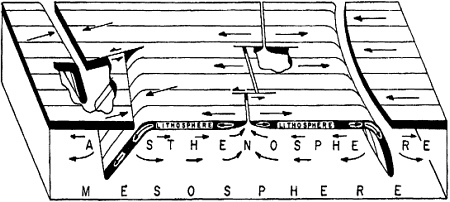
FIGURE 1 Lithospheric plate motion in three dimensions shows plate generation along the mid-ocean ridges, transform motion associated with ridge offsets, and sinking of the plate at the ocean trenches. Reprinted from Isacks et al.
(1968), with permission from the American Geophysical Union.
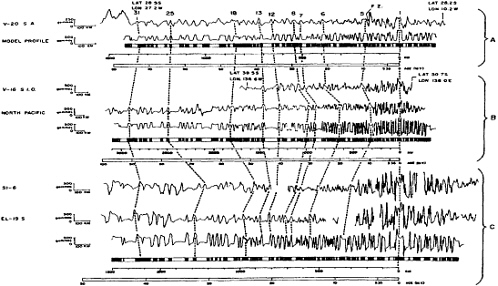
FIGURE 2 Comparison of magnetic anomaly profiles from the South Atlantic (A), and North Pacific (B) with the Elianin profile (C) from the South Pacific. Correlations of individual anomalies are indicated with dashed lines. |Shaded boxes are the magnetic reversal time scale. Reprinted from Heirtzler et al. (1968), with permission from the American Geophysical Unions.
and looked and looked. Next, Lynn Sykes delivered the one-two punch by showing that earthquake focal mechanisms on transform faults were consistent with J. Tuzo Wilson's theory of ridge offset. Menard returned to Scripps a complete convert.
Although the battle for acceptance of plate tectonics was quickly waged and won in the mid-1960s, there were still a number of details to be filled in, much of which was done under the sponsorship of NSF. The present-day plate kinematics were to be sorted out using the azimuths of transforms and the width of the near-ridge magnetic anomalies. The history of plate motions and reorganizations needed to be worked out, a problem often requiring targeted expeditions funded by NSF to key areas where there were gaps or complexities in the magnetic records. Second-order effects, such as the existence of propagating ridges and microplates, were observed from detailed surveys and found to be important mechanisms for accommodating changes in the direction of relative plate motion.
The vertical motion of the seafloor was predicted from conductive cooling relations and compared with the depth data. The archives of heat flow observations were compared with what was predicted based on the thermal cooling model that fit the subsidence of the seafloor away from the ridges, but were found lacking. The conductive heat flow was less than predicted near the ridges and on the flanks, leading to the proposal that hydrothermal circulation was appreciable in young crust. Later expeditions funded by NSF, notably the RISE (Rivera Submersible Experiments) Expedition to the East Pacific Rise in 1979, found the "smoking gun" for hydrothermal circulation near mid-ocean ridges in the form of hot vents and the completely unexpected chemosynthetic food chain associated with them. Thus, even the crowning achievement in the field of marine biology can be claimed by MG&G.
Hotspots, although not a natural component of the plate tectonic paradigm, proved to be a useful indicator of the direction and speed of absolute plate motion. Observations of the flexure of the lithosphere beneath the weight of the hotspot islands and seamounts, and seaward of subduction zones, were used to calibrate the strength of the oceanic plates. These studies, funded mostly by NSF, led to unprecedented abilities to predict the horizontal and vertical history of seafloor in all of the world's oceans.
I recall the first time I heard about the theory in 1972. I was an undergraduate at Colorado College majoring in physics, soon to graduate. One of my physics professors gave me an article from Scientific American written by John Dewey describing the new theory. After the geology courses I had taken that spoke of geosynclines deformed under unknown forces, plate tectonics seemed so simple and elegant. Soon after, J. Tuzo Wilson came to speak at the college. I was hooked. I had already applied to graduate school in physical oceanography, but quickly decided that geophysics was what I really wanted to study—nothing like getting in on the first decade of a major paradigm shift. On my first oceanographic expedition, there was no one more senior than the graduate students, including the two co-chief scientists, Peter Lonsdale and Kim Klitgord. Everything had to be discovered anew and reinterpreted in terms of the new model, and who better to do it than the graduate students who had no stake in any previous ideas?
It is impossible to understate the importance of plate tectonics. It grandly explained the distribution of earthquakes and volcanic eruptions. It exactly predicted evolutionary patterns and distributions of related species. It predicted the history of possible pathways for ocean circulation, trends in ocean volume that controls sea level, and alteration of seawater chemistry via fluid circulation at ridges and trenches. In the chemosynthetic colonies in the hot vents, it might even explain the origin of life.
Reconstruction of Earth's Paleoclimates
The impact on society of the use of MG&G observations to reconstruct paleoclimates has been no less important and followed fast on the heels of the plate tectonic revolution. Whereas the time scales for plate tectonics are measured in millions of years, the deep sea record from sediment cores has taught us that Earth's climate vascillates on thou-sand-year time scales, and possibly much less. No great revolution sparked the acceptance of the climate proxies from the deep sea, as was the case in plate tectonics, but the impact on mankind could be much greater. We doubt that plate tectonics will render Earth uninhabitable for mankind on a human time scale, but there is every reason to believe that natural climate cycles enhanced by man's degradation of air, water, and land could result in an Earth unable to support the present population in a matter of centuries or less.
The climate story is also one of fortuitous gathering of samples, specifically the deep-sea cores, before their significance was established. A large number of researchers labored long and hard to work out the biostratigraphy of the cores using the carbonate and siliceous shells of microscopic marine animals. These cores demonstrated that the carbonate compensation depth in the oceans had varied over time, for not completely understood reasons, as had sea level. Furthermore, the microfossils indicated that there had been sudden swings of climate from warm-loving to cold-loving marine planktonic microfossils and back again at rates too fast to have been caused by plates drifting into different climate zones. But the resolution in the biostratigraphy was too poor to work out the rates of climate shift and to establish absolute global synchronicity. Here again the pioneering work of Cox et al. (1964) proved useful, in that the reversal of Earth's magnetic field at the beginning of the Bruhnes epoch, about 700,000 years ago, was often faithfully preserved in the paleomagnetic field of the core, such that it
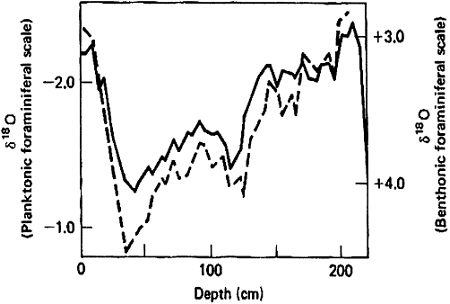
FIGURE 3 Oxygen isotope records of planktonic and benthic foraminifera. Reprinted from Shackleton and Opdyke (1973), with permission from Academic Press, Inc.
provided at least one absolute calibration point for estimating average rates of sediment accumulation.
Nick Shackleton, a British marine geologist, was the foremost figure in promoting another proxy for climate change, stable isotopes. Working in England, he used a high-resolution mass spectrometer to analyze the down-core oscillations in the ratio of the heavy oxygen isotope, 18O, to the light oxygen isotope, 16O. Based on the correlation with the biostratigraphy, these variations were clearly correlated with changing climate, but it was unclear whether the isotopic variations were caused by changes in ocean temperature or in terrestrial ice volume. With the encouragement of NSF, Shakleton became the first international corresponding member of NSF's CLIMAP program, which sought to decipher Earth's paleoclimate during the last glacial maximum. U.S. researchers were intrigued by Shakleton's stable isotope work, and Shakleton badly needed better samples on which to work. He had been using samples collected 100 years earlier by the HMS Challenger! Under CLIMAP sponsorship, Shakleton came to the United States and worked on core V28-238, a high-resolution core in the Lamont data bank collected by the Vema from the Ontong Java Plateau (Figure 3). This core contained well-preserved benthic and planktonic foraminifera, which showed the same oxygen isotopic signal. The argument was that whereas surface waters are very prone to temperature changes, the deep sea is roughly isothermal. Therefore, the fact that the signal was the same in the surface waters as the deep sea argued that the ultimate cause was climate-related changes in ice volume, not temperature directly.
The impact of the development of the stable isotope proxy on paleoceanography was substantial. On the assumption that sedimentation rates were constant throughout the entire Bruhnes epoch, the oscillations in the stable isotopes became the paleoclimate equivalent of the magnetic reversals for plate tectonics. The pattern could be used for global correlation. But unlike the magnetic reversal signal, which defies prediction and is likely an excellent example of chaos, there was a pattern to the variations in the oxygen isotopes. In 1976, Hays at Lamont, working with Imbrie at Brown and Shackleton, applied spectral techniques to the signals from cores that were thought to be fairly well dated such that the isotopic signal as a function of depth could be accurately converted to a time series. The result was the identification of spectral peaks that matched the predictions of the Milankovitch hypothesis (Figure 4). According to this theory, variations in Earth' s orbital parameters (eccentricity, tilt, and precession of the equinoxes) caused variations in solar insolation that resulted in changes in climate.
Although there was some cause to question how well core depth had been converted to time, the strength of the spectral peaks and the repeatability of the pattern won many converts—so much so that now cores with poor age control are assigned dates by assuming that the isotopic peaks and troughs should correspond in time to what is predicted by the Milankovitch hypothesis ("orbital tuning"). Not all is completely understood, however. For example, northern and southern hemispheres would be predicted tc be out of phase for the precession period, but they are not. Overall, phase relationships demonstrate that regional insolation is not important. The net effect on the whole globe ,with its unequal distribution of continents and oceans must be taken into account. In addition, the strength of the spectral peaks is not consistent with the hypothesis that it is variations in solar
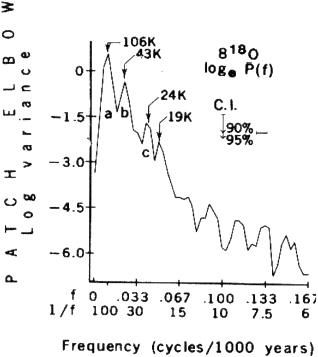
FIGURE 4 Spectra of climate variations in sub-antarctic piston cores as inferred from variations in oxygen isotopes. Prominent spectral peaks, labeled a, b, and c, correspond to the predicted periods of eccentricity, obliquity, and precession of the Earth's orbit. Reprinted from Hays et al. (1976) in Science, Vol. 219 with permission from the American Association for the Advancement of Science.
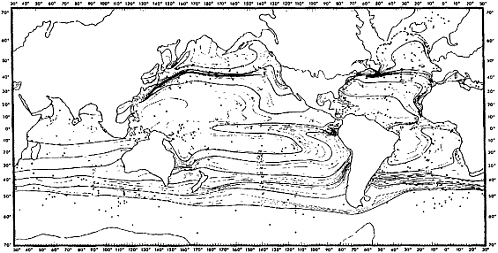
FIGURE 5 Sea-surface temperatures for northern hemisphere summer 18,000 years ago as determined by climate proxies mapped by the CLIMAP project. Contour intervals are 1°C for isotherms. Black dots show the locations of cores used to determine paleoclimate. Extent of continental glaciers is shown for the northern hemisphere, and coastlines reflect the corresponding lowering of sea level. Reprinted from CLIMAP (1976) with permission from the American Association for the Advancement of Science.
insolation that leads to ice volume variations, and the spectral amplitudes are not stationary in time. Despite these remaining questions, the deep sea has provided a well-calibrated record of Earth's natural climate changes that can be used to help assess the future impact of man's activities.
The National Science Foundation was by far the greatest supporter of climate research, including the very successful CLIMAP project (Figure 5). A large amount of the paleoclimate work was supported and continues to be supported by NSF-MG&G. However, the Division of Atmospheric Sciences and the Ocean Drilling Program were also major players. MG&G has benefited greatly from broader NSF initiatives in global change that support paleoceanographic research beyond what the MG&G program could afford.
THE ASCENDANCE OF NSF SUPPORT
During the course of my interviews for this assignment, I asked a number of people when they recalled NSF taking over from ONR as the principal source of funding in MG&G. The universal answer was that the changeover occurred in the mid-to late-1970s. And yet the numbers from Lamont (Figure 6) and Scripps in no way support this impression. Even in the early 1970s (as far back as, it seems, anyone bothered to keep records), NSF was providing more dollars to the oceanographic institutions than ONR. Why was the impression just the opposite?
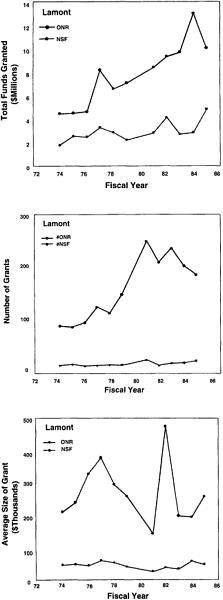
FIGURE 6
Total funds granted (top), number of grants (middle), and average size of grant (bottom) for NSF versus ONR awards given to Lamont, 1974-1985. Similar trends are seen in data from Scripps, but Lamont numbers are used here since they can reasonably be expected to represent trends in MG&G as opposed to those in marine biology, chemistry, or physical oceanography.
Deborah Day, the Scripps archivist, suggested a possible answer to this question. The prelude to many key MG&G experiments was the development of a new technology—Woods Hole' s Alvin, Scripps' ocean bottom seismometers, Lamont's airguns, swath mapping systems, and so forth. The Navy tended to take the lead in instrument development in MG&G, but once the technology was proven, NSF would support the science programs that used the technology. In a few cases, successful science programs initiated by ONR would be continued by NSF. It is possible that into the 1970s, ONR was still getting credit for programs it had started but handed off to NSF.
With some exceptions, NSF's decision-making process of judgment by our peers has not been a good source of "venture capital" in MG&G. Rather, the community found this venture capital at ONR, from industry, and from the discretionary funds of institute directors. NSF was quick to support the successful venture, and make them pay off.
The Impact of International Programs
One place in which NSF clearly set a policy direction different from that of ONR was in the encouragement of international collaborations. Initially through the International Geophysical Year (IGY), and later via the International Decade of Ocean Exploration (IDOE), U.S. investigators were encouraged to invite foreign colleagues to the United States with travel support from NSF. This sort of attitude would have been uncharacteristic for an agency like ONR responsible for maintaining a competitive advantage in U.S. science for the sake of national security.
In the area of MG&G, the international program that has had the greatest impact has been the Deep Sea Drilling Program (DSDP) and its successors. Because this is the topic of another paper (see paper by Winterer, this volume), I mention here a few of the highlights. DSDP sampled the basal sediments in Leg 3 along a magnetic-profile in the South Atlantic that established beyond a shadow of a doubt that the seafloor just beneath was indeed the age predicted by the Vine-Matthews hypothesis. The ocean drilling program developed the hydraulic piston corer that became the mainstay for sampling thick, continuous sequences in areas of high sedimentation rate in order to investigate climate change on orbital and suborbital time scales. DSDP and its successors established repositories for logging data and cores and thick volumes of results. It set the standard for interna
tional scientific cooperation and became the vehicle for exporting American science and our scientific system to the rest of the world.
The "Democratization" of Ocean Science
The plate tectonic revolution led to an explosion in the number of young graduate students studying marine geology and geophysics. At first, in the late 1960s and early 1970s, many of the most promising researchers were retained by their Ph.D. institutions or one of the other oceanographic institutions in order to complete the data analysis for the revolution. But by the mid-1970s, the slots within the institutions were filled by a young cohort, and nonoceanographic institutions began hiring the MG&G students to teach plate tectonics to undergraduates and graduates. As these former students who found themselves at nonoceanographic institutions sought to develop their own research programs, they saw the lock that their former alma maters had on MG&G funds and ship time, and they cried, "Foul!" By the end of the 1970s, the democratization of MG&G was well underway, as perhaps best illustrated by the increase in non-Lamont chief scientists on her ships (Figure 7).
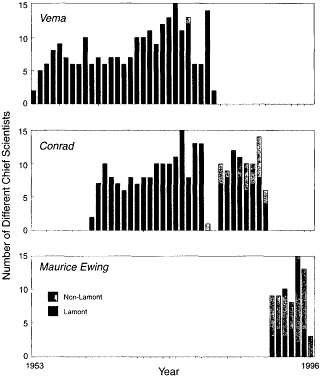
FIGURE 7 Comparison of the number of different chief scientists from Lamont versus other institutions sailing on Lamont's research ships. The establishment of UNOLS went a long way towards opening up access to ship time to researchers from nonoceanographic institutions. Data from Woods Hole and Scripps, although not as easily interpreted in terms of trends in MG&G, show that this changeover in institutional affiliation of the chief scientists happened somewhat earlier outside of Lamont.
This change was inevitable and brought a much larger talent pool to the table to compete for funding and ship time. The system became more open and more accountable. Cruises were more carefully planned, and no funds were wasted taking observations unnecessary to test the hypothesis at hand. But much was lost along the way as well. Without omnibus grants in the hands of the leaders of oceanographic institutions, there was no opportunity to put together larger projects that cut across disciplines by a few people with great vision. With less institutional funding, there was no incentive to work with colleagues at one's own institution as opposed to those across the country. The institutions became less cohesive. Since researchers from one oceanographic institution were likely to be scheduled for ship time on another institution's vessel, less attention was paid to maintaining and improving the home institution's assets. "Expeditions" became a string of unrelated legs with completely different science parties and objectives. With more PIs competing for the funding pool, the success rate dropped, such that researchers were writing more proposals to raise the same amount of research funds. The sharp curtailment of ONR support for MG&G that occurred soon after only made matters worse.
To some extent, this changeover in the support pattern in MG&G happened at a fortunate time. The reconnaissance sampling of the geology and geophysics of the oceans had already been completed, and it was time for more focused hypothesis testing in targeted areas, the type of research for which NSF funding is ideally suited. I wonder whether the same was true for the other oceanography disciplines, for which the critical observations were not as routinely measured or as easily archived during the early days of wideopen ocean exploration as they were for MG&G.
The Growth of Special Initiatives
I view the growth of special initiatives in MG&G as an attempt to allow for the earlier type of coordinated planning in spite of the system that predominantly funded a single PI or small group of PIs for one month of ship time to address one problem. Initiatives such as the Ridge Inter-Disciplinary Global Experiments (RIDGE), provided a mechanism to tackle bigger science questions in a systematic way, while still maintaining the openness of the system and the advantages of peer review. This initiative has been immensely successful by any measure, integrating mid-ocean-ridge-related research throughout the oceans and across the disciplines of geology, geophysics, chemistry, and biology. The down side is that RIDGE has been so very successful in terms of discoveries and in capturing the attention of the community that it is in danger of reducing the breadth in interests for the RIDGE generation of students. I recall spending summers at Woods Hole when it was difficult to find a seminar that was not RIDGE-related or a graduate student that was not working on a RIDGE problem. Special initiatives are a
superb mechanism for enabling research larger than that supported by a single grant, but they should not be allowed to dominate the field. (RIDGE-related research accounts for all of the targeted funds in the special program and competes successfully for about 35 percent of the core funds.) Nor should they continue for so long that several generations of students learn of nothing else.
Special initiatives have provided a forum for planning larger research programs that has replaced the internal planning that used to occur within the confines of the oceanographic institutions. The big difference is that we all must spend endless hours on airplanes instead of wandering down the hall. Of course, planning was not as extensive in those days as it appears to be today. Denny Hayes recalls having been chief scientist on the Vema in 1968 for support of the deep-sea drilling leg to date the basal sediments along the South Atlantic profile to be drilled on Leg 3. The site survey was being accomplished, literally, a few days ahead of the drilling. At one point, Denny jumped from Vema into a Zodiac with rolled seismic records under his arm to deliver the data (and I believe some whiskey) to the Glomar Challenger. Dick Von Herzen, co-chief scientist on the drill ship, recalls happily taking delivery of the data and whiskey, and reciprocating with some beef—high seas barter in the far South Atlantic. These days, planning is so extensive, time-consuming, and exhaustive that it has led one jaded investigator on soft money to remark, "It is cheaper for NSF to pay us to plan than to pay us to do science."
EPILOGUE
When I was asked to review the history of marine geology and geophysics from the perspective of NSF sponsorship, I firmly believed that I would end up regretting the assignment. It was sure to be a time-consuming task with low prospects for gaining personal or professional satisfaction from the result. However, as I became more involved in putting together my notes for this paper, my view took an about-face. I came to realize that as the director of the only oceanographic institution in the nation that can still set its own ship schedule, determine its own research priorities, and commit itself to high-risk, long lead time, interdisciplinary research, it is essential that I understand what sort of science the NSF and the ONR of the 1950s and 1960s were best suited to accomplish, as contrasted with the type of science that succeeds today and indeed during the entire tenure of my own research career. The Monterey Bay Aquarium Research Institute must go after the problems that go beyond what can be addressed by the individual investigator with a three-year grant and one month of ship time. We should seek out those vaguely defined areas of ocean science still in search of a fundamental paradigm on which to base testable hypotheses. And we should work to develop those research tools that no one else is so bold to propose for seagoing research.
ACKNOWLEDGMENTS
I am indebted to a large number of colleagues who shared with me their memories and their institutional archives. In particular, material in this report reflects information gleaned from Bob Arko, Jim Cochran, Bill Curry, Deborah Day, R.L. Fischer, Denny Hayes, Jim Hays, Charlie Hollister, Ken Johnson, Garry Karner, Walter Munk, John Mutter, John Orcutt, Mike Reeve, George and Betty Shor, Stu Smith, Fred Spiess, Scott Tilden, Dick Von Herzen, and Jeff Weissel. Thank you all for your time, your generosity, and your insights.
REFERENCES
Bush, V. 1945. Science-The Endless Frontier. A Report to the President on a Program for Postwar Scientific Research. U.S. Office of Scientific Research and Development, Government Printing Office, Washington, D.C.
Climate Long-range Investigation, Mapping and Prediction (CLIMAP) Project Members. 1976. The Surface of the Ice Aged Earth. Science 191:1131.
Cox, A., R.R. Duell, and G.B. Dalrymple. 1964. Reversals of the Earth's magnetic field. Science 144:1537-1543.
Hays, J.D., J. Imbrie, and N.J. Shackleton. 1976. Variations in the Earth's orbit: Pacemaker of the ice ages. Science 194:1121-1132.
Heirtzler, J.R., G.O. Dickenson, E.M. Herron, W.C. Pitman III, and X. Le Pichon. 1968. Marine magnetic anomalies, geomagnetic field reversals, and motions of the ocean floor and continents. J. Geophys. Res. 73:2119-2136.
Isacks, B.L., J. Oliver, and L. Sykes. 1968. Seismology and the new global tectonics. J. Geophys. Res. 73:5855-5899.
Menard, H.W. 1986. The Ocean of Truth. Princeton University Press, Princeton, New Jersey.
National Academy of Sciences (NAS). 1929. Oceanography: Its Scope, Problems, and Economic Importance. Houghton Mifflin Company, Boston.
Mukerji, C. 1989. A Fragile Power: Scientists and the State. Princeton University Press, Princeton, New Jersey.
Shackleton, N.J., and N.D. Opdyke. 1973. Oxygen isctope and palaoemagnetic stratigraphy of equatorial Pacific core V28-238: Oxygen isotope temperatures and ice volumes on a 105 year and 106 year scale. Quaternary Research 3:39-55.
Shor, E.N. 1978. Scripps Institution of Oceanography: Probing the Oceans 1936 to 1976. Tofua Press, San Diego, Calif.
Wertenbaker, W. 1974. The Floor of the Sea: Maurice; Ewing and the Search to Understand the Earth. Little, Brown, and Co., Boston, Massachusetts.


