
4
Processing Technologies
PROGRAM OBJECTIVES AND OVERVIEW
Current R&D on processing technologies is focused on improving the conversion of low-value biomass feedstocks to ethanol. According to the Bioethanol Strategic Roadmap, NREL's primary guide for the development of its conversion goals were set by the anticipated needs of the marketplace (NREL, 1998). Based on the assumptions that ethanol tax incentives will expire after 2007 and that petroleum prices will remain relatively flat until 2010, NREL estimates expected cost reductions of nearly 66 cents per gallon by 2010 (OFD, 1998). NREL believes that, with improvements in pretreatment and enzyme-based hydrolysis, bioethanol would be competitive in the marketplace at that price without tax incentives. NREL identified two critical breakthrough technologies necessary to reduce costs: (1) increasing the specific activity of cellulase enzymes and (2) increasing the temperature of the fermentation step. Beyond 2010, NREL will seek further cost reductions through genetic improvements in feedstocks (Wooley et al., 1999).
OFD also supports R&D in the following areas to reduce the costs of producing bioethanol:
-
the development of a countercurrent reactor for the pretreatment of biomass
-
methods for processing lignin residues for new higher value products
-
the integration of all unit operations
-
the evaluation and optimization of process configurations
BACK TO FUNDAMENTALS
A primary aspect of OFD's conversion-technology development plan is supporting the near-term development of a bioethanol industry. In accordance with congressional mandates, OFD provides some funding support for bioethanol conversion at Arkenol, Inc. (Sacramento, California), BC International (Jennings, Louisiana), and Masada Resources (Orange County, New York). All of these plants use locally available feedstocks, such as crop residues (e.g., corn stover or rice straw) or municipal solid wastes, for cellulose-to-ethanol conversion. These facilities all use both currently available, well demonstrated technologies and some new technologies, notably new recombinant organisms to ferment both five-carbon and six-carbon sugars to ethanol. The knowledge and experience gained from these commercialization projects should provide valuable information for future commercialization.
NREL's modeling analyses indicate that significant reductions in the cost of ethanol manufacturing were made during the 1980s. However, the committee's analysis indicates that cost reductions have leveled off since 1991 (see Figure 2-1). The committee is concerned that some of the processing technologies currently in the NREL program have reached their inherent limitations and that, even though incremental improvements may be achievable, much less expensive and more effective alternatives should replace these technologies.
In addition to OFD's program, a broad range of innovative research is being done outside of DOE that could improve bioethanol conversion technologies. Researchers have already identified several opportunities for improving cellulosic-to-ethanol conversion and lowering manufacturing costs in the following research areas (Himmel et al., 1997; Lynd, 1996; Lynd et al., 1996; Wyman, 1999):
-
advanced pretreatments to increase sugar yields and reduce sugar degradation
-
improved cellulase and hemicellulose enzymes
-
consolidated bioprocessing of hydrolysis and fermentation
-
product diversification including coproduction of nonfuel products (e.g., organic chemicals and biobased materials) with bioethanol
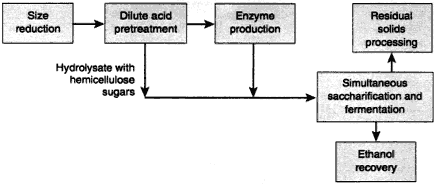
FIGURE 4-1 Schematic diagram of the conversion of biomass feedstock to ethanol fuel. Source: NREL, 1998.
A better fundamental understanding of underlying phenomena in all of these technology areas will be crucial to the development of innovative approaches to reducing costs.
An understanding of the fundamental mechanisms underlying pretreatment, cellulose and hemicellulose hydrolysis, and consolidated processing can lead to insights on the areas that have the greatest potential for improvement through R&D. As the knowledge base grows, researchers will be able to develop meaningful comparisons among technologies and investigate the effects of changes in key performance parameters on process economics. Approaches to innovation that rely largely on trial and error are inefficient, risky, and less likely to support scale-up and commercialization by industry. Investment in basic R&D will be key to identifying technical opportunities to lower the costs of manufacturing cellulosic bioethanol.
IMPROVING CONVERSION
The ethanol manufacturing process that has been most thoroughly investigated by NREL is shown in Figure 4-1. Biomass is ground to an appropriate size and treated with dilute sulfuric acid to convert most of the hemicellulose to soluble pentose sugars, which are then separated from the feedstock material. The remaining plant material (mostly cellulose and lignin) is then hydrolyzed with enzymes. The resulting sugar solutions (glucose, xylose, arabinose, galactose, and mannose) are combined and fermented to produce ethanol, which is then distilled. Residual solids in the distillation mixture are burned to provide process steam and excess electricity, which is sold into the electric grid.
In the current NREL process, cellulase hydrolysis and fermentation take place simultaneously in the same vessel, a procedure referred to as SSF (simultaneous saccharification and fermentation). A portion of the biomass is also diverted to a separate fermentation step in which the enyzmes for cellulose hydrolysis are produced. Although a wide variety of types of cellulosic biomass are referred to in the literature, most laboratory and pilot-plant work to date has been focused on hardwoods (primarily poplar species). Apparently little experimental work has been done on grasses, such as switchgrass, or crop residues, such as corn stover.
The current conversion process makes use of technologies that have largely been developed in house at NREL. One technology, notably the acid hydrolyis/pretreatment, has remained essentially unchanged for almost 20 years (Lynd, 1996; NREL, 1998). Because processing downstream of the pretreatment step is greatly affected by the characteristics of the pretreated material and the hydrolyzed sugar solutions, innovation in downstream processing has also been limited.
Research on pretreatment has been underfunded relative to the high cost of this processing step and its significant effects on the costs of subsequent hydrolysis and fermentation steps (Lynd, 1996). Although large increases for research on pretreatment for fiscal year 2000 have been requested, the committee believes OFD should consider using pretreatment technologies under development elsewhere to improve bioethanol manufacturing processes.
Diverse pretreatment processes under evaluation may have the potential to unlock vast reserves of cellulosic biomass (NRC, 1999c). The most thoroughly researched pretreatment processes are dilute acid hydrolysis, steam explosion, ammonia fiber explosion, and treatment with organic solvents (Lynd, 1996). Less is known about liquid hot water pretreatment (van Walsum et al., 1996), and none of these pretreatments is currently a commercial success (NRC, 1999c). Lynd (1996) has established some criteria for determining the ideal pretreatment: produces reactive fiber; yields penroses in nondegraded form; does not significantly inhibit fermentation; requires little or no size reduction; can work in reactors of reasonable size and moderate cost; produces no solid residues; has a high degree of simplicity; and is effective at low moisture contents. This committee agrees with Lynd's assessment that the dilute acid hydrolysis process
used by NREL does not meet these criteria, nor does steam explosion. Lynd suggests that other processes, such as liquid hot water and ammonia fiber explosion, merit further evaluation. Because improvement in performance of pretreatment technology is intimately associated with fermentation and enzyme production steps, leap-forward advances in pretreatment will require that NREL focus on the best available technologies, keeping in mind basic process design.
OFD recognizes that investing in research on enzymatic processes will be critical to improving the efficiency of the bioethanol process in the long term. The strategic plan for the next five years emphasizes two key activities: (1) developing more active cellulase enzymes that can operate at higher temperatures and (2) developing microbes capable of fermenting a broad range of sugars at relatively high temperatures (OFD, 1998). The ideal microorganism or system of organisms for producing ethanol from cellulosic biomass in a process featuring enzymatically mediated hydrolysis would simultaneously exhibit the following properties: (1) synthesis of an active cellulase enzyme system at high levels; (2) fermentation and growth on sugars from both cellulose and hemicellulose; and (3) production of ethanol. Many organisms under evaluation have either an inability to use a range of carbohydrates (e.g., cellulose, xylan) and simultaneously produce ethanol at high yields, or differing requirements for oxygen for various functions essential to the process (Lynd, 1996).
Although the committee agrees that cellulase enzymes are a key component of bioethanol research, hemicellulose enzymes have the potential to unlock additional sources of sugars for fermentation. NREL currently has little R&D on hemicellulose enzymes, which can hydrolyze the hemicellulose fraction of biomass. Another outside panel of experts from industry and academia has recommended that NREL consider this area of research, which could lead to additional sources of sugars for further processing (Glassner, 1998). It should be noted that Iogen and other private-sector companies have made substantial investments in R&D on enzymatic hydrolytic processing and that these cellulase technologies are potentially lower in cost than those under development at NREL (Foody, 1999).
Given that cellulase enzymes can be inhibited by the sugars they produce, private-sector research has focused on increasing the consumption of these sugars by fermentative organisms as the sugars are produced, and significant progress has been made in this area. The logical extension of this work is called "consolidated bioprocessing" and refers to the production of enzymes by the fermentation organism (or by another organism in the vessel with the fermentation organism) (Hogsett et al., 1992; Lynd, 1996). Consolidated bioprocessing reduces biological inhibition and increases reaction rates.
The committee recognizes that various approaches to processing are possible and that improvements in pretreatment and enzymatic hydrolysis can significantly reduce the overall costs of manufacturing bioethanol (see Figure 1-1). The impact of specific technologies currently under development on overall performance and cost cannot be determined, however, because the relationships among these processing steps are not completely understood. Thus, improvements in the basic process design, as well as improvements in pretreatment, enzymatic technologies, and fermentation organisms, will be essential to reducing the costs of bioethanol.
OPPORTUNITIES FOR COPRODUCTS
Early in this century, the petroleum refining industry focused on producing kerosene and took in little revenue from other products. At that time, gasoline was essentially a waste product. Over time, however, much more complex oil refineries evolved with a very large product slate, including products with a much greater profit margin. OFD's analysis of the costs of petroleum refining and the profitability of gasoline indicates the advantages of a process that can produce coproducts along with ethanol fuel. A plant that manufactures valuable coproducts will probably be more profitable than one that manufactures only ethanol. Although the sources of biomass are diverse, most plant-derived biomass contains the following components: cellulose, hemicellulose, lignin, oil, starch, and protein. In addition, some biomass components, such as protein, do not lend themselves to fuel but could be an important and valuable source of income for a bioethanol plant.
Biorefineries that can produce high-value as well as low-value products will be more competitive with oil refineries. Biorefineries that can produce a variety of products will not only benefit from increased profitability from the higher margin products but will also benefit from their ability to change their product mix in response to changing demands. In fact, corn wet mills, a prototype biorefinery, already produce many products, and the number of products they produce is growing. NREL, however, has focused only on the fermentation of ethanol and coproducing electricity by burning residual solids.
The Bioenergy Initiative will focus on increasing the potential for the coproduction of ethanol fuels, organic chemicals, and electricity from biomass. The initiative will be a collaboration among the DOE offices engaged in biomass-related activities.1 The committee encourages DOE to extend these partnerships to other agencies, such as USDA, to promote research on coproducts of bioethanol manufacturing.
The OFD believes that the abundance of corn stover and grass feedstocks and the ease of converting these sources of
biomass to ethanol (compared to converting woody biomass) should facilitate the commercial introduction of this technology (Hettenhaus and Glassner, 1997). Accurate material balances on corn stover and candidate grasses will be crucial to ensuring that all components of these materials, including nonfuel components, are used effectively. Corn stover is an underutilized resource, and if its collection and distribution can be expedited and some conservation issues addressed, the conversion of corn stover (and other agricultural residues) in countries with large agricultural sectors could become feasible. The role of OFD in these international projects will have to be evaluated in terms of U.S. domestic objectives, but this could be a fruitful area for research.
BIODIESEL
Interest in biodiesel in the United States has been focused on soybean oil as the primary feedstock because of its abundance and relatively low cost among vegetable oils. Most European biodiesel is made from rapeseed oil, a cousin of canola oil (Tyson, 1998). Biodiesel can also be prepared from spent cooking oil and other waste fats, which are less expensive than soybean oil but of variable composition and limited availability. Biodiesel is prepared by transesterifying the oil to the fatty ester and glycerol (a by-product). Transesterification is necessary to convert the triglyceride, which has undesirable flow and combustion properties, into an acceptable motor fuel.
In Europe, the European Union subsidizes farmers growing oilseed crops. Without this subsidy, rapeseed-based biodiesel would not be competitive in the marketplace. Researchers have attempted to extract biodiesel directly from oilseed crops to eliminate the expensive transesterification process. However, biodiesel in this form has poor performance characteristics when used in current diesel engines (NRC, 1999c).
In an efficient crushing operation, a bushel of soybeans can produce 47.5 pounds of meal and 11.1 pounds of oil. Meal, oil, and bean prices are all related and are all influenced by the global demand for food oil and protein. At the time of this writing, soybean oil prices were at a historic low of $0.215 per pound. One gallon of biodiesel requires approximately seven pounds of soybean oil. Thus, even at this time, the cost of raw material alone for biodiesel would be more than $1.50 per gallon. Therefore, even if processing costs were minimal, the potential for reducing costs enough to make an economically viable fuel are also minimal.
Congress has enacted some legislation to meet environmental concerns by establishing niche markets for biodiesel, but no further infusion of OFD funds is needed to support this project. If an oil-producing species emerges with a potential for widespread agricultural production at substantially lower cost than soybean oil, OFD could reconsider its involvement in the development of biodiesel fuels.
CONCLUSIONS
Conclusion.
Technologies will have to be greatly improved for the emerging bioethanol industry to survive without subsidies. A broad range of innovative research is being done outside of the U.S. Department of Energy that could improve bioethanol conversion technologies.
Conclusion.
The committee is concerned that some of the processing technologies currently in the Office of Fuels Development program have reached their inherent limitations and that, even though incremental improvements may be achievable, much less expensive and more effective alternatives should replace these technologies.
Conclusion.
The new bioethanol industry would benefit from a more thorough fundamental understanding of key processes and feedstock technologies.
Conclusion.
Reducing the cost of biodiesel will be extremely difficult because of high feedstock costs.
RECOMMENDATIONS
Recommendation.
To reduce the cost and increase the competitiveness of bioethanol with other energy sources in the near term (2000-2010) and midterm (2010-2020), the Office of Fuels Development should redirect the focus of its research and development programs away from demonstrations of specific technologies to fundamental research that supports new technologies in both feedstock development and ethanol conversion. Continued technical support should be provided to the demonstration plants now in place to test and evaluate the results of this fundamental research and development. As industrial firms commercialize lower cost technologies, the role of the Office of Fuels Development in biofuels research should be refocused on fundamental and exploratory research directed toward overcoming the remaining technical barriers.
Recommendation.
The Office of Fuels Development should focus on fundamental research in the following areas for reducing the costs of manufacturing bioethanol: (1) advanced pretreatments; (2) consolidated bioprocessing; (3) digestive enzyme activity; (4) the development of diversified products and coproducts during biomass processing or via plant metabolism; (5) reductions in the cost of raw materials via improved yields or the development of pest-resistant or stress-resistant plants; and (6) changes in feedstocks to make processing and conversion more efficient by modifying plant biochemistry.
In the long term, the new bioethanol industry will benefit most from a comprehensive understanding of fundamental biological and engineering principles that could be provided
by a refocused federal research program. For example, rather than trying to expand the limits of native organisms, the Office of Fuels Development research program could investigate the underlying mechanisms of these limits in nature through genomics and other fundamental studies. Armed with a fundamental understanding of natural limitations, companies would be in a better position to undertake their own applied development programs.
Recommendation.
The Office of Fuels Development should return to its traditional role of providing a technical basis for future commercial ventures. Advancing the technology base will help new processing plants improve their competitive position and pave the way for the next generation of processing plants.
Recommendation.
The Office of Fuels Development should support and encourage, perhaps by interagency cooperation with the U.S. Department of Agriculture and other federal agencies, work on coproducts of bioethanol manufacturing.
Recommendation.
Because of a lack of any foreseeable opportunity for reducing the production costs of biodiesel, the Office of Fuels Development should consider eliminating its biodiesel program and redirecting those funds into the bioethanol program.


