
2
Adolescence: A Time of Opportunity and Risk
The demographic profile of the adolescent population has changed dramatically during the past few decades, and these changes are expected to continue well into the 21st century. Following a steady decline since the mid-1970s, the number of adolescents in the United States began to increase in the 1990s. In 1993, there were close to 36 million (35,807,000) adolescents, ages 10 to 19, representing nearly 14 percent of the population. This increase is expected to continue until the year 2020, gradually leveling off between the years 2020 and 2050 (Figure 2-1). Until recently, more of the adolescent population consisted of younger people: 52 percent (18,529,000) between ages 10 and 14, compared with 48 percent (17,278,000) between ages 15 and 19. As of 1990, however, this pattern was reversed: 49 percent of adolescents between ages 10 and 14 and 51 percent between ages 15 and 19. This trend is also likely to continue into the 21st century, and increasingly researchers, service providers, and policy makers are arguing that the age frame that defines adolescence should include youth up to age 24. In terms of this new definition, a very different profile emerges with respect to future population projections: the adolescent and young adult population will continue to increase well beyond the year 2050 (Figure 2-1).
In addition, the increasing racial and ethnic diversity in the general population of the United States has resulted in increasing proportions of adolescents belonging to racial and ethnic minority groups. Although 74 percent of all children in the United States in 1980 were white, this propor-
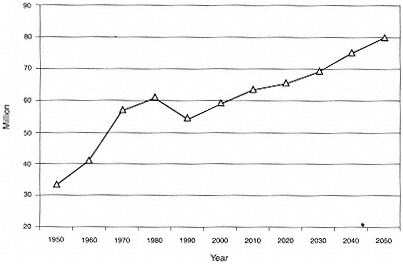
FIGURE 2-1 Number of youth ages 10–24 selected years, 1950–1990, and projected, 2000–2050. SOURCE: Data from Bureau of the Census (1965, 1974, 1982, 1996, 1999).
tion has steadily decreased ever since and is projected to continue to have a downward trend through the year 2050 (Figure 2-2). In 1993, more than one-third of the population of adolescents ages 10 to 19 were Hispanic or nonwhite. Black children were the largest minority population prior to 1997, but now their numbers are slightly superseded by Hispanic children (each making up about 15 percent of the total child population). The U.S. Bureau of Census is estimating that by the year 2020, more than one in five U.S. children will be Hispanic. The Asian population will also continue its rapid increase, from 4 to 6 percent by the year 2020. This rapid rise in racial and ethnic diversity in the United States is expected to continue through the coming decades.
THE DEVELOPING ADOLESCENT
Adolescence is one of the most fascinating and complex transitions in the life span: a time of accelerated growth and change, second only to infancy; a time of expanding horizons, self-discovery, and emerging independence; a time of metamorphosis from childhood to adulthood. Its begin-
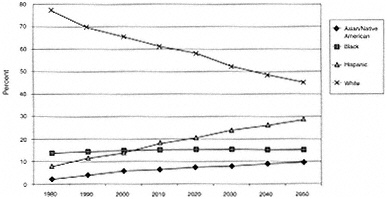
FIGURE 2-2 Percentage distribution of children ages 10–24 in the United States selected years, 1980–1990, and projected 2000–2050. SOURCE: Data from Bureau of the Census (1965, 1974, 1982, 1996, 1999).
ning is associated with biological, physical, behavioral, and social transformations that roughly correspond to the move from elementary school to middle or junior high school. The events of this crucial formative phase can shape an individual's life course—and, by extension, an entire society.
In the United States, the period called adolescence is considered to extend over many years, so it can be usefully subdivided into three developmental phases. Early adolescence encompasses the biological changes of puberty as well as sexual and psychological awakenings, extending roughly from ages 10 through 14. Middle adolescence is a time of increased autonomy and experimentation, covering ages 15 to 17. Late adolescence, for those who delay their entry into adult roles because of educational or social factors, can stretch from age 18 into the early 20s. Each phase has a unique set of developmental challenges, opportunities, and risks.
Puberty is often used to define the onset of early adolescence. Triggered by preprogrammed events in the brain, the pituitary gland products hormones that in turn stimulate the secretion of sex hormones. These hormones have powerful effects on many tissues of the body, including the brain, and lead to significant changes in social, emotional, and sexual behavior. Although the biology of puberty has remained essentially the same for many generations, the social context in which these biological events
occur has changed dramatically. Institutionalization, urbanization, technological advances, geographic mobility, and cultural diversity have radically transformed the world, and the interaction between biology and this new environment has fundamentally altered the circumstances of growing up as an adolescent in the United States.
Over the past two decades, the research base in the field of adolescent development has undergone a growth spurt, and knowledge has expanded significantly. New studies have allowed more complex views of the multiple dimensions of adolescence, fresh insights into the process and timing of puberty, and new perspectives on the behaviors associated with the second decade of life. At the same time, the field's underlying theoretical assumptions have changed and matured.
For much of this century, scientists and scholars tended to assume that the changes associated with adolescence were almost entirely dictated by biological influences. It has been viewed as a time of storm and stress, best contained or passed through as quickly as possible. Adolescence, a 1904 book by G. Stanley Hall, typified this standpoint. It was Hall who popularized the notion that adolescence is inevitably a time of psychological and emotional turmoil. Half a century later, psychoanalytic writers including Anna Freud accepted and augmented Hall's emphasis on turmoil. Even today, ''raging hormones" continue to be a popular explanation for the lability, aggression, and sexual activity associated with adolescence. Intense conflict between adolescents and their parents is often considered an unavoidable consequence of adolescence. However, this assumption has not been supported by scientific evidence. The assumption that turmoil and conflict are inevitable consequences of the teenage years may even have prevented some adolescents from receiving the support and services they needed.
Research is now creating a more realistic view of adolescence. Adolescence continues to be seen as a period of time encompassing difficult developmental challenges, but there is wider recognition that biology is only one factor that affects young people's development, adjustment, and behavior. There is mounting evidence to suggest that the adolescent years need not be troubled ones. There is now greater recognition that most young people move through the adolescent years without experiencing great trauma or getting into serious trouble. Although adolescence can certainly be a challenging span of years, individuals negotiate it with varying degrees of difficulty, just as they do other periods of life. Moreover, when problems do arise during adolescence, they should not be considered "normal"—i.e.,
that the adolescent will grow out of them—nor should they be ignored. Indeed, parents, teachers, members of the community, service providers, and social institutions can both promote healthy development among adolescents and intervene effectively when problems do arise.
There is also a growing recognition that only a segment of the adolescent population is at high risk for experiencing serious problems. Over the past 50 years, studies conducted in North America and Europe have documented that only about a quarter of the adolescent population is at high risk for, or especially vulnerable to, experiencing psychological problems and poor developmental outcomes, such as academic failure and school dropout, alcohol and other drug abuse, delinquency and problems with the law, and violence. These adolescents are not believed to be at increased risk because of biological or hormonal changes associated with puberty, but rather from a complex interaction among biological, environmental, and social factors. Indeed, there is mounting evidence that most biological changes interact with a wide range of contextual, psychological, social, and environmental factors that affect behavior.
Adolescence is frequently described as a time of increased risk-taking. This is in part due to the fact that adolescence is developmentally a time when teenagers begin to experiment with tobacco, alcohol, and other drugs and initiate sexual intercourse (as many as two-thirds reporting initiating sexual intercourse before graduating from high school). It is also because the outcomes associated with some of these behaviors can be so disastrous: the rates of many sexually transmitted diseases are highest during the adolescent and young adult years; many adolescents experience unintended pregnancies, which can significantly affect their life course and limit future opportunities; a disproportionately high number of automobile accidents occurs among teenagers, and typically alcohol is involved; and violence has increased to the point that homicide is the second leading cause of death among young people.
As children develop into adolescents, they gain greater autonomy and are exposed to a greater variety of adults and peers. They therefore begin to have more opportunities to make choices about who they will spend time with and how they will behave.
Adolescents' involvement in risk-taking behaviors has been explained in a number of ways. Some teenagers tend to be especially high in sensation-seeking, while others use these behaviors to appear more mature or because of heightened egocentrism. Increasingly, researchers attribute these behaviors to a combination of individual, social, and environmental fac-
tors. One of the factors that has received much less attention in recent years is adolescent decision making. In fact, most research conducted on decision-making processes has been carried out with adults.
Decision making involves not only recognizing consequences, but also determining the likelihood that a consequence will occur. Adolescents' involvement in risky behaviors has often been attributed to their thinking of themselves as invulnerable—as thinking that bad consequences will not happen to them. Research now shows that adolescents are no more likely than adults to see themselves as invulnerable. That is not to say that adults do a good job of estimating probabilities of the likelihood of their experiencing negative consequences. Numerous studies have found that adults tend to see themselves as less likely than others to experience negative outcomes and more likely to experience positive ones. Young people favor their own experience and anecdotal evidence over probabilistic information in making decisions, particularly about social situations, as do adults. Adolescents also make important decisions under a set of circumstances in which we know adults have difficulty: unfamiliar tasks, choices with uncertain outcomes, and ambiguous situations.
Adolescents' social cognition—the way they think about their social world, the people they interact with, and the groups they participate in—differs from that of adults and influences their decision-making skills.
Emotions affect how people think and behave and influence the information they attend to. When people are experiencing positive emotions, they tend to underestimate the likelihood of negative consequences to their actions; when they are experiencing negative emotions, they tend to focus on the near term and lose sight of the big picture. Both adolescents' and adults' decision-making abilities are influenced by emotions. However, there is evidence that adolescents experience more intense emotions than adults, which suggests that they may process information differently and therefore make different decisions than adults do.
SOCIAL CONTEXT IN WHICH ADOLESCENTS DEVELOP
One of the important insights to emerge from scientific inquiry into adolescence in the past two decades is that problem behaviors, as well as health-enhancing ones, tend to cluster in the same individual, and these behaviors tend to reinforce one another. Crime, dropping out of school, teenage pregnancy and childbearing, and drug abuse typically are consid-
ered separately, but in the real world they often occur together. Teenagers who drink and smoke are more likely to initiate sex earlier than their peers; those who engage in these behavior patterns often have a history of difficulties in school. The fact that the health-enhancing behaviors cluster together suggests that families, schools, and other social institutions have an important opportunity to foster healthy lifestyles during adolescence by addressing common roots of both positive and negative behaviors.
Another important insight of scientific inquiry is the profound influence of settings on adolescents' behavior and development. Until recently, research conducted to understand adolescent behavior, particularly risk-related behaviors, focused on the individual characteristics of teenagers and their families. A 1993 National Research Council study took a critical look at how families, communities, and other institutions are serving the needs of youth in the United States. This study concluded that adolescents depend not only on their families, but also on the neighborhoods in which they live, the schools that they attend, the health care system, and the workplace from which they learn a wide range of important skills. If sufficiently enriched, all of these settings and social institutions in concert can help teenagers successfully make the transition from childhood to adulthood.
Yet the unfortunate reality is that in the United States, these settings and social institutions are under severe stress. It is now not unusual for families to be headed either by a single mother or by two wage earners, and as much as 40 percent of young adolescents' time is unstructured, unsupervised, and consequently unproductive; much of this time occurs during the after-school hours when adolescents are frequently alone, watching television. Neighborhoods and communities—particularly inner-city, poor neighborhoods—are also increasingly less able to provide resources and services to youth, and school systems are often not organized to provide opportunities to learn and grow during the after-school hours.
In the past few decades, researchers have started to examine why some adolescents in low-income communities successfully navigate environmental challenges, while others, similarly situated, adopt lifestyles characterized by drug use, unprotected sexual behavior, dropping out of school, delinquency, gang membership, and violence. Researchers have also sought to identify not only risk factors that may be associated with these problems, but also patterns of resilience that protect teens and encourage them to succeed. This research has emphasized the need to examine the "whole" youth—a concept that describes the assets as well as the deficits of individual adolescents—rather than isolating selected problem behaviors asso-
ciated with adolescents in difficult circumstances. This research has also attempted to take a broader view of development by not focusing on each critical developmental stage in isolation from one another but rather to look at development across the life span—from early childhood to the middle childhood years, adolescence, and adulthood. This is largely because of the growing literature that suggests that problems experienced later in life are typically foreshadowed by problems that occurred earlier in life.
Although this focus on the whole youth has been applauded, much more work needs to be done before the picture is clear about which combination of factors, influences, contexts, and interventions will ultimately ensure the healthy development of children and adolescents.
CHANGES IN U.S. FAMILIES
Years of research have shown that adolescents are most likely to develop into healthy, happy, and productive adults when they are supported by a caring family. Such a positive environment is characterized by nurturing and mutual respect and by the serious and sustained interest of parents in the lives of their adolescent children.
Contrary to popular belief, adolescence is a time when many young people continue to need more parental attention. They need guidance and close supervision. They need a parent or other responsible adult to listen and respond to them as they shape their ideas. They need help with setting goals. And they still need to be taught ethical behavior and the appropriate ways of handling conflict with others. Parents who offer this type of support to their adolescent children can provide powerful protection against the possibility that they may engage in unhealthy practices, become socially isolated, or become troubled or depressed.
Today, adolescents are growing up in families that are diverse with respect to their size, shape, and structure. From families characterized as traditional with two parents and a stay-at-home mother, which was typical in the 1950s and 1960s, to the dual-career families and stepfamilies that gained in prominence in the late 1980s and 1990s, today there is no typical or normative family setting in which adolescents grow and develop.
In addition, changing societal and economic factors have threatened the stability of many families in today's society. Many of these changes have occurred during the past 30 years, including increased rates of divorce, increases in the number of single parents, increases in the rate of mothers'
employment, and increases in the proportion of families living in poverty. For example, by the early 1990s, nearly half of all marriages ended in divorce, a rate twice that of 1960, and about a quarter of all births were to unmarried women. The net result has been that nearly 25 percent of all children live with only one parent, usually the mother, a rate double that of 1970. Overall, about 50 percent of all children today will reside in a single-parent home before age 18, spending an average of 6 years with a single parent. These changes have transformed the nature of family life, as well as the experiences of adolescents.
Although there has been less research than the issue deserves, many argue that the time that American children spend with their parents has decreased significantly during the past few decades. Under the best of circumstances, raising a child is a difficult experience, but during this past decade, as more families are defined as dual-income and single-parent households, parent spend on average 11 fewer hours with their children each week compared with parents in 1960. In addition, less than 5 percent of all families have another adult (such as a grandparent) living in the home, compared with 50 percent two generations ago. This reduces the backup support that might otherwise be available to working parents. It is also a commonly held belief that as parents spend less time with their children, they have less time available to provide guidance and supervision, and fewer opportunities to instill values. More research is needed, however, to determine if in fact it is true that parents are spending less time with their teens, and what impact this has on the safety, security, and well-being of today's adolescents.
One of the most profound changes in the past few decades is the increased proportion of adolescents living in or near poverty. Patterns in family structure are associated with differential economic status, with households headed by two parents reporting significantly higher incomes than those headed by single parents. In 1993, the median household income for adolescents (ages 12 to 17) living with one parent was $38,935,18 percent lower than that for adolescents living with both parents. Twice as many one-parent families lived below the poverty line (16.8 percent compared with 8.4 percent for two-parent families). This disparity is more dramatic for one-parent households headed by women: the median family income for adolescents in these settings was $15,837, and 42 percent lived below the poverty line. Female-headed households experience greater poverty due to a variety of factors, including pay inequities faced by women and lack of paternal financial support.
Among the many factors that influence adolescents' health, development, and well-being, perhaps the most powerful is family income. Decisions about housing, neighborhoods, schools, and social opportunities for adolescents are largely controlled by income. A family's income and employment status also strongly influence its access to health care services and the quality of those services. Opportunities for advanced education and training and entry into the workforce are also closely linked to family income. On a more fundamental level, income is a powerful influence in shaping the most important of settings, the family itself. There is evidence that economic hardship—whether from low wages, sustained poverty, or unemployment—significantly diminishes the emotional well-being of parents, with direct and indirect effects on their children's health and well-being. Thus, the decline in economic security of young families has had important and far-reaching consequences for many children and adolescents.
Divorce has added an even more challenging dimension to the problems of today's families. Children from divorced families must confront the emotional stress of a breakup—the often prolonged time preceding and subsequent to divorce proceedings—in addition to conditions associated with single parenthood. Many of these children experience elevated levels of depression and anger and declining school performance and self-esteem. Children of divorce experience a range of stresses of greater magnitude than children in two-parent households, and these stresses are directly associated with adolescents' involvement in behaviors that may be associated with poor developmental outcomes. Adolescents who experienced divorce at an early age may be at particularly high risk of school failure and problems with emotional adjustment.
When custodial parents remarry, children often experience another stressful transition, which appears to be especially difficult for adolescent girls. This effect is diminished, however, when separated parents maintain collegial relations and engage in cooperative parenting.
While it is certainly not the case that all adolescents growing up in poor or divorced families are destined to problems and failure, there is an extensive literature that suggests that adolescents living in families experiencing economic hardship, divorce, or both are at increased risk for a range of health and behavioral problems, including school failure, use and abuse of alcohol and other drugs, unintended pregnancies, and illegal activities. The effects of these challenges can be moderated, however, by parents' behaviors. Parents who maintain strong emotional relationships with their
children, display supportive attitudes, and practice loving, warm, yet firm and consistent parenting can help their children and adolescents cope more successfully.
Despite these changes in the structure and composition of families, it remains the case that the family remains an extremely important influence on adolescents, and having a positive and warm relationship with parents remains one of the most important predictors of healthy, secure development during the adolescent years.
PEER RELATIONSHIPS
Adolescents spend twice as much time with peers than with parents or other adults, and adolescent peer groups function with much less adult supervision than do childhood peer groups. The relative importance of peer group influence versus family influence on adolescents has been the subject of controversy. The popular notion of the reluctant teenager being pressured into trying a risky behavior by friends may be overly simplistic. It appears that adolescents select their closest friends on the basis of similar interests, as do adults; young people tend to have two to four best friends who are very similar to themselves. It is unusual for a young person who does not use cigarettes or alcohol to select a close friend who does use them. Even if the adolescent has a friend who behaves differently, for example, the nonsmoking teenager who has a friend who smokes cigarettes, it appears that peer influence is relatively small and mediated by family factors, such as parental monitoring. Some research suggests that peer pressure accounts for between 10 and 40 percent of the variations in adolescents' smoking and drinking behavior. Other research has found that susceptibility to peer influence may be higher among younger teenagers than older teenagers and is negatively correlated with their confidence in their social skills.
The influence peers exert can be indirect or passive. Indeed, young people are sometimes influenced as much by what they think their peers are doing as by what they really are doing. A young person may think that everyone is smoking or everyone is sexually active and may therefore feel pressure to try those behaviors.
REPORTS REFERENCED
-
Adolescent Behavior and Health (1978)
-
Adolescent Decision Making: Implications for Prevention Programs (1999)
-
Adolescent Development and the Biology of Puberty: Summary of a Workshop on New Research (1999)
-
America's Fathers and Public Policy (1994)
-
Inner-City Poverty in the United States (1990)
-
Integrating Federal Statistics on Children: Report of a Workshop (1995)
-
Losing Generations: Adolescents in High-Risk Settings (1993)
-
Reducing Risks for Mental Disorders: Frontiers for Preventive Intervention Research (1994)
-
Violence and the American Family (1994)
-
Violence in Families: Assessing Prevention and Treatment Programs (1998)
-
Youth Development and Neighborhood Influences: Challenges and Opportunities (1996)


