
5
The Juvenile Justice System
A separate juvenile justice system was established in the United States about 100 years ago with the goal of diverting youthful offenders from the destructive punishments of criminal courts and encouraging rehabilitation based on the individual juvenile's needs. This system was to differ from adult or criminal court in a number of ways. It was to focus on the child or adolescent as a person in need of assistance, not on the act that brought him or her before the court. The proceedings were informal, with much discretion left to the juvenile court judge. Because the judge was to act in the best interests of the child, procedural safeguards available to adults, such as the right to an attorney, the right to know the charges brought against one, the right to trial by jury, and the right to confront one's accuser, were thought unnecessary. Juvenile court proceedings were closed to the public and juvenile records were to remain confidential so as not to interfere with the child's or adolescent's ability to be rehabilitated and reintegrated into society. The very language used in juvenile court underscored these differences. Juveniles are not charged with crimes, but rather with delinquencies; they are not found guilty, but rather are adjudicated delinquent; they are not sent to prison, but to training school or reformatory.
In practice, there was always a tension between social welfare and social control—that is, focusing on the best interests of the individual child versus focusing on punishment, incapacitation, and protecting society from certain offenses. This tension has shifted over time and has varied significantly from jurisdiction to jurisdiction, and it remains today.
In response to the increase in violent crime in the 1980s, state legal reforms in juvenile justice, particularly those that deal with serious offenses, have stressed punitiveness, accountability, and a concern for public safety, rejecting traditional concerns for diversion and rehabilitation in favor of a get-tough approach to juvenile crime and punishment. This change in emphasis from a focus on rehabilitating the individual to punishing the act is exemplified by the 17 states that redefined the purpose clause of their juvenile courts to emphasize public safety, certainty of sanctions, and offender accountability (Torbet and Szymanski, 1998). Inherent in this change in focus is the belief that the juvenile justice system is too soft on delinquents, who are thought to be potentially as much a threat to public safety as their adult criminal counterparts.
It is important to remember that the United States has at least 51 different juvenile justice systems, not one. Each state and the District of Columbia has its own laws that govern its juvenile justice system. How juvenile courts operate may vary from county to county and municipality to municipality within a state. The federal government has jurisdiction over a small number of juveniles, such as those who commit crimes on Indian reservations or in national parks, and it has its own laws to govern juveniles within its system. States that receive money under the federal Juvenile Justice and Delinquency Prevention Act must meet certain requirements, such as not housing juveniles with adults in detention or incarceration facilities, but it is state law that governs the structure of juvenile courts and juvenile corrections facilities. When this report refers to the juvenile justice system, it is referring to a generic framework that is more or less representative of what happens in any given state.
Legal reforms and policy changes that have taken place under the get-tough rubric include more aggressive policing of juveniles, making it easier (or in some cases mandatory) to treat a juvenile who has committed certain offenses as an adult, moving decision making about where to try a juvenile from the judge to the prosecutor or the state legislature, changing sentencing options, and opening juvenile proceedings and records.
Changes in laws do not necessarily translate into changes in practice. In addition to the belief that at least some juvenile offenders are amenable to treatment and rehabilitation, other factors limit overreliance on get-tough measures: (1) the expense of incarceration, (2) overcrowding that results from sentencing offenders more harshly, and (3) research evidence that finds few gains, in terms of reduced rates of recidivism, from simply incapacitating youth without any attention to treatment or rehabilitation (Beck and Shipley, 1987; Byrne and Kelly, 1989; Hagan, 1991; National Research Council, 1993a; National Research Council, 1993b; Shannon et al., 1988). Practice may also move in ways not envisioned when laws are passed. For example, many jurisdictions have been experimenting with
alternative models of juvenile justice, such as the restorative justice model. Whereas the traditional juvenile justice model focuses attention on offender rehabilitation and the current get-tough changes focus on offense punishment, the restorative model focuses on balancing the needs of victims, offenders, and communities (Bazemore and Umbreit, 1995).
Tracking changes in practice is difficult, not only because of the differences in structure of the juvenile justice system among the states, but also because the information collected about case processing and about incarcerated juveniles differs from state to state, and because there are few national data. Some states collect and publish a large amount of data on various aspects of the juvenile justice system, but for most states the data are not readily available. Although data are collected nationally on juvenile court case processing, 1 the courts are not required to submit data, so that national juvenile court statistics are derived from courts that cover only about two-thirds of the entire juvenile population (Stahl et al., 1999). Furthermore, there are no published national data on the number of juveniles convicted by offense, the number incarcerated by offense, sentence length, time served in confinement, or time served on parole (Langan and Farrington, 1998).2 Such national information is available on adults incarcerated in prisons and jails.
The center of the juvenile justice system is the juvenile or family court (Moore and Wakeling, 1997). In fact, the term juvenile justice is often used synonymously with the juvenile court, but it also may refer to other affiliated institutions in addition to the court, including the police, prosecuting and defense attorneys, probation, juvenile detention centers, and juvenile correctional facilities (Rosenheim, 1983). In this chapter, juvenile justice is used in the latter, larger sense.
After providing a brief historical background of the juvenile court and a description of stages in the juvenile justice system, we examine the various legal and policy changes that have taken place in recent years, the impact those changes have had on practice, and the result of the laws, policy, and practice on juveniles caught up in the juvenile justice system.
Throughout the chapter, differences by race and by gender in involvement in the juvenile justice system are noted. Chapter 6 examines in more detail the overrepresentation of minorities in the juvenile justice system.
|
1 |
The National Center for Juvenile Justice, under contract with the Office of Juvenile Justice and Delinquency Prevention, U.S. Department of Justice, has collected and analyzed juvenile court statistics since 1975. |
|
2 |
Data on the first two categories are already collected but not published. Data on the latter three categories are not now collected nationally. |
HISTORY OF THE JUVENILE JUSTICE SYSTEM
Until the early 19th century in the United States, children as young as 7 years old could be tried in criminal court and, if convicted, sentenced to prison or even to death. Children under the age of 7 were presumed to be unable to form criminal intent and were therefore exempt from punishment. The establishment of special courts and incarceration facilities for juveniles was part of Progressive Era reforms, along with kindergarten, child labor laws, mandatory education, school lunches, and vocational education, that were aimed at enhancing optimal child development in the industrial city (Schlossman, 1983). Reformers believed that treating children and adolescents as adult criminals was unnecessarily harsh and resulted in their corruption. In the words of one reformer, the main reason for the establishment of the juvenile court was “to prevent children from being treated as criminals ” (Van Waters, 1927:217). Based on the premise that children and young adolescents are developmentally different from adults and are therefore more amenable to rehabilitation, and that they are not criminally responsible for their actions, children and adolescents brought before the court were assumed to require the court's intervention and guidance, rather than solely punishment. They were not to be accused of specific crimes. The reason a juvenile came before the court—be it for committing an offense or because of abuse or neglect by his or her parents or for being uncontrollable—was less important than understanding the child's life situation and finding appropriate, individualized rehabilitative services (Coalition for Juvenile Justice, 1998; Schlossman, 1983). Historians have noted that the establishment of the juvenile court not only diverted youngsters from the criminal court, but also expanded the net of social control over juveniles through the incorporation of status jurisdiction into states' juvenile codes (e.g., Platt, 1977; Schlossman, 1977).
The first juvenile court in the United States, authorized by the Illinois Juvenile Court Act of 1899, was founded in 1899 in Chicago. The act gave the court jurisdiction over neglected, dependent, and delinquent children under age 16. The focus of the court was rehabilitation rather than punishment. Records of the court were to be confidential to minimize stigma. The act required separation of juveniles from adults when incarcerated and barred the detention of children under age 12 in jails. The act also provided for informality in procedures within the court. The idea of the juvenile court spread rapidly. By 1925, a functioning juvenile court existed in every state except Maine and Wyoming (Schlossman, 1983).
How well the juvenile courts around the country lived up to the founders ' aspirations is difficult to ascertain. They succeeded in diverting most children and adolescents from the criminal system, but they may
have been less successful with their rehabilitative goals. Schlossman (1983:965) noted that the following broad generalizations could be made of early 20th century juvenile courts:
First, the clientele was overwhelmingly from the lower class and of immigrant parents. Second, boys and girls appeared in court for different reasons, and the courts disposed of their cases differently. The majority of girls, as compared to a very small proportion of boys, were charged under the loose heading of “immorality;” however, higher percentages of girls than boys were sent to reformatories, whereas lower percentages were placed on probation. Third, referral to court by agents other than the police, especially parents, relatives, and neighbors, was a far more common practice than it is today. Fourth, juvenile courts, particularly the probation staffs, often dealt with nearly as many cases “unofficially” (without court appearance) as officially. This placed added burdens on already large case loads and widened the net of the court to embrace every conceivable form of nonconventional behavior.
A case study of the Milwaukee juvenile court in the early 20th century (Schlossman, 1977) found that probation officers had over 200 cases, far too many for the individualized services envisioned by the Progressive Era reformers. The detention center lacked any serious diagnostic function and was sometimes used punitively. The court hearings, rather than relying on “empathy, trust, and a spirit of rapprochement” (Schlossman, 1983:966) as called for by Denver's Judge Ben Lindsey, resorted to “fear, threats, and short-term detention to render children malleable” (Schlossman, 1983:966).
As early as the 1910s, criticisms of the juvenile court's fairness and effectiveness began to be heard. One set of critics called into question the court's informality, charging that it resulted in discrimination and lack of attention to due process. Furthermore, the court treated children who had committed no crime the same as those who had committed a criminal act. Unlike adults, juveniles could be detained and incarcerated without a trial, a lawyer, or even being made aware of the charges against them. Another set of critics charged the court with being too lenient on young offenders. These same criticisms continue today (Dawson, 1990; Feld, 1997).
Three Supreme Court decisions in the second half of the 20th century resulted in more procedural formality in the juvenile court, but other decisions maintained differences between juvenile and criminal courts. In 1966, in Kent v. the United States, the Court concluded that Morris Kent was denied due process rights when his case was transferred to criminal court without a hearing and without giving his attorney access to the social information on which the juvenile court judge based his decision.
The Court held that juveniles had the right to a hearing on the issue of transfer to adult court, that there must be the right to meaningful counsel, that counsel must be given access to the social records considered by the juvenile court, and that the juvenile court must provide a statement of its reasons for transfer with any waiver order. Justice Abe Fortas also called into question the fundamental fairness of the juvenile court:
While there can be no doubt of the original laudable purpose of juvenile courts, studies and critiques in recent years raise serious questions as to whether actual performance measures well enough against theoretical purpose to make tolerable the immunity of the process from the reach of constitutional guaranties applicable to adults. . . . There is evidence, in fact, that there may be grounds for concern that the child receives the worst of both worlds: that he gets neither the protections accorded to adults nor the solicitous care and regenerative treatment postulated for children (Kent v. United States, 383 U.S. 541, 555-556).
A year later, the decision of in re Gault (387 U.S. 1, 1967) extended the procedural safeguards required in juvenile court even further, giving juveniles many rights similar to those of adults charged with a crime. Fifteen-year-old Gerald Gault was sentenced to a state reformatory for an indeterminate period that could last until his 21st birthday for making an obscene phone call. The maximum sentence for an adult would have been a $50 fine or 2 months in jail. The case embodied nearly every procedural irregularity distinctive of juvenile courts: Gault was detained by the police and held overnight without his parents being notified; he was required to appear at a juvenile court hearing the following day; a probation officer filed a pro forma petition alleging Gault was a delinquent minor in need of care and custody of the court; no witnesses were called; there was no sworn testimony or written record of the court proceedings; and Gault was not advised of his right to remain silent or to have an attorney. The Gault decision entitled juveniles to receive notice of charges against them, to have legal counsel, to confront and cross-examine witnesses, to be protected against self-incrimination, to receive a transcript of the court hearing, and to appeal the judge's decision.
In 1970, the Supreme Court raised the standard of proof necessary in juvenile court to that required in adult criminal court. In in re Winship (397 U.S. 358), the Court required that juveniles charged with criminal acts be proved “beyond a reasonable doubt” to have committed them. Prior to this ruling, there was no constitutional decision that required more than the less stringent civil court standard of a “preponderance of the evidence.”
Protection from double jeopardy was extended to juveniles by the Supreme Court in 1975. In Breed v. Jones (421 U.S. 519), the Court held that
the double jeopardy clause of the Fifth Amendment prohibits states from trying a person as a juvenile and later as an adult for the same crime. In so doing, the Court recognized juvenile court proceedings as criminal proceedings, not social welfare ones (Feld, 1999). Nevertheless, the Court did not grant full criminal procedural entitlements to juveniles. In McKeiver v. Pennsylvania (403 U.S. 528 [1971]), the Court held that juveniles were not entitled to a trial by jury, arguing that the juvenile court proceeding was not the fully adversarial process found in criminal courts. Some critics of the juvenile court argue that, given the punitive changes in juvenile justice legislation since the 1971 decision, the only remaining procedural differences between juvenile and adult criminal courts are access to juries and access to counsel (Feld, 1993). The lack of access to juries may have consequences for the outcome of a trial because judges and juries may decide cases differently. There is some evidence that juvenile court judges may be more likely than juries to convict. For example, a study by Greenwood et al. (1983) of juvenile justice administration in California compared the conviction rates of similar types of cases in juvenile and adult courts, concluding that it “is easier to win a conviction in the juvenile court than in the criminal court, with comparable types of cases” (Greenwood et al., 1983:30-31 cited in Feld, 1999). Furthermore, judges try hundreds of cases every year and consequently may evaluate facts more casually and less meticulously than jurors who focus on only one case. Judges may have preconceptions of the credibility of police and probation officers and of the juvenile in question. In contrast, jurors hear only a few cases and undergo careful procedures to test bias for each case. Also, judges are not required to discuss the law and evidence pertinent to a case with a group before making a decision, and they are often exposed to evidence that would be considered inadmissible in a jury trial (Feld, 1993, 1999).
From their inception, juvenile courts had authority not only over children and adolescents who committed illegal acts, but also over those who defied parental authority or social conventions by such acts as running away from home, skipping school, drinking alcohol in public, or engaging in sexual behavior. These children and adolescents were deemed to be out of control and in need of guidance. Criticism of treating these status offenders (whose acts were considered problematic only because of their status as children) the same as children and adolescents who had committed criminal acts grew during the 1960s. The juvenile courts also had jurisdiction over abused and neglected children who had committed no offense. In the 1960s, many states revised their delinquency laws to move status offenders and nonoffenders into new nondelinquent categories, such as Persons, Children, or Minors in Need of Supervision (referred to as PINS, CHINS, and MINS). In 1974, in response to reported abuses in
the nation's training and reform schools and the high numbers of juveniles being held in adult facilities, Congress passed the Juvenile Justice and Delinquency Prevention Act (42 U.S.C. §§5601-5640), creating a federal Office of Juvenile Justice and Delinquency Prevention within the Department of Justice. The Act provided federal leadership in the reform of the treatment of status offenses and nonoffenders. It required states that received federal formula grants to remove noncriminal status offenders and nonoffenders (e.g., abused and neglected children) from secure detention and correctional facilities. The provisions for the deinstitutionalization of status offenders led to a decrease in the numbers of status offenders held in detention facilities and institutions by the early 1980s (Krisberg and Schwartz, 1983; National Research Council, 1982; Schneider, 1984a). Schneider (1984b), however, found that some children and adolescents who, prior to the move to deinstitutionalize status offenders, would have been charged with a status offense, were subsequently being charged with minor delinquent offenses (e.g., theft rather than running away). Therefore, Schneider asserted, they were still coming to the court at the same rate, but as delinquents rather than status cases. Amendments to the 1974 act in 1980 weakened the deinstitutionalization mandate somewhat by allowing detention and incarceration of noncriminal juveniles for violating a valid court order. Status offenders who did not comply with treatment ordered by the court could become criminal delinquents by virtue of being charged with criminal contempt of court.
Young people who might formerly have been processed through the juvenile justice system for status offenses may now be institutionalized in other facilities, such as private mental health and drug and alcohol treatment facilities. Very little is known about the number of youngsters confined to such institutions, the length of their institutionalization, or the conditions of their confinement.
Concern over housing juveniles with adult criminals led to other requirements under the Juvenile Justice and Delinquency Prevention Act. Sight and sound separation of juveniles and adults in detention and correctional facilities and removal of juveniles from adult jails and lockups were mandated. In 1988, the act was amended to require states to address disproportionate confinement of minority juveniles.
At the same time the federal agenda and the voices of reformers were calling for deinstitutionalization procedures and more prevention, the states seemed to be moving in the opposite direction (Schwartz, 1989). Between 1978 and 1981, lawmakers in nearly half the states enacted some form of tougher legislation with regard to handling serious and chronic juvenile offenders. In a handful of states, provisions included making it easier to prosecute juveniles in adult court by lowering the age of judicial waiver (three states); excluding certain offenses from juvenile court juris-
diction (four states); and enacting mandatory minimums or sentencing guidelines for juveniles (three states). The impact of these reforms was an increase in the detention rate on any given day by more than 50 percent between 1977 and 1985.
In response to public concern over crime, in particular violent crime, committed by children and adolescents, almost all states now have made these kinds of changes to the laws governing their juvenile justice systems since the early 1990s. These changes are described following a description of the current juvenile justice system processes.
THE JUVENILE JUSTICE SYSTEM IN THE 1990s
Juvenile justice systems vary greatly by jurisdiction. The organization of courts, case processing procedures, and juvenile corrections facilities are determined by state law. Most juvenile courts have jurisdiction over criminal delinquency, abuse and neglect, and status offense delinquency cases. Criminal delinquency cases are those in which a child has committed an act that would be a crime if committed by an adult. Status offense delinquency cases are acts that would be legal for an adult, but are not allowed for juveniles, such as truancy, running away, incorrigibility (i.e., habitually disobeying reasonable and lawful commands of a parent, guardian, or custodian; also referred to in various statutes as unruly, uncontrollable, or ungovernable), or curfew violations. Some courts also have responsibility for other types of cases involving children, such as dependency, termination of parental rights, juvenile traffic cases, adoption, child support, emancipation, and consent cases (e.g., consent for a minor to marry, have an abortion, enlist in the armed services, or be employed).
Before any court processes come into play, a juvenile must be referred to the court. Referrals may be made by the police, parents, schools, social service agencies, probation officers, and victims. Law enforcement agencies account for the vast majority—86 percent in 1996—of delinquency referrals (Stahl et al., 1999).3 The police are the principal gatekeepers of the justice system and play a central role in the processing of youths in both the criminal and juvenile justice systems. They have a great deal of contact with youthful offenders and at-risk youth, perhaps more than any other officials do in the justice system. Most of these contacts are undocumented and of low visibility (Goldstein, 1960); only a fraction reach the attention of juvenile court judges or youth detention authorities.
|
3 |
An analysis by panel member Steven Schlossman of Los Angeles juvenile court from 1920 to 1950 found that 63 percent of referrals were from police. |
There is scant empirical data on police encounters with juveniles (Black and Reiss, 1970; Lundman et al., 1978; Wordes and Bynum, 1995). A study by Sealock and Simpson (1998), based on an analysis of Philadelphia birth cohort data in which police contacts with juveniles from 1968 through 1975 were recorded, is one of the few that deals with juveniles ' encounters with police. To further understand the nature of police interactions with juveniles, the panel commissioned an analysis by Worden and Myers (1999) of the data involving juveniles from the Project on Policing Neighborhoods, a multimethod study of police patrols in two cities (Indianapolis, Indiana, and St. Petersburg, Florida). The study involved systematic social observations of patrol officers in the field by trained observers who accompanied officers during their entire work shifts. Observations were based on spatial and temporal sampling, with shifts representing all times of the day and all days of the week. Data were gathered during summer 1996 in Indianapolis and summer 1997 in St. Petersburg. Observers recorded more than 7,000 encounters involving approximately 12,000 citizens. Of these encounters, 421 involved one or more citizens (a total of 626) who appeared to be under 18 years of age and who were treated by the police as suspected offenders. An encounter was defined as “any event in which there is face-to-face communication between a police officer and a member of the public” (Worden and Myers, 1999:13).
Consistent with past research, most of the encounters involved incidents of relatively low seriousness; 55 percent were for public disorder (e.g., disorderly behavior and loitering), nonviolent crimes (e.g., shoplifting and other theft), and traffic offenses. Less than one-tenth of the encounters concerned violent crimes. It appears that police may be initiating more of the encounters than in the past. Worden and Myers (1999) reported that previous research (primarily conducted in the 1960s and 1970s) found that the majority of police encounters with juveniles resulted from a request from a victim or complainant, and only one-quarter to one-third of encounters were initiated by the police themselves. In the study, half of the encounters with juveniles were initiated by the police. This finding may indicate an increase in proactive policing, although direct comparisons with past research are hindered by differences in measurement and sampling. The existence of a juvenile curfew in Indianapolis gave police in that city authority to stop juveniles after hours and contributed to a high percentage (61 compared with 37 percent in St. Petersburg) of their encounters with juveniles being police-initiated.
Worden and Myers (1999) found that only 13 percent of the encounters ended with the arrest of the juvenile(s). Table 5-1 shows the frequency with which each disposition in these encounters was the most authoritative that the police took. The categories are listed from least
TABLE 5-1 Disposition of Police Encounters with Juveniles and Adults
|
Disposition |
Juveniles (%) |
Adults (%) |
|
Release |
18.5 |
22.5 |
|
Advise |
10.4 |
9.4 |
|
Search/interrogate |
25.1 |
26.5 |
|
Command/threaten |
33.2 |
27.5 |
|
Arrest |
13.1 |
14.2 |
restrictive (release) to most restrictive (arrest). Over half (56 percent) of the encounters involve interrogation and/or searching of the suspects. As the table shows, dispositions were similarly distributed in police encounters with adults.
Worden and Myers (1999) analyzed factors that affected the likelihood of arrest in juvenile encounters with police. Arrests were significantly more likely when there was strong evidence against a suspect and when the offense was a serious one. The likelihood of arrest more than doubled when a juvenile showed disrespect for the police officer. Possession of a weapon also increased the likelihood of arrest. Female juveniles were significantly less likely to be arrested, independent of other factors, including seriousness of offense.4 Worden and Myers concluded that “the situational factors on which research on police behavior has dwelt do not suffice to account for arrest decisions, however, and they are of even less value in explaining officers' choices among nonarrest alternatives” (1999:31).
Once a juvenile is taken into custody, it appears as if police are less likely now to deal informally with him or her than in the past. About 22 percent of juveniles taken into custody by police were handled informally within the department and released in 1998, compared with 45 percent in 1970 (Federal Bureau of Investigation, 1999); 69 percent of juveniles taken into police custody in 1998 ended up in juvenile court and 7 percent in criminal (adult) court.
Although there are many differences among juvenile courts in case processing, there are stages that they all must go through: intake, petitioning, adjudication, and disposition. Figure 5-1 provides a simplified view of case flow through the juvenile justice system. Cases that are referred to the court are screened through an intake process, in which charges are delineated. In some systems, this process is done within the
|
4 |
Information on the Worden and Myers analysis of differences by race appears in Chapter 6. |
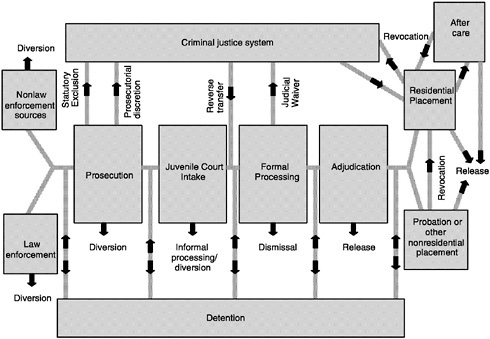
FIGURE 5-1 Simplified view of case flow through the juvenile justice system. Source: Adapted from Snyder and Sickmund (1999).
court system; in others, it occurs outside the court system, for example, in a probation department, a state juvenile justice department, or the prosecutor's office. The intake screening determines whether a case should not be filed because of insufficient evidence, resolved by diversion to a program or specified set of conditions, or should proceed to formal processing in the juvenile court (i.e., petitioning, which is similar to indictment in criminal court). Depending on state law, a decision to waive a case to criminal court may also be made at intake processing.
If a case proceeds to formal handling, a petition is filed and the case is scheduled for an adjudicatory hearing in the juvenile court, or the case may be waived to criminal court. At the adjudicatory hearing, which establishes the facts of the case (similar to a trial in criminal court), the juvenile may be judged to be delinquent (similar to a finding of guilty in criminal court) and scheduled for a disposition hearing; the juvenile may be found not guilty, and the case may be dismissed; or the case may be continued in contemplation of dismissal. In the latter event, the juvenile may be asked to take some action prior to the final decision being made, such as paying restitution or receiving treatment. If a juvenile has been
adjudicated delinquent (i.e., found guilty), a disposition hearing (similar to sentencing in criminal court) is held to determine the appropriate sanction. Dispositions include commitment to an institution, placement in a group or foster home or other residential facility, probation, referral to an outside agency or treatment program, imposition of a fine, community service, or restitution. At any point during the process, some juveniles may be held in a secure detention facility. In 1996, juveniles were detained in 18 percent of criminal delinquency cases processed by the juvenile courts (Snyder and Sickmund, 1999).
Juvenile courts also vary by the extent of services for which they are responsible. Some courts oversee only the adjudication process, while others provide a full array of preadjudication and postdisposition services. In over half the states, juvenile courts administer their own probation services, and many are responsible for detention and intake as well (Torbet, 1990).
Some researchers have expressed concerns regarding certain juvenile justice procedures. As mentioned previously, the lack of a right to a jury trial may have consequences for the outcome of a trial. Also at issue is legal representation for juveniles. As in adult court, juveniles have the right to be represented by an attorney. The majority of states, however, allow juveniles to decide independently to waive their rights to an attorney without having had legal counsel prior to the decision (U.S. General Accounting Office, 1995b). This practice is inconsistent with the assumption that children are different from and should be treated differently than adults, in that it implies that juveniles can make the decision “voluntarily and intelligently, ” although studies suggest that juveniles are not as competent as adults to waive their rights in a “knowing and intelligent” manner (Feld, 1993:31).
Studies from 1980 to 1990 found that the majority of juveniles were not represented by an attorney, including the majority of youths who received out-of-home placement (Feld, 1993). Rates of representation varied between urban and rural jurisdictions, and among states and within states (U.S. General Accounting Office, 1995b).
Also of possible concern are the quality and impact of attorney representation. Some studies suggest that there are grounds for concern about the effectiveness of defense counsel in juvenile trials, possibly because of inexperience and large caseloads (Feld, 1993). Studies also indicate that presence of counsel in juvenile courts is related to differences in pretrial detention, sentencing, and case-processing practices (Feld, 1993). One study (U.S. General Accounting Office, 1995b) found that, in general, while unrepresented juveniles were as likely as represented juveniles to be adjudicated as delinquents, they were less likely to receive out-of-home placement for certain crimes than juveniles with attorneys. The
study also found that other factors, including the type of counsel, were more strongly associated with placement outcomes than the mere fact of being represented by counsel.
Juvenile courts processed nearly 1.8 million criminal delinquency cases5 and 162,000 status offense delinquency cases in 1996 (Stahl et al., 1999). Figures 5-2 and 5-3 show how criminal and status delinquency cases, respectively, were handled by the courts in 1996, the most recent year for which data are available. A total of 56 percent of the criminal delinquency cases that were referred to juvenile courts in 1996 were formally handled by the court (petitioned); that is, these cases appeared on the official court calendar in response to the filing of a petition, complaint, or other legal instrument. Over the past 10 years, there has been an increase in the percentage of cases (from 47 percent in 1986 to 56 percent in 1996) handled formally for all juveniles, regardless of age, race, or gender. Criminal delinquency cases involving older juveniles, males, and blacks, however, are more likely to be petitioned than those involving younger juveniles, females, and whites or other races, respectively (Stahl et al., 1999). Arguably, formal handling of cases can be considered more punitive than release or diversion to other systems. Therefore, the increase in formal handling of juveniles who come into contact with the police or who are referred to juvenile court may be interpreted as a system that is becoming more punitive.
Diversion
Diversion covers a wide range of interventions that are alternatives to initial or continued formal processing in the system (Kammer et al., 1997). The idea behind diversion is that processing through the juvenile justice system may do more harm than good for some offenders (Lundman, 1993). First offenders or minor offenders may be diverted to an intervention at intake processing or prior to formal adjudication. Juveniles may be diverted from detention while awaiting adjudication and disposition. After adjudication, minors may be diverted from incarceration by being placed on probation or given some other sanction or intervention.
One concern that is often raised about diversion programs is that they may result in net widening which is “a phenomenon whereby a program is set up to divert youth away from an institutional placement or some other type of juvenile court disposition, but, instead, merely brings more youth into the juvenile justice system who previously would never have
|
5 |
“A case represents a youth processed by a juvenile court on a new referral regardless of the number of violations contained in the referral” (Sickmund et al., 1998:1). |
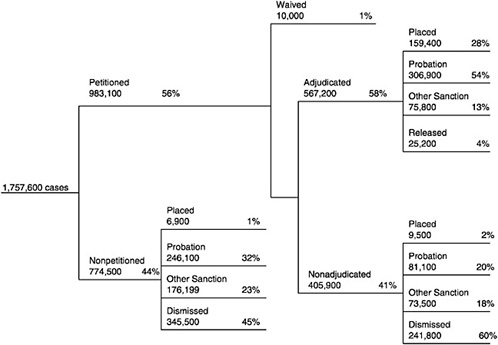
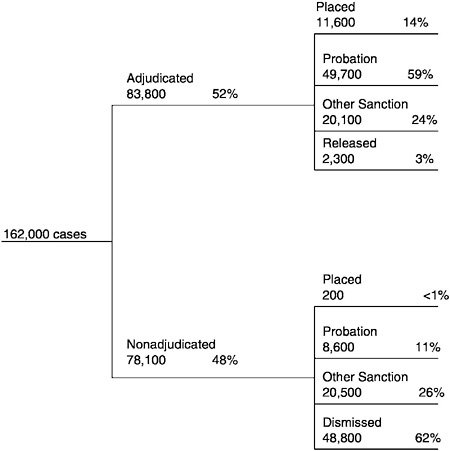
FIGURE 5-3 Juvenile court processing of petitioned status delinquency cases, 1996. Source: Stahl et al. (1999:Figure 16).
entered” (Shelden, 1999:4). A true diversion program takes only juveniles who would ordinarily be involved in the juvenile justice system and places them in an alternative program.
The array of interventions covered under the term diversion makes it difficult to generalize about them or their effects. Some researchers have found significantly lower recidivism rates among diverted juveniles than among controls who received normal juvenile justice system processing (e.g., Henggeler et al., 1993; Pogrebin et al., 1984). (For an overview of studies discussed in this section, see Table 5-2.) Other research has found no difference in recidivism rates between juveniles diverted from the juvenile justice system and those who remained in it (Rausch, 1983; Rojek and Erickson, 1982) or more recidivism among diverted juveniles (Brown
TABLE 5-2 Interventions in the Juvenile Justice System: Evaluations of Diversion Programs
|
Intervention |
Evaluation Type |
Number of subjects at follow-up |
Program components |
|
Adams County Juvenile Diversion Program (Pogrebin et al., 1984) |
Random assignment |
N = 560 cases |
Individual, parent, and family counseling, referrals to other services as needed |
|
Diversion of Status Offenders Project (Rojek and Erickson, 1982) |
Quasiexperimental |
N(diverted) = 766 N(comparison1) = 508 N(comparison2) = 375 |
Diversion without treatment; diversion with referral to community agency (various treatments) |
|
Connecticut's Deinstitutionalization of Status Offenders Project (Rausch, 1983) |
Quasi-experimental |
N(community, minimum) = 18 N(court, minimum) = 94 N(community, maximum) = 47 N(comparison) = 201 |
Minimum intervention = short term crisis counseling by either community agency or probation officers; Maximum intervention = full assessments and referral to appropriate community agencies |
|
Mediation (Umbreit and Coates, 1993) |
Quasiexperimental |
N(mediation, victims) = 280 N(mediation, offenders) = 252 N(comparison 1, victims) = 103 N(comparison 1, offenders) = 95 N(comparison 2, victims) = 107 N(comparison 2, offenders) = 111 |
Victim-Offender Mediation |
|
Age at treatment |
Length of treatment |
Length of follow-up |
Delinquency and antisocial behavior outcomes |
Other outcomes |
|
not reported |
Up to six months |
18 months |
Lower recidivism (measured by arrest) among treatment group |
|
|
not reported |
Average of 2 days (diverted not treatment); average of 88 days (diverted with referral) |
not reported |
No differences in arrests of self-reported delinquency between diverted with or without referral; no differences in arrests among diverted groups and comparison groups of samples drawn of arrested status offenders before diversion program was implemented |
|
|
up to age 16 |
Minimum = up to 5 sessions; Maximum = up to 6 months |
6 months |
No difference in subsequent court referrals among any of the groups |
|
|
7- to 18-yearolds (avg. age 15) |
4 to 8 hours |
1 year |
Mediation group had lower recidivism and less serious subsequent offenses than comparison, although not statistically significant. |
Mediation victims more satisfied than comparisons with process; no difference in satisfaction of offenders with justice system treatment. Mediation offenders more likely to complete their restitution than comparisons. |
|
Intervention |
Evaluation Type |
Number of subjects at follow-up |
Program components |
|
Multisystemic therapy (Henggeler et al., 1992, 1993) |
Randomized clinical trial |
N(exp) = 43 N(control) = 41 |
Family therapy; problem-focused interventions within family, peer, school, and neighborhood; other strategies as relevant (e.g., cognitive behavioral therapy) |
|
Multisystemic therapy (Borduin et al., 1995) |
Pretest-posttest control group design with random assignment to conditions |
N(exp) = 70 N(control) = 56 |
Family therapy; problem-focused interventions within family, peer, school, and neighborhood; other strategies as relevant (e.g., cognitive behavioral therapy) Control group received individual therapy |
|
Multidimensional treatment foster care (Chamberlain and Reid, 1998) |
Random assignment of referred boys to one of two treatment conditions |
N(group care) = 42 N(treatment foster care) = 37 |
Foster care parents trained in behavioral techniques |
|
Restitution (Schneider, 1986) |
Random assignment to restitution or traditional disposition |
Boise, ID: N(exp) = 86 N(control) = 95 Washington, DC: N(exp) = 143 N(control) = 137 Clayton Co., GA: N(exp) = 73 (control) = 55 Oklahoma Co., OK: N(exp) = 104 N(control) = 78 |
Adjudicated youths required to pay fine or perform community service |
|
Age at treatment |
Length of treatment |
Length of follow-up |
Delinquency and antisocial behavior outcomes |
Other outcomes |
|
15.2 years (mean age) |
13 weeks (average) |
2.4 years |
Treatment group less likely to be rearrested and, if rearrested, had longer time to rearrest |
Improved family relations; improved peer relations |
|
12- to 17-yearolds (mean age 14.8) |
Average: 24 hours of treatment for multisystemic therapy group; 28 hours for individual therapy controls |
4 years |
Treatment group less likely to be rearrested and, if rearrested, had longer time to rearrest and less serious offenses |
Improved family relations; decreased psychiatric symptomatology |
|
12- to 17-yearolds (mean age 14.9) |
up to a year |
1 year |
Fewer arrests and days incarcerated among juveniles in treatment foster care than in group care |
Treatment foster care group more likely to finish treatment |
|
15 to 15.5 (avg.) |
Not reported |
22 to 36 months |
Reduced recidivism among offenders assigned to restitution |
et al., 1989; Lincoln, 1976). The variety in findings may be due to the types of juveniles involved and the types of treatment and services provided.
For a diversion program to be successful, it may have to provide intensive and comprehensive services (Dryfoos, 1990); services that include the juveniles' families and take into account community, school, and peer interactions (Henggeler et al., 1993); and use experienced caseworkers (Feldman et al., 1983). Elliott and colleagues (1978) found that whether intervention occurred in the juvenile justice system or in another program, juveniles experienced increases in their perception of being labeled as delinquent and increases in self-reported delinquency. It is even possible that some diversion programs are more intrusive than traditional juvenile justice processing. Frazier and Cochran (1986b) found that juveniles in the diversion program they studied were actually in the system longer and had at least as much, if not more, official intervention in their lives than those not diverted.
One well-studied intervention for both juveniles diverted from incarceration as well as for juveniles at various stages of processing in the juvenile justice system is multisystemic therapy. Multisystemic therapy is a family- and community-based treatment derived from theories and research that trace the development of antisocial behavior to a combination of individual, family, peer, school, and community factors and their interactions. The intervention is not limited to the adolescent or the family but includes work on the intersections between various systems, such as family-school and family-peer interactions. Treatment is individualized to meet the needs of the adolescent and his or her family using empirically based treatment models, such as cognitive behavioral therapies, behavioral parent training, and structural family therapy (Henggeler, 1999). In addition, attention is paid to treatment fidelity through supervision of and support for treatment providers. A study that randomly assigned serious, violent juveniles either to multisystemic therapy or to the usual juvenile justice system processing (Henggeler et al., 1993) found that multisystemic therapy reduced recidivism at 2.4 years after referral to half of that for those who received the usual juvenile justice services. Borduin and colleagues (1995) found that juvenile offenders randomly assigned to multisystemic therapy, at four years after treatment, had better family relations and fewer psychiatric symptoms and were significantly less likely to be rearrested than those randomly assigned to individual therapy. A meta-analysis of family-based treatments of drug abuse found that multisystemic therapy had one of the largest effect sizes of all treatments reviewed (Stanton and Shadish, 1997).
A promising approach for youngsters for whom home-based programs have failed is multidimensional treatment foster care (see, e.g., Chamberlain, 1998; Chamberlain and Mihalic, 1998; Chamberlain and
Reid, 1998). This approach recruits, trains, and supports foster care families to implement a structured, individualized program for each youngster. Juveniles are placed in the foster care family for six to nine months, during which time their appropriate behavior is reinforced, they are closely supervised, and their peer associations are carefully monitored. Foster care families have daily contact with program staff to work out difficulties and review program plans. Juveniles also receive individual skill-focused treatment. Other components of the program include frequent visits with and weekly family therapy for biological parents (or guardians) to prepare them for after care and coordination with school and other needed service systems after their children return to their homes. Chamberlain and Reid (1998) compared chronic delinquent boys (with an average of 13 prior arrests and 4.6 prior felonies) who were randomly assigned to treatment foster care or to group homes in lieu of incarceration. Boys in treatment foster care were more likely to complete treatment and less likely to be rearrested or to spend time incarcerated than boys assigned to the group home.
Victim-offender mediation is one increasingly popular form of diversion. A national survey discovered 94 victim-offender programs dealing with juveniles in 1996, 46 of which were dedicated exclusively to them (Umbreit and Greenwood, 1998). The programs ranged from having 1 to 900 case referrals, with a mean of 136 cases. Referrals to victim-offender mediation are typically for vandalism, minor assaults, theft, and burglary (Umbreit and Greenwood, 1998). The vast majority of mediation cases are first-time offenders. Typically, mediation occurs prior to adjudication. Some pressure appears to be mounting to include more serious cases in mediation programs (Umbreit and Greenwood, 1998). Whether more serious or complicated cases can be handled through mediation remains to be seen.
Studies have consistently shown that victims tend to be more satisfied with the process of mediation than with court processes (Coates and Gehm, 1989; Marshall and Merry, 1990; Umbreit, 1990; Umbreit and Coates, 1992, 1993). This may be because victims are included in the mediation process only if they volunteer to do so. In their quasi-experimental study of four sites in the United States, Umbreit and Coates (1992:12) concluded that for offenders, “participation in mediation appears to not have significantly increased their satisfaction with how the juvenile justice system handled their case.” The study included interviews with victims and offenders who completed the mediation process. Two comparison groups were devised—the first of victims and offenders who had been referred to the mediation process but did not participate and the second victims and offenders who had not been referred to mediation in the same jurisdiction as the mediation sample, and matched on age, race, sex, and offense.
Over 90 percent of mediations resulted in a restitution plan agreed to by both victims and offenders (Neimeyer and Shichor, 1996; Umbreit and Coates, 1992) and significantly more juvenile offenders completed the agreed-on restitution than did those whose restitution was ordered by the court (Umbreit and Coates, 1993).
Findings on recidivism for juveniles who have been part of mediation programs are mixed. Schneider (1986) reported a significant reduction in recidivism among offenders in a mediation program. Other studies have found small but statistically nonsignificant reductions in recidivism among mediation program participants (Marshall and Merry, 1990; Umbreit and Coates, 1993).
Victim-offender mediation programs are one part of a larger diversion movement in juvenile justice that has been gaining attention worldwide —the restorative justice model. Under a restorative justice model, victims are given the opportunity to come face to face with the offender to negotiate restitution. In addition, restorative justice programs keep youth in the community and maintain community safety by community-based surveillance practices designed to limit the opportunities for juveniles to reoffend and strengthen rather than sever their connections with the community. These practices include monitored school attendance, monitored employment attendance, monitored program attendance, supervised community work service, supervised recreation, adult mentors and supervisors, training offenders' families to provide appropriate monitoring and disciplinary practices, day reporting centers, electronic monitoring, house arrest, and random drug testing. Placement in a secure facility is reserved for those juveniles who continue to offend or who pose a high risk to others. (For a more complete discussion of restorative justice, see Bazemore and Umbreit, 1995; Office of Juvenile Justice and Delinquency Prevention, 1998.) The restorative justice model is currently being evaluated in Australia.
On balance, the research on diversion and intensive probation (discussed in below) suggests that some community-based interventions can serve the needs of many juvenile offenders without added danger to the community. There also may be advantages to keeping juveniles in a less restrictive setting. Well-structured and well-run programs with appropriate services have the potential for improving the lives of diverted juveniles and their families and maintaining community safety.
Detention
Figures 5-2 and 5-3, which illustrate juvenile court processing of criminal delinquency and petitioned status delinquency cases, respectively, do not include the percentages of detained juveniles, because reported
detention figures do not differentiate between preadjudication detention and postadjudication detention. Juveniles may be detained at any stage during the court process if it is believed that they pose a threat to the community, will be at risk if returned to the community, or may fail to appear at an upcoming hearing. Children and adolescents may also be detained for evaluation purposes. Juveniles who have been adjudicated delinquent and sentenced to incarceration may also be kept in secure detention until a placement in a long-term facility can be made. In 1996, 18 percent (320,900 cases)6 of the 1.8 million criminal delinquency cases referred to the court resulted in detention, as did 6 percent (12,700) of the 162,000 status delinquency cases (Sickmund et al., 1998; Stahl et al., 1999). The percentage of criminal delinquency cases that result in detention has remained fairly stable over the past 10 years, and the percentage of status delinquency cases that result in detention has dropped. However, because the overall number of criminal delinquency cases coming to the court has increased, the number of cases that result in secure detention has increased, even though the percentage of cases detained has remained steady. Research consistently shows that juveniles who have been in detention are more likely to be formally processed and receive more punitive sanctions at disposition than those not placed in detention, after controlling for demographic and legal factors, such as current offense and history of past offenses (Frazier and Bishop, 1985; Frazier and Cochran, 1986a; McCarthy and Smith, 1986). Researchers have been unable to determine the variables that affect the initial decision to detain a juvenile, however. For example, Frazier and Bishop (1985), in an analysis of initial detention decisions, could explain less than 10 percent of variance in the decisions. Therefore, there may be unidentified factors related to the initial decision to detain that affect the impact of detention on eventual court dispositions.
It is important to remember that the court statistics do not refer to the number of juveniles detained, but only to the number of cases (in the course of a year, one juvenile may be detained in several cases). Based on one-day censuses of detention centers, it appears that the rate of detention of juveniles increased by 68 percent from the mid-1980s to the mid-1990s (Wordes and Jones, 1998). The average length of detention in the mid-1990s was 15 days (Wordes and Jones, 1998).
Of all juvenile cases resulting in detention in 1996, 26 percent were for person offenses, 38 percent were for property offenses, 21 percent were for public order offenses, 12 percent for drug law violations, and 3 percent
|
6 |
For comparison purposes, about 37 percent of the adult felony cases in the 75 most populous counties in the United States result in pretrial detention (Hart and Reaves, 1999). Misdemeanor cases do not usually result in detention. |
for status delinquency cases (Snyder and Sickmund, 1999). Males are detained at a rate six times higher than females, and blacks are detained at eight times the rate of whites (Wordes and Jones, 1998).
The two generally accepted uses of preadjudication detention are to ensure that a juvenile will show up for his or her hearing and to prevent reoffending prior to adjudication. However, detention is also used as punishment, protection, and as a place to keep juveniles when more appropriate placements are unavailable (Office of Juvenile Justice and Delinquency Prevention, 1997). Intake workers and juvenile judges have a great deal of discretion in deciding whether to place a juvenile in detention. Several studies found evidence that detention rates varied in direct proportion to the availability of detention facilities (Kramer and Steffensmeier, 1978; Lerman, 1977; Pawlak, 1977). Anecdotal evidence suggests that whether a juvenile in crisis is kept in detention or sent to a mental health facility may depend on whether the juvenile's family has health insurance to cover private psychological or psychiatric treatment. The result of the use of detention for such diverse reasons is that a juvenile who has run away from an abusive home may be placed in detention alongside a juvenile awaiting trial for violent crimes.
Detention can be quite disruptive to children's and adolescents' lives. It separates them from their families, friends, and support systems, and it interrupts their schooling. Although some detention centers have many services in place to assess and treat physical and mental health problems and behavioral problems and to provide educational services, the scope and quality of services varies greatly from jurisdiction to jurisdiction. In addition, many detention centers have become overcrowded, jeopardizing their ability to provide services. Nearly 70 percent of children in public detention centers are in facilities operating above their designed capacity (Smith, 1998). Overcrowded conditions have been found to be associated with increased altercations between juveniles and staff and increased injuries to juveniles (Wordes and Jones, 1998). Even under the best of circumstances, providing services to an ever-changing, heterogeneous group of young people can be difficult. The average length of stay in juvenile detention centers is 15 days, but many youngsters may be there for only a few days, while some are there for much longer periods (Parent et al., 1994). For marginal students, even a few days of school missed because of detention may increase their educational difficulties.
The negative effects of being in detention and the overcrowded conditions in many detention centers have led to investigations of alternatives to detention. Table 5-3 summarizes the evaluations of alternatives to detention programs discussed in this section. A study in North Carolina (Land et al., 1998) examined 19 alternatives to detention programs around the state. The programs varied from site to site, but all were characterized
by the following factors: careful screening and interviews for case admission of secure custody-eligible juveniles; intensive monitoring and supervision; small caseloads with individualized attention; strict rules for compliance and curfew; contacts at nights and weekends; verification of compliance at home and school; inclusion of supportive community resources; and rapid placement into secure confinement if needed. Land and colleagues (1998) found the programs to provide less restrictive options to secure detention in a cost-effective manner without compromising public safety. Over three-quarters of the cases served by the alternative programs successfully avoided secure detention. The vast majority (80 to 90 percent) of the cases that failed in the alternative program and were sent to secure detention were for technical program violations, not for new offenses. Less than 5 percent of all alternative placement admissions committed new offenses while in the program.
The Annie E. Casey Foundation began a Juvenile Detention Alternatives Initiative in 1992 (Rust, 1999). Five urban jurisdictions—Cook County, Illinois (Chicago); Milwaukee County, Wisconsin; Multnomah County, Oregon (Portland); New York City; and Sacramento County, California —were awarded grants to establish programs to eliminate the inappropriate or unnecessary use of detention, reduce the number of delinquents who fail to appear for court or who commit a new offense, develop alternatives to secure detention rather than adding new detention beds, and to improve conditions and alleviate overcrowding in secure detention facilities. The final evaluation of the programs in Chicago, Portland, and Sacramento, by the National Council on Crime and Delinquency, was due in 2000. Preliminary indications from the evaluation are that the programs achieved significant reductions in admissions to detention and alleviated overcrowding without increasing failure-to-appear rates or pretrial crime rates (Rust, 1999).
After adjudicatory hearings, cases in juvenile court are scheduled for disposition hearings, in which the sanction is determined. Juveniles may be put on probation, placed in a correctional institution or other out-of-home placement, sent to treatment or other programs, or given some other sanction, such as paying restitution or performing community service. The most common disposition is probation; over half of the cases adjudicated delinquent were placed on probation in 1996; 28 percent of those adjudicated delinquent in 1996 were sent to out-of-home placement. Males were more likely than females to be placed (29 and 22 percent of adjudicated delinquency cases involving males and females, respectively) and females were more likely to be put on probation (53 and 59 percent for males and females, respectively). A higher proportion of cases involving blacks and other races results in out-of-home placement than do cases
TABLE 5-3 Interventions in the Juvenile Justice System: Evaluations of Alternatives to Detention
|
Intervention |
Evaluation Type |
Number of subjects at follow-up |
Program components |
|
Alternatives to Detention (ATD) programs (Land et al., 1998) |
N = 3,183 |
Alternative to secure detention to allow juveniles to remain at home, with relatives, or other approved placement |
|
|
Intensive supervision: Intensive Probation Unit (IPU), Michigan Human Services (MHS), and the Comprehensive Youth Training and Community Involvement Program (CYTCIP) (Barton and Butts, 1991) |
Random assignment to IPU, MHS, CYTCIP, or state training school (control) |
N(exp) = 326 N(control) = 185 |
IPU: Counseling, monitoring of school attendance, general behavioral supervision; MHS: Youth and family counseling; CYTCIP: Job training and preparedness |
|
North Carolina Court Counselors' Intensive Protective Supervision Randomized Experimental Project (Land et al., 1990, 1992) |
Random assignment to intensive protective supervision or regular probation |
N(exp) = 90 N(control) = 84 |
Extensive and proactive contact between counselor, youth, and youth 's family; professional analytic or therapeutic services available |
|
Age at treatment |
Length of treatment |
Length of follow-up |
Delinquency and antisocial behavior outcomes |
Other outcomes |
|
Not reported |
Not reported |
6 months |
ATD programs successful in avoiding secure detention; Rate of post-program recidivism for successful ATD program completers ranged from 26.4% to 33.8% |
|
|
Not reported |
Not reported |
2 years |
No difference in official or self-reported recidivism |
|
|
11- to 16-yearolds |
Up to a year |
1 year |
In first 1-1/2 years of program implementation, youths with no prior delinquent offenses less likely to be referred to juvenile court for a delinquent act during period of supervision, but no difference in second 1-1/2 years of program |
In first 1-1/2 years of program implementation, youths with no prior delinquent offenses more likely to successfully complete protective supervision program, but no difference in second 1-1/2 years of program |
|
Intervention |
Evaluation Type |
Number of subjects at follow-up |
Program components |
|
Serious 602 Offender Project (Fagan and Reinarman, 1991) |
Random assignment |
N(exp) = 267 N(control) = 102 |
Intensive probation supervision for youths charged with serious offenses: individual and family counseling, school follow-up, group activities, and substance abuse |
involving white juveniles (32 percent for blacks and other races, 26 percent for whites in 1996) (Stahl et al., 1999).
Probation
Over half of juveniles adjudicated delinquent in juvenile court are put on probation, as are one-fifth of those nonadjudicated (found not guilty). One-third of the cases that do not receive formal juvenile court processing are also placed on probation at intake (Stahl et al., 1999). In 1996, 634,100 criminal delinquent cases and 58,300 status offense delinquent cases resulted in probation. These figures do not include juveniles who were under the supervision of probation departments after serving time in a residential facility. National figures for the latter group are not collected.
Probation is essentially surveillance designed to prevent reoffending, with the threat of punishment and to detect reoffending if it should occur. Surveillance alone may be insufficient to prevent reoffending. Research with adults has found that the most successful probation programs combine both treatment and surveillance (Petersilia, 1997).
The early founders of juvenile courts saw probation as one of the most significant components of the juvenile court system (Schlossman, 1983). Probation provided the opportunity to rehabilitate juveniles in their homes rather than incarcerating them. Probation officers could get
|
Age at treatment |
Length of treatment |
Length of follow-up |
Delinquency and antisocial behavior outcomes |
Other outcomes |
|
Up to 17.5 years; 15.02 (avg.) |
Not reported |
36 months |
No difference in recidivism between experimental group in Contra Costa County or control group; Experimental group in Richmond had more youths arrested for violent offenses but a lower number of youths rearrested for any offenses in general |
to know the individual juveniles and their families and therefore provide individualized guidance. As with other ideals of the juvenile court, the reality of probation did not always live up to its expectations, either at the beginning of the juvenile courts 100 years ago or today. Nevertheless, probation has remained the overwhelming dispositional choice for adjudicated offenders of juvenile courts since statistics were first kept in 1927 (Torbet, 1996).
There is a great deal of variety in the responsibilities and structure of probation departments from state to state and even within states. In general, juvenile probation departments have three basic functions: intake screening of cases referred to juvenile court, presentence investigations, and court-ordered supervision of juveniles. This section deals only with court-ordered supervision of juveniles who were given probation as their primary disposition. The use of probation officers to supervise juveniles following incarceration is covered in the section on after care; it is not always easy to separate the two conditions, however. The same parole officers may oversee juveniles whose primary sanction was probation (probationers) and juveniles who have been released from incarceration (parolees). Conditions of probation may be similar for both groups of juveniles. Both probationers and parolees may attend the same treatment programs while serving their probation.
There has been little evaluation of traditional probation practices,
with more research emphasis being focused on such alternatives as intensive supervision (Clear and Braga, 1995). Intensive supervision, as its name implies, involves more intense scrutiny and monitoring than traditional probation. Interest in intensive supervision probation has waxed and waned since the 1960s. Spurred by both increasing overcrowding in correctional facilities and the get-tough approach, intensive supervision programs grew in popularity in the late 1980s (Armstrong, 1991). Studies of intensive supervision for adult offenders have not found increased monitoring alone to reduce recidivism. In fact, increased monitoring may detect more cases of technical probation violations than regular probation (MacKenzie, 1997), leading to higher rates of measured reoffending if technical violations are included in recidivism measures.
A study by Land and colleagues (1990, 1992) examined an intensive supervision program for status delinquency cases. Status offenders were randomly assigned to regular probation or to intensive supervision. In addition to frequent visits with the juvenile and his or her family from the counselor (as often as daily at first, then at least weekly thereafter, compared with visits once every 90 days for regular probation), juveniles and their families in intensive supervision were directed to community programs to assist them. Based on individualized assessments and program plans, juveniles in the intensive supervision program were given behavioral objectives to be met and were regularly assessed on their progress. A year after treatment end, juveniles in intensive supervision had significantly fewer criminal delinquency referrals than did those in regular probation. There was no difference between the groups in status offense referrals. As the program matured and became routinized, it appeared to become less effective. Status offenders who entered the program after it had been in existence for 1.5 years were as likely to be referred for criminal delinquency as were those in regular probation. Land et al. (1992) noted that there were fewer referrals to services made in the mature program than occurred when it was new, and that staff received less attention and support after the program was well established. Intensive supervision coupled with treatment and well-supported staff appears to have the potential to keep status offenders who have not already been involved in criminal delinquency from committing criminal delinquent acts.
Most of the intensive supervision probation programs instituted beginning in the late 1980s and throughout the 1990s have been targeted not at status offenders, but at high-risk juveniles for whom community safety demands more intense supervision than can be provided under routine probation (Armstrong, 1991). These intensive supervision programs vary greatly from jurisdiction to jurisdiction. Some include short-term residential placements with intensive community-based services; others rely on frequent contact between the probation officer and the
juvenile. The definition of frequent also varies from daily to weekly, but it is always more frequent than traditional probation.
Several studies have evaluated intensive supervision of probationers.7 A study in which juveniles were randomly assigned to one of three inhome programs in Detroit, Michigan, or to the state training school (the control group), found no significant differences in recidivism (measured by court appearances for new offenses) or self-reported criminal delinquency among all four groups during the two-year follow-up (Barton and Butts, 1991). The in-home programs cost only one-third the expense of incarceration in training schools. The evaluators concluded that intensive in-home programs were cost-effective and posed no increased danger to the community.
A three-year follow-up of juvenile offenders randomly assigned to regular probation or intensive probation in Contra Costa County, California, found little difference in recidivism (measured by rearrest, court appearances, incarceration, and self-reported offending) between the two groups (Fagan and Reinarman, 1991). Although the intensive program was designed to include more therapeutic programs than regular probation, in practice, the major difference was the number of contacts between probation officers and juveniles—weekly for intensive supervision and monthly for regular probation. The program was originally intended for serious and violent offenders, but many nonviolent, less serious offenders ended up in the program. The authors concluded that regular probation suffices for most juvenile offenders and that intensive supervision should be reserved for serious and violent offenders who have failed under regular probation conditions.
A number of researchers (e.g., Altschuler and Armstrong, 1991; Baird, 1991; Clear, 1991) argue that intensive supervision is warranted only for juveniles at high risk of serious reoffending. Defining which juveniles are high risk and therefore warrant intensive supervision, however, is a complicated and difficult task. Relying solely on the seriousness of the current offense is inadequate, as that alone is a poor predictor of future offending (see, for example, Wolfgang et al., 1972). Judicial judgments of dangerousness have been shown to be quite poor at accurately predicting which offenders are dangerous (Fagan and Guggenheim, 1996). Demonstrating the success or failure of intensive supervision programs may ride on their ability to identify the appropriate group of juveniles to serve.
|
7 |
Studies that evaluate intensive supervision programs for parolees or for a combination of probationers and parolees are discussed in the section below on after care. |
Incarceration
Deprivation of liberty through incarceration is usually thought to be the most severe sanction that can be meted out by the justice system.8 Of all juvenile criminal delinquency cases disposed in 1996, 18 percent (320,900 cases) resulted in detention. The type of offenses for which juveniles are detained include not only violent offenses but also property and drug offenses.
The Census of Juveniles in Residential Placement (CJRP), conducted on October 29, 1997, found that nearly 93,000 youngsters under age 18 were held in public or private detention, correctional, and shelter facilities (Gallagher, 1999). The CJRP, which collects individual data on each person under age 21 held in residential facilities, replaced the Children in Custody census, which collected aggregate data on persons under age 21 in each facility biennially from 1971 through 1995. Differences in methodology between the two censuses make direct comparisons of the numbers of juveniles in custody over time problematic. It appears that the numbers of juveniles in custody has grown steadily since 1975 (see Figure 5-4). It is impossible to determine, however, how much of the increase from 1995 to 1997 is real and how much is an artifact of the change in method of data collection. Nevertheless, the United States has a high rate of juveniles in custody—368 per 100,000 juveniles (Snyder and Sickmund, 1999)—a rate that is higher than the adult incarceration rate in most other countries (Mauer, 1997).
It is easy to forget that most children who are incarcerated will be out on the streets in a few years or months. What they learn through the juvenile justice system is likely to influence their behavior later. Their access to appropriate education and vocational training and to mental health services may make all the difference between successful reintegration into society and reoffending.
Conditions in juvenile facilities vary greatly, from those in which appropriate educational and other services are provided and staff are well trained to those in which many juveniles spend much of their time in cells with nothing to do, and where facilities are unsafe and unsanitary, services are lacking, and staff are poorly trained and may even be abusive. In 1995, Human Rights Watch (1995) documented physical abuse of juveniles in Louisiana's Tallulah Correctional Center for Youth. The New York Times (1998) documented continuing physical abuse and other problems in this facility in 1998, which “houses 620 boys and young men, age
|
8 |
Research has found that some adult offenders prefer incarceration to intensive supervision probation, indicating that at least some offenders find intensive supervision more punitive (Crouch, 1993; Petersilia and Deschenes, 1994). |
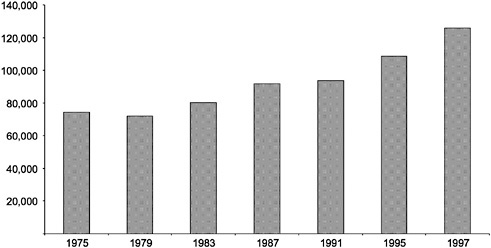
FIGURE 5-4 Total number of youth under 21 in custody. Source: Data for 1975 to 1991 from Smith (1998); data for 1995 and 1997 from Snyder and Sickmund (1999).
11 to 20, in stifling corrugated-iron barracks jammed with bunks. . . . Meals are so meager that many boys lose weight. Clothing is so scarce that boys fight over shirts and shoes. Almost all of the teachers are uncertified, instruction amounts to as little as an hour a day, and until recently there were no books.” In late 1999, three boot camps in Maryland were closed and top juvenile justice officials lost their jobs after physical abuse of juveniles by staff was found to be widespread (The Washington Post, 1999). The Arkansas Democrat-Gazette reported in June 1998 that boys in the Central Arkansas Observation and Assessment Center seldom saw daylight, were given clean clothing only every other week, and were subjected to the unsanitary condition of raw sewage backing up into shower drains whenever toilets were flushed (Coalition for Juvenile Justice, 1999).
In contrast, some facilities provide a wide range of programs in well-kept settings. The Giddings State Training School in Texas has modern educational facilities that are wired for the Internet and offers high school equivalency classes and vocational training. The facility has intensive treatment for drug abusers, sexual offenders, and capital offenders. The facilities are tended by the residents and are clean and well kept (Coali-
tion for Juvenile Justice, 1999).9 Ferris School in Delaware, after years of fighting lawsuits, was rebuilt and restructured in the mid-1990s. Education is now stressed over punishment there. In fact, Ferris is the only education program in a juvenile secure care facility in the Mid-Atlantic region to receive accreditation (Coalition for Juvenile Justice, 1999).
Even in well-kept settings, however, some misbehaving youth are punished through isolation or deprivation of privileges. The panel could find no studies of the impact of these punishments on the behavior of juveniles either during incarceration or upon release.
The only national study of conditions of confinement in juvenile correctional facilities (Parent et al., 1994) found substantial and widespread problems concerning amount of living space, health care, security, and control of suicidal behavior. Crowded conditions are widespread in juvenile training and reform schools. In 1995, 68 percent of juveniles in public facilities and 15 percent in private facilities were in facilities that housed more juveniles than they had been designed to house (Smith, 1998). Overcrowded conditions are not only unpleasant, but also may be dangerous—both staff and juveniles have higher rates of injury in overcrowded facilities (Parent et al., 1994). Injury rates were also higher for both juveniles and staff in facilities in which living units were locked 24 hours a day, regardless of the percentage of youth incarcerated for violent crimes, than in less secure facilities. The study found that large dormitory sleeping arrangements were accompanied by high rates of juvenile-on-juvenile injuries. Single sleeping rooms were related to suicidal behavior, with the rate of suicide attempts increasing as the percentage of juveniles in single rooms increased (Parent et al., 1994). Apparently, rooms housing two or three juveniles are preferable to either single rooms or large dormitories.
Parent and colleagues (1994) also found serious deficiencies in health care for incarcerated juveniles. Health care screenings, which national standards say should occur within one hour of admissions, and appraisals, which should occur within seven days of admission, are often not completed in a timely manner. Timely screenings are important to identify injuries and acute health problems that may require immediate attention. Timely health appraisals are important to identify health care needs that require treatment during confinement and to prevent the spread of infectious diseases. In addition, the Parent et al. study found that health care screenings may be performed by staff with no health training. This was a particular problem in detention centers, where one-third of juveniles were screened by untrained staff.
|
9 |
Members of the study panel visited the Giddings School and can corroborate the praise of the facility by the Coalition for Juvenile Justice. How to handle very disruptive and violent youth, who end up in isolated lock-up, however, remains a problem for this facility. |
Parent et al. (1994) also examined education, recreation, and mental health programming in juvenile facilities. They found that, in the early 1990s, 65 percent of juveniles in public facilities were in institutions with current court orders or consent decrees related to programming deficiencies. They could not determine which areas of programming were specified in the orders and decrees, however. Nevertheless, this finding points to widespread inadequacies in services available to juveniles held in residential facilities.
Educational Needs and Services
Many children and adolescents involved in the juvenile justice system have fared poorly in school and have significant educational needs. Although not as well studied as the mental health needs of these youngsters (discussed in the next section), many have not attended school recently and many perform below grade level. In addition, for most incarcerated juveniles, correctional education services are their last exposure to formal education (Dedel, 1997). In site visits made during their study, Parent et al. (1994) received estimates from language teachers in juvenile facilities that 32 percent of their students read at or below 4th-grade level, 27 percent at 5th-or 6th-grade level, 20 percent at 7th- or 8th-grade level, and 21 percent at or above 9th-grade level. A Massachusetts state court decision (Green v. Johnson, 513F. Supp. 965, 968 D. Mass., 1981) estimated that 50 to 80 percent of children in juvenile facilities were handicapped under the definitions in the federal Education for All Handicapped Children Act.
The Parent et al. (1994) study found that nearly all juveniles are held in facilities that provide some kind of educational programming: 95 percent of juveniles in detention centers had access to educational programming, as did 97 percent in training schools, and 96 percent in ranches, camps, or farms.10 The quality of the educational programming, however, appeared to vary greatly from site to site. The American Correctional Association standards recommend that educational programs in juvenile facilities use state-certified teachers, have a maximum student-to-teacher ratio of 15:1, and assess the educational status of juveniles to develop individualized educational plans. Only 55 percent of training school residents and 29 percent of ranch, camp, or farm residents are in facilities that meet all the recommended educational standards. The
|
10 |
Adjudicated delinquents who do not require strict confinement in a training school may be sent to a ranch, camp, or farm run by the state or local government or by private organizations for long-term residential placement. |
Parent et al. (1994) study did not have access to information on educational outcomes to assess the effects of the educational programming on residents. Dedel (1997) reports that 75 percent of students in custody advanced less than a full grade level per year while in custody.
Mental Health Needs
A number of studies of incarcerated juveniles have found the prevalence of psychiatric disorders, diagnosed from structured interviews or clinical assessments, to be three to five times higher than in the general population of young people (Chiles et al., 1980; Davis et al., 1991; Eppright et al., 1993; Hollander and Turner, 1985; Lewis et al., 1987; McManus et al., 1984a; McManus et al., 1984b; Miller et al., 1982; Shelton, 1998; Steiner et al., 1997; Timmons-Mitchell et al., 1997). Conduct disorder was present in over 80 percent of incarcerated youth (Davis et al., 1991; Eppright et al., 1993; Hollander and Turner, 1985; Timmons-Mitchell et al., 1997). This finding is not surprising because the criteria for a diagnosis of conduct disorder includes delinquent and criminal behavior, such as truancy, arson, theft, breaking and entering, and assault. Other psychiatric disorders found among detained and incarcerated young people included depressive disorders, attention deficit hyperactivity disorder (ADHD), and psychotic disorders. Studies also report many times more personality disorders, especially borderline personality disorder, among incarcerated youth than among the general population of young people. At least half of juvenile detainees also report substance abuse (Davis et al., 1991; Timmons-Mitchell et al., 1997).
A study of randomly selected incarcerated boys and girls in Ohio found that girls displayed significantly more mental health problems (other than conduct disorder) than boys—84 percent of girls had a mental health disorder compared with 27 percent of boys. Studies of adult incarcerated women suggest that psychiatric disorders are also much more prevalent in adult incarcerated women than in either adult incarcerated men or the general population (Jordan et al., 1996; Teplin et al., 1996).
Juvenile offenders have been found to have a high rate of drug and alcohol use. In 1998, the Arrestee Drug Abuse Monitoring Program found illegal substances in the urine of 40 to over 60 percent (depending on the city) of male juvenile arrestees (National Institute of Justice, 1999). An analysis of the National Youth Survey found a strong correlation between serious substance use and serious delinquent behavior (Johnson et al., 1993): 23 percent of juveniles who reported involvement in multiple serious crimes were current cocaine users, compared with 3 percent of nondelinquents. Drug and alcohol use often coexist with other mental health problems (McBride et al., 1999).
Young people with substance abuse or mental health disorders in juvenile correctional facilities have little chance of receiving either an adequate assessment or appropriate treatment. Furthermore, treatment is very rarely coordinated with services after youth are released. Longitudinal evidence suggests that delinquents with serious psychiatric disorders are less likely than others to desist from delinquency in their late teens or twenties (Hare et al., 1988; Robins, 1974). The lack of adequate mental health treatment in the juvenile correctional facilities represents a lost opportunity for these juveniles.
Evaluations of Treatments in the Juvenile Justice System
Although no treatment program works 100 percent of the time for 100 percent of the participants, there are treatment programs that have been found to reduce the rate of future offending, whereas some get-tough sanctions have been found to increase recidivism. The panel did not have the resources to examine all the literature relevant to treatment of juveniles under the control of the juvenile justice system (Lipsey and Wilson, 1998, alone found 200 experimental or quasiexperimental studies for their meta-analysis). Rather, we relied on published reviews (Krisberg and Howell, 1998; MacKenzie, 1997; Petrosino et al., 2000) and several metaanalyses (Gottschalk et al., 1987; Lipsey, 1995; Lipsey and Wilson, 1998; Mayer et al., 1986).
Lipsey and colleagues have performed several meta-analytic studies of treatments for juvenile offenders (Lipsey, 1995; Lipsey and Wilson, 1998). Meta-analysis allows the quantitative findings of many studies to be combined and statistically analyzed. Differences in study methods and procedures can be controlled for statistically, allowing a pattern of treatment effects across studies to be revealed. Effect size is the usual measure employed in meta-analyses. It should be noted that effect size is influenced as much by the nature of the comparison group as by the treatment programs being evaluated. Meta-analyses can be an extremely important aid to identifying good treatment programs, but their use cannot overcome problems of poor research design. In fact, when metaanalyses are not based on rigorous criteria for inclusion, the results can be misleading.
In a meta-analysis of 400 research studies of programs for delinquency reduction, Lipsey (1995) found that the average effect across all the programs studied was a 10 percent reduction in delinquency among participants in the program compared with a control group. However, there was wide variety from program to program, with some studies finding increased delinquency among participants in certain programs and studies of other types of programs finding a 30 percent improvement in the
program participants over the control group. Overall, Lipsey (1995) found that programs that targeted behavioral change in a relatively structured and concrete manner had a greater effect on reducing delinquency than programs that targeted psychological change through traditional counseling or casework approaches. Other meta-analyses have similarly found that cognitive-behavioral, skill-oriented, and multimodal programs have the best effects (Gottschalk et al., 1987; Mayer et al., 1986). This pattern held for programs conducted under the auspices of the juvenile justice system and for those run by other institutions.
Of particular concern are programs that increased delinquency. Lipsey (1995:74) says about them:
Most notable are the deterrence approaches such as shock incarceration. Despite their popularity, the available studies indicate that they actually result in delinquency increases rather than decreases. Unfortunately, there are distressingly few studies in this category, making any conclusions provisional. The studies we do have, however, raise grave doubts about the effectiveness of these forms of treatment.
A systematic review of evaluations of deterrence programs, such as Scared Straight, that involve exposing youngsters who have come in contact with the juvenile justice system to prison life and adult inmates was undertaken by Petrosino and colleagues (2000). None of the nine evaluations that involved random assignment of youngsters to the treatment or control groups found any positive effect on future delinquency. Seven of the studies found that the effects of the program were harmful, that is, youngsters in treatment were more likely to commit additional delinquent acts than were those in the control group who received no treatment.
Lipsey (1995) also found that the length of the program and how well it was planned and delivered affected how well the program reduced delinquency. Programs that were monitored to ensure that they were delivered as planned had larger effects than programs that were not monitored. More of an otherwise effective program appears to be better than less. In general, Lipsey (1995) recommended that programs should have 100 hours or more of total contact with the juvenile, delivered at two or more contacts per week, over a period of 26 weeks or longer. Because the average length of stay for juveniles in residential placement is less than four months (Smith, 1998)—significantly shorter than 26 weeks—it may be difficult to provide programs over a sufficient length of time to make a difference for many youth in residential placement. Continuity of programming after release may be a way to increase effectiveness. It should be noted, however, that Lipsey and Wilson (1998) found that characteristics of effective programming both inside and outside institutions differed.
Lipsey and Wilson (1998) performed a separate meta-analysis on 200 studies of all the experimental or quasi-experimental studies of the effects of interventions with serious juvenile offenders. They summarize their results as follows (Lipsey and Wilson, 1998:229-230): “The average intervention effect for these studies was positive, statistically significant, and equivalent to a recidivism reduction of about 6 percentage points, for example, from 50 percent to 44 percent (mean effect size = 0.12). The variation around this overall mean, however, was considerable.”
Lipsey and Wilson (1998:330) note that the primary lesson of their study is “that sufficient research has not yet been conducted on the effects of intervention with serious juvenile offenders.” They found that the dimensions that characterized good programs for incarcerated offenders differed from those for nonincarcerated offenders. Therefore, they searched separately for effective programs in these two settings. Programs that provided interpersonal skills and insight into their own behavior and programs that placed offenders into community-based teaching family homes were most consistently effective for incarcerated offenders. Individual counseling, teaching of interpersonal skills and insight into their own behavior, and behavioral programming were most successful for the nonincarcerated offenders.
Of course, no program is effective for all offenders. A variety of attempts have been made to match offenders to programs on the basis of assessed needs. Whether such matching can be the basis for improved results has been the subject of some debate (see, e.g., Andrews et al., 1990b; Lab and Whitehead, 1990). Because effective programming can be costly, benefits should be carefully determined and reported (MacKenzie, 1997).
Although studies have focused on recidivism rates for treatment programs, there seem to be few credible studies of effects of policies in residential facilities, such as television viewing, recreational privileges, or the use of isolation or of lockups that occur in training or reform schools designed for juveniles. Many juvenile correction systems employ a behavior modification strategy tying rewards (e.g., to purchase special food, watch TV, use the library, play athletic games) to compliance. These systems also typically link punishments to misbehavior. Although designed to teach inmates better behavior, empirical evidence has demonstrated that the strategy may backfire with some populations (Deci, 1971; Kruglanski et al., 1971; Lepper et al., 1997). Because the punishments used in reformatories involve physical force, lockups, isolation, and a variety of forms of deprivation, some juveniles may be learning that force is appropriate to obtain compliance. Studies are needed to learn about effects of lockups and of behavior modification strategies in order to
ensure that the juvenile justice system is not creating or exacerbating problems it is designed to alleviate.
After Care and Reintegration
Following incarceration, most juvenile offenders will return to the communities from which they came. As with the adult system, juvenile corrections officials have a poor record of controlling juvenile parolees released from secure detention into the community. As in the adult system, concerns have been raised that heavy caseloads and poor quality and delivery of services affect offender rehabilitation and public safety. This situation has led to the testing of models of intensive parole supervision and after care (Altschuler and Armstrong, 1994a). Knowing how difficult it is for all individuals to make major changes in complex behavior patterns, it should not be surprising that juvenile offenders may need assistance if they are to avoid reoffending. Even for those who received appropriate treatment programs while incarcerated, change may be difficult to maintain when they return to their old environment. For juveniles to succeed in reintegrating into the community, more emphasis may have to be placed on continued treatment rather than merely on surveillance and monitoring.
Intensive after-care programs have evolved over the past 10 years out of the adult supervision probation movement and juvenile intensive supervision probation programs (Altschuler and Armstrong, 1994a). The intensive after-care model, as designed by Altschuler and Armstrong (1994b), represents a reintegrative alternative to confinement and release into the community under traditional parole supervision. From initial confinement to transition into the community, the goals of intensive after-care programs are to prepare the offender for prosocial adjustment to life in the community and in social networks (e.g., family, peers, school, and employment). The after-care component combines surveillance and control of offenders in the community with the provision of treatment and services based on the offender's needs and an assessment of factors that might increase his or her chances of reoffending. The combination of treatment and surveillance is critical to the intensive after-care model. Reviews of the research suggest that community corrections programs that emphasize surveillance and control only may not be enough (Byrne and Brewster, 1993; Petersilia, 1997; Petersilia and Turner, 1993). Community-based corrections programs that balance the provision of treatment and rehabilitation services (i.e., individual and family counseling, drug treatment, and vocational or employment training and assistance) with offender surveillance and monitoring (i.e., drug testing, curfew, and electronic monitoring) should be carefully evaluated to learn what mix is effective.
Very few studies have been conducted that evaluate the effectiveness of juvenile corrections programs; even less is known about how juveniles adjust to the community when they are released from secure confinement. Although there is evidence that rehabilitation programs, in general, can work (Andrews and Bonta, 1994; Andrews et al., 1990a, 1990b; Gendreau and Ross, 1979; Palmer, 1975), more information is needed on what programs work best for whom.
There is evidence that elements of the confinement experience increase the probability of failure upon release (Byrne and Kelly,1989; Hagan, 1991; National Research Council, 1993; Shannon, 1988). Moreover, researchers have found that the provision of services to offenders may be more effective when administered in the community rather than in secure facilities (Lipsey, 1992). Some research has also shown that length of confinement has no effect on rearrest rates of juvenile parolees (Beck and Shipley, 1987; Cohen and Canela-Cacho, 1994; National Research Council, 1993).
The most promising programs and strategies for use in juvenile after-care programs include those that address the needs and risk factors for reoffending of high-risk juveniles leaving secure confinement. Lipsey and Wilson's (1998) meta-analysis suggests that programs that provide interpersonal skill training (i.e., social skills training), behavioral contracting, and cognitive-behavioral individualized counseling are best at reducing recidivism rates for noninstitutionalized youth. These are the types of treatment and rehabilitation programs offered in many intensive after-care programs.
There have been very few scientifically rigorous evaluations of juvenile after-care programs. In addition, intensive supervision programs often mix probationers and parolees, making it difficult to separate possible different effects on juveniles diverted from incarceration and on those released from incarceration. Generally, these studies have failed to find consistent evidence of the effectiveness of juvenile intensive supervision programs and after care in reducing reoffending (Altschuler et al., 1999). As noted in the discussion of probation, intensive supervision may simply bring more technical violations of parole conditions or other delinquent acts to the attention of authorities than would be the case under routine parole or probation. Outcomes in addition to rearrest or reincarceration should be considered in evaluating program success. Intensive supervision after-care programs often include goals similar to those found in the restorative justice model, such as restitution and reintegration. How successful programs are in having juveniles pay fines, complete victim restitution conditions, attend school, or find a job are some of the other areas that could be considered in addition to recidivism measures. Evaluations of after-care programs are summarized in Table 5-4.
TABLE 5-4 Interventions in the Juvenile Justice System: Evaluations of After Care Programs
|
Intervention |
Evaluation Type |
Number of subjects at follow-up |
Program components |
|
Philadelphia Intensive Probation Aftercare Program (Sontheimer and Goodstein, 1993) |
Random assignment to intensive aftercare probation or traditional probation |
N(exp) = 44 N(control) = 46 |
Frequent contact by probation officer with youth and youth's family; aftercare plan including education, job placement, and counseling |
|
Maryland Drug Treatment Program (Sealock et al., 1997) |
Quasiexperimental |
N(aftercare) = 120 N(comparison) 132 |
Intense supervision, youth support group meetings, family support group meetings, counseling |
|
Skillman Aftercare Experiment (Greenwood et al., 1993) |
Random assignment |
N(exp) = 57 N(control) = 67 |
Intense supervision and assistance by well-trained aftercare workers; family counseling and referral for assistance |
|
Minnesota diversion and after care (Deschenes et al., 1996) |
Quasi-experimental |
N(program) = 97 N(comparison) = 95 |
Wilderness activities, skills training followed by community surveillance and treatment including family services |
|
Age at treatment |
Length of treatment |
Length of follow-up |
Delinquency and antisocial behavior outcomes |
Other outcomes |
|
17.1 years (avg.) |
3 to 16 months (11 months average) |
Fewer arrests among intensive probation group; lower rate of subsequent conviction and incarceration among experimental group |
||
|
not reported |
44 weeks (average) |
18 months (from entry into study) |
No difference between groups on proportion arrested, but aftercare group had fewer arrests for crimes against persons |
|
|
17 (avg.) |
6 months |
1 year |
No difference between groups on proportion arrested, self-reported offending, or drug use |
|
|
14 and older |
3 months residential followed by 9 months intensive community supervision |
2 years |
No difference in felony arrest rate between intervention and comparison groups |
|
Intervention |
Evaluation Type |
Number of subjects at follow-up |
Program components |
|
Multifaceted intensive supervision (Minor and Elrod, 1990) |
Random assignment (2 × 2 factorial between-groups design) |
N(exp, intensive) = 7 N(exp, moderate) = 15 N(control, intensive) = 8 N(control, moderate) = 15 |
Job preparation, outdoor experience, family skill building |
|
Intensive supervision (Barton and Butts, 1990) |
Random assignment |
N(exp) = 326 N(control) = 185 |
Intensive probation (in lieu of incarceration — not aftercare move to chapter 5 ?) |
Some evaluations of intensive after care have indicated moderate benefits. For example, an evaluation of the Philadelphia Intensive Probation Aftercare Program, in which serious juvenile offenders in one institution were randomly assigned to intensive after care or typical probation, found that, although the same proportions of youths in after care as without after care had been arrested, those in after care had fewer arrests (Sontheimer and Goodstein, 1993). The Philadelphia youth in the intensive probation group who were arrested were significantly less likely to be convicted or reincarcerated than those assigned to typical probation. Youth participating in juvenile after care as part of the Maryland Drug Treatment Program performed no better in terms of alleged or adjudicated offenses than those in a control group; however, after-care participants did have significantly fewer new crimes against persons than controls (Sealock et al., 1995, 1997).
In an evaluation conducted by Greenwood and colleagues (1993) of two intensive after-care programs implemented in Detroit and Pittsburgh,
|
Age at treatment |
Length of treatment |
Length of follow-up |
Delinquency and antisocial behavior outcomes |
Other outcomes |
|
12- to 17-year olds (avg. age of 15) |
3 months |
18 months |
No differences in self-reported or officially recorded delinquency except for experimental subjects with extensive offending histories, who had significantly fewer offenses during follow-up than controls with similar backgrounds. |
|
|
15.4 (avg. age) |
1 year |
2 years |
No difference in criminal charges brought against the two groups; no difference in self-reported offending |
youth randomly assigned to either intensive after care or traditional supervision performed equally well when compared on the proportion of arrests, self-reported offending, and drug use during a 12-month followup period. Deschenes et al. (1996) conducted a quasi-experimental evaluation of youth participating in a program that combined an alternative to traditional residential confinement (three months of participation in a wilderness camp) with placement in intensive after-care supervision (treatment and surveillance) upon release. When compared with youth placed in a traditional residential facility (the control group), program participants did no better on measures of arrest and self-reported drug use. Program participants did, however, report less involvement in drug selling than the control group.
Other studies show less positive findings. Minor and Elrod (1990) found no significant differences in self-reported or officially recorded delinquency overall, although juveniles in intensive supervision with extensive offending histories had significantly fewer offenses during an
18-month follow-up than controls with similar backgrounds. In an experimental study conducted by Barton and Butts (1990), juveniles randomly assigned to intensive supervision had more delinquency charges than those randomly assigned to the control group, but these charges were less severe. When only criminal charges were considered, the two groups had similar levels of charges. Both groups also had similar levels of self-reported reoffending.
This research is far from conclusive. It seems clear that delinquent juveniles require more than intensive surveillance and control to affect rates of future offending. Determining the appropriate amount and type of treatment and services is clearly an issue in need of further research and clarification. Change among delinquents may involve some backsliding. Relapse is known to be part of other forms of habit change (e.g., smoking, drinking, and drug use) and relapse prevention has become a standard part of drug and alcohol treatment programs (Institute of Medicine, 1990, 1997).
No clear evidence shows whether services or treatment are better received in the community or in secure confinement. As for program content, more research is needed that untangles effects attributable to intensive supervision from those of treatment and rehabilitation provided along with the supervision. It is also unclear from existing intensive supervision evaluations which specific rehabilitation and treatment programs are effective and for whom (Altschuler et al., 1999). Several intensive after-care programs are currently being evaluated through grants from the Office of Juvenile Justice and Delinquency Prevention.
JUSTICE SYSTEM INVOLVEMENT AND EMPLOYMENT
Being caught by the police and caught up in the juvenile or criminal justice systems are especially hazardous for youth from disadvantaged backgrounds, because becoming involved in crime can produce not only future criminality, but also later problems in finding employment. These problems can be further conceptualized in terms of a process of “criminal embeddedness” (Hagan, 1993; Hagan and McCarthy, 1997).
For most individuals, the key to a successful transition from adolescence to adulthood is finding a job, and this involves social embeddedness. The personal contacts of individuals, friends, and families and the network of relations that flow from these contacts are important sources of social capital used in finding jobs and making job changes (Coleman, 1990; Granovetter, 1974). Youth from advantaged class backgrounds are more likely than others to have the social capital that derives from being socially embedded in job networks. This embeddedness facilitates finding and changing jobs.
However, just as early employment contacts can enhance the prospects of getting a job and subsequent occupational mobility, contacts with crime and the justice system seem likely, in a converse way, to increase the probability of unemployment. For example, criminal involvements of family and friends are more likely to integrate young people into the criminal underworld than into referral networks of legal employment. And youthful delinquent acts and justice system supervision are likely to further distance juveniles from the job contacts that initiate and sustain legitimate occupational careers. Criminal embeddedness is a liability in terms of prospects for stable adult employment. This embeddedness is compounded by the effects of becoming officially labeled and known as a criminal offender, especially in distressed community settings in which few jobs are available in any case.
These risks are reflected in a recent analysis of juveniles tracked from childhood through adulthood in a London working-class neighborhood (Hagan, 1993). This study reveals that intergenerational patterns of criminal conviction make youth especially prone to subsequent delinquency and adult unemployment (Hagan, 1993; Hagan and Palloni, 1990; Ward and Tittle, 1993). Other studies similarly show that working-class males with conviction records are uniquely disadvantaged in finding and maintaining employment (Laub and Sampson, 1995; Schwartz and Skolnick, 1964), and that a criminal arrest record can have negative effects on employment as much as eight years later (Freeman, 1992; Grogger, 1995; Thornberry and Christenson, 1984). Conviction and imprisonment have also been shown to have a permanent impact on legal earnings (Freeman, 1992; Hunt et al., 1993; Needels, 1996; Sampson and Laub, 1993). For example, Freeman's (1992) analysis of the Boston Youth Survey indicated that youths who were incarcerated had exceptionally low chances of employment; similarly, his analysis of the National Longitudinal Survey of Youth revealed that men who had been in jail or on probation experienced “massive long-term effects on employment ” (Freeman, 1992:217). Sampson and Laub (1993) found that unstable employment and a higher likelihood of welfare dependence characterized the lives of the delinquent boys in a prospective sample of 500 delinquents and 500 non-delinquents. Moreover, juvenile incarceration was found to have an indirect effect on the incidence of future crime, because “incarceration appears to cut off opportunities and prospects for stable employment [and] job stability in turn has importance in explaining later crime” (Laub and Sampson, 1995:256). Other data indicate that while more than half of state prisoners are employed before going to jail, only about a fifth of those on parole are employed following imprisonment (Irwin and Austin, 1994).
It is therefore important to emphasize the role of the police, courts,
and prisons in the development of these youthful criminal careers. Sullivan (1989) found in the more stable white neighborhood he studied that parents, using their well-developed social networks and resulting social capital, “sought to manipulate the system—and were often successful in doing so—by means of money and personal connections” (p. 196). In contrast, in both of the minority neighborhoods Sullivan studied, youth began to move further away from home to commit violent economic crimes and encountered more serious sanctions when they did so. These crimes produced short-term gains, but they also separated minority youths from the legitimate labor market, stigmatizing and further damaging their social and cultural capital in terms of later job prospects. Of the minority youth, Sullivan writes that “their participation in regular acts of income-producing crime and the resulting involvement with the criminal justice system in turn kept them out of school and forced them to abandon their earlier occupational goals” (p. 64). Court appearances and resulting confinements removed these youth from whatever possibility for inclusion in job referral networks school might provide and placed them in prison and community-based crime networks that further isolated them from legitimate employment.
It is not surprising, therefore, that Sullivan's work and other recent ethnographies of poverty and crime make the point that the material gains associated with embeddedness in the drug economy usually prove to be transitory. For example, in Getting Paid, Sullivan (1989) argues that although participation in the underground economy may yield temporary material gains, over time it becomes a limitation, and those involved “age out of youth crime and accept . . . low wage, unstable jobs” (Sullivan, 1989:250). Joan Moore, in Going Down to the Barrio, suggests a similar conclusion when she observes that “the very culture of defiance at best dooms the boys to jobs just like their fathers hold,” serving in the end “to keep working-class kids in the working class” (Moore, 1991:42). Felix Padilla echoes this theme in his ethnography of The Gang as an American Enterprise, noting that “instead of functioning as a progressive and liberating agent capable of transforming and correcting the youngsters' economic plight, the gang assisted in reinforcing it” (Padilla, 1992:163). In each of these ethnographies and in the related studies noted earlier, it is embeddedness in crime networks, including the juvenile and the criminal justice systems, that seals the economic fate of these young people.
Thus a number of studies now confirm that as time spent in prison increases, net of other background factors and involvements, the subsequent likelihood of disengagement from the legal economy increases. This is not surprising, given that even those in disadvantaged neighborhoods who do not have criminal records have difficulty finding employment. Hagan (1991), using data from a 13-year panel study, and Grogger (1995),
analyzing arrest data from the California Justice Department's Adult Criminal Justice Statistical System and earnings records from the California Employment Development Department, have demonstrated that even being charged and arrested are detrimental in the near term for occupational outcomes and earnings.
GIRLS IN THE JUVENILE JUSTICE SYSTEM
As discussed in Chapter 2, arrests of girls, although smaller in number than those of boys, have increased at a faster rate. The police are not the only justice system agency to see an increase in the number of female juvenile offenders; increases also extend to juvenile courts. Between 1987 and 1996, the number of cases involving female juveniles that were petitioned to juvenile court increased 76 percent, while the number involving male juveniles increased 42 percent. Girls, however, still only made up a little over 20 percent of juvenile court criminal delinquency cases and about 40 percent of status delinquency cases in 1996 (Stahl et al., 1999).
The nature of the offenses for which girls are seen in juvenile court has changed over time. Girls are increasingly referred to juvenile court for violent crimes. The rate for violent female juvenile court cases increased 127 percent from 1987 to 1996. During the same period, the rate for male juveniles increased 68 percent. Property offense case rates also increased from 1987 to 1996 by 37 percent for girls and 4 percent for boys. Drug case rates, in contrast, increased faster for boys (123 percent) than for girls (100 percent) (Stahl et al., 1999).
The handling of girls in the juvenile justice system also appears to have changed somewhat over the past 30 years. Studies done during the 1970s found that girls were considerably more likely than boys to be referred to juvenile court for status delinquency offenses (e.g., running away from home, incorrigibility, truancy). Girls were also more likely than boys to be formally processed, detained, and sentenced to incarceration for status delinquency offenses (see, e.g., Andrews and Cohn, 1974; Chesney-Lind, 1973; Conway and Bogdan, 1977; Datesman and Scarpitti, 1977; Gibbons and Griswold, 1957; Pawlak, 1977). However, girls were less likely to be arrested for criminal delinquency offenses, to be formally charged if arrested, or to be incarcerated (Chesney-Lind, 1973; Cohen and Kluegel, 1979; Datesman and Scarpitti, 1977). More recent studies have equivocal findings, with some showing differences in treatment of males and females (Pope and Feyerherm, 1982; Tittle and Curran, 1988) and some showing no differences (Clarke and Koch, 1980; Teilmann and Landry, 1981; U.S. General Accounting Office, 1995c) with regard to dispositions of status delinquency cases.
Criminal delinquency cases involving females, however, are less likely
than cases involving males to be disposed of by detention or long-term confinement in secure facilities, after controlling for severity of offense and previous offenses (Bishop and Frazier, 1992). When contempt status (i.e., when the delinquency charge is for violation of a previously ordered condition of supervision) was introduced as a variable and interaction effects examined, however, Bishop and Frazier (1992) found that girls' risk of incarceration was substantially elevated in cases of contempt, whereas contempt had only a small impact on boys' risk of incarceration. In many cases, for girls, the original charge for which they were held in contempt was a status offense. In essence, for girls, the contempt charge means they are essentially treated as a criminal delinquent for a status offense, receiving harsher punishment for the contempt charge than for other criminal delinquency charges. Bishop and Frazier (1992:1183) reported that “the typical male offender who is not in contempt has a 3.9 percent probability of incarceration. The risk is increased only slightly, to 4.4 percent, when he is found in contempt. In sharp contrast, the typical female offender not in contempt has a 1.8 percent probability of incarceration, which increases markedly to 63.2 percent if she is held in contempt.”
In a study conducted on a geographically diverse, longitudinal (nine years of data) sample of approximately 36,000 court referrals, Johnson and Scheuble (1991) found that, after controlling for the nature of the offense, past offending, and other background variables, girls were more likely than boys to have their cases dismissed and boys were more likely than girls to be put on probation or to be locked up.
Very few programs address the unique needs and problems of female juvenile offenders. In a meta-analysis of juvenile prevention and intervention programs, the author reported that only 8 percent of the programs primarily served girls (Lipsey, 1992). When females get involved in the juvenile justice system, there are fewer options for them than for boys. Although delinquent girls share some problems with delinquent boys, they also have unique problems, including higher rates of childhood sexual victimization and depression (see Chapter 3) and greater, more central parenting roles. Yet programs are rarely tailored specifically for the needs of girls and their experiences.
RECENT LEGISLATIVE CHANGES AFFECTING THE JUVENILE COURT
In response to the rise in violent crime by juveniles during the late 1980s and early 1990s, states around the country made changes to their juvenile justice laws. These changes mainly involved making it easier to transfer juveniles to adult court, changing sentencing structures, and modifying or removing traditional confidentiality provisions. Between
1992 and 1997, 47 states and the District of Columbia changed their laws in at least one of these ways. State laws have also been changed in two other areas: regarding the rights of victims of juvenile crimes and in correctional programming. Table 5-5 indicates the type of changes made in each state between 1992 and 1997.
Ease of Transfer to Criminal Court
Determining which children belong in juvenile court has been an issue since the court's beginnings (Tanenhaus, 2000). There are a number
TABLE 5-5 How States Have Stiffened Laws Relating to Juvenile Justice in 1992-1997, by Type of Change
|
State |
Type of Changes in Law |
State |
Type of Changes in Law |
||||||||
|
Alabama |
T |
C |
V |
Montana |
T |
S |
C |
V |
CP |
||
|
Alaska |
T |
C |
V |
Nebraska |
|||||||
|
Arizona |
T |
S |
C |
V |
CP |
Nevada |
T |
C |
V |
CP |
|
|
Arkansas |
T |
S |
C |
CP |
New Hampshire |
T |
S |
C |
V |
||
|
California |
T |
C |
V |
CP |
New Jersey |
S |
C |
CP |
|||
|
Colorado |
T |
S |
C |
CP |
New Mexico |
T |
S |
C |
V |
CP |
|
|
Connecticut |
T |
S |
C |
V |
CP |
New York |
|||||
|
Delaware |
T |
S |
C |
North Carolina |
T |
C |
CP |
||||
|
D.C. |
T |
S |
North Dakota |
T |
C |
V |
CP |
||||
|
Florida |
T |
S |
C |
V |
CP |
Ohio |
T |
S |
C |
V |
CP |
|
Georgia |
T |
S |
C |
V |
CP |
Oklahoma |
T |
S |
C |
V |
CP |
|
Hawaii |
T |
C |
CP |
Oregon |
T |
S |
C |
V |
CP |
||
|
Idaho |
T |
S |
C |
V |
CP |
Pennsylvania |
T |
C |
V |
||
|
Illinois |
T |
S |
C |
V |
Rhode Island |
T |
S |
C |
CP |
||
|
Indiana |
T |
S |
C |
V |
South Carolina |
T |
C |
V |
CP |
||
|
Iowa |
T |
S |
C |
V |
South Dakota |
T |
V |
CP |
|||
|
Kansas |
T |
S |
C |
CP |
Tennessee |
T |
S |
C |
CP |
||
|
Kentucky |
T |
S |
C |
V |
CP |
Texas |
T |
S |
C |
V |
CP |
|
Louisiana |
T |
S |
C |
V |
CP |
Utah |
T |
C |
V |
CP |
|
|
Maine |
C |
V |
CP |
Vermont |
V |
CP |
|||||
|
Maryland |
T |
C |
V |
CP |
Virginia |
T |
S |
C |
|||
|
Massachusetts |
T |
S |
C |
V |
Washington |
T |
C |
CP |
|||
|
Michigan |
T |
S |
C |
CP |
West Virginia |
T |
C |
||||
|
Minnesota |
T |
S |
C |
V |
CP |
Wisconsin |
T |
S |
C |
CP |
|
|
Mississippi |
T |
C |
CP |
Wyoming |
C |
V |
CP |
||||
|
Missouri |
T |
S |
C |
CP |
|||||||
|
T = transfer provisions; S = sentencing authority; C = confidentiality; V = victims' rights; CP = correctional programming. Source: Adapted from Snyder and Sickmund (1999) and Torbet et al.(1996). |
|||||||||||
of ways in which courts have excluded certain juveniles from juvenile court jurisdiction. These include setting an age above which the juvenile court no longer has jurisdiction and various mechanisms for transferring juveniles under that age to criminal court.
Maximum and Minimum Ages of Jurisdiction
State laws set a maximum age for adolescents for which the juvenile court has original jurisdiction. This age varies by state and sometimes by offense. In Connecticut, New York, and North Carolina, the highest age of juvenile court jurisdiction in criminal delinquency cases is 15; that is, anyone age 16 and older is handled in the criminal (adult) court. In Georgia, Illinois, Louisiana, Massachusetts, Michigan, Missouri, New Hampshire, South Carolina, Texas, and Wisconsin, juvenile court jurisdiction applies through age 16. In the remaining states and the District of Columbia, the highest age of jurisdiction is 17 (Griffin et al., 1998). Assuming that children under a certain age cannot be responsible for their behavior, 15 states specify the lowest age for juvenile court jurisdiction. In North Carolina, the lowest minimum age is 6 years; it is 7 in Maryland, Massachusetts, and New York; 8 in Arizona; and 10 in Arkansas, Colorado, Kansas, Louisiana, Minnesota, Mississippi, Pennsylvania, South Dakota, Texas, Vermont, and Wisconsin (Snyder and Sickmund, 1999). In practice, very few children under the age of 10 appear before the juvenile court for delinquency charges.
Lowering the maximum age of juvenile court jurisdiction is one of the most drastic steps a state can take, because it moves an entire age group of adolescents into the adult system. In recent years, only three states have changed their laws to lower the maximum age of juvenile court jurisdiction. In 1993, Wyoming dropped its maximum age from 18 to 17. In 1995, New Hampshire and Wisconsin lowered their maximum ages from 17 to 16 (Torbet et al., 1996). Although it is difficult to determine exactly how many juveniles these changes affected, 17-year-olds accounted for 24 percent of the arrests of all those under 18 in 1998. Therefore, moving 17-year-olds to the criminal justice system could reduce the case flow in the juvenile system by as much as one-fourth. The fact that so few states have chosen this option suggests that legislative concern has been focused on serious and violent crime rather than all juvenile crime (Dawson, 2000).
Transfer Mechanisms
From the inception of the juvenile court, juvenile court judges have had the discretion to waive jurisdiction to the criminal court. These waivers generally fit one of three case types: serious offense, extensive
juvenile record, or juvenile near the age limit. In the first case, the offense with which the juvenile is charged is so serious that the sanctions available to the juvenile court are felt to be insufficient. These cases usually involve violent crimes, most often murder. The second type of case involve juveniles with extensive histories of arrests and juvenile court sanctions who are deemed unable to benefit from juvenile court. In the third type of case, the juvenile is very close to the age limit of the juvenile court's jurisdiction. These cases are waived because the juvenile court would not have jurisdiction over the particular youth for a long enough period of time or because the juvenile is thought to be appropriate for adult court (Zimring, 1998).
All states have some mechanism for treating juveniles, under certain conditions, as adults (Torbet and Szymanski, 1998). How the decision to transfer is made is governed by state law and therefore varies from state to state. The state laws, including the District of Columbia, use one or more of the following methods to place a child in the adult criminal court: judicial waiver, prosecutorial direct file, and statutory exclusion. Judicial waiver, in which the transfer decision is left to the discretion of the juvenile court judge, is the traditional method that juvenile courts have used for transfer. Statutory changes in recent years have removed some of the judicial discretion and given it to either the prosecutor, through direct file, or to the state legislature, through statutory exclusions.
During the 1990s, most states made it easier to transfer juveniles to adult court (Torbet and Szymanski, 1998). The most common ways in which state laws were changed were by adding offenses that allow or mandate transfer to criminal court and lowering the age at which certain juveniles could be tried in criminal court.
Judicial Waiver. Most states and the District of Columbia have laws that permit juvenile court judges to waive jurisdiction from the juvenile court to the criminal court under certain conditions. The transfer decision is up to the juvenile court judge. There are three types of waiver proceedings: discretionary waiver, mandatory waiver, and presumptive waiver. There is also a provision known as reverse waiver, as well as a special transfer category described as “once an adult, always an adult.”
In all, 46 states give juvenile court judges the discretion to decide whether a matter will be tried in the juvenile court or the criminal court (Griffin et al., 1998). Some states require that the prosecutor initiate the process by filing a motion. Other states allow any party or the court to initiate the action.
The discretionary statutes in most states specify criteria similar to those set forth in Kent v. United States (383 U.S. 541, 566-67 [1966]) that should be considered by the juvenile court in deciding whether to transfer
jurisdiction to the criminal court. Generally, the states require the court to consider the following factors in the exercise of its discretion: whether a waiver of jurisdiction would serve the interests of the juvenile and the public; whether public safety requires it; whether there are further services available for the juvenile through the juvenile court system; and whether the child is amenable to rehabilitation (Griffin et al., 1998).
The statutes in 14 states provide for mandatory waivers in cases in which the age and offense criteria are met. Mandatory waiver proceedings are initiated in the juvenile court; however, the involvement of the juvenile court in a mandatory waiver case is minimal. Generally there is a preliminary hearing to determine if the case is one to which the mandatory statute applies. If the threshold criterion is met, the court has the authority only to appoint counsel and to issue interim detention and transfer orders (Griffin et al., 1998); the juvenile court judge may not opt to keep the case in juvenile court. Mandatory waivers leave no room for judicial discretion.
In 15 states, the statutes designate cases in which waiver to the adult criminal court is presumed to be appropriate (presumptive waiver). In these cases, the burden in the waiver hearing is on the child rather than the state. If a child who meets the age, offense, or other criteria specified in the statute fails to show that he or she is amenable to treatment or that his or her retention in the juvenile court does not jeopardize public safety, the case must be transferred to the criminal court.
The statutory criteria that activate presumptive waiver cases fall into three broad categories (Griffin et al., 1998). The first category focuses primarily on the current offense. In the second category, the statutes presumptively require a waiver for an older child, even if the offense for which the child was accused would not otherwise raise the presumption. The third category emphasizes the child's previous juvenile offense history over all other factors.
There are laws in 23 states that provide some mechanism for a child who is being tried in the criminal court to petition to have the case transferred to the juvenile court (Griffin et al., 1998). These provisions are sometimes referred to as reverse waiver. In some states, the statutes authorize the transfer from criminal court to juvenile court even if the case arrived in criminal court by direct file, statutory exclusion, or waiver. Some statutory provisions permit the criminal court to transfer a case to the juvenile court for disposition. Generally when the offense the criminal court is considering is one that was excluded from juvenile court by statute or one in which the prosecutor exercised the discretion to file the case directly in the criminal court, the criminal court's decision is governed by the same considerations and best interests standards as those
that the juvenile court must take into account when deciding whether to waive jurisdiction.
A total of 31 states and the District of Columbia have created a special transfer category which is referred to as “once an adult, always an adult” (Griffin et al., 1998). Most states with such statutes provide that once a child has been convicted in the criminal court, all subsequent offenses require criminal prosecution. In Mississippi, even if a child was not convicted on the first adult-prosecuted offense, he or she will be prosecuted in the criminal court for any subsequent offenses. The California statutes limit the application of the “ once an adult, always an adult” provision to children who are at least 16 years of age and require that any subsequent offenses must be those for which waiver to the adult court would be appropriate.
Prosecutorial Direct File. The statutes in 15 states designate a category of cases that may be tried in either the juvenile court or the criminal court (i.e., the juvenile and criminal courts have joint or concurrent jurisdiction) (Griffin et al., 1998). In those states, the prosecutor has the authority to decide in which court to file the case; the juvenile court judge has no part in the decision. The state laws vary widely regarding the category of the offenses, the age of the child, the seriousness of the offense, and the extent of the child's juvenile offense history that are to be considered in deciding where to file.
Statutory Exclusion. Certain offenses are excluded by statute from juvenile court jurisdiction in 28 states. The laws provide that a child who has reached a certain age and is accused of a designated offense will be tried as an adult in the criminal court. All proceedings against the juvenile occur in the criminal court in the same manner as if the offense had been committed by an adult. These laws focus on the nature of the offense, rather than on the background or needs of the offender. Some states exclude only the most serious offenses, while others exclude offenses based on age. For example, in New Mexico a child who is at least 15 years of age and is accused of first-degree murder is excluded from juvenile court jurisdiction. Mississippi excludes all felonies committed by juveniles who are 17 years of age. Among the offenses excluded by Indiana is the misdemeanor offense of carrying a handgun without a license. The focus in some states is not so much on the nature of the offense and the age of the juvenile as the previous juvenile offense history. Arizona excludes any felony committed by a juvenile who is at least 15 years of age if the juvenile has been previously adjudicated for two or more offenses that would have been felonies if committed by an adult (Griffin et al., 1998).
Sentencing Structure
Traditionally, sanctions imposed by juvenile courts were to be based on the needs of the offender, with an emphasis on the future welfare of the juvenile (Torbet et al., 1996). Juvenile court judges had a great deal of discretion in the disposition they selected for an individual. Sanctions could be indeterminate in length; that is, juveniles could stay under the oversight of the court until they were too old to be under juvenile court jurisdiction. The traditional goal of sanctions was rehabilitative. State legislative changes in recent years have moved the court away from its rehabilitative goals and toward punishment and accountability. Laws have made some dispositions offense-based rather than offender-based. Offense-based sanctions are to be proportional to the offense and have retribution or deterrence as their goal. Strategies for imposing offense-based sentences in juvenile court include blended sentences, mandatory minimum sentences, and extended jurisdiction (Torbet and Szymanski, 1998). All these sentencing options allow for longer sentences than might have been available under traditional juvenile courts.
Blended Sentences
Blended sentences allow the imposition of a combination of juvenile and adult correctional sanctions.11 The form of the blended sentences varies from state to state. In some states, a juvenile or criminal court may impose a sanction in either the juvenile or the criminal system. In some states, the juvenile or the criminal court may sentence a youth to the juvenile corrections system to be followed by a sentence in the adult corrections system, which may be suspended if the juvenile successfully completes his juvenile sanctions. In a few states (Colorado, Massachusetts, Rhode Island, and Texas), the juvenile court may impose a sentence that goes beyond the age of its jurisdiction, at which point the case is transferred to adult corrections. In Texas, for example, juveniles as young as 10 can be sentenced to as many as 40 years for certain crimes and can be transferred to the adult corrections system any time after they turn 16 if approved by the sentencing court at a transfer hearing, and automatically
|
11 |
In some states, legislatures have called their blended sentence laws determinate sentencing because rather than committing a juvenile to supervision by the juvenile court for an indeterminate period of time up to limit of the court's jurisdiction, the sentence is given for a set number of years. In Texas, the “determinate sentencing” law does not necessarily result in the given sentence being served (a true determinate sentence), but rather in a hearing after the juvenile turns 16 to determine if he or she should be released, retained in juvenile corrections, or transferred to adult corrections. |
at age 21 if the sentence has not been completed. Because these blended sentences are often longer and more severe than those that traditional juvenile courts could impose, the laws frequently provide for more procedural safeguards for the juveniles subject to these penalties (Torbet et al., 1996).
Proponents of blended sentences see them as a less severe option than outright transfer of juveniles to criminal court. Systems that give juveniles a suspended criminal sentence that only becomes operational if they violate the terms of their juvenile disposition, as well as ones that require a reevaluation of the juvenile after a period in the juvenile correctional system, are intended to give juveniles who commit serious offenses a final opportunity to avoid serious criminal sanctions (Dawson, 2000). Some critics of blended sentencing plans note, however, that the juvenile courts do not provide all the same safeguards of the accused's rights as do the criminal courts, even though blended sentencing can result in adult sanctions. Other critics say that blended sentences represent a procedural and substantive convergence between juvenile and criminal courts and erode the rationale for a separate juvenile justice system (e.g., Feld, 1997).
Mandatory Minimum Sentences
Since 1992, a number of states have modified their laws to allow for mandatory minimum sentences for certain serious crimes. In Massachusetts, for example, a juvenile age 14 or older convicted of murder must receive a sentence of at least 15 years for first-degree murder and at least 10 years for second-degree murder (Torbet et al., 1996). Some states have instituted progressive or graduated sanctions that legislatively tie type of disposition to both current offense and past offense history.
Capital Punishment
The United States is among a handful of countries to have legitimized the use of capital punishment for juveniles. In 23 states, capital punishment is an option for offenders who were under the age of 18 at the time of their offense. The Supreme Court upheld the constitutionality of capital punishment for those over age 16 in a decision made in 1989. Only Georgia, Louisiana, Missouri, Oklahoma, South Carolina, Texas, and Virginia have actually executed juveniles. The practice has been condemned by the United Nations Convention on the Rights of the Child, the American Bar Association, the Children's Defense Fund, and the International Convention on Civil and Political Rights.
Extended Jurisdiction
In response to criticisms that the length of commitment to the juvenile system is too short, some states have increased the maximum age of the juvenile court's jurisdiction over offenders. Many states allow a judge to commit a juvenile to be held in the state's juvenile corrections system up to age 21 (even though the court's jurisdiction for hearing and disposing of cases ends when a juvenile is 16 or 17). In California, Oregon, and Wisconsin, the extended age is 25 and in Colorado, Connecticut, Hawaii, and New Mexico, the juvenile jurisdiction extends for the full term of commitment, regardless of age.
Confidentiality
Traditionally, the rehabilitative philosophy of the juvenile court led to protocols to protect the identity of and information about juveniles who came before it. Proceedings were closed to the public. The identity of juveniles was not disclosed. There was limited access to court records and the records could be sealed or expunged after a certain length of time. These measures were aimed at minimizing the stigma attached to court involvement and promoting the goal of rehabilitation. As state legislatures began stressing punishment and retribution over rehabilitation, many states changed their laws concerning confidentiality in the juvenile court.
As of the end of 1997, 30 states permitted or required open juvenile court hearings in cases involving juveniles charged with violent or serious offenses or repeat offenders (Torbet and Szymanski, 1998). And 22 of those states either created or modified their open hearing statutes between 1992 and 1997. For example, in 1997, Idaho added language to its statute requiring open hearings for all juveniles 14 or older charged with an offense that would be a felony if committed by an adult. States have also changed laws regarding the release of the name of a juvenile to the general public or the media. As of the end of 1997, 42 states allowed the release of a minor's name or picture under certain conditions, such as being found guilty of a serious or violent offense (Torbet and Szymanski, 1998).
Another area of legislative change involves access to juvenile court records. Although court records traditionally have been available by court order to any party who can show a legitimate interest, a number of states now allow access to a wide variety of people or agencies, including law enforcement, social service agencies, the schools, victims, and the general public. A number of states mandate notification of a juvenile's school when the child or adolescent is found guilty of particular offenses.
For example, in North Dakota, if a child or adolescent is found guilty of a sexual assault, the court must notify the child's school superintendent or principal. Juvenile records, fingerprints, and photographs are increasingly being integrated into centralized repositories. In some states, juvenile records are kept in a separate centralized system, but in others they are merged with the centralized criminal system, including sex offender registries (Torbet et al., 1996; Torbet and Szymanski, 1998).
Traditionally, juvenile records could be sealed or expunged after a specified amount of time without offending. These provisions allowed young people who had been successfully rehabilitated to clear their records so that, in effect, the proceedings would be treated as if they had never occurred (Hurst, 1985). Recent changes in state laws have lengthened the amount of time before records can be sealed or have prohibited the sealing of records for some crimes. As of the end of 1997, 25 states had made such changes (Torbet and Szymanski, 1998).
Victims' Rights Legislation
The traditional juvenile court model did not include consideration of the victims of juvenile offenders. During the past 10 years, concerns about violence by juveniles, the victims' rights movement, and interest in a restorative justice approach led to changes in state law that provided for consideration of the victims of juvenile crime. Such legislation includes measures to allow victims to be informed of hearings and dispositions, to attend hearings, to make statements before disposition or sentencing, and to be notified if an offender is released. Between 1992 and 1997, 32 states passed laws dealing with the rights of victims of juvenile crime (Torbet et al., 1996; Torbet and Szymanski, 1998).
Correctional Programming
In a number of states, changes in transfer and sentencing laws have led to changes in laws and administrative rules concerning corrections. These changes included allowing juveniles convicted as adults to be housed in separate facilities or in juvenile facilities until a certain age, creating special programs for juveniles convicted as adults, and enhancing programs in the juvenile correctional system. Between 1992 and 1995, these laws focused on the need for secure detention of violent juvenile offenders; more recently, they have focused on authorizing and funding community-based interventions and supervision of offenders (Torbet and Szymanski, 1998).
IMPACT OF LEGISLATIVE CHANGES
Most of these legislative changes are too recent for research to provide much information about their impact either on practices regarding juvenile offenders or on the young people themselves. In addition, the many inadequacies in the data available on juveniles at various stages of the system make it difficult to examine their effect on changes in practice.
The number of juveniles who are sent to criminal (adult) court nationally is not known (U.S. General Accounting Office, 1995a). In 1994, about 21,000 persons under the age of 18 were convicted of a felony in a state criminal court (Brown and Langan, 1998). And 40 percent of them were convicted of a violent offense, compared with only 18 percent of all felony convictions of those over 18. An estimated 12,000 of the 21,000 were juveniles who had been transferred through judicial waiver, prosecutorial direct file, or statutory exclusion. The remainder were in states whose maximum age for juvenile court jurisdiction is 15 or 16 (i.e., states in which 16- or 17-year-olds are defined as adults). Bishop and Frazier (2000) suggest that the above figures may be a substantial undercount. Prosecutors alone reported filing 27,000 juvenile cases in adult court in 1996 (DeFrances and Steadman, 1998), and 10,000 cases were judicially waived in 1996 (Stahl et al., 1999).
Transfer to Criminal Court
Judicial waivers have been tracked for a number of years, but data on cases transferred by prosecutorial direct file or statutory exclusion are not systematically counted. Waivers by juvenile judges have remained fairly constant over the period 1986 to 1996, representing between 1.0 and 1.6 percent of all petitioned cases (Sickmund et al., 1998). There is some evidence that a similar percentage of cases was transferred in the early years of the juvenile court. About 1 percent of cases were waived by the Milwaukee Juvenile Court in the early 20th century (Schlossman, 1977). In a study of the Chicago juvenile court, Jeter (1922) reported that the percentage of boys transferred to adult court per year was usually less than 1 percent.
Despite some stability in the overall proportion of cases transferred through judicial waiver, there is variety by type of offense. Between 1986 and 1996, cases involving person offenses (i.e., homicide, rape, robbery, aggravated assault, simple assault, other violent sex offenses, and other offenses against persons) were the most likely to be sent to criminal court by juvenile court judges; about 2 percent of person offense cases resulted in judicial waiver (Sickmund et al., 1998; Stahl et al., 1999). In the late 1980s, there was a dramatic increase in waivers for drug offense cases,
which increased from 1.2 percent in 1986 to 4.1 percent in 1991. By 1996, the percentage of drug offenses waived dropped back down to 1.2 percent. It seems unlikely that changes such as those seen in waived drug cases were due to changes in legislation. The peak occurred during the height of the war on drugs and the rise in youth violence, which was often associated with drug dealing. Waiver decisions may have been influenced by the general antidrug tenor of the period. Alternatively, the drug cases seen in juvenile court during the early 1990s may have been much more serious offenses than in the years before and after. Research, including data collection, to explain such trends remains to be done.
National data on the number of cases transferred through direct file or statutory exclusion are not available. A study by the U.S. General Accounting Office (1995a), based on data from five states, the District of Columbia, and counties in five additional states, found that the percentage of cases sent to criminal court by prosecutorial direct file ranged from less than 1 percent (in Utah) to 10 percent in Florida and 13 percent in Arkansas. At least in some states, the change to prosecutorial direct file appears to have resulted in more juveniles being processed in adult criminal court.
Recent changes in statutory exclusion laws have generally increased the population of juveniles potentially subject to transfer to the criminal courts, but no national data are currently available to determine the actual number of juveniles affected by exclusion laws, the characteristics of such juveniles, or the offenses for which they are transferred. A 1985 study of 12 jurisdictions (Gragg, 1986) reported that juveniles transferred by legislative exclusion tended to be younger and to have fewer prior arrests and placements than juveniles transferred by other means.
Research has examined the impact of various aspects of transferring juveniles to criminal courts, including studies on the types of cases most likely to be transferred, comparisons of sentences in juvenile and criminal courts, and comparisons of recidivism between transferred and non-transferred juveniles.
Types of Cases
In an analysis of judicial transfer decisions in Boston, Detroit, Newark, and Phoenix from 1981 to 1984, Fagan et al. (1987a) found that age at the time the offense was committed, age of delinquency onset, and seriousness of offense were the factors that most influenced juvenile judges' decisions to transfer a case to criminal court. The cases most likely to be waived involved older juveniles charged with serious, violent offenses, predominantly homicide. Poulos and Orchowsky (1994) examined the factors influencing judicial transfer between 1988 and 1990 in the state of
Virginia. Using multivariate logistic regression, they found that the factors most important to juvenile judges' decisions to transfer a case included current offense, prior record, and age. Most likely to be transferred were juveniles who were charged with homicide, rape, or drug sales; older juveniles; juveniles who used a gun in committing the offense; and those with prior felony person or drug adjudications or prior commitment to a residential juvenile corrections facility (learning center). Judges in metropolitan courts in Virginia were less likely to transfer cases than were those in rural counties. A small study of judicially transferred cases in New Mexico found similar results (Houghtalin and Mays, 1991). Podkopacz and Feld (1996) analyzed transfer motions filed between 1986 and 1992 in Hennepin County, Minnesota, and determined that in addition to age, present offense, and weapon use, the recommendations of probation officers and clinical evaluators significantly affected the eventual judicial waiver decision. They also found prior correctional interventions to be significant: youths with no prior program placements and those with only a few (1 to 3) were less likely to be certified to adult court than youths with four or more placements.
In contrast to the findings on judicial transfers, Bishop and Frazier (1991) found that juveniles transferred through prosecutorial waiver (direct file) in Florida from 1979 to 1981 were less often violent or chronic offenders: 55 percent of those waived were felony property offenses and only 29 percent were felony person offenses. Clarke (1996), in a study of automatic transfer (offenses legislatively excluded from the juvenile court) in Cook County, Illinois, from 1992 to 1994, found that 39 percent of the transfers were for drug or weapon offenses, 25 percent were for murder, and 22 percent were for armed robbery. The proportion of transfer cases for murder had dropped from nearly half of those transferred by judicial waiver from 1975 to 1981 to a quarter under automatic transfer. Clarke (1996) concluded that Illinois's automatic transfer provisions failed to identify and therefore protect the public against serious violent juvenile offenders. Instead, they prosecuted and stigmatized many juveniles who did not represent a threat to public safety and who could benefit from the more rehabilitative programs of the juvenile court.
A high proportion of the juveniles transferred to adult court are minorities. For example, blacks and Hispanics made up 94.7 percent of those transferred in the Cook County, Illinois, study (Clarke, 1996). Hispanics and American Indians made up 67 percent of judicially transferred cases in the New Mexico study (Houghtalin and Mays, 1991). The preponderance of minorities among transferred juveniles may be explained in part by the fact that minorities are disproportionately arrested for serious crimes. In the Fagan et al. (1987a) analysis, the effects of race on the judicial transfer decision were found to be indirect.
Sentencing
One reason given for transferring juveniles to criminal court is that the juvenile court cannot provide adequate sanctions for some offenses. Research on the likelihood and length of sentence in criminal versus juvenile court has mixed results. Brown and Langan (1998), in a national sample, found that a higher percentage of juveniles transferred to adult court were sentenced to incarceration than were those who remained in juvenile court: 63 percent of juveniles transferred to criminal court were sentenced to prison terms and 16 percent to jail terms. Prison sentences averaged 9.25 years. Only 21 percent were given probation. In comparison, only 31 percent of juveniles found guilty of person offenses in juvenile court were sentenced to out-of-home placement, and 53 percent were put on probation (Stahl et al., 1999).
A comparison of robbery and burglary cases in New Jersey and New York suggested that processing juveniles in the criminal court resulted in higher rates of incarceration, but not lengthier sentences than processing in the juvenile court (Fagan, 1995). Fagan also found higher rates of rearrest and reincarceration among young people processed for robbery in the criminal courts than in the juvenile courts; no such differences were found for burglary cases. A comparison of cases transferred to adult court with those adjudicated in juvenile court in St. Louis found that transferred youth did not receive greater punishment than they would have received in juvenile court (Kinder et al., 1995). The U.S. General Accounting Office (1995a) study of transferred juveniles found great variability in incarceration rates by state. In Vermont, for example, one-third of juveniles convicted of violent, property, or drug crimes in criminal court were incarcerated, while Minnesota incarcerated over 90 percent of the transferred juveniles convicted of those three types of crime. Pennsylvania incarcerated 90 percent of transferred juveniles in violent and drug offense cases, but only 10 percent in property cases.
There is some evidence that length of sentence varies in the juvenile and adult systems according to type of offense. For example, Podkopacz and Feld (1996) found in their Hennepin County, Minnesota study that for youths adjudicated of property offenses, the juvenile courts imposed longer sentences than did the criminal courts, while youths convicted of violent offenses in criminal courts received substantially longer sentences than their juvenile counterparts. Length of sentence and actual length of stay in a facility may differ, however. The length of stay in a juvenile facility appears, on average, to be much shorter than that in adult prison. Although national data on length of sentences given in juvenile court are not available, national average length of stay in long-term juvenile facili-
ties was about 8 months in 1990 (Parent et al., 1994) and was down to about 4 months in 1995 (Smith, 1998).
There appears to be variation by state in length of stay, however, with some states well above the national average. For example, in California, the average length of stay in Youth Authority institutions was 25.7 months in fiscal year 1997-1998 (California Youth Authority, 1997-1998); in Texas, the average length of stay in Texas Youth Commission facilities was 23 months for violent offenders (Criminal Justice Policy Council, 1999) and 16.5 months for all offenders in fiscal year 1999 (special data analysis done by the Criminal Justice Policy Council for this report). The California and Texas figures are similar to lengths of stay in reform schools in the late 19th and early 20th centuries.
An analysis was prepared by panel member Steven Schlossman of length of stay in Michigan's Lansing Industrial School for boys and in the New York House of Refuge. In the Michigan reform school, average length of stay was 29 months in the 1870s, dropping to 21 months in the 1890s. In the New York House of Refuge, the average length of stay in 1925 was 20 months. Because there are no national historical figures, it is impossible to tell if the national average length of stay is similar to or has actually dropped considerably over the course of the past century.
Recidivism
Studies have found higher recidivism rates among juveniles who had been transferred to adult court than among those who remained in the juvenile system, even when severity of offense was controlled (Podkopacz and Feld, 1996); the researchers concluded that transfer to adult court may be more likely to increase recidivism than to lessen it (Bishop et al., 1996; Fagan, 1995; Winner et al., 1997). These studies have noted that the higher recidivism rates may be attributable to a number of possible factors: the juvenile system may have correctly identified and consequently transferred youths likely to recidivate; law enforcement may be more vigilant of youths who had been through the adult court; treatment in the juvenile system may have been effective in preventing repeat offending; or adult incarceration may have encouraged further criminality. More research is needed to replicate these studies and to determine the effects on subsequent recidivism of processing in the juvenile versus the adult systems. Studies in New York (Singer and McDowall, 1988) and Idaho (Jensen and Metsger, 1994) on the general deterrent effects of legislative waiver statutes indicate that waiver laws in those two states did not have a deterrent effect on rates of juvenile violent crime.
Levitt (1998) examined the relationship between the relative punitiveness of the juvenile and adult systems and arrest rates. Using state-level
panel data from the censuses of public and private juvenile facilities and censuses of adult prisons collected by the Department of Justice for the period 1978-1993, he found that in states in which the adult system was more punitive12 than the juvenile system, violent crime rates decreased significantly at the age of majority. In states in which the adult system was more lenient than the juvenile system, violent crime rates increased at the age of majority. This suggests that it is the relative punitiveness of the system, not whether it is the juvenile or adult system per se, that may deter crime among young people in the short term. Levitt did not find any long-term relationship between the punitiveness of the sanctions imposed on juveniles and their adult criminal behavior.
Blended Sentences
The number of juveniles affected by blended sentencing is not known on a national level. There is some information at the state level, suggesting that blended sentencing may result in relatively lengthy sentences. For example, in 1996 in Texas, the average blended sentence imposed for all offenses was 10.5 years, ranging from an average of 5 years for burglary to 31 years for capital murder (Texas law permits blended sentences up to 40 years). The percentage of commitments to the Texas Youth Commission that were blended sentences increased from about 2 percent in 1990 to nearly 8 percent in 1996. The addition of 16 offenses eligible for blended sentencing in 1996 led to an increase from 4.7 percent of commitments in 1995 to 7.6 percent in 1996. The majority of juveniles receiving blended sentences in 1996 in Texas were Hispanic (42 percent) and black (32 percent). Nearly one-third of those receiving blended sentences in 1996 were 14 years old or younger (Criminal Justice Policy Council, 1997). The impact of these laws on ultimate sanctions for juveniles sentenced under them will not be known for some years to come; this is an area that is ripe for research to begin.
The effect of these legislative changes, overall, appears to be an increase in the number of juveniles held in adult state prisons. That is not to say that all juveniles who are tried as adults and found guilty end up in adult prison. States have adopted a variety of means to deal with sanctioning these juveniles, including blended sentences that allow juveniles to begin serving time in a juvenile facility and finish their sentence in an adult facility. Some states (e.g., Texas, New York) have created special secure facilities under the auspices of the juvenile or adult corrections
|
12 |
Levitt defined punitiveness as the number of juveniles (adults) in custody per reported violent crime by juveniles (adults). |
department to house youth found guilty in criminal court. Nevertheless, some of the juveniles sentenced as adults are incarcerated in adult prisons, where the emphasis is on punishment and few services are available.
Youth in Adult Prisons
Between 1985 and 1997, the number of offenders under 18 admitted to state prisons more than doubled, from 3,400 in 1985 to 7,400 in 1997 (Strom, 2000). And 61 percent of those under 18 sent to state prison in 1997 had been convicted of a violent offense. Juveniles arrested for violent offenses are more likely to end up in state prison now than in 1985. In 1997, 33 of every 1,000 juveniles arrested for a violent crime were sentenced to prison, compared with 18 per 1,000 in 1985. Nearly two-fifths of the juveniles sent to state prison in 1997, however, were not there for violent offenses—22 percent had been convicted of a property offense, 11 percent of a drug offense, and 5 percent of a public order offense (Strom, 2000).
Juveniles remain a very small percentage of the total state prison population. Those under 18 make up less than 1 percent of the inmates in state prisons, a figure that has remained steady since the mid-1980s. Since 1985, juveniles have consistently made up about 2 percent of new admissions to state prisons (Strom, 2000).
Minority juveniles are disproportionately represented among juveniles sent to adult prison. In 1997, minorities made up three-quarters of juveniles admitted to adult state prisons,13 with blacks accounting for 58 percent, Hispanics 15 percent, and Asians and American Indians 2 percent (Strom, 2000). Males accounted for 92 percent of the juveniles admitted to state prisons in 1997.
Based on current sentencing and release policies, prison officials estimate that 78 percent of those who were admitted to prison prior to their 18th birthday would be released by age 21 and 93 percent would be released by age 28 (Strom, 2000). The fact that 90 percent of juveniles admitted to prison had not completed high school, coupled with the paucity of services available to them in adult prison, does not bode well for their reentry into society.
Historical Perspective
To provide some historical perspective on juveniles in state prison, panel member Steven Schlossman analyzed a detailed sample of prison-
|
13 |
In 1997, minorities accounted of two-thirds of juveniles committed to public juvenile residential facilities (Snyder and Sickmund, 1999). |
ers at San Quentin and Folsom prisons in the late 19th and early 20th centuries.14 Between the 1870s and the 1930s, mid-teens were committed to San Quentin and Folsom prisons, but in very small numbers and percentages. The largest shares were in the 1870s to 1890s, when 3.7 percent of the inmates were between ages 14 and 17. With the creation of California 's juvenile court in 1903 and reform schools for juvenile offenders (see, Schlossman, 1989, for historical details), juveniles under age 18 were eliminated entirely from Folsom by the 1910s. Juveniles under age 16 were eliminated from San Quentin and those ages 16 and 17 declined to less than 1 percent of the inmate population in the 1910s and afterward. This is similar to the percentage of juveniles in adult prisons nationally today (Strom, 2000).
Racial and ethnic minority groups (black, Hispanic, Chinese, Hawaiian, American Indian, Japanese) were represented among the mid-teens committed to San Quentin and Folsom prisons, but only in two decades was there notable overrepresentation of any group: the Chinese in the 1870s, at the height of anti-Chinese period in California; and Hispanics in the 1930s, a period of severe deprivation and outmigration of Mexicans from California following large-scale immigration in the 1920s. Overall, race does not appear to have been a significant factor in influencing commitment patterns to state prison. Whites, not minorities, constituted the overwhelming majority of both mid-teen and adult offenders sent to San Quentin and Folsom prisons between the 1870s and the 1930s (see Table 5-6).
Just as today, a substantial percentage of juveniles in San Quentin and Folsom prisons were sentenced for property offenses (burglary and theft) rather than violent offenses against persons (murder, robbery, assault, rape). Over two-thirds of 14- and 15-year-olds in these two state prisons in the late 19th century were sentenced for property crimes. In the early 20th century—when the share of juveniles in adult prison declined considerably—a new pattern of commitment began to emerge. Their offense profile became significantly more violent; it became as common for juveniles sent to San Quentin or Folsom to have committed a person offense as a property offense. Nonetheless, half of the juveniles who were sent to these state prisons had been committed for property rather than person offenses.
The average length of sentence for juveniles committed to San Quentin and Folsom prisons in the 19th century was 3.5 years (compared to under 2 years for reform schools), much shorter than the 6.8 year national average for juveniles in state prisons in 1997 (Strom, 2000). By the 1920s to
|
14 |
The panel thanks Gary Gates, Carnegie Mellon University, for assisting member Steven Schlossman with the analysis of these data. |
TABLE 5-6 Race Distribution (Weighted Percentages) by Decade for Those Under 18 and Those Age 18 and Older in San Quentin and Folsom Prisons
|
Race |
1870s |
1880s |
1890s |
1900s |
1910s |
1920s |
1930s |
All Decades |
|
Under age 18 |
||||||||
|
White |
57.0 |
74.8 |
93.2 |
73.2 |
100.0 |
73.6 |
57.4 |
70.7 |
|
Black |
0.0 |
7.6 |
3.4 |
11.1 |
0.0 |
9.9 |
0.0 |
5.1 |
|
Hispanic |
15.5 |
7.1 |
3.4 |
6.5 |
0.0 |
16.5 |
42.6a |
14.4 |
|
Chinese |
24.4 |
8.1 |
0.0 |
0.0 |
0.0 |
0.0 |
0.0 |
7.2 |
|
Other Asian |
0.0 |
2.4 |
0.0 |
4.6 |
0.0 |
0.0 |
0.0 |
1.0 |
|
Other |
3.1 |
0.0 |
0.0 |
4.6 |
0.0 |
0.0 |
0.0 |
1.6 |
|
Total |
45 |
39 |
28 |
16 |
2 |
7 |
5 |
142 |
|
18 and older |
||||||||
|
White |
71.3 |
77.2 |
83.2 |
84.0 |
78.3 |
78.3 |
75.1 |
77.7 |
|
Black |
1.5 |
2.5 |
3.9 |
4.9 |
5.2 |
7.6 |
8.9 |
6.1 |
|
Hispanic |
8.8 |
8.4 |
7.0 |
7.6 |
13.6 |
10.6 |
11.1a |
10.5 |
|
Chinese |
16.1 |
10.3 |
4.7 |
1.5 |
0.5 |
1.1 |
1.2 |
3.2 |
|
Other Asian |
0.2 |
0.1 |
0.3 |
0.8 |
1.2 |
1.5 |
3.4 |
1.5 |
|
Other |
2.1 |
1.5 |
0.9 |
1.3 |
1.3 |
0.9 |
0.4 |
1.0 |
|
Total |
950 |
949 |
960 |
968 |
985 |
979 |
974 |
6765 |
|
a Apart from the small number of observations in the sample of those under age 18, we cannot readily explain the disparity between Hispanic commitments under age 18 and 18 and older in the 1930s. Source: Analysis by panel member Steven Schlossman. |
||||||||
1930s, the average sentence length for juveniles more than doubled to 8 years, more comparable to today's average.
CONCLUSIONS
The origin of the juvenile court reflects an abiding tension between safeguarding children and protecting society. This tension has been present historically and continues to be present today in the policy debates dealing with the juvenile justice system. The balance between rehabilitative goals and concerns about the best interests of the child, on one hand, and punishment, incapacitation, and protecting public safety, on the other, has shifted over time and differed significantly from jurisdiction to jurisdiction. Given the local nature of juvenile justice in the United States, there has never been a single dominant vision of how to deal with delinquent children in law or in practice. The delinquency jurisdiction of the
juvenile courts today, as in the past, continues to include both children who break criminal laws and children who commit status delinquency offenses.
Policies of the last decade have become more punitive toward delinquent juveniles, but especially toward juveniles who commit violent crimes. Punitive policies include easier waivers to adult court, excluding certain offenses from juvenile court jurisdiction, blended juvenile and adult sentences, increased authority to prosecutors to decide to file cases in adult court, and more frequent custodial placement of adjudicated delinquents. The great majority of recent changes in juvenile justice law and practice have not been evaluated. Research to date shows that juveniles transferred to adult court may be more likely to recidivate than those who remain under juvenile court jurisdiction. Furthermore, there are negative effects of detention and incarceration of juveniles on behavior and future developmental trajectories. Detained and incarcerated juveniles have higher rates of physical injury, mental health problems, and suicide attempts and have poorer educational outcomes than do their counterparts who are treated in the community. Detention and incarceration also cause severe and long-term problems with future employment, leaving ex-offenders with few economic alternatives to crime. Recent research also demonstrates that many serious as well as nonserious offenders can be treated in the community without endangering public safety.
At the same time that laws have become more punitive, innovative approaches to providing services within the juvenile justice system have been introduced. In addition, a fair amount of evaluation research on some programs has been undertaken. Contrary to those who claim that rehabilitative efforts are a waste of time because nothing works, efforts at diverting children and adolescents from detention or incarceration and providing services for them in the community show some promise. Research on treatment programs in correctional institutions suggests that cognitive-behavioral, skill-oriented, and multimodal programs have the best results in terms of recidivism reduction. Research on intensive after-care programs is less conclusive, but it seems clear that delinquent juveniles require more than just intensive surveillance and control to affect rates of future offending and help them successfully reintegrate into society. Experiments with the restorative justice model point to ways in which juvenile offenders can be held responsible for their offenses, make restitution to victims, and receive services aimed at reintegrating them into society.
Information about the number of juveniles in custody—in detention or juvenile correctional facilities—is very poor. Data on the conditions under which juveniles are incarcerated and the types of services available to them are minimal. From the available data, it appears that the rate of juveniles placed in custodial institutions has increased substantially in
the past two decades, leading to widespread overcrowding in detention and correctional facilities. The average length of stay, nationally, in public custodial institutions appears to have decreased. There is a great deal of variety by state, however, in average length of stay in long-term public facilities, with some states reporting average stays that are well above the national norm. The trend toward privatization of juvenile correctional facilities may further complicate understanding of juveniles in custody.
RECOMMENDATIONS
Being placed in secure detention disrupts a young person's life and increases the juvenile's likelihood of receiving formal processing and punitive sanctions. Secure detention and correctional facilities have become increasingly crowded, impairing their ability to provide adequate services to their heterogeneous populations. Overcrowded conditions also increase the risk of injury to both staff and juveniles. Research on alternatives to secure detention and confinement have found them to pose no greater risks to the public than secure detention or confinement. In addition, alternatives to detention or confinement tend to be less costly.
Recommendation: The federal government should assist the states through federal funding and incentives to reduce the use of secure detention and secure confinement, by developing community-based alternatives. The effectiveness of such programs both for the protection of the community and the benefit of the youth in their charge should be monitored.
Research has shown that treating most juvenile offenders within the community does not compromise public safety and may even improve it through reduced recidivism. Considering the negative effects of detention and incarceration, community-based treatment should be expanded. Evaluation components should be built into program delivery with the goal of improving services, expanding the use of programs that work, and ending support for programs that are shown to be ineffective. Replication of programs that have been found successful, such as treatment foster care or multisystemic therapy, is particularly important to advancing knowledge about what works and for whom.
Recommendation: Federal and state funding should be provided to replicate successful research-based community-based treatment programs for all types of offenders with continuing evaluations to ensure their safety and efficacy under the specific circumstances of their application.
OJJDP sponsors a biennial Census of Juveniles in Residential Placement that provides minimum information. This instrument identifies juveniles in custody on the specific date of the survey and therefore over samples juveniles in long-term confinement. Furthermore, neither this instrument nor the newly designed Juvenile Residential Facility Census (begun in October 2000), which collects basic data on size, structure, security arrangements, and ownership of facilities designed to house juveniles, as well as information about the provision of health care, education, substance abuse treatment, and mental health treatment in those facilities, yields information about children or youth housed in jails, adult institutions, or mental hospital facilities. OJJDP is planning a Survey of Youth in Residential Placement that will help to inform the public about conditions of confinement. It should be a matter of public accountability for facilities that hold juveniles in secure confinement to report on a regular basis on the conditions under which those juveniles are kept and the types of services provided.
Recommendation: The Congress should provide adequate funds to OJJDP and the Bureau of Justice Statistics in order to assure proper data collection on conditions of confinement as well as new funds to develop national data collection systems to measure the number and characteristics of children and adolescents outside the juvenile jurisdictions, those transferred to criminal court, and those held in adult prisons or jails.
Despite the large amount of descriptive literature about the juvenile justice system, little research has identified how different laws regarding juvenile crime or different practices in confinement affect juveniles in the juvenile justice system. For example, do behavioral modification programs used in secure facilities have an influence on behavior of juveniles after release? Are there long-term effects of isolation used as punishment for disobedient juveniles in confinement? Are there special benefits for particular educational programs carried out in juvenile institutions? Studies of a variety of policies and practices should be undertaken, with evaluations of psychological, educational, and physical effects on the juveniles, as well as measures of recidivism.
Recommendation: The federal government should assist the states in evaluating the effects of correctional policies and practices such as the use of behavior modification programs, physical restraints, and isolation on incarcerated juveniles, as well as determining the effectiveness of educational and psychological programming in correctional facilities.
The American Correctional Association has set minimum standards that facilities for juveniles should meet, but there is little information on the extent to which these standards are met, nor have the standards been evaluated to determine their impact on incarcerated juveniles. An evaluation of these standards in conjunction with on-going work by the Office of Juvenile Justice and Delinquency Prevention on performance-based standards in juvenile corrections would lead to the development of standards that improve outcomes for juveniles who are incarcerated.
Recommendation: Congress should provide funds for an independent evaluation of the adequacy of the American Correctional Association standards for juvenile detention and correctional facilities to ensure that the needs of juveniles in these facilities are met. The evaluation should include both short- and long-term effects on juveniles. States should be encouraged to adopt those parts of the standards that prove to be effective.
Knowledge about the operations of the juvenile justice system and the effects of a juvenile's involvement with the system is completely inadequate. Much remains to be learned at all stages of processing in the system, from the interaction of juveniles and the police, to the factors considered by various juvenile justice system personnel in decision making, to the effects of juvenile justice system involvement on juveniles' development and future life course. Many areas of juvenile justice system policy currently must rely on anecdotal evidence and best guesses.
Recommendation: Congress should provide funding for the Office of Juvenile Justice and Delinquency Prevention, in collaboration with other relevant federal agencies (such as National Institute for Mental Health, National Institute on Child Health and Human Development), to develop a research agenda with the goal of expanding knowledge needed for policy making in the following areas:
-
How police decisions and current police practices affect the number, type, and outcomes of juveniles in the system;
-
The nature of decisions made in juvenile court by various professionals, including probation officers, judges, prosecutors, and other key actors;
-
The extent, systemic effects, costs, and cost-effectiveness of the various possible dispositions of juvenile cases;
-
Long-term effects of transferring juveniles to adult court and incarcerating them in adult facilities;


