
10—
Factors Contributing to the Success of the Partnership for a New Generation of Vehicles
Christine S. Sloane
General Motors Corporation
The Partnership for a New Generation of Vehicles (PNGV) is a cooperative undertaking to conduct R&D for a significant advancement in the energy efficiency of passenger transportation in the United States. The partnership is focused on a number of challenges that require basic research into the chemistry and physics of new materials, which are coordinated toward the achievement of quantitative technical performance goals that are linked through system analysis models ultimately to the fuel efficiency of vehicles.
Because the partnership targets and coordinates this broad spectrum of R&D projects under the cooperative leadership of the U.S. government and the three principal domestic vehicle manufacturers, it offers a model for other cooperative research undertakings to consider. The objective of these remarks is to convey an industry-based perspective about six selected features of this partnership that have been essential factors in its success. First, however, let us review some of the defining elements of the partnership to establish a common basis of reference.
Background: Program Description
The PNGV was established in the fall of 1993 by the then newly elected Clinton administration and the three principal domestic automotive manufacturers. It addresses three goals: the development of technologies for highly efficient five-passenger vehicles, for their reliable and cost-effective manufacture, and for the spin-off transition of these technologies into passenger vehicles as soon as commercially feasible. All aspects of energy efficiency were targeted: powertrain, aerodynamics, mass, rolling resistance, and regenerative energy capture and reuse. Several scenarios of design targets, such as a scenario illustrated in Figure 10.1, are evaluated in vehicle simulation models to determine whether they are consistent with the desired threefold improvement in overall vehicle fuel efficiency. The challenge has been to identify scenarios that have the potential of being realized within the PNGV time frame under an aggressive development program.
The schedule for the program requires considerable discipline to identify research requirements to support candidate technologies, to monitor progress relevant to automotive requirements, and to focus
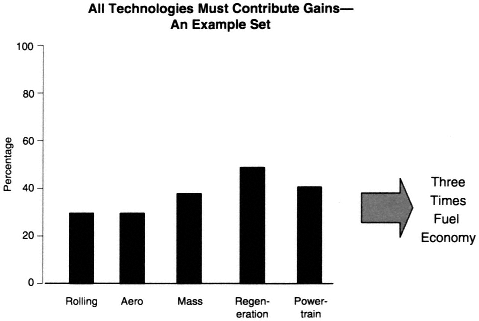
Figure 10.1
Reaching a threefold increase in fuel economy.
resources consistent with the requirement to demonstrate proof of technical concept at the vehicle level in calendar year 2000. Toward that end, technology selections scheduled for calendar year 1997 were accomplished and focused attention on lightweight materials, four-stroke direct injection engines, hybrid electric drivetrains, and fuel cell systems (see Figure 10.2).
Proof-of-technical-concept vehicles will demonstrate the fuel economy attainable in fully realistic five-passenger vehicle designs during calendar year 2000. The concept vehicles are deliverables for the industry that is responsible. The government is responsible for support of the high-risk R&D needed to create the knowledge base that underpins the technology development. The next stage of the program will focus on improved vehicle utility and reduced cost as the program drives toward production feasibility. The many needs for new understandings in chemistry and physics will underlie the manufacturing challenges in that focus period of the program (see Figure 10.3).
Elements of the Program Critical to its Success
Of the many critical features of this program, six can be highlighted as essential to its success from an industry perspective:
- Compelling significance: societal benefit and technical challenge,
- Commitment,
- Cognizance of market forces,
- Reinvention of relationships,
- Diverse resource base, and
- Accountability.
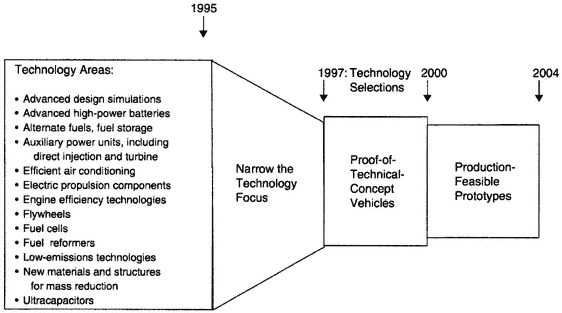
Figure 10.2
PNGV schedule. The plan: Invent on schedule.
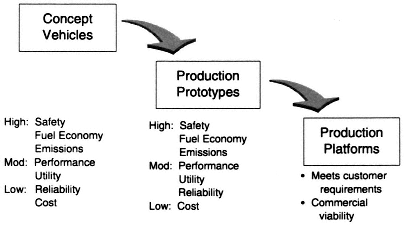
Figure 10.3
Evolving priorities.
This listing is not intended to be comprehensive, but to provide focus points for discussion.
A compellingly significant societal benefit is essential to build the breadth of support required to attract inspired technical thinking and to maintain financial support over the full duration of the program schedule. From the government's perspective, the PNGV program addresses several pressing national objectives: U.S. energy security, global warming, balance of trade (oil and auto imports), and economic competitiveness. From industry's perspective, the PNGV program provides, in addition, a U.S. demon-
stration of nonadversarial government-industry problem solving and the leveraging of resources toward U.S. transportation objectives. Nonadversarial government-industry problem solving and leveraging of resources have prospered in the health, agricultural, and defense sectors. PNGV offers a complementary model to improve the quality of life and meet significant national objectives in transportation.
A compelling technical challenge has historically attracted the best technical talent to think of novel solutions and accept the risk of pursuing them. The challenge of designing a car that gets up to 80 miles per gallon with comfort, performance, and utility for five passengers while maintaining compliance with safety and emissions requirements has demanded novel and cooperative thinking for every component and subsystem and every manufacturing process to lay the foundation for the 21 st century.
Experts stimulated by seemingly impossible technical targets have risen to the challenge to find solutions that have built the probability of success from near zero at the beginning of the program (when no solutions were evident) to today's favorable expectation for the proof-of-technical-concept vehicle demonstrations in calendar year 2000. The subsequent phase of the program, the production-feasible prototypes in calendar year 2004, is likely to present even greater technical challenges.
Commitment at the highest responsible levels of the participating organizations has been critical to maintain resources and a sense of significance. In an environment of fixed government research funding, support of good new ideas and pursuit of worthy new objectives requires that funds be diverted from programs already under way. In industry, competitive requirements to cut costs and meet current market challenges result in continuing pressure to divert funding from ongoing development programs. A very public and personal commitment to the goals of the PNGV program by the government leaders in both the administration and Congress, and in industry, has been essential to maintain the focus of resources on the program objectives over the past five-year period.
Cognizance of market forces is essential for significant and long-term industry participation. American market forces in the personal transportation sector are dominated ultimately by preferences of the U.S. customer. As evidenced in Box 10.1, customer preferences for fuel economy reflect the price of
|
BOX 10.1 Purchase Priorities for U.S. Car Buyers in 1980 and 1994
|
||||||||||||||||||||||||||||||||||||||||||||||||||||
gasoline, which is currently at a historical low as a percent of average income. As a result, current market forces do not support responsible investment of industrial investment in fuel economy. Two offsetting factors are critical to this program. First is the awareness that current market forces can change, and investments in technologies for improved fuel economy provide security against that shift. Second, and of primary importance, is the leveraging of the investment risk by government funding of targeted R&D to offset the market deterrents caused by individual purchase choices in favor of the societal benefit.
The reinvention of relationships has characterized PNGV in four respects. First, the competing partners (the domestic manufacturers) agreed to fundamental guiding principles for the PNGV program: (a) the prime objectives are the achievement of technical goals and credibility in progress toward societal goals and national competitiveness; (b) credibility requires sustained commitment and visible progress; and (c) collaboration will be the preferred approach whenever feasible. Second, the working relationship between industry and government participants was defined. Government and industry technical communities committed to jointly defined goals and a vision of success, which developed a common technical strategy. In the implementation of the joint technical strategy, the government role focused on provision of R&D resources, convening power (national laboratories and government suppliers), and coordination of regulatory and infrastructure issues. The industry role focused on provision of R&D resources, convening power (industrial supply base), and coordination of market requirements. The joint technical strategy was developed in support of vehicle-level requirements by identifying and prioritizing technical opportunities; setting performance targets and milestones for subsystems, components and materials; and identifying resource responsibilities (see Figure 10.4).
Next, relationships between the principal automotive manufacturers and their supply base shifted to include far-term technology development targets and the rapid deployment of evolutionary applications. The domestic manufacturers provided encouraging evidence of their commitment to pursue commercial product opportunities. Suppliers were encouraged to cooperate to leverage their capability for more rapid technical progress. Last, relationships with universities were shifted by linking research requirements to performance targets and program schedules, and by coordinating industrial research objectives with government objectives and programs.
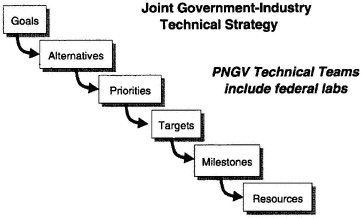
Figure 10.4
PNGV strategy.
A diverse resource base beyond the traditional automotive technical community has been required to leverage rapid advancements in computing and electronics for hybrid electric drivetrain development, to tap opportunities for fuel cell systems, and to tackle the breadth of materials requirements to meet the PNGV goals. Technical talent has been required with basic, developmental, and applied expertise. Matching the breadth of technical talent has been a broad funding base including the federal government, the automotive manufacturers (collectively and individually), and the industrial supply base.
Key issues in maintaining stability in government resources have been a commitment by otherwise divergent political interests to the goals of the program and its evidence of progress and careful consideration of the alignment of individual government agencies' missions with PNGV technical objectives. Early concerns about corporate welfare were resolved by recognition that little of the government funding (less than 1 percent in 1999) passes through the automotive manufacturers, that the industry contribution exceeds the government contribution by a considerable margin, and that the government role serves to offset adverse market forces to encourage development of technologies toward national energy efficiency. A continuing issue remains with regard to government cost-share requirements that discourage participation by small innovative companies and noncommercial entities such as universities and contract research organizations.
Accountability is, perhaps, a unique feature of the PNGV. Accountability consists of three elements: hardware deliverables, visible milestones, and external technical audit. The hardware deliverables, which are obligations of the industry partners, consist of proof-of-technical-concept vehicles to be delivered in calendar year 2000 and production-feasible prototypes to be delivered in calendar year 2004.
Visible milestones have been produced each year during the program. They consist of measurable evidence of achievement of subsystem performance targets and intermediate concept vehicles presented annually at the North American International Auto Show. Achievement of visible milestones has been critical to sustaining the technical credibility of the program.
Finally, the program is subjected to extensive external technical audit. The formal element of audit occurs under the direction of the National Academies of Science and Engineering, which conduct an annual technical review and publish an annual report.1 The review has provided constructive insight and is generally quite supportive of the program priorities, targets, and progress. The informal element of technical audit occurs through the technical new media, which reports frequently and aggressively on the PNGV program.
All of these elements of accountability have functioned to ensure that the program maintains diligence in continually evaluating technical opportunities, funding priorities, measures of progress, and relevance toward the ultimate objectives.
Discussion
Joseph Cecchi, University of New Mexico: The issue of globalization has come up a few times, and here is an example in which this impacted in the middle of your program. Can you comment on how the Daimler Benz acquisition of Chrysler affected their participation, and in particular is all of the Mercedes Benz research in this topic part of the group now?
Christine Sloane: The United States Council for Automotive Research (USCAR), the organization through which collaborative R&D is undertaken within the domestic automobile manufacturers, is the organization through which PNGV is coordinated with the federal government. USCAR reaffirmed its mission and membership criteria. Those criteria include significant basic R&D facilities and engineering activity within the United States. Another criterion is that the full technical resources of the members are brought to bear on collaborative projects.
Joseph Cecchi: So that was a good deal.
Christine Sloane: If you mean that the R&D base is broader, yes.
Christopher Hill, George Mason University: I want to ask two quick questions about the political objectives of the program and whether they have been achieved. And the questions are impertinent, but they are highly relevant. In the year 2000 Democratic primary in Michigan, will the United Auto Workers support Bradley or Gore?
Christine Sloane: I don't know.
Christopher Hill: It's a critical political outcome because United Auto Workers' support for candidate Clinton was one factor that drove the program originally.
Christine Sloane: Let me add a personal perspective on your assertion. In 1994, the majority party in the Congress changed and advocated different political objectives than the administration. There was considerable scrutiny to eliminate "corporate welfare" programs, and the PNGV program was reviewed extensively by the new majority party in that light. The majority party, through its actions in the appropriations process, has supported the PNGV program at roughly constant levels over the past five years. So while Mr. Gore was very involved in the initiation of the program, its supporters crossed party lines both at the outset and today. The reason, of course, is that the societal benefits for the country override party allegiances.
Christopher Hill: That's an important observation. The second question, closely related, is that this program has managed to forestall any increase in Corporate Average Fuel Economy (CAFE) standards over seven years, but what it hasn't forestalled is the radical shift in market share from passenger autos to trucks and sport utility vehicles (SUVs). We are now beginning to see pressure to impose on them some of the performance standards that passenger vehicles have been under. How will that affect this program?
Christine Sloane: The PNGV program charter refers to passenger vehicles, not cars. A primary milestone of the program, however, is the delivery by the automobile manufacturers of proof-of-concept cars that provide up to 80 miles-per-gallon fuel economy, safety, emissions, and utility comparable to midsize passenger cars. So in that sense, the program's focus is stronger on cars than on trucks. However, virtually everything that we are developing collectively—for lightweight structures, compression ignition direct injection-based powertrains, emissions control, electric drive comportentry, fuel cell componentry—can be applied to SUVs and trucks. Indeed, all of us are seriously looking at applying these technologies across the product line, definitely including SUVs and trucks. Indeed, if you look at this year's auto shows, you will see fuel cell power systems in SUV-concept vehicles.
Ashok Dhingra, Dupont: What part of your new concept car in 2000 will involve materials innovation and what will involve the innovation in energy such as fuel cells and other competing technologies?
Christine Sloane: We cannot approach the threefold fuel economy without employing the most advanced technologies for powertrain, reduced vehicle weight, reduced auxiliary power losses, and reduced aerodynamic and rolling losses. In the drive for reduced weight, two primary factors influence material usage: strength to maintain excellent safety performance and cost to provide customer affordability. The year-2000 vehicles will be revealed in January with full descriptions of material use. Early indicators suggest that there will be at least two aluminum-intensive designs.
We expect that the three companies will produce three different realizations of lightweight vehicle design. Two will be aluminum-intensive, that is, involving aluminum structure. However, all three manufacturers will use composites extensively where weight savings can be achieved consistent with reasonable cost potential.
Ashok Dhingra: And the composite materials?
Christine Sloane: The vehicles have not been announced yet, so a definitive statement of materials usage today would be premature. But surely, just as today's vehicles are not made of one material, these concept vehicles will use composites extensively. By the way, it can be misleading to cite material usage in a vehicle in terms of the percentage of the vehicle weight. For example, if half of the material in a car is replaced by new materials that weigh half as much as the old materials, the weight percentage of the new materials will only be 33 percent, not 50 percent, even though the lighter materials have replaced half of the car.
James Desveaux, University of California, Los Angeles: Do you think that your experience with USCAR, or for that matter with any other significant collaboration, has fundamentally altered the climate of trust between General Motors and the government? You made a point early in your talk that government, whether at the state or federal level, often sets technological standards for you to meet and only later realizes that for technological reasons, they have set a threshold that is too high and is one that you cannot meet. Government understands that they need to throttle back on requirements, while industry has spent millions or tens of millions in an effort to meet those standards, and they see little or no reward for the effort.
But from the government's perspective, there is a history of disingenuousness on the part of the auto industry. Here I am thinking of the CAFE standards, and the claims by industry that these and other Environmental Protection Agency requirements were impossible to meet, which were proved in many instances to not be the case. So my general question is, have some of these mismatches and problems in perception and trust between you and government bureaucracy gotten better as a result of more collaboration in R&D?
Christine Sloane: Trust is hard to measure; it's an outgrowth of in-depth understanding, evidence of actions, and mutual experience in working problems. There is no question that the PNGV program has afforded the federal government insight into the development of technologies within the automotive industry and the opportunity to validate its assessment of technological challenges. Indeed, the technical challenges are fairly clearly identified, and the state of progress in the collaborative projects to surmount them is evident to the participating government scientists. So the government agencies that are working with us have a sense of reality about what is technically feasible. They are entrained in the
challenge too. They don't always have to take our word for it. In a sense, that alleviates the reliance on trust, or from another perspective, it buttresses trust. One caveat is that the Department of Energy is the primary government agency that is engaged with us in solving the technical challenges, so other government agencies have a less direct basis for understanding.
Beyond the technology projects, there is considerable evidence that PNGV is creating a push to develop advanced technologies for enhanced fuel economy. Early PNGV activity appears to have spurred early activity in JCAR and EUCAR (corresponding Japanese and European car programs), which in turn create a competitive environment for fuel efficiency. As a result, Toyota has announced the introduction of a moderate-sized car with a hybrid electric drivetrain for the United States in 2000, and General Motors has announced a hybrid electric truck, just to name a couple. So the spin-offs are already beginning. The PNGV focus, however, is to push the development to an even higher level of fuel efficiency.


