
3—
University-Industry Strategic Alliance: A British Perspective
P. O'Brien, William A. Wakeham, and J.T. Walsh
Imperial College of Science, Technology, and Medicine, London
The marked shift in United Kingdom and European government policies away from the direct support of research within the higher education sector has led universities to alter the focus of their search for funding much more toward industry. At the same time, governments have encouraged increased collaboration and the exploitation of the results of university research. These changes present new challenges for universities in the maintenance of academic freedom and excellence in scholarship that constitute their primary mission.
We describe how one European institution, Imperial College of Science, Technology, and Medicine, has been developing new approaches and initiatives that provide new opportunities for supporting fundamental research. Multidisciplinary strategic alliances represent an approach that has allowed the college to develop research in a commercial context while maintaining its academic purpose and excellence. However, it must be recognized that making such strategic alliances work successfully can be a difficult process requiring universities to establish new practices and methods of organization to take advantage of the industrial funding of research which will become increasingly important in the future.
Introduction
In this chapter we necessarily write from the perspective of a university with the highest research income in the United Kingdom and one with a relatively small endowment. We also write within the funding context of the United Kingdom, which has been following a particular trend that has been at some variance with the remainder of Europe, although there are signs now that other countries are following the same track. Furthermore, even within the United Kingdom, Imperial College is at one extreme of a spectrum of higher education institutions by virtue of its concentration on science, technology, and medicine and its focus on research. Thus, whereas our description of the behavior of Imperial College does not describe an average institution in a typical European country, it does indicate the direction for all European countries and institutions.
In Europe, higher education has always been funded directly by the government in large measure.
Until very recently, nearly the whole of the tertiary education system, including the staff of universities and their infrastructure, their research, and the undergraduate and postgraduate students, were all supported by central and, in some European countries, local government. Indeed, in some countries such as Germany, the academic staff members of the university are government employees. Government funding of a particular university amounted to as much as 85 percent of the university's income until the early 1980s. This funding has always been supplemented for research with grants from individual government agencies on a competitive basis, and governments of different countries have continued to support research in a collaborative manner through the European Union (EU).
In general, within Europe, the spending of gross domestic product on research is less than that spent in the United States and Japan, although there is a considerable variation within Europe and the gap is narrowing somewhat. However, one feature within the countries of the EU is a trend from high- to low tax economies. Such a shift has made it harder for governments to justify funding the costs of student tuition and subsistence and the direct and indirect costs of research from which companies, rather than individual taxpayers, are seen to benefit. The United Kingdom, in particular, has experienced this change, and it has culminated in the introduction of student fees payable by individual students from the United Kingdom and even higher fees for overseas students. At Imperial College the transition has been such that, in place of 85 percent of the costs of the university being met by governmental direct funding, the figure is now below 40 percent, as illustrated by Figure 3.1, and has not been matched by an increase in the sums available competitively for research funding from government agencies. In some Southern European countries, this trend has been much less pronounced.
The direct consequence of this reduction is threefold depending on the nature of the university. For those universities with little research, a dramatic increase of student numbers (home or overseas) funded by fees and/or the central government can assure financial viability. Other universities with large independent endowments are cushioned against hard times by their assets and given the opportunity for further growth. For Imperial College, the relatively small endowment and the impossibility of a substantial growth in numbers of high-quality students has meant that the college has to focus its
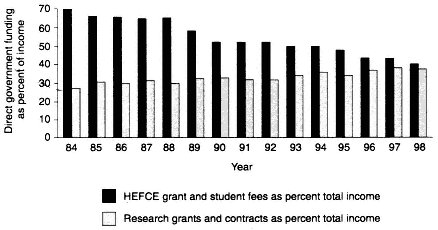
Figure 3.1
Percentage of Imperial College income met by government funding, 1984–1998.
HEFCE, Higher Education Funding Council for England.
reactions to these developments. To ensure its development it has relied on its research base to finance its activities through new mechanisms. These new mechanisms have included the search for new opportunities and new markets for science and technology. The most significant example of this is Imperial's creation, by merger, of the largest medical school in Europe. This has, in part, been driven by the belief that medicine can benefit substantially from the interaction with basic science and engineering and also by the pragmatic observation that future government funding will increasingly be in health and related activities in the new century.
A New Climate
The changes described above affected the composition of research income and altered the proportion of funds from various sources, so that today, for Imperial College, 60 percent of research income is derived from non-U.K, government sources, as shown in Figure 3.2. This has in turn ushered in other more far-reaching developments. Hitherto its reliance on central government funding induced a culture of dependency and militated against risk. Universities were conservative institutions intent on protection of intellectual property because any alternative was thought to be a potential misuse of funds. In the new climate, the diversification of our funding base has meant that the college can now take advantage of new opportunities and is no longer prevented from taking (albeit calculated) risks.
The environment in which universities operate has also been modified as a result of other government policies. Attempts to increase the fraction of the population engaged in higher education in the United Kingdom from 25 percent to 40 percent has shifted the focus from research-based universities to
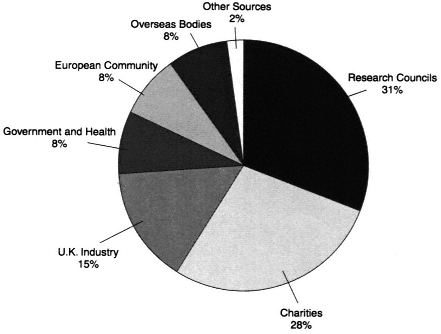
Figure 3.2
Research income for Imperial College, 1998.
teaching-based ones. Although the financial provisions made for these additional numbers ensure that teaching-based universities are financially viable, the system now makes it increasingly difficult to have a highly focused teaching university that is also active in research. Government initiatives to support research have changed the conditions even further, emphasizing the importance of industry as both a stakeholder in higher education and as a potential source of funding. This is reflected in the initiatives that have been forthcoming.
Government Initiatives
One recent initiative has recognized the relative lack of a venture capital market within the United Kingdom and thus the government has organized a competition for seed capital funds for universities. The successful universities have been granted a capital fund, which is simply constrained to developing the intellectual property they own. The mechanisms can range from the development of patented ideas toward the marketplace through licensing, to the creation of spin-out companies. This concept moves as far as possible from the tradition of risk avoidance. Other, longer-term programs have also been developed to support the government' s increasing expectation that the results of research that they, or others, sponsor should be exploited and marketed. As well as this stimulation of an increased exploitation of research results at the output stage of the research process, governments have become increasingly keen to stimulate interaction between industry and universities at the input stage that will allow research ideas to develop and be exploited in an industrial context. One example of an intergovernmental approach of this kind is provided by the Fifth Framework Programme of the EU. This is the latest of a series of programs of technical endeavor funded by the EU but it is a far cry from the early programs whose main purpose was the stimulation of international contacts in science. It is an essential part of the latest program that there be industrial involvement and an exploitation strategy.
Within the United Kingdom, the so-called "Link Programme" is another example of a government initiative that brings industry and universities into more intimate contact. It functions through a consortium of industrial companies funding precompetitive research jointly with the government. This sort of funding is particularly associated with the Foresight Programme organized by the previous United Kingdom administration. In this program all interested parties including industry, government, and universities were invited to contribute through various sectoral panels to identify the top priority areas for research in the country. This process allows targeted funding for these research areas without provision of new money. Since 1995 this has lead to about 20 very innovative research partnerships between industry and universities, each with a value of roughly £200 million, which is equivalent to two-thirds of the annual United Kingdom budget for physics.
"Realizing Our Potential Awards" is a further illustration of research support that, in this case, seeks to encourage universities to undertake research with a relationship to industrial needs. Specifically this scheme offers a "blue-skies" research grant for an investigator who has held a qualifying applied or strategic industrial research contract funded by industry. The work carried out under such a grant is itself not permitted to be applicable directly to industry, but there is obviously a strong indirect incentive encouraging such work.
Infrastructure for Research and Industry
The frequency and range of these initiatives, as well as their specific nature, has encouraged universities to adopt quite different structures than have been traditional to manage their operations with regard to research and industry. To enable us to participate in these government initiatives and to take
maximum advantage of industrial opportunities, Imperial College has developed a support infrastructure for managing research contracts and grants. Thus, on top of the usual activities associated with the negotiation and agreement of many kinds of contracts for research with a variety of government and nongovernment agencies, the college has added specific entities concerned with intellectual property exploitation, the provision of scientific services, and consultancy. It is the view of the college that it is no longer acceptable for these activities to be conducted in a rather amateur fashion but rather that they must be pursued with full commercial rigor. For this purpose it is necessary to employ staff with industrial training and appropriate professional qualifications. Necessarily, these staff members have a different culture from that of the traditional employees within a university and there are tensions created that have to be managed, not least with respect to remuneration.
An important element of this increasingly professional approach to research management has been the desire to evaluate the full costs of all activities, including research. Imperial College has been at the forefront of this activity-costing exercise in the United Kingdom and has aggressively pursued policies of the full funding of research by all sponsors. Combined with a rigorous policy of intellectual property ownership and high quality of research, this approach to overhead recovery has more than maintained the financial situation of the college and developed intellectual assets of considerable value.
For some considerable time the college perhaps cared rather more about the protection of those intellectual assets than about their exploitation, partly because of the aversion to risk. However, this view has been moderated recently as pressure from the academic community and government to see the results of research exploited has increased and the reasons to fear risk have diminished. Instead the college now takes the view that the exploitation of intellectual property generated by staff is an important factor in retaining high-quality staff. Indeed, this is seen as the primary motive to seek exploitation. Whereas there is always the chance of generating income from licensing or equity growth in companies from exploitation, the former route is safe but seldom lucrative and the latter has a very small chance of success. Indeed, it is well known that rather few technology transfer offices of universities cover their costs, as the chances of great success are small. Neither of these is, in the end, a primary motive for the college to seek exploitation of its intellectual property rights, although, of course, the college would not spurn such success or income!
Imperial College has a technology transfer company (IC Innovations) that is staffed with technology transfer professionals who identify the commercial potential of research and market it, sometimes, when appropriate, by forming spin-out companies or, more often, by licensing. When a spin-out company is created, the college normally takes a share in the equity, which is justified by its investment of its intellectual property rights in the spin-out. However, the share is usually, but not always, a minority one, and the independent companies are left to exploit the intellectual property rights in the best commercial manner possible with a strictly arm's length relationship with the college. The college has a wholly owned subsidiary that can provide its spin-out companies with legal and business mentoring services and advice; it also aids them in their search for venture capital.
In addition, the college operates a consulting company called IC Consultants (ICON), which markets the expertise of the academic staff as consultants. It accepts the professional liability for the provision of such consulting activity and negotiates the fees for the work of individuals and groups. ICON also markets the use of the college's scientific research facilities for use by industrial partners when they are not in use for their prime purpose of college research. Thus, for example, unique wind tunnel facilities have been made available at commercial rates for the development work of Formula-1 racing teams in a manner that provides funding for future college research in a complementary fashion. This particular college company has been important in establishing linkages with small companies with fewer than 200 employees. Such companies have proved to be rather difficult for Imperial College to reach and engage
in research. In part this is because, for small companies, the typical size of a research project is a large sum of money but also because they are interested in focused short-term work rather than longer-term strategic research. ICON is a further example of the college' s commitment to see the ideas and expertise of its staff members exploited for their own benefit and that of the college itself.
Strategic Alliance
An even more recent addition to the armory of means of interaction with industry is the rather extensive mode of partnership between a company and a university that we term a ''strategic alliance." The concept of the strategic alliance is a relatively new concept in Europe in terms of the relationship between universities and industrial partners. The characteristics of such an alliance are that it will be a long-term partnership across a number of the university departments or disciplines, usually beyond the life of a single research project contract, and will normally involve a large multinational company. The alliances are open ended with no limitations on what sort of interaction might be involved so that it can include staff exchange, undergraduate recruitment, and student prizes or endowments. An open negotiation is fundamental in getting an alliance to work and must proceed from a position of mutual trust toward an agreement for mutual benefit. Such mutually beneficial arrangements do not follow automatically from the signature on an agreement. Rather, they take a considerable amount of work on both sides to stimulate and refresh the interaction. When they work, the benefits are substantial to both sides because the process builds a relationship that has a broad base within both the industrial organization and the higher education institution and a degree of interdependence founded on respect for what each party brings to the relationship, which makes it more than the relationship of a provider and a customer. For example, universities generate many of the new ideas and the future employees needed to perpetuate a vibrant industrial sector, but it is in the interests of both parties to ensure that graduates are employable and that ideas with potential are commercially exploited.
One example of such a strategic alliance at Imperial has been the involvement of two pharmaceutical companies, Smithkline Beecham and Zeneca, who have supported not merely a research project, but the entire discipline of analytical chemistry by funding a center at Imperial in that topic. This was because the two companies believed that the national need for people with such skills (which was particularly acute, although not confined to them) was not being fulfilled by existing activities. The center has grown with their initial support into a dynamic center training students and staff and performing innovative research for those two companies and others. Another example, particularly in a European context, is the increasing desire of companies to have graduates with a multinational and multilingual background—something that the college also encourages. Our industrial links with several multinational companies across disciplines and national boundaries allow our students to work outside of the United Kingdom on internships or projects benefiting themselves and their future employers, whether they be the project sponsors or not. It might also be said here that the development of strategic alliances between universities in several countries with some of the same purposes in mind cannot be far away.
For strategic alliances to be successful, hard work must be added to a carefully constructed framework. Our experience has shown that commitment from a company and the university partner must be long-term, flexible, and at a high level in both institutions, and not be confined to a single project, a single academic investigator, or a particular company division or academic department. The alliance should begin with a network of collaborative projects and relationships between the two partners; and when this base has been established, further activities, funding opportunities, and industrial partners can be developed with great ease.
An essential part of the framework of the alliance has been a practical realization by the university
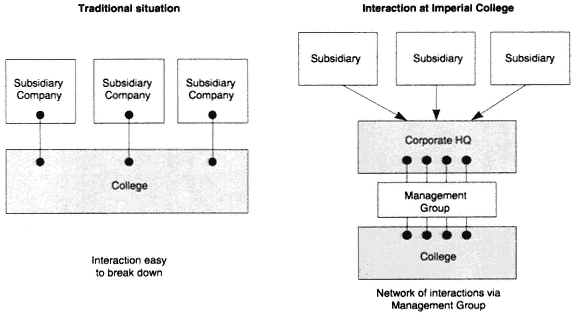
Figure 3.3
Strategic alliances.
of the industrial need to seek solutions without regard to discipline. This has encouraged the development of a different university structure for research from that which remains appropriate for the education of undergraduates where a single traditional discipline remains the norm. The use of a broadly based management group for each strategic alliance has also been a key part of this development. This group includes representatives from both sides involved: members of several college departments and several members of the company at the corporate level. This body has operated to remove barriers to communication between the two partners and internal barriers within the two individual components of the partnership. The inclusion of high-level representation in the group has the added benefit of a communication between entire organizations rather than individuals, which enhances the networking, the trust, robustness, and effectiveness. The change in the nature of the interactions between a university and a company introduced by a strategic alliance is illustrated in Figure 3.3, where it is compared with the more conventional interaction.
It is evident that the network of relationships between a university and a company, exemplified by Figure 3.3, has enormous benefits to both partners in the context of government support for interaction as discussed above. The alliance provides ready-made partners for collaborative ventures in which the sums of money invested by the company in the university enable other funds to come from the government and, in the European context, intergovernmental funding that makes use of the multinational nature of the industrial partner.
An Example of an Alliance
Among the strongest alliances that Imperial College has established to date is that with Air Products and Chemicals, Inc., a company operating in a number of sectors throughout the world. This is a prime
example of how an alliance has brought about changes within Imperial College that had been more difficult to accomplish without the interaction. The relationship has been a productive one in terms of scientific output, some with commercial potential, some effective student exchanges, and the acquisition of new research funding inaccessible without the relationship. In this relationship we jointly created an arrangement in which Air Products provides an annual sum to fund research. This sum is available to bids from academic groups within the college and judged by a panel made up of staff from the college and members of the company. For projects to be successful, they must have the support of a business sector of the company as well as a corporate drive. That support may be expressed in writing or through separate funds supplementing the corporate funding. The result of such an arrangement is of obvious academic benefit to the college and potential commercial benefit for the company. The projects have brought together members of the Chemistry, Chemical Engineering, and Materials departments at Imperial College in a new manner to achieve a common end. This particular alliance has also had a profound effect on the Chemistry Department at Imperial College since it contributed to a new-found confidence for interactions with industry. The department has raised its research income from industry to nearly 70 percent of its total research income and to a figure three times greater than five years before. Obviously, strategic alliances also have considerable financial benefits in addition to those of an academic kind.
In addition to the direct benefits, it is worth pointing out some less obvious gains from strategic alliances that are, nonetheless, important. Agreements over intellectual property and overheads can be negotiated once instead of for each individual research project; as well as being more convenient, this also in some small way reduces the college overhead itself by reducing the amount of staff time spent on negotiation.
Academic Freedom?
One of the most obvious concerns when pursuing any kind of collaboration with industry is that there will be a divergence of motives that could lead to a loss of academic freedom. However, as illustrated above, the basis for a strategic alliance is one of mutual benefit, only where a convergence of interest between the college and the company is feasible. In addition to mutual interest, cooperation and trust are equally important in the foundation of such an alliance. These elements of the agreement are usually enshrined within an overall memorandum of understanding that spells out the rights and obligations of each party. Although such agreements will usually encompass general conditions surrounding the alliance, they will not include any restrictions on the college in terms of other collaborations or areas of activity. Such conditions on confidentiality as there may be will be held within individual project agreements. Thus, there is no compromise of academic freedom and, indeed, it may be argued that such freedom is enhanced by the provision of additional income, especially that which meets overhead costs. Furthermore, because some government schemes reward industry-supported work with a blue-skies grant, there is a further stimulus to independent, innovative work.
Conclusions
The reduction of centralized governmental funding for universities within Europe, and the United Kingdom in particular, has altered the relationship between industry and higher education institutions. It has proved possible for a research-led university to develop a relationship with several multinational companies that enhances its research activity and enhances the relevance of its research without any compromise of its scientific freedom. These relationships have several characteristics in common,
which have encouraged multidisciplinary approaches to research and the development of long-term interactions with a greater stability than achieved by isolated project grants. Indeed, government measures within the United Kingdom and the EU have introduced new schemes that make government funding more easily secured with such alliances in place.
Discussion
Fritz Kokesh, Massachusetts Institute of Technology: You indicate that over a period of time, Imperial College's position on intellectual property has changed. Could you explain this further?
William Wakeham: Essentially, if we have to pay a fraction of the cost of the research, meaning if the industrial company does not pay entirely, we would expect to own the intellectual property. The more that industry pays toward the full costs, the more they can share in the intellectual property. If they pay the full costs, there is a reasonable argument that they may be allowed to keep it as long as they promise to exploit it.
One of our concerns is that many companies choose to keep the intellectual property in order to not exploit it, to prevent somebody else from exploiting it. So we usually try to write provisions into the agreements that someone must exploit it.
Fritz Kokesh: Would you explain more fully about what full cost means?
William Wakeham: We have worked out our full overhead rate using fairly simple, but government-approved, rules as to how to cost our activities. We know, for example, by survey, how much time our academic faculty spend on research and how much time they spend teaching. Once you have this information, you can cost all of your research activity and prove what the costs are. And in negotiations with a multinational company, you have to prove this and a lot of other things about what you say. If you say your overhead is "x," they want you to prove it. And you have to be able to. Traditionally this is not easy for a university. One of the points I made in my presentation was that we employ people who are from industry in our industrial liaison office. They can do these calculations in a hard-nosed way and in a way that the people on the other side of the table will appreciate.
David Schetter, University of California, Irvine: Are the faculty allowed to strike their own independent consulting agreements under this icon, or is it a requirement of the institution that everyone participate? Second, how do you initiate a strategic alliance? Does identifying opportunities come from the faculty up, or from management down? How are those put together from the start?
William Wakeham: The consulting company is not obligatory. Perhaps I should say that, in a British context, the academic people are much less aggressive in negotiating their fee. They are prone to do things out of interest, not to make the right amount of money from it.
One of the uses of an icon is to negotiate the fees. It also negotiates a cover for professional liability and provides a separation between the university and the liability. In a test case at one of our universities, an individual member of the faculty did a consulting job, got the wrong answer, was sued by the company for getting the wrong answer, and the university was found liable even though the faculty member never used the university note paper, telephone, or anything. This is a dangerous precedent. So we now use a company to separate the university. The consulting is taken by the company and sub-
contracted to the individual. And, of course, if you are an individual member of the faculty, you can see the advantage in this arrangement.
Regarding your second question on who initiates strategic alliances, it can be either from the faculty up or management down. In the case of Air Products, it took place because one of our alumni was a vice president of research at Air Products and suggested that it would be a good idea to get back together at Imperial College. But in some cases, it's been a top-down decision by someone such as myself, saying that we should talk to Smithkline Beecham about analytical chemistry, which in our case disappeared into almost nothing inside the Chemistry Department. We wanted to build up again. It turned out that the department could see a national need for that because no one was being trained in analytical chemistry. Several pharmaceutical companies then came together and agreed with us. It wasn't sponsoring particular research projects, it was the existence of the discipline that was supported. So there has to be a synergy between what the companies want and what the college wants.
Janet Osteryoung, National Science Foundation: Have you run into any problems with some of your external partners bumping into each other inside the university?
William Wakeham: Yes. Our linkage with British Petroleum (BP), for example, which is in the area of catalysis, essentially supported about 30 people in one laboratory in a particular area. The type of catalyst being studied was of interest to more than one company. Imperial Chemical Industries (ICI) was also interested in that catalyst, but for a polymer that was of no interest to BP. So we tried very hard to get the companies to understand that they could work together. In the end it failed. ICI would not be involved because BP was already involved, even though the technologies coming out of the alliance would have been completely independent.


