
2
Process Issues
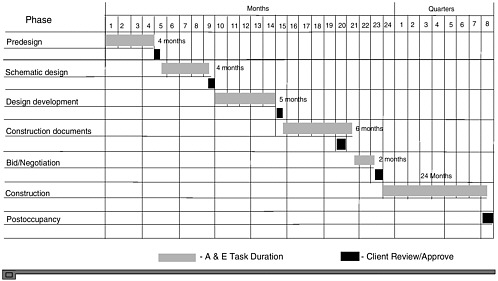
Laboratory facilities are complex, technically sophisticated, and mechanically intensive. Constructing or renovating them requires careful planning guided by an experienced design professional. During the planning and construction phases, a great number of decisions will have to be made. To ensure a rigorous decision-making process, formal lines of communication and authority among the participants should be established early in the planning stages. As the project progresses, it will become necessary to establish mechanisms for other aspects of the process, such as rigorous reviews of design and construction documents, and a document approval process. It is also necessary to establish mechanisms for controlling budgets and change orders. Finally, before the project is completed a plan for the future maintenance and operation of the building should be established through an owner stewardship plan and building commissioning. An overview of a typical time line for these processes is given in Figure 2.1.
Because the processes of designing and constructing a laboratory building are dominated by the activities of the design and construction professionals, this chapter is divided into sections that correspond to the professionally designated phases of a project: predesign, design/documentation, construction, and postconstruction. It is, however, essential for the facility's owner, users, and other individuals collectively known to the design professional as the client to understand the responsibilities and limitations of the design and construction professionals and the means by which the client can most meaningfully contribute to the success of the project.
PREDESIGN PHASE
The goal of the predesign phase is to identify the project's scope and budget as well as any issues that could influence the subsequent design/documentation phase. Although this phase is often slighted in project budgets, experience has shown that its successful completion enhances the probability that the construction or renovation project will be completed within the prescribed schedule and budget. Sufficient funds should be allocated for this vital phase.
The predesign phase often includes an inventory and evaluation of existing facilities, identification of facility program requirements, development of preliminary planning alternatives, and completion of preliminary cost estimates. The predesign phase for a particular project should be coordinated with any strategic or master plan previously developed for the institution. If a strategic or master plan has not been developed, the predesign phase could be used to initiate the development of such a plan.
Procedural Guidelines
Due to the complexity of laboratory facilities, the design, construction, and renovation processes should be planned as carefully and thoughtfully as the laboratory facility itself. This applies to all phases of the project—predesign, design/documentation, construction, and postconstruction. Careful planning is required because of the number of individuals that should be actively involved in the processes as well as the number and types of issues that need to be considered throughout the project.
Decision-Making Process
Decisions made during the predesign phase set the direction for the entire design/documentation phase and subsequent construction or renovation. The client should therefore develop early on a decision-making process and establish lines of communication and authority that will serve throughout the project. Committees and decision-making processes and authority should be established to ensure appropriate input and participation. For example, decisions related to laboratory components will need the input of researchers, whereas decisions related to the number of laboratory modules will need input from administration representatives.
Participants and Participant Responsibilities
The number and types of participants will vary from project to project. However, many projects require a minimum number of groups and teams. Principal among these are the client group (which includes the client team, client
senior administrative and financial officials, environmental health and safety (EH&S) personnel, and representatives from the facilities/operation and planning departments) and the design group. These teams and groups are described in the "Participants" section of Chapter 1. The role of the individuals within the client group is to provide input for various components of the predesign phase including facility programming, facility evaluation, and site planning.
The responsibilities of the client team during the predesign phase typically include input to and review of the various documents that will be included in the predesign phase report, including a facility evaluation, facility program, preliminary design alternatives, and preliminary construction cost estimates. The client team members derive their authority from and represent other individuals who are not within the client team, such as representatives from the users, administration, facilities, and finance.
The senior administrators' role is to assist in the identification of project goals, periodically review the progress of the predesign phase, and provide comments regarding the project's process as it relates to their expectations. This group may include representatives from the administration such as the president, provost, dean, and CEO; representatives from the business office such as the vice president, chief financial officer, and treasurer; and representatives from the development office. In addition to charting the project's course through the development of goals and periodically reviewing the project's direction, these individuals may review the various alternatives prepared by the client team and decide which alternative(s) should be selected for further consideration during the subsequent design/documentation phase. The selection of the alternative(s) will most likely include decisions regarding project size, program components, location, schedule, and cost.
Representatives from the users should provide detailed descriptions of the proposed facility through a series of interviews with the design professional. The user representatives should, therefore, be individuals who can describe the functional, area, utility, and environmental requirements of each space to be included in the project. They, in turn, obtain this information by direct consultation with the users, as discussed in the "Sociology" section of Chapter 1. These areas include research laboratories, laboratory support rooms (e.g., instrument and equipment rooms), shared support spaces (e.g., animal rooms, chemical storerooms, radiation laboratories), offices, and shared amenities (e.g., cafeteria, lounges, libraries). Information for other special areas, such as chemical stockrooms, supply storerooms, receiving, and custodial spaces, is also required. The users must, however, clearly understand that it may not be possible to accommodate all of their wishes in the final design and should be realistic in their requests.
If the project involves a renovation or an addition, EH&S personnel and representatives from the facilities/operation department should work with the design professional in developing a thorough description of the scope and condi-
tions of existing facilities. The EH&S and facilities/operation representatives are responsible for (1) providing the design professional with previously completed studies and documents of the existing facilities (such as existing-conditions drawings), a description of the scope of required renovations, and a list of deferred maintenance items, and (2) reviewing and approving drafts of the facility evaluation prepared by the design professional.
If the project involves an addition or new building, representatives from the office or planning department responsible for overall campus/site planning activities, or a planning consultant previously engaged to complete a strategic or master plan, should assist in the selection of a site for the new construction. If a strategic or master plan has not been previously developed, the predesign services may need to be expanded to include this planning exercise so that the anticipated project can be coordinated with other potential projects in terms of siting, vehicular and pedestrian circulation, and utilities.
The responsibility of the design group is to work with the client group to produce the facility evaluation, facility program, preliminary design alternatives, and preliminary construction cost estimates that constitute the predesign report. If the client group includes a staff of design professionals, the design team should work actively with them throughout the project.
Primary Point of Contact
Throughout the predesign, design/documentation, and construction phases, a single individual should represent the client group and guide the process. This person is designated the project leader. On large projects this individual is typically the client team's project manager; for smaller projects, especially in smaller institutions, this person is often the user representative. The project leader works closely with the user representative and is often the liaison between the client team and the senior administrators as well as between the client team and the other members of the client group. He or she is responsible for the sustained progress of the project; serves as the primary point of contact for all communications between the client group, design group, and the construction group; and ideally attends all meetings scheduled to discuss existing facility evaluation, proposed facility program requirements, renovation scope, and/or new construction size and site. In other words, the project leader must be familiar with virtually every detail of the project and should be relieved, at least in part, of other responsibilities in order to allow sufficient time to perform his or her project-related responsibilities.
The design group should similarly be guided by a single individual who is responsible for all communications from the design group to the client team, including communications from consultants engaged by the design professional (e.g., structural, mechanical, electrical, plumbing engineers). These types of consultants will most likely be required to assist in the completion the facility evalua-
tion (if required) and the facility program, both described later in this chapter. If the project entails new construction and a site has been selected through the completion of a strategic or master plan, the design professional leading the design group should be an architect. If the project entails an addition and/or renovation, an architect will most likely be required to lead the design group with or without the assistance of a laboratory programmer. Predesign phase participants and recommended communication paths are illustrated in Figure 2.2.
PRELIMINARY CONSIDERATIONS
Goals and Objectives
Goals and objectives should be established by the client with the assistance of the design professional at the beginning of the predesign process to define those aspects of the project that are important to the client. They should be developed in concert with any previously developed strategic or master plan, and reviewed periodically during the predesign process to determine if they require modification and to confirm that identified issues are being considered.
One technique used to establish goals is to identify attributes of a successful project. These may encompass issues related to collaborative research, interlaboratory interactions, shared instrumentation, flexibility, and adaptability. (Some of these attributes are more fully discussed in the "Sociology" section in Chapter 1.) Visits to recently completed projects often help in identifying both the features of a successful project and those to be avoided. However, unique attributes of the proposed research facility should also be identified and celebrated as defining characteristics.
Once the project goals have been identified, the objectives required to reach those goals need to be established. For example, if collaborative research has been identified as a goal, one objective would be to identify attributes of a laboratory facility that encourage collaboration. If interlaboratory interaction is identified as a goal, an objective may include the identification of features that promote such interaction.
Benchmarking
Benchmarking, which draws on information about other, similar research facilities, can be a useful tool for comparing existing and proposed facilities. It can be used to initiate the facility programming process or to evaluate the appropriateness of the completed facility program. Such information can be obtained from a variety of sources such as published projects and case studies, or directly from the university or private organization where the facility is located.
The direct use of benchmarking information may be difficult, however, for
|
BOX 2.1 Steps in Benchmarking
|
several reasons. Benchmarking information may not be expressed in the same terms as the information developed for the existing or proposed research facilities (e.g., occupied area can be expressed either as net square feet (NSF), which may include corridors but not mechanical rooms, rest rooms, etc., or as net assignable square feet (NASF), which most likely excludes corridors and other unassignable areas). In addition, while the total building area is typically expressed in terms of gross square feet (GSF; all occupied and unoccupied areas including mechanical shafts and all wall thickness), the occupied area identified as the research facility may or may not include offices, conference rooms, or lounges, for example. If the benchmarking information includes costs, the cost figures for additions, renovations, and new buildings may be expressed as construction costs or project costs. (For a discussion of costs, see the "Research Laboratory Costs" section of Chapter 3.) Before benchmarking information is used, the basis of the information (e.g., NSF versus GSF, construction costs versus project costs, presence or absence of a central utility plant) should be confirmed to ascertain that the information is comparable to the information developed as part of the facility inventory. Possible steps in benchmarking are shown in Box 2.1.
If the basis of the benchmarking information can be established, the information should be used to compare similar research facilities. For instance, the size of the area typically allocated for synthetic chemistry laboratories may be substantially different from that allocated for physical chemistry and will most likely be very different from the size of the area allocated for biological chemistry research facilities.
Predesign Phase Report Elements
Facility Evaluation
If the proposed project is to include an addition to and/or renovation of an existing laboratory facility, the predesign phase should include an existing-conditions evaluation, which is needed to generate a description and preliminary cost estimate for renovations required to bring the facility up to current stan-
|
BOX 2.2 Steps in Conducting a Facility Inventory
|
dards. If the proposed project is to include a new building, the predesign phase should include an inventory of existing research facilities. This inventory can be used to compare the proposed building specifications with the existing research facility's size, composition, and usage. An inventory of the existing facility would at a minimum provide a valuable database of the current uses and occupancy of existing research laboratories, laboratory support spaces, and offices. The existing-conditions evaluation should be completed by an architect with the assistance of consulting engineers, representatives from the facilities/operation department, and the research institution's EH&S office. To the extent possible, the project leader should monitor the progress of the inventory. See Box 2.2 for a list of possible steps in conducting a facility inventory.
Facility Program
The facility program is the document that describes the proposed project's area, function, laboratory components, laboratory services, and environmental requirements. It is developed from a series of interviews by the design professional with research facility users or their representative(s). The facility program can be a summary of space requirements or a detailed inventory. The summary is typically a list of space types, quantities, and space allocations. The detailed facility program usually includes a program summary supported by diagrams of space types and detailed data worksheets of function, anticipated activities, proposed fixed and movable laboratory furnishings and equipment, proposed laboratory services, and required environmental characteristics (e.g., temperature, relative humidity, lighting levels). The purpose of the diagrams is to provide a graphic representation of the area allocated for each space type; they
should not necessarily be considered schematic designs of the space type. A detailed facility program generally provides sufficient information on which to base a preliminary construction cost estimate or planning exercise. Components of a facility program are given in Box 2.3.
Planning Alternatives
Planning alternatives should be developed after the requirements of the project are determined, should be based on the facility evaluation and program, and should take into account the sequence of construction or renovation activities. A number of preliminary planning alternatives should be developed, which
|
BOX 2.3 Facility Program Components
|
|
BOX 2.4 Factors to Consider in Formulating Planning Alternatives
|
may be used to explore the advantages and disadvantages of various design alternatives, and a single recommended alternative should be identified. Factors to consider in formulating alternatives are given in Box 2.4, and examples of planning alternatives are presented in the "Design Considerations" section of Chapter 3.
For renovations the description of the alternatives typically includes a combination of text and preliminary drawings that illustrate the relative locations of facility program elements within the context of the existing facilities. For additions or new construction the preliminary drawings typically include a site plan illustrating the approximate size and location of the proposed facility in relation to existing buildings, roads, paths, utilities, and other site features.
Preliminary Cost Estimates
The description and proposed phasing for each planning alternative are used in conjunction with the facility program to generate preliminary construction cost estimates for each alternative. If a complete facility program was not used as the basis of the planning alternatives, information such as construction characteristics, fixed and movable laboratory equipment, laboratory services, mechanical, electrical, plumbing systems and equipment, and site development and utilities may be needed to generate the preliminary construction cost estimate. At this point, a client's construction manager or professional cost estimator should be engaged to independently derive a preliminary construction cost estimate. In addition, construction costs for the proposed project should be compared with other similar projects in the client's area of the country. See the section on "Research Laboratory Costs" of Chapter 3 for a more complete discussion of costs.
The preliminary construction costs can be used to estimate the overall project costs. As discussed in the costs section of Chapter 3, construction costs typically represent 65 percent to 75 percent of the total project costs. Hence an itemized project budget should be developed to accurately estimate the costs over and above the construction costs. The design professional can assist in the develop-
ment of a template of these potential nonconstruction costs but, again, an independent cost estimator should also be engaged. If the budget is predetermined, the estimated project budget—and the actual work to be done—may have to be adjusted.
Application of Predesign Phase Report
Build Versus Renovate
One purpose of developing planning alternatives is to help decide whether to build a new or renovate an existing research facility. Evaluation of the planning alternatives should consider all of the issues related to a complex research laboratory project and should quantify the issues in terms of time and money. The project schedule and cost estimates should therefore include all phases of renovation, relocation, new construction, and cost escalation, as well as an assessment of the remaining useful lifetime of the building. Following the evaluation of the planning alternatives, it is not uncommon to discover that the costs of a complex renovation project involving significant relocations over a long period of time may approximate the costs associated with construction of a new facility. Beyond the often substantial renovation costs, the decision to build versus renovate is often influenced by the resulting functionality of the renovated facility. For example, the organization of the renovated spaces may be suboptimal because of efforts to minimize disruptive relocations during construction, or because the renovated spaces may lack optimal adjacencies. For a more complete discussion of this topic, see the "Research Laboratory Costs" section of Chapter 3.
Recommending a Preferred Alternative
Before recommending a preferred planning alternative, the advantages and disadvantages of each alternative should be compared by the client team and the senior administrators. This comparison may include the amount of occupant disruption, spatial organization of the completed project, construction schedule, construction costs, and other related factors. The comparison of the planning alternatives should also identify the degree to which each alternative achieves the original project goals. The recommendation of an alternative is based on an assessment of the advantages and disadvantages of each alternative. The recommended alternative can be used as the basis of the subsequent design/documentation phase.
Design and Documentation Phase
The formal design and documentation phase follows the predesign phase and includes the design of the research facility and the completion of documents
needed to begin construction. The design and documentation phase is further divided into subphases often referred to as the schematic design, design development, construction documents, and bidding phases, although some state and federal agencies may use different terminology. The design of the facility is developed starting with general directions and working toward specific details in the schematic design and design development phases. Global decisions regarding the relationship of laboratories and offices should be made during the schematic design phase. Specific questions regarding laboratory bench details are most appropriately discussed during the design development phase. The documents required to construct or renovate the laboratory facility are completed in the construction document phase. Thus construction details, such as those related to exterior wall and lab cabinet construction, are best discussed in the construction document phase. The design and documentation process can be expedited by following this natural order. This means that design decisions have to be made before the construction documents are created. The bidding and construction phases commence following the review and approval of the construction documents.
Although much of the work in these phases is conducted by the design group—the design professionals including architects, laboratory planners, engineers, specialty consultants such as fire specialists, environmental consultants, and code consultants—involvement of the client group is essential. If a construction manager has been engaged prior to the completion of the construction documents, the involvement of the construction group is also essential. The necessary participants and the recommended communication paths are illustrated in Figure 2.3. The types of decisions to be made and approvals required should follow the general-to-specific order outlined above. The decision-making process and lines of communication established in the predesign phase should continue seamlessly through the subsequent phases of the project, as should the single point of contact for the client and design teams, One new procedural element must be established—a rigorous review process to verify the accuracy, completeness, and constructibility of all design documents.
Procedural Guidelines
The procedural guidelines used during the design and documentation phases are similar to those used in the predesign phase. Many of the same groups, teams, and individuals are still engaged, and the decision-making process is still in effect. However, the frequency of the design group's formal meetings with and presentations to the client team differs throughout the design and documentation phases: such meetings and presentations are frequent in the schematic design phase, less frequent in the design development phase, and periodic in the construction document phase. The involvement of the client team, by contrast, increases throughout the design and documentation phases because of the quan-
tity and specificity of the design and construction documents that need to be thoroughly reviewed prior to their approval.
Participants
If the recommended predesign phase has not been conducted, it is essential that the client group, especially the users through the user representative and client team, provide detailed descriptions of the desired facility in the schematic design phase. As discussed in the "Sociology" section in Chapter 1, direct input from the users is essential. If the project involves a renovation or an addition, representatives from the facilities/operation department and from EH&S should work with the architects and engineers to develop a description of the scope and conditions of the existing facilities.
Even when a complete predesign phase has been conducted, the users (through the client team) and the EH&S representative should ensure that the desired details of the project are being met, especially in the schematic design phase. Other individuals, such as those empowered with decision-making authority, should review the progress of the design documents. Occasionally representatives from the trustees or scientific board of advisors may also be involved with the review procedures at critical points of the process to resolve issues regarding project scope and further definition of project aesthetics.
Process
It should be recognized that all formal drawings are communication and should be treated as such. The importance of establishing a rigorous process to verify their accuracy and completeness cannot be overemphasized. Complete and accurate communications—within the client group, between the client and design groups, within the design group, and between the design and construction groups—are absolute requirements for an efficient design process and the production of accurate and complete construction documents. Beyond communication, the formal drawings and specifications are also the documents on which the construction bids are based. Because, by statute, many institutions are required to accept the low bidder, it is absolutely necessary that every requirement of the project be unambiguously detailed.
Several methods can be used to verify design and construction documents. Typically, the design group provides the client team with drawings and specifications at the conclusions of the schematic design and design development phases. Drawings and specifications are also provided at various times during the construction document phase. These progress documents represent a particular percentage of completion, often 50 percent, 75 percent, and 100 percent. Regardless of the verification procedures used, the client team is responsible for carefully checking all documents for adherence to the facility requirements at
several stages during the design and construction phases. Each user is responsible for verifying the design of his or her specially designated spaces. The client team should confirm that the university or private company has the expertise to execute this responsibility. If not, it is in their interest to engage an individual with experience in architectural and engineering reviews to perform this function.
Necessary changes identified in the design and construction documents by the client team should be indicated in such a manner that they can be clearly identified by the design professional. The annotated design and construction documents should then be returned to the design group, with the client team retaining a copy to facilitate future verification that the desired changes or corrections have been made. For facilities with mandatory low-bid contract restrictions it is essential to engage an independent architect/engineer to verify that the construction documents are complete, coordinated, and technically appropriate to build the desired facility.
Design and Documentation
Schematic Design
During the schematic design phase, the architect, in consultation with the users through the user representative or client's project manager, investigates various aspects of the design. These include large-to small-scale issues including the overall size, shape, and general appearance of the new building or renovation, alternative organizations of the spaces within the building, and the general configuration of the elements within the spaces. (Various aspects of the laboratory design are discussed in the "Design Considerations" section of Chapter 3.) The formal definition of the schematic design phase is given in Box 2.5. If a thorough predesign process has been completed, the schematic design phase can proceed unimpeded because the project scope will already have been generally established.
Large-scale issues concerning design concepts for the facade and the overall shape and size of the new facility may be explored in the schematic design phase. For renovations, this effort may focus on alternative design concepts for public corridors and lobbies.
Intermediate-scale issues concern the configuration of the overall laboratory facility and the organization of space on each floor. These issues include the vertical (between-floors) and horizontal (same-floor) relationships of offices, research laboratories, and research laboratory support spaces. Laboratory support spaces include shared instrument rooms and equipment spaces. These issues also may include the relationship of laboratory and nonlaboratory facilities such as lounges, libraries, conference rooms, and other interaction areas as well as the configuration of individual spaces within the laboratory facility.
|
BOX 2.5 Schematic Design Phase Schematic design establishes the general scope, conceptual design, and scale and relationships among the components of the project. The primary objective is to arrive at a clearly defined, feasible concept and to present it in a form that achieves client understanding and acceptance. The secondary objective is to clarify the project's program, explore the most promising alternative design solutions, and provide a reasonable basis for analyzing the cost of the project. Source: Excerpted from American Institute of Architects (1993), p. 638. |
The relationships between elements affect construction and operational costs of the facility as well as sociological concerns such as ease of collaboration. For instance, the grouping of similar space types such as research laboratories horizontally or vertically has the cost benefit of localizing the special mechanical, electrical, and plumbing services that are typically required. However, this type of organization may isolate offices, lounges, and other nonlaboratory areas to more distant parts of the floor and/or building, whereas locating offices adjacent to research laboratories may provide a greater number of potential opportunities for researcher interaction. Likewise, the number and area of floor plates will determine the optimum configuration of the facility when existing site constraints are considered. The number and area of laboratory floors will dictate the number of research groups that can be accommodated in a given area. Proximity of research groups will, in turn, affect the possible interactions, collaborations, and shared facilities between different research groups. (The sociological implications of these choices are discussed in Chapter 1.) Because the configuration and arrangement of spaces affect the functionality, efficiency, and potential for and type of interaction, choices to be made among alternatives must reflect the needs and interests of the user and the organization.
Small-scale issues include the configuration of individual spaces within the laboratory facility as well as the arrangement of elements—laboratory benches, fume hoods, desks, and other large pieces of equipment and storage units—within those spaces. Modular design, which uses a similar dimensional module for various space types, and generic laboratory planning, which uses a similar arrangement of the elements contained within each individual space, are the preferred methods for new laboratory construction. The modular and generic approach to laboratory planning can also be used for renovations, but the existing building structure may limit the degree to which a modular approach can be used. A modular design approach allows for the development of alternative organizations and ensures a degree of flexibility, should the need for alternative arrangements of spaces become necessary during the design/documentation and construction phases. A modular approach can also facilitate subsequent renova-
tions. The use of generic laboratory planning can meet customization in the laboratory or in the laboratory support rooms to accommodate individual research requirements. When research facilities are constructed or renovated with modular design and generic laboratories, construction costs tend to be lower and construction activities tend to proceed more rapidly. Once occupied, laboratories can be reassigned with minimal retrofit costs.
The products of the schematic design phase typically include architectural drawings such as a site plan, floor plans for all new or renovated floors, exterior elevations (for new facilities), and building sections (to explain floor-to-floor heights). For research laboratory projects, the schematic design floor plans are used to finalize the organization of laboratories, laboratory support spaces, and offices. The drawings may also include larger-scale floor plans of the laboratories and laboratory support spaces to begin to illustrate some of the design details. Structural, mechanical, electrical, plumbing, and fire-protection drawings showing the general organization of systems and equipment are also provided. These drawings may include single-line plan representations of the various elements and systems coordinated with the laboratory floor plans and sections. Mechanical rooms housing the major equipment should be drawn at a larger scale to confirm that adequate space has been allocated for the mechanical, electrical, plumbing, and fire-protection equipment. Other materials such as perspective renderings, three-dimensional models, and computer simulations may be produced as part of the schematic design phase. An outline specification is also typically provided; it describes the quality of materials and other technical details (in outline format) of the building materials systems and equipment. All of these documents are used to generate or update the preliminary construction cost estimate. As described in the procedural guidelines, all such drawings should be verified by the client team—particularly the users—to ensure that the design group correctly understands the program requirements.
Design Development
In the design development phase, the design group develops a detailed plan for all interior and exterior elements. Other participants involved in this phase include the client group. Because the goal of the design development phase is to finalize all design details (a formal definition of the design development phase is provided in Box 2.6), including the aesthetic elements of the architecture, the design group—particularly the architect—must understand the expectations for the facility and, in turn, communicate to the research institution's participants how his/her efforts will meet their needs.
During this phase, the design of all structural, mechanical, electrical, plumbing, and fire-protection systems and equipment is finalized. Many design professionals recommend that large-scale coordination drawings be completed to confirm that all such systems and related equipment are fully coordinated with
|
BOX 2.6 Design Development Phase The primary purpose of design development is to further define and describe all important aspects of the project so that what remains is the formal documentation step of construction contract documents. Source: Excerpted from American Institute of Architects (1993), p. 643. |
all structural and architectural elements. The coordination of these systems is a critical part of the design and documentation process for laboratory construction or renovation, and the foundation for this coordination is established during the design development phase. Any drawings developed should be verified for code compliance as well as for accuracy by the appropriate specialty consultants.
Interior elevations, which give two-dimensional views of the laboratory interiors, including laboratory benches and fume hoods, and typical wall sections are often part of the design development drawings. They are used to confirm that the programmatic requirements to be met by the laboratory's components are accurately and comprehensively documented, and they provide the basis for an updated construction cost estimate as well as for the construction documents.
Related documents, such as specifications that describe all aspects of the research facility design, are also provided at this stage. These documents, based on the outline of specifications prepared for the schematic design phase, include additional information such as specific products and manufacturers and may be used to update previous estimates of construction costs. Depending on the outcome of the cost estimate, revision of the project's scope and details may be needed to meet the construction budget.
To aid in necessary communication within the client group, the architect should consider supplementing conventional pictorial documents, such as floor plans, elevations, and sections, with others that may be more meaningful to the client. These include perspective drawings, three-dimensional computer-aided design (CAD) drawings, axonometric drawings (two-dimensional drawings that depict three-dimensional objects), study models of both interior and exterior design elements, and full-size mock-ups of interior and exterior elements, made of either paper and cardboard or the proposed building materials. Construction of a full-size mock-up of the proposed laboratory module, permitting users to evaluate the proposed design prior to committing to the design and construction of several laboratories of a similar design, is highly recommended, particularly prior to the commencement of construction documents.
The client team must make the effort to understand the general and specific aspects of the design, the user representative should actively participate in the development of design elements, and the client's senior administrators should
approve the general form of design early in the design development phase. The members of the client group, including the client's special consultants, EH&S representative, and representatives of the organizations facilities/operation department, should also be involved. Again, the client team should carry out timely and rigorous design verification of all documents developed during this phase. Each user is responsible for verifying the design of his or her specially designated spaces.
Construction Documents
During the construction documents phase, the design group completes the documents required by the contractor to build or renovate the laboratory facilities. With a few exceptions all documentation completed prior to this phase is used to help establish the scope and design of the research facility and communicate them to the client team and client group. Based on the previously completed design development drawings, the construction documents incorporate any revisions required as a result of the design verification process and any adjustments to the scope of the project. Box 2.7 indicates the scope and purpose of these documents.
If all design decisions were made and all design approvals were obtained during the design development phase, then the architect and engineers can focus on developing construction documents that are consistent with the previously approved design documents. However, research laboratory facility projects require a substantial amount of coordination among the various project components, including architectural, structural, mechanical, electrical, plumbing, and fire protection systems and equipment. Because laboratory constructions or renovations typically involve many more details than do other building projects, the construction documents phase requires continued contact and interaction with
|
BOX 2.7 Construction Documents Phase
Source: Excerpted from American Institute of Architects (1993), p. 703. |
the client team. It may be in the client's interest to have the construction documents independently verified for accuracy and completeness.
In addition to indicating all components that will be provided and installed by the contractor, the construction documents should also indicate all items that will be provided by others but that will require coordination with services or with components to be installed by the contractor. The client or a subcontractor engaged by the client may provide these items, often referred to as not-in-contract (NIC) items, which may include laboratory equipment that must be coordinated with laboratory services or large furnishings that must be fit in with built-in components.
Large-scale coordination drawings, begun during the design development phase, are completed to confirm that all mechanical, electrical, plumbing, and fire protection systems and equipment are fully coordinated with all structural and architectural elements. The importance of coordinating these systems cannot be overemphasized as a critical part of the design and documentation process for laboratory construction or renovation projects. In a study of construction change orders, the Veterans Administration found that failure to ensure such coordination was a frequent reason for change orders.1
The completed construction documents, comprising drawings and specifications, are combined with other contractual documents, such as contract forms, to serve as the basis for a contract between the client and contractors, as well as to develop bidding forms and requirements. The construction documents are used during the bidding phase to obtain competitive bids for the project and during the construction phase to define the responsibilities of the construction, client, and design groups.
CONSTRUCTION PHASE
This section considers the selection of a contractor, the identities and roles of the active participants, the process of their interactions, and the special issues that need attention. The participants and their interactions are illustrated in Figure 2.4. An important point of this phase of the project is that the construction documentation for the laboratory facility may require clarification, and so the input and evaluation offered by the construction phase team often determines the final quality of the project. A specific procedure must also be developed to handle evolving user needs and desires and construction document omissions and errors, in order to minimize change orders and keep the construction project on schedule and on budget. Finally, it is important to note that the potential for substantial liability commences with the start of construction activities. There-
fore, the procedures developed to enhance and regulate communication must continue to be rigorous and must be rigorously adhered to.
Procedural Guidelines
Contracting Considerations
The lowest cost for the kind of construction project described in this report—the design and build delivery model—is usually obtained through competitive bidding. Ideally, the general contractors who submit bids will be prequalified, although state and federal agencies may not allow the prequalification of general contractors. Selecting the contractor is discussed below in the section on ''Selection of a Contractor."
For projects that require an accelerated construction schedule, the "early packages" project delivery model can be used. In this model, certain portions of the construction documents, such as for excavation, foundations, and structural steel or concrete, can be completed and issued to subcontractors for competitive bidding prior to the completion of the full set of construction documents. Construction activities can thus begin while the construction documents for interior and other less critical elements are completed. A general contractor or construction manager should be engaged by the client to manage the bid process and engage the subcontractors for these early packages. To limit the client' s risk, the general contractor or construction manager may agree to a guaranteed maximum price for the project prior to engaging subcontractors. When the remaining portions of the construction documents have been completed, they too can be issued to the appropriate subcontractors for competitive bidding. This model has the advantage of accelerating the construction schedule and maintaining a degree of bid competition.
Selection of a Contractor
The client needs to decide which type of construction contract and contracting method to use. The two general types are formal and negotiated (some consider the negotiated type to be more informal). The formal method generally requires an advertisement, followed by review/prequalification, bidding/negotiation, and award. The negotiated contract, which can also start with an advertisement and a review/prequalification process, is often used with a contractor or construction manager known to the client or architect/engineer, or recognized by the industry. Following completion of the construction documents, the contractor or construction manager may obtain competitive bids on the various project components. Details of alternate contracting methods are discussed in the chapter titled "Delivery Options" in The Architect's Handbook of Professional Practices (AIA, 1993).
As in all phases of a laboratory construction or renovation project, good communications are essential in the selection of a contractor. A thorough prebid briefing and tour of the site or the building to be renovated should be provided, as should an adequate period for the review of bid documents and preparation of the contractor's bid. A timely and effective way to respond to contractors' questions should be implemented and should include answers and supplemental information, or addenda, distributed to all bidders.
Participants and Participants' Responsibilities
The construction team should include, at a minimum, the participants listed in the "Construction" column of Table 1.1, Chapter 1. The recommended communication paths among the participants are illustrated in Figure 2.4.
Client Group. As in the predesign and design/documentation phases, one member of the client team should be appointed the primary point of contact for all communications within the client group and among the client, design, and construction groups. For most projects, this person is the client team project manager.
The senior administrator, typically the person ultimately responsible for space allocation in a facility, should be an active participant in the construction phase for administrative oversight. The senior financial officer of the institution should be periodically briefed by the client budget authority and might sometimes need to make a final decision on a change from the original design that has significant financial implications.
The user representative brings users' issues to the attention of the construction-phase team and reports regularly to the senior administrator about the progress being made in the construction phase.
One member of the client group should act as the internal construction administrator, providing technical oversight for the client. Usually this person is either the client project manager or the representative of the design/construction unit of the facilities/operation department. The advantage of appointing the client project manager as the construction administrator for the client is that this person is continuously involved in the project from predesign through postconstruction. The construction administrator should have experience in supervising construction projects at the institution. If the institution does not have an appropriate person, then a construction administrator may be hired from the outside.
The client, through the project manager, is responsible for activity coordination, contract enforcement, stopping work, provision of funds to cover the cost of all contracts, and management of the project. The project manager may also verify the appropriateness and cause of each change order or engage an independent entity to do so.
Design Group. The design group has a single point of contact who serves as the
architect's construction administrator. Usually this person is the architect's project manager. This individual is responsible for ensuring that clarification and interpretation of construction documents are obtained from the design professional and engineers and communicated to the contractor; seeking approval from the client team for all changes in the scope of work; and, depending on contractual arrangements, reviewing and approving operation and maintenance manuals and "as-built" documentation prepared by the contractor. The construction administrator also assists the client team and construction manager in seeking rights-of-way or permits required prior to the start of construction or renovation and perhaps also in obtaining occupancy permits.
The design group includes representatives of the engineers who will provide technical oversight of the construction. These individuals visit the construction site periodically to assess progress and to ensure that construction meets the design intent and that the equipment and materials meet specifications. The frequency of site visits varies depending on the architects and the engineers involved and also varies over the course of the construction activities. During the most active periods, the architect's representative may visit the site weekly or biweekly. These individuals also check shop drawings from vendors and subcontractors, issue responses to requests for information from contractors, and make recommendations to the design professional regarding change orders.
Construction Group. The construction group, which typically includes the general contractor and/or construction manager and subcontractors, is the most heterogeneous of the three participant groups involved in the construction phase of a laboratory construction or renovation project. The general contractor/construction manager is responsible for the construction schedule, quality, methods, materials, direction of labor, and job safety and site security; for seeking construction permits and assisting the client team in obtaining occupancy permits; and for start-up activities and providing the client group assurance the facility can be occupied.
The contractor/construction manager should employ experienced construction supervisors to manage the work force and the delivery of materials to the site. Subcontractors typically also employ supervisors to direct the work of their tradespeople, and these supervisors communicate with and are responsible to the general contractor. The general contractor's supervisor attends regular project meetings with the project managers from the client team and design group. Construction administrators representing the client team and the design group may also attend and report on the progress of the work and help resolve conflicts between construction participants. The general contractor's supervisor also issues requests to the design group for information, manages the shop drawing distribution, provides estimates for change orders, and approves applications for payment to the general contractor.
Partnering
Because of the large number of participants involved in the construction phase of the project, the development of procedures for complete and accurate communication between them is essential. One method that has been successful is partnering, which brings together key stakeholders (client/users, architects, engineers, suppliers, construction manager, contractor, and subcontractors) to work as a team. The users should be included because they are far more knowledgeable about the program and equipment than are the other partners in the project, and this is critical to a successful laboratory construction or renovation project. However, the users' input should be communicated through the user representative to ensure that the scope of the project is maintained and the number and cost of change orders minimized. The partnering process provides a way to mutually agree on a formal strategy of communications and problem solving, and thus creates an environment of trust in which the team members communicate with one another and work together to achieve common goals.
Process Control
Decision making and problem solving in the midst of evolving users' needs and desires, budget and space constraints, and omissions or errors in the construction document are often complicated and sometimes contentious. Thus, even with the proper team composition, the process of managing the project from final design to inspection, move-in, and postoccupancy evaluation is critically important.
Scheduling and Developing a Format for Regular Meetings
The dates for regular meetings of the construction phase group should be established at the beginning of the construction phase, and a mechanism for calling ad hoc meetings, when necessary, should be established. The client's project manager typically establishes the meeting agenda. The meetings should be attended regularly by the client project manager, the architectural and engineering project manager, the construction administrator, the general contractor's supervisor, the EH&S representative, and other experts as needed.
Establishment of Construction Phase Milestones
Construction phase milestones should be established as early as possible in the construction phase. A suggested set is given in Box 2.8.
Construction Progress Review
The project managers representing the client and design groups should visit
|
BOX 2.8 Construction Phase Milestones
|
the construction site periodically (two to four times per month) to assess the project's progress and to see if the construction meets the design intent and the equipment and materials meet specifications. The individuals representing the design group's engineers typically visit the project site less frequently over the duration of the project but should visit the site as required to review the progress of their respective disciplines. These individuals also check shop drawings from vendors and subcontractors, issue responses to requests for information from contractors, recommend approval or rejection of change orders to the client, and approve applications for payment to the general or prime contractor. It is essential that the shop drawings submitted by the vendors and subcontractors be thoroughly reviewed both by the general contractor and by construction administrators representing the client and design groups. A large fraction of change orders are necessitated by problems arising from inconsistencies between the subcontractor shop drawings and the construction documents.
It is important to obtain continuous review of the construction through the eyes of the users, who communicate with the design group through the user representative. The users generally understand only their specific needs, while the user representative has the perspective of the resources and constraints of the entire project.
Project Pitfalls
"On time" and "on budget" are the two key terms for a successful project.
Since time and budget are generally related, it is important to keep the project moving forward at the planned (contracted) pace. Two major pitfalls of laboratory projects are changes in scope of the project and upsets to the schedule. Changes in scope are often user driven and reflect inadequate communication during the predesign, design, and documentation phases. However, changes in scope are justified in certain situations, such as those resulting from the change of proposed users during the construction phase. Changes in the project scope may also be justified if there is a prolonged hiatus between the completion of the predesign, design, and documentation phases and the commencement of the construction phase. If these changes are small and occur late in the project, it may be more cost-effective to complete the project and then contract for a minor renovation, rather than delay the construction of the entire project and incur all the costs associated with both the delay and the change.
Schedule delays may originate from a variety of sources including overly aggressive scheduling by the general contractor, delays in the review and approval of shop drawings, or lack of project funding. Though some delays are unavoidable due to weather, work stoppages caused by subcontractor/contact renegotiations, and labor problems unrelated to the project, many delays result from an inexperienced contractor or a lack of communication between the client, design, and contractor groups. Whatever their cause, schedule delays generally translate into cost overruns.
Implementing previously developed cost reduction design alternatives can offset cost overruns created by unforeseen events. These alternatives should ideally be developed during the construction document phase to provide some degree of flexibility should the general contractor bids exceed the established budget or should cost overruns be created by unforeseen conditions. If cost reduction design alternatives were not identified before the bidding phase, they will most likely have to be developed as the project continues. The advantage of design alternatives is that they represent discrete costs and can be used as tradeoffs in the context of the budget and future use of the facility.
Change Orders
It is extremely difficult to produce construction documents that do not require clarifications or supplementary information. Occasionally these clarifications may result in modifications to planned or previously completed construction. Changes may also be required because of unforeseen site conditions, program changes resulting from research or organizational changes, drawings that are not sufficiently coordinated, the specifying of materials that are no longer produced, and equipment that does not fit. A process that encourages open communications to cope with these changes must be established and implemented. One of the primary reasons to schedule construction meetings on a frequent basis is to provide a forum for frequent communication among the project man-
|
BOX 2.9 Special Laboratory Facility-Related Issues
|
agers of the client, design, and construction groups. Frequent meetings and well-established communication networks will help reach the goal of the construction phase team to complete the project within budget, on time, at the specified quality, and without litigation. Change order control is also discussed in the "Research Laboratory Costs" section of Chapter 3.
Tradeoffs between budget, schedule, and changes in scope are inevitable with laboratory facilities. It is important that a process be developed at the beginning for dealing with these questions within the project team.
Special Issues Related to Laboratory Facilities
In addition to the participant, procedure, and process control issues discussed above, which are common to most construction projects, laboratory facilities have several issues specific to them. These are listed in Box 2.9.
POSTCONSTRUCTION PHASE
The postconstruction phase is typically used to confirm that the performance of the recently completed research facility is consistent with the construction documents and the expectations of the client group. Also during this phase the client group is familiarized, in a process called building commissioning, with the procedures required to operate and maintain the research facility. Just as decisions made during the predesign, design/documentation, and construction phases affect building performance and use for the life of the facility, the building commissioning phase of the process, in which the client verifies that the building was built and will operate as planned, also starts in the predesign and design phases. But the client's commitment to the operation and maintenance of the facility for the foreseeable future should be fully discussed and finalized during this final phase of the project.
This phase differs from the others in the project in that some of its processes overlap the earlier predesign, design and documentation, and construction phases. It also differs in that it continues after the project is completed and some of the previous participants are no longer required. This section will discuss the operations that constitute the postconstruction phase of a project, indicate when those take place during the building project, and describe those that continue long after the project is completed.
Building Commissioning
Building commissioning is often thought of as a postconstruction program, because in this phase the building is inspected to ensure that it was built as planned and will operate as planned. However, building commissioning is really a process that provides the client with assurance that the building has been programmed, designed, constructed, and put into service according to the client's expectations. There are several different aspects of building commissioning; they include opportunities for operations and management input into final design decisions, system verification, the provision of operations and maintenance manuals, and the production of "as-builts."
During the design phase, the building commissioning process provides the group that will operate the building systems—usually the operations and management department—and the facilities management department, an opportunity to recommend the systems they will maintain. The recommended process is a formal review of the facility designs, prior to final design, by the client' s organization that will operate and maintain the facility. This ensures a seamless operation from the completion of the building project, through the start-up and testing of systems, to the users moving in and operating the building.
During construction, inspectors representing the client and officials representing the community (code inspectors) will monitor the construction process. Some system—such as water and gas, HVAC (both supply and exhaust), control, and others—will be tested upon partial or entire completion. In some cases the code inspectors will certify the systems before they can be put into operation; in other cases the contractor certifies that the systems operate as designed. Occupancy of a new laboratory facility should not occur until the engineering systems designed to safeguard occupants against harm have been tested and verified to he operating properly. Such systems include fire communication, alarm, and suppression systems; laboratory chemical hood ventilation systems; eyewash fountains and emergency showers; and ventilation systems supporting controlled access areas. Validation of these systems should be performed as part of a formal commissioning program that begins prior to or immediately following completion of the construction phase of the project. The EH&S professional assigned to the client team should oversee validation procedures that involve health and safety engineering systems. The project team should also consider
developing an orientation program to inform users about how the laboratory facility was designed to support safe use and how the occupants can work safely within their new facility. This task could be delegated to the client's EH&S representative.
Operation and maintenance manuals, which are required regardless of the implementation of a building commissioning process, are often more comprehensively prepared and reviewed during this phase of the project. Although they are often overlooked during the course of a project, these manuals are critical for the owner because they provide information about the operations and maintenance of all systems and equipment. They may include videos as well as print copy, but there is a current initiative by the National Institute of Building Sciences to standardize this information. The provision of operation and maintenance manuals should be included in the designer's contract.
Throughout the construction, the general contractor maintains a set of construction documents on which are recorded all changes made during construction. This information should be reflected on the original drawings and specifications and provided to the owner in the form of hard copies and, more recently, in electronic format. The design group should be engaged to review and verify these. These drawings, often called "as-built" drawings, provide the owner with an accurate record of the completed project.
The client's facility personnel will use the as-built drawings and the operations and maintenance manuals on a daily basis, and so the client should put in place a process for updating these for the life of the facility.
And, finally, during building commissioning staff that will operate and maintain the facility must be trained on specific systems. This is critical for buildings with highly technical systems. Training may be provided through equipment service contracts that include provisions for training of the owner's staff.
Postoccupancy Evaluation
In addition to confirmation that the building was built and is operating as planned, the client also requires assurances that the building will continue to operate as planned. The process of surveying and analyzing recently completed and occupied facilities is called "postoccupancy evaluation" (POE) and is usually done after the first year of operation. This review allows the client and others involved with the project to determine how the building is performing and how to improve the overall facility program. The goals of POEs are listed in Box 2.10.
POEs are usually conducted by a survey team of representatives from the client, design, and construction groups and may also include professional staff and outside experts from each design discipline including architectural, civil/structural, mechanical, and electrical, as illustrated in Figure 2.5. Each technical professional involved in the review process should evaluate their respective major system (for example, electrical engineer for emergency power) and its effec-
|
BOX 2.10 Goals of Postoccupancy Evaluations
|
tive performance for the facility. The team should visit the facility and inspect all exterior and interior elements of the facility and site. The survey report should discuss the use of alternate materials and/or systems (i.e., those not called for in the original specifications), and comment on the cost-effectiveness of the installed systems. During the visit, survey team members should interview the facility managers and occupants to determine their reactions to the building. In conducting the survey, the team should not limit their observations to design or construction deficiencies, but should also note facility features, efficient operation, maintenance, and design elements pleasing to the occupants and to visitors.
Postconstruction Interactions
When a construction or renovation project is completed and commissioned, the owner's responsibility for communication does not end. It will shift, however, into a new arena. Users and others within the institution will clearly maintain contact with the administration, and there may be some need for further contact with design and construction experts if problems are discovered at a later time. But the most important—and often overlooked—area of communication to be addressed is the interaction with the laboratory's neighbors. These issues are discussed in the NRC report Prudent Practices in the Laboratory: Handling and Disposal of Chemicals, which addresses a variety of such interactions, ranging from the need for contact and joint planning with emergency response teams to the need for public notification and outreach.
Financial Responsibilities of Ownership
The financial responsibilities of ownership commence before the laboratory renovation or construction is initiated and continue after it has been completed; they run from the selection of building materials and methods through its continued maintenance and repair. To neglect any of these is to trivialize the effort that has gone into the project.
Life-Cycle Approach to Building Costs
The life-cycle approach to building costs is best expressed in the executive summary of the 1991 NRC report Pay Now or Pay Later: Controlling Costs of Ownership from Design Throughout the Service Life of Public Buildings (NRC, 1991, p. xi).
A building is an investment made by owners in anticipation of the shelter and services it will provide to the people and activities it will house. With proper management of this investment, returns may continue for hundreds of years, but failure to recognize the continuing costs of ownership can lead to premature loss of services and deterioration of the building and high costs for the building's users. Some materials and building systems are particularly reliable or durable and repay their higher initial costs with savings in future operating and maintenance efforts. Other materials or systems may be selected because their lower initial costs meet the limits of available construction budgets and, with proper use, are likely to deliver entirely satisfactory service. Sometimes safety, security, or aesthetic concerns warrant both higher initial and future costs. Designers and owners of buildings recognize that there are many such choices and trade-offs among initial construction costs, recurring operations and maintenance (O&M) costs, and building performance. Decisions about a building's design, construction, operation, and maintenance can, in principle, be made such that the building performs well over its entire life cycle and the total costs incurred over this life cycle are minimized.
For further discussion of this topic, see the ''Research Laboratory Costs" section in Chapter 3.
Committing to the Cost of Ownership
Owners must bear the responsibility of being good stewards of buildings. Underfunding of maintenance programs for facilities can affect public health and safety, reduce productivity, and cause long-term financial losses when buildings must be prematurely renewed or replaced. An appropriate budget allocation for routine maintenance and repair of buildings will typically range from 2 percent to 4 percent of the aggregate current replacement value of those facilities (excluding land and major associated infrastructure) (NRC, 1990).
Funding requirements to support new buildings include the appropriation of an adequate maintenance and repair budget and adequate staff to operate and maintain the building. The former is necessitated both by the simple increase in building stock of the institution and by the greater complexity, with its greater probability of malfunctioning, of the new facility. The latter is necessitated both by the increase in building stock and by the greater technical knowledge needed to ensure the optimum performance of a more complex structure.
Condition Assessments
Supporting a facility throughout its lifetime requires ongoing knowledge of the condition of the building. Condition assessments should therefore be done regularly to provide building information for appropriate maintenance and identification of necessary repairs.
The daily walk-through by the building engineer is an informal condition assessment, providing information on the immediate needs of the building. The building engineer also uses this information, coupled with the operations and maintenance manuals, to plan operating and maintenance activities for a week or month at a time.
Condition assessments are also performed on a more formal basis by the client's facilities staff or by professionals contracted for this activity. These more formal assessments are performed to determine building deficiencies and to develop project scope of work and cost estimates. This is done to decide on the work and budget required for both short-term projects and long-term facility plans.
RECOMMENDATIONS
To address process issues during the several phases of a laboratory construction or renovation project, the committee recommends the following actions:
-
Develop a planning and decision-making process. Planning should include all relevant participants. Decisions should not be revisited without cause.
-
Implement a predesign phase. Predesign, involving a design professional, maximizes end results.
-
Designate a single point of contact for each group. This individual will coordinate all information exchange within the group and with the other (client, design, and contractor) groups.
-
Maintain control of the budget. Detailed cost estimates should be completed and reviewed at the conclusion of each phase. A clear process for handling change orders should be developed before construction begins.
-
Establish a system for rigorous review and approval of documents. Design documents should be carefully reviewed and approved by the client group representative at the end of each phase.
-
Establish and implement a process for building commissioning. Building commissioning should include the production of operation and maintenance (O&M) manuals, updated construction documents ("as-builts") and drawings, systems testing, and training. There should also be a postoccupancy evaluation.
-
Owners should be good stewards. Beginning at the planning stage and continuing for the life of the laboratory facility, owners must provide adequate funding and staffing for operation and maintenance of the buildings.


