
APPENDIX C
Programmatic Approaches and Results of a Local Managers Questionnaire
Many federal agencies are associated with programs that provide information relevant to an understanding of coastal eutrophication. Some are devoted solely to this topic, while others treat it only peripherally. Certain programs have been in existence for decades while others remain in the planning stage. Often the programs involve collaboration amongst multiple federal agencies as well as with state, local, and private units.
The following brief descriptions include:
-
Representative federal programs currently addressing coastal eutrophication from regulatory, policy, non-regulatory management, educational and incentive program standpoints. The Clean Water Act, Clean Air Act, and Coastal Zone Management Act have been described in Chapter 2 are and not repeated in this appendix;
-
Representative federal monitoring and assessment programs which address coastal conditions, including eutrophication;
-
Management strategies addressing coastal eutrophication, as developed by National Estuary Programs; and
-
Results of a local managers questionnaire conducted by this committee.
The list of programs selected for description is meant to be exemplary, not exhaustive.
REPRESENTATIVE FEDERAL PROGRAMS
Regulatory Programs
The National Pollutant Discharge Elimination System (NPDES), established by the Clean Water Act, requires permits for the discharge of pollutant material into water bodies, with the states ultimately establishing the standard at or below the Environmental Protection Agency (EPA) established maxima. The NPDES permitting program is the primary regulatory program addressing point source discharges, and is often recognized as being responsible for improvements in water quality in specific areas of coastal systems.
Data collected as required by NPDES urban stormwater permits are proving to be very useful to develop area- and land-use specific runoff coefficients, a secondary benefit of the permitting program. To date, sparse literature values, often from areas of the country far from the coastal area of concern, have been the only readily available information for specific loading measurements from a variety of land uses. Runoff coefficients representative of local conditions provide much-needed information for developing adequate nutrient loading budgets and are critical in developing watershed-based nutrient management strategies.
The Total Maximum Daily Load (TMDL) program, established under Section 303(d) of the Clean Water Act, focuses on identifying and restoring the Nation’s polluted waterbodies.
The goal of a TMDL is the attainment of water quality standards. A TMDL is a written, quantitative assessment of water quality problems and contributing pollutant sources. It can identify the need for point source and nonpoint source controls. Under this provision, States are required to (1) identify and list waterbodies where State water quality standards are not being met following the application of technology-based point source pollution controls; and (2) establish TMDLs for these waters. EPA must review and approve (or disapprove) State lists and TMDLs. If State actions are not adequate, EPA must prepare lists and TMDLs. EPA has revised TMDL program regulations and guidance for public review and comment.
Policy
The Coastal Nonpoint Source Pollution Control Program (CNSPCP) (Section 6217 of the Coastal Zone Act Reauthorization Amendments of 1990), administered by National Oceanic and Atmospheric Administration (NOAA), EPA, and the states, addresses nonpoint pollution problems in coastal waters. Section 6217 requires the 29 states and territories
with approved Coastal Zone Management Programs to develop CNSPCPs. General requirements for approval of management plans include provisions for protection and management of important resources; policies directed at resource protection, managing development, and simplifying government procedures; and clear guidelines for decisionmakers within the management program.
To help states and territories identify appropriate technologies and tools, EPA issued “Guidance Specifying Management Measures for Sources of Nonpoint Pollution in Coastal Waters”, describing the best available, economically achievable approaches used to control nonpoint source pollution from major categories of land management activities that can degrade coastal waters. States may elect to implement alternative measures as long as the alternatives will achieve the same environmental results as those described in the guidance. Mechanisms for ensuring implementation of management measures include permit programs, zoning, enforceable water quality standards, or voluntary approaches like economic incentives if they are backed by appropriate legislation.
The Clean Water Action Plan (CWAP) was initiated in 1998 in commemoration of the 25th anniversary of the Clean Water Act (USDA and EPA 1998a). It is a broad effort designed to protect and restore the nation’s water resources by highlighting existing activities, starting new activities, and building partnerships among federal, state, tribal, and local decisionmakers, resource managers, and citizens. On the federal side, it is a multi agency effort, initiated by the White House, with the lead agencies being the U.S. Department of Agriculture (USDA); U.S. Department of Commerce, NOAA; U.S. Department of Defense, U.S. Army Corps of Engineers; U.S. Department of the Interior; and EPA. Supporting agencies include the Tennessee Valley Authority, U.S. Department of Energy, U.S. Department of Transportation, and U.S. Department of Justice.
The Action Plan contains 111 key actions designed to reinvigorate efforts to protect rivers, lakes, coastal waters, and wetlands by strengthening leadership at the local level and bringing together federal, state, tribal, and local partners. Many of the actions included in CWAP, if implemented, will directly or indirectly address eutrophication in coastal waters.
Non-Regulatory Management Programs
As of April 1996, 22 sites have been designated in NOAA’s National Estuarine Research Reserve (NERR) program (Figure C-1); another six reserves are in various stages of development. The program was created with the 1972 passage of the Coastal Zone Management Act. Through linked programs of stewardship, education and research, the NERR
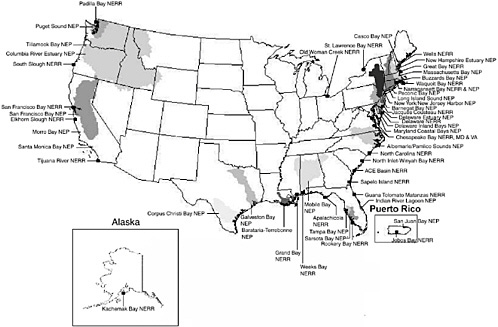
enhances informed management and scientific understanding of the Nation’s estuarine and coastal habitats (NOAA 1999a).
EPA’s National Estuary Program (NEP) currently includepoint sourcecs 28 estuaries throughout the United States (Figure C-1), with the overall objective to restore and protect “estuaries of national significance”. NEP has adopted an “ecosystem or watershed management approach” which encourages cooperation among the various stakeholders and regulators, and promotes practical solutions that attempt to provide the maximum environmental benefit in the most cost-effective manner (ANEP 1998). Although each individual estuary program has developed unique approaches and solutions, four steps are generally followed:
-
characterization of the major threats facing an estuary;
-
development of a Comprehensive Conservation and Management Plan (CCMP) that sets specific goals for protecting or improving the estuary and allocates responsibility for achieving those goals among NEP partners (regulatory agencies, local governments, and citizens);
-
implementation of CCMP by the various NEP partners, emphasizing flexibility in solutions as long as overall goals are met; and
-
monitoring to determine progress made toward achieving CCMP goals.
Eutrophication has been identified as a primary management concern in over half of the NEP estuaries, and a variety of nutrient management strategies have been developed through the individual programs (see discussion below).
The 1990 Amendments to the Clean Air Act (Section 112[m]) called for the establishment of the Great Waters Program, a joint effort between EPA and NOAA. This program was specifically designed to address air pollution and its impacts on water quality in the Great Lakes, the Chesapeake Bay, Lake Champlain, and other specified coastal waters. Specific elements of the Great Waters Program include a monitoring program of facilities on each of the five Great Lakes, Lake Champlain, Chesapeake Bay, National Estuary Program waters, and National Estuarine Research Reserves, and a research program which seeks to determine sources and deposition rates for air pollutants. Additional research is aimed at improving monitoring as well as determining the fraction that air pollution contributes to the overall pollution of coastal waters. Adverse health and environmental effects are also appraised. This appraisal includes indirect exposure pathways, results of which are then linked to the appropriate provisions of the Clean Water Act and the Safe Drinking Water Act. Finally, a sampling program of living organisms strives to determine the
bioavailability of these pollutants. EPA is required to report their findings to Congress on a biennial basis from 1993 onward.
The Chesapeake Bay Program (EPA, three states, and the District of Columbia) is the largest locally-based estuarine management program in the United States, and Chesapeake Bay was the nation’s first estuary targeted for restoration and protection. In the late 1970s, researchers identified nutrient over-enrichment as one of three areas requiring immediate attention. In 1987, the Chesapeake Bay Agreement set a goal to reduce nitrogen and phosphorus loading to the bay by 40 percent by the year 2000, a goal that was been renewed in 1997, with the acknowledgment that reductions of nitrogen would need to be accelerated to reach the 40 percent reduction goal. Recent assessments indicate that the phosphorus reduction goal has been met, but that despite considerable management effort and progress toward the goal, the nitrogen reduction goal will not be met by 2000. Current efforts to reach goals are highlighted below in this appendix.
The Gulf of Mexico Program (GOMP) is patterned after the successful efforts of the Chesapeake Bay Program, with the specific mission to facilitate the protection and restoration of the coastal marine waters of the Gulf of Mexico and its coastal natural habitats through a network of citizens and institutions. To address nutrient enrichment and its effects on hypoxia and harmful algal blooms, GOMP has initiated a Mississippi River/Gulf of Mexico Watershed Nutrient Task Force. It is anticipated that the Task Force will work closely with the federally mandated “HAB and Hypoxia Task Force” (called for by the Harmful Algal Bloom and Hypoxia Research and Control Act of 1998), with GOMP Task Force taking the lead on developing an action plan to implement management and policy recommendations as they are finalized.
Education Programs
Educational and public outreach are important components of several of the larger federal programs, including NOAA’s NERRS, EPA’s NEPs, and Seagrant programs. In addition, the following program provides funds for implementation of industry-specific education and pollution prevention guidelines.
EPA’s Pollution Prevention Grants Program provides project grants to States to implement pollution prevention (P2) projects, including educational outreach, training, and technical assistance for businesses, and projects focusing on multimedia pollution prevention as an environmental management priority. States are required to provide at least 50 percent of total project costs.
Incentive Programs
The Environmental Quality Incentives Program (EQIP), administered through USDA and local/state NRCS, was established to provide a single, voluntary conservation program for farmers and ranchers to address significant natural resource needs and objectives. Nationally, it provides technical, financial, and educational assistance, half of it targeted to live-stock-related natural resource concerns and the other half to more general conservation practices. EQIP is available to non-federal landowners engaged in livestock operations or agricultural production. Eligible land includes cropland, rangeland, pasture, forest land and other farm and ranch lands. Cost share of up to 75 percent is available for certain conservation practices, with a maximum of $10,000 per person per year and $50,000 over the length of the contract.
While traditionally used to build wastewater treatment facilities, Clean Water State Revolving Funds loans, administered through EPA Office of Wastewater and the States, can now be used for other water quality management activities, including 1) agriculture, rural and urban runoff control; 2) estuary improvement projects; 3) wet weather flow control, including stormwater and sewer overflows; 4) alternative wastewater treatment technologies; and 5) nontraditional projects such as landfills and riparian buffers. States lend money to municipalities, communities, citizen groups, Non-Profit Organizations, and private citizens implementing nonpoint source pollution and estuary management activities (Clean Water Act Section 319 and 320). Twenty percent state match is required.
Nonpoint Source Implementation Grants (319 Program), administered by the States with funds from EPA, provides grants to implement nonpoint source projects and programs in accordance with Section 319 of the Clean Water Act. Examples of projects funded through this program include best management practices (BMPs) for animal waste; design and implementation of BMP systems for stream, lake and estuary watersheds; and basinwide landowner education programs. State/local organizations are required to provide 40 percent of the total project cost.
FEDERAL MONITORING AND ASSESSMENT PROGRAMS
Watershed and Airshed
One of the oldest monitoring programs in the United States, the U.S. Geological Survey (USGS) Streamgaging Network, was initiated in 1889 to measure stream discharge. The USGS with over 800 different funding partners currently monitor about 7100 stations nationwide. The National Estuarine Eutrophication Assessment notes that “without data from this
long-term monitoring program, conclusions drawn from this assessment about linkages between symptoms and nitrogen sources would not have been possible” (Bricker et al. 1999).
The National Water Quality Assessment (NAWQA) program was fully initiated by USGS in 1991. NAWQA program is assessing water-quality conditions in more than 50 river basins and aquifers, known as Study Units, which collectively cover more than one-half of the United States. Data collected in each Study Unit include discharge, concentrations of suspended sediment, major ions, nutrients, trace elements, synthetic organic chemicals, and biological conditions. Understanding derived from individual Study Units and regional and national syntheses of information is being compiled with the objective of describing relationships between natural factors, human activities, and water quality conditions and to define those factors that most affect water quality in different parts of the nation. To make the program cost-effective and manageable, intensive assessment activities in each of the study units are being conducted on a rotational schedule, with one-third of the study units being studied at any one time. Topics presently being addressed by national synthesis include nutrients, pesticides, volatile organic chemicals, and trace elements. Plans for an ecological synthesis of streams are in early stages of implementation.
The National Atmospheric Deposition Program (NADP)/National Trends Network, coordinated by USGS, was initiated in 1978 and currently includes over 220 sites in the United States. Weekly samples of wet atmospheric deposition are analyzed for common ions, pH, and nitrogen. Data, yearly national isopleth maps, and interpretive reports are available on the Internet. Participants include over 100 partners from public and private entities throughout the states. NADP data have been crucial to the development of national models, including the regional acid deposition model and the Spatially Referenced Regressions on Watersheds (SPARROW) model.
The Clean Air Status and Trends Network (CASTNET) (multi-agency, EPA primarily) is a network of 55 sites nationally, sampling weekly (initiated in 1991) for air quality (criteria pollutants, fine particulates, toxics) and wet and dry deposition. Very few stations are located in coastal areas; however, CASTNET data are used in many of the local, state and national atmospheric deposition modeling efforts.
Coastal Waters
EPA’s Environmental Monitoring and Assessment Program (EMAP) is a research program to develop the tools necessary to monitor and assess the status and trends of national ecological resources. Specific objectives
of EMAP are to advance the science of ecological monitoring and risk assessment, guide national monitoring with improved scientific understanding of ecosystem integrity and dynamics, and demonstrate the framework through large regional projects.
NOAA’s National Estuarine Research Reserve system has designed a System-Wide Monitoring Program (SWMP) to “establish a comprehensive national monitoring program for coastal marine and Great Lakes environmental quality that will provide data and information on the status and trends in the levels and biological effects of natural and anthropogenic stresses needed for our nation to make well-informed decisions concerning the utilization and protection of our coastal resources and environments” (NOAA 1999c). The proposed monitoring network includes three primary elements:
-
A Nationwide Coastal Environmental Quality Monitoring Network (20-25 monitoring sites) used primarily for measurements of a set of common parameters that can serve as indicators of long-term trends in environmental quality and ecosystem health. Measurements at these sites will provide the basis for linking state and regional monitoring programs into national-scale assessments, and will serve as sites for linking process research studies with long-term measurements of environmental driving variables.
-
Nested within this network will be the more intensive Regional Monitoring Programs, to be developed and implemented primarily through State and local academic institutions. Particular emphasis will be placed on areas considered to be under greatest threat from chemical contamination, nutrient over-enrichment, habitat degradation and other degradative anthropogenic influences.
-
A National Coastal Monitoring Center is proposed to provide a national focal point for coordination, data management and archiving, methods development, information dissemination, and development of routine state of the coast reports and other national-scale assessments.
To implement the proposed National Coastal Monitoring Program, SWMP recommends that the Environmental Quality Network sites include:
-
all estuarine regions in the National Estuarine Research Reserves and the National Estuary Program; and
-
additional areas nominated for inclusion by the governor or governors of the states that border a proposed region.
A regional monitoring coordination group will be established for each
region to develop and direct a coordinated monitoring program tailored to the needs of its region, and to develop a long-term monitoring plan for its region. NOAA’s National Center for Coastal Monitoring and Assessment in the National Ocean Service will support development and improvement of scientific methods and procedures for implementing the National Coastal Monitoring Program.
EPA, NOAA, and the National Aeronautic and Space Administration (NASA) have joined in a partnership to establish pilot sites for the development of a network known as the Coastal Intensive Site Network (CISNet). CISNet is composed of intensive, long-term monitoring and research sites around the U.S. marine and Great Lakes coasts. In this partnership, EPA and NOAA are funding research and monitoring programs at pilot sites that utilize ecological indicators and investigate the ecological effects of environmental stressors. NASA is funding research aimed at developing a remote sensing capability that will augment or enhance in situ research and monitoring programs.
To select sites for inclusion in CISNet, criteria were developed by a working group of NOAA and EPA scientists, who then nominated 120 locations (subsequently narrowed to 41) from around the U.S. coasts. An announcement of opportunity for funding monitoring/research activities at one or more of the 41 sites resulted in over 100 proposals, of which 10 were selected for funding.
An Integrated Coastal Monitoring Program for the Gulf of Mexico is being developed by the Gulf of Mexico Program Office in cooperation with Gulf State agencies, EPA Regions 4 and 6, EPA’s Office of Water and Office of Research and Development (ORD). Goals of the coastal watersheds (estuarine focus) element are to:
-
integrate existing federal, state, local and private sector monitoring activities into a statistically-based sampling design that will provide data to support a regional assessment;
-
support implementation of the monitoring requirements in the Federal Clean Water Action Plan for gulf coastal watersheds;
-
support Gulf state monitoring and modeling assessments in Gulf coastal watersheds and contiguous near coastal waters;
-
develop and implement a statistically-based sampling design for monitoring near coastal waters; and
-
provide public access to Gulf coastal monitoring data and information.
A proposal to establish a coastal element to the existing Coastal Componenets of the Global Ocean Observing System (C-GOOS) is under development in response to a congressional request to propose a
plan to achieve a “truly integrated ocean observing system”. The purposes of the proposed coastal component are to 1) quantify inputs of energy and materials from land, air, ocean, and human activities; and to 2) detect and predict the effects of these inputs on human populations living in the coastal zone, on coastal ecosystems and living marine resources, and on coastal marine operations (NORLC 1999). Eutrophication issues (including nutrient flux measurements) figured prominently in recommendations from scientists and resource managers participating in a development workshop held in May 1999.
Five key elements are proposed for the C-GOOS system (NORLC 1999):
-
remote sensing to capture the spatial and temporal dimensions of change;
-
in-situ measurements to capture change in time and depth;
-
index sites, pilot projects and test beds to develop the models to link observations to products in the form of predictions and early warnings;
-
real time telemetry and data assimilation for timely access to and applications of environmental data; and
-
an effective data management system that accommodates the disparate coastal observation data systems and sources.
Assessment Programs
The Long Term Ecological Research Network (established by the National Science Foundation [NSF] in 1980) is a collaborative effort involving more than 1100 scientists and students investigating ecological processes operating at long time scales and over broad spatial scales. The network promotes synthesis and comparative research across sites and ecosystems, and now consists of 21 sites. Of these current sites, two focus on coastal areas: the Virginia Coast Reserve is a coastal barrier island with a focus on salt marsh ecology; the Plum Island Ecosystem project focuses on linkages between land and coastal waters involving organic carbon and organic nitrogen inputs to estuarine ecosystems from watersheds with various land covers and uses.
In 1997, the Committee on Environmental and Natural Resources (CENR), one of nine committees under the National Science and Technology Council established the CENR Environmental Monitoring Team to develop a Framework for Integrating the Nation’s Environmental Monitoring and Research Networks and Programs. The team’s charge was based on the assessment that current monitoring programs do not provide integrated data across multiple natural resources at the various temporal
and spatial scales needed to develop policies based on current scientific understanding of ecosystem processes. The emphasis was on agency cooperation and coordination. The CENR conceptual framework, which was developed by a team representing 13 federal agencies, supports better understanding, evaluation, and forecasting of renewable natural resources at national and regional scales.
Many of the concepts outlined in CENR Monitoring Framework are being incorporated into the outline of the Coastal Research and Monitoring Strategy, as an element of the Clean Water Action Plan. A draft outline has been developed (June 1999) by an interagency workgroup consisting of the following organizations (number of representatives on the workgroup is shown in parentheses): EPA (16), NASA (1), the National Institute of Health (3), NOAA (15), NSF (2), the Office of Science and Technology Policy (1), the Smithsonian (1), the U.S. Army Corps of Engineers (2), the U.S. Bureau of Reclamation (1), the U.S. Coast Guard (2), USDA (1), and USGS (5), plus “stakeholder representatives”: Association of National Estuary Programs (1), Coastal States Organization (2), National Estuarine Research Reserves (1), Center for Marine Conservation (1), Coastal Alliance (1), Association of State and Interstate Water Pollution Control Administration (1), and Consortium for Oceanographic Research and Education (1). The Strategy will attempt to coordinate existing programs; however, it is not clear to date how and when implementation will take place, or whether a new initiative will be needed to implement recommendations from the workgroup.
National Strategy for the Development of Regional Nutrient Criteria. As part of the Clean Water Action Plan, which calls for expanded efforts to reduce nutrient over-enrichment of waterways, the EPA has begun an effort to accelerate the development of scientific information concerning the levels of nutrients that cause water quality problems and to organize this information by different types of waterbodies (e.g., streams, lakes, coastal waters, wetlands). EPA is to work with states and tribes to adopt criteria (i.e., numeric concentration levels) for nutrients, including nitrogen and phosphorus, as part of enforceable state water quality standards under the Clean Water Act. Draft nutrient criteria guidance for estuaries are scheduled for review by 2002.
The NOAA Coastal Services Center has initiated several national projects that directly address access and coordination of data and information concerning eutrophication. These projects include:
-
the Coastal Information Directory, which provides a single query point to search a variety of nationwide databases for descriptions of coastal data, information and products;
-
the Coastal Management and Geographic Information Systems
-
Bibliography, which is an international compilation of documented geographic information system and remote sensing applications in the field of coastal management;
-
the Coastal Ocean Habitat Project, which aims to produce easily accessible remotely sensed time series imagery for detecting long-term, seasonal and event-specific trends in water turbidity and sea surface temperature for coastal regions;
-
NOAA Coastal Services Center Library, which provides information required by coastal resource managers on-line; and
-
the Coastal Zone Information Center Collection, which contains all publications produced under the Coastal Zone Management Act of 1972. To date, approximately 5000 of the estimated 12000 pieces have been cataloged and classified, and are available on-line.
MANAGEMENT STRATEGIES ADDRESSING COASTAL EUTROPHICATION
National Estuary Program Strategies
In 1997, 27 of the 28 EPA National Estuary Programs met in an American Assembly format to define key management issues. Eighteen of the 27 NEPs, from every region of the United States, identified the impacts of nutrient overloading as either a high or medium program priority (ANEP 1997). Management actions used to address eutrophication within NEP estuaries vary considerably between programs. Many of the programs reporting actions list regulatory control as the primary technique; however, several have also initiated a mixture of regulatory and nonregulatory (voluntary) approaches. A summary of some of these approaches is presented in Table C-1.
RESULTS OF A MANAGERS QUESTIONNAIRE
Managers and Scientists
To gather information about how federal, state and local programs are currently perceived by those managers in eutrophic coastal areas, the committee talked with local managers and scientists from 18 estuaries and coastal areas throughout the United States in the spring of 1999. These areas were selected from the 48 estuaries identified by NOAA’s National Estuarine Eutrophication Assessment as exhibiting the effects or being at high risk from nutrient over-enrichment. Individuals were asked to express their views regarding the tools they currently use for management, whether they consider those tools adequate for the development of
TABLE C-1
|
Estuary |
Approach and Milestones |
|
Albemarle-Pamlico Sounds |
Develop basinwide plans, and the Tar-Pamlico Basin Association, a coalition of permitted dischargers, is experimenting with a point/nonpoint source trading strategy. |
|
Barataria-Terrebonne Bays |
Develop initiatives to reduce agricultural and sewage pollution and manage stormwater impacts. |
|
Buzzards Bay |
Develop a nitrogen loading strategy amending local zoning to reduce future development so as not to exceed critical loading limits. |
|
Indian River Lagoon |
Require all domestic wastewater discharges to cease by 1995, develop and implement pollutant loading goals, and implement pollution reduction programs through education and BMPs. |
|
Long Island Sound |
Targets for improved DO levels in phases: Phase1: freeze critical point and non-point nitrogen loading at 1990 levels; Phase 2: commit to low-cost reductions in annual nitrogen load below 1990 levels; and Phase 3: develop specific nitrogen targets for 11 geographic management areas. |
|
Morro Bay |
Require replacement of septic systems in Los Osos with a sewer system, improve riparian buffer areas in watershed, and implement BMPs. |
|
New York-New Jersey Harbor Estuary |
Upgrade municipal discharges to secondary treatment, establish DO targets and nitrogen controls based on eutrophication model, and control rainfall-induced discharges of organic materials. |
|
San Francisco Bay |
Encourage voluntary dairy waste discharge requirements. (Successes, though, are limited to cases where formal enforcement actions were taken.) |
|
Sarasota Bay |
Eliminate wastewater discharges to the bay and upgrade STP to advanced treatment standards (reducing nitrogen load by 25 percent). |
|
Tampa Bay |
Require all STPs discharging to the bay to be upgraded to advanced treatment standards, obtain voluntary agreement to maintain nitrogen loads at 1992-1994 levels, and develop a TMDL (EPA-approved) for nitrogen loading. |
|
Western Peconic Estuary |
Implement a nitrogen “freeze” on point sources and develop a TMDL to reduce nitrogen inputs. |
|
TABLE C-1 National Estuary Programs and their regulatory and voluntary approaches. |
|
effective strategies to address eutrophication and other effects of nutrient over-enrichment, and how the tools could be improved. In addition to the local managers and scientists, similar input was requested from state managers from several states. Managers from the following coastal areas responded to the questionnaire:
Casco Bay, Maine
Boston Harbor, Massachusetts
Long Island Sound, New York and Connecticut
Chesapeake Bay Mainstem, Maryland, Delaware, Virginia
Delaware Inland Bays, Delaware
Albemarle-Pamlico Sound, Neuse River, North Carolina
St. Johns River, Florida
Florida Bay, Florida
Charlotte Harbor, Florida
Sarasota Bay, Florida
Tampa Bay, Florida
Apalachicola, Florida
Upper Laguna Madre, Texas
Galveston Bay, Texas
Corpus Christi Bay, Texas
Newport Bay, California
San Francisco Bay, California
Puget Sound, Washington
Program Coordination
The local and state managers interviewed by the committee were asked which federal programs have been useful in developing their management strategy, and why. Those managers associated with a NEP generally identified EPA’s NEP program as a critical federal player; one characterized NEP as “the glue that keeps the management program going.” Those outside the national EPA’s NEP or NOAA’s NERR systems identified a variety of federal programs associated with monitoring as important, particularly USGS (primarily for stream flow) and NOAA. The U.S. Army Corps of Engineers is participating in large modeling efforts in several estuaries, and USDA and their National Resources Conservation Service were identified as important contributors to agricultural strategies. However, several managers indicated that federal involvement in the development of their management plans was minimal.
A consistent theme identified by managers was the need for better coordination between federal agencies, and between federal and state/ local efforts. One program noted an “appalling lack of understanding at
the federal level of what happens at the local level, and what local and regional managers need.”
To address these issues, some of the larger local programs have initiated coordination/oversight bodies to their processes. The Florida Bay program noted that an oversight panel (including independent scientific review) is an important element of their multi-agency initiative, and is being used to integrate and coordinate research efforts among the agencies (federal, state and local). This program is finding that a periodic Florida Bay Science Conference for all researchers is proving very important for sharing of findings between agencies and initiatives.
Monitoring Effects and Sources
The larger estuaries (Long Island Sound, Chesapeake Bay, Florida Bay, St. Johns River, San Francisco) report that federal programs are the primary source of in-bay data, with little or no local support. Conversely, the smaller estuaries (including Casco Bay, Delaware Inland Bays, Albemarle-Pamlico, Charlotte Harbor, Sarasota Bay, Tampa Bay, the Texas estuaries, Newport Bay) report little or no federal assistance with in-bay monitoring; these programs rely on a mixture of local/state government or water quality authority, and volunteer monitoring. Several programs noted that the scale and objectives of large national monitoring programs (such as EMAP) are too broad to be useful at the local or regional level.
Almost all (15 local programs) report that federal USGS stream flow data have been a critical element to their loading estimates. Point source permit monitoring data are noted as important in eight of the 17 local programs (Boston Harbor, Long Island Sound, Chesapeake Bay, Charlotte Harbor, Tampa Bay, Newport Bay, San Francisco Bay, and Puget Sound).
Eight programs noted that atmospheric deposition data are important, but the majority of these programs (six of the eight) consider these data sources inadequate at this time. Relative contribution to nitrogen input budgets, transport through the watershed, sources, and impacts on coastal conditions from atmospheric deposition are all cited by local programs as largely unknown.
Access to monitoring data from different federal, state and local governments was noted as a barrier to development of management strategies in six of the 18 local programs included in the inquiry.
Models and Assessment Techniques
Results from the Managers Questionnaire indicate that local programs are using a wide range of modeling tools and assessment techniques,
ranging from very complex linked watershed:hydrodynamic:water quality models to simplistic conceptual models. More than half of the programs indicated that modeling had not yet been completed. However, most of the managers who are at a point they can judge the effectiveness of their modeling tools indicate that the tools have been adequate to help develop management strategies, although all programs have noted limitations and additional needs.
Several of the larger programs that are developing complex modeling strategies (Chesapeake Bay, Long Island Sound, St. Johns River, Florida Bay) have not yet used them to identify management options (although several have used earlier versions to help with setting targets). These programs expect that the fully developed models, when functional, will be critical for their strategies.
To develop nutrient loading estimates, planners working on Long Island Sound, Chesapeake Bay, St. John’s River, Charlotte Harbor, Sarasota Bay, Tampa Bay, Galveston, San Francisco Bay, Newport Bay, and Puget Sound all use land use-based spreadsheet models, with empirical loadings where available. Runoff coefficients used in the land use models were considered the “best available,” primarily from literature sources. Hydrologic Simulation Program-FORTRAN-based models and/ or Groundwater Loading Effects of Agricultural Management Systems are also used in Chesapeake Bay, St. John’s River, and Newport Bay, and will be used in Long Island Sound. Florida Bay uses a suite of surface water flow models.
In-bay models range from 3-D hydrodynamic models linked to water quality models (Long Island Sound, Chesapeake Bay, St. John’s River, Florida Bay) to an empirical regression-based model approach (Tampa Bay), to conceptual models (Newport Bay) to a technology-based approach (Sarasota Bay). Although the complexity ranges widely between programs, almost all programs believe that their modeling process is (or is expected to) providing adequate information for addressing the impacts of nutrient over-enrichment in their systems, with caveats noted by all programs. Charlotte Harbor and Sarasota Bay indicated that an in-bay model has not proven useful.
Effectiveness of the models used, as perceived by managers queried for this report, varied. Long Island Sound noted that “we’d be nowhere without the models” in helping to provide the scientific basis for multi-jurisdictional actions; Chesapeake Bay noted that the models provided a shared view of goals critical for political buy-in. Several programs noted that the complex estuarine circulation dynamics required that relatively complex modeling efforts be developed to help assess nutrient over-enrichment impacts and potential management options.
However, not all programs agreed that the limited funds available for
assessment were best spent on complex modeling, particularly in estuaries with limited stratification. Tampa Bay has developed simple regression-based approaches relating nitrogen loading estimates to ambient water quality parameters to help develop nutrient loading goals. Sarasota Bay is using a “technology-based” approach in which potential reductions in the watershed are ranked according to cost-effectiveness, and implementation of actions with the largest potential for nutrient reduction are encouraged.
Management Strategies
When asked about management strategies during the committee’s interviews with the managers of 18 estuaries where nutrient enrichment is a major management issue, the managers offered the following insights:
-
Ten of the eighteen local programs interviewed reported that a management program to address the effects of nutrient over-enrichment is underway; five more noted that one was in development. Two programs reported that the method and means of implementation were “unclear”. The Florida state-wide programs estimated that 50 percent of the coastal waters in Florida have some level of management at local levels ongoing.
-
Strategies range from entirely educational and non-regulatory (Delaware Inland Bays, Casco Bay) to primarily regulatory (Long Island Sound, Newport Bay, Boston Harbor); the other programs reported mixed (regulatory and nonregulatory) approaches.
-
Seven of the seventeen local programs (Long Island Sound, Delaware Inland Bays, St. John’s River, Charlotte Harbor, Laguna Madre, Newport Bay, and Puget Sound) report that a TMDL is, or is expected to be, a driving factor for the management strategy. Two programs (Chesapeake Bay and Tampa Bay) expressed concern that a TMDL, if approved, could curtail ongoing voluntary nutrient management activities.
-
Eight local programs report that numeric targets are in place or are being developed. Targets include nutrient reduction or loading targets (six programs) and in-bay indicator targets for four programs (Chesapeake Bay, Florida Bay, Delaware Inland Bays, and Tampa Bay).
-
Two local programs (Tampa and Sarasota Bays) report that the strategy seems to be effective for reducing eutrophic conditions in their waterbody, resulting in increased water clarity and seagrass in both bays. These two programs are also the only two that report
-
that point source regulatory management efforts were in place prior the existing management program.
-
Only one program, San Francisco, answered that their strategy did not appear to be working. However, three programs (Long Island Sound, Chesapeake Bay, and Albemarle-Pamlico) reported mixed results, with some areas improving and some not. Twelve of the 17 report that it is too early to tell.
-
For those coastal areas which are far enough along in implementation of their strategy to judge effectiveness, a regulatory approach has been considered most effective for Long Island Sound, Albemarle-Pamlico Sounds, Sarasota Bay, and Newport Bay, while non-regulatory approaches (voluntary reductions, education) are considered by their managers to be most effective for Casco Bay, Chesapeake Bay, Delaware Inland Bays, and Tampa Bay.
-
Newport Bay notes that the regulatory component is essential in that bay because it is “too late for a voluntary approach.” In contrast, the state Coastal Management Program in Florida notes that, for nonpoint sources, probably a non-regulatory approach will be more effective due to the weakness of agricultural regulations.
-
The Albemarle-Pamlico Sounds and the Neuse River programs report that they are moving toward a more regulatory process. The primarily voluntary efforts initiated in the early 1990s (including trading in the watershed) has not been successful with the huge increase in concentrated animal feeding operations. Nutrient trading was initially intriguing, but has not actually been effectively implemented, due to the details of implementing a formal trading program. However, the new regulatory rules have more flexibility for some areas in meeting requirements than previous point source discharge limits.
-
Two programs (Delaware Inland Bays and San Francisco Bay) cited public policy involvement as essential elements for reducing the effects of nutrient over-enrichment, while Florida Bay note that a multi-agency approach has been critical.
-
Setting quantitative reduction goals has been critical for the Chesapeake Bay and Tampa Bay.
In those same interviews, the most frequently cited barriers to development of management strategies noted by the managers included:
-
Lack of participation in the management process by major sources and stakeholders. Several local programs reported lack of participation by agricultural interests, electric utilities, and jurisdictions upstream in watersheds as major barriers.
-
Lack of regulatory authority (including numerical nutrient standards) to require nutrient reduction.
-
Lack of coordination between local, state and federal programs, including implementation of regulatory programs such as TMDLs.
-
Lack of credible source loading information, especially for atmospheric deposition, nonpoint sources, and sediment flux.
When asked which elements of their management strategy were most difficult to develop and implement, the managers offered a wide variety of responses, including:
-
building trust among the management participants;
-
source identification, particularly atmospheric deposition;
-
nonpoint source controls, primarily due to lack of regulatory control on these sources;
-
agricultural community difficult to engage (several programs mentioned this element);
-
data on sediment flux and recycling;
-
interagency cooperation;
-
scientific basis a time-consuming process; and
-
changing public attitudes about residential lawn maintenance.
When asked what could make their management strategy more effective, five of the 11 programs answering this question identified the need for additional or better information, and four identified additional funding. Several programs mentioned better cooperation between agencies.


