
5
Small Launch Vehicles
The effective use of small satellites to fulfill Earth observation needs depends on the availability and costs of launch vehicles. As spacecraft become smaller and less expensive, so also must launch vehicles, or launch costs will become disproportionately large. Additionally, the trend toward smaller spacecraft implies a commensurate increase in the number and rate of launches. It is well known that long launch queues, slips, and delays can increase overall mission costs. Similar problems with small missions are likely to have even greater impacts due to limits on launch site capacity.
Selecting the appropriate launch vehicle for a particular mission involves mission architecture trade-offs reflecting the number of satellites to be launched, orbit requirements, satellite on-board propulsion, and launch vehicle performance. Missions that call for multiple satellites in common orbit planes can accrue cost benefits with multisatellite launches on higher performing launch vehicles. Satellites that must carry on-board propulsion for orbit maintenance or attitude control can sometimes effectively exploit lower performance, lower cost launch vehicles to place them into low initial orbits and then use their own propulsion systems for final orbit insertion. Whatever the specifics, the launch vehicle must be matched to the mission if costs are to be minimized. Excess launch capacity beyond prudent margins represents wasted costs.
Recognizing that the move toward smaller spacecraft places added emphasis on the costs and availability of appropriate launchers, the aerospace industry has moved to develop a number of "small" launch vehicles tailored specifically to meet this growing market segment. This chapter presents an overview of these small launchers in terms of their known costs, performance parameters, capabilities, and performance records.
U.S. launchers were emphasized in this assessment, since current U.S. policy precludes the launching of government-funded spacecraft on foreign launch vehicles. Launchers based on converted ballistic missiles were also excluded on the grounds of current U.S. policy. Formal policy states that the use of converted ballistic missiles is restricted to government payloads only, and then only when such use would result in significant savings over the use of commercial launch services. Statements by administration personnel indicate that any requests to use a converted ICBM (Intercontinental Ballistic Missile) for an orbital flight would meet with strict scrutiny. In general, the National Space Transportation Policy directs U.S. departments and agencies to purchase commercial launch services to the fullest extent feasible. In the event that U.S. policy changes, some discussion of foreign launch vehicles is provided for a more complete assessment of small satellite launch capabilities.1
SMALL LAUNCH VEHICLES FOR EOS AND NPOESS
This section covers launch vehicles capable of launching to the Earth Observing System (EOS) and National Polar-orbiting Operational Environmental Satellite System orbits with mass performance capabilities up to and including the Delta II. While the Delta II may be considered excessive for the launch of individual 500 kg payloads (the upper limit of what this report defines as a small satellite), its capacity for launching multiple small spacecraft on a single launch vehicle merits its inclusion. Also, Boeing Corporation (which recently acquired McDonnell Douglas Co.) is developing a downsized version of the Delta II (Delta II-7320) to extend the utility of this reliable launch vehicle. However, this will still be a fairly high-performance launch vehicle with a relatively high absolute cost compared with the alternatives, suitable primarily for medium-sized or multiple small satellites. Within these guidelines, the launch vehicles considered here are the Delta II, Pegasus, Taurus, Athena (previously known as the Lockheed-Martin Launch Vehicle), and Conestoga. Further detail on these launch vehicles is provided in Appendix C, which also addresses the Eagle family of launch vehicles—the Eclipse Express and Astroliner, the PacAstro, and the Kistler booster. These launch vehicles, while all still in development, are included because of their potential for significant cost savings and market impact.
Pertinent data for the U.S. launch vehicles evaluated are presented in Tables 5.1 and 5.2. Table 5.1 summarizes their mass performance to a 700 km polar Sun-synchronous orbit, approximate cost, and performance history; Table 5.2 provides data on their fairing dimensions and launch environments. Table 5.1 also provides data for relevant foreign launch vehicles.
Generally, mission planners look to minimize mission costs. Because absolute launch vehicle costs increase with launch vehicle size and performance, the lowest performance (and hence lowest cost) launch vehicle that accomplishes the mission should be used. Preferably, the mission designer would have a series of launch vehicle options with increments in performance filling the gap between the low-capacity Pegasus and the high-capacity Delta II. Small launch vehicles such as the Pegasus and Athena 1 have limited capacity to put payloads into EOS orbit. However, these launch vehicles can be used for Earth observation missions by supplementing them with spacecraft on-board propulsion to enable them to reach the desired orbit (e.g., the Total Ozone Mapping Spectrometer Earth Probe). This approach is being used, but it results in some increase in spacecraft cost. The development of intermediate-capacity launch vehicles, such as the Taurus XL and Athena 2, helps fill this gap and offers more opportunity to optimize missions.
Fairing size is sometimes another criteria in selecting a suitable launch vehicle for a mission in that it must accommodate the stowed payload. It is preferable that launch vehicle candidacy not be limited by fairing size but by performance to orbit. Thus, most manufacturers are developing larger fairings for their vehicles for added utility. The fairing size for the Pegasus, however, which does impose significant size constraints, is limited by its airplane launcher system.
Figure 5.1 plots the cost and performance data for operational and planned U.S. launch vehicles as the specific cost per unit payload (satellite) mass to the EOS orbit versus launch capacity. For operational launchers, the minimal cost per unit mass to orbit is achieved with the Delta II and increases with decreasing or increasing launch vehicle capacity. The cost per pound penalty is severe for small launchers with payloads under 500 kg. It is this superior cost efficiency of the Delta II, along with its excellent reliability, which makes launching multiple satellites on a single Delta II an attractive alternative to multiple smaller launch vehicles when possible. In fact, early experiences (failures) with new, smaller launch vehicles indicate that reliability is a major concern, as indicated by the success rates shown in Table 5.1. It will probably take several years and more failures before any small launch vehicle achieves the reliability of the Delta II (>95 percent).
Table 5.1 Launch Capacity to EOS Orbit, Cost, and Performance History of Candidate Small Satellite Launch Vehicles
|
Vehicle/Configuration |
Capacity to 700 km Sun-Synchronous Orbit (kg) |
Cost ($M) |
Performance History (Successes/Flights through Oct. 1988) |
|
U.S. LAUNCH VEHICLES |
|||
|
Delta II 7920/25 |
3,275 |
50 |
47/49 |
|
Delta II 7320 |
1,750 |
35 |
0/0 |
|
Pegasus XL |
225 |
14 |
|
|
Taurus XL/Orion 38 |
945 |
24 |
0/0 |
|
Taurus/Orion 38 |
860 |
22 |
3/3 |
|
Athena 3 |
2,200 |
30 |
0/0 |
|
Athena 2 |
700 |
22 |
1/1 |
|
Athena 1 |
200 |
16 |
1/2 |
|
Conestoga 1229 |
220 |
12 |
0/0 |
|
Conestoga 1620 |
540 |
18 |
0/1 |
|
FOREIGN LAUNCH VEHICLES |
|||
|
CZ-2D (China) |
1,200 |
20 |
5/5 |
|
PSLV Mk2 (India) |
1,300 |
12/15 |
1/1 |
|
Molniya M (Russia) |
1,775 |
30 |
256/289 |
|
Shavit 2c (Israel/US) |
340 |
15 |
0/0 |
|
Shtil 1N (Russia) |
185 |
5/6 |
1/1 |
|
Tsyklon 3 (Ukraine) |
2,300 |
25 |
111/117 |
|
a Successes exclude incorrect orbit, failure to separate on orbit, and damaged spacecraft. b Includes all versions of the Pegasus. c Coleman Research Corporation, in collaboration with Israel Aircraft Industries, has recently won a Small Expendable Launch Vehicle contract from the National Aeronautics and Space Administration to provide launch services in the United States using an export version of the Israeli-designed Shavit rocket (Next). The Shavit is a solid-fuel rocket with performance comparable to the Pegasus XL. Through January 1998, it had achieved three successful launches in five attempts. SOURCE: International Space Industry Report, Nov. 9, 1998; available online at <CS:WebLink>http://www.launchspace.com/isir/home.html>. |
|||
Table 5.2 Launch Vehicle Fairing Dimensions and Launch Environment
|
|
Pegasus XL |
Athena 1 (Mod 92 fairing |
Taurus (63 in fairing |
Conestoga (1229 fairings) |
Delta II (7920 (9.5 ft fairing) |
|
Fairing dimensions |
|||||
|
Max diameter (m) |
1.118 |
1.981 |
1.372 |
1.616 |
<2.54 |
|
Max cylinder length (m) |
1.110 |
2.291 |
2.692 |
0.392–2.664 |
3.81 |
|
Max cone length (m) |
1.016 |
2.002 |
1.270 |
1.768 |
1.94 |
|
Launch environment |
|||||
|
Axial accel (g) |
<13.0 |
<+4/-8 |
<11.0 |
<11.0 |
<6.0 |
|
Lateral accel (g) |
< ±6.0 |
< ±2.5 |
NA |
< ±2.7 |
< ±2.0 |
|
Acoustic (dB) |
<141 |
<133.5 |
<141 |
<128.5 |
<139.6 |
|
Longitudinal freq (Hz) |
NA |
>15 |
NA |
NA |
>35 |
|
Lateral freq (Hz) |
NA |
>30 |
NA |
NA |
>15 |
|
NA = not applicable. |
|||||
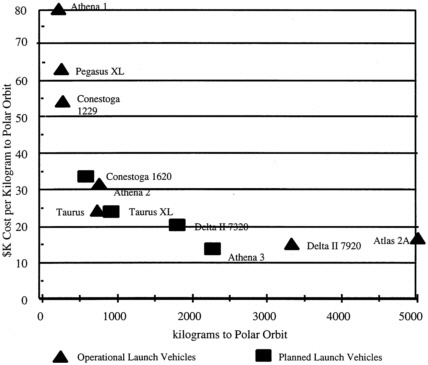
Figure 5.1
Launch vehicle cost per unit mass to EOS orbit.
SUMMARY
Achieving the full promise of small satellites will require the availability of reliable U.S. launch vehicles with a full range of performance capabilities. This is currently not the case: There is a significant gap in capability between the Pegasus/Athena/Taurus launch vehicles and the Delta II. Plans to fill this gap by numerous suppliers are encouraging, as are the efforts by launch vehicle suppliers to provide a range of fairing sizes to accommodate a larger percentage of potential missions. Foreign launch vehicles may also ultimately play a role in filling this gap, should U.S. policy change.
Early experience with the new small launch vehicles has included a number of failures—probably due in part to a desire to minimize development costs for these commercial ventures. Continued development should overcome the difficulties and yield a suitable balance between cost and reliability. However, it will take some time—and, likely, some additional failures—before any of these launch vehicles establish a reliability record approaching that of the Delta II.


