
4
Clinical Scientists
IDENTIFYING THE WORKFORCE
Of the three groups that make up the health research workforce, clinical investigators are the most difficult to identify and track. In part, this is a result of the increasing diversity of this sector of the research workforce, which was once dominated by physicians but now includes increasing numbers of Ph.D.s. Assessment of this workforce is also complicated by a lack of information about the research training and career paths of physicians and other health care professionals, who necessarily play a major role in the field of clinical research.
The dearth of information about such health care doctorates as physicians, dentists, and other doctoral-level professionals without Ph.D.s is a longstanding problem, identified by the first NRC committee to examine the needs for biomedical and behavioral researchers in 1975 1 and regularly cited as an obstacle by subsequent committees. 2 , 3 Only in the last few years has more detailed information become available, after the National Institutes of Health (NIH) adopted a definition of clinical research and began collecting information about its grants and the investigators who receive them. In keeping with its new policy, implemented in 1996, the NIH classifies studies as clinical research when they fall into one of three categories: (1) patient-oriented research, including clinical trials, the development of new technologies, studies of therapeutic interventions, and the mechanisms of human disease, (2) epidemiological and behavioral studies, or (3) outcomes and health services research. 4 Although the Agency for Healthcare Research and Quality (AHRQ) does not categorize the research it funds in the same fashion, the studies it supports generally fall within the parameters for clinical research established by the NIH.
In fiscal year 1997, almost 23 percent of the approximately 12,000 new and competing grants awarded by the NIH were for clinical research projects. 5 Because the grant portfolio of the AHRQ is much smaller, combining it with that of the NIH does not increase significantly the percentage of clinical research projects supported by the two agencies (see Table 4-1 ). The majority of principal investigators for clinical research projects supported by NIH and AHRQ held Ph.D.s (1,449), rather than M.D.s or M.D.-Ph.D.s (1,061).
As indicated in Table 4-1 , a much larger fraction of researchers with M.D.s than with Ph.D.s were involved in clinical research. More than any other group of investigators receiving grants from the NIH and AHRQ in 1997, M.D.s were most likely to conduct clinical research (36.3 percent). At 29.6 percent, “other” degree holders ranked next in conducting clinical research
|
1 |
National Research Council. Personnel Needs and Training for Biomedical and Behavioral Research. Washington, D.C.: National Academy of Sciences, 1975. |
|
2 |
National Research Council. Personnel Needs and Training for Biomedical and Behavioral Research. Washington, D.C.: National Academy of Sciences, 1976. |
|
3 |
National Research Council. Biomedical and Behavioral Research Scientists: Their Training and Supply. Volume 1: Findings. Washington, D.C.: National Academy Press, 1989. |
|
4 |
National Institutes of Health. Director's Panel on Clinical Research. Report to the Advisory Committee to the NIH Director. Bethesda, Md.: NIH, 1997. |
|
5 |
Unpublished tabulation from the NIH CRISP and IMPAC systems; on file in the archives of the Academies. |
TABLE 4-1 NIH and ADHRQ Comoeting Awards by Type of Research and Degree of Investigator, Fiscal Year 1997
|
M.D. |
M.D.-Ph.D. |
Ph.D. |
Other a |
Total |
||||||
|
Type of Research |
No. |
Percent |
No. |
Percent |
No. |
Percent |
No. |
Percent |
No. |
Percent |
|
Clinical |
959 |
36.3 |
102 |
21.3 |
1,449 |
18.0 |
257 |
29.6 |
2,767 |
23.0 |
|
Nonclinical |
1,682 |
63.7 |
376 |
78.7 |
6,593 |
82.0 |
611 |
70.4 |
9,262 |
77.0 |
|
Total |
2,641 |
100.0 |
478 |
100.0 |
8,042 |
100.0 |
868 |
100.0 |
12,029 |
100.0 |
|
NOTE: NIH data exclude training grants and predoctoral fellowships. AHRQ data exclude training grants, predoctoral fellowships, innovation awards, and conference grants. a This category includes dentists and veterinarians, as well as investigators for whom no degree information was available. SOURCES: Data are from the NIH CRISP and IMPAC systems and the AHCPR State List of Active Grants. |
||||||||||
perhaps reflecting the fact that dentists are included in this group), followed by M.D.-Ph.D.s (21.3 percent). As a group, Ph.D.s were least likely to conduct clinical research: only 18 percent did so.
DEFINING CLINICAL RESEARCH AND THE CLINICAL RESEARCH WORKFORCE
Previous NRC analyses of clinical research have generally assumed that Ph.D.s conducting clinical research were trained in the health science disciplines listed in Appendix E , including fields such as environmental health, epidemiology, health services, nursing, and pharmacy. Yet the data on federally funded clinical research collected over the last few years reveal a workforce that is much more complex than previously recognized. According to this new information, the pool of investigators conducting clinical research supported by the NIH and AHRQ includes many who were trained in the behavioral and social sciences and, to a lesser extent, the basic biomedical sciences.
Among those whose fields of study could be identified, more Ph.D.s conducting clinical research received their degrees in clinical psychology (13.4 percent) than in any other discipline. Other fields producing large numbers of clinical investigators (listed in Table 4-2 ) included such traditional disciplines as epidemiology and nursing, as well as those less commonly associated with clinical research, including sociology, biochemistry, and physiology.
By adopting a definition of clinical research that encompasses behavioral and social science studies, the
TABLE 4-2 Ph.D.s Receiving NIH Awards for Clinical Research, by Field of Degree, 1998
|
Field of degree |
Number |
Percent |
|
Clinical psychology |
142 |
13.4 |
|
Experimental psychology |
60 |
5.7 |
|
Sociology |
52 |
4.9 |
|
Epidemiology |
42 |
4.0 |
|
Nursing |
40 |
3.8 |
|
Biochemistry |
36 |
3.4 |
|
Psychology, general |
36 |
3.4 |
|
Social psychology |
35 |
3.3 |
|
Developmental and child psychology |
31 |
2.9 |
|
Physiology |
26 |
2.5 |
|
Genetics (human and animal) |
23 |
2.2 |
|
Molecular biology |
23 |
2.2 |
|
Speech-language pathology and audiology |
23 |
2.2 |
|
Physiological psychology/psychobiology |
21 |
2.0 |
|
Bioengineering and biomedical engineering |
21 |
2.0 |
|
Anthropology |
19 |
1.8 |
|
Other Fields |
437 |
41.4 |
|
Total identified |
1,056 |
100.0 |
|
Unknown fields |
347 |
|
|
Total |
1,403 |
|
|
SOURCES: Principal investigators were identified from the NIH CRISPand IMPAC Systems and matched against data from the Survey of EarnedDoctorates to determine the fields in which they earned their doctoraldegrees. |
||
NIH has recognized the links and inevitable overlap between the two fields. The committee applauds this development in NIH policy and hopes that it will encourage more cross-disciplinary research on the behavioral and social factors so critical to the nation's health. However, this definition of clinical research creates some complications for evaluating the clinical research workforce.
Because there is no simple way, for example, to predict which clinical psychology Ph.D.s will pursue careers in research and which will focus on clinical practice or to distinguish biochemists and sociologists in clinical research from those pursuing laboratory or other types of research (unless they have received funding from the NIH since 1996), we did not include these investigators in our assessments of the size and characteristics of the clinical research workforce, opting instead to rely on the traditional taxonomy of health science Ph.D.s (see Appendix E ). Nonetheless, it is important to keep in mind that investigators from fields other than the health sciences play a significant role in clinical research. Future studies of this workforce should consider approaches that better account for these Ph.D.s, especially clinical psychologists, who were not included in our analysis of the behavioral and social science workforce.
GAUGING THE SIZE AND FEATURES OF THE WORKFORCE
Because a group as difficult to identify as clinical researchers cannot be accurately measured, we have attempted only the most general estimates of the size and characteristics of the workforce. According to data collected by the American Medical Association, research was the primary professional activity of 14,434 M.D.s and M.D.-Ph.D.s in 1997. 6 If the percentage of clinical researchers in this pool were the same as for the M.D.s and M.D.-Ph.D.s supported by the NIH and AHRQ in 1997 (34 percent for the two agencies combined), the number of physicians in the clinical research workforce would have been 4,908. Add 14,618 Ph.D.s from the fields traditionally associated with clinical research working in science in 1997 (see Table G-6 ), and the estimated total size of the workforce that year was 19,526. Of course, this figure may well be an underestimate; it does not include dentists or other health care doctorates active in clinical research, about whom little is known, or Ph.D.s trained in the basic biomedical or behavioral and social sciences, some of whom are part of the clinical research workforce, at least part of the time.
The two major groups of investigators in the clinical research workforce are quite different in character, except for their age. 7 , 8 , 9 , 10 , 11 and 12 In 1997 the median age of physicians whose primary activity was research was approximately 47.8, just under that of Ph.D.s conducting clinical research, whose median age was 48. Women were more likely to be found among the Ph.D.s conducting clinical research (52.7 percent) than among physician-scientists (17.6 percent). The same is true of underrepresented minorities. In 1997, 7.8 percent of Ph.D.s conducting clinical research were underrepresented minorities, more than double the estimate for U.S.-trained physician-scientists (3.5 percent).
Physician-scientists also differ from physicians in practice and other nonresearch activities. In 1997 they were two years older than the rest of the physician workforce, whose median age was 45.8. The portion of the physician workforce outside of research also included slightly more women (22.1 percent) and nearly twice as many underrepresented minorities (7.1 percent).
The relative roles of M.D.s and Ph.D.s in the clinical research workforce appear to have changed considerably from what they were a few decades ago. If the proportion of physicians conducting clinical research had been the same in the mid-1970s as today, there would have been more physicians than Ph.D.s in the clinical research workforce of 1975. By 1997 it was likely that the opposite was the case (see Figure 4-1 ).
|
6 |
Pasko, Thomas, and Bradley Seidman. Physician Characteristics and Distribution in the US, 1999. Chicago: American Medical Association, 1999. |
|
7 |
Ibid. |
|
8 |
Unpublished tabulation from the Survey of Doctorate Recipients; on file in the archives of the Academies. |
|
9 |
|
10 |
Pasko, Thomas, and Bradley Seidman. Physician Characteristics and Distribution in the US, 1999. Chicago: American Medical Association, 1999. |
|
11 |
Unpublished tabulation from the Association of American Medical Colleges, Minority Physician Database; on file in the archives of the Academies. |
|
12 |
Pasko, Thomas, and Bradley Seidman. Physician Characteristics and Distribution in the US, 1999. Chicago: American Medical Association, 1999. |
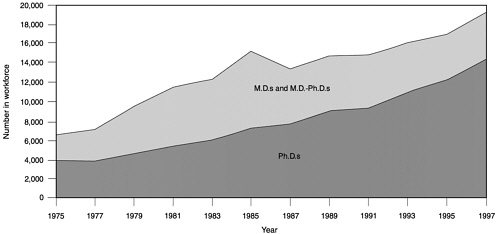
FIGURE 4-1 Trends in the composition of the clinical research workforce. The number of M.D-Ph.D.s is estimated, using the assumption that 34 percent of physicians whose primary professional activity is research are conducting clinical research.
SOURCES: Data are from the Survey of Doctorate Recipients and the American Medical Association, Physician Characteristics and Distribution in the United States, various years.
From 1975 to 1997, the number of Ph.D.s from fields traditionally associated with clinical research who were working in science more than quadrupled, increasing from 3,515 to 14,618.
THE ECONOMICS OF CLINICAL RESEARCH
When concerns about the declining role of M.D.s in the research workforce began to emerge 20 years ago, 13 many attributed the trend to the difference between the salaries of academic and private-practice physicians. Since then the disincentives for physicians and other health care doctorates to pursue research careers have grown. These include increasing levels of educational indebtedness, continuing discrepancies between research training stipends and salaries paid to medical residents, limited time for research, and salaries of investigators.
Except for graduates of dual-degree (e.g., M.D.-Ph.D. or D.D.S.-Ph.D.) programs, most physicians and dentists today begin their professional careers with sizable educational debts. From 1990 to 1997, the average medical school debt of M.D. graduates increased more than 50 percent, from almost $41,000 (in 1997 dollars) to just over $64,000. 14 For underrepresented minorities, the debt burden is generally even more. The average medical school debt reported by minority students graduating in 1997 was nearly $68,500, roughly $5,000 more than for white and Asian students. 15
The amount of medical school debt for M.D.-Ph.D. students graduating in 1997 was considerably less and lower still for participants in the NRSA Medical Scientist Training Program; the latter had a mean debt of about $13,600 (Table 4-3 ).
Levels of educational debt for dental students are higher than those in medicine, but this debt increased
|
13 |
Wyngaarden, James B. “The Clinical Investigator as an Endangered Species.” New England Journal of Medicine 301, December 1979, 1254–59. |
|
14 |
Unpublished tabulation from the Association of American Medical Colleges, Student and Applicant Information Management System and the National Research Council; on file in the archives of the Academies. |
|
15 |
Unpublished tabulation from the Association of American Medical Colleges, Student and Applicant Information Management System; available from the archives of the Academies. |
TABLE 4-3 Medical School Debt Reported by 1997 Gradutes
|
MD-Ph.D.s |
||||
|
MSTP a |
Non-MSTP |
Subtotal |
All others |
|
|
All graduates |
178 |
324 |
502 |
15,426 |
|
Mean |
$13,598 |
$44,787 |
$33,728 |
$64,052 |
|
Graduates with debt |
71 |
205 |
276 |
10,723 |
|
Mean |
$26,239 |
$60,299 |
$51,537 |
$77,582 |
|
a Participants in the NRSA Medical Scientist Training Program. SOURCE: Data are from the Association of American Medical Colleges,Student and Applicant Information Management System. |
||||
at a slower rate in the 1990s. In 1997, graduating dentists reported nearly $75,000 in dental school debt, up from just over $62,000 (in 1997 dollars) in 1990. 16 , 17
Although health care professionals are permitted to postpone payments on their student loans during NRSA or other authorized research training programs, this option may not be as widely used as intended. In informal polls of research fellows at major Boston and San Francisco teaching hospitals, our committee found that a large majority of fellows took advantage of loan deferments, but a number of others were not aware they qualified for a deferment. 18 ,19 Even with deferment of their loan payments, research training generally entails financial sacrifice for young physicians. Despite the significant increase in NRSA stipends in 1999, payments for physicians in research training are generally less than the salaries paid to medical residents. Following the third year of residency, for example, when many young physicians have their first opportunity for postdoctoral research training, the NRSA stipend is $36,036, nearly $3,000 less than the average payment for medical residents with the same experience. 20 , 21
After their research training, physicians face still further obstacles in establishing research careers. First, they have to find—or negotiate —time for research, an increasingly difficult matter, particularly for those working in highly competitive health care markets. According to a 1997 study of the activities of medical school faculty, new faculty members in the most competitive health care markets were more likely to have patient care duties, spend more time teaching, and publish fewer papers than their peers in other parts of the country. Even in their own institutions, junior faculty in the most competitive health care markets had greater teaching responsibilities and were more likely to be assigned to patient care duties than their more senior colleagues. In light of these findings, the study's authors cautioned that protected time for new clinical faculty to conduct research is threatened by the growing competition in health care. 22
Another obstacle for physician-investigators has been the limitation on salaries for NIH-funded investigators that Congress imposed in 1990. 23 (Although not required to do so, AHRQ has followed the NIH policy and has restricted the salaries of its investigators as well.) 24 Now set at $141,300, the maximum allowable salary for researchers supported by either agency is less than most medical school faculty members earn. During the 1997-1998 academic year, physicians serving as assistant professors in medical school clinical departments received an average base salary of $127,800 and associate and full professors received $151,600 and $181,000, respectively. 25 While most investigators
|
16 |
American Association of Dental Schools, Survey of Dental School Seniors—1998 Graduating Class. Washington, D.C.: AADS, 1998. |
|
17 |
Unpublished tabulation from the National Research Council; available from the archives of the Academies. |
|
18 |
Goldman, Lee. Department of Medicine, University of California, San Francisco School of Medicine. Personal communication, January 1999. |
|
19 |
Hiatt, Howard. Department of Medicine, Harvard Medical School. Personal communication, March 1999. |
|
20 |
“National Research Service Award (NRSA) Stipend Increase.” NIH Guide for Grants and Contracts, 19 November 1998. Available: http://grants.nih.gov/grants/guide/index.html . |
|
21 |
Association of American Medical Colleges. AAMC Data Book: Statistical Information Related to Medical Schools and Teaching Hospitals. Washington, D.C.: AAMC, 1999. |
|
22 |
Campbell, Eric G., Joel S. Weissman, and David Blumenthal. “Relationship Between Market Competition and the Activities and Attitudes of Medical School Faculty.” JAMA 278, no. 3 (1997): 222-26. |
|
23 |
“Salary Limitation on Grants, Cooperative Agreements and Contracts. ” NIH Guide for Grants and Contracts, 6 January 2000. Available: http://grants.nih.gov/grants/guide/index.html . |
|
24 |
Drott, Greta. Agency for Healthcare Quality and Research. Personal communication, July 1999. |
|
25 |
Association of American Medical Colleges. AAMC Data Book: Statistical Information Related to Medical Schools and Teaching Hospitals. Washington, D.C.: AAMC, 1999. |
spend less than full-time in research, their base compensation must still be calibrated to the salary cap. So, for example, a faculty member conducting research half-time cannot draw more than $70,650 in salary from an NIH or AHRQ grant. As a result, medical schools and their faculty must often seek supplementary funds from other sources to carry out federally sponsored clinical research.
THE CHANGING ROLE OF THE NATIONAL RESEARCH SERVICE AWARD PROGRAM
Other than M.D.-Ph.D.s, whose numbers have been steadily growing, as shown in Figure 4-2 , the number of medical students receiving research training has remained relatively constant during the 1990s. Over the same time period, M.D.s participating in postdoctoral NRSA programs declined by more than 20 percent, from 2,228 to 1,775 (Figure 4-3 ).
In contrast to their declining participation in NRSA training programs overall, increasing numbers of M.D.s and other health care doctorates have obtained research training and experience through mentored career development awards (Figure 4-4 ). From 1988 to 1997, career development awards granted to physicians and dentists increased by 62 percent, from 674 to 1,092. It is not clear what accounts for the upsurge in career development awards to health care doctorates, but the compensation that accompanies these awards is likely a factor. In contrast to postdoctoral NRSA awards, which require the recipient to be in full-time training and provide a maximum stipend of $41,268, 26 salaries for mentored career development awards generally range from $50,000 to $75,000 for a commitment of 75 percent time (although a few NIH institutes provide up to the maximum allowable under the salary cap, $141,300). 27 In addition, career development awards
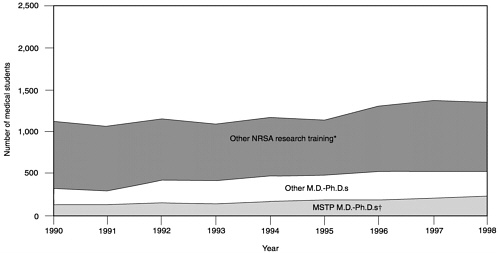
FIGURE 4-2 Students receiving various types of research training during medical school. Some M.D.-Ph.D.s participated in the NRSA Medical Scientist Training Program (MSTP); other NRSA participants generally received short-term research training. SOURCES: Data are from the Association of American Medical Colleges, Student and Applicant Information Management System, and the NIH Trainee and Fellow File.
|
26 |
“National Research Service Award (NRSA) Stipend Increase,” NIH Guide for Grants and Contracts, 19 November 1998. Available: http://grants.nih.gov/grants/guide/index.html . |
|
27 |
National Institutes of Health. Office of Extramural Research. “Extramural Training Career Development Awards,” and from relevant NIH institute links. Online. Available: http://grants.nih.gov/training/careerdevelopment awards.htm . Accessed 8 December 1999. |
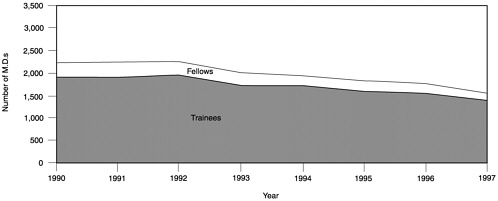
FIGURE 4-3 Physicians in postdoctoral NRSA training. SOURCE: Data are from the NIH Trainee and Fellow File.
include funds for research expenses, usually between $10,000 and $25,000.
In recent years the NIH has increasingly encouraged the use of career development awards for clinical research training. When the agency unveiled three new grant programs to foster the training and retention of clinical investigators in 1998, all three programs took the form of career development awards28 . In the fall of
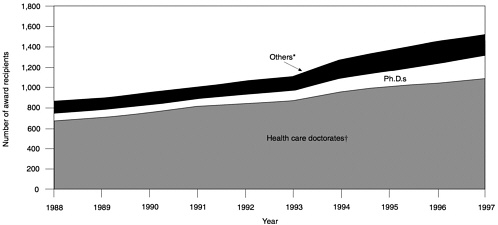
FIGURE 4-4 Recipients of mentored career development awards by degree type. Mentored career development award mechanisms include the K01, K08, K11, K14, K15, K17, K20 and K21. SOURCE: Data are from the NIH IMPAC System.
|
28 |
National Institutes of Health. “New Initiative in Clinical Research Training and Career Development. ” NIH Backgrounder. Bethesda, Md.: NIH, 6 March 1998. |
1999 the AHRQ followed suit and offered career development awards for clinicians committed to careers in health services research. 29
Given their financial advantages, dual-degree programs would seem to be another attractive option for health care professionals seeking clinical research training. To date, the NIH has developed several types of dual-degree training: (1) the Medical Scientist Training Program, (2) individual M.D.-Ph.D. fellowships, and (3) the Dental Scientist Training Program. The oldest and largest of these is the Medical Scientist Training Program (MSTP), established by the National Institute of General Medical Sciences in 1964. Today, the education and research training of nearly 900 medical students are supported by MSTP training grants to 38 medical schools and universities. 30 , 31 Fellowships for M.D.-Ph.D. training are a more recent development, instituted in 1989 by the National Institute of Mental Health, the National Institute on Alcohol Abuse and Alcoholism, and the National Institute on Drug Abuse to encourage dual-degree training in the areas of mental health, behavior, and neuroscience. The fellowship program is much smaller in scale, supporting about 40 students a year. 32 The latest type of dual-degree training to be introduced is the Dental Scientist Training Program (DSTP), which was created following the recommendations from the committee preceding ours. Since the first DSTP training grants were awarded in 1996, the program has grown to support roughly 10 students in three dental schools, and the National Institute of Dental and Craniofacial Research has also introduced an individual fellowship award for dental students in dual-degree training. 33 , 34
Each of these avenues for NRSA dual-degree training provides participating students with tuition support and stipends while they pursue professional and doctoral training, allowing them to earn two degrees in roughly seven years and graduate with very little—or no—educational debt. Indeed, the difference in the indebtedness between recent M.D.s and their classmates who received NIH support through the Medical Scientist Training Program is striking. Of the 178 MSTP students who graduated in 1997, just over 60 percent (107) reported no medical school debt (Table 4-3 ); of those with educational debt, the average amount owed was just over $26,200, about one-third of that reported by their medical school classmates graduating with the M.D. alone (who reported owing more than $77,500).
Yet despite the attractions of M.D.-Ph.D. programs, relatively few participants receive research training in clinical research methods; neither do they go on to conduct clinical research. A 1996 analysis of the fields of study chosen by MSTP participants found that nearly 60 percent of graduates from the late 1980s and early 1990s received their Ph.D.s in five basic science fields: biochemistry, neuroscience, molecular biology, cell biology, and pharmacology. 35 Further, in their subsequent research careers, MSTP graduates focused almost entirely on laboratory-oriented research and sought NIH funding for such research projects at the same rate as Ph.D.s.
This emphasis on laboratory-oriented research stems, in part, from the conventional organization of M.D.-Ph.D. training. Traditionally, dual-degree programs have encouraged and in many cases directed their students toward doctoral study in the basic biomedical sciences. More recently, however, the National Institute of General Medical Sciences has recommended that institutions provide broad opportunities for M.D.-Ph.D. training, recognizing that restrictions on student choice of training areas may limit their subsequent fields of investigation.
In early 1997 the National Institute of General Medical Sciences issued new guidelines for its Medical Scientist Training Program, urging the medical schools with such training grants to extend their programs to give students “a breadth of doctoral research training opportunities,” in fields including computer science,
|
29 |
“Mentored Clinical Scientist Development Award,” NIH Guide for Grants and Contracts, 11 November 1999. Available: http://grants.nih.gov/grants/guide/index.html . |
|
30 |
National Institutes of Health. National Institute of General Medical Sciences. The Careers and Professional Activities of Graduates of the NIGMS Medical Scientist Training Program. Bethesda, Md.: NIH, September 1998. |
|
31 |
National Institutes of Health. National Institute of General Medical Sciences. “Medical Scientist Training Program (MSTP) Institutions. ” Online. Available: http://www.nih.gov/nigms/funding/mstp.html . Accessed 3 March 2000. |
|
32 |
Unpublished tabulation from the NIH IMPAC System; available from the archives of the Academies. |
|
33 |
Lipton, James. National Institute of Dental and Craniofacial Research. Personal communication, July 1999. |
|
34 |
“Individual Predoctoral Dental Scientist Fellowship,” NIH Guide for Grants and Contracts, 15 August 1997. Available: http://grants.nih.gov/grants/guide/index/html . |
|
35 |
Sutton, Jennifer, and Charles D. Killian. “The M.D.-Ph.D. Researcher—What Species of Investigator?” Academic Medicine 71 (May 1996): 454–59. |
the social and behavioral sciences, economics, epidemiology, public health, bioengineering, biostatistics, and bioethics. 36 So far, most M.D.-Ph.D. programs have been slow to respond. An examination of catalogs, brochures, and other program materials at the start of the 1999-2000 academic year revealed that few programs had expanded their offerings. Almost 60 percent still advise prospective dual-degree students that their options for pursuing a Ph.D. are limited to the biological, chemical, and physical sciences; other programs generally offer only one or two choices outside these fields.
To adapt to the new National Institute of General Medical Sciences policy, some M.D.-Ph.D. programs may need to expand their rosters to encompass additional fields of study in the medical school, such as the Ph.D. programs in clinical research that Johns Hopkins and UCLA have introduced. 37 Others may opt to forge ties with doctoral programs in departments outside of the medical school, as the University of North Carolina has done with the Department of Epidemiology in its School of Public Health. 38 Still others may seek to establish links to neighboring universities, as Emory has with Georgia Tech for training in bioengineering. 39
Finally, the extent to which Medical Scientist Training Programs sponsored by the National Institute of General Medical Sciences offer their students the opportunity to earn Ph.D.s in a broad range of fields in addition to the basic biomedical sciences may influence other dual-degree programs. For example, because the M.D.-Ph.D. fellowships sponsored by the National Institute of Mental Health, National Institute on Drug Abuse, and National Institute on Alcohol Abuse and Alcoholism are generally available only to those enrolled in existing M.D.-Ph.D. programs, there is little opportunity for these fellows to obtain many of the research skills that facilitate clinical research related to behavior and mental health. Almost all recipients of these fellowships so far have graduated with Ph.D.s in basic biomedical disciplines, rather than in the behavioral or social sciences. 40
As in the basic biomedical and behavioral and social sciences, Ph.D. production in the fields associated with clinical research has expanded. Indeed, the number of clinical science Ph.D.s has grown at a rate much faster than in the biomedical or behavioral sciences. In 1997, 1,349 Ph.D.s were awarded in clinical research-related fields, almost six times the number in 1975 (see Table G-3 ).
Meanwhile, the numbers of women, minorities, and noncitizens earning degrees have all increased. In a pattern of growth nearly identical to the behavioral and social sciences, the percentage of women earning doctoral degrees in clinical fields has more than doubled since 1975, growing from 31.3 percent in 1975 to 64.5 percent in 1997. The share of Ph.D.s earned by minorities, furthermore, increased at a more rapid pace than in any other field in this study, from 0.9 percent in 1975 to 5.9 percent in 1997. Today, the clinical sciences rank above the biomedical but below the behavioral sciences in the percentage of doctoral degrees earned by minorities.
The percentage of clinical science Ph.D.s awarded to noncitizens has always been relatively high; in 1975, for example, temporary-visa holders earned a greater share of doctoral degrees awarded in the clinical sciences (9.1 percent) than in the biomedical sciences (8.3 percent). Since then the fraction of clinical science Ph.D.s awarded to temporary-visa holders has doubled, growing to 18.3 percent in 1997, just below that in biomedical fields.
Time to degree has also increased in the clinical sciences, and those earning Ph.D.s are older than ever before. Today, clinical science Ph.D.s typically earn their degrees 10 years after beginning graduate study (median time to degree, as measured from entry into post-baccalaureate study) at a median age of 38.4. In 1975 the median time to degree was seven years, and the median age of Ph.D.s was less than 32.
Ph.D.s in nursing present a special situation; on average, they complete their degrees much later in life. In many cases, this may result from pursuing a Ph.D. parttime. Even those receiving NRSA funds, which require
|
36 |
Described in memorandum to NIGMS Training Grant Program Directors from John Norvell, April 29, 1997. |
|
37 |
Association of American Medical Colleges. For the Health of the Public: Ensuring the Future of Clinical Research. Washington, D.C.: AAMC, 2000. |
|
38 |
University of North Carolina at Chapel Hill School of Medicine. M.D.-Ph.D. Program. “Research.” Online. Available: http://www.med.unc.edu/mdphd/researchINFO.htm . Accessed 5 March 2000. |
|
39 |
Emory School of Medicine. M.D.-Ph.D. Program. “Program Information.” Online. Available: http://omesa.medadm.emory.edu/MDPHD/program.html . Accessed 1 February 2000. |
|
40 |
Unpublished tabulation from the NIH Trainee and Fellow File and the Survey of Earned Doctorates; available from the archives of the Academies. |
full-time study, however, are generally past 40 by the time they finish their studies. The median age at which an NRSA recipient completes a nursing Ph.D. is over 41 years, in marked contrast to the basic biomedical sciences, where NRSA recipients complete their Ph.D.s at a median age of 30, and the behavioral and social sciences receive their degrees at age 32. 41
The advanced age of nursing Ph.D.s stems, in part, from the norms of the profession, which encourages its members to acquire considerable professional experience before seeking research training. Although this practice ensures professional expertise, later research training inevitably limits the length of an individual's research career. The advanced age of nursing Ph.D.s also poses a staffing challenge for nursing school administrators. The median age of nursing school faculty is now 50, and many nursing school deans report concerns about their abilities to replace retiring faculty. 42
IMPLICATIONS AND RECOMMENDATIONS
Overall, the clinical research workforce lags well behind both the basic biomedical and the behavioral and social science workforces in size. Given the apparently ample supply of both biomedical and behavioral researchers, however, the significance of this difference in workforce dimensions is not entirely clear.
Within the clinical research workforce itself, the considerable growth in the number of research doctorates awarded in fields related to clinical research since 1975 has yielded an abundant supply of Ph.D.s. Other than the advanced age of Ph.D.s in nursing, the committee finds little cause for concern in the training and supply of clinical research Ph.D.s.
Over the same time period, however, the number of physician-investigators has declined, as fewer physicians have pursued research training and established research careers. The evidence suggests that the decline in health care doctorates in the clinical research workforce is due in large measure to the economic disincentives associated with NRSA research training and the conduct of federally funded research.
Because those who interact with patients often bring great understanding and awareness of the health needs of the public to clinical research, the diminishing role played by physicians affects the capacity of the clinical research workforce to sustain a program of research that addresses the nation's needs. If this pool of investigators dwindles further, it is possible that the NIH— which has depended on physician-investigators to initiate much of the clinical research it supports—may not be able to maintain its clinical research portfolio at current levels.
The NIH, the Agency for Healthcare Research and Quality, and the Health Resources and Services Administration should pay increased attention to the training of underrepresented minorities for the clinical research workforce. The number of minority students earning Ph.D.s in clinical science fields has increased since 1975, but this trend must accelerate if the workforce is to better reflect the nation 's increasing diversity and to meet the nation's changing health needs. The number of minority physicians and dentists in research cannot be easily determined, but the estimates for physicians, at least, suggest that underrepresented minorities pursue research careers at about half the rate they choose other careers in medicine.
Future analyses of this workforce would be improved by more data on the training and careers of physicians and other health care doctorates who conduct clinical research, as well as by a better understanding of the role played by Ph.D.s from fields other than those traditionally associated with clinical research.
Recommendation 4-1. The NIH, the Agency for Healthcare Research and Quality, and the Health Resources and Services Administration should intensify their efforts to train and retain physicians in clinical research until the decline in the numbers has been reversed and the clinical research workforce includes substantially more M.D.s and other health care doctorates than is now the case.
Without adequate numbers of physicians and other health care doctorates, the research conducted by the clinical research workforce will almost surely fail to fully reflect the nation's needs. The committee commends the NIH's introduction of a new series of career development awards to enhance the clinical research training of physicians and other health care professionals and recommends that the agency carefully monitor and report on the outcomes of these new initiatives. In addition, the committee urges the
|
41 |
Unpublished tabulation from the NIH Trainee and Fellow File and the Survey of Earned Doctorates; available from the archives of the Academies. |
|
42 |
American Association of Colleges of Nursing. 1998-1999 Salaries of Instructional and Administrative Nursing Faculty in Baccalaureate and Graduate Programs in Nursing. Washington, D.C.: AACN, 1999. |
NIH, the Agency for Healthcare Research and Quality, and the Health Resources and Services Administration to consider additional measures to bolster the training and retention of health care doctorates in clinical research, including those described in the following recommendations.
Recommendation 4-2. The NIH, the Agency for Healthcare Research and Quality, and the Health Resources and Services Administration should substantially increase opportunities for dual-degree training in fields related to clinical research.
The committee urges the agencies to work together to substantially increase opportunities for dual-degree training (whether M.D.-Ph.D., M.D.-M.P.H., or dual-degree programs targeted to dentists and other health care doctorates) in fields related to clinical research, such as epidemiology, psychology, and health services research.
Recommendation 4-3. The NIH, the Agency for Healthcare Research and Quality, and the Health Resources and Services Administration should take steps to reduce the economic barriers to clinical research careers faced by physicians, dentists, and other health care doctorates.
The committee urges the agencies to work together to (1) ensure that physicians and dentists in postdoctoral research training are fully informed of their options for loan deferment and (2) seek legislative authority to establish extramural loan repayment programs for those who pursue clinical research training and careers. In addition, the committee urges the NIH and the Agency for Healthcare Quality and Research to consider seeking legislative authority to raise the salary cap above current levels for physicians and other health care doctorates conducting clinical research.
Recommendation 4-4. The NIH, the Agency for Healthcare Research and Quality, and the Health Resources and Services Administration should take additional steps to improve their understanding of the training and career paths of clinical investigators.
Since the NIH began to monitor the number of clinical research grants it awards, its efforts have yielded some important new data on the clinical research workforce. Still, information on the training and career paths of physicians, dentists, and other health care doctorates is too limited to permit detailed analyses of the clinical research workforce.
Recommendation 4-5. There should be no growth in the aggregate number of Ph.D.s awarded annually in the fields traditionally associated with clinical research.
Given the considerable growth in the number of research doctorates awarded in clinical science fields since 1975, and the resulting expansion of the Ph.D. portion of the clinical research workforce, the committee finds no reason for Ph.D. production to increase outside of dual-degree programs.
Recommendation 4-6. The National Institute of Nursing Research should emphasize research training programs that foster earlier entry into research careers.
Delayed research training inevitably limits the length of an investigator 's research career and affects the supply of nursing faculty. The National Institute of Nursing Research may wish to consider redirecting a portion of its NRSA funds to programs targeting students entering the nursing profession (such as B.A.-to-Ph.D. programs) and recent nursing graduates.
Recommendation 4-7. The NIH, the Agency for Healthcare Research and Quality, and the Health Resources and Services Administration should increase their efforts to identify and support programs that encourage and prepare underrepresented minority students for careers in clinical research.
Although the number of underrepresented minority men and women earning Ph.D.s in the clinical sciences has grown over the last few decades, the NIH and its fellow agencies should increase their efforts to ensure that these trends accelerate. In addition, the NIH, the Agency for Healthcare Research and Quality, and the Health Resources and Services Administration should intensify their efforts to increase the percentage of minority physicians in research, which appears to be about half that of other careers in medicine.


