
6
Making More Effective Use of the Existing IT Workforce
One approach to reducing the difficulties that employers have in hiring is to make more effective use of qualified workers who can be put to work in a relatively short time with little or no additional education or training. Thus, the strategies discussed in this chapter can fairly be characterized as actions that individual employers may take to relieve their hiring difficulties to a certain extent. While many, if not most, employers may be aware of these strategies, the committee hopes that a brief discussion of them here may help increase awareness of their potential for reducing hiring difficulties. Furthermore, for these strategies to pay off, execution and follow-through are as essential as initial awareness of the strategies. According to much of the anecdotal information provided to the committee, employers who implement these strategies successfully appear to have fewer difficulties in hiring.
6.1 ATTRACTING AND USING IT WORKERS MORE EFFICIENTLY
Several options for attracting and using IT workers more efficiently are discussed with respect to their potential benefits and costs. The actual benefits and costs will, of course, depend on the circumstances of each employer.
6.1.1 Increased Use of Overtime
Historically, the increased use of overtime in preference to hiring additional workers has been one response to tightness in the labor force. Especially for exempt workers, the use of overtime may save money relative to hiring additional workers, because many fringe benefits, such as health insurance, unemployment insurance, and workers ' compensation, are fixed and the firm will not experience any increase in costs for these benefits when current employees work additional hours. As importantly, workers who can work overtime are in fact already on the payroll, and so an employer does not incur the costs of recruiting additional workers.
A common stereotype of IT workers portrayed in the popular press is that of workers who work long days and as much as 80 hours per week. Furthermore, this stereotype is typically described as being caused by the culture of the IT workplace, the push to bring products to market before other firms, and the overall shortage of workers available to IT firms. However, the quantitative data available to the committee do not support this stereotype across the board.
In particular, data from the Current Population Survey (CPS) on selected Category 1 occupations indicate that, during 1997 and 1998, average weekly hours in these occupations were just under 40 hours per week. 1 By comparison, weekly hours across all workers averaged 34.6 during 1997 and 1998. Full-time managers, executives, and professional specialty workers, though, worked an average of 44.7 hours per week during 1999.
Figure 6.1 and Figure 6.2 illustrate a distribution of CPS-tabulated (Category 1) IT workers in numbers of hours worked per week. About 80 percent of computer systems analysts, computer scientists, and computer programmers worked between 36 and 50 hours per week in 1999 according to the CPS. A November 1999 survey by Software Development magazine, which yielded 3,928 responses to a question about hours worked per week, yielded similar results: among this self-selected group, 61 percent reported clocking 41 to 50 hours per week.2
Moreover, the percentage of employees who worked 40 or more hours per week was higher for each of lawyers and judges, health diagnostic occupations, and engineers than for IT jobs as tabulated by CPS. As shown in Figure 6.3, only 25 percent of computer programmers and 40 percent of computer systems analysts and scientists worked more than
|
1 |
U.S. Department of Labor, Bureau of Labor Statistics, Current Population Survey, March 1999, special tabulation. |
|
2 |
Morales, Alexandra Weber. 1999. “Salary and Job Satisfaction Survey,” Software Development, November. See <http://www.sdmagazine.com/articles/1999/0011/0011a/0011a.htm>. |
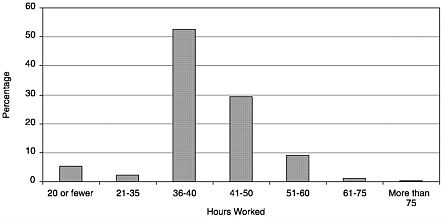
FIGURE 6.1 Computer systems analysts and scientists, by number of hours worked per week, 1999. SOURCE: U.S. Department of Labor, Bureau of Labor Statistics, Current Population Survey, 1999, special tabulations.
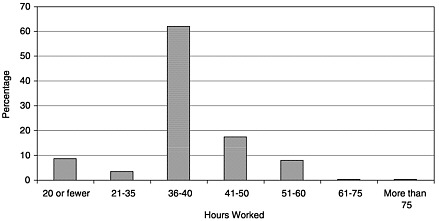
FIGURE 6.2 Computer programmers, by number of hours worked per week, 1999. SOURCE: U.S. Department of Labor, Bureau of Labor Statistics, Current Population Survey, 1999, special tabulations.
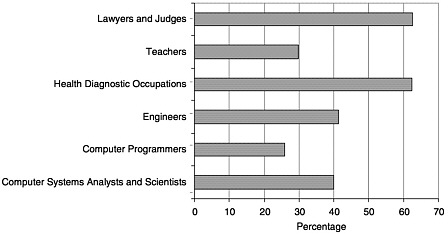
FIGURE 6.3 Percent of employed who worked more than 40 hours per week, IT and selected occupations, 1999. SOURCE: U.S. Department of Labor, Bureau of Labor Statistics, Current Population Survey, March 1999, special tabulation.
40 hours per week in 1999 according to the CPS. The vast majority of these individuals worked between 41 and 50 hours per week.
Only small numbers of CPS-tabulated IT employees work more than 50 hours per week. According to the CPS, 10.5 percent of computer systems analysts and scientists and 8.6 percent of computer programmers worked more than 50 hours per week in 1999. Similarly, the Software Development survey results indicated that 13 percent said they worked 51 to 60 hours per week, and 4 percent said they worked an average of 61 hours or more per week.
A related issue is the availability of vacation and the ability to use accrued vacation time. The Software Development magazine survey asked respondents about this. Among the 3,862 respondents, 57 percent said they were able to use their vacation each year, but another 40 percent said they could use only part of their vacation, and rolled the rest over to the following year. Only 3 percent said they were unable to use any of their vacation time.
The data also do not support the notion that longer workdays are more typical in smaller firms. Figure 6.4, for example, provides data on the percentage of computer systems analysts and scientists who work 40 or more hours per week by firm size. Data on computer programmers are very similar.
Despite the implication of the large-scale quantitative data that long work hours do not characterize the IT workforce taken as a whole, the anecdotal evidence provided to the committee in testimony, electronic
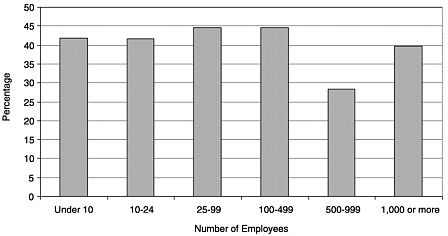
FIGURE 6.4 Percent of computer systems analysts and scientists who worked more than 40 hours per week, by size of firm, 1999. SOURCE: U.S. Department of Labor, Bureau of Labor Statistics, Current Population Survey, March 1999, special tabulation.
input, site visits, and the public press suggests that these large-scale averages may mask a wide variation in work hours characteristic of different individual employers. Employees at different firms visited by the committee described their work hours quite differently. Employees at Firm A—a moderately sized software company that has not yet gone public—actively sought “Type A” employees willing to work 18 hours a day 6 days a week, with the consequence that turnover in the firm was high. Firm B, a small growing company, provided compensatory time for the long hours that were sometimes necessary. Employees from Firm C said they “had a life.” Microsoft employees report the hours of work and the pace are moderate, involving some “crash” periods with night and/or weekend work at other times during the 2- to 3-year cycle of software development. 3
Why might some firms feel pressure to expect long hours from their IT workers? In some cases, market windows for certain IT firms are small, and these firms must beat competitors to market with acceptable levels of functionality. Under such time pressure, the approach of partitioning the work to be done by more workers entails considerable over-
|
3 |
Fallows, James. 2000. “Inside the Leviathan,” The Atlantic Monthly 285(2):34-38. |
head in terms of communicating what the additional people are doing, resulting in significant inefficiencies.4 As a result, employees may have to work long hours in order to meet deadlines. This point is most significant when the work involved requires knowledge of the entire system being developed and how the different portions of it interact with each other. Good system design minimizes the number of such interactions needed, but perfect isolation of components is never possible—indeed, a completely isolated component cannot contribute at all to the functionality of the system.
A second reason is that the individual culture of some firms—not only in the IT sector—involves very long hours. People who work reduced hours are often seen as uncommitted to project success and/or to their employer. 5 And, in competitive environments that reward differential effort, private incentives lead people to work too much.6
When they exist, long hours are controversial for many of the same reasons that they are unpopular in other businesses. Long hours are often viewed negatively by workers who wish to live lives more balanced between work and nonwork. Long hours also tend to lead to inefficient behavior in any case as workers make more mistakes, especially when these hours are sustained for extended periods of time. And many IT workers are “exempt” from overtime,7 and thus employers need not pay
|
4 |
See, for example, Brooks, Frederick. 1995. The Mythical Man-Month: Essays on Software Engineering, Anniversary Edition. Reading, Mass.: Addison-Wesley. |
|
5 |
See, for example, Landers, Renee M., James B. Rebitzer, and Lowell J. Taylor. 1996. “Rat Race Redux: Adverse Selection in the Determination of Work Hours in Law Firms,” The American Economic Review 86(3):329-348. This study noted that in law firms, long hours were regarded by senior decision makers as a symbol of commitment and ambition. (The study also found that long hours became a symbol because these decision makers had few objective measures of an individual 's work quality, a difficulty that is probably less operative—but not entirely absent—in the context of a software development firm.) |
|
6 |
Robert, Frank, and Philip J. Cook. 1995. The Winner-Take-All Society. New York: Free Press. See also Schor, Juliet. 1993. The Overworked American: The American Decline in Leisure. New York: Basic Books. |
|
7 |
Workers in certain jobs are exempt from the overtime provisions of the Fair Labor Standards Act and do not receive a premium for hours in excess of 40 hours per week. “Exempt” jobs are defined by law, not by the employer. As a general rule, a job entailing intellectual work requiring the consistent exercise of discretion and judgment in its performance is exempt. Job titles are not necessarily associated with “exempt” status. In addition, Public Law 104-188 (29 USC 213, paragraph 17) mandates exempt status for “any employee who is a computer systems analyst, computer programmer, software engineer, or other similarly skilled worker,” and who is compensated on an hourly basis at more than $27.63 an hour. The primary duties of these employees must be “(A) the application of systems analysis techniques and procedures, including consulting with users, to determine hardware, software, or system functional specifications; (B) the design, development, documentation, analysis, creation, testing, or modification of computer systems or programs, including prototypes, based on and related to user or system design specifications; (C) the design, documentation, testing, creation, or modification of computer programs related to machine operating systems; or (D) a combination of duties described in subparagraphs (A), (B), and (C) the performance of which requires the same level of skills.” |
them for overtime work—a practice that is interpreted as employer exploitation by some commentators. At the same time and as noted in Chapter 1, the committee also heard from a number of individuals who asserted that many IT workers spend much longer at work than necessary, because they work inefficiently and do not cleanly separate work and play —in this view, excessively long hours are the result of poor personal time-management strategies.
6.1.2 Improved Recruitment and Retention
Improving Job Attractiveness
Upgrading the attractiveness of a job can increase the number of qualified applicants, make it more attractive for incumbents holding that job to stay (thus reducing turnover), and provide incentives for students, as well as workers in other industries, to obtain the education and training necessary to qualify for these more attractive jobs.
As noted earlier, increasing financial compensation is the time-honored way of making a job more attractive. Financial compensation can take many forms: base salary; bonuses for recruitment, retention, and performance; and stock options and/or equity stakes.8 And IT workers have seen wages rise in real terms in recent years, though not uniformly through all categories of IT employment (as discussed in Chapter 3). (Of course, when other firms are able to raise compensation, turnover at any given employer may well increase, all else being equal.)
At the same time, even though workers may temporarily set aside their concerns about quality of life in a quest for riches, they are also equally concerned with quality-of-life factors, including telecommuting, less stressful commuting, and hours providing a better balance between work and family. In addition, mentoring, plum work assignments, a
|
8 |
Stock options and equity stakes in small start-up companies can also act to drive employees away on a time scale of a few years. In particular, talented IT workers can build their own stock portfolio of pre-initial public offerings shares in order to improve their chances of winning the high-tech lottery and striking it rich. They may well be tempted to leave for another start-up company after a relatively short period of time (e.g., 2 years), with only a fraction (but a significant fraction) of their options vested in order to exploit the opportunity offered by another employer to receive additional options in a different company. |
congenial work culture, good management, and opportunities for retraining can all make a job more attractive.9
Most importantly, the opportunity to work on challenging projects with new and interesting technology is a great motivator for many employees. Indeed, many surveys report that employees commonly rank compensation lower on their priority lists than technical challenges and the opportunity to learn new technical skills.10 Many IT workers, especially those doing large amounts of Category 1 work, are sustained by a love of technology and the intellectual challenges of working on cuttingedge problems with others of comparable technical skill and intelligence. This is not to say that money is unimportant —but rather that they are also motivated strongly by their intellectual environment. These points suggest that employers that have a choice about projects to which to assign workers may be able to attract workers in individual cases with non-financial incentives as well as with higher levels of compensation.11
One study12 has found that long-term employment relationships in large firms stem from the greater capacity of large employers to provide job opportunities within the enterprise and the lower probability of business failure facing large producers. In addition to directly lowering turnover, these factors act to raise the expected returns from on-the-job training as the expected duration of the employment relationship increases. As a result, large firms invest in higher levels of on-the-job training that in turn inhibits turnover. Mobility is further reduced by large firms hiring employees who prefer stability and permanence and paying mobility-inhibiting wage premiums and fringe benefits in order to protect their training investments.
An example of an employer program to increase retention is the Intel
|
9 |
In the case of foreign workers brought to the United States, it is not unreasonable to consider the opportunity to live and work in the United States as an additional nonmonetary compensation, which is one reason that the United States is attractive to foreign workers. |
|
10 |
Additional evidence on this point can be found in the fact that many programmers volunteer time beyond their paid jobs to participate in Open Source software development, an example of which is the development of Linux. For a discussion of this phenomenon, see Eric Raymond, The Cathedral and the Bazaar. Available online at <http://yuma.tdyc.com/bazaar.html/bazaar.html>. |
|
11 |
For example, a large employer may have multiple projects and be faced with the choice of assigning a worker to a project in which he or she will be maximally productive because of high familiarity with the project, or to a different project that presents new technical challenges and a learning opportunity for the worker. While the first choice may be better from the standpoint of immediate efficiency, the second choice may motivate the worker more effectively. |
|
12 |
Idson, Todd L. 1995. Employer Size and Labor Turnover. New York: Columbia University, February. Available online at <http://www.columbia.edu/dlc/wp/econ/econ673.html>. |
Corporation's practice of redeployment. All employees who face potential job loss due to a project ending or an obsolescence of skills are permitted to join a redeployment pool for an assigned period of time, depending on a number of factors including skill type, retraining potential, etc., but generally around 4 months. During this time they receive job search support and retraining for other jobs and are utilized as a pool for temporary positions that arise within the company. As a result, an overwhelming majority of employees find internal positions within the company. This program was recognized by the Equal Employment Opportunity Commission as a Best Practice in 1997.
Former employees are another source of labor. For example, to deal with the current labor force tightness of middle and senior managers in the IT sector, certain farsighted employers are reaching out to previously unutilized former employees to fill those gaps.13
Finally, taking steps that combat negative stereotypes of IT work may have positive effects. For example, stereotypes of the entire IT field as being a field for young and generally single workers with Friday night beer parties, very long hours and/or extensive business travel in a fast-paced and highly unstructured environment, and risky compensation practices (e.g., stock options and equity stakes in lieu of higher wages) may well discourage a broad segment of the population from seriously considering such work, and/or encourage negative feelings and perceptions of IT work on the part of some of those already working in the field. Perceptions resulting from such stereotypes may lead potential workers to self-select away from the IT field, and employer actions to emphasize a company's appeal to a wider population may help to broaden its appeal.
Increasing Awareness of Jobs Among Potential Workers (Including Those Working for Competitors)
In order to attract potential workers, many employers advertise publicly. IT employers in particular (as well as biotechnology firms to a somewhat lesser extent) tend to emphasize job advertising on the Internet; print advertising is used as well but less often (and is required by law as an element of a permanent labor certification for an alien).
Many IT employers also recruit at colleges and universities for recent graduates for entry-level positions. At the same time, they openly acknowledge a strong preference for recruiting primarily at colleges and universities known to have strong computer science programs, and not at
|
13 |
Reingold, Jennifer, and Diane Brady. 1999. “Brain Drain,” Business Week, September 20. Available online at <http://www.businessweek.com/1999/99_38/b3647001.htm>. |
other institutions. In many instances, IT employers have developed extensive relationships with the IT programs at these universities (which may include contributions of money, equipment, software, faculty, and advice). Employers are thus drawn to recruit from strong programs whose curricula they know well.
Finally, a substantial amount of recruiting for IT positions is undertaken by “head-hunters,” word of mouth, and personal connections (e.g., a firm goes to a university computer science department head to ask for top students, a current employee personally recruits another employee). In some cases, personal connections may simply be the most efficient way to find new employees. Employees doing referrals are likely to be hesitant to recommend individuals who are unqualified, and the candidates they recommend are likely to know more about the work and working conditions than other job candidates. Many IT employers report that open advertisements are far less useful than personal referrals in attracting appropriate candidates, and an increasing number of employers pay recruiting bonuses to employees who bring in new workers.
In principle, all of these channels to promote awareness could be used more. More aggressive advertising could be done, both in print and on the Internet. Such advertising might, for example, target groups underrepresented in the IT workforce. Recruiting efforts at colleges could be stepped up, e.g., by recruiting at more colleges and universities. And greater efforts could be made to bring in personal referrals.
Each of these strategies has associated costs as well as benefits. For example, open advertising is costly, and often results in a flood of unqualified candidates who must then be screened out. Advertising targeted at underrepresented groups may fail because the proportion of individuals with the relevant skills is too small. And broader advertising is likely to be successful only when the unemployment rate for IT workers and/or the number of IT-work-capable people working in other professions is high. Many IT employers report that only a fraction of their new hires result from open advertising, as opposed to other channels.
Expanding the number of universities at which a firm can do meaningful recruiting is a longer-term affair that requires substantial effort in engaging the relevant departments intellectually. Recruiting without such engagement is possible but is likely to have a relatively low yield, because the employer will have relatively little idea of the curricula imparted to the student. (And some IT employers question the value of recruiting at large numbers of universities beyond the top tier, because they believe the work they do requires students of top caliber.)
Reliance upon word-of-mouth recruiting potentially exposes employers to legal challenges, though there is no affirmative legal requirement that firms hire competitively. Case law addresses word-of-mouth hiring,
which is often challenged when it systematically leads to disparities (e.g., a Korean-owned janitorial business that operates in a black neighborhood in Chicago but hires no blacks, saying all its hiring is word of mouth and that just happens to produce all Koreans); however, the circuit courts are divided on the legality of word-of-mouth hiring that produces such results.14 Such challenges to employer practices may present risk to employers and in any event are costly for employers to handle. A further downside is the fact that word-of-mouth recruiting may limit the population from which an employer draws. For example, to the extent that social relationships are most common among age peers, qualified older individuals would more rarely come to the attention of those responsible for hiring in companies that have large numbers of younger workers.
For some employers, a particularly effective approach in seeking out new workers is to target employees working for other firms. Compared to recent college graduates or those who might read an employment ad by chance, workers from other firms are more experienced, better understand the business environment, and infuse the new employer with knowledge of and a perspective on another company's practices. Furthermore, a resume that does not indicate experience with multiple employers can be regarded as an indicator of an employee's lack of quality in a tight job market (i.e., this person has not been desirable to many employers).
Improving Internal Human Resource Policies
Employment practices and policies at a given firm may not be well-connected to its needs for IT workers. For example, amidst corporate concerns about internal equity and morale, salary scales may well be determined on a corporation-wide basis, based on experience and educational background. But such scales may not be well-suited to IT workers, who may be able to command significantly higher salaries on the market for the same experience and educational background. Accustomed to a more sedate employment market for other specializations, company policy may forbid “special treatment” for IT workers that may include rapidly growing wages, bonuses for hiring and “hot skills,” and team perfor-
|
14 |
In EEOC vs. Consolidated Services Systems, the Seventh Circuit Court held that a firm using word-of-mouth as its primary mode of recruitment was not in violation of Title VII of the Civil Rights Act, even though that practice resulted in disproportionate representation of certain protected groups (EEOC vs. Consolidated Services Systems, 989 F.2d 233, 7th Cir., 1993). In Domingo vs. New England Fish Company, the Ninth Circuit Court held that a firm using word-of-mouth recruitment that results in disproportionate representation of certain protected groups may, under some circumstances, violate Title VII (Domingo vs. New England Fish Company, 727 F.2d 1429, 9th Cir., 1984). |
mance and retention bonuses. Further, because the human resources (HR) department is often the intermediary between job applicants and line managers that actually need workers, mismatches between company policy and the realities of hiring IT workers are often perceived by line managers as problems caused by HR departments.
“Cultural” issues arise as well. The highly informal culture of work in IT may differ significantly from that of the parent company, which may be highly formal, and insistence that IT workers conform to the cultural practices of the parent company is likely to be a significant disincentive for many of them.
Finally, to the extent that HR departments (especially in companies that do not focus on IT as their principal business) are staffed by generalists who are not able to keep track of rapidly changing trends in IT or in the marketplace for IT workers, the detailed requirements set for hiring IT workers may not reflect the current state of the IT workforce. For example, an IT department may be seeking workers with substantial Java experience. On the basis of their work with other departments in the company, someone unfamiliar with technology trends in IT may well translate this need into an advertisement running in 1998 specifying “5 years of experience with Java”—an impossibility since Java was formally announced in 1995.
Increasing the coupling between HR and IT would improve the matching process, and indeed, some IT-sector companies have begun to develop internal structures that address recruitment, training, and retention of the company's skilled workforce. In some cases, these internal structures are mini-HR departments that work exclusively with the IT department; in other cases, IT departments and corporate HR departments have established closer connections.
6.1.3 Making Clearer Distinctions Between Essential and Optional Attributes
An employer's desire for a new employee to be a perfect fit to the requirements of a job for both skills and experience is understandable and has many motivations.15
-
Employers believe that new employees should be able to “hit the ground running.”
|
15 |
Some of these motivations are described by York (York, Thomas. 1999. “Why Are Employers So Picky?” Infoworld, November 22, available online at <http://www.infoworld.com/articles/ca/xml/99/11/22/991122cajob.xml >). |
-
Employers are often risk-averse, and workers who fit job requirements perfectly pose less of a risk, all else being equal, than workers who don't.
-
The IT environment today is complex, with many technologies interacting with each other, thus creating a requirement for skills in many areas.
-
With employee turnover at high levels, employers are reluctant to hire someone who needs training or retraining because they fear losing their investment. This premise puts a premium on individuals with no need for training (i.e., individuals with many skills rather than few).
-
Hiring managers are loath to spend time interviewing individuals who are not at least well-matched to the jobs in question.
In addition to skills, IT employers may place a high value on actual experience, in some cases higher than the value accorded education or training. In interviews conducted for the committee, hiring managers often stressed that demonstrated ability and experience were the most important factors for hiring—degrees and ranking of the college were secondary factors.16 The most attractive candidates are those who can show they have applied the latest programming languages or other technological skills on the job. Individuals other than recent college graduates who can demonstrate only that they have taken formal training in the current language or other “hot” technology may not even obtain an interview.
While understandably motivated, employer behavior in searching for the perfect candidate is puzzling. Insistence on a long list of qualifications will inevitably make it harder to find a qualified worker, and yet much of the time that an employer is waiting to hire could be invested in training a worker with nearly the right skill set. However, making a commitment to training someone entails the certain loss of productivity while that individual is training, whereas it is indeed possible that an applicant requiring no training could show up tomorrow. Given this fact, it is not surprising that many individuals (including hiring managers) end up waiting longer than they expected to hire someone, simply because they believe that an appropriate applicant could be “the next one in the door.” (And training an individual, say for 6 months, would not result in an individual with 3 years of experience, whereas waiting “just a little longer” might result in someone with such experience.) On the other
|
16 |
Salzman, Hal, “Information Technology Labor Markets,” commissioned paper prepared for the Committee on Workforce Needs in Information Technology, 2000. |
hand, if such a person is not forthcoming, it may take months or even a year to recruit and hire the “dream date,” with the common result that the project schedule is not met.
The fact that this behavior is understandable does not make it entirely rational, and a relaxation of the requirements needed to fill any job opening will result in a larger number of now-qualified applicants. And some companies are indeed taking the route of hiring applicants who possess many of the required skills and training the employee in the remaining job requirements. For these companies, it often takes less time to provide this training and upgrade a new employee 's skills than it would take to continue searching for the ideal job candidate. For the companies that testified to the committee, the “break-even” point was typically 4 to 6 months for the “retrain versus hire-from-outside” decision because college grads only become available on that time scale (i.e., every semester).
6.2 EXPANDING THE POOL OF IMMEDIATELY AVAILABLE WORKERS
One approach to coping with tight labor markets is finding better ways to identify talent within the labor pool. A natural consequence is for employers to search from the broadest possible pools of talent. On the assumption that the distribution of human talent does not respect ethnic, racial, or national boundaries, this is fundamentally the “enlightened self-interest” rationale for employers seeking out workers from underrepresented groups as well as from the traditional pools, and it is also a major rationale for seeking talent abroad.
6.2.1 The Role of Assessment
To find ways of utilizing a broader pool of talent, it is necessary to use assessment techniques that can identify qualified individuals in that broader pool. (For purposes of this report, assessment is the process by which employers evaluate applicants for the purpose of making hiring decisions.) For the IT employer, assessment is particularly difficult because of rapid change in technologies and in the business. Such change makes it difficult to analyze the requirements of today 's jobs and even more difficult to identify the skills, knowledge, and ability that might be required in the future.
Assessment techniques are never perfectly accurate. There will always be false positives (applicants who are hired but cannot perform the job) and false negatives (applicants who are rejected but can perform the job). Preselection screens using hiring standards that are too high cause many false negatives, and many applicants will be rejected even though they
would be highly productive on the job. The cost of this approach also would be to artificially inflate demand by artificially increasing sector-wide vacancy rates. The primary goal of assessment is to minimize false positives and false negatives to the greatest extent possible.
On the whole, IT-sector employers have been generally successful in minimizing false positives (i.e., screening out unqualified applicants) —this success is not an unreasonable inference from the IT sector's broad success and growth throughout the economy. On the other hand, given existing tightness in the IT workforce, a question arises as to whether IT-sector employers could do a better job in reducing false negatives (i.e., finding additional qualified and productive applicants from underrepresented groups that they currently overlook).
Because of the heterogeneity of IT-sector firms, it is difficult to make broad generalizations about assessment practices across the IT sector. Nevertheless, Murphy reports that many IT firms do not make use of structured assessment methods.17 Structured assessment methods are procedures that are used to evaluate a job applicant and that are administered in a standardized and uniform manner, scored in a consistent manner, and validated against indicators of job success. However, Murphy finds that IT employers seem to prefer assessment methods that require minimal time (e.g., resume screening) or function as two-way communication (e.g., unstructured interviews) rather than more formal “structured” assessment methods.18
For example, many IT employers obtain a significant number of their new employees from the pool of relatively recent college graduates. Often, they prefer to focus their recruiting on recent college graduates with high grades from the top computer science departments, on the theory that good academic performance at top-tier universities is suggestive of highly productive workers and because this approach makes efficient use of recruiter efforts. At the same time, there is no data or evidence to suggest that those who do not attend top schools are less qualified or less productive.
In other cases, companies seek to identify entry-level prospects through proactive means, such as asking the professors of university computer science departments for recommendations and/or hiring undergraduates for summer internships. In such cases, employment decisions are not
|
17 |
Murphy, Kevin, and Zinta Byrne, “Applications of Structured Assessment in the IT Workforce,” commissioned paper prepared for the Committee on Workforce Needs in Information Technology, 2000. |
|
18 |
Murphy and Byrne, 2000, “Applications of Structured Assessment in the IT Workforce,” commissioned paper. |
made on a competitive basis, in the sense that the individual prospective new hire does not compete against his or her peers for a given job.
Another approach to seeking talent is to advertise and wait for resumes to arrive. Under these circumstances, an initial screening of resumes winnows initial applicants to those who are “promising.” The committee heard a number of hiring managers report that they used “years of experience ” as a first-order filter. As discussed in Chapter 2, some experience clearly improves programmer productivity. But other studies indicate no clear relationship between the programmer's level of experience and the quality of the programs he or she writes or the time required to implement those programs.19 In practice, research shows a rather low level of correlation between years of experience or education and actual measures of job performance. 20
Among IT employers seeking to fill senior jobs requiring high levels of experience and sophistication, initial screening is almost always undertaken with a human being reading submitted resumes.21 But for entrylevel jobs and jobs requiring relatively low levels of experience, automated resume screening appears to be quite common. This practice is made possible because many IT employers emphasize their Web presence as their primary employment point of entry. Applicants can submit resumes electronically with a single mouse click. As a result, a company may receive hundreds of resumes for a single job vacancy. To sort through the many resumes received, both individual employers and online services use search engines that hit on keywords selected by hiring managers and recruiters.22
|
19 |
Prechelt, Lutz. 1999. “Comparing Java vs. C/C++ Efficiency Differences to Interpersonal Differences,” Communications of the ACM 42(10). Prechelt also reports (personal communication, October 1999) that the relationship between programmer experience and time to code the program is very weak, and that the correlation between time to code the program and the program's performance is also small. (He does note also that there is some tendency for Java programs to run faster after longer programming times, while programs in other languages were slower.) For data on the first point, see <http://wwwipd.ira.uka.de/~prechelt/documents/experience_years.gif >. and <http://wwwipd.ira.uka.de/~prechelt/documents/experience_KLOC.gif>. For data on the second point, see <http://wwwipd.ira.uka.de/~prechelt/documents/worktime_efficiency.gif >. |
|
20 |
The average correlation between years of education and years of job experience and measures of job performance is 0.10 and 0.18, respectively. See Schmidt, F.L., and J.E. Hunter. 1998. “The Validity and Utility of Selection Methods in Personnel Psychology: Practical and Theoretical Implications of 85 Years of Research Findings,” Psychological Bulletin 124:262-274. |
|
21 |
Murphy and Byrne, 2000, “Applications of Structured Assessment in the IT Workforce,” commissioned paper. |
|
22 |
To test online keyword searches of resumes, an NRC staff member on this study submitted the following paragraph. “Ph.D. in physics, received in 1979 from MIT. Extensive but old background in systems programming and development, but without current technical skills. Seeking position doing design and requirements specification on interesting project, subject irrelevant. Demonstrated problem-solving skills and ability to ask the right question. Currently employed doing policy work—and bored with it. Want to return to technical work.” A few hits were received in a 1-week period. He then added the following line: “I don't know C++ or Java or Oracle databases, but I'm a very quick study on technical matters.” The hit rate tripled in the next week. |
For jobs involving such open competition, the second screening usually entails an interview involving multiple persons (perhaps in a group, perhaps a series of one-on-one encounters).23 But what is asked of the applicant during the interview varies. In many cases, the interview is unstructured. Unstructured interviews are easy to conduct, but by definition they do not ask the same questions of an applicant and do not use a common scoring system. In other cases, the applicant is asked to provide a work sample in real time. For example, candidates for software engineering positions might be required to take a series of software design and coding tests, the results of which are evaluated by other, experienced, technical personnel. The advantage of such an approach is that it can examine the overall approach that the candidate uses, as well as the specific skills the candidate applies.
Accounting for Unintended Bias
Even among the most well-intentioned of individuals, the possibility of unintended bias is present. That is, without knowing that he or she is doing so, those responsible for hiring may favor someone that “looks like us” (for whatever definition of “us” is relevant). The hiring managers may select a superbly qualified person who looks different in contrast to an adequately qualified person who looks the same, but the bias is most likely to come out in a choice between two nearly equally qualified individuals.
Steps can be taken to reduce the likelihood of unintended bias—as a general rule, these steps involve separating the dimensions on which an individual is evaluated from personally identifying (and irrelevant) characteristics. Of course, such a separation is not always possible (e.g., when an individual's ability to work in a team is being evaluated), but it is possible more than it is practiced.
The impact of such steps can be quite significant. For example, in hiring musicians, symphony orchestras require applicants to audition. All auditions are “live,” but some orchestras conduct them with the appli-
|
23 |
This phenomenon was widely reported to the committee in site visits and regional open testimony in Santa Clara, California. |
cant behind a screen that prevents the judges from seeing the musician. In doing so, the music that the applicant plays—the relevant part of the audition—is separated from the irrelevant characteristics of the applicant's sex, race, and age. Goldin and Rouse find that the use of screen increases—by 50 percent—the probability that a female musician will be advanced from certain preliminary rounds and increases by severalfold the likelihood that a female musician will be selected in the final round.24
Effectiveness of Assessment Techniques and the Role of Job Analysis
How effective are current methods for identifying highly productive workers among applicants from underrepresented groups? As noted above, IT employers commonly use unstructured assessment methods and fail to evaluate applicants against the same criteria. One primary reason may be that many hiring managers are simply unaware that there are alternatives. Another reason may be that the alternatives are more expensive. On the other hand, the appropriate cost comparison must consider not only the immediate cost of unstructured informal methods versus the alternatives, but also the likelihood that one may find a larger number of productive workers from within a given applicant pool.
A variety of structured assessment methods are described in Box 6.1. Several of the methods have a solid empirical basis, a long and consistent record of validity,25 and demonstrated cost-effectiveness.26 Furthermore,
|
24 |
Goldin, Claudia, and Cecilia Rouse. 2000. “Orchestrating Impartiality: The Impact of “Blind” Auditions on Female Musicians,” American Economic Review 90(September):715-742. |
|
25 |
A 1999 review of 85 years of research into alternative methods of assessment found the following average correlation with measures of job performance: cognitive ability tests (0.51), work samples (0.54), structured interviews (0.51), and assessment centers (0.37). See Schmidt, F.L., and J.E. Hunter. 1998. “The Validity and Utility of Selection Methods in Personnel Psychology: Practical and Theoretical Implications of 85 Years of Research Findings,” Psychological Bulletin 124:262-274. However, note that these correlation figures are based on a number of statistical and psychometric corrections that are controversial (Hartigan and Wigdor, 1989; Murphy and DeShon, in press) and that probably lead to inflated estimates. Nevertheless, there does seem to be clear and compelling evidence that selection tests can show substantial validity as predictors of performance, and conclusions about the relative validity of these tests (i.e., rank-ordering these tests by validity) appear reasonable. |
|
26 |
Numerous studies have shown that structured assessment methods can be highly cost-effective. For example, Campion et al. conclude that structured interviews have substantially greater validity than unstructured interviews. See Campion, M., D. Palmer, and S. Campion. 1997. “A Review of Structure in the Selection Interview,” Personnel Psychology 50(3):655-703. Three factors contribute to the cost-effectiveness of certain structured assessment methods. First, these methods are good at predicting job performance. Second, the quality and productivity of IT workers vary tremendously, so that good selection methods have a huge potential payoff. Finally, the costs of most assessment methods are minuscule in comparison to the benefits of making good hiring decisions (i.e., minimizing false positives and false negatives). If structured assessment can result in the identification of the most productive IT workers, the benefits are potentially huge. Because the productivity of individual systems analysts and programmers varies tremendously, companies that can identify the top-performing candidates are likely to have greater revenues and profits than will companies that do not use structured assessments. |
|
BOX 6.1 Structured Assessment Methods
Structured assessment methods are procedures used to evaluate the skills, abilities, competencies, personal characteristics, or experience of a job applicant or job incumbent. There are many types of structured assessment, ranging from interviews to pencil-and-paper cognitive ability tests, but all have three features in common: standardized administration, consistent scoring rules, and empirical evidence that scores are job-related. Structured assessment methods are more likely to be used for lower-level jobs than for managerial, executive, or professional jobs. The reason is that lower- and mid-level jobs generally involve a small set of clearly defined tasks, while the responsibilities and duties of managers and professionals are broader and more variable. As a result, it is easier to analyze lower- and mid-level jobs and to develop assessment methods that can accurately predict future performance in these jobs. Nevertheless, some structured assessment methods, including work samples and simulations and assessment centers (discussed further below) have been developed and tested on managerial and professional jobs. Among employers who do use structured assessment methods, the following types of structured assessments are most widely used in hiring and evaluating employees. These methods, when used individually or in combination, provide good opportunities for IT employers to find qualified workers from groups that heretofore may have been overlooked. Assessments of experience, background, and biographical information. To assess prior experience and other biographical information, many employers rely on applicant-written resumes. However, research suggests that underperformers tend to overrate their abilities, while overachievers tend to underrate their abilities, and in fact many applicants “tune” their resumes to match the skills required by the opening. An alternative is to construct empirically validated systems that can evaluate and score biographical data obtained from resumes, job applications, or other sources. These systems hold great promise as assessment tools and are among the most valid and cost-effective methods of assessment for hiring. |
structured assessment methods have been shown to facilitate the selection of highly productive workers,27 though the utility of these methods
|
27 |
Murphy and Byrne, 2000, “Applications of Structured Assessment in the IT Workforce,” commissioned paper. |
|
depends on the quality of the information available about the content and requirements of the job. Several of these structured assessment methods have also been shown to expand the selection process to include larger numbers of persons from traditionally underrepresented groups such as woman and minorities.28
Identifying the appropriate assessment method for a given IT job or
|
28 |
A 1994 review of the validity and adverse impact of structured assessment methods found that certain methods, such as assessment centers, work samples, and trainability tests, are equal to traditional cognitive ability tests in terms of validity but are far more inclusive in terms of identifying qualified applicants from underrepresented groups. See Reilly, R., and G. Chao. 1994. “The Validity and Fairness of Alternatives to Cognitive Ability Tests,” pp. 131-224 in Policy Issues in Employment Testing. L.C. Wing and B.R. Gifford (eds.). Boston: Kluwer. |
classification of jobs requires that the duties and responsibilities of the job(s) be identified. Systematic efforts to determine the duties, responsibilities, and requirements of a job are often referred to as “job analysis.”29 In principle, job analysis is based on concrete and specific information about the tasks, duties, and demands of the job. Traditional methods of job analysis have proved most successful in jobs that are relatively stable and well-defined. But, because the IT industry is changing so rapidly, it is very difficult to apply these traditional methods to many IT jobs, especially those in Category 1.
A recently completed NRC study30 notes that current job analysis techniques are not sufficiently detailed to describe work attributes such as abstract analytical work, skill in the use of information technology, teamwork competencies, and skill in performing effective work. Further, they are not sufficiently flexible to address unpredictable combinations of job requirements. In general, a more contingent approach to describing Category 1 IT jobs may be needed if the most effective structured assessment methods are to be identified for this category of jobs (one that can take account of different systems for organizing work and of work systems that are undergoing continuous improvement or more rapid change).
Job analysis tends to be most appropriate for IT jobs in Category 2. For example, the Northwest Center for Emerging Technologies' Skill Standards for Information Technology provides information about skills, tasks, curricula, etc. for eight major career clusters in the IT industry. For higher-level jobs in the “core” IT occupations, the U.S. Department of Labor's Dictionary of Occupational Titles and its successor O*NET provide some information about the tasks, duties, and skills involved in many IT jobs, but they are insufficiently fine-grained to capture the specifics of what many IT employers seek.
While some structured assessments are often resource-intensive to administer and thus more suitable to assessments of a relatively small number of individuals, other structured assessment methods can have applicability even for initial screening purposes. For example, rather than automatic keyword searches on applicant-submitted resumes, an approach
|
29 |
However, there is variability in the definition of a good job analysis and in the methods that might be used to analyze work. See, for example, Harvey, R.J., 1991, “Job Analysis,” pp. 71-164 in Handbook of Industrial and Organizational Psychology, 2nd Edition, M.D. Cunnette and L.M. Hough, eds., Vol. 2, Palo Alto, Calif.: Consulting Psychologists Press; Fine, S., and S. Cronshaw, 1999, Functional Job Analysis: A Foundation for Human Resources Management, Mahway, N.J.: Lawrence Erlbaum Associates; and Whetzel, D.L., and G.R. Wheaton, 1997, Applied Measurement Methods in Industrial Psychology, Palo Alto, Calif.: Davies Black Publishing. |
|
30 |
National Research Council. 1999. Changing Nature of Work: Implications for Occupational Analysis. Chapter 7. Washington, D.C.: National Academy Press. |
based on an “accomplishment record” can be used to perform initial screening.31 Accomplishment records require organizations to identify the key dimensions of performance for each job and to develop specific behavioral examples of performance at the level required in that job (e.g., the behavioral examples that describe adequate performance on the dimension of “oral communication” would be different for a university professor than for members of a team involved in assembling automobile engines). Applicants then rate themselves in reference to these dimensions and exemplars.
Legal Dimensions of Assessment
Apart from the value of assisting employers to identify and hire the most productive and talented IT workers, assessment is important to employers for legal reasons as well: some methods of assessment run afoul of antidiscrimination statutes—and others may raise suspicions of discrimination even if they are legally defensible. Employers who do not exercise care in the way in which they conduct assessments leave themselves vulnerable to legal challenge.
These concerns arise from a fundamental conflict between the protection of individual rights and the rights of employers to make assessments of potential employees for legitimate business reasons. The essential reality of assessment is that any assessment method will result in false positives (an individual will be hired who in fact is unable to perform adequately) and false negatives (an individual will not be hired who in fact is able to perform adequately). Thus, any employer making hiring decisions will reject some qualified people in hiring decisions. On the whole, this outcome is not surprising—and is in fact the cost that a society must pay for the overall good. But for understandable reasons, individuals who feel that they were improperly rejected are loath to accept this outcome.
For these reasons, any system used for making decisions about hiring, placement, firing, compensation, or conditions of employment is potentially vulnerable to legal challenge. Employers that discriminate or are perceived to discriminate against members of legally protected groups
|
31 |
Accomplishment records have proven reasonably accurate in predicting success in professional jobs and are also cheap enough to administer on a large scale. See Hough, L., 1984, “Development and Evaluation of the ‘Accomplishment Record' Method of Selecting and Promoting Professionals,” Journal of Applied Psychology 69(1):135-146; Smith, M., and I.T. Robertson, 1989, Advances in Selection and Assessment, New York: John Wiley & Sons; and Von Bergen, C.W., and B. Soper, 1995, “The Accomplishment Record for Selecting Human Resources Professionals, ” Advanced Management Journal 60:41-46. |
(e.g., applicants over 40, women, or members of minority groups) will find it difficult to offer an effective defense if they cannot demonstrate the appropriateness of their assessment methodology. The choice of assessment strategy can have a substantial impact on the perceived (and actual) fairness of assessments and decisions based on those assessments.
The assessment problem is further complicated by the fact that there is often a tradeoff between the time and effort needed to conduct an assessment and its validity in predicting job performance. For example, work sample or simulation assessment methods are known to be very good predictors of job performance. They also do a good job of increasing diversity within the pool of applicants identified as best qualified. However, they are labor-intensive to develop and administer, and they require much of the applicant's time. Employers may have difficulty applying such methods on a large scale (making them less practical for initial screening). However, such methods may be cost-effective when the employer is seeking employees for senior management positions.
Note also that perceptions play an important role—even if a particular assessment methodology is valid (i.e., can be shown on average to predict job performance at a reasonable rate) and legally defensible, the perception that its use constitutes discriminatory behavior on the employer's part may lead to legal action being taken against the employer. If the methodology is valid and legally defensible, the employer will prevail—but at a nontrivial cost in legal expenditures and bad publicity. For this reason, employers should use assessment methodologies that have “face validity,” that is, are perceived as valid and fair by applicants.
Job candidates seem to view some structured assessments (e.g., multiple interviewers using uniform questions with concrete feedback to the applicant on his or her performance) as more fair than unstructured assessments (e.g., an unstructured interview conducted by a single hiring manager).32 If an employer who uses certain structured assessment methods does face a lawsuit, he or she may be more able to successfully defend the selection procedure than an employer who uses unstructured methods. Thus, companies using certain structured assessments may be less likely to encounter rejected job candidates claiming illegal discrimination.
The employer's defense against charges of discrimination can be strengthened if it can provide a clear definition of what the jobs in question entail with respect to duties, skills, and required abilities, of what constitutes good performance or success on the job, and of how the information that was used to make decisions about applicants is related to
|
32 |
Murphy and Byrne, 2000, “Applications of Structured Assessment in the IT Workforce,” commissioned paper. |
successful job performance. However, as noted earlier, the IT sector (as well as work in many IT-intensive industries) is characterized by rapidly changing jobs in a rapidly changing business environment amidst rapidly changing technology. Under these circumstances, it is understandable that IT employers may not have as formal a set of standards for employee selection as they might have in a more slowly changing sector. Nonetheless, IT employers are expected as a matter of law to have standards that are job-related and nondiscriminatory. Moreover, less formal employment standards are precisely the circumstances that lead unsuccessful applicants to fear that they are the victims of adverse actions that are based on something other than their qualifications.
Future Trends in Assessment of IT Workers
Because of the difficulty of assessing future job performance in a fast-changing industry, and because job postings often draw very large responses, some IT employers are turning to outside vendors to assist with recruitment and hiring. As noted above, a large number of online job-matching services are now available to both employers and jobseekers.
In addition, online assessment and certification of several different types of computer hardware and software skills are growing rapidly. These certification systems are particularly well developed for skills and knowledge related to support and maintenance of computer hardware and networks. For example, the Tek.Xam assessment examination measures technology and problem-solving skills within the technology environment. The Tek.Xam is Internet-based, vendor-independent, and delivered online in a proctored computer lab. According to its creators, individuals certified by the Tek.Xam can “synthesize and analyze data, draw conclusions, and present those conclusions using a variety of common computer applications. They can create websites and can effectively use the Internet for information gathering and analysis. In addition, they understand a wide range of computer concepts related to networking, hardware and software as well as the key legal and ethical issues associated with the use of this technology.”33 Primarily a test for mastery of computer applications, the test is useful chiefly to certify individuals who are “management trainees in production, finance, marketing, customer service and human resources; webmasters and help desk personnel in IT; research assistants, project managers, analysts, and consultants.” In general, the test seems directed at individuals applying for positions that “do not require candidates to have a specialized degree in engineering or
|
33 |
From the Tek.Xam Web site at <http://www.tekxam.com>. |
computer science but are strengthened by those with problem-solving skills. ”
Finally, one of the most recent developments is assessment and certification of a broader range of skills. In theory, employers might use such certificates as an important part of (or even in place of a large part of) their own assessment of job candidates. For example, a commercial testing group is now offering skills assessment and certification based on the Northwest Center for Emerging Technologies skill standards. The Chauncey Group International, a for-profit testing firm, will certify an individual as an “Associate Technology Specialist” if he or she is successful on three assessments. Two of the examinations relate directly to one of the eight career clusters identified by NWCET, while the third measures the skills common to all eight clusters. This third, “core skills ” assessment is now being offered in the marketplace, via computer-based delivery or paper-and-pencil administration. Over the next 3 months, the Chauncey Group will be pilot-testing assessments designed to measure skills in all eight IT skill clusters.
It is possible that new types of online assessments, similar to those described above, will be developed for use in assessing the potential future performance of workers in higher-level IT jobs. One central issue that remains to be addressed in assessing IT workers is the fact that many of them work in teams. Most of the structured assessment techniques described in Box 6.1 (with the exception of the assessment center and the leaderless discussion) focus on predicting the ability of an individual to apply his or her skills alone. New methods are needed to assess the potential future ability of an individual to contribute productively to a software development team.
6.2.2 Targeting Underrepresented Groups for IT Careers
Talent is equally distributed among all demographic groups, without regard for race, ethnicity, nationality, gender, or age. What is not equally distributed is the opportunity and the encouragement to develop and use one's talents.34
|
34 |
In addition to the sources cited later in this section, useful data on women in IT can be found in Camp (Camp, Tracy. 1997. “The Incredible Shrinking Pipeline,” Communications of the ACM 40(10):103-110) and in Carver (Carver, Doris L. 1999. “Research Foundations for Improving the Representation of Women in the Information Technology Workforce,” Virtual Workshop Report, pp. 8-9. Available online at <http://www.cise.nsf.gov/itwomen/itwomen_final_report.pdf>). Data on minorities can be found in Garcia, Oscar N., and Roscoe Giles, “Research Foundations on Successful Participation of Underrepresented Minorities in Information Technology,” available online at <http://www.cise.nsf.gov/itminorities/itminorities_final_report.pdf >. |
As noted in Chapter 2, IT workers are predominantly white and male. In 1997, 27 percent of all U.S. computer and mathematical scientists were women, 4 percent were black, and 3 percent were Hispanic.35 In the same year, 73 percent were men, 81 percent were white, and 12 percent were Asian American. In 1986, 36 percent of all earned bachelor's degrees in computer science went to women; a decade later, the proportion had declined to 28 percent.36 At the master's level, the numbers are also down, although less dramatically: from 30 percent in 1986 to 27 percent in 1996.37 In 1997, research showed that elementary and middle school boys and girls were using computer games and the Internet in roughly equal proportions; male and female high school students are also roughly equal in their rate of computer use. High school women have substantially increased their participation in science courses, although only 17 percent of students taking Advanced Placement courses in computer science in 1997 were female.
In 1998, the percentage of college freshmen planning science or engineering majors was slightly higher among black and Hispanic students (33 percent for both groups) than among white students (30 percent). The gap between males and females planning to study S&E was largest among white and Hispanic students (10- and 9-point gaps, respectively) and smallest among black students (32 percent of females versus 34 percent of males).38 However, a substantial fall-off occurs between freshmen's declaration of intent to study S&E fields and actual completion of degrees in those fields. A survey of students at enrollment in 1989-1990, with follow-up in 1995,39 indicated that less than one-half of all students who had declared an intent to do so completed an S&E degree within 5 years. Within this overall trend, however, females were more likely than males to complete an S&E degree within 5 years. Furthermore, the survey found that, compared with the white and Asian/Pacific Islander groups, fewer underrepresented minority students completed an S&E degree within 5 years, and a higher percentage of underrepresented minority students switched to non-S&E fields.
|
35 |
National Science Board. 2000. Science and Engineering Indicators—2000. Arlington, Va.: National Science Foundation, Appendix Table 3-10. |
|
36 |
National Science Board, 2000, Science and Engineering Indicators—2000, Appendix Table 4-17. |
|
37 |
National Science Board, 2000, Science and Engineering Indicators—2000, Appendix Table 4-23. |
|
38 |
National Science Board, 2000, Science and Engineering Indicators–2000, Appendix Table 4-8. |
|
39 |
National Center for Education Statistics (NCES). 1996. Beginning Postsecondary Student (BPS) Longitudinal Study. Washington, D.C.: U.S. Department of Education, Office of Educational Research and Improvement. |
Among underrepresented racial and ethnic minority groups in the United States, the percentages receiving both bachelor's and master's degrees increased during the 1980s and 1990s but still remain at low levels. In 1996, among U.S. citizens and permanent residents awarded bachelor's degrees in mathematics and computer science, 10 percent were black, 5 percent Hispanic, and less than one-half of 1 percent American Indian or Alaskan Native.40 At the master's level, proportions were even lower: fewer than 6 percent were black, 3 percent were Hispanic, and 0.3 percent were American Indian or Alaskan Native.41 The wage gap is also evident between white and Asian U.S. scientists and engineers and black and Hispanic scientists and engineers. In 1997, the median annual salary for computer and mathematical scientists and engineers was $56,000. Whites earned 101.4 percent of the median and Asians 100 percent, while blacks earned 85.7 percent and Hispanics 94.6 percent.42
The argument has been made that the use of foreign workers should be curtailed so that employers and industry groups will be motivated to work harder to attract, recruit, promote, and retain U.S. IT workers who are members of underrepresented groups.43 Whether in fact this strategy would be effective is an empirical question, about which the committee has seen no evidence one way or another.
Whether temporary immigration and outreach to the underrepresented should be linked explicitly in a policy sense is essentially a political question on which the committee is explicitly silent. Nevertheless, encouraging members of underrepresented groups to develop their talents in areas relevant to IT makes sense for reasons of economics and social policy. Economically, a tight labor market should imply the development of all sources of talent. Socially, such encouragement strengthens the commitment to fairness and equity in a democratic society.
Many commentators have observed the underrepresentation of certain demographic groups in IT, and some have sought to develop explanations for it. One reason may be a lack of awareness among those in underrepresented groups about IT careers. For example, a survey taken in Silicon Valley indicated that African American and Hispanic students were less aware of such IT careers as engineer, network manager, and
|
40 |
National Science Board, 2000, Science and Engineering Indicators–2000, Appendix Table 4-35. |
|
41 |
National Science Board, 2000, Science and Engineering Indicators–2000, Appendix Table 4-38. |
|
42 |
National Science Board, 2000, Science and Engineering Indicators–2000, Appendix Table 3-17. |
|
43 |
See, for example, Hugh B. Price, statement of the National Urban League, “National Urban League Calls upon Congress to Hold Off on Another Expansion of the H-1B Special Visas Program,” June 20, 2000. |
computer programmer than were their Caucasian and Asian American counterparts.44 Female students were consistently less aware of career opportunities than were males. Another recent survey found that, in middle and early high school, girls and young women “deselect” technology careers.45 These female students lacked or had wrong information about the nature of IT work, the preparation required, the degree to which technology careers might interfere with having children, and opportunities for women in technology fields.
A second reason may be what is often termed the “digital divide.”46 Even within similar socioeconomic classes, whites are disproportionately more likely than blacks and Hispanics to own a computer and have access to the Internet. The divide continues at school, where suburban schools and more affluent schools report a better ratio of student to computer use than that seen in urban, rural, and poor schools. Likewise, teacher facility in using technology in the classroom differs markedly, with teachers of “higher achieving” students reporting using the Internet more, and boys and “better students” found dominating classroom computer use. Conversely, reports claim that African American students are tasked to use computers simply for practice and drill sessions rather than for the computer-facilitated development of higher-order skills that are emphasized in majority, suburban, affluent classrooms.47
A third possible reason may be perception of IT work as highly stressful, competitive, demanding, and overwhelming. Furthermore, the field may have a “majority male” model stereotype that places underrepresented members in a position as outsider upon entering the field.48 For example, as female participation in college-level computer science majors has declined overall, one study showed that, of students transferring out of computer science majors, nearly twice as many women as men cited worries about career demands and lifestyle as factors.49
A fourth possible reason is that whether or not justified by their actual educational background, certain groups may feel inadequately prepared
|
44 |
Joint Venture: Silicon Valley Network. 1999. Joint Venture's Workforce Study: An Analysis of the Workforce Gap in Silicon Valley. Palo Alto: Joint Venture: Silicon Valley Network. Available online at <http://www.jointventure.org/initiatives/edt/work_gap/home.html>. |
|
45 |
Northwest Center for Emerging Technologies (NWCET). 1999. “CyberCareers for the Net Generation,” Bellevue, Wash.: NWCET. |
|
46 |
Fisher, Allan. 1999. Report of the Carnegie Mellon Symposium on Minorities in Computing, a white paper. Available online at <http://www.nsf.gov/sbe/tcw/events_991114w/start.htm>. |
|
47 |
Fountain, Jane E. 2000. “Constructing the Information Society: Women, Information Technology, and Design,” Technology in Society 22:45-62. |
|
48 |
These possibilities were also discussed at the CMU symposium. |
|
49 |
Fountain, 2000, “Constructing the Information Society: Women, Information Technology, and Design.” |
to major in IT-related fields. For example, a 1995 survey conducted in the Massachusetts Institute of Technology's Electrical Engineering and Computer Science Department commented on the extent to which women MIT undergraduates feel that they are less prepared than their peers to major in computer science. The report noted that “although it is probably true that women, on the average, come to MIT with less experience in EE and CS than do men, it also seems true that such a difference in responses must be due partly to perception rather than reality.”
As this report went into review, the report by the Commission on the Advancement of Women and Minorities in Science, Engineering, and Technology Development was released (July 2000).50 Because of the release's timing, the committee was unable to consider the report of the commission fully. The report concluded that “the nation needs to cultivate the scientific and technical talents of all its citizens, not just those from groups that have traditionally worked in science, engineering, and technology fields,” and made recommendations to address a number of problems that the commission found in this area (Box 6.2).
6.3 RECAP
Because efforts undertaken to promote education and training will bear fruit only in the relatively long run (and these are discussed in Chapter 7), it is worth paying some attention to ways that employers can make more effective use of qualified workers who can be put to work in a relatively short time without additional education or training.
For example, employers can ask workers to work very long hours. While this can be a practical strategy during certain limited periods, over the long run it is unsustainable if workers wish to achieve a good integration of work and life. The data available to the committee indicate that taken across the universe of employers of IT workers, excessively long hours week in and week out do not characterize the lives of IT workers.
Seeking to reduce turnover and to attract more qualified applicants, employers can make jobs more attractive. Additional compensation is one element, of course, but many studies have indicated that IT workers are also highly motivated by the opportunity to work on technically interesting problems. Corporate personnel policies that take into account a tight labor market for IT workers to allow, for example, higher salaries for
|
50 |
Commission on the Advancement of Women and Minorities in Science, Engineering, and Technology Development. 2000. Land of Plenty: Diversity as America's Competitive Edge in Science, Engineering, and Technology. Available online at <http://www.nsf.gov/od/cawmset/report/cawmset_report.pdf>. |
SOURCE: Excerpted from Commission on the Advancement of Women andMinorities in Science, Engineering, and Technology Development. 2000.Land of Plenty: Diversity as America's Competitive Edge in Science, Engineering, and Technology. Available online at <http://www.nsf.gov/od/cawmset/report/cawmset_report.pdf>. |
IT workers with a given level of experience would position many employers to compete more effectively in the IT labor market for talent.
Employers who make a clearer distinction between essential and optional attributes in the workers they hire will find it easier to hire workers in a tight labor market.
In a tight labor market, the expansion of the pool from which employers draw their workers is one of the most rapid ways in which employers can address their hiring difficulties. And, contrary to popular belief, an expansion of the hiring pool need not necessarily lead to a reduction in the quality of the individuals being hired. In particular, some techniques of structured assessment—including but not limited to paper-and-pencil tests—have been shown to expand the pool of qualified workers in fields that share many attributes with IT work. Formal assessment techniques
also reduce the likelihood of unconscious bias on the part of those making employment selection decisions. And, while structured assessment techniques are likely to be more useful for jobs involving Category 2 work, they can be used to identify certain attributes that are necessary for Category 1 work as well.
Whether temporary immigration and outreach to the underrepresented should be linked explicitly in a policy sense is essentially a political question on which the committee is explicitly silent. Nevertheless, encouraging members of underrepresented groups to develop their talents in areas relevant to IT makes sense for reasons of economics and social policy. Economically, a tight labor market should imply the development of all sources of talent. Socially, such encouragement strengthens the commitment to fairness and equity in a democratic society.
Finally, it is important to note that while some of these approaches to making more effective use of the existing workforce are well-known, execution and follow-through are as essental as awareness of the strategies.


