
2
Understanding the IT Workforce
2.1 WHO IS AN IT WORKER?
As noted in Chapter 1, “information technology” is a broad term encompassing computer and communications technology. For purposes of this report, the committee is concerned about IT workers based on what they do. Specifically, IT workers are those persons engaged primarily in the conception, design, development, adaptation, implementation, deployment, training, support, documentation, and management of information technology systems, components, or applications. In addition to “computer occupations” described by the (mostly software) job categories of the Bureau of Labor Statistics (i.e., computer programmers, computer scientists, and systems analysts), this definition includes:
-
Persons who design, install, upgrade, or maintain and support IT hardware, including computers, switches, routers, and chips with a digital aspect to their operation;
-
Persons who design, author, adapt, test, implement, maintain, or support software or databases;
-
Persons who install, configure, support, maintain, or utilize “back office” systems and applications for use by those who interact directly with these systems for business purposes;
-
Persons who design, develop, document or train on, or implement computer-based business solutions for clients;
-
Persons undertaking software-based enterprise resource planning or just-in-time inventory control and systems integration;
-
Persons who write software code for embedded systems such as hand-held, palm-top devices or equipment controllers;
-
Persons who develop design tools, simulation, and IT-intensive systems for the delivery of electronic content;
-
Persons who are responsible for testing, documentation, or configuration management; and
-
Persons who directly manage IT workers.
Box 2.1 lists some sample titles of IT workers. Excluded are persons who work primarily with “front office” or end-user applications that are necessary to job functions not included in the above definition. For example, most office workers use word processors and spreadsheets, but they would not be considered IT workers in this definition.1 Help-desk personnel and technicians who install the PCs, networks, and software applications would be included.
The committee has a number of reasons for choosing a definition based on what people do.
-
To the extent that IT is a pervasive enabling technology that requires expertise to implement or to apply to specific business problems, IT workers are necessarily found in all sectors of the economy, not just the industries responsible for creating and developing IT. Thus, a definition based solely on industry of employment is inappropriate.
|
1 |
The reason for such an exclusion is that “users” of IT even heavy users—use IT for purposes that are secondary to their jobs. In other words, users of IT generally use IT in support of other job functions that are not related to IT per se. The business manager of an office may use spreadsheets in an extremely sophisticated manner, and the intellectual skills used may be those that characterize highly skilled programmers, but the primary purpose of his or her use of spreadsheets is to manage budgets in support of an office. By contrast, a Web page designer is included, even though his or her work relies in a similar way upon the use of Web authoring tools, because the primary purpose of the job is the management of IT-enabled electronic content. Also, workers such as the business manager described above are not generally the focus of concern that led to the commissioning of this report. Nevertheless, it must be acknowledged that distinguishing between the class of workers instantiated by business managers (excluded from the definition of “IT workers”) and the class instantiated by Web page designers (included in the definition of “IT worker”) is somewhat arbitrary. An additional complication arises when dealing with IT hardware. A semiconductor firm manufactures chips and integrated circuits for others to integrate into finished IT hardware systems. But a semiconductor manufacturing plant requires chemical engineers and process control engineers and materials scientists to design and maintain the production line. Such individuals are as critical to the semiconductor industry as are the designers of integrated circuits and microprocessors, but they are not what one might usually imagine when considering the term “IT worker.” The committee had no access to data relevant to such ambiguities, and thus such individuals are omitted from the analysis. |
|
BOX 2.1 Sample Titles of IT Workers Analyst Animator Applications analyst Applications developer Circuit design engineer Communications engineer Computer-aided design specialist Computer hardware engineer Computer operations manager Computer programmer Computer science teacher, postsecondary Computer security specialist Computer software engineer Computer systems analyst Data analyst Data warehouser Database administrator Database manager Design engineer Document specialist Help desk technician Integrated circuit design engineer Media specialist Microprocessor design engineer Network administrator Network engineer Network technician PC support specialist Program manager Programmer/analyst Project manager Software developer Software engineer Software quality assurance specialist System architect Systems administrator Systems analyst Systems engineer Systems integrator Technical writer Telecommunications systems engineer Telecommunications technician Two-dimensional/three-dimensional artist Web manager and Web administrator Web page developer |
-
To the extent that IT work does not require a formal background in information technology or computer science (and this extent is considerable), IT workers have a wide variety of educational backgrounds. Thus, a definition based solely on educational pedigree is inappropriate.
-
To the extent that job titles do not reflect what IT workers actually do from day to day, job titles are inadequate. Indeed, IT work in the IT sector and in IT-intensive firms is much more varied for a given job title than in some other sectors such as construction or manufacturing. Thus, a definition based solely on job titles may not fully capture all IT workers of interest to the committee.
Unfortunately, however, there do not exist data that identify workers based on what they do, although data do identify workers' industry, education, and/or job title. For this reason, and because job titles are developed as an attempt to capture what workers do, IT workers are in this report identified primarily based on their job title or occupation. Nevertheless, the committee recognizes that job titles often mask wide variation in what actually happens on the job for many workers.
2.2 THE NATURE OF IT WORK
The nature and scope of IT work are highly diverse. All IT work draws to some extent on core or foundational knowledge, acquired either formally through classroom training or circumstantially through contextual application. Future development of IT workers at every level requires mastery of this core knowledge, often referred to as “IT literacy ” or “IT fluency.” For example, IT workers must generally have some facility with applications programs such as word processors, e-mail, Web browsers, and spreadsheets. They must also understand the basic purpose or application of algorithms, digital representation of information, and the basic technical aspects, features, and limitations of information technology systems.
Most IT jobs require a mix of conceptual ability, knowledge of theoretical IT constructs and frameworks, and applied technical skills. The mix depends on the extent to which the job requires creativity and the invention of original work as compared to application of previously developed skills in typical situations.
2.2.1 Category 1 Work
It is helpful to distinguish between two different types of IT work.
Category 1 work involves the development, creation, specification, design, and testing of an IT artifact, or the development of system-wide applications or services; it also involves IT research. Such work involves conceiving of and sketching out the basic nature of a computer system artifact, or conducting research and development leading to new approaches to hardware and software. Category 1 work relies heavily on conceptual ability and theoretical knowledge, and also involves high creativity, self-discipline, and logical thinking, and often the ability to translate business and organizational needs to hardware and software systems specifications. Some job titles associated with primarily Category 1 work include computer scientist, entrepreneur, product designer, research engineer, systems analyst, computer science researcher, requirements analyst, system architect, system designer, programmer, software engineer, tester, computer engineer, microprocessor designer, and chip designer.
Category 1 work results in the creation of a new product, service, or application, or even a new technology. But creation of new products, services, and applications has aspects of both conceptualization and implementation. For conceptualization, cognitive skills of evaluation, judgment, and synthesis are crucial. The conceptualization of an IT product or service is dependent on human insight and understanding, and the constraints within which a conceptualizer must work are limited only by imagination and the understanding of the problem to be solved.
Category 1 work is often too complex to be performed by one person. Also, the path from determining a requirement to developing a product or service is not entirely sequential, and the events are not independent. An apparently small change in a functionality requirement, for instance, may result in big performance penalties. Providing more convenience features for users might create inadvertent security issues. Therefore, the ability of Category 1 people to work in teams, develop appropriate specifications, communicate effectively, visualize and anticipate, develop creative and original solutions to unique problems, and produce to specification in a timely manner in a rapidly changing technical environment is paramount. Category 1 work is therefore sometimes likened to playing music in ensemble. Not only must each person be extremely competent in his or her own right, but each must also understand the work of the other members of the team, and all must “play together. ”
Finally, Category 1 work usually requires an individual to be able to manage complexity well. Today's IT systems are very complex artifacts, involving large amounts of highly sophisticated code, and the ability to maintain a good mental model of the relevant parts of a system —and how they interact with each other—is highly valued.
2.2.2 Category 2 Work
By contrast, Category 2 work primarily involves the application, adaptation, configuration, support, or implementation of IT products or services designed or developed by others. In general, Category 2 work also requires the ability to support technical systems and to communicate with both equipment vendors and system users. Category 2 work relies heavily on technical skills related to specific platforms or applications software, and the ability to do Category 2 work depends on high levels of technical knowledge especially in areas of configuration, maintenance, installation, functionality, and system capabilities or constraints. Category 2 work entails an understanding of how applications are used, what conflicts might arise from coexistent applications, and how to work around systemimposed limitations and the capabilities of users. Category 2 work may entail the ability to use the end-user programming capabilities provided by the IT artifacts in question. And Category 2 work requires a knowledge of the business context in which the work is done. Some job titles associated with primarily Category 2 work include system consultant, documentation writer, customer support specialist, help desk specialist, hardware maintenance specialist, network installer, and network administrator.2
Category 2 work often demands well-developed problem-solving and troubleshooting capabilities. Individuals doing Category 2 work are the first (and often the only) resource when users have problems with applications or hardware. They are expected to size up the problem quickly, make correct judgments about the set of most likely solutions, and help test these solutions systematically until the problem is remedied. Hypothesis development and testing, good interpersonal skills, and excellent communication skills are a must for this work, and a well-developed understanding of and experience with typical problems and likely problem fixes enhances the value and productivity of Category 2 workers.
2.2.3 The Interaction Between Category 1 and Category 2 Work
Both IT-sector and IT-intensive firms require employees who do both kinds of work, although the mix may differ. For example, software-producing companies would be expected to employ individuals doing a great deal of Category 1 work—senior-level programmers, applications
|
2 |
In addition to the technical support they provide, these individuals are often the point of contact for management on IT issues because they have day-to-day exposure to an organization's information technology infrastructure. Thus, they may find themselves part of the decision process, helping to determine whether, when, and how new applications are to be deployed. As a result, they can be important conduits for organizational learning. |
developers, software designers, and testers, all of which are critical to their core mission. However, they might outsource maintenance of their computers or administration of their corporate Web site to a third-party service provider, who would employ many individuals doing Category 2 work.
Both Category 1 and Category 2 work are themselves highly differentiated. In Category 1, for example, development of software tools (e.g., programming language environments) that will be used by others to develop their own applications is different from the development of those applications themselves. Category 2 work also covers a wide range of work, and so, for example, troubleshooting a new network installation with hubs, routers, and servers requires significantly more technical knowledge and problem-solving ability than does stepping a user through a flowchart to figure out why a PC modem won't dial. As a general rule, two individuals with the same job title may well require different skill sets and background knowledge.
Implementation is an aspect of IT work that straddles the border between Category 1 work and Category 2 work. As described above, Category 1 work involves the specification of performance requirements that reflect an understanding of what an IT artifact is supposed to do. Implementation, which can be regarded as work that simply creates an IT artifact designed by another party, thus is arguably Category 2 work.
Implementation is also medium-dependent. For example, implementation of an IT artifact may need to be done in a specific programming language or for a particular database management system. Thus, implementation-related skills change as rapidly as the implementation medium changes, i.e., as fast as the underlying information technology evolves. And it is the case that exceptional technical knowledge is often needed for implementation. The development of new or faster operating system kernels, for instance, must occur with detailed knowledge of the architecture of the microprocessor on which the system will run. New processor design must occur in the context of the applications for the device. New applications must be developed with very detailed knowledge of user requirements, platform capabilities, and functionality issues. Systems integration work requires the ability to form clear pictures of how different components could fit together, the ability to anticipate what the interface issues might be, and knowledge of what the possible benefits or penalties of different options might be.
To the extent that the underlying information technologies are “backwards-compatible,” learning of new skills is not especially necessary to implement the same product conceptualizations in the same way. But learning of new skills is always needed to take advantage of new features or capabilities enabled by improvements in IT. For example, the
speed of microprocessors has increased by an order of magnitude over the past several years. Faster microprocessors enable new applications and functionality (e.g., speech recognition). Developers who wish to take advantage of newly available speech recognition capabilities enabled by faster microprocessors must clearly learn new skills. And, as the disparity between processor speed and secondary memory speed has increased, the consideration of techniques to lessen memory access and to manage and exploit memory hierarchies has become much more important and has made many software system design problems much more difficult. Because the skills needed for implementation can change with the technology, implementation can seem like Category 2 work.
At the same time, the implementation of an IT product or service can require creativity and innovation. A variety of ways of implementing a given concept are possible, and these possible implementations differ considerably with respect to various dimensions of quality (Box 2.2), leaving a wide variation in the range of solutions that individual implementers will develop. In general, a very productive implementer is probably able, in the same amount of time as a less productive worker, to develop an implementation that is more robust, has more functionality, is easier to change and evolve, and overall embodies more of the “ilities” (e.g., flexibility, reliability, security).
Furthermore, requirements specification and implementation do not necessarily proceed sequentially. Indeed, for the most part they do not proceed sequentially, but are rather highly intertwined. Nor are they independent of each other; sometimes, a small change in performance requirements can have a large impact on the ease or difficulty of implementation. And finally, because there are in general many different ways to implement a given specification, implementation can also involve considerable technical judgment and creativity. In this way, it is more like Category 1 work.
2.2.4 Category 1 and Category 2 Workers
Any given IT worker is likely to do work that involves a mix of Category 1 work and Category 2 work. A good example is individuals who can be characterized as modifiers or extenders (e.g., maintenance programmers, programmers, software engineers, computer engineers, database administrators), who modify or add on to existing information technology artifacts. In the software domain, they write code based on design created by others, and they modify or tailor software to meet specific user needs. Note also that Category 1 work and Category 2 work both entail a need for skills in problem solving, time management, and interpersonal relationships.
|
BOX 2.2 Productivity Variations in Software Developers In the software domain, there appears to be considerable variation in the productivity of software developers, The landmark study in this area, published in 1968,1 showed variations of more than 20 to 1 in the time required of programmers to solve particular programming problems, In addition, the fastest programmers developed programs that had fewer errors and were more efficient in both running time and utilization of memory than those of their counterparts. Thus, the fastest programmers were arguably more effective than would be indicated by their problem-solving speed alone, The results of other, more recent studies2 are consistent with the results of the Sackman study. Some detailed insight is provided in a study by Lutz,3 who found that the median program written by the top half of a group of graduate student programmers was 30 times as efficient as the median program written by the bottom half of the group (as measured by run time and memory use; the programming problem involved the conversion of telephone numbers into word strings). Further:
Findings such as these—quite consistent over a wide range of studies—suggest that employers of IT workers have considerable incentives to find the most productive personnel. Measuring the quality of software produced can be problematic. One key reason is that such measures can generally account only for how a given set of requirements has been implemented in software—and not for whether those requirements capture any kind of functionality that is useful or helpful to users. Related is the fact that systems that have been tightly optimized for performance are often very difficult to change. Conversely, systems designed in a flexible manner almost always exhibit suboptimal performance. A second reason is that some measures of program quality may not be particularly valuable in the marketplace. For example, run time or resource usage may be less significant when the hardware on which programs run can provide rapidly growing increases in speed and resources such as memory. At the same time, software producers who wish to develop products that will run on a large installed base of hardware cannot exploit such growing resources fully, simply because many of their target platforms will not be new.
|
The fact that most IT workers engage in a mix of Category 1 work and Category 2 work means that the boundary between Category 1 and Category 2 workers is fluid. Category 1 work and Category 2 work are differentiated by the amount of formal education required, the degree to which conceptualization and invention apply to the core tasks, and the complexity of the tasks or the number of system components to be integrated. But people entering IT through Category 2 work have opportunities to acquire the additional higher education (through evening, weekend, and online courses) and experience to qualify for Category 1 jobs. Furthermore, the culture of IT work is one in which education and training, as well as experience, are richly valued intrinsically and well rewarded monetarily.
For example, a small company with straightforward networking requirements would usually be able to meet its needs for the design, installation, and administration of a local area network (LAN) with workers who do primarily Category 2 work, because the requirements would fall within the conventional application parameters already anticipated and set forth by the hardware and software providers. However, expertise with such Category 2 work would provide a foundation for such workers to move to the design and management of enterprise-level LAN/WAN (wide area network), Web, or e-business applications that involve a large number of system components, a high level of risk, a large number of users, high data volumes, and a number of mission-critical and specialized applications. Such endeavors would naturally entail a greater degree of Category 1 work.
A similar situation might pertain to programming and software engineering. Category 2 work in this area would typically involve the routine job of writing code to specifications developed by designers, or modifying existing code to fix bugs in the software. Expertise in such work would provide a good foundation on which to develop further expertise with Category 1 work in this area, which might entail developing the specifications for the program itself, or authoring software tools for other programmers to use in producing end-user applications.
The close coupling of innovation and application is common in IT. The constant drive on the part of IT users to exploit new applications, or upgrade to the latest version of current applications, constantly challenges individuals doing Category 2 work, and staying current technically on the new features and attributes of applications software and network operating systems is important to such individuals. Thus, the coupling between innovation and application creates a robust array of career pathways that can lead to rapid advancement.
For ease of discussion, this report defines Category 1 workers as individuals whose responsibilities involve a greater amount of Category 1 work relative to Category 2 work, and Category 2 workers in the opposite
manner. Both are essential to the IT sector and IT-intensive firms. Category 2 workers, who work primarily at the applications and user level, would have nothing to apply if there were no software developers or engineers, no system integrators or analysts, no one to develop new hardware, or no one to pioneer new languages or applications. (One need only look at the boost Java has given the Web applications for proof of this.) Commensurately, there would be little economic justification for investing in the Category 1 work if new developments could not be moved rapidly to users and effectively applied—the purview of Category 2 workers.
2.3 INTELLECTUAL AND KNOWLEDGE REQUIREMENTS
2.3.1 Formal Education and Type of IT Work3
Category 1 work generally requires more years of formal education in IT-related disciplines than does Category 2 work. Some Category 1 work (algorithm design, for example) requires mathematical concepts and skills. Research on and development of new technologies and new products require a high level of specialized technical knowledge and skills, grounding in research methods, and access to research facilities. Other Category 1 work needs people with well-developed conceptual and abstract reasoning ability. Systems integration, systems analysis, and network design, for instance, require persons who can visualize outcomes, anticipate problems, and manage projects, budgets, and people.
Historically, different kinds of formal education have been needed for different kinds of Category 1 work. Research in IT generally requires post-baccalaureate degrees in an IT-related field, as do certain types of development work (e.g., the development of software tools for use by others doing Category 1 work. But the general benefits of higher education (systems thinking, ability to generalize, abstract reasoning) have often enabled persons with baccalaureate degrees in disciplines ranging from mechanical engineering to music to be effective in many areas of Category 1 work, especially in IT-intensive firms. (The extent to which this historical trend will continue into the future is discussed in Chapter 7.)
Category 2 work involving installation, maintenance, repair, or modification of an IT artifact generally requires skills that are based more on the specific characteristics of the particular software or hardware than on
|
3 |
This subsection draws on information in Freeman and Aspray (Freeman, Peter, and William Aspray. 1999. The Supply of Information Technology Workers in the United States. Washington, D.C.: Computing Research Association. Available online at <www.cra.org./reports/wits/>) and in NWCET materials. |
abstract concepts and theoretical knowledge. Thus, Category 2 work often requires an associate's degree, professional/technical or vocational certificate, and/or vendor certification. Some Category 2 jobs are available to graduates from high school technical programs, but more commonly technically oriented high school graduates pursue additional education at a community or technical college.
These variations in the amount of formal education that is typically required for certain types of IT jobs affect the speed at which new supplies of IT workers can be provided. A significant increase in the supply of Category 1 workers is likely to take at least several years (i.e., the time needed for large numbers of these individuals to matriculate). Because Category 2 workers tend to require less formal education in IT, training efforts for these workers can—in principle—bear fruit in a matter of months, and jobs in Category 2 have been more open to people without formal education in the field but with experience.
2.3.2 Core Knowledge and Abilities for IT Work
Given the wide variety in IT occupations and the importance of “tacit” knowledge developed in the workplace, education and training programs for future IT workers should be designed to enhance flexibility. Individuals will have that flexibility if their initial education and training help them to develop a set of “core” or foundational IT knowledge and abilities. With this core knowledge as a foundation, workers can more easily develop additional skills related to particular technologies and/or occupations.
Several recent studies have attempted to identify the core knowledge and abilities needed for most kinds of IT work (in both Category 1 and Category 2). Although they differ slightly, the studies converge on the following list:
-
Intellectual abilities,4 including the ability to
-
Define and clarify a problem, and know when it is solved;
-
Understand the advantages and disadvantages of apparent solutions to problems;
-
Cope with unexpected consequences and troubleshoot;
-
Think logically and reason quantitatively;5
|
4 |
Computer Science and Telecommunications Board, National Research Council. 1999. Being Fluent with Information Technology. Washington, D.C.: National Academy Press. |
|
5 |
Adelman, Clifford. 1999. Leading, Concurrent or Lagging? The Value of IT Education in IT Careers. Washington, D.C.: U.S. Department of Education, p. 11. |
-
Observe, and learn from one's observations;6
-
Conceptualize, gather, organize, and analyze data; and
-
Manage complexity.
-
Understanding of basic concepts supporting IT, including
-
Algorithms and finite mathematics,
-
How information is represented digitally, and
-
Basic concepts of physics and electronics (if hardware is involved). 7
-
Social abilities, including
-
Communications skills,
-
Teamwork,
-
An understanding of one's own personality and learning style, and
-
Translation competency (the ability to translate between the world of technology and the world of IT users).
In addition to these core or “enduring” skills, IT workers will require varying degrees of knowledge and skill in different types of technology. As IT continues its rapid pace of change, some of these more specific skills may only be required for short periods of time. This suggests a typology of skills for IT work (Table 2.1). Within both the “enduring” and “perishable” categories are skills that are “hard,” or technological, and skills that are “soft,” or more general.
2.3.3 The Role of Experience and Situated Learning and Knowledge
Formal education alone does not make a productive worker. In addition to the widely recognized explicit, or “formal” knowledge, all workers—including IT workers—also rely on implicit, or “informal” knowledge. Formal knowledge includes facts, principles, theories, algorithms, and so on. Because it is abstract, formal knowledge can be (and is) codified in the form of university textbooks, work manuals, and company policies. Most education and training programs are designed to enhance formal knowledge. Informal knowledge, on the other hand, is “situated” and includes work styles and “situated understandings about materials, tools, and techniques. ”8 This knowledge is tacit and seldom recorded. It exists primarily
|
6 |
Northwest Center for Emerging Technologies. 2000. Skill Standards for Information Technology v2.0: The Millennium Edition Skill Standards. Bellevue, Wash.: NWCET, p. 22. |
|
7 |
Northwest Center for Emerging Technologies. 2000. Skill Standards for Information Technology v2.0. |
|
8 |
National Research Council. 1997. Bonalyn Nelson, “Should Social Skills Be in the Vocational Curriculum? Evidence from the Automotive Repair Field,” pp. 62-88 in Transitions in Work and Learning: Implications for Assessment. Washington, D.C.: National Academy Press. |
TABLE 2.1 Types of Knowledge Required for IT Work
|
Enduring |
Perishable |
|
|
Hard (technological) |
Intellectual abilities, including logical reasoning and the ability to apply algorithms to solve problems |
Knowledge of particular hardware or software languages or systems (e.g., COBOL, client servers, Java) |
|
Understanding of basic physics and electronics concepts supporting IT |
||
|
Soft |
Social abilities, including the ability to learn from others and develop “tacit” knowledge |
Knowledge of a particular company or industry |
|
Ability to translate between technology experts and users |
||
|
Knowledge of basic business practices |
in the collective memory and work practices of a local “community of practice.”
Cognitive scientists have found that expertise in many fields (including mathematics and computer programming) is “conditional”—it is based on the ability to quickly apply content knowledge in response to a situation or problem.9 In this view, skills are an integral part of a social system (either at work, in school, or elsewhere), and skill requirements, distribution of work, and other factors are strongly influenced by the social context and cannot be defined in isolation. Learning and skills are “contextualized,” and skills learned and used in one context may be difficult to transfer to another context. It is this problem of “contextualization ” that makes some employers reluctant to hire IT workers (or any workers) based on their school grades or on successful completion of a training course.
Studies of IT workers illustrate the importance of this “informal” knowledge to effective job performance. For example, Lee's surveys and focus groups with IT workers indicate that “interpersonal communica-
|
9 |
National Research Council. 1999. How People Learn: Brain, Mind, Experience, and School. Bransford, John D., Ann L. Brown, and Rodney R. Cocking, eds. Committee on Development in the Science of Learning. Washington, D.C.: National Academy Press. |
tion accounts for the most important means of knowledge transfer in technological work.”10 Salzman finds that informal knowledge goes a long way toward helping individuals without college degrees or formal training in computer science to work in very technical areas.11 Such recent findings reprise earlier studies conducted in the early 1990s, which also found that for personal computer support technicians and in-house database programmers in some companies, academic credentials for these individuals were neither required nor customary, and that half had no formal technical training. Instead, they gained—and used —contextual knowledge by solving problems, receiving informal coaching, and perhaps most importantly by listening to “war stories” that encode lessons learned by colleagues, discussing problems face-to-face with on-site colleagues, and sharing information through journals and computer networks with others off-site, forming a “community of practice.”12
Another, more quantitative analysis illustrates the power of on-the-job learning. Boehm (Box 2.3) has estimated the impact of experience on the productivity of software developers engaged in developing large software systems.13 He finds that about a year of experience in a programming language and with a particular system environment (what Boehm calls a “virtual machine,” consisting of the complex of hardware and software that supports the task being programmed) is necessary for a worker to develop an average level of productivity, and that more years of experience in these areas (up to about 3 years) enhance productivity further. However, beyond 3 years, additional experience with a system environment or with a programming language has no impact on productivity.
The story is different for the individual's experience in the particular applications domain of the programmingproblem. Boehm's data indicate
|
10 |
Lee, David, Suffolk University, “Knowledge/Skill Requirements and Professional Development of IS/IT Workers: A Summary of Empirical Findings from Two Studies,” paper prepared for Committee on Workforce Needs in Information Technology, December 9, 1999. |
|
11 |
Salzman, Hal, University of Massachusetts-Lowell, “Information Technology Labor Markets,” commissioned paper prepared for the Committee on Workforce Needs in Information Technology, March 2000. |
|
12 |
Barley, Stephen R. 1993. “What Do Technicians Do?” EQW Working Papers, National Center on the Educational Quality of the Workforce. Philadelpia, Pa.: University of Pennsylvania. |
|
13 |
Today's software environment is notably different from that characterized by the software projects on which Boehm based his estimates of the impact of experience on productivity. Specifically, many projects in today's environment—even if they serve important business purposes—are not of the size or scale of those examined by Boehm. Thus, Boehm's data should be taken only as an illustration of how experience affects productivity and not used as the basis of specific conclusions or inferences about work in today's software environment. |
|
BOX 2.3 The Impact of Experience on Productivity The basic COCOMO model is an empirical model that predicts the time needed to complete a large software project as a function of its size. Refinements to the model include different dimensions of a large-scale programming project as “multipliers” to the project completion time predicted by the basic COCOMO model. Table 2.3.1 provides Boehm's multipliers for parameters related to the experience of personnel on the project (applications experience, experience with the programming language involved, and so on). A multiplier of 1.0 represents a nominal impact (average impact on productivity). Multipliers of less than 1 indicate the advantage of more experience, because they multiplicatively reduce the time needed to complete the project. For example, the data indicate that a very novice programmer with only 1 month of experience in a given programming language is less productive than one with a year of experience. One with 4 months of experience is more productive, but still does not match the one with a year of experience. Programmers with 3 years of experience are more productive than those with 1 year, but experience after 3 years does not appear to increase their productivity. TABLE 2.3.1 Multipliers Relating Experience of Project Personnel to Time Required for Project Completion
|
||||||||||||||||||||||||||||||||||||||||
that average productivity is reached after 3 years of experience, but unlike systems (virtual machine) experience or language experience, increasing levels of applications experience bring increasing improvements in productivity. Furthermore, the range of productivity variation as a function of applications experience is much wider than for either systems experience or language experience.
The “situated” view of experience also helps to explain observed workplace differences between individual performance and team performance. All team managers know that a brilliant individual may—or may not—work well with a team. This is because the brilliant individual's ability to interact successfully with others, to build on and to draw on the commonly shared tacit or informal knowledge of his or her particular work team, will greatly influence the success of the group.
Finally, the situated view of experience explains the importance of contextualizing IT work for specific applications. It is well-known in IT-intensive firms that IT workers with specific business experience and/or an understanding of how those businesses work can make significant contributions. Understanding the business context provides the worker with the “big picture,” and it reduces significantly the amount of explicit communication and direction that would be necessary if he or she lacked such understanding —thus reducing the amount of higher-level direction needed for such a worker.
2.4 CHARACTERIZING THE IT WORKFORCE
In the discussion below, the committee focuses primarily on the Category 1 IT workforce. This is not because of any conclusion that one category is more or less important than another, but rather because the range of occupations spanned by Category 2 is so diffuse that it is nearly impossible to reach a consensus on which occupations to include in the definition, and because data are not available on many of these occupations.
2.4.1 Size of the IT Workforce
Analysts who have recently examined the size of the “IT workforce” have developed a wide range of estimates that have varied from just under 2 million to more than 10 million (see Appendix B). The different methodologies underlying these estimates can be explained, but the numerical estimates themselves cannot be precisely reconciled.
-
Estimates of the IT workforce depend on the definition of “IT worker” used. For example, estimating the number of Category 1 or “core” IT workers (see Table B.1, Appendix B) would yield a very different result than would estimating the combined total of Category 1 and Category 2 workers (see Table B.2, Appendix B). Similarly, estimating the number of individuals in software occupations would be a different exercise than estimating the number of individuals in both software and hardware occupations.
-
Estimates depend on the data set used in the analysis and, of critical importance, the occupational categories in that data set used as a proxy for the analyst's IT worker definition.
-
Estimates depend on whether the analyst focuses on the number of individuals employed, the number of individuals in the labor force (employed plus unemployed who are seeking), or the number of positions a firm has (filled or vacant) in a particular occupational category or set of categories.
Because they use different data sets and count different populations, it is impossible to reconcile the varying estimates of the size of the IT workforce produced by various analysts drawing on U.S. government or private data sources. Nevertheless, it is the judgment of the committee that the size of the Category 1 workforce is very likely now, or soon will be, in the range of 2.5 million or more. This figure includes those who categorize themselves as computer systems analysts and scientists, computer programmers, computer science teachers, and electrical and electronic engineers.14 It is also the judgment of committee that the Category 2 workforce is at least equal in size to the Category 1 workforce, and may well be larger. Thus, the overall size of the IT workforce is at least 5.0 million, with approximately 2.5 million Category 1 workers and a number of Category 2 workers that is at least as large.
More details on the various ways of estimating the size of the IT workforce are contained in Appendix B.
2.4.2 Growth in the Category 1 IT Workforce
Despite the drawbacks of using U.S. government data (these drawbacks and the data themselves are described in Appendix B), the committee used government data sets to examine trends in the IT workforce over time. Such an examination requires data collected according to a consistent methodology that can be used to support a time-series analysis. U.S. government data satisfy this requirement, and no other estimates brought to the committee's attention share this characteristic. Thus, the discussion of growth below is based on these U.S. government data.
The primary data source used in the trend analysis below is the Current Population Survey (CPS), because it has the most current data, an established time series, and a broad set of variables. When CPS data are
|
14 |
As discussed in Appendix B, not all electrical and electronic engineers are engaged in doing IT work. Appendix B argues that about 52.6 percent of electrical and electronic engineers are doing IT work, and it is this fraction of such engineers that is included in the overall estimate of 2.5 million. |
inadequate, the committee has used the National Science Foundation 's SESTAT data system.15,16 SESTAT data cover only workers who have a bachelor's degree or above in a science or engineering field from a U.S. institution and a few individuals who are working in science and engineering occupations or have science and engineering degrees who were in the United States in 1990 or earlier. Despite this limitation, the SESTAT system is useful because of its large sample size and its broad range of variables related to occupation and education.
For example, the SESTAT estimate of those employed in IT in 1997 with a bachelor's or higher degree is approximately 1.2 million. This figure compares to the CPS estimates of 1.36 million individuals in 1999 with a bachelor's or higher degree working in positions such as computer systems analysts and scientists and computer programmers and of 1.64 million who work in these occupations or as computer science teachers or computer engineers.
U.S. government data indicate that employment growth for the IT occupations they measure was higher than employment growth in the overall economy during the late 1990s, particularly in certain occupational groups. This provides one important indicator of a dynamic IT labor market with strong demand for workers.
-
Annual employment growth in the collection of workers in several occupational groups—computer systems analysts and scientists, computer programmers, computer science teachers, and electrical and electronic engineers—was larger than growth in the labor force as a whole during the 1990s, according to the CPS. (Note that this collection of occupations also includes electrical and electronic engineers not doing IT work, and so is somewhat larger than the Category 1 workforce per se.) From 1992 to 1999 the number employed in this collection of occupations increased from 1.8 million in 1992 to 2.8 million in 1999 (Figure 2.1). Thus, as a percentage of total employment in the United States, employment in these occupational groups grew from 1.5 percent in 1992 to 2.1 percent in 1999.
-
Annual growth for these occupations (computer systems analysts and scientists, computer programmers, computer science teachers, and electrical and electronic engineers) averaged 6.9 percent from 1992 to 1999.
|
15 |
The NSF's SESTAT integrated databases each contain records on more than 100,000 college graduates who have an education and/or an occupation in a natural science, social science, or engineering field. At this writing, there are about 12 million scientists and engineers in the United States. |
|
16 |
Note that the use of NSF data does not imply NSF endorsement of the research methods or conclusions contained in this report. |
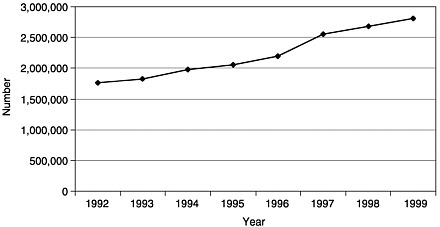
FIGURE 2.1 Total employment in Category 1 IT occupations from 1992 to 1999, as tabulated by CPS. “IT occupations” includes computer systems analysts and scientists, computer programmers, computer science teachers, and electrical and electronic engineers. SOURCE: U.S. Department of Labor, Bureau of Labor Statistics, Current Population Survey, March 1992 to March 1999, special tabulation.
The average annual growth rate for these occupations excluding electrical and electronic engineers and computer science teachers was 8.8 percent for this period. These rates are substantially higher than the average annual employment growth of 1.9 percent in the U.S. economy as a whole from 1992 to 1999. They are also substantially higher than the 3.5 percent annual growth in employment among professional occupations during this period.
-
Average annual growth in employment for these occupations was higher still after 1995. The annual change was greatest between 1996 and 1997, when employment in Category 1 occupations increased 16.3 percent. Annual growth then declined to just 5 percent between 1998 and 1999.
-
As shown in Figure 2.2, growth in the number of computer systems analysts and scientists has generated much of the overall growth in IT employment as tabulated by the CPS. From 1992 to 1999, employment of computer systems analysts and scientists grew at an annual rate of 11.7 percent; employment of computer science teachers, a much smaller group, grew at 11.8 percent. Employment of computer programmers grew at 3.8 percent annually and employment of electrical and electronic engineers, at 2.4 percent
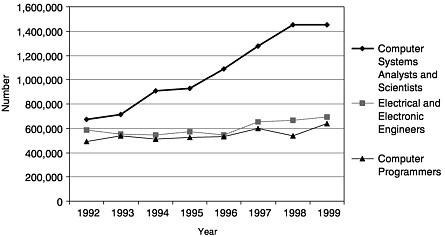
FIGURE 2.2 Employment in Category 1 IT occupations by occupational category, 1992 to 1999. SOURCE: U.S. Department of Labor, Bureau of Labor Statistics, Current Population Survey, March 1992 to March 1999, special tabulation.
-
Since CPS data are rather coarse, it is highly likely that within the large categories of computer systems analysts and scientists, computer programmers, computer science teachers, and electrical and electronic engineers are jobs that require new kinds of skills that have had much higher growth rates. Anecdotal evidence suggests that recent growth rates within these subcategories may be in excess of 20 percent per year, and SESTAT data show that employment of computer engineers working on software grew annually at a rate of approximately 15 percent from 1993 to 1997, whereas employment of electrical engineers and computer engineers working on hardware was relatively flat during that period.
-
Similarly, as shown in Figure 2.3, data from the Occupational Employment Survey (OES), a survey of public and private employers conducted by the Bureau of Labor Statistics, indicate that employment in computer occupations (even excluding computer engineers, a group for which employment grew even faster) increased more than 10 percent between 1997 and 1998, a greater increase than that experienced by workers in other science and technology occupations.
-
The OES data in Figure 2.4, however, indicate that the overall increase in IT professionals between 1997 and 1998 was led by increases of almost 20 percent for computer engineers and “other computer scientists” and almost 15 percent for computer programmers.
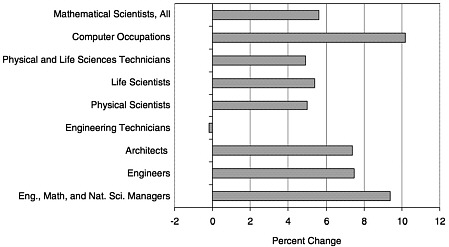
FIGURE 2.3 Change in employment, selected science and technology occupations, 1997-1998. In this figure, computer engineers are included in the category “engineers,” not in “computer occupations.” SOURCE: U.S. Department of Labor, Bureau of Labor Statistics, Occupational Employment Survey, 1997-1998, special tabulation.
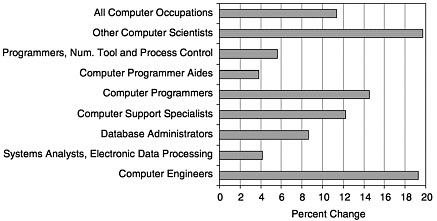
FIGURE 2.4 Change in employment, Category 1 computer occupations, 1997-1998. In this figure, “all computer occupations” includes computer engineers. SOURCE: U.S. Department of Labor, Bureau of Labor Statistics, Occupational Employment Survey, 1997-1998, special tabulation.
2.4.3 Demographics of the Category 1 IT Workforce
Demographically, the Category 1 IT workforce can be characterized as predominantly white, male, young, educated, and U.S. born. Trends indicate that the IT workforce is becoming increasingly diverse in terms of race and ethnicity and place of birth, but perhaps less so in terms of gender. It is also aging. Important characteristics follow:
-
The Category 1 IT workforce is predominantly white. However, the CPS indicates that from 1995 to 1999, whites decreased from 86 to 77 percent of the Category 1 IT workforce. Asian and Pacific Islanders increased from 5.6 to 9.9 percent, while underrepresented minorities (blacks, Hispanics, and Native Americans) increased from 8.5 percent to 12.4 percent. SESTAT data indicate, however, that underrepresented minorities with a bachelor's or higher degree who are employed in Category 1 occupations remained stable at 7 percent from 1993 to 1997.
-
The Category 1 IT workforce is also predominantly male. CPS data indicate that about 77 percent of Category 1 IT employees were male in 1995 and 1999, compared to 53 percent of all employed individuals and 46 percent of those employed in professional specialty occupations. 17 Similarly SESTAT data indicate that the IT workforce was 71 percent male in 1993 and even increased to 75 percent in 1997.
-
The Category 1 IT workforce is relatively young, but aging. According to SESTAT, the median age of the IT workforce increased from 35.6 years in 1993 to 37.5 years in 1997, yet it is about 4.5 years younger than the total workforce, which had a median age of 40.3 years in 1993 and 41.6 years in 1997. This difference in the age distribution and aging of the IT workforce is shown in Table 2.2. The CPS shows similar trends. In 1995, 37 percent of Category 1 IT workers were age 40 or over, while 42 percent were in 1999. Even with the trend in aging, IT workers were younger than individuals employed in professional specialty occupations, 54 percent of whom were age 40 or over in 1999.
-
Category 1 IT workers are overwhelmingly U.S. born. However, the percentage of individuals employed in Category 1 IT occupations who are foreign born—a term that lumps together naturalized citizens, permanent immigrants, and temporary nonimmigrants—increased from about 13 percent in 1995 to 17 percent in 1999. By comparison, foreign-born individuals constituted about 10 percent of all individuals employed in the United States in 1999. This proportion of foreign-born workers in the IT workforce is not unusual for technical fields. In addition, foreign-born IT workers who are permanent and temporary residents have higher levels of formal education than do native-born IT workers. 18 And foreign-born IT workers tend to be more concentrated in a relatively small number of states that have large immigrant populations, which in turn may lead to networks of immigrants developing to promote and support immigrant enterprises.
|
17 |
Professional specialty occupations include a broad list: engineers, mathematicians, computer scientists, physical scientists, health diagnostic professionals, health assessment and treatment occupations, postsecondary teachers, elementary and secondary teachers, social scientists and urban planners, social and religious workers, lawyers and judges, writers, and artists. |
TABLE 2.2 Percentage, by Age Group, of Science and Engineering Graduates Employed in IT and Non-IT Occupations, 1993 to 1997
|
1993 |
1995 |
1997 |
||||
|
Age Group |
IT |
Non-IT |
IT |
Non-IT |
IT |
Non-IT |
|
21 to 30 |
20.2 |
15.8 |
16.8 |
15.4 |
15.5 |
16.2 |
|
31 to 40 |
43.3 |
31.0 |
42.2 |
28.8 |
40.1 |
25.9 |
|
41 to 50 |
26.8 |
32.0 |
29.8 |
33.0 |
30.9 |
33.1 |
|
Over 50 |
9.7 |
21.2 |
11.2 |
22.8 |
13.5 |
24.8 |
|
SOURCE: Derived from the National Science Foundation's SESTAT data, which cover only workers with bachelor's degrees and higher in all science and engineering fields receivedfrom U.S. universities. Estimates in the text of the IT workforceare based on the assumption that the percentage distributions derivedfrom SESTAT data approximate those of the Category 1 IT workforceas tabulated by the CPS. |
||||||
-
Insight into the composition of the non-U.S. citizen portion of the IT workforce—either permanent immigrants or temporary nonimmigrants —is difficult to obtain, because most of the available data sets do not disaggregate foreign workers into these categories. (Chapter 5 contains additional comments on this point.)
-
About two-thirds of Category 1 IT workers in both 1995 and 1999 had at least a bachelor's degree. This fraction compares to about one-third of all employed individuals and three-quarters of all employed in professional specialty occupations in the United States. More discussion on this point is contained in Section 2.4.5.
|
18 |
Ellis reports that 15 percent of native-born IT workers have a master 's degree or above, whereas 40 percent of foreign-born IT workers have such degrees (Ellis, Richard, and B. Lindsay Lowell. 1999. “Foreign-Origin Persons in the U.S. Information Technology Workforce, ” Report III of the IT Workforce Data Project, United Engineering Foundation, available online at <www.uefoundation.org>). Note that U.S. visas for permanent and temporary residents specify certain minimum educational requirements, most often a bachelor' s degree or equivalent. And, to the extent that foreign-born permanent and temporary residents receive the bulk of their formal education in the United States, they become known by and are accessible to U.S. employers. For example, about 22 percent of H-1B holders have previously held student visas (U.S. Immigration and Naturalization Service. 2000. Characteristics of Specialty Occupation Workers (H-1B). Washington, D.C.: INS, February). |
TABLE 2.3 Distribution of the Category 1 IT Workforce by Employment Sector
|
Total (% of total) |
|||
|
1993 |
1995 |
1997 |
|
|
Academia |
64,218 (5.4) |
63,842 (5.5) |
61,795 (5.0) |
|
Industry |
930,209 (78.4) |
925,236 (79.7) |
1,010,939 (81.3) |
|
Government |
113,173 (9.5) |
101,794 (8.8) |
98,415 (7.9) |
|
Self-employed |
38,888 (3.3) |
34,095 (2.9) |
33,502 (2.7) |
|
Nonprofit |
39,771 (3.4) |
35,862 (3.1) |
39,189 (3.2) |
|
SOURCE: See source line, Table 2.2. |
|||
-
Across the different employment sectors, the vast majority of IT workers are in industry, with a small fraction in the other sectors (Table 2.3). It is also interesting to note that the percentages in each sector, except for industry, have been declining, and the greatest decline has been in government, both the number and the percent. This decline in the number of IT workers in government may reflect better pay in industry for similar skills.
2.4.4 Compensation in the Category 1 IT Workforce
One important indicator of a dynamic labor market with strong demand for workers is rising compensation. Rising compensation levels may indicate strong demand that leads to bidding up of the amount that employers are willing to pay at the margin for labor. Data from U.S. government and private sources provide evidence that annual salaries —one component of compensation—for IT workers have been growing at a faster rate than employee salaries in the economy generally. As a rule, those employed by IT-producing and IT-intensive firms hold high-wage jobs, and the earnings gap between wages for these jobs and average wages (even of skilled workers) continues to grow. A Department of Commerce study19 indicates that wages for those employed by IT-producing firms are significantly higher and have grown faster than
|
19 |
Henry, David, Patricia Buckley, Gurmukh Gill, Sandra Cooke, Jess Dumagan, and Dennis Pastore. 1999. The Emerging Digital Economy II. Washington, D.C.: U.S. Department of Commerce, June. Available online at <http://www.ecommerce.gov/ede>. |
average wages across all private sector industries, particularly so for workers in the IT software and services industries. Similarly, as shown below, annual salaries for employees in the Category 1 IT occupations as surveyed by the CPS have been increasing faster than employee salaries in the economy generally. Salary growth rates for IT occupations, however, vary over time, among types of IT workers, and among geographic regions. Of note is that compensation is rising fastest for employees who are able to bring current “hot” skills to their employers.
At the outset, it is important to point out that data from government and private sources are gathered and aggregated according to different definitions and methods, and—in general—demonstrate different results. Because of differences across surveys in definitions (especially with regard to occupational titles) and methodologies, the committee believes that it is not appropriate to compare salary growth rates obtained by different surveys. However, it is reasonable to draw conclusions from differences among occupations and regions within a given survey.
For example, data from private sources tend to indicate higher rates of annual salary growth for IT workers—especially those in certain occupations—than do government data.20 Government data sets such as the
|
20 |
These occupations were not limited exclusively to Category 1 occupations; they included CIO/vice president, IS director, manager (systems analysis and programming), manager (systems programming/tech support), network manager LAN/WAN, systems analyst/programmer/project leader, database admininstration manager, manager telecommunications, e-commerce director, data center manager, pc workstation manager, senior software engineer, software engineer, senior database analyst/administrator, year 2000 analyst, objectoriented/GUI developer, WWW/Internet developer, network administrator LAN/WAN, senior systems analyst programmer, systems analyst programmer, senior systems administrator/UNIX, senior client server programmer/analyst, client server programmer/analyst, senior Mid/MF programmer analyst, Mid/MF programmer analyst, telecommunications specialist, PC applications specialist, quality assurance analyst, and security specialist. Barnow et al. point out that while the CPS weekly earnings series shows only average wage growth among IT workers, other salary surveys and anecdotal evidence on wages of IT workers suggest much higher levels and higher growth in wages, especially among the most highly skilled computer workers. In a survey of compensation conducted for ITAA, William M. Mercer found that average hourly compensation for information technology workers had increased substantially between 1995 and 1996. A survey conducted by Deloitte & Touche Consulting Group revealed that salaries for computer network professionals rose an average of 7.4 percent between 1996 and 1997. Coopers and Lybrand found that the average salary increases at 500 software companies were 7.7 percent in 1995 and almost 8 percent in 1996. Computerworld 's annual survey found that in 11 of 26 positions tracked, average salaries increased more than 10 percent from 1996 to 1997. According to this survey, systems analysts' salaries increased by 15 percent, programmer/analysts' salaries were up by 11 percent, and directors of systems development had salary increases of 10 percent. In 1997, starting salaries for graduates with bachelor's degrees in computer science had increased to an average of $36,666, while experienced programmers received salaries in the range of $45,000 to $75,000. The wage rates and wage growth reported in the Mercer study are far higher than not only the CPS weekly earnings data but also the data from other private surveys and the BLS employer survey data. (See Barnow, Burt, John Trutko, and Robert Lerman. 1998. Skill Mismatches and Worker Shortages: The Problem and Appropriate Responses. Draft final report for the Urban Institute, Washington, D.C., Task Order #21, February 25). |
CPS and OES are based on job titles that are consistent from year to year and provide data that support time-series analysis—an approach that works especially well for long-established industries that change relatively slowly and in which the job responsibilities encompassed by various job titles are relatively clear and stable. However, in a rapidly changing industry such as IT, job titles appear and disappear quickly, and a given job title can cover a broad range of responsibilities. Thus, data on wages for job titles that are consistent from year to year, as in BLS surveys, may well mask wage indicators for different jobs subsumed within those titles. By contrast, private surveys—because they are not intended to support time-series analysis—are more likely to use job titles that are more highly differentiated and more closely reflect the current set of IT occupations, including those that have emerged more recently.
Government data indicate that annual growth rates for IT salaries in the late 1990s were higher than those of most other professional occupations in general and other science and technology jobs in particular. For example, the average annual increase in income (in constant dollars) from 1996 to 1999 for professional specialty occupations was 3.2 percent, according to the CPS (Figure 2.5). For all those employed who held at least a bachelor's degree, the average annual increase was about 3.4 percent. The categories “computer programmers” and “computer systems analysts/scientists” each had higher than average annual increases (in constant dollars) of 3.8 and 4.5 percent, respectively, during this period. According to the OES and as shown in Figure 2.6, mean annual salaries in constant 1999 dollars for computer occupations (even excluding computer engineers, whose salaries grew still faster) increased by more than 5 percent from 1997 to 1998, faster than the growth in mean salaries for other science and technology occupations.
While salary growth rates for IT occupations have been and remain strong relative to those of other professional groups, available data suggest that the rate of salary growth for IT occupations overall may be tapering off. As shown in Figure 2.7, data collected by the National Association of Colleges and Employers (NACE)21 on beginning salaries for
|
21 |
The NACE salary survey collects data on beginning base salary offers (not acceptances) from 343 career planning and placement offices of colleges and universities across the United States. NACE salary survey data for a given year represent a compilation of data on offers received from September 1 of the previous year through August 31 of the survey year. The reports consist of salary offers made to new graduates by employing organizations in business, government, and nonprofit and educational institutions. |
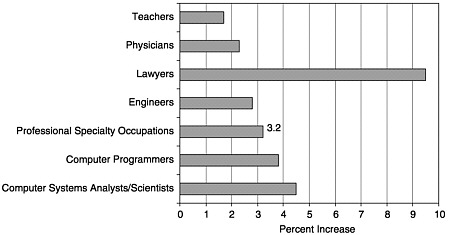
FIGURE 2.5 Average annual increase in income for Category 1 IT and other selected occupations, 1996 to 1999 (constant 1999 dollars). SOURCE: U.S. Department of Labor, Bureau of Labor Statistics, Current Population Survey, March 1996-March 1999, special tabulation.
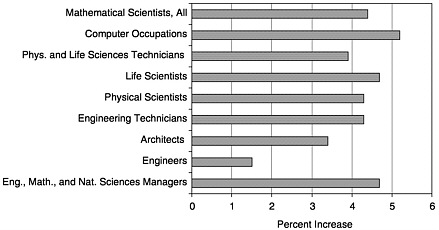
FIGURE 2.6 Increase in mean annual salary, science and technology occupations, 1997-1998 (constant dollars). SOURCE: U.S. Department of Labor, Bureau of Labor Statistics, Occupational Employment Survey, 1997-1998, special tabulation.
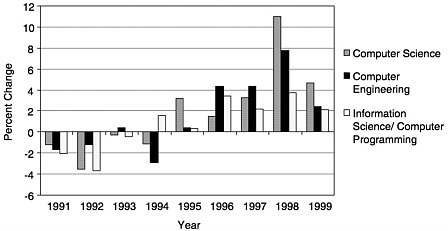
FIGURE 2.7 Annual change in beginning salaries for bachelor's degree recipients in computer science, computer engineering, and information science/computer programming, 1991 to 1999 (constant 1999 dollars). SOURCE: National Association of Colleges and Employers (NACE). 1999. 1998-99 Salary Survey [and the corresponding reports for the years 1991 through 1998]. Bethlehem, Pa.: NACE.
new bachelor's degree recipients indicate that while beginning salaries for new degree holders in computer science, computer engineering, and information science/computer programming have been more robust than for new bachelor 's degree holders in other professional fields, they follow an overall pattern similar to that for other fields: flat or down in the early 1990s, turning upward in 1995 with peak annual increases around 1998, followed by a lower, but still positive, increase in 1999. The annual Computer Industry Salary Survey conducted by DataMasters, which tracks salaries by IT occupation and region, indicates a similar peak in the annual change in median salary for all IT occupations in 1998. 22 As seen in Figure 2.8, the annual change in IT salaries was still positive from 1998 to 1999 and from 1999 to 2000, but at a progressively lower rate.
While salaries have been increasing for IT occupations generally, there are important differences among various specific IT occupations. For example, OES data show that computer engineers and computer programmers led other occupational categories with a 5.8 percent increase from 1997 to 1998 (Figure 2.9). Close behind at 5.7 percent were employees
|
22 |
The DataMasters survey is conducted for DataMasters by Dowden & Company, a firm that does research on compensation. The year 2000 data were gathered from more than 900 employers of information systems professionals, including corporations of all sizes, in every industry group, from every U.S. region. More information is available online at <http://www.datamasters.com/survey.html>. |
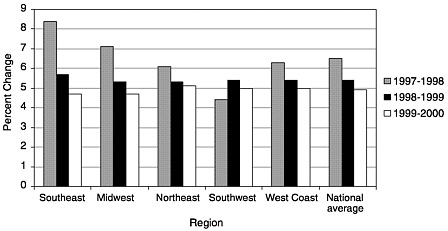
FIGURE 2.8 Average change in median annual salary for information technology occupations, by region, 1997 to 2000. The job titles included in the DataMasters survey are as listed in the main text. SOURCE: DataMasters Computer Industry Salary Survey, 1997-2000. Available online at <http://www.datamasters.com/survey.html>.
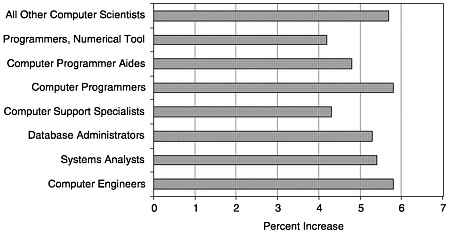
FIGURE 2.9 Increase in mean annual salary, science and technology occupations, 1997-1998 (constant dollars). SOURCE: U.S. Department of Labor, Bureau of Labor Statistics, Occupational Employment Survey, 1997-1998, special tabulation.
in the category “all other computer scientists.” Data from the 1999 Information Week salary survey also show that from 1998 to 1999 a handful of IT occupations continued to have higher salary increases than did other IT occupations (Figure 2.10).23 Staff specialists, senior programmers, Webmasters, and systems administrators all had annual increases of more than 8 percent. Systems analysts and systems programmers had annual increases in excess of 9 percent. The increase in median annual salary for senior Webmasters was 10.7 percent.
In some instances, the differences in annual salary growth also translate into differences in the rate of change in salary growth. For example, according to the CPS, annual increases for computer programmers fit a pattern seen in private data, with a peak increase in 1997 and smaller but still positive increases in 1998 and after (Figure 2.11), but the CPS data also show that computer systems analysts and scientists have experienced progressively larger salary increases, including a 1-year increase in annual salary of almost 14 percent from 1998 to 1999 (Figure 2.12). This rate of change could perhaps be explained by the large ongoing salary increases for individuals with specific skills. Indeed, the DataMasters survey shows that IT workers who specialize in Web design are currently experiencing not only rapid salary growth but also, as shown in Figure 2.13, accelerating annual salary increases that buck the trend of lower annual increases across other IT occupations.
It is important to note that differentiation by the rate of salary growth across IT occupations is compounded by significant differences in salary levels across geographical regions (Figure 2.14 through Figure 2.17). Of special note is that in 1998 computer programmers in San Jose (Silicon Valley) received salaries that were 131 percent of the mean annual salary of computer programmers nationally (Figure 2.15). For certain occupations in certain locales, job markets may be seen to be especially tight.
Finally, another component of compensation widely associated with IT workers is the opportunity to exercise stock options. Data from the National Center on Employee Ownership indicate that computer programming and software firms may provide for their technical staff options on stock whose average value is higher than that of the stock made available to employees by other industry groups. Similarly, according to the NCEO data, just one other industry group in addition to “computer programming/software” provides more of its stock options to nonmanagers than to managers. (Additional comments on stock options are made in Chapter 3.)
|
23 |
Mateyaschuk, Jennifer. 1999. “1999 National IT Salary Survey: Pay Up,” Information Week Online, April 26. Available online at <http://www.informationweek.com/731/salsurvey.htm>. This survey is based on the responses of more than 21,000 online responses. While the number of respondents is significant, the survey may be subject to biases related to coverage and sampling that are often typical of online surveys. |
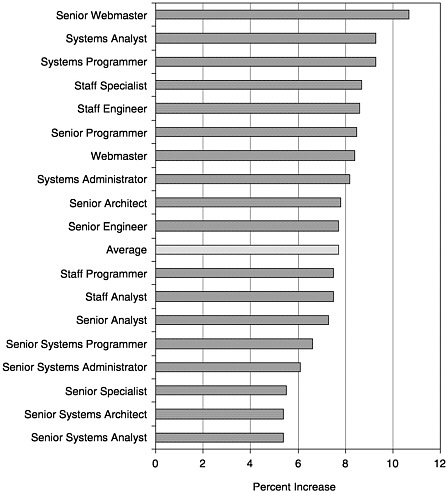
FIGURE 2.10 Annual change in median salaries for selected information technology occupations, 1998-1999 (constant 1999 dollars). SOURCE: Information Week, 1999 National IT Salary Survey. Available online at <http://www.informationweek.com/731/salsurvey.htm>.
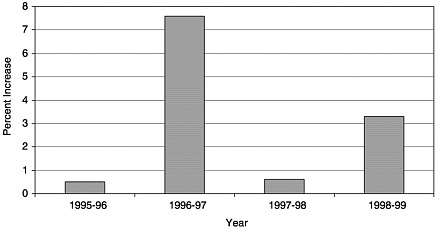
FIGURE 2.11 Annual increases in mean income for computer programmers, 1995 to 1999 (constant 1999 dollars). SOURCE: U.S. Department of Labor, Bureau of Labor Statistics, Current Population Survey, March 1996-March 1999, special tabulation.
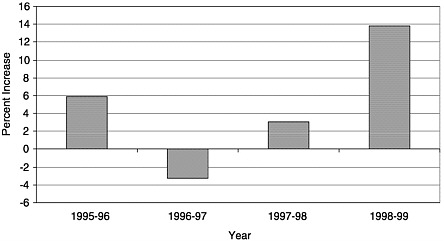
FIGURE 2.12 Annual increases in mean income for computer systems analysts and scientists, 1995 to 1999 (constant 1999 dollars). SOURCE: U.S. Department of Labor, Bureau of Labor Statistics, Current Population Survey, March 1996-March 1999, special tabulation.
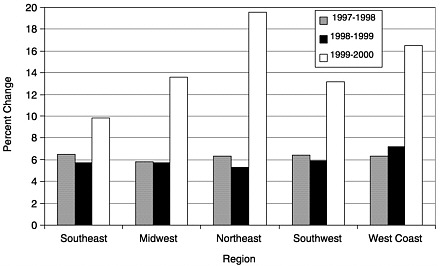
FIGURE 2.13 Change in median annual salary for World Wide Web/Internet developers, by region, 1997 to 2000. SOURCE: DataMasters Computer Industry Salary Survey, 1997-2000. Available online at <http://www.datamasters.com/survey.html>.
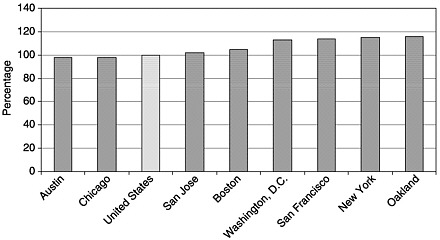
FIGURE 2.14 Mean annual salary of systems analysts in high-technology metropolitan areas as a percentage of the mean annual salary of systems analysts nationally. SOURCE: U.S. Department of Labor, Bureau of Labor Statistics, Occupational Employment Survey, 1998, special tabulation.
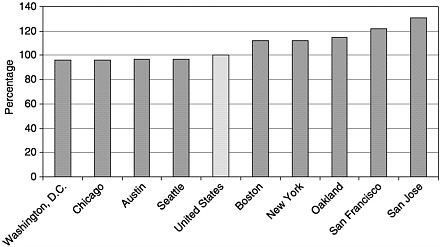
FIGURE 2.15 Mean annual salary of computer programmers in high-technology metropolitan areas as a percentage of the mean annual salary of computer programmers nationally. SOURCE: U.S. Department of Labor, Bureau of Labor Statistics, Occupational Employment Survey, 1998, special tabulation.
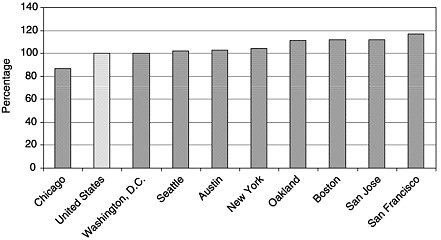
FIGURE 2.16 Mean annual salary of computer engineers in high-technology metropolitan areas as a percentage of the mean annual salary of computer engineers nationally. SOURCE: U.S. Department of Labor, Bureau of Labor Statistics, Occupational Employment Survey, 1998, special tabulation.
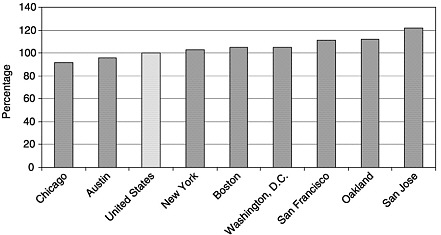
FIGURE 2.17 Mean annual salary of electrical and electronic engineers in high-technology metropolitan areas as a percentage of the mean annual salary of electrical and electronic engineers nationally. SOURCE: U.S. Department of Labor, Bureau of Labor Statistics, Occupational Employment Survey, 1998, special tabulation.
2.4.5 Educational Background
The Category 1 IT workforce as tabulated by CPS is highly educated, with at least two-thirds having completed at least a bachelor's degree in some discipline from a U.S. institution. In 1998, only 6 percent of these workers had only a high school diploma, 26 percent had associate 's degrees, 48 percent had bachelor's degrees, and 19 percent had master's or other postgraduate degrees.24 However, the correlation between field of education and employment as an IT worker in a CPS Category 1 IT occupation is not very tight. Of those working in a CPS IT occupation in 1997, about 59 percent did not have a formal IT background (19 percent had an engineering background in a non-IT field).
Of those with a formal IT background, about 21 percent in 1997 were not working as computer scientists, computer programmers, or systems analysts. These individuals were employed in a variety of occupations, but most, about 75 percent, were not working in science and engineering
|
24 |
These figures are based on BLS data for IT workers in four “core” occupations in 1998: computer scientists, computer engineers, systems analysts, and programmers. See tabulations by Ellis, Richard, and B. Lindsay Lowell. 1999. “Core Occupations of the U.S. Information Technology Workforce,” Report I of the IT Workforce Data Project, United Engineering Foundation. Available online at <www.uefoundation.org>. |
fields. They could be working in sales or other service occupations, and a small percentage, about 5 percent, were in management outside of IT. The fraction of IT-educated workers taking jobs as computer scientists, computer programmers, or systems analysts upon receipt of their degree increased from about 71 percent in 1993 to about 74.5 percent in 1997.25
In general, individuals can develop in a variety of ways the skills and abilities needed to work successfully in certain IT jobs, especially those in Category 2. Career paths are changing across the entire economy, diverging from the traditional linear model in which young people became full-time students to qualify for long-term careers with one or only a few employers.26 Today, many more employed adults, including IT workers, are developing their skills both on and off the job. To meet this growing demand, formal education is becoming more flexible: universities and community colleges are offering for-credit and noncredit classes at a variety of times and places, while public and private providers of education and training often offer courses on the Internet. One popular route to a career or advancement in IT occupations is self-study leading to industry certification, as described in Chapter 7.
The number of individuals with a formal education in IT-related fields has grown in the past few years, but it is difficult to estimate what will occur in the future. While enrollment at the undergraduate level is difficult to estimate, the Taulbee survey, which collects data on computer science and computer engineering programs at Ph.D.-granting institutions, shows that the number of undergraduates entering full-time study in those institutions doubled over the 5-year period from 1995 to 1999, rising sharply in 1996 and 1997 and then leveling off in 1998 and 1999 (Table 2.4).However, data from the same survey on total undergraduate enrollment in computer science and engineering indicate a decline from 59,049 students in 1998 to 54,366 students in 1999.
The increased enrollments in computer science and engineering in the mid-1990s resulted in an increase in awarded bachelor's degrees from about 7,500 in 1995 to about 12,700 in 1999, for a gain of about 10 percent each year, except for a 25 percent increase from 1998 to 1999 (Table 2.5). Whether these increases in the number of bachelor's degrees will be sustained is questionable considering the leveling off of undergraduate enrollments. The total number of degrees awarded at the associate's and bachelor's levels reflects a pattern of decline in the late 1980s followed by an approximately constant level of production through the mid-1990s
|
25 |
NRC staff analysis, based on NSF SESTAT data from 1993, 1995, and 1997. |
|
26 |
Freeman, Peter, and William Aspray. 1999. The Supply of Information Technology Workers in the United States, “ Chapter 5, Supply—The Degree Programs.” Washington, D.C.: Computing Research Association. Available online at <http://www.cra.org/reports/wits/>. |
TABLE 2.4 New Students Entering Computer Science and Computer Engineering Departments in U.S. Institutions Awarding Doctoral Degrees in These Fields, 1995 to 1999
|
New Students |
1995 |
1996 |
1997 |
1998 |
1999 |
|
Undergraduate |
8,207 |
11,972 |
16,197 |
16,075 |
16,605 |
|
Master's |
1,191 |
3,101 |
3,085 |
3,955 |
4,862 |
|
Doctoral |
992 |
1,283 |
1,354 |
1,697 |
1,808 |
|
SOURCE: See source line, Table 2.2. |
|||||
TABLE 2.5 Degrees Granted in Computer Science and Computer Engineering in U.S. Institutions Awarding Doctoral Degrees in These Fields, 1995 to 1999
|
Degree |
1995 |
1996 |
1997 |
1998 |
1999 |
|
Undergraduate |
7,561 |
8,411 |
8,063 |
10,161 |
12,692 |
|
Master's |
4,425 |
4,260 |
4,443 |
4,934 |
5,579 |
|
Doctoral |
1,006 |
915 |
894 |
933 |
852 |
|
SOURCE: See source line, Table 2.2. |
|||||
(Figure 2.18). Based on the Taulbee data for 1996 to 1999 and the fact that about one-third of all 4-year computer science students attend institutions that offer advanced postgraduate study leading to a Ph.D.,27 the committee estimates that the total number of bachelor's degrees may increase to about 36,000 entering 2000.
Table 2.4 also shows significant increases over the period from 1995 to 1999 in the number of new entrants into master's and Ph.D. programs in CS&E, with nearly a fourfold increase at the master's level and a doubling at the Ph.D. level. Data on total enrollments at the master's level, available only for 1998 and 1999, indicate that about 12,200 were enrolled for 1998 and 13,800 for 1999. According to the Taulbee data, the actual number of master's degrees awarded was constant at about 4,400 to 1997
|
27 |
The Taulbee surveys are taken from various issues of Computing Research News, published by the Computing Research Association (available online at <www.cra.org>). The 1995 CRA Taublee survey can be found in the March 1996 issue (Vol. 8, No. 2); the 1996 survey, in the March 1997 issue (Vol. 9, No. 2); the 1996-1997 survey, in the March 1998 issue (Vol. 10, No. 2); the 1997-1998 survey, in the March 1999 issue (Vol. 11, No. 2); and the 1998-1999 survey, in the March 2000 issue (Vol. 12, No. 2). |
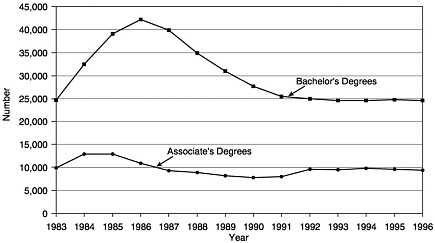
FIGURE 2.18 Bachelor's and associate's degrees awarded in computer science, 1980 to 1996. SOURCE: NRC staff analysis.
and then increased significantly in the next 2 years, to about 5,600 in 1999 (see Table 2.5). Such increased enrollments may indicate additional increases in degree production at those levels in the coming years.
The picture at the Ph.D. level, however, is very different, as indicated by the declining number of doctorates awarded from the mid-1990s to 1999 (see Table 2.5). Total enrollment has also declined over the same period, from about 7,900 full- and part-time students in 1995 to about 7,100 in 1999 and a low point of 6,800 in 1997. Although the disparity between new enrollments and the number of Ph.D. degrees awarded may simply reflect the time required to earn a doctorate, it might also indicate that students are dropping out of Ph.D. programs to take employment in a very good job market.
Across all institutions the number of degrees awarded in the mid-1990s was constant at about 10,000 for master's degrees and 1,100 for doctorates. If the Taulbee data on computer science and engineering enrollments can be extrapolated to enrollments across all institutions, then growth at the master's level to about 12,500 by the end of the 1990s might be anticipated. However, significant increases at the doctoral level in the late 1990s are unlikely, given that the Taulbee and the National Science Foundation data show no increases. It is possible, then, that at the start of the 21st century, the number of trained computer scientists added to the workforce yearly may stand at 36,000 with bachelor's degrees, 12,500 with master's degrees, and 1,100 with doctorates.
2.4.6 Distribution of Category 1 IT Workers by Size of Employer
In 1997 in all industries, almost one-half of the Category 1 IT workforce (44.7 percent) was employed in large companies (more than 5,000 employees), and only 18 percent worked in small companies (fewer than 100 employees), as noted in Table 2.6. By contrast, about 36.6 percent of Category 1 IT workers working in companies that produce information technology or provide computer services are employed in large companies, and 26.9 percent are employed in small companies.
As indicated in Table 2.6, in 1997 well over one-half of Category 1 IT workers (63.8 percent) were employed in companies with over 1,000 employees that were not IT companies such as Intel or Cisco, but were large product- or service-oriented companies. At the other end of the spectrum, small companies with fewer than 25 employees account for a substantial percentage of Category 1 IT employment (16.9 percent). Table 2.6 also shows that in 1997 the distribution of Category 1 IT workers in IT industries was very similar to that for all workers across all U.S. industries.
TABLE 2.6 Number of Category 1 IT Workers and All Workers in Industrial Employment by Size of Company, 1997
|
Category 1 IT Workers |
|||
|
Size of Company |
In All Industries (% of total) |
In IT Industries (% of total) |
All Workers in All Industriesa (% of total) |
|
Under 10 employees |
68,416 (6.3) |
58,871 (11.3) |
775,727 (13.1) |
|
10–24 employees |
36,040 (3.7) |
29,097 (5.6) |
442,816 (7.5) |
|
25–99 employees |
72,361 (8.0) |
52,369 (10.0) |
654,231 (11.1) |
|
100–499 employees |
126,841 (12.3) |
77,356 (14.8) |
856,354 (14.5) |
|
500–999 employees |
56,344 (6.0) |
31,014 (5.9) |
340,300 (5.8) |
|
1,000–4,999 employees |
167,979 (19.1) |
82,685 (15.8) |
841,662 (14.2) |
|
5,000 plus employees |
446,585 (44.7) |
191,332 (36.6) |
1,999,429 (33.8) |
|
Total |
974,566 (100.0) |
522,724 (100.0) |
5,910,519 (100.0) |
|
a“All workers” includes only those with bachelor's and higher degrees from U.S. educational institutions; the “industries” category does not include government or nonprofit employing institutions. SOURCE: See source line, Table 2.2. |
|||
2.4.7 Unemployment of Category 1 IT Workers
According to the SESTAT data set, the rate of unemployment for graduates of computer science and computer engineering programs declined from 2.7 percent in 1993 to 1.2 percent in 1997. This low level of unemployment was comparable to that for all graduates—2.8 percent in 1993 and 1.4 percent in 1997. The data also indicate essentially no difference in unemployment among Category 1 IT workers of different age cohorts. However, the percentage of computer science and engineering degree holders who are unemployed and not seeking employment has been consistently held at 4 percent but has stood closer to 7 percent for all graduates. This lower rate for CS&E degree holders may imply that there is a smaller proportion of the unemployed computer science and computer engineering graduates who have given up looking for work and hence, a greater demand for such graduates than for others.
Because BLS-measured “unemployment rates” count only unemployed individuals who are seeking work, they set a floor on the number of individuals who would be available to take IT work. Other categories of individuals who might be available for IT work include those with previous work experience in IT who currently hold jobs in other, non-IT fields that pay less than their previous job in IT and those who have become “discouraged” and are no longer (technically) looking for work and thus are not counted in official unemployment statistics.
An examination of the SESTAT database in the period from 1995 to 1997 indicates that the number of Category 1 IT workers who took jobs in non-IT occupations is approximately twice the number of unemployed Category 1 individuals.
2.4.8 A Note About the Hardware Subsector Within Information Technology
Although this report comments on workforce needs in hardware when possible, it devotes more attention to the software side of the IT sector. One reason is that the data sources available to the committee largely focus on aspects of the software and applications workforce. A second reason is that while IT hardware provides the platforms on which software and applications build, a very large number of different kinds of software and applications can be built upon a much smaller number of hardware platforms. Finally, many firms whose product lines were originally dominated by hardware production are increasingly involved in providing IT-related services. For example, Dell, originally a company that derived most of its revenues from hardware sales, is now beginning to provide Internet-based IT services. Thus, it is not surprising that the
number of people engaged in software and applications work is significantly larger than the number engaged in hardware work. See Box 2.4 for more commentary.
2.4.9 Characteristics of the Category 2 IT Workforce
Occupational clusters developed by the Northwest Center for Emerging Technologies (NWCET)28 provide a broad, up-to-date list of occupations that generally map the expansive territory of the Category 2 IT workforce. These clusters include occupations in database development and administration, digital media, enterprise systems analysis and integration, network design and administration, programming and software engineering, technical support, technical writing, and Web development and administration (Table 2.7). Unfortunately, it is almost impossible to try to map the list of NWCET occupations onto the occupational categories covered in the large, government data sets, such as the CPS, that provide demographic information about the U.S. workforce. The data illustrate the widely varying characteristics of individuals in a small set of CPS occupations who hold Category 2 jobs, although the committee emphasizes that generalization to the overall Category 2 IT workforce is not necessarily possible based on these data.
-
Technical writers and data-processing equipment repairers are rapidly growing occupational groups. The number of technical writers, a group that includes both IT and non-IT workers, grew at a rate of 13.3 percent per year, from 33,000 in 1992 to more than 78,000 in 1999. The rate for data-processing equipment repairers was 12.6 percent annually, with an increase from about 146,000 in 1992 to more than 335,000 in 1999. Computer operators, by contrast, are a rapidly shrinking occupational group, with a decrease from about 641,000 in 1992 to 340,000 in 1999. The number of electrical and electronic technicians grew at a rate of 5.5 percent per year, from 316,000 in 1992 to 461,000 in 1999.
-
Technical writers are well educated. In 1999, 59 percent held a bachelor's degree and 23 percent held master's degrees. By contrast, 76 percent of data processing equipment repairers and 86 percent of both electrical and electronic technicians and computer operators had less than a bachelor's degree.
|
28 |
Based at Bellevue Community College in Washington State, the mission of the North-west Center for Emerging Technologies is to advance information technology (IT) education to improve the supply, quality, and diversity of the IT workforce by preparing and educating versatile knowledge workers of the future. As part of this work, it has developed comprehensive skill standards designed in part to ensure that current 2-year IT education matches the requirements of the labor market. These are discussed at greater length in Chapter 7. |
|
BOX 2.4 Size of the Hardware IT Workforce The number of people working in hardware in the IT sector is much more difficult to estimate than the number working in software. The Bureau of Labor Statistics (BLS) captures software workers as “computer scientists, systems analysts, and computer programmers,” all of whom can work for software vendors or other IT-intensive firms that make use of software. IT does not, however, capture any IT occupations that are unique to IT hardware. The National Science Foundation's SESTAT database does include the category “computer hardware engineer,” but that category does not necessarily include the circuit and chip designers, manufacturing engineers, process control specialists, and other professionals who fabricate the components of IT hardware systems and integrate them into computer and telecommunications systems. Nor does it include any of the important support occupations associated with installing and maintaining hardware. SESTAT data on the number of individuals employed in this category in the mid-1990s are given in Table 2.4.1. Because IT-intensive firms generally do not produce hardware, professionals whose occupations are associated with hardware are generally found in IT-producing firms; these are generally Category 1 workers. But IT-intensive firms do employ many individuals whose role is to support hardware deployments (Category 2 workers). An upper bound on Category 1 workers in hardware is provided by BLS statistics on total employment in the semiconductor, telecommunications equipment, and computer equipment sectors (Table 2.4.2); however, these figures include lawyers and janitors and administrators as well as the technical workers who are the primary focus of this report. Informal estimates from senior industry executives in the semiconductor industry indicate that the fraction of technical professionals is about 22 percent, and the fraction of technical support workers about 44 percent. Estimates of the distribution for the telecommunications and computer equipment sector were unavailable, but if the fractions are comparable, a rough estimate as shown in the two right-hand columns of Table 2.4.2 can be made of the size of the hardware workforce. However, the Category 2 column total almost certainly understates the total number of workers with hardware support responsibilities, because the BLS baseline “total employment” figures shown do not include employees in IT-intensive firms. Clearly, Category 1 workers in hardware constitute a much smaller group than the Category 1 workers in software (among IT vendors) and applications (among IT-intensive firms). And it is likely, though less certain, that the Category 2 workers in hardware are similarly outnumbered by their counterparts in software and applications. TABLE 2.4.1 Employment in the Category “Computer Hardware Engineers”
TABLE 2.4.2 Estimating the Size of the Hardware Workforce
|
||||||||||||||||||||||||||||||||||||||||
-
In 1999, technical writers and computer operators were relatively older, with each group having a median age of 44 years. The median age of electrical and electronic technicians was 35 and that of data-processing equipment repairers was 31.
-
In 1999 in each of the above four occupational groups, fewer than 10 percent of the workers were foreign-born. By contrast, 17 percent of individuals in Category 1 occupations were foreign-born.
-
For each of the above four occupational groups, the large majority of individuals are also white, but the percentage varies widely by group. In 1999, 96 percent of technical writers, 82 percent of data processing equipment repairers, 78 percent of computer operators, and 69 percent of electrical and electronic technicians were white.
TABLE 2.7 NWCET Occupational Clusters and Related Skill Standards
|
Career Cluster |
Representative Job Titles |
Sample Critical Work Function |
Sample Key Activity |
Sample Performance Indicator |
Sample Technical Knowledge |
Sample Skills for Employability |
|
Database development and administration |
Data analyst, database administrator |
Analyze and design database |
Perform research and analyze requirements |
Business objectives and goals for project are well defined |
Knowledge of basic business objectives and requirements analysis |
Ability to identify key sources of information |
|
Digital media |
Animator, 2D/3D artist, media specialist |
Produce visual and functional design |
Determine media types and delivery platform |
Chosen media elements and delivery platform support project goals and scope |
Knowledge of media types and capabilities |
Ability to present technical information |
|
Enterprise systems analysis and integration |
Systems analyst, systems integrator |
Define customer requirements |
Identify and document customer requirements |
Constraints are properly identified |
Knowledge of continuous quality improvement tools |
Ability to compare multiple viewpoints and analyze communication |
|
Network design and administration |
Network technician, network engineer |
Perform monitoring and management |
Monitor and report component, security, and connectivity problems |
System is closely monitored and outages are reported in a timely manner |
Knowledge of network architecture, topology, hardware, and software |
Ability to interpret and evaluate data |
|
Programming/software engineering |
Applications analyst, programmer/analyst, software engineer, software QA specialist |
Implement program |
Write code |
Code is developed using efficient software design processes |
Knowledge of programming language required for application |
Ability to write simple documents |
|
Technical support |
Analyst, help desk technician, PC support specialist |
Perform troubleshooting |
Analyze problem and research solutions |
Problem is correctly identified |
Knowledge of troubleshooting methods |
Ability to analyze and prioritize information |
|
Technical writing |
Technical writer, document specialist |
Design document |
Select style and tone |
Style and tone are appropriate for purpose, medium, and audience |
Knowledge of different writing styles |
Ability to present information persuasively and objectively |
|
Web development and administration |
Web page developer, Web site developer |
Perform content and technical analysis |
Research content |
Content is properly indexed and weighted by importance |
Knowledge of indexing and weighting techniques |
Ability to interpret communication and compare multiple viewpoints |
TABLE 2.8 Annual Rate of Change in Mean Wages for Selected Category 2 Occupations
|
Selected Category 2 Occupation |
Annual Average Rate of Growth (loss) |
|
Technical writer |
16.9% |
|
Electrical and electronic technician |
5.6% |
|
Computer operator |
4.4% |
|
Data processing equipment repairer |
(−1.6%) |
|
SOURCE: Current Population Survey, March Supplement 1996 to 1999. |
|
-
An increasing percentage of technical writers are female, up from 46 percent in 1995 to 62 percent in 1999. The percentages of females among computer operators has been relatively stable and was 63 percent in 1999. Electrical and electronic technicians and data-processing equipment repairers, however, were overwhelmingly male, at 86 and 82 percent, respectively, in 1999.
-
Mean wages (in constant 1999 dollars) in the Category 2 occupations of technical writers, electrical and electronic technicians, and computer operators grew annually by amounts ranging from about 4 percent to 17 percent between 1996 and 1999, while wages for data-processing equipment repairers declined by almost 2 percent (see Table 2.8).
2.5 RECAP
“Information technology” is a broad term encompassing computer and communications technology. For purposes of this report, IT workers are those persons engaged primarily in the conception, design, development, adaptation, implementation, deployment, training, support, documentation, and management of information technology systems, components, or applications.
IT work is highly diverse. Most IT jobs require a mixture of conceptual ability, knowledge of theoretical IT constructs and frameworks, and applied technical skills. The mix depends on the extent to which the job requires creativity and the invention of original work (Category 1 work) as compared to the extent that it requires application of previously developed skills in typical situations (Category 2 work). Some types of work, such as implementation of a concept, can reasonably be characterized as both Category 1 work and Category 2 work. Furthermore, expertise in IT (as in many other domains) depends on both formal knowledge (that can be
acquired in the context of formal education) and situated knowledge that is specific to a work or problem situation.
Because most jobs require a mix of Category 1 work and Category 2 work, the boundaries between Category 1 and Category 2 workers is fluid. That said, Category 1 work tends to require more years of formal exposure to IT-related disciplines than does Category 2 work. This difference suggests that a significant increase in the supply of Category 1 workers is likely to take at least several years (i.e., the time needed for large numbers of these individuals to matriculate), while training efforts for Category 2 workers can—in principle—bear fruit in a matter of months.
The size of the IT workforce is difficult to estimate. However, the committee estimates that the overall size of the IT workforce is at least 5.0 million, with approximately 2.5 million Category 1 workers and a number of Category 2 workers that is at least as large. The IT workforce has grown rapidly in the last 8 years, with the “core ” Category 1 workforce nearly doubling. Demographically, the Category 1 workforce is predominantly male, white, and younger than the workforce in general. And theCategory 1 workforce is highly educated, with most Category 1 workers having at least a bachelor's degree (though frequently not in an IT-related discipline). Real wages have grown in Category 1 occupations overall at a rate of about 3.8 to 4.5 percent annually since 1996, although this figure masks much more substantial growth in certain subspecialties and also does not include the impact of stock options and equity stakes on total compensation.


