
INTRODUCTION
Astronomical discoveries of the past decade—images of the hot universe at an epoch before the first galaxies and stars emerged, of other solar systems beginning to take form, of planetary systems beyond our own—have captured the imagination of scientists and citizens alike. These startling advances are the result not only of the collective creative efforts of scientists and engineers throughout the United States and around the world, but also of the generous investments in astronomy over much of the past 50 years by federal and state governments, foundations, and individuals.
In the decades ahead, the pace of discovery—remarkable as it has been over the past—will accelerate. Astronomers stand poised to examine the epoch when galaxies similar to our Milky Way first took form, to image Earth-like planets beyond our solar system, and to learn whether some show evidence of life. To take these next steps will require significant investments of both imagination and public resources.
Because the magnitude of these investments will be large, it is fair to ask why astronomical research should merit such support. Perhaps the most persuasive, but least quantifiable, justifications lie in the importance American society has always attached to exploring new frontiers, and in the deep human desire to understand how we came to be, the kind of universe we live in, whether we are alone, and what our ultimate fate will be. Exploring frontiers of unimaginable mystery and beauty, astronomy speaks compellingly to these fundamental questions.
As researchers, astronomers experience the excitement of discovery most vividly and are the first to glimpse new answers to ancient questions. As a community of citizens fortunate to live in a society that supports them generously, astronomers believe strongly that “from those to whom much is given, much is asked.” It is in that spirit that the committee offers below an accounting of astronomy’s more tangible contributions to broader societal goals.
THE ROLE OF ASTRONOMY IN PUBLIC SCIENCE EDUCATION
Astronomers’ most significant contribution to society lies in the area of science education, broadly conceived to include (1) raising public awareness of science, (2) conveying scientific concepts to students at all
levels and to their teachers, and (3) contributing to educating a technically capable and aware citizenry. Astronomy is relevant to each of these goals, and it can act as a pathfinder in stimulating people’s interest in all of science.
THE RELEVANCE OF ASTRONOMY
Astronomy excites the imagination. The beauty of the night sky and its rhythms are at once stunning and compelling. The boldness of our collective efforts to comprehend the universe inspires us, while the dimensions of space and time humble us. Astronomy encompasses the full range of natural phenomena—from the physics of invisible elementary particles, to the nature of space and time, to biology—thus providing a powerful framework for illustrating the unity of natural phenomena and the evolution of scientific paradigms to explain them. In combination, these qualities make astronomy a valuable tool for raising pubic awareness of science, and for introducing scientific concepts and the process of scientific thinking to students at all levels. A few reminders serve to illustrate the potential of astronomy to advance public science education goals.
Astronomy is all around us. Just look up! Who has not looked at the night sky and wondered at the panoply of stars there? We are all aware of the motion of the Sun through the sky during the day and the changing phases of the Moon at night. The motions of astronomical objects determine the day-night cycle, the seasons of the year, the tides, the timing of eclipses, and the visibility of comets and meteor showers. Easily observed astronomical events have formed the basis for time keeping, navigation, and myths or sagas in cultures around the world.
Much of astronomy is visual and can be appreciated for its aesthetic appeal as well as its illustrative power. Images of deep-sky objects convey the beauty of the universe, even to those who are too young to understand their context or implications.
Astronomy is a participatory science. Many nonscientists have astronomy as a lifelong avocation. Astronomy is one of the few sciences in which amateurs by the tens of thousands have formed active organizations (e.g., the Planetary Society, with membership exceeding 130,000), and many amateurs make significant scientific contributions to such fields as the monitoring of variable stars and measuring positions of moving objects. Telescope and magazine sales suggest that nearly 300,000 citizens take some active interest in amateur astronomy. The American
Astronomical Society has formed a working group to foster partnering between professional and amateur astronomers. Many amateurs freely share their excitement about science with local teachers and students through such programs as Project ASTRO, which links astronomers with 4th through 9th grade teachers and classes in 10 sites around the country.
Astronomy offers the possibility of discovery. The chance to find a never-before-seen supernova, nova, comet, or asteroid is very exciting, especially to nonprofessionals. Both the distribution of astronomical data and software via the Internet and the ready availability of sophisticated imaging devices on moderate-cost small telescopes enable amateur astronomers to play an active and growing role in discovering new objects, searching for transient and variable objects, and monitoring them.
Astronomy inspires work in the arts. From poetry and music to science fiction books and films, the ideas and discoveries of modern astronomy serve as inspiration for artists, for youngsters, and for the public at large. In the process, the works inspired by astronomy can serve as goodwill ambassadors for the value and excitement of physical science to many in society who do not otherwise come into contact with the sciences.
CONVEYING ASTRONOMY TO THE PUBLIC
Statistics confirm the widespread interest in astronomy.
Planetariums and observatories are popular visitor destinations. There are approximately 1,100 planetariums in North America. About 30 percent of these serve school groups only, while about 70 percent do both school and public shows. Approximately 28 million visits are made to the planetariums in the United States each year. For many school children from urban areas, such a visit may be their only introduction to a dark night sky and to the wonders of the universe.
Observatory visitor centers are similarly popular. They provide a place where families learn about science together. For example, the seven observatories that belong to the Southwestern Consortium of Observatories for Public Education (McDonald, the National Solar Observatory at Sacramento Peak, Kitt Peak National Observatory, the Very Large Array (VLA), Lowell Observatory, Whipple Observatory, and Apache Point), collectively host more than 500,000 visitors annually and reach more than 4,000 teachers through workshops. The new Visitor Center at Arecibo in Puerto Rico hosts an average of 120,000 visitors each year. Most science
museums have sections on astronomy and hold weekend, evening, and summer programs on astronomical sciences.
Astronomy serves as an introduction to science for nearly 10 percent of all college students—more than 200,000 each year, nationwide. For many, astronomy will be the only science course they will ever take. To examine and improve the effectiveness of teaching science via introductory astronomy courses—many of which are offered at community colleges and small colleges without extensive research programs—the Astronomical Society of the Pacific and the American Astronomical Society are jointly sponsoring a series of symposia and discussions at their meetings. The first such symposium was held in Albuquerque in 1998, and another one entitled “The Cosmos in the Classroom” was held in Pasadena in July 2000.
Discoveries in astronomy are well covered by the media. For example, staff of the New York Times and the Dallas Morning News, two of the leading papers in terms of science coverage, each develop on average more than one astronomy story per week. News conferences of the American Astronomical Society are heavily attended, covered by many news media and often held up as a model by other sciences and scientific organizations. Dozens of astronomy columns now run in newspapers and magazines. Many focus on sky phenomena, while others report on recent developments. Perhaps the best known of these is the regular series of science articles published in Parade, the national Sunday supplement—a series begun by the late Carl Sagan and now continued by David Levy.
Magazines devoted exclusively to astronomy enjoy wide circulation—nearly 300,000 combined for Sky and Telescope and Astronomy. Many other national magazines, such as Popular Science, National Geographic, Discover, and Scientific American, cover astronomy regularly and report that their astronomical stories or issues are among the most popular. It is no coincidence that when Scientific American began a new quarterly magazine devoted to single-topic issues, the first was entitled “The Magnificent Cosmos.”
Astronomy reaches an extraordinary audience of radio listeners. The program “Earth and Sky” is carried by about 900 radio stations in the United States, and the program is heard about 280 million times each year. “StarDate/Universo” reaches an audience of about 8.7 million listeners weekly. Surveys in Michigan and Florida showed that 51 percent and 36 percent, respectively, of the listeners discussed what they
had heard on the “Earth and Sky” program with other adults or children. Eighty percent of the listeners felt the program “expanded their knowledge of science.” Gender, ethnicity, and occupational status did not correlate with whether or not a person listened to the series. These statistics show that well-presented astronomy stories have an extremely large and diverse audience.
Astronomical sites are among the most popular science destinations on the Web. The American Astronomical Society has found that news stories carried on Web sites often stimulate stories on affiliated television networks. Web sites offer the additional advantage of coverage in depth since they are not limited in terms of space in the same way as newspapers and television broadcasts. Web sites of the Jet Propulsion Laboratory (JPL) and the Space Telescope Science Institute (STScI) are enormously popular and provide the public with a sense of shared participation in the startling discoveries of planetary probes and the Hubble Space Telescope. For example, the Web provided real-time access for millions to view spectacular events such as the impact of Comet Shoemaker-Levy on Jupiter and the adventures of Pathfinder and Sojourner on Mars. The JPL and the U.S. Geological Survey have developed a planetary photojournal Web site that is accessed by 100,000 users who download 700,000 files every month. These Web sites, as well as those run by the Astronomical Society of the Pacific and the American Astronomical Society, provide resources used by thousands of teachers throughout the nation—and bring the excitement of science from the frontiers of research directly into the classroom.
Public interest in astronomy has fueled a number of successful small businesses. Several hundred million dollars are spent each year by hobbyists, small telescopes users, and travelers journeying to witness astronomical events. The catalog of educational materials in astronomy from the nonprofit Astronomical Society of the Pacific reaches about 300,000 people each year.
ASTRONOMY IN PRECOLLEGE SCIENCE EDUCATION
The national science education standards developed by the National Research Council (NRC, 1996) specify age-appropriate content goals for the teaching of science in grades K-12. However, content goals alone are not enough. Although students may be able to give the correct answers to traditional problems and questions, these correct answers often mask fundamental misconceptions. Largely to address this prob-
lem, the national science education standards suggest an emphasis on the teaching of science as inquiry. Engaging students in the active process of inquiry can help them to develop a deeper understanding of both scientific concepts and the nature of science. Through inquiry, students can gain an appreciation of how we know what we know about science.
Astronomy lends itself extraordinarily well to inquiry-based teaching and allows teachers to take advantage of the natural fascination students have with the field. Many astronomical phenomena can be observed by students directly with no special equipment, and astronomy-based investigations (focusing on topics like light and color, for example; see Figure 4.1) can naturally lead students to explore concepts that inform other scientific fields.
Consequently, astronomers and astronomy educators have invested significantly in developing hands-on activities to support science curricula at all levels. The best of these are collected in The Universe at Your Fingertips: An Astronomy Activity and Resource Notebook (edited by A. Fraknoi et al., Astronomical Society of the Pacific, San Francisco, 1995), a resource and activity notebook that is now in use in almost 15,000 schools around the country.
Over the past decade, astronomers also began to work closely with educators to bring data from spacecraft and observatories directly into the classroom and museums (an example is shown in Chapter 5 in Figure 5.2). Programs such as Hands-on Universe (sponsored by Lawrence Berkeley National Laboratory), Hands-on Astrophysics (sponsored by the American Association of Variable Star Observers), Telescopes in Education (sponsored by NASA), and Research-Based Science Education (sponsored by NSF/NOAO) allow students to explore and use newly acquired astronomical data. Simple image analysis tools are now widely available and, when used in connection with images from planetary exploration and telescopic observations, can be powerful tools in engaging the imaginations of students. Programs like these have already led to well-publicized examples of students discovering a supernova and a new Kuiper Belt object. An increasing number of schools are able to connect to the Internet, thereby making access to astronomical data and images widely available.
A number of astronomical organizations and groups have also been working directly with K-12 teachers, providing training, materials, and classroom visits by teams comprising both professional and amateur astronomers (see Figure 5.1 in Chapter 5). By the end of 1999, for
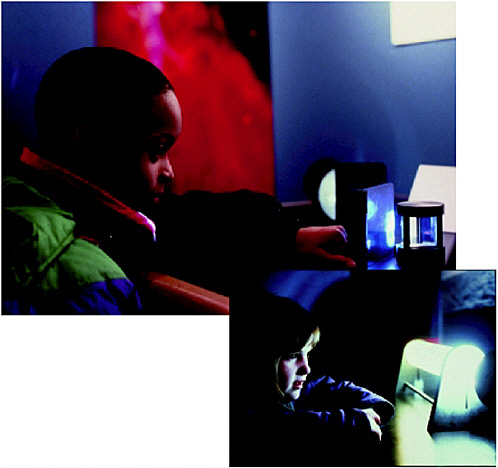
example, Project ASTRO (developed initially by the Astronomical Society of the Pacific) had established about 700 astronomer-teacher partnerships and had reached more than 50,000 students around the country. Through such projects as the AASTRA program sponsored by the American Astronomical Society, the SPICA and ARIES programs at the Harvard-Smithsonian Center for Astrophysics (see Figure 4.2), and the Astronomical Society of the Pacific’s Universe in the Classroom workshops, several thousand teachers have learned how to be more effective in conveying astronomy and science to their students. The astronomical community has recognized the value of such efforts and is seeking ways to expand their reach to a larger number of teachers throughout the United States.

FIGURE 4.2 Elementary school student using a gnomon to follow the motion of the Sun’s shadow. This program is a part of the Earth in Motion module of Project ARIES at the Harvard-Smithsonian Center for Astrophysics, Cambridge, Massachusetts. The project is funded by the National Science Foundation, the Smithsonian Astrophysical Observatory, and Harvard University. Photograph courtesy of the Harvard-Smithsonian Center for Astrophysics.
The variety of organized science education outreach efforts built on astronomical themes has been growing rapidly and promises to increase throughout the decade as NASA and the National Science Foundation encourage investigators and teams to add education components to their funded research. A good, frequently updated summary of current national astronomy education projects can be found on the Web site of the Astronomical Society of the Pacific (<www.aspsky.org/education/naep.html>).
Because of the importance of linking the public investment in research to advancing public science education goals, the astronomical community has worked hard to identify areas where successes have been achieved, efforts that are highly leveraged, and ways that those gains can be propagated. Recommendations aimed at better coordinating these efforts in the new decade are described in Chapter 5.
THE PRACTICAL CONTRIBUTIONS OF ASTRONOMY TO SOCIETY
Federal support of curiosity-driven scientific research has historically led to a broad range of contributions to technological advances with long-term benefits to society. Indeed, national investment in curiositydriven scientific research is widely viewed as an essential element of U.S. economic strength and competitiveness. Despite its focus on the extraterrestrial, astronomy has made important contributions on Earth as well. In large measure, these contributions derive from the need to measure precise positions, luminosities, and structural details in faint and distant cosmic sources, to measure time with exquisite precision, and to analyze large statistical samples of objects spanning a wide range of physical, chemical, and evolutionary conditions. All these activities have led to numerous benefits to society that are discussed in more detail below. In some areas, astronomers have pioneered the technology, while in others they have worked symbiotically with industry and the defense sector in developing and perfecting the appropriate technologies.
ANTENNAS, MIRRORS, AND TELESCOPES
Large mirrors or antennas that focus and image light, infrared radiation, or radio waves are used not only by astronomers but also by, for example, the communications industry, the military (e.g., in surveil-
lance), and the scientists who use telescopes that look down from space to study Earth’s ecosystem and resources. In order to produce a sharp image, either large-diameter mirrors or antennas are required, or the radiation must be collected on widely spaced individual mirrors or antennas and then combined—a technique called interferometry.
Besides size, another key to a high-quality image is producing a very accurately shaped mirror or antenna. Astronomers have made major contributions to mirror and antenna technology. Examples include developing mirror materials (lightweight materials in particular), mirror designs, precision shaping and metrology (shape testing), procedures for correcting the effects of bending under the force of gravity, technologies to correct for the blurring effect of the atmosphere (e.g., a technology called adaptive optics), interferometry, and the technology for steering the beams and efficiently collecting the radiation in large radio telescopes. Besides the obvious applications noted above, there are additional spinoffs. One notable example is in the area of adaptive optics. Techniques developed by astronomers for adaptive optics are being refined to produce ophthalmic instruments that can image the retina of an eye and measure an individual’s eye aberrations in unprecedented detail. The potential exists for low-cost diagnosis of eye disease, as well as for specification of parameters for either contact lenses that will provide “supernormal vision” or corrective eye surgery.
Adaptive optics techniques and techniques to manufacture and figure ultralightweight, ultrahigh-precision mirrors are examples of synergy between investments in defense-related technology and in astronomy. The rapid growth of adaptive optics over the past decade owes much to the declassification of techniques developed in the service of national security interests. Mirrors for the Hubble Space Telescope are a direct descendent of efforts in service of surveillance during the 1970s and 1980s, while today, NASA and the National Reconnaissance Office are partners in efforts to develop next-generation, large space-based mirrors.
SENSORS, DETECTORS, AND AMPLIFIERS
Perhaps the biggest technology spinoff contributed by astronomy has been the development or improvement of devices that convert light and other forms of radiation into images. Historically, astronomy pushed the development of photographic film to greater sensitivities and resolution. However, film has now been largely replaced by electronic sensors, detectors, and amplifiers—devices that enable accurate digitized mea-
surements of brightness over a wide range of wavelengths. In this section, astronomy’s contributions to signal detection are discussed by frequency band, starting with the high-frequency x-ray band and moving to ever lower frequencies: ultraviolet/optical, infrared, and radio.
X rays partially penetrate opaque objects and can thus be used to image their “insides.” One prominent example is provided by the luggage scanners used as security devices in airports. The most common version of this device is a spinoff from space x-ray astronomy, where the requirement to observe weak cosmic signals resulted in the development of high-sensitivity x-ray detectors. Application of these detectors to luggage scanners enabled the use of low x-ray dosages to obtain good images, thus enhancing their safety for operators and passengers alike. X-ray astronomy detectors, with their sensitivity to single photons and to low-energy x rays, are also ideally suited for fundamental biomedical research, for cancer and AIDS research, and for drug and vaccine development. These sensitive detectors have led to a plethora of x-ray medical imaging devices, including those used to search for breast cancer, osteoporosis, heart disease (the thallium stress test), and dental problems. The last is a new development that uses x-ray charge-coupled devices (CCDs; miniature electronic detectors) to replace dental x-ray film, a change that will reduce exposure to x rays. Another exciting development is the x-ray microscope. A microscope is, in effect, a miniature telescope. X-ray astronomy has led to the development of the Lixiscope, a portable x-ray microscope to be used to image small objects and fine detail, with applications in energy research and biomedical research. It is widely used in neonatology, out-patient surgery, diagnosis of sports injuries, and Third World clinics. The Lixiscope is NASA’s second largest source of royalties. In a somewhat different technique called x-ray diffraction, a “super-microscope” is achieved that is capable of studying tiny molecular structures. This technique utilizes the interference of the x rays with each other after they scatter off a sample surface. X rays are preferred because they resolve molecular structure. Astronomical advances in detector sensitivity and focused beam optics have allowed the development of systems with much shorter exposure times, and have allowed researchers to use smaller samples, avoid damage to samples, and speed up their data runs. Biomedical and pharmaceutical researchers have used these systems for basic research on viruses, proteins, vaccines, and drugs, as well as for cancer, AIDS, and immunology research.
At ultraviolet (UV) and optical frequencies astronomers have pushed the development of more sensitive CCDs and of large arrays of CCDs.
Cooled silicon CCD arrays developed for optical astronomy now dominate in a multitude of industrial imaging applications. The basic performance of these detectors has been improved by a thinning process developed by astronomers. CCD manufacturers have adopted this technique for use on Earth satellites (e.g., to watch for lightning strikes in the atmosphere) and in surveillance applications. In the UV, CCD development undertaken for a Hubble Space Telescope instrument was later incorporated in a stereotactic breast biopsy machine, which detects tumor positions accurately enough to steer the biopsy probe, thereby reducing the need for surgery and cutting costs by 75 percent (see the Scientific Imaging Technologies Web site at <www.site-inc.com/newsbreastcancer.htm>). In addition, UV detectors developed for the Hubble Space Telescope are being considered as a key element in a helicopter-based system aimed at rapid detection of power-line failures in remote areas.
Objects on Earth radiate most of their energy at infrared (IR) frequencies. In addition, infrared radiation can in some cases be more penetrating than visible light, thus rendering it useful for looking “inside” objects, in analogy to x rays. For both of these reasons, the development and/or improvement of sensitive IR detectors, large-format arrays, and IR techniques by infrared astronomers has had significant benefit to society. In this area, there has been a symbiotic relationship with the Department of Defense, which has invested large amounts of money in IR detector development for defense applications. Improvements made by astronomers have contributed to the final versions of the detectors used in the Strategic Defense Initiative and for night-vision devices. In the industrial sector, IR detector arrays developed by astronomers are being used in the semiconductor industry in IR microscopes that examine computer chips for flaws. In the medical sector, IR detectors and spectroscopes are being used to diagnose cervical cancer and genetic diseases and to image malignant tumors and vascular anomalies.
Not only radio and television, but also all satellite and much telephone communication is accomplished with radio waves. Radio astronomers have provided the impetus to many technical advances that have improved the stability, widened the bandwidth, and reduced the noise and interference of radio communications: low-noise maser, parametric, and other transistor amplifiers that have had wide application in the communications industry. Astronomers have perfected highradio-frequency systems that have found application in devices to detect concealed weapons, to see through fog and adverse weather for aircraft landing systems, and to image human tissue (e.g., in mammograms).
SPECTROMETERS AND DEVICES TO FOCUS RADIATION
Astronomers have driven the development of ever more precise instruments, called spectrometers, that separate and analyze the different frequencies present in a beam of radiation. In addition, they have perfected precision techniques to focus radiation into spots too small to be visible. These developments have been highly beneficial to the industrial, defense, and medical sectors of the economy.
NASA supported the development of a novel x-ray spectrometer, the microcalorimeter, for x-ray astronomy, but this new device can also be used to analyze the chemical elements in a small sample. Applications include materials science research, rapid trace-element analysis for the semiconductor industry (semiconductor wafer testing), and biomedical research, which requires low doses for biological samples. X-ray spectrometers developed in part in response to the needs of astronomy are also used in x-ray laser materials science and in fusion energy research, as well as in the nuclear nonproliferation program. UV spectrometers are used in laboratory analysis equipment. IR spectrometers remotely analyze the composition of the atmosphere. Spaceborne and ground-based radio spectrometers remotely monitor temperature, winds, humidity, and chemical composition in the atmosphere with applications to weather prediction, global warming, and pollution monitoring. The depletion of ozone has been monitored with astronomical radio telescopes equipped with radio spectrometers. Spaceborne radio spectrometers also sense ground-level quantities such as soil moisture, vegetation cover, ocean height and sensitivity, oil spills, snow cover, and iceberg hazards. Essential components of all these spectrometers have been invented or perfected by the astronomical community.
Efforts in UV and x-ray astronomy pioneered the development of technologies crucial for UV and x-ray lithography, a process by which fine beams of radiation etch lines in a material. Very fine line widths are needed by the semiconductor and microchip manufacturing sector to make advanced computer chips, transistors, and other microelectronic devices. In the medical sector, astronomical technology invented to focus x rays is being put to use in precision deposition of x-ray radiation to destroy cancerous tumors.
IMAGE RECONSTRUCTION
Astronomers are bedeviled by faint and blurred images that are often swamped by large amounts of noise or static. An analogous problem would be faint TV reception, superimposed on the static produced by a hair dryer operating nearby. Consequently, astronomers have been at the forefront of efforts to improve and sharpen images, to reduce extraneous noise, and to extract the maximum information from the radiation received. One example of this effort is a system of image analysis tools and computer applications programs developed by astronomers at the National Optical Astronomy Observatories: IRAF, the Image Reduction and Analysis Facility. IRAF has been used not only by thousands of astronomers worldwide, but also by researchers outside astronomy engaged in underwater imaging, mapping of the aerosols in the atmosphere, medical imaging for detection of breast cancer, decoding of human genetic material (in connection with the Human Genome Project), numerous defense-related applications, visualization of the images from electron microscopes, and many other applications. AIPS, the Astronomical Image Processing System developed at the National Radio Astronomy Observatory, is another software package for manipulation of multidimensional images that is used routinely in nonastronomical image analysis applications. Astronomers have also contributed to the advancement of tomography, which enables construction of three-dimensional images out of a series of two-dimensional pictures. Tomographic imaging is used widely in both medical x-ray imaging and industrial applications. The image reconstruction work of R. Bracewell, a pioneering radio astronomer, is widely cited by the medical imaging community. Techniques pioneered by astronomers, such as “wavelet smoothing” and “maximum entropy,” have been used for pattern recognition in areas like mammography and to sharpen images for police work.
PRECISION TIMING AND POSITION MEASUREMENTS
Interferometry is the main technique used by astronomers to measure with ultrahigh precision the position in the sky of astronomical objects. Interferometers employ two or more telescopes located some distance apart that precisely measure the time difference in the arrival of radiation from a source. To do this properly requires extremely accurate clocks, since the time differences are extremely short. Astronomers played a significant role in refining the hydrogen maser clock, which is
now widely used for space communications and in the defense sector. The interferometric timing technique to locate radiation sources has had widespread application, including finding noise sources (such as faulty transmitters that interfere with communications satellites), locating cellular phones to track locations of 911 calls, measuring the tiny shifts of Earth’s crust before and after earthquakes, and precisely locating people and vehicles using the Global Positioning System precision surveying network.
DATA ANALYSIS AND NUMERICAL COMPUTATION
Astrophysics has been a major driver of supercomputer architecture and computational science for nearly 50 years. Computations of stellar evolution by the pioneering astronomer Martin Schwarzschild occupied nearly half of the time of one of the first computers (MANIAC). Computers are severely challenged by the gigabytes of data streaming in daily from modern astronomical sensors and large sky surveys, and by the large computational speeds required for both simulations and database searches. These requirements are stimulating the development of large computers and innovative hardware components. Beowulf computers, which provide simple commodity supercomputing, were developed by astronomers to enable sophisticated numerical simulations. The idea of designing special-purpose hardware for a specific task has also flourished in astronomy. Two examples of such hardware are the GRAPE computer chips for doing large-scale gravitational N-body simulations (details are available at <grape.c.u-tokyo.ac.jp/grape/>), and the Digital Orrery for calculating the motions of the bodies in our solar system (now retired at the Smithsonian Institution in Washington, D.C.). The Gordon Bell Prize—a prestigious award for significant achievement in the application of supercomputers to scientific and engineering problems—was won by astronomers in 1992, 1995, 1996, 1997, and 1998. FORTH, a high-performance computer programming language and operating system, was developed at the National Radio Astronomy Observatory and has been used in hand-held computers carried by Federal Express delivery agents and by automotive engine analyzers in service stations, in environmental control systems in airports, and by Eastman Kodak in quality control for film manufacturing.
Many software developments were also either created by astronomers or received much of their impetus for improvement from them. Fast Fourier transforms and other image-processing techniques were
greatly improved by radio astronomers and later by optical astronomers. Some of the more popular grid-based computational fluid dynamics techniques that are used in applications such as weather prediction were either created or improved by astronomers. Another particle-based hydrodynamic technique, smoothed particle hydrodynamics, was both invented and improved by astronomers and has found uses outside astronomy, for example in modeling ballistic impacts. Magnetohydrodynamic codes and numerical simulations of plasmas developed by astronomers contribute to design efforts aimed at harnessing fusion power. Digital correlation techniques for spectral analysis of broadband signals have been adapted for use in remote sensing, oceanography, and oil exploration. IDL, a commonly used graphical package, originated as visualization software for the Mariner Mars 7 and 9 space probes. “Numerical Recipes,”1 a collection of numerical algorithms that is now widely used throughout science, started as an astronomy course on scientific computing. To handle the large databases being produced by astronomical surveys, several groups are collaborating with computer scientists to push forward the frontiers of database mining. Inexpensive and errorfree methods of archival mass data storage have been invented by astronomers. Such developments will obviously have far-reaching applications. Finally, astronomy serves as a prolific and productive training ground for many computational scientists.
EARTH’S ENVIRONMENT AND PLANETARY SURVIVAL
Astronomical studies are essential to understanding the evolution of Earth’s atmosphere and the factors that drive climate changes. Geological evidence suggests that in past millennia, Earth’s climate—as well as the atmosphere and oceans that control it—was remarkably different. It is now certain that the astronomical environment, including changes in the Sun’s brightness, the influx of cosmic rays, variations in Earth’s orbit, and the influx of zodiacal dust, is an important driver of major long-term climatic changes, such as the ice ages, as well as some smaller and more rapid changes. Together, astronomical and geological observations provide the framework for understanding the response of the biosphere to external change, which is an essential precursor to comprehending and predicting the relative importance of changes that may be wrought by modern industrial activity.
Deepening our understanding of the factors that control climatic conditions on Earth will depend critically on continued careful observa-
tion of the Sun itself, of variations in luminosity among other similar stars spanning a wide range of ages, and of the distribution of dust in the solar system. Observations of atmospheres surrounding other planets combined with numerical modeling also promise important insight into the complex interactions that drive climate changes.
In addition to terrestrial climate, understanding and monitoring solar “climate”—the ebb and flow of energetic particles arising in solar flares and the solar wind, and the ultraviolet output of the Sun—are also essential. The effects of energetic particles on radio communications can be dramatic, and variations in solar ultraviolet radiation can play a major role in affecting the concentration of critical trace atmospheric constituents such as ozone.
Study of the history of collisions of asteroids and comets with Earth provide the framework for understanding cataclysmic climate changes over geological time scales. While far rarer now than during the first billion years in the solar system’s history, collisions of comets and asteroids with planets still take place. On Earth, such collisions can produce dramatic environmental events, from giant tidal waves to Earth-girdling dust clouds that can alter climate for centuries and in some cases lead to mass extinctions of species. Astronomers now have the tools to detect comets and Earth-crossing asteroids of size sufficient to threaten human civilization and to assess the threat of a collision. In Chapter 3, the report discusses the potential role of the Large-aperture Synoptic Survey Telescope in providing a census of Earth-crossing asteroids.
CONNECTIONS BETWEEN ASTRONOMY AND OTHER DISCIPLINES
Building an understanding of the universe and the evolution of its constituents requires tools and insights from many other disciplines, including physics, chemistry, optical science, electrical engineering, computer science, and biology. In turn, astronomical discoveries as well as the need to develop new instruments and computational techniques often provide strong impetus for developments in other disciplines.
INTERACTIONS WITH PHYSICS
The largest set of interactions of astronomy with other fields currently involves modern theoretical physics, whose major goal is to understand
the basic constituents of matter and the forces between these constituents. The classic example is the 300-year-old problem of the stability of the solar system. Astronomers working on this and other problems in astrophysical dynamics have provided much of the inspiration for and many of the tools used in modern nonlinear dynamics and chaos theory, which are now routinely applied to subjects as diverse as evolutionary biology and the stock market. In turn, the concepts of nonlinear dynamics have been successfully used by astronomers in the past decade to determine the dynamical stability of planetary systems, including our own.
One of the greatest intellectual advances of the past millennium was the recognition that all of the laws of nature work the same way in both the laboratory and the cosmos. However, the universe provides higher energies, temperatures, and densities; stronger magnetic and gravitational fields; and much longer observing times than we can hope to reproduce on Earth. Important findings include (1) the discovery that nuclear fusion provides the energy source for the Sun and other stars, (2) evidence from the Sun and cosmic rays that the three sorts of neutrinos can interchange their identities, (3) observations of changes in the orbits of binary pulsars (neutron stars) that provide dramatic confirmation of gravitational radiation, a crucial prediction of Einstein’s theory of relativity, (4) very tight limits on the extent to which the strengths and other properties of the forces could have changed over billions of years, and (5) the recognition that most of the matter in the universe resides in some mysterious unseen form (“dark matter”), perhaps a new kind of elementary particle, and the recent evidence that a novel form of “dark energy” dominates the dynamics of the cosmic expansion.
The committee agreed that astronomers and astrophysicists can reasonably anticipate a number of future interactions with physics:
-
In the realm of very high energies, high energy densities, and high pressures common in astronomical objects, where advances can illuminate areas such as nuclear physics, high-energy physics, and new states of matter;
-
In investigations of plasma dynamics, energetic fluid behavior, magnetic interaction with matter, turbulence, and chaos—phenomena whose complex dynamics represent one of the major scientific and engineering challenges today, and one where astronomical examples and theory are being studied intensively; and
-
In “astronomical laboratories” that extend the reach of terrestrial
-
laboratories by providing opportunities to test the known laws of physics in extreme environments (e.g., the strong gravitational fields near the event horizons of black holes or the high density of neutron stars) or to search for new physics such as new particles, new forces, and the unification of forces (e.g., solar neutrinos, the early universe).
ASTRONOMY AND THE COMPUTATIONAL SCIENCES
The astronomical community stands poised to take advantage of the continuing breathtaking advances (factor-of-2 increases each 18 months) in computational speed, storage media, and detector technology in two ways: first, by carrying out new-generation surveys spanning a wide range of wavelengths and optimized to exploit these advances fully (see Chapters 1 and 3); and second, by developing the software tools to enable discovery of new patterns in the multi-terabyte (1012) and, later, petabyte (1015) databases that represent their legacies (Chapter 3). In combination, new-generation surveys and software tools can provide the basis for enabling science of a qualitatively different nature. Whereas in the past astronomical experiments were constrained by the need to carefully select small samples, often strongly guided by a priori assumptions, astronomers can now plan far more objective approaches based on deep images of wide areas of the sky spanning a range of wavelengths, or on spectra of millions of stars and galaxies.
Here, the committee noted the potential synergy of these efforts with computer science and other scientific disciplines facing the need for
-
Simultaneous, rapid querying of individual terabyte archives by thousands of researchers located at remote sites throughout the world;
-
Complex querying of multiple catalogs and image databases, including efficient correlation of catalog and image information from these archives aimed at discovery of complex patterns or rare phenomena through advanced visualization and sophisticated statistical tools—to discover rare galaxies that “look like this, but not that.”
Developing efficient archiving protocols, querying methods, and data mining and visualization tools will enable astronomers to fully exploit the rapid advances in computer and detector technology. Forging partnerships among scientists who are working on these fundamental issues will enable linkage of the efforts of multiple scientific communities with the dynamism of commercially driven efforts to address these problems. For
example, the kinds of tools needed by astronomers to query huge image databases are closely related to those needed by physicians searching for commonalities and anomalies in medical images, and by agricultural analysts studying crop yields by analyzing satellite images.
POTENTIAL INTERACTIONS WITH THE BIOLOGICAL SCIENCES: ASTROBIOLOGY
Astronomy and space science have reached a stage where astronomers can make important contributions to answering fundamental questions related to the origin and distribution of life in the universe. For the first time, astronomers are able to trace, both observationally and theoretically, the birth of planetary systems around other stars. Researchers are also able to determine the key events in the history of Earth and other planets in our solar system, including the sources of water and other volatiles, and of the organic chemicals that are the building blocks of life. In the past few years, astronomers have discovered around other stars more than five times as many planets as the nine planets comprised by our solar system. Powerful new instruments will soon permit us to survey for Earth-like planets around Sun-like stars.
Within a decade astronomers may be able to search for the spectroscopic signatures of biogenic gases, which provide evidence for life on such extrasolar planets. But researchers can recognize the signature of life elsewhere only by understanding better the history of life on Earth over the past 4 billion years and exploring more deeply the possibility that life has also had an independent history on Mars or other planets and moons in our solar system. This study is an essential part of the new synergy between astronomy, planetary science, and biology—what has been called astrobiology. This nascent activity aspires to encourage collaborations across these disciplines in order to address questions that compel the imaginations of scientists and citizens alike: What is the origin and evolution of life? Is there life elsewhere in the universe? What is the future of life on Earth and in space?
Answering these questions will require the combined efforts of astronomers, planetary scientists, and biologists, as well as investments in new facilities and instruments. Astrobiology has the potential to draw together investigators from disciplines that in the past have shared little except a common interest in understanding the natural world. Astronomers can contribute to this effort by determining the conditions that lead to the formation of habitable planets, by finding planets and satellites that
could be habitable, and by searching for evidence for life through remote observation. It is difficult to predict the potential for advances at this new interface between the physical and life sciences—other than to note the extraordinary potential of bringing diverse scientific cultures together at the right moment in time.
Perhaps of equal importance is the extraordinary public interest generated by attempts to understand our origins and the ubiquity of life in the universe. Like astronomy, astrobiology has the potential to link the seemingly abstract world of research at the frontiers of knowledge to questions that have excited the human imagination since people first gazed at the heavens.
NOTE
|
1. |
“Numerical Recipes” refers to copyrighted software published in the series Numerical Recipes: The Art of Scientific Computing, available as books from Cambridge University Press and also in electronic form at <www.nr.com>. |


