
SUMMARY
Radio astronomy covers five orders of magnitude in wavelength (300 mm to 30 m) and provides unique as well as complementary windows on the origins of the universe, galaxies, stars, and planets. Radio astronomers sample milliarcsecond scales and millisecond periods. Radio astronomers alone can view the early universe directly through the cosmic microwave background (CMB) and probe large-scale structure independent of redshift using the Sunyaev-Zel’dovich (SZ) effect. Radio waves offer the only clear view of the earliest stages of star and planet formation, both locally and in distant galaxies, by directly probing the dust, magnetic fields, gas dynamics, and rich molecular complexity in the highly obscured environments where galaxies, stars, and planets form.
Not surprisingly, astronomy in the radio and submillimeter wavelength range is driven by technology advances. The last decade has seen the success of the Cosmic Background Explorer (CORE); the completion of the Very Long Baseline Array (VLBA); the launch of the Japanese Very Long Baseline Interferometry (VLBI) Space Observatory Program (VSOP) mission, which pioneered the technique of very-long-baseline interferometry from space; the upgrade of the Arecibo telescope; and the development of millimeter-wave interferometry and submillimeter capabilities. The Green Bank Telescope (GBT), a unique and powerfully flexible instrument exploiting new technology for radio-wave active optics, was dedicated in August 2000. The Atacama Large Millimeter Array (ALMA), the first-ranked major project of the Astronomy and Astrophysics Survey Committee’s Panel on Radio Astronomy a decade ago (it was known then as the Millimeter Array), is currently approaching its construction phase.1 The ALMA project is far more exciting and capable than originally envisaged and will provide the means to explore the dusty sites of planet and star formation and the hearts of the earliest galaxies. The Panel on Radio and Submillimeter-Wave Astronomy reaffirms the high priority given to ALMA by the 1991 Astronomy and Astrophysics Survey Committee and emphasizes that its construction schedule should be maintained.
The panel recommends as its highest priority for major new funding
the Expanded Very Large Array (EVLA). While the Very Large Array (VLA) remains the most powerful and productive centimeter-wave telescope in the world, advances in technology make possible an order-of-magnitude improvement in both sensitivity and angular resolution, combined with a more than 1000-fold improvement in spectroscopic capability. The new EVLA will be an essential tool for astronomers investigating a wide range of scientific problems. For example, submillimeter studies have shown that a substantial part of the energy release at high redshifts occurs in regions obscured by dust, but the origin of the energy is in question. The EVLA will uniquely distinguish between massive star formation and accretion onto a supermassive black hole as the underlying energy source, allowing researchers to decode the history of star and galaxy formation as well as the role of supermassive black holes in galaxy evolution.
The panel recommends the following moderate projects2 in order of priority:
-
A well-orchestrated technology development program leading to the future construction of the Square Kilometer Array (SKA), an international next-generation radio telescope;
-
Immediate construction of the Combined Array for Research in Millimeter-wave Astronomy (CARMA), to precede and ultimately to complement ALMA;
-
Development of the Advanced Radio Interferometry between Space and Earth (ARISE) mission for space VLBI to achieve the highest spatial resolution at centimeter and millimeter wavelengths; and
-
Construction of a large, single-aperture telescope at the South Pole equipped for wide-area surveying at submillimeter wavelengths, the 10-m South Pole Submillimeter Telescope (SPST).
The panel emphasizes that continued investment in the pursuit of a complete understanding of the CMB, particularly its polarization properties, is critical. A host of experiments—on the ground, balloon-borne, and in space, including the Microwave Anisotropy Probe (MAP) and Planck missions—will characterize the CMB anisotropy within the next few years. Detection of the signature of gravitational waves on the CMB
polarization would provide a unique measurement of the energy scale of the inflationary potential, allowing the origin of the Big Bang to be explored. Radio astronomers will probe energy scales of 1016 GeV, well above the reach of particle accelerators, with a sensitivity to the gravity-wave background well beyond that possible with direct gravity-wave detectors. Discoveries by the MAP and Planck missions as well as ground-based investigations will suggest the direction for follow-on NASA missions. NASA should take the necessary steps to initiate those missions rapidly when the optimal strategy becomes clear.
The panel endorses construction of the Low Frequency Array (LOFAR), an international and interagency project. This unique instrument will provide the first real capability to image the low-frequency (meter- and decameter-wave) sky and, along with the One Hectare Telescope (1HT), will constitute the first of the stepping-stones to the SKA.
The panel further recommends an aggressive and vigorous program of technology development. SKA development activities should focus on low-cost, high-performance electronics and processors, techniques and technologies for radio frequency interference (RFI) identification and compensation, array optimization, and radio-wave adaptive optics. For future space missions, development should emphasize inexpensive large apertures, large-format arrays, receivers with the lowest possible noise, high-capacity, space-qualified refrigerators, and enhanced telemetry bandwidth.
The panel supports the recommendation of the Panel on Ultraviolet, Optical, and Infrared Astronomy from Space that NASA pursue technology development leading toward a far-infrared (FIR)/submillimeter interferometer in space (see Chapter 7). The Single-Aperture Far Infrared (SAFIR) Observatory is the logical first step toward the long-term goal of space FIR/submillimeter interferometry, which could provide high-resolution imaging of star formation sites both locally and at high redshift. Such a capability will provide an excellent FIR/submillimeter complement to ALMA, EVLA, and SKA.
The panel emphasizes that the National Science Foundation (NSF) has a special responsibility for radio astronomy, because it is primarily a ground-based activity. This responsibility is reflected in NSF’s current support for the university radio observatories as well as the national centers. The panel strongly endorses continuation of this support and recommends enhanced efforts to support full utilization of these essential facilities by their general users.
The radio astronomy community is proud of the national radio astronomy centers. At centimeter wavelengths, the National Radio Astronomy Observatory (NRAO) and the National Astronomy and Ionosphere Center (NAIC) lead the world, and U.S. astronomers rely almost entirely on them for telescope access. The NSF needs to provide increased support to operate, maintain, and continually upgrade the radio facilities to keep them at the cutting edge, and it should seize the opportunity to develop subarcsecond imaging capabilities, complementing those of the VLA and the Next Generation Space Telescope (NGST) at shorter wavelengths (with ALMA) and at longer wavelengths (with LOFAR).
The panel is concerned that NSF funding for critical activities such as data analysis, theory, correlative studies, and student support is not commensurate with its investment in facilities. The NSF should provide sufficient funds for individual investigators to maximize the scientific output of both national and university facilities. It should consider innovative ways to support astronomers in obtaining, analyzing, and publishing data, along with training a new generation of astronomers. This new support should complement the traditional grants program, for which the fraction of proposals that can be funded within the budget has fallen to dangerously low levels.
The panel emphasizes that preservation of portions of the spectrum for future radio astronomical research is vital. The NSF plays a critical role in setting spectrum management policy and in increasing public awareness of its importance. Continued vigilance is required at both the national and international levels to ensure that spectrum allocation balances commercial and research interests. At the same time, investments must be made in the development of hardware and signal-processing techniques to mitigate the effects of human-generated radio interference, which will otherwise drown out the much weaker cosmic radio signals.
In summary, technological advances in telescope hardware spanning the entire wavelength range of interest to radio and submillimeter astronomy now permit the construction of a new generation of powerful instruments. These powerful instruments will provide crucial information on the leading astronomical questions of the decade, especially on how the universe formed—from its superclusters, clusters, and galaxies to their constituent stars and planets. Full exploitation of these instruments will require adequate support for facilities and investigators and preservation of portions of the radio spectrum.
SCIENCE OPPORTUNITIES
Radio astronomy in the last decade has made fundamental contributions to the most important issues in astrophysics. By directly observing CMB radiation, radio astronomers have shown that its spectrum is described to remarkable accuracy by a thermal Planck spectrum, verifying the Big Bang model and illustrating beautifully the simple physics needed to describe the universe at only 2×10⁻⁵ times its present age. The present imaging of the weak anisotropy in the CMB indicates that the universe may be flat, a strong prediction of the inflationary theory. Ongoing observations of the CMB promise to constrain to high precision a host of parameters that describe our universe, including its curvature and, therefore, the energy density; the Hubble constant; the baryonic and dark matter content; and Einstein’s cosmological constant. High-resolution radio imaging allows the detailed measurement of the kinematics in galactic microquasars and their more powerful extragalactic counterparts and measurement of the speed of expansion of gamma-ray bursters. Such observations provide compelling evidence of a supermassive black hole in the heart of the nearby galaxy NGC 4258 and suggest the presence of many more massive black holes in galactic cores. In the past decade, radio astronomers have shown that most forming stars are surrounded by disks, and they have watched the expansion of material ejected from dying stars. Radar probes of Mercury have shown the existence of water ice in the polar craters of the planet closest to the Sun. Quite unexpectedly, it was the exquisitely precise timing of a pulsar spinning on its axis 161 times per second that led to the discovery by radio astronomers of the first extrasolar planetary system.
In areas where radio astronomy is not the only channel of information, it provides a crucial complementary view. In nearly all forefront areas of astronomical research, from the solar neighborhood (star and planet formation) to the furthest reaches of the universe in space (high-redshift galaxies), time (the CMB), and energy (gamma-ray bursts), radio astronomy complements optical, infrared, ultraviolet, x-ray, and gamma-ray observations, delivering ever more detailed views of the cosmos. The imaging capabilities of the new arrays will produce fantastic and fascinating pictures of the otherwise invisible internal workings of molecular clouds producing planetary systems, of the active engines buried within the hearts of galaxies, and of the intricate wisps and filaments lacing the interstellar medium in the core of our galaxy, in the lobes of radio galaxy halos, and in the outermost reaches of distant clusters of galaxies. Fur-
thermore, radio telescopes have already proven to be effective hunters of the faint ephemeral signatures of the titanic explosions signaling star deaths in the distant universe, as heralded by flashes of gamma rays. It is ever more clear that in the coming decades the diverse views provided by the whole of the electromagnetic spectrum will be synthesized into a coherent physics picture of the clockwork of the universe. The radio and submillimeter programs and facilities described in this chapter will be a vital part of this intellectual adventure.
THE LARGE-SCALE STRUCTURE OF THE UNIVERSE
Studies of the relic radiation of the Big Bang, the CMB, lie entirely within the province of radio astronomy. The CMB contains the fossil record of conditions existing in the very early universe before the time of recombination. The mapping of fluctuations in the brightness of the CMB—its anisotropy—provides a snapshot of conditions in the universe at a redshift z~1000, equivalent to an age of 300,000 years. The CMB contains the imprints of structures that later grew to produce the large-scale structure we see today. Studies of the CMB radiation and how it has propagated from the time of its generation to the current time of observation thus allow us to take inventory of the matter and energy content of our universe.
A comprehensive program is under way to characterize the CMB anisotropy using ground-based (e.g., CBI, DASI, VSA, Viper, POLAR, Polatron), balloon-based (e.g., BOOMERANG, TopHat, BEAST, MAXIMA), and space-based (MAP, Planck) missions. The majority of these will be operational in the first few years of this decade, and their results will determine the specifications for the suite of missions to follow. As illustrated in Figure 4.1, observations of the details of the CMB will allow radio astronomers to directly test models of the emergence and evolution of large-scale structure, leading to the formation of the superclusters, clusters, and galaxies we see today. Before the end of the decade, radio astronomers will provide high-precision determinations of the primary cosmological parameters.
Measurements of the polarization of the CMB will determine the contribution to CMB anisotropy from gravitational waves excited by the decaying inflationary potential in the early universe (t=10−30 s). Detection of the unique signature of gravitational waves on the CMB polarization will provide a measurement of the energy scale of the inflationary potential, on the order of 1016 GeV, well beyond the reach of particle
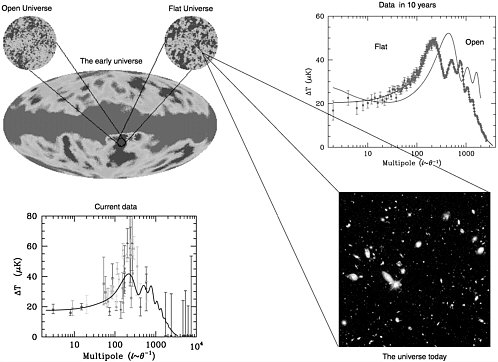
FIGURE 4.1 Cosmology with the cosmic microwave background (CMB) radiation as promised by the planned ground-based (e.g., CBI, DASI, VSA, Viper, POLAR, and Polatron), balloon-based (e.g., BOOMERANG, TopHat, BEAST, and MAXIMA), and space-based (MAP, Planck) missions. The enlarged regions of the COBE CMB map of the whole sky show the vastly increased resolution expected from future experiments. The simulated high-resolution observations are shown for both a low-density “open” universe and a “flat” universe, which is favored by the inflationary theory for the origin of the universe. The slight variations in the intensity of the CMB measure the inhomogeneities in the universe 300,000 years after the Big Bang. These inhomogeneities eventually grew into the rich structure observed today, as seen, for example, in the HST image shown bottom right. The most efficient way of extracting the cosmological information from CMB maps is to look at the amplitude of temperature fluctuations at different angular scales. This power spectrum is indicated bottom left for today’s experiments and top right for the level of accuracy expected within the next 10 years. The two curves shown are for open and flat cosmological models—whether current models are correct and whether the universe is open or flat will be easy to tell. The combination of results promised for the next decade will determine the correct cosmological model for our universe and measure its parameters with high precision. Courtesy of J.Carlstrom, University of Chicago, D.Scott, University of British Columbia, and M.White, Harvard-Smithsonian Center for Astrophysics.
accelerators and with a sensitivity to the gravity-wave background well beyond that possible with direct gravity-wave detectors. Such scales are of great interest not only to cosmologists but also to particle physicists working on constructing a fundamental “theory of everything.” Polarization measurements will be difficult and will require, depending on just what the universe is up to, a combination of ground- and space-based instruments toward the end of this decade and beyond, but the importance of these measurements is tremendous. In the end, the observations made by these instruments will tell us whether the inflationary model for the origin of the Big Bang is correct or whether our understanding of the origin of the universe must undergo another major revision.
The small distortion of the background radiation induced when CMB photons scatter off electrons in the hot gas contained within clusters of galaxies is known as the Sunyaev-Zel’dovich (SZ) effect. On its own, the SZ effect is an effective probe of the baryon density in the cluster intergalactic medium. In concert with x-ray observations of free-free emission from the same gas, the SZ effect provides an independent determination of the Hubble constant from local as well as high-redshift clusters. Figure 4.2 illustrates the promise of SZ mapping for tracking the census of galaxy
clusters through time, thus strongly constraining models of structure formation. The second-order SZ effect, due to the CMB dipole that the cluster itself sees, can also provide a measurement of the peculiar velocity in its own frame of rest (i.e., the kinematic SZ effect). The smallest antennas proposed for CARMA will be critical for conducting large-scale SZ surveys of the high-redshift universe, while submillimeter observations with the SPST will measure the spectral dependence of the SZ effect. The large collecting area and high spatial resolution provided by ALMA at 7- to 10-mm wavelengths will allow sensitive detailed imaging of the SZ effect from distant clusters.
Radio astronomy also provides its own direct probes of the expansion history of the universe and the allowed values of the cosmological
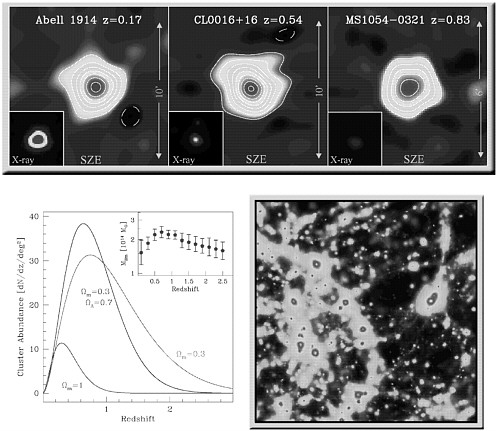
FIGURE 4.2 Montage of observations and simulations of the Sunyaev-Zel’dovich (SZ) effect. The top montage shows SZ effect images, obtained using dedicated centimeter-wave receivers on the OVRO and BIMA millimeter-wave arrays, of three galaxy clusters at redshifts z=0.17, z=0.54, and z=0.83 (at z=0.83, the universe is approximately one-third of its present age). The same contour level is used for each SZ image. Insets show x-ray images of each cluster, with the same intensity scale used for each cluster. The signature of the SZ effect is comparable at all three distances, whereas the detected x-ray emission (in fact, any emission) decreases rapidly with distance. Hence SZ effect observations allow detection of clusters throughout the observable universe. As illustrated in the bottom left panel, observations of the abundance of clusters at different redshifts, corresponding to different epochs, will allow discriminating between cosmological models. The inset shows the limiting cluster mass Mlim as a function of redshift for a realistic SZ effect survey instrument. The bottom right panel illustrates the expected image of the SZ effect for a simulated supercluster (by D.Bond, Canadian Institute of Theoretical Astrophysics). Future very sensitive SZ observations promise to image the intercluster gas (green and blue in the image), a diffuse cosmic web that is likely to be the largest reservoir of baryons or normal matter in the universe. CARMA, ALMA, and SPST will provide the range of sensitivity, resolution, stability, and sky coverage needed to exploit all aspects of the SZ effect for cosmology. Courtesy of J.Carlstrom and J.Mohr, University of Chicago.
constant. Gravitational lensing, in particular that due to individual galaxies, which causes image splitting on scales of arcseconds, gives measurements of the Hubble constant through time-delay observations. Additionally, the gravitational mass, luminous plus dark matter, in the lensing galaxy is measured. Ongoing and future large surveys of lensing in samples of compact radio galaxies and quasars will determine parameters such as the cosmological constant, matter density, and curvature. In addition to providing large lens samples, the EVLA will offer great improvements in the ability to monitor lens systems for time-delay measurements. The order-of-magnitude increase in sensitivity promised by the future SKA will likewise offer a leap forward in lens statistics.
Radio-source surveys provide the bread-and-butter source count statistics, object identifications, and parent samples that enable high-profile cosmological studies. In particular, gravitational-lens surveys are possible only after a catalog of target sources is available. Furthermore, an understanding of lens statistics requires knowledge of the radio-luminosity relationship as a function of redshift. Other radio-source-based cosmological tests are important: angular size versus redshift, superluminal jet speed versus redshift, and geometric distance measurements made by observing maser hot spots and supernova expansion. Additionally, CMB studies must be carefully corrected for foreground
(Galactic and extragalactic) radio contamination. The two recent large-scale, centimeter-wave continuum surveys, the FIRST survey and NVSS, have been important products of the current VLA, providing views of the radio sky comparable to those from surveys produced at other wavelengths. Data mining of these surveys continues to engage various segments of the astronomy community at large. An important task for the EVLA and other future arrays will be to produce the next generation of such multiuse surveys, including surveys of gravitational lenses and compact galactic objects.
Models of large-scale structure and galaxy formation predict that between redshifts of about 20 and 5—the dark age—detectable signatures of the first structures should exist in the form of inhomogeneities in the primordial hydrogen heated by infalling gas or by the first generation of stars or quasars. More recently than z~5, the development of the cosmic web of neutral hydrogen and the formation and evolution of galaxy halos should be observable. Calculations of the sensitivity required for these measurements led to the need for a radio telescope with 1 square kilometer of collecting area, giving the SKA its name. Depending on the redshift of this epoch, studies of highly redshifted atomic hydrogen (HI) at low frequencies might be undertaken by LOFAR and/or the SKA, allowing researchers to follow the evolution of the baryons quite possibly even before the formation of the first stars and quasars. Figure 4.3 shows what the primordial HI might look like, either before or after the first generation of galaxies/quasars. The first generation of luminous objects will heat the primordial hydrogen, giving observable signatures of their properties and the epoch of their formation, potentially revealing the source of the radiation that reionized the universe. The correlation properties of the hydrogen structures should reflect the initial conditions provided by the quantum fluctuations of the early universe, in effect probing the same linear density field as the CMB, although at a much later stage, and thus will provide an independent check of cosmic background radiation studies and of the effects of reionization on structure formation.
THE FORMATION AND EVOLUTION OF GALAXIES
One of the important observations carried out during the 1990s was the imaging of submillimeter-luminous galaxies at intermediate and high redshift. Much like the discovery of ultraluminous infrared galaxies by IRAS in earlier decades, the newly discovered objects give researchers a
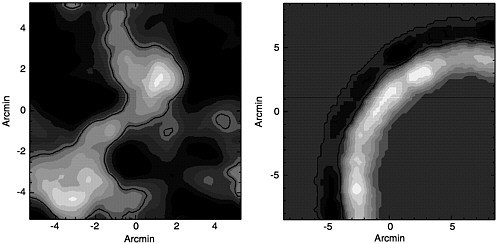
FIGURE 4.3 Simulations of observations of highly redshifted atomic hydrogen during the dark age. Left: A map of the 21-cm radio HI line at redshift z=8.5 in an open universe dominated by cold dark matter. The surface brightness fluctuations are due to inhomogeneities in the density of neutral hydrogen that were seeded by the primordial density fluctuations. Right: The outwardly propagating front of absorption and emission caused by the interaction of the neutral gas with the Lyman-alpha photons emitted by a newly formed quasar. It is reasonable to expect that a centimeter-wave radio telescope with a very large collecting area would be capable of detecting these two very different signatures of the first structure formation in the universe after recombination. The possibility of carrying out such measurements is a prime driver for the SKA. With permission of P.Tozzi, Johns Hopkins University. Courtesy of J.Hewitt, Massachusetts Institute of Technology.
window onto an otherwise invisible critical phase in the life cycle of galaxies. These galaxies include some of the most distant objects in the universe, and their radio-to-submillimeter spectral index serves as a promising indicator of redshift even in the absence of detection at optical wavelengths. It is too soon to tell if the submillimeter-luminous galaxies are signposts for the all-important principal star-forming phase, but indications are that they represent a population comparable in significance to the Lyman-break galaxies discovered in the near infrared (IR) and most likely represent an early ultraluminous star-formation phase in a forming or merging galaxy. As illustrated in Figure 4.4, high-resolution observations made with the current millimeter arrays demonstrate the likely link between low-redshift, gas-rich, ultraluminous infrared galaxies
and the high-redshift submillimeter sources; however, the co-moving number density of the distant objects is 100 times higher and their far-infrared luminosities are greater than those of the nearer population. Many of the ultraluminous galaxies appear as faint radio continuum sources, invisible to ground-based optical images and to the Hubble Space Telescope (HST). During this decade, observations of these objects at all wavelengths will be critical to our understanding of them.

FIGURE 4.4 Future studies with ALMA, CARMA, and the EVLA will identify galaxies at high redshift and the processes responsible for their high luminosities. The upper left panel shows a simulation of a 2.56-arcmin2 deep field observed at 350 GHz (a wavelength of 870 mm) with ALMA. It illustrates the ease with which ALMA will find galaxies at redshifts greater than 3 (red symbols). Observations made with the OVRO millimeter array already show the power of spectroscopic studies of the ultraluminous infrared galaxies found by IRAS and SCUBA. The lower left panel shows contours of the CO (2–1) emission superposed on HST/NICMOS images of four double-nucleus ULIRGs; insets show the CO spectra at the emission peaks. The right panel shows the CO (3–2) emission in two high-redshift (z~2.6 to 2.8) submillimeter sources detected by SCUBA. Nearly all of the local ultraluminous merging systems contain massive central molecular gas disks. They appear to be analogues of the high-redshift ultraluminous dusty galaxies, although the co-moving number density of the submillimeter population is more than 100 times higher than that of the low-redshift objects. The suite of high-resolution studies enabled by the future arrays will allow the construction of detailed models of merging systems and an understanding of their importance through cosmic history. Courtesy of NRAO (top left) and Caltech (lower left and right panels).
The increased resolution offered by EVLA and CARMA will be followed by the superb capabilities of ALMA, which will detect high-redshift galaxies with great ease. Sensitive surveys using multiband bolometer arrays on the SPST will provide a complete characterization (source flux densities and spectral characteristics) of the source population and target lists for the ALMA programs.
Deep-field radio continuum observations obtained with the EVLA and SKA will revolutionize the study of radio galaxies and their environments. Figure 4.5 offers a glimpse of such a deep field observed after Phase I of the VLA expansion. High-redshift radio galaxies can be found by low-frequency continuum spectral selection (i.e., compact steep-spectrum sources) and, if prevalent, may indicate vigorous structure formation at early epochs. Relic radio haloes, low-energy cosmic-ray electrons, and low-energy radiation due to shocks in large-scale structures in galaxy-cluster environments are a relatively unexplored realm and are accessible only through long-wavelength radio astronomy. The pilot studies using the VLA at λ=4 m are extremely promising, proving that the effects of the ionosphere can be removed. It is well known that radio continuum luminosity correlates tightly with the star formation rate and that radio continuum observations, unlike their optical counterparts, do not suffer from dust extinction. Because the EVLA will detect synchrotron radiation from galaxies undergoing massive star formation to z=5, it will serve as an excellent tracer of the history of star formation
through the ages. Following Phase II of the VLA expansion, the resolution will be improved to only a few hundredths of an arcsecond, comparable to the spatial resolution of ALMA and NGST, and distant galaxies will be imaged with sufficient resolution to distinguish star-forming phenomena from active galactic nuclei (AGN) related to a massive central engine.
Molecular gas, as traced particularly by carbon monoxide but also by other species, represents the star-forming component of the interstellar medium in galaxies. The dynamics of the gas in bars, in spiral density
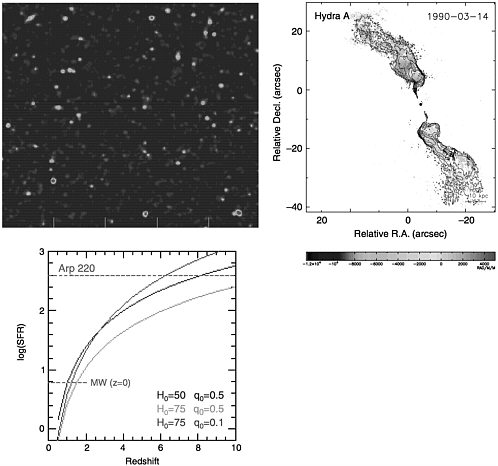
FIGURE 4.5 Future centimeter-wavelength deep-field observations will revolutionize studies of faint radio sources. Top left: Simulation of a deep integration comparable in area to the Hubble Deep Field (160 arcsec×160 arcsec) made with the EVLA at 1.4 GHz for 500 h, yielding about 500 radio sources stronger than 500 nJy. The full field imaged by the EVLA will be much larger (45 arcmin×45 arcmin but with reduced sensitivity in the outer parts) and will contain 40,000 sources with a resolution of a few arcseconds. Studies of these sources will be used to trace the star formation history with redshift, irrespective of dust extinction. Additionally, it will yield 1000 rotation measures that probe the structure of the large-scale magnetic field. In the future, the SKA will achieve comparable sensitivity in only 1 hour. Top right: The rotation measure structure of Hydra A at 0.3-arcsec resolution as seen with the current VLA; the EVLA will allow similar mapping of sources that are an order of magnitude fainter: Bottom left: The 5σ detectability of star-forming galaxies in the deep EVLA radio continuum field in terms of the star formation rate (vertical axis, in logarithmic units of solar masses per year), assuming the local relationship between star formation rate and the radio continuum flux density holds. At this level of sensitivity, it will be possible to detect galaxies similar to our own Milky Way (with a star formation rate of 6 solar masses per year) out to z=1 and star-forming galaxies such as Arp 220 out to z=10. Courtesy of NRAO.
waves, in regions of starbursts, and in the vicinity of AGNs is often gleaned only from molecular studies, yielding clues to the radial redistribution of gas that must drive at least in part the evolution of galaxy disks. The all-important rate of star formation and its evolution through cosmic history is constrained by studies of redshifted molecular lines and atomic recombination lines. The study of the neutral hydrogen 21-cm line emission has been a staple of observational cosmology, providing diverse clues to the structure of galaxy disks, the circumstances of star formation within them, and the history of galaxy interactions. The molecular, atomic, and continuum studies of galaxies provide the foundation on which detailed galaxy formation models will be built, while the information extracted from the velocity fields via spectroscopic imaging of atomic and molecular species reveals the history of encounter dynamics. Figure 4.6 illustrates the potential for future studies with EVLA, ALMA, and CARMA to provide rich details on the processes of tidal disruption and mergers tracing the kinematic disturbances on both large and small scales.
Late-type spiral and irregular galaxies are rich in neutral hydrogen, which often extends far beyond their optical boundaries. In gas-rich dwarf galaxies, the HI line provides the most efficient, if not the only, means of measuring the redshift. The HI line width, in combination with
optical imaging, gives an easily measured, redshift-independent distance estimate via the Tully-Fisher relation. Extension of such studies to the more distant universe awaits improvements in spectral resolution and coverage through the VLA correlator enhancement and in low-frequency-array sensitivity through LOFAR and, later, the SKA. With these advances, the otherwise invisible network of lower-density, large-scale structure bridging the clusters, superclusters, and galaxy groups will be delineated by HI line emission and/or absorption. Because the HI can
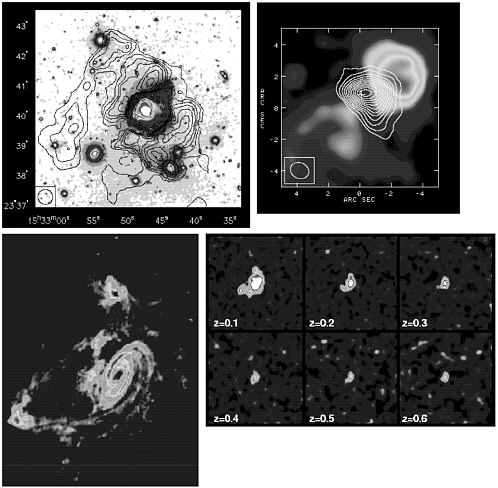
FIGURE 4.6 Spectroscopic studies of disturbed gas disks bear the spatial and kinematic signatures of the dynamics of galaxy encounters. HI traces the interaction history of the merger on large scales, while studies of the CO and other species elucidate the effects of the merger on small scales. Top left: The HI emission obtained from VLA mapping of Arp 220 superposed on a deep R-band image. The large-scale HI distribution and corresponding velocity field reveal that two gas-rich galaxies have merged, producing widespread tidal tails. Top right: A high-resolution image of CO (2–1) emission obtained with the OVRO millimeter array overlaid on a deep Hα image of the central pixel of the HI map. The details suggest that the bulk of the molecular gas has settled into the center faster than have the two individual galaxy nuclei. Bottom left: VLA observations of the HI in the M81/M82/NGC3077 system reveal the tidal disruption. Bottom right: Simulation of what the EVLA would see in a similar system at redshifts out to 0.6. Future spectroscopic observations with the EVLA, ALMA, and CARMA will reveal the details of merger histories as well as the evolution of quiescent gas disks. The combination of atomic, molecular, and continuum imaging permits comparison of the interaction and starburst time scales. Courtesy of NRAO.
be traced in many objects far beyond the optical edge, the HI rotation curve strongly constrains the dark matter halo parameters. It is recognized, but not understood, that in many galaxies the radial surface densities of gas closely follow the inferred dark matter surface densities. Improvements in VLA spectral resolution and coverage promise advances in understanding the shapes and structures of haloes as well as constraints on the nature of the dark matter within them.
Magnetic fields are suspected or known to be important in virtually all astrophysical contexts. Synchrotron and maser emissions are both intimately connected to magnetic phenomena and provide direct probes of magnetic field distributions, orientation, and strength. High-fidelity polarization imaging and Faraday rotation measurements trace out the magnetic field structure in normal galaxies and distant clusters and locate distant (z>2) clusters of galaxies.
About 10 percent of bright elliptical galaxies and quasars are strong radio sources, often traced by radio jets and lobes stretching as far as a million light-years from the central compact core. Determination of the origin and evolution of this radio emission remains among the most challenging problems in contemporary astrophysics. The radio emission almost surely arises from the synchrotron radiation of highly relativistic electrons moving in weak magnetic fields, but the energy required in the form of relativistic particles and magnetic fields is enormous—up to 1061 ergs. It is widely speculated that this energy originates in a supermassive black hole accreting material from its surroundings.
Figure 4.7 illustrates the complex structure of the radio continuum emission and its wavelength dependence, seen over many orders of magnitude in scale in the giant elliptical galaxy M87. How is the energy of accretion converted to relativistic plasma, and what collimates this plasma into narrow beams and relativistic jets that extend far beyond the optical galaxy? VLBA observations of circular polarization in some of these relativistic jets have provided compelling arguments that the plasma is composed primarily of electrons and positrons rather than electrons and protons. Future VLBA observations of the polarized morphology and kinematics of quasars and AGN with angular resolution better than 0.001 arcsec (a few parsecs at cosmological distances) will give new insight into the energy and mass content of relativistic jets and help us to understand how they are created. Indeed, VLBA observations at a resolution of 100 µarcsec (about 30 Schwarzschild radii, Rs) have already shown that the jet is not fully collimated at a radius of about 100 Rs. Measuring and understanding the collimation mechanism of the jet is crucial to understanding its origin. It can be expected that new images obtained with ARISE will be able to settle the controversy about whether jets are powered by the accretion disk or the spin of the black hole. Space VLBI observations with VSOP2, the planned Japanese follow-on mission to VSOP, and, later, ARISE, will improve the linear resolution to better than a parsec for distant quasars and AGN and to within 3 Rs for nearby AGN.
As illustrated in Figure 4.8, high-precision observations with the VLBA of the positions, velocities, and accelerations of the water vapor masers reveal in detail the dynamical structure of the central molecular disk in the nearby Seyfert galaxy NGC 4258. Although the rotation period of the disk is about 800 years, the high angular (200 µarcsec) and velocity (0.1 km s−1) resolutions of the VLBA measurements allow tracking the rotation of the water vapor masers within the disk over a time frame of only a few years (at 32 µarcsec/yr). The molecular material that traces a very thin disk is in near-perfect Keplerian motion over a wide range of radii. The central mass contained within 0.1 parsec exceeds 3×10⁷ solar masses, with a mass density exceeding 1010 solar masses per cubic parsec; such a high density provides compelling evidence that the central object is a supermassive black hole. In the new decade, similar observations will be extended to much higher sensitivity with the large, ground-based radio telescopes and arrays and to unprecedented angular resolution with ARISE.
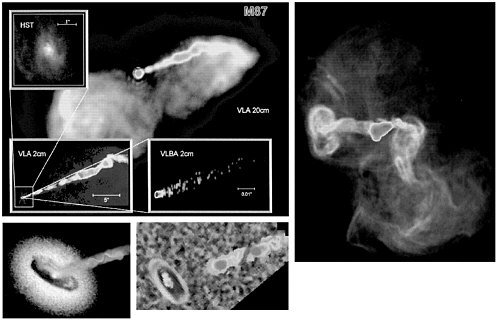
FIGURE 4.7 Current and future observations of the radio emission from the giant elliptical M87, one of the first known radio galaxies. Right panel: Recent observations with the VLA at 90 cm tracing the intricate structure of the cloud of relativistic plasma on the largest scales. The radio lobes extend over 100 kpc, nearly 10 times larger than the optical extent of the galaxy. This radio halo is embedded in an even larger x-ray-emitting gas. The bright plumes emanating from the inner lobes suggest that the halo is still “alive” and is being supplied by energy from the central black hole. Top left panel: Progressively higher-resolution observations, made with the VLA and VLBA, of the inner set of radio lobes and the relativistic jet. The inset is an HST Wide Field Planetary Camera 2 (WFPC2) image of the nucleus of M87. The scale of the VLBA image is represented by one pixel in the HST image. The radio jet appears one-sided because of the relativistic boosting of the radio brightness along the direction of motion; the bright side is the side moving toward us. The VLA image at 2 cm shows the jet with a resolution of about 0.2 arcsec. The 2-cm VLBA image has an angular resolution of better than 0.001 arcsec and shows the inner few parsecs. The jet appears to flow at a velocity of only about one-tenth the speed of light, whereas the VLA and HST observations further outward indicate motions much closer to the speed of light. This increase in velocity implies that acceleration is taking place along the jet rather than in the black hole. The VLBA image shows evidence of a corkscrew motion or periodic oscillation, characteristic of a precessing nozzle or a plasma instability. At the highest resolution of the VLBA, 100 µarcsec, or 30 Schwarzschild radii (image not shown here), the jet appears to narrow toward its base. Bottom left panel: A cartoon of a supermassive black hole, surrounding accretion disk, and jet like the one in the center of M87. The cartoon consists of an actual HST image of the inner accretion disk in a nearby galaxy [NGC4261] with a simulated jet superimposed to conceptually show greater detail. Bottom center panel: Simulation of the image of the inner accretion disk and jet that ARISE would obtain at a wavelength of 3 mm. Courtesy of NRAO (VLA and VLBA images), the Space Telescope Science Institute and NASA (HST images), and NASA’s Jet Propulsion Laboratory (simulation and cartoon).
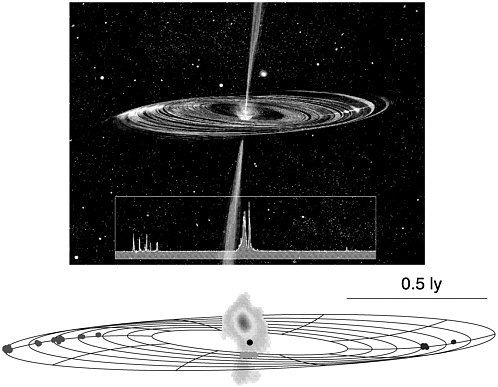
FIGURE 4.8 The H2O maser and continuum emission from the nearby Seyfert galaxy NGC 4258, also known as Messier 106. Top panel: A cartoon drawing of the accretion disk surrounding the black hole in NGC 4258 and the synchrotron jet emerging along its spin axis. The spectrum of the H2O maser at 1.3-cm wavelength is shown below. Bottom panel: The image of the H2O maser. The wire grid diagram depicts the accretion disk determined from the positions, velocities, and accelerations of the maser spots. The continuum emission near the dynamical center of the system appears to be the innermost portion of a jet. Proper motions of the systemic group of masers have been measured at about 32 µarcsec per year, providing direct evidence of the rotation of the disk as well as a method for determining the distance to the galaxy to an accuracy of 4 percent. Future kinematical studies of masers around supermassive holes will be greatly enhanced by use of the VLBA in conjunction both with the GBT and with orbiting antennas such as VSOP-2, RADIOASTRON, and ARISE. Top image prepared for M.Inoue, National Astronomical Observatory of Japan, by John Kagaya, Hoshi No Techou. Both images courtesy of J.Moran and L.Greenhill, Harvard-Smithsonian Center for Astrophysics.
Precision astrometry achieved through VLA and VLBA observations has enabled accurate determinations of Milky Way structure, including direct estimates of the distance to the Galactic center and the angular rotation rate. The latter compares well with recent estimates, based on results obtained with the Hipparcos satellite, of the shear and vorticity (Oort’s constants A and B) in the solar neighborhood. The apparent proper motion of Sgr A*, about 6.0 milliarcsec/yr relative to extragalactic sources, can be attributed entirely to the Sun’s orbital motion about the Galactic center. The lack of a measurable peculiar motion of Sgr A* itself indicates that the subastronomical-unit-scale radio source is more massive than 103 solar masses and that it anchors the dynamical center of the Galaxy. Coupled with proper motions of stars in the central cluster, the case for a black hole of a few million solar masses in the center of the Galaxy is very strong.
Observations of the position of Sgr A* relative to extragalactic sources may soon be able to achieve an accuracy of 30 marcsec, allowing a determination of the distance to Sgr A* via a trigonometric parallax with an uncertainty of about 5 percent. The angular rotation of the Sun around the Galactic center will then be determined to much higher accuracy (<1 percent), and thus the Sun’s circular velocity will be known with an accuracy limited only by knowledge of the Galactic center distance. The new antennas of the EVLA, when used in conjunction with the VLBA, will provide the increased astrometric accuracy. Ultimately, the SKA, if sited in the Southern Hemisphere, operated at high frequencies (≥20 GHz), and capable of multibeaming (simultaneous observations toward different sources), might yield a trigonometric parallax to the Galactic center accurate to 1 percent.
Gamma-ray bursts (GRBs) have been one of the long-standing mysteries vexing astronomers over the past decades. Radio observations delivered the identification of the host galaxies of GRBs and vindicated the cosmological fireball model for the origin of GRBs. One gamma-ray burst was found to expand at an apparent superluminal speed and to be the product of a very massive supernova, given the epithet “hypernova.” Highly accurate radio positions and light curves obtained with the EVLA will complete the view of these transient high-energy phenomena when combined with the automated gamma-ray alert network, x-ray localization, and optical redshifts (and, lately, early flashes).
THE FORMATION AND EVOLUTION OF STARS
Star formation is a pivotal process about which both galaxy formation and planet formation turn: the formation of galaxies is ultimately controlled by how they form stars, and planets form out of disks that are intimately connected to the star-formation process. Post-main-sequence stars provide the heavy-element enrichment of the general interstellar medium and the kinetic energy that stirs it, affecting subsequent generations of star formation as well as the likelihood of habitable planets and the building blocks of life. Yet all these phenomena are poorly understood.
Star formation occurs in dense cores within molecular clouds, where dust hides the process from observations at optical wavelengths. In the earliest stages, only radio/submillimeter and far-infrared observations can peer deep within the hearts of star-forming cores. Dust emission in the Rayleigh-Jeans limit increases rapidly with frequency, and a rich spectrum of molecular transitions arises at millimeter wavelengths. As a result, radio observations of star formation have been most intensely pursued at millimeter and submillimeter wavelengths, revealing the rich complexity of molecular clouds. Such observations have only just begun to unveil the details of the accretion disks that feed the stars and eventually form planets.
Stars of low mass like the Sun are of particular interest. They can be studied in detail in nearby clouds, where some form in relative isolation rather than in rich clusters. A paradigm for the formation of isolated low-mass stars exists, but is it correct? Observations of dust continuum emission across the radio/submillimeter band, combining fine spatial resolution with sensitivity to extended structures, can trace the flow of matter from the outer envelope through the disk to the forming star. Bolometer arrays on the Caltech Submillimeter Observatory (CSO) 10.4-m antenna, the Large Millimeter Telescope (LMT), the GBT, and the SPST will map the largest scales, while the Submillimeter Array (SMA), CARMA, and ultimately ALMA will enable study of smaller scales. Studies of spectral lines with excellent spectral resolution with the same telescopes will reveal the kinematics, physical conditions, and chemical complexity.
Massive stars, and probably most stars, form in embedded clusters within massive dense cores. We lack a clear paradigm for clustered star formation. Can our understanding of low-mass star formation be extended to massive stars? The most massive stars, being rarer, are found
principally in more distant regions, and observations with better angular resolution are needed to provide a firm comparison to the formation of low-mass stars. In addition to enabling submillimeter studies, the EVLA will be able to image, simultaneously and with sufficient angular resolution, multiple transitions of molecules like ammonia in the dense, high-temperature material close to the star. The new centimeter-wave continuum observations of nascent ionized hydrogen (HII) regions and stellar jets will have the high spatial resolution necessary to directly image the essential structures in these objects, providing crucial clues to the evolutionary state of different objects.
Studies of star formation in clustered environments will also address questions about the origin of the stellar initial mass function (IMF). The mass function of molecular clouds or of clumps within clouds is not the same as the IMF. New results suggest that interactions in dense clumpy cores may cause the mass function of clumps to evolve toward the IMF. Imaging a variety of regions with large detector arrays on single dishes and with arrays of telescopes like the SMA, CARMA, and ALMA, combined with new theoretical insights, will ultimately yield an understanding of the IMF and how it depends on initial conditions. Such an understanding will be crucial to unraveling the formation of stars at high redshift and the origin of the first generation of stars in the universe.
One of the most striking facts about stars is that about half of them exist in multiple systems, mostly binaries. Why is it so close to a 50:50 split, rather than almost all single or almost all binary systems? Some crucial parameter must be poised close to a critical point so that half the time a single star forms. Rotation is the obvious candidate, but rotation is not dynamically important on the scales of individual star-forming cores. Spectroscopic observations of Doppler shifts with CARMA, ALMA, and the EVLA can trace rotational motions to smaller scales, where rotation does become important, identifying the stages at which multiplicity should develop. ALMA, observing dust continuum emission with exquisite sensitivity to mass, will identify binaries at the earliest stages and determine the effects of binaries on disks, resolving long-standing issues about the method of binary formation and the possibilities for planets in binary systems.
The wild card in star-formation studies is the magnetic field. Astronomers know little about the strength, orientation, and organization of magnetic fields in regions forming low-mass stars. What they know about regions forming more massive stars suggests that magnetic fields play an important role. Zeeman measurements of molecular lines probe mag
netic field strengths along the line of sight, while polarization of dust continuum and line emission will provide the field direction projected on the plane of the sky. Recent progress in detecting the Zeeman effect in lines tracing denser gas indicates that the future, more sensitive arrays on higher-spatial-resolution instruments will allow study of the magnetic field strength in more condensed regions closer to the forming stars. The polarization of continuum and line emission has also been detected with current arrays in a few cases, although the interesting structures in these objects are somewhat blurred by the limited spatial resolution of the arrays; CARMA and ALMA will allow systematic study of the role of magnetic fields in star formation.
From the red-giant phase to their final state, stars eject dust grains and molecules back to the interstellar medium (ISM). Future studies of evolved stars will focus on imaging the expulsion of matter at various stages. Figure 4.9 shows sequences of images obtained for two dramatic examples: the extragalactic supernova SN1993J (left) and the x-ray nova CI Cam (right). In both cases, radio images trace the expansion of the material into the surrounding medium. Measurement of the expansion of the supernova, in combination with the observed Doppler broadening of the optical Hα line, also provides a simple geometric determination of the distance to the host galaxy, M81. While such ejection of material from old stars is commonplace, many puzzles about the processes of ejection and their consequences remain. How, in detail, is dust made in the outflows from late-type stars? How do the anisotropic winds observed in certain late-type stars form prior to, and during the transition to, the planetary-nebula stage, and why is the large-scale morphology of these objects often bipolar? Studies of obscured supernovae are the domain of long-wavelength radio astronomy. The EVLA, LOFAR, and the SKA will be important tools for the study of supernovae and, along with the Arecibo Observatory and the GBT, the pulsars they leave behind. Studies of pulsar Doppler shifts promise further exciting discoveries, including more pulsar planets and, with any luck, binary systems containing a pulsar and a black hole. The tremendous increase in sensitivity offered by the SKA will make possible the submicroarcsecond timing of several hundred millisecond pulsars, the ultimate pulsar timing array, not only to serve as a time standard for referencing the solar system barycenter but also to be capable of sensing the passage of long-period gravitational waves and to probe the gravitational-wave background.
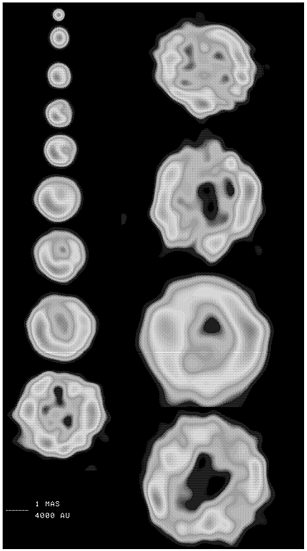
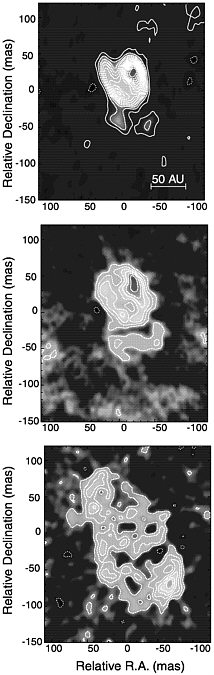
FIGURE 4.9 Time-lapse imaging of exploding stars. Left: A sequence of VLBA images of the expansion of the supernova SN 1993J observed in the nearby galaxy M81. The images were taken from May 16, 1993 (top left), 6 weeks after the explosion, to November 14, 1997 (bottom right). Courtesy of M.Rupen (NRAO). Right: A sequence of VLBA images of the evolving x-ray nova Cl Cam taken 75 (top), 93 (middle), and 163 (bottom) days after the x-ray outburst. Some of the fade-out of structural detail in the last image is an artifact of the current imaging capability, as the source becomes larger than ideal for the VLBA but is still too small to be resolved by the existing VLA. The EVLA will allow tracking of such expansion without degradation of the image quality. Courtesy of A.Mioduszewski, NRAO/Joint Institute for VLBI in Europe.
THE FORMATION AND EVOLUTION OF PLANETS
It is now well established that most young solar-mass stars are surrounded by circumstellar accretion disks with masses of ~10−3 to 10−1 M⊙ and sizes of ~100 to 400 AU. In addition to serving as a conduit for mass accretion onto the young star, the disks also serve as a reservoir of gas and dust for the formation of planetary systems. Figure 4.10 illustrates the promise that ALMA offers for imaging protoplanetary systems, including the ability to detect giant planets in formation. The canonical theory for the formation of our own solar system holds that the Jovian planets formed in the solar nebula at or near their present location, while the terrestrial planets were assembled largely in gas-poor conditions long after the formation of the outer gas giants. In this model, the delivery of volatiles from primitive planetesimals such as chondrites and comets may have played an important role in the surface chemistry of Earth, Venus, and Mars. The highly reduced organic contents of these chondrites and comets are difficult to generate in young planetary atmospheres and may thereby have contributed substantially to the prebiotic evolution of terrestrial planets.
The recent discovery of massive extrasolar planets in orbits well inside 1 AU—the so-called “hot Jupiters” —casts considerable doubt on our present understanding of the formation and evolution of (habitable) planetary systems. All the theoretical mechanisms for inducing the migration of large planets during star formation require the presence of a massive gas and dust disk that can exchange angular momentum with the Jovian protoplanet. The gas densities required of such massive disks imply large optical depths in the optical and infrared. Gaps cleared by
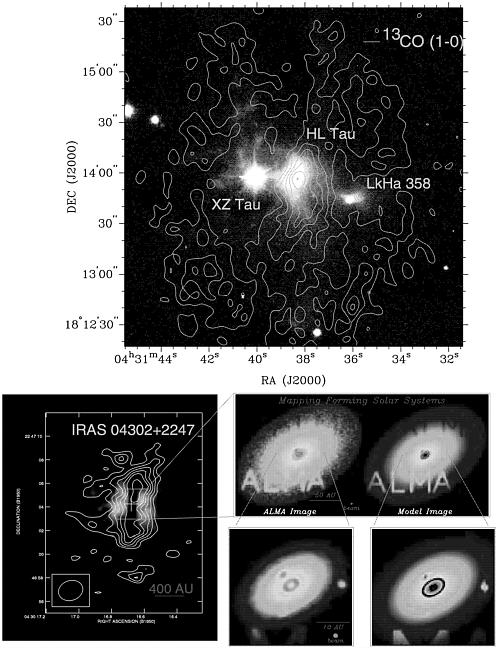
FIGURE 4.10 Montage of future observations of protoplanetary disks around young stellar objects (YSOs) embedded within complex molecular clouds. The large-scale molecular distribution will be studied with the LMT, the GBT, and the Arecibo telescope, while higher-resolution studies of localized regions with ALMA and CARMA will focus on individual star-forming cores. Top: 13CO (1–0) map of the Taurus region made with the BIMA millimeter array. Bottom left: HST-NICMOS image of the accretion disk around the YSO IRAS 04302+2247, which lies to the north and west of the BIMA field. The contours present 13CO (1–0) emission mapped with the OVRO millimeter array. Bottom right: Simulations of potential ALMA images of disks around embedded young stars showing the formation of giant planets. The model disk has a central hole 3 AU in radius and protoplanet-driven overdensities at 9 AU, 22 AU, and 37 AU. The word ALMA in the model images has a line stroke 4 AU wide and 35 AU high and is used as a gauge of the image fidelity. Simulations courtesy of L.Mundy, University of Maryland, and G.Blake, Caltech.
the planet as it migrates will certainly be observable at short wavelengths, but to probe the earliest stages of the process and to access the nebular mid-plane, where the bulk of the planetesimal growth occurs, observations at radio and submillimeter wavelengths are essential. Initial forays early in this decade will utilize the SMA, CARMA, and the EVLA; toward the end of the decade ALMA will examine planetary migration mechanisms directly in the nearest star-forming clouds. Observations by these arrays, and in the 2010s by the SKA, will extend our understanding of planet formation and migration to the most deeply embedded, protostellar stages. Large bolometer arrays on the CSO, the LMT, the GBT, and the SPST will examine the coldest components of debris disks, complementing studies in the infrared. Follow-up studies with CARMA and ALMA will reveal the structure of these debris disks.
ALMA and the SKA will be able to detect the photospheres of stars out to distances of at least 30 pc. Provided that the centroids of the photospheres are sufficiently stable, astrometric searches for planets will be feasible. The superb long-term precision and accuracy of radio astrometry will allow the study of long orbital periods and will complement the measurements from spaceborne instruments, which are necessarily of limited duration. Subarcsecond imaging with ALMA and the EVLA, in tracers of both the gas and dust, will be crucial for answering questions such as the following: Do habitable planets form around stars more massive than the Sun? What kinds of binary and multiple stars have planetary systems capable of supporting life? Does the migration process in such systems differ dramatically from that which operates in the disks around single low-mass stars?
Radio and submillimeter instruments will also make possible the first detailed studies of the chemical composition of circumstellar accretion disk analogues of the solar nebula. In particular, by combining images from the SMA, CARMA, and ALMA with spectra of various gas-phase species and solid-state features from the CSO, GBT, LMT, the Stratospheric Observatory for Infrared Astronomy (SOFIA), and the Space Infrared Telescope Facility (SIRTF), astronomers will be able to probe, for the first time, the radial chemical variations so clearly observable in the composition of small bodies in the solar system. The detailed comparison of these results with what is known about our own solar system will be critical in unraveling the complex suite of chemical and physical processes that lead to the formation of potentially habitable worlds.
An important component of this investigation will be the new studies of our solar system made possible by advances in radio and submillimeter
instruments. In the outer solar system, the combination of optical/IR surveys and millimeter-wave flux measurements can directly constrain the size-albedo relationship for Kuiper Belt objects (KBOs). High-resolution images from the SMA, CARMA, and ALMA can be combined with images from heterodyne focal-plane arrays at the CSO, GBT, LMT, and SPST to examine the comae of comets, including, for the first time, those with short periods. Direct imaging of the nuclei of comets and investigations of large particles in their comae will be possible with the Arecibo radar system. Observations of the continuum emission from comets and KBOs will become possible for objects 10 times smaller than those currently observable. The inventory of such objects reflects the properties of the solar nebula at the time of their formation. In addition, dust grains from small bodies may have provided a substantial fraction of the organic compounds on the early Earth, and so it is important to understand their composition in detail. Such studies will include precision measurements of isotopic ratios such as the deuterium-to-hydrogen ratio in various tracers, studies that can now be done for only the brightest objects.
Studies of the planets themselves and of smaller, inner solar system bodies such as asteroids will also be revolutionized during this decade. The great boost in sensitivity given by the recently completed upgrade will be exploited for ever-more-detailed Arecibo radar studies of the surfaces of the terrestrial planets as well as the satellites of Jupiter and Saturn. The Arecibo radar system now allows imaging with 20-m scales of a large number of near-Earth asteroids, giving clues to their surface and dynamical properties and their collision histories. The subarcsecond imaging capability envisioned for CARMA, ALMA, and the EVLA will enable observations of solar system objects at radio and submillimeter wavelengths with resolution similar to that of HST and NGST. In continuum mode, such observations can be used to examine the properties of the surface and subsurface layers of terrestrial bodies, while spectroscopic tracers at radio wavelengths directly probe the atmospheric circulation and composition. The former observations can detect, among other things, the presence of ice versus that of rock, while the latter probe both the vertical and the horizontal profiles of the atmosphere. Such observations, which are nearly impossible in any other spectral region, provide essential comprehensive adjuncts to spacecraft missions, in addition to being of great interest in their own right.
THE ORIGIN AND EVOLUTION OF LIFE
In addition to the evolution of the Universe at the macroscopic level, complexity also evolves at the microscopic level, eventually leading to life, possibly sentient. From a sea of quarks, baryons emerge and organize themselves into progressively more complex nuclei, first in the era of Big Bang nucleosynthesis and later in stars. With more-complex nuclei, molecules and dust can appear when conditions are suitable. What is the history of nucleosynthesis and chemical complexity in the universe? Preliminary evidence suggests that molecules and dust are common out to a redshift of at least 4, but the detailed history remains to be unraveled by observations of atoms (primarily carbon, nitrogen, and oxygen), molecules (carbon monoxide and others), and dust at high redshift. These will be accessible to ALMA, CARMA, and the EVLA. In nearby molecular clouds, these same instruments will trace the evolution of chemical complexity in the dense cores that will form stars. It is already clear that molecules accrete onto dust grains in cold regions, are sublimated when those grains are heated by forming stars, and trigger further increases in complexity when ejected back into the gas phase. The study of these processes in collapsing molecular cores will connect to studies of the chemical evolution in disks and in our solar system to provide a more complete picture of how the building blocks of life are delivered to planetary surfaces.
Recent developments have led to the emergence of astrobiology as a new, interdisciplinary field. The past decade has witnessed the addition of more complex organic molecules to the list of interstellar ingredients, the detection of extrasolar planetary systems, and the identification of more potential sites for liquid water in our solar system. On Earth, life has been found in extreme and unexpected environments, organisms of unexpectedly small size have been claimed, and, most controversially, such organisms have been suggested to exist in Martian meteorites. Within the next few decades, we may acquire a crude chemical assay of the atmospheres of nearby extrasolar terrestrial planets. Indirect evidence for the existence of extraterrestrial life may follow.
Are we alone? This question, more than any other, fascinates the general public. The detection of atmospheric signatures of life around other stars may become possible in the next few decades. The most exciting development would be unambiguous evidence that life elsewhere has evolved intelligence and a technological civilization. Evidence for another technological civilization would have a profound
impact on humanity. Observations currently under way at a number of radio telescopes may succeed in detecting radio signals from other civilizations, but past searches have barely stirred the surface of the cosmic haystack. It is important to support observational programs that attempt to detect signals at increasingly large distances. Modest resources are needed to develop new signal-processing techniques and new hardware and to establish innovative search programs. Such programs should be part of a broad strategy to search for life elsewhere in the universe.
The 1HT will be the first telescope built to search for extraterrestrial signals and will pioneer new radio techniques. Later, the SKA will add a powerful capability: it will be capable of detecting signals—comparable to our own planet’s television emission—from planets around nearby stars.
EXISTING PROGRAMS
Because radio astronomy is almost exclusively a ground-based activity, primary funding comes from the National Science Foundation.
NATIONAL CENTERS
Through cooperative agreements, the NSF supports two national centers for radio astronomy: the National Radio Astronomy Observatory (NRAO), operated by Associated Universities, Inc., and the National Astronomy and Ionosphere Center (NAIC), operated by Cornell University. At centimeter wavelengths, NRAO and NAIC facilities are the best in the world, and unlike the situation in optical astronomy, there are no competing private facilities; university astronomers working at centimeter wavelengths rely almost entirely on NRAO and NAIC for their research.
NRAO operates the 27-element Very Large Array (VLA) in New Mexico; the 10-element VLBA, spread throughout the United States; and the newly completed 100-m GBT in West Virginia. The NRAO also operates a ground station for space VLBI and a VLBI antenna for the U.S. Naval Observatory at Green Bank. A cutting-edge technology development program is conducted at the NRAO central headquarters in Charlottesville, Virginia. The NRAO spearheads U.S. involvement in ALMA and has aggressively and successfully pursued its design and development.
Activities at the NAIC revolve around the 305-m spherical antenna in northwestern Puerto Rico but span the fields of atmospheric and ionospheric modification and planetary remote sensing as well as passive radio astronomy. The recent installation of the Gregorian optical system has provided unprecedented sensitivity and new frequency coverage and flexibility.
The panel endorses the statements about NRAO and NAIC made in the Executive Summary of the survey committee report. The radio astronomy community is justifiably proud of both its national centers, NRAO and NAIC, for their expertise, leadership, and dedication to providing the most advanced instrumentation to the nation’s scientists. In addition to supporting their respective scientific programs, both NRAO and NAIC maintain effective education and outreach programs.
UNIVERSITY RADIO FACILITIES
Until ALMA begins operation, the university radio facilities will provide the only U.S. high-resolution capabilities at millimeter and submillimeter wavelengths. Furthermore, even when ALMA is fully operational, they will continue to play a crucial role. These facilities include the following:
-
Caltech Submillimeter Observatory. In operation since 1988, the CSO, operated by Caltech as an open-access facility, consists of a 10.4-m-diameter antenna in a dome near the summit of Mauna Kea. It provides the only regular access to the crucial submillimeter region for U.S. astronomers, and the hands-on operation and state-of-the art instrument development provide vital experience for young astronomers. A full suite of heterodyne receivers covers the atmospheric windows from 350 to 1300 µm, and large-format detector arrays are being developed.
-
Five College Radio Astronomy Observatory. FCRAO currently operates a 14-m antenna at New Salem, Massachusetts, working at millimeter wavelengths. It offers a heterodyne array and an advanced spectrometer for large-scale mapping. Like the CSO, it is a hands-on facility used by many students, and it supports instrumentation development by young astronomers. In the decade 2001 to 2010, operations will be shifted to the LMT, a joint U.S.-Mexican 50-m active optics antenna at a high (4600-m) site in Mexico. The telescope will greatly enhance flexibility and sensitivity in the 0.85- to 3–4-mm window.
-
Berkeley-Illinois-Maryland Association array. The BIMA array
-
consists often 6-m dishes operating at 1 and 3 mm and located at the Hat Creek Radio Observatory in northern California. The antennas can be configured in various patterns to give baselines from 7 m to 2 km.
-
Owens Valley Radio Observatory millimeter array. The present OVRO array consists of six 10.4-m dishes in a reconfigurable pattern that provides baselines out to 440 m at an altitude of 1200 m. SIS heterodyne receivers cover the 1- and 3-mm spectral regions, with analog and digital correlators serving as the continuum and spectral line back ends. A flexible, high-bandwidth digital correlator based on field-programmable gate array technology will soon be completed.
-
Combined Array for Millimeter Astronomy. The BIMA and OVRO arrays will be merged, moved to a higher site, and enhanced to produce the CARMA facility, one of the moderate initiatives recommended by the panel in the next section.
-
Submillimeter Array. Now under construction near the summit of Mauna Kea, the SMA will consist of eight 6-m elements in a reconfigurable array that will provide baselines from 8 to 508 m and will cover all bands from 1.6 mm to 300 µm. A collaborative project of the Smithsonian Astrophysical Observatory and the Academia Sinica Institute of Astronomy and Astrophysics of Taiwan, the SMA is an exploratory instrument designed to provide high-resolution imaging capability in the wavelength regime intermediate to the wavelengths covered by the existing millimeter arrays and the far-infrared band accessible from air- or spaceborne instruments. Although the SMA is not strictly a university facility, U.S. astronomers will have access to it.
-
Coordinated Millimeter VLBI Array. The CMVA facilitates 1- to 3-mm VLBI observations of galactic and extragalactic sources using a worldwide array of millimeter-wave radio telescopes. It offers submilliarcsecond resolution and provides correlated VLBI data to its users.
Support for university radio facilities provides the astronomy community access to unique observational capabilities and maintains a strong university involvement in scientific and technological development. The NSF-supported university radio facilities all provide substantial community access, typically 30 to 50 percent, through their guest observer programs. Student involvement in cutting-edge research is crucial for the education of the nation’s next generation of scientists. Growing numbers of graduate students incorporate multiwavelength data into their research. It is therefore crucial to increase their knowledge of the
capabilities of instruments in different wavelength regimes. Enhanced support for research at the university radio facilities is a vital part of the nation’s investment in research.
RECOMMENDED NEW INITIATIVES
The panel recommends the following new major- and moderate-category projects3 for the decade, in order of priority:
|
Major Project |
Estimated Cost (millions of dollars) |
|
EVLA |
140 (NSF) less ~50 (cost sharing) |
|
Moderate Projects |
|
|
SKA program |
22 (NSF) |
|
CARMA |
11 (NSF plus external) |
|
ARISE |
300 to 400 (NASA) |
|
SPST |
50 (NSF) |
As illustrated in Figure 4.11, the proposed facilities will contribute wide-ranging new capabilities, among them increased angular resolution and wavelength coverage, thus opening up large areas of discovery space. The objective is to construct unique new facilities and design future ones that provide maximal observing capability, often exploiting facilities partly or largely funded through nonfederal sources. For example, the millimeter/submillimeter portfolio will include the ALMA, CARMA, CSO, SMA, LMT, and SPST, each contributing uniquely to the overall effort. International collaboration is already incorporated into ALMA, the EVLA, LOFAR, the LMT, the SMA, and the SKA. The NSF Office of Polar Programs may fund the SPST. The U.S. Department of Defense and the Netherlands Foundation for Research in Astronomy (NFRA) will provide the major funding for LOFAR. All proposed instruments assume provision of significant, if not total, community access, even when capital funding comes from other sources.
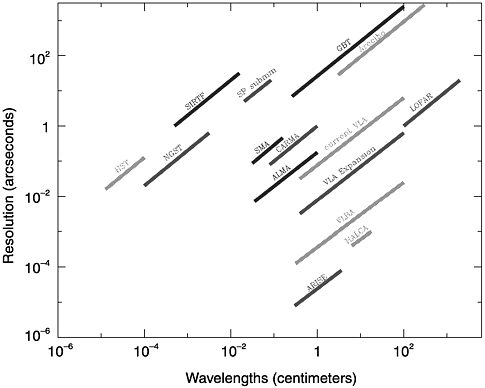
FIGURE 4.11 Angular resolution as a function of wavelength for some individual radio, infrared, and optical telescopes. Colors indicate existing facilities (green), facilities under construction (blue), and proposed projects (red). The radio and submillimeter programs recommended in this chapter will add wide-ranging new capabilities, among them increased angular resolution and wavelength coverage, thus opening up large areas of discovery space. Note that the SKA is not shown; it will cover the 1.3-cm to 1-m band with a resolution comparable to that of the expanded VLA, but its primary objective is to increase sensitivity by orders of magnitude. If the SKA is located in the Southern Hemisphere, it will provide uniquely high resolution for southern centimeter-wave targets.
EXPANSION OF THE VLA
By most measures, the VLA is by far the most powerful and productive centimeter-wave telescope in the world. As a general-purpose facility, the current VLA serves 600 scientific programs per year. However, much of the instrumentation uses 25- to 30-year-old technology because refurbishment has been inadequate. The modernization represented by the EVLA will provide dramatic new capabilities for the world’s most powerful radio telescope.
The overdue leap forward in technology associated with the EVLA
will provide an order-of-magnitude improvement in sensitivity and angular resolution combined with a greater than 1000-fold improvement in spectroscopic capability. The resolution of this new VLA will be comparable to that of ALMA and NGST, facilitating complementary multiwavelength studies. Of particular interest will be the study of protogalaxies as well as protostars and protostellar disks that are often optically thick or obscured by dust at shorter wavelengths. With the greatly increased sensitivity and resolution of the VLA at centimeter wavelengths, it will be possible to study star formation at the earliest epochs, to distinguish starburst from AGN phenomena even for z>5, and within our Galaxy, to see into the regions corresponding to planetary formation on scales of 10 AU and less.
The EVLA project will proceed in two phases: Phase I includes the construction of an advanced correlator/spectrometer, installation of the wideband fiber-optic data links required for improved sensitivity, the replacement of the 15-year-old unsupported monitor-control computer, enhancement of the archive system, installation of sensitive new receiver-feed systems to replace the aging receivers and to cover new frequency bands, the development of new software tools, the enhancement of antenna performance, and the development of a means of extending continuous frequency coverage below 1 GHz. In Phase II, as many as eight new antennas will be sited within 250 km of the VLA and connected to the new VLA correlator by fiber-optic links. The new antennas will be used together with both the VLA (to increase the angular resolution by an order of magnitude, with high sensitivity and image quality) and the VLBA (to increase its field of view and sensitivity to low-surface-brightness structures). These antennas are important because they will improve image fidelity and angular resolution, as can be seen in the simulation of observations of a supernova remnant in the Andromeda galaxy displayed in Figure 4.12.
Image quality is of critical importance in tracing the time evolution of cosmic sources, as evidenced in Figure 4.9. Transient radio sources associated with x-ray and gamma-ray bursts, relativistic jets from microquasars, and early phases of nova outbursts will be followed in much greater detail than previously possible. To image the regions of planet formation may require wavelengths as long as 1 cm and, for nearby systems, angular resolution spanning spatial scales provided by the new antennas. A fiber-optic system is now in place connecting the VLA to the innermost VLBA antenna. This single connection provides a twofold improvement in resolution over the stand-alone VLA and
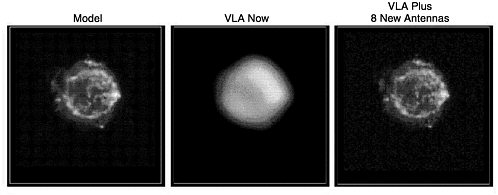
FIGURE 4.12 Simulations of observations of a supernova remnant like the famous Cassiopeia A remnant if it were located in the Andromeda galaxy, M31. Left panel: The model source, based on the actual VLA image of Cas A. Center panel: The image that would be obtained with the current VLA. Right panel: The image that would be obtained with the expanded VLA, illustrating the great improvement in image fidelity that would be provided by eight additional antennas spread throughout New Mexico. Courtesy of NRAO.
demonstrates the feasibility of extending the real-time operation to the Los Alamos VLBA antenna, the proposed eight new antennas, and eventually to the entire VLBA.
Although the EVLA will provide dramatic new observational capabilities, it does not involve the creation and operation of new facilities and hence will require only a small increment in the current operating costs. While the SKA will ultimately provide even more sensitivity than the EVLA at the longer wavelengths, nothing proposed replaces the VLA at the shorter wavelengths. Furthermore, the SKA may be placed in the Southern Hemisphere, leaving the VLA preeminent for northern skies. The need for Phase I is urgent and should be undertaken immediately. Phase II should generate worldwide interest, leading to considerable cost-sharing.
SQUARE KILOMETER ARRAY
The SKA is a proposed centimeter-wave radio telescope with 106 m2 of collecting area. The SKA is the next-generation radio telescope, an instrument motivated by the desire to observe, as illustrated in Figure 4.3,
the formation of the first structures and the first luminous objects during the dark age of the universe. Considerations of antenna element cost and improvements in computation technology steer the design of the SKA toward an array composed of a large number of elements, offering dramatic new imaging capabilities. The SKA is being pursued as an international collaboration with an expected total cost of $600 million, the U.S. share of which would be about one-third. The United States must play a major role in the conceptual design and development of the SKA. The panel recommends that our country establish an SKA development program during this decade that will, in collaboration with the international radio astronomy community, develop the technology and techniques for SKA construction in the next decade.
An increase of two orders of magnitude in sensitivity, with vastly improved imaging capabilities, will revolutionize fields newly accessible to study by centimeter-wave astronomy. It will be possible to image the HI jets in forming stars and the inner 1 AU of optically thick disks forming around stars. Molecular Zeeman studies will trace how magnetic fields control cloud collapse. The effects of weak gravitational lensing will map the dark matter on the largest scales. Thousands of new pulsars will be discovered, including, possibly, the first black-hole-pulsar binary or pulsar-pulsar binary. Extensive observations of complex organic molecules at various stages of preprotostellar evolution will be possible. With the improvements in sensitivity and imaging, the ability to form images with many beams at once, and the tremendous dynamic range in intensity and scale will come unanticipated discoveries. A dramatic example would be the detection of radio signals from nearby civilizations as astronomers eavesdrop on the local neighborhood.
The SKA has been an international project from the outset. An international steering committee, with representatives from the participating nations, has been formed. The U.S. activities are coordinated by the U.S.-SKA Consortium, which is university-led; NRAO and NAIC are both involved by virtue of their membership on the consortium board. The prominent participation of the academic community provides an excellent opportunity for innovative development in the competitive university environment and will train the next generation of instrument builders and radio telescope users. It is anticipated that some aspects of the development will be carried out in collaboration with industrial partners, providing important cross-fertilization between the industrial and academic communities. The goals of the SKA are ambitious, and not all are achievable with current technology. However, it is reasonable to
expect that a coherent development program over the next 5 to 10 years will lead to technology advances and techniques that will allow the current science objectives to be met over a longer time frame.
COMBINED ARRAY FOR MILLIMETER ASTRONOMY
CARMA is the planned combination of the BIMA and OVRO millimeter arrays at a new high site (2700 m) in the Inyo Mountains of southeastern California. In addition to the current ten 6-m BIMA antennas and six 10.4-m OVRO dishes, an array often 2.5-m antennas, critical for SZ mapping, will be added. The resultant array will have much-improved sensitivity and will be able to work at shorter wavelengths than the current separate arrays. Furthermore, because of its mixture of antenna sizes, CARMA will offer unique imaging capabilities for the study of structures on all scales, with particular sensitivity to low-surface-brightness, extended emission. Operation down to λ=860 µm should be possible.
The hybrid CARMA array will uniquely address wide-field millimetric imaging, in particular that of the SZ effect and star formation at all epochs. Complementary to ALMA with respect to both its hybrid characteristics and northern location, CARMA has an educational mission and a role in technique development, both of which are likewise critical. The project is highly leveraged and cost-effective, and the panel recommends that it begin as soon as possible.
ADVANCED RADIO INTERFEROMETRY BETWEEN SPACE AND EARTH
ARISE, a proposed NASA mission, will place a sensitive ~25-m radio antenna into space that can operate at wavelengths as short as 3 mm in an elliptical orbit reaching as high as 50,000 km and giving baselines as long as ~5 Earth diameters. Together with Earth-based radio telescopes, ARISE will allow radio imaging with a sixfold improvement in angular resolution compared with the VLBA. In combination with the large ground-based telescopes such as the VLBA, GBT, and LMT, the 25-m space antenna, equipped with state-of-the-art receivers, will be more than an order of magnitude more sensitive than the 8-m Japanese HALCA antenna.
The main goal of ARISE is to study jet regions in AGN as close to the supermassive black hole as possible, as illustrated in Figure 4.7, and to
map the spatial-velocity structure of masers, as seen in Figure 4.8, to determine the mass of the black hole and the physical conditions in the accretion disk. The highest angular resolution of ARISE corresponds to 150 AU for a nearby active galactic nucleus like M87 or about 3 Rs for the 3×10⁹ M⊙ black hole estimated to power that source. Even for a quasar of typical redshift (z~0.5 to 1), the resolution of ARISE is very fine—a few light-months.
The panel recommends that NASA continue to support the development and operation of large apertures in Earth orbit for VLBI in order to achieve angular resolution of ~10 µarcsec. An instrument such as that on the ARISE mission will allow mapping of the emission from the inner accretion disks and the masers in the outer accretion disks in AGN as well as the x-ray- and gamma-ray-emitting regions from the jets of blazars. The panel recommends that the ARISE mission be funded so that it can (1) be launched before the end of the decade, (2) operate at wavelengths down to and including 3 mm, and (3) use either an inflatable or a solid structure with sufficiently wide bandwidth and sufficiently sensitive detectors so that its sensitivity remains close to the proposed level.
The panel further recommends that NASA continue to support foreign missions such as VSOP-2 and the Russian mission RADIOASTRON by making available to them ground tracking stations and other logistical support.
SOUTH POLE SUBMILLIMETER TELESCOPE
The panel recommends the construction of a large, single-aperture telescope operating at submillimeter wavelengths that would take advantage of the superb atmospheric transmission conditions at the South Pole. The South Pole is the best known site in the world for its combination of low opacity and stable seeing conditions at submillimeter wavelengths. The SPST should be equipped with wide-field array detectors to survey the dusty universe, study arcminute anisotropy of the CMB, determine the spectral dependence of the SZ effect, and identify sources such as primordial galaxies. The South Pole station is undergoing modernization, and new infrastructure is being built that will enable the deployment of the large telescope. To optimize the scientific output of the SPST and to provide community access to the South Pole astronomical facilities, a scientifically driven umbrella organization is needed to continue the efforts of the Center for Astrophysical Research in Antarctica, an NSF Science and Technology Center with a grant that ends in
February 2002. A high-speed data link to the South Pole is also a requirement.
OTHER HIGH-PRIORITY PROJECTS
Projects of smaller cost and scope will also be critical to the continued study of the universe. Among the several promising areas identified by the panel for smaller-scale investment are the following, which are neither exhaustive nor ranked: construction of LOFAR, a ground-based array for long-wavelength (2- to 20-m) astronomy; studies of CMB polarization and the SZ effect; development of far-infrared/submillimeter-wave interferometry in space; laboratory astrophysics; and solar radio astronomy.
LOW-FREQUENCY ARRAY
The LOFAR will provide the first real capability to image the low-frequency sky; important applications across all areas of astrophysics will mean an exciting potential for new discoveries in this relatively unexplored part of the electromagnetic spectrum. As currently conceived, LOFAR will be an electronically controlled, broadband, ground-based array operating in the wavelength range from 20 to 2 m and, with reduced sensitivity, at 1 m. Digital signal processing will be used to suppress interference adaptively. LOFAR will have multiple simultaneous beams that can be steered instantaneously over the sky. LOFAR might use the VLA site as its primary location, but additional remote sites would give an overall dimension of a few hundred kilometers. LOFAR will achieve a two- to three-orders-of-magnitude improvement in both sensitivity and resolution over existing instruments and may provide the opportunity to detect HI structures at the epoch of reionization (z>6) at these long wavelengths.
LOFAR is a joint project between the Netherlands Foundation for Research in Astronomy (NFRA) and the U.S. Naval Research Laboratory (NRL), with the cooperation of the NRAO. Initial development has begun. NFRA and NRL plan to contribute equally toward a combined investment of $20 million. The panel recommends that NSF contribute the additional $8 million required if the facility is to offer access to a broader segment of the science community. LOFAR will employ many of the design concepts intended for the SKA, including electronic beam switching, ionospheric compensation, real-time interference excision,
and remote operation. At the longest wavelengths, LOFAR will have about a million square meters of collecting area—equivalent to that of the SKA.
COSMIC MICROWAVE BACKGROUND EXPERIMENTS
Because of the large number of imminent observations and the likelihood of surprises, the panel elects not to specify in detail future CMB missions and projects. Clearly, however, further study of the CMB radiation will produce unique and fundamental clues to the processes and evolution of the earliest epochs. In particular, the panel recommends the following:
-
Continued support of the ambitious suite of ground-based and balloon-borne experiments, satellite missions, and extensive theoretical studies of the CMB radiation that will allow direct determination of the fundamental parameters that govern the cosmology describing the origin and evolution of our universe. The program will culminate with the completion of the MAP and Planck space missions during this decade.
-
The construction of dedicated instruments to carry out large-scale imaging surveys and high-sensitivity spectral observations of the SZ effect in order to obtain a redshift-independent inventory of the cosmic web of large-scale structure, to determine the expansion history of the universe, and to measure the velocities of massive galaxy clusters and superclusters relative to the Hubble flow.
-
The establishment of small exploratory programs to investigate and develop the techniques and technology for extracting the detailed polarization structure of the CMB that will directly test the ingredients of the inflationary model for cosmology. The results of these efforts will guide planning for the Planck mission and also set the stage for post-Planck mission planning in the CMB field.
FAR-INFRARED/SUBMILLIMETER INTERFEROMETER IN SPACE
The far-infrared/submillimeter spectral region contains about half the luminosity of the universe and carries vital diagnostics for galaxy, star, and planet formation. An integral part of the radio/submillimeter vision is thus the development of a capability for FIR/submillimeter interferometry in space. As can be seen plainly in Figure 4.11, a FIR space interferometer will fill a crucial gap between NGST and ALMA in the wavelength-
resolution plane. The science addressed by such an instrument requires superb sensitivity in continuum and high-spectral-resolution modes (λ/Δλ≥105). During this decade, technology development and precursor missions are needed.
LABORATORY ASTROPHYSICS
Laboratory studies underpin the interpretation of astronomical observations at all wavelengths. This is particularly true as new spectral windows such as the submillimeter and far infrared are exploited. Support for laboratory astrophysics is becoming increasingly difficult to obtain and must be enhanced to meet the scientific objectives of the existing and planned radio and submillimeter facilities. Relevant laboratory measurements are an integral component of the analysis of astronomical data, and funds for such research should be included in both NASA- and NSF-supported astronomy programs.
SOLAR RADIO ASTRONOMY
Observations of the Sun at radio wavelengths contribute significantly to the study of transient energetic phenomena, the nature and evolution of coronal magnetic fields, and the solar atmosphere. A suitable dedicated instrument such as the proposed Frequency Agile Solar Radio telescope (FASR) discussed by the Panel on Solar Astronomy appears to be feasible and would be ideal for the continued investigation of these areas. While it is possible that some of the objectives of FASR, particularly studies of transient phenomena, might be met by modifying current or planned instruments such as the 1HT, the EVLA, and LOFAR, the panel recognizes the importance of constructing a facility dedicated to the study of the Sun.
TECHNOLOGY FOR THE FUTURE
The coming decades promise truly remarkable developments in radio and submillimeter astronomy. Projects under way or just beginning (ALMA, SMA, SOFIA, and FIRST/Planck) will improve the sensitivity resolution product of submillimeter observations by one to two orders of magnitude. Projects on the 2010 horizon (SKA, a FIR/submillimeter interferometer in space, and space-based CMB polarization observations)
will push the sensitivity×resolution product orders of magnitude further. To achieve these ambitious goals, technology development must be pursued aggressively throughout the chain, from telescope to detector to processing electronics and data reduction/image processing. As the pace of technological innovation quickens, it is essential to pursue a technology development strategy that maintains the health of a range of different institutions and approaches, rewards innovation, and maintains a base of talented researchers well connected to the science of the field. To this end, the panel recommends emphasizing a number of areas, which have been classified as ground-based or space-based.
GROUND-BASED NEEDS AND OPPORTUNITIES
The large arrays that are under development rely on very wide receiver bandwidths to improve their sensitivity and on a large number of elements to generate high-fidelity images. The resulting downstream processing must deal with bandwidths greater than 1 Tbps, which places severe demands on correlator technology. While the rapid pace of semiconductor innovation will help, it is likely that novel approaches to megacorrelator design will be needed. The wide bandwidths also lead to dramatically increased sensitivity to radio-frequency interference (RFI). With the advent of high-redshift astronomy, astronomical research must extend beyond the small, protected frequency windows established for radio astronomy into spectral ranges (necessarily) allocated for commercial and other purposes. Radio astronomers, accordingly, must develop ways to characterize and excise man-made signals in order to recognize and study cosmic ones. It will thus be imperative to characterize and excise interference where and when it occurs. Eventually, it should be possible to construct the entire receiver/intermediate-frequency (IF) chain after the mixer in digital circuitry at radio frequencies, opening up a wealth of new possibilities. At their largest extents, ground-based arrays suffer from atmospheric or ionospheric phase distortion, and phase-correction schemes (the radio equivalent of adaptive optics) must be further developed. Finally, large-scale surveys for a wide variety of objects would most profitably be carried out by large detector arrays at single-dish instruments, as would spectral line imaging with large-format, heterodyne receiver (SIS) arrays.
SPACE-BASED NEEDS AND OPPORTUNITIES
The extraordinarily low natural backgrounds at radio and submillimeter wavelengths lead to superb sensitivities for space-based telescopes. To take advantage of this sensitivity, a new generation of large-format, incoherent arrays is needed. Bolometer development must be continued, as must the design of superconducting detectors that can also be used as energy-resolved photon counters in the optical and UV. A major stumbling block at present is the design of multiplexers for large-format arrays. The telescopes as well as the detectors must be kept at very low temperatures, so the development of high-capacity, space-qualified refrigerators must be accelerated. In certain cases (e.g., spectral line work), heterodyne receivers may provide alternatives to direct detectors provided they operate at or near their quantum noise limit. As detectors and processing electronics approach their fundamental sensitivity limits, the only means left for improving sensitivity is to increase the collecting area. Large, inexpensive apertures, including inflatable ones, are therefore another high-priority item for space-based radio and submillimeter astronomy. Finally, instruments with large numbers of detectors or imaging elements produce data streams that cannot be dealt with using existing downlinks, and new means must be found to increase the telemetry bandwidth for future missions (true for all wavelengths).
POLICY ISSUES
OPEN SKIES POLICY
The panel reaffirms that the open skies policy—allocating telescope time based purely on scientific merit—is the policy that enables the best science to be undertaken. However, the panel is concerned about how future cost-sharing arrangements may affect this policy. Traditionally, some foreign radio facilities have provided comparable open access. The panel encourages continued dialogue to enable U.S. astronomers to have open access to all facilities, particularly those operating at millimeter wavelengths.
RADIO SPECTRUM MANAGEMENT
Radio-frequency interference is a worldwide problem that transcends national boundaries and policies. For decades, U.S. radio astronomers have been active in the spectrum management activities of the International Astronomical Union (IAU), the International Union of Radio Science (URSI), and the International Telecommunication Union (ITU). Radio astronomers from around the world have collaborated closely to preserve their common interests in the face of powerful commercial, government, and military interests. The recent award-winning film produced by NSF on the need for preservation of the radio spectrum is an outstanding example of NSF’s proactive effort in this arena. The panel recommends continued U.S. participation and vigorous involvement in spectrum management issues.
THE NATIONAL RADIO ASTRONOMY OBSERVATORY AND THE ATACAMA LARGE MILLIMETER ARRAY
It is imperative that the United States maintain its leadership and critical involvement in ALMA. Given the demonstrated effectiveness of the NRAO organization, the panel urges that to operate ALMA, no new institution be created as an entity separate from NRAO. At the same time, NRAO’s other unique and vital facilities must be run in synergy with ALMA, not in competition with it.
AGENCY FUNDING AND MANAGEMENT POLICIES
The NSF needs to provide adequate support for operating, maintaining, and continually upgrading federally funded radio facilities (both the national centers and the university radio facilities) to keep them at the cutting edge. Increased and continuing investment is needed.
The NSF’s funding for ancillary activities such as observing preparation, data analysis, theory, and correlative studies is not commensurate with its investment in facilities.
The NSF should provide sufficient funds to allow individual investigators to maximize the scientific output of the facilities it supports. In particular, NSF should plan to make available sufficient funds for data reduction and analysis as well as for the maintenance and operation of the new facilities. The panel endorses the recommendations laid out in
the survey committee report with regard to the funding of new programs and facilities.
The NSF should also establish a national postdoctoral program similar to the Hubble Fellowship program that includes support for outstanding young scientists pursuing research associated with the NSF-supported radio facilities.
Making the provision of leveraged or matching funds a criterion for grant support may in some cases compromise the opportunity to pursue individual initiatives. The NSF should examine the circumstances under which such support is required and should ensure that review panels do not give undue weight to the availability of matching funds in programs that do not require them.
ACKNOWLEDGMENTS
The panel benefited from written comments received from many individuals through the American Astronomical Society (AAS) discussion forum and oral comments at the public forums conducted during the AAS meetings in January and June 1999 and at the URSI meeting in January 1999. Presentations to the panel were made by J.Baars (University of Massachusetts), D.Backer (University of California at Berkeley), F.Bash (University of Texas), T.Bastian (NRAO), L.Blitz (University of California at Berkeley), R.Brown (NRAO), M.Davis (NAIC), R.Dickman (NSF), D.Gary (New Jersey Institute of Technology), R.Ekers (Australia Telescope National Facility), P.Goldsmith (NAIC), N.Kassim (Naval Research Laboratory), T.J.Lazio (Naval Research Laboratory), D.Leisawitz (NASA), J.Mather (NASA), H.Moseley (NASA), R.Perley (NRAO), J.Peterson (Carnegie Mellon University), P.Schloerb (University of Massachusetts), A.Stark (Harvard-Smithsonian Center for Astrophysics), R.Taylor (University of Calgary), H.Thronson (NASA), M.Turner (University of Chicago), J.Ulvestad (NRAO), P.Vanden Bout (NRAO), K.Weiler (Naval Research Laboratory), and D.Woody (California Institute of Technology).
ACRONYMS AND ABBREVIATIONS
1HT
—One Hectare Telescope
AAS
—American Astronomical Society
AGN
—active galactic nuclei
ALMA
—Atacama Large Millimeter Array
ARISE
—Advanced Radio Interferometry between Space and Earth, an orbiting antenna that will be used in concert with the ground-based VLBA
AU
—astronomical unit. A basic unit of distance equal to the separation between Earth and the Sun, about 150 million km
BEAST
—Background-Emission-Anisotropy Scanning Telescope; a long-duration, balloon-borne cosmic microwave background experiment
BIMA Array
—Berkeley-Illinois-Maryland Association Array
BOOMERANG
—Balloon Observations of Millimetric Extragalactic Radiation and Geophysics; a balloon-borne telescope that circumnavigated Antarctica
CARMA
—Combined Array for Research in Millimeter-wave Astronomy, a millimeter-wave array in the Northern Hemisphere
CBI
—Cosmic Background Imager, a 13-element interferometer located in northern Chile
CMB
—cosmic microwave background
CMVA
—Coordinated Millimeter VLBI Array
COBE
—Cosmic Background Explorer, a NASA mission launched in 1989 to study the cosmic background radiation from the Big Bang
CSO
—Caltech Submillimeter Observatory, a 10-m telescope operating on Mauna Kea, Hawaii, used for observations of millimeter and submillimeter wavelength radiation
D/H
—deuterium/hydrogen ratio
DASI
—Degree-Angular-Scale Interferometer for imaging anisotropy in the cosmic microwave background
EVLA
—Expanded Very Large Array
FASR
—Frequency-Agile Solar Radio telescope
FCRAO
—Five College Radio Astronomy Observatory
FIR
—far infrared
FIRST
—European Far Infrared Space Telescope
GBT
—Green Bank Telescope
GRB
—gamma-ray burst
HALCA
—Highly Advanced Laboratory for Communications and Astronomy, the Japanese VSOP satellite launched in February of 1997
HI
—atomic hydrogen
HII
—ionized hydrogen
HST
—Hubble Space Telescope, a 2.4-m-diameter space telescope designed to study visible, ultraviolet, and infrared radiation, and the first of NASA’s Great Observatories
IAU
—International Astronomical Union
IMF
—initial mass function
IR
—infrared
IRAS
—Infrared Astronomical Satellite, a NASA Explorer satellite launched in 1983 that surveyed the entire sky in four infrared wavelength bands using a helium-cooled telescope
ISM
—interstellar medium
ITU
—International Telecommunication Union
JPL
—Jet Propulsion Laboratory (NASA)
KBO
—Kuiper Belt object
LMT
—Large Millimeter Telescope
LOFAR
—Low Frequency Array, a joint Dutch-U.S. initiative to make observations at radio wavelengths longer than 2 m
MAP
—Microwave Anisotropy Probe mission
MAXIMA
—Millimeter Anisotropy Experiment Imaging Array; a balloon-borne millimeter-wave telescope designed to measure the cosmic microwave background
NAIC
—National Astronomy and Ionosphere Center, Arecibo, Puerto Rico
NASA
—National Aeronautics and Space Administration
NFRA
—Netherlands Foundation for Research in Astronomy
NGST
—Next Generation Space Telescope, an 8-m infrared space telescope
NICMOS
—Near Infrared Camera and Multi-Object Spectrometer, an instrument on the Hubble Space Telescope
NRAO
—National Radio Astronomy Observatory
NRL
—Naval Research Laboratory
NSF
—National Science Foundation
NVSS
—NRAO VLA Sky Survey
OVRO
—Owens Valley Radio Observatory
POLAR
—Polarization Observations of Large Angular Regions, an instrument designed to measure the polarization of the cosmic microwave background
Planck Surveyor
—A European-led space mission to image anisotropies in the CMB.
Polatron
—a bolometric receiver with polarization capability designed for use at the Owens Valley 5.5-m radio telescope
RADIOASTRON
—A Russian satellite designed to conduct VLBI observations of radio sources in conjunction with the global ground VLBI network
RFI
—radio-frequency interference
SAFIR
—Single Aperture Far Infrared Observatory
SCUBA
—Submillimeter Common-User Bolometer Array, a British-French-Canadian ground-based telescope located in Hawaii; it operates at wavelengths between 350 and 2000 µm.
SIRTF
—Space Infrared Telescope Facility, NASA’s fourth Great Observatory, will study infrared radiation
SIS heterodyne receivers
—devices that use a SIS superconducting junction, a junction consisting of two layers of superconducting metal (niobium) separated by a few nanometers of insulator (aluminum oxide)
SKA
—Square Kilometer Array, an international centimeter-wave radio telescope
SMA
—Submillimeter Array
SOFIA
—Stratospheric Observatory for Infrared Astronomy, a 2.5-m telescope flown above most of the Earth’s water vapor in a modified Boeing 747 aircraft to study infrared and Submillimeter radiation
SPST
—South Pole Submillimeter Telescope
STScI
—Space Telescope Science Institute
SZ effect
—Sunyaev-Zel’dovich effect, the small distortion of the CMB radiation induced when CMB photons scatter off electrons in the hot gas contained within clusters of galaxies
TopHat
—A NASA-sponsored experiment in which a telescope was placed on top of a balloon to measure cosmic microwave background radiation anisotropy
ULIRG
—ultraluminous infrared galaxy
URSI
—International Union of Radio Science
Viper
—A 2-m telescope designed to measure anisotropy in the CMB at angular scales down to 0.1 deg
VLA
—Very Large Array, a radio interferometer in New Mexico consisting of 27 antennae spread out over 35 km and operating with 0.1-arcsec resolution
VLBA
—Very Long Baseline Array, an array of radio telescopes operating as an interferometer with a transcontinental baseline and resolution less than a thousandth of an arcsecond
VLBI
—Very Long Baseline Interferometry, a technique whereby a network of radio telescopes can operate as an interferometer.
VSA
—Very Small Array, a project to make images of the CMB radiation on angular scales of around 1 deg
VSOP
—VLBI Space Observatory Program, a mission led by the Institute of Space and Astronautical Science in collaboration with the National Astronomical Observatory of Japan
WFPC
—Wide-Field Planetary Camera, an instrument on the Hubble Space Telescope


