
SUMMARY
X rays and gamma rays are emitted by the hottest gases and the most energetic events in the universe. Because of their penetrating power, they enable us to see into regions that are inaccessible in other wave bands, and because of their energy, they probe matter under the most extreme conditions. They also allow us to see out to large distances, observing the universe when it was much younger than it is today. X rays and gamma rays can only be observed from space, so their use for astronomy is young compared with other wavelengths. Still, dramatic discoveries of cosmological gamma-ray bursts, magnetars, baryon-rich clusters of galaxies, iron lines from accretion disks, and microquasars have led to a better understanding of these energetic environments and have taken us closer to a number of long-range scientific quests: finding the first light of the modern universe, elucidating relativistic gravity by directly imaging black holes, and understanding the origin of the elements that are critical for forming planets and life.
The technological capability is at hand to take the next steps toward these goals. Accordingly, the Panel on High-Energy Astrophysics from Space of the Astronomy and Astrophysics Survey Committee recommends a program for the coming decade that will require the building of three new telescopes:
-
The Constellation-X Observatory (Con-X) is a major, high-spectral-resolution, broad-bandpass, x-ray spectroscopy mission. It is proposed as a launch of four telescopes on two rockets well away from Earth. Their combined sensitivity will improve upon that of existing and imminent x-ray missions by factors of 20 to 100, depending on wavelength.
-
The top-priority, intermediate-class mission is the Gamma-ray Large Area Space Telescope (GLAST), which will use technology developed for particle physics experiments to detect high-energy gamma rays from quasars, pulsars, and gamma-ray bursts.
-
The second-priority, intermediate-class mission is the Energetic X-ray Imaging Survey Telescope (EXIST), which will be attached to the International Space Station. It will monitor the whole sky at hard x-ray energies every 90 minutes.
In addition, the panel proposes a prioritized, advanced technology program that will comprise three missions: the Microarcsecond X-ray
Imaging Mission (MAXIM), Generation-X, and the MeV Spectroscopy Mission. Such a program would do three things:
-
Lay the foundation for ultimately resolving black holes using x-ray interferometry in space.
-
Develop the mirror and detector technology required to create a 10-m-diameter, focusing x-ray telescope that can detect emission from the first galaxies and stars in the universe.
-
Develop instruments sensitive enough to perform extensive gamma-ray spectroscopy of the sites of element formation.
The six missions are listed in Table 1.1. A healthy high-energy astrophysics program should also embody a balance between larger and smaller projects. Accordingly, the panel presents four unprioritized recommendations:
-
Maintain the Explorer program, which offers timely opportunities for opening up fresh territory, including nuclear line spectroscopy, x-ray surveys to map the “missing baryons,” and continuous x-ray monitoring of the entire sky.
-
Develop ultralong-duration ballooning, a cost-effective approach to hard x-ray and gamma-ray astronomy.
-
Increase the investment in laboratory astrophysics so as to be ready to interpret the results anticipated from the observing program.
TABLE 1.1 New Major and Intermediate Missions Considered in Chapter 1
|
Mission |
Specialty |
Recommendation |
|
Con-X |
X-ray spectroscopy |
2008 launch |
|
EXIST |
Hard x-ray survey |
2005 deployment on ISS |
|
Generation-X |
Large-aperture x-ray telescope |
Technology development |
|
GLAST |
Hard gamma-ray survey |
2005 launch |
|
MAXIM |
X-ray interferometry |
Technology development |
|
MeV Spectroscopy Mission |
Gamma-ray spectroscopy |
Technology development |
-
Support focused theoretical challenges centered on the principal targets of observation. This would also enhance the scientific return from Con-X, GLAST, and EXIST.
Finally, the panel advocates three unprioritized policy actions:
-
Provide sustained support for data analysis groups.
-
Support instrumentalists in junior faculty positions.
-
Maintain the exemplary record of public outreach.
A DECADE OF OPPORTUNITY
Our universe is an astounding place, and we are privileged to be alive when its scope, contents, and history are being revealed. From the almost-perfect microwave background radiation to immense clusters of galaxies; from the first quasars to the sleeping, giant black holes that they leave behind; from dense hydrogen gas clouds, where stars and their scalding planets are discreetly born, to the life-giving elements that these stars spawn—we have discovered worlds more wondrous than our boldest prophecies and more subtle than our most careful predictions. This flow of enduring discovery has been sustained by applying ingenious technology to increasingly sensitive telescopes operating throughout the electromagnetic spectrum as well as by exploring the universe using cosmic rays, neutrinos, and—soon, it is hoped—gravitational radiation.
The panel was charged with surveying x-ray and gamma-ray astronomy and recommending new initiatives for the coming decade at a particularly exciting time. As astronomers absorb the momentous discoveries of the U.S.-led Compton Gamma-Ray Observatory (CGRO) and Rossi X-ray Timing Explorer (RXTE), the Japanese-led spectroscopic satellite ASCA, the German-led low-energy survey satellite ROSAT, and the Italian-led broadband x-ray to gamma-ray mission Beppo-SAX, they are starting to make fundamental discoveries using the recently launched Chandra X-ray Observatory and the European-led X-ray Multi-Mirror Observatory (XMM-Newton). In addition, the European gamma-ray observatory INTEGRAL and the U.S. missions Hete-2 and Swift will also be launched and are expected to make major advances in gamma-ray astronomy.
However, these current missions have nominal lifetimes of 5 years, and the scientific opportunity and technology are already in hand to go
well beyond their capabilities. It is therefore imperative to plan now for their successors. To focus its conclusions, the panel has organized its report around three long-term scientific “quests”:
-
To see the first light at the end of the universe’s dark age and comprehend our cosmic origin;
-
To image black holes and elucidate relativistic gravity; and
-
To understand the origin of the elements essential for forming Earth-like planets and life.
These quests will probably take several decades and will involve observations over the whole electromagnetic spectrum. For this reason, the panel has selected 12 associated near- to mid-term challenges (items A through L in Table 1.2) that are specific to high-energy astrophysics and that could be met over the next 10 to 15 years.
EMERGENCE OF STRUCTURE
The central task in contemporary observational cosmology is to reconcile the ancient and the modern universe. By detecting tiny fluctuations in the microwave background radiation, astronomers expect that they will soon have comprehensive measurements of the minor irregularities in the expanding universe from a time when it was less than a million years old. These irregularities grew, under gravity, to form the structure that we see around us now. Measurements such as these will also allow us to estimate the size and shape of the ancient universe. Meanwhile, observations of nearby stars and galaxies reveal the size and shape of the modern universe as it ages from roughly 1 to 13 billion years. Although the full story is not yet in, there is confidence that, within a few years, it will be possible to link these two views, using cosmological theory, for a universe containing cold dark matter (CDM) and, perhaps, dark energy. This will give us a description of the overall expansion of the universe—the stage upon which great cosmic dramas are enacted.
However, even if this endeavor is brilliantly successful, it will not tell us how, when, or where the first stars and galaxies formed. Indeed, we still do not know if the first luminous objects are stars in developing dwarf galaxies, as most theory predicts, stars in normal galaxies like our own, or accreting black holes in galactic nuclei. Although there has been impressive progress in recent years using optical observations of very distant galaxies and quasars, these observations are proving difficult to interpret,
TABLE 1.2 High-Energy Astrophysics Challenges to 2015
|
Designation |
Challenge |
Sections in Which Discussed |
|
A |
Find and weigh the first clusters of galaxies |
Emergence of Structure, Hot Intergalactic Medium (Con-X), Generation-X |
|
B |
Detect local intergalactic gas and measure its density and temperature |
Emergence of Structure, Hot Intergalactic Medium (Con-X) |
|
C |
Observe the first generation of gamma-ray bursts, perhaps associated with the first massive stars |
Emergence of Structure, Cosmic Rays (GLAST), Gamma-ray Bursts (GLAST), Gamma-Ray Bursts (EXIST) |
|
D |
Find the first active galactic nuclei (AGN) |
Emergence of Structure, Cosmic Rays (GLAST), Obscured AGN and the X-ray Background (EXIST) |
|
E |
Form an indirect image of the flow of gas around a black hole |
Gravity Power, Black Holes and Neutron Stars (Con-X), Cosmic Rays (GLAST), Obscured AGN and the X-ray Background (EXIST), Galactic Survey (EXIST), MAXIM, All-Sky Monitors |
|
F |
Understand how jets are created and collimated |
Gravity Power, Black Holes and Neutron Stars (Con-X), Blazars (GLAST), Cosmic Rays (GLAST), Gamma-ray Bursts (EXIST), MAXIM, All-Sky Monitors |
|
G |
Measure accurately the variation of neutron star radii with mass |
Gravity Power, Black Holes and Neutron Stars (Con-X), Galactic Survey (EXIST) |
|
H |
Solve the mystery of gamma-ray bursts |
Gravity Power, Gamma-ray Bursts (GLAST), Gamma-ray Bursts (EXIST), All-Sky Monitors |
|
I |
Balance the cosmic energy budget of galaxies and their active nuclei |
Gravity Power, Black Holes and Neutron Stars (Con-X), Blazars (GLAST), Gamma-ray Bursts (GLAST), Obscured AGN and the X-ray Background (EXIST), Generation-X |
|
Designation |
Challenge |
Sections in Which Discussed |
|
J |
Use x-ray and gamma-ray observations to associate evolving stars with their post-supernova remnants and the elements they form |
Origin of the Elements, Nucleosynthesis (Con-X), Galactic Survey (EXIST), Gamma-ray Bursts (EXIST), MeV Spectroscopy Mission, Nuclear Line X-ray Spectroscopy |
|
K |
Determine accurately the relative abundances and distribution in the interstellar medium of the 20 most common elements |
Origin of the Elements, Nucleosynthesis (Con-X) |
|
L |
Understand the cosmic history of element production and dispersal |
Origin of the Elements, Hot Intergalactic Medium (Con-X), Nucleosynthesis (Con-X), MeV Spectroscopy Mission, Nuclear Line X-ray Spectroscopy, Soft X-ray Surveys |
for three reasons. First, we do not understand how the distribution of luminous galaxies relates to that of the dark matter. Second, the first stars create heavy elements that quickly condense into dust grains and lead to variable and uncertain obscuration of optical light. Third, the formation of galaxies involves much complex physics that is difficult to quantify. As a result, future progress is believed to depend on observations at both longer (infrared) and shorter (x-ray) wavelengths.
The practical approach to the first light quest is to investigate how structure emerges on all scales. The pivotal discovery—that the largest collections of galaxies, called “clusters,” are luminous x-ray sources— gave us a probe of large-scale structure that avoids all three of the above problems. This is because the penetrating x-ray photons allow us to measure the mass of both the gas and the dark matter and because the formation of clusters is believed to be simpler than the formation of individual galaxies. X-ray observations of local clusters of galaxies provided the first indication—and, in many respects, the strongest argument yet—that the universe contains too little dark matter to arrest its expansion.
A central tenet of the CDM theory is that large structures were formed from the merging of smaller structures. In other words, clusters of galaxies should be relatively young. Some support for this view comes
from the observation that many local clusters appear to comprise colliding subclusters, which may be visible by virtue of the strong x-ray-emitting shock waves that they develop. However, the similarity of distant x-ray clusters to those that we see around us now and the discovery of an apparently very dense x-ray cluster, which must have formed when the universe was less than 8 billion years old, suggest that much of the large-scale structure was in place earlier than had once been thought. To understand what really happened, we need to know the size of these young clusters, when they were formed, and how they themselves congregated. These considerations naturally motivate our first challenge, namely to find and weigh the first clusters of galaxies (A).
Another way to understand the development of structure is to find the gas that does not condense into stars, galaxies, and clusters. Optical astronomers have probably found much of this gas—at epochs when the universe was only a few billion years old and temperatures were around 30,000 K—through its absorption of quasar light. However, they also know that most of this gas is no longer in this form and that it is necessary to understand what has become of it. We already know, from microwave background observations, that its current temperature must be less than 30 million K and that the recently launched Far Ultraviolet Spectroscopic Explorer (FUSE) will detect any gas with a temperature around 300,000 K. However, numerical simulations suggest that the temperature ought to be closer to a few million kelvin, which is well suited to x-ray observation. Therefore, in order to describe most of the matter in the expanding universe, we need to detect local intergalactic gas and measure its density and temperature (B).
A more direct approach to finding the first light of the universe comes from observing gamma-ray bursts. These are now known to be ultraluminous explosions, probably associated with massive stars and already seen from when the universe was only 2 billion years old. They should be visible from much earlier times and may turn out to be a signature of the very first stars. If so, we should be able to use observations of gamma-ray bursts to study the history of formation of these stars and to determine whether or not they are localized in normal galaxies. Consequently, we desire to observe the first generation of gamma-ray bursts, perhaps associated with the first massive stars (C). Like supernovae, gamma-ray bursts can serve as invaluable cosmological probes even if we are unsure how they work.
We now know that most normal galaxies contain nuclei that, although mostly dormant now, were very active in the past. The most
luminous of these are the quasars, and they can be recognized using x-ray and gamma-ray observations. Quasars have already been seen from when the universe was only a billion years old and should be observable from much earlier epochs. There is no sign yet from the x-ray observations (in contrast to the optical searches) that we are seeing the onset of quasar activity. It is even possible that quasars formed before stars. X-ray and gamma-ray observations are particularly important for finding distant quasars because they are much less susceptible to absorption than optical emission. The final challenge associated with the first quest is, then, to find the first active galactic nuclei (AGN) (D).
GRAVITY POWER
The study of black holes began as a theoretical consequence of Einstein’s General Theory of Relativity more than 80 years ago. During the past decade, the evidence that they exist in abundance—in the nuclei of most normal galaxies as massive (a million to a few billion solar masses) black holes and as 5- to 30-solar-mass products of stellar evolution in close binary systems—has become overwhelming, and their masses have been confidently measured in roughly 10 cases. (More recently, there have also been reports that black holes with masses several thousand times that of the Sun may have been detected, and these might have a cosmological origin.)
An astrophysical black hole is described by just two parameters, a mass (which also measures its size) and a rate of rotation. Black holes have to be observed indirectly through their effects on nearby matter. As relativistic objects, they accelerate gas near their surfaces to speeds close to that of light and so can convert mass into radiant energy with an efficiency a hundred times greater than nuclear reactions. This happens in quasars, which sometimes outshine their host galaxies by a factor as large as 1000 to 10,000. It also happens in the nuclei of “normal” galaxies like our own, which contains a 2.6-million-solar-mass black hole (Figure 1.1). And it happens in binary stars, where the gas swirling around the black hole can be much brighter than the regular stellar companion. Indeed, far from being seen as an end point, the formation of a stellar black hole is now regarded as a beginning—the start of a new phase when it can convert matter into radiant energy with far greater efficiency than was possible for it as a star. We are deeply curious about how they function. This is our second quest.
Black holes were predicted to swallow their gas via accretion disks,
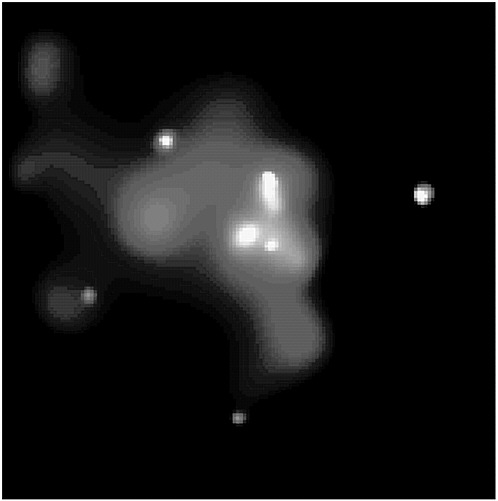
FIGURE 1.1 Chandra x-ray image of the galactic center. Infrared observations have demonstrated that there is a 2.6-million-solar-mass black hole at the dynamical center of our galaxy. This massive black hole accretes gas from its surroundings and heats it to x-ray-emitting temperatures. It is spatially coincident with the x-ray point source at the center of this image. The intensity of this source is surprisingly small. The other sources in the image are mostly associated with gas and stars near the black hole. Courtesy of NASA/Massachusetts Institute of Technology/Pennsylvania State University (PSU).
which orbit the hole rather like the rings that encircle Saturn (Figure 1.2). The existence of disks has been substantiated by several observations, most notably the measurement, by ASCA, of relativistically broadened iron line profiles (combined with narrow absorption features) from nearby galactic nuclei. These measurements have also been used to argue that the black holes must be spinning very rapidly. The gas in accretion disks is believed to sink toward the central hole and be heated by the frictional effect of a magnetic field. This magnetic field can also sustain an active corona rather like that observed around the Sun and from which extremely energetic x-ray photons are produced. Roughly half of the coronal radiation is reprocessed by the accretion disk, and much of the x-ray spectrum of nearby Seyfert galaxies (which resemble low-power quasars) has been interpreted in this manner. However, the arrangement and thermal states of the absorbing and the emitting gas are unknown.
A new diagnostic of the hole-disk-corona connection has been studied in great detail in accreting stellar black holes using RXTE. It has been found that these sources often exhibit quasi-periodic oscillations (QPOs), which are probably derived from the excitations of waves in the accretion disk. Interestingly, the x-ray photons are so energetic that they must have been created in the corona. Some QPOs are associated with bursts that happen on neutron star surfaces. These provide good measures of the (high) spin frequencies of the neutron stars and test our understanding of their properties.
To understand how gas accretes onto a black hole, we must use observations from binary stars and AGN and combine these with laboratory atomic astrophysics investigations and three-dimensional, numerical magnetohydrodynamical simulations. In essence, what we are trying to do is to form an indirect image of the flow of gas around a black hole (E), in much the same way that a geophysicist might analyze seismic waves, gravity data, surface geology, and so on to create an image of Earth’s interior. The x-ray counterparts of these diagnostics include the variable iron line profiles and the QPOs, which ought to be characteristic of the mass and spin of the hole and the rate and manner by which gas is supplied to it.
In addition to disks, many accreting black holes form a pair of jets that appear to flow with speeds close to that of light along opposite directions that are perpendicular to the disk (Figure 1.3). These jets were first found associated with galactic nuclei using radio astronomy. However, they have also been seen emanating from stellar black holes and
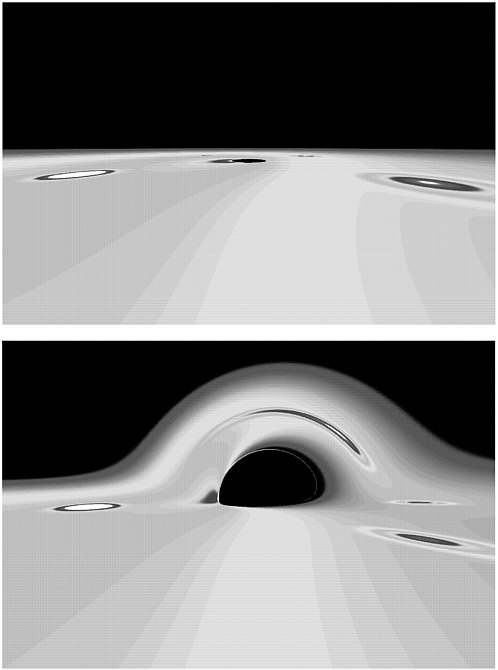
FIGURE 1.2 Numerical simulation of the appearance of a flat accretion disk orbiting a rapidly spinning black hole. The disk is endowed with four orbiting bright features to aid visualization. The brightest features are shown as white, the faintest as red. The observer is at rest and hovering just above the disk at a distance equal to 10 times the radius of the black hole. The top frame shows the appearance of a disk to an observer when the gravitational bending of the light is ignored. The bottom frame exhibits the strong distortions caused by general relativity. The observer sees the disk behind the black hole apparently elevated because of the bending of light rays. The strong effect of the Doppler shift, the gravitational redshift, and the “dragging” of inertial frames are also apparent. The faint red curve that apparently delineates the surface of the hole is actually formed by rays from the underside of the accretion disk. One long-term goal of the MAXIM technology development program is to make images of real accretion disks that would exhibit these physical effects. Courtesy of Kevin Rauch, Johns Hopkins University.
are particularly well-suited to x- and gamma-ray observations. It is a consequence of the near-light speed of these jets that they are overwhelmingly intense when we observe directly along one of them, in which case they are known as blazars. Even allowing for this beaming, the gamma-ray power can still outshine all of the other emission. Because relativistic jets can carry away such a large fraction of the energy released by the accreting gas, their formation is now seen as an integral part of accretion onto a black hole. Nearly a hundred gamma-ray blazars have been found by CGRO at GeV1 energies and as many unidentified and possibly related sources have also been detected. The challenge now is to understand how jets are created and collimated (F). In particular, it will be necessary to determine if they derive their power from the spin energy of the black hole or the gravitational energy of the accreting gas. This is a second area where there are thought to be unusually good opportunities for close collaboration between observers, theorists, and laboratory astrophysicists, particularly in exploring the behavior of ultrarelativistic plasma.
Neutron stars are also relativistic objects, and they permit quantitative tests of strong gravity. They contain matter with density greater than that found in atomic nuclei and are usually born with magnetic fields millions of times stronger than we can sustain in the laboratory. Conse-
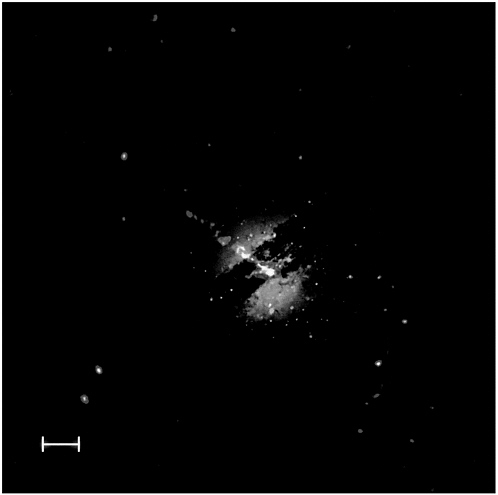
FIGURE 1.3 Image of the jet in the nearby active elliptical galaxy Centaurus A superimposed on the optical image of the galaxy. The x-ray image was obtained with the high-resolution camera on Chandra (scale bar=1 arcmin). The jet is created by a massive black hole in the center of the galaxy and powers a pair of giant radio sources. Several point x-ray sources, probably neutron stars and black holes that accrete gas from their companion stars, can also be discerned. Jets like those in Centaurus A are called blazars when they are pointed toward us and are also prodigious gamma-ray sources. Note the prominent dust lanes in the optical image. These absorb soft x rays and allow only the hard x rays to escape from the nucleus. Courtesy of NASA/CXC/Smithsonian Astrophysical Observatory (SAO) and NSF/Association of Universities for Research in Astronomy, Inc. (AURA)/National Optical Astronomy Observatories.
quently, neutron stars form unique cosmic laboratories, allowing us to study matter under physical conditions that cannot be reproduced on Earth. In particular, the rate at which neutron stars cool can be measured and can provide a unique test of the properties of matter at densities greater than that of atomic nuclei.
All neutron stars spin, and—in contrast to black holes—this spin causes regular pulsations with periods that can be as short as ~1.5 ms. Most neutron stars are isolated and powered by their spin energy, so they slow down with time. They are most luminous in gamma-ray photons. Other neutron stars attract gas from companion stars, and the gravitational energy that is released powers their emission, which is mostly observed at x-ray energies. This gas spins up the neutron star, and it appears that an equilibrium period of ~3 ms is commonly attained. These rapidly spinning neutron stars may be one of the most promising sources of gravitational radiation.
Even more remarkably, it has recently been discovered that a minority of neutron stars—called magnetars—are born with magnetic fields up to a billion times stronger than we can create and so strong that the uncertainty principle requires that electrons have ultrarelativistic energies independent of their densities. We observe magnetars through bursts of “soft” gamma-ray photons. The high magnetic fields are discovered by measuring the very rapid rate of their spin period change, which is much faster than that of radio pulsars; this requires a third energy source, magnetic energy. There is much fundamental astrophysics to explore here. However, perhaps the most significant use of neutron stars will be to measure accurately the variation of neutron star radii with mass (G), which tells us how neutron star matter responds to gravity and produces pressure. This will enable us to understand in much more detail what happens in a supernova explosion and will be an invaluable contribution to fundamental physics, complementing the results that are coming from heavy-ion colliders.
In recent years, it has become clear from high-energy observations that gamma-ray bursts (GRBs) are cosmologically distant and consequently so powerful that they must transform a fraction of a solar rest mass into pure energy within seconds. The only objects thought likely to create GRBs are black holes and neutron stars. These explosions may create relativistic jets moving even closer to the speed of light than blazar jets. As with supernovae, their ejecta are decelerated by the surrounding gas, and they create afterglows at essentially all frequencies that can be followed for up to a year. Surprisingly, CGRO has detected four bursts at
~1 GeV energies, including one that persisted for an hour (one burst was reported at TeV energies). Also, as with supernovae, there appear to be many different types: Some GRBs are relatively low power and may be by-products of supernovae associated with massive stars; others show features like those of AGN. In spite of these breakthroughs and many creative suggestions, there is still no widely accepted explanation for GRBs. GRBs have stimulated study of the behavior of matter under completely new physical conditions. In particular, understanding the coalescence of neutron stars requires detailed study of the behavior of nuclear matter using general relativity. It is a prime challenge to observers, laboratory astrophysicists, and theorists combined to solve the mystery of gamma-ray bursts (H). Success in this endeavor will surely also clarify our understanding of advanced stellar evolution and AGN.
We can also consider the global properties of AGN to understand how they operate on the average. By measuring the masses of black holes in nearby galactic nuclei, it is possible to estimate how much radiant energy was produced in forming them. This quantity turns out to be significantly larger than we actually observe at optical, ultraviolet, and soft x-ray energies. However, many AGN are quite overluminous when observed in hard (in contrast to soft) x-ray photons (Figure 1.4). This suggests that most of the light they emit is absorbed by cold gas and dust and then reradiated as infrared radiation. Only the penetrating hard x-ray photons and gamma-ray photons can show these “obscured” AGN as they truly are. Furthermore, because this high-energy emission is likely to vary, we are unlikely to confuse its black-hole origin with stars, which is a problem with similar observations at infrared wavelengths. High-energy observations are necessary to tell us the true powers of AGN and to understand how efficiently they convert mass into energy.
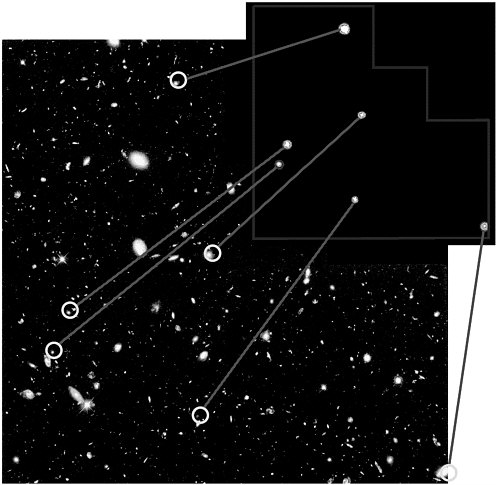
There is an additional consideration. We already know that most of the soft x-ray background comes from discrete sources (Figure 1.5). The same is probably true of the hard (~10 to 100 keV) x-ray background. Observing the x-ray background allows us to measure the time-averaged luminosities of accreting black holes in AGN and to see how they have changed over cosmic time. It is already clear that the average AGN power is at least several percent of that associated with stars (and might even be comparable). AGN power may also account for a significant fraction of the recently measured far-infrared background. The inevitable consequence of all of this is that AGN are likely to have played an important role in galaxy formation. To place these ideas on a more quantitative footing, we need to balance the cosmic energy budget of
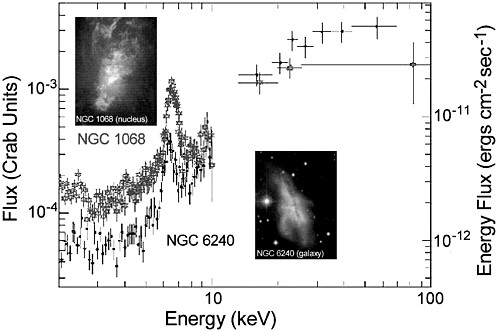
FIGURE 1.4 X-ray spectra recorded by Beppo-SAX of two highly absorbed Seyfert galaxies, NGC 1068 and NGC 6240. Note the fluorescent iron lines around 7 keV and the increasing fluxes to well beyond 10 keV, which are indicative of strong absorption by heavy elements in intervening gas, partially visible in the accompanying galaxy images from the Hubble Space Telescope (HST) and the European Southern Observatory (ESO), respectively EXIST could discover thousands of AGN like this that probably dominate the hard x-ray background. Courtesy of Beppo-SAX collaboration.
galaxies and their active nuclei (I). This connects strongly to our first quest, which involved understanding the role of massive black holes in the birth and evolution of galaxies.
ORIGIN OF THE ELEMENTS
One of the most important discoveries in recent years has been of large numbers of extrasolar planets. These are typically “Jupiters,” comprising mostly hydrogen and helium gas; often located extremely close to their stars, they are, consequently, very hot. Earth-like planets, by contrast, are made out of the heavier elements and are solid. By their
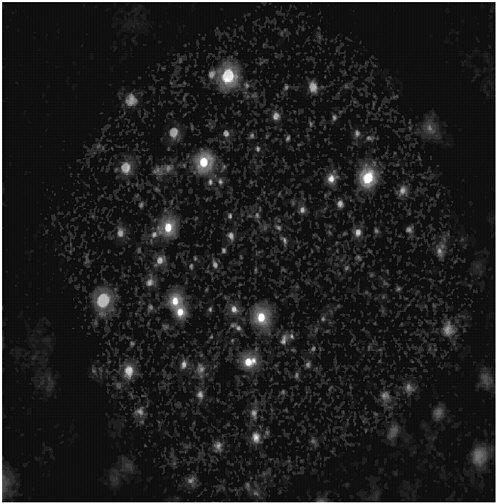
FIGURE 1.5 Deep fields from ROSAT, Chandra, and Hubble. The left-hand image of the x-ray sky was taken as a long exposure by the German-led x-ray satellite ROSAT. The image, which measures 25 arcmin on a side, contains a variety of sources, including about 40 distant AGN. These sources are representative of those that form the x-ray background. (The colors indicate the “hardness” of the x-ray spectrum, with blue being hard—relatively more high-energy photons—and red, soft.) Con-X will be able to obtain high-resolution spectra for essentially all of these x-ray sources. Courtesy of ROSAT/G. Hasinger. The bottom right image is of the famous Hubble Deep Field (HDF) North as observed at optical and x-ray wavelengths. The image size is roughly 2.5 arcmin. Chandra (top right) can detect x-ray sources that are more than 10 times fainter than ROSAT and is sensitive to higher-energy photons as well. Of the six x-ray sources found so far in the HDF North, one is identified with the bright active nucleus of a galaxy (an AGN), three are associated with elliptical galaxies (some of which appear to contain weak AGN), one is associated with an optically faint galaxy that shows relatively strong emission in the infrared (probably a hidden AGN), and one appears to lie in the outer parts of a nearby spiral galaxy. Some AGN are seen only through their penetrating high-energy x rays, suggesting that optical, ultraviolet, and low-energy x-ray photons are absorbed by gas and dust. Optical surveys for quasars and AGN have underestimated their density and importance in the evolution of galaxies. Top right courtesy of NASA/PSU/G.P. Garmire, A.E.Hornschemeier, W.N.Brandt, and the ACIS team, and NASA/CXC. Bottom right courtesy of R.Williams and the Hubble Deep Field team, NASA/STScl.
nature, high-energy observations are not useful for finding these potentially habitable environments; they are only good for assessing those factors that are inimical to life! However, where high-energy astrophysics can make a contribution is by determining where and when the heavy elements—the raw materials of life—were made in the first place.
With the possible exception of carbon and nitrogen, most of the heavy elements in nature were made in supernovae. These exploding stars can be divided into two basic classes—those of type II (including also those of types Ib and Ic), where the explosion is preceded by gravitational collapse and a neutron star or black hole is left behind, and those of type Ia, where there is a thermonuclear explosion of a white dwarf and no remnant. For both classes, the sudden release of energy raises the temperature to the point where violent nuclear reactions occur. The ejection of both kinds of elements—those made explosively and those made prior to the supernova—is responsible for producing most of the atoms heavier than helium in our universe. This basic picture has been corroborated by many observations. However, important details of the explosion mechanism are not yet understood, and these have a crucial bearing on the yield of freshly synthesized elements from different types of supernovae. For example, we still do not understand how the fusion flame propagates in a type Ia supernova—faster or slower than sound— nor do we know the mass of the progenitor star. In type II supernovae, we do not understand exactly how the collapsing star gets converted to an explosion and, in particular, which elements fall into the neutron star and which are ejected.
We can address these issues most directly by observing the gamma-ray lines that are made by radioactive nuclei created in the explosion. In fact, we can match the lifetimes of these unstable nuclei to the timescales over which we need to average. For example, the supernova that was observed in 1987 in the Large Magellanic Cloud was detected in lines created by a cobalt isotope that decays on a timescale of several months. Supernovae in the Galaxy that are part of the historical record have been observed in lines formed by a titanium isotope, which decays in about a century. Lines from aluminum and iron isotopes, which last a million years and have half-lives of a few million years, may chart the average rate of formation of massive stars in the Galaxy long after these stars and their remnants have vanished from view. In addition, gamma-ray photons, made by decaying pions, tell us about cosmic-ray-induced production of the light elements lithium, beryllium, and boron within the expanding remnants. Gamma-ray nucleosynthetic studies are in their
infancy, because the poor sensitivity of gamma-ray telescopes has so far limited us to detecting just a few lines from nearby supernovae.
The debris from the explosion expands rapidly, creating a strong shock wave and heating the interstellar gas to x-ray temperatures. This, in turn, decelerates and heats the debris as well. Both types of hot gas radiate strong atomic and ionic emission lines (Figure 1.6). Many of these lines have already been measured and, to some extent, mapped, using ASCA. However, neither the sensitivity nor the angular resolution
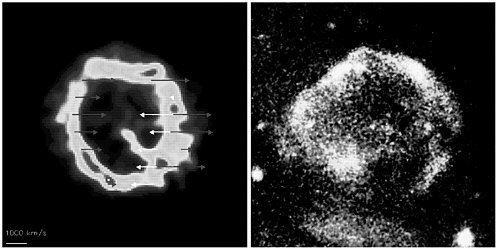
FIGURE 1.6 On the left is a Chandra x-ray image of a nearby supernova remnant, E0102–72.3, using an emission line created by ionized neon in the hot gas formed by the explosion. The arrows measure the velocity along the line of sight (toward us when directed to the right), which can be determined using the Doppler shift of the wavelength of the line. Images like these can be used to test our understanding of how the chemical elements are formed in supernova explosions. Courtesy of NASA/Massachusetts Institute of Technology (MIT)/C. Canizares and J.Houck. On the right is a detail from an image of the Large Magellanic Cloud made using the EPIC detector on the XMM-Newton x-ray observatory, launched in late 1999 by the European Space Agency (ESA), showing a new supernova remnant. The bright source in the bottom right-hand corner is the remnant of the famous supernova explosion that was observed in 1979. XMM-Newton complements the Chandra Observatory by emphasizing collecting area and spectroscopy over image quality. Con-X is designed to use mirrors similar to, although much larger than, the XMM mirrors. Courtesy of ESA/XMM/G. Hasinger.
has so far been adequate to develop a quantitative understanding of the different types of explosion and the yield of trace elements. It will be necessary to use x-ray and gamma-ray observations to associate evolving stars with their postsupernova remnants and the elements they form (J). A very good example is provided by the well-studied supernova remnant Cassiopeia A, which now appears to contain a compact object, either a neutron star or a black hole. Another good example is provided by the Crab Nebula, the remnant of a supernova that occurred in 1054. The Crab Nebula is mostly powered by a central pulsar—a rapidly spinning, magnetized neutron star. (Both Cassiopeia A and the Crab Nebula were formed by type II explosions. The study of type Ia supernovae has been given added impetus in recent years by their role in cosmic distance determination.)
Eventually, the supernova debris mixes with the ambient interstellar gas, so we also need to understand how the mix of the elements has evolved in different environments. One approach is to measure the strengths of absorption lines in gas that lies between us and bright x-ray sources like quasars. This technique is particularly robust because, unlike with optical and ultraviolet studies, it is not sensitive to the ionization state of the absorbing gas and the fraction of the elements that has been incorporated into dust grains. It should be possible to determine accurately the relative abundances and distribution in the interstellar medium of the 20 most common elements (K). This is the material that is incorporated into new stars, planets, and—occasionally—living organisms.
The dispersal of the elements does not stop in the interstellar medium. Observations of nearby galaxies with high rates of star formation have already found hot, outflowing gas that has been recently enriched. For those galaxies that reside within the rich clusters, this gas will be trapped and will augment the hot intracluster gas. All other galaxies should enrich the general intergalactic medium, which, as mentioned above, is expected to be at x-ray temperatures and must now account for the bulk of normal matter. In addition to locating intergalactic gas, it is of prime importance to understand the cosmic history of element production and dispersal (L). This relates directly to the history of star formation and should help us understand how much of the formation happened outside normal galaxies. It also relates to our first two quests, because quasars and gamma-ray bursts provide ideal probes of the build-up of heavy elements in the early universe.
SURPRISES
As must be clear from the above, if history is any guide, the most significant discoveries of the next decade in high-energy astrophysics will be unanticipated and will not fit into some preconceived pattern. It is therefore important to structure a research program so as to permit a broad investigation of “discovery space” —new areas of investigation that open as new observational technologies and techniques are used. Each of the facilities now described by the panel fulfills this requirement.
A NEW BEGINNING
This report is being written as astronomers start to use the Chandra and XMM-Newton observatories. (A third x-ray observatory, Japan’s ASTRO-E, was lost following a launch failure. It was to have complemented Chandra and XMM-Newton by emphasizing high-energy x-ray observations.) In addition, three gamma-ray missions are awaiting launch.
CHANDRA
Launched on July 23, 1999, and performing as planned, the Advanced X-ray Astrophysics Facility of the National Aeronautics and Space Administration (NASA), renamed the Chandra X-ray Observatory,2 is poised to make major discoveries in x-ray astronomy. It is designed primarily as an imaging x-ray telescope that uses grazing incidence reflectors to achieve a 0.5 arcsec angular resolution over a 7-arcmin (diameter) field of view, comparable to what is obtained on the ground using optical telescopes. Chandra can detect x-ray photons with energy in the range ~0.1 to 10 keV, with an effective area for imaging of 600 cm2 at ~1 keV; armed with charge-coupled devices (CCDs) and microchannel plate detectors, it has over a hundred times better sensitivity than the Einstein Observatory, which was launched in 1978, and 10 times the angular resolution of ROSAT. It also has a strong spectroscopic capability using transmission gratings and will provide energy resolution of up to one part in a thousand (depending upon the energy) (Figure 1.7). As it is
|
2 |
See <http://chandra.harvard.edu/>. |
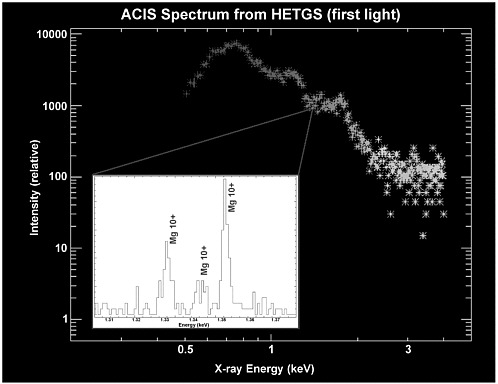
FIGURE 1.7 Spectra from the nearby bright binary star Capella, obtained using the Chandra X-ray Observatory. The x rays are produced by hot gas in a corona. The moderate-resolution spectrum measured using the Advanced CCD Imaging Spectrometer shows several broad features; those in the ~1- to 2-keV interval are contributed mainly by Si and Mg. The inset shows a small detail of the high-resolution spectrum obtained with the High-Energy Transmission Grating Spectrometer close to 1.3 keV, where a magnesium triplet is clearly resolved. These spectra can be used to deduce the physical conditions and abundance in the source. Con-X will be able to take spectra like this for sources that are a hundred times fainter than Capella. Courtesy of NASA/Chandra X-ray Center/ MIT, SAO.
in high Earth orbit, it will allow essentially uninterrupted observation of faint and variable sources.
Among Chandra’s many scientific objectives are the following:
-
Performing x-ray spectroscopy of normal stars so as to detect their coronae and stellar winds and compare them with the Sun;
-
Mapping supernova remnants using emission lines from the most common elements at moderate spectral resolution;
-
Observing binary star x-ray sources from as far away as the Virgo cluster of galaxies and performing a census so as to understand more clearly their role in stellar evolution;
-
Observing black hole accretion disks using their iron emission lines; and
-
Imaging galaxies, AGN (including jets), and clusters of galaxies to much greater distances and earlier times than before.
XMM-NEWTON
By emphasizing field of view (30 arcmin) and effective area (~6000 cm2 for imaging at 1 keV) at the expense of angular resolution (15 arcsec), the European-led XMM-Newton3 (launched in December 1999) nicely complements the Chandra X-ray Observatory. It has an onboard optical-UV monitor and a high-resolution x-ray spectrometer using reflection gratings, which provides simultaneous observations with the imaging detectors. Many of XMM-Newton’s overall science objectives are similar to those of Chandra. Its special strengths are sensitivity to extended, low-surface-brightness sources, notably the x-ray background, and spectroscopy of faint point sources. Like Chandra, XMM-Newton is performing well and producing a steady stream of remarkable astronomical discoveries.
HETE-2 AND SWIFT
There are two missions poised to capitalize on recent developments in our understanding of gamma-ray bursts. HETE-24 was launched in October 2000. It is expected to locate roughly 30 gamma-ray bursts per year to better than ~10 arcsec and communicate these positions to waiting ground stations in about 5 s. This will allow immediate optical follow-up. Swift,5 which is planned for launch in 2003, is expected to improve upon this capability by obtaining immediate arcminute positions for roughly one burst per day and then using its onboard optical, UV, and
|
3 |
See <http://sci.esa.int/xmm/>. |
|
4 |
See <http://space.mit.edu/HETE/>. |
|
5 |
See <http://swift.gsfc.nasa.gov/>. |
x-ray telescopes to obtain arcsecond accuracy after a few minutes have elapsed, facilitating a determination of the distances and powers of the bursts. It will also produce a 10 to 100 keV survey of the sky with sensitivity at least 10 times better than that of the best existing survey.
INTEGRAL
The European gamma-ray mission, INTEGRAL6 (2001 launch), will break new ground in gamma-ray spectroscopy and imaging. It will be sensitive up to ~10 MeV and have an energy resolution of ~2 keV at the crucial electron-positron annihilation line at ~0.5 MeV. Its solid-state germanium detectors will give it a narrow line sensitivity, which is a 10-fold improvement over CGRO. INTEGRAL also carries a “coded mask” imager to reconstruct source positions to an accuracy of ~2 arcmin. The key scientific objectives include the study of explosive nucleosynthesis in type Ia supernovae out to a distance of about 50 million light-years through the detection of cobalt lines and the survey of recent and past Galactic supernovae through the detection and mapping of titanium and aluminum lines.
THE NEXT STEPS
After having considered a variety of proposals, the panel unanimously recommends that NASA start and launch three missions over the coming decade. The capabilities of these missions would represent major advances over the capabilities of current missions, and the three would complement each other in addressing the quests and challenges described above.
PROPOSED MAJOR MISSION: CONSTELLATION-X
MISSION DEFINITION
Con-X7 (Figure 1.8) is planned as a high-throughput, x-ray facility emphasizing observations with unprecedented energy resolution, E/DE, of between about 300 and 5000 over a broad energy range, ~0.25 to
|
6 |
See <http://sci.esa.int/integral/>. |
|
7 |
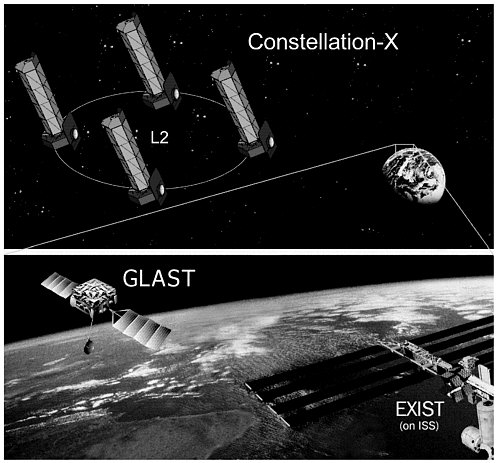
FIGURE 1.8 Montage showing the three proposed missions: Con-X, GLAST, and EXIST. Con-X will operate on the far side of Earth from the Sun at the second Lagrange point, designated L2. GLAST and EXIST will both operate in low Earth orbit. Courtesy of NASA/Goddard Space Flight Center (GSFC).
40 keV. As such, it will complement Chandra in much the same way that the Keck and Gemini optical telescopes complement HST. Con-X’s large effective area in spectroscopic mode (~1.5 m2) will exceed the spectroscopic effective areas of Chandra and XMM-Newton by factors of ~20 to 100. Con-X will be able to time individual photons to ~100 µs.
As currently configured, Con-X’s high sensitivity will be attained using four telescopes launched by two Atlas/Delta rockets to the second Lagrange point, on the far side of Earth from the Sun. The main mirror design is a larger and lighter version of the XMM mirror, while the CCDs will benefit from experience gained with Chandra. The main spectroscopic detector takes the form of a cooled microcalorimeter array. Each telescope will also carry a separate multilayered mirror for the hard x-ray observations. Fabricating these components constitutes the main technology challenge for Con-X.
Con-X has been under study for over 5 years, and a broad-based facility science team has been formed to refine its scientific objectives and match them to attainable instrument and spacecraft capability. Technology development for Con-X is part of the 1997 strategic plan of NASA’s Office of Space Science (OSS). The Con-X time line envisages a phase C/D start in 2005, leading quickly to a 2008 launch. The cost is expected to be $450 million for phase C/D development, $189 million for the two launches, and $133 million for 5 years of mission operations and data analysis (MO&DA), giving a total cost of $772 million.
HOT INTERGALACTIC MEDIUM (A, B, L)
As discussed above, some giant clusters of galaxies appear to have formed sooner in the life of the universe than had been expected. Provided that all clusters formed after the time when the universe was about 4 billion years old, they should be detectable by Chandra and XMM-Newton. If they are, Con-X will be able to measure the composition and temperature of the x-ray-emitting gas and convert these measurements into mass distributions for the gas, the stars, and the dark matter. These observations will provide a quantitative measure of the growth of large-scale structure, especially when combined with radio observations that measure the effect that clusters have on the microwave background radiation.
In addition, Con-X will perform detailed analyses of the closer and brighter clusters, measuring their gas flow speeds with accuracies of ~20 km s−1, somewhat better than the formal resolution. It should also locate the shock waves expected to surround these clusters. By measuring the abundances of all the common ions, the thermal state of the gas can be specified and its recent history reconstructed. This is essential if, as we believe, clusters merge with one another. The combination of all of these x-ray measurements with optical studies, microwave background
observations, and numerical simulations should allow us to determine when these individual clusters were assembled and how they subsequently grew. Measuring the steady increase of metals inside clusters as the universe ages also traces the star formation, which, in turn, relates to the evolutionary history of the galaxies inside the cluster.
If, as numerical simulations strongly suggest, most of the mass of the intergalactic medium is now at million-kelvin temperatures, then Con-X should be able to measure its distribution and follow its dynamics by seeing absorption lines (notably those formed by oxygen ions) in the spectra of hundreds of bright, background quasars in much the same way that optical astronomers have been able to detect 30,000-K intergalactic gas from when the universe was only a few billion years old using hydrogen and carbon atoms (Figure 1.9). Indeed, Con-X should also be able to see emission from this hot gas associated with nearby groups of galaxies and draw conclusions parallel to those for the clusters (Figure 1.10).
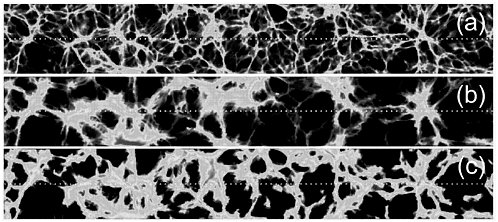
FIGURE 1.9 Numerical simulations of the gas density in the local intergalactic medium. These simulations show small sections of the expanding universe and can be used to produce estimates of the column densities of different ionization states and elements as a function of recession velocity along a line of sight like the dotted lines shown in the figures: (a) density of oxygen ions with two electrons, (b) density of oxygen ions with one electron, and (c) overall density of all heavy elements. Courtesy of N.Y.Gnedin, U.Hellsten, and J.Miralda-Escudé, Astrophysical Journal 509 (1998): 56–61.
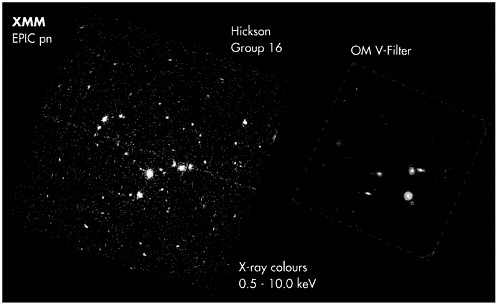
FIGURE 1.10 X-ray image of a nearby, compact group of galaxies known as Hickson 16. The righthand frame is a corresponding optical image. Both images were acquired with XMM-Newton. Con-X will be able to measure the composition, distribution, and temperature of the gas in groups like Hickson 16. Courtesy of ESA/XMM-Newton.
NUCLEOSYNTHESIS (J, K, L)
Similarly, soft x-ray absorption studies of our own interstellar medium will provide total abundances of the common elements C, N, O, Fe, Ne, Mg, and Si. This should be a great advance in sensitivity and reliability over optical observations and the capability of XMM-Newton. Observations of supernova remnants promise an even more dramatic demonstration of Con-X’s spectroscopic prowess. Trace elements like P, K, Cl, Cr, and Mn can also be measured. Detecting these elements, and their ionization states, soon after they are formed will serve as a quantitative test of our understanding of how radiation escapes from these remnants as well as of the theory of nucleosynthesis inside supernova explosions. The most abundant elements can be assayed from supernovae occurring as far away as the Virgo cluster, which should be sufficient to derive a fair average rate of element production.
Another major design goal is to be able to map the distribution of the
hot gas that has already been detected in the ~100 kpc dark matter halos of galaxies. Here, spectroscopy has a dual role. It will provide gas densities and abundances and, using the Doppler shift and Newton’s laws, it will be able to determine the distribution of the dark matter. Used in conjunction with optical/ultraviolet observations of nearby galaxies, Con-X observations should be able to measure the abundances of elements created by massive stars and so provide a measurement of the distribution of star formation within nearby galaxies, which, in turn, provides a record of when these stars formed.
Perhaps the most spectacular demonstrations of Con-X’s spectroscopic capability will come from observations of the coronas of nearby bright stars. These will measure thousands of emission lines with resolving powers greater than several hundreds and will allow the physical conditions and abundances within the coronas to be studied, putting our rapidly improving understanding of the solar corona to the test. In addition to allowing astronomers to detect trace elements essential to life, understanding star-planet relationships is highly relevant to the third quest, because stellar coronas are an important source of x rays and low-energy cosmic rays, whose intensity is a strong factor determining the habitability of planets.
BLACK HOLES AND NEUTRON STARS (E, F, G, I)
Con-X should greatly advance our understanding of black hole astrophysics because the accreting gas naturally emits x-ray photons just before it falls into the hole. As outlined above, astronomers have learned much over the past 5 years and anticipate further enlightenment over the next 5. A key capability is Con-X’s large aperture and fine energy resolution, which will permit rapid measurement of the shape of the variable, strong iron emission and absorption lines that have already been detected from some Seyfert galaxies. These line features are imprinted upon the spectrum of the x-ray photons that the disk reflects from its own hot corona. Its shape is dictated by the rotation speed, the orientation of the disk, the bending of light rays by the strong gravitational field, the gravitational redshift, and the spin of the hole. Con-X will measure line profiles for a large sample of AGN and should determine the black hole spin rates as well as verify that space-time geometry is as predicted by Einstein’s general theory of relativity (Figure 1.11).
More detailed information can be derived by observing the time variation of the iron line in response to changes in the strength of the x-
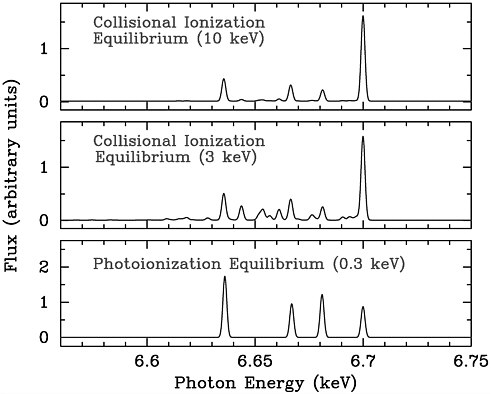
FIGURE 1.11 Detailed high-resolution simulation of an x-ray source that shows helium-like iron. Two cases of collisional excitation and one of photoionization are presented with associated temperatures. Note that the ratios of the lines are quite different in each case. In this way it should be possible to infer the physical conditions in the source. Con-X should be able to perform time-resolved spectroscopy of the inner regions of accretion disks orbiting massive black holes and to form indirect “imaging” of the gas flow. Courtesy of M.Sako, Columbia University.
ray photons from the corona. These variations are delayed by the time it takes light to cross the disk region (typically minutes to hours), and analyzing these variations offers another promising approach to making an indirect image of the flow of gas around the black hole. As it will be possible to carry out these studies on distant quasars as well as nearby Seyfert galaxies, astronomers hope to learn why only a minority of AGN form powerful radio jets.
These observations can then be related to the gas at larger radii, which is probed by measuring its emission and the absorption features imprinted upon the spectrum of the escaping x-ray photons. In particular, the hard x-ray capability of Con-X will be invaluable for finding
heavily obscured AGN. Some of this gas will be associated with intense bursts of star formation occurring within the nucleus, and astronomers hope to clarify the relationship of these “starbursts” to the emission coming from directly around the black hole. In another approach, it will be possible to infer whether or not our own galactic center, which is currently dormant, was active over the past few centuries by observing the x-ray photons scattered back towards us by more distant molecular gas.
Analogous accretion disk studies will be possible for the stellar black holes. In addition, it will be possible to see x-ray line photons reflected off the companion stars and thereby obtain reliable mass estimates for many of the black holes that have so far stubbornly resisted this analysis. Another opportunity is to seek QPO variation in the emission lines, which, if detected, should greatly clarify their physical origin.
Isolated young neutron stars can be thought of as giant nuclei whose observable properties depend crucially on the basic principles of nuclear physics, general relativity, quantum electrodynamics, superconductivity, superfluidity, and so on. They have been studied assiduously over the past 30 years and yet astronomers are still discovering completely unexpected properties. Perhaps the largest impediment to understanding neutron stars in a quantitative manner is that astronomers still do not know how much pressure matter exerts when the density exceeds that of nuclear matter. It is this that determines the radius of a neutron star of a given mass. By measuring the spectrum of the x-ray emission from the surfaces of hot neutron stars, Con-X will be able to determine the gravitational redshift with high accuracy and, consequently, their radii and masses. These observations will also identify the surface composition, which is important for understanding how neutron stars interact with their environments and how they cool. Specifically, by accurately measuring the surface temperature and composition of a sample of neutron stars of known age, it will be possible to measure how fast they cool. This, in turn, sheds light on the detailed physics of dense matter. In addition, it should be possible to use these observations to map the surface magnetic field by, for example, measuring cyclotron lines.
FIRST-PRIORITY PROPOSED INTERMEDIATE MISSION: GLAST
MISSION DEFINITION
The Gamma Ray Large Area Space Telescope (GLAST)8 is conceived as a successor to the highly successful Energetic Gamma-Ray Experiment (EGRET) on CGRO. It will observe gamma-ray photons with energies from 10 MeV to 300 GeV and an energy resolution, E/ΔE, of ~50. Like EGRET, GLAST is a pair production telescope, but with six times the effective area, and by observing six times as much sky at any given time, it will be over 40 times as sensitive. It will position individual photons to within 2 deg at 100 MeV and 10 arcmin at 10 GeV as well as to ~2 µs in time. Images of bright, extended sources should have angular resolution of ~10 arcmin. Bright point sources can be located to 30 arcsec, which should allow the identification of some of the large number of sources that could not be located from EGRET observations.
Unlike EGRET, GLAST will rely on modern solid-state detectors, similar to those used successfully in particle physics. Silicon-based technology has been chosen for gamma-ray tracking.
GLAST is currently in phase A and is planned to enter phase C in 2002 in time for a 2005 launch. The phase C/D cost is $205 million, of which ~$50 million is expected to be contributed by DOE and the French and Japanese space agencies. A Delta launch into low Earth orbit costs $53 million and MO&DA for 10 years will be $48 million, for a combined total cost to the United States of $286 million.
BLAZARS (F, I)
GLAST will be able to detect several thousand AGN and observe them when the universe was roughly a billion years old (Figure 1.12). It will have the sensitivity to see rapid variations in a large number of these sources. Comparing these variations with those that occur at lower frequency is the best way to understand how jets are formed and what they contain. Already, large, multiwavelength campaigns have made it possible to construct a tentative model of how jets emit. Relativistic
|
8 |
See <http://glast.gsfc.nasa.gov/>. |
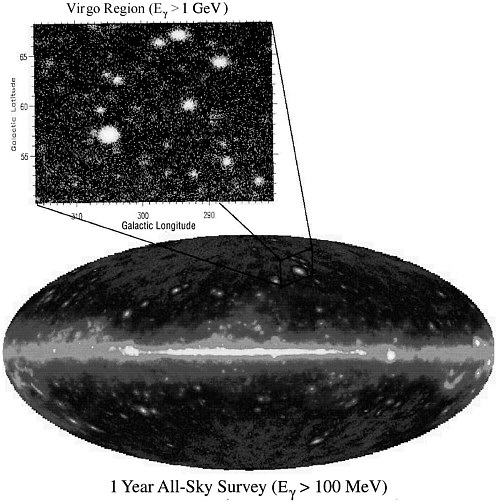
FIGURE 1.12 Simulation of a 100-MeV all-sky survey by the proposed mission GLAST after 1 year’s observation. Several thousand sources should be detected. The inset shows the region around 3C279 observed above ~1 GeV. Note that the positional accuracy improves with increasing energy. Courtesy of NASA/GLAST/GSFC.
electrons are accelerated at shock fronts formed inside the jet, and these electrons radiate x-ray photons by the synchrotron process. These x-ray photons are subsequently scattered by the same relativistic electrons, producing hard gamma-ray photons. As these jets propagate outward, they form, successively, optical, infrared, and radio synchrotron sources.
GLAST is designed to answer three outstanding questions: whether the jet plasma contains protons or positrons, how they are confined, and what the role is of the radiation field through which the jet propagates. Answering these questions should lead to a much better understanding of how jets are powered at their sources, especially whether this is due to spin of the black hole or the energy liberated by the accreting gas. Furthermore, by determining the evolution of the strengths of these jets over cosmic time, it should also be possible to check whether or not they dominate the gamma-ray background, as is widely suspected.
A comprehensive understanding of blazars requires a knowledge of the total gamma-ray spectrum extending to energies beyond the GLAST limit of 300 GeV. Here the detectors are ground-based and involve detecting atmospheric Cherenkov emission. Although it is not part of its charge, the panel regards the interplay between space-based and ground-based detectors as so strong that it endorses the proposal to construct the Very Energetic Imaging Telescope Array System (VERITAS).
COSMIC RAYS (J, K, L)
Hard gamma-ray photons should also be emitted by the cosmic rays that are believed to be accelerated within supernova remnants. In particular, GLAST should observe the gamma-ray photons produced through the decay of neutral pions around ~70 MeV and demonstrate, conclusively, that the majority of the cosmic rays with energies in the range ~1 GeV to ~100 TeV are accelerated in these sites. GLAST will also have the angular resolution to determine where this acceleration is taking place, in particular to determine if the ions are accelerated mainly at strong shock fronts or throughout the body of the remnant. Comparison with radio and x-ray observations will enable a fairly comprehensive description of particle acceleration to be developed. Because cosmic rays account for such a large fraction of the energy in a supernova remnant, they must be included in the dynamical analysis that underpins the nucleosynthetic investigations. On a larger scale, it will be possible to
use these types of observation to observe the overall consequences of particle acceleration within nearby galaxies and even clusters of galaxies.
A quite different type of cosmic-ray decay might be detectable. One of the strongest candidates for dark matter is a new elementary particle called a neutralino—the lightest “supersymmetric” partner to the normal particles. These particles may not be stable and, according to some theories, may decay over cosmological timescales into gamma-ray photons with a particular energy in the GLAST range. If this gamma-ray line were detected, it would have major implications for physics as well as astrophysics.
GAMMA-RAY BURSTS (C, H, I)
The discovery by Beppo-SAX in 1997 of afterglows from GRBs has revolutionized our understanding of these cataclysmic events. Their incredible power plus the multiwavelength nature of the afterglows has captured the public imagination and led more astronomers to work on understanding what mechanisms are responsible for GRBs.
GLAST has a central role in the future of this research because GeV photons are strongly susceptible to absorption—they create an electron-positron pair within the source, just as they do in the detector. As a result, observing GeV gamma-ray photons from nearby bursts (in contrast to the ≤ 1 MeV photons detectable by Swift) places strong constraints on the physical conditions within the source region. There are already indications that the gamma-ray burst emission originates from relativistic jets that move even faster than those associated with blazars. Based on the EGRET detections, it is projected that GLAST, with its greater sensitivity and much shorter dead time, will see a GRB about once every 2 days, quite possibly including bursts from the first generation of stars, although these can only be seen at lower energy. GLAST seems to be a particularly good candidate to produce the key insight that will identify the predominant source of GRBs.
Above a certain energy, gamma rays from GRBs and blazars are also subject to absorption outside their sources as they propagate through the infrared cosmological background radiation. By measuring this absorption and (in the case of blazars) combining it with hard x-ray spectra that EXIST (see below) can measure, GLAST should be able to measure the infrared background when the universe was quite young. This infrared background is believed to be dominated by reprocessed stellar light (although, as discussed above, AGN may contribute as much as one-half
of it), so these gamma-ray observations can monitor the history of star formation in the universe. An understanding of the absorption on the infrared background is also needed to measure the intrinsic high-energy spectrum of gamma-ray bursts.
SECOND-PRIORITY PROPOSED INTERMEDIATE MISSION: EXIST
MISSION DEFINITION
An imaging survey of the hard x-ray sky is our second candidate for a moderate mission. There has been no hard x-ray survey of the whole sky to match the existing ROSAT soft x-ray survey since that performed by the High-Energy Astronomical Observatory (HEAO-1) satellite. The International Space Station-attached EXIST9 would carry out this survey using eight wide-field (~40 deg), coded-aperture, hard x-ray (~5 to 600 keV) telescopes with good energy resolution (E/ΔE~100) that image the whole sky every 90-min orbit. (This is a particularly important feature because the hard x-ray sky is so variable and is enabled by having eight telescopes.) The final survey limit would be roughly 100 to 1000 times fainter than the HEAO-1 limit and roughly 10 times fainter than the anticipated Swift hard x-ray survey (with a much broader energy range and superior angular resolution). EXIST would provide ~30 arcsec source localization for bright sources and angular resolution of ~5 arcmin for bright extended sources as well as ~1 µs photon timing. The International Space Station provides a nearly ideal platform for this fixed-pointing, scanning telescope (although it could also be a free flyer). A single telescope could be prototyped on an ultralong-duration balloon flight.
This project is enabled by recent advances in hard x-ray Cd-Zn-Te detectors (which are also used for medical imaging). The most difficult technology challenge is to construct ~1m2 arrays of these detectors for each telescope. Other challenges concern data handling and integration with the International Space Station.
EXIST was selected as a New Mission Concept in 1994, and the proposal has developed considerably since that time. An EXIST science
|
9 |
See <http://exist.gsfc.nasa.gov>. |
working group has been formed. Because of its strong synergy with Con-X and GLAST, a 2005 launch would be optimal. The projected phase C/D cost is $120 million, and the MO&DA for a 2-year mission is $30 million, for a combined estimated cost of $150 million.
OBSCURED AGN AND THE X-RAY BACKGROUND (D, E, I)
Perhaps the most compelling survey science is the first deep survey of AGN above ~20 keV. There are already strong indications from ASCA and Beppo-SAX that many AGN are heavily obscured. EXIST should discover more than 3000 such self-absorbed AGN, which can then be subjected to deep follow-up study. (These sources are probably quite variable, and EXIST is well suited to monitor them.) This will be necessary to understand the source composition of the hard x-ray background (at around 40 keV, where it is most luminous). In addition, EXIST observations will facilitate a secure calculation of the contribution of accreting black holes in AGN to the “luminosity density” of the universe and a direct comparison with the galaxy luminosity density that should be measured by the Next Generation Space Telescope (NGST). Further comparison with the distribution of black hole masses in dormant galactic nuclei will lead to a quantitative understanding of the evolution of black holes in different types of galaxy.
GALACTIC SURVEY (E, G, J)
With its very large field of view, EXIST is well suited to detect the “soft x-ray transients” that are usually associated with black holes. Studying these objects and understanding why they behave as they do will lead to a census of stellar mass black holes within our galaxy. In addition, its good energy resolution should allow EXIST to perform the first high-sensitivity, high-energy galactic search for supernovae that are hidden inside molecular hydrogen clouds by seeking gamma-ray emission lines from radioactive titanium. If these lines are seen, they should help us to understand the overall supernova rate and relate this to the theory of advanced stellar evolution.
Sensitive, hard x-ray observations of accreting neutron stars should measure their magnetic fields. In addition, it will be possible to observe QPOs from the disk coronas around neutron stars and stellar black holes at the high energies where they are most prominent.
GAMMA-RAY BURSTS (C, F, H, J)
EXIST is also well matched to the study of GRBs. With a projected sensitivity 20 times better than CGRO and 4 times better than Swift, EXIST should detect GRBs every 4 hours and furnish arcminute positions for all and ~10 arcsec positions for the brightest cases. If there is a large population of low-power GRBs associated with supernovae, like the recent example 1998bw, then EXIST should find them. It also has the sensitivity to detect bursts from when the universe was less than a billion years old, and this will provide a direct probe of early star and galaxy formation. EXIST can time tag each photon with microsecond accuracy, which will be a useful diagnostic tool for exploring the kinematics of the expanding, ultrarelativistic blast waves and jets.
INVESTING FOR THE FUTURE
The missions that have just been described are large steps towards the long-term goals with which this report began. To go further requires investing in selected technologies that will be needed by missions that could be launched after 2010. The panel has identified three important areas where there has recently been considerable progress and where the prospects for future advances seem particularly good. In order of priority, they are MAXIM, Generation-X, and the MeV Spectroscopy Mission.
MAXIM (E, F)
The second quest, imaging a black hole, could succeed, in principle, using x-ray interferometry, as proposed for MAXIM10 (Figure 1.13).
Success would require ~0.1 µarcsec angular resolution, a seven-order-of-magnitude improvement over Chandra. At first sight, this seems unrealistically ambitious. However, new interferometer designs, using grazing incidence mirrors, suggest a clever way of using widely separated spacecraft to form an interferometer in a manner that will combine photons with different energies and accommodate source variability. One spacecraft holds the mirrors, which are separated by a fixed
|
10 |
See <http://maxim.gsfc.nasa.gov/>. |
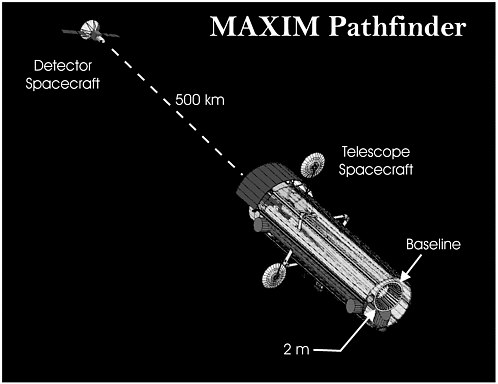
FIGURE 1.13 In the MAXIM approach to x-ray interferometry, beams of x rays separated by several meters are formed by the “optics spacecraft.” The x-ray photons in these beams are then detected by a second “detector spacecraft” roughly 500 to 1000 km away. Ultimately it is proposed to use x-ray interferometry to form images of gas flow around a black hole. Courtesy of NASA/ MAXIM/GSFC.
“baseline” as large as ~100 m. These mirrors reflect the x rays onto a second spacecraft up to 1000 km away, where the interference fringes are formed.
One possible intermediate goal is a pathfinder mission designed to demonstrate ~100 µarcsec resolution at ~1 keV, comparable to what is achieved at radio wavelengths using very long baseline interferometry (VLBI). In order to have an adequate flux of x-ray photons, a collecting area of 100 cm2 and a baseline of ~2 m are required. The detector would have to be ~500 km away. The biggest technology challenges for
such a pathfinder mission include developing x-ray optics based on large optical flats and fabricating large, two-dimensional cryogenic detector arrays with sufficient energy resolution. The pointing (~30 µarcsec) and metrology (~0.1 nm) demands are similar in character to those of the Space Interferometry Mission (SIM) and the Laser Interferometer Space Antenna (LISA), and much of the technology should be transferable.
GENERATION-X (A, I)
Attaining the first goal of seeing directly the very faint first galaxies and stars requires much larger collecting areas to capture enough photons to form an image or attempt spectroscopy; x-ray detectors are already approaching 100 percent efficiency. Furthermore, to make the identifications, it will be necessary to localize sources to within an arcsecond. These requirements motivate the fabrication and deployment of x-ray mirrors with effective areas exceeding ~100 m2, a hundred times larger than Con-X and comparable to a single Keck telescope. Large-format detectors capable of sub-eV energy resolution will also be necessary.
A paced program of mirror and detector technology development directed toward these long-term goals is recommended.
MEV SPECTROSCOPY MISSION (J, L)
As discussed above, the measurement of nuclear gamma-ray lines provides a direct probe of the formation of the elements in supernovae. Most of the lines have MeV energies, and measuring them poses an unusual instrumental challenge because it is not possible to use focusing optics. The INTEGRAL mission will be an important pathfinder for this field. It appears that in order to attain its scientific goals, it will be necessary to surpass INTEGRAL in sensitivity by a factor of roughly 30. The panel recommends support for technology leading to a future mission with sensitivity matched to our scientific goals for reasonable cost.
SMALLER PROGRAMS
A healthy high-energy astrophysics program must embody a balance between larger and smaller projects. Accordingly, the panel also endorses four smaller programs.
POTENTIAL EXPLORER RESEARCH
There is strong support in the high-energy astrophysics community for the Explorer program, as demonstrated by the large number of exciting proposals submitted by high-energy astrophysicists. As the central purpose of this program is to encourage innovation and rapid responses to emerging scientific opportunities, the panel does not endorse any specific mission proposals. However, three exciting research areas appear to be particularly well suited to Explorer missions.
NUCLEAR LINE X-RAY SPECTROSCOPY (J, L)
Recent advances in multilayer coatings used at grazing incidence make it possible to concentrate soft gamma-rays onto a small detector, greatly reducing the background and allowing unprecedented sensitivity with a much more modest instrument than previously imagined. Several important nuclear lines occur in the accessible energy range, below ~200 keV, including three isotopes of Ti, Co, and Ni that are stringent diagnostics of the explosion mechanism for type II supernovae. Many supernovae could be observed in this manner, providing unique diagnostics of how elements are created and disseminated.
SOFT X-RAY SURVEYS (L)
A systematic low-energy survey of a substantial area of sky to depths significantly beyond that investigated by the all-sky survey ROSAT could map distant clusters and the hot structures surrounding them to probe the missing baryons. Spectroscopic surveys of diffuse emission offer another approach to observing the intergalactic medium that would complement absorption line measurements by the large observatory missions, and they could also help determine the nature of the hot interstellar medium in our own galaxy.
ALL-SKY MONITORS (E, F, H)
Soft x-ray transients, microquasars, and AGN are all highly variable. Continuous monitoring of large numbers of these sources at low and intermediate x-ray energies will complement the high-energy studies proposed above using EXIST and help produce an indirect image of accretion disks and their coronas. Continuous monitoring of a large
fraction of the sky should also discover new and important rare phenomena. “Lobster eye” optics promises an order of magnitude gain in sensitivity, enabling thousands of AGN, binary x-ray sources, variable stars, and so on to be monitored simultaneously.
ULTRALONG-DURATION BALLOONING
There is a good history of performing high-energy astrophysics from balloons. A particularly fine example was the rapid response to supernova 1987a, which exploded in the Large Magellanic Cloud in 1987. Hard x-ray and gamma-ray missions were successfully mounted from the Southern Hemisphere and were able to confirm directly the production of radioactive nuclei within the expanding supernova remnant. Since that time the capabilities of balloons have increased considerably. The ultralong-duration balloon (ULDB) program offers the prospect of carrying several ton payloads to ~40 km altitudes for flights of several months’ duration. The panel recognizes that this capability offers relatively cheap access to near space for certain classes of hard x-ray and gamma-ray payloads and urges that this capability be developed further. It is noted that ballooning is particularly well matched to the needs of the best younger scientists, who require experience in building and flying instruments with relatively rapid turnaround. Additional support of roughly $5 million per year is needed for the development and operation of the balloons.
LABORATORY ASTROPHYSICS
High-energy astrophysics missions will return spectroscopic data over the next decade with unprecedented breadth and detail. This will take us into virgin territory largely unexplored by theoretical chemists and experimental astrophysicists. In addition, the laboratory study of high-energy-density fluid dynamics, magnetohydrodynamics, and plasma physics appropriate to the interpretation of supernovae, jets, and GRBs is in its infancy. There is need for an increased, though still comparatively small, investment (the panel estimates roughly $2 million per year for high-energy astrophysical studies) in both computational modeling and experimental facilities in order to make the best scientific use of the new observatories. A cross-agency initiative involving the Department of Energy (DOE), NASA, and the National Science Foundation (NSF) is recommended.
THEORETICAL CHALLENGES
The contributions of theory to the development of high-energy astrophysics are legion. Black holes, neutron stars, cosmological GRBs and relativistic blast waves, supernova nucleosynthesis, gamma-ray jets, cosmic-ray acceleration in supernova remnants, and the hot intergalactic medium were all widely discussed in the theoretical literature before observations established their reality. However, what was found was not usually exactly what had been predicted, so the theory had to be modified. To continue this symbiotic relationship, the panel proposes that each of its three recommended missions sponsor a particular theory challenge (see further discussion in Chapter 6) in order to refine mission planning and to obtain the best scientific return. The expenditure on this program should be matched to the perceived benefit, which may vary from mission to mission. Candidate challenges for Con-X, GLAST, and EXIST are those designated E, F, and G, respectively, and elaborated upon in Chapter 6.
POLICY ISSUES
The panel identified three policy issues for which it makes focused recommendations.
LONG-TERM SCIENTIFIC SUPPORT FOR OBSERVERS
The NASA data support centers serve the critical function of writing and maintaining the data analysis software needed for the dissemination, interpretation, and archiving of high-energy data. The concomitant large pool of scientists creates a critical mass for broad scientific investigations. The role of academic researchers in high-energy astrophysics has historically been to propose single observations, and they receive incremental funding to carry out the specific observations at hand. However, the lack of long-term, stable funding makes it difficult to create critical masses of researchers in universities similar to those in other countries, and it is also hindering the training of graduate students, a potential loss for the field. Accordingly, the panel recommends that NASA invest in a small number of focused, high-energy astrophysics data analysis groups within universities and research institutes. In particular, computing facilities and an
appropriate mix of graduate students and postdoctoral scientists needs to be supported.
JUNIOR FACULTY INSTRUMENTATION PROGRAM
Space missions are becoming increasingly complex and their organization concentrated in a few centers. This has the unfortunate side effect that instrument and spacecraft development is becoming remote from most universities, in particular from graduate students, who are eager to enter the field at a time when there are great opportunities and a need for new blood. As evidence for this, the panel cites the apparent shortage of U.S.-trained postdoctoral scientists with experience of high-energy instrumentation. To alleviate this problem, the panel proposes that NASA initiate a modest program specifically directed at supporting a small number of carefully selected junior faculty working in high-energy instrumentation.
EDUCATION AND PUBLIC OUTREACH
In recent years, high-energy astrophysicists have established an enviable record for responding to a strong public interest in their discipline. Black holes, supernovae, and gamma-ray bursts have captured the public imagination like few other topics in the physical sciences and are at least as firmly established as cosmology and the search for extraterrestrial life. High-energy astrophysicists have experimented successfully with a variety of new education and outreach initiatives, including the High-Energy Astrophysics Learning Center and the Astronomy Picture of the Day. Individual missions such as Chandra, Swift, GLAST, and Con-X maintain interactive Web sites and have distributed compact disks and brochures widely. In recent months the early-release images from Chandra have been broadly accessed and disseminated in the news media. The panel recognizes the importance of these outreach activities and recommends that they continue to be encouraged, financially supported, and rewarded in a manner that is described in more detail in the survey committee report.
ACRONYMS AND ABBREVIATIONS
ACIS
—Advanced X-ray Astrophysics Facility (now Chandra) CCD Imaging Spectrometer
AGN
—active galactic nuclei
ASCA
—Advanced Satellite for Cosmology and Astrophysics mission (Japan)
ASTRO-E
—fifth in a series of Japanese x-ray astronomy satellites; with help from the United States
AURA
—Association of Universities for Research in Astronomy, Inc.
Beppo-SAX
—Satellite per Astronomia X, a European collaboration x-ray mission
CCD
—charge-coupled device
CDM
—cold dark matter
CGRO
—Compton Gamma-Ray Observatory
Chandra
—Chandra X-ray Observatory (NASA, launched in 1999)
CXC
—Chandra X-ray Center at the Smithsonian Astrophysical Observatory
DOE
—Department of Energy
EGRET
—Energetic Gamma Ray Experiment aboard CGRO
EPIC
—European Photon Imaging Camera (on XMM-Newton)
ESA
—European Space Agency
ESO
—European Southern Observatory
EXIST
—Energetic X-ray Imaging Survey Telescope
FUSE
—Far Ultraviolet Spectroscopic Explorer
GLAST
—Gamma-ray Large Area Space Telescope
GRBs
—gamma-ray bursts
HDF
—Hubble Deep Field
HEAO-1
—High-Energy Astronomical Observatory
HETE-2
—High-Energy Transient Explorer (launched in 2000)
HST
—Hubble Space Telescope
INTEGRAL
—International Gamma-Ray Astrophysics Laboratory
ISS
—International Space Station
LISA
—Laser Interferometer Space Antenna
MAXIM
—Microarcsecond X-ray Imaging Mission
MO&DA
—mission operations and data analysis (NASA)
NASA
—National Aeronautics and Space Administration
NGST
—Next Generation Space Telescope
NSF
—National Science Foundation
OSS
—Office of Space Science (NASA)
QPOs
—quasi-periodic oscillations, x-ray pulses from compact objects
ROSAT
—Roentgen Satellite (German-U.S.-U.K. collaboration)
RXTE
—Rossi X-ray Timing Explorer
SAO
—Smithsonian Astrophysical Observatory
SIM
—Space Interferometry Mission
STScI
—Space Telescope Science Institute
ULDB
—ultralong-duration balloon
VERITAS
—Very Energetic Radiation Imaging Telescope Array System
VLBI
—very long baseline interferometry
XMM-Newton
—X-ray Multi-Mirror Observatory, a European collaboration x-ray space mission


