
SUMMARY
The Panel on Theory, Computation, and Data Exploration was charged with surveying two separate branches of astronomy and astrophysics: theoretical astrophysics and data exploration. “Theoretical astrophysics,” in the convention of this report, includes both analytic theory and numerical simulation. The term “data exploration” is introduced to describe the newly emerged discipline of mining insight from large and complex astronomical databases using sophisticated modeling tools. The panel reviews the status of these two branches of astronomy and astrophysics and provides separate sets of recommendations for prioritized initiatives and policy directives.
THE SCOPE OF THEORETICAL ASTROPHYSICS
Unlike many astronomy communities, which identify themselves by wavelength or mission, the community of theoretical and computational astrophysicists defines itself by synthetic tasks that cross disciplinary boundaries:
-
Defining the frontier. The community invents concepts that create frontiers and a framework for observational discovery—new ideas about the universe—from the extremes of space-time to physics in exotic environments to the new universe of captured digital knowledge.
-
Model building. It creates intelligible descriptions of physical systems with precise quantitative connections to reality, including both sophisticated simulations that incorporate a comprehensive range of physical processes and compact mathematical constructions that identify and represent the key physical effects.
-
Synthesizing a world view. It knits physical science into a coherent narrative of our place in the universe, one that is accessible, interesting, and edifying to society at large. This scientific view of the universe competes in the free market of ideas; theorists tell and sell the astronomers’ story of the universe.
In these tasks, theoretical and computational astrophysicists combine leadership for and service to the larger astronomical community. Their specific activities are defined by both their core intellectual values and their interactions and collaborations outside their community. Three important themes recur in this report:
-
The rapid pace of discovery in this golden age of observational astronomy has created for the first time a comprehensive view of what is happening in the universe over much of observable space-time and is quickly expanding the complexity and range of accessible phenomena.
-
The continuing advance in digital technology is redefining and expanding the character of knowledge. In astronomy, the digital revolution is creating explosive growth in the quality and quantity of data and our ability to model complex phenomena, resulting in a new “digital universe.”
-
Paradoxically, the cultural gap between the frontier science community and much of the rest of American society continues to widen at precisely the time that new technologies allow us to create tools for broader and more rapid dissemination of knowledge outside the science community. We must work to resolve this paradox.
The panel believes that theory defines the context within which most of astronomy operates. Observers may answer the questions what and where, but theory addresses the how and why and seeks explanation and synthesis. No modern observation would make sense, or could be properly interpreted, without the pioneering theoretical work that gave us white dwarfs, neutron stars, black holes, atomic physics, relativity, radiative transfer, hydrodynamics, mechanics, statistical physics, high-energy radiation processes, and so on, and without the theorists who are the developers and users of these concepts and tools. One need only think of Penzias and Wilson without Gamow, Dicke, and Peebles or Bell and Hewish without Gold and Wheeler to understand the centrality of fundamental theory.
Given this history, the panel asserts that the theoretical core of astronomy must be nurtured and strengthened in the next decade in order to optimize the scientific return from the coming explosion of astronomical discoveries.
THEORY INITIATIVES PROPOSED BY THIS PANEL
The theoretical foundation of any discipline is most secure when the broadest possible range of research is supported. The panel proposes three new initiatives for theoretical astrophysics, believing that they will bring significant, tangible benefits to the entire astronomy community. One of these initiatives advances a new model for supporting theory
efforts aligned with observational missions. The other two initiatives are designed to enhance the current broadly based theory programs that support the inspirational theoretical research that complements mission-oriented research. The panel summarizes its initiatives and then supplies details of each in a later section.
THEORY CHALLENGES TIED TO PROJECTS AND MISSIONS
The most important output of the Astronomy and Astrophysics Survey Committee is its prioritized list of facilities and missions for the next decade. The panel proposes that most of these prioritized initiatives should be accompanied by, and continuously interact with, one or more coordinated theory challenges. The challenges should describe theoretical problems that are ripe for progress and either relevant to the planning and design of the mission or key to the interpretation and understanding of its results in the broadest context.
The theory challenges should be planned and budgeted as an integral part of the project or mission. The funds should be allocated through open competition in the national community rather than as addons to observational or instrumentation grants or contracts, and under no circumstances should they divert funds from existing grants programs for broadly based theory. Both individuals and consortia should be supported. Panels drawn from the theoretical community, broadly construed, should select the award recipients. Support should cover the broadest possible range of theory, from the basic theoretical foundations for the mission to detailed modeling.
Appropriate challenges will evolve during the life cycle of the project or mission. In the early stages, the challenges contribute to mission definition, identify opportunities, and add enthusiasm and ideas. As the data flow in, theory contributes to the interpretation of the results and sets the context for subsequent initiatives. At the end, theory helps produce a synthesis of the results.
The cost of theory challenges might typically be 2 to 3 percent of the project or mission cost, although the scope of the challenges should be determined individually for each project, and much larger fractions—or no theory challenges at all—could be appropriate for some projects. The panel believes that this small cost will be repaid many times over by the contributions of theorists to mission design, analysis of newfound phenomena, and the vision that inspires future missions.
A NATIONAL POSTDOCTORAL PROGRAM IN THEORETICAL ASTROPHYSICS
All of astronomy and astrophysics thrives under constant reinvigoration by young researchers. Postdoctoral fellows fill a unique role as innovators, owing to their combination of scientific independence, freedom from administrative and teaching duties, and ambition to establish a personal scientific identity. The presence of talented young people enhances research productivity and cross-field collaborations. Theoretical astrophysics, in particular, has seen its directions and technical methods driven largely by the efforts of postdoctoral fellows, and theory postdoctoral fellows do much of the highly innovative nonprogrammatic research that inspires new missions and research directions far into the future. Nor should we forget the important role of postdoctoral fellowships in training the astrophysicists of the future.
The present support mechanisms for theoretical postdocs are inadequate and unstable. Grants to individual theory researchers rarely are sufficient to fund a full-time postdoc. The few who are supported in this way are tied to a specific project, with limited freedom to pursue untested or potentially revolutionary ideas. A handful of U.S. institutions award fellowships that occasionally support theorists. However, several foreign institutions have large and strong theory postdoctoral programs that exceed in scope the programs available at almost any single U.S. institution. Some support for theorists has also been available from the Hubble, Compton, and Chandra fellowship programs; however, this support is programmatically selective and fragile.
To meet the need for a healthy postdoctoral research corps in the United States, the panel proposes a national program of freestanding postdoctoral fellowships. The panel envisions the program being administered in much the same way as the successful Hubble postdoctoral program, with postdocs distributed at institutions throughout the country and selected through competitive review. Such a program will provide an indispensable base for fundamental, creative theoretical research; it will identify the most outstanding young theorists and foster their development in a cost-effective way; it can encourage ethnic and gender diversity; and it will enhance the vitality of research at universities across the country and the talent pool available for this research.
The panel recommends a program that would award 10 or so 3-year theory fellowships a year, at an annual cost of about $2 million.
RIGHT-SIZING THEORY SUPPORT
Federal support for theoretical research is central to the continuing health of astronomy. However, despite the best efforts at the National Science Foundation (NSF) and the National Aeronautics and Space Administration (NASA), support for theory has not kept pace with the considerable growth in astronomical data in the last 10 years, creating an imbalance in the funding profile at a time of exceptionally rapid discovery.
To help remedy this imbalance, the panel recommends that major observational facilities, projects, and missions share the responsibility of funding both mission-related and broadly based theoretical research. Moreover, because the direct benefits of theoretical research are difficult to quantify, the funding agencies should develop guidelines for its support. The panel believes that a suitable preliminary guideline is that at least 30 percent of the costs for research personnel in grant programs, academic departments, and research institutes should normally be directed toward theoretical research activity.
The most cost-effective mechanism to address the challenge of right-sizing support for theory in this era of discovery is the targeted expansion of existing grants programs at the NSF and NASA that support broadly based theoretical research. In particular, the panel recommends a substantial augmentation of NASA’s successful Astrophysics Theory Program (ATP). Enhanced support through such programs would complement the theory challenge program and the national theory postdoc program to establish a thriving and balanced research effort in theoretical astrophysics.
DATA EXPLORATION INITIATIVE PROPOSED BY THIS PANEL: THE NATIONAL VIRTUAL OBSERVATORY
Astronomy will experience a major paradigm shift in the next few years, driven by large, systematic sky surveys at multiple wavelengths. The panel believes that these digital archives will soon be the astronomical community’s main avenue for accessing data. Systematic exploration and discovery in these databases will play a central role in the day-to-day research activities of most astronomers. This data avalanche—the flood of terabytes of data—is happening, whether or not we plan effectively for it. The first megasurveys are already in progress, including 2MASS, SDSS, and MACHO.
This transition is driven by advances in technology. The last decade witnessed a thousandfold increase in computer speed, a significant increase in detector size and performance, a dramatic decrease in the cost of computing and data storage capabilities, and widespread access to high-speed networks. Despite these advances, the environment to exploit these huge data sets does not exist today. In order to handle terabytes of data efficiently, one needs database engines with fast input/ output speeds and advanced query engines that can access databases spread throughout the country. Existing analysis tools do not scale to terabyte data sets. In combination, these factors make a new initiative, the National Virtual Observatory (NVO), both feasible and compelling.
The NVO will help the astronomer preparing for the next observing run, the theorist analyzing large-scale structure, or the phenomenologist searching for extremely rare objects. The NVO will link the major astronomical data assets into an integrated—but virtual—system that enables a qualitatively new type of astronomical research: automated multiwavelength and multiple-epoch exploration and discovery among all known catalogued astronomical objects. The NVO will initially provide access to tens of terabytes of catalog and image data, growing to multiple petabytes by the end of the decade. It will influence all disciplines of astronomy and astrophysics, from x rays to optical and infrared through the radio wavelengths, and it will be essential for confronting sophisticated theories with observations.
The NVO is “national” because it serves the needs on a national scale; it is “virtual” because it supports observations on digital representations of the sky, and it is an “observatory” because it is a general-purpose facility, just like a traditional observatory. The four major elements of the NVO are (1) integration of major data archives, (2) advanced services for the astronomical community, (3) standards and tool development, and (4) education. The NVO will involve a coordinated—but distributed— effort of universities and national centers to develop an integrated data architecture for astronomical research. Such standards and coordination will play a key role in linking the multiple archives and service providers; without them, astronomy will be unable to exploit its data fully and efficiently. The NVO will be a powerful resource for public education and outreach at many levels. A digital representation of the sky, easily accessible via the Web, has the potential to excite the imagination of future scientists and allow them to participate in the astronomical discovery process. Educators will draw on the NVO to develop educational
materials, and public institutions such as planetariums will use the NVO to develop presentations and displays.
The software and standards developed as the core of the NVO will be relevant to many other fields of research and should attract the attention of researchers in computer science, statistics, bioinformatics, earth sciences, and other fields. The NVO supports many of the goals of the recent federal Information Technology for the 21st Century Initiative (IT2) and is particularly appropriate for multiagency funding.
The panel envisages that the management of the NVO will be similar to that of the NSF Science and Technology Centers or NASA’s Astrobiology Institute. The NVO should be a multistaged effort, consisting of definition, demonstration, development, and deployment phases. Cost estimates for the NVO project are preliminary. Firm estimates will require a broad consensus on how the project is to be organized as well as on the scope and schedule of the project. Current projections for the definition and demonstration phase in years 1 to 3 are around $5 million total, with development scoped at $10 million total and deployment in years 3 to 5 at around $30 million total. Public outreach, grants to observers, and research in related areas of computer science and astronomy, including theory, could amount to an additional $15 million over 5 years.
SUMMARY OF PANEL FINDINGS AND RECOMMENDATIONS
The specific findings and recommendations of the Panel on Theory, Computation, and Data Exploration are summarized in this section. Details and supporting arguments are found, in each case, elsewhere in this report.
PROPOSED INITIATIVES
The panel’s principal recommendations take the form of three initiatives in theoretical astrophysics and one in data exploration:
-
The panel recommends that most prioritized projects or missions recommended by its parent committee, the Astronomy and Astrophysics Survey Committee, be accompanied by one or more coordinated theory challenges. The theory challenges should be budgeted and programmed as an integral part of the project or mission. However, the funds should
-
be allocated through periodic peer-reviewed open competitions in the national community rather than as add-ons to project grants or contracts. Both individuals and consortia should be supported. Support should cover the broadest possible range of theory, from speculative scenario building to detailed modeling.
-
The panel finds that present support mechanisms for theoretical postdoctoral fellows are inadequate and unstable, and it proposes a national program of “portable” theoretical postdoctoral fellowships. The program would be administered much like the successful Hubble postdoctoral program. Postdocs will be distributed at institutions throughout the country and selected through competitive review. The program will identify the most outstanding young theorists and foster their development in a cost-effective way. It will enhance the strength and vitality of university-based research and encourage ethnic and gender diversity.
-
The panel believes that there is an imbalance between the considerable growth in astronomical data in the last 10 years and the support of theory that is essential to a proper understanding and context for that data. The panel recommends that steps be taken to correct this imbalance. Specifically, the panel recommends that at least 30 percent of the support for research personnel in grant programs, academic departments, and research institutes normally should be directed toward theoretical research activities; that major observational facilities, projects, and missions should fund both “harvest” and “seed-corn” theoretical research; and that funding agencies should develop overall guidelines for right-sizing their levels of theory support. A high priority should be given to the expansion of NASA’s Astrophysics Theory Program.
-
The panel recommends the creation of a National Virtual Observatory to accomplish the integration of the nation’s priceless astronomical data, to facilitate its archiving, and to lead in the development and dissemination of tools for new scientific discovery from archival data. The NVO will undertake activities in standards, archive services, basic analysis tools, and advanced analysis tools. In toto, these efforts will require resources comparable to those of a small satellite mission. Very roughly, a 3-year definition and prototyping stage will be budgeted at $5 million. Development and testing would pick up in the second year and cost $10 million over 4 years. Deployment and operations would ramp up from the second through fourth years, with a 5-year cost of $30 million. Public outreach, grants to observers, and research in related areas of computer science and astronomy, including theory, would be
-
budgeted at $15 million over 5 years. Unless specifically rechartered, the project would terminate or descope after 5 years of operation.
OTHER RECOMMENDATIONS
-
DOE support of theoretical astrophysics. While the survey committee is not specifically tasked to examine Department of Energy (DOE) support of astrophysics, it would be impossible to give a complete picture of U.S. theoretical astrophysics without doing so to some extent. The panel offers the following suggestions for optimizing the effectiveness of DOE’s contribution to astrophysics:
-
DOE’s Office of Science should leverage its efforts in low-energy nuclear physics with appropriate research in nuclear astrophysics; a particular example is radioactive ion beam research.
-
Research in cosmology and matter under extreme conditions is similarly relevant to major new DOE facilities such as the Relativistic Heavy Ion Collider (RHIC) and the Continuous Electron Beam Accelerator Facility (CEBAF), the Stanford Linear Accelerator Center’s (SLAC’s) B-factory, the European Laboratory for Particle Physics’ Large Hadron Collider (LHC), and the Fermi National Accelerator Laboratory’s (FNAL’s) collider and fixed target programs.
-
DOE’s Defense Programs should recognize more explicitly the close synergy between their national security missions and research in astrophysics and (noting past high returns on investments made, particularly in terms of quality personnel brought into the defense program) should support with programmatic funds certain areas of relevant theoretical research in astrophysics. The ASCI program, in particular, is both the beneficiary and the benefactor of research in theoretical astrophysics, and this connection could be strengthened.
-
-
Institutes with opportunities for visiting theorists. While conferences allow sharing of research results, they seldom provide opportunities for actual collaborative work. The panel endorses the support by funding agencies of the several institutes that provide opportunities for extended working visits by scientists away from their home departments. The panel recommends that such institutes continue to receive healthy support.
-
High-performance computing. The panel notes that several national initiatives in computing will allow for the participation of, and
-
allocation of resources to, computational astrophysicists—but only if every effort is made within NASA and NSF to be responsive to these initiatives at an agency level. The panel recommends that the funding agencies position themselves to benefit from such initiatives by supporting algorithm development, Grand Challenge applications, and the development and dissemination of community codes and by conveying at agency levels the message that they support the continued health of the national supercomputer centers.
DESCRIPTION OF THEORETICAL ASTROPHYSICS
The initiatives that the panel recommends represent only the part of theoretical astrophysics that readily matches the AASC process. The panel represents a much broader community than can be adequately served by “initiatives.” More than any other area of astrophysics, theory depends on continuous healthy support of broadly based science rather than large discrete investments, although history has shown that theory has a remarkably strong influence on large scientific investments. To help the reader understand the field of theoretical astrophysics, the panel describes here its vision for the field, and in doing so looks at who theoretical astrophysicists are, where they have been, and where they are going.
THE NEW THEORIST
Traditionally, a theoretical astrophysicist studied astronomical phenomena primarily by analytical and conceptual (pencil-and-paper) reasoning. Today’s theorist performs on a larger stage. In particular, the 1980s saw the emergence of numerical modeling and simulation as a distinct and powerful subdiscipline of theoretical astrophysics. In a wide variety of astrophysical problems—cosmological structure formation, globular-cluster evolution, star formation, supernova explosions, accretion disks and jets, galactic dynamics, formation and evolution of planetary systems—the synergy of numerical modeling and analytic theory led to far greater progress than either tool could achieve on its own. Numerical modeling has also blurred the distinction between theory and observation: to properly understand and model selection biases, experiments and observations are now often numerically simulated, and
theoretical simulations are observed using the same acceptances as the actual observations.
Two developments in particular have driven this evolution. The first has been a tremendous expansion in both the quality and quantity of observational data as the result of the deployment of new facilities. For example, the angular resolution afforded by the Hubble Space Telescope (HST) and the exquisite sensitivity of instruments such as the High-Resolution Echelle Spectrometer on the Keck I telescope demand far more detail from theoretical modeling than was necessary in the past. New data sets are of sufficient size and complexity that new discoveries will require creative new strategies for organizing the data. Second, and equally important, has been the spread of computing resources of unprecedented power. Calculations that were recently impossible anywhere can now often be done on consumer-level computers. This expansion in computing speed has made it possible to construct physical models with sufficient detail to confront the new observational data. Astrophysicists are now able to test fundamental theories for a wide range of complex problems, from the growth of structure in the universe to the physical mechanisms of supernovae.
All areas of science rest on the three legs of theory, observation, and experiment (some colleagues regard numerical simulation as a fourth leg). The relative strength of these legs varies with time in any discipline: in the 19th century, experiment and theory in biology were clearly subordinate to observation, but such is no longer the case. The panel believes that the importance of the theory leg in astronomy and astrophysics is growing, not only because of the expansion of the scope of theoretical activities to include numerical modeling and data mining, but also because of the increasing sophistication of our conceptual understanding, our rapidly improving numerical algorithms, and the explosion in computer speed and memory.
Theory plays several distinct roles in astronomy research:
-
Theory uses laboratory-tested physical laws to interpret and explain astronomical observations, providing a coherent and satisfying framework for the interpretation of diverse observational data and showing how they fit together to yield an integrated picture of the universe as a whole. The most exciting observations are not those that confirm past predictions but rather those that are surprising or apparently paradoxical—and astronomy has no shortage of these.
-
Theory guides the choice of new observations and the develop-
-
ment of new instruments and observational strategies. For example, the wide variety of ongoing and planned ground-based, balloon, and satellite experiments to measure fluctuations in the cosmic background radiation are a direct response to theoretical predictions that these fluctuations provide an exquisitely sensitive probe of cosmological parameters; another example is the immensely successful gravitational-microlensing experiments of the past decade, which were stimulated by the theoretical prediction of this effect.
-
To a growing extent, physicists use astronomical observations and the associated theoretical calculations to probe fundamental physics in regimes that cannot be reached by traditional Earth-based experiments— for example, properties of neutrinos, including mass and lifetime; constraints to the existence of hypothetical particles including the axion, neutralino, and gravitino; and the behavior of matter at nuclear density and above.
The panel believes that disciplines without powerful theoretical underpinnings tend to become stagnant pools of undigested information.
SUCCESSES OF THE PREVIOUS DECADE
It is difficult to enumerate concisely the successes of theoretical astrophysics, given its breadth and diverse roles. Confirmation of explicitly predicted phenomena provides the most dramatic successes of theoretical astrophysics. Often, the observational verification comes decades after the theoretical prediction. Thus, we count an old prediction as a “recent” success of theoretical astrophysics if it was confirmed only in the past decade.
THEORETICAL PREDICTIONS VERIFIED BY OBSERVATION
Observation has confirmed the following theoretical predictions:
-
Blackbody spectrum of the cosmic microwave background. The COBE-FIRAS measurement of the spectrum of the cosmic microwave background (CMB) confirmed that it was indeed the cosmological blackbody predicted nearly 50 years ago in the hot Big Bang model. The frequency spectrum would have been considerably different if the CMB were the integrated flux from a number of discrete unresolved objects.
-
Big Bang and stellar nucleosynthesis. Increasingly precise measure-
-
ments of light-element abundances (particularly the deuterium abundance at high redshifts) are in excellent agreement with the predictions of Big Bang nucleosynthesis. The recently observed patterns of heavy-element abundances in halo stars agree with those expected from the r-process in the late stages of stellar nucleosynthesis.
-
Galactic black holes and quasars. The prodigious luminosity of quasars was interpreted almost 30 years ago by theorists to be the accretion of material onto a black hole of mass 106 to 109 times that of the Sun. The inevitable consequence of this dramatic prediction—that many inactive nearby galaxies should host massive black holes, even if they are quiet from lack of matter to accrete (“dead quasars”) —has been verified directly during the past decade with a wealth of kinematic evidence for the existence of compact dark objects in the centers of many galaxies, including our own.
-
Helioseismology. Models of the solar interior predict the temperature, density, and pressure in the Sun on the basis of a handful of parameters and physics, under conditions far from those that can be achieved on Earth and far from those at the solar surface. Nevertheless, exquisitely sensitive probes of the solar interior from helioseismology have shown that the standard solar model predicts the sound speed throughout the solar interior to within 0.1 percent and the density to within 1 percent.
-
Neutrino astrophysics. Neutrino astrophysics has now matured to the point where it provides unique and important information on neutrino properties. Measurement of the width of the Zº boson at the European Laboratory for Particle Physics confirmed the upper limit on the number of light-neutrino species from Big Bang nucleosynthesis. The success of solar models now implies that the solar-neutrino problem almost certainly points to new physics, probably in the form of nonzero neutrino mass.1
-
Gamma-ray burst afterglows. Theorists realized that if gamma-ray bursts are at cosmological distances, then injection of such a huge amount of energy would drive a relativistic shock into the interstellar medium. The temporal and spectral behavior of the x-ray, optical, and radio afterglows observed provide excellent qualitative agreement with the predictions of such “fireball” models.
-
Star formation. The theoretical paradigm for star formation has
-
long involved infall to an intermediate state with a protostellar disk. Recent observations have verified the presence of such a disk, as well as the predicted inside-out dynamical infall pattern in the surrounding envelope.
OTHER SUCCESSES OF THEORY, COMPUTATION, AND DATA EXPLORATION
Many of the most important contributions of theoretical disciplines to astronomy and astrophysics cannot be characterized as simple theoretical prediction/observational confirmation stories. For example, modeling can make sense of preexisting observations that were at first incomprehensible. Although some discoveries are serendipitous, an increasingly large number of major breakthroughs in astronomy come from observations motivated by theory. Finally, during the past decade theorists have begun to exploit massive data sets to address fundamental issues in astronomy. Some examples of these successes follow:
-
Magnetohydrodynamic instabilities and accretion disks. During the past decade, it was discovered that saturated magnetohydrodynamic (MHD) instabilities driven by shear in rotating flows provide the long-sought physical mechanism for driving outward angular-momentum transport and, hence, inward matter accretion in a wide variety of astrophysical disks. The identification of this linear instability was immediately followed by numerical simulations that verified the linear analysis and showed that a saturated state develops in which turbulence is steadily driven by the interaction of magnetic tension with orbital motion and in which the effective viscous stress scales with the magnetic pressure (see Figure 6.1).
-
Cosmological simulations and the origin of the Lyman-alpha forest. In the last few years, the incorporation of hydrodynamic effects into cosmological simulations has invigorated the N-body simulations that preceded them and allowed for the first time detailed comparison between the simulations and the visible large-scale structure in the universe. The most dramatic achievement of these simulations is the striking similarity between simulations and observations of the Lyman-alpha forest of absorption lines produced by intergalactic gas clouds.
-
Mergers and galactic structure. In the 1970s, theorists proposed that many features of peculiar galaxies were due to gravitational tidal forces acting between colliding galaxies. The roughly concurrent discov-
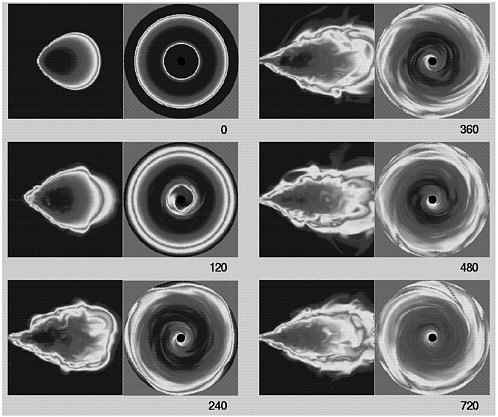
FIGURE 6.1 Magnetohydrodynamic simulation of an accretion torus surrounding a black hole in a galactic nucleus. Each snapshot shows the density distribution as a (one-sided) cross section and as a top view. The simulation shows that laminar flow in the torus is unstable and rapidly develops turbulence. Courtesy of J.Hawley, University of Virginia.
-
ery of flat rotation curves (that implied massive dark halos) and the observation that galaxies tend to congregate in clusters led theorists to surmise that many, if not all, peculiar galaxies could be attributed to mergers. Detailed numerical simulations of interacting galaxies, made possible by innovations in computer algorithms and the explosive growth of computing power during the past decade, now produce many features in remarkably good accord with those observed in interacting galaxies.
-
Cosmic microwave background anisotropy. Following the spectacular success of COBE, theorists began to study what could be learned by mapping the CMB with better angular resolution and improved sensitivity. Theorists showed how a suite of intriguing structure-formation theories (e.g., inflation and topological-defect models) could be tested with the CMB. By additionally illustrating that some cosmological parameters could be determined precisely, they articulated clearly the science case for NASA’s MAP mission and the European Space Agency’s Planck mission, scheduled for launch in summer 2001 and 2007, respectively, and helped to define these missions (polarization optimization on Planck, number and position of frequency channels, etc.).
-
Gravitational microlensing. The observation of gravitational microlensing provided dramatic confirmation of this half-century-old prediction of general relativity. The observed rate of microlensing toward the Galactic bulge is in rough agreement with what one would expect from models of the Galaxy and the stellar populations therein. Moreover, the success of microlensing surveys demonstrates the feasibility of astrophysics experiments that require the collection, search, and analysis of huge data sets.
-
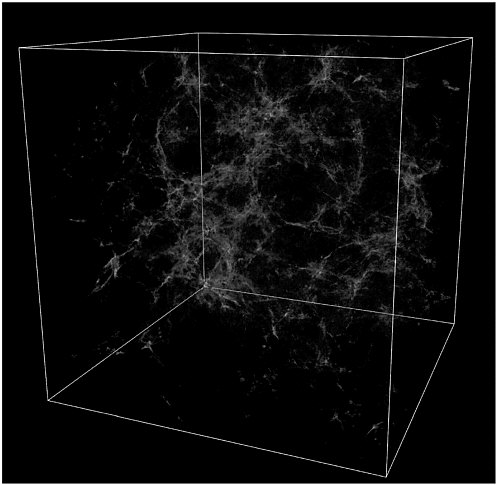
Three-dimensional simulations. The decade of the 1990s was a watershed for computational astrophysics because, for the first time, computer speed and memory allowed three-dimensional simulations to be performed with respectable resolution and physics. This capability enabled a number of impressive computational successes, including two mentioned above: the elucidation of the nonlinear behavior of MHD instabilities in accretion disks and the understanding of the origin of the Lyman-alpha forest (see Figure 6.2).
-
Algorithm development. In the 1990s, powerful and efficient algorithms were developed for following the evolution of large N-body stellar systems, planetary systems, magnetohydrodynamics, reactive flow, radiation hydrodynamics, special and general relativistic hydrodynamics, and Einstein’s field equations in four dimensions. The development of multiscale algorithms for astrophysical problems, such as tree codes and adaptive mesh refinement, enabled theorists for the first time to resolve a vast range of length scales at reasonable computational cost.
-
Practical applications of theoretical astrophysics. In a surprising twist of technology, two of the most abstract realms of astrophysics theory, orbital dynamics and general relativity, have achieved prominent and ubiquitous practical application in the Global Positioning System, with diverse uses ranging from earthquake prediction to navigation to recreation.
THEORY CHALLENGES TIED TO PRIORITY MISSIONS AND PROJECTS
INTRODUCTION
We are living in a golden age of astronomical discovery, unprecedented in its breadth across the electromagnetic and particle spectrum. Major advances—some serendipitous, others anticipated by theoretical work—seem to be reported almost weekly. These remarkable ongoing achievements in observational astronomy cannot be fully understood, nor can future directions in observational astronomy be intelligently planned, without commensurate advances in theoretical astrophysics. The panel believes that in times of rapid observational progress, theorists should be intimately involved in all stages of a mission or project, from the earliest planning to the ultimate interpretation of the scientific results.
To accomplish this, theorists should be involved in the agency, institutional, and collaborative apparatuses (committees, collaborations, teams, working groups, etc.) that direct each mission and project. Moreover, theoretical astrophysics should be encouraged to expand, especially in areas aligned with prospective observational projects. This encouragement should begin at the earliest possible stage of the mission planning and continue throughout the mission life cycle.
Diverse processes shape the intellectual progress of theoretical astrophysics. Sometimes progress is triggered by a single theoretical idea, sometimes it is a result of national programs focused on a carefully selected area that is ripe for theoretical advances, and sometimes it comes from an unexpected observational discovery. For example, our new understanding of the gravitational dynamics and state of primordial gas at significant redshifts (the problem of Lyman-alpha clouds) can be traced to the success of one of the projects in the NSF computational Grand Challenge program. This example (and there are others) shows that theoretical efforts of the highest quality can be elicited and focused by the conscious and thoughtful intervention of a funding agency.
The panel proposes that most new initiatives prioritized by the survey committee should be accompanied by, and continuously interact with, one or more coordinated theory challenges. The challenges should describe theoretical problems that are ripe for progress, relevant to the planning and design of the mission, and/or key to the interpretation and understanding of its results in the broadest context and should provide support for research on these problems over the broadest possible range,
from speculative scenario-building to detailed modeling. Broadly based missions may have many suitable challenges, not all of which will be supported. The theory challenges should be budgeted and programmed as an integral part of the project rather than through existing grant programs. However, funds should be allocated through periodic peer-reviewed open competitions in the national theory community rather than as add-ons to observational or instrumentation grants or contracts. Under no circumstances should they be allowed to divert or diminish the funds available for broadly based theory. Both individuals and consortia should be supported as appropriate, theory challenges are important at all stages of a mission but are perhaps most critical in the early planning stages, when theorists contribute to mission definition and identify novel opportunities, and near the end, when theory synthesizes the results and helps to define the big questions that inspire future missions.
There is no simple and persuasive algorithm to determine the cost of appropriate theory challenges for any given project. The scope of the challenges should be determined individually for each project. A typical cost might be 2 to 3 percent of the project or mission cost, although much larger fractions—or no theory challenges at all—could be appropriate for some projects. A guideline for the minimum funding required for a worthwhile theory challenge is $2 million.
EXAMPLES OF THEORY CHALLENGES
The specific theory challenges tied to each mission and project should be determined by the informed astronomical community— probably through ad hoc panels drawn from the theory community and convened for this purpose. However, to illustrate the concept, it is worthwhile to suggest some possible challenges for two existing major projects (SIM and ALMA) and several of the recommended initiatives of the survey committee.
SIM
The Space Interferometry Mission (SIM) will determine the positions and distances of stars several hundred times more accurately than they are now known. SIM will determine the distances and velocities of stars throughout the Galaxy and in nearby galaxies and will probe nearby stars for evidence of planets. Following are examples of theory challenges that could be posed by SIM:
-
To understand what determines the phase-space distribution of stars, star clusters, satellite galaxies, and dark matter in giant spiral galaxies like our own. The theoretical challenge raised by the SIM observations is to improve the resolution and fidelity of models of structure and galaxy formation to enable us to compare these models to SIM’s survey of the Galaxy.
-
To establish what determines the frequency, size, and mass of planetary systems around solar-type stars. The challenge posed by SIM, and later by the Terrestrial Planet Finder (TPF), is to develop our understanding of planet formation to explain how the orbital radii and masses of planets are determined.
ALMA
ALMA is a large millimeter array that will look with high sensitivity and angular resolution for molecular line and continuum emission from galaxies forming at large redshift and probe star-forming regions. A possible theory challenge for ALMA is to formulate a comprehensive theory of global star formation, aiming to answer such questions as how the star formation rate and initial mass function depend on the properties of a galaxy. This will require developing theories and algorithms to address such questions as the following: How do turbulence and magnetic fields affect the masses and clustering properties of the stars? How is the binary star or planet formation rate related to the properties of the parent cloud prior to its collapse and fragmentation?
NGST
The Next Generation Space Telescope (NGST), intended as an infrared successor to the HST, has a much larger aperture and is cooled to much lower temperatures. In the 1- to 5-µm infrared waveband, NGST would be over 1000 times more sensitive than any existing or planned facility, while retaining the image quality achieved by HST at visible wavelengths. Major theory challenges posed by NGST could include the following:
-
To develop an integrated theory of the formation and evolution of large-scale structure, Lyman-alpha clouds, galaxy clusters, and galaxies.
-
To understand the formation of planetary systems in the context of star formation and protostellar disks.
These tasks will involve radiation/hydrodynamic simulations on multiple scales, with detailed atomic physics.
CON-X
The Constellation-X Observatory (Con-X) will provide high-resolution x-ray spectroscopy over a wide bandwidth. It will analyze broadened iron emission lines from the region near the event horizon of supermassive black holes in active galactic nuclei, thereby probing the black hole masses and spins and testing strong-field general relativity. It will measure the properties of clusters of galaxies at high redshifts and thereby constrain models of early galaxy formation.
A possible theory challenge posed by Con-X is to develop accurate, documented, general-purpose codes to model multidimensional, time-dependent radiation hydrodynamics in full general relativity. High-spectral-resolution observations of the iron K-alpha emission line by Con-X should inform us about the properties of space-time near a spinning black hole, testing general relativity and constraining the mass and spin of the hole. The time is right to envisage constructing sophisticated and validated codes that could handle the relativistic MHD—including radiative transfer in a Kerr metric—needed to simulate the inner portions of these accretion disks (see Figure 6.3).
TPF
TPF is a near-infrared, space-based interferometer with a baseline of up to 1 km that will allow detailed imaging at 1 milliarcsec resolution with the sensitivity of NGST. TPF will conduct a complete census of planets as small as Earth around nearby stars. TPF will also allow us to image the centers of our own and nearby galaxies.
A possible theory challenge of TPF is to understand the unique objects and processes that occur at the centers of galaxies, such as stellar collisions, tidal disruption of stars, supermassive black holes, accretion discs, and relativistic jets, and to understand how the interplay of these objects leads to the complex phenomena of active galactic nuclei.
GSMT
The Giant Segmented Mirror Telescope (GSMT) is a giant (30 m)
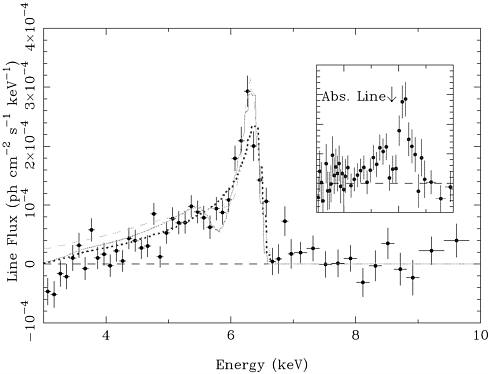
FIGURE 6.3 The broadened iron K-alpha line in the Seyfert 1 galaxy NGC3516. The solid green line shows the predicted spectrum from an accretion disk around a rotating black hole. Courtesy of P.Nandra, Goddard Space Flight Center.
optical/infrared (0.3 to 25 µm) telescope equipped with adaptive optics in order to achieve diffraction-limited resolution down to ~1 µm.
A possible theory challenge for GSMT is to develop models of star and planet formation, concentrating on the long-term, dynamical coevolution of disks, infalling interstellar material, and outflowing winds and jets.
The modeling of disks, which incorporates both (magnetized) gas and solid materials (dust and ices), is required to understand the sequence and details of disk dynamical processes, which high-resolution GSMT images and spectral studies may reveal for the first time.
Unresolved theoretical questions include the following: What small-scale processes drive protostellar disk accretion, and which conditions lead to episodic versus steady accretion? Is coagulation starting from micron-sized particles required to initiate planet formation, or does gravitational instability play a role? At what stage of evolution does
fragmentation produce binary stars, how does accretion proceed afterwards, and how do final mass ratios depend on initial conditions? How do the orbits of planets and binaries evolve in the presence of disks of varying masses, with varying ratios of gas/solids and varying solid-body size distributions?
EVLA
The Expanded Very Large Array (EVLA) will achieve microjansky sensitivity and 10-milliarcsec angular resolution. It will produce images of high-redshift galaxies with sufficient detail to determine whether active galactic nucleus (AGN) activity associated with a supermassive black hole precedes, is contemporaneous with, or follows starbursts of the first generation of stars.
A possible theory challenge for the EVLA is to understand from a theoretical perspective the respective roles of star formation and supermassive black holes in powering luminous galactic nuclei.
LSST
The Large-Aperture Synoptic Survey Telescope (LSST) is a large ground-based telescope with a wide field of view, designed to map the entire accessible sky in a few nights. LSST will provide a unique new window on rare and transitory astronomical phenomena.
A possible theory challenge for LSST is to understand the origin and fate of small bodies in the solar system, and to interpret them as fossils of solar system formation. LSST will discover and follow vast numbers of Earth-crossing and main-belt asteroids, Centaurs, Kuiper Belt objects, and comets, enabling the development of large catalogs with accurate orbital elements and well-understood selection effects. These catalogs can be used in conjunction with long-term orbit integrations to address such issues as the extent and mass of the Oort comet cloud, the evolution of Jupiter-family comets, the impact hazard from long-period comets, and the population of inactive comets in the inner solar system.
LSST will open an enormous discovery space for rare, faint, or short-lived astronomical events. Possibly the most important theory challenge for this project could be to discover, interpret, and explain unexpected rare phenomena buried in the LSST database. Responding to this challenge will require both sophisticated algorithms for data mining and speculative model-building.
GLAST
The Gamma-ray Large Area Space Telescope (GLAST) is a high-energy gamma-ray observatory. It will probe the 20 MeV to 300 GeV region of the electromagnetic spectrum with far better sensitivity and angular and energy resolution than earlier missions. It will observe gamma rays from supermassive black holes, Galactic gamma-ray sources, and gamma-ray bursts, and it will explore the star-formation history of the universe and the nature of dark matter.
A possible theory challenge posed by GLAST is to model the relativistic jets that emanate from the central black holes in active galaxies, to elucidate the radiation and acceleration mechanisms in jets. This challenge will require modeling the inner parts of the accretion disk and the “launching” of the jets and explaining particle acceleration within relativistic shocks. This work will also benefit studies of galactic superluminal sources and gamma-ray bursts, where much of the same physics appears. Most jet phenomena vary in time, so that time-dependent hydrodynamic studies are also required.
LISA
The Laser Interferometer Space Antenna (LISA) is a spaceborne gravitational-wave detector aimed primarily at studying strong-field gravity, the coalescence of supermassive black holes, and Galactic binary-star systems, including those with black holes and neutron stars. A major theory challenge posed by LISA could be to compute the expected gravitational waveforms from black-hole mergers. This will require developing robust three-dimensional general relativistic codes with adaptive mesh refinement. Many of the required algorithms were developed by the NSF-funded Binary Black Hole Grand Challenge project in the second half of the 1990s.
SDO
The Solar Dynamics Observatory (SDO) will image the Sun in many wavelengths from the visible to the extreme ultraviolet. Combining spectroscopy and helioseismic inversions, SDO will measure flows and temperatures above and below the surface and observe photospheric vector magnetic fields with high resolution. The goal is to understand the origin and evolution of active regions and how they affect the structure,
dynamics, and heating of the corona. Possible theory challenges include modeling the interaction of turbulent convection and magnetic flux tubes and the interaction and reconnection of magnetic structures.
AST
The Advanced Solar Telescope (AST) is a large-aperture, adaptive-optics, ground-based solar telescope designed to achieve high resolution in the infrared (0.1 arcsec resolves features on the Sun’s surface of ~75 km). Its aim is to obtain observations at high spatial, temporal, and spectral resolution, in order to resolve the microstructure of solar magnetic fields, determine the evolution of magnetic structures, and clarify the basic physics of the solar magnetic activity cycle. It will advance our understanding of the dynamo origin of solar magnetic fields and their emergence through the solar surface, the recycling of magnetic flux, the relation of global to small-scale magnetic field organization, and the effect of magnetic fields on convective energy transport and its variation over the solar cycle. A possible theory challenge for AST is to model the solar activity cycle. This will require three-dimensional magnetohydrodynamic simulations spanning multiple length and time scales.
VERITAS
The Very Energetic Radiation Imaging Telescope Array System (VERITAS) will observe TeV gamma rays from the jets of active galactic nuclei (AGN) and possibly also gamma ray bursts (GRBs). These highly variable, energetic signals reflect violent processes occurring in the active inner regions of their distant sources.
A possible major theory challenge posed by VERITAS is to understand the origin and characteristics of the energetic signals from AGN and GRB. Although there are a number of models for high-energy emission from AGN and GRB, comparison of the predictions of the different models with present observations has not been able to identify either the type of primary particle that is accelerated (hadrons or electrons) or the acceleration mechanism (shocks, MHD processes, electric fields). A closely related challenge is to compute the expected very-high-energy spectra of AGN and GRB for a variety of acceleration mechanisms and particle types to try to identify unique observational signatures. Modeling the high-energy spectral shape and cut-off location will also be critical in differentiating intrinsic cutoffs and absorption effects from the expected
external absorption due to pair production with cosmic infrared background radiation.
COMPUTATIONAL THREADS IN THEORY CHALLENGES
Several computational threads run through the theory challenges. The growth in computing power over the next decade will enable these challenges to be attacked with a far greater level of physical detail and realism than has hitherto been possible. By 2010, it is expected that the national supercomputing centers will provide access to individual systems capable of executing 100 Tflop (1014 floating point operations per second), and distributed aggregations of supercomputers approaching 1000 Tflop will be accessible from users’ desktops in a seamless fashion. The desktops themselves will be in the 10 to 100 Gflop range—comparable to the supercomputers currently housed in NSF and NASA centers. Research groups will have at their disposal dedicated clusters with intermediate capabilities. Assuming a factor of 102 from the exponential growth of processor speed (Moore’s law), a factor of 10 from parallelism (i.e., from ~103to 104 processors), and a factor of 10 from improved algorithms, we can look forward to a factor of ~104 growth in computing power over the next decade, enabling us to attack the large range of spatial and temporal scales present in astrophysical systems with unprecedented success. Some of the areas that will benefit the most from these increases in computational power are discussed below:
-
Stellar magnetohydrodynamics. Magnetic fields are ubiquitous in astrophysical systems. The Sun has shown us that unexpected phenomena occur. Current models of solar convection and magnetic turbulence solve MHD coupled to crude radiative transfer over a narrow range of length scales. In 2010, solar physicists will be able to simulate the entire convective layer in the Sun, for scales ranging from granulation to giant cells and for timescales approaching the solar cycle. Speedup by a factor of about 3 is needed for improved radiative transfer, by a factor of 3 for the application of adaptive grid techniques to handle the large range of spatial scales, and by a factor of 1000 for long temporal integrations. With such improvements, much-desired goals such as developing direct stellar dynamo models may finally be achieved. Codes of this type will also find applications to star formation, magnetic stars, and the Galactic dynamo.
-
Cosmological structure formation. The twin requirements driving this field are the needs for a large spatial dynamic range and more realistic models of star formation. A spatial dynamic range of 105 is presently achievable with adaptive mesh refinement and tree codes. A factor of 104 hardware speedup, with balanced increases in memory and storage sizes, would allow increasing this number to 106.5, sufficient to resolve the internal structure of forming galaxies within a cosmological volume. Codes of this kind will be able to study the entire history of cosmic structure formation from the first bound objects to large-scale structure.
-
Relativistic astrophysics. Three-dimensional, fully general relativistic hydrodynamics is currently being done on ~2003 grids to study neutron star mergers. A factor of 104 would permit the construction of a more general code for studies in relativistic astrophysics, including MHD, radiative transfer, and high-energy plasma processes. Such a code would have applications to black hole accretion, relativistic jets, and mergers of neutron stars and black holes. Long time integrations would be possible, permitting the study of topics such as AGN variability and the decay of binary orbits from gravitational radiation.
-
N-Body dynamics. Current N-body modeling of the structure and evolution of star clusters employs particle numbers up to 104 or 105. While impressive, these calculations still fall far short of the actual number of stars in a globular cluster (up to 106) or galactic nucleus (up to 108). A factor of 104 increase in computing power would enable simulations of stellar systems in which stars are represented by computational particles on a one-to-one basis. Simulations of this magnitude are essential for understanding the dynamical processes driven by two-body relaxation that determine the evolution of these stellar systems.
-
The interstellar medium. Because of its enormous range of physical conditions and spatial and temporal scales, the interstellar medium is one of the most complex astrophysical systems. Realistic models require incorporation of dynamically strong magnetic fields, nonequilibrium heating/cooling and ionization/recombination, optically thick radiative transfer, and dynamical representation of the cosmic-ray distribution. Using adaptive meshes, it is now possible to follow the collapse and fragmentation of a protostellar cloud in its early optically thin stages; computational power enhanced by a factor of 104 would enable the simulation of the subsequent evolution under the optically thick conditions that accompany disk and protostellar core formation.
THE NATIONAL VIRTUAL OBSERVATORY
MOTIVATION FOR THE NVO
THE NEW ASTRONOMY
A data revolution is occurring in astronomy. In the past, most astronomical data consisted of individual observations of a small sample of objects, usually over a narrow wavelength range. The Palomar Sky Survey plates served as a reference catalog of the sky, with visual inspection as the access method.
The situation is changing dramatically. New dedicated surveys, such as SDSS and 2MASS, are producing uniform, high-quality photometric and spectroscopic observations of millions of objects, and these observations will be available in digital form on the desktop of every astronomer. The science returns from these surveys will be enormous: from the discovery of large numbers of high-redshift quasars, to the characterization of the moderate redshift universe, to the structure of our own Galaxy, to definitive studies of low-mass stars and brown dwarfs.
The new surveys typically have 0.5 arcsec×0.5 arcsec pixel size over the 40,000 deg2 of the whole sky, resulting in 2 trillion pixels, or about 4 TB in each waveband. Ongoing surveys are currently generating tens of terabytes of data, and by observing many different epochs, the LSST will be generating petabytes by the end of the next decade. The volume of data from these surveys will be increasing every year, and there will be enormous incentive to integrate the separate archives into a seamless entity that allows true multiwavelength astronomy to be performed on entire classes of objects.
In addition, astronomers will need integrated access to the archives of individual observations from ground- and space-based observatories and seamless connection to information/metadata archives such as NASA’s Astrophysics Data System (ADS), the NASA/Infrared Processing and Analysis Center Extragalactic Database (NED), and the Set of Identifications, Measurements, and Bibliography for Astronomical Data (SIMBAD), as well as legacy data archives such as the High Energy Astrophysics Science Archive Research Center. The panel recommends the creation of a National Virtual Observatory to accomplish the integration and facilitate the archiving of the nation’s priceless astronomical data.
The NVO is only practical because of recent developments in database technology, high-speed networking, and storage systems. An NVO would be a true national observatory facility capable of supporting a large number and range of astronomical investigations initiated by individual researchers. It would give astronomers unprecedented multiwavelength access to large areas of the sky. However, unlike any current observatory, the NVO would be virtual, supporting astronomical observations and investigations via digital representations of the sky and associated electronic archives. It would be distributed in nature, using the next generation of high-speed networks for infrastructure.
The NVO will build upon and help integrate existing data and information projects such as NED and SIMBAD, as well as the various astronomical archives. One major goal of NVO is to discover new astronomical objects by comparing millions of objects at various wavelengths. If the new objects are galaxies, NVO would provide an interface to NED or its successor to record and catalogue these newly identified objects (i.e., produce metadata on the objects). Likewise, NED or SIMBAD could be used to generate a list of objects of a particular type. The astronomer could then use the data mining and cluster analysis tools of the NVO to identify new candidate objects of the same class.
SCIENCE RETURN
The NVO would enable a wide range of unique and important astronomical research: multiwavelength identification of large candidate samples of objects such as brown dwarfs, high-redshift quasars, gravitational lenses, and ultraluminous infrared galaxies; multiwavelength cross-identification of sources discovered in new surveys and observations; and searches for rare and exotic new objects among the billion or so catalogued sources. The NVO would be an important new tool for several main-line fields of astronomical research: large-scale structure, galaxy evolution, active galaxies, galaxy clusters, galactic structure, and stellar populations.
Most important, the NVO would enable science of a qualitatively different nature. The panel imagined exploiting the revolution in computing and networking to carry out a new and different type of astronomical research: multiwavelength exploration and discovery over the entire sky using all known catalogued astronomical objects and background radiation maps. The exploration process will include discovery and identification of unique astronomical objects through unusual colors;
discovery of patterns revealed from the analysis of statistically rich and unbiased image and catalogue data; and gaining of new insights into complex astrophysical systems through confrontation between sophisticated numerical simulations and the data. The discovery process will be accelerated through the application of advanced visualization, data mining, and statistical tools.
The NVO or some similar facility is indispensable for the full scientific utilization of wide-angle variability experiments such as those proposed for LSST. The NVO will be the keystone of the user interface for the LSST database, and in turn the LSST project will drive the scope and requirements for the NVO in the next decade.
Expected science returns include the following:
-
Discovery and identification of unusual astronomical objects. Early examples of this type of science include detection of L and T dwarfs and high-redshift quasars. Rare objects occurring at a rate of 1 in 10 million will be detectable with the NVO in significant numbers. With automated discovery tools, astronomers will be able to search for exotic objects on an unprecedented scale. These will stand out by virtue of their unusual colors, variability, peculiar morphology, and/or unusual spatial coincidence.
-
Definitive population studies of galactic and extragalactic objects. Unbiased surveys are essential for determining luminosity functions, mass functions, and evolutionary characteristics. Studies of large-scale structure, galactic structure, and galaxy evolution will all benefit significantly from the NVO.
-
Enabling new science. The NVO will become the premier tool for designing observing programs for large ground- and space-based telescopes. The broad, multiwavelength coverage will allow efficient construction of target lists to be followed up by detailed spectroscopic and imaging observations.
-
Rapid turnaround in the discovery process. Digital access to the whole sky at multiple wavelengths can dramatically compress the idea-observation-analysis-result-publication sequence. Researchers at smaller institutions will benefit in particular, since the NVO will provide equal access to all.
WHY NOW?
The time is right. All of the components—storage, computer, and
networking technology—are here, and the large-format detectors are pouring out data, but these parts are not yet integrated into a coherent system. Similar integration efforts in other areas of science have not always worked well, but there are strong reasons to believe that astronomers can do better, partly because they (and space scientists) form a relatively small community. They have been able to create and adhere to standards in the past—a prominent example is the well-established FITS format, which cuts across many subdisciplines of astronomy. Perhaps most important, astronomers all have access to the same objects in the sky.
MAJOR ASPECTS OF THE VIRTUAL OBSERVATORY
The following sections contain a brief initial design for the organization, tasks, administrative structure, and budget for the NVO. All of these are expected to evolve rapidly over the next few years, due to technological and conceptual advances in computer science and database management, the increasing maturity of the NVO concept, and synergies with the LSST and other survey projects. The description in this report should be regarded as a snapshot of NVO development as of mid-1999 rather than as a rigid template for the future. In fact, the panel recommends that one of the first steps toward the NVO should be the establishment of a working group to define the tasks and organizational structure of the NVO more precisely.
The NVO would consist of the main repositories of astronomical data in the United States, together with significant computational resources, all connected by high-speed networks. It would include information services such as ADS and NED and compute servers such as those at the NSF and NASA supercomputing sites. It would be responsible for serving data sets to the whole community in a transparent and efficient manner. NVO participants would collaboratively manage the available resources and ensure that data sets were up to date and online. The NVO would also provide links to astronomy name servers and legacy data. Searches for astronomy sources would be executed across the data sets in a fashion transparent to the users.
The NVO would be based on four layers:
-
Standards. This layer defines the means of communication between the layers, by establishing a set of interfaces and data exchange formats.
-
Archive services. This layer contains the individual data and information archives, their connections to the virtual system, and their respective basic data delivery services.
-
Basic analysis took. This layer consists of the tools that integrate the archives and includes the basic cross-archive query tools, browsing tools, and basic statistical tools.
-
Advanced analysis tools. This layer consists of the advanced visualization, classification, and data mining tools that will be used to exploit NVO data.
STANDARDS
A critical and immediate activity of the NVO will be the development of standards for information exchange. Specific areas for standardization include those for metadata, metaservices, streaming formats, object relationships, and object attributes (e.g., position, flux, and band). These standards will allow individual data archives to develop services that integrate seamlessly with other components of the NVO.
ARCHIVE SERVICES
Data Content
The essence of the NVO is the interconnection of distributed astronomical data sets, compute servers, and information providers. The NVO will link data from the major astronomical surveys, such as 2MASS, SDSS, DPOSS, Radio-FIRST, NVSS, MACHO, ROSAT, LSST, EXIST, and GALEX, into an integrated data system together with data from major ground- and space-based telescopes such as HST, Chandra, SIRTF, Gemini, VLA, and ALMA. The NVO will also provide access to information/metadata services such as NED, ADS, and SIMBAD. As an example, an astronomer interested in discovering new galaxy clusters will be able to ask for all compact associations of objects in SDSS that also show x-ray and radio emission from the cluster of objects. A subset of these that has ROSAT or Chandra imaging could be selected and a list of those with existing literature/NED/ADS references generated automatically.
The panel envisages that data would reside with the respective groups, which know their own data best. The groups would receive NSF or NASA support to maintain their own data. There is also a need to support continued access to important archival data sets after the active
mission phase, as well as to support information/metadata services such as ADS, NED, and the Los Alamos e-print archive. The funding of the surveys and data/information archives is envisioned as separate from NVO as it is currently conceived. NVO primarily provides the infrastructure and services needed to access, cross-compare, and analyze data from multiple information sources. In this sense, NED, SIMBAD, 2MASS, SDSS, and so on are all seen as sources of data that the astronomer needs to access and manipulate in an automated fashion in order to deal efficiently with large numbers (millions) of astronomical objects.
An important feature of the NVO would be a program of grants to support data analysis and associated theory. Just as with other novel facilities, grants encourage the community to invest its energy in a new observational tool, facilitate the development of shared expertise, and ensure that the up-front investment in a new facility yields the maximum scientific return.
Interconnections
The interconnection of the different archive/service sites could be accomplished via one of the testbed programs connected to the next generation of high-speed networks. Extensive use of data mirroring and data caching would also be employed to allow efficient, high-speed access to the data sets. The NVO could thus become a prime example of creative network usage.
Query and Computation Support
Much of the general astronomy community will use the NVO only on a casual look-up basis and will utilize a www interface, generating a large number of rather simple queries. These can be easily supported via a central Web site with a modern, simple-to-use query engine. Intermediate users will want to access the archives in a more elaborate fashion, using a more advanced query engine. Their usage should be free, but limited in scope, in order to manage the available resources.
The greatest difficulty arises from the requirement to serve “power users,” who will undertake multiple searches through terabytes of data, extracting hundreds of gigabytes for further processing. This task resembles accessing supercomputer resources and could be handled in a similar manner; that is, database server time would be allocated in a fashion analogous to supercomputer CPU time. Centers and individual
researchers would get funding to support these database activities. As computing technology and networks evolve, more of the query engine activity could be accomplished on so-called commodity supercomputers such as Linux clusters.
TOOL DEVELOPMENT
Effective use of the NVO will require the development of basic analysis tools that provide the ability to look at data and perform queries across the different catalogs and to navigate through and manipulate terabyte data sets. Advanced tools will be needed to look at multidimensional objects and discover unexpected patterns in an automated fashion (data mining), as well as for visualization and classification, and numerical simulations will be needed to efficiently confront the large data sets.
OUTREACH
Education
The NVO will be a wonderful resource for education at all levels, including K-12. Planetariums and public science museums could utilize the resources of the NVO in exhibits and presentations. Through Web-based resources, the excitement of astronomy can be conveyed to every interested student on the planet. The panel also anticipates benefits for upper-level education in astronomy and other disciplines. The intellectual work of the NVO will involve astronomers, computer scientists, statisticians, and even mathematicians; it should enhance linkages between astronomy and these other disciplines and thereby broaden the range of training and career options for both undergraduate and graduate students.
Information Technology
The NVO must solve challenging problems using state-of-the-art techniques from computer science. The solutions will be applicable to other scientific disciplines and to business. Among the most critical problems are creating appropriate data structures, storing the data on physical media in a fashion that anticipates and adjusts dynamically to subsequent queries, and carrying out computations on multiterabyte databases. Implicitly, these require using huge input/output bandwidth
and massive computational power; developing improved query engines that enable users to formulate sophisticated search and recognition queries efficiently; and developing advanced statistical and visualization tools for massive databases.
The technology to access and mine the data can best be developed by a wide collaboration that involves not only astronomers but also computer scientists, statisticians, and participants from industry. The NVO would be a very credible interdisciplinary project that could be paid for by funds for long-range information technology (IT) research.
PROJECT SCOPE, STRUCTURE, AND TIME LINE
PROJECT TASKS
The following components of NVO will require support:
-
System development. Database technologies, query estimation and optimization, standards development, and network technology;
-
Maintenance of NVO-specific databases. For example, cross-identification information and custom data subsets;
-
User tools and interfaces. Applications environment and tool kit, query languages, statistics tool kit, and visualization tool kit;
-
User services. Documentation, user feedback, and bug-fixing;
-
Advanced research. Automatic search algorithms, data mining, statistics, and visualization; and
-
Operations. Data and compute servers for NVO-related data and services.
PROJECT STRUCTURE
The panel suggests that the NVO program fund a range of research activities, including smaller grants to individuals and research groups as well as larger efforts at universities and national centers. In the panel’s view, the variety of skills, their location in multiple institutions with different cultures, and the need for agile deployment of resources to match skills to new opportunities mean that NVO will need to have a distributed structure with the following components:
-
A small core group having the skill mix to work with the commu-
-
nity to plan and manage NVO activities. This includes a central management office;
-
Project teams located at a number of institutions throughout the nation and the world, each charged with working on one or more of the key NVO project tasks; and
-
Project teams at universities, the national data centers, and the national laboratories, each project being charged with working with the NVO to develop protocols, standards, and quality assurance for carrying out surveys and populating archives.
Useful models for distributed management structures spanning multiple institutions can be found in the NSF Science and Technology Centers or the NASA Astrobiology Institute.
PROJECT COSTS AND PHASING
To be successful, the NVO will require resources comparable to those of a small satellite mission. In this section, the panel makes a first attempt to scope an NVO effort. This estimate is limited to the scope and cost of the new elements of the NVO and does not attempt to summarize the total cost of maintaining the national astronomy data resources, which includes the individual surveys and data archives.
The development cycles for the NVO’s four layers (standards, archive services, basic analysis tools, and advanced analysis tools) will go through four phases: (1) definition, (2) prototyping, (3) development and testing, and (4) deployment/operations. Initially, the system will include only survey data, with individual observations and information services being integrated at a later stage.
The panel estimates that the definition and prototyping phases will cost approximately $5 million total and be staged over the first 3 years of the program. Development and testing would begin in year 2 and continue through the program’s end, with an estimated total cost of approximately $10 million. These two phases will require an estimated 80 person-years of effort. Deployment and operations would start during the latter half of year 2 and ramp up to full level during year 4. The cost is estimated at approximately $30 million total, assuming seven major operations sites are funded. Public outreach, grants to observers, and research in related areas of computer science and astronomy, including theory, could cost an additional $15 million over 5 years. It is important to recognize that the cost estimate primarily consists of funding for
software development for the integration of existing data sets and does not include funding for the archives themselves. It is also important to recognize that LSST will be an essential component of the NVO and will influence its scope and cost. The data efforts within the LSST and the NVO should be closely coordinated so that astronomers will have optimal access and use LSST data when it comes online.
The panel anticipates that if NVO is successful as a managed development project, it will terminate after the 5-year period, leaving a legacy of standards and software that can be further developed by the community. The level and nature of continued operations for the resulting integrated astronomical data system should be assessed at the end of the 5-year period.
NATIONAL POSTDOCTORAL FELLOWSHIPS IN THEORETICAL ASTROPHYSICS
A strong postdoctoral program is essential for the long-term health of all areas of astronomy and astrophysics. The postdoctoral period is a critical and ubiquitous step in the development of an independent and creative researcher. Even more important, postdocs are mature and independent researchers who remain free from teaching and administrative duties, allowing them to play a central role in establishing new theoretical concepts or research thrusts as well as new observational programs and experiments. This role of postdocs is becoming more important as missions and facilities grow and, along with them, the administrative duties of senior scientists.
There are numerous cases where theory postdocs have made fundamental contributions to the development, execution, and analysis of experiments, observations, or missions. Theory postdocs are particularly effective because of their flexibility: they can change fields and focus their energy on the most exciting new results or areas more rapidly and effectively than either senior researchers or postdocs whose support is closely tied to data analysis. An equally important role of theory postdocs is to provide the visionary, speculative research that sets the direction of the field and enhances the discovery potential of future missions over timescales of decades.
Current support for postdoctoral fellows in astrophysics is inadequate. Postdoctoral researchers are the most expensive single line-items in most theory research proposals and hence are the first to be cut if
funds are tight. More important, the few postdocs who are supported from research grants are usually tied to a specific project and have no (or only limited) freedom to pursue independent and creative research. A handful of institutions can support postdoctoral fellows in astronomy from internal endowed or operating funds, but the number of such postdocs is far too small to sustain the creative spark for the entire national astrophysics program. Many foreign institutions (e.g., Cambridge University, the Canadian Institute for Theoretical Astrophysics, and the Max-Planck-Institut) have stronger and more flexible postdoc programs than their U.S. counterparts of comparable size and reputation. This situation becomes more acute as the fraction of research support that is tied to specific observing or instrumentation projects grows.
The panel applauds the success of the Chandra, Compton, and Hubble postdoctoral fellowship programs. These fellowships are awarded to young researchers working on mission-related problems and can be held at institutions throughout the country. The competition is stiff, with the competitors generally regarded as among the most prestigious and desirable postdocs in the world. Indeed, there is a much higher success rate in placement for faculty jobs from the holders of these fellowships than from the postdoctoral pool at large. Though a significant fraction of these fellowships have been awarded to theorists, most have (quite properly) gone to observers.
The support for theorists from these important programs is fragile, and it is not enough. The Compton fellowships were funded out of Guest Investigator support and were phased out as the mission-operations and data analysis (MO&DA) dollars shrank for that mission. The Chandra fellows are funded in much the same way and will likely decrease as that mission ages. Selection committees for these fellowships have generally interpreted “mission-related” research broadly, which allows them to support theorists, but it cannot be assumed that this interpretation will persist over the next decade. Moreover, as emphasized above, the work of theorists whose research is not specifically related to current missions is likely to be crucial to the planning of future missions and is certainly crucial for the long-term vitality of astronomical research.
These considerations lead the panel to propose a national program of postdoctoral fellowships in theoretical astrophysics tied not to specific missions but rather to elucidating the long-term vision of astrophysical research. The program can be administered in much the same way as the Hubble postdoctoral program; that is, the postdocs will be selected through a competitive peer review and distributed at institutions through-
out the country. Such a program has demographic and institutional benefits as well as scientific ones:
-
Centralized selection and peer review would identify the most promising young theorists more accurately and with less administrative cost than a host of independent searches tied to individual grants; moreover, the process would allow the best young researchers to thrive in the environment of their choosing.
-
The centralized selection of competitive fellowships could encourage ethnic and gender diversity, and the portability of the fellowships would benefit two-career couples.
-
The presence of talented young people could dramatically enhance the research productivity and collaborations of others at the host institution; moreover, a national postdoc program could distribute this talent to a large number of institutions.
-
In an era of increasing specialization, such fellowships would enable young researchers to shift their research area in response to new opportunities or to synthesize previously disjointed topics.
The panel recommends a program that would give out about ten 3-year theory fellowships a year, for a steady-state number of about 30 at any one time, managed with rules similar to those for the Hubble fellowship. The annual cost would be around $2 million. This program should not be seen as discouraging the Hubble, Compton, and Chandra programs from awarding fellowships to theorists in the respective subfields.
RIGHT-SIZING THEORY SUPPORT
One of the central issues faced by this panel and by the survey committee is how to determine the appropriate level of support for research in theoretical astrophysics. Prioritizing and budgeting support for theory research faces several challenges: innovative theoretical programs usually cannot promise to achieve a well-defined set of scientific goals within a fixed schedule and budget; when budgets are squeezed or capital projects have cost overruns, theory support is usually the most expendable budget item, and the full impact of theoretical research is often not visible until decades after the research is complete. A further complication is the need to distinguish two broad classes of theoretical research: (1) “harvest” research, which reaps the observa-
tional product of a mission or facility and is closely tied to data analysis, and (2) “seed-corn” research, which enables the community to develop new concepts and innovative strategies and targets for the next generation of major projects.
A variety of statistics can be used to indicate the impact of theoretical research within astronomy. In the past 25 years, theorists have comprised roughly 30 percent of the winners of the Henry Norris Russell Lectureship, the most prestigious award of the American Astronomical Society. Theorists have won 20 percent of the Hubble postdoctoral fellowships awarded since the program began (this figure would probably be higher except that fellowship holders must be doing mission-related research). Of the 50 astronomers ranked highest in the Institute for Scientific Information’s list of most-cited physicists, 45 percent are theorists. At the top five U.S. universities in astronomy and astrophysics, as ranked by the 1995 Goldberger report, 40 percent of the faculty are theorists. The report Federal Funding of Astronomical Research1 estimates that 24 percent of the members of the American Astronomical Society are theorists active in research.
All of these statistics suggest that roughly 35± 10 percent of the most influential and visible researchers in astronomy and astrophysics are theorists—at all levels from postdocs to senior faculty. This proportion is remarkably consistent with the proportion in the DOE’s program in high-energy physics, which devotes roughly 30 to 40 percent of its university support to theoretical groups (as measured by number of Ph.D. researchers or number of students).
These arguments lead the panel to the following recommendations:
-
At least 30 percent of the costs for research personnel in grant programs, academic departments, and research institutes should normally be directed at theoretical research activity.
-
Major observational facilities, projects, and missions must share the responsibility for funding both harvest and seed-corn theoretical research.
-
Because the direct benefits of theoretical research—particularly seed-corn research—are difficult to quantify, the funding agencies should develop guidelines for its support.
The NSF and NASA were important sources of support for astrophysics theory during the 1980s and 1990s, with the programs of the Division of Astronomical Sciences at the NSF and the Astrophysics Theory, Long-Term Space Astrophysics, and Supporting Research and Technology programs at NASA providing the bulk of the individual investigator grants. The introduction of NASA’s Astrophysics Theory Program (ATP) in the 1980s was a major shot in the arm for theoretical astrophysics, so that the NSF and NASA programs now provide comparable support for theory. However, despite the best efforts of program officers and administrators at both NSF and NASA, support for theoretical research has not kept pace with the impressive growth in astronomical data over the last 10 years.
A few numbers taken from Federal Funding of Astronomical Research serve to illustrate the current problems. For the ATP, the oversubscription by number increased from ~3.0 in 1987 to ~4.8 in 1997; the oversubscription by funds was higher. The per-grant award (in 1997 dollars) decreased from a high of $190,000 in FY1987 to $85,000 in FY1997, reflecting the trend away from group grants and the attempt to maximize the number of principal investigators supported within a limited budget. The annual awards declined from a peak of $5.8 million (1997 dollars) in 1994 to $3.1 million in 1997. At the NSF, the oversubscription rate for individual proposals increased steadily over the past decade and has recently been ~5.0, while the average award has remained flat in constant dollars.
This unhappy situation is exacerbated by other circumstances. The best students are increasingly turning away from theory to observation, because that is where the money and the exciting new facilities lie. In addition, many senior theorists are joining guest observer programs to obtain funding. Although the panel applauds closer connections between theorists and observers, these should be motivated by science rather than funding imperatives. Whether or not theorists have obtained access to MO&DA money in this way, during budget squeezes support for theory is always the first to be cut.
The panel’s concerns about theory support are echoed in Federal Funding of Astronomical Research, which concludes that theory and instrumentation are two specific areas in which “support has not been adequate to support the dramatic scientific discoveries of the last decade…. [T]his has severely limited the field’s ability to understand and interpret the wealth of new data.”
By far the most direct and cost-effective single contribution to right-
sizing support for theory would be the long-overdue expansion of the individual investigator grants program at the NSF and NASA. In particular, the panel recommends a substantial augmentation of NASA’s ATP. Such expansion would benefit broadly based theoretical research and thus would complement the more directed initiatives of the theory challenge program and the career-development initiative of the national postdoctoral fellowships to establish a balanced and thriving effort in theoretical astrophysics research. Not to address the growing crisis in theory research will jeopardize the future health of both observational astronomy and theoretical astrophysics. The astronomy community must decide whether theory will be given the modest resources it requires to flourish or whether through benign neglect and inflexibility it will be driven into decline.
As a path forward, the panel suggests that NSF’s Division of Astronomical Sciences and NASA’s Office of Space Science study the issue of right-sizing theory support, perhaps through the mechanism of the NRC’s Committee on Astronomy and Astrophysics, and certainly in consultation with NSF’s Division of Physics, which exemplifies the separate theory program.
INSTITUTIONAL ISSUES FOR THEORETICAL ASTROPHYSICS
UNIQUE ROLE FOR THE DEPARTMENT OF ENERGY
The DOE supports astrophysics and cosmology at universities and at its national laboratories in areas where there is intellectual overlap between astrophysics and the missions of the DOE. Much of this work involves theoretical and computational astrophysics; in addition, there is a vigorous and growing interest in astronomical data exploration at the national laboratories. The panel briefly highlights some of this work and then makes recommendations. DOE-supported university research programs in nuclear and particle physics often contain elements of nuclear or particle astrophysics. This work is frequently only part of the research effort of one scientist in a group; support for purely astrophysical research is uncommon. One outstanding historical example of DOE-sponsored research is the discovery of cosmological inflation.
Substantial astrophysics research programs are found at the national laboratories. There are programs at both the Office of Science laborato-
ries (which are discussed first) and the Defense Programs laboratories (see below). At Fermi National Accelerator Laboratory (FNAL), there is an active theoretical astrophysics group. At Oak Ridge National Laboratory, there is extensive research in nuclear astrophysics, and much of the work on the development of new radioactive-ion-beam facilities is motivated theoretically by astrophysical considerations. Similarly, much of the motivation for the RHIC at Brookhaven National Laboratory and CEBAF at the Jefferson Laboratory is to study the quark-hadron phase transition in the early universe. Cosmology is also an important consideration in the experimental programs at SLAC’s B-factory, the LHC, and FNAL’s collider and fixed target programs (e.g., search for supersymmetry, neutrino mass, and charge-parity violation).
Basic research at the Defense Programs laboratories, especially at Los Alamos National Laboratory (LANL) and Lawrence Livermore National Laboratory (LLNL), is concentrated in areas that support the core national security mission of the labs. This has been interpreted to include a wide variety of astrophysical problems, including modeling the conditions interior to stars and supernovae, modeling explosive processes such as supernovae, and computing the synthetic spectra of high-temperature gases.
The national laboratories have been in the vanguard of large-scale data exploration. The MACHO project originated at LLNL and has now gathered and processed over 6 TB of data. The data processing for SDSS is performed at FNAL. Two projects designed to detect optical counterparts at gamma-ray bursts, ROTSE at LANL and LOTIS at LLNL, routinely image the entire night sky and have gathered several terabytes of image data. These various efforts are intellectually successful, but their visibility and impact could be greatly enhanced if the DOE were to recognize their value more explicitly and encourage research in astrophysics as a policy at DOE headquarters level. Specifically, the panel offers the following suggestions:
-
The Office of Science should support research in nuclear astrophysics to complement its efforts in low-energy nuclear physics and, in particular, to support its new programs in radioactive-ion-beam research.
-
The Office of Science should support research into cosmology, especially where relevant to its major new facilities (e.g., RHIC, CEBAF) or to theoretical work in particle physics.
-
Defense Programs should recognize the close synergy between its national security missions and research in astrophysics and should
-
support with programmatic funds certain areas of basic theoretical research in astrophysics at Defense Programs laboratories. Examples include the physics and computational methods of stellar structure and evolution, the theory and computation of magnetic accretion disks and jets, the modeling of relativistic blast waves, and data-mining techniques for large astrophysical databases. The ASCI program, in particular, is both the beneficiary and the benefactor of research in theoretical astrophysics, and this connection could be strengthened.
Finally, the panel stresses what is perhaps the most important contribution of DOE to the day-to-day life of astronomers: the celebrated Los Alamos preprint server, which provides a fully automated e-print archive for astrophysics and many other subjects. The Los Alamos server now archives a significant fraction of all new astronomical literature, distributes new e-prints around the world less than 24 hours after submission, and has virtually eliminated the practice (and significant expense to funding agencies) of distributing paper preprints.
INSTITUTES FOR VISITING THEORISTS
There is no substitute for face-to-face interaction and collaboration. Even though physicists pioneered new technologies for electronic collaboration (such as preprint archives and browsing software), personal contact adds an important dimension to creative work. This is true in all of science but especially in conceptually challenging theory.
Astrophysics is a big subject covered by relatively few researchers. While faculty groups are the norm in many large disciplines of physics, astrophysical theorists are thinly spread among institutions. Conferences allow sharing research results but seldom allow for collaborative work or collective exploration of ideas. The panel therefore applauds the success of several institutes that provide opportunities for extended working visits by scientists away from their home departments, allowing them an opportunity to work closely with their collaborators and providing the infrastructure required for research.
One example is the Institute for Theoretical Physics (ITP) in Santa Barbara. It organizes topical programs lasting for several months and encourages and financially supports long visits. The science program is anchored by a strong core of long-term participants. Another example is the Aspen Center for Physics. The summer program is organized around a series of thematic workshops lasting several weeks, with 3-week-long
visits encouraged. The science program is anchored by the members of the center, chosen from leaders in many areas of physics, and by workshop organizers, chosen for each summer’s program. Housing subsidies are funded on a graded scale that strongly favors young scientists. Both institutes also support shorter conferences organized along the themes of their long-term programs. There are plenty of examples where subfields of astrophysics were given a significant boost by programs such as these; for example, the basic elements of the Cold Dark Matter paradigm for structure formation were substantially worked out during a program at ITP, which is generally acknowledged to have accelerated the development of the subject by at least 2 years.
The panel recommends that institutes such as these continue to receive healthy support.
HIGH-PERFORMANCE COMPUTING
What is in store for high-performance computing and communications in the first decade of the 21st century?
-
Continuation of exponential growth. The National Technology Roadmap for Semiconductors of the Semiconductor Institute of America foresees that exponential growth in computing power will be sustained by current complementary metal oxide semiconductor (CMOS) technologies and manufacturing processes through 2006. Beyond that, new short-wavelength lithography techniques will be required, as well as overcoming formidable device design and packaging challenges. The industry has historically met such challenges, and the panel believes it will do so again.
-
March to the petaflop. Spurred on by the DOE’s Accelerated Strategic Computing Initiative (ASCI), the NSF supercomputing centers have deployed 1 Tflop computers and are pursuing aggressive upgrade paths to deploy 10 and 100 Tflop computers by 2003 and 2007, respectively. It is expected that NASA will follow suit. These levels of performance are achieved through massive parallelism (~103 CPUs) and advances in commodity microprocessor architectures that should yield 1 Gflop chips early in this decade.
-
Affordable, ubiquitous computing. For a few thousand dollars, every researcher will be able to afford desktop computers only about 1000 times less capable than the high-end supercomputers described
-
above. This puts the supercomputer performance of the mid-1990s on everyone’s desktop within this decade.
-
Proliferation of commodity PC clusters. Research groups and departments are currently building high-performance clusters based on commodity PCs that rival the capabilities of high-end supercomputers for far less money. While these systems have distributed memories with slower interprocessor communications than tightly integrated supercomputers, their number, performance, and scientific impact will grow in this decade. A key policy issue will be striking the appropriate balance between federal investments in national supercomputing centers and in group and departmental resources.
-
Information grids, computational grids. Both the NSF and NASA have programs to link nationally distributed high-value resources such as supercomputers, data archives, and scientific instruments via high-speed networks into what is referred to as a grid. The NSF Partnerships for Advanced Computational Infrastructure Program will probably be in place until 2007. NASA’s Information Power Grid project has a more uncertain tenure. Computational astrophysics and remote and interactive observing are key application drivers.
-
Information technology. The President’s Information Technology Advisory Committee, recognizing that IT will be a key factor driving American progress and economic competitiveness in the 21st century, has recommended a broad-based, long-term program of basic research and development in IT across federal agencies, including NSF (lead agency), NASA, DOE, the Department of Defense, the National Institutes of Health, and the National Oceanic and Atmospheric Administration. One of the novel recommendations is the creation of interdisciplinary R&D virtual centers of computer and application scientists making bold assumptions about the future and then asking what information technologies will be required to get there.
How can astronomy and astrophysics take advantage of these technological and societal trends? Because the Information Technology for the 21st Century Initiative (IT2) initiative is broad based, there is no guarantee that the programs that fund astronomers and astrophysicists will benefit. Therefore, every effort must be made to ensure that existing programs within NASA and NSF are responsive to this and similar follow-on initiatives. Areas that are particularly ripe for increased funding include but are not limited to the following:
-
Algorithmic development and Grand Challenge applications. To take advantage of these computational advances, the panel recommends that funding be provided for both algorithmic development and scientific applications. This funding should support both small consortia and Grand Challenge efforts.
-
Development and dissemination of theoretical simulation software (community codes). Such software should increasingly come to be viewed as a standard tool. Just as it has proven centrally useful to the astronomy community to have available standardized software such as FITS, IRAF, and AIPS++, so too would it be productive for theorists to have access to repositories of well-tested, flexible, expandable, and documented production codes. However, the best numerical codes that are the natural products of many modern astrophysical investigations generally are not made available to the broader community. The panel recommends support for code documentation and standardization to facilitate public dissemination of commonly used software.
-
Support for the national supercomputer centers. The national centers provide a unique resource beyond the capabilities of any single institution for state-of-the-art calculations. The panel recommends that support for these centers be continued. The ASCI program, in particular, is both the beneficiary and benefactor of research in theoretical astrophysics, and this connection can and should be strengthened.
Although not strictly within its scope as a panel on theory, the panel nevertheless notes the importance of experimental efforts that verify and validate the underlying physics. The goal of simulation is reality, not virtual reality.
ACRONYMS AND ABBREVIATIONS
2MASS
—Two Micron All Sky Survey
ADS
—Astrophysics Data System (NASA)
AGN
—active galactic nuclei
AIPS++
—Astronomical Image Processing System, software used for image processing and data analysis
ALMA
—Atacama Large Millimeter Array
ASCI
—Accelerated Strategic Computing Initiative (DOE)
AST
—Advanced Solar Telescope
ATP
—Astrophysics Theory Program (NASA)
CEBAF
—Continuous Electron Beam Accelerator Facility (DOE)
CMB
—cosmic microwave background
CMOS
—complementary metal oxide semiconductor
COBE
—Cosmic Background Explorer, a NASA mission launched in 1989 to study the cosmic background radiation from the Big Bang
Con-X
—Constellation-X Observatory
DOE
—Department of Energy
DPOSS
—Digitized Palomar Observatory Sky Survey
EVLA
—Expanded Very Large Array
EXIST
—Energetic X-ray Imaging Survey Telescope, to be attached to the ISS
FIRAS
—Far Infrared Absolute Spectrophotometer, an instrument on COBE
FIRST
—European Far Infrared Space Telescope
FITS
—Flexible Image Transport System; format adopted by the astronomical community for data interchange and archival storage
FNAL
—Fermi National Accelerator Laboratory
GALEX
—Galaxy Evolution Explorer, a space ultraviolet imaging and spectroscopic mission
Gemini
—an international project operating two 8.1-meter telescopes, one located on Mauna Kea and the other in Cerro Pachon, Chile
GLAST
—Gamma-ray Large Area Space Telescope, a joint NASA-DOE mission
GRB
—gamma-ray burst
GSMT
—Giant Segmented Mirror Telescope, a 30-m-class, ground-based telescope
HST
—Hubble Space Telescope, a 2.4-m-diameter space telescope designed to study visible, ultraviolet, and infrared radiation; the first of NASA’s Great Observatories
IPAC
—Infrared Processing and Analysis Center (NASA)
IR
—infrared
IRAF
—Image Reduction and Analysis Facility, a set of computer programs for working with astronomical images
ISS
—International Space Station
IT
—information technology
IT2
—Information Technology for the 21st Century Initiative (federal program)
ITP
—Institute for Theoretical Physics (in Santa Barbara)
LANL
—Los Alamos National Laboratory (DOE)
LHC
—Large Hadron Collider (European Laboratory for Particle Physics)
LISA
—Laser Interferometer Space Antenna
LLNL
—Lawrence Livermore National Laboratory (DOE)
LOTIS
—Livermore Optical Transient Imaging System, the primary purpose of which is to search for simultaneous optical counterparts of gamma-ray bursts
LSST
—Large-aperture Synoptic Survey Telescope
MACHO
—massive compact halo object
MAP
—Microwave Anisotropy Probe mission
MHD
—magnetohydrodynamic
MO&DA
—mission operations and data analysis
NASA
—National Aeronautics and Space Administration
NED
—NASA/IPAC Extragalactic Database
NGST
—Next Generation Space Telescope, an 8-m infrared space telescope
NSF
—National Science Foundation
NVO
—National Virtual Observatory, a virtual sky based on enormous data sets
NVSS
—NRAO/VLA Sky Survey (uses the VLA in producing radio images)
R&D
—research and development
RHIC
—Relativistic Heavy Ion Collider (at DOE’s Brookhaven National Laboratory)
ROSAT
—Röntgen Satellite, an orbiting x-ray telescope launched in 1990 and named after the German scientist W.Röntgen, the discoverer of x rays; a German-U.S.-U.K. collaboration
ROTSE
—Robotic Optical Transient Search Experiment, designed and operated by a collaboration of astrophysicists from the Los Alamos National Laboratory, Lawrence Livermore National Laboratory, and the University of Michigan
SDO
—Solar Dynamics Observatory, a successor to the pathbreaking SOHO mission
SDSS
—Sloan Digital Sky Survey
SIM
—Space Interferometry Mission
SIMBAD
—Set of Identifications, Measurements, and Bibliography for Astronomical Data, created and maintained by the Strasbourg Astronomical Data Center
SIRTF
—Space Infrared Telescope Facility, NASA’s fourth Great Observatory, which will study infrared radiation
SLAC
—Stanford Linear Accelerator Center (DOE)
TPF
—Terrestrial Planet Finder, a free-flying infrared interferometer designed to study terrestrial planets around nearby stars
VERITAS
—Very Energetic Radiation Imaging Telescope Array System
VLA
—Very Large Array, a radio interferometer in New Mexico consisting of 27 antennas spread over 35 km and operating with 0.1 arcsec resolution


