
SUMMARY
The following missions are the priority recommendations of the Astronomy and Astrophysics Survey Committee’s Panel on Ultraviolet, Optical, and Infrared Astronomy from Space. All recommendations are a consensus of the panel.
MAJOR MISSIONS
When it prioritized major missions, the panel assumed that the Space Interferometry Mission (SIM), one of the initiatives recommended in the 1991 survey committee report,1 will be flown and that the Hubble Space Telescope (HST) will operate until 2010.
NEXT GENERATION SPACE TELESCOPE
NGST, ranked by the panel as the top-priority major mission for the decade, will reveal the onset of star and galaxy formation in the early universe. Its combination of scientific breadth and depth make it a compelling successor to the Hubble Space Telescope. It is the first of two logical paths to improved image resolution and sensitivity in space: increase overall aperture size. It should be technologically ready to be launched before 2010.
The panel considered extensions of the core mission, currently 1 to 5 µm, and favors an extension to longer wavelengths, beyond 20 µm, for example, as scientifically more useful than extension to shorter wavelengths.
TERRESTRIAL PLANET FINDER
TPF was ranked as the second-priority major mission for the decade. Designed to observe directly Earth-sized planets near other stars, it is potentially the most scientifically exciting of all the major missions, depending on the breadth of its mission goals. It is the second logical path to improved image resolution and sensitivity in space: distributed aperture interferometry. Because TPF will depend on the successful
technology developed for both SIM and NGST, the panel saw it as being less technologically ready for the coming decade and therefore gave it lower priority.
MODERATE MISSIONS
SINGLE-APERTURE FAR INFRARED OBSERVATORY
SAFIR, the panel’s top-priority moderate-size mission, is a large, filled-aperture telescope sensitive in the far infrared using NGST technology that will enable a distributed array in the decade 2010 to 2020. Such a telescope will be able to determine the total energy output from the first galaxies and will unambiguously determine the separate contributions of stars and accretion onto black holes to the total radiant energy. It will also be able to see through the opaque cores of molecular clouds that are creating new stars, thus providing a window on the first stages of star formation. An 8-m-class telescope will improve observational speed by factors of 104 to 105 over SIRTF, using the definition of “astronomical capability” in the 1991 survey committee report. The far infrared presently has enormous discovery potential. The single most important requirement is improved angular resolution. The logical build path is to develop a large, single-element (8-m-class) telescope leveraging NGST technology on time scales set by NGST’s pace of development. A later generation of interferometric arrays of far-infrared telescopes could then be leveraged on SIM or TPF technologies on correspondingly longer time scales.
The panel considered SAFIR to be a moderate project and rated it as such. The survey committee placed it in the major category because its fairly uncertain costs fall close to the boundary separating moderate from major missions. The panel recognized that this mission could appropriately be included in the class of major missions in the survey committee report, and the committee decided to do so.
SPACE ULTRAVIOLET OBSERVATORY
SUVO, the panel’s second-priority moderate-class mission, is a development effort leading to an 8-m-class ultraviolet/optical telescope in the decade starting with 2010. The main science goal is to map the distribution of matter between the galaxies by observing its absorption of light against distant quasars and to search for dark matter by obtaining
gravitationally lensed images of galaxy clusters. It is thought that most of the baryons in the universe may reside in this intergalactic matter. Other core science includes studies of protostellar disks in Orion-like environments and starburst galaxies at z<1. An 8-m-class UV/optical telescope will achieve gains of 100 to 1000 over the current capabilities of the Hubble Space Telescope, especially when combined with the next generation of energy-sensitive detectors for the UV/optical bands. Because the costs of a large-aperture UV/optical telescope are presently unknown, the recommendation is for technology development leading up to a new start at the end of this decade or later.
SMALL MISSIONS
ULTRALONG-DURATION BALLOON FLIGHTS
The panel’s top priority for small missions is to include ULDB flights in the Explorer line so that they can compete for funding at least at the SMEX level—$75 million. Recent developments in ballooning have resulted in flights lasting on the order of 100 days. Atmospheric models show that the atmosphere is exceptionally transparent and stable at altitudes of 30 km and above. A whole class of missions, ranging from hard x rays to the submillimeter regime, could benefit from missions at cost levels of mid-Explorer-class projects and lower. The panel recommends that NASA allow long-duration ballooning projects to compete within the Explorer program with space missions for funding. With funding similar to that for a SMEX, it should be possible to improve the technology of balloons to make them attractive alternatives to spacecraft for some applications. Such suborbital flights also have great potential for training students who will one day become the technical force in space science.
LABORATORY ASTROPHYSICS
The panel recommends an expanded National Aeronautics and Space Administration (NASA) investment in laboratory research in several areas of astrophysics in support of space missions. The areas requiring fundamental studies and measurements include (1) spectroscopic properties of irradiation-processed ices, (2) the properties of refractory components of interstellar grains, (3) astrophysical and space plasmas, (4) the organic chemistry of the interstellar medium, (5) radia-
tive and dielectronic recombination, and (6) collisional and photoionization studies, including measurements of iron cross sections for both processes. New space missions will explore wavelength regions and temperature regimes not previously observed and study interstellar dust and organic molecules with unprecedented sensitivity, requiring a broader suite of supporting laboratory investigations than have ever before been conducted.
TECHNOLOGY DEVELOPMENT
ENERGY-RESOLVING DETECTORS
The highest priority for technology development is detectors sensitive to ultraviolet/optical wavelengths. Energy-resolving detectors, both superconducting tunnel junctions (STJ) and transition-edge sensors (TES), will completely revolutionize observations at ultraviolet and optical wavelengths when fully developed. The potential is so enormous that it is important to invest heavily in making arrays of flight-qualified detectors with either of the two new technologies. Improving detectors will expand observing capability in the UV-optical range by large factors and is a much less expensive way to achieve gains than building larger telescopes with today’s detectors.
FAR-INFRARED DETECTORS
State-of-the-art far-infrared detectors, as represented by the arrays to be flown on SIRTF, have background-limited sensitivity but are of modest format (32×32). If SAFIR and subsequent far-infrared missions are to achieve their full potential, NASA should support continued development of these photoconductor and bolometer array technologies to formats of at least 128×128. Because there are no commercial or defense-related efforts in this area, as there are at shorter wavelengths, it is essential that NASA provide the support. An investment of $10 million in the next decade would lead to array sizes better matched to the capabilities of future telescopes.
REFRIGERATORS
At the same time, it is important to develop a new class of refrigerators for these new detectors, allowing routine operation at millikelvin
temperatures. The techniques for cooling are well known but require investment to produce reliable, long-lived devices for spacecraft.
SPACECRAFT COMMUNICATIONS
It is essential for NASA to improve the bandwidth of space telemetry systems, so that expensive missions will not be underutilized as a result of low data rates. The limit to science capability for many of the future missions will be the rate at which data can be transmitted to the ground. Modern detectors can produce data at rates far exceeding those at which data are transmitted through the Telemetry Data Relay Satellite System (TDRSS) or the Deep Space Network.
ULTRALIGHTWEIGHT OPTICS
Three of the major recommendations from this panel involve large-aperture space telescopes, for which very lightweight optics are highly desirable. The panel supports NASA’s initiative to develop gossamer optics to enable the next generation of large telescopes for ultraviolet, optical, and infrared applications.
SCIENCE OPPORTUNITIES
Ultraviolet, optical, and infrared (UVOIR) astronomy, the region between about 0.1 and 1000 µm, is the largest source of information about the universe. Stars and planets emit most of their radiation in this energy range. The electronic transitions of molecules, atoms, and ions as well as the vibration-rotation transitions of molecules fall within the UVOIR; the range includes all chemistry important to life. Approximately 50 percent of the photon energy density in the Galaxy is starlight in the UVOIR; the rest is primarily in the cosmic background radiation. For these reasons, observations at these wavelengths dominate astronomical study and are likely to continue to do so.
UVOIR astronomy flourished in the decade 1990 to 1999. The Hubble Space Telescope was launched, repaired, and enhanced to produce images of unparalleled resolution and depth and spectra that are only now being rivaled by the new class of giant telescopes on the ground. Its public impact has been profound. Hubble alone has put astronomy much more in the minds of nonscientists than any other
facility as the number of Hubble discoveries continues to capture the attention of the public. The Hubble Deep Field opened the way to study galaxies when the universe was a small fraction of its current age and focused the world’s attention on astronomy. The Hubble ultraviolet spectrographs provided a new way to observe stars, planets, and galaxies. The first of the giant ground-based telescopes, the 10-m Keck and the VLT, went into operation and began to revolutionize ground-based astronomy. The Keck telescopes produced a number of exciting new discoveries, especially about the early universe, for which smaller telescopes cannot collect enough light for spectral analysis of the most distant objects.
Interferometers were developed and used for astrometry and imaging. Instruments were improved. Advances in the precision with which spectroscopic lines could be measured resulted in the first discoveries of planets outside the solar system. Hipparcos, the European astrometric survey satellite flown early in the decade, provided the most accurate map of stellar positions in history. The European Infrared Space Observatory (ISO), flown in mid-decade, returned a wealth of new data on the mid- and far-infrared bands. The Far Ultraviolet Spectroscopic Explorer (FUSE) was launched in 1999. The Space Infrared Telescope Facility (SIRTF) got a new start and will be launched early in this decade.
Research with these new facilities produced two scientific themes. One was to observe ever more distant objects in an attempt to discover the first stars and galaxies as they came into being after the Big Bang. This theme continues to dominate extragalactic astronomy. The primary motivation for constructing 8-m-class telescopes was to collect enough light to make it practical to take spectra of the faint galaxies and quasars at redshifts greater than 1. The second motivation was the growing recognition that planetary systems may be common in the Galaxy, culminating in the first, albeit indirect, discoveries of planets outside the solar system. The discoveries rekindled the age-old interest in the uniqueness of the solar system, an understanding of our origins, and the possibility that the detection of extraterrestrial life is within our reach.
These two themes dominate any discussion of scientific priorities for the next decade. They embody some of the oldest philosophical questions: How did the universe come into being? How did life arise? Are we alone? We are, indeed, fortunate to live at a time when our technology makes possible the answers to these questions, where we see a clear path to addressing these old questions directly with the scientific method. The priorities of the panel reflect the deep urge to understand our roots
through measurement and observation, testing of theory, and discovery of those properties of the universe now beyond our imagination.
The most distant objects in the universe are typically less than an arcsecond in size. We need subarcsecond resolution simply to discern their shapes and structures. Even with adaptive optics and artificial guide stars, only a small fraction of the youngest galaxies can be observed with adequate resolution from ground-based telescopes now, and the challenge to provide good sky coverage with theoretical systems of the future is daunting. At redshifts exceeding 2, most of the observable energy of these objects emerges in the near-infrared part of the spectrum, at wavelengths beyond 1 µm. They are so faint that the nighttime sky is usually more than 10,000 times brighter than the objects, even at the best sites on Earth. And the most interesting parts of the spectra are often blocked by the Earth’s atmosphere, as the important spectral lines shift from the nearly transparent visual window to wavelengths between 1.5 and 4 µm.
Extrasolar planetary systems pose an even greater challenge to observation. The light from planets either is emitted in the far-infrared parts of the spectrum, where detection from ambient-temperature telescopes on Earth is essentially impossible, or is reflected starlight, in which case the stars are more than a billion times brighter than the planets. Distortion by Earth’s atmosphere smears the starlight, causing it to overwhelm the light from a planet in any ground-based observation. Even from space, the optics of a telescope create insurmountable limits to the observation of a faint planet next to a bright star unless the telescope is enormous—100 m in diameter, say—or the starlight is reduced by interference effects. The study of planet building through observations of the circumstellar disks from which planets are born is easier but nevertheless demands much higher angular resolution at infrared wavelengths than anyone has attempted.
Two scientific themes—discovering the formation of stars and galaxies after the Big Bang and searching for planets around other stars— challenge our technical prowess to develop the next generation of astronomical observatories. Many of the wavelengths covered by this panel are inaccessible from ground-based sites and can only be observed from space. Even at optical and near-infrared wavelengths, where the Earth’s atmosphere is largely transparent, the enormous gains in resolution and sensitivity made possible by freedom from the distortion and background created by Earth’s atmosphere mean that spacecraft are poised to dominate many observations. The large impact of the Hubble
Space Telescope with its aperture of modest size is a good example of how the advantages of space make up for disadvantages in size.
These missions are just beginning to tap the potential of space-based observations of the cosmos in the UVOIR bands. Scientifically, there are important areas not touched by the current generation of space satellites. Technology has now progressed to where gains of several orders of magnitude are possible in each of the areas covered by the current generation of missions. The Hubble Space Telescope sees deeply into the universe but not yet deeply enough to see the “edge of light,” where the first stars and galaxies came into existence after the Big Bang. Both HST and FUSE are still inadequate to detect faint quasars needed to map out the intergalactic medium using observations of their absorption lines. For these tasks, more collecting area—a larger aperture—will be needed. Hipparcos measured positions of stars to about 1 milliarcsec, an impressive precision but still more than an order of magnitude shy of the level needed to detect planetary companions to nearby stars by measuring the stellar wobble. Improving on the precision of Hipparcos requires interferometers with baselines on the order of 10 m, many times larger than that of Hipparcos.
ISO and SIRTF use telescopes less than 1 m in diameter, meaning that source confusion sets the limit to the sensitivity throughout the far-infrared band. The high density of sources in the far infrared means that the greatest advances will come from increases in angular resolution or image sharpness. Gains in resolution imply larger structures, since all far-infrared telescopes have been limited entirely by the diffraction of the primary optics. Therefore, larger telescopes and eventually interferometers with telescopes spread across several hundred meters or more are needed to exploit the potential of this rich wavelength regime.
The recommendations of this panel are made so that known scientific problems of great significance can be addressed by the new facilities. But the history of astronomy suggests that the most important and interesting results will be new discoveries unanticipated by those who advance our observational capability. New discoveries often result when capability is increased by a factor of 10 in some dimension. They are common for improvements of 100-fold. Increases by a factor of 1000 or more virtually guarantee discoveries. The panel was especially enthusiastic about initiatives such as NGST that promise 1000-fold (or more) gains, since it believes that such gains are likely to revolutionize our knowledge of the universe.
There are, as a consequence, many opportunities for new UVOIR
spacecraft. Some of these fall within NASA’s Explorer (<$140 million) and Discovery (<$300 million) programs. These programs are peer-reviewed in regular calls for proposals, so the panel did not attempt to rank any projects that could be proposed as Explorer or Discovery missions, although there are some broad directions that it highlights for special attention. NASA selects its Grand Challenge missions, whose total costs typically exceed $1 billion, by means of a strategic planning process involving much of the astronomical community. The panel independently reviewed the missions in the current strategic plan and produced its own ranking. It also reviewed the complementary character, both scientifically and technologically, of the Grand Challenge missions—SIM, NGST, and TPF—and found that they constitute a compelling package. It discussed several possibilities for moderate missions that are highly desirable and are ranked by priority. Several small missions and technology investments received strong endorsement from the panel. In fact, modest investments in technology are likely to increase astronomical capability in several areas where alternative approaches are very expensive, so these relatively inexpensive recommendations are among the most important.
ASSUMED FACILITIES
THE HUBBLE SPACE TELESCOPE
The panel fully supports the recommendations relating to the Hubble Space Telescope contained in the 1996 report of the Dressler committee, HST and Beyond,2 which emphasized the importance of an extended life for HST.3 The report’s rationale remains as apt today as when it was written.
The first 10 years of HST have been a remarkable period of advance in the science and practice of astronomy. The qualitative superiority of
|
2 |
HST and Beyond Committee. 1996. HST and Beyond (Washington, D.C.: Association of Universities for Research in Astronomy, Inc.); also known as the Dressler report for the committee’s chair, Alan Dressler. |
|
3 |
Information about HST can be found online at the Space Telescope Science Institute’s Web site at <http://www.stsci.edu>. |
Hubble’s imaging and spectroscopy, combined with its sophisticated data management, has enabled astronomers worldwide to make observations that further reveal the remarkable complexity of the universe.
The panel assumes that the Hubble operations will extend until 2010, currently NASA’s plan for the facility. It will be the only facility covering the ultraviolet portion of the spectrum, and its imaging power at all wavelengths will remain a necessary adjunct to the suite of facilities planned for the coming decade.
THE SPACE INTERFEROMETRY MISSION
The 1991 survey committee report, The Decade of Discovery in Astronomy and Astrophysics,4 recommended an astrometric interferometry mission as a high priority. In line with that recommendation, a major initiative of the last decade was the development of the Space Interferometry Mission (SIM).5 While the advanced state of SIM’s development and an anticipated launch in 2005 precludes its inclusion among the new missions being prioritized here, its successful completion and execution will require an ongoing major investment by both NASA and the astronomical community throughout this decade. The panel believes that the present high level of commitment to the SIM mission is well merited, and it fully supports the launch of SIM.
The primary scientific objective of the SIM mission is ultrahigh-accuracy astrometry. The spacecraft is a Michelson interferometer with a 10-m baseline, operating in visible light. The performance goals are 4-µarcsec absolute accuracy anywhere on the sky and 1-µarcsec relative precision over a 1-deg field to a limiting visual magnitude of 20. These astrometric goals are approximately 200 times more accurate than the measurements of the Hipparcos mission, and the faint limit is nearly 1000 times more sensitive. It is important to combine high astrometric accuracy with deep sensitivity, for both are required to study the entire Galaxy and local group.
The additional mission goals—to demonstrate interferometric nulling
|
4 |
Astronomy and Astrophysics Survey Committee, National Research Council. 1991. The Decade of Discovery in Astronomy and Astrophysics (Washington, D.C.: National Academy Press). |
|
5 |
Information on SIM can be found online at <http://sim.jpl.nasa.gov>. |
over a dynamic range of 104 and synthesis imaging in space—are essential tests of the technology for imaging planets around nearby stars. SIM is a technology precursor to the Terrestrial Planet Finder. As the first long-baseline interferometer in space, SIM will be a testbed for precision deployment of distributed optics, optical control systems, laser metrology with relative precision in the tens of picometer range, vibration and thermal control, interferometric delay mechanisms, and synthesis imaging. These capabilities are essential to the TPF mission, and many also support key facets of the NGST.
The scientific capability of SIM is enormous. The measurement of distance is arguably the most fundamental and difficult measurement in astronomy. The SIM goals will provide distance measurements of 1 percent accuracy to distances of several kiloparsecs and of 10 percent accuracy throughout the Galaxy, providing a firm foundation for the understanding of stellar astrophysics. At the same time, luminosity determinations for key classes of stars—for example, Cepheid and RR Lyrae variables—will reduce the calibration uncertainties in the cosmological distance scale. Distances to a selected sample of stars throughout the Galaxy will refine our understanding of galactic structure, and in particular the structure of the Galactic halo, thus tracing the distribution of dark matter.
Searching for planets near stars in the solar neighborhood is the most ambitious of SIM’s goals. SIM should generate a preliminary survey of the local planetary population and a more extensive survey of the Jovianmass planets. By detecting the shifts in stellar positions, the orbital parameters for these planetary systems will be able to determine mass directly when combined with radial velocity techniques and will not leave any ambiguity about the masses of the extrasolar planets.
The majority of exciting astrophysical goals already pose a challenge under the floor requirements currently proposed: 3 µarcsec for narrow-angle astrometry and 10 µarcsec for wide-angle astrometry. Relaxing these floor requirements might eliminate large fractions of the important science. If SIM is unable to meet these requirements within its presently planned budget and schedule, it should be reevaluated by the scientific community to determine if it should remain a high priority as a major mission.
RECOMMENDED NEW INITIATIVES
MAJOR MISSIONS
NEXT GENERATION SPACE TELESCOPE
The parameters of NGST,6 which is a passively cooled 8-m telescope in an orbit at L2, are shown in Table 7.1.
Scientific Goals
The primary science problems to be addressed by NGST are the following:
-
Detect the light from the first epoch of star formation in the universe and trace the evolution of galaxies from that epoch to the present time.
-
Determine the pattern of production of elements, beginning with the first generation of stars and leading to the current epoch, to understand the history of element creation.
-
Understand how stars and planets are born, from the creation of circumstellar disks, through the time of planet formation, ending in solar-system-like dust clouds and Kuiper Belts.
-
Exploit the enormous discovery potential associated with improving sensitivities in the infrared by several orders of magnitude and image sharpness by a factor of 10.
NGST will reveal the nature of the universe at high redshifts using a combination of multicolor deep surveys and spectroscopy of a representative sample of galaxies. Deep imaging surveys from 1 to ~10 µm will be able to discover galaxies at redshifts as high as 20, if they exist. Larger area surveys will discover enough galaxies to observe the development of structure and construct the history of star formation after the Big Bang. Spectra of these galaxies will determine their masses and internal dynamics to allow searching for giant black holes undergoing assembly.
|
6 |
Information on NGST can be found online at <http://ngst.gsfc.nasa.gov> and <http://www.ngst.stsci.edu>. |
TABLE 7.1 Parameters of NGST
|
Parameter |
Planned value |
Comments |
|
Wavelength range |
0.6–10 µm |
Minimum: 1–5 µm Goal: 0.6–30 µm |
|
Sensitivity (λ/Δλ=5, 5σ in l03 s) |
5.3 nJy (1.5 µm) |
HST achieves 590 nJy |
|
4.9 nJy (3.5 µm) |
SIRTF will achieve 3000 nJy |
|
|
0.2 µJy (8 µm) |
SIRTF will achieve 25 µJy |
|
|
2.6 µJy (24 µm) |
SIRTF will achieve 300 µJy |
|
|
Angular resolution (2-µm, diffraction-limited) |
|
|
|
0.05″ (2 µm) |
HST provides 0.2″ |
|
|
0.2″ (8 µm) |
SIRTF will provide 1.9″ |
|
|
0.6″ (24 µm) |
SIRTF will provide 5.8″ |
|
|
Spectral resolution Multiobject spectroscopy (MOS), integral field spectroscopy (IFS) |
λ/Δλ=5 for imaging λ/Δλ=100–5000 for MOS and/or IFS |
HST provides λ/Δλ~5–50 over 1–2.5 µm SIRTF will provide λ/Δλ~600 over 5–40 µm |
|
Temporal resolution |
~1 s |
|
|
Field of view (FOV) |
>4′×4′ |
Telescope delivers a large FOV (>10′); available telemetry rates limit the practical FOV |
|
Lifetime |
5 years |
Goal: 10 years |
|
Cost category |
Major |
NASA primary funding, ESA and CSA participation |
NGST will routinely pick up supernovae at high redshift, which can then be used to determine the rate of expansion of the universe and its deceleration at early times and to study the evolution of the supernova rate (Figure 7.1). Spectra of the galaxies and supernovae trace the history of production of the heavy elements in the universe.
NGST’s spectral imaging capability in the thermal infrared (5 to 30 µm) will make it possible to study how matter accretes around a star, becomes a disk, creates planets, and eventually disperses after the planet formation phase. Observations of stars at different ages, including older stars with “debris disks” akin to the remnant material in the solar system, will show how the disks evolve throughout their history. The high-resolution images should reveal gaps in the disks created by giant planets that have already assembled in the early history. The excellent sensitivity will suffice to study small objects in the solar system’s own Kuiper Belt.
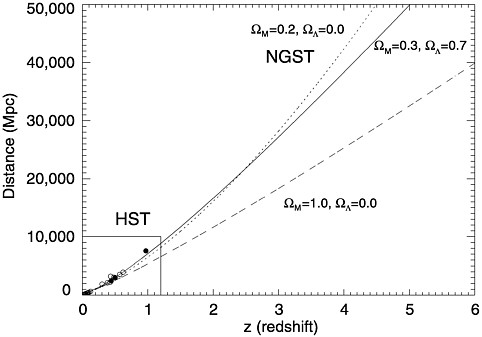
FIGURE 7.1 This diagram plots the distance to supernovae as a function of redshift, used to determine the geometry of the universe. The open circles were measured by ground-based observatories, and the filled circles are measurements with the Hubble Space Telescope. The box in the lower left-hand corner shows that the most distant supernovae that can be observed with HST are at z=1.2. The curved lines show the expected relationship between distance and redshift for three different models of the universe: an open model with no cosmological constant (dotted line), a flat universe with some matter and a cosmological constant making up 70 percent of the energy density (solid line), and a flat universe dominated by matter (dashed line). Only NGST will be able to measure the magnitudes for rest-frame wavelengths and in the region beyond z=1.2, where the models are clearly differentiated from one another. Courtesy of M.Livio, Space Telescope Science Institute (STScl).
By means of mid-infrared observations of the Kuiper Belt objects, from which distributions of sizes, albedos, and collision frequencies can be inferred, it will be possible to watch processes similar to those that created the planets several eons ago and check the theories of assembly.
NGST has superior sensitivity to large ground-based telescopes across its entire wavelength range. Its sensitivities will improve upon those of ground-based facilities by factors of up to 1000, meaning astronomical capability will increase by factors of up to 1 million. Its sensitivities will also exceed those of SIRTF at all operational wavelengths shorter than 30 µm, and it will have an order-of-magnitude better angular resolution.
This angular resolution is essential to resolve the most distant galaxies responsible for the far-infrared background (Figure 7.2). NGST will be the first facility to provide the sensitivity coupled with angular resolution commensurate with the sizes of high-redshift galaxies at wavelengths longer than 2 µm. Of particular importance will be NGST’s ability to
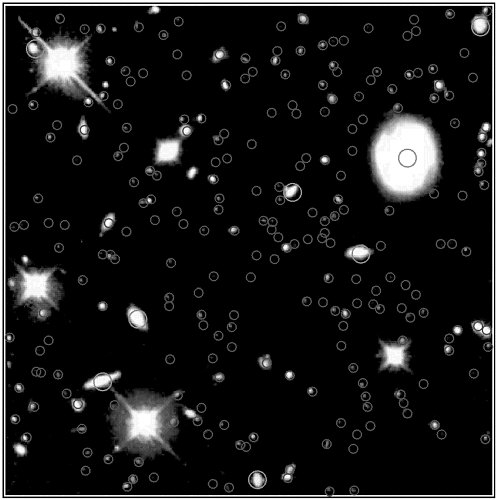
FIGURE 7.2 A portion of the Hubble Deep Field. The eight blue circles identify the galaxies whose near-infrared spectra can be observed with an 8-m-class ground-based telescope; the red circles mark the sources for which only NGST will be able to study the spectra at wavelengths longer than about 2.5 µm, allowing physical analysis of these faint galaxies. NGST will also be unique in providing continuous spectral coverage of these faint galaxies to give complete coverage of different redshifts. Courtesy of E.Schreier and H.Stockman, STScl.
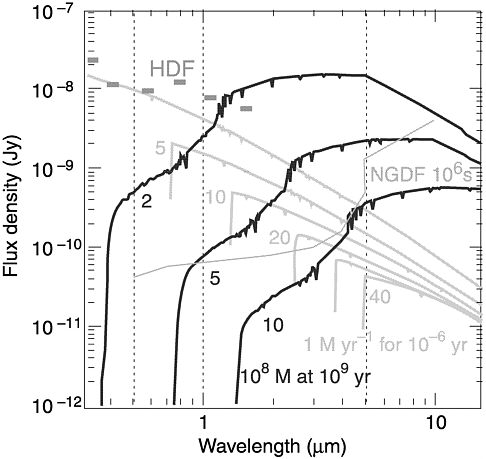
FIGURE 7.3 This plot shows the spectral energy distributions of two types of young galaxies at different redshifts. The blue curves indicate a starburst of 1 solar mass per year for 1 million years at redshifts of 0, 5, 10, 20, 30, and 40. The red curves show a more evolved galaxy with 100 million solar masses after 1 billion years of evolution at redshifts of 2, 5, and 10. The orange dashes show the sensitivity limits of the Hubble Deep Field in its six wavelength bands. The solid yellow curve shows the sensitivity of an NGST Deep Field after an exposure time of 1 million seconds—about 10 days. NGST will be able to detect young starbursts to a redshift of 20 and dwarf galaxies to a redshift of 10. Courtesy of H.Stockman, STScl.
obtain redshifts for the most distant galaxies (Figure 7.3). SIRTF will be unable to measure redshifts in most of these young objects, and the panel expects that the rich rest-frame optical spectrum of galaxies will continue to be the most important signature needed for redshift measurements of newly discovered objects in the distant universe.
Other proposed facilities for studying galaxy evolution and the history
of star formation in the universe include FIRST, the Atacama Large Millimeter Array (ALMA), a large far-infrared telescope in space (SAFIR), and a very large (30 to 100 m) telescope on the ground. FIRST is much less sensitive for deep imaging than NGST and lacks the angular resolution to discriminate high-redshift galaxies unambiguously from field galaxies at redshifts near 1. ALMA will be able to observe the Rayleigh-Jeans tails of some of the high-redshift galaxies that NGST will also see, but it will not provide enough data to characterize the galaxies to understand their evolution—for example, it cannot observe the stars in such galaxies and will only get redshifts in some cases. A very large ground-based telescope would be complementary to NGST, since it would be excellent for high-resolution visible and near-infrared spectra of objects discovered in NGST’s wide-field images. This space-ground combination would be similar to the currently successful HST-Keck combination.
The panel considered both long- and short-wavelength extensions of NGST’s core wavelength range of 1 to 5 µm. The longer-wavelength extension is the more compelling enhancement. The sensitivity and resolution of NGST will be superior to anything proposed for the next decade in the wavelength range 5 to 30 µm. The combination of NGST and a large far-infrared telescope would provide an unmatched combination for studying the high-redshift universe and the star-formation process nearby.
Extension to longer wavelengths is important for both extragalactic research into the origins of galaxies and for studies of star and planet formation in the Galaxy. The rich spectral domain in the thermal infrared—5 to 30 µm—and the transparency of dust make it a compelling window on the physical processes governing cloud collapse, disk evolution, and planet formation.
The diffuse infrared background radiation reaching us from the cosmos is an indicator of the total energy generated by stars and active galactic nuclei since the end of the dark age. Most of this background radiation probably originates in dusty young galaxies and their nuclei, where energy generated by stars and accretion onto massive black holes at optical and x-ray wavelengths is absorbed by dust and reradiated in the infrared. Ultimately a link between this diffuse radiation and the individual sources that generated this radiation will be required if we are to understand how and when these galaxies, their nuclei, and their stellar components originally formed and how they further evolved.
Source counts in the thermal infrared obtained with the Infrared Space Observatory reach galaxies out to z~1 but not much farther.
NGST could easily extend this range to much higher redshifts and could resolve the individual objects contributing to the diffuse infrared light. In fact, NGST will be needed to bridge the resolution gap between far infrared and near-infrared/optical telescopes for source identification of cool infrared objects. The large aperture provides adequate spatial resolution to permit clear identification, so that studies at other wavelengths can be carried out as well.
Similarly, star formation in the Galaxy is always associated with opaque clouds of gas and dust, and the study of the youngest phases of new stars takes place mainly at infrared wavelengths long enough to penetrate the dust. The thermal infrared is also the waveband where most of the luminosity of the youngest stars emerges, making thermal infrared observations important to determine the total energy budget of the stars. An extension of NGST capabilities to longer wavelengths is the panel’s highest priority for star formation research.
Given the large factors by which NGST improves upon the sensitivity and angular resolution of its precursors, it has an enormous discovery potential. It typically improves observational capability over all precursor missions by a factor of 1000. This discovery potential is one of the main reasons that the panel ranked NGST as the top priority.
Technology Development
NASA recognized that NGST needs substantial development in several areas, and work is now under way to enable a launch by 2008. NGST requires a deployable primary mirror fabricated from lighter materials and structures than have ever been used before. It needs control and image analysis systems to align the primary mirror segments once they are deployed and to keep them aligned in the changing thermal environment to which they will be exposed. Telemetry rates limit the number of detectors and field-of-view coverage for the observatory. Improvements in cryocoolers will be needed to enable operation beyond about 5 mm. Finally, improvements in the dark currents and read noises of near-infrared detectors are required to ensure good performance of NGST’s high-resolution spectrometers.
The panel is confident that the NGST project team’s technology development will be realized within the time and budget constraints. The project has already fabricated mirror sections with the desired low surface density. Advances in detector technology put the current generation of detectors very close to NGST requirements. Pixel formats of
20482 for near infrared and 10242 for mid-infrared detectors are available now or will become available in the near future. Extrapolations indicate that the dark currents requirements can be met with another generation of work on materials. The area of cryocoolers may need more attention in the NASA plan if the mid-infrared is to be pursued to the maximum extent possible.
Several of these technologies, once developed, will enable other missions, notably TPF. The deployable sunshade and the deployable primary mirror enable missions at both far-infrared and UV wavelengths. Cryocooler development is of interest to the same two categories of mission.
Cost
NASA presented the following estimates to the panel in FY2000 dollars:
|
Conceptual design and development |
$ 271 million |
|
Construction (assumes an ESA instrument) |
575 million |
|
Launch (new mid-size EELV) |
92 million |
|
Science and mission operations (10 years) |
267 million |
|
Total |
$1205 million |
The estimates include all U.S. investments by NASA but not Department of Defense investments. The panel notes that ESA and CSA together plan to contribute another $271 million. DOD is funding the bulk of the costs of the advanced mirror development technology in partnership with NASA.
TERRESTRIAL PLANET FINDER
The parameters of TPF—which consists of four 3.5-m telescopes in a free-flying interferometric array, diffraction-limited at 2 µm, and operating at <40 K—are listed in Table 7.2.
Scientific Goals
The primary science problems to be addressed by TPF are the following:
TABLE 7.2 Parameters of TPF
|
Parameter |
Planned Value |
Comments |
|
Wavelength range |
3–30 µm |
General imaging |
|
|
7–20 µm |
Planet detection |
|
Sensitivity |
0.35 µJy |
Planet detection (12 µm, 5σ in 104 s at λ/Δλ~3); better sensitivity for imaging |
|
Angular resolution |
7.5×10⁻⁴ arcsec |
3 µm, 1-km baseline |
|
Spectral resolution |
λ/Δλ~3–20 |
Planet detection (imaging) |
|
|
λ/Δλ~3–300 |
Continuum and spectral line imaging |
|
λ/Δλ~105 |
Option for specific lines (e.g., H2, H, CO) |
|
|
Temporal resolution |
<1 s |
Fringe sensing |
|
FOV |
0.25″ |
3 µm |
|
|
1.0″ |
12 µm |
|
Lifetime |
>5 years |
|
|
Cost category |
Major |
NASA funded |
-
Survey of ~150 stars to determine the frequency of planetary systems with planets the size of Earth or larger;
-
Low-resolution spectroscopic observations of ~50 planetary systems, looking for broad, strong spectral lines such as CO2 and H2O;
-
High-resolution spectroscopy of about five planetary systems to search for O3 or CH4; and
-
Milliarcsecond images of ~1000 astronomical objects at infrared wavelengths providing unprecedented views of protoplanetary disks, galactic nuclei, starburst galaxies, and galaxies at high redshift, as well as many other interesting objects.
The goal of TPF is to observe directly Earth-like planets around other stars and to measure their rudimentary atmospheric properties, looking for disequilibrium chemistry (Figure 7.4). Finding atmospheric species such as oxygen that require continuous production is the best hope at present of discovering life on other planets beyond the solar system in a
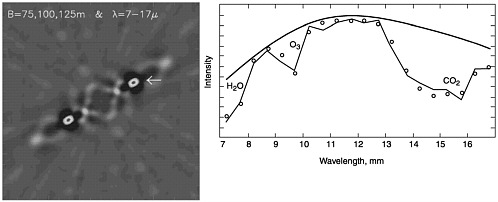
FIGURE 7.4 The left-hand figure shows an image reconstruction of an Earth-like planet around a nearby star. Because of the phase ambiguity in an interferometer, there are two symmetrically placed images. The right-hand figure shows the reconstruction of the spectrum derived from images at many different wavelengths. Note the presence of H2O, O3, and CO2, similar to what is seen in a spectrum of Earth’s atmosphere. Courtesy of C.Beichman, Jet Propulsion Laboratory.
passive experiment; active experiments would require any extraterrestrial life form to broadcast its existence either inadvertently or as a targeted attempt to communicate. TPF will be designed to detect Earth-sized planets around any of the several hundred nearest stars (<15 pc). Onboard spectrometers will have the resolution and sensitivity to resolve common molecular species in the atmospheres of most of these planets.
The panel considers direct observations of planets with the possibility of passive experiments to infer life as potentially the most important scientific advance of the next century, let alone the next decade. The philosophical implications are enormous, and it is a goal that will have overwhelming public support. If the technological hurdles can be overcome, the committee believes this facility must be built. It is only a question of time.
TPF will have the ability to make very-high-resolution images with exquisite sensitivity. Four cold, 3.5-m telescopes will be able to image examples of most common astronomical objects, so TPF will be an imaging interferometer with unprecedented resolution and depth. It will have a spatial resolution of 0.1 AU at the distance of the nearest star formation regions and 0.4 pc at a distance of 100 Mpc for extragalactic
objects. Examples of observations that TPF might carry out are the following:
-
Observations of the disks surrounding young stars at spatial resolutions of ~0.1 AU. Such an observational capability will permit direct study of the morphological, physical, and chemical structure of planet-forming environments. Existing theoretical studies of orbital migration and dynamical scattering as revealed by gaps and other structures in circumstellar disks will be challenged by observational data.
-
Observations of the hot dust surrounding a giant black hole in a galaxy nucleus. TPF will provide a direct test of unification theories for active galactic nuclei.
-
Detailed studies of star-formation regions in a variety of distant galaxies. TPF will achieve spatial resolution at infrared wavelengths in Virgo Cluster galaxies similar to what we now have for star formation regions in the outer parts of the Milky Way.
There is not room here to list all the potential science targets; however, there will be few areas of astrophysics untouched by the power of an infrared interferometer with the resolution and sensitivity of TPF.
While the primary design drivers for TPF are extrasolar planet studies, the panel noted with satisfaction that TPF will also be able to address a wide variety of other classes of astrophysical problems. The panel recommends that the TPF mission should plan for an allocation of observing time between planet searches and general astrophysics to ensure that astronomical observations are included in the mission goals.
Technology Development
TPF will require more technology development than most missions. The areas where the current state of the art needs substantial improvements include nulling (Figure 7.5), formation flying, large cryooptics, adaptive optics, metrology, control systems and systems engineering, passive cooling, and infrared detectors. NASA has a plan to develop each of these areas in precursor missions that will operate before TPF enters its development phase.
Some of these techniques will be challenging. The panel believes all will be developed as part of a staged plan but is skeptical about the predicted development times. It may well be that TPF technologies will be ready for launch before 2020; NASA did manage to put a man on the
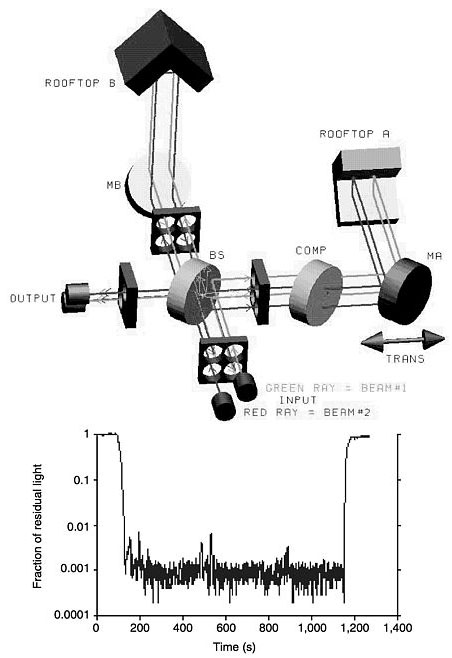
FIGURE 7.5 Lab experiment (shown schematically at the top) from E.Serabyn, Jet Propulsion Laboratory (JPL), on nulling in the visible that achieves 25,000:1 on laser and 5000:1 on 5 percent white-light source at 0.6 µm. The plot below is the amount of residual light versus time for the experiment (in seconds). Since null depth improves as wavelength squared for a given path length stability and optical system accuracy the 10-µm performance of the white-light system would be 5000×(10/0.6)2~1.4×106, sufficient to achieve TPF’s main goals. Courtesy of C.Beichman, JPL.
Moon in 10 years starting from essentially no base. It seems unlikely, though, that the country would be willing to support TPF at the same level at which it supported the Apollo program.
Table 7.3 lists precursors to the TPF mission that will be used to develop the needed technology. Since the development is incremental, some of the early precursors will not test technology to the precision needed to guarantee a successful TPF. However, at least one mission in each category will test the technology at the needed level (these are denoted in the table with asterisks). These critical missions, including SIM, ST-3, and NGST, must be flown successfully before TPF to demonstrate the technological readiness of the mission.
It would not be surprising if delays of several years occurred because so many new techniques need to be developed. Therefore, it would be
TABLE 7.3 TPF Precursor Missions
risky to accord TPF a higher priority for the next decade than NGST, for example, which is farther along its development cycle and will certainly be as important to general astrophysics as viewed today.
Cost
There is no cost cap on the current TPF mission. The panel believes it is exceedingly difficult to estimate the cost of a mission with such ambitious technology goals, and although it did not attempt an independent cost analysis, it believes that cost growth would not be surprising in light of the development work to be done. NASA estimates the life cycle costs at approximately $2.1 billion:
|
Predevelopment (FY1999 to 2006) |
$ 415 million |
||
|
|
ST-3, including launch vehicle |
|
180 million |
|
Technology development |
110 million |
||
|
Studies and designs through PDR |
125 million |
||
|
Development cost (FY 2007–2011) |
1300 million |
||
|
Launch vehicle |
200 million |
||
|
Operations (5 years) |
200 million |
||
|
|
Total |
$2115 million |
|
MODERATE MISSIONS
SINGLE-APERTURE FAR-INFRARED OBSERVATORY
The parameters for SAFIR, a passively cooled, 8-m-class, far-infrared telescope in a distant orbit (probably L2) —it could be an NGST clone with a modified sunshield—are given in Table 7.4.
Scientific Goals
The primary science problems to be addressed by the SAFIR observatory are the following:
-
Study the birth and evolution of stars and planetary systems at ages so young that they are invisible even to NGST. The far infrared is sensitive to emission from gas and dust at temperatures between ~20 K and 200 K, which is the temperature range for the majority of the material in protostellar envelopes and protoplanetary disks.
TABLE 7.4 Parameters for SAFIR
|
Parameter |
Planned Value |
Comments |
|
Wavelength range |
30–300 µm |
|
|
Sensitivitya |
0.3 µJy (30 µm) |
SIRTF=28 µJy at 24 µm |
|
|
1.3 µJy (60µm) |
SIRTF=400 µJy at 70 µm |
|
18 µJy (100 µm) |
FIRST=2400 µJy at 90 µm |
|
|
100 µJy (300 µm) |
FIRST=3500 µJy at 180 µm |
|
|
Angular resolution (30 µm diffraction-limited) |
0.8″ (30 µm) |
Same as NGST at 30 µm |
|
8″ (300 µm) |
FIRST will provide ~18″ at 300 µm |
|
|
Spectral resolution |
λ/Δλ~5 |
Imaging |
|
|
λ/Δλ>103 |
Atomic and molecular lines |
|
Temporal resolution |
1 s |
|
|
FOVb |
>6′×6′ |
Assumes 128×128 photoconductors and 32×32 bolometer arrays |
|
Lifetime |
5 years |
|
|
Cost category |
Moderate |
NGST clone assumed |
|
a5 in 104 s, confusion-limited by faint galaxies (ISO extrapolated). bTo achieve the full field of view, a separate wide-field mode would be present that is not diffraction-limited at all wavelengths owing to the limited number of detectors. |
||
-
Determine the bolometric luminosities of the first generations of stars and galaxies in the early universe. Dusty galaxies radiate the bulk of their energy at far-infrared wavelengths.
-
Understand the trade-off between star formation and nuclear activity in active galaxies. Far-infrared radiation penetrates circumnuclear and circumstellar dust and provides the tools to distinguish the sources of luminosity in active galaxies.
-
Explore the universe in the far infrared, making use of the enormous discovery potential (greater by a factor of ~105 than that of SIRTF) to uncover new phenomena.
The far-infrared region lies between the visual wavelengths dominated by starlight and the millimeter wavelengths of the cosmic background radiation. This wavelength region, here taken to be the wavelengths between about 30 and 300 µm, is one of the least explored but potentially most important because of its diagnostic potential. It plays an important role in astronomy because of the prevalence of dust in the
space between the stars. The dust is opaque, or nearly so, in the visible spectrum, so it absorbs starlight and reradiates the energy as far-infrared light. In some galaxies and in many regions within our galaxy, the dust is so dense that the far-infrared light dominates the energy output. Equally important, the dust is almost transparent in the far-infrared spectrum, making it possible to penetrate dusty clouds and galaxies with infrared observations and see the objects producing the original radiation: stars and accretion onto giant black holes.
The coming generations of far-infrared telescopes, SIRTF and the European FIRST mission, will be limited by source confusion at the faintest levels (Figure 7.6). The only way to overcome source confusion is to increase the size of the aperture or increase the baseline in an interferometer. The build path proposed here is to construct an 8-m-class telescope that could be used first as an interferometer (by using the
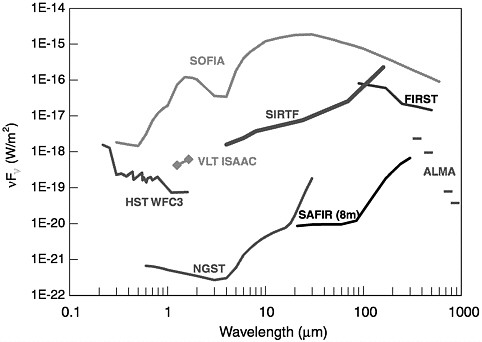
FIGURE 7.6 Relative performance of different facilities. The estimated performance is based on the combination of photon and confusion noise appropriate to the high-Galactic-latitude sky and assumes 5σ detections in 104 seconds. The performance is compared with the most sensitive facilities that will be available by 2010 under current plans. ALMA will not have continuous coverage, owing to the opacity of Earth’s atmosphere, and is plotted as line segments corresponding to the transmission windows. Courtesy of G.Rieke, University of Arizona, and S.Beckwith, STScl.
outside radii of the mirror) to give a resolution of 1 arcsec at 100 µm. This telescope could, alternatively, be one element of an interferometer to be built after 2010, so that baselines of several hundred meters would become routine. At a resolution of 1 arcsec, it will be possible to measure the far-infrared light from the galaxies in the distant universe discovered by NGST without source confusion and to penetrate the cores of molecular clouds to witness the onset of disk formation when stars are born.
SAFIR will address scientific areas similar to those addressed by ALMA—star formation locally and in very distant galaxies—but the two facilities do so from complementary perspectives. Because ALMA observes wavelengths longward of 300 µm and in only narrow bands, it is best suited to studying the coolest material in the outer regions of collapsing stars and the very highest redshift galaxies. SAFIR will be most sensitive to warmer material at T~20 to 100 K. Examples of warmer material include circumstellar disks and Kuiper-Belt-like regions lying 5 to 200 AU from stars. The vast majority of the bolometric luminosity from regions of star formation at redshifts below 2 is in the far infrared. Furthermore, SAFIR provides continuous coverage of the spectrum, especially important to observe spectral features such as the mid-infrared lines that distinguish active galactic nuclei (AGN) from starbursts over a broad range of redshifts. These lines, as well as the fundamental transitions of molecular hydrogen at 28 and 17 µm, are not accessible with ALMA except at redshifts in excess of 12. SAFIR will excel in the z~1 to 5 domain, where it will be able to observe the peak in far-infrared emission from dust.
Birth and Evolution of Stars and Planetary Systems Stars are born in cold interstellar cloud cores that are opaque to all radiation at mid-infrared (~10 µm) and shorter wavelengths. After about 100,000 years, the creation of a young star within the cloud core causes a disruption of the cloud by the action of powerful stellar winds. Surrounding the star is a circumstellar disk, whose subsequent evolution is the source of a planetary system. The initial assembly of the star and disk is hidden from view. To understand how the cloud collapses, how it fragments, and how it builds a disk, we must penetrate the dust and observe the physical conditions directly. To understand when, where, and how frequently these disks give rise to planetary systems, it will be essential to observe these processes at far-infrared wavelengths, where the bulk of the radiation emerges.
A far-infrared 8-m telescope can provide a resolution of 1 arcsec at 100 µm or about 150 AU at the distance to the nearest star-forming regions. Spectral imaging would resolve the density and temperature structure of ~1000 AU collapsing cores. This resolution should uncover fragmentation in the formation of binary systems, since about half the binaries observed have separation greater than 100 AU.
The temperature of the gas in the core is only a few tens of kelvin, so that the primary molecular transitions lie in the far-infrared and submillimeter regions. Emission lines from water and high-order rotational lines of CO, as well as the atomic lines of oxygen, will reveal physical conditions in the same manner as they have for the Orion Nebula (Figure 7.7). Emission from H2O is the principal means by which clouds lose their energy from the highest temperature and density regions in their interior. Bright water lines between 25 and 180 µm dominate the cooling in the inner cloud, where a broad component is expected from the accretion shock and a narrow one from the disk. The CO lines from 170 to 520 µm are the main coolants for the outer cloud; warmer CO from within the cloud can also be studied because of velocity shifts due to the collapse. This suite of lines therefore provides complete access to the process of star formation.
The First Generations of Stars and Galaxies Even small amounts of dust can shift starlight into the far infrared. This shift occurs for a few percent of the local galaxy population, one of the best examples being M82, where only a few percent of the light escapes in the visual band and the luminosity is dominated by far-infrared radiation. At redshifts between 1 and 3, when star formation appears to have been most vigorous, a substantial fraction of all galaxies may have their light extinguished at short wavelengths only to reemerge in the far infrared.
The measurements of the DIRBE experiment aboard the Cosmic Background Explorer (COBE) indicate that the far-infrared energy density in the distant universe is comparable to that of visible and near-infrared light. This far-infrared background is thought to arise from starburst galaxies at redshifts between 1 and 3, meaning that roughly half the young galaxies radiate primarily in the far infrared. If so, it will be necessary to resolve this background into its components and measure the far-infrared luminosities of the individual sources to understand the history of heavy-element synthesis after the Big Bang. An 8-m telescope with detection limits on the order of 0.1 mJy would probably resolve most of this high-redshift background into individual galaxies, thus showing the
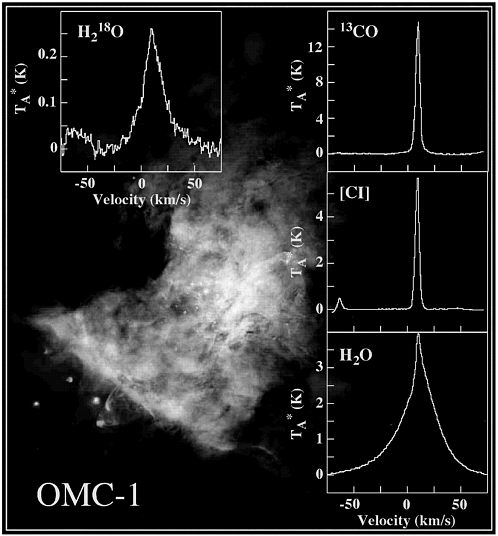
FIGURE 7.7 These spectra of the Orion Molecular Cloud were taken with SWAS. The indicated gases—H218O, 13CO, H2O, and atomic carbon, Cl—are primary coolants over most of the temperature and density range in which star formation occurs. Cooling by pure molecular hydrogen is believed to play a major role in the earliest phases of galaxy formation in the early universe, before heavier elements like oxygen and carbon had been formed. To observe the formation of these primordial galaxies at high redshifts, far-infrared telescopes with large apertures are essential. Courtesy of G.J.Melnick, Harvard-Smithsonian Center for Astrophysics.
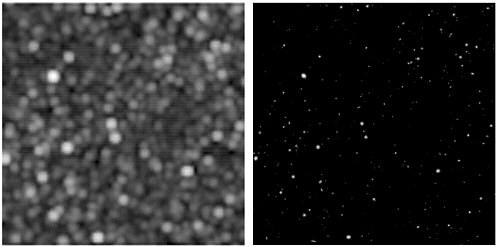
FIGURE 7.8 These simulated 70-µm images span a four-decade range in flux from the peak flux in the field. The brightest galaxy in the field is 39 mJy. The FOV is 413 arcsec for each image. On the left is a SIRTF/MIPS image; on the right is an image from an 8-m far-infrared telescope. At this wavelength, the 8-m gives a 2 arcsec diffraction-limited beam, which provides an angular resolution that is barely suitable for identifying sources at other wavelengths. The SCUBA 12-arcsec beam and the SIRTF 17-arcsec beam will lead to confusion in source identifications and redshifts. Courtesy of E.L.Wright, University of California, Los Angeles.
dominant phases of dust-embedded star formation and nuclear activity throughout the universe (Figure 7.8).
The Hubble Deep Field revealed many galaxies too faint to contribute significantly to the far-infrared background. To complete the study of star formation in the early universe, we must understand these small systems and possible galaxy fragments. The rate of star formation in these small galaxies can best be determined from far-infrared measurements of the energy between 20 and 200 µm. By using an 8-m far-infrared telescope in tandem with NGST and ALMA, the spectral energy distribution from 1 µm to 1 mm can be measured, which will define the peak output wavelength and total energy balance. For the faintest galaxies, the location of the peak can be used to estimate a redshift not possible with NGST and ALMA alone.
Active Galactic Nuclei and Starbursts in the Early Universe Giant black holes weighing as much as a billion Suns are believed to reside at the center of most galaxies. Astronomers observe galaxy mergers nearby that produce luminous far-infrared radiation through a combination of violent starbursts and energy released as matter falls into these black holes (AGN). Both types of energy source are hidden within cocoons of interstellar dust that are impenetrable at the optical and near-infrared wavelengths. These local events are uncommon, but galaxy mergers are thought to have been very common in the early universe, when the galaxies were assembled from the residue of the Big Bang.
What happened during the much more common mergers that built galaxies in the early universe? The fine structure lines of Ne II (12.8 µm), Ne III (15.6 µm), and Ne V (14.3 µm) are the best tools to distinguish unambiguously whether the luminosity of a dusty galaxy is dominated by a burst of star formation or by an AGN. They are 30 times less susceptible to absorption by dust than lines at visible wavelengths. Observed today, these lines will be redshifted into the 45- to 55-µm range from AGN at the peak of the assembly phase, currently thought to be near redshifts of 3. An 8-m far-infrared telescope would have both the necessary resolution and sensitivity to use this suite of lines to determine the relative roles of star formation and nuclear activity in the early universe.
An 8-m NGST clone will have 10 times better angular resolution than SIRTF and will provide more than 100 times better sensitivity with more than 10 times the number of detectors. As for the speed of an observation—the astronomical capability defined in the 1991 survey committee report, an 8-m far-infrared telescope will be 105 times faster than SIRTF and more than 103 times faster than FIRST at the longest wavelengths where they overlap. This enormous discovery potential is what most impressed the panel when it was making its recommendation for this mission.
The techniques developed for SIM and, eventually, TPF will later be usable with several of these telescopes to produce an infrared interferometer as a next step to advance the field. In this phased approach, the most expensive technology development will be borne by the Grand Challenge missions: NGST for cooled, deployable mirrors and SIM and TPF for interferometric techniques. For this reason, it can be assumed that the filled-aperture telescope will be a moderate mission (<$500 million).
Technology Development
As noted above, the Grand Challenge missions will develop the most difficult technologies. An NGST clone with a sunshield of twice the efficiency (i.e., doubling the number of layers in the NGST design) could produce a superb far-infrared telescope. A telescope reaching < 10 K passively cooled would probably eliminate the need for a cryocooler for the thermal infrared detectors, although it is uncertain in the absence of a detailed design study if passive cooling will be adequate to reach these temperatures. A cryocooler to take bolometers to subkelvin temperatures is desirable and will have to be developed for other missions as well (e.g., ultraviolet detectors).
Detectors exist with the necessary sensitivity, but they do not have large pixel formats to take advantage of large fields of view. Pixel formats of 32×32 are currently state of the art for the far-infrared photoconductors. The largest bolometer arrays are about 10×10. The main technology development needed is in increasing these formats. The panel’s working assumptions are that bolometers will increase 10-fold, to 32×32, and photoconductors will increase 16-fold, to 128×128.
Bolometer formats are increasing now because they have important applications in ground-based astronomy. The panel assumed that this technology would develop without additional funding from NASA. To move from the current state of the art in photoconductor arrays, which are 32×32 devices, will require a substantial investment on NASA’s part. There are no ground-based or commercial applications for these arrays. An investment of $500,000 per year for 5 years would lead to a flight-qualified prototype of a 128×128 Ge:Ga photoconductor array. This estimate assumes that the current expertise in building arrays for SIRTF does not get lost and will not have to be relearned. This $2.5 million might be included in the cost of the mission.
Cost
The panel requested a detailed cost estimate from scientists at the Goddard Space Flight Center and the Space Telescope Science Institute based on NGST costs. Its conclusion is that a far-infrared 8-m telescope (30 to 300 µm) based on NGST technology would cost about 50 percent of NGST’s cost. It is likely that a pure NGST clone would be inadequate to realize the full potential of a far-infrared telescope, so that some technology development would be needed to cool the telescope to less
than 10 K. The technology development cost is unknown and not counted in the budget for projects. The cost estimate below, which has been adjusted to FY2000 dollars, assumes reduced mission operations costs and a 5-year lifetime.
Although this telescope is recommended as a moderate-class mission, its cost is very close to the boundary that separates moderate from major missions, and the panel recognizes that it could just as appropriately be classified as a major mission, as was done in the survey committee report.
|
Construction (assumes an ESA instrument) |
$335 million |
|
Launch (new mid-size EELV) |
92 million |
|
Science and mission operations (5 years) |
108 million |
|
Total |
$535 million |
SPACE ULTRAVIOLET OPTICAL TELESCOPE
The parameters for SUVO, an 8-m-class telescope in a distant orbit (probably L2) —it could also be a spin-off from NGST—are given in Table 7.5.
Scientific Goals
The primary science goals of SUVO are the following:
-
Study the evolution of the structure and composition of the intergalactic medium.
-
Map out dark matter at cluster and supercluster scales.
-
Study feedback effects from star formation on interstellar medium (ISM) and protoplanetary disks.
-
Determine processes by which galaxies, clusters, and AGNs are formed.
The SUVO (8-m) mission will focus on high-throughput ultraviolet spectroscopy and wide-field optical and ultraviolet imaging.
Mapping Dark Baryons and Large-Scale Structure One of the important predictions generated by hydrodynamical simulations of galaxy formation is the existence of a large-scale filamentary network of matter spread throughout intergalactic space (the “cosmic web”). Not only is
TABLE 7.5 Parameters for SUVO
|
Parameter |
Planned Value |
Comments |
|
Wavelength range |
0.115–1 µm |
|
|
Sensitivity |
50 pJy |
Visual imaging, mV(lim) ~35m |
|
|
0.6 µJy |
λ/Δλ~3×104, S/N=10 in 4×10⁴ s |
|
Angular resolution |
0.005″ (0.1 µm) |
NGST will give ~0.06″ at 1 µm |
|
|
0.03″ (1 µm) |
|
|
Spectral resolution |
λ/Δλ~2×103 |
Very high resolution is a stretch goal |
|
|
λ/Δλ~4×104 |
|
|
λ/Δλ~2×105 |
||
|
Temporal resolution |
33 µs-1 ms |
MCP and STJ responsesa |
|
FOV |
10′–15′ |
|
|
Lifetime |
5–10 years |
|
|
Cost category |
Moderate |
NGST spin-off assumed |
|
aMCP is microchannel plate and STJ is superconducting tunnel junction. |
||
the universe dominated by unseen (dark) matter, but a large fraction of ordinary (baryonic) matter remains undetected and probably resides in the intergalactic medium (IGM). The infall of this intergalactic gas continues the buildup of modern galaxies and their halos. It may also have triggered “recent” star formation 3 to 10 billion years ago (z<2) and fueled quasar outbursts by supplying gas to the black holes thought to lie at the centers of many galaxies.
At z<1, the gas in the IGM is distributed in roughly equal amounts between warm, photoionized gas at 30,000 to 100,000 K and hot shocked gas at 106 to 107 K. Such gas is exceedingly difficult to detect optically. By far the best way of detecting the warm IGM during the last 70 to 80 percent of cosmic time (z<1.65) is by measuring the UV resonance absorption lines of hydrogen (Lyman-alpha) and the heavy elements produced by the first stars (e.g., C, O, Si, Mg, and Fe). The ultraviolet band is unique in being able to detect trace amounts of these important chemical elements; UV spectra are several orders of magnitude more sensitive than x rays in detecting heavy elements. In addition, the background quasars used for absorption spectra have far-higher photon fluxes in the UV than in the x ray. Thus, studying the cosmic web of
matter and making quantitative measurements of the modern evolution of the chemical products is a problem that can best be done by high-throughput UV spectroscopy with SUVO.
From recent galaxy redshift surveys, astronomers have detected the existence of an organized large-scale structure in the galaxy distribution; this structure takes the form of large filamentary walls and voids. By 2010, these galaxy surveys will outline the distribution of luminous matter in fine detail, but the dark, gaseous universe (the IGM) will remain largely unexplored at z<1.65 (the last 70 to 80 percent of cosmic time). SUVO will measure the distribution of dark baryonic matter in these filaments and voids, tracing the cosmic web using UV spectra of the Lyman-alpha lines toward QSOs and other AGN (Figure 7.9). The SUVO goal is to conduct a survey on subdegree angular scales of baryons in the IGM comparable to that of the MAP explorer and to the structure seen in galaxy surveys. Doing so will allow connecting the high-redshift seeds of galaxies and clusters with the distribution of galaxies and IGM in the modern epoch, at z<1. This project is impossible with the throughput of current UV spectrographs. To achieve a frequency of one QSO every 100 arcmin2 on the sky requires using QSOs at mB=18 to 20 as background targets. In the next several years, the GALEX mission is expected to identify 105 to 106 QSOs with 18<mB<20, and the Sloan survey will provide redshifts for 105 of these targets.
Detecting Unseen Matter in the Modern Universe SUVO can use large-scale weak gravitational lensing to probe the underlying matter in galaxy clusters and superclusters, extending over 5 to 20 Mpc h−1. A 10 to 15 arcmin field of view (much larger than is achievable with HST or NGST instruments) provides a good match to expected correlation lengths of cosmological structures at z<1. Through its wide-field imaging, SUVO will use weak gravitational lensing to map out the distribution of dark matter in clusters of galaxies and perhaps on the supercluster scale. Light from distant galaxies is bent and focused into small, faint arclets by the gravitational fields of intervening clusters and superclusters. Although some weak lensing studies can be done from the ground, experience with the Hubble Space Telescope has shown that the amount of dark matter on large scales is most accurately determined in space. The availability of a very small, stable point-spread function and the access to the blue-light characteristic of the background galaxies at z<1 gives SUVO wide-field imaging a significant advantage.
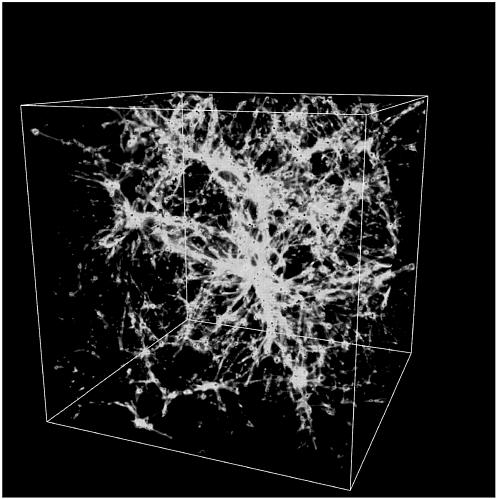
FIGURE 7.9 This simulation shows the expected distribution of intergalactic gas resulting from structure formation in the early universe. Most of the matter is cold and dark but can be detected via its absorption of light from distant quasars. SUVO could map this intergalactic structure that may contain most of the normal matter in the universe through systematic observations of many quasars. Courtesy of R.-Y.Cen and J.P.Ostriker, Princeton University.
Studying the Feedback from Star Formation An important challenge for UV astronomy in 2010 will be to follow the emergence of the modern universe over the last 10 billion years (z<1.65). As described earlier, the gaseous components of the universe during this epoch can best be studied in the ultraviolet, where one has access to the resonance lines of H (Lyman-alpha) and other key heavy elements. At z>1.65, some of these lines are redshifted into the optical. However, this leaves some 70 to 80 percent of cosmic time inaccessible without UV instruments. The lack of high-throughput UV spectroscopy is a major hindrance to understanding the cosmic chemical evolution of the modern universe at z< 1.65.
With SUVO, astronomers will be able to make precision studies of the modern (z<1.65) counterparts of star-forming galaxies in the high-redshift universe studied with NGST. The fact that stars at redshifts less than 1.65 produced over 90 percent of the heavy elements seen today further justifies the need for access to the UV, which will give astronomers the key resonance lines of most elements. For the most recent 70 percent of cosmic time, the UV band provides the best means for them to quantify the rate at which galaxies accrete mass from the IGM, form new heavy elements in stars, and expel mass and radiation as a result of this star formation. UV spectra of both emission and absorption lines provide quantitative measurements of the effects of “feedback” from star formation on the surrounding IGM and on the galaxies themselves. This feedback takes the form of newly synthesized heavy elements (C, O, and so on), of powerful ionizing radiation from massive stars, and of hot gas produced by stellar winds and exploding stars. This feedback of radiation and energy modulates the rate at which galaxies continue to accrete gas and determines how heavy elements are spread throughout the universe.
Studying Galactic Star Formation With Hubble, spectral imaging in the optical and ultraviolet proved its value in measuring the products of star formation in local regions of the Milky Way. The usefulness of these images is dictated by the physics of line emission and the peak of the radiative cooling function at 105 K, arising from strong UV emission lines of C, N, and O. The UV and visible bands also allow astronomers to probe the effects of stellar radiation on exposed molecular clouds and protoplanetary disks. Understanding the effects of Galactic ionizing radiation and stellar outflows is critical to understanding large-scale star formation and the survivability of disks in the Galactic environment.
The narrow-field UV/optical detectors aboard HST provided detailed images of nearby star-forming regions, Orion’s protoplanetary disks, planetary nebulae, and shock waves. With its wide-field imagers and filters, SUVO will be able to map, in a single pointing, entire star-forming regions in diagnostic emission lines and broadband colors. Within the Milky Way, but more importantly in external star-forming galaxies, SUVO will be able to study global star formation and the interactions between young star clusters and the ISM. Diffraction-limited imaging will allow astronomers to measure the interactions of stars and the ISM at scale lengths necessary to probe important physical processes (winds, shock waves, thermal conduction, and wind ablation of disks). The dynamic range and wide field of these images will enable astronomers to study the stellar initial mass function, after the molecular cloud is blown away, from the most massive stars down to brown dwarfs. In this respect, UV/optical imaging is complementary to infrared studies of the initial stages of star formation.
Some of these science goals are complementary to those in the IR and x-ray regimes. However, some can only be achieved using the wide-field images and sensitive spectral diagnostics of the UV and optical bands. In particular, images of weak gravitational lensing and large-scale surveys of Lyman-alpha absorption may be the only way to find the dominant components of the invisible universe. SUVO will allow astronomers to map out the large-scale distribution of dark matter and the nearly invisible warm components of the cosmic web of gaseous matter that may dominate the missing baryons.
Technology Development
No high-throughput UV/optical mission will be possible without significant NASA investments in technology, including UV detectors, gratings, mirrors, spectrographs, and imagers. The panel assumes the telescope will use the technology developed for NGST: lightweight, deployable optics. With an 8-m aperture, SUVO will achieve a 10-fold increase in collecting area over HST for imaging and spectroscopy. With improved efficiencies in detectors and gratings and with increases in camera sizes and in spectral multiplex efficiency by means of simultaneous wavelength coverage, SUVO should achieve, overall, a 100-fold increase in power.
The most critical needs for SUVO are the following:
-
Develop more sensitive UV detectors with low background noise, high quantum efficiency, large dynamic range, and large formats.
-
Develop three-dimensional, energy-resolving detectors such as photon-counting superconducting tunnel junction (STJ) or transition-edge sensor (TES) devices. These cryogenic detectors have the potential to revolutionize UV/optical astrophysics, and the cryogenic technology would be shared with other missions (far-IR and submillimeter).
-
Space-qualify large mosaics of low-noise, high-quantum efficiency charge-coupled device (CCD) detectors (at least 16K×16K) for wide-field imaging cameras in the optical and near UV.
-
Develop micromirror arrays for use in multiobject and integral-field spectrographs in the UV and visible.
-
Develop large, lightweight precision mirrors for use in the UV/ optical. Although SUVO could be done with a 4-m monolith, the extension to an 8-m aperture will probably require segmented deployable optics.
SMALL MISSIONS
ULTRALONG-DURATION BALLOONS
For many small payloads, the top of the stratosphere accrues essentially all the benefits of space, and these payloads could be flown on balloons at a fraction of the cost of satellites or of using a space shuttle. The principal disadvantages of balloons—short-duration flights and lack of control over the flight path—can be alleviated with new technologies that would enable flights of 1-ton payloads at altitudes above 35 km for 100 days or longer with enough control over the flight path to ensure a safe landing at the point of launch. As such, balloons would be more attractive for many small payloads than traditional spacecraft and would give NASA an inexpensive way to carry out novel science experiments as well as to prove new payload technology and train future scientists in instrumentation.
Examples of the kind of science that can be carried out with balloons include searches for planets with a coronagraph on a diffraction-limited telescope a few meters in diameter; the imaging of convective flows and magnetic fields in the Sun’s photosphere with a large solar telescope; extragalactic observations with a moderate-size far infrared telescope; and all-sky surveys at hard x-ray wavelengths. The top of the stratosphere is far superior to terrestrial sites and enables a wide range of
small-mission science experiments at wavelengths not transmitted to Earth.
The typical balloon science payloads would be similar to those proposed under the Explorer program. The panel recommends that ULDBs be permitted in the competition for Explorer missions. Furthermore, it finds that it would be appropriate to invest money in balloon technology to enable flight path control and very long flights. The investment could come from either the technology program or the Explorer program as part of the cost of a SMEX mission.
LABORATORY ASTROPHYSICS
Much of the data provided by new space missions will have spectral signatures that cannot be interpreted given our current knowledge of atomic and molecular lines. Resonance transitions from small particles are commonly observed that lack counterparts in the limited number of laboratory studies of solid-state lines. It is already the case that space missions reveal spectral lines that are unidentified owing to a lack of laboratory data. This problem spans the spectrum from the x ray to the far infrared and means that the space missions do not realize their full potential for basic research.
Laboratory research can lead to important discoveries. For example, spectra observed in the disks around young stars showed the presence of the mineral forsterite, whose spectrum had been measured in the laboratory. Forsterite is a magnesium-rich silicate that is seen in the spectra of some comets and is also known on Earth. The close match between spectra of the circumstellar disks, thought to be the birthsites of new planetary systems, and those of comets, consisting of the same material in the disk surrounding the proto-Sun, greatly strengthened the belief that the young stars are akin to the early phases of our solar system and that the early solar system consisted of cometlike bodies orbiting the young Sun. The material from these comets is believed to have aggregated in the solar system planets known today.
Similar conditions dominate the optical and ultraviolet spectra of many ionized molecular and atomic species and of radicals that are unstable under normal terrestrial conditions. Such substances, although short-lived, can often be produced in the laboratory and studied in sufficient depth to permit unambiguous identification when astronomically observed. A particular instance of this is the identification of the diffuse interstellar bands. More than 150 of these are now known,
though none has to date been unambiguously identified. Preliminary laboratory studies now indicate that some of these bands may be associated with ionized buckyballs,  Another recent laboratory study indicates that the anion of the linear carbon chain
  may be associated with the narrow bands at 496.4, 561.0, 574.7, 606.5, and 627.0 nm. This study led to the suggestion that other bands may be due to carbon chain anions that are six, eight, and nine atoms long. Suggestions such as these require laboratory follow-up, since there are no theoretical means for calculating the energy levels of such molecular ions or the transition probabilities between these levels.
The cost of laboratory studies tends to be low in comparison with overall mission costs but can make a decisive difference in obtaining the astrophysical insights that these missions were designed to yield. The panel recommends an increased investment in laboratory astrophysics to take advantage of the wealth of new data already being returned by space science missions.
TECHNOLOGY FOR THE FUTURE
ENERGY-SENSITIVE UV/OPTICAL DETECTORS
A revolution is occurring in the technology for ultraviolet detectors. Two technologies, superconducting tunnel junctions (STJ) (Figure 7.10) and transition-edge sensors (TES), make it possible to measure the energy of individual photons as they are detected. Unlike all previous techniques, these detectors simultaneously give the photon rate (brightness) and spectral energy distribution. For many applications, all images will immediately yield modest-resolution spectra of each pixel. The increase in information capacity relative to today’s images is huge. These detectors will increase the efficiency of spectral observations by factors on the order of 100.
When fully developed, these detectors will increase the astronomical capabilities of even small telescopes by an equivalent factor. The increased capability will permit many scientific problems to be solved with current telescopes, without the expense of building larger telescopes. This potential is so great that the panel recommends NASA invest aggressively in these technologies, perhaps selecting the most promising after an initial investment, to ensure that the new potential is fully exploited. The panel believes that investments of about $25 million would
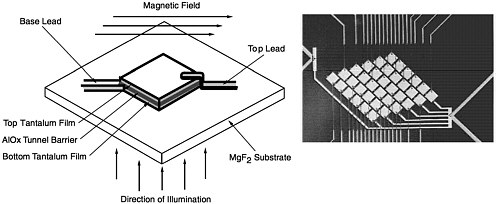
FIGURE 7.10 A schematic diagram of a superconducting tunnel junction detector shows the basic elements for the first ofthe ultraviolet-energy-resolving detectors (left). An array of 6×6 detectors (pixels) has been fabricated and is shown on the right in a microphotograph. Courtesy of ESTEC (<http://www.estec.esa.nl>).
save several times that amount by enabling new science without further increasing the size of telescopes in the next two decades.
Investment in energy-resolving detectors is the top priority of the panel for new technology development.
REFRIGERATORS
Most detectors require cooling to achieve their full sensitivity. The STJ and TES detectors operate at millikelvin temperatures. Far-infrared detectors typically must be cooled to a few kelvin. Far-infrared telescopes require optics below about 10 K to achieve their full potential. For these applications, missions will need refrigerators capable of operating for long periods with minimal power to keep the detectors and optics cold.
NASA should invest in technology to develop space-qualified refrigerators needed for the suite of missions enabled by the new detector technologies. It should be straightforward to develop devices for far-infrared applications. It will be more challenging to make refrigerators capable of millikelvin temperatures, but because the new UV detectors have tremendous potential, it is vitally important to invest in the needed
technology. The panel believes an investment comparable to that for detectors, about $25 million, will be needed to develop technologies for next-generation cryocoolers.
SPACECRAFT COMMUNICATIONS
Missions currently under consideration envisage gathering data at rates many orders of magnitude higher than were traditionally considered possible. Missions such as NGST are expected to have focal plane arrays with more than 3×108 pixels, and even this number will not capture all the information delivered by the telescope—more than 10 times as many pixels would be needed to critically sample the entire diffraction-limited field of view. At 16 bits per pixel, the characterization of a single frame then would require almost 1010 bits of information. Exposure times lasting no more than a minute will be routine to ensure that none of the pixels become saturated, meaning that bandwidths on the order of 1 billion bits per second (GHz) would be needed to transmit the data to Earth.
Current telemetry systems for NASA’s science missions are limited to data transmission rates of a few million bits per second (MHz). Moreover, the telemetry bands need to be shared among all the different missions simultaneously operating in space. The rate has not been upgraded significantly in the last few decades and is rapidly becoming the bottleneck that will limit the utility of the more ambitious missions being planned.
Onboard processing and data compression can help but cannot completely alleviate this bottleneck. Most missions encounter unanticipated sources of noise that can be removed only with processing that involves interactive analysis. Interactive processing requires the transfer of all the data to Earth, where sophisticated algorithms can be developed on computers much more powerful than those on board the mission.
Commercial systems are now becoming available that permit transmission at bandwidths of 100 GHz. These normally work at infrared wavelengths and would require an approach to ground stations different from that used by the radio telescopes now in place. However, investment in new ground stations permitting vastly increased telemetry bandwidths is likely to be needed if we are to realize the enormous gains made possible by the advanced detector arrays that will be used with the next generation of space science missions.
A dedicated optical communications satellite at L2 would cost about $70 million. Operational costs for using a dedicated 3-m telescope as a receiver would need to be added, although it is almost certain that one or more telescopes already exist that could be used for this purpose. The panel urges NASA to make an investment of this magnitude to capitalize on the great potential for science from L2.
ULTRALIGHTWEIGHT (“GOSSAMER”) OPTICS
Filled-aperture telescopes have been the principal sources of information for astronomers for almost 400 years, since Galileo turned the first telescope to the heavens in the early 17th century. Very large telescopes in space have an enormous advantage over those on the ground because they avoid Earth’s atmosphere and its concomitant distortion of the light. If it were possible to develop very large optical surfaces for space telescopes—more than 100 m, say—such telescopes would enable astronomical studies of great interest, in particular, the study of Earthlike planets around nearby stars, without having to use special interferometric techniques, where the collection of light is important for high-resolution spectroscopy of the planetary atmospheres. Very large ultraviolet telescopes would be extremely useful for high-throughput spectroscopy of the intergalactic medium, galactic halos, and heavy-element evolution in the ISM and IGM, where the background targets are faint.
The panel supports NASA’s initiative to develop gossamer optical surfaces that would be the basis for a new generation of giant telescopes in space. Although how much money would be needed to achieve this breakthrough technology is unknown at present, the panel believes it would be prudent to invest several million dollars per year to explore the means of manufacturing very large, accurate optical surfaces for future space telescopes.
ACRONYMS AND ABBREVIATIONS
AGN
—active galactic nuclei
ALMA
—Atacama Large Millimeter Array
AU
—astronomical unit, a basic unit of distance equal to the separation between Earth and the Sun, about 150 million km
CCD
—charge-coupled device, an electronic detector used for low-light-level imaging and astronomical observations; CCDs were developed by NASA for use in the Hubble Space Telescope and the Galileo Probe to Jupiter and are widely used on ground-based telescopes
COBE
—Cosmic Background Explorer, a NASA mission launched in 1989 to study the cosmic background radiation from the Big Bang
CSA
—Canadian Space Agency
DIRBE
—Diffuse Infrared Background Explorer, an instrument aboard COBE
DOD
—Department of Defense
EELV
—Evolved Expendable Launch Vehicle
ESA
—European Space Agency, the European equivalent of NASA
ESTEC
—European Space Research and Technology Centre
FIRST
—Far-Infrared Space Telescope (ESA)
FOV
—field of view
FUSE
—Far-Ultraviolet Spectroscopic Explorer
GALEX
—Galaxy Evolution Explorer, a space ultraviolet emission and spectroscopic Small Explorer mission
Hipparcos
—European Space Agency mission for measuring the distances, motions, and colors of stars
HST
—Hubble Space Telescope, a 2.4-m-diameter space telescope designed to study visible, ultraviolet, and infrared radiation; the first of NASA’s Great Observatories
IFS
—integral field spectrograph
IGM
—intergalactic medium
ISM
—interstellar medium
ISO
—(European) Infrared Space Observatory
L2 orbit
—Lissajous orbit about the L2 Sun-Earth Lagrange point 1.5 million km from Earth
LBT
—Large Binocular Telescope, an American, Italian, and German collaboration
MAP
—Microwave Anisotropy Probe
MCP
—microchannel plate
MIPS
—Multiband Imaging Photometer for SIRTF, a far-infrared instrument capable of imaging photometry and high-resolution imaging
MOS
—multiobject spectrograph
NASA
—National Aeronautics and Space Administration
NGST
—Next Generation Space Telescope, an 8-m infrared space telescope
PTI
—Parkes-Tidbinbilla Interferometer (it has a baseline of 275 km)
QE
—quantum efficiency
QSOs
—quasi-stellar objects; together with active galactic nuclei, they form the group of objects known as active galaxies
SAFIR
—Single-Aperture Far-Infrared Observatory, an 8-m space-based telescope
SCUBA
—Submillimeter Common-User Bolometer Array, a British-French-Canadian ground-based telescope in Hawaii operating at wavelengths between 350 and 2000 µm
SIM
—Space Interferometry Mission
SIRTF
—Space Infrared Telescope Facility, NASA’s fourth Great Observatory, will study infrared radiation
Sloan survey, also known as the Sloan Digital Sky Survey (SDSS)
—a mission to produce high-resolution pictures of one quarter of the sky and to measure the redshift of distant galaxies
SMEX
—Small Explorer, a NASA program to fly small, inexpensive satellites on a rapid timescale
ST-3
—NASA’s Space Technology 3, two spacecraft launched together and put into an orbit around the Sun to demonstrate interferometry
STJ
—superconducting tunnel junctions
SUVO
—Space Ultraviolet Observatory, a proposed 8-m-class telescope
SWAS
—Submillimeter Wave Satellite, one of NASA’s Small Explorer missions; it studies interstellar clouds
TDRSS
—Telemetry Data Relay Satellite System
TES
—transition-edge sensors
TPF
—Terrestrial Planet Finder, a free-flying infrared interferometer designed to study terrestrial planets around nearby stars
ULDB
—ultralong-duration balloon flights
UV
—ultraviolet
UVOIR
—ultraviolet, optical, and infrared
VLT
—Very Large Telescope, the European Southern Observatory’s four 8-m telescopes


