




Below is the uncorrected machine-read text of this chapter, intended to provide our own search engines and external engines with highly rich, chapter-representative searchable text of each book. Because it is UNCORRECTED material, please consider the following text as a useful but insufficient proxy for the authoritative book pages.
Chapter 4 FEDERAL GOVERNMENT SUPPORT SUMMARY A review of federal support of electrochemical science and technology revealed that funding levels for basic research and for applied research and development were, respectively, about $30 million and $60 million annually. The funding was heavily oriented toward two areas advanced energy conversion devices and corrosion. This level of funding Inky be compared with current major electrochemical markets (nearly $30 billion) and projected new ones ($20 billion). Four conclusions were reached: First, the support framework from federal agencies is provided along traditional disciplinary lines, whereas the field is multidisciplinary. Second, current funding does not sufficiently emphasize unconventional high-risk, high-payoff research. Third, the federal R&D budget for this area is inadequate to contribute effectively to a competitive and modern industry; in particular, the major shortfall in funding is in innovative applied work. Fourth, to exploit research results, attention should be given to science and technology transfer, particularly to the removal of institutional barriers to invention and commercialization. For a few electrochemical programs, where national objectives cannot be achieved through privately funded ventures, temporary initiatives staffed by personnel from industry, universities, and national laboratories should be created for a defined period and for a specific goal. INTRODUCTION Given the large markets and the industrial infrastructure that support some of the electrolytic technologies, the question naturally arises as to the justification and role for federal support of electrochemical science and engineering. Such support would be clearly warranted in certain cases where the national interest is involved, such as security, trade balance, health, energy, and environmental protection. The contribution of electrochemical technology to each of these areas and of electrochemical phenomena to essential technologies has been documented in Chapter 2. 33
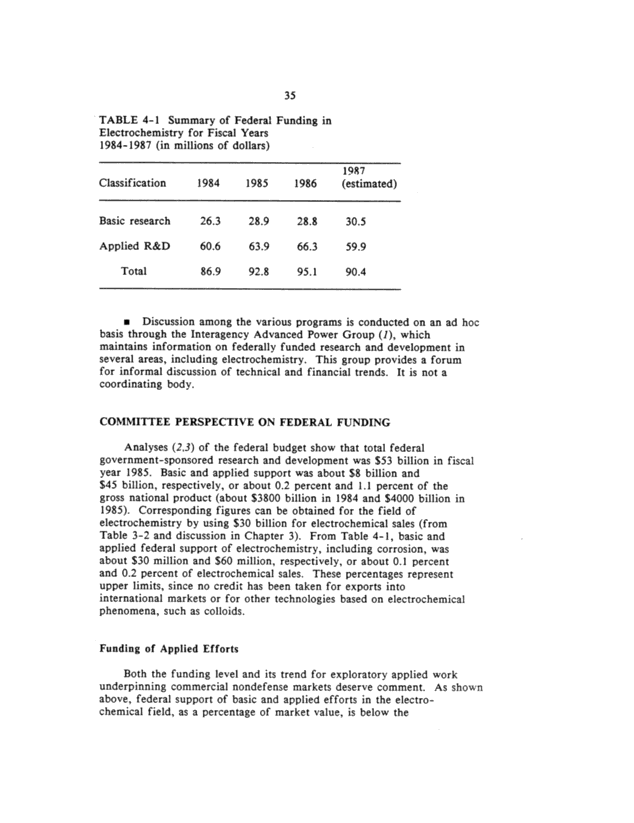
34 FEDERAL FUNDING LEVELS The federal government has made major commitments to support certain aspects of electrochemical science and engineering. The committee obtained information on the level of federal support of basic research and of applied research and development (i.e., classifications 6.1 and 6.2/6.3/6.4, respectively, in Department of Defense terminology). This information was obtained from program managers in the Departments of Commerce, Defense, Energy, Interior, and Transportation, the National Science Foundation, the National Aeronautics and Space Administration and the National Institutes of Health (see Acknowledgments). Results were sent back to key individuals for validation. The review was considered to be complete when no additional program managers were suggested as sources by persons being contacted. The government funding for fiscal years 1984 through 1987 is summarized in Table 4-1. Several points should be emphasized: · Basic and applied efforts receive approximately $30 million and $60 million, respectively, and the ratio of applied to basic work is thus about 2:1. v Two agencies (DOD and DOE) provide nearly all (more than 80 percent) of the federal funding in electrochemistry. In turn, most DOD and DOE support addresses advanced energy conversion devices for military and civilian applications. · Electrochemistry programs, both basic and applied, are oriented primarily toward batteries, fuel cells, corrosion, and analytical techniques. Corrosion was identified by most agencies as part of their electrochemistry programs. Total basic and applied funding for corrosion was about $9 million and $7 million, respectively; these amounts are included in the amounts shown in Table 4-1. Major program changes during the period surveyed were (a) new starts in DOD for programs on advanced electrochemical concepts (batteries and fuel cells with very high specific energy and/or specific power) and (b) significant reductions in two DOE electrochemical programs the first in the energy conservation office, which supports generic technology efforts as well as battery development, and the second in the fossil energy office on fuel cell development for utility power generation. These program changes reduced DOE applied support to a level below that for DOD beginning in fiscal year 1986.
35 TABLE 4-1 Summary of Federal Funding in Electrochemistry for Fiscal Years 1984-1987 (in millions of dollars) 1987 Classification 1984 1985 1986 (estimated) Basic research 26.3 28.9 28.8 30.5 Applied R&D 60.6 63.9 66.3 59.9 Total 86.9 92.8 95.1 90.4 l · Discussion among the various programs is conducted on an ad hoc basis through the Interagency Advanced Power Group (1), which maintains information on federally funded research and development in several areas, including electrochemistry. This group provides a forum for informal discussion of technical and financial trends. It is not a coordinating body. COMMITTEE PERSPECTIVE ON FEDERAL FUNDING Analyses (2,3) of the federal budget show that total federal government-sponsored research and development was $53 billion in fiscal year 1985. Basic and applied support was about $S billion and $45 billion, respectively, or about 0.2 percent and 1.1 percent of the gross national product (about $3800 billion in 1984 and $4000 billion in 1985~. Corresponding figures can be obtained for the field of electrochemistry by using $30 billion for electrochemical sales (from Table 3-2 and discussion in Chapter 3~. From Table 4-1, basic and applied federal support of electrochemistry, including corrosion, was about $30 million and $60 million, respectively, or about 0.1 percent and 0.2 percent of electrochemical sales. These percentages represent upper limits, since no credit has been taken for exports into international markets or for other technologies based on electrochemical phenomena, such as colloids. Funding of Applied Efforts Both the funding level and its trend for exploratory applied work underpinning commercial nondefense markets deserve comment. As shown above, federal support of basic and applied efforts in the electro- chemical field, as a percentage of market value, is below the
36 corresponding percentages for overall federal support of research and development. The data also show that the ratio of total funding applied to total basic funding for the overall federal program in 1985 is about 6:1, versus a ratio of 2:1 for the federal program in electrochemistry. A ratio of 10:1 is the rule of thumb for high-technology areas, once developmental efforts have begun (4~. While such comparisons provide only approximate guidelines, there nonetheless appears to be a major shortfall in federal support of electrochemical programs, primarily in applied areas. Given the $13 to $24 billion potential annual new markets in electrochemistry (Table 3-3), the consensus of the committee was that the federal funding of applied efforts (Table 4-1) should be substantially increased, indeed doubled, in the near term. Thus the committee concluded that an increase in federal support of electrochemical research on the order of $60 million is justified, with the bulk directed toward anolied ~ ~ . innovative research and early stages of exploratory development. This increase should be phased in over a period of 3 to 5 years. Increased support of applications-oriented efforts would be cost-effective both for traditional electrochemical technologies and for new-generation opportunities. Although the committee recognized that most guidelines for research investment are inexact, experience for medium-technology industries has generally shown that the level of total research and development should be about 3 percent of sales to maintain competitiveness (5~. By this criterion, the annual total support for applied work in the range of $500 to $800 million is justified for electrochemical applications; of this total amount, industry, including venture capital, would contribute the principal portion. In the area of production of established materials, such as metals and chemicals, the major contributions would come from established industries. In others, such as advanced batteries and fuel cells, venture capital and government could provide the major impetus. For example, with new markets for commercial-sector batteries and fuel cells estimated at $2 to $10 billion annually (Table 3-3), yearly total funding of research and development on the order of $100 million (actually $60 to $300 million hased on ~ percent of nrnincter1 markets) . ~ _ ~ _ ,, is warranted up to the point of commercial demonstration. Excluding DOD, government funding of electrochemistry associated with batteries and fuel cells decreased from about $35 million in fiscal year 1984 to about $20 million for 1987 (mostly for the Department of Energy). The aggregate of private funding is about $30 million annually. In view of the scientific and technical problems and the potential payoff (in terms of new systems and new electrochemical energy conversion industries), the present funding level is inadequate for aggressive technology development. A funding level twice the present value could be put to excellent use without modifying the existing research and development infrastructure.
37 More specifically, research and development work on batteries and fuel cells depends on the federal government for support because the lead time in development is longer than can be supported by private industry. In addition, the existence of the targeted markets has not been demonstrated in most cases. Federal support is therefore needed to bring new electrochemical systems to the point where the risk is low enough so that it can be assumed by industry. The development of fuel cell and battery technology is in the federal interest because of energy independence and national security considerations. The role of industry in this field is to provide a significant portion of the expertise and some of the funding for the development of new electrochemical systems into marketable products, once feasibility on an engineering scale has been established. Support Framework Chapters 5 and 6 document areas of electrochemical science and engineering that could advance rapidly with a higher priority in federal programs at this time. The field warrants a higher priority because of its large economic impact as well as from a second viewpoint the growing recognition of the essential role of government support for multi- disciplinary activities, which establish bridges among the various contributing disciplines (6~. Most federal agencies and offices, however, currently support research along the lines of traditional disciplines. This arrangement works for some electrochemical problems when the solution lies primarily within a single discipline. For multidisciplinary problems, however, the present orientation inhibits the broad perspective that is needed. Electrochemical science and technology would be more effectively nurtured through federal programs if given a multidisciplinary support framework. This would benefit both basic research and applied efforts. Agency program managers recognize the desirability of funding this field as an interdisciplinary effort, in spite of organizational constraints, but the current results are far from optimal. Unconventional High-Risk Programs The present distribution of government funds is weighted principally toward problems associated with advanced energy conversion devices and secondarily on corrosion. Programs of comparable magnitude focused on other high-risk, high-payoff areas, such as electrochemical aspects of microelectronics, surface processing, membranes, sensors, and waste utilization, are needed. Excellent opportunities for new technology in these areas lie outside the financial base of existing electrochemical industries, so that a federal role in realizing these opportunities is essential. Support of such fields, together with existing programs, ,
38 would provide the broad-based coverage of electrochemistry that is necessary to exploit these opportunities. Science and Technology Transfer Of the many factors affecting science and technology transfer, one federal policy regarding patent and licensing rights has recently been changed. The committee welcomes this as an incentive for reduction of other institutional barriers to technology transfer and venture initiation. It specifically endorses establishing at universities and national laboratories practices that enable inventors and entrepreneurs to realize the economic benefits of their work. The committee recommends that these individuals be enabled to share with their institutions the rights to exploit their inventions and the monetary benefits therefrom in a framework that will encourage formation of commercial enterprises. At present some universities and institutions retain these rights, even though they are often unable to act in a timely manner for high-technology areas, where a product can become obsolete in 3 to 5 years. Active entrepreneurship could alleviate the need for the commitment of large federal outlays for demonstration programs. Beyond the emphasis on the creation of ventures, joint efforts involving industries, government, and universities should be undertaken when major well-defined national technical goals are to be attained. These initiatives would provide for an integrated industry-national laboratory-university collaborative effort in developing the products and processes necessary to maximize the probability of yielding a commercially successful product. The initiatives would have an agreed-upon lifetime, after which the investigators would return to their home organizations. This plan would provide for effective science and technology transfer and would ensure rapid implementation of research results in the development process. The "partnership" between industry and government in the development centers is a key tool in moving the technology into industry rapidly. Such joint and focused efforts are common today in Japan and are quite successful in operating for a defined period of time and creating specific technologies. REFERENCES 1. Semiannual Compilation of Project Briefs. Washington, D.C.: Power Information Center, Feb. 19&6. The United States Budget in Brief, Fiscal Year 1987. Government Printing Office Document S/N 041-001-00301-1, Jan. 1986.
39 3. Erdevig, E. The Bucks Stop Elsewhere: The Midwest's Share of Federal R&D. Federal Reserve Bank of Chicago Economic Perspectives, Nov.-Dec. 1984, p. 13. Assessment of Research Needs for Advanced Fuel Cells. DOE Advanced Fuel Cells, DOE Advanced Fuel Cell Working Groups, DOE/ER/30060-T-1, 1985. 5. Business Week. R&D Scoreboard. Issue 2902, July 8, 1985, pp. 86-106. 6. Keyworth, G. A. An administrative perspective of federal science policy. The Bridge, National Academy of Engineering, 16~1), Spring 1986, p. 5.
