
CHAPTER 52
MIND IN THE BIOSPHERE; MIND OF THE BIOSPHERE
MICHAEL E.SOULÉ
Adjunct Professor, School of Natural Resources, University of Michigan, Ann Arbor, Michigan
Say you want to convince your father-in-law to get involved in conservation—in rescuing biodiversity. How would you start? Would you tell him about the genes for disease resistance in wild relatives of crops plants? Would you mention the probable existence of undiscovered, valuable pharmaceuticals, talk of tropical rain forests and their rates of conversion, or describe a personal experience of nature that still brings tears to your eyes or goose bumps to your skin? That is, would you appeal to his intelligence or to his emotions? The chapters in this section may help to inform us about this choice.
There are many ways of seeing the biosphere. Each of us is a unique lens, a lens ground and coated by nature and nurture. And our responses to nature—to the world—are as diverse as our personalities, though each of us, at different times, may be awed, horrified, dazzled, or just amused by nature.
Most such experiences are quite ordinary, everyday encounters with suburban birds, street trees, garden pests, or domesticated plants and animals. But some of these experiences leave vivid memories and can change our behavior. These so-called peak experiences can fuse our separate selves to nature, establishing a lifetime bond.
Ordinary or sublime, such encounters constitute just one of several dimensions of our total involvement with the natural world. It is the fundamental dimension, though, because experience provides the raw material out of which the more conceptual dimensions are formulated.
What are these ordinary dimensions? Previous sections in this volume deal with some of them, including the value dimension, which is dominated by the polarity
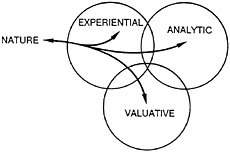
FIGURE 52–1 Three dimensions of mind involved in our perception of nature. The basis for the overlap of these dimensions is both neurophysiological and experiential.
between utilitarian values on the one hand and intrinsic (spiritual-ethical) values on the other. Another is the scientific-analytical one, in which the mind perceives biodiversity as a phenomenon to be organized and explained.
The relationships among these three dimensions are shown in Figure 52–1. First, there is one’s immediate, sensory experience of nature; it is mediated by the sensory-neural apparatus of the nervous system. Next, this input is categorized, interpreted, and analyzed by the mind (mostly the limbic and neocortical organs of the brain). If the input is particularly arousing, the limbic-hypothalamic centers may trigger emotional responses such as fear, disgust, or sublime joy. In addition, there may be physiological changes such as sweating, goose bumps, and tears, or attack, flight, and exclamations.
Mental activity of another sort may be launched. One sort of activity is normative or judgmental; this is the value dimension mentioned above. The judgments and classification are partly learned. At some stage in our life we may make a generic judgment about nature, deciding whether it is, on the whole, good or bad, or whether it is a part of me1 or, at the other extreme, is a hostile but useful other. Many neural structures, including the highest cortical centers, play a role in the normative process.
Finally, the scientific-analytical dimension of mental activity mentioned above occurs in the greatly expanded human cortex. This structure, called the neocortex in humans because of its evolutionary newness, occupies about 70% of the cranial vault, but it is almost nonexistent in the reptile brain. It is in this structure that complex associations are made, theories are conceived, and conceptual systems are born.
When biologists function in this dimension, their desire is to generalize and predict and ultimately to control. Their self-appointed task is to narrow and channel the Amazon of input from nature—to somehow place it into a few, manageable categories. Experience teaches that this process of pigeon-holing can lead to interesting or useful ideas.
The intellectual’s standard operating procedure, therefore, is to discriminate, dissect, and simplify, reducing the infinite variety of things and processes to a
manageable number of categories and to the simplest atomistic parts and processes. This reductionistic approach has worked well in physics, chemistry, and in much of biology. Quite often, when we are finally able to reassemble the whole, it makes more sense (and is more beautiful) than before. For the scientist, in other words, understanding, not ignorance, is bliss.
MOTIVATION
Clearly, then, doing science, a characteristically neocortical-analytical activity, is not the same as loving nature, a limbic-emotional process. But this distinction between scientific activity and our appreciation of nature is a rock that often trips up many of us. Biologists wish to convince others of the importance of protecting biodiversity, including ecological and evolutionary processes. The problem is that very little thought and research has gone into the best ways to accomplish this vital goal.
Scientists, like everyone, usually revert to habitual ways of communicating. Their favorite format is the lecture. Facts, mixed with inductive or deductive reasoning, are presented with the idea of convincing the listener by the power of evidence and logic that nature is important and deserving of support. To the biologist, it may appear to be perfectly obvious that knowledge will lead to action—that once another human being (including a father-in-law or politician) understands the dimensions of the current spasm of species extinction and understands the agricultural, economic, and climatic implications of deforestation and desertization, that human being will have to do something about it and will simply be forced to join conservation organizations, change his or her life-style, contribute lots of money to the right causes, and vote the right way.
There are two lines of evidence, however, suggesting that such a didactic approach—the lecture-hall model—is inefficient and insufficient. The first is motivational science, the most frequent application of which is commercial advertising and promotion. I won’t say much about this, because it isn’t my field. But I hope that I won’t be too far off the mark if I point out that the content of advertising is rarely informative or logical. Instead, commercials are designed to arouse and to evoke pleasurable emotions and desires. More precisely, they bypass the cognitive centers, communicating through our basic physical desires (oral, sexual) and emotional needs (security, status, control, potential profits).
For example, I recently came across a promotional brochure for a Caribbean cruise. The cover was a frontal view of a well-endowed blond in a minimalist bathing suit. She is kneeling on the beach, looking straight into my eyes with lips apart and an expression of intense desire. The accompanying text reads, “Come Aboard.” Inside the brochure, one is told that passengers are called ShipMates. The crewmembers are described as SeaMates, “free-spirits…the most affectionate and entertaining people you’ll ever meet…whose challenge is to bring you total pleasure, …and they don’t accept tips.” The brochure adds that “Never before has a cruise ship been so free,” that there will be “feasts with unlimited beer and wine” and a “Monte Carlo-styled casino.” Lavish color photographs display around 40 “mates,” none over 25, all nearly naked, nubile, or muscular (if male). There
isn’t one word about the opportunity to meet local people or to learn about racial, social, or economic problems in the Lesser Antilles.
This is not to argue that one should try to equate extinction of species with sexual gratification;2 rather, the point is that bad news by itself is not motivating—just the reverse. Physiologically, bad news is depressing, and depression inhibits arousal in the limbic-emotional system. Advertisers and politicians know this tacitly: consumers don’t buy coffins, even when on sale, and voters don’t elect prophets of doom. Perhaps this is one reason why there are no biologists in the U.S. Congress.
On the other hand, if our objective is to motivate people, the best way to do this is probably with pleasurable experiences and memories. If neurobiology has told us anything about the mammalian brain, especially the human brain, it is that the mind and the body are not separate. Furthermore, the most direct and powerful pathways to pleasurable emotions are not via the thought centers of the neocortex but through the sensory-motor centers of the brain stem and cerebellum, and from there into the emotional centers of the limbic system. This is also the region that houses the playful, nurturing, and social behaviors that we find so pleasurable and that must be evoked in the people we wish to involve in the cause of biodiversity.
Perhaps it would be more effective politically to stress that the members of the movement to save nature can have special, positive experiences—peak experiences that flow from participating with others in doing something of great importance and value. Furthermore, the new motivators for nature might take a page from the advertiser’s book, promoting a wider love of nature with a sensory, physical experience of nature in the convivial company of like-minded friends.
One reason for the apparent frustration of the conservation educator may be inattention to the distinction between mentation and motivation, between the neocortex and the cerebellar-limbic axis. Students and others may be convinced cognitively, neocortically, of the value of life and diversity, but somehow our audiences don’t follow through. The urgency isn’t there. It is as if the organ of learning were not hooked up to the organ of doing.
The hypothesis is that if our pedagogy is purely cognitive, our chances of motivating a change in values and behavior are nil. We can’t succeed in teaching people biophilia (Wilson, 1984) (i.e., the love of life), with economic arguments and ecological reasoning alone. We must see to it that they have limbic experiences, not just neocortical ones. We must learn from the experts—politicians and advertising consultants who have mastered the art of motivation. They will tell us that facts are often irrelevant. Statistics about extinction rates compute, but they don’t convert.
We must also ask if there are critical developmental stages in the training of the limbic system for bonding with nature. Just as Harlow’s rhesus monkeys must have physical contact with warm, moving bodies if they are ever to breed suc-
cessfully, so there might be developmental stages for bonding with nature and landscapes (Orians, 1986). Perhaps college-age students are too old to imprint.
Returning to the father-in-law, who is still waiting to be convinced of the importance of biodiversity, we come face to face with the urgency of communications. What is the message that we want to get across? A Buddhist sutra teaches, “Each thing has its own intrinsic value, and is related to everything else in function and position.” Ecology affirms it. But what then? How do we convince others? Maybe it begins with the courage to let ourselves describe our private, emotional experience of nature to our father-in-law.
The following chapters reinforce the idea of a multidimensional conceptualization of our place in nature and the importance of subcortical communication. Lovelock’s Gaia hypothesis (Lovelock, 1979) is quintessentially scientific and holistic. The biosphere (or the entire planet and the Sun) is a dynamic community of relationships in which humans are imbedded. This interpenetration of processes, this network of mutual dependencies endows the biosphere with certain qualities such as homeostasis (Gaia; Lovelock, Chapter 56), unity (God; Cobb, Chapter 55 ), immediateness and power (meat; McClure, Chapter 53), and spirit (consecration; Littlebird, Chapter 54). Aren’t we lucky!
REFERENCES
Lovelock, J.E. 1979. Gaia. A New Look at Life on Earth. Oxford University Press, Oxford. 157 pp.
Naess, N. 1985. Identification as a source of deep ecological attitudes. Pp. 256–270 in M.Tobias, ed. Deep Ecology. Avant Books, San Diego, Calif.
Orians, G.H. 1986. An ecological and evolutionary approach to landscape aesthetics. Pp. 3–22 in E.C.Penning-Rowsell and D.Lowenthal, eds. Landscape Meanings and Values. Allen and Unwin, London.
Wilson, E.O. 1984. Biophilia. Harvard University Press, Cambridge, Mass. 157 pp.
CHAPTER 53
A MAMMAL GALLERY
Five Word Pictures and Three Poems
MICHAEL McCLURE
Poet/Professor, California College of Arts and Crafts, Oakland, California
1.
THE GIANT PANDA, huge mammal, furred in black and white, basks and lolls in the shadiness of the bamboo grove. The panda sometimes sits like a man, on his rump with legs outspread, on an earthy mound covered with moss. Perhaps he looks at his beloved and family. He is surrounded by his nutriment, by the tips of bamboo plants that reach many times his height from the surface of the Earth toward the sun. Perhaps strange, thoughtless philosophies drift across the platens of his sensorium and create and recreate themselves in his limbs and organs. All of his being is an accumulation of his plasm and the activities of his body. He sprang from the matter of the Earth as it was energied by the nearby star that he sees through the sparse places in the glade.
The bamboos about the panda are air creatures. They draw nitrates, some material substance, and water from the Earth through the pores of their searching motile root tips. But much of the substance of the bamboo is drawn from thin air, from the gasses of the atmosphere, which are changed by a chemical cycle and the sun’s rays into solid substance. Gasses become the BODY of the panda via the bamboo. The bamboos are threads that reach from the plant toward the star that energies them.
2.
AN INVISIBLE WATCHER is in a room with a man and woman who are arguing—they are a lover and beloved, a man and wife. They are quarrelling about the payment on a car, or about the loss of a laundry ticket. The argument becomes
The five word poems are reprinted from Scratching the Beat Surface, copyright © 1982 by Michael McClure, with permission of North Point Press. The three poems are reprinted from Selected Poems, copyright © 1974, 1975, 1983 by Michael McClure, with permission of New Directions Publishing Corporation.
too intensive for so minor an issue. It appears that the man and woman are enacting a rite. If the invisible observer closes his ears to the meanings of the words and listens only to the vocalization as sounds, a thought occurs to him:
He is listening to two mammals. It might be two snow leopards, two bison, two wolves. It is a mammal conversation. The man and woman are growling, hissing, whimpering, cooing, pleading, cajoling, and threatening. The specific rite and biomelodic patterning of meat conversation rises and falls in volume. It makes variations, it repeats itself, it begins again, it grows, diminishes. There is a hiss and counterhiss. There is a reply and new outburst. The game that the man and woman are enacting, and the ritual, is as old as their plasm. It is capable of extremes of nervous modulation because of their neuronic complexity but it is more than ancient—it is an Ur-rite.
If the man and woman are lucky, and if their intelligences are open, then one of them will HEAR that it is a rite—that they are growling and hissing. Then he, or she, will laugh at the comedy and the ridiculousness of the pretext. The other partner will laugh in response, intuiting the same perception. Most likely it is a sexual ritual. They are hungry for contact with each other. Their intellective and emotional processes have been frozen into simulations of indifference by pressures of the surroundings and events. If they are lucky enough, one of them will raise a hand to the other, and touch or stroke, recognizing the other as the universe, the counterpart of a star, a galaxy, a planet, a bacterium, a virus, a leopard.
3.
A MAN IS SITTING CROSS-LEGGED in bright afternoon sunlight. He opens a book of reproductions of Egyptian art. Clear light gleams off the paper. The alto relievo statuary is uncanny. The lazy intellectual mind scans the opposite page and finds text describing the statuary in a foreign language. It says, apparently, that this is a Pharaoh and two goddesses. The man’s attention returns to the reproduction—a passing perception takes the shape of a fragmentary poem:
THE MESSENGER (RNA)
slides to the ribosome
(to the Constellation).
The beads move.
The Pharaoh, Chacal, & Hathor
are glabrous
perfectly
balanced
arm in arm. The weight
of the Man-God
is on
one foot/or the other.
They create the gleam
of this dimension,
of this single
process,
of perfection.
But who is who? and WHAT?
The words mime the balance of the figures as they stand—Goddess, Pharaoh, Goddess—side by side, touching one another. Their weight is immaculately balanced. The sculptor of the archaic figures had a knowledge difficult to regain, though easy to reperceive thousands of years later.
The sculptor sensed that man-mammal is created from the inside outward. That man begins at the interior of his cells and from their perfect balance the body is created.
((Within the human body the RNA slides through the walls of the cell’s nucleus, through infinitesimal tubes in the structure, and finds the pearllike ribosome bodies in the cytoplasm. The bodies MOVE across the long threadlike molecules of RNA and create the substances of the cell.))
The three sculpted figures show muscular development that is excellent, generalized, not excessive. The bodies rest naturally in mammal fashion. A wolf can be seen standing in relaxation, peering with interest, involved and yet disinvolved. The carved stone reproduces muscle tone that is healthy and without contradictory strains. The faces of the Pharaoh and goddesses are as interesting, or as uninteresting, as the faces of snow leopards. Their bodies are erect, with the pelvis slightly forward to balance the weight of the head. The Pharaoh stands with one foot a little forward—it is impossible to tell which foot bears his weight, or if both feet do. The goddesses stands in variations of this posture.
4.
I STAND IN FRONT of the cyclone wire cage containing the female snow leopard. My friend has a tape recorder. We have been taping sounds of animals before the zoo opens. I step over the guardrail where the snow leopardess is watching us. She is indifferent to humans when they keep at a distance. Her task is to fight the physical psychosis of encagement. Most of her waking is spent pacing the constricted outlines of her cage. But now it is early morning, and she is resting. When I step over the guard rail she growls in anger without moving—except her head, which swivels to watch me.
No part of her can reach through the mesh of the cyclone wire. I put my face almost to the wire and nearly to her face. There are only a few inches between her mouth and my face. She is enraged, and her face, which seems divine in such proximity, twists into feline lines of rage. The anger and rage are clearer than the conflicting human expressions on the daily streets. She knows the uselessness of pawing or clawing at me.
She puts her face within an inch of the wire and SPEAKS to me. The growl begins instantly and almost without musical attack. It begins gutturally. It grows in volume and it expands till I can feel the interior of her body from whence the energy of the growl extends itself as it gains full volume of fury. It extends itself, vibrating and looping. Then, still with the full capacity of untapped energy, the growl drops in volume and changes in pitch to a hiss. The flecks of her saliva spatter my face. I feel not smirched but cleansed. Her eyes are fixed on me. The growl, without a freshly drawn breath, begins again. It is a language that I un-
derstand more clearly than any other. I hear rage, anger, anguish, warning, pain, even humor, fury—all bound into one statement.
I am surrounded by the physicality of her speech. It is a real thing in the air. It absorbs me, and I can hear and feel and see nothing else. Her face and features disappear, becoming one entity with her speech. The speech is the purest, most perfect music I have ever heard, and I am touched on my cheeks, and on my brow, and on the tympanums of my ears, and by the vibrations on my chest.
We play back the several minutes of this growl, and it is more beautiful than any composition of Mozart. Three-quarters of the way into the tape is the clear piercing crow of a bantam rooster making his reply to the mise-en-scène about him—to the calls of his ladies, to the sparrows, to the sounds of traffic, to the growling of the leopardess, to the morning sun, to the needs of his own being to vocally establish his territory. The crow of the tiny rooster is smaller but no less perfect or monumental or meaningful than the statement of the leopardess—they make a gestalt. The tape is a work of art as we listen. WE are translated.
5.
TRAVELLING ON A SMALL SHIP to the Farallon Islands near the San Francisco coast, I spoke with a virologist who had just returned from Australia. He was travelling to the Farallons to study the rabbits there. A lighthouse keeper’s son had a pair of rabbits that escaped on the island. The rabbits and their progeny devastated the island of every leaf of plant life. The island was left bare rock, without any vestige of higher plant life. The virologist believed that the rabbits—still populous on the island—ate the desiccated corpses of gulls and seabirds. His idea was that only one type of rabbit had the capability of surviving under these conditions.
I wandered on the island—seeing a rabbit and traces of rabbits—but not a blade of grass or a bush. The island is rocky, craggy, like a miniature, eroding crest of the Alps. After climbing the tiny peak, I descended to the beach, which was scattered with boulderlike rocks. I found myself looking down onto a herd of sea lions, the closest no more than 30 feet away. They were drowsing and lolling in the sun. Seeing something comic in the scene, I raised my hand and began speaking as if I were delivering a sermon. The astonished sea lions dived into the ocean. The ones in the ocean swung about to see me. They began a chorus of YOWPS, and huge angered MEAT CRIES, dense in volume and range. I continued my performance, and they carried on their yowping. Perhaps 30 or 40 of the animals were yowling at one time. They were FURIOUS, ENRAGED, ASTONISHED. Like the leopardess, their voices were driven by hundreds of pounds of meat force and energy. I was frightened, worried that they might change about, clamber out, and pursue me. They remained in the water cursing me in a clear ancient language that left little doubt about meaning.
AND THEN I knew that not only were the monster shapes of meat enraged, they were PLEASED. THEY WERE SMILING AS WELL AS ENRAGED! They were overjoyed to be stimulated to anger by a novel—and clearly harmless—intruder. Undoubtedly they enjoyed my astonishment and fear as well as the
physical pleasure of their rage. Perhaps they relished my physical reaction to their blitzkrieg of sound. They began to yowp not only at me but to each other.
My ears could not take it any longer and I began walking up the beach. I walked halfway around the island. Five members of the tribe followed in the waves. They watched, taunted, encouraged, scolded, and enjoyed me to the fullest. I have not been in finer company.
GRAY FOX AT SOLSTICE
WAVES AND FLUFF JEWEL SAND
in blackness. Ten feet from his den
the gray fox squats on the cliff edge
enjoying the beat of starlight
on his brow, and ocean
on his eardrums. The yearling
deer watches—trembling.
The fox’s garden trails
down the precipice:
ice plant, wild stawberries,
succulents.
Squid eggs
in jelly bags (with moving
embryos) wash up on
the strand.
It is the night of the solstice.
The fox coughs,
“Hahh!”
Kicks his feet—
stretches.
Beautiful claw toes
in purple brodiaea lilies.
He dance-runs through
the Indian paintbrush.
Galaxies in spirals.
Galaxies in balls.
Near stars and white mist swirling.
TO A GOLDEN LION MARMOSET
OH BEAUTIFUL LITTLE FACE,
PEERING THROUGH
THE DAWN
OF TIME,
THE GOLDEN FUR UPON YOUR CHEEKS
is precious as a rhyme.
The April in your gracious snarl
can loose a body to ungnarl
and
stand
upright in the sun.
Come back, I’ve caught my mind!
Your life is all I find
to prove ours are worthwhile.
————————————————
The monster caterpillars
and the teeth of fire
that eat your jungle
crunch my house.
ALL
BEASTS
ARE
MEN;
all men are beasts.
————————————————
BUT
I want you alive
in more than memory!
ACTION PHILOSOPHY
THAT GOVERNMENT IS BEST WHICH GOVERNS LEAST.
Let me be free of ligaments and tendencies
to change myself into a shape
that’s less than spirit.
LET ME BE A WOLF,
a caterpillar, a salmon,
or
an
OTTER
sailing in the silver water
beneath the rosy sky.
Were I a moth or condor
you’d see me fly!
I love this meat of which I’m made!
I dive in it to find the simplest vital shape!
AH! HERE’S THE CHILD!!!
WHAT’S LIBERTY WHEN ONE CLASS STARVES ANOTHER?
CHAPTER 54
COLD WATER SPIRIT
LARRY LITTLEBIRD
Director, Circle Film Productions Company, Santa Fe, New Mexico
Stories are sacred and real,
and the storyteller is a consecrated person.
from Breath of Whales, Circle film.
In the early New Mexico morning, before the yellow light of dawn, the wind sweeps gently through the high mesa flats. I was little, and I remember waking up hearing the battered corrugated tin shade catch in the wind. It was loosely tied with wires to long wooden poles above the doorway of the little stone and mud house that was my grampa’s sheep camp.
My bare feet touched the cool dirt floor as I rushed to dress and be out into the new morning before he would call, “Get up! Wash with cold water; it’ll make you tough and handsome, like me.” In that early Pueblo Indian childhood on the reservation the word was still sacred to me. I grew up in that world of tending sheep and seeing the land, discovering that life for our people continues in the telling of stories, that language is a gift of God, and when a story is told we are given a way to learn and to live.
A child wakes up believing in the world he finds himself in; and for a long time I believed everyone had stories to guide them, like I did. Forty years later I now see much is lost or being forgotten about the telling of stories. We are now living in a time when the storyteller is no longer a human being disciplined by life but can be anyone with a facility for language, anyone who can turn words cleverly for their own ends, never fearing that such willful action is wrong, or that thoughtless words obstruct the life vision. Where I grew up, the storyteller was still a consecrated person.
My grampa, in his stern reprimands, the harshness removed by the mischievous twinkle in his clear eye, understood the commands he gave me and applied that knowledge strictly: “Get up! You gonna rot in that bed all day? Get up; run to the river; wash with the cold water; you wanna stay young, like me.” I always saw him wash with cold water, and catching me looking he’d say, “The girls can’t stay away from me because I’m so young looking!” Grampa knew life was full, never dull, and always new with unexpected surprises. For him life was real. It had dimension and depth and was to be taken seriously to be enjoyed. A man had to be tough; he knew this, and he wanted me to know it also.
His use of language crossed back and forth between our own Keres tongue and the broken English he used for emphasis and added understanding. “Keep your eyes peel it,” he’d tell me, softly waving his firm, dark, and weathered hand in front of his face indicating some imagined far horizon or space I was to see. Over and over I heard him tell me, “Keep your eyes peel it.” I knew he meant “keep your eyes peeled,” stay watchful, be alert. Or so my mind told me, until one day, as I trailed along behind him trying to match his stride by stepping into the prints he made in the soft earth, he stopped abruptly, and in Keres asked me, “Are you tracking me, stepping in my footsteps?” I nodded, yes. We sat down, right there in the sand, and he gestured with his mouth, puckering his lips to point the way we had just come. “See the tracks; it’s clear that’s the way we got here, to this place, this spot. Stand up. What’dya see ahead, toward the way we’re going?” I looked off toward the distance. “No tracks,” I said. He responded, “That’s right, until we walk that way there are no tracks. And when we go that way we must leave our own trail. You make your tracks, and I make mine.” Then in English he added, “Keep your eyes peel it.”
He rose from the ground, and his eyes scanned the whole space before us and I saw from the way his eyes moved that his vision took in the entire land and the distance to the far horizon. His words confirmed what I glimpsed in that look, “We follow in the footsteps of the men of old, all those grampas gone on before us. Their paths are here, but we keep our eyes off the ground, to watch ahead and all around us, to seek what they were looking for.” In my heart a voice said, “What were they looking for?” The question was caught in the next beat as grampa reminded me, “Keep your eyes peel it,” and he began making his tracks across the land once more.
Grampa wasn’t the only one to teach me to accept without question the words of elders. During the winter months when he stayed at sheep camp alone, and I was at home in the village going to school, there were nights I will never forget. Looking back on them, I see how important they were in learning to listen carefully.
In the long winter, the people celebrate and come together to hear the songs and see the dances that tell the drama of our lives. There was a special house near the center of the village. It was a large house with a long wide room. All the people would gather at this old house.
When it was dark and after we had eaten our meal, we would put on our coats and caps, and dressed warmly, leave our home, stepping into the brisk wintery night to walk along the pathway through the village to the special house.
My shoes crunching the fine new powder snow made it squeak. The air didn’t
feel cold, yet tiny flakes swirled about my face. I imagine I could have reached up and pocketed a fist full of stars, they were so close overhead in the night’s frozen sky. When we reached the house, people were already there, patiently waiting.
Waiting doesn’t come naturally to little boys. In the long clean room, children shuffle restlessly, squirming in their seats. Mothers whisper back and forth visiting with sisters, aunts, and other relations. An older man nods off in seeming sleep, propped against the wall in the back. On the long bench where he droops, two men carry on a steady conversation, first one speaking then the other, each of them punctuating the telling with loud confirmations or acknowledgments. Their voices are the loudest sound in the room. Catching my restlessness, my grandmother motions me to sit beside her, and even better, up on her lap. Quietly, her breath tingling and warming the smooth surface of my ear, she reminds me about patience, with a story. In her voice, time slips away, reaching like a steady hand to pull me effortlessly through the long night.
“Ponci wanted to dance. The grown-ups only laughed, saying he was just a funny little boy. All day long in secret he made up songs, and when no one was around he would dance and sing. Day by day songs grew inside him and stayed in his imagination. Then something wonderful happened that helped Ponci discover the extraordinary.
“His uncle Dan, a man with many songs, and who was always singing, came to visit. Ponci liked Uncle Dan’s singing and all the stories he would tell. He could sit on his uncle’s lap and bounce to the rhythm of a song or listen quietly for hours as his stories were told.”
“‘There’s a lizard who lives where it is very dry and dusty. It’s so hot where he lives that the sun has scorched two gray dirt lines down his green back. This lizard always has its eyes open hoping to see a cloud so he can run to it and lie cool in its shadow. That’s why you see Lizard always hurrying over the parched earth, running here and there. He’s seen and found many places where the clouds gather,’ Uncle Dan, explained. With brightly shining eyes, Ponci held his breath as Uncle Dan went on. ‘When you see him lift his chest up and down and see his throat moving, he’s singing, calling clouds.’
“‘But lizards don’t make any sound!’ Ponci burst forth wide-eyed. ‘Oh, sure they do,’ Uncle Dan tells him. ‘A true-hearted person who wants to hear will be able to hear. The Lizard People make beautiful songs, and they’re good dancers. You’ve got to be careful though; never tease Lizard; he’s a powerful person.’
“The next day, Ponci was awake and up without being called. He ate his blue corn atole, never touched his eggs, and before his mother could question his rushing about, he was out of the house running toward the dry, flat lowland.
“In that stretch of long horizons, underneath the spiny, thin branches of a spindly tumbleweed, lay Lizard, watching the running boy approach. His out-stretched body had sensed the boy’s footfalls, and he’d seen him pass back and forth several times already. Lizard smiled at the boy’s seriousness.
“Ponci, disappointed at not finding Lizard as easily as he thought he should have, was turning to go when out of the dust Lizard presented himself. Lizard moved up and down in the pulsing motion Uncle Dan had described, and his
throat moved. The boy’s whole being concentrated on the lizard before him. He stood still, trying to hear any faint whisperings of what might be a song. He stood like this for a long time. Finally, Lizard sighed; Ponci moved closer. Doubts crept into his thoughts about the truth of Uncle Dan’s story. Laughter suddenly burst forth from the lizard on the ground with such force it caused Ponci to jump back. Lizard lay rolling in mighty shakes of laughter, his skinny belly rumbling. At last he quieted down enough to ask in a strangely melodious and resonant voice, ‘So you want to dance?’ The question set Lizard, twitching and convulsing, into hysterics once more. Gaining control, he wiped tears from his eyes as he spoke again. ‘It’s funny to me, a small fellow like you, wanting to dance so much that you would come looking for me. No one’s been to see me or to ask for songs for so long, I don’t know if I can even remember any. You see, this ground is so dry even tumbleweeds are few and small.’ He slumped forward sadly, ‘I don’t know if I can help you.’
“All this time the boy stood frozen, eyes wide open, amazed and afraid of what he saw happening before him. Lizard cocked his head out of the dust, ‘You were looking for me, weren’t you?’ Ponci nodded yes, then stammered, ‘But, but I didn’t know I’d really find you.’
“‘Well you found me,’ Lizard groaned. ‘It might be very hard for both of us seeing how small you are and how old I’ve gotten.’ His eyes blinked. ‘Let’s hear you sing.’ Never having sung for anyone before, Ponci became unsure of himself, and as he started, his voice cracked so he stopped. Lizard smiled, gently reminding him, ‘Anyone can be born with a beautiful voice. Look at Mockingbird. He makes some of the most beautiful sounds, but not a single song is his own.’ Reassured, the boy started again, this time with one of his own songs. The range of his young voice was delicate and varied. His song ended in a high pitch only possible in youthful freedom. Hearing the song inspired Lizard and encouraged him for the task at hand. He didn’t say anything about the song or the singing. He didn’t have to, for in answer, a tiny white speck of cloud appeared over the top of the distant blue, west mountain. They saw it at the same time.
“‘Quickly!’ Lizard commanded. ‘Take off your shoes and shirt!’ Ponci did as he was told, and at once Lizard ran up the boy’s legs, up one side of his back and down the other, leaving two grey dust marks identical to his own. Then he ran back and forth in front of him telling him to do the same and to follow wherever he might run.
“They ran south. After many minutes, Lizard began to sing. That’s like my song,’ thought Ponci, as they continued south while the song lasted. At the end of Lizard’s song, Ponci sang one of his own. They turned north. Singing toward the north, they ran and ran. Although Ponci’s legs were tiring, and he felt himself gasping for air, he ran and kept on singing, following the dusty little lizard.
“Beneath the desert stillness, out of the parched dirt, a low humming began to rise. Slowly at first, then the unfailing soughing of their voices came together with a sound, becoming one sound emerging from the earth, a singular pulse beating with everything and everybody…then, as far as he could see, everything was dancing and everything was singing. The sound went forth, on and on.
“As Ponci sang, he felt a shadow move over his face. Drops of the first cooling rain splashed his skin. He opened his eyes to glance down onto the ground before him. Lizard was gone. Instead, looming out of the west, a huge dark cloud built skyward. Little spurts of dust rose in puffs as the rain began to fall. Ponci looked back toward the village and saw rain pouring in slanting silver sheets onto the thirsty fields in the distance. Their song had been answered. In his weariness, his feet continued to lift as he trotted toward home in the gentle wash of sweet rain.”
The breathing in my ear stopped, and slowly the room came back into focus with my nose smelling the moist earth. There’s a man with a large watering can sprinkling the dirt floor to settle the dust. He has just finished, and the people in a shuffling of feet settle back again to wait, when a quickened keening brings all of us together at once. The door opens, and from somewhere in the darkness comes the unmistakable sound of metal bells. The deer, eagle, and butterfly dancers are coming. The drums are beating. The singing men’s voices can be heard. The people’s patience will again be rewarded, and life will be remembered, in the dance, in the song, in the story.
CHAPTER 55
A CHRISTIAN VIEW OF BIODIVERSITY
JOHN B.COBB, JR.
Ingraham Professor of Theology, School of Theology, Claremont Graduate School, Claremont, California
Most people are distressed by the widespread destruction of species of living things. There is a deep sense that this is a serious loss to the planet. The major problem does not arise from direct approval of the destruction of species and of the simplification of the environment. It arises from the lack of awareness of the consequences of our actions and from the primacy of other concerns. In the pursuit of economic gain, most people do not want to be bothered by questions about biodiversity.
This volume, and the activities of many of its authors, are designed to heighten awareness of what we are doing to our biosphere. The correct assumption is that heightened awareness and intensified attention are the primary needs. People will act more appropriately if they are reminded again and again of the effects of their actions.
The authors of this section have a different role. We were asked to reflect on why biodiversity is important. It is not necessary to answer this question for people to recognize its importance. Nevertheless, good answers to our question are urgent, because the intuitive sense of importance is gradually weakened if its justification is not articulated. Also, there are ways of viewing the world that make concern about endangered species appear to be an esoteric or sentimental matter. Indeed, this type of world view is dominant in much of our society. We can all remember many of the disparaging comments that were made about concerns that a species of snail darter interfered with the building of a dam. Staying power in defense of biodiversity probably depends on a world view that grounds it more deeply than sentiment, however natural and healthy that sentiment may be.
The most obvious way to argue for biodiversity is to show how it benefits human beings. In the foregoing sections, much evidence was given for the risk to the
human future that would be presented by a drastic simplification of various ecosystems. Hence there is a strong argument that for the sake of the future of our own species, we need to be concerned with biodiversity.
On the other hand, this argument is limited. Human beings have survived the disappearance of thousands of species with relatively little practical loss. If the only reason for preserving a particular species of insect or fish is its value to us, there will be many occasions when other needs will seem far more pressing. Furthermore, our sense of the importance of biodiversity is in fact not adequately reflected in the practical anthropocentric arguments. We feel that other species should have their place, even if they do not benefit us. Can we explain or justify this feeling?
One argument, a valid one I believe, is that all living things have intrinsic value. Not only are they of instrumental value to one another and to us, they also have value in and of themselves. They are of value for themselves. Hence, our destruction of other living things, while inevitable, should never be taken lightly. The reasons for destruction may be good ones—our need for food, for example. But we should not underestimate the cost to others. We should tread lightly on the Earth rather than bulldoze away all inconvenient objects.
Whereas this argument is a good one in itself, it does not go very far to explain the specific value of biodiversity. It does explain why we should avoid unnecessary destruction of living things, but it does not explain why a variety of such things is better than a monoculture. If by destroying the biodiversity of a prairie we can bring about the monoculture of a wheat field, and if the total number of insects and animals that are supported is not fewer, then there would seem to be no loss. The value of members of the lost species is made up by the value of more members of the species that is preserved.
Another argument, also valid in my opinion, is based on relations. The human species is not apart from others but is instead intricately and intimately related to the remainder of the web of life. When we experience the whole biosphere in this way, we experience destruction of any of its species as a diminution of ourselves.
The sense of relatedness has two dimensions. One dimension is genetic. We are kin to other living things. We have a common ancestry that has impressed itself in common genetic elements. The same sensibility that gives us a special sense of responsibility toward other human beings who are related to us can operate to give us a sense of responsibility for the other species to which we are also related.
The second dimension is ontological. We are increasingly realizing that individual entities, including individual human beings, do not exist apart from relations with other beings. We are constituted by our relations. Of course, many of our most important relations are with other human beings. But by no means all. We are related to the whole world of inanimate and animate things. We are part of them, and they are part of us. To feel this relationship with other things is not sentimentality but reality.
Although this is all true, it still does not go far enough to explain our sense of the importance of biodiversity. It does strongly support the sense of the intrinsic value of other living things. It cuts against the widespread Western dualism that places human beings above and outside nature. It works against the dominant
Western ethics that has taught us that only human welfare really matters. It reintegrates us into the web of life and thereby heightens our sense of its importance for us. But it does not tell us specifically why biodiversity has its own inherent value.
The category that comes to mind when we reflect on the value of diversity is aesthetics. At least in traditional art we have thought that the complexity of forms that could be brought into unity and harmony correlated with the greatness of a piece of art. Today, some qualifications would be required, but the general principle still holds. The same applies to experience generally. There is a richness of experience that correlates with the manifold contents that jointly make their contributions.
Much of our negative reaction to the destruction of species seems to stem from this sense that there are possibilities of experience forever lost. We are aware that some of our environments have already been simplified in ways that have impoverished our experience, and we are disturbed at the prospect that such impoverishment continues. Some of the experiences that were possible for us will not be available to our children. We rightly feel this as a loss that we should try to prevent, even at considerable cost in more practical realms of life.
This, too, is a strong and valid argument that goes far to reflect the feelings that are engendered by our awareness of the simplification of the biosphere. Yet it still fails to deal with our total concern. There are myriad species that have lived and died unknown by humans. It is true that their disappearance sets limits on what future generations can experience. But often in ordinary human experience, the ones that are lost do not differ sufficiently from others that remain to affect any but the most perceptive human beings. Judged simply by their potential contribution to the richness of human experience, many species seem to be of limited importance.
There is a deeper sense on our part that even when we are not ourselves able to benefit even aesthetically from the presence of other species, they are still making a contribution to the whole that is irreplaceable. Indeed, in one sense, this is self-evident. Surely the whole is diminished in some way by the loss of any of its parts!
The problem is that it is not so easy to locate this loss. We often try to locate it in human experience of the whole, but we have already seen that this is too limited a locus. It seems to be the whole-as-such that is impoverished. Yet this makes sense only if we can speak of the whole as having its own unity, its own perspective, its own experience.
We theists believe that just such unity, perspective, and experience does characterize the whole. From our point of view, the sense of the importance of biodiversity reflects an often unconscious recognition that the whole is indeed much more than the sum of its parts. Human beings sense that every creature, and especially every species, makes its contribution to the richness of the inclusive or divine experience.
It is this inclusive experience that provides the norm by which all of us are truly evaluated and judged. God knows us better than we know ourselves, and it is this knowledge of us that is the truth about us. For God, I am of no more worth than
my neighbor, and hence when I treat my neighbor as a mere means to my own advantage I act wrongly. For God, no one nation is inherently of more worth than others. Hence, we act wrongly when we seek our own national advantage at the expense of other peoples. For God, every species has value. We do wrong when we treat other species as if they existed only for our sake and as if they could be destroyed with impunity when it is convenient for us to do so.
It would be going too far to say that the value of biodiversity is explicitly taught in the Bible. What we mean by this term presupposes much scientific knowledge that is not reflected in the Jewish and Christian scriptures. Nevertheless, the rudiments of the idea are present, and the extension of Biblical teaching into our own time strongly supports the concerns of biodiversity.
Consider the first chapter of Genesis. This account of creation has had profound effects on Western culture. There are features of this story that have been used to justify a mode of human relation to other creatures that has been profoundly destructive. But let us look at the story again.
One point that is striking in this account is that when God created the various plants and animals, God saw that they were good. There is no suggestion here that they were good because they would be useful to human beings. They were good in themselves and thus contributed to the divine satisfaction. Specifically, the story says that God blessed them and told them to be fruitful and to multiply, each according to its kind.
Now it is true that human beings are presented in a special light. We are one species among others, but we are also more than that. We are that species that is made in the image of God, and this is closely related to the assertion that God has given us dominion over other living things.
The resulting sense of rightful dominion has been important to the readers of the Bible, and this sense can be reaffirmed today. However, there is no question but that the story has been interpreted to mean that human beings are free to use and destroy other living things at will; and this interpretation needs to be strongly rejected.
Human beings are placed in a position in relation to other creatures much like that of God in relation to the whole of creation. God has dominion over all. We have dominion over the other creatures. God exercises dominion for the sake of those over whom the dominion is exercised. Similarly, the political ruler of Israel is to rule for the sake of those who are governed. A king who uses his power to amass riches for himself at the expense of the suffering of the ruled is a despot, not one who exercises rightful dominion. There is no justification here to suppose that human dominion over other creatures is a sanction of selfish exploitation. The meaning of the dominion given to us is much better expressed in servanthood and stewardship than in exploitation.
This book’s content expresses a profoundly biblical view of the relation of human beings to the other species who with us constitute the biodiversity of the world. It recognizes that we human beings do exercise a determinative power over other creatures. Whether hundreds of thousands of species survive depends on the decisions of humans. It would be pointless to deny that we exercise dominion. But
unlike so many who have asserted their dominion, we are acknowledging that with power comes responsibility—specifically, responsibility to God. To wipe out unnecessarily whole species of those creatures over whom we exercise stewardship is to betray that stewardship and to impoverish the experience of God. It is a crime against our Creator.
CHAPTER 56
THE EARTH AS A LIVING ORGANISM
JAMES E.LOVELOCK
Launceston, Cornwall, United Kingdom
The idea that the Earth is alive may be as old as humankind. The ancient Greeks gave her the powerful name Gaia and looked on her as a goddess. Before the nineteenth century even scientists were comfortable with the notion of a living Earth. According to the historian D.B. McIntyre (1963), James Hutton, often known as the father of geology, said in a lecture before the Royal Society of Edinburgh in the 1790s that he thought of the Earth as a superorganism and that its proper study would be by physiology. Hutton went on to make the analogy between the circulation of the blood, discovered by Harvey, and the circulation of the nutrient elements of the Earth and of the way that sunlight distills water from the oceans so that it may later fall as rain and so refresh the earth.
This wholesome view of our planet did not persist into the next century. Science was developing rapidly and soon fragmented into a collection of nearly independent professions. It became the province of the expert, and there was little good to be said about interdisciplinary thinking. Such introspection was inescapable. There was so much information to be gathered and sorted. To understand the world was a task as difficult as that of assembling a planet-size jigsaw puzzle. It was all too easy to lose sight of the picture in the searching and sorting of the pieces.
When we saw a few years ago those first pictures of the Earth from space, we had a glimpse of what it was that we were trying to model. That vision of stunning beauty; that dappled white and blue sphere stirred us all, no matter that by now it is just a visual cliché. The sense of reality comes from matching our personal mental image of the world with that we perceive by our senses. That is why the astronaut’s view of the Earth was so disturbing. It showed us just how far from reality we had strayed.
The Earth was also seen from space by the more discerning eye of instruments, and it was this view that confirmed James Hutton’s vision of a living planet. When seen in infrared light, the Earth is a strange and wonderful anomaly among the planets of the solar system. Our atmosphere, the air we breathe, was revealed to be outrageously out of equilibrium in a chemical sense. It is like the mixture of gases that enters the intake manifold of an internal combustion engine, i.e., hydrocarbons and oxygen mixed, whereas our dead partners Mars and Venus have atmospheres like gases exhausted by combustion.
The unorthodox composition of the atmosphere radiates so strong a signal in the infrared range that it could be recognized by a spacecraft far outside the solar system. The information it carries is prima facie evidence for the presence of life. But more than this, if the Earth’s unstable atmosphere was seen to persist and was not just a chance event, then it meant that the planet was alive—at least to the extent that it shared with other living organisms that wonderful property, homeostasis, the capacity to control its chemical composition and keep cool when the environment outside is changing.
When on the basis of this evidence, I reanimated the view that we were standing on a superorganism rather than just a ball of rock (Lovelock, 1972; 1979), it was not well received. Most scientists either ignored it or criticized it on the grounds that it was not needed to explain the facts of the Earth. As the geologist H.D. Holland (1984, p. 539) put it, “We live on an Earth that is the best of all possible worlds only for those who are well adapted to its current state.” The biologist Ford Doolittle (1981) said that keeping the Earth at a constant state favorable for life would require foresight and planning and that no such state could evolve by natural selection. In brief, scientists said, the idea was teleological and untestable. Two scientists, however, thought otherwise; one was the eminent biologist Lynn Margulis and the other the geochemist Lars Sillen. Lynn Margulis was my first collaborator (Margulis and Lovelock, 1974). Lars Sillen died before there was an opportunity. It was the novelist William Golding (personal communication, 1970), who suggested using the powerful name Gaia for the hypothesis that supposed the Earth to be alive.
In the past 10 years these criticisms have been answered—partly from new evidence and partly from the insight provided by a simple mathematical model called Daisy world. In this model, the competitive growth of light- and dark-colored plants on an imaginary planet are shown to keep the planetary climate constant and comfortable in the face of a large change in heat output of the planet’s star. This model is powerfully homeostatic and can resist large perturbations not only of solar output but also of plant population. It behaves like a living organism, but no foresight or planning is needed for its operation.
Scientific theories are judged not so much by whether they are right or wrong as by the value of their predictions. Gaia theory has already proved so fruitful in this way that by now it would hardly matter if it were wrong. One example, taken from many such predictions, was the suggestion (Lovelock et al., 1972) that the compound dimethyl sulfide would be synthesized by marine organisms on a large scale to serve as the natural carrier of sulfur from the ocean to the land. It was known at the time that some elements essential for life, like sulfur, were abundant
in the oceans but depleted on the land surfaces. According to Gaia theory, a natural carrier was needed and dimethyl sulfide was predicted. We now know that this compound is indeed the natural carrier of sulfur, but at the time the prediction was made, it would have been contrary to conventional wisdom to seek so unusual a compound in the air and the sea. It is unlikely that its presence would have been sought but for the stimulus of Gaia theory.
Gaia theory sees the biota and the rocks, the air, and the oceans as existing as a tightly coupled entity. Its evolution is a single process and not several separate processes studied in different buildings of universities.
It has a profound significance for biology. It affects even Darwin’s great vision, for it may no longer be sufficient to say that organisms that leave the most progeny will succeed. It will be necessary to add the proviso that they can do so only so long as they do not adversely affect the environment.
Gaia theory also enlarges theoretical ecology. By taking the species and the environment together, something no theoretical ecologist has done, the classic mathematical instability of population biology models is cured.
For the first time, we have from these new, these geophysiological models a theoretical justification for diversity, for the Rousseau richness of a humid tropical forest, for Darwin’s tangled bank. These new ecological models demonstrate that as diversity increases so does stability and resilience. We can now rationalize the disgust we feel about excesses of agribusiness. We have at last a reason for our anger over the heedless deletion of species and an answer to those who say it is mere sentimentality.
No longer do we have to justify the existence of the humid tropical forests on the feeble grounds that they might carry plants with drugs that could cure human disease. Gaia theory forces us to see that they offer much more than this. Through their capacity to evapotranspire vast volumes of water vapor, they serve to keep the planet cool by wearing a sunshade of white reflecting clouds. Their replacement by cropland could precipitate a disaster that is global in scale.
A geophysiological system always begins with the action of an individual organism. If this action happens to be locally beneficial to the environment, then it can spread until eventually a global altruism results. Gaia always operates like this to achieve her altruism. There is no foresight or planning involved. The reverse is also true, and any species that affects the environment unfavorably is doomed, but life goes on.
Does this apply to humans now? Are we doomed to precipitate a change from the present comfortable state of the Earth to one almost certainly unfavorable for us but comfortable to the new biosphere of our successors? Because we are sentient there are alternatives, both good and bad. In some ways the worse fate in store for us is that of becoming conscripted as the physicians and nurses of a geriatric planet with the unending and unseemly task of forever seeking technologies to keep it fit for our kind of life—something that until recently we were freely given as a part of Gaia.
Gaia philosophy is not humanist. But being a grandfather with eight grandchildren I need to be optimistic. I see the world as a living organism of which we are a part; not the owner, nor the tenant, not even a passenger. To exploit such
a world on the scale we do is as foolish as it would be to consider our brains supreme and the cells of other organs expendable. Would we mine our livers for nutrients for some short-term benefit?
Because we are city dwellers, we are obsessed with human problems. Even environmentalists seem more concerned about the loss of a year or so of life expectation through cancer than they are about the degradation of the natural world by deforestation or greenhouse gases—something that could cause the death of our grandchildren. We are so alienated from the world of nature that few of us can name the wild flowers and insects of our locality or notice the rapidity of their extinction.
Gaia works from an act of an individual organism that develops into global altruism. It involves action at a personal level. You well may ask, So what can I do? When seeking to act personally in favor of Gaia through moderation, I find it helpful to think of the three deadly Cs: combustion, cattle, and chain saws. There must be many others.
One thing you could do, and it is no more than an example, is to eat less beef. If you do this, and if the clinicians are right, then it could be for the personal benefit of your health; at the same time, it might reduce the pressures on the forests of the humid tropics.
To be selfish is human and natural. But if we chose to be selfish in the right way, then life can be rich yet still consistent with a world fit for our grandchildren as well as those of our partners in Gaia.
REFERENCES
Doolittle, W.F. 1981. Is nature really motherly? CoEvol. Q. 29:58–63
Holland, H.D. 1984. The Chemical Evolution of the Atmosphere and the Oceans. Princeton University Press, Princeton, N.J. 656 pp.
Lovelock, J.E. 1972. Gaia as seen through the atmosphere. Atmos. Environ. 6:579–580.
Lovelock, J.E. 1979. Gaia. A New Look at Life on Earth. Oxford University Press, Oxford. 157 pp.
McIntyre, D.B. 1963. James Hutton and the philosophy of geology. Pp. 1–11 in Claude C.Albritton, ed. The Fabric of Geology. Addison-Wesley, Reading, Mass.
Margulis, L., and J.E.Lovelock. 1974. Biological modulation of the Earth’s atmosphere. Icarus 21:471–489.


