
B
Previous Training and Education Studies
During the 1990s, three major efforts were made by National Research Council committees to examine the role of science and technology in enhancing job performance and increasing human efficiency in the military services: the Navy Carrier-21 study, 1 the Army Star-21 study, 2 and the Technology for Future Naval Forces (TFNF) study. 3 Relevant findings and recommendations from these studies are reproduced here.
NAVY CARRIER-21 STUDY (1991)
The Carrier-21 study was the first of the three studies to deal with training and educational technology. Although the analysis focused on identifying emerging technologies that would affect future training aboard carriers, many of the findings and recommendations are relevant to on-shore jobs and units and directly to Marine Corps forces.
The Human Factors Technology Group of the Carrier-21 study stated that dependence on computer-based technologies would become as commonplace and essential as today’s dependence on the telephone. Further, these technologies must be harnessed in the training arena in ways that would make training more accessible, convenient, relevant, inexpensive, and effective. The most important of these technologies and their relationship to critical functions is shown in Figure B.1 .
|
1 |
Naval Studies Board, National Research Council. 1991. “The Task Group Report of the Human Factors Technology Group,” Future Aircraft Carrier Technology, Vol. II: Task Group Reports (U), National Academy Press, Washington, D.C., pp. 445-568 (classified). |
|
2 |
Board on Army Science and Technology, National Research Council. 1994. STAR-21: Personnel Systems. Strategic Technologies for the Army of the Twenty-first Century, National Academy Press, Washington, D.C. |
|
3 |
Naval Studies Board, National Research Council. 1997. Technology for the United States Navy and Marine Corps: 2000-2035, Becoming a 21st-century Force, Vol. 4: Human Resources, National Academy Press, Washington, D.C. |
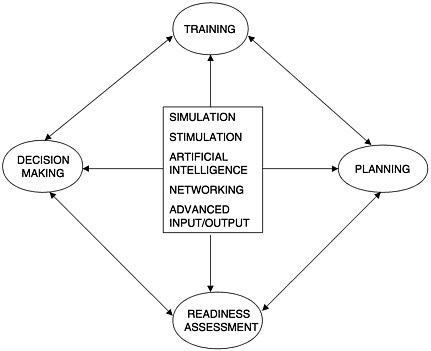
FIGURE B.1 Technologies and processes required for fleet readiness training. SOURCE: “The Task Group Report of the Human Factors Technology Group,” Future Aircraft Carrier Technology, Vol. II: Task Group Reports (U), National Academy Press, Washington, D.C., p. 527 (classified).
The group made the following recommendations to guide advanced simulation and training capabilities:
-
Use available resources and procedures to speed the transfer of proven computer-based simulation and stimulation capabilities. As these technologies become more reliable and less expensive, they will become increasingly important.
-
Move with deliberate speed to establish and use a standardized network of shipboard and shore-based trainers. A service standard for network linkages should be established and maintained. Both simulation and stimulation systems should be incorporated into a single system. Systems that will allow scenario generation, modification of training exercises to meet specific requirements, automatic recording and analysis of performance data, and timely feedback of readiness assessments must be overlaid on the integrated network to allow commanding officers and training personnel to tailor the training to the needs of specific crews and missions.
-
Develop requirements, strategies, and facilities to support the development of a worldwide capability for task force and battle group training. This capability will be essential for allowing the battle force commander to conduct coordinated, mission-relevant training anytime and anywhere. A global network using satellite linkages will be critical for developing this capability.
ARMY STAR-21 STUDY (1994)
In the second of the three studies, one facet of the effort focused on personnel systems in the Army. The Personnel System Panel of the Star-21 study stated that training would become increasingly important. As missions became more unpredictable, the soldier would have to understand capabilities rather than doctrine and the job would become more strenuous. At the same time, rapid technological change would require continued retraining of experienced personnel. New jobs would place considerable demands on training technologies, which would have to:
-
Be cost-effective and quickly applicable to emergent problems;
-
Enable personnel to perform successfully in increasingly complex tasks;
-
Be adaptable to different abilities and aptitudes;
-
Be developed for specific social skills needed for teamwork roles; and
-
Consider the motivation of the individual(s) being trained.
In addition to using cognitive science techniques to construct systems that are specifically intended for training, the Army should make extensive use of simulation systems—deployed in the field—to maintain unit readiness. The simulations should be user-reprogrammable to allow for a wide variety of computer systems that can be used to present meaningful tasks in forms that support efficient learning. The development of instructional tasks in these systems can utilize the expertise of experienced soldiers. Problems are presented with varying levels of help, so that students with different learning capacities can be trained in individually tailored sessions.
Not all training problems are solved by these suggestions. The available scientific base is deficient on three important topics. There is an insufficient understanding of (1) the learning that occurs on a job and the kind of technology that can make this learning more efficient, (2) how social interactions among workers promote or inhibit learning, and (3) the ways in which training prepares people to become effective learners and contributing members of a working group.
The panel concluded that to achieve better job performance and more efficient training, science and technology must be applied to the design of equipment for job training and to the management of the soldier’s career. Table B.1 shows how areas of performance enhancement relate to one another, to technology, and to system management technology.
TABLE B.1 Potential Areas for Improvement in Army Personnel Systems
|
|
Training |
Technologies and Systems |
System Management |
|
Enhancing the performance of the individual soldier |
• Develop research to find ways to improve physical and mental training • Second language • Intelligence gathering |
• Optics, electronics, and computing • Visored helmet • Miniature computers and communications • Position-locating systems • Chemical/biological protection • Biomedical systems • Mobile mech. mastiff • Exoskeleton |
• How much information is really needed by the soldier • Use model-based computer-aided design approaches • Practice user-centered design • Conduct mission-oriented simulations • Make use of psychometric techniques for the selection of battle managers |
|
Human-machine systems (human factors engineering) |
• Must train to work without advanced technologies (e.g., battle management system), in case of system failure or situation limitations (e.g., laser intercept capability (LIC)) • Develop technology to support predeployment mission rehearsal |
• Sensor technologies • Computer assistance • Use reusable software • Develop analytical models for predicting human-system performance • Simulation-based training technologies for C3I |
• Provide program support for research that is clear and enduring • Give high priority to research on the retention of skills |
|
Selection, assignment, training, and career development (personnel systems) |
• Support basic research aimed at a theory of situated learning • Examine theories of the transfer of knowledge from situation to situation • Study complex skills and their application • Study the development of teamwork skills • Study motivation • Conduct research on “learning to learn” • Cross-cultural training |
• Examine technologies that promote on-the-job learning |
• Augment present test batteries with computer-administered tests |
|
The soldier as a system |
• Behavioral and computer science research • Second language training |
• Supersensory devices • Weapons systems • Personal information systems • Mechanical mastiff • Simulation technologies • Visored helmet • Lightweight chemical, biological, and radiological protective uniforms • Tailored vaccines |
• Consider the soldier as a system |
|
SOURCE: Board on Army Science and Technology, National Research Council. 1994. STAR-21: Personnel Systems. Strategic Technologies for the Army of the Twenty-first Century, National Academy Press, Washington, D.C., p. 4. |
|||
TECHNOLOGY FOR THE UNITED STATES NAVY AND MARINE CORPS, 2000-2035 STUDY (1997)
The most recent NRC analysis of technology applied to training was conducted by the Panel on Human Resources of the TFNF study in Volume 4. The overarching emphasis of the panel’s analysis of technology as a means of increasing training effectiveness and efficiency was to “invest more in the conversion of conventional forms of training to technology-based, distributed training” (p. 8). The panel suggested that training capabilities being sought should be accessible, effective, and efficient. Specific recommendations included the following (pp. 55-56):
“• Training should be accessible.
-
Training should transcend physical location so that it is available wherever it is needed or wanted. Training should be available in schools, homes, workplaces, and learning centers. Environmental constraints should be minimal.
-
Training should transcend time so that it is available whenever it is needed or wanted. Scheduling of training resources, equipment, materials, and/or instructors should not constrain the time at which training can be accessed.
-
Training should transcend physical devices so that it can be portable. Constraints imposed by delivery platforms should be eliminated.
“• Training should be effective. It should do the right things. It must be relevant (1) to the job to be performed and (2) to the individual who is to perform it. Training analyses should be done in real time to set skill and knowledge objectives specifically tailored to the skills and knowledge that an individual needs.
“• Training should be efficient. It should do things right. Once relevant objectives are chosen, the instructional approaches used to meet them should be the most cost-effective available for the individual being trained.”
The panel suggested that three areas of technological development seemed likely to change the nature of training: embedded training, modeling and simulation, and intelligent training systems. Technology-based training capabilities expected to be available by 2035 (or earlier) are listed in Table B.2 .
Workplaces in all sectors are being continually infused with technology that requires workers to become increasingly technology literate. The Internet is quickly changing the way companies train their workers in technology. Internet-based lessons are replacing more traditional corporate classrooms, face-to-face meetings, and manuals. Technology is being used by companies to deliver current training on demand via the Internet to workers worldwide. Institutions of higher learning are also offering courses via distance learning. The panel, however, reported that in FY97 technology-based software was unlikely to be found in more than 4 percent of all Navy and Marine Corps training. It was suggested that the military could join with other federal agencies and the private sector to leverage the development of performance and certification standards for jobs and occupational areas of common interest.
TABLE B.2 Technology-based Training Capabilities Expected to Be Available in 2035
|
Capability |
Description |
Key Enabling Technologies |
Goal |
|
Embedded training |
Training for operation, maintenance, and/or employment of a system (e.g., device, software package) included in, and presented by, the system itself |
• Human-computer interaction • Information access and decision support technology • Cognitive modeling |
• Obviate requirements for external training: potential user should need only to turn the system on to learn how to use it—all operator and deployment training should be embedded, as should most maintenance training • Ensure separation of training from operations and noninterference of one with the other |
|
Distance learning |
Structured learning that takes place without the physical presence of an instructor. Distance learning refers to distance training, distance education, distributed training, etc., and includes the full range of approaches (not just video teletraining) for distributing instruction to physically dispersed students |
• Computer and video communications • Data compression • Networking • Interactive courseware (e.g., computer-based instruction, interactive multimedia instruction, techniques of individualization, design to effect specified outcomes) |
• High-quality training available anytime, anywhere, to any student • Integration with personnel, classification, and assignment systems |
|
Interactive courseware |
Training delivered using computer capabilities that tailors itself to the needs of individual students |
• Computer technology Training that uses interactions with • Cognitive modeling • Instruction engineered to achieve specified training outcomes |
Training that uses interactions with each student to maximize its efficiency by tailoring sequence, content, style, and difficulty of instruction to the needs of that student |
|
Intelligent training systems |
A form of interactive courseware that is generated in real time, is tailored to the needs of the individual student, and permits initiation of a tutorial dialogue and open-ended questioning by the student |
• Speech and natural language interaction • Cognitive modeling • Knowledge representation • Computer technology |
• An articulate, expert tutor for every student, possessing full knowledge of the student, the subject matter, and tutorial techniques and capable of sustaining mixed initiative, tutorial dialogue in terms the student understands • “An Aristotle for every Alexander” |
|
Capability |
Description |
Key Enabling Technologies |
Goal |
|
Simulation |
Representations of real-world systems, situations, and environments that help achieve specified training objectives |
• Digital, multimedia displays • Fidelity matched to training objectives • System, situation, and environment representation • Knowledge representation |
• Device representations for maintenance and operator training generated directly from computer-aided design databases • Representations of interpersonal situations that respond to student decisions and actions • Representations of environments that convey sufficient psychological reality to achieve specified training objectives |
|
Virtual reality |
A form of virtual simulation—sensory immersing representations of real-world environments |
• Digital, multimedia displays • Multisensory displays • Real-time interaction |
Environmental representations providing full psychological reality and sufficient physical reality selected to achieve training outcomes |
|
Engagement simulations |
Simulations providing live, virtual, and constructive representations of real-world warfighting environments |
• Networking • Data communications • Digital, multimedia displays |
Seamlessly linked simulations supporting simulated environments in which engagements occur continuously against “real” and semiautomated forces |
|
Human performance assessment |
Assessment of relevant performance capabilities of individuals and teams |
• Psychometrics of simulation • Job-sample testing • Assessment of cognitive processes |
Valid (measures the right thing), reliable (measures things right), and precise (exactly identifies progress toward learning objectives) assessment of the knowledge, skills, and attitudes of individual students and teams available at any time in a training program |
|
SOURCE: Reprinted from Naval Studies Board. National Research Council. 1997. Technology for the United States Navy and Marine Corps: 2000-2035, Becoming a 21st-century Force, Vol. 4: Human Resources, National Academy Press, Washington, D.C., pp. 58-59. |
|||


