
4
Demographics
Demographic information for the field of astronomy is critical to addressing several of the key questions posed in Section 3.1. In particular, demographic trends such as the number of astronomers are important in determining the stability and availability of funding over time. As much as possible, demographics should be gathered for individual subfields to ascertain whether or not there have been dramatic shifts in the number of astronomers working in a given subdiscipline and whether or not such shifts correlate with comparable changes in funding between subdisciplines.
The committee gathered several types of demographic data: AAS membership and full membership records, graduate enrollments and Ph.D. production, and publication statistics from the literature, including citations of funding sources. The committee also obtained the APS Division of Astrophysics membership list for 1998.
Other useful demographic information would be the distribution of astronomers and astrophysicists by type of employment (e.g., postdoctoral scientist, staff scientist, or professor) and by tenure status. Such demographic information was not gathered for this particular study but is being gathered by the AAS.
4.1
NUMBER OF ASTRONOMERS
The total number of astronomers, as measured by AAS membership and AAS full membership, continued to increase through this decade (see Figure 2.1 ), but the number of active researchers, as measured by AAS full membership, has leveled off over the past five years. The number of junior members also continued to increase, and this increase is consistent with the continued increase in the number of degree recipients and graduate enrollments shown in Figure 4.1.
(Note that the total number of U.S. astronomers is best estimated by combining the AAS and APS Division of Astrophysics rolls. In 1998 there were approximately 6,700 AAS members, of which 18 percent were foreign (as determined by address, not citizenship), for a total of approximately 5,500 U.S. resident AAS members. In 1998 there were approximately 1,600 members of the APS Division of Astrophysics, of which approximately 9 percent were at foreign addresses. Of the approximately 1,450 U.S. members, about one-third are also members of the AAS. Thus, the combined number of U.S. AAS members and non-AAS, APS Division of Astrophysics members was approximately 6,500 in 1998. This represents a lower limit, since there are professional astronomers who are not members of either society.)
Astronomy graduate enrollment has declined approximately 10 percent since its peak a few years ago (Figure 4.2 ). However, this decline is smaller than that for graduate physics enrollment, which has dropped by approximately 20 percent since its peak (Enrollments and Degrees Report). Astronomy Ph.D. production, including physics department students doing astronomical and astrophysical dissertations, continued to rise in the last three years, in contrast to Ph.D. production in physics and the physical sciences in general. (It is important to note from these data that the theses of approximately 5 to 7 percent of physics students are in astrophysics. This is why astronomy enrollments represent only 7
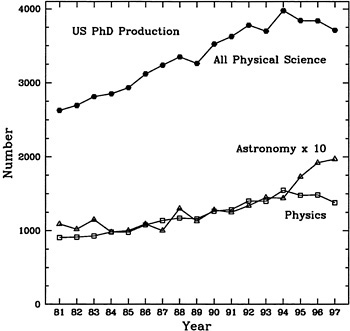
FIGURE 4.1 Astronomy Ph.D. production, 1981-1997, compared to Ph.D. production for all physical sciences and for physics alone. SOURCE: NRC, Office of Scientific and Engineering Personnel (OSEP), Summary Report 1996 Doctorate Recipients from United States Universities, National Academy Press, Washington, D.C., 1998; unpublished data from OSEP.
percent of physics, even though 13 percent of the combined physics and astronomy Ph.D.s produced are in astronomy and astrophysics.) Astronomy remains arguably the most vibrant of the physical sciences in the United States.
To gain further insight into the trends in the number of astronomers, the committee estimated the fraction of astronomers by discipline (typically by wavelength orientation) and also by scientific field (e.g., planet formation, stellar astronomy, instrumentation) from the AAS membership lists. This was done for two years, 1989 and 1997, before and after the 1991 Decadal Survey. In both cases, random samples of 600 to 700 full, U.S. members were drawn from the AAS rolls. U.S. AAS membership refers to residency in the United States and its territories and commonwealths (e.g., Guam, Puerto Rico).
Individuals were classified by discipline, field, and place of employment. The classifications employ a fairly simple mnemonic: OO - observational optical, OR - observational radio, and so forth. The full lists of classification categories are given in Table A.1 in Appendix A. These same categorizations were used for the classification of publications and funding sources discussed below in Section 4.2. The committee is aware that many individuals fall into more than one of the categorizations and that because only about 20 percent of the U.S. full AAS membership was sampled, the accuracy of the estimates for distribution by discipline and field is necessarily limited. Nonetheless, such categorizations are useful.
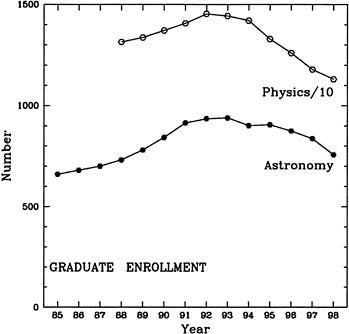
FIGURE 4.2 Astronomy and physics graduate enrollment, 1985-1998. Note that enrollment in physics is approximately 15 times that in astronomy. SOURCE: Data from Patrick J. Mulvey and Starr Nicholson, Enrollments and Degrees Report, American Institute of Physics, College Park, Maryland, 2000, see <http://www.aip.org/statistics/trends/undtrends.htm > ; The American Astronomical Society's Examination of Graduate Education in Astronomy, available online at <http://www.aas.org/publications/baas/v29n5/edrpt.html>.
Field and discipline classifications were based primarily on literature searches in NASA's Astrophysical Data System (ADS) and indexes of the main journals. This information allowed fairly accurate classification of 85 to 90 percent of the sample. Place of employment was determined from the address in the AAS directory or, if only a home address was given, from the institutional affiliation given on papers published in or near the year surveyed. In what follows, people who could not be assigned fields or disciplines (NA in Table A.1 ) are not counted in computing fractions of the community. Despite maintaining AAS full membership, they probably were (1989) or are (1997) no longer active researchers publishing work in the field of astronomy. For those cases in which the committee could determine that individuals were not employed in any of the major categories, they were counted in the “other” employment location category.
TABLE 4.1 AAS Membership Statistics by Discipline, Field, and Location for 1989 and 1997
|
1989 |
1997 |
|||
|
Total Number of Entries |
714 |
599 |
||
|
With discipline |
644 |
(90.2%) |
541 |
(90.3%) |
|
With field |
619 |
(86.7%) |
507 |
(84.6%) |
|
With location |
654 |
(91.6%) |
596 |
(99.5%) |
|
Discipline Summary |
||||
|
Observational radio or SMM |
13.7 |
± 1.5% |
10.4 |
± 1.4% |
|
Observational IR |
7.6 |
± 1.1% |
5.7 |
± 1.0% |
|
Observational optical |
36.5 |
± 2.4% |
34.6 |
± 2.5% |
|
Observational UV |
5.0 |
± 0.9% |
6.5 |
± 1.1% |
|
Observational HEA |
5.6 |
± 0.9% |
8.7 |
± 1.3% |
|
Experimental particles and fields |
1.1 |
± 0.4% |
1.3 |
± 0.5% |
|
Laboratory astrophysics |
2.2 |
± 0.6% |
2.2 |
± 0.6% |
|
Theory |
23.8 |
± 1.9% |
23.9 |
± 1.8% |
|
Administration |
1.7 |
± 0.5% |
3.5 |
± 0.8% |
|
Amateur or historian |
2.6 |
± 0.6% |
3.0 |
± 0.7% |
|
Aeronomy or atmospheric science |
0.3 |
± 0.2% |
0.4 |
± 0.3% |
|
Field Summary |
||||
|
Planetary |
15.0 |
± 1.6% |
11.6 |
± 1.5% |
|
Solar |
10.3 |
± 1.3% |
10.7 |
± 1.4% |
|
Stellar |
29.9 |
± 2.2% |
25.4 |
± 2.2% |
|
ISM + the Galaxy |
4.4 |
± 0.8% |
8.3 |
± 1.3% |
|
Galaxies + clusters |
10.7 |
± 1.3% |
12.2 |
± 1.6% |
|
Active galactic nuclei |
10.5 |
± 1.3% |
7.5 |
± 1.2% |
|
Star and planet formation |
6.3 |
± 1.0% |
5.7 |
± 1.1% |
|
Instrumentation |
5.5 |
± 0.9% |
8.1 |
± 1.3% |
|
Cosmology |
5.8 |
± 1.0% |
8.7 |
± 1.3% |
|
Fundamental experimental |
1.6 |
± 0.5% |
1.8 |
± 0.6% |
|
Location Summary |
||||
|
Research university |
47.4 |
± 2.7% |
47.5 |
± 2.8% |
|
College |
8.4 |
± 1.1% |
10.1 |
± 1.3% |
|
FFRDC or equivalent |
9.9 |
± 1.2% |
11.2 |
± 1.4% |
|
Government laboratory |
18.8 |
± 1.7% |
19.8 |
± 1.8% |
|
Private |
3.8 |
± 0.8% |
2.7 |
± 0.7% |
|
Industry |
8.0 |
± 1.1% |
6.0 ± |
1.0% |
|
Other (amateur, retired) |
3.7 |
± 0.7% |
2.7 |
± 0.7% |
|
NOTE: Acronyms are defined in Appendix H. |
||||
Table 4.1 shows the estimated percentages of AAS full members by discipline and field for 1989 and 1997. The numbers represent the numbers in the actual subsamples; the 1989 subsample is larger than the 1997 subsample by construction, not because the membership declined between these two years. Optical and infrared observational astronomers constitute approximately 40 percent of research astronomers; radio astronomers, about 12 percent; the other observational fields, about 13 percent; theory, about 25 percent; and the remaining 10 percent, astronomers involved in fundamental measurements, laboratory astrophysics, administration, atmospheric physics, and the history of science. Between 1989 and 1997 there were slight decreases in the fraction of astronomers involved in optical, infrared, and radio observations and increases in the fractions involved in ultraviolet and in high-energy
astrophysics. Most of these differences are within the sampling errors of this survey, with the possible exception of the decline in the fraction of radio astronomers, slightly more than a 1.6 sigma result.
By field, the largest number of astronomers are working on stellar astronomy. There appear to be marginally significant decreases in the fraction of planetary and stellar astronomers (1.6 and 1.5 sigma, respectively) and astronomers working on active galactic nuclei that are balanced by increases in the fraction of astronomers working in cosmology, the interstellar medium, and the galaxy and in instrumentation. Extragalactic astronomy as a whole, encompassing the fields of galaxies and clusters, active galactic nuclei (AGN), and cosmology, was pursued by approximately 27 percent of astronomers in 1989, a figure that grew by slightly less than 1 sigma to 28.4 percent in 1997. Again, these changes are at the margin of what is statistically significant, especially because it is often difficult to draw the distinctions between, for example, astronomers working on AGN themselves or using AGN to study cosmology or astronomers studying the interstellar medium (ISM) and those concerned with the connection of the ISM to star formation. Aggregation into broader categories would probably show less significant changes.
Lastly, slightly less than 60 percent of all research astronomers as judged by their enrollment as full members of the AAS are employed at colleges and universities, including both private and state; a little less than one-half are at research universities. Approximately 30 percent are employed at federally funded laboratories including NASA centers, the National Observatories, the Smithsonian Astrophysical Observatory (SAO), and other Federally Funded Research and Development Centers (FFRDCs). The remainder are split between private observatories, industry, self-employment, and retirement. The statistics show essentially no change in employment locations for astronomers over the eight-year period between samples. The differences are all within the sampling errors. There appear to be both robustness and inertia in the field. The small changes noted may well be the result of individual mobility (i.e., changing fields or disciplines as a result of changing opportunities, either funding or scientific).
The committee also addressed the question of what fraction of ground-based optical or IR observers have access to their own telescopes. In the AAS membership subsamples for 1989 and 1997, between 200 and 300 astronomers were classified as observational optical or observational infrared (including solar observers). In 1989, the fraction of OIR observers without direct access to 2-meter-class telescopes or larger was 58 percent. By 1997, with the establishment of several new university and university-National Optical Astronomy Observatories (NOAO) consortia, and counting telescopes now under construction, this fraction had dropped to slightly less than one-half (48 percent). Given that roughly 10 percent of astronomers are at small colleges and another 30 percent or so are at FFRDCs and government laboratories such as the Goddard Space Flight Center (GSFC) or the Space Telescope Science Institute (STScI), it is, however, unlikely that this fraction will ever drop below approximately 40 percent.
4.2
PUBLICATIONS AND DISTRIBUTION OF FUNDING SOURCES
Many studies have been made of the growth of publications by field. The astronomical literature continues to grow almost exponentially. From 1985 to 1996, there was an 85 percent increase in the number of pages published in the five main astronomical journals sampled by Abt (H. Abt, Publications of the Astronomical Society of the Pacific 110, 210, 1999).
The committee assessed trends in publication rates by discipline and field and also by funding source. To sample publications, the first volume published in October of 1986, 1989, 1992, 1995, and 1997 was examined for the following journals: the Astrophysical Journal (including Letters and Supplement), the Astronomical Journal, Monthly Notices of the Royal Astronomical Society, Publications of the Astronomical Society of the Pacific, Icarus, Nature, Science, Physical Review D, and Physical Review Letters. This sample contained 884 publications, or an average of 177 for each of the five years considered. The sample attempts to include planetary research by including Icarus, and high-energy or particle astrophysics by including Physical Review Letters and Physical Review D, but it is clearly not representative of solar research. It also slightly undersamples those fields that publish primarily in journals that appear more than once a month (Nature, the Astrophysical Journal, Physics Review D, Monthly Notices of the Royal Astronomical Society, Science ).
Each article was assigned to one or more disciplines and fields and to one or more funding sources. The codes for discipline and field were developed from an initial reading of the literature and were also used to classify astronomers and grants. Funding agencies were identified from acknowledgments at the end of each article. The committee suspects that this method is incomplete, because some authors do not acknowledge funding sources.
4.3
DATA AND CONCLUSIONS
Figure 4.3 shows the fraction of publications in each field. There is little trend in the distribution of fields, except for a slight decline early in stellar, which nonetheless continues to dominate the fraction of publications. Note that Figure 4.3 has two panels simply to avoid confusion and that the upper panel has an expanded scale.
Figure 4.4 shows the fraction of publications in each discipline, again using two panels and an expanded scale in the top panel. There are marginal declines in the radio and ultraviolet publication fractions. Publications concerning optical observations and theory continue to dominate the overall publication rate, just as the numbers of optical or infrared observers and theorists dominate the population of astronomers. The dip in high-energy papers in 1989 is probably real and probably represents the lull between the last of the High Energy Astrophysics Observatory and Einstein analysis, large satellites launched in the late 1970s, and new x-ray data from the German ROSAT, launched in 1990.
Figure 4.5 plots the fraction of papers funded by different sources. “Other federal” is usually dominated by DOE but includes the Department of Defense (DOD) and the individual military services, the North Atlantic Treaty Organization (NATO), and the Smithsonian. The main trends are that an increasing fraction of papers cite support by NASA and foreign agencies, whereas the fraction citing NSF support has declined.
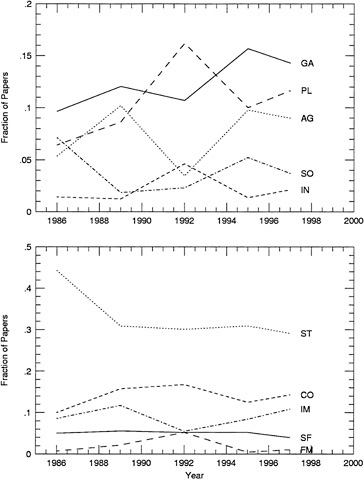
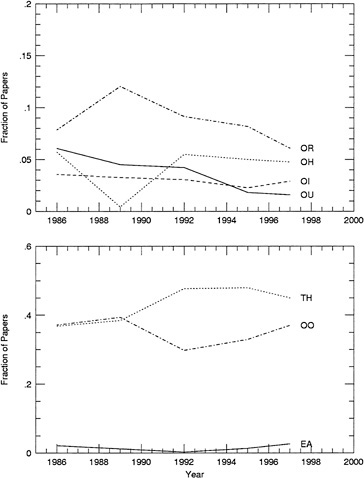
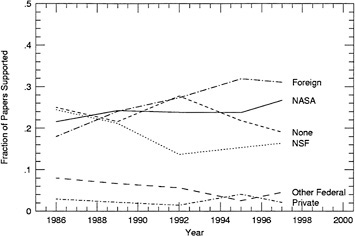
FIGURE 4.5 Fraction of research papers supported by various agencies and institutions.
In Figure 4.6, the panels show the fraction of total papers supported by NSF (solid line) and NASA (dashed line) published in each field. (Note that this is not the fraction of the total papers published in each field that were supported by each agency; it is the number of papers in the field that acknowledge agency support divided by the total number of papers in all fields that acknowledge agency support.) The fraction of papers supported by the two agencies is similar in most fields, but NASA dominates planetary (PL) papers and NSF dominates stellar (ST) papers. The only noticeable trends are a decrease in NSF support of ST papers and an increase in both NSF and NASA support of extragalactic (GA) papers. Stellar papers continue to dominate despite the decline, with the exception of 1992, when there was a spike of PL papers. This figure suffers in many fields from small-number statistics.
In summary, the data on both demographics and publications show a modest growth overall and relative stability in the profession over the past 15 years. The strongest trend seen is the increasing role of foreign scientists, indicative of the increasing importance of international collaboration to the profession. Future tracking of these statistics may reveal longer-term trends that are not yet apparent over a 15-year time base.


